Home Blog Page 635

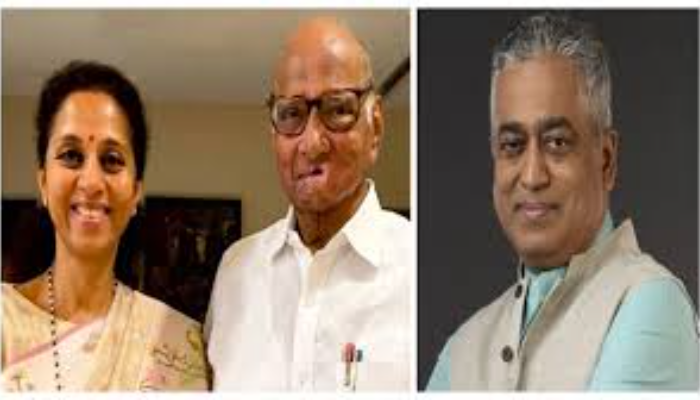
Outrage on Vinod Tawde, silence ‘bitcoin scam’ allegations against Supriya Sule: Is Rajdeep Sardesai repaying Sharad Pawar’s favour to his father Dilip Sardesai?

The 2024 Maharashtra Assembly Elections are underway. Bharatiya Janata Party (BJP) leader Vinod Tawde has been accused by the opposition of giving money to people, however, he dismissed the claims later. Lok Sabha MP Supriya Sule, leader of The Nationalist Congress Party (NCP)- Sharad Pawar faction which is part of the Maha Vikas Aghadi (MVA) has also been charged with embezzling Bitcoin scam funds.

Meanwhile, India Today ‘journalist’ Rajdeep Sardesai has once again taken a biased stance over the two issues. Bahujan Vikas Aghadi (BVA) members in Palghar, Maharashtra, accused BJP National General Secretary Vinod Tawde on 19th November of distributing money to voters. Afterward, Rajdeep Sardesai made several tweets regarding the issue which is a matter of investigation, and kept highlighting the issue.

“Huge: A day before Maharashtra goes to polls, major controversy. BJP national general secretary Vinod Tawde trapped and gheraoed by a BVA MLA in a hotel in Virar, accused of having a Rs 5 crores cash bag with a diary of people to whom money given is reportedly mentioned. BJP and BVA activists clash. Money power in this Maharashtra election is worst kept secret. How can elections be free and fair if votes are ‘bought’? Will Election Commission of India investigate, act or stay quiet once again,” he stated in a tweet.

He then made another tweet about the three First Information Reports (FIRs) submitted in “cash for votes” issue at Tulinj police station. He wrote, “BJP candidate named in two FIRs. Vinod Tawde named in one FIR. BVA also named in one FIR. Total cash found 9 lakhs 53 thousand 900 rupees. 9,53,900 total cash seized by election officials.” The FIRs are filed over “illegal campaigning under 48 hours before voting, cash seized and illegal press conference by both sides.”

Downplaying the allegations against Supriya Sule he remarked. “Criminal and defamation case after purported audio clip of her claiming to seek Bitcoin funds for election campaign goes viral. Interesting that allegation was made by BJP within hours of the cash for votes allegations involving its senior leader Vinod Tawde became the big story. Even more intriguingly, the person who made the allegations had spent several months in jail. Maharashtra political drama needs an OTT serial to expose all the muck.”

Rajdeep Sardesai was providing up-to-date information on Vinod Tawde. Now, anyone can argue that Rajdeep Sardesai is a journalist, so what’s wrong if he’s tweeting over the matter? However, there is a problem. While Vinod Tawde was accused, Sharad Pawar’s MP daughter Supriya Sule was also accused of using the money from the bitcoin scam in the assembly elections and the BJP also raised the issue. However, Rajdeep Sardesai did not tweet even once about the allegations against her. The one who accused her is a retired IPS officer. An audio of a conversation has also surfaced, with some alleging that the voice is Sule’s. Maharashtra Deputy Chief Minister Ajit Pawar also confirmed that he recognized the voice of his cousin Supriya Sule and it was her on the audio clip.

Rajdeep Sardesai while amplifying the allegations against Tawde, actively downplayed the allegations against Sule. A popular handle on X named ‘Eminent Intellectual’ asked if the cause behind the bias is the bond between Sharad Pawar and Rajdeep Sardesai’s father, Dilip Sardesai. The journalist is still repaying Sharad Pawar for a favor he did for his father, the handle suggested.

The handle named Eminent Intellectual on social media site X has revealed that in October 1993, Dilip Sardesai, the cricketer was arrested on charges of money laundering. Sharad Pawar was the Chief Minister of Maharashtra at that time. Eventually, this case completely disappeared. Maybe this explains why Rajdeep Sardesai still feels grateful to Sharad Pawar. On 20th October 1993, it was announced that Dilip Sardesai and Jayant Vittaldas, a businessman from Pune, had been detained in connection with a money laundering case involving 6.89 million US dollars (about Rs 58 crore in today’s currency) and placed in judicial custody until 29th October. The arrest took place after the Income Tax raid at Vittaldas’ place.

However, no one knows what happened later. With Sharad Pawar’s grace, Dilip Sardesai reportedly emerged unscathed. Maybe this explains why Rajdeep Sardesai continues to benefit from Sharad Pawar’s generosity and is paying him back by not tweeting on the allegations against his daughter.

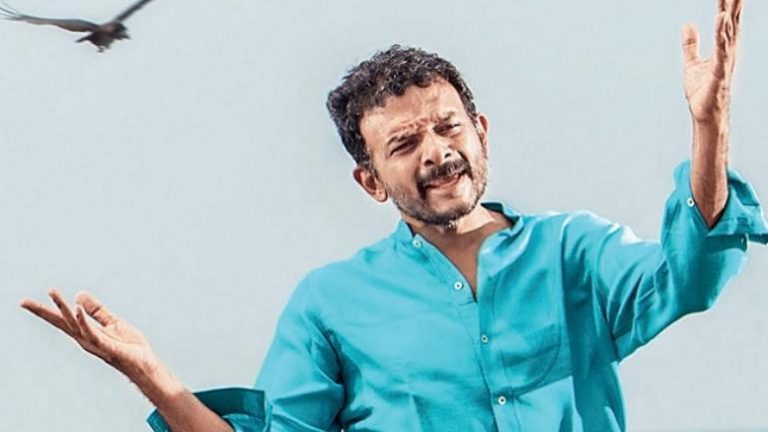
Madras High Court stops Madras Music Academy from adding MS Subalakshmi’s name to the Sangita Kalanidhi award to controversial personality TM Krishna

On Tuesday (19th November), the Madras High Court restrained the Music Academy from presenting the Sangita Kalanidhi MS Subulakshmi award to Leftist activist TM Krishna.

In an interim order, Justice G Jayachandran stated that the Madras Music Academy can present the ‘Sangita Kalanidhi’ award to TM Krishna, but the name of legendary artist MS Subulakshmi shall not be added to it.

Srinivasan, the grandson of MS Subbulakshmi, and her legal heir, had moved the High Court challenging the Music Academy’s decision to award controversial artist TM Krishna in his grandmother’s name. Music Academy’s plea against Srinivasan’s petition has been dismissed by the court.

Notably, MS Subbulakshmi, the legendary Carnatic singer, said in her will in 1997 that no memorials, foundations, or trusts be established in her name. The court determined that Srinivasan, as the will’s beneficiary, had the locus standi to contest the presentation of the award.

“The best way to honour a departed soul is to honour and respect her wish and not to disrespect her. If any person is really having reverence and regard to MS Subbulakshmi, after knowing her desire and mandate, should not continue to give awards in her name,” Justice G Jayachandran’s order noted.

Musicians pulled out of Madras Music Academy’s annual conference 2024 after the Academy conferred the Award to TM Krishna

The Sangita Kalanidhi MS Subulakshmi award has been started to honour the Madras Music Academy each year. A number of singers and artists have objected to the Academy choosing controversial artist TM Krishna for this year’s award.

Earlier this year, several musicians, including the Trichur brothers and Dushyanth Sridhar, have pulled out of Madras Music Academy’s annual December conference to protest the Sangita Kalanidhi award to Krishna, who they allege has “glorified Periyar” and vilified the Carnatic music community.

The artists are miffed with the Chennai-based academy’s decision to bestow the honour, considered the Oscar equivalent in Carnatic music, on the 48-year-old vocalist. Krishna was picked to preside over the 98th annual conference and concerts of the Madras Music Academy later this year in December. 

Renowned Indian classical duo Ranjani and Gayatri said their participation in this year’s conference under TM Krishna’s presidency would constitute a “moral violation.” They accused TM Krishna of insulting the most respected icons like Tyagaraja and MS Subbulakshmi. The musicians further alleged that Krishna’s actions have “tried to spread a sense of shame in being a carnatic musician” and has been exhibited through his “consistent denigration of spirituality in music.” 

Subsequently, the sibling duo of Srikrishna Mohan and Ramkumar Mohan, otherwise known as the Trichur Brothers said participating in the year-end festival conference hosted by the Academy will make them “outright hypocrites in our own eyes.”

Further, three-time Grammy Award winner Indian music composer Ricky Kej condemned N Murali, the chief of the Madras Music Academy for writing an attacking letter against Carnatic musician sisters Ranjani and Gayatri.

TM Krishna and his controversial antecedents

TM Krishna, full name Thodur Madabusi Krishna, is an Indian Carnatic vocalist, author, and self-styled liberal social activist. Born on 22nd January 1976, in Chennai, India, Krishna has gained widespread recognition for his excellence in Carnatic music, a classical music tradition of India. He is the grandnephew of former Indian finance minister TT Krishnamachari, who was among the founders of the Madras Music Academy.

Apart from his musical pursuits, TM Krishna is also known for his self-styled social activism and advocacy for various causes which he considers attention-worthy. This includes caste issues, gender equality, and the democratisation of the arts. In the guise of addressing these issues, he had been a vocal critic of Hinduism and a staunch supporter of the Periyarite thoughts.

In his attempt to be vocal about the need to break down barriers in classical music and make it more accessible to people from all backgrounds, he often resorted to making various statements against particular castes and communities especially the Brahmins by quoting EVR Periyar. For those unversed, Periyar had a long history of spreading hate against Hindu deities including breaking Murthis to Ravana leela.

In March 2023, TM Krishna released a song in honour of Periyar to commemorate 100 years of his “anti-caste” movement. The post shared by TM Krishna was reshared by Tamil Nadu Chief Minister MK Stalin as well. Unsurprisingly, Tamil Nadu CM had come out in support of TM Krishna when the renowned musicians protested against Madras Music Academy over conferring the Sangitha Kalanidhi Award to TM Krishna.

TM Krishna has closely worked with Tamil writer Perumal Murugan, who has misrepresented Hindu temple festivals of yore in order to cast aspersions on the character of Indian men and women.

On Diwali last year, TM Krishna took to X to express his support for Palestinians saying that he found it difficult to celebrate the festival of lights at such a time.

“Difficult to celebrate the festival of lights when for people of Palestine lights indicate incoming death. Support for the Palestinians is support for all those who have been marginalised. In prayer for peace and a return of humanity,”

“Support for the Palestinians is support for all those who have been marginalised,” he wrote along with a photo of himself.

In an op-ed on 14th January 2024, TM Krishna trained guns at Infosys founder N Narayan Murthy and Sudha Murthy for endorsing longer work hours by likening their views to “Brahminism” followed by an unending rant.

In another casteist op-ed on 11th February 2024, he began by writing that the Indian classical dance form Bharatanatyam has been appropriated by Brahmins leading to its alteration and erosion.

TM Krishna, despite being a Carnatic vocalist himself, has said that Carnatic music and Bharatanatyam are not superior to other art forms. “Carnatic music is just like gaana, cinema music, or rock and roll,” he said in an interview in January.

In 2022, he performed in an event marking the Gujarat riots titled “Gujarat 2002-2002. Memories of Struggle.” He performed an “Urdu bhajan” at the event.

In an atrocious and misleading op-ed in September 2020, TM Krishna declared that Guru-Shishya parampara in Indian arts is abusive and should be abolished. He used the case of sexual abuse allegations against the Gundecha brothers to demonise the entire tenet of the Guru-Shishya tradition which has given India great artists and performers.

In 2018, irked by the outrage from Hindu connoisseurs of the arts for performing Christian hymns in Carnatic, TM Krishna vowed that he would sing one song on Allah and Jesus every month. The same year, admitted that he feels no empathy when RSS members are killed by communists or Islamists in places like Kerala. Trying to give context to his barbarian and bloodthirsty beliefs, Krishna had funnily blamed the Modi government for making him inhuman. “They (BJP and allies) have made the rest of us crass and inhuman to the extent that we are unable to empathise when an RSS member is killed,”

Most importantly, in the context of the current petition, on 24th November 2017, he said that MS Subbulakshmi was celebrated only because of her upper caste. He had said, “Earlier in her career, Subbulakshmi’s music had incredible freeness in spirit but later it was imbued with a certain sorrow that was mesmerising in itself. Her music was what it was because of the sorrow in her.”

PM Modi meets Acharya Jonas Masetti in Brazil and lauds his passion towards Vedanta and Bhagavad Gita

0

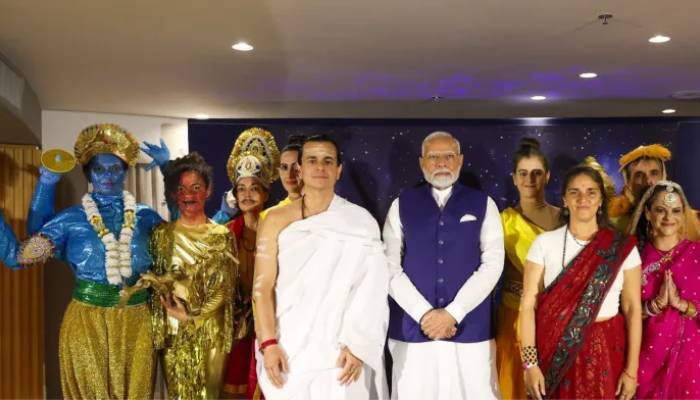
On 17th November, Prime Minister Narendra Modi landed in Brazil for the G20 Summit, and in addition to his hectic schedule of meetings with many heads of state, he also had an interesting encounter with Acharya Jonas Masetti whom he lauded for his passion towards Vedanta and the Bhagavad Gita.

Notably, PM Modi also talked about Masetti in a segment of his popular show “Mann Ki Baat,” in 2020.

The Prime Minister remarked, “His team presented glimpses of the Ramayan in Sanskrit. It is commendable how Indian culture is making an impact all over the world,” while posting glimpses of his meeting with Masetti and his team on social media.

The Ramayana was performed by the students of Masetti’s Vishwa Vidya Gurukulam, a Brazilian organisation dedicated to promoting Vedanta and Sanskrit. He had also welcomed PM Modi by reciting “Sanskrit Mantras.”

Acharya Jonas Masetti is originally from Brazil. He is also called “Vishvanath” and is known for teaching Vedanta and Bhagavad Gita across the world. He is a mechanical engineer by profession. He obtained the title of Acharya while studying Vedanta in Coimbatore under Sri Swami Dayananda Saraswati’s tutelage. He established the Vishwa Vidhya Organisation, the first Gurukulam situated in the Petropolis hills close to Rio de Janeiro. Pequena Tribo (small tribe), his “social project” works to aid underprivileged kids. He stated, “The aim is to impart spiritual teachings through sports. Currently, we have more than 40 children and we plan to expand once the project gets mature and validated.”

He rose to fame in India after PM Modi recognized his contributions during an episode of his program “Mann Ki Baat” and stated, “Some people came to India in search of them and stayed here for life. While some returned to their countries as cultural ambassadors of India,” while referring to the profoundness of Indian culture.

Renowned for his humanitarian endeavors, Masetti is committed to promoting better cooperation between Brasilia and New Delhi in order to disseminate Vedic knowledge in the West. “India holds a special place in my heart. Its culture, traditions, teachings, and rich history have profoundly influenced my perspective on life. My life’s purpose is now to spread the same wisdom and enlighten the world through the teachings of Vedanta and the Bhagavad Gita,” he stated.

Masetti, who has been to India numerous times, discussed his spiritual development, views on religion, and Indian culture when he visited the country last year. During an interview with The Indian Express he informed, “My first time in India was in 2005. I stayed for six months and it changed my life. I discovered a sense of belonging and could understand the culture from the society’s perspective. After that, I was certain of my path in life. I began studying Sanskrit, Mantras, and Puja alongside Vedanta which was already going on.”

He added, “My second visit in 2008 was to undertake a residential course with Swami Dayananda in the forest of Tamil Nadu. That was where I received my knowledge; My self-doubts were resolved. It was a rebirth for me. I became a simple and happy person. I found a new purpose for spreading the Vedic teachings in the West.”

He was also pleased that PM Modi had mentioned him in his program and expressed, “Being foreigners, there is a lot of resistance. Those who choose to go on this path (of spirituality) lack a sense of belonging. For us, it was very special because we felt that we were accepted. It was a reason for a lot of joy for us (being talked about in Mann Ki Baat),” during an interview with Jagran.

Masetti was born into a modest Rio de Janeiro household. He mentioned, “We were raised in the slums. My family struggled a lot. Priority for my mother was the education of her children. I was a survivor, and I believe it was my good karma to receive a good education.” He was able to graduate from one of Brazil’s best colleges with a degree in mechanical engineering. Later in his life, he had different therapies and spiritual sadhanas to move past his childhood trauma.

He confessed his dissatisfaction with life before his transition despite having everything that stoked his drive to pursue more and discover himself. He looked to India and Vedanata for solutions to his concerns after realizing that Western society was unable to provide him with better answers. He unveiled, “Well, I had everything that a Western society needs to have. I had family, friends and money. I used to go to parties but I was not feeling fulfilled. Also, the people I knew (the company managers and the big names) had a lot of trouble. People in the West take pills to sleep. They have a lot of stress. I thought this doesn’t make sense.”

He added, “I felt what the Western ideology was proposing to me wasn’t going to give me fulfilment. I started searching for answers and that’s how I came across yoga and Vedanta. It became a necessity when I realised that Western ideology and way of life could not lead me to happiness and peace. So I started searching and ended up in yoga and Vedanta.

“I had it all, success, wealth, recognition, but it wasn’t the life I truly wanted. I would often meet elites in my profession, and while they were nice people, their lifestyle wasn’t what I aspired to have. I wasn’t religious at that time, but that night, I asked for guidance from the universe. The next day, I woke up with the thought of doing yoga. My yoga guru was also a Vedanta teacher, and that’s how it all began,” he disclosed in another interview with Times Now.

Masetti admitted that he was having a crisis since he was unable to find happiness and he didn’t see other people happy, so he had to search widely. He added, “Actually, I didn’t choose Hinduism. When I chose Vedanta, I saw it as a means of knowledge and a tool for knowing myself. This was the main goal. In the course, I got to learn about Indian culture and temples. I realised I belonged to that. It was not like I chose it in the first place. My students are from all the religions. However, many of them became vegetarians and Hindus.”

He studied yoga and vedanta for ten years in Brazil and informed, “It (Vedic studies) was a slow movement in Brazil but it was happening. I decided to come to India and spent over four years at Swami Dayanand Saraswati’s Arsha Vidya Gurukulam in Coimbatore. It was not easy because I had a life back home in Brazil, but it has been the best decision of my life.” He studied Advaita Vedanta and Sanskrit over these four years.

He established the Vishva Vidya Organization in Rio de Janeiro after his return to Brazil. He then began educating people in Brazil and other Western nations about Vedanta and the Bhagavad Gita. Swami Sakshatkrtananda, the guru of Acharya Masetti, was among many who were taken aback by the popularity of Vedanta in Brazil. He was astounded by their fervor for this ancient knowledge. “When my Guru came to Brazil, he commented that, ‘it seems like so many Indians have taken birth in Brazil’. Brazilians do not view Vedanta as a religious or cultural shift; it’s a pursuit of personal harmony,” he revealed. According to him, Indian and Brazilian civilizations are intertwined.

Masetti also shared what drew him to the Bhagavad Gita and highlighted that one doesn’t need to follow Sanatan Dharma to practice yoga, mantras or meditation. He stated that the vedic tradition offers a wealth of resources for human welfare without requiring anyone to adhere to any specific faith. “In the West, they have yoga, mantras and meditation. You don’t have to be a Hindu to practice such things. When you go to an ayurveda doctor, he doesn’t ask about your religion before treating you. Same way, the Vedanta teacher is not asked where you belong. My understanding is that Vedic tradition has so many tools for the well-being of humanity. The religion a person takes is his choice.”

“Every knowledge contained in Vedas couldn’t be reached through scientific experiences. Maybe you can prove some points. Everything that you receive from Vedas does not contradict science but they are not scientific,” he mentioned and added, “Science has its basis in Vedas but Vedas don’t have their basis in science. Science needs Vedas,” regarding the assertions that the basis of many scientific discoveries was Vedas. 

He also raised the horrific acts that Christians committed in the name of their faith, pointing out that although it could be claimed that all religions are the same, the people who follow them are not. He underlined, “I think the point is understanding prophets and sacred teachings. If you look at what Christianity has done in neuro in medieval times, it’s horrible. I am sure it has nothing to do with the teachings of Christ. Whatever is good for human beings is common. We can say all religions are the same but it’s not like the people following these religions are the same.”

He brought up his own research and experiences with the Bhagavad Gita and Vedanta. He provided an insight of his acute comprehension and conveyed, “Of course, Vedanta has two basic teachings running together. One is Karma Yoga, the way of living ‘dharmik’ life and this is how you can stabilise your mind and emotions. There is always a self-understanding of the whole process. This is something that you can verify all the time. The second subject is Aatma Gyanam, the understanding of the self. It cannot be objectified. You can see your mind, body and the external world but you cannot see the witness. For this witness, you need a Pramaana. You get this certainty from the nature of self.”

The only thing that matters, he declared with delight, is that he was happier than he was before and added, “For me a good day of prayer and going to the temple is better than going to the beach, so I do that.”

Masetti highlighted, “Western ideology cannot bring you happiness. But the Indian culture, if you go beyond religion, and go for knowledge of the Vedas, all the cues are there for a person to become, mature, and peaceful. If you want to rule over western ideology, you need to embrace the Vedic culture. Comfort and happiness are two different things and I need to understand the difference. If I don’t see the difference, my mind will get attached to the materialistic world. Spiritual path has to be a part of life and not viewed as something that one picks up after retirement.”

He also talked about the westernization of young Indians and stressed, “Nowadays, the Indian youth is charmed by Western ideology, but I must say it is very shallow. It cannot bring happiness, peace, or a sense of adequacy. So I would say that for Indian youth, Vedas aren’t just a secret weapon for your own well-being but for success in life as well.”

“In Brazil, we have students from different religions who have become Hindus of their own choice. Ayurveda, astrology, asanas, and Vedanta are all tools for humanity. They are a means to live a happier and meaningful life. When the person is interested in healing, in happiness, in a better life; they should be open to receiving knowledge independently of the source. With Brazil being such a multicultural country, the people in general have an open heart. They are open to diverse cultures,” he stated.

He also talked about his initiative in his home country and stated, “We are doing everything on our own. All our classes are based on the contribution model. We have volunteers among our students. That’s how we have been run. I don’t want it to be a giant organisation. I am alone doing this. The next step would be to bring new teachers who could spread this knowledge.”

He then addressed the problem of a miserable life and dilemmea over specific issues. He mentioned, “In Brazil, we have a school called Chhatralya. That is for students who live in poor areas. Currently, there are 40 students who are receiving spiritual teachings. We think that spirituality comes naturally but it’s not true. You have to put hard work in that direction. My message to youths is that they are very charmed by the Western culture. I must say there is no fulfilment there.”

He declared, “I don’t claim to be superior or different than anyone else. I present myself as a human being who is keen on sharing the knowledge of Vedas and of course, helping others. I believe that human life is short and precious and following the teachings of Bhagavad Gita makes it worthwhile. Moreover, the essence of Vedas can only be passed to people who are sincere.”


PM Modi visits Guyana, first Indian PM to do so after 56 years, here’s how Modi’s Guyana visit matters for India’s energy security

0

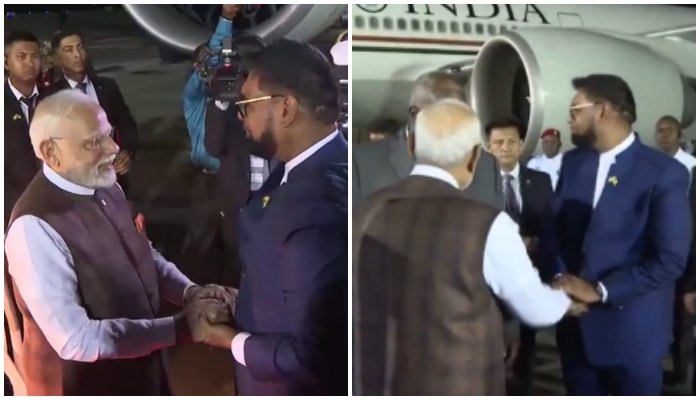
On Wednesday, 20th November, Prime Minister Narendra Modi visited Guyana, and became the first Indian prime minister to visit Guyana in 56 years.

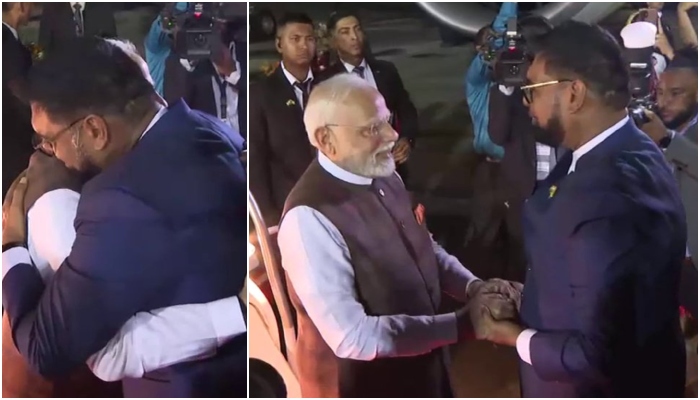
PM Modi was greeted warmly at the airport by President Irfan Ali and more than a dozen cabinet ministers, in an unprecedented gesture. The President of Guyana hugged and exchanged pleasantries at the arrival of PM Modi and the latter was greeted ceremoniously in Georgetown, Guyana, by a guard of honor.

During his visit, PM Modi has plans to address a special session of Guyana’s Parliament. He will also attend the second India-CARICOM Summit, which will bring together leaders from Caribbean partner countries. 

In a press briefing ahead of the Prime Minister’s visit to Guyana, the Ministry of External Affairs, stated that PM Modi’s visit took place at the request of Guyanese President Mohammad Irfaan Ali. 

“Recently, there has been an uptick in high-level contacts between India and Guyana. President Irfaan Ali himself was a chief guest at Pravasi Bharatiya Divas in January 2023,” Ministry of External Affairs Secretary (East) Jaideep Mazumdar said. 

“We have had a longstanding developmental partnership with Guyana, and this is in the fields of health, connectivity, and renewable power. The Garden Reach Shipbuilders and Engineers (GRSE) built an ocean-going ferry, which we supplied to Guyana last year. We also supplied two HAL 228 aircraft under a line of credit to Guyana this year. Solar lighting for about 30,000 indigenous communities has been provided to 30,000 households. So far, we have 800 ITEC alumni from Guyana who have studied in India. We hope to partner with them in a number of fields, including in hydrocarbons, but also in areas of healthcare, education, and defense,” he added.

Energy Security: India’s priority during the visit to Guyana

Notably, as per reports, energy security will be Modi’s main priority during his three-day visit to Guyana, which has emerged as India’s key partner in the Caribbean. Guyana is a rapidly expanding nation as a result of the discovery of oil and gas reserves. India’s engagement with the country aims not only to improve energy security for India but also to increase Guyana’s stature among Global South nations and the Caribbean area.

India notably is also drawing on Guyana’s unique past. Nearly 40% of the country’s population is of Indian heritage, including President Mohamed Irfaan Ali, whose forefathers were carried to the Caribbean region as indentured laborers by the British in the middle of the nineteenth century. Many even today, continue to uphold the cultural and religious traditions of their ancestors, who were brought to Guyana between 1838 and 1917 as indentured laborers to fill the workforce gap on plantations following the abolition of slavery.

India’s visit to Guyana after 56 years

Before PM Modi, former Prime Minister Indira Gandhi had visited the region in the year 1968. Following this, President Ali visited India in the year 2023 after which Guyana’s Vice President Bharrat Jagdeo visited India the same year. Guyana’s Prime Minister Mark Phillips also paid a visit to India in February, followed by visits by ministers and military personnel. However, this time, PM Modi is set to hold delegation-level talks with Ali, address the Indian community, and address a special session at Guyana’s parliament.

The Indian community earlier expressed happiness over the arrival of the Indian Prime Minister. Raising the slogans praising Modi, the Indian said that they were excited and eagerly waiting to see PM Modi.

As per the reports, Guyana is experiencing annual economic growth exceeding 40% due to its booming oil and gas sector, making the country a key destination for traders and investors. Amid this surge in interest, India has deepened its engagement with Guyana, leveraging the strong historical and cultural ties between the two nations. Both countries are optimistic about forging mutually beneficial agreements.

Guyana’s Foreign Secretary, Robert Persaud, highlighted that a visit by Indian Prime Minister Narendra Modi would mark a significant milestone in strengthening bilateral relations. “Both countries can, through their cooperation, develop greater synergies in a variety of areas, including energy, agriculture, technology, and security. Already, we have strong bilateral ties, but with PM Modi’s visit, it is expected that the relations between Guyana and India will be taken to a level that will see enhanced benefits for both countries,” he was quoted as saying.

Scott MacDonald, an economist and Caribbean Policy Consortium scholar further opined that Modi’s visit aims to raise India’s global foreign policy profile while also tapping into the region’s developing energy complex. Guyana is rapidly emerging as a prominent player in the oil industry and is poised for continued growth in both oil and natural gas production. At the same time, India, allegedly grappling with a power generation deficit, relies heavily on imported energy. Neighboring Suriname is also on the brink of its transformation in oil and gas production. For India, the southern energy hub comprising Guyana, Suriname, Trinidad and Tobago, and potentially Grenada holds significant geopolitical importance.

India and Guyana’s Strengthened Energy Collaboration

In recent years, energy collaboration between India and Guyana has strengthened, as evidenced by Indian Oil Corporation Ltd (IOCL) purchasing 1 million barrels of crude oil from Guyana, alongside another 1 million barrels acquired by a consortium led by HPCL-Mittal Energy. Additionally, state-owned ONGC Videsh and Oil India Limited (OIL) have shown interest in exploring opportunities in Guyana’s expanding oil and gas sector, the outlet noted.

India’s engagement with Guyana’s energy industry is part of its broader strategy to diversify energy sources, reducing dependence on the Middle East, which faces potential supply disruptions, and addressing scrutiny over oil imports from Russia. Guyana and neighboring Caribbean nations provide a reliable and stable alternative.

India also views Guyana as a strategic entry point to the Caribbean region. During his visit, Prime Minister Narendra Modi will meet with leaders from the Caribbean Community (CARICOM), a regional organization comprising 15 member states, at the Caricom-India Summit on Thursday. Co-chaired by Modi and Grenadian Prime Minister Dickon Mitchell, the summit aims to deepen bilateral partnerships.

CARICOM has indicated that the discussions will focus on strengthening cooperation in key areas, including energy, infrastructure, agriculture and food security, health and pharmaceuticals, and technology and innovation.

Apart from all this, Modi is also scheduled to participate in a floral tribute at the Mahatma Gandhi statue in Georgetown, installed in 1969 to mark the centenary of Gandhi’s birth. Additionally, Modi will visit the Indian Arrival Monument, which commemorates the arrival of the first ship carrying Indian indentured laborers to the Caribbean.

Survey conducted at Sambhal’s Jama Masjid over temple claim, court cites petition on historical significance, demolition by Babar

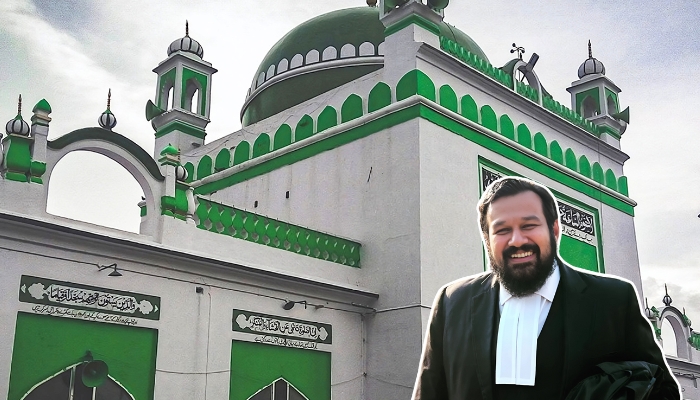
On the night of 19th November, a survey was initiated at the Jama Masjid in Sambhal, hours after the Civil Court of Sambhal directed the same. The directive came in response to a petition suggesting that the mosque was originally the Hari Har Mandir, a Hindu temple, partially demolished in 1529 by Mughal invader Babar. The petition was filed by Supreme Court lawyer Vishnu Shankar Jain. In his petition, Jain argued that the site holds religious importance for Hindus and demanded an Advocate Commissioner’s survey of the premises.

Following the court’s directive, the survey was carried out under the supervision of the Advocate Commissioner, with security provided by the Sambhal district administration. District Magistrate Rajendra Pensia stated that the survey was completed, and the report would be submitted by the Advocate Commissioner to the court.

He said, “We ensured security for the survey. The Advocate Commissioner has completed the proceedings and will file a report in court. Any further action will be determined by the court.”

Petitioner claims signs of temple, invokes religious prophecy

In his petition, Jain asserted that the site showed signs of its Hindu origin. He cited carvings and symbols that indicated the presence of a Hindu temple. He also highlighted the significance of Sambhal in Hindu belief, as it is the prophesied birthplace of Kalki Avatar, an incarnation of Bhagwan Vishnu, who will take birth towards the end of the Kaliyug.

In a post on X, he wrote, “Today the Hon’ble Civil Court Sambhal, on my petition, has directed a survey by the Advocate Commissioner in the alleged Jami Masjid in Sambhal, which was known as Hari Har Mandir. Babur partly demolished this place in 1529. It is believed that Kalki Avatar is to happen at Sambhal.”

Opposition from Samajwadi Party MP

Samajwadi Party MP Zia Ur Rehman Barq criticised the court order, referencing the Supreme Court’s 1991 directive to maintain the religious status quo as of 1947. Barq claimed that the Jama Masjid was a historical mosque and should remain recognised as such. He said, “This mosque has always been a mosque. Changing its status violates established law and disrupts communal harmony.”

Court to deliberate on findings

The court, in its order, instructed the submission of a detailed report supported by photography and videography of the site. The findings will be reviewed by the court on 29th November 2024 to decide the next course of action. Meanwhile, an additional police force has been deployed in the area to ensure peace.

ED probe finds direct links between the preferred sellers of Amazon and Flipkart, e-commerce giants under scanner: Report

The Enforcement Directorate (ED) discovered “direct links” between e-commerce giants Amazon and Flipkart and their preferred vendors. ED has been probing alleged violations of foreign direct investment (FDI) legislation and questioned the top five sellers on both platforms and found that the majority have close ties to e-commerce companies, Economic Times reported.

During their investigation, the Enforcement Directorate recovered substantial evidence like the “email dumps” from Amazon and Flipkart sellers, indicating that the two companies have direct influence over their preferred sellers. According to the ET report, investigators confirmed the control over everything from inventories, and warehouses to profit margins after reviewing several email exchanges between the e-commerce giants and their preferred sellers. So far, there is no confirmation if Amazon and Flipkart received a summons or correspondence from the probe agency.

Among the sellers interrogated by ED, one seller’s testimony reportedly indicated glaring disparities between his annual turnover of several thousand crores and his minimal annual profit of Rs 20 lakh, implying that Amazon and Flipkart may similarly influence profit margins. The seller, who lives in a two-bedroom flat, supposedly works directly for the corporations, with even his bank accounts being monitored. The ED inquiry uncovered faults in Amazon and Flipkart’s “Just in Time” (JIT) stock management model.

Notably, the FDI law requires an open marketplace for all vendors, including small businesses, however, by controlling factors such as inventory, warehouses, and profit margins, Amazon and Flipkart are said to be violating FDI laws and reducing the marketplace to a multi-brand platform that solely benefits themselves.

Within the next three months, ED is likely to file a final complaint against Amazon and Flipkart under the Foreign Exchange Management Act (FEMA). The probe agency might question top officials from both companies to thoroughly examine the evidence before proceeding with filing a final complaint.

ED raids at the premises of the main vendors of Amazon and Flipkart

Last week, the Enforcement Directorate conducted searches under the Foreign Exchange Management Act (FEMA) at 19 premises of main vendors of e-commerce giants Amazon and Flipkart across multiple cities, including Delhi,

Bengaluru, Mumbai, Hyderabad, and Panchkula (Haryana). The raids are still underway as part of an ongoing investigation initiated by the ED after receiving several complaints against the Amazon and Flipkart companies.

The allegations suggest that Amazon and Flipkart, through their marketplace platforms, are violating Foreign Direct Investment (FDI) rules, said the federal agency. As per the agency, Amazon and Flipkart are accused of directly or indirectly influencing the sale prices of goods and services, and not providing a level playing field for all vendors.

The Central agency said that its investigation is focused on determining the extent of these alleged violations,” added the agency. “ED initiated its FEMA investigation based on several complaints against Amazon and Flipkart. The e-commerce entities providing a marketplace that they are violating FDI rules by directly or indirectly influencing the sale price of goods or services and not providing a level playing field for all the vendors,” it added.

Bengal hospital: Woman suffering labour pain delivers premature baby on toilet floor, newborn carried away by stray dog

A horrifying incident has come to light at Sonamukhi Rural Hospital in Bankura, West Bengal, where a stray dog allegedly carried off a premature baby born to a woman who had come to the hospital for delivery. The incident took place on 18th November. The woman is reportedly one Priya Roy from the village of Kochdihi.

She reportedly delivered a six-month-old baby in the washroom of the hospital while waiting to be admitted. The newborn baby was then carried away by a dog that was roaming on the premises. Despite efforts to chase the dog, the baby could not be retrieved.

Reportedly, Priya was rushed to the hospital with severe stomach pain. She was directed to collect a urine sample. As she entered the washroom, she unexpectedly delivered the premature baby on the floor. Family members alleged that they immediately approached the hospital staff seeking help, but the staff were slow to respond.

Accusing the hospital staff of negligence, the family stated that no one attended to Priya despite their repeated requests for assistance. The baby was left unattended in the washroom as requests were being made to attend to Priya. By the time family members returned to check, they found the baby missing. Soon after, they spotted a stray dog carrying the baby away.

Shockingly, onlookers confirmed that stray dogs were present within the hospital compound even after the incident.

Hospital authorities initiate probe

The hospital authorities swung into action soon after receiving information about the incident. Deputy CMOH of Bishnupur Health District, Minakshi Maity, claimed in a statement that preliminary findings suggested discrepancies in the family’s allegations, including the gestational age of the pregnancy. She further claimed that a photo provided by the family to support their claim was “fabricated”. However, Priya insisted that she was six months pregnant and refuted the claims of incorrect medical records by local health workers.

Police initiated probe

There was an altercation between the family and the hospital staff, after which police from Sonamukhi Police Station visited to investigate the matter. Representatives from the Bishnupur Health District, including two deputy CMOHs, conducted an on-site investigation, gathering evidence and interviewing staff.

BJP called out Mamata Banerjee-led government
Bharatiya Janata Party’s IT Cell chief, Amit Malviya, shared a post stating the ordeal of the victim how stray dog allegedly took away a premature baby. Calling the incident appalling and heartbreaking, Malviya criticised the Chief Minister of West Bengal, Mamata Banerjee, for failing to provide decent medical facilities.

He wrote, “A horrifying incident has emerged from Sonamukhi, West Bengal. Under the so-called ‘world-class’ leadership of Health Minister Mamata Banerjee, a pregnant woman was forced to give birth in a toilet after enduring prolonged labour pain, without receiving any medical attention. Tragically, following the delivery, a dog—roaming freely within the premises, where cats and dogs move unchecked—snatched the newborn and ran away with it. Appalling and heartbreaking.”

PM Modi reaches Guyana, first Indian PM to visit the country in 56 years, welcomed by President Md Irfaan Ali

Prime Minister Narendra Modi on Wednesday arrived in Guyana, the first Indian PM to visit the country in 56 years.

In an unprecedented gesture, he was received at the airport by the President of Guyana, Mohamed Irfaan Ali, and over a dozen cabinet ministers.

On PM’s arrival, the President of Guyana shared a hug and exchanged pleasantries.

PM Modi received a ceremonial welcome and Guard of Honour in Georgetown, Guyana.

During his visit, PM Modi will address a special sitting of Guyana’s parliament. He will also join leaders from the Caribbean partner countries for the 2nd India-CARICOM Summit.

In a press briefing ahead of PM’s visit to Guyana, the Ministry of External Affairs had noted that Prime Minister’s visit comes at the invitation of Guyanese President Mohammad Irfaan Ali.

Ministry of External Affairs Secretary (East) Jaideep Mazumdar said, “Recently, there has been an uptick in high-level contacts between India and Guyana. President Irfaan Ali himself was a chief guest at Pravasi Bharatiya Divas in January 2023”.

He added, “We have had a longstanding developmental partnership with Guyana, and this is in the fields of health, connectivity, and renewable power. The Garden Reach Shipbuilders and Engineers (GRSE) built an ocean-going ferry, which we supplied to Guyana last year. We also supplied two HAL 228 aircraft under a line of credit to Guyana this year. Solar lighting for about 30,000 indigenous communities has been provided to 30,000 households. And we have so far had 800 ITEC alumni from Guyana who have studied in India. We hope to partner with them in a number of fields, including in hydrocarbons, but also in areas of healthcare, education and defence.”

Elaborating on the Guyana visit, Mazumdar said that the PM will engage in delegation-level talks with President Irfaan Ali.

The MEA official further said that Guyana is the fastest-growing economy in the world and asserted that India in future will get the opportunity to partner with them in various fields. “It is the fastest-growing economy in the world, and we will have opportunities for partnering with them in diverse fields,” Mazumdar said. 

(This news report is published from a syndicated feed. Except for the headline, the content has not been written or edited by OpIndia staff)

“No use in blaming others”: Union Minister ML Khattar amid Delhi’s severe air crisis

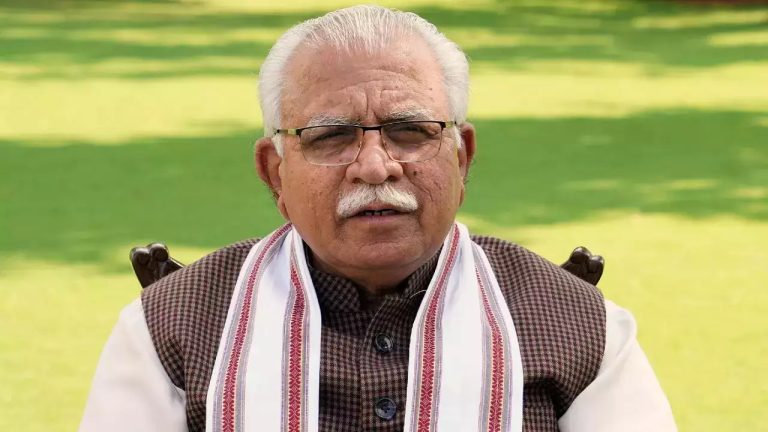
Amid deteriorating air quality in Delhi, Union Minister Manohar Lal Khattar on Tuesday emphasized that both the state and central governments are actively working to combat air pollution, saying there is “no use in blaming” others.

“All departments are taking combined action against pollution. The Supreme Court has also become strict on this. GRAP-4 has been implemented in Delhi… The state government and central government are all engaged in eliminating pollution. There is no use in blaming others,” Khattar told reporters after a meeting with officials regarding development works at the Mini Secretariat in Haryana.

Khattar highlighted that between September 15 and 18 November, Haryana recorded 1118 cases of stubble burning, whereas Punjab logged 9600 during the same period.

Deputy Commissioner Bathinda Shaukat Ahmed Pare said that in 2023 about 2700 incidents were recorded, whereas this year, 670 incidents of stubble burning were recorded, adding that more than 75 per cent drop is recorded.

However, Punjab recorded its highest single-day count of stubble-burning incidents this season on Monday, with 1,251 cases reported.

Data from the Punjab Pollution Control Board (PPCB) shows that the total number of farm fires in the state has reached 9,655 this year.

The surge underscores the ongoing challenge of stubble burning, a major contributor to air pollution in northern India. Monday’s figures have surpassed the daily tallies of the past three years, with 701 incidents reported on the same day in 2022 and 637 in 2023.

Officials from the PPCB have stressed the need for stricter enforcement and greater cooperation from farmers to tackle the issue effectively.

Meanwhile, Delhi Chief Minister Atishi highlighted ongoing infrastructure development in the national capital, saying that work is progressing “on a war footing.”

“Infrastructure is being expanded on a war footing in Delhi. Be it roads or flyovers, development work is progressing rapidly. The fourth phase of the metro is also expanding rapidly. Today, I inspected the State-of-the-Art Driverless Train at the Mukundpur Depot,” the Delhi CM said.

The national capital’s air quality remained in the ‘severe plus’ category for the second consecutive day on Tuesday morning, with smog reducing visibility and worsening pollution to touch alarmingly high levels. 

(This news report is published from a syndicated feed. Except for the headline, the content has not been written or edited by OpIndia staff)

Thousands of farmers march towards London against Labour Party’s imposition of Agricultural Inheritance Tax: All you need to know

On the 19th of November, thousands of farmers in Britain are set to demonstrate in Parliament Square in London against the removal of an inheritance tax exemption that has aided farmers to bequeath their farmlands to the next generations, alleging that this decision will jeopardise food production.

In what was called a measure to raise funding to restore public services, UK’s Finance Minister Rachel Reeves stated in October that farmers with land worth more than 1 million pounds ($1.26 million) will no longer be authorised to transfer their farms to their children tax-free after 2026. The opposition to this “tractor tax” is a fresh addition to a broader backlash against Reeves’ financial policies. Earlier, Minister Rachel Reeves raised the social security contributions of the employers to 15% to increase government revenue. A significant number of Britain’s largest companies have warned that proposed increases to employers’ social security contributions could exacerbate inflation. After the country’s firms, the Labour Party government’s desperation to increase its revenue has become a nightmare for the British farmers.

Agricultural Property Relief from Inheritance Tax and the Labour Party’s “Tractor Tax”

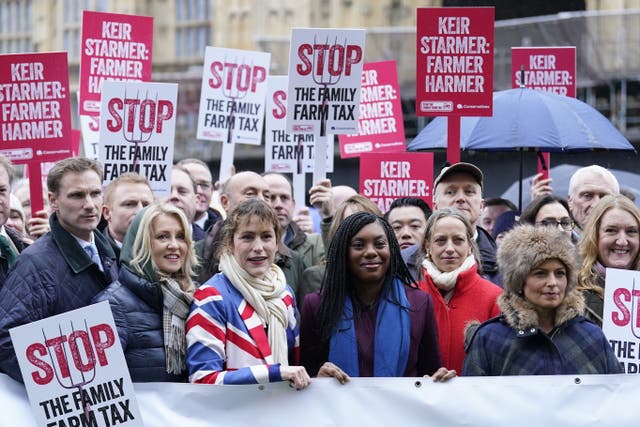
Flags, toy tractors, banners, and tractors are reaching London in one of the major farmer’s agitations in the United Kingdom. Several farmer protestors were seen holding posters and banners reading  “Keir Starmer Farmer Harmer”. Along with more than 1800 members of the National Farmers’ Union (NFU), its president Tom Bradshaw and thousands of farmers, TV presenter and farm owner Jeremy Clarkson and other noted personalities are also joining the farmers’ protest in Westminster.

The protesting farmers are deeply concerned and outraged over the Labour government’s revisions to the Agricultural Property Relief (APR). As the name suggests, the APR is sort of an agricultural tax inheritance relief, which allows the farmers to pass on their farmlands to their future generations with certain tax reductions.

Conservative MP Kemi Badenoch and others gather in Westminster to protest against inheritance tax (Source: Independent UK)

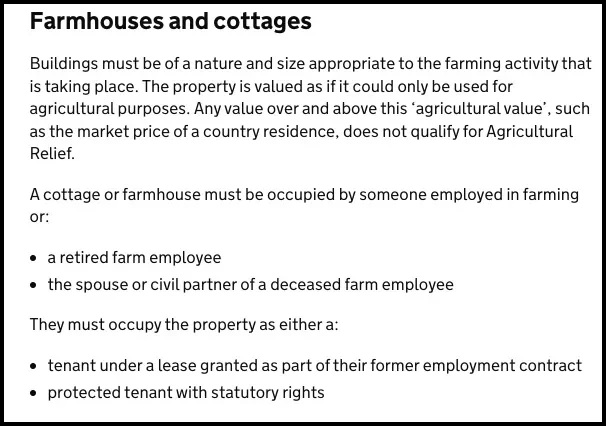
As per the existing framework, the farmers can pass on some agricultural property free of Inheritance Tax, either during their lifetime or as part of their will. In addition to land or pasture used for growing crops or rearing animals, agricultural properties like stud farms for breeding and rearing horses and grazing, land not currently being farmed under the Habitat Scheme, land not currently being farmed under a crop rotation scheme, the value of milk quota associated with the land, some agricultural shares and securities, farm buildings, farm cottages and farmhouses are covered under agricultural properties qualified for APR.

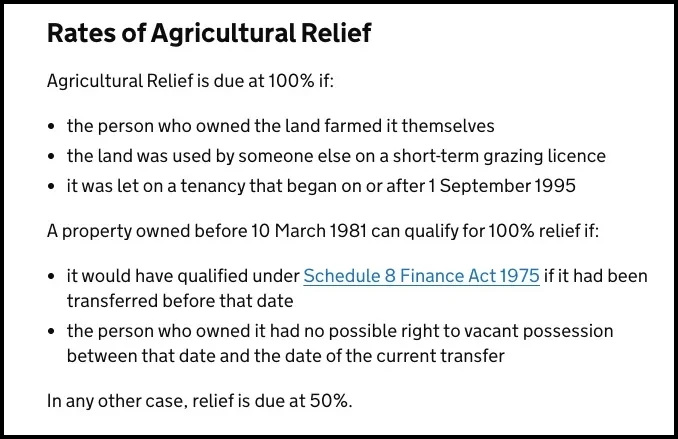
Source: UK govt website

About the period of agricultural land ownership or occupation, the rules say, “property must have been owned and occupied for agricultural purposes immediately before its transfer for: 2 years if occupied by the owner, a company controlled by them, or their spouse or civil partner, 7 years if occupied by someone else.”

Notably, the Agricultural Relief until the Labour Party’s revisions of the rules, was 100% if “the person who owned the land farmed it themselves, the land was used by someone else on a short-term grazing licence, it was let on a tenancy that began on or after 1 September 1995.”

There are certain criteria for obtaining 100% agricultural relief for the property owned before 10 March 1981. However, in other cases, the agricultural tax inheritance exemption is cut short to 50%.

Coming to the changes to the existing framework announced by the Labour government in the budget, the government said that starting on the 6th of April 2026, only the first £1 million in combined commercial and agricultural property will be eligible for the full 100% inheritance tax exemption. Also, no changes have been made to the tax exemption granted on agricultural land transfers between spouses and civil partners.

Beyond this threshold, landowners will pay inheritance tax at a reduced rate of 20% rather than the regular 40%. Unlike other types of inheritance tax, this tax can be paid in interest-free instalments over a 10-year period. The UK government says that this is in addition to all of the other spousal exemptions and nil-rate bands available to people for inheritance tax purposes. “This means that two people with farmland, depending on their circumstances, can pass on up to £3 million without paying any inheritance tax,” the government said.

Explaining the requisite behind making these changes, the Labour government said, “The latest figures show that the top 7% (the largest 117 claims) account for 40% of the total value of agricultural property relief. This costs the taxpayer £219 million. The top 2% of claims (37 claims) account for 22% of agricultural property relief, costing £119 million.  It is not fair for a very small number of claimants each year to claim such a significant amount of relief, when this money could better be used to fund our public services.”

The UK government claims that these changes to the rules of agricultural relief from inheritance tax will impact only the wealthiest 500 estates each year with smaller farms not affected by the changes.

What the agitating farmers say and the Labour government’s doubling down

While the government and the tax supporters contend that imposing a 20% agricultural inheritance tax will recoup money from the wealthiest farmers or those who have bought up huge farms as investments to benefit from its increasing cost, the protesting farmers argue that nearly 60% to 75% of the working farms may face a tax imposition. Moreover, the farmers’ unions say that in contrast with the high value of farmland on paper, the profits they earn are diminutive.

Source: SkyNews

The NFU president Tom Bradshaw has said that around 75% of the working farms will fall under the scope of the agricultural inheritance tax. He also called the tax imposition as a “stab in the back”. “The impact for retail prices and shelf prices is going to have to be dramatic. It’s an inflationary budget for food production and you in this group have nothing left to give. It’s been nothing but a bad Budget and I’ve never seen anything like it in my lifetime,” Bradshaw said.

However, Prime Minister Keir Starmer remains adamant about the government’s stance that a major portion of working farms will remain unaffected by taxation. “It is very important that we support farmers,” Starmer said adding that he is “confident” when he claims that a “vast majority of farms and farmers” will stay unaffected by the revisions to the tax exemptions.

Despite the Labour government’s claim that the new reforms will only target the wealthiest estates, protesting farmers expressed concerns that the policy would jeopardise multigenerational family farms, threatening their ability to continue producing food and maintaining rural traditions. The Labour government claims that the changes to the tax exemption framework are required to fund essential public services such as the NHS and housing and that the reforms will primarily affect the richest estates, not small farmers and average-sized farms. However, the protesting farmers and their unions, such as the National Farmers’ Union, think the consequences will be far-reaching and that in addition to harming family legacies, these changes will also jeopardise the UK’s food security.