Home Blog Page 7175

Indian Army seizes heavy arms and weapons with Pakistani markings from terrorists killed in Kashmir

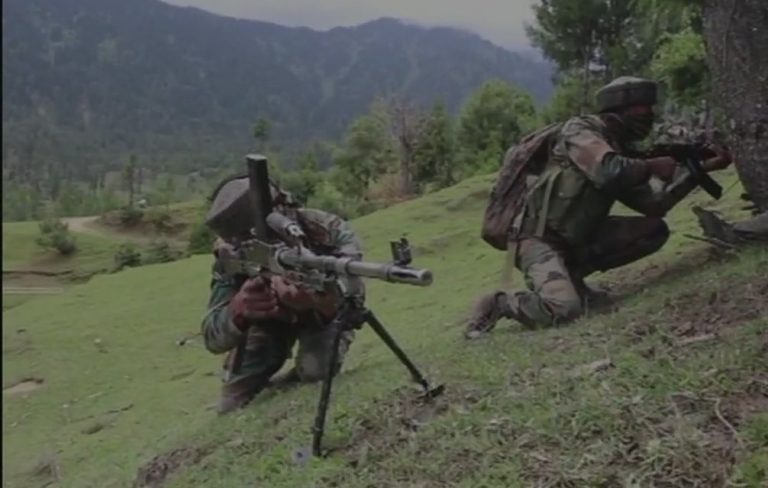
In an operation conducted by the Indian Army, the security forces have recovered heavy arms and modern weaponries from the slain terrorists along the LoC in Kashmir. The Army said that the weaponries had the markings of Pakistan and these are indicative of Pakistan aiding and abetting of terrorism in India.


The Army, during an encounter, killed five terrorists and foiled their infiltration bid along the LoC in Tangdhar sector of Jammu and Kashmir early morning on Saturday, 26th May. This operation is the second in past 10 days, as earlier the army had killed four terrorists near Kupwara. The Army also said that the movement of terrorists was very close to the Pakistani forces.


The infiltration comes after General Bipin Rawat had issued a warning to Pakistan to shut down terror operations in Kashmir. He said, “Pakistan is continuously violating ceasefire, causing damage to life and property. When such things happen, we can’t remain silent. If Pakistan wants peace, they should take initiatives to stop terrorists who infiltrate to vitiate the atmosphere.”

He also accused Pakistan of violating ceasefire through infiltrations. He also said the India expects peace at the borders. It said that the Pakistan needs to shut down its terror camps for peace to return at the borders.

Last week, the Centre had announced ceasefire in Jammu and Kashmir during the holy month of Ramzan. The Home Minister however, reiterated that the security forces have the right to retaliate if attacked or if essential to protect the lives of the people.

Remembering Nehru and his ‘Himalayan blunders’

0

Pt. Jawaharlal Nehru (the title of Pandit is a little incongruous for a sworn secularist) passed away on this day, 54 years ago in 1964. His larger than life image though has only lately begun to be put in perspective. A lot of it has to do with social media for it loosened the grip of mainstream media and academics in controlling the narrative, hiding the ugly and sprucing up the good.

This revisit on Nehru’s early years, his rise in Congress echelon, manipulation at the time of independence to PM’s seat, his shaping of Hindu Civil Code etc are now being fiercely ripped out in open. I would presently concentrate on two of his actions which have put India’s eastern and western borders in permanent strife. I am of course referring to Pt. Nehru’s conduct during the incursion of Pakistani raiders in Kashmir in 1947 and the disastrous China War of 1962.

Pakistan Raiders in Kashmir in 1947

Within a month of India’s independence, Maharaja Hari Singh of Kashmir offered his state’s accession to India in September 1947. Nehru refused for his “blood brother” Sheikh Abdullah was in jail. It was thus a deadlock. By next month, Pakistan’s raiders from North West Frontier Province had penetrated up till the outskirts of Srinagar, looting, pillaging, killing and raping along the way. On October 26, Hari Singh had agreed to sign the Instrument of Accession to Indian Union.

On the same day, Lord Mountbatten, the Governor-General, called an urgent meeting in Delhi. Nehru was his typical ambivalent self. Sardar Patel, the home minister, lost his cool. Sam Manekshaw, then an army colonel, was to later recall: “As usual Nehru talked about the United Nations, Russia, Africa, God Almighty, everybody until Sardar Patel lost his temper. He said ‘Jawaharlal, do you want Kashmir or do you want to give it away?’.” Nehru was thus pinned into taking an action and thanks to Sardar Patel, troops were flown to Srinagar and the airport, the only link with New Delhi, was saved.

In just a few weeks, in December 1947, Nehru had committed his grave blunder for which successive generations of India are still paying the price. He referred the matter to United Nations—there was no need for Kashmir was literally India’s “internal matter” since Maharaja Hari Singh had already acceded the state to Indian Union.

Why did Nehru go to United Nations? There are two explanations forwarded: one, he wanted Sardar Patel out of Kashmir for the latter fed up by Nehru’s antics had offered to resign just a few days before in December 1947; two, Nehru walked into a trap laid by Mountbatten who wanted UN to mediate.

(The truth is, India didn’t need Mountbatten as its Governor-General. Pakistan never considered a similar option for itself. Mountbatten then manoeuvred himself as head of India’s defence counsel).

Nehru then approached United Nations for arbitration. In the first few months of 1948, the folly had begun to hit Nehru in the face. The British stance in front of UN was completely opposite to what Mountbatten had led Nehru to believe. The Indian complaint was ignored; instead, UN Security Council began adopting anti-India resolutions.

The cat was out of the bag. Despite India’s protests, Pakistan was firmly in control of “Azad Kashmir.” India had to lose Gilgit-Baltistan region. UN and its plans for a plebiscite went kaput. India’s next generations had been condemned with the festering wound of Kashmir. Terrorism and internal security, if not secession, are everyday issues emanating from the Valley.

India’s China War of 1962

This refers to India’s political and military humiliation at the hands of China during the 1962 War. The impression successfully perpetuated all these years is that it was all China’s aggression which didn’t respond to Nehru’s brotherly overtures. The truth is more nuanced.

Britain didn’t leave India with any boundaries. India was left to settle matters with Pakistan, Nepal and China. While the first two nations didn’t cause any problem, China was a different matter altogether. They were not prepared to let Nehru get away with his “forward policy” of aggression.

India inherited the McMahon line on its eastern border with China which British had created in the mid-1930s by seizing the Tibetan territory, renaming it NEFA. The Chinese government’s plea for renegotiation was turned down by Nehru who latched on to London’s fake claim of Simla Conference (1945), legitimatizing the McMahon Line. Nehru topped it with his fake claim on Aksai China claim which even the British hadn’t made on a territory China had termed its own for over a hundred years.

Then on its Western (Ladakh) border, Nehru’s “forward policy” in September 1962 tried to force the Chinese out of territory it claimed as its own. Nehru announced on October 11 that the army had been ordered to “free our territory.” That’s how the war began with China reacting to the situation.

China fought the 1962 war while in the throes of economic hardship. Its forces were hardly elite, mostly comprising regiments of local military. Their equipment and logistics were poor. Yet they overpowered the Indians. In that short war of two weeks—China called for a unilateral ceasefire as quickly as it had gained ground—India lost 1383 of its soldiers; 1047 were wounded, 1696 were missing.

Our only clue to 1962 China War is a book by Australian journalist Neville Maxwell: India’s China War. He could pen it down by accessing the Henderson (Brooks)—(Premindra Singh) Bhagat report which had been commissioned in the wake of 1962 War disaster. Even Maxwell could copy only a part of the report which the Indian government had classified as “top secret.”

It’s been over a half century yet the Henderson-Bhagat report, as well as various correspondences of Nehru, are out of reach—being treated as “private property’ of Nehru Library, a private trust. The papers of India’s first prime minister belongs to his family and not to the state!!! The classified secret clause of “30 years” is long over yet the report isn’t being made public.

That’s how truth in this country is treated. Everyone tries to muzzle changes in school textbooks and academia in light of new findings so that their narrative remains perpetuated. Doesn’t the history of this country deserve a revision when important annals of this country are being kept locked in the form of documents inside safety vaults?

The crowning jewel of 4 years of Modi Government: The war against Maoists

In the 4 years of Modi government, the war against Naxalism has yielded very sweet fruits for the security forces. According to the official statistics published by the Ministry of Home Affairs, there has been a steady decline in Maoist violence ever since Narendra Modi came to power at the Center. Livemint quoted an unnamed senior Home Ministry official as saying, “If you look at the last four years, we have made significant progress. LWE areas, especially those in Chhattisgarh and Jharkhand, were neglected before 2014. But we have introduced infrastructure projects that are ushering in development in these areas and have also been sending out troops on area combing operations to destroy Naxal hideouts.”

In April 2018, the security forces conducted one of its most successful operations against the Naxalites. Over 35 terrorists were slaughtered during the operations, it is regarded as one of the most terrible blows the Naxals have suffered in quite a while. Earlier in the month, 44 districts were removed from the list of districts affected by Left-Wing extremism. Recently, Home Minister Rajnath Singh announced that Chhattisgarh will also get a specialized unit to combat Maoist insurgency in the state.

In May 2017, Rajnath Singh announced the formulation of a new security operation doctrine against the Naxals, ‘SAMADHAN’. The acronym SAMADHAN stands for Smart leadership, Aggressive strategy, Motivation and training, Actionable intelligence, Dashboard Based KPIs (key performance indicators) and KRAs (key result areas), Harnessing technology, the Action plan for each theatre, and No access to financing. The focus has been on utilizing technology for surveillance and assistance in conducting operations combined with strategic attempts at choking the funding mechanism of Naxalites. In March, the Enforcement Directorate had attached properties worth Rs. 68 lakh of one Maoist leader. More recently, the central government has set up a multidisciplinary committee to choke the funding received my Left-Wing extremists.

Union Home Minister Rajnath Singh had said after the announcement of SAMADHAN, “We have to bring aggression in our policy, there should be aggression in our thinking, aggression in our strategy, aggression in the deployment of security forces, aggression in operations, aggression in bringing development, aggression in road construction. We will have to be cautious that extremely defensive deployment may result in the reduction of operational offensive.” One other significant takeaway is the encouragement for the troops to be proactive in eliminating or neutralizing threats rather than reactive.

There has also been a concerted attempt at infrastructure development and increased connectivity in Maoist areas. In May last year, it was reported that the Center had announced that it will spend Rs. 11,000 crores in increasing road connectivity in 44 Maoist affected districts. In November 2017, Indian Railways started operating its first express train service in the Maoist affected region of Dantewada. It is, perhaps, a testament to the success of the Modi government’s policy towards Maoists that the Indo-Tibetan Border Police (ITBP) completed the construction of a bridge in just 30 days in the Maoist-infested Kaneri village of Chhattisgarh’s Rajnandgaon district, a feat which could not be achieved for the past 9 years.

The War against Naxalism may well be on its last legs due to the efforts of the current ruling disposition. It was reported in January that Naxal influence had been shrinking to merely 58 districts. Even Narendra Modi’s most vitriolic detractors have to concede, the offensive against Naxals has been one of the crowning jewels of his government’s achievements.

Pak Army summons ex ISI chief over book co-authored by ex RAW chief and launched by Congress leaders

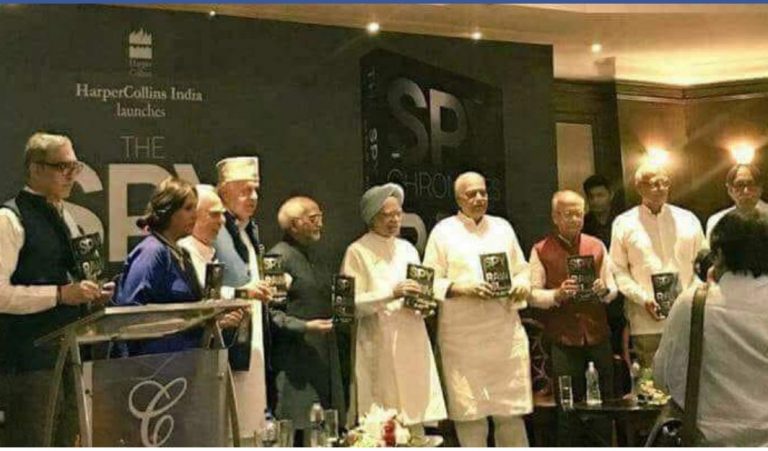
In a shocking event, former Union Minister Yashwant Sinha, former Prime Minister Manmohan Singh, controversial former Vice-President Hamid Ansari and other Congress leaders jointly released a book co-authored by former Pakistan ISI chief Asad Durrani and former RAW chief A S Dulat, in New Delhi. Other Congress leaders like Farooq Abdullah, Kapil Sibal were also present at the event. Interestingly, controversial scribe Barkha Dutt who is known to be the sympathizer of terrorists was also present at the meeting. Dutt is often accused of leaking sensitive information to Pakistani Army during terrorist operations in India.

The Pakistan Army has now summoned former ISI chief Asad Durrani on 28th May, to seek his explanation over a book he co-authored with India’s ex-spy chief AS Dulat, accusing him of violating the military code of conduct.


Asad Durrani was ISI chief in the 90s when Kashmir insurgency had just started. He has co-authored a book with former RAW chief A S Dulat who is known for all wrong reasons in the country, especially his soft outlook towards terror where helped terrorist and Hizbul Mujahideen Chief Syed Salahuddin’s son get a medical seat in Srinagar.


Durrani was denied visa by the Indian government due to national security reasons for which he thanked Indian state as it ‘saved him from the wrath of our (Pakistan’s) hawks’.

Earlier too, Congress leaders were caught red-handed during Gujarat Elections when many Congress leaders, including former Prime Minister Manmohan Singh and Ansari, had met the Pakistani High Commissioner. Some sections of media allegedly accused them of seeking help from the Pakistani establishment to defeat the Narendra Modi government. Congress’ Mani Shankar Aiyer in the past had openly asked Pakistani establishment to help to dethrone Modi government.

How the tragic death of Savita Halappanavar united the Irish people against Catholic influenced abortion law

In a dramatic defeat of the Catholic church’s influence, Ireland has voted by a landslide to legalise abortion. The Irish electorate voted by 14,29,981 votes to 7,23,632 in favour of abolishing the controversial constitutional amendment that gave equal legal status to lives of foetus and the woman carrying it. Unfortunate death of the 31 year old Savita Halappanavar, a dentist from India, living with her husband Praveen, triggered the nationwide movement. At 17 weeks pregnant she was looking forward to a life full of joy and possibilities. Her dreams were shattered on the day she was admitted in the University Hospital Galway on 21st October 2012, with complaints of intense back pain.

In the hospital, the medical staff concluded that a miscarriage was inevitable in Savita’s case. The foetal heartbeat could still be heard and Irish law stated that as long as there is a foetal heartbeat, medical intervention in the pregnancy is not allowed. Following the rupture of foetal membrane, Savita’s condition was rapidly deteriorating. Her family requested for a termination of pregnancy which was denied by the medical staff citing the said law. By 24th October, Savita was diagnosed with an infection and later went into septic shock. A week after she was admitted, on 28th October, she died.

During her ordeal at the hospital, Savita had reportedly requested the medical staff repeatedly for a termination of pregnancy to save her life. In reply, she was told, “This is a Catholic Country.” Savita reportedly even pleaded that she is neither Irish nor Catholic, but her requests went in vain.


Savita’s tragic death sparked a nation-wide stir in the country. All across Ireland, people took to streets marching, holding candlelight vigils and demanding legal access to abortion for women. Soon global organisations like Amnesty International and several activists joined in. Catholic bishops worldwide were against abortion. In 2013, a legal panel set up for an investigation into the incident gave a unanimous verdict that Savita Halappanavar could have survived if her pregnancy had been terminated on time.

In Ireland, abortions had been strictly illegal since 1861. The law has been challenged and criticised many times and as many as five referendums had been made so far. But till now there is no clear legal certainty available for medical practitioners on when to terminate a pregnancy. Under this law, even victims of rape, incest and cases of fatal foetal abnormality are not allowed an abortion, even if they are underage girls. In 2010, the European Court of Human Rights ruled that the state of Ireland has failed to provide clarity on the legal availability of abortion when a mother’s life is at risk. The particular clause in Ireland’s constitution, popularly called as the Eighth Amendment, has been a topic of protests and global outrage for a long time. Savita Halappanavar’s death opened the floodgates.

Though the clause was amended in 2013 allowing medical practitioners to terminate a pregnancy if the mother’s life is explicitly at risk, there were no provisions made for victims of rape, incest or cases of fatal foetal abnormality. In 2016, the United Nations Human Rights Committee also spoke against the clause and its implications. Finally, in 2017, a citizen’s assembly in the country voted 64% in favour of a change in the strict laws. The Irish government declared that it will hold a referendum vote to decide whether to change the law.

The date of the vote was 25th May. People of Ireland participated overwhelmingly in the referendum vote. There have been numerous campaigns. Irish people had been trending the hashtag #HomeToVoteYes, wearing T-shirts labelled ‘Repeal’ and hoping to bring down the law that barred women a basic right to their own health and lives.


Savita Halappanavar deserved the right to live. That right was taken from her because laws in the country that she lived did not give her the right to abort when her own life was at risk. If the eighth amendment is repealed, not only it will bring some much-awaited justice for the women in Ireland, it will bring at least some sense of gratification for the ageing parents of Savita, Mr Andanappa Yalagi and Mrs Akkamahadevi, whose loving, laughing daughter was snatched away from them for no fault of her own. An unborn child should have rights too, but when the pregnancy bears serious risks for the mother’s life, women should have a right to choose. Victims of rape or incest, where the pregnancy has been thrust upon a woman (in many cases an underage girl) should have the benefit of a flexible law that weighs physical, social and psychological risks of the unwanted pregnancy and allows the women a right to choose. While a termination in later weeks of pregnancy also bears risks for the mother, a permission for termination in the earlier weeks for the above-mentioned cases is awaited in Ireland.

When New York Times exploited children’s deaths to malign Yogi govt’s crackdown on illegal slaughterhouses

A few days ago the New York Times which in the past has exhibited traits like racism and elitism against India, decided to conjure up a unique angle about the menace of killer dogs in Uttar Pradesh’s Sitapur.

The residents of the UP district in the past six months have been living under the terror of “killer stray dogs” which as per reports have claimed the lives of at least 14 children during that period. Besides those dead, at least 30 individuals including 12 children have been injured in the attacks.

Reports claim that these killer dogs hunt in the packs and mainly target children without provocation and directly attack the victim’s neck. The town of Khairabad which is the most affected has seen parents even being fearful of sending the children to schools.

As a result of these attacks, locals have formed about 18 vigilante groups to hunt down such dogs.

The New York Times too decided to report these attacks, and incidentally decided to draw a link between them and the closure of illegal slaughterhouses in UP after the Yogi government assumed power in 2017:

When New York Times exploited children's deaths to malign Yogi govt's crackdown on illegal slaughterhouses
Headline by New York Times

It was evidently clear that the New York Times had decided to mess things up in the headline itself after it failed to mention that the Yogi Government has only closed illegal slaughterhouses.

In the content, the article proceeded to quote some unnamed farmers who it claims have asserted that “Hindu-right politicians’ zeal to protect cows, may have created killer dogs”.

To further solidify its narrative, the piece claimed that the stray dogs in the region earlier used to fill their stomach on meat scraps from slaughterhouses and owing to the shutdown asserted that, “some of the strays might have gone mad with hunger”.

Immediately in the next paragraph, the article quotes Indian Veterinary Research Institute’s director – Dr RK Singh as saying that:

“Because these dogs are getting less food, they move toward the neighbourhoods in search of food. That is leading to intense human-animal interaction.”

Clearly, for the average reader, the message would be clear that the closure of slaughterhouses has driven some stray dogs so desperate with hunger that they are willing to go to any extent to quench their craving for meat. The fact that one of India’s topmost veterinary official appears to be agreeing with this theory too would not be lost on the reader.

Following this article by NYT, a Swarajya report sought to uncover the truth of the matter, and in the process indicated the American publication of malicious attempt at false propaganda.

Swarajya in its report decided to investigate the most credible part of the NYT report and contacted Dr. RK Singh. The doctor though had a completely different outlook and claimed that his statement had no relation to slaughterhouses. He thus asserted that his statement simply was:

“Because of our change in lifestyle, we don’t offer as much food to stray dogs as we used to. Earlier, we used to make a separate chapati for the dog, but we don’t do it anymore. It’s just less food available to them that is creating the problem”.

After making his statement he said that he had nothing to add and even took objection to the term “killer dogs” which has been used by NYT. He also refuted claims that his institute has made any sort of a mention about slaughterhouses in its report submitted to the authorities over these killings – a claim which was made in a Times of India report.

Besides the statement, another question which might poke holes in NYT’s theory is that “why is only the district of Sitapur affected when the slaughterhouses have been closed throughout the state”.

Ironically the NYT report too asked this question and in an attempt to answer it – wrote this:

When New York Times exploited children's deaths to malign Yogi govt's crackdown on illegal slaughterhouses
NYT claims that the answer to a perfectly legitimate question is a mystery

Shockingly, the answer which NYT managed to come up with for this very legitimate question was “that remained a mystery”.

It can be well accepted that if a school kid writes, “that remains a mystery” to a question asked during an examination, he/she won’t be awarded any marks. But for some odd reason, such explanations are considered perfectly acceptable by the editors of NYT.

What might further puncture this “slaughterhouse theory” is the fact that such a stray dog menace has also been noted in Kerala, with at least 90,000 people being a victim of dog bites in 2014 – despite the fact that there is no such restriction on slaughterhouses in the state, and slaughtering animals is actively encouraged politically.

Also, the question arises as to why did the three journalists who worked on the NYT story did not actively interview residents living near the closed slaughterhouses to ascertain whether the dogs indeed were so dependent on its scraps of meat.

Following this, the NYT needs to answer whether its report was merely an ill conjured attempt at reportage, or whether it knowingly carried such a narrative to actively discredit the Yogi government by even going to the extent using the deaths of innocent children to achieve it.

Operation 136 : Cobrapost’s PayTM sting has way too many loopholes to be taken seriously

0

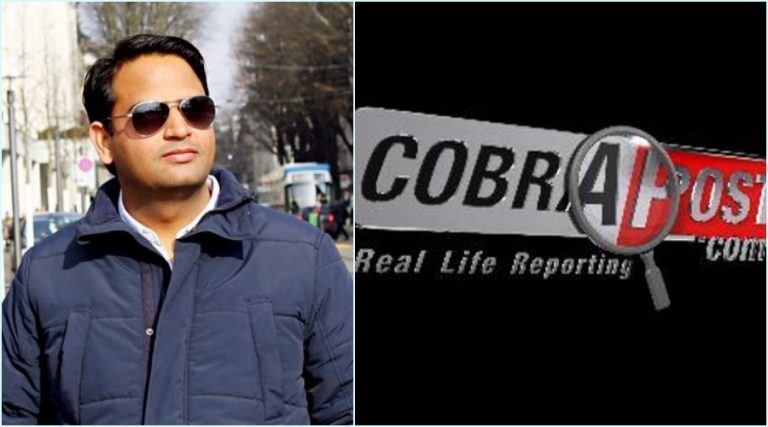
Cobrapost has published a series of sting operations that aim to project how the media has sold itself out to the ‘Hindutva’ brigade. The list of media houses that the sting operation covered is large. The ethical issues here, several. However, one video that stands out is the sting video of Cobrapost journalist Pushp Sharma, who was earlier arrested for peddling fake news, with PayTM Vice President Sudhanshu Gupta. It has ended up being the most talked about video and while PayTM has categorically denied any wrongdoing, many have questioned the payment app and their methods.

While social media is abuzz, there are certain issues with the Cobrapost sting operation that must be analysed threadbare and rationally. And when one does, it appears that the video might be craftily hiding much more than it has revealed.

The video begins with a short introduction to the growth and expansion of PayTM. No issues there. Any enterprise diversifies with growth.

Next, we are introduced to Vice President of PayTM, Sudhanshu Gupta. The voice-over says that Gupta cleared his political interest at the very beginning, which I think we can all appreciate. Now, Gupta tells Pushp (the journalist) how promotion on PayTM works. Important to note that we aren’t made aware of what conversation took place up until that point as the audio of the original video had been muted. We are dropped mid-conversation where Gupta is explaining promotion strategies. He asks what kind of content will Pushp Sharma be promoting and he claims that he wishes to promote Shrimad Bhagwat Gita. Gupta before suggesting any options tells Pushp that PayTM is promoting ‘Exam Warriors’ authored by PM Modi by displaying on the homepage. Here, I would like to point out that this is a very standard practice in advertising and sales to display the object of promotion or that which sells better at a prominent space, such as front page of a newspaper in case of ads or put it in a showcase in case of selling goods, nothing problematic there.

Hearing this, Pushp says that he also wants to promote some e-books. Gupta asks what exactly is to be promoted and how they want it done. But the Cobrapost journalist says that all of that they will discuss later and makes a joke about providing a budget to his seniors.

THEN, there is a ‘jump cut’! What was said next? We don’t know. We are pulled out of the conversation then dropped back in at a different point, again mid-sentence.

Let’s call this manoeuvre “pull out and drop” every time it is used.

This time Sudhanshu Gupta is seen explaining another promotion method: Quiz Games. Here again, the voice in the video is muted and ‘voice over’ takes over to explain how viewers should interpret things. Does Cobrapost think that viewers are not intelligent enough to draw their own conclusion? Or is it that the portal doesn’t want us to come to our own conclusion independently?

Anyways, the narrator says that through quizzes any ‘agenda’ can be run without any barriers. Please note the negative tone of the word ‘agenda’. But from Gupta’s perspective, he is being asked to promote the Gita. What is negative about this “agenda”? This sting will go on to insinuate that THIS is some sort of sinister Hindutva “agenda”.

More on that later when this is brought up again, for now, let’s move further in the video. We are “dropped” again where the PayTM Vice President explains the engagement level that is achieved by the Quiz Games. At this moment we are “pulled out” again and the narrator tells us that the meeting ended. How it ended and what was talked about in the end is not in the video. Cobrapost doesn’t think that is relevant information.

Then we’re “dropped” in the next meeting in a Delhi hotel, as told by the narrator. The narrator continues to tell that this meeting is attended by Mr Ajay Shekhar, the Senior Vice President of PayTM and the younger brother of Mr Vijay Shekhar, the owner of PayTM. Even as the narrator is speaking, we are shown footage of both Ajay and Sudhanshu Gupta speaking but the audio is muted due to voice over. Obviously, the viewers once again must not hear what Cobrapost does not want us to hear.

Before being given the privilege of listening to the actual conversation the narrator tells us that Ajay has an affinity for a particular ideology and organisation as if it is something unique and unthinkable that an adult would have a particular ideology. This, in my opinion, is meant as an ad hominem to discredit his capability to make an objective decision.

When the audio is resumed, we hear the Cobrapost journalist claim he is with the Sangh and studied from Shishu Mandir but he doesn’t want the name of the Sangathan to come forward to avoid political controversy and that the work will be done by Shrimad Bhagwat Gita Prachar Samiti (I am not sure if this Samiti is part of the Sangh Parivar umbrella or an independent Hindu organisation). This seems to confuse Ajay as to why the Sangh would hide its involvement (anybody who has worked with them would know that RSS doesn’t hide its involvement in its activities) and he goes on to talk about his association with RSS. Ajay then names a couple of people from the RSS he knows and is close with. Suddenly, we are “pulled out and dropped” yet again. In between this ‘jump cut’ narrator tells us that Ajay told them about his connection with the Sangh. As if we couldn’t hear and comprehend that, but without the narration, perhaps the dramatic negative effect that Cobrapost wanted to create would have been lost on the viewer.

Audio resumes once again and Ajay says he is also close to ‘Organiser’ editor Prafulla Ketkar but he never heard about what Pushp Sharma wants him to do. Now, Pushp tries to make up an excuse that it is actually the Samiti’s work and the Samiti doesn’t want to be known. Ajay asks if even Arun Kumar, a senior person in RSS, would not come to know of it. Mr Pushp claims RSS people need not know about it. A somewhat surprised Ajay says it’s strange that RSS is not being kept in the loop about its own activity as RSS is a big factor in BJP victories. Before his next sentence is uttered unsurprisingly we are “pulled out” and we are not allowed to hear the actual conversation. At this point, I think this is a deliberate attempt to mischaracterize what transpired in these meetings and portray a sensational misrepresentation that insinuates illegality or unethical practice of some sort.

Before we are “dropped”, the narrator comes up once more and says that Ajay claims to have done a lot of work for the particular organisation (probably referring to RSS) but knows nothing about this plan, this ‘Hindutva agenda’ (which to remind you, is promoting Gita. How sinister!) and that it surprised him that he did not come to know of such an important task.

Audio resumes, and we see Ajay and Pushp go back and forth about how it was never discussed with him when it is supposed to be him who has to contribute towards this promotion of Gita when he has been involved in many other important things.

Another jump cut here and we are “pulled out and dropped” into a conversation where Ajay helps out Sangh magazines ‘Organiser’ and ‘Paanchjanya’ by advertising PayTM in them. During this manoeuvre, the narrator mentions the sinister ‘Hindutva agenda’. Ajay at this point says that he will talk to Praffula Ketkar how RSS wants to do the Gita promotion or as Cobrapost has been calling it pursuing Hindutva agenda and that there was no need for being so vague about it.

So, far I don’t see any allegations against Paytm hold up. Being associated with RSS and BJP is not wrong in any way. Advertising in magazines published by RSS is perfectly fine. What I have seen, however, that when approached by somebody claiming to be from RSS, and when asked to do something in a roundabout manner, instead of readily doing it without asking questions, as a co-opted person would, Ajay decided to confirm from Sarsanghchalak Dr Bhagwat. But even this due diligence by PayTM is called as bending to its political masters.

The way Cobrapost claims promotion of Bhagwat Gita, which was its cover to do this sting, is some sinister agenda which we need to be wary of, seems extremely disgusting and deeply offensive. Selling e-books of Narendra Modi authored ‘Exam Warriors’ is not illegal, running quizzes about Gita is not illegal. So perhaps PayTM or the liberal coterie should explain what the charge against PayTM is.

At this point, I am tired of writing about the repeated jump cuts over and over, but the most important part still needs to be addressed and so, I will address it without line by line description of the video. Readers can count for themselves how many times in the last two minutes alone “pull out and drop” is craftily done. But at one point Mr Ajay says that during the cash crunch when stone pelting had stopped (due to lack of funding) he had received a call personally from the PMO that there may be PayTM users (among pelters). And hence, he was asked to share data with them (PMO).

As is the case with any statement in this entire video, Cobrapost does not show what was said before or after this statement. We have no context. But Cobrapost and media houses reporting this “sting” are adamant that this is an admission of misuse of personal information. However, what is more likely, and in my opinion actually the case, is that merely transaction data and not personal data was asked for in order to cooperate with the security agencies just as when banks are asked to make transaction data available when a fraud is being investigated. At a time when there was no cash to pay to stone-pelters, it was important for security agencies to track transactions and investigate any suspicious activity.

Ajay Shekhar of PayTM clearly has a political ideology, and has been affiliated with the Sangh all his life and admittedly attended Shakhas as a kid. So what? Is it illegal to have a political ideology? Is it illegal to join a legal volunteer organisation that is involved in social work? India is a free country and there is nothing illegal or unethical about anything that was said in the video. Hence his involvement with the Sangh and the various organisations under the Parivar is completely irrelevant.

What I find the most strange, nonetheless, is that parts of the conversation are muted and there is voice-over narration. What is the need for a narration? Does Cobrapost think that viewers are incapable of following a conversation and understanding what’s happening? And why the frequent jump cuts? Why is raw footage not released? To the rational viewer, it seems like Cobrapost deliberately wants people unaware of the context. Why is anything said by Pushp not heard most of the time? Why is it edited out? We don’t know most of what the Cobrapost journalist said to Mr Ajay and Mr Gupta in the two meetings.

The most pertinent query here also is how reliable are these operations when they are being performed by a journalist who himself had been arrested for fake news? However, it has been my attempt to evaluate the video regardless of the shoddy history of the journalist in question, or Cobrapost as a portal, and even then, the sting operation doesn’t pass the test.

If Cobrapost wants to maintain that the sting operation is authentic, it must release the raw footage and explain what “Hindutva agenda” was peddled other than something as inane was promoting the Bhagwad Gita. It must also explain what the impropriety on the part of PayTM was because, in a democracy, every individual is free to advocate their political ideology unless the affiliation is with an illegal or banned outfit.

Or is it that Cobrapost thinks that mere association or support for BJP and/or the Sangh qualifies as impropriety and illegality? And if so, Cobrapost seems to merely be peddling a very veiled, shoddily hidden agenda themselves.


The United Opposition ‘khicchdi’ has too many Prime Ministerial mouths to feed

The Bahujan Samaj Party’s national executive committee is meeting today and it is being speculated that Mayawati is going to be projected as the party’s PM face. According to reports, the meeting is being held also to evaluate pre-poll alliances with Congress for the upcoming polls in Chhattisgarh, Madhya Pradesh and Rajasthan. Party leaders have reportedly stated that the meeting will also decide on projecting Mayawati as the PM candidate for the upcoming Lok Sabha polls in 2019.

It is notable here that the BSP, in total, has 4 Rajya Sabha seats and ‘Zero’ Lok Sabha seats. With this, social media is already buzzing with speculations about how the alliance with Congress will work if other parties too have their own ‘PM candidates’.


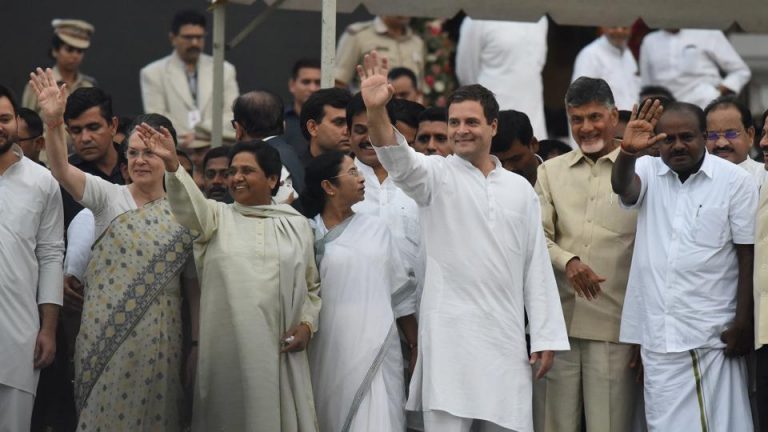
Mayawati is not the only lady challenging Congress’s Prince charming for ‘PM face’ either. In West Bengal, Mamata Banerjee has since long been the one continuously calling for a ‘United Opposition’. She has met Shiv Sena’s Uddhav Thackrey, TDP’S Chandrababu Naidu and has been very vocal for an anti-BJP alliance in recent times. Whats more, there is even a massive social media campaign going on with the slogan “Didi for PM” being actively propagated by her supporters.

Mamata Banerjee’s All India Trinamool Congress has 38 members in the Lok Sabha and her power and ability to swing a mandate at least in West Bengal cannot be ignored in the elections. Mamata Banerjee did not attend the gala dinner organised by Sonia Gandhi. She did not even meet Rahul Gandhi when she went to Delhi to meet leaders for an anti-BJP alliance. Her tweet congratulating the new Congress-JDS alliance government in Karnataka said a lot because she did not mention Rahul Gandhi in the tweet.


The absence of Rahul Gandhi or Sonia Gandhi’s name and the deliberate emphasis on the word ‘regional’ was noted by many. Does that mean Mamata will not meekly agree to Congress’s Gandhi family-centric political manoeuvres?

Rahul Gandhi has stated openly that he wants to become the PM, Congress, being Congress, is always expected to cater to the ‘family’. But there are many regional political leaders who may not agree to that. With its diminishing political hold and loss of power in so many states, many senior political leaders of regional parties may not agree with Rahul Gandhi becoming their PM face. A United opposition also needs a single leader projected as the possible PM candidate. With many leaders throwing their hats in the ring, will Rahul Gandhi be sidelined? Or the Congress will hold its loyalty to the dynasty above political dealings and ditch the regional leaders? Or will the United Opposition front crumble like a house of cards because the khichdi alliance has too many mouths to feed? Only time will tell.

Arun Jaitley lashes out: Calls Congress the ‘fringe’ and ‘United Opposition’ an Anarchist formation

As per reports, on the occasion of completion of 4 years in power, the BJP Union Minister Arun Jaitley in his Facebook post said today that aspirational India will reject the “anarchist” formation of “disparate political parties” which are promising to come together to fight the Bharatiya Janata Party (BJP) in the next general elections.

In his writing which read ‘My reflections on the NDA after completion of four years in power,’ he said that the political agenda for the debate this year would surely be Prime Minister Narendra Modi versus an “anarchist combination” of such parties.


He went on to accentuate that groups of political parties are uniting but some of their leaders are mercurial, the others occasionally change ideological positions. “With many of them, such as TMC, DMK, TDP, BSP and the JD(S), the BJP has had an opportunity to share power. They frequently change political positions,” Jaitley wrote in his Facebook post.

Jaitley stressed that ambitious societies do not approve of misrule, adding that a good society requires good governance which the BJP has given to the society in the last few years, the “result of this has been that the BJP is more confident, its geographical base has become much bigger, its social base has expanded and its winnability has hugely increased.” Prime Minister Modi has given ‘scam-free’ government and his fifth year will focus on consolidation of policies and programmes, he wrote.

Attacking Congress by calling it a fringe organization, Jaitley said the party “is in desperation without the perks of office”. From the most dominant party of Indian politics, the Congress has moved towards becoming the brink.

The Congress, according to Jaitley realizes that they can never come to power so as to avoid face-loss its best to become supporters of Regional parties. “State-level regional political parties have realized that the marginalized Congress can at best be either a junior partner or a marginal supporter,” he said.

Jaitley took a grandstand by saying that the 2014 election conclusively established that in the New India chemistry will score over arithmetic when it comes to deciding the country’s destiny.

Rahul Gandhi tries to rate the Modi government, gets rated himself

With the Modi government completing four years in power, various entities like the media, politically aware citizens, politicians and opinionated individuals have looked back upon the performance of the Narendra Modi led central government.

In some ways, the government has already got a vote of confidence from the populace, with Times group’s survey finding 71% of the respondents willing to vote for PM Modi again if general elections were to be held now, and 73.3% of the respondents stating that 2019 will again see a Modi led government.

Congress president Rahul Gandhi too decided to jump into the 4-year anniversary fray, and put out a tweet rating the Modi government’s performance:


Rahul via his tweet gave an F rating to the Modi government for its performance in sectors like agriculture, foreign policy, and proceeded to launch a sly attack on the PM. This episode though didn’t go according to plan for the Congress as Twitter users noticed the rating exercise and in turn decided to rate Rahul and his party.

Some reminded the dismal rating his party has managed in the recent assembly elections:


One gave a holistic rating of Congress’ performance since independence:


One user gave an interesting spin to Rahul’s argument:


Following this, it remains to be seen whether Rahul would come up with another such rating for the opposition in the Lok Sabha or what’s left of it.