Home Blog Page 7181

Modi govt approves scheme to provide mobile connectivity in areas affected by Left Wing Extremism

The Union Cabinet has approved a scheme to provide mobile network connectivity in areas affected by Left Wing Extremism. Sitanshu Kar, the Principal Spokesperson for Government of India and Director General of Press Information Bureau has informed that the areas proposed to benefit under the scheme span across 96 districts in 10 states.

mobile network in areas with LWE
courtesy: Sitanshu Kar

The information shared by the PIB states that the scheme is supported by the Universal Services Obligation Fund and it will provide mobile services at 4072 tower locations. The tower locations are reportedly identified by the Ministry of Home Affairs. These areas are inhabited but are yet to receive mobile network connectivity. The total project cost is estimated to be Rs 7,330 crores.

The scheme is aimed at not only providing the security personnel deployed in the area with better and easier connectivity but to benefit the residents of the areas by enhancing economic activities. It is also expected to help the several e-governance activities and help the locals with easier access to financial and public benefits.

governmnet approves scheme to bring mobile connectivity in LWE afflicted areas
courtesy: Sitanshu Kar

Jharkhand and Chhattisgarh states have the highest number of tower locations in the government proposal with 1054 and 1028 locations identified respectively. Other states include Bihar, Andhra Pradesh, Telangana, Odisha, Madhya Pradesh, Maharashtra, Uttar Pradesh and West Bengal.

In another announcement, the DG of PIB informed that the cabinet has also approved a plan to provide mobile connectivity in the state of Meghalaya under the Comprehensive Telecom Development Plan (CTDP) for the North Eastern Region at the estimated cost of Rs 3911 crore. This plan will include mobile network coverage in unconnected areas and also along the National Highways.

The central government has been taking strong steps to curb out the Naxal activities in the country after it came to power. Minister of Home Affairs Rajnath Singh had yesterday stated about preparing specialised anti-Naxal forces called ‘Black Panther’ in the state of Chhattisgarh. He had also informed that the government is also cracking down on fundings received by Left Wing Extremists.

How the Modi government’s ‘Make In India’ is steadily growing India’s manufacturing capability

0

From 1960’s to 1990’s, under Congress’s socialist policies, India’s GDP growth continued at a tardy 3%, which was mocked by the West as “Hindu rate of growth”. This is the same period during which East Asian economies like South Korea, Taiwan, Hong Kong and Singapore galloped at more than 7% on the back of their growing manufacturing capabilities and evolved into “developed economies”.

In that perspective, “Make in India” is a much-needed step in the right direction. It increases the focus on manufacturing sector to create a powerful growth engine to propel India’s economy. Since its launch in 2014, “Make in India” has attracted some of the most prominent global manufacturers in heavy machinery, defence equipment, automobiles and electronics to name just a few.

For electric locomotives, Alstom (France) has set up its manufacturing factory in Madhepura, Bihar with maintenance depots in Saharanpur (UP) and Nagpur (Maharashtra). They are producing strong 12,000 HP train engines to enable faster transfer of freight by Indian Railways. For Diesel locomotives, General Electric (GE) of USA is setting up the factory in Marhowra, Bihar with maintenance centres at Roza (UP) and Gandhidham (Gujarat). They will be manufacturing strong 4,500 HP and 6,000 HP locomotives with production planned to start by end of 2018

Hanwha-Techwin (HTW) of South Korea has set up Greenfield Manufacturing facility in Hazira, Gujarat. They are manufacturing Mobile K9 Self-Propelled VAJRA-T9 Artillery guns in collaboration with India’s Larsen & Toubro (L&T). Boeing (USA) has started manufacturing Apache Military Helicopters in collaboration with India’s Tata Aerospace Ltd. Their factory in Hyderabad is producing fuselages for AH-64 Apache helicopters for its global customers including US Army. Boeing (USA) has also tied up with India’s HAL and Mahindra Defence for manufacturing F/A-18 Fighter Jets in Bengaluru.

In addition, Saab (Sweden) has offered to manufacture Gripen fighter jets in India (with Adani) while Lockheed Martin (USA) has offered to manufacture F16 fighter jets in India (with Tata). Lockheed Martin has also offered to manufacture third generation Javelin missiles in India. Russia is in the final stages of starting the production of AK-103 Kalashnikov Assault Rifles in collaboration with Ordinance Factory Board in India.

In Automobiles sector, Volvo (Sweden) has already started manufacturing XC90 cars in Bengaluru. Volvo also plans to use its Bengaluru plant for its S90 sedan and the XC60 SUV in the near future. In addition, Lexus (Japan) is about to be the next luxury car maker to set up their plant in India shortly.

Image source: here

Gionee and Xiaomi (China) have started manufacturing their mobile handsets at Foxconn plant in Andhra Pradesh. Last one year has seen investment from 37 mobile manufacturing companies in India. In 2017, India became world’s second largest mobile phone producer after global handsets produced in India increased from 3% in 2014 to 11% in 2017. With this milestone, Mobile production in India crossed 100-million units and may cross 500 million units in the next two years. Apple (USA) is about to start manufacturing in Bengaluru. Gionee (China) plans to invest Rs. 300 crore over the next three years and Taiwan’s Foxconn, is planning to build seven to eight new units in India. (source: here)

In 2016-17, electronics worth $50 billion were manufactured locally in India compared to $43 billion in Imports. For the first time in history, Electronic goods made in India exceeded the imports from outside (source: here). In another significant move, Electronics Manufacturing Corridor may come up shortly in UP. This will provide a significant boost to the local electronics industry in India.

In other industries, Hyosung (South Korea) has acquired land on Delhi Mumbai Industrial Corridor to set up a factory, with manufacturing planned to start by 2019. 37 other companies have already acquired land along DMIC to start local manufacturing.

These are just a few early successes. India’s potential as “world’s fastest-growing major economy” along with a jump of 42 places in “Ease of Doing Business” rankings has made India an attractive investment destination. A survey of global multinational companies in the 2017 World Investment Report by UNCTAD (United Nations Conference on Trade & Development) ranked India as the third most favoured destination for FDI after USA and China. This is likely to result in even higher investment in India in the coming years.

Slowly but surely, the fruits of a sustained campaign are becoming visible.

Quint, your story about Sri Sri was fake news. Just face the facts!

Dear ‘The Quint’,

You seem to have been hurt that one of our volunteer-driven attempts termed your report an example of ‘fake news’, which it was. Three days after our volunteer-driven report was published, you came up with a defence, which was as good as Suresh Raina defending a short ball on a South African pitch.

What you’ve done is typical of what your ilk – the mainstream media swearing by its ‘liberal’ credentials – does when they’re caught on the wrong foot. You shift the goalpost.

In your response, you claim that the only aspect your report focused was on the Art of Living (AOL) being fined for holding the World Culture Festival by the National Green Tribunal (NGT), and thus, “case closed!”

That’s where you shifted the goalpost.

That the AOL was asked to pay up by the NGT is obviously a fact (which you assert by typing in all capital letters) and not fake news; our volunteer-driven report never contested that aspect. Our report focused on two aspects where you were caught peddling half-truths:

  1. Your video report made it appear as if farming stopped in the area because of the AOL event in 2016, while the truth is that an NGT order of 2015 had already banned farming on Yamuna floodplains.
  2. Misrepresenting a farmer’s opinion where he didn’t blame it entirely on AOL or Sri Sri Ravi Shankar.

By the way, AOL’s appeal against the NGT order (where it asked AOL to pay up) is under consideration before the Supreme Court, and thus technically the case is not yet closed, as you claim, so that is another half-truth you are peddling even in your latest report addressed to OpIndia.

Your latest report doesn’t address the first point at all – why the NGT order banning farming was not put forward in your report – so you continue to peddle half-truth to your readers. To seemingly address the second point, you uploaded longer video clips of farmers’ interviews to prove that you didn’t misrepresent their views.

You further asked OpIndia to upload the ‘raw footage’ to prove that farmers were not “instructed” by our volunteers to say something against The Quint.

Well, first of all, here is the unedited raw footage of the farmer who accused The Quint of malicious editing. As readers can see, the farmer brings up the mention of The Quint without any “instructions” by our volunteer. In fact, the farmer, Sukhbir, names The Quint twice, without our volunteer “instructing” him to do so. Only after he named The Quint twice, our volunteers asked questions specific to The Quint.

[youtube https://www.youtube.com/watch?v=Ddj8iSoLlYk]

However, the interesting thing is how you suspect that farmers could be “instructed” to say stuff that can be later carried on by media organisations. Perhaps that’s where you betrayed your own modus operandi. In one of the video clips you uploaded, which had a sudden ‘jump cut’, the farmer suddenly starts talking about Narendra Modi. Was that an “instruction” from your team? Why was there a cut in the video?

We can keep trading such charges till the cows come home. We don’t want to get into this game that you started by accusing us of “instructing” the farmers. However, thanks for letting the readers know that media organisations “instruct” people to come up with statements to peddle half-truths or a particular agenda. Earlier, a journalist named Nikhil Wagle too had ended up exposing this trick by the media.

Anyway, coming back to the issue at hand. Our volunteer-driven report was not about giving any clean chit to AOL or Sri Sri for holding the festival – let the Supreme Court decide that – it was an example of how the common citizens, armed with mobile phones, can cross-check facts and narrative peddled by the mainstream media.

You represent the worst of the mainstream media despite being a new media venture. In 2017, your journalist was booked for abetting the suicide of Lance Naik Roy Matthew. In fact, your pussyfooting on Hafeez Saeed is not surprising, considering you had published an entire piece about Osama Bin Laden being a father and a husband. You had also come up with a story that basically declared Kulbhushan Jadhav an ‘Indian spy’ thereby endangering his life and national security. We had rebutted that story threadbare and post massive backlash, you had taken the story down and decided to “recheck its story“, but not before Pakistanis and its official agencies had started quoting The Quint article on Jadhav in an attempt to undermine India’s position.

The whole point of our report was to empower the common people to fight your might – which is owing to you possessing billions of rupees and being part of the same old media establishment – and show the real power of citizen journalism.

You can keep shifting the goalpost and try to make it only about one particular NGT order or about the raw footage, but deep down even you now know that the old media tricks employed by your ilk will not go unchecked and uncontested from now on.

Just accept this reality and move on.

Yours Sincerely,

Nupur J Sharma,
Editor, OpIndia.com

Savio Rodrigues threatened for criticising the Archbishop’s communal agenda

Savio Rodrigues, former Congress leader, in an open letter recently slammed the Archbishop at the Archdiocese of Delhi for urging Catholics to fast and pray for a new government in 2019. Condemning Archbishop’s letter, he questioned the media for not calling out the communal propaganda.

Since then, he has received threats and hate messages for speaking up against the communal message of the Church, he has claimed.


Savio has claimed he is also receiving messages from relatives asking him to issue an apology for his remarks on the Archbishop.


He has also tweeted screenshots of texts he has received on WhatsApp.


Thus far, such behaviour has only been witnessed from radical Maulanas and Maulvis who issue Fatwas at the drop of a hat. For instance, there was the Shahi Imam of Kolkata’s Tipu Sultan Mosque, who announced a reward for anyone who shaved Prime Minister Narendra Modi’s beard. He also threatened Tareka Fatah declaring that he would be beheaded.

Then, there was the case of Muslim BJP leader Bukkal Nawab who was ostracized from Islam by Darul Uloom Deoband for worshipping Lord Hanuman at a Temple in Lucknow. It appears some Christians are catching the radical bug from the most rabid sections of Islamists in Indian society.

Amnesty International report confirms that Rohingya terrorists cross border pretending to be refugees

Amnesty International, the global organisation for human rights, in its report published yesterday has revealed how armed terrorists of the Arakan Rohingya Salvation Army (ARSA) had carried out the mass execution of Hindus in the Rakhine province. Since yesterday, the report has gathered much shock and realisation globally as the terrorism side of the Rohingya has largely been downplayed and underreported all over the world.

In its report, the Amnesty International has confirmed that In August 2017, the ARSA terrorists, with the support of local Rohingya men, had attacked the Hindus from the village, robbed, bound and blindfolded them. The terrorists had then marched the Hindus and separated a group of 8 women and children who had ‘agreed to convert to Islam’. The ARSA terrorists had then shot 53 Hindus execution style. The report also states that the Rohingya people who helped the ARSA carry out this massacre lived alongside the Hindus and Buddhists in the same cluster of villages known as Kha Maung Seik.

courtesy: Amnesty International

The report goes ahead to confirm that the eight women and their children were then forced to flee into Bangladesh with the ARSA fighters. From Bangladesh, they were later repatriated to Myanmar in October 2017 due to the agreement between the authorities of the two countries.

The report also states that the Kha Maung Seik massacre was not the only one where ARSA killed Hindus. The report gives details of a second massacre on the same day in a nearby village of Ye Bauk Kyar where all 46 Hindus are believed to have been killed by ARSA. The bodies of the Ye Bauk Kyar victims are yet to be found.

courtesy: Amnesty International

This statement in itself reaffirms the greatest worry of India regarding the Rohingya refugees. Radicalised terrorists do pose as refugees to infiltrate into borders and the radicalisation in Rohingya camps. In October 2017, Bangladesh had banned 3 Muslim charities from providing aid in Rohingya camps within their border, fearing that radicalisation is taking place. The Indian authorities too had been concerned with rampant radicalisation and criminal movements in the Rohingya camps. Rohingya camps have come up in places as far as Delhi and Jammu and Kashmir. Despite the central government asserting that the Rohingyas are illegal immigrants and are a security threat, the camps have been thriving inside Indian territory.

A section of Indian liberals and state governments have been defending the Rohingyas claiming humanitarian grounds and denying the security threats. Even the widely reported massacre of Hindus was denied by many. But there are people who even refuse to believe that the radicalised and armed terrorists can be present among the refugees too.


The Amnesty report clarifies that ARSA terrorists crossed the border as refugees and several local Rohingyas have been joining not only in the armed resurgence against Myanmar authorities but also in the cold-blooded massacres of Hindus. Maybe it is the time that the Indian authorities start taking strict measures to deport the Rohingyas.

Scientific, Ethical and Cultural reasons for banning cow slaughter in India

0

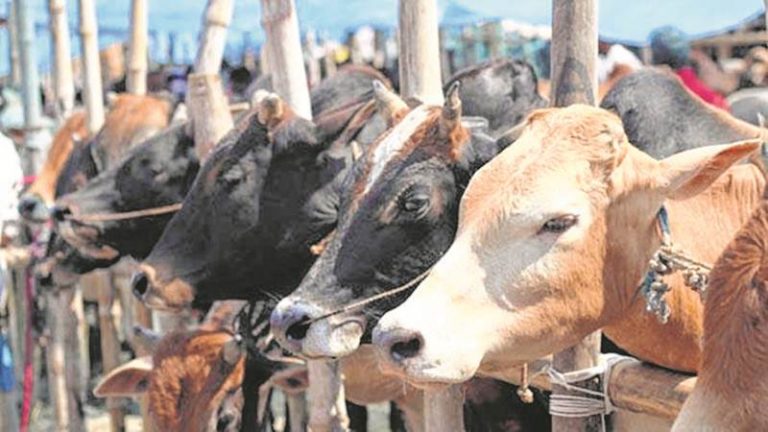
Cow slaughter has always been a contentious topic in India, mainly because of the skewed system of secularism that is peddled in India. Other than religious concerns of Hindus, there are many other reasons why slaughtering of cows is counterproductive. Perhaps the greatest injustice has been the liberal hounding when cow slaughter is spoken again, simply to diss the Hindus, while the entire world seems to be waking up to the scientific and ethical reasons to ban the same.

Scientific Reasons:

A UN report named “Livestock’s Long Shadow” categorically stated :

  • The livestock sector is a major player, responsible for 18% of greenhouse gas emissions measured in CO2 equivalent. This is a higher share than transport.
  • It also leads to huge mismanagement of available land-mass. The total area dedicated to feedcrop production amounts to 33% of total arable land globally. In all, livestock production accounts for 70% of all agricultural land and 30% of the land surface of the planet.
  • In the United States, a staggering 50% of antibiotics produced get used on livestock. In 1998, half of the 22.7 million kg of antibiotics produced in the United States was used on animals (Harrison and Lederberg, 1998). One can only imagine the impact it will have on human health when such meat is consumed.
  • When a substantial portion of the antibiotics or hormones administered to cattle does not get absorbed in the animal but passes from the faecal waste into water sources like rivers and lakes, if not treated properly can have a negative effect on human health.
  • The amount of food diverted to feed livestock is mind-boggling. Some 670 million tonnes of cereals (maize, barley etc) were fed only to livestock in the year 2002, representing a cropped area of around 211 million hectares. About 45 million tonnes of roots/vegetables, 17 million tonnes of pulses, 14 million tonnes of oilseeds (like soybeans etc) was cultivated in 2001 just for this purpose. Is this the best use of food when we have millions of malnourished people with the shortage of food?

As recently as Nov 2017, world scientists signed a ‘Warning to Humanity’ calling for, among other things, drastically diminishing our per capita consumption of meat.

‘Consumers Union’ in the US has concluded that there is a real and growing threat to public health from the overuse of antibiotics animals bred for food. Humans are at risk both due to the potential presence of superbugs in meat and poultry. These superbugs also migrate into the environment, where they can transmit their genetic immunity to antibiotics to other bacteria, including bacteria that make people sick.

Air pollutants generated by animal farms can cause respiratory illness, lung inflammation, and increase vulnerability to respiratory diseases, such as asthma.

Ethical Reasons:

Ethically, the treatment meted out to livestock has been horrendous. In many cases, chickens are de-beaked (i.e their beaks are removed or clipped), piglet have their tails cut and teeth removed to prevent them from injuring each other when fighting.

Male calves are taken away from their mothers when they are just a day old and are locked in small crates to keep their meat tender by not having them walk around. They are killed after only a couple of months to keep their meat tender.

Cows which are not able to walk due to injury or ill-health are called ‘downers’ in the US are in some cases have ropes or chains tied around their legs so that they can be dragged off the trucks for slaughter. They are forced through a chute and are stunned to reduce the pain of being cut up. Because the line moves fast in the slaughter-house, there have been many instances where the cow is conscious while each part of its body gets cut off.

Cultural Reasons:

The predominant religion in India is Hinduism. It would naturally have an influence on the traditions and culture of the country. Just like in the US and other western countries, it is frowned upon eating a dog or a horse because of their love and sense of loyalty to these animals, so in India, the traditions of this country should govern the laws.

In the Hindu culture, the cow is treated as a mother. The three forms of the mother are the biological mother, mother earth and the cow mother as per Indian traditions.

Even in our Vedas, the importance of cow has been stated unequivocally –

  • A cow is like a mother for all those who are bachelors until the age of 25 years, a daughter for those who are 26 years old and a sister for those who are 48 years old. – Rigveda
  • Cow brings well-being and purity in the house. She is a source of wealth and prosperity. – Atharvaveda
  • A guru, a teacher, a father, a mother, a brahmana, a cow and a yogi all should never be killed. – Manu-Samhita
  • Cow as an adobe of 33 crore Hindu Deities and hence Cow is considered as sacred in Hindu Dharma – Atharvaveda
  • It is definitely a great sin to kill innocents. Do not kill our cows, horses, and people. – Atharvaveda

There are specific festivals where the cow is worshipped –

  • Govardhan Puja, a day before Diwali.
  • A cow is worshipped on the 3rd day of Pongal
  • A cow is worshipped as goddess Laxmi in Nepal during Diwali
  • Gaijatra in Nepal is dedicated to the cows where a big procession is carried out

The Hindu Gods are shown as protectors of cows – Gorakhnath (another name for God Shiva) is the protector of cows. He is also called Pashupatinath. God Krishna is deeply affectionate towards cows and has been called Govinda for that reason.

An excerpt from Mahatma Gandhi’s views on cows was “The central fact of Hinduism is cow protection. Cow protection to me is one of the most wonderful phenomena in human evolution……”

Article 48 of the Constitution of India mandates the state to prohibit the slaughter of cows and calves and other milch and draught cattle.

With so many valid reasons for protecting the cows, it’s utterly abominable that cow slaughter is still permitted in India. It is also tragic, that just the liberals have not only disregarded the cultural reasons of the Hindu majority, but also the scientific and ethical reasons that the world is now waking up to.

Nipah virus: all we know about it till now

According to World Health Organization (WHO), Nipah Virus (NiV) infection is a newly emerging zoonosis (the disease is directly transmitted from animals to humans through media such as air or through bites and saliva) that causes severe disease in both animals and humans. The natural host of the virus are fruit bats of the Pteropodidae Family, Pteropus genus. Nipah virus infection gets its name from the village in Malaysia where the person from whom the virus was first isolated succumbed to death.

How does Nipah Virus get transmitted?

It spreads through ‘flying foxes’ or fruit bats, who are natural reservoir hosts of the Nipah and Hendra virus. It gets transmitted when someone comes in contact with bat urine and potentially, bat faeces, saliva, and birthing fluids.

In Bangladesh and India, there have been reports of possible human-to-human transmission of the disease, with as many as ten people having died due to Nipah infection in Kerala. A 28 year old nurse, Lini, too contracted the disease and later succumbed to it. Therefore, precautions are necessary for hospital workers in charge of taking care of the infected patients. Precautions should also be taken when submitting and handling laboratory samples, as well as in slaughterhouses.

Symptoms

Human infection has symptoms similar to an encephalitic syndrome which is marked by fever, headache, drowsiness, disorientation, mental confusion which could lead to coma and potentially be fatal. During the outbreak in Malaysia, about 50% of those who were infected died of it.

Treatment

While there is no specific treatment for Nipah Virus, the primary treatment for human cases is primary intensive care.

Preventive measures

While there is no vaccination available for Nipah virus yet, preventive measures could be taken to control the infection from spreading. Farm animals should be prevented from eating fruits which may have been infected by fruit bats, the carriers of this virus. Consumption of contaminated date palm sap including toddy should also be avoided.

Doctors and medical staff attending to patients suspected or confirmed of having contracted the virus should take basic precautions like washing hands, using a gown, cap mask and wearing gloves. Due to the highly contagious nature of the virus in swine populations, mass culling of seropositive animals may be necessary.

Rahul Gandhi exploits deaths of Sterilite protesters, lies blatantly to maliciously attack Modi and RSS

Congress President Rahul Gandhi was slammed on social media on Wednesday after he appeared to be exploiting the Sterlite protests in Tamil Nadu to launch a malicious attack against PM Narendra Modi and the RSS.

The Tuticorin region of TamilNadu has been engulfed in violent protests by agitators who are opposing the proposed expansion of smelter Thoothukudi by Sterlite Copper – a subsidiary of Vedanta. This expansion plan would result in the plant’s total output potential to rise to 4.2 lakh tonnes per year.

The violent protests which have seen damage to public property have resulted in the deaths of at least nine individuals after the police resorted to firing to try and establish control.

Congress President Rahul Gandhi though looked like exploiting these protests to launch an attack on PM Modi and the RSS, blaming them for these deaths:


This tweet in Tamil was translated by News18 as Rahul alleging that Tamilians were being “massacred” for not following RSS’ ideology. He also alleged that the bullets killing the protesters belonged to Modi and RSS:


Going by the statement, Rahul clearly looked like accusing PM Modi and the RSS, as well as its ideology for the deaths of the protesters.

Such an attack though came under intense scrutiny from various social media users, owing to its overt fallacy. It was pointed how law and order was a state subject, hence if indeed Rahul wanted to scrutinise the administrative action, he should have questioned the AIADMK led Tamil Nadu government and not PM Modi or RSS:


One user poked further holes in Rahul’s attack by pointing out BJP’s lack of political representation in the state of Tamil Nadu:


As pointed out in a Swarajya report, Rahul’s moral high ground in this matter is ironic considering it was the Manmohan Singh led UPA government which had approved Sterlite’s expansion plan in 2007, against which the protesters are now battling.

Some might allege a further complicity of the Congress in this matter owing to its senior leader P Chidambaram being a non-executive director in Vedanta – Sterlite’s parent company before he joined the UPA-I government in 2004.

‘Yeshu ki maya’: A song that slams the Archbishop and the conversion tactics used by missionaries

Recently, the Archbishop of the Archdiocese of Delhi in a letter to Catholics in India called for them to engage in fasting and pray for a new government in 2019. The letter states that the fasts and prayers should be held for the ‘spiritual renewal of our nation’.

Co-founder of Pragyata, Ashish Dhar, in his usual manner has composed a song on the whole controversy. In his own words, the song is inspired by the ‘Delhi Archbishop’s call to his flock in favour of ‘democracy and secularism’.
[youtube https://www.youtube.com/watch?v=hhEpN0SBEms]

The song talks about the manner in which Christian evangelists entice poor people to abandon their native faith and convert to Christianity with offers of bags of rice. Ashish Dhar calls it “Yeshu ki Maya”. In the song, he also alludes to the myth that St. Thomas visited India. Even the then Pope admitted that St. Thomas never visited Kerala, much to the disappointment of Indian evangelicals. He also refers to the atrocities committed by St. Xavier who committed a series of atrocities against the Hindus in Goa, which columnist Shefali Vaidya has elucidated in her talk on the subject.

Ashish Dhar has also composed numerous songs on various political issues in the past. He composed a song titled, “Mandir Wahi Banayengey“, in response to secularists and liberals demanding schools or hospital be constructed at Ram Janambhoomi. In another song titled “Yeh hai Bengal meri Jaan”, he sings of the “commie-jihadi-secular” nexus in the state. In another song of his, “Don’t worry, vote BJP“, he criticizes the party for decisions which he perceives to be against the interests of Hindus.

The Archbishop’s letter has drawn flak from across the spectrum. Savio Rodriguez, former Congress leader and a Christian himself, has also slammed the Archbishop for peddling a communal agenda.

Congress plays divisive politics again, demands ban on RSS Chief Mohan Bhagwat’s entry into Bihar

As per reports, Rashtriya Swayamsevak Sangh (RSS) chief Mohan Bhagwat was accused by RJD and Congress of creating communal tension in Bihar as he is on a four-day visit to the state, however, the ruling BJP-JD(U) alliance leaders countered the allegations as “vote bank politics”.

On arriving, Chief Bhagwat immediately left for Nawada where he is expected to participate in an event of Sangh’s “Shiksha Varg”, where he will interact with students and youngsters in the 15-25 age group as well as tell them about the ideology and activities of the organization. After addressing the participants he is expected to return to Bihar on the 25th May.

Reprehending Bhagwat’s Bihar visit, RJD national spokesperson, and Rajya Sabha member Manoj Jha said: “We have nothing personal against Mohan Bhagwat but the hateful ideas he represents and spreads in society pose a great challenge to harmony and cordiality. We cannot ignore the stark reality of what happened in different parts of Bihar during Ram Navami and just a month before he had visited Bihar.”

Adding fuel to the fire, Senior Congress leader, and MNC, Prem Chandra Mishra, demanded a ban on Bhagwat’s entry into the state, blaming his last visit as the reason for communal unrest in the state.

RJD national vice-president Shivanand Tiwary, lashed out at CM Nitish Kumar saying, “It is shocking how Nitish Kumar allows Bihar to continually slip deeper into the grip of communalism. Despite all his secular credentials, he is keeping quiet even as the state is under seize of the communal politics practised by Amit Shah and PM Narendra Modi.”

Clouting hard at the opposition, Union minister and senior BJP leader Giriraj Singh said, the party Bhagwat is heading has no parallel when it comes to making sacrifices for National interests.

Similarly, JD(U) MLC and spokesperson Neeraj Kumar, lashed out at the opposition saying that they do not need lessons on secularism from Congress and RJD. He further said, “these parties are bankrupt of ideas and see everything through political lenses.”

The RSS, however, refused to react to the controversy. “We don’t react to comments of political parties. We, rather, believe in doing our work silently,” said an RSS office-bearer.

A controversy had been triggered during Chief Bhagwat’s last visit to Bihar on the 11th of February when he was misquoted by various media houses, that, while it takes the Army six to seven months to get ready for a war, RSS has the capacity to be ready for war within just three days. Opindia had then analyzed what was actually said and how it was misconstrued by various media persons.

Media attack on RSS is not new, time and again RSS leaders have been on the radar. The media, which has a regular habit of twisting facts in the hope of sensationalizing an issue, was found aiding the ‘attack RSS policy’ by spinning RSS leader Manmohan Vaidya’s statement on the reservation policy.

Linguistic chauvinists too, have often nicknamed RSS as tyrants without any probable reason which has often led to the dehumanization of the average Swayamsevak. Communists and leftists are often seen celebrating the murder of RSS workers and constantly playing the blame game targeting BJP, RSS or any right-leaning organization for that matter.