Home Blog Page 7363

How lies about World Bank ‘reviewing’ Ease of Doing Business ranking of India were spread

In the last 2-3 days, you might have come across some comments, especially on the social media, that the World Bank could review its latest Ease of Doing Business ranking, and India will be given a lower rank than the 100th position it was given earlier. In October last year, India for the first time had got a rank of 100 after lagging around in 130s for years.

As soon as a global endorsement of India doing better on some parameters came, some people in India were deeply hurt and attempts to discredit the rankings began. OpIndia.com had carried a piece that showed how shallow and silly some of these attempts to discredit the rankings were.

But perhaps the silliest of those attempts were the claims made by some Congress leaders, which were obliquely supported by their leader Rahul Gandhi, that the rankings were “fixed”. Basically, the Congress party insinuated that the Modi government had paid money to World Bank to manipulate data to show India in a better light.

Since such claims by the Congress party appear silly on the face value, the Congress fed ‘ecosystem’ was under pressure to come up with some ‘intellectual’ sounding reasons to back this conspiracy theory. And the ecosystem got an opportunity earlier this month.

On 12 January this year, a controversy erupted around the (Ease of) Doing Business rankings when WSJ (Wall Street Journal) published a story claiming that World Bank’s chief economist Paul Romer had said that they (World Bank) had changed the methodology of calculating the rankings in ways that were misleading and unfair, suggesting political motivation behind doing so. The controversy had surrounded one particular country – Chile.

However, 4 days later, Paul Romer clarified in his personal blog that he had neither seen any manipulation of rankings nor did he think that he had said so in the interview.

But on 20 January, “Go News”, a news website run by Pankaj Pachauri – former NDTV anchor and Communications Advisor to Manmohan Singh’s PMO – published an article titled “India’s ease of doing business just got uneasy”. The article referred to Romer’s alleged comments about political manipulation despite Romer having clarified otherwise, and worse, it dragged in India while the original controversy was about Chile.

In the said article, Go News resorted to lies and spins to insinuate that India’s improvement in Doing Business rankings was on account of dubious methodology and political manipulation. The website claimed that there will be a review of Doing Business rankings and India will be given a lower rank, in the process giving credence to earlier claims by the Congress party that the rankings were “fixed”.

Pankaj Pachauri's website resorts to lies to help Congress porpaganda
The underlined part of the article is based on hearsay and is a complete distortion of facts

But the truth is that World Bank has made it clear that the said review will be limited only to Chile. There will be no review of any other country’s performance. Interestingly, Go News contradicts itself later in the same article admitting that the review will be restricted to Chile (emphasis added) –

But in indicating a review, the bank restricted itself wholly to the Chile issue saying that “In the light the concerns expressed by World Bank Chief Economist Paul Romer in the media and our commitment to integrity and transparency, we will conduct an external review of Chile’s indicators in the Doing Business report”.

Go News didn’t stop here. It gave the entire matter further twist by trying to discredit the Doing Business rankings based on the views of a think-tank called Centre for Global Development (CGD). This think-tank has calculated its own rankings based on World Bank’s data and ranked India 147th in 2018 using their own methodology, which Go News tried to present, through their social media handles, as the “real” and “genuine” ranking.

This was further spread on the social media by some anti-Modi commentators such as a journalist named Mihir Sharma, who earlier worked with a newspaper called Business Standard (BS). A couple of days later, BS also published an article based CGD’s rankings and questioned World Bank’s credibility.

With this being a carefully crafted and well-orchestrated narrative, I feel it’s important to highlight the following points with respect to World Bank and CGD rankings –

  • World Bank’s Doing Business (DB) rankings are based on a score called as “Distance to Frontier” (DTF), which captures the gap between an economy’s performance and a measure of best practice across the entire sample.
  • The methodology to calculate DTF score is updated periodically and the history of these changes is available publicly on the DB website. There has been no change in the methodology for DB 2018 rankings i.e. it’s same as DB 2017. So, the comparison with 2017 score is perfectly legitimate.
  • World Bank also provides DTF scores computed using past methodologies. For example, India’s DTF scores using past methodologies are presented in the below picture (source – World Bank):
    So even if we consider DB2016 methodology, it’s clear that India has shown consistent improvement from DB 2015 to DB 2018 rankings, showing the highest improvement in DB 2018 rankings.
  • Even if we rank the countries on DTF scores of DB 2018 calculated using the DB 2016 methodology, there will be no change in India’s ranking i.e. India is ranked 100 in DB 2018 using both the DB 2018 and DB 2016 methodologies. So a revert in methodology by the World Bank will not hurt India’s ranking.
  • The think-tank CGD hasn’t provided any details about its own methodology apart from a program/script that was used to compute rankings using World Bank’s data, and hence I find it difficult to take CGD’s claims at face value (it has ranked countries like Niger, Sudan, Sierra Leone, Nigeria, Ethiopia above India!)
  • In their blog post, CGD experts criticize the Doing Business rankings for having “extreme libertarian” bias. For instance, they accuse World Bank of ignoring the benefits of taxes and regulations. But they do not propose any mechanism to quantify those benefits. If World Bank can be accused of having libertarian bias, CGD can also be accused of having a socialist bias. Moreover, World Bank has clarified that Doing Business ranking is not a comprehensive measure of the business environment in a country, rather it’s a measure of the red tape and regulation relevant to the life cycle of a small to medium-sized firm.
  • Even if the one is to agree with the assertion of CGD that the Ease of Doing Business rankings reward libertarian and punish socialist policies, shouldn’t the self-declared “economic right” commentators be actually happy that India has done better on this count? Or they are ready to junk their libertarian ideology because they must show Modi government in poor light?

So in essence, a misconstrued comment by a World Bank economist about Chile’s rankings were used to insinuate that Indian ranking was manipulated. To further promote this insinuation, findings by a ‘think tank’ – which also makes no comments about any manipulation to favor India – were used out of context. This was done not only by a news website run by Manmohan Singh’s former aide, but by various economists, activists, psephologists and other -ists to attack the Modi government. It shows either their desperation or lack of basic comprehension. Or maybe both.

(With inputs from Rahul Roushan)

IIM professor rebuts Jairam Ramesh’s politically motivated article on the payroll study

0

The official Twitter handle of Congress party tried to peddle Jairam Ramesh’s politically motivated article that sought to downplay the study conducted by IIM professor Pulak Ghosh and SBI chief economic advisor Soumya Kanti Ghosh. We had put out a summary of this study (Towards a Payroll Reporting in India) in our earlier report . The article by Ramesh, titled ‘A misleading story of job creation‘ published in The Hindu was shared by Congress party on Twitter.

Desperate efforts in mental gymnastics from the Congress’s side came up after PM Narendra Modi mentioned this study in his interviews to Zee News and Times Now. While answering questions on job creation he cited this  independent study which had unearthed 70 lakh new PF accounts that were opened in the past one year. The Prime Minister had also argued that formal sector employment is just 10% and the 90% of jobs are in the informal sector. He had also said that the loans given under Mudra scheme would have created jobs and employment opportunities that are not captured in official labor bureau statistics.

Jairam Ramesh’s flawed analysis of the IIM’s payroll study

The article co-authored by Jairam Ramesh and Pravin Chakravarthy makes three key arguments

Most of the new PF accounts are due to formalization of informal jobs prior to demonetization and GST:

The Indian economy was subjected to massive external forces of formalization by the twin forces of demonetization in FY-2017 and the GST in FY-2018. As we know through numerous surveys, demonetization resulted in thousands of employers retrenching a large part of their informal workforce paid in cash and registering the remaining employees as formal workers with benefits such as provident fund.

In the process of formalization of these jobs, many informal jobs have been lost. They say:

In other words, if, say, for every five informal employees, four lost their jobs due to the GST and demonetisation and one became formal, this study will count it as one new job created. Instead, the truth would be that four jobs were lost and one job turned formal from informal, not new. Thus, the study conflates what could be formalisation gains with new jobs.

He further asserts that a study on new PF accounts for the years FY (financial year)-2015 and FY-2016, shows a poor growth of 7% and 8% respectively. Hence the huge jump of 20% in 2017-18 only shows that that job creation has been poor under NDA :

If one had to truly separate out GST- and demonetization-induced formalization effects, then the study should have compared the EPFO numbers of FY-2016 and FY-2015. We did exactly that. And what did we find? In FY-2015, the total number of contributing EPFO members grew 7%. In FY-2016, it grew 8%. But after demonetization, in FY-2017, it grew 20% and by December 2017, it had grown a further 23%. Are we then saying that the Modi government did not produce enough jobs in the first two years but, miraculously, after demonetization and the GST, there were jobs galore, as per the same EPFO data set?

After this they go on to make a pointless comparison of employment figures of the study to rise in bank deposits after demonetization. Employment data is not as straightforward as bank deposit data. This is the same as comparing apples with bananas.

Flaws in the arguments

A cursory glance shows that these arguments made to downplay a tedious piece of research are politically motivated. Firstly, there is no data to say how many were retrenched (if any) in the process of ‘formalization’ of the economy. Secondly, the data they have collected for FY-16 and FY-17 has not been presented clearly, unlike the study of researchers. Have they removed zero contribution accounts? Which age group did they focus on? These details are absent. Lastly, if the same logic is used, we can say that there were no jobs created under UPA as well, because all jobs showing up in labor bureau reports can be construed as informal jobs that were formalized.

Response of researchers

Pulak Ghosh and Soumya Kanti Ghosh, the researchers who collaborated on the study of payrolls have replied to the analysis of Jairam Ramesh  in an article titled ‘Payroll reporting works.’ They clarify the details of their methodology and also point out the baseless claims made by the Ramesh and Chakravarthy (emphasis added):

First, we considered only those who specifically joined jobs during that year in the age group of 22-25 years (most jobs in the 18-25 age group are clustered around 22). They are hence strictly first-time employees. Also, we only considered those first-time employees who had been making continuous non-zero contributions since their date of joining.

They bust the false logic propounded by Jairam Ramesh by clarIfying that new additions to EPFO data under the amnesty scheme had already been deducted from their final figures. They say (emphasis added) :

Also, the argument that EPFO contributions have jumped many times in FY-2017 and hence create a false narrative is not correct, as this is exactly the point that we are making but for a different reason. There were 10 million EPFO additions under the Amnesty scheme during January and June of 2017 and this has resulted in a surge in EPFO contributions, but we have not taken this into consideration for our analysis.

The researchers concluded that new jobs were being created and the economists in labor bureau had to improve their data output by using big data analytics instead of the current method of surveys. They conclude by saying :

Young people are getting jobs and contributing to Employees Provident Fund and Employees’ State Insurance and that is what the data shows. Even though we appreciate the enormity of India’s job challenge, we believe that the debate about jobs should move to adequate reporting, skilling and compensating our labour force. Until our well known labour economists understand this simple logic, they will continue to say that data analytics has gone berserk!

Thus the Congress party’s attempt to malign the employment record under the NDA government seems to have failed on the factual and logical front. It remains to be seen if the party tries to understand the researcher’s genuine concerns of employment data or continues to make politically motivated arguments to mislead the country.

Twitter user shows Congress spokesperson the mirror after she attacks PM Modi over development record of his adopted village

0

Congress spokesperson Priyanka Chaturvedi has unfortunately had quite a few gaffes during her time on Twitter.

One time she was schooled by twitter users when she failed to grasp the basics about how insurance schemes are supposed to work. She in another instance decided to wish her followers a happy Ram Navami, when the occasion on that day was actually Mahanavami.

Now she is again in the twitter news after she decided to attack PM Modi for his adopted village allegedly not being up to the mark, when it comes to development :


She, in the process of discrediting PM Modi’s promises, quoted a Livemint article from March 2017 which claimed that infrastructure at PM Modi’s adopted village of Jayapur, like toilets, and solar panels were in bad shape.

Following Ms. Chaturvedi’s charge against PM Modi, a twitter user who goes by the name Shashi Kumar decided to show her the mirror by comparing the adopted villages of PM Modi, Rahul and Sonia Gandhi:


He listed out a few facilities provided at PM Modi’s model village like: construction of village roads, renovation of schools, setting up of High Schools for girls, opening up of banks and post offices, establishment of a skill development centre for women. Apart from this, bio toilets and solar panels have been constructed, which fully illuminate the village.

Here are a few images of PM Modi’s adopted village which were shared by Shashi:

Shashi also pointed out that other schemes like distribution of LED bulbs, gas connections, E-rickshaws, setting up of a library and an air-conditioned aanganbari centre for women have also taken place. Plus the whole village is covered with a WiFi connection.

He then came to the villages which have been adopted by Congress leaders Sonia and Rahul Gandhi.

With regards to Rahul Gandhi’s village of Jagdishpur, Shashi claimed that it lacks basic amenities like proper drainage system, medical centre, water distribution facilities:


These are some of the pictures from Rahul Gandhi’s village, as uploaded Shashi:

Incidentally, it was somewhat evident that Rahul Gandhi may not be paying much heed to his adopted village as he was critical of this scheme in itself. As per him, his job was to ensure development for all and not just for one village.

Shashi finally turned his attention to the adopted village of former Congress President Sonia Gandhi. Turns out that even though the walls in Ms. Gandhi’s village named Udva, contain graffiti about women’s empowerment, the girls actually have to leave their studies as there are no schools or colleges :


As per a 2016 report, the village only received about 10 hours of electricity and lacks even a vaccination centre. The nearest hospital is 22 KM away. Also reports claim that only 19 out of the total 608 families in the village have a toilet.

Here are a few images from Sonia Gandhi’s village:

So considering the above analysis, it remains to be seen whether Ms. Chaturvedi taps into her inner conscience, and takes up the issue of the poor condition of Sonia and Rahul Gandhi’s villages to reaffirm her concern for rural India.

How a tweet from a parody account was attributed to former SC Judge Katju

0

The Aam Aadmi Party has been known to play the victim every chance they get. Last week the Election Commission disqualified 20 of their MLAs for holding ‘office of profit’. The recommendation has since been approved by The President of India and AAP’s subsequent moves against it has been stalled by the Delhi High Court. In the desperation to claim victimhood, the party and its supporters, even CM Arvind Kejriwal himself have been clutching at any virtual rope thrown towards them.

A parody account attributed to former Supreme Court Judge Markandey Katju made a satirical tweet toying with the idea that the EC’s decision of disqualifying 20 AAP MLAs is “pure vendetta”. As luck would have it AAP supporters soon picked it up as “news” and started retweeting.

Unbelievable as it may sound but a baseless tweet by a parody account was soon converted to “news” where TV24 News Channel made it into a statement issued by Justice Katju himself.


Twitter user @Being_Humor pointed out this was a parody account but it was too late by then.


Even AAP supremo Arvind Kejriwal retweeted it.

Justice Katju tweets from his handle @mkatju and the parody handle is named as @KatjuPCI. As pointed out to Arvind Kejriwal and especially TV24 News Channel, PCI stands for Private Citizen of India and it is evident from the name itself that the said handle belongs to a parody account. Twitterati had a field day making fun of the said news channel and AAP supporters.

15 year old gang rape victim commits suicide and the Odisha government has a lot to answer

0

In a sad turn in a long series of events, on 22nd January, the 15-year-old Gangrape victim of Kunduli, Odisha has committed suicide. She was found hanging from her own dupatta in her room by her family members. Her body was brought to the government hospital in Kunduli, Koraput where she was declared dead.

This tragic event has pushed the entire state into turmoil. The opposition parties, as well as citizens, have taken to streets protesting against the alleged “lack of empathy” and failure of justice by the current Biju Janata Dal Government led by Chief Minister Naveen Patnaik. Odia News channel OTV has reported that this could cast a shadow on CM Naveen Pattnaik celebrating the much-hyped ideal CM award and would also lead to allegations of “opposition design” by the ruling BJD.


The gang rape case came to highlight when the family of the victim, a student of standard 9, in the tribal area of Kunduli, Koraput, brought her in a critical condition to Kunduli government hospital on October 10, 2017. She was reported to have been brutally raped by at least four men. She was sent later to Koraput Medical College for further treatment. After treatment, she was sent to a Children’s home, 17 days later under the vigilance of the Child Welfare Committee. She has been repeatedly in and out of hospitals since then. In an unexpected turn of events, the state police denied that any rape has happened. The victim’s family had protested against it. On 8 November, the case was handed over to crime branch for re-investigation. After many trips between hospitals and children’s home, the victim finally went home under her family’s supervision on 28 November.

The state police’s denial of rape had triggered wide outrage among the public. The victim had alleged earlier that while undergoing treatment in Koraput medical college, the police had tried to pressurise her into withdrawing her complaint. Even her family had alleged that while under treatment, attempts had been made to showcase her as ‘mentally unstable’. The victim had attempted suicide twice earlier. The firs time, she was stopped by an aunt while she tried to fling herself from the roof. Later she had consumed too many iron pills in the hospita. Though the state police denied this event, the hospital authorities had confirmed.

The young girl’s suicide has rekindled many questions about Odisha’s dismal record in cases of crimes against women. Regional newspaper, The Sambada, has reported that the state has a disturbing 6.2% rate of conviction in cases of crimes against women, a shocking 3 times LESS than the national average. Mostly by judicial delay and lack of proper investigations. While a staggering 82,364 cases were sub-judice, as per last year, only 6304 cases saw verdict. Even then only 392 of them saw the culprits charged.

The tragic end of a young girl’s life has put both the society and state machinery in shock.

Several Odia political leaders have expressed sadness over the incident.


Whether the victim finds justice, only time will tell.

Update: The probe report of the Commission of Inquiry on Kunduli gang rape & suicide case, which was tabled in the Odisha Assembly today by Minister of State for Home Department, Dibya Shankar Mishra, questioned the role of the victim’s family members and political parties, while terming the whole case a mystery that will require further probe.

“The victim girl could have been the best person to have said that why she made such false accusations & why she committed suicide. The exact cause is a mystery & will remain so unless unearthed by making further investigation,” the report said.

Nagaland Baptist Church Council calls Yoga a deeply Hindu practice, asks Churches to not practice Yoga

0

The Nagaland Baptist Church Council has declared Yoga a spiritual discipline deeply rooted in Hinduism and asked its associate Churches to not practice as it is not compatible with Christianity.


This is not the first time that Yoga has attracted opposition from certain sections for theological reasons. Recently, a fatwa was reportedly issued against Rafia Naz, a Muslim Yoga teacher, and she received death threats after pictures of her doing Yoga with Baba Ramdev went viral on Social Media.

In 2015, the All India Muslim Personal Law Board (AIMPLB) had declared that Yoga, along with Surya Namaskar, was not acceptable to Muslims and had appealed to secular forces to join their cause in opposing the “imposition” of Yoga by the Modi government.

There are other instances of such opposition. Christian parents in the United States of America have regularly objected to Yoga being taught in schools. Christian priests oppose Yoga because it apparently puts the soul in “jeopardy“. Even Cardinal Joseph Ratzinger, who would later go on to become Pope Benedict XVI, in a letter to Bishops in 1989 warned Catholics against ‘eastern meditation practices’ such as Zen and Yoga.

The response from most Hindu politicians thus far to the objections raised against Yoga, has been to concede ground to their opponents and forfeit the rich Hindu history of Yoga for the sake of Secularism. Senior Members of the BJP have often reiterated that ‘Yoga has no relation with Hinduism’, to appear secular.


The cause has not been helped by spiritual leaders who have been prone to making statements like “If Yoga is Hindu, then Gravity is Christian.”

The de-Hinduization of Yoga has led to the undermining of the deep spiritual roots of Yoga and various spurious forms of the practice such as “Beer Yoga” have emerged into the scene.

[youtube https://www.youtube.com/watch?v=KoDvXcTgTl4]

However, the regular opposition to Yoga by fundamentalist sections of other faiths for theological reasons will serve as a reminder to everyone, even Hindus, that despite the many attempts at secularization of the ancient spiritual practice, Yoga cannot be disassociated from Hinduism.

Dalit family brutally beaten up for refusing to convert to Islam, Jignesh Mevani maintains silence

0

A Dalit family living in the Mohlaka village of the Nagina Khand region in Mewat Haryana, has alleged that it was brutally attacked by the village goons for refusing to convert to Islam. As per reports, casteist slurs were also hurled at the family. Based on complaint by the family, a case has been registered against five accused in the Nagina police station.

This village in question is populated by about 3000 people. Out of these seven families belong to the Dalits and the rest are Muslims.

The complainant named Kishan has claimed that a villager named Islam was pressurising them to convert their religion. Thus last Monday, at about 6 AM, Islam, Taufeeq, Mosim, Ataru and Asmina attacked the Dalit family using sticks and iron rods. Kishan as a result of this attack suffered grave injuries.

As per Kishan, he lives in a house which was allotted to him for being below the poverty line. The accused named Islam had illegally occupied a nearby plot and used to threaten Kishan’s family that if they wished to live in the colony, they have to convert to Islam. The accused Islam, was also declared absconding in another matter and was also believed to be in possession of an illegal weapon.

A local report claimed that such forced conversions have happened earlier in the village. So much so that, a family was tortured to such an extent that it decided to flee the area. It has also been alleged that the girls belonging to these families are regularly harassed.

After the matter was highlighted, the members of the Mehrishi Valmiki foundation met the Dalit family with regards to the matter. The family as a result narrated the incident and even pleaded for justice. It also alleged that the police was trying to hush up the matter. Also in light of this matter, the family pleaded that they be provided adequate protection.

The foundation’s members as a result assured that the matter won’t be hushed up, and they would meet the Chairman of the National Commission for Scheduled Castes. They also claimed that letters would be written to President Kovind and PM Modi regarding this matter.

With such a serious matter of atrocities against Dalits coming from a region near the national capital, many wondered why some leaders are keeping quiet over the issue. People on social media especially questioned Dalit leader and now Gujarat MLA Jignesh Mevani, who otherwise has been very vocal about any such incident:


Mevani’s silence, who is otherwise vocal about any attack on Dalit anywhere, comes at a time when his aide Hardik Patel was seen supporting an extremist who declared choosing Quran over Constitution of India.

This silence by Mevai also raised the question whether, he is quiet so as to try and not destabilise the ‘Dalit-Muslim unity’ narrative?

Incidentally the Mewat region of Haryana, which has seen this incident, was also in the news, after two teachers in a local residential school were accused of forcing Hindu students to offer namaz, and had also allegedly forced them to convert to Islam.

Dear Twinkle Khanna, I love you, but you are so, so wrong

Dear Twinkle Khanna

Firstly, I love you. You are a feisty woman who has found a new purpose to life. That is especially difficult for women who come from the field you started your career with. A misogyny riddled profession where women don’t get paid as much as men, and are more often than not, looked upon as objects that can move well to masala songs. A field where beyond a point, the only option left to women is to either bask in the reflected glory of her husband, or frequent Page 3 parties and talk about the ‘could have beens’. You on the other hand, have chosen to leverage your social capital to talk about causes you feel deeply about. That is admirable.

Unfortunately my dear, this time you are barking up the wrong tree, and in a spectacularly wrong fashion. I am of course referring to your now viral tweet, which I reproduce below:


The issue of women using hygienic options such as sanitary pads, is indeed a noble cause. Of course I presume your enthusiasm on this issue is not solely linked to your husband’s impending movie on the same issue, and that this vigour will be seen well beyond the release of the said movie. But the issues you are tackling are grossly misplaced.

Firstly, the premise you answer to is in fact wrong. In India, Sildenafil Citrate, which is known as Viagra, is not tax free and is actually taxed at 12% GST. In a later tweet you have clarified that you were referring to Viagar in the USA and not in India.

While the clarification is welcome, it fails on two counts:

1. What relevance does the tax rate on a product in USA have with taxation of sanitary pads in India?

2. Since your initial tweet was misleading, it has gone viral and readers believe you are talking about the Indian situation itself. This misinformation can be damaging for none other than you, because you will (and are) being called out. Moreover, many media sites have also carried your tweet without your subsequent clarification, and you, my dear, don’t seem to have a problem with that. Your vocal, vociferous self hasn’t once asked the Media outlets to publish your clarification tweet as well. You ought to be more careful with your words.

Secondly, to the question: Why should sanitary pads even be taxed? The Government and many tax experts have clarified this, but maybe you did not read or understand it, so I have to repeat it (sometimes even voracious readers who can sit, sleep on, eat on, live on books, miss reading up before forming an opinion. Its okay. We are human).

A. If one is to take all the taxes, by the centre, the state and the embedded taxes in the Pre-GST era, Sanitary Napkins were already being taxed at around 13%.

B. A lot of adhesives and additional materials that are used in the manufacturing of Sanitary Napkins are taxed at 18% GST. Hence, many of the input items are taxed at 18% while the final item is taxed at 12%.

C. As of now, a manufacturer can set off the tax on purchase against the GST he is collecting on sales. If sanitary items are made tax free, then all these tax credits on purchases are lost and become a “cost”.  If these are treated as cost, then the final MRP of sanitary pads can actually rise, even though the rate of GST is 0%. A very simplistic example is as below:

As you can see, keeping all variables constant such as cost and profit percentage, and only by changing GST rate on pads, the MRP of pads actually increases by about 5%. The actual calculation could vary but I hope you get the crux: reducing GST rate does not mean reduction in MRP.

This, in tax parlance is called “inverted duty structure” where the GST rate on purchase is more than the GST rate on sales. This kind of taxation hurts the industry. Already, the fertilizer industry is reported to feel this pain, since their purchases are at 18% and sales are at 5%. Do you want the sanitary pads industry to also join them?

Next, I come to your answer to the question which was purportedly put to you on BBC News:

“Because policies are made by 65 year old men with erectile dysfunction”

While this comment is great for laughs and shares, it is utterly insensitive and even offensive to senior citizens and men at large who suffer from this medical condition. If a converse remark was made by a man, you and your friends would be ready to burn him at stake. Can you imagine one of these men responding to you by saying “Oh she’s a bitter and stupid 40 something failed actress who is facing premature menopause“? Would you take that comment lightly? I wouldn’t and you shouldn’t either. But maybe the difference is that I wouldn’t resort to making the kind of insulting remark you made, either.

Instead of the tax rate on pads, I suggest you focus on the Government’s scheme for distributing such pads all across India. Between 2012-15, a Central pilot scheme was run in 160 districts of India under which the Health Ministry procured and sold sanitary napkins. Eventually, patchy supplies and procurement issues sounded the death knell for the scheme. Further, the structure of the scheme came in for criticism from states who told the Centre that a menstrual hygiene scheme where the supply of sanitary napkins sometimes comes after a gap of three months is “self-defeating”.

This is where we need to focus. On rural India where lack of awareness or supply, or both, is forcing women to adopt unhygienic means during menstruation. The answer to this problem is not reducing tax rates or making distasteful, sexist remarks on senior citizens. To truly solve a problem, one has to get his or her hands dirty, like the character played by your husband does.

Regards

A fan


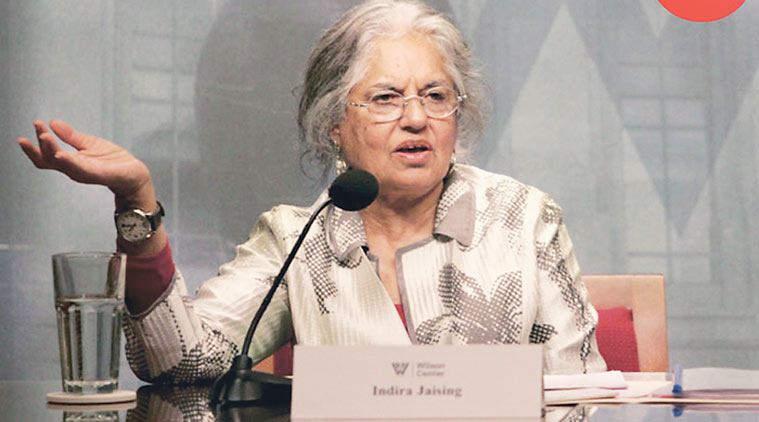
Indira Jaising crosses the line, withdraws her remark, says sorry to the CJI

0

Senior lawyer Indira Jaising was left eating her own words after she crossed the line while arguing for an independent probe in Judge Loya’s death. The heated argument took place in the Chief Justice’s Court, between the country’s top senior lawyers, Harish Salve and Dushyant Dave, Mukul Rohatgi and Indira Jaising.

As per the exchange produced on livelaw, the argument took place when Salve, arguing for the State of Maharashtra, requested that the documents and reports relating to the case be kept confidential. Dushyant Dave, who appeared for Bombay Lawyers Association, also said he’d give the documents in sealed cover to Salve. However, Salve then sought an order from the court to restrict the media from reporting on the case. Indira Jaising, who was supporting Dave, said that this restriction would amount to gag order on the press and the publication and discussion should be allowed.

Salve argued that since this is a sensitive matter, he doesn’t want the media discussing the statements of the lawyers. To that, Dave argued even Tharoor and Chidambaram matters, which are sensitive, are also discussed in media. Justice Khanwilkar asked whether they want to discuss sub-judice matters in the media, Dave retorted saying that the Court cannot stop the nation from discussing even sub-judice matters.

Jaising, too, came to support Dave and said,

‘I will oppose if a gag order is being issued. Two days ago in Padmaavat matter, your Lordship stayed the screening by states citing freedom of speech and expression.’

This angered Chief Justice of India (CJI) Dipak Misra, who reprimanded Jaising for drawing a conclusion and crossing a line. He asked her to apologise unconditionally and withdraw her statement:

“We have not passed any order to that effect. Please expressly withdraw your statement. And please do not make such comments“.

Following this, she said sorry and withdrew her statements. CJI further admonished her and she repeated:

‘I withdraw my statement’.

In the end, the court did not heed to Salve’s request.

Supreme Court makes some ‘interesting’ observations while hearing the Judge Loya case

0

In the recent days, a section of the ‘Indian intelligentsia’ has started seeing a conspiracy in the death of CBI court judge BH Loya, who was presiding over the Sohrabuddin fake encounter case where BJP President Amit Shah was pegged as the main accused.

Judge Loya passed way in December 2014, but three years after the death, in November last year, a magazine named Caravan came out with a sensational story, which insinuated possible foul play behind the death, which was deemed as a natural death. Caravan’s story was later debunked to a large extent by an Indian Express article and an inconsistency, which the IE failed to address, was explored and debunked by us.

Things though refused to mellow down, and the conspiracy theories became so rife that the family of Judge Loya, in a press-conference had to come out and plead to the NGOs, lawyers and politicians to stop harassing them, as the death of Judge Loya, they believed, was natural.

This too didn’t stop the so-called ‘vultures’ and another conspiracy emerged that claimed that this press conference was organised by Amit Shah, and the family was making the statements under his influence. This theory too was debunked.

Things have kept rolling since then, and two writ petitions have been filed in the Supreme Court, which seek an independent probe into the Judge’s death. These petitions were filed by journalist Banduraj Sambhaji Lone and a Congress supporter Tehseen Poonawalla.

This matter came to hearing in front of a three judge bench of Chief Justice Dipak Misra, Justice D. Y. Chandrachud and Justice A. M. Khanwilkar on Monday.

The proceedings were eventful to say the least, and some pretty interesting observations were made during the course of it.

In response to the technicalities of the surroundings of Judge Loya’s death like the ECG reports and the buildup to the fateful day, Justice Chandrachud directed both the sides to file all documents in their possession in a catalogued manner. The ‘sides’ here included senior lawyer Harish Salve, who appeared on behalf of the state of Maharashtra, and senior counsel Mukul Rohatgi, Indira Jaisingh and Dushyant Dave.

Justice Chandrachud very interestingly remarked that they needed to see everything, and couldn’t base their analysis solely on articles which appeared in Caravan, Indian Express, The Wire or Scroll.

Further Dushyant Dave, who was appearing for the Bombay Lawyers’ Association, tried to get the Supreme Court to not allow Harish Salve’s participation in the matter, simply because he appeared for Amit Shah.

This too was shot down by Justicle Chandrachud who asked Dave to not cast aspersions or comment on such matters. Justice Chandrachud commented that it’s for the advocates to comment whether they should or should not appear in a matter.

Harish Salve had also sought for an order which sought that the documents of the matter be not shared beyond the concerned counsels, which interestingly drew a huge backlash from Indira Jaising. She called the request inappropriate and claimed that it amounted to a gag order. She stated that the Supreme Court had recently upheld freedom of expression with regards to the movie Padmaavat and hence the court should not pass such orders which restrict the same.

This drew a stern reaction from the Chief Justice who commented that, “We have not passed any order to that effect. Please expressly withdraw your statement. And please do not make such comments“.

The apex court though finally rejected Salve’s request.

The court has also directed that, similar writ petitions which are pending before the Bombay High Court, be transferred to it. It also instructed that Bombay High Court and other courts to not entertain any identical petitions.

The next hearing in the matter is on February 2.