Home Blog Page 787

‘Make your child anti-India’: Taslima Nasrin shares photo of aid worker wearing shirt with anti-India message in Bangladesh

OpIndia has been widely reporting how domestic and foreign players have been orchestrating and fueling anti-India narratives and sentiments in Bangladesh, especially after the violent ouster of the country’s elected Prime Minister Sheikh Hasina. Strikingly, a picture of an aide worker who is seen wearing a T-shirt with an anti-India message has surfaced on social media. Importantly, a Bangladeshi blogger and activist has confirmed the veracity of this picture. 

(An aide worker in Bangladesh was seen wearing a T-shirt which had anti-India message written on it, while distributing relief material to flood affected persons, thus spreading hatred against India in the Islamic nation)

Incidentally, the picture of the aide worker spreading hatred against India was taken somewhere in a flooded area in Bangladesh, at a time when notorious domestic and foreign players were falsely blaming India for the flash floods in the Islamic nation. In this picture which is now going viral on social media, an aide worker is seen wearing a white-colour T-shirt while distributing water bottles in flood-affected areas. The anti-India inscription written on the back of the T-shirt in Bengali reads, “আপনার সন্তানকে ভারত বিদ্ধেষী বানান!” which translates to “Make your child anti-India.” 

On Sunday (1st September), Bangladeshi author Taslima Nasreen also shared this picture through her social media handles and pointed out how Bangladeshi Jamaat-e-Islami has been peddling anti-India sentiments in Bangladesh. She added that they have been making poor people wear this T-shirt which has an anti-India message written on it. “Teach your child to hate India,” she attributed the text written on the T-shirt saying. While she gave a slightly different translation, the underlying meaning is the same.

She wrote, “Bangladeshi Jamate Islami helping poor people wearing a t-shirt that says ‘teach your child to hate India.’ Islamists ask people to boycott Indian products. Anti India anti Hindu Wahabi Islamists are growing in Bangladesh (sic).” 

She also shared the picture on Facebook where a lot of users probed the veracity of the viral picture with one Bangladeshi citizen finally confirming its veracity, stating that the picture is true. In her FB post, Tasleema Nasreen asked, “Camp Relief Distribution Program! Found this picture. Authentic or fake?” 

In the comment section of her post, some users alleged that the picture was fake as it had spelling errors. Reacting to their claims of spelling mistakes in the post, a few users replied that the mistakes rather proved that the anti-India message was real and not doctored as the one fabricating it would not make spelling mistakes to undo their fabrication efforts.  

Responding to the spelling error claims, Nasreen replied, “So authentic. If the spelling was correct, it would rather be doubtful.” 

However, a Bangladeshi blogger and Secular activist Asaduzzaman Noor confirmed the veracity of the picture and debunked the claim that the picture was fabricated by some IT-cell guys. 

(Commenting on Taslima Nasreen’s FB post that shared the viral picture, a Bangladeshi blogger and activist confirmed its veracity)
(The verified FB account of the Bangladeshi activist)

Commenting on her post, Noor said, “The picture is true.” It is important to note that Noor is a Bangladeshi blogger and activist and his FB account is a verified handle

Furthermore, the same picture was also shared by a Bangladeshi digital content creator on 30th August. Falsely blaming India for the flash floods, he wrote, “Make your child Anti India! Just a small reason, 1 of the rain in Feni over the past 1 week. Not even 5 feet of water is supposed to be. So how did the 2 storey building in Fulgazi / Parashuram submerged? You only let the answer know.”

India has categorically debunked baseless allegations that blamed India for flash floods in Bangladesh, not once but twice

It is important to note here that several Bangladeshis are spreading an anti-India narrative amid the floods alleging that India has deliberately opened the gates of the Dambur Hydroelectric Project in Tripura state. Apart from netizens, several media houses also alleged that India was behind the floods that have shaken Bangladesh currently. However, India has factually debunked these allegations twice.  

India has factually debunked the allegation that flash floods occurred in Bangladesh because India opened the dam in Tripura not once but twice. India has clarified that the gates were not opened as claimed by many including credible Bangladeshi and other nation’s media houses, but the automatic release of water due to heavy rainfall was observed. Floods in Bangladesh have created havoc.

Manipur: Suspected Kuki insurgents fatally shoot a Meitei woman, injure her 8-year-old daughter and three others, bomb dropped using drone

0

Manipur which has been grappling with ethnic tensions and witnessed large-scale violence last year, recorded a fresh round of violence on Sunday (1st September 2024). As per reports, on Sunday afternoon, armed insurgents opened indiscriminate fire and dropped a bomb on a house using a drone. In the attack, they fatally shot a 31-year-old Meitei woman and severely injured her 8-year-old daughter as well as three others. The assailants are suspected to be Kuki insurgents. Reportedly, one police commando was injured in the bombing incident. 

The firing incident took place in Imphal West district which shares a border with the Kuki-dominated Kangpokpi district. According to officials, it all unfolded at around 2 PM near the border between Imphal West and Kangpokpi districts. Notably, Imphal West is dominated by the Meitei community while Kukis are a majority in Kangpokpi.

The deceased Meitei woman has been identified as Ngangbam Surbala. She was hit on her head while her 8-year-old daughter was hit in her right arm. The victims were at their homes when the firing and bombings began. It is said that the assailants opened fire from the nearby hills. 

According to reports, a drone was used to drop a bomb which caused heavy damage to a house. However, no civilian was reportedly injured. It is said that the incident occurred at a place near a Border Security Force (BSF) station. One police commando, part of the reinforcement team, was hit by a splinter of a drone-dropped bomb. 

Kadangband residents said that at least one drone dropped a “bomb” on a house in the area. They have also shared purported visuals of the drone dropping a bomb, while people were seen running to find cover for their safety. However, sources in the security forces said they are yet to look into this claim.

Following the firing and bomb blast incident, the body of the deceased woman was shifted to the Regional Institute of Medical Sciences (RIMS) for post-mortem examination. Her daughter and police officer N Robert (30) were admitted to RIMS while two others are recuperating at Raj Medicity. 

On Sunday, the Police said a woman was killed, and four others were injured when suspected militants launched a gun-and-bomb attack in Manipur’s Imphal West district. 

According to police, the militants fired indiscriminately from hilltop positions towards the low-lying valley areas of Koutruk and neighbouring Kadangband. The Police added that the sudden assault on the unsuspecting village caused widespread panic, forcing many residents, including women, children, and the elderly, to flee to safer areas. 

The Police further stated that security forces, including both state and central units, have been deployed to the area to stabilise the situation.

Following the incidents, the Meitei community blamed the Kuki community. They have claimed that “Kuki terrorists” killed the Meitei woman and injured four others in the recent firing and bomb attack. However, social media users from the Kuki tribes alleged that the Meiteis began firing at Kuki villages in Kangpokpi first. It is pertinent to note that ethnic tensions between both communities had resulted in large-scale violence last year and tensions continue to prevail between both communities. 

The incident comes a day after Kuki-Zo groups carried out protest rallies against Chief Minister N. Biren Singh in the Kuki-Zo dominant districts of Kangpokpi and Churachandpur.

MeToo saga in Malayalam Film Industry: All you need to know on origin, key findings and aftermath of Justice Hema Committee Report on sexual abuse and ‘casting couch’

The Justice Hema Committee Report has opened a pandora’s box for not just the Malayalam Film industry, it has also stirred a demand to undertake similar initiatives for cinema industries in other states including Telugu Film Industry. The shocking findings of the report which was released after a long gap of five years have led to a cascading effect and great ramifications for the Cinema industry. Here is a detailed explainer of the origin, key findings, and the aftermath of Justice Hema Committee’s Report on sexual abuse, the casting couch, the pay gap, and other issues in the Cinema Industry.  

Origin of the Hema Committee Report and the delay in its publication

The Kerala government established the Justice Hema Committee in February 2017 after a heinous case of sexual assault of an actress came to light. Notably, a prominent Malayalam actress was kidnapped, sexually assaulted, and filmed in a moving car. The Investigations revealed that actor Dileep had allegedly orchestrated the attack to “teach her a lesson.” 

After the survivor identified herself on social media, the industry witnessed a major upheaval which led to the formation of the Women in Cinema Collective (WCC). The WCC filed a petition to investigate the challenges faced by women in the Malayalam film industry following the actress’ sexual assault case. Based on their petition, the Kerala government set up a three-member committee. This was headed by retired Justice K. Hema and the committee was named after its head. It also comprised former actor Sharada, and retired IAS officer K.B. Valsala Kumari. It submitted its report to the government on 31st December 2019.

However, the findings of the report were made public on Monday (19th August 2024), five years after it was submitted to the Kerala government as it was claimed that it had a lot of sensitive information which needed to be redacted before releasing it to the public. They believed that publishing the full report would harm the industry. 

It is pertinent to note that it was published after several rounds of legal battles in the High Court. Five Right To Information activists had approached the Kerala State Information Commission (KSIC) for more details on the report. Subsequently, the KSIC decided on 6th July, this year that a controlled report could be released to the petitioners. The original report had 295 pages but 63 pages were redacted before its release under the Right to Information Act (RTI), as they expected widespread repercussions. It was initially scheduled to be released on 24th July, then on 14th August. 

But the Kerala High Court held its release while hearing a plea moved by a Malayalam film producer Saji Parayil, who argued that its publication would violate the right to privacy of individuals (including himself), and possibly expose them to retaliation and harassment. But the High Court dismissed the plea on 13th August and directed the government to publicize the report within a week.


The 63 pages that were redacted had portions that could infringe on the privacy of the individuals mentioned in it, as directed by the State Information Commission (SIC). However, the state government is facing widespread allegations that it is trying to protect the accused and excluded more information than what was recommended.

Major findings of Hema Committee Report

The Justice Hema Committee Report has revealed horrid tales of sexual abuse, illegal bans, discrimination, drug and alcohol abuse, wage disparity, and inhuman working conditions, especially for women. According to the report, the Cinema industry is male-dominated and has become an exclusive Boys’ Club. 

(This is how Justice Hema Committee report start while listing out the findings on sexual abuse and casting couch in Malayalam film industry, Image Source – The New Indian Express)

It has identified at least 17 forms of exploitation experienced by women working in 30 different categories within the industry. According to reports, Several Malayalam female actors and junior artists have accused director Baburaj, actor Siddique, Mukesh, Jayasurya, Maniyanpilla Raju, Edavela Babu, Thulasidas, and CPI-M MLA Vichu Mukesh of sexual harassment, and misconduct. 

The report emphasised that women were being asked to make certain “adjustments” and “compromises” – euphemisms for sexual favours – to secure or retain opportunities. It added, that these two words are very familiar among women working in Malayalam cinema, who “are asked to make themselves available for sex on demand”.  

According to the findings of the report, the Malayalam film industry is under the control of a powerful lobby of male producers, directors, and actors who “dominate other persons working in cinema.” 

It added that “these influential figures could even coerce and threaten the persons who work in ICC to deal with the complaint, in the manner they demand.” The report describes the situation in cinema as “very shocking.”

It also revealed grave concerns regarding the effectiveness of the Internal Complaints Committees (ICC) within the Malayalam film industry stating that the formation of ICCs is not recommended due to several reasons. The most startling discovery was that women who experience sexual harassment or assault frequently choose not to speak up for fear of being branded as “troublemakers” or being shunned by the business.

The government-appointed expert group discussed several embarrassing aspects, including unwanted physical advances made to women in the Malayalam film industry before they even started working and code names for women who would compromise. Testimonies from other women in the industry, who detailed their terrifying experiences, are included in the report. In one incident highlighted in the report, an actress was made to rehearse a scene in which she was hugged by an actor who had previously molested her. The filmmakers took 17 takes to finalize the shot.

These testimonials highlight the widespread culture of insensitivity and exploitation that women in the field face on a daily basis. The study found that the Malayalam film industry has a deeply embedded patriarchal mentality that feeds the myth that women only pursue careers in the business to gain notoriety and fortune, and as a result, they will “surrender” to anything.

Additionally, women actors are denied basic facilities like access to toilets and safe changing rooms even on film sets. They often have to find secluded spots to change or use the bathroom during outdoor shoots, with no access to water or basic facilities, the report added. 

It is pertinent to note the report also highlighted challenges faced by their male counterparts in the film industry. According to the report, several well-known male artists have been subjected to “unauthorised” bans from working for extended periods, often for “very silly reasons.” 

According to the report, these bans are usually a result of artists unknowingly provoking powerful figures within the industry’s influential lobby. Consequently, many men are reluctant or afraid to speak out against the industry’s practices, fearing that any information they provide could jeopardise their future opportunities in cinema.

Repercussions

A Special Investigation Team (SIT) has been formed to conduct a preliminary inquiry into allegations of sexual harassment against a few actors in Malayalam cinema and it consists of senior women police officers. The Kerala High Court has taken cognizance and directed the state government to submit the full report in a sealed envelope.

Around 17 cases have also been filed after the release of the Hema Committee report. These cases have been registered against several big names in the industry, including actor Jayasurya and actor and politician Mukesh. 

Furthermore, the Association of Malayalam Movies Artistes (AMMA) was dissolved on 27th August and its president popular actor Mohanlal, and the other 17 members of the executive committee including Siddique and Edavela Babu also resigned leading to the dissolution of the cinema body. Actor Siddique resigned as General Secretary of the Association of Malayalam Movie Artists after he was hit by sexual assault allegations. He resigned over allegations of sexual assault levelled against him by a female actor.

Major reactions

The Women in Cinema Collective (WCC) which initially petitioned for such a Committee, released an official statement on the very day when the findings of the report were made public. In their statement, they said, “Today, we stand vindicated”. 

An organisation representing film technicians – Film Employees Federation of Kerala (FEFKA) has demanded that the names of the accused mentioned in the Hema Committee report should be made public

While speaking with Matrubhumi, the director and general secretary of the FEFKA, B Unnikrishnan denied the existence of ‘power groups’ in the Malayalam film industry but admitted that the casting couch exists

Unnikrishnan said that it was an ‘undeniable fact’ that some production houses had ‘strong alliances’ with certain directors, writers, and actors to make big films. Unnikrishnan also said that denying the casting couch exists in Mollywood would be ‘denying reality’.

The publication of the Justice K Hema Committee report on sexual misconduct and abuse in the Malayalam film industry has opened a can of worms. Several actresses have come forward with disturbing accounts of the mistreatment they faced at the hands of their various male counterparts in the Kerala film industry. The actresses also came down heavily on their male counterparts for not speaking up on the findings of the Hema Committee report. 

Recently, popular South Indian actress Radhika Sarathkumar made startling allegations. In a recent interview, she said that the ordeals of actresses aren’t limited only to Malayalam cinema but also to the Tamil and Telugu industries. Recounting her own experience, she said that hidden cameras were secretly installed inside the vanity vans on the shooting set of a Malayalam film to record videos of actresses, specifically while they were changing clothes. She asserted that she had personally witnessed male actors watching such objectionable videos on their mobile phones. 

Meanwhile, after maintaining silence for several days, senior actors Mohanlal and Mammootty have finally reacted to the findings in the Hema Committee report.

On Saturday, Mohanlal held a press conference over this issue. While he maintained that the culprits must be punished, he said, “Please don’t kill the Malayalam film industry”. He said that he had not ‘run away’ anywhere. 

After him, another popular star Mammootty also claimed that he stayed mum so far because he wanted AMMA to speak about it first

While the findings of the report have been widely amplified and hailed by the actresses of the Malayalam and other film industries, their male counterparts from the Malayalam Industry have either been accused of giving cold responses or maintaining silence. But ever since, the report exposed the dark underbelly of the film industry in Kerala, actors, and actresses from other industries have also demanded similar comprehensive initiatives in their regional cinema industries. 

Nonetheless, the National Commission for Women (NCW) has asked the Kerala government to submit the full Hema Committee report in a week. Additionally, the Kerala High Court has taken cognizance and directed the state government to submit the full report in a sealed envelope.

#MeToo in Malayalam film industry: Actress Charmila alleges director Hariharan dropped her from a movie for rejecting sexual demands, accuses producer of attempted rape

In another revelation in the sex scandal in the Malayalam film industry, actress Charmila has levelled serious allegations against director Hariharan that he had been putting some deplorable demands before her. The allegations have been confirmed by ex-member Vishnu. She said, “Hariharan asked me to go and question Charmila if she is ready to “adjust” One needs no brains to decipher what that means”. Vishnu says, when this question was popped before her, Charmila refused. And when Vishnu informed Hariharan about Charmila’s stand, her name was axed from the film ‘Parinayam’.

Charmila alleged that director Hariharan asked if she was willing to make an “adjustment” (a euphemism for sex). She stated, “He asked my friend and actor Vishnu if I would adjust. When I said ‘no,’ Hariharan dropped both of us from his film ‘Parinayam’.”

She also recalled a horrific incident from the sets of the 1997 film ‘Arjunan Pillayum Anju Makkalum’, alleging that her colleague was raped and she herself was assaulted. Charmila alleged that producer M.P. Mohanan and the production manager tried to rape her by pulling her saree.

Having acted in over 35 Malayalam films, Charmila shared, “During the 1997 shoot of ‘Arjunan Pillayum Anju Makkalum’, producer M.P. Mohanan, production manager Shanmukhan, and their friends attempted to gang-rape me. I somehow managed to escape from the hotel room. They tried to remove my saree.”

According to a report by Onmanorama, the actress further stated, “They also sexually harassed my assistant, and a male assistant was assaulted. The hotel receptionist where I was staying was involved too. An auto-rickshaw driver saved us. Although I managed to escape, they raped a junior artist working on the film.”

Charmila added, “I have worked in four languages. These issues are mainly in the Malayalam industry.” She explained that she refrained from filing a complaint due to her responsibilities as a mother. Charmila admitted that refusing to meet such inappropriate demands has led to fewer film offers.

Justice Hema Report exposed challenging circumstances faced by women in Malayalam film industry

The allegations by actresses from Malayalam Film Industry have started pouring in after Hema Committee Report. On 20th August, the Kerala government came under heavy criticism for or holding up the release of the Hema committee report, featuring startling information about how women are treated in the Malayalam film industry. The report was made official on 18th August.

This study, which bears the name of the committee’s chair, Justice K. Hema (Retd.), is an important document that highlights the challenging circumstances that women in the film industry face. The committee was established in response to the 2017 sexual assault of a well-known actress, which caused public indignation and prompted calls for structural reform in the business.

The study emphasized the serious obstacles that women encounter in the Malayalam film business, such as pervasive sexual harassment, discrimination based on gender, and an unfriendly workplace. The most startling discovery was that women who experience sexual harassment or assault frequently choose not to speak up for fear of being branded as “troublemakers” or being shunned by the business.

Testimonies from other women in the industry, who detailed their terrifying experiences, are included in the report. A scenario that was particularly unsettling featured an actress who was made to rehearse a scene in which she was hugged by an actor who had previously molested her. The actress suffered severe physical and psychological damage from having to endure 17 takes. Her performance was critiqued by the producer, who failed to recognize or comprehend the emotional agony she was experiencing.

The study emphasized how few basic amenities, like women’s restrooms and changing areas on movie sets, are available to women in the business. The substantial salary gap that exists in the Malayalam cinema industry between male and female actors was also highlighted by the survey.

The committee discovered that the sector frequently rejects women who dare to speak out against harassment or discrimination. They are called “problem-makers,” which negatively impacts their chances of getting a job and makes them feel alone in the workplace. The industry’s culture of backlash against female employees who speak for themselves is a contributing factor to the ongoing harassment and abuse of these workers.

“Height of appeasement politics”: Pralhad Joshi hits back at Tejashwi Yadav for supporting ‘Jumma break’ in Assam assembly

0

Hitting back at Rashtriya Janata Dal leader Tejashwi Yadav over his comments on Assam Chief Minister Himanta Biswa Sarma, Union Minister Pralhad Joshi termed it “height of appeasement politics.”

Joshi asked if the state assembly, or the two houses of Parliament, were the places for offering Namaz.

“Is Assembly, Rajya Sabha or Lok Sabha, the place for offering Namaz? This is the height of appeasement politics…I am a minister and worship some god or goddess on Thursday, then give me rest on Thursday. Does the country run like this? What kind of a method is this, isn’t this foolish?” Joshi told ANI.

This comes after Tejashwi referred to CM Himanta as the “Chinese version of Yogi,” while attacking him over the Assam Assembly’s decision to end the 2-hour Jumma practice on Friday.

“The Chief Minister of Assam deliberately keeps doing acts to harass Muslims, in an attempt to gain cheap popularity and become the “Chinese version of Yogi.” The people of BJP have made Muslim brothers a soft target to spread hatred, attract the attention of Modi-Shah and polarize the society,” Yadav stated.

“People of all religions, except RSS, have a hand in the independence of the country. Our Muslim brothers have made sacrifices in getting the country freedom and as long as we are here, no one can harm them,” he added.

The former Bihar Deputy CM had also accused the Assam CM of seeking “cheap popularity” to stay in the news.

“Assam Chief Minister (Himanta Biswa Sarma) wants cheap popularity and wants to remain in the news…(UP CM) Yogi Adityanath is using bulldozers, and he (Assam CM) is stopping namaz, the country belongs to everyone, there should be peace, but these people are only spreading hatred,” Tejashwi Yadav told ANI.

The Assam state assembly ended the practice of a two-hour adjournment for Jumma Prayers, every Friday that was introduced by the Muslim League government in colonial Assam.

Assam Speaker Biswajit Daimary said that the decision was taken as it had become difficult to hold discussions on Fridays due to a lack of time.

Earlier on Saturday, Assam Chief Minister Himanta Biswa Sarma defended the state assembly’s decision to end the 2-hour break for Jumma prayers, saying that no other state assembly in India has a similar break.

“The decision to end the Jumma break in Assam was also supported by the Congress. There is no such break in Bihar or any other state assembly in the country. I am surprised that people outside Assam are opposing it without thinking,” CM Himanta said in a post on X.

According to the previous rule, the sitting of Assam Assembly on Friday used to be adjourned at 11 am to facilitate Muslim members to go for namaaz, but, as per the new rule, the Assembly will conduct its proceedings without any adjournment for religious purposes.

As per the amended rule, the Assam assembly will commence its proceedings at 9.30 am every day, including Fridays. The order stated that the amendment was done to scrap the colonial practice, which aimed at dividing society on a religious basis. (ANI).

Responding to Yadav’s statement against him, Assam Chief Minister Himanta Biswa Sarma said “Our work will not stop based on the comments of people. Our work is to keep going forward.” 

(This news report is published from a syndicated feed. Except for the headline, the content has not been written or edited by OpIndia staff)

Days after Mamata Banerjee’s ‘Assam will also burn’ comment, Assam TMC chief Ripun Bora quits party, says didn’t get appointment to meet her and Abhishek for 1.5 years

Assam Trinamool Congress President Ripun Bora on Sunday resigned from the party, citing perception of people of the state of TMC being a regional party.

“I thought that from the platform of TMC, we could intensify our fight against the BJP in Assam… But subsequently, I experienced that the people of Assam are not inclined to accept TMC in Assam. The people of Assam view TMC as a regional party of Bengal… No doubt people have very deep respect for Mamata Banerjee. But the people of Assam do not want to accept the TMC. That is why I have decided if the people do not accept it, then how we can intensify the fight against the BJP through TMC… I decided that if I continue in TMC only I will get no result. It is a waste of my time and energy,” Bora said while speaking to ANI.

He further highlighted measures that could be taken by the party, such as need for an Assamese leader at the national level, declaring the residence of Bharat Ratna Dr Bhupen Hazarika at Tollygunge as a heritage site and converting the Madhupur Satra at Cooch Behar into a cultural hub to counter the perception of the people of TMC being a regional party.

“…Assam TMC has great potential but several recurring issues have hindered our progress, including the perception of TMC as a regional party of West Bengal. To counter this perception, we made several suggestions, such as the need for an Assamese leader at the national level, declaring the residence of Bharat Ratna Dr Bhupen Hazarika at Tollygunge as a heritage site and converting the Madhupur Satra at Cooch Behar into a cultural hub,” he wrote in a letter to TMC National General Secretary Abhishek Banerjee.

He revealed that he made numerous attempts to sit down with the TMC’s National General Secretary, Abhishek Banerjee, and West Bengal Chief Minister Mamata Banerjee to address pressing concerns, but his efforts were met with silence. This lack of engagement is also a reason for his decision to resign from the party.

“Despite my repeated attempts over the past year and a half to secure an appointment with you and our Chief Minister Mamata Didi to address these concerns, I have been unsuccessful,” he added.

He stated that the people of Assam are not ready to accept a party from the other state and view TMC as a regional party of West Bengal.

“It has been my honour to serve as the State President of Assam TMC for over two years. I have interacted extensively with people across the state. Unfortunately, the issues mentioned above have led many people in Assam to continue viewing TMC as a regional party of West Bengal. The people of Assam are not willing to accept a party that they perceive as being from another state. In light of these challenges and the lack of an adequate resolution, I feel compelled to make a difficult decision and have decided to dissociate myself from TMC,” he wrote in the letter.

Ripun Bora had joined TMC after leaving Congress party in 2022.

Notably, the resignation of Ripun Bora came just days after Mamata Banerjee triggered outrage in Assam by talking about burning the state, along with other states and Delhi. Addressing a public rally on Wednesday, Mamata Banerjee had warned that the unrest in Bengal could have far-reaching consequences beyond the state.

The West Bengal CM had alleged that PM Narendra Modi is using his party to cause fire in West Bengal over the Kolkata woman doctor rape and murder incident. She had threatened that if Bengal burns, other states including Assam, North-East, Uttar Pradesh, Bihar, Jharkhand, Odisha and Delhi too shall burn. She had said, “Mr. Modi, you’re using your party to cause fire here. If you burn Bengal, Assam, North-East, Uttar Pradesh, Bihar, Jharkhand, Odisha, and Delhi too shall burn! We will topple your chair.”

Assam CM Himanta Biswa Sarma had strongly reacted to her comments, asking how can she dare to threaten Assam. Sarma said, “Didi, how dare you threaten Assam? Don’t show us red eyes. Don’t even try to burn India with your politics of failure. It does not befit you to speak divisive language.” Several other leaders of BJP also condemned Mamata Banerjee for her comments.


(With inputs from ANI)

Fact check: No, BJP did not welcome rape accused of IIT-BHU by cutting cake

Days after the Allahabad High Court granted conditional bail to two accused in the IIT-BHU rape case, social media was rife with disinformation about BJP celebrating their release and welcoming the men by cutting a cake.

One of the leading proponents of fake news was Sayema. The overseas Congress’ social media chief, Avi Dandiya, also peddled disinformation about the ruling political dispensation.

Islamists and social media troll accounts, supporting Congress and the Samajwadi party, made wild claims about the BJP endorsing the bail of the rape accused.

Screengrab of the tweets posted by D-Intent Data

To substantiate their claims, the usual suspects shared an image of one of the accused and alleged that he was having a gala time with BJP workers.

In the said image, the accused’s face could be seen covered in cake. The fake news peddlers claimed that the picture was shot after he was released on bail.

In reality, the viral image is not recent. It was uploaded on social media on 12th July 2021 on the date of the accused Saksham Singh Patel’s birthday. To add to it, Saksham Singh was not granted bail by the Allahabad High Court.

It is indeed true that the two accused in the IIT-BHU rape case, namely, Kunal Pandey and Anand Chauhan, were granted bail by the Allahabad High Court.

While Kunal was released on 24th August, Anand was released on 29th of last month. The third accused Saksham Singh Patel is yet to receive bail.

The trio were members of the BJP IT Cell but were quickly removed from the party after their role emerged in the heinous crime last year. The Yogi Adityanath government promptly acted against them and ensured their arrest.

But this did not stop the politically motivated fake news peddlers from re-sharing an old picture from 2021 as ‘BJP celebrating the release of IIT-BHU rape accused.’

NCPCR calls for action against harassment of students during Hindu festivals, says schools should not ban customary items like rakhi, mehndi, tilak etc

0

The National Commission for Protection of Children Rights (NCPCR) has raised serious concerns relating to the treatment of children in schools concerning Hindu festival celebrations. The NCPCR, in two separate letters dated 8th August 2024 and 31st August 2024, had instructed that immediate action was required from the relevant authorities to stop discrimination and harassment in schools of students during festival seasons. The letters in particular mentioned harassment which students have to face regarding carrying tradition, customary symbols or items like rakhis, mehndi, tilak, etc.

Initial directive to states and UTs

On 8th August, the NCPCR sent a letter to the Principal Secretaries of School Education Departments across all States and Union Territories and urged them to ensure that the schools do not engage in practices that discriminate against students if they were wearing traditional items during the festival season. The letter highlighted that various news reports and observations indicated that some schools were not allowing children to wear rakhis, tilak or mehndi during festivals such as Rakshabandhan.

The commission said that such actions not only cause harassment but also are against the Right to Free and Compulsory Education (RTE) Act, 2009, which prohibits corporal punishment or any form of discrimination in schools. The letter read, “It has been observed by the Commission through various news reports that children are subject to harassment and discrimination by the school teachers and other staff on account of celebration of festivals. It has been noticed that schools do not allow children to wear rakhi or tilak or mehndi in schools during festivals such as Raksha Bandhan and subject them to harassment, both physical and mental.” Notably, similar directives were issued in previous years as well.

Follow-up action against schools in Mumbai

Despite the direct initial instruction issued by the commission, it was found that some schools discriminated against students during Rakshabandhan. Another letter was issued by Priyank Kanoongo, chief of National Commission for Protection of Children Rights, on 31st August 2024 to the Municipal Commissioners of Greater Mumbai and Navi Mumbai addressing the concerns over discriminatory practices. The letter specifically pointed out that schools in Mumbai were reportedly cutting off and discarding rakhis and other religious threads worn by students deeming the act as harassment and a violation of the rights of the children.

The letter noted, “Despite NCPCR’s letter to the Secretaries, Education Department… various Schools in Mumbai are subjecting children to harassment and are cutting away and throwing their Rakhis and other religious threads. It may be noted that as per The United Nations Conventions on the Rights of the Child (UNCRC), children have the right to preserve their identity without unlawful interference.”

Urgent call for compliance and reporting by NCPCR

The commission has called for an immediate intervention by the concerned authorities to ensure that such practices do not happen again in the future. The NCPCR has requested the Municipal Commissioners to take immediate action against the school administrations and staff involved in such actions. Furthermore, the commission asked the authorities to issue clear directions to prevent such incidents in the future. A compliance report has been sought within five days of the issuance of the letter.

West Bengal rocked by 4 sexual assault cases in a day including 2 in hospitals, a patient named Abbas Uddin and a TMC leader among the arrested

Amid the ongoing outrage over the trainee doctor’s rape and murder in Kolkata’s government-run RG Kar Medical College and Hospital, the state of West Bengal has been rocked by 4 heinous cases of sexual assault in a day. As per multiple reports, these cases include the molestation of an on-duty nurse in a government-run hospital in Birbhum, the sexual abuse of a minor girl by hospital staff in Howrah, the rape of a minor girl in Nadia, and the sexual assault of a minor by a TMC Panchayat member in Madhyamgram. Notably, two of the four cases took place in hospitals.

Highlighting four back-to-back heinous cases of sexual assault in a day, the Bharatiya Janata Party has launched a scathing attack on Mamata Banerjee’s government. Taking to X, BJP leader and social media head, Amit Malviya said, “West Bengal is the most unsafe State for women. She is an unmitigated disaster as a Chief Minister and must resign,” as he listed out details of the sexual assault cases reported in a day from the state of West Bengal.

Rauf arrested for sexually assaulting a minor girl in North 24 Parganas; TMC leader Abul Hafeez asks victim’s family to ‘settle the matter’

Tensions erupted in North 24 Parganas’ Madhyamgram area after locals staged a massive protest demanding swift action against a man who is accused of sexually assaulting a minor girl. According to locals, the accused is close to a Trinamool Congress leader, which is why, a TMC leader tried to save him. On Saturday midnight, locals reportedly attacked Trinamool leader Abul Hafeez’s house in Madhyamgram.

As per reports, the outrage was triggered after the TMC leader asked the family of the minor victim to “settle the matter”. Meanwhile, according to the BJP, the accused is a TMC Panchayat member who raped a 7-year-old minor girl studying in class two.

The father of the minor victim said, “The accused is a resident of our village. I could not imagine that he could do such a thing. My daughter, who is nine years old, was coming to my shop from home. At that time he assaulted her. I demand exemplary punishment for him.” 

As per reports, after getting information about the sexual assault of a minor in the Rajbari area of Rohanda panchayat on Saturday night, locals started protesting in front of the home of the accused. The TMC leader who allegedly interfered in this case is the husband of a local panchayat member.

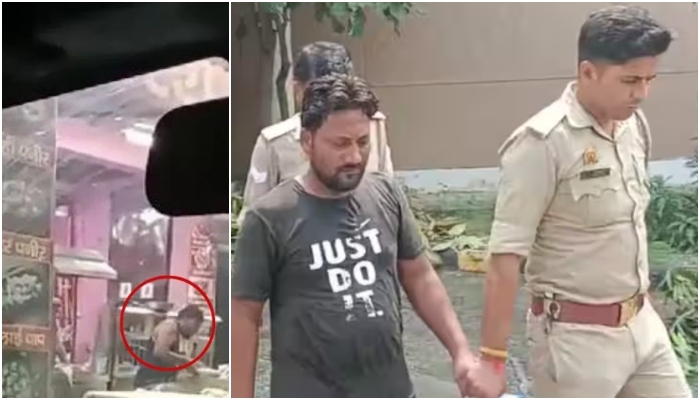
According to Aaj Tak Bangla, the Police have arrested an accused named Rauf for the sexual assault of a minor girl. He has a grocery shop in Madhyamgram. Additionally, the Police also arrested the husband of the local panchayat member who is accused of trying to save the accused. Police arrested the panchayat member’s husband and TMC leader Abul Hafeez on charges of protecting the accused in the molestation case.

Following the massive outrage, police and Rapid Action Force personnel were deployed in the area and tear gas was used to disperse the crowd.

Minor raped in Nadia

According to the information, a man raped a minor girl in Bhajanghat of Nadia’s Krishnaganj. After committing the heinous crime, the accused also threatened her.

The incident took place on Saturday (31st August 2024) evening. It is said that the teenager was returning home after shopping when a neighbour forcibly dragged her into the garden where he raped her. After this, he threatened to kill the minor victim if she told anyone about it. 

However, the victim came home and informed the family about her ordeal. Subsequently, her family lodged a complaint with the police.

Patient Abbas Uddin arrested for molesting an on-duty nurse at a government-run hospital in Birbhum

On Saturday (31st August), the Police arrested a patient named Abbas Uddin for molesting an on-duty nurse at a government-run hospital in West Bengal’s Birbhum district. As per reports, the incident unfolded when the nurse was administering a saline drip to the accused who was brought as a patient to the hospital. When he was admitted, he came on a stretcher due to a high fever.

According to the nurse’s complaint to the police, the accused patient touched her inappropriately while she was attending to him. She added that the accused not only touched her inappropriately but also used offensive language towards her.

Following the incident, the hospital authorities immediately called the police, and the accused patient was arrested. A formal complaint has been lodged with the Ilambazar Police Station, and an investigation is now underway.

Sharing her ordeal, the nurse recounted the incident saying, “A male patient was brought in during the night shift with a fever complaint. As advised by the doctors, I was preparing to administer saline to him when he misbehaved. He touched me and used foul language. We feel unsafe working here due to the lack of proper security. How could a patient act this way?”

As per reports, Dr. Masidul Hasan was on duty at the health center on the night of the incident. 

Sharing further details, Dr. Hasan said, “Around 8.30 pm, a patient named Abbas Uddin arrived from Chotochak village with a fever. He started misbehaving as soon as he arrived. After some clinical examinations, we advised that he be given injections and IV fluids. When the nurse went to administer the saline, the patient behaved violently and molested her by touching her inappropriately. We requested the patient’s family to cooperate, but the patient continued to misbehave. We have reported the incident to the police and the authorities. If no action is taken, we will consider a cease work”.

Minor girl molested by hospital staff in Howrah

OpIndia earlier reported a similar case from a hospital in Howrah. According to reports, a laboratory technician named Aman Raj molested a girl who was undergoing treatment at the hospital premises. Following an uproar over the incident, the accused was arrested by the Howrah police. The victim was identified as a 12-year-old girl, who was admitted to the Howrah District Hospital on Wednesday (28th August) after complaining of chest pain.

The increasing reports of heinous cases of crime against women and minors come at a time when the state is witnessing massive protests over the horrific rape and murder case of a trainee female doctor in Kolkata’s state-run RG Kar Hospital on 9th August. Since then, the Mamata Banerjee government has had massive widespread protests for the failure in the law and order situation in the state and the failure in protesting the doctors, females, and minors.