Home Blog Page 116

CEC Gyanesh Kumar hands over Malda violence case to NIA: Here’s what SC observed, DM and Home Secretary didn’t reach scene, even food and water were denied to judicial officers

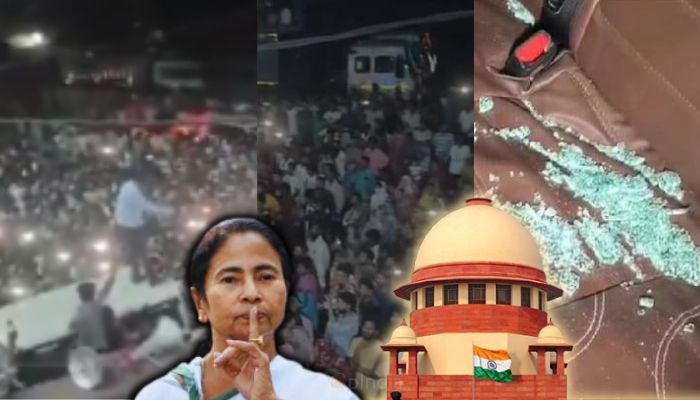
Mockery of democracy has become a routine affair in the Trinamool Congress-ruled West Bengal. On the 1st of April 2026, seven judicial officers, including three women, who were on election duty for the Special Intensive Revision (SIR) of electoral rolls, were gheraoed at a BDO office in the Muslim-dominated Malda district. The Supreme Court observations in the Malda violence case reveal how the judicial officers endured a nine-hour-long horror because of the Mamata Banerjee-led state administration’s nonfeasance.

A Supreme Court bench comprising CJI Surya Kant, Justice Joymalya Bagchi and Justice Vipin Pancholi took sou motu cognisance of the Malda violence after being alerted by the Calcutta High Court CJI. The apex court came down heavily on the West Bengal government and the Malda district administration.

Calculated and deliberate move

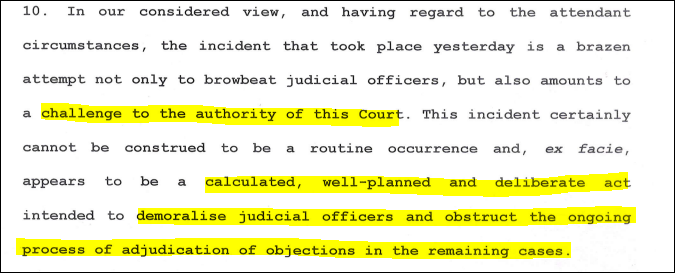
The court noted that the incident was not routine but a “calculated and motivated move” to demoralise the judicial officers and to stop the ongoing process of adjudicating objections in the left-out cases. The court described the incident as a challenge to its authority.

Moreover, the court observed that the targeting of judicial officers, who are, in essence, an “extension of this Court”, is a “brazen attempt not only to browbeat judicial officers, but also amounts to a challenge to the authority of this Court. This incident certainly cannot be construed to be a routine occurrence and, ex facie, appears to be a calculated, well-planned and deliberate act intended to demoralise judicial officers and obstruct the ongoing process of adjudication of objections in the remaining cases.”
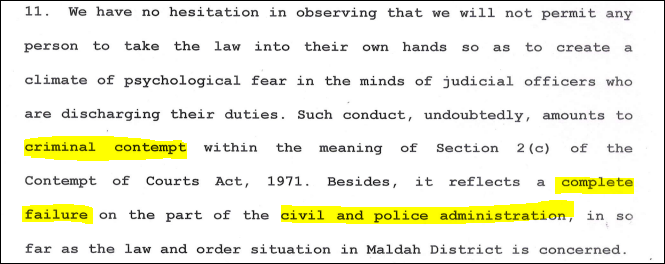
The Bench further observed that such attempts to create psychological fear in the minds of judicial officers to prevent them from discharging their duties, by disrupting law and order, will not be permitted. The court dubbed the gherao and harassment of judicial officers in Malda as a case of “criminal contempt”.

“We have no hesitation in observing that we will not permit any person to take the law into their own hands so as to create a climate of psychological fear in the minds of judicial officers who are discharging their duties. Such conduct, undoubtedly, amounts to criminal contempt within the meaning of Section 2(cl of the Contempt of Courts Act, L97L,” the court said.
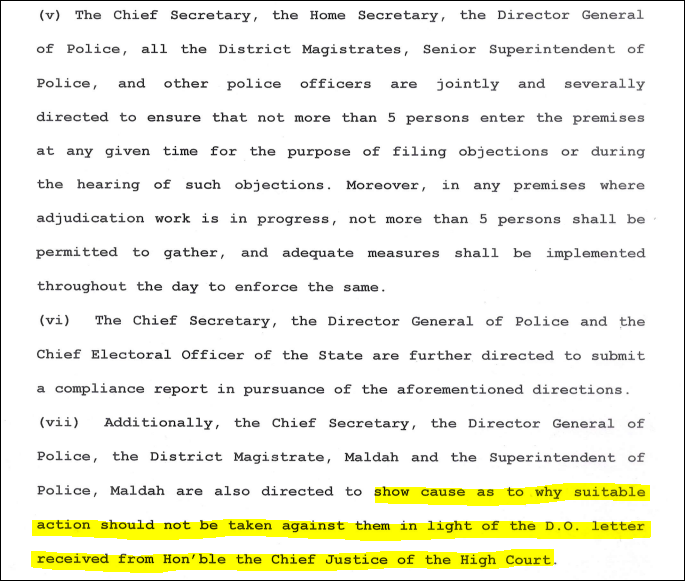
The court further noted that the Malda incident “reflects a complete failure on the part of the civil and police administration, in so far as the law and order situation in Maldah District is concerned.” The Bench also took note of the information provided that the judicial officers were deliberately deprived of even essentials like food and water.

“We are informed that the situation was so dire that even food and water were not permitted to be supplied to the judicial officers. The Hon’ble Chief Justice further pointed out that neither the District Magistrate nor the Superintendent of Police had reached the BDO office where the officers were gheraoed,” the Court stated.

Conduct of administration “highly deplorable”: SC seeks explanation

 The Supreme Court highlighted the failure on the part of the Chief Secretary, the Home Secretary, the Director General of Police, the Collector and the Superintendent of Police in taking effective measures to safely evacuate the gheraoed judicial officers despite receiving information.

“It also pains us to observe that the manner in which the Chief Secretary, the Home Secretary, the Director General of Police, the Collector and the Superintendent of Police have acted is highly deplorable. They owe an explanation to this Court as to why, upon being informed that the judicial officers had been gheraoed at around 03:30 p.m., no effective measures were taken to secure their safe evacuation,” the court said,

“It was incumbent upon the State administration to immediately inform the Election Commission of India and seek deployment of central forces, wherever necessary, safety of the judicial officers,” it added.

Orally, CJI Suryakant said that West Bengal is the “most polarised state” where “everyone speaks in political language”. The court also lamented that it was expected that everyone would welcome judicial officers, since they are court-appointed neutral agents; however, even “they were not spared from attacks”.

Supreme Court issues multiple directives

In the wake of the Malda incident, the Supreme Court issued a set of directives to ensure that “no obstruction or impediment is caused to the ongoing SIR process entrusted to the judicial officers, and that their life, liberty, property, and that of their family members are duly protected under the orders and directions of this Court.”

The top court directed the Election Commission of India (ECI) to requisition “adequate central forces and for their deployment at all places where the judicial officers have been deputed for adjudication of objections under the SIR process.”

In addition, the court ordered that adequate security arrangements must be made at hotels and government guest houses, etc., where the judicial officers and their families are residing. The court also directed the police administration to assess threat perception apprised to them by on-duty judicial officers and take necessary measures accordingly and immediately.

Moreover, the court directed the ECI and the West Bengal government to “take all remedial measures that may be necessary to ensure the safety and smooth functioning of the responsibility entrusted upon the judicial officers.”

The Supreme Court directed the Chief Secretary, the Home Secretary, the Director General of Police, all the District Magistrates, Senior Superintendent of Police, and other police officers to ensure that not more than 5 persons enter the premises at any given time for the purpose of filing objections or during the hearing of such objections. These officers have also been ordered to submit a compliance report.

Pertinently, the apex court has directed the Chief Secretary, Malda DGP, DM and SP to show cause as to why suitable action should not be taken against them.
The most important directive issued by the Supreme Court is to the ECI to entrust an investigation into the Malda judicial officers gherao incident to an independent agency like the Central Bureau of Investigation or the National Investigation Agency (NIA). The court ordered the ECI to file a compliance report while the entrusted probe agency to submit a preliminary report post-investigation.

 CEC Gyanesh Kumar hands over the Malda violence case to the NIA

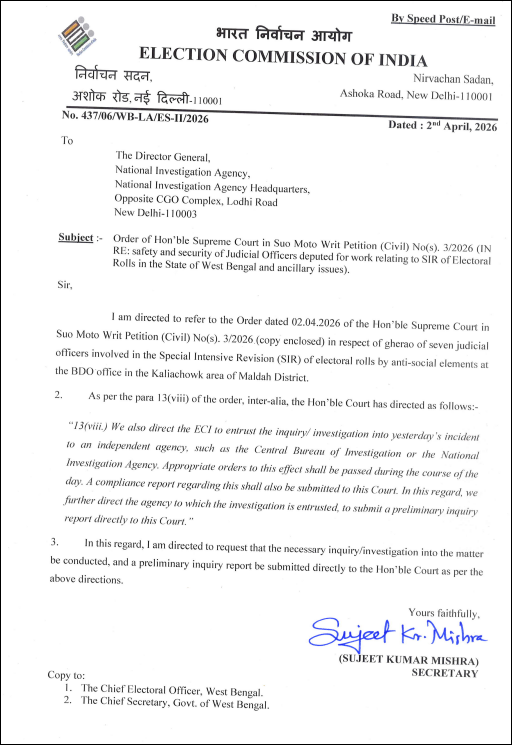
In compliance with the Supreme Court directive to hand over the Malda violence probe to an independent investigation agency, the Chief Election Commissioner CEC) Gyanesh Kumar, wrote a letter to the NIA, entrusting the probe agency to investigate the case.
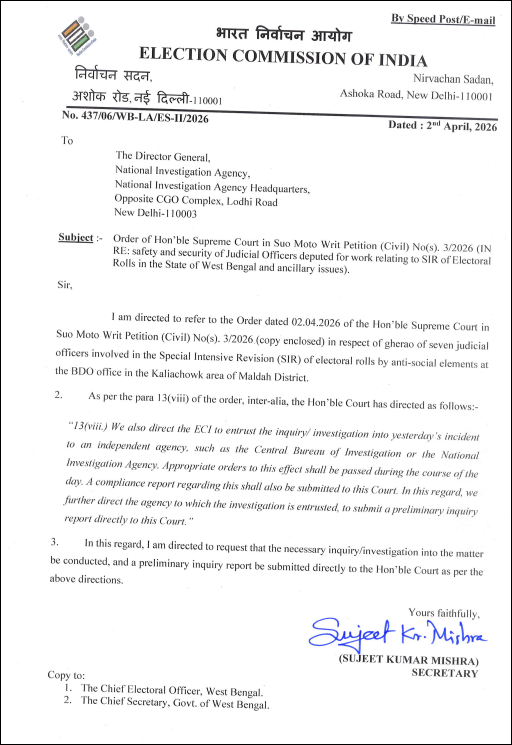
“I am directed to refer to the order dated 02.04.2026 of the Hon’ble Supreme Court in Suo Moto writ Petition (civil) No(s). 3/2026 (copy enclosed) in respect of the gherao of seven judicial officers involved in the Special Intensive Revision (SIR) of electoral rolls by anti-social elements at the BDO office, the Kaliachowk area of Maldah District. In this regard, I am directed to request that the necessary inquiry/investigation into the matter be conducted, and a preliminary inquiry report be submitted directly to the Hon’ble court as per the above directions,” the letter signed by ECI Secretary, Sujeet Kumar Mishra, reads.
Background of the Malda Violence case

The case relates to an incident in West Bengal’s Malda district, where seven judicial officers, including three women judges, were gheraoed by a huge mob on Wednesday evening (1st April) for over 9+ hours. The officers were working at the Block Development Officer (BDO) office in Muslim-dominated Kaliachak as part of the Special Intensive Revision (SIR) of electoral rolls.

The trouble began around 3:30 pm, when a large group of people gathered outside the office, protesting the deletion of their names from the voter list. The crowd blocked the premises, preventing the officers from leaving for several hours.
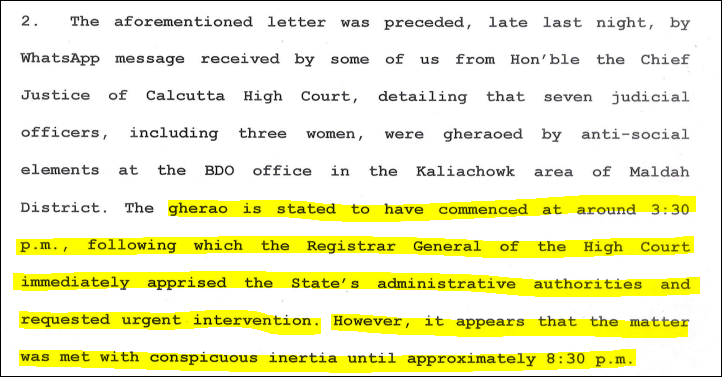
According to the court, the situation remained tense well into the night, with little immediate response from local authorities. It was only after the intervention of senior officials, including the Director General of Police and the Home Secretary, that the officers were finally rescued after midnight.

However, even after their release, the officers were not completely safe. As they were heading back, their vehicles were attacked with stones and sticks, raising serious concerns about their security. “Shockingly, when the judicial officers were released around midnight and were returning to their respective places of stay, their vehicles were pelted with stones and attacked with bamboo sticks and bricks,” the Supreme Court noted.

The Supreme Court stated that the Malda violence incident would have a chilling effect on the judicial officers who have been working tirelessly, without availing any leave.
Walk of shame: Maharashtra police adopts a fresh strategy to deal with crime and its glorification, the approach has already yielded positive results in UP

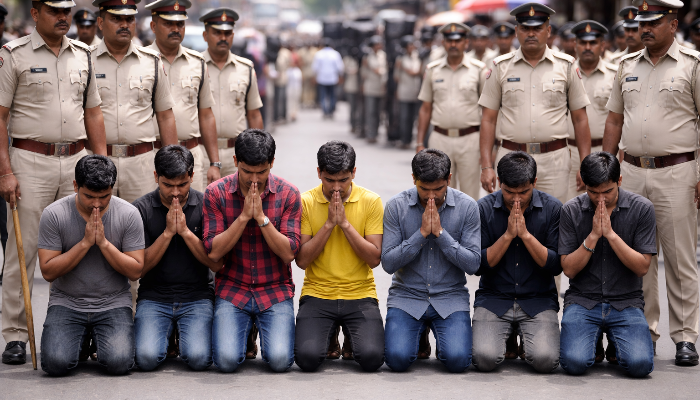
The police under the government of Maharashtra, presided over by the Bharatiya Janata Party, has discovered an intriguing approach to addressing criminal activities that could be both effective and advantageous. The authorities have begun not only to arrest and subject criminals to legal proceedings but also to publicly shame them. Such scenes routinely unfold outside the Nashik Police Crime Branch office, reported The Indian Express.

The slogan “Nashik zilla kaydyacha balekilla (Nashik district, a fortress of law and order)” is stated as an accused is taken out, sometimes hobbling or held up by cops on either side and told to face the cameras. It has occurred several times during the past six months, including in presence of media and it is now taking place in other places as well. The measure has motivated police in other regions to address the offenders in a similar manner.

Some persons were captured apologising on video for creating reels that glorify gangsterism outside the Mumbra police station in Thane. They were accompanied by police personal and “Thane zilla kaydyacha balekilla (Thane district, a fortress of law and order)” was declared as the new slogan.

The local police in Akola have been employing the same method to post the before-and-after footage of the perpetrators, likewise announcing, “Thane zilla kaydyacha balekilla (Thane district, a fortress of law and order)” as the fresh motto. An official expressed, “While we would take action against those involved in such reels earlier, the way the video is shot and the balekilla reference is from Nashik police.”

Nashik sets the trend with an even-handed approach

Nashik Commissioner Sandeep Karnik initiated the trend and disclosed that the accused had come up with the phrase. A group of young people had called Nashik a “fortress of crime” in one of the earliest videos which gained traction on social media. Afterwards, the police apprehended them and flipped the meaning of their remark.

“This is where we got the slogan from. Henceforth, anyone arrested in such crimes was made to say Nashik zilla kaydyacha balekilla. That this city is a fortress of law and order,” he voiced while talking to the media house. The individuals who undergo this “walk of shame” in Nashik include a wide variety of accused ranging from street-level criminals and youths charged with celebrating crime on the internet to those with political links such as former corporator and Republican Party of India (Athawale faction) leader Prakash Londhe along with his sons.

Notably, even BJP functionary Mama Rajwade was not spared in a strong message outlining impartial and unbiased action. The self-proclaimed godman Ashok Kharat, who is facing accusations of sexually exploiting multiple women, was recently subjected to the same. For locals and the police, this represents prompt, exemplary justice for the state’s fastest-growing urban centres during the last ten years, with manufacturing hubs in locations including Satpur and Ambad.

A limited selection of these videos was posted on the official Instagram account of the Nashik Police, which boasts approximately 70,000 followers, as per IE’s review of over 50 videos. Nonetheless, many of these originated from private accounts and local news channels. Most of the footage depicted the accused outside the Crime Branch office and in some cases they are seen kneeling, holding their ears and expressing remorse while chanting the slogan.

Several videos follow a before-and-after structure. The crime is illustrated as a reel in the initial segment, while the accused is shown being taken into custody, apologising and referring to the city as “a fortress of law and order” in the second.

What is the purpose of this move

Nashik, similar to other areas, has witnessed the extensive impact of social media with youngsters sharing videos that frequently promote local gang culture or criminal behaviour. Hence, the police commenced a crackdown to stop this. Furthermore, Chief Minister Devendra Fadnavis visited the city after multiple killings and ordered Karnik to take tough measures against outlaws regardless of their political ties. Additionally, police introduced a helpline to encourage people to report offensive material or antisocial acts

Karnik pointed out that reels created by criminals were influencing impressionable minds. “In some reels youngsters are seen putting up rap songs which have lyrics glorifying street crime. We want youngsters who may otherwise be influenced by such elements to see what happens to them eventually. We asked our cyber police to trace people who were in these reels and registered an offence in cases that are dire,” he informed.

“These people were arrested, told to delete the particular video and upload new ones where they are seen saying how they were wrong in uploading such videos and saying Nashik zilla kaydyacha balekilla. When people see local politicians from any party, who otherwise try to exert their influence and indulge in criminal acts, fold their hands in these videos and call Nashik city a law-and-order fortress, the common man feels good,” the senior official asserted.

Maharashtra emulates the path of Uttar Pradesh

The significant transformation in law and order in Uttar Pradesh has been one of the highlights of the saffron government. The state, which was once a haven for gangsters and mafia due to political patronage, has an extraordinary shift in handling crime and its perpetrators since Yogi Adityanath was appointed as chief minister. Many criminals have chosen to voluntarily surrender, renounce the illegal path and even leave the state.

Thus, it is not surprising that the Maharashtra police has drawn lessons from a similar playbook in dealing with the problematic elements in society. The Uttar Pradesh police have been displaying offenders in the streets of the state to serve as both an example and a warning to others engaged in similar activities.

Amir Zaidi, a leader of the Samajwadi Party, was booked for sexually abusing a Hindu girl and pushing her to embrace Islam in February. Afterwards, he was arrested and police ushered him barefoot through crowded town crossings. “Sir, I made a mistake, I will not look at another girl,” the accused was heard assuring with folding their hands.

He encountered her when she was 16 years old, following her father’s death in 2013 and exploited her vulnerability. He recorded explicit images and videos of her, which were subsequently used to blackmail her into complying with his demands. He even threatened her fiance with murder.

A case was submitted against Zaidi and his three aides based on the victim’s complaint under the sections relating to rape, criminal intimidation and the applicable provisions of the Protection of Children from Sexual Offences (POCSO) Act, the Information Technology (IT) Act and the Uttar Pradesh Prohibition of Unlawful Conversion of Religion Act. According to Ghatampur police, Zaidi is a repeat offender with previous allegations related to the Goonda Act, intimidation and assault.

Similarly, 12 history-sheeters were paraded within the confines of the Chandaus Kotwali in Aligarh last month. Officer Satyaveer Singh indicated that there are 65 such individuals registered in their jurisdiction and they are required to report to the police station on various days to participate in an attendance parade each month.

Singh stressed that they are under close monitoring and warned that any form of crime or disorder would not be tolerated. He also added that the fight against crime and criminals is going to continue relentlessly. The same destiny awaited 10 offenders in Gorakhpur.

On 27th October, a violent confrontation transpired between two rival gangs due to a shared dispute at the Aktahwa Bridge in Pipiganj. The members of group assaulted their adversaries with sticks and clubs, leading to 7 injuries. The police were notified and promptly arrived at the location, however, the violators escaped the scene while discharging firearms. Afterwards, 10 accused from “AK-47” and “Red” factions were nabbed and paraded prior to their court appearance. The Gorakhpur authorities proceeded to catch at least 21 accused.

Conclusion

Uttar Pradesh police have distinctly set a precedent for countering crime alongside criminals, and Maharashtra has started to pursue the same route. It is a fact that combating crime takes persistent effort, but the BJP governments have definitely provided a leading example with their strategies, which could significantly contribute to deterring such sinister entities and influence other states.

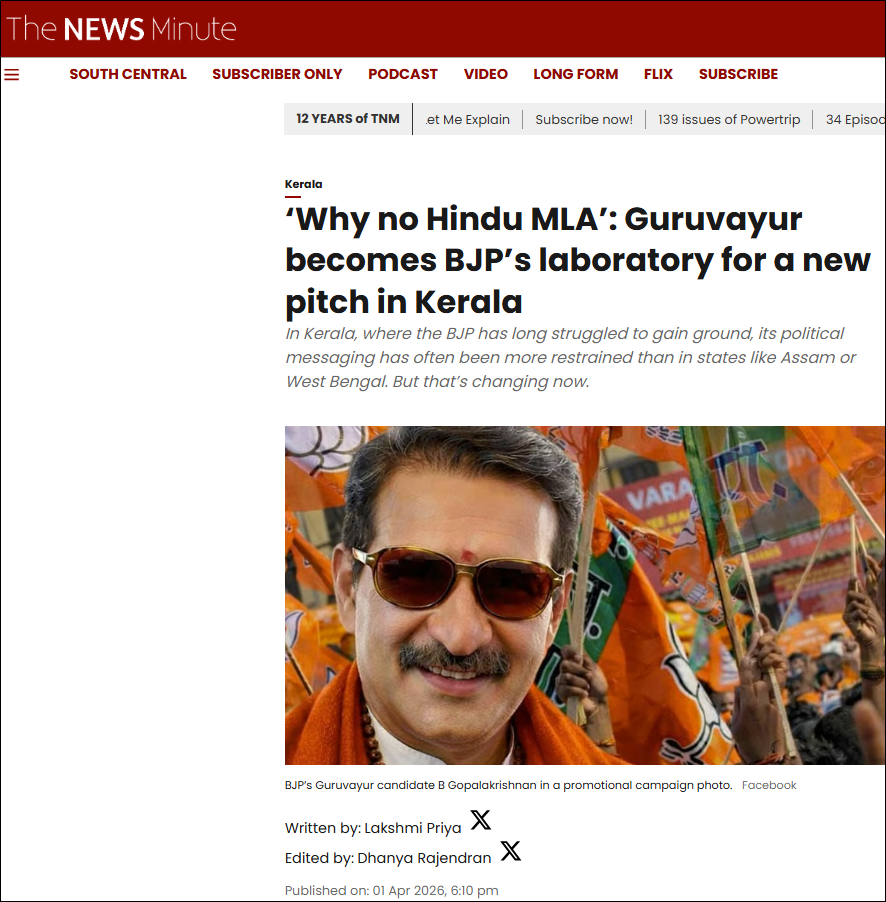
‘The News Minute’ runs propaganda article trashing BJP for asking people of temple town in Kerala to elect Hindu MLA: Read how the portal had been rationalising Hindu exclusion

Kerala, which has historically seen a power switch between the LDF and UDF, is witnessing a notable rise of the BJP ahead of the state assembly elections. As the BJP intensifies efforts to gain ground in the politically tough terrain, the leftist media is alarmed and is resorting to its usual tactics, painting the party as ‘communal’ for its pro-Hindu stance. In this vein, The News Minute recently interviewed B Gopalakrishnan, a lawyer and BJP candidate from the temple town of Guruvayur, and framed his pitch to voters to elect a “Hindu MLA”, as some sinister ‘laboratory experiment’, ‘promoting enmity’, ‘divisive’ “Yogi Adityanath-type projection.”

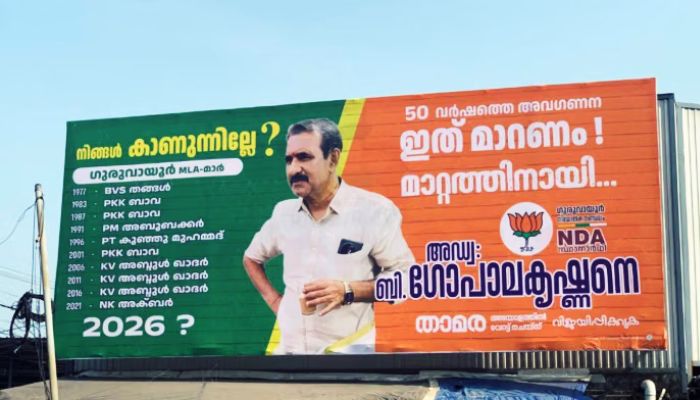
The News Minute’s chagrin is rooted in a flex board, featuring BJP’s B Gopalakrishnan, a list of MLAs from 1977 to 2021, who were all Muslims, and a question: “Are you not seeing this?” The BJP’s messaging is urging voters to change this “50 years of neglect”. In March this year, Gopalakrishnan was booked after CPIM lodged a complaint accusing him of making a communally sensitive statement.

“Why doesn’t Guruvayur, an international pilgrimage centre, have a Hindu MLA? I have been called on by Guruvayurappan to rescue the land from this half-century-long imprisonment in the hands of temple looters and temple-opposers. Why don’t the Left or Right fronts field a Hindu MLA?” Gopalakrishnan had said in a campaign video.

After CPIM approached the police and Congress knocked on the door of the court, the BJP leader doubled down and said, “Does Guruvayur have an MLA who can stand at the Guruvayur Temple and say that they believe in Guruvayurappan? Instead, there is the MLA who says lighting lamps is haram, or that the Guruvayur Temple is a myth. I will raise Hindu issues, and I don’t care if I face charges for that.”

In the article titled, “‘Why no Hindu MLA’: Guruvayur becomes BJP’s laboratory for a new pitch in Kerala”, The News Minute laments that while BJP has adopted a rather ‘secular’ approach in Kerala, in sharp contrast to its approach in poll-bound Assam or West Bengal, Gopalakrishnan’s overtly pro-Hindu poll messaging and invocation of religious imagery, particularly, posters featuring him wearing Rudraksh beads and saffron attires, as problematic.

While TNM persistently portrayed Gopalakrishnan’s “Hindu MLA” pitch and assertion that the temple town is lacking development since the Muslim MLAs there lacked faith in the historic Guruvayur Temple, as communally charged and divisive, when the BJP leader claimed that the present CPIM MLA NK Akbar allegedly said that lighting lamps is haram, The News Minute quickly defended the Islamic belief.

“For clarity, there is no publicly documented instance of Guruvayur MLA NK Akbar stating that lighting a lamp in a temple is ‘haram’. While Islamic theology discourages idol worship for adherents, that does not translate into opposition to the religious practices of others,” the TNM article published on 1st April, reads.

Contrary to TNM’s assertion, Islamic ‘theology’ indeed mandates opposition to idol worship and other rituals of polytheists like Hindus, and destruction of idols.

Moving ahead, it is indeed a fact that since at least the 1970s, there has been no Hindu MLA from Guruvayur, the religious-cultural heartland for Hindus. The News Minute article acknowledges this history but somehow finds a BJP leader highlighting it as communal messaging, even though it is a mere publicising of facts. If the pattern was reversed: no Muslim MLA in a Muslim-majority seat for decades, every ‘secular’ party and leftist media outlet would have dubbed it systemic exclusion of one religious community.

Not to forget, just last month, a group of Muslim organisations in Rajasthan submitted a representation to the Congress party, seeking Rajya Sabha candidature for 2020 anti-Hindu Delhi Riots accused mastermind Umar Khalid, arguing that Muslims in the state lack political representation. When Muslims believe that they can and should be represented by Muslim politicians only, and political parties heed such demands, nobody has a problem, but when a BJP leader played the same card in Kerala, the same tactic became divisive, communal, and whatnot.

While the onus of presenting evidence about the incumbent MLA NK Akbar’s alleged “lighting lamps is haram”, indeed lies on BJP’s Gopalakrishnan, the repeated fielding of Muslim candidates by both LDF and UDF in a Hindu-majority constituency, where economy and culture revolve around the worship of Shri Krishna, indicates a deliberate neglect of Hindus to appease Muslims.

Although The News Minute’s “Yogi-style” sneer reveals its own bias, the deliberate downplaying of BJP candidate’s campaign raising local issues like water, sanitation, pilgrim infrastructure, and corruption, etc, and overemphasising his “Hindu MLA” pitch and unapologetic expression of his religiosity in poll campaign, comes across as an attempt to portray Gopalakrishnan as a fringe element and not a serious leader with a vision.

It is particularly amusing that leftists find nothing problematic in ‘secular’ parties consolidating the Muslim votebank, but when the BJP attempts Hindu vote consolidation, it becomes a ‘divisive’ communal tactic. The News Minute contrasts it with the BJP’s “moderate, secular approach, including Christian outreach”, as if outreach to Hindus is the anomaly.

It is notable that the Chavakkad Taluk, which encompasses Guruvayur, has a 54% Muslim population, compared to a 42% Hindu population, with Christians comprising the rest, as per the 2011 Census.

BJP leader Gopalakrishnan cited a massive rally held by Kanthapuram AP Aboobacker Musliyar near Chavakkad and said that, only two kilometres away, there was a Hindu Kumbh Mela, yet none of these leaders went there.

 “But just two kilometres away, there was the Kumbha Mela, which was a Hindu religious gathering. If these leaders are truly democratic and secular, they should attend to that as well. But they didn’t. They refused to go. Why? For appeasing a particular community? Why avoid Hindu events? If you are truly secular, you should engage with all communities equally,” the BJP candidate from Guruvayur said.

However, The News Minute dismissed Gopalakrishnan’s argument as ‘evasive’ and attempted to broaden the discussion into a wider narrative about selective secularism and political bias. If questioning why the Hindu cultural heartland of Guruvayur did not have a single Hindu MLA in 50 years, and wearing Rudraksh beads and saffron clothes, is turning a constituency into a ‘laboratory’, then other constituencies where Hindus have faced consistent political neglect should also be turned into such laboratories.

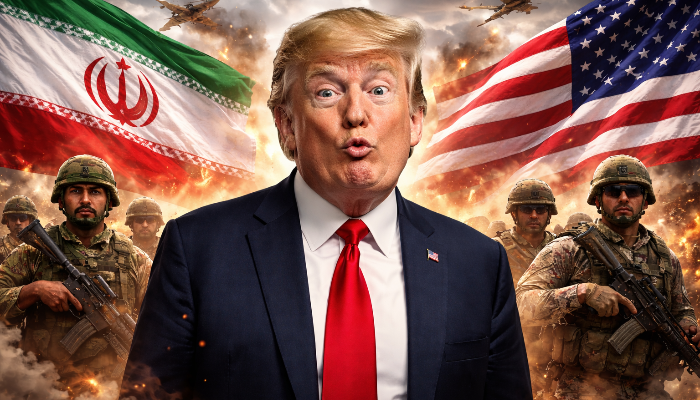
Personal jab at French President, ridiculing British warships, invoking Pearl Harbour and more: US President Donald Trump’s shocking conduct during the Iran war

“You may love them or hate them, but they are impossible to ignore,” United States President Donald Trump, recognised for his outrageous remarks that vary from offensive to ludicrous and unintelligible, embodies this expression. The habitual offender has remained unperturbed despite the onslaught of criticism and backlash directed at him for his peculiar antics that are unbecoming of his position. Diplomatic standards have also failed to induce him to filter his thoughts before speaking, as even heads of other states are not immune to the awkwardness and discomfort stemming from his absurd statements.

Trump is clearly not accustomed to exercising restraint and persists in a consistent display of his uncanny behaviour, a trait unfit for a world leader. He has regularly exhibited an extraordinary disregard for diplomatic wisdom and discourse, ranging from commenting on the personal life of British royal family, telling German Chancellor Friedrich Merz that D-Day was “not a great day” for his country to declaring Canada as the 51st state of America and labelling Spain as part of the geopolitical bloc, BRICS (Brazil, Russia, India, China and South Africa).

Therefore, it would be equally unreasonable to expect him to modify his conduct during critical global matters such as the present tensions in West Asia. If nothing has dissuaded him thus far, why would the ongoing conflict be capable of accomplishing the impossible? As a result, he has continued the tradition of similar utterances, much to the astonishment and bewilderment of others.

Trump’s wild dig at French President Emmanuel Macron

On 1st April (Wednesday), the 79-year-old Republican leader criticised NATO (North Atlantic Treaty Organisation) partners for their unwillingness to back the United States in its confrontation with Iran and made fun of French President Emmanuel Macron while taking a personal jab at his wife, Brigitte Macron.

“We didn’t need them, but I asked anyway,” he stated at a lunch event at the White House and mocked, “I call up France, Macron, whose wife treats him extremely badly. He still recovering from the right to the jaw.” Trump was alluding to footage from May 2025 that purportedly showed Brigitte pushing the French president’s face during a trip to Vietnam. The clip was later dismissed as an element of disinformation attempt.

“And I said, Emmanuel, we’d love to have some help in the Gulf even though we’re setting records on knocking out bad people and knocking out ballistic missiles. We’d love to have some help. If you could, could you please send ships immediately,” Trump mentioned.

“No no no, we cannot do that, Donald. We can do that after the war is won,” he imitated a French accent to quote Macron and insisted, “I said, no, I don’t need after the war is won Emmanuel.” Afterwards, Trump ominously conveyed, “So, I learned about Nato, it won’t be there if we ever have the big one, you know what I mean by the big one,” without elaborating.

Interestingly, he left many with their jaws dropped when he was heard extolling Brigitte’s appearance during his state visit to France in 2017. “You’re in such good shape,” he remarked, pointing towards her during a visit to the historic Hotel des Invalides in Paris. He reiterated this observation to her husband and then turned back to the French First Lady, complimenting, “Beautiful.” Trump was accompanied by his wife, Melania.

Trump’s weirdly intense admiration for JD Vance’s weight loss

Trump praised his vice president’s weight loss, branding him a “perfect-looking specimen,” amid an Eastern lunch. He scanned the East Room seeking the latter, who was directly in front of him, where he is seated during such programs, in the audience.

Trump eventually spotted JD Vance and lauded, “He’s lost weight. He got a little thinner. I’m looking for a heavy-set gentleman, and now I find a perfect-looking specimen,” eliciting curiosity because of the odd flattery.

“I’ll tell you a story. A friend of mine, he’s a businessman, very, very, very top guy. Most of you would’ve heard of him. Highly neurotic, brilliant businessman, seriously overweight, and he takes the fat shot drug,” Trump claimed in May during his much-publicised plans to decrease medication expenses for Americans.

He cited his unnamed friend to suggest that the medication costs $88 in London, in contrast to $1,300 in New York. “He’s not talking about me,” Vance had quickly interjected at the time.

Trump describes NATO as “paper tiger” and “cowards”

Trump has persistently demonstrated his discontent with NATO for refusing to participate in the Iran dispute. He displayed frustration at the refusal of these allies to send warships to help end the blockade of the “Strait of Hormuz,” which has caused interruptions in the global supply of fuel and high prices.

Trump termed the defence coalition a “paper tiger” and indicated that the prospect of the US exit from its membership is now “beyond reconsideration.” He shared similar sentiments in the past.

“I think that NATO made a terrible mistake when they wouldn’t send a small amount of military armament, when they wouldn’t send just even acknowledge what we were doing for the world and taking on Iran,” the president stressed while addressing the Future Investment Initiative Priority Summit in Florida on 28th March. He previously referred to NATO as “cowards” for not siding with Washington.

Trump has charged NATO with always continually to assist the US, despite its continuous support and the investment of hundreds of billions of dollars for their protection.

Trump derides the military strength of the United Kingdom

Trump dubbed British warships “toys” in his newest jab at the NATO nations for their decision to abstain from fighting in Iran. “We had the UK say, this is three weeks ago, we’ll send our aircraft carriers, which aren’t the best aircraft carriers, by the way. They’re toys compared to what we have. But they said we’ll send our aircraft carrier when the war is over. I said, Oh that’s wonderful, thank you very much. Don’t bother. We don’t need it,” he asserted during a cabinet meeting at the White House.

“Now they all want to help. When they’re annihilated, the other side is annihilated, they said we’d love to send ships,” Trump added. He earlier conveyed that he asked Britain for two aircraft carriers, which Prime Minister Keir Starmer first refused before agreeing to provide. Nevertheless, 10 Downing Street disputed that a request was submitted or turned down.

Trump jokes about the attack on Pearl Harbour

A meeting between Trump and Japanese Prime Minister Sanae Takaichi took an unpleasant turn when he joked about the Pearl Harbour World War II attack in reaction to queries about the Iran war. The shocking moment happened on 19th March during a news conference in the Oval Office, when a reporter questioned why the US did not notify allies, including Japan prior to commencing strikes on Iran.

Trump responded that the choice was made for the purpose of surprise and then added, “Who knows better about surprise than Japan? Why didn’t you tell me about Pearl Harbour,” as Takaichi stopped smiling, seemed to widen her eyes, inhaled deeply and leaned back in her chair in visible unease.

Japan is well acquainted with Trump’s loudmouth as he compared the US assault on Iran to the bombings of Hiroshima and Nagasaki, which claimed the lives of nearly 140,000 people. “That hit ended the war. I don’t want to use an example of Hiroshima, I don’t want to use an example of Nagasaki, but that was essentially the same thing,” he argued last year, earning strong condemnation from the country for the bizarre justification of the nuclear attack.

If they rise, they rise: Trump on gas prices, appears nonchalant over deaths of US service members

Trump maintained that US military operations were his top priority and that he was not worried about rising gas prices brought on by the escalating Iranian standoff. “I don’t have any concern about it. They’ll drop very rapidly when this is over, and if they rise, they rise, but this is far more important than having gasoline prices go up a little bit,” he stated while talking to Reuters.

He illustrated a similar indifference in an interview with Time Magazine, where he answered “I guess” when questioned whether Americans should be concerned regarding domestic attacks connected to the war. “But I think they’re worried about that all the time. We think about it all the time. We plan for it. But yeah, you know, we expect some things. Like I said, some people will die. When you go to war, some people will die,” he reaffirmed.

“We have three, but we expect casualties, but in the end, it’s going to be a great deal for the world,” Trump likewise mentioned to NBC News following the reports of the first three US fatalities during the military operations. “And sadly, there will likely be more (deaths) before it ends. That’s the way it is. Likely be more. But we’ll do everything possible where that won’t be the case,” he conveyed in a video afterwards, sparking criticism for his callous attitude in relation to the critical issue.

Trump terms the US involvement in Iran as a “performance”

Trump spoke with Jonathan Karl of ABC News and lauded his decision to declare war on Iran along with how happy he was with himself. “I hope you are impressed. How do you like the performance? I mean, Venezuela is obvious. This might be even better. How do you like the performance,” he asked.

Karl clarified that the people were genuinely anxious about what might happen next, to which Trump retorted, “Forget about next. They are decimated for a 10-year period before they could build it back,” offering valuable insight into his self-serving perspective.

Conclusion

The aforementioned even fail to touch upon the vast barrel of Trump’s erratic opinions, which breach every diplomatic norm. He is already involved in an embarrassing spat with Iran, where he insists that the latter is begging for a ceasefire and negotiations, only to be rebuffed by the Iranian regime. Furthermore, the “peacemaker” who desired a Nobel Prize for his “efforts” to establish ceasefires between hostile nations seems to be even more audacious in times of strife, when restraint should be exercised instead of such aggression or obnoxiousness.

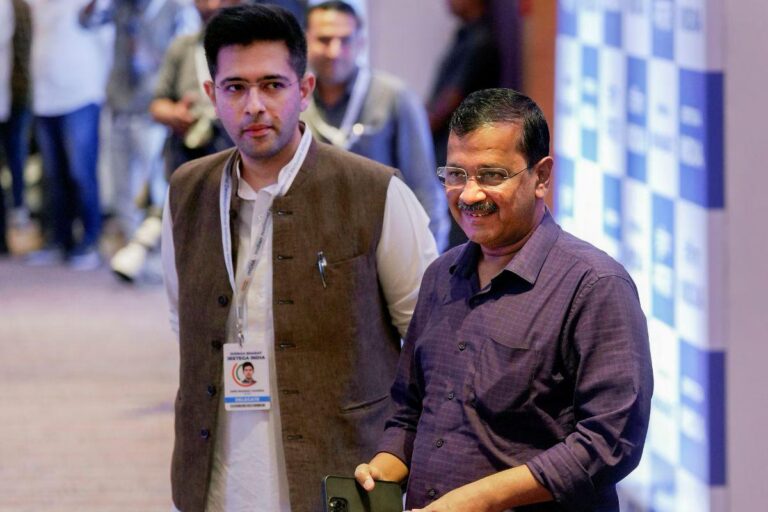
AAP removes Raghav Chadha as Rajya Sabha deputy leader: How Chadha’s ‘growing clout’ challenged Arvind Kejriwal-led AAP’s power structure

In politics, sudden demotions are rarely administrative; they are almost always political. The Aam Aadmi Party’s decision to remove Raghav Chadha as its deputy leader in the Rajya Sabha, coupled with the extraordinary step of asking the Chair not to allot him speaking time from the party’s quota, is not routine reshuffling. It carries the unmistakable imprint of internal discomfort, perhaps even insecurity.

On paper, the move is procedural. AAP has written to the Rajya Sabha Secretariat proposing Ashok Mittal as the new deputy leader and seeking formalisation at the earliest. But politics is not played on paper; it is played in subtext. And the subtext here is loud.

Raghav Chadha is not just another MP, but neither is his rise entirely organic or beyond criticism. Alongside his growing visibility, Chadha has frequently jumped on the bandwagon of attacking the Centre and his critics at every available opportunity, often aligning with AAP’s broader political strategy of confrontation and playing victimhood when convenient. Yet, despite toeing this line, he now finds himself being sidelined.

Perhaps, Chadha’s rise threatened the AAP’s power structures.

Unlike many party functionaries who operate strictly within the leadership’s shadow, Chadha has successfully managed to put up a facade of an independent voice in Parliament, not weighed down by AAP’s brand of nasty and vindictive politics. To this end, he spoke on issues that resonated beyond partisan lines: menstrual hygiene, grassroots democracy distortions like the “sarpanch pati” phenomenon, and even the gig economy. His decision to spend a day as a delivery partner also cast him as an MP willing to talk on issues concerning vulnerable sections of society. It was political messaging of a kind that AAP once thrived on: performative concern.

And that is precisely where the problem may lie.

Because in tightly controlled political ecosystems, independent visibility can quickly be interpreted as a threat.

AAP, despite its origins as an anti-establishment movement, has increasingly shown traits of a centralised command structure. Decision-making, messaging, and political positioning have become heavily leader-centric. In such an environment, a leader who begins to command attention on his own, especially in national forums like Parliament, can unsettle internal equations.

Chadha’s trajectory over the past few years fits that description. He has emerged as one of the party’s few parliamentary faces untouched by scandal so far, a factor that has helped him expand his appeal beyond AAP’s traditional support base. His interventions were not limited to attacking political opponents; they often addressed systemic issues, giving him a broader appeal.

That kind of positioning, while beneficial for a party in expansion mode, can become inconvenient if it begins to shift internal power balances.

And here lies the more uncomfortable question: has Chadha’s rise begun to cast a shadow on the very leadership that built the party?

For years, Arvind Kejriwal has been the undisputed face of AAP, the central axis around which its politics, messaging, and electoral strategy revolve. From the anti-corruption movement days to forming a government in Delhi, Kejriwal cultivated not just a leadership position, but a personality-centric political brand. At various points, his ambitions were not confined to Delhi; they extended to the national stage, with clear signals that he envisioned himself as a potential Prime Ministerial contender.

In such a framework, the emergence of a young and independent parliamentarian like Raghav Chadha presents a paradox.

Despite being loyal to AAP and its ideology, Chadha finds himself shunned by the party.

Chadha’s growing visibility, especially in Parliament and national media, has the potential to dilute the singularity of Kejriwal’s positioning as AAP’s primary face. Unlike many second-rung leaders who derive their relevance entirely from proximity to the top leadership, Chadha has begun to command attention on his own terms. Issues raised by him were seen as those he felt individually and not what AAP represented.

For a leadership model that thrives on centralised authority and a clearly defined “face,” this can be unsettling.

The decision to not just remove him from a leadership role but also to restrict his speaking opportunities is particularly telling. Parliamentary speaking time is political capital. It determines visibility, relevance, and influence. By asking that Chadha not be allotted time from AAP’s quota, the party is effectively curbing his ability to remain a prominent voice in the Upper House.

This is not mere sidelining; it is containment.

If one were to read between the lines, it begins to look less like organisational restructuring and more like a pre-emptive move to ensure that no alternative power centre begins to emerge within the party. In political ecosystems dominated by a single towering figure, the rise of any other leader can often trigger defensive responses, often in the form of demotion. It also explains why so many prominent political figures have eventually left AAP.

Chadha’s removal bears the hallmarks of such a moment.

The elevation of Ashok Mittal, a relatively low-profile figure compared to Chadha, further reinforces this reading. It suggests a preference for predictability over prominence.

None of this conclusively proves intent. But politics is rarely about explicit admissions; it is about patterns. And the pattern here, a rising leader being stripped of both position and voice, aligns too closely with classic political containment to be dismissed as a coincidence.

For Raghav Chadha, the message is clear: visibility without central approval has limits.

For Arvind Kejriwal, if this reading holds, it reflects a familiar dilemma in personality-driven politics, the challenge of nurturing leadership without diluting one’s own dominance.

And for AAP, the episode may well mark a subtle but significant shift: from being a party that once claimed to empower new voices, to one that appears increasingly cautious of them. Because when a new leader begins to “steal thunder” in a system built around a single face, the response is rarely applause.

More often than not, it is the quiet, calculated clipping of wings.

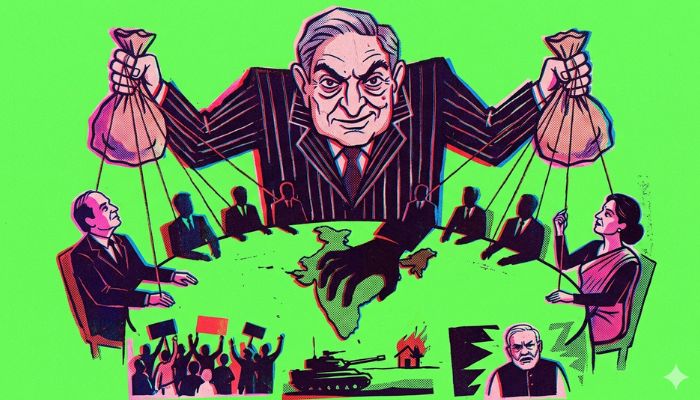
The Soros Boardroom and India’s shadow diplomats: A network worth examining

The International Crisis Group (ICG) portrays itself as a noble enterprise: a globally known conflict prevention think tank with offices on five continents, staffed by former leaders of state, seasoned diplomats, and high-minded intellectuals. Its website, crisisgroup.org, features a Board of Trustees that reads like a who’s who of world foreign policy elites. However, a close look at who sits on that board and who funds the company raises a number of legitimate concerns.

Shivshankar Menon, India’s National Security Advisor under Prime Minister Manmohan Singh from 2010 to 2014, and Nirupama Rao, India’s Foreign Secretary and later Ambassador to the United States during the UPA era, are two names among the 47 trustees selected from more than 30 nations that should cause any student of recent Indian diplomatic history to pause. George Soros, the founder of Open Society Foundations, and his son, Alexander Soros, the Deputy Chair of its Global Board, join them on that same board. There is no conspiracy here. This is merely a public record, and public records frequently give rise to uncomfortable questions.

The Soros factor

One must first understand George Soros’s public remarks toward India to comprehend the significance of these board memberships. In January 2020, Soros pledged $1 billion to combat nationalism worldwide at the World Economic Forum in Davos, citing India as the biggest and most frightening setback. He stated that Prime Minister Narendra Modi was creating a Hindu nationalist state. He predicted that the Adani group would significantly weaken Modi’s hold on power and intervened in India’s domestic political discussion during the Munich Security Conference in February 2023. India’s External Affairs Minister, S Jaishankar, publicly referred to him as ‘an old, rich, opinionated’ person interfering with sovereign countries. As early as 2016, the Indian government had actually put Soros’s Open Society Foundations on a watch list.

In 1994, Open Society Foundations gave the ICG $200,000 in seed money. In April 2022, the organisation announced that OSF granted it a $20 million grant to support its conflict prevention mission. Soros co-founded the ICG, and his family’s foundation continues to be one of its key sources of funding; it is more than just a platform in which he takes part. Because of this, the question of who shares that boardroom with the Soros family is no longer just a matter of institutional membership.

Shivshankar Menon: The NSA who chose his platform

During his tenure as Prime Minister Manmohan Singh’s National Security Advisor from January 2010 to May 2014, Shivshankar Menon was regarded as one of Singh’s most dependable aides. Menon has been vocal in his criticism of the government that followed his patrons ever since he left office.

Menon said that India was ‘in violation of our international commitments,’ that the Citizenship Amendment Act had caused India to be isolated globally, and that even long-standing allies had become critical during a public event in 2020. He went on to claim that India had hyphenated its image with Pakistan as a religiously driven and intolerant state, a description that would have been unusual from an official in office but seemed acceptable from a man currently serving alongside George Soros on an international board. He voiced concern about the repeal of Article 370, which many Indians believed to be a discriminatory clause that denied minorities, Dalits, and Kashmiri women equal rights.

The trend is consistent: a former NSA who previously oversaw the country’s most sensitive security brief now uses his reputation on international forums to support viewpoints that are quite similar to those that a worldview supported by Soros would deem acceptable. Alignment can be observed without claiming coordination. And the most straightforward question is this: which direction did that alignment flow during the UPA years, when Menon wielded great control over India’s strategic decisions?

Nirupama Rao: The diplomat and the ceasefire narrative

In 2024, Nirupama Rao, a former Foreign Secretary and the country’s first female ambassador to China and spokeswoman for the Ministry of External Affairs, became a member of the ICG Board of Trustees. She is now firmly in the Soros family’s institutional network thanks to that board appointment.

Given the current situation between the two countries, many people found Rao’s post on X startling, ‘The women of India and Pakistan need to deploy our ingrained common sense and suggest ways forward in our relationship.’ A women’s caucus is necessary. Instead of accusing one another, we should consider the future with composure and reason. for the benefit of our kids. The sentiment may come across as well-intentioned. However, keep in mind that it was posted during a time when India was still processing the blood of 26 civilians killed in Pahalgam by terrorists with ties to Pakistan, when Operation Sindoor was still fresh in the country’s memory, and when the Indian government had maintained a firm stance of no talks without accountability. It does not seem like statesmanlike moderation for a former foreign secretary to publicly advocate for cross-border women’s caucuses with Pakistan at this time. It seems like pressure, the kind that erodes determination.

Then, on February 23, 2026, Rao shared her most recent article on X, writing Managing crises in the absence of dialogue. Today, political limitations, a harsher regional environment, and strategic mistrust all influence India-Pakistan ties. Grand diplomatic breakthroughs are unlikely in such circumstances. Instead, calibrated steadying mechanisms, quiet barriers that manage risk, prevent miscalculation, and keep intense animosity contained even when communication is frozen, become crucial. X Critics claim that the framing that the relationship must be managed and bounded through back channel safeguards is the exact reasoning that kept India in constant contact with a Pakistan that, during the ten years she and her colleagues were in office, never fulfilled a single counterterrorism commitment. Dialogue evolved from a tool to a destination. And now, from her ICG boardroom, she is selling the same framework again.

The architecture of influence

The current government in India has not held back when identifying this phenomenon. The BJP has contended, supported by solid evidence, that a web of foreign-funded institutions, intellectuals, and media proxies strives to soften India’s strategic stance, internationalise its domestic affairs, and undermine an elected government’s mandate. This is dismissed by critics as delusional. However, pattern recognition and delusion are not the same thing.

Shivshankar Menon and Nirupama Rao held the top positions in India’s foreign and security apparatus during the UPA decade, which is being closely examined for the results it produced. A Pakistani policy based on repeated discussions yielded no accountability for cross-border terrorism. An institutional culture in the foreign policy establishment that frequently seems more at ease justifying India’s behaviour to the West than explaining the West’s double standards to India.

The current leadership has shifted its stance, sometimes controversially, always assertively. Contested decisions include the revocation of Article 370, the CAA, the strong reaction to Pahalgam, and the rejection of regular third-party mediation on Kashmir. However, these are the decisions of a government with a wider democratic mandate than India has seen in thirty years.

 Conclusion

All of this does not prove any wrongdoing. Both Shivshankar Menon and Nirupama Rao are successful diplomats with illustrious careers. It is not criminal to serve on an international board. It is not treason to disagree with the existing leadership.  

Institutions, however, have ideological weight. Alignments are reflected in boardrooms. The least a curious citizen can do is take notice when two of the most powerful individuals from a period of Indian foreign policy now sit on the same governing body as a man who has publicly stated his intention to oppose Indian nationalism, and when their public interventions regularly contradict the most consequential choices made by the current government.

The International Crisis Group is a legitimate organisation. The queries it poses are not. In a democracy, the people have the right to inquire about who influences the perspectives of those who once influenced their fate, as well as who provides funding for the establishments where these discussions take place.

Jharkhand: Muslims pelt stones at Ram Navami procession in Dhanbad, police tie Hindus with rope and parade them like criminals, NHRC issues notice

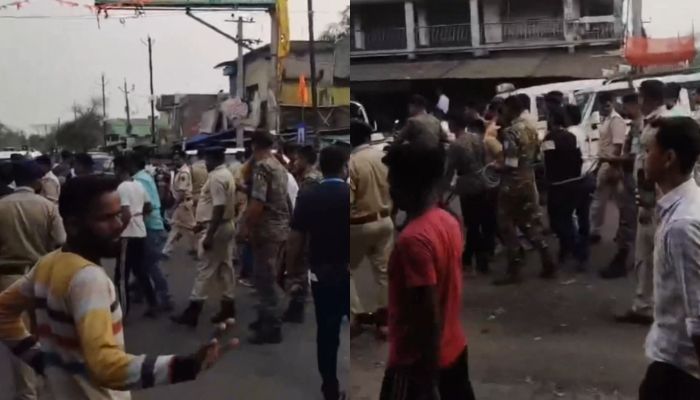
On 1st April, a video surfaced on social media showing a Hindu organiser of a Ram Navami procession in Dhanbad being tied and paraded by the police along with other detainees following a clash that broke out after Muslims pelted stones.

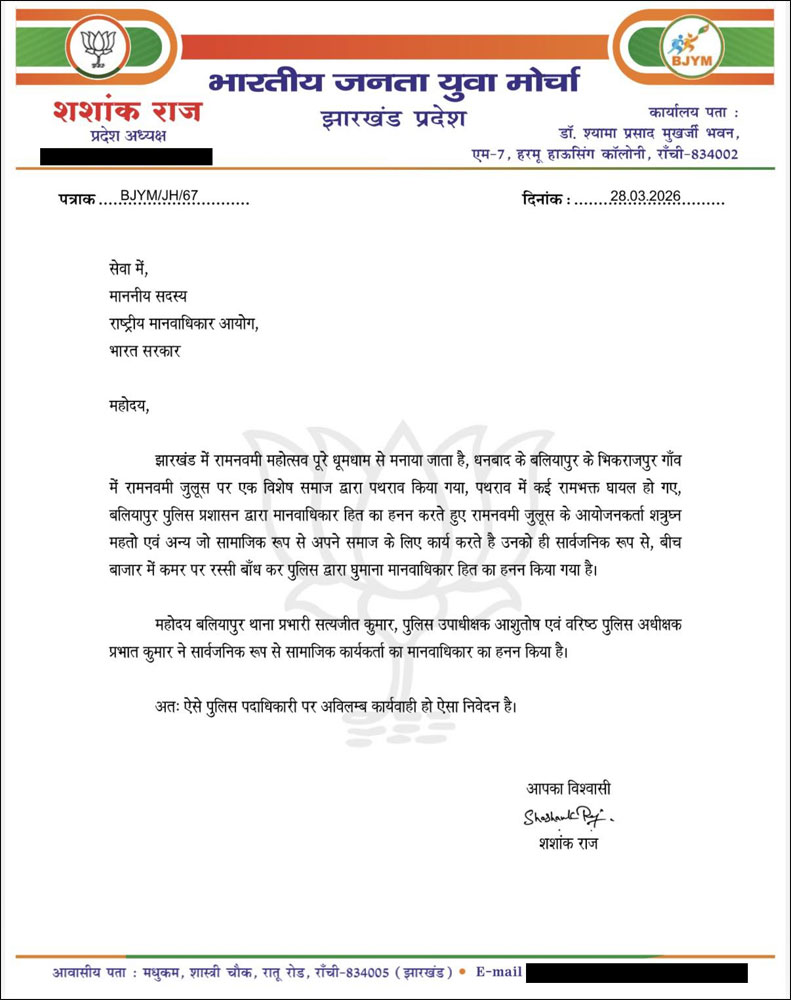
A complaint in the matter had been filed a few days earlier by Bharatiya Janata Yuva Morcha district president Shashank Raj on 28th March before the National Human Rights Commission.

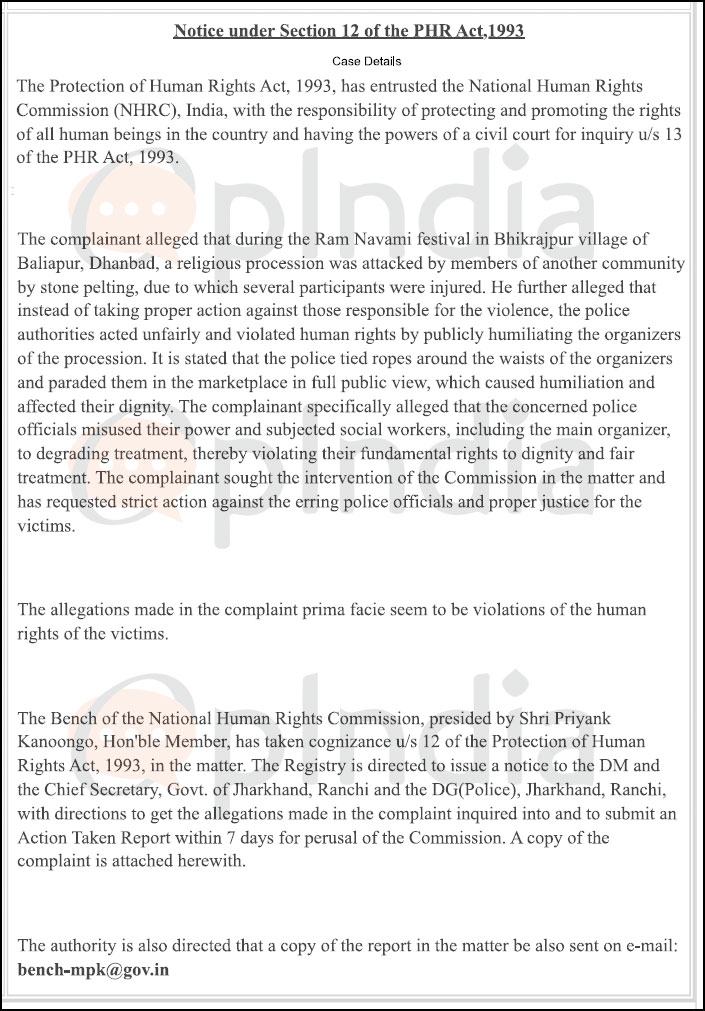
According to the notice accessed by OpIndia, NHRC observed that the allegations prima facie indicate a human rights violation and issued a notice to the Chief Secretary and Director General of Police of Jharkhand, seeking an action taken report.

According to the complaint, the religious procession in Bhikrajpur village of Baliapur was attacked by Muslims. They pelted stones on Hindu devotees, leading to injuries. The incident escalated into a clash, following which persons from both sides were detained by the police.

Allegations against police action

In his complaint, Shashank stated that instead of taking action strictly against those responsible for the violence, the police subjected Hindu organisers and participants to degrading treatment. He asserted that the organisers, including Shatrughan Mahato, a social worker, were tied with ropes around their waists and paraded publicly in the marketplace.

Source: Shashank Raj/Facebook

He termed this act as a violation of human dignity and an abuse of power by the police. He further stated that individuals who were engaged in organising the religious procession and social work were treated like hardened criminals in full public view.

What the complainant Shashank Raj told OpIndia

OpIndia spoke to Shashank Raj, President of BJYM Jharkhand and the complainant in the matter. He reiterated the allegations made in the complaint and questioned the conduct of the police.

He said that members of the Muslim community pelted stones on devotees participating in the Ram Navami procession, leading to the clash. He added that while people from both sides were taken into custody, the manner in which Hindu organisers were treated raised serious concerns.

NHRC takes cognisance, issues notice

Taking note of the complaint, NHRC Chairperson Priyank Kanoongo stated in a post on social media that a complaint had been received regarding stone pelting during the procession and the subsequent police action in which Hindu devotees and organisers were allegedly tied with ropes and humiliated.

Source: NHRC

The NHRC has issued notices to the Chief Secretary and Director General of Police of Jharkhand, seeking a detailed report on the matter. The authorities have been directed to submit an Action Taken Report within seven days.

UK launches independent probe into Pakistani Grooming Gangs after decades of institutional failures: Read how previous probes failed and why new inquiry is announced

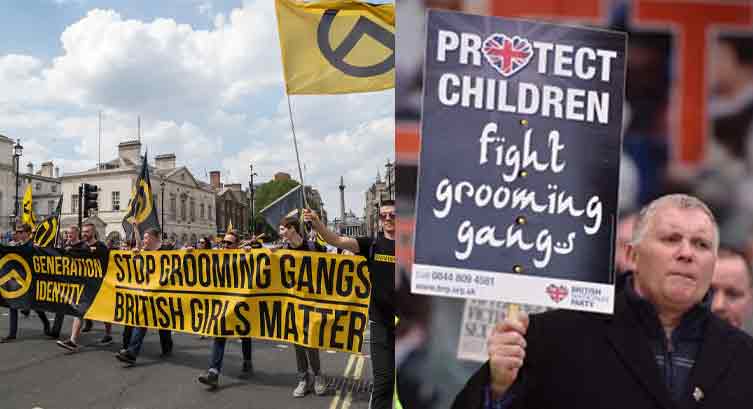
The British government has announced a statutory independent inquiry into the Pakistani grooming gangs, which targeted and sexually exploited thousands of minors across the country. The inquiry panel, headed by the former Children’s Commissioner, Anne Elizabeth Longfield, will, inter alia, examine how factors such as ethnicity, religion and culture of the perpetrators and the victims influenced the offending patterns and institutional response to the group-based exploitation.

To maintain transparency and provide regular updates relating to its work, the public hearings to be organised by the inquiry will be livestreamed, and their transcripts will be published after each hearing. The findings of the inquiry will be published progressively instead of being published altogether in a final report. The inquiry has a maximum period of three years. till March 2029, and a budget of £65m to conclude their investigation.

Talking about the independent inquiry, Longfield said that it intends to address the systemic failures which led to victims of child sexual abuse being disbelieved, dismissed or blamed. “Children across England and Wales were and are sexually abused and exploited. When they asked for help, they were too often disbelieved, dismissed or blamed. That is the reality this inquiry exists to address,” Longfield said. “Victims and survivors have every right to ask whether this inquiry will be any different from those that came before. My answer is this: where we can, we will publish our findings as we go, not in a single report years from now. There will be no opportunity for institutions to quietly manage what we find. We will follow the evidence wherever it leads. We will not flinch from uncomfortable truths,” she added.

On December 9, 2025, the Home Secretary, Shabana Mahmood, published the draft terms of reference of the inquiry, laying down the scope of the inquiry, and announced the name of Baroness Anne Elizabeth Longfield as the inquiry panel’s chairperson. The panel includes two other panellists, Zoë Billingham CBE, a former Inspector at His Majesty’s Inspectorate of Constabulary and current Chair of Norfolk and Suffolk NHS Foundation Trust, and Eleanor Kelly CBE, the former Chief Executive of Southwark Council. The panel consulted with victims and other stakeholders on the draft terms of reference, and the final terms of reference, prepared in agreement with the Home Secretary, were published on March 31, 2026. The final terms of reference will be laid before the Parliament on 13 April 2026, when the inquiry will start its work.

    Scope of operations of the inquiry panel

    As per the terms of reference published by the inquiry, it will look into the failures of institutions, including the police, local authorities, health services, social care services and schools in tackling grooming gangs in England and Wales, while focusing on the experiences of victims and survivors during and after abuse. The inquiry aims to scrutinise a wider (and non-exhaustive) range of organisations with an extended time frame for issues that it can cover, from 1 January 1996 to 31 March 2029. A separate inquiry into group-based child sexual abuse in Scotland will be established by the Scottish Government.

    The inquiry will have the power to summon witnesses to give evidence and organisations to produce any documents. The panel can refer to criminal conduct by professionals to Operation Beaconport, the national policing operation launched last year to review hundreds of previously closed investigations. The panel will conduct local investigations in areas where significant response failures have been identified with respect to child sexual exploitation by grooming gangs. Oldham has been confirmed among the first such areas where the investigation will be conducted. The terms of reference will be laid down before the Parliament on 13th April.

    Previous investigations into Pakistani grooming gangs

    After several cases of organised child sexual abuse by grooming gangs primarily comprising Pakistani men, and the failure of public authorities came to light in areas like Derby, Rochdale and Oxford, several local-level inquiries into the organised crime were conducted. In July 2014, the then Home Secretary Theresa May announced a non-statutory inquiry panel to look into how authorities responded to the incidents of organised sexual exploitation by these grooming gangs. Following objections by the victims, the inquiry panel was upgraded in February 2015, under the Inquiries Act 2005 and was conferred the power to compel witnesses.

    In March 2015, a statutory inquiry, the Independent Inquiry into Child Sexual Abuse (IICSA), was established to examine cases of organised child sexual abuse across England and Wales. The IICSA published its final report, containing 20 recommendationsin October 2022, including improvements in data collection and the maintenance of records relating to cases of child sexual abuse, setting up separate Child Protection Authorities for England and Wales, stricter background checks for staff working with children, mandatory reporting of child sexual abuse, victim support and legal reforms. In May 2023, many of the IICSA recommendations were accepted by the government, but none were implemented. Meanwhile, many local investigations were carried out into the organised sexual exploitation, but they proved inefficient as they were limited in scope and powers.

    In July 2024, the Oldham Council unanimously approved a motion for the council’s chief executive to write to the Home Secretary requesting a Home Office-led Public Inquiry into Child Sexual Exploitation in the borough of Oldham. However, the request was rejected by the Minister for Safeguarding and Violence Against Women and Girls, Jess Phillips. Subsequently, the issue came to be discussed widely by the public and the media at the national and international levels.

    In January 2025, the then Home Secretary, Yvette Cooper, told the House of Commons that none of IICSA’s recommendations had been implemented. Cooper made two announcements: first, that the government would create a timeline to recommend the IICSA implementations, and second, she directed Baroness Louise Casey of Blackstock to conduct a rapid national audit of the scale and nature of gang-based exploitation across the country. In April 2025, the government published the time-table of the implementation of the IICSA recommendations.

    What led to the announcement of the national inquiry

    In the rapid national audit report published in June 2025, Baroness Louise Casey highlighted that the authorities were reluctant to act in cases of gang-based sexual exploitation due to the ethnicity of perpetrators. As most of the accused were Pakistani Muslims, police feared that they will be accused of racial bias if any action was taken, and chose to ignore the cases.

    It was in response to Baroness Casey’s national audit that the government decided to establish a national inquiry to address the gaps in the previous inquiries, such as the rule of ethnicities and cultural backgrounds of the victims and perpetrators and to make recommendations for a stronger legal framework, better data collection and maintenance, and improved coordination between authorities.

    According to Yvette Cooper, Baroness Casey’s national audit had not recommended “another overarching inquiry” on the model of IICSA, but had instead recommended a time-limited inquiry with a more specific purpose “to challenge what the audit describes as continued denial, resistance and local wrangling among local agencies”.

    Organised sexual exploitation of minors by Pakistani grooming gangs in the UK

    According to the official figures, it is estimated that nearly 19,000 minors in England were sexually groomed in 2019 alone. Reportedly, the local authorities in England have identified around 18,700 suspected victims in 2018-19, up from 3,300 five years ago. The highest rates of child grooming victims in Britain were reported in areas including Birmingham, Lancashire, and Bradford.

    In 2015, the Birmingham Mail, West Midlands Police published a Child Sexual Exploitation Problem Profile, which detailed the similarities in the modus operandi of the on-street and online grooming gangs there with those in Rotherham. The 2015 report found that out of the 75 grooming suspects identified, a large proportion are from a Pakistani ethnic background (62%), 12% are White and 5% African Caribbean.

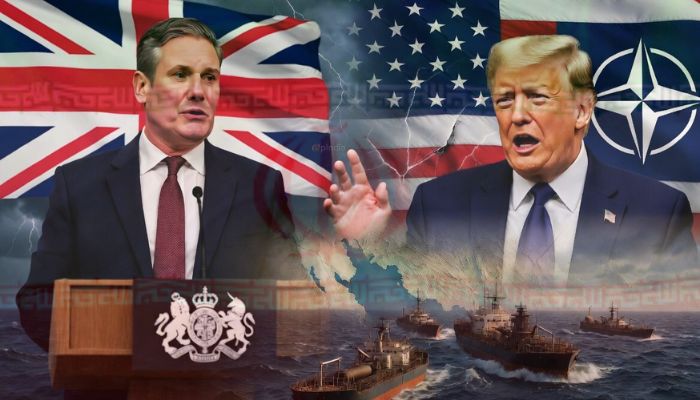
    ‘This is not our war’: Keir Starmer announces UK will not be dragged into Iran war while Trump threatens to pull out of NATO, calls it ‘paper tiger’

    On the 1st of April 2026, Keir Starmer, the Prime Minister of the United Kingdom, made an unambiguous announcement that his country will not be “dragged” into the US-Iran war. The announcement came amidst US President Donald Trump’s repeated verbal attacks on Europe for failing to deploy warships to aid US forces in clearing the blockade of the Strait of Hormuz.

    In a national address, PM Starmer said, “The conflict in the Middle East has now entered a second month. And while we are working at pace for de-escalation and peace, it is now clear that the impact of this war will affect the future of our country. So today, I want to reassure the British people that no matter how fierce this storm, we are well-placed to weather it and that we have a long-term plan to emerge from it a stronger and more secure nation.”

    “First – let me say once again: this is not our war. We will not be drawn into the conflict. That is not in our national interest,” Starmer asserted.

    The British Prime Minister, however, stressed that while the UK will not enter the Iran war directly, it does not mean the country will simply stand aside.

    He said that Foreign Secretary Yvette Cooper will host an international summit to discuss the imperative of reopening the Strait of Hormuz, currently blockaded by Iran.

    In what holds a special significance amidst shifting loyalties and changing geopolitical dynamics, Starmer emphasised that the UK’s relations with the European allies are not mere diplomatic niceties but are central to the country’s interests.

    “We will continue to stand up for the British national interest, and we will continue to do what we must to guide our country calmly through this storm. However, it is increasingly clear that as the world continues down this volatile path, our long-term national interest requires closer partnership with our allies in Europe and with the European Union,” Starmer said.

    When asked about Trump’s declaration that the US would not come to the UK’s aid anymore, and how the British Prime Minister sees it, Starmer said, “Firstly, NATO is the single most effective military alliance the world has ever seen, and it has kept us safe for many decades, and we are fully committed to NATO. Whatever the pressure on me and others, whatever the noise, I am going to act in the British national interest in all decisions that I make. That’s why I have been absolutely clear that this is not our war, or we are not going to get dragged into it.”

    Trump threatens to pull US out of NATO, calls it ‘paper tiger’, as Europe remains reluctant to join the Iran war

    On Wednesday, 01 April 2026, US President Donald Trump expressed his dismay over NATO allies refusing to send warships to aid in clearing the Iran-imposed blockade of the Strait of Hormuz, which has led to global oil and gas supply disruptions and a price spike. Donald Trump said in an interview that the possibility of the US withdrawing from the North Atlantic Treaty Organisation (NATO), is now “beyond reconsideration”. He described the defence bloc as a “paper tiger”.

    “Oh yes, I would say [it’s] beyond reconsideration,” he said when asked if he would revisit US membership. I was never swayed by NATO. I always knew they were a paper tiger, and Putin knows that too, by the way,” Trump said.

    Trump further lamented that while the US was there for Ukraine when Russia launched an offensive in 2022, even as it was not America’s problem, now, when there is a need for NATO allies to aid the US in its military offensive against Iran, the bloc says this is not our war.

    “Beyond not being there, it was actually hard to believe. And I didn’t do a big sale. I just said, ’Hey, you know, I didn’t insist too much. I just think it should be automatic. We’ve been there automatically, including Ukraine. Ukraine wasn’t our problem. It was a test, and we were there for them, and we would always have been there for them. They weren’t there for us,” Trump said.

    The American President bashed the UK in particular for failing to deploy warships in the US-Israel war against Iran. Trump resorted to mocking the British navy and said, “You don’t even have a navy. You’re too old and had aircraft carriers that didn’t work. I’m not going to tell him what to do. He can do whatever he wants. It doesn’t matter. All Starmer wants is costly windmills that are driving your energy prices through the roof.”

    It is interesting to note, however, that while the UK may have refused to deploy warships and troops to West Asia to aid American forces against Iran, and is facing Trump’s anger, the country continues to allow American warplanes to land at its bases.

    In recent weeks, US warplanes, including B-1B Lancer bombers and AC-130J Ghostrider gunships, have landed at the UK’s Royal Air Force (RAF) bases, particularly the RAF Fairford in Gloucestershire. These deployments are a part of the US’s expansion of the presence of American troops and warships in West Asia, which indicates that Washington might be planning a ground invasion of Iranian territory.

    However, Donald Trump has continuously been complaining about European countries refusing to join American forces in clearing the Strait of Hormuz blockade. France, UK, China, South Korea, Australia and Japan, one after the other, America’s ‘allies’ declined Trump’s appeal to join American forces in reopening the Strait of Hormuz.

    The frustration has reached a point where Trump urged France and other countries which want to secure oil or gas to either buy it from the US, or go to the Strait, and “get your own oil”.

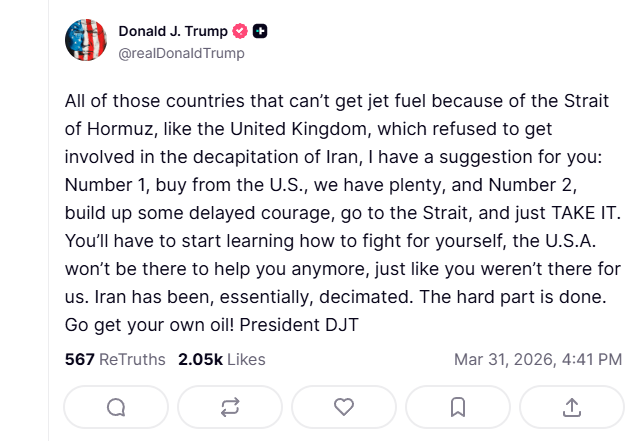
    “All of those countries that can’t get jet fuel because of the Strait of Hormuz, like the United Kingdom, which refused to get involved in the decapitation of Iran, I have a suggestion for you: Number 1, buy from the U.S., we have plenty, and Number 2, build up some delayed courage, go to the Strait, and just TAKE IT. You’ll have to start learning how to fight for yourself; the U.S.A. won’t be there to help you anymore, just like you weren’t there for us. Iran has been, essentially, decimated. The hard part is done. Go get your own oil!” Trump wrote on Truth Social on 31st March.

    The American President has been attacking UK and other countries for refusing military aid against Iran to clear the Hormuz blockade, even as it is the US and Israel themselves to blame for the blockade and its detrimental global impact. On one hand, Trump is shifting the blame for the prolonged Hormuz blockade to Europe’s non-participation in the war, and is threatening to pull out of NATO; on the other, he is planning on pressuring the Gulf countries targeted by Iran into paying for the war expenses. All this while, Trump also announced that the US may wind up the military offensive against Iran in two to three weeks, even without any deal with the Iranian regime.

    Basically, Trump wants NATO to fix the mess he orchestrated, or he will pull the US out of the bloc. He also wants the Gulf to cover war expenses, while he gets the ‘peacemaker’, ‘liberator’ and ‘tough guy’ tag, and casually vaunts bombing Kharg Island “just for fun”.

    This is not the first time that Trump has threatened to pull out of NATO. He did the same during his first tenure, although under different circumstances. It is essential to note, however, that Congress has already passed a law (National Defence Authorisation Act), Sec. 1250A of which says a President cannot withdraw from NATO unilaterally without either a two-thirds Senate vote or separate new legislation.

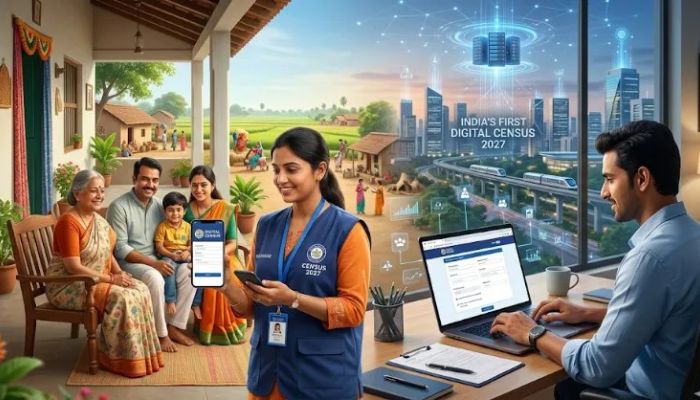
    After a 15-year gap, India’s first fully digital Census 2027 starts on 1st April: All you need to know about the questionnaire and the process

    Census 2027 will be the 16th in the series and the 8th after Independence. This census, which is starting from 1st April, 2026, will prove to be historic for India as it is going to be the first completely digital census of the country after a gap of fifteen years.

    Census in India is not just a process of collecting statistical data but a strong pillar of the socio-economic planning of the country. Systematic census in India started in 1872 during the British period. The tradition of conducting a census every ten years has been going on continuously since 1881. The last in this series was the 15th census conducted in 2011, which gave a clear picture of the population and geographical situation of India as per the data at that time.

    In India, the Census is conducted under the provisions of the Census Act, 1948 and the Census Rules, 1990, as amended from time to time. As per the rules, the 16th Census was to be conducted in the year 2021. However, the process had to be postponed indefinitely due to the COVID-19 pandemic that spread across the world in 2020 and the nationwide lockdown imposed due to it. This was the first time in the history of independent India that a decade-end census was delayed.

    This time, instead of paper forms, information will be collected through mobile apps and ‘Self Enumeration’ portals, which will demonstrate the digital transformation of modern India. The Central Government has announced a list of 33 questions for the House Listing and Housing Census (HLO) and has also made 33 FAQs (Frequently Asked Questions) available on the portal.

    It is noteworthy that the Central Government has approved a total budget of ₹11,718.24 crore for the upcoming 16th Census. This amount will be used mainly for the honorarium of the employees associated with the census work and their intensive training. In addition, since this time, the census is digital for the first time, adequate provisions have also been made in the budget to create a strong IT infrastructure, build data centres, and provide necessary logistics facilities. 

    Census preparations

    To ensure the Census 2027 is flawless, a complete ‘pre-test’ (rehearsal) was conducted in 5000 blocks across the country in November 2025, in which all digital methods from appointment to data processing were tested. To ensure accuracy in this enumeration, the administrative boundaries of 7,092 districts, talukas and about 6.39 lakh villages of all 28 states and 8 Union Territories of the country have been frozen from 1st January 2026 to March 2027, so that no geographical changes become a hindrance during the enumeration. 

    A robust three-tier training structure has been prepared for this massive national campaign, in which 45,000 field trainers have been trained by 100 national trainers and 2000 master trainers. These field trainers are now providing intensive training to approximately 31 lakh enumerators and supervisors across the country in about 80 thousand batches. All training materials have been provided to these enumerators in their regional languages, so that they can collect quality and accurate information from the people on time without any hassle. It is noteworthy that this time the census will be conducted in 2 phases.

    First stage begins on 1st April

    The first phase of the 16th Census of India will officially begin from 1st April, 2026 and will continue till 30th September, 2026. According to Registrar General of India (RGI) Mrityunjay Kumar Narayan, the field operation will be carried out as per the different schedules decided by various states and union territories. Hence, the operation will start in some parts of the country in April, while in other parts, the process will be carried out in June, July or August as per geographical and administrative convenience.

    The first phase of the census, known as the ‘House Listing and Housing Census’ (HLO), will be conducted from April to September 2026. Each state and union territory will complete this work by fixing any 30 days of these six months, at its convenience. The speciality of this phase is that exactly 15 days before the enumerator visits your home, an option of ‘self-enumeration’ will be given, through which the details can be filled in manually through online means.

    The main objective of this first phase is to know the condition of houses and the lifestyle of families in the country. It will mainly collect information on what kind of house it is, what basic facilities like drinking water, electricity and toilets are available to the family and what assets like TV, vehicle or internet are available in the house. A list of questions that will be asked for this process has also been released.

    The census work will begin at different stages in different states of the country. The first group includes Andaman and Nicobar, Delhi (NDMC and Cantonment), Goa, Karnataka, Lakshadweep, Mizoram, Odisha and Sikkim. Citizens in these states will be able to do ‘self-enumeration’ online from 1st to 15th April, 2026, while enumerators will go door-to-door from 16th April to 15th May to record details of houses.

    The second group includes states like Madhya Pradesh, Andhra Pradesh, Arunachal Pradesh, Chandigarh, Chhattisgarh and Haryana. The period for self-enumeration in these states has been fixed from 16th to 30th April, 2026, after which the process of house listing will be carried out from 1st to 30th May. The detailed schedule of all the remaining states and union territories has been given in the appendix issued by the government.

    State/Union TerritorySelf-Enumeration PeriodHouse Listing and Housing Census (HLO) Period
    Andaman and Nicobar Islands, Delhi (NDMC/Cantonment), Goa, Karnataka, Lakshadweep, Mizoram, Odisha and Sikkim1st April to 15th April16th April to 15th May
    Gujarat, Dadra and Nagar Haveli, Daman and Diu5th April to 19th April20th April to 19th May
    Uttarakhand10th April to 24th April25th April to 24th May
    Madhya Pradesh, Andhra Pradesh, Arunachal Pradesh, Chandigarh, Chhattisgarh and Haryana16th April to 30th April1st May to 30th May
    Bihar17th April to 1st May2nd May to 31st May
    Telangana26th April to 10th May11th May to 9th June
    Punjab30th April to 14th May15th May to 13th June 13
    Delhi (MCD), Maharashtra, Meghalaya, Rajasthan and Jharkhand1st May to 15th May16th May to 14th June
    Uttar Pradesh7th May to 21st May22nd May to 20th June
    Jammu and Kashmir, Ladakh and Puducherry17th May to 31st May1st June to 30th June
    Himachal Pradesh1st June to 15th June16th June to 15th July
    Kerala and Nagaland16th June to 30th June1st July to 30th July
    Tamil Nadu and Tripura17th July to 31st July1st August to 30th August
    Assam2nd August to 16th August17th August to 15th September
    Manipur17th August to 31st August1st September to 30th September
    West BengalWill be announced later.Will be announced later.

    How will the process be done?

    Census 2027 will be India’s first fully digital census. In this process, enumerators will use their smartphones and a special mobile application instead of paper and pen. The information they collect from door to door can be directly submitted online through the app. To make this process easier, the mobile app and the ‘self-enumeration’ portal will be made available in a total of 19 languages, including Gujarati, Hindi and English, so that accurate information can be collected without language barriers.

    The facility of ‘self-enumeration’ is an important aspect for the citizens this time. People will be able to fill in the details of their families by going to the online portal themselves. Apart from this, a state-of-the-art central portal has been created to manage the entire campaign. 

    This portal will handle the appointment of enumerators, generation of their ID cards, allocation of work to them and management of their training. This digital system will also enable real-time monitoring of the extent to which the enumeration work has been completed.

    To bring accuracy at the administrative level, this time ‘House Listing Blocks’ (HLBs) will be prepared using ‘Web Mapping Application’, so that no house or area is left out of the census. Being a digital medium, sufficient vigilance has also been taken regarding the security of people’s personal information. Extremely strong firewalls and protocols have been implemented for data security, so that the data of citizens remains completely safe and confidential.

    How can self-enumeration be done?

    In Census 2027, a special facility has been provided to the citizens, through which they will be able to fill out their details online even before the enumerator comes to their home. For this, one will have to log in to the official SE portal (se.census.gov.in) using their mobile number. This process can be completed anytime and from anywhere, as per their convenience.  

    After logging in to the portal, the person will have to mark the exact location of their house on the map and fill in the necessary details of the family. After filling in all the information, when the form is submitted, a 16-digit unique ‘Self-Enumeration ID’ (SE ID) will be generated by the system. This ID is very important because when the census staff visits the house in person, they will have to give only this SE ID.

    Notably, self-enumeration is an additional optional facility provided to the citizens. Even if a person is unable to fill in the details online, the enumerators will still visit the house in person and collect the information just like in the previous census. The staff will also visit the houses of those who have filled in the details online for verification, but instead of asking them for all the details again, the data will be confirmed only through SE ID, and the person will be included in the census.

    Second stage is the important phase of the Census

    The second and most important phase of the census, called ‘Population Census’, will be mainly conducted during February 2027. However, in snow-covered and inaccessible areas like Ladakh, Jammu and Kashmir, Uttarakhand and Himachal Pradesh, this process will be completed earlier, i.e. in September 2026. The biggest feature of this phase is that, as per the government’s decision, this time, along with the population census, a caste-based census will also be conducted, which will help in obtaining social statistics.

    During this second phase, enumerators will collect personal and detailed information about every citizen of the country. This includes important aspects such as a person’s education, social and economic status, residential migration and fertility. The exact questions that will be asked for this phase and its exact dates will be officially announced by the government in the near future.

    Which FAQs (questions) are included in the first phase?

    During the first phase of the census, citizens will be asked 33 questions, the list of which has been announced on Monday, 30th March. The main objective of these 33 questions is to get accurate information about the standard of living of citizens, housing facilities, family structure and use of technical devices. Now, let’s know what those 33 questions are, which will have to be answered in every household.

    Building and residence details:

    • 1. Building Number: A number assigned by a municipality, local body, or census.
    • 2. Calculation House Number: A number for the unique identification of the house.
    • 3. Flooring material: The main material used in the flooring of a house (tiles, cement, wood, etc.).
    • 4. Wall material: The main material used in building the walls of the house (brick, stone, concrete, etc.).
    • 5. Roof material: What material is the roof of the house made of (thatch, pipes, sheets, etc.)?
    • 6. Use of the house: Details of whether the house is used for residence, shop or other purpose.
    • 7. House condition: The current condition of the house (new, old or dilapidated).

    Family and Head Details:

    • 8. Number of families: The number of families living in a house.
    • 9. Total number of persons: Total number of members usually living in the household.
    • 10. Name of the head of the household: Name of the head of the household.
    • 11. Gender of the head: Is the head male, female or transgender?
    • 12. Social Class: The majority belong to the Scheduled Caste (SC), the Scheduled Tribe (ST) or other classes.
    • 13. Ownership status: Is the residence owned or rented?

    Accommodation facilities:

    • 14. Number of rooms: How many rooms does the family have to live in?
    • 15. Married couples: Number of married couples living in the household.
    • 16. Source of drinking water: Where is the water obtained from (tap, hand pump, well, etc.).
    • 17. Availability of water: Is drinking water available within the premises, or does it have to be brought from outside?
    • 18. Source of light: The main source of light in the house (electricity, solar, kerosene, etc.).

    Hygiene and cooking:

    • 19. Toilet facilities: Whether there is a toilet in the house or not.
    • 20. Toilet type: What type of toilet is it (flush, pit, etc.)?
    • 21. Wastewater disposal: Details of the drainage or sewerage system.
    • 22. Bathing facilities: Whether or not there is a separate space or bathroom for bathing in the house.
    • 23. Kitchen and gas connection: Is there a separate kitchen and LPG/PNG connection facility or not?
    • 24. Cooking fuel: What fuel is mainly used for cooking (gas, wood, electricity, etc.)?

    Assets and resources:

    • 25. Radio/Transistor: Is this device available in the house or not?
    • 26. Television (TV): Whether there is a TV facility or not.
    • 27. Internet facility: Whether or not there is an internet access facility in the house.
    • 28. Laptop/Computer: Whether or not there is a computer or laptop in the house.
    • 29. Phone facility: Availability of landline, mobile or smartphone.
    • 30. Two-wheeled vehicle: Whether it is a bicycle, scooter or motorcycle. 
    • 31. Four-wheeled vehicle: Availability of a vehicle such as a car, jeep or van.

    Other details:

    • 32. Main grain: Which grain (wheat, rice, millet, etc.) does the family mainly use in food?
    • 33. Mobile Number: Family’s mobile number for future contact and verification.

    Change in current calculation

    The biggest difference between the previous census and the upcoming 2027 census is in its methodology. While the process was completely paper-based from the British era till 2011, the 2027 census will be India’s first ‘fully digital’ census. This time, enumerators will use a mobile app, and citizens will get a new facility of ‘self-enumeration’ in 16 languages, which will reduce the data processing time from years to just 6-9 months. At the technological level, real-time monitoring will be done by making the exact location if each house through GPS tagging and geofencing, which will be more accurate than the physical mapping method of 2011. 

    In terms of time and phases, the earlier census was conducted simultaneously, whereas in 2027, two clear phases were decided. The first phase (April-September 2026) will be for the list of houses and amenities, and the second phase (February-March 2027) will be for personal details. There are also important changes in the questionnaire. In which banking questions have been removed and new details like internet, smartphone and mobile number have been added as per the digital age. The questions on migration have also been kept more detailed this time.

    A historic change from a social and administrative perspective is the ‘Caste Census’; in 2011, only SC/STs were counted, but in 2027, for the first time since independence, a complete caste census will be conducted for all communities. The central government has allocated a budget of ₹11,718 crore for this massive digital infrastructure, which is much higher than the expenditure in 2011. A major part of this amount will be used for training 31 lakh employees and building a robust IT infrastructure.

    The previous census was traditional and relatively slow, while the 2027 census will be more transparent, fast and inclusive. With new protocols for data security and privacy through digital means, this census will present an accurate picture of the changing geographical and social situation of the country. The data collected through this census, especially the caste-based enumeration and personal details of the second phase, will prove to be a strong pillar in accurate policy making for welfare schemes like education, health and housing for the next decade.

    (This article is a translation of the original article published on OpIndia Gujarati.)