

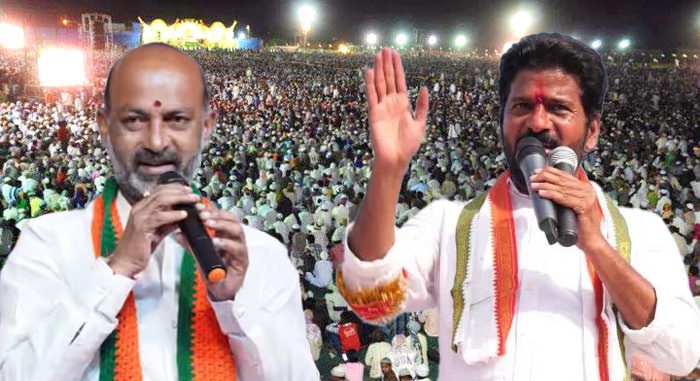
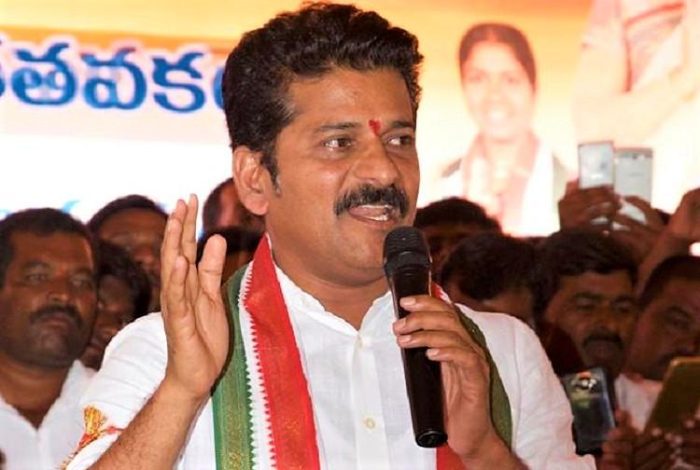
The Bharatiya Janata Party has strongly reacted to the decision of the Congress government in Telangana to provide Rs 2.4 crore for the Tablighi Jamaat congregation in Nematnagar village of Pargi Mandal in Vikarabad district from 6th to 8th January next year. BJP’s national general secretary and Karimnagar Lok Sabha MP Bandi Sanjay Kumar has urged Chief Minister A. Revanth Reddy to take firm action against the officers who granted authorization and initiated the process of releasing money for the event. Furthermore, he insisted that the gathering should be called off.
Pure evil and outrageous of Congress government in Telangana to fund Tablighi Jamaat meeting.
— Bandi Sanjay Kumar (@bandisanjay_bjp) December 21, 2023
Does the newly elected government of Revanth Reddy know this? What are intelligence agencies doing? What do you want to do to Telangana with Tukde Tukde gang?
Congress government… pic.twitter.com/McLYuqHiK2
Bandi Sanjay Kumar took to X to slam the decision and stated, “Pure evil and outrageous of Congress government in Telangana to fund Tablighi Jamaat meeting.”
He questioned whether the state chief minister was aware of the development and referred to the Islamic movement as the “Tukde-Tukde gang.” He asked, “Does the newly elected government of Revanth Reddy know this? What are intelligence agencies doing? What do you want to do to Telangana with the Tukde Tukde gang?”
The BJP leader charged, “Congress government claims that state is bankrupt, but is funding program organized by Tablighi Jamaat which promotes terrorism and the spread of Islam. It is an unforgivable crime to commit such acts in the guise of secularism.”
He recounted that Tablighi Jamaat was the primary cause of the coronavirus’s transmission in India in 2020 during the Covid-19 pandemic. “During the Covid-19 pandemic, the main reason for the spread of the virus in India 2020, was the Tablighi Jamaat’s religious prayers. This organization’s entry into Telangana in the name of gatherings and meetings is leading to many suspicions, that too at a time when the coronavirus is spreading in India again.”
The parliamentarian accused, “It is outrageous that more than Rs 2.45 crores have been sanctioned for the arrangements of the meeting organized by the Tablighi Jamaat organization in the name of Islamic society in January in Parigi mandal of Vikarabad district.” He pointed out, “Islamic countries like Saudi Arabia, Uzbekistan, Tajikistan and Kazakhstan have banned the Tablighi Jamaat organization for promoting terrorism.”
He inquired about the brains behind the decision to give money to a group that propagates radical religions and forces people to convert to their religion and pushed for the scrapping of the program. “Who is the mastermind behind the government’s grant of funds to an organization involved in spreading extremist ideologies and forced religious conversions? On behalf of the party’s Telangana unit, we demand Strict action be taken and the meeting of the Tablighi Jamaat should be cancelled immediately.”
“As soon as the Congress government came, the conference was organised by the Tablighi Jamaat, a Muslim missionary organisation, had been funded. The funds were sanctioned at a meeting held in Parigi mandal of Vikarabad district. We are not against minorities, but why is the government giving money to an organisation that spreads the ideology of Islam and terrorism? Released on December 13, 2023, the Minority Welfare Department’s GO No. 123 sanctioning funds for the conference is dangerous for the country,” voiced BJP state spokesperson Rachana Reddy in a press conference on 20th December and accused Congress of unveiling its true face.
She added, “The Tablighi Jamaat has been banned in Saudi Arabia for its illegal conversion drive to Islam and its involvement in proselytizing activities. Saudi Arabia, the birthplace of Islam, has banned the Tablighi Jamaat. How can the government fund an organisation that indulges in the spread of extremist ideology and forced conversions without any intelligence inputs and without consulting the authorities.” She further expressed regret at the Waqf Board’s decision to permanently provide Tablighi Jamaat with amenities including parking and drinking water pipes.
The Congress government in Telangana has cleared the provision of Rs 2,45,93,847 crore to hold an Islamic congregation just one week after taking office. Two to five lakh Muslims from Telangana, Andhra Pradesh are anticipated to attend the Subaee Deeni Ijtema which is organised by Tabliqhi Jamaat.
Parigi Congress MLA Dr T RamMohan Reddy declared that he was able to swiftly acquire the cash after serious consideration and speaking with Chief Minister Revanh Reddy. A directive from Syed Umar Jaleel, the Secretary of Minority Welfare revealed that monetary assistance from several departments had been authorised for the conference.
A similar gathering was conducted by Tablighi Jamaat in Delhi in March 2020 during which the deadly Covid virus was prevalent and most of the attendees were infected. Moreover, they scattered around the nation, causing the virus to spread widely. It was found after a police inquiry that a large number of foreigners attended this event as well and travelled to different regions of the nation which presented a security danger.
The Tablighi Jamaat congregation and its activities are prohibited in many Islamic countries. Saudi Arabia outlawed Tablighi Jamaat in December 2021, referring to it as “one of the gates of terrorism.” The Islamic organisation was outlawed and classified as an extremist organisation in Kazakhstan in 2013. Furthermore, Iran, Russia, Tajikistan, Turkmenistan and Uzbekistan forbade the outfit.


Ram Mandir, Sanatan Dharma, and the shallow discourse: Unraveling ‘historian’ Ramachandra Guha and ‘journalist’ Karan Thapar’s limited grasp of Hindu way
On 20th December, Karan Thapar of The Wire interviewed ‘historian’ Ramachandra Guha based on his op-ed in The Telegraph. The discussion between the two mainly revolved around Guha’s perspective on the political and cultural shifts in India, specifically regarding the prominence of Hindu identity in Indian politics. As expected, Guha vehemently expressed his concerns about the changing language of the political discourse. He claimed that the Indian society is shifting away from secularism.
The interview then delved into Guha’s apprehensions about the “implications” of the Bhavya Ram Mandir that is scheduled for inauguration on 22nd January, 2024, in Ayodhya by Prime Minister Narendra Modi. Guha claimed that he would not be celebrating the event because he “experienced the communal violence” that followed the demolition of the disputed Babri structure.
Guha also expressed his reservations about the monumental scale of the temple, claiming that it would potentially have implications for the country’s future. He claimed that the construction of Bhavya Ram Mandir is a step towards a “Second Republic” with a Hindu-first approach, which, according to him, contrasts with the secular ethos of the Constitution of India.
Ramachandra Guha questioned the need to construct such a monumental Mandir and criticised the endorsement it has received from the political leaders. The discussion then drew comparisons with the other Asian countries like South Korea, Singapore, Pakistan, Sri Lanka and Bangladesh. While giving examples of Sri Lanka, Guha asserted the way India is moving towards Hindu majority, the country may face a similar fate as the neighbouring country Sri Lanka. He said, “The civil war happened in Sri Lanka because the Sinhala-speaking Buddhist majority sought to put the Tamils, who are Hindus, in their place.”
Notably, during the interview, Karan Thapar made a bizarre statement that the inauguration of Swarved Mahamandir by the PM leads to Hindus taking the path of authoritarianism, which calls for a deep dive into the importance of Guru Parampara while attaining the path of spirituality.
Ayodhya Bhavya Ram Mandir and legal reclamation of sacred spaces
The way Ramachandra Guha expressed his views about the Ram Mandir in his op-ed, and the interview with Karan Thapar showed how misinformed he is about the Hindu culture and the ethos that ensured India remained secular. Notably, the Supreme Court verdict legitimised the rebuilding of Bhavya Ram Mandir, which the invaders destroyed. The judgment is a testament to Hindus’ belief in the legal and democratic approach.
Through the legal process, Hindus exercised their constitutional right to reclaim a sacred space of immense significance that they had fought for over 500 years. The land dispute between Hindus and Muslims spanned for decades and witnessed a legal battle that culminated in a verdict which recognised the complexity of the situation. One has to appreciate the balance between the cultural reverence and the rule of law that led to the construction of the Bhavya Ram Temple. It has given a ray of hope to every sane Hindu worldwide that their sentiments matter.
Every country has a different design, which Thapar and Guha forgot to comprehend
While discussing the “implications” of Ram Mandir’s construction on Indian politics, they asserted that India should learn from what happened in Sri Lanka and Pakistan. According to Guha, the civil war occurred in Sri Lanka because the Sinhala-speaking Buddhist majority sought to put the Tamils, who are Hindus, in their place. Similarly, the fundamentalists changed the country’s course of progress in Pakistan. They asserted that if India continues its chosen path, it will end up like these two countries. Furthermore, they stated that India should learn from Singapore and South Korea, where religion does not “find a place in the public view”.
Interestingly, while expressing their imaginative concerns, they completely ignored the nuanced nature of the secular fabric in Indian society shaped by the constitutional principles and the Hindu way of living that is rooted in “live and let live”. Unlike Sri Lanka and Pakistan, India is unlikely to become a religious state.
Left-liberals often forget that it is not the Hindus that conspired to make India a religious state. It was the Popular Front of India and other Islamic organisations that called for “Ghazwa-e-Hind” and wanted Sharia to be implemented in the country. Had PFI been not banned, they would have moved on with their plan for Sharia in India by 2047. Both Guha and Thapar ignored that India has a diverse religious landscape and the coexistence of multiple faiths for centuries. Furthermore, it is only because of Hindus that India has remained a secular state. Otherwise, it would have turned into the likes of Pakistan long ago.
Guha and Thapar’s suggestion for India to learn from South Korea and Singapore regarding religious ethos completely oversimplified the complex dynamics of religion in each country. While India has a rich history of religious pluralism, South Korea and Singapore have homogenous religious landscapes. India’s inclusive approach to diverse religious practices must be aligned with models designed for much smaller and more homogenous populations. Both failed to recognise India’s constitutional protections and its historical embrace of diversity in terms of religion.
Lack of understanding of Hinduism, spirituality and the importance of Guru Prampara
Now, coming to Karan Thapar’s bizarre statement that the inauguration of Swarved Mahamandir by the PM is Hindus taking taking the path of authoritarianism. He completely missed the point that Sanatan Dharma talks extensively about Guru Pramapara. The philosophies embedded in the Hindu traditions discuss the significance of having a spiritual guide.
Sant Kabir famously wrote, “Guru Gobind dou khade, kaku lagun paye… Balihari guru aapne, Gobind diyo milaye”. In the couplet, Sant Kabir said that when Guru and Gobind (Bhagwan) are standing together in front of you, bow down to the Guru first as he is the one who showed the path connecting with the divine.
In Sanatan Dharma, a Guru is not just a teacher. He is a spiritual guide who imparts wisdom. He facilitates self-realisation and leads disciples on the path of righteousness. What Thapar contended, failed to grasp the essence of the Guru-Shishya Parampara, the foundational element in the Spiritual journey within Hinduism.
The profound significance of Guru Parampara has been described in the life stories of many saints. For example, Guru Gorakhnath, one of the most prominent figures in Nath traditions, belonged to a strong lineage of Gurus who played a crucial role in preserving and disseminating spiritual knowledge. Chief Minister of Uttar Pradesh Yogi Adiyanath belongs to the lineage and currently holds Guru Gaddi after Mahant Avaidyanath.
Similarly, the great philosopher and theologian Adi Shankaracharya established the Advaita Vedanta tradition. His Guru, Shri Guru Bhagvapada, was crucial in shaping his profound understanding of Vedanta.
Sant Tukaram, the 17th-century saint and poet from Maharashtra, was influenced by his Guru Babaji Chaitanya. Swami Vivekananda became a renowned saint because of his Guru, Sri Ramakrishna Paramhansa, who introduced him to the universality of religions and the importance of direct experience in spirituality. Without Gurus, these saints would never have been what they became.
Guha expressed his dismay over the meditation centre and his amazement that someone would guide people on how to chant mantras, what to chant, what not to chant, etc. His assertions made it clear that he must know the importance of pronouncing the Mantras correctly. The right pronunciation and understanding of the inherent vibrations of the Mantras hold spiritual significance. In a way, Guha neglected the meditative and transformative aspects crucial for the spiritual growth of Hinduism.
Notably, Mantras are a bridge between the individual and the divine. Chanting Mantras plays a pivotal role in meditation and spiritual elevation of the devotee. Understanding their depth goes beyond the surface-level rituals and plays and significantly fosters a profound connection with the spiritual realms.
Notably, Hindu practices are not homogenous. A large spectrum of beliefs and paths in Sanatan Dharma can take an individual to spiritual realisation.
The critique of Hindu practices in the op-ed by Guha and the discussion with Thapar, particularly regarding the Ram Mandir, reflected their limited understanding of Sanatan Dharma. They dismissed the legitimate cultural reclamation and undermined the essence of spiritual teachings. Their misguided comparisons completely lacked nuanced comprehension and showed the immediate need for them to reconsider their perspectives.