Home Blog Page 1582

“I don’t know”: Mamata Banerjee on next INDI Alliance meeting on December 6

0

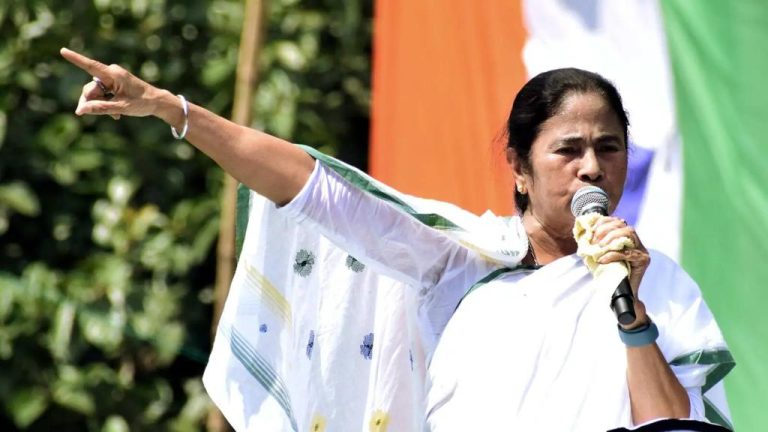
West Bengal Chief Minister Mamata Banerjee might skip the upcoming meeting of the opposition’s INDIA bloc on December 6, as the party supremo said on Monday that she was “not aware” of any such meeting.

The December 6 meeting will be held after a gap of three months since the last one in Mumbai on August 31 and September 1.

While addressing the media on Monday, the West Bengal CM said that her party was unaware that the INDIA grouping is planning to hold a sitting in New Delhi.

“I don’t know, I have no information so I kept a programme in North Bengal…If we had the information, we wouldn’t have scheduled those programmes. We would have definitely gone (for the meeting), but we have not received any information,” the TMC chief said.

Ahead of the next meeting, Congress President Mallikarjun Kharge has dialled his alliance partners and invited them to converge. Nationalist Congress Party (Sharad Pawar faction) leader Supriya Sule gave a hint after the Mumbai meeting that the next meeting will be held in the national capital.

Seat sharing for the Lok Sabha polls, which are just four to five months away, is likely to be at the top of the agenda. The next INDIA bloc meeting would also be crucial for Congress, particularly as the party lost Rajasthan, Chhattisgarh and Madhya Pradesh Assembly polls, the Hindi heartland states that send a large number of members to the Parliament.

However, the Congress could find the going tough in this meeting, with key ally Samajwadi Party having struck a belligerent tone against the Congress in the assembly elections. SP boss Akhilesh Yadav had accused the Congress of betraying the SP by not giving it tickets to contest in a potential alliance with the Congress in MP.

The Congress now desperately needs the alliance to take off if it harbours any hope of giving Narendra Modi and the BJP competition in the 2024 election.

INDIA or ‘Indian National Developmental Inclusive Alliance’ is a group of 28 opposition parties, including the Congress. The parties have come together to take on the National Democratic Alliance (NDA), which is led by PM Modi’s Bharatiya Janata Party (BJP), and prevent it from winning a third straight term at the Centre in the 2024 Lok Sabha elections.

The first meeting of the joint opposition convened in Patna on June 23 and the second meeting was held in Bengaluru on July 17-18. The third meeting happened in Mumbai during August 31-September 1.

In the Mumbai meeting, the opposition parties adopted resolutions to collectively contest the upcoming 2024 Lok Sabha elections while announcing that seat-sharing arrangements would be finalized as soon as possible through a spirit of give-and-take.

The theme they have chosen for the elections is “Judega Bharat, Jeetega India” (India will unite, India will win) to take on the ruling Bharatiya Janata Party (BJP)-led government.

(This news report is published from a syndicated feed. Except for the headline, the content has not been written or edited by OpIndia staff)
Ravish Kumar’s bizarre rant: Ex-NDTV journalist says Shivraj Chouhan defeated Narendra Modi in the MP assembly election

The landscape of Indian politics is ever-evolving. The narrative surrounding the elections is extensively complex for the citizens to decipher. Thus, sharp and knowledgeable electoral analysts are essential for the world of media. However, sometimes, the hate and apathy of the analysts make it challenging to give a fair reasoning for the outcome of the elections.

One such analysis of Madhya Pradesh Assembly Elections has been done by “infamous” journalist-turned-YouTuber Ravish Kumar. While he tried to provide a “unique perspective” of the MP election results, a critical examination of his 20-minute-long rant revealed certain aspects that merit questioning.

Firstly, Ravish Kumar selectively emphasised particular aspects of the elections, such as posters and social media posts. He constructed a narrative of Shivraj Singh Chouhan being sidelined within the Bharatiya Janata Party (BJP), based on selected social media posts and posters.

However, they are only a tiny fragment of a larger, sophisticated political mosaic. It is a well-known fact that ground reporting is the cornerstone of credible journalism. However, Ravish Kumar’s analysis lacked ground reporting as he admitted not going to Madhya Pradesh to sniff out the ground narrative and realities that often shape the election outcomes.

Ravish Kumar assumed that the media reports were based on the “inside knowledge” of the party that some journalists have. It became another point of contention in his analysis. He implied an intentional sidelining of Chouhan for sympathy, a claim based on pure speculation. This kind of assumption risks oversimplifying the multifaceted nature of the political decisions that the party takes within the organisation. Ravish Kumar also ignored the dynamic interplay of the various factors, including the work done by the state government and how the central government played a role in implementing different schemes.

His analysis also underestimated the genuine influence of Prime Minister Narendra Modi on the psyche of the voters, especially in a state like Madhya Pradesh, where BJP has ruled for over 19 years. In a way, Kumar criticised the BJP for relying heavily on Modi’s face in the election campaigning. However, he forgot that every national political party, whether BJP, Congress, or even AAP, brings their top leaders into the play during campaigning.

PM Modi’s appeal transcends regional boundaries. It has been pivotal in multiple electoral victories, including Uttar Pradesh, Gujarat and other states. His presence in the political landscape during campaigning cannot be ignored and dismissed. Furthermore, Lok Sabha elections 2024 are approaching fast, and the five-state assembly elections are seen as precursor for the General Elections. It was essential for the BJP to understand how ‘Modi Magic’ is playing its role in the hearts of the voters. The results of the Madhya Pradesh, Rajasthan, and Chhattisgarh elections made it clearer how the BJP should play its cards for the General Elections.

Ravish Kumar completely ignored the strategic decisions made by the political parties. He acknowledged that knowing everything inside the party office is impossible but continued to form a perspective around op-eds and social media posts. How can a seasoned “journalist” like Ravish Kumar forget that the media is biased? They publish op-eds and reports based on their political leaning. How can someone like Ravish Kumar forget that the media ran similar reports of differences between UP Chief Minister Yogi Adityanath and PM Narendra Modi just before the UP Assembly Elections?

BJP’s decision not to project a local face for the Chief Minister’s position was a calculated move. It reflects a deeper understanding of the political terrain and the party’s electoral strategy. Elections are complex battles. Every action has to be precise, as a wrong placement of a pawn can finish the game in seconds. Ravish’s analysis lacked the understanding of the nature of the game-play that the BJP had for the MP election.

Ravish asserted that Shivraj Singh Chouhan‘s local initiatives played a vital role in the election’s outcome. However, he failed to recognise that the voters of the states under the BJP are not limited to state issues. They know the importance of having the same party at the center and in the state assembly. Various factions, including national-level governance and leadership credibility, often influence the voters’ decisions.

In a diverse and dynamic country like India, forming a narrative based on social media posts and a few op-eds is impossible. The ground-level approach is a must to understand the background so that one can create the right direction in reaching a conclusion about the results. Ravish’s analysis lacked that critical aspect and showed how distanced he was from reality. Most of the voters are not on social media.

4,34,23,475 (Four Crores, thirty-Four Lakhs, Twenty-Three Thousand, Four Hundred and Seventy-Five) votes were cast in the MP elections. Only a fraction of them are influenced by the social media posts on X and Facebook, which were the basis of Ravish’s analysis that Chouhan was “sidelined”. The ground reality in most of the cases is different.

Ravish Kumar serves the Hindi-speaking viewers. While his followers navigate the shadows of political narratives based on his videos, it is imperative to understand the importance of a holistic and nuanced understanding of the complex narrative dance of the Indian elections. Ravish Kumar failed in it, and he failed his viewers in that motion.

Ghaziabad: Junaid, others gang-rape woman upon learning she is Hindu, Muslim couple accompanying victim watch on, police probe possible involvement

A distressing incident shedding light on Islamist animosity towards non-believers (kafirs) surfaced in Ghaziabad, Uttar Pradesh. In this case, Islamists allegedly gang-raped a Hindu woman solely due to her religious identity, while the Muslim couple along with her were spared, a report published in Organiser and authored by journalist Subhi Vishwakarma said.

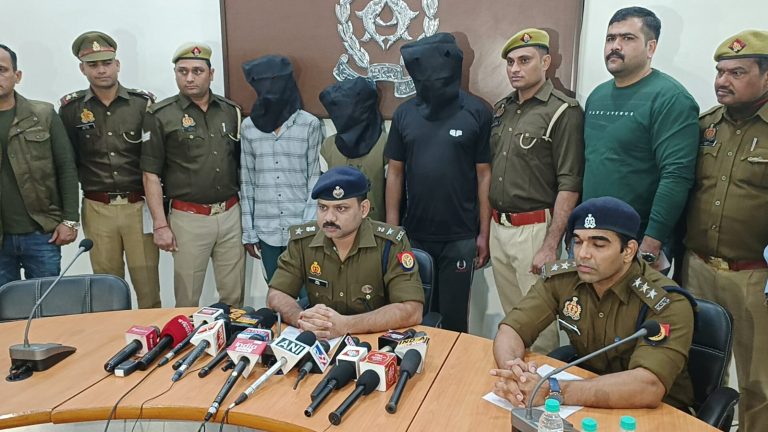
The accused, Junaid and four others were apprehended by police after an encounter on December 2. Notably, one of the arrested individuals has connections to the Muslim couple with whom the victim was socialising, prompting law enforcement to investigate their potential involvement in the matter. The Muslim couple was present at the crime scene but did not take any action to protect the victim.

An FIR was filed in the matter at the Tronica City police station in the Ghaziabad district on November 30.

As per the police statement, the complainant detailed in her account that one of her female colleagues from Delhi, employed at the same toy factory, had recently purchased a new scooter just four days before the incident. To acquire proficiency in riding the scooter, the colleague invited her boyfriend, and the trio proceeded to a secluded area in Ghaziabad.

Following that, three unidentified individuals approached them at that location and gang-raped the woman.

“They came running towards me, seizing me before I could understand the situation. Despite my attempts to resist and raise an alarm, they forcibly took me behind the bushes. The three assailants took turns raping me. I cried out for help, but unfortunately, no one came to my rescue,” said the woman in her complaint.

In her complaint, the victim made a startling revelation. She stated that the Muslim couple that took him to the secluded place were present at the spot throughout the incident, yet they displayed no signs of resistance or struggle to stop the perpetrators from gang-raping her. Responding to her account, the police charged all three suspects and filed a case against them.

The victim underwent a comprehensive medical examination. During the investigation, the woman identified one of the accused, who had a photo with her friend’s boyfriend. Subsequently, the police initiated a manhunt and successfully arrested all three suspects.

The accused, identified as Junaid, a resident of Khanpur, exchanged fire with a police team when asked to surrender near a forest area in his village. In the ensuing gunfire, he was wounded in the leg.

Reports indicate that while the couple was on a ride, the victim waited along a deserted road, engrossed in her phone. Junaid and two others initially confronted the couple, accusing them of inappropriate behaviour. After realising the couple was Muslim, the attackers shifted their focus to the other woman, a Hindu, waiting a few meters away. She was taken to the bushes nearby and gang-raped.

The assailants fled upon spotting an approaching car. The woman returned home with her friends and recounted her harrowing experience to her parents.

As per the police, the group consisted of five men. While three among them took turns to rape the woman, the remaining two subdued her friends and maintained a lookout on the road.

On December 4, the Ghaziabad police released a press note announcing the arrest of one of the accused, Imran, following an encounter, during which he sustained a leg injury. The prime accused, Junaid, was arrested a day earlier in a similar encounter, with a recovered firearm in his possession.

DCP (rural) Vivek Yadav stated that the police filed an FIR under Section 376D (gang rape) of the IPC and commenced a review of CCTV footage to identify the accused. The woman positively identified some of the accused from video clips.

Acting on a tip-off on Sunday evening, the police team located Junaid in a forested area in his village. Upon seeing the officers, he opened fire, resulting in a return of fire that wounded him in the leg. He received treatment at a hospital and is currently in stable condition.

After fighting with I.N.D.I. Alliance partner Congress for seats, Samajwadi Party gets 0.46% votes in MP, loses deposits on almost all seats

On 3rd December (Sunday), the Election Commission of India announced the assembly election results for Madhya Pradesh, Rajasthan, Chhattisgarh, and Telangana. Out of these four, the Samajwadi Party Chief Akhilesh Yadav particularly targeted Madhya Pradesh assembly elections. 71 SP candidates tried their luck in MP after it had a fallout with its I.N.D.I. Alliance partner Congress.

Samajwadi Party (SP) national president Akhilesh Yadav even led a relentless campaign against Congress while seeking votes for his party candidates and making poll promises. During his election rallies, Akhilesh Yadav presented SP as a viable alternative for both Congress and BJP. Appealing to the electorates not to cast votes for Congress candidates, Akhilesh expressed hope that the Congress party would be defeated by a coalition of smaller parties under the PDA umbrella in the 2024 Lok Sabha elections.

Akhilesh even accused his I.N.D.I. alliance partner Congress of “betrayal” and not giving it due respect and seats as ‘had been promised’ during midnight discussions with state leadership, as claimed by SP leaders.  

However, SP registered its worst performance in MP since 1998. It could not even open its account and got the lowest vote share to date. It only received 0.46% votes in this election, which is less than NOTA (0.98%). It received total votes of 1,97,935 in the state as against 4,27,710 votes cumulatively polled for NOTA. Interestingly, SP made an undesirable record and about 98.5915% (70/71 candidates) of its candidates lost deposits, and around 49 out of 71 candidates lost to NOTA (69%). Further, around 54 SP candidates failed to secure even 1% of the total valid votes.

Despite contesting 71 odd seats, the party could not even manage to finish in second position in any of these seats. Previously, SP used to get maximum electoral presence and influence in Madhya Pradesh outside its home turf Uttar Pradesh. In 1998, it won four seats in Madhya Pradesh and bagged a 1.58% vote share. 

Similarly, in 2007, the party secured a 3.7% vote share. In subsequent elections in 2008 and 2018, it won one seat each and received 1.9% and 1.3% vote share respectively. Even in 2013, when the party failed to win any seat, its vote share was around 1.2%. This time, it has worsened. 

Out of the 71 SP candidates, 45 got less than one thousand votes. However, in four assembly seats, it did manage to play spoilsports for Congress and ended up cutting votes in Bahoriband, Chandla, Jatara, and Niwari. BJP won all four of these seats. 

Congress and SP tussle during Madhya Pradesh election campaigning 

The infighting that began after disputes on the seat-sharing formula in Madhya Pradesh soon escalated into rift between I.N.D.I.A. partners Congress and Samajwadi Party, with both party leaders making scathing remarks against each other. SP Chief Akhilesh publicly expressed his displeasure and accused Congress of not forming an alliance in the state. He accused the Congress of cheating and asserted that if there is no alliance for the state assembly elections, he will consider the same for the Lok Sabha elections. Congress state president Kamalnath responded to media queries on SP Chief’s disagreements saying leave aside ‘Akhilesh-Vakhilesh‘. 

Following the election results, Samajwadi Party leader Sudhir Panwar claimed that the performance of the SP and Congress has made three things clear. Explaining this in detail, he said, ‘First of all, despite the formation of I.N.D.I. Alliance, Congress’s decision to contest the elections alone proved wrong. Secondly, this proves that the strength of the organisation is necessary to compete with the BJP. The bottom line is that BJP governments are running schemes like Kisan Samman Nidhi and Laadli Behna through DBT and the opposition has no answer to this.”

Sajid Mir, a key conspirator of the Mumbai 26/11 attacks, on ventilator support after being poisoned by an unknown person in Pakistan jail: Report

Lashkar-e-Taiba terrorist Sajid Mir, infamous for his role in planning and executing the Mumbai 26/11 attacks, is poisoned inside Central Jail at Dera Ghazi Khan in Pakistan, as per reports.

Mir has been reportedly airlifted by Pakistani intelligence agency ISI and is currently on ventilator support in CMH Bahawalpur.

According to reports, Pakistan Authorities are investigating a private cook, employed in the Central Jail Dera Ghazi Khan kitchen since October 2023, who has gone missing.

The alleged poisoning of Mir comes on the heels of several assassinations of terrorists hostile to India or those who have carried out terror attacks against India by unknown entities. The alleged poisoning of Mir comes on the heels of several assassinations of terrorists hostile to India or those who have carried out terror attacks against India by unknown entities. A large number of Kashmiri terrorists, Pakistan-based terrorists planning and plotting attacks against India, have been neutralised under mysterious circumstances by ‘unknown men’ in the last few months.

Who is terorrist Sajid Mir?

Terrorist Sajid Mir is the chief commander of Lashkar-e-Taiba (LeT) and is in charge of the group’s “India establishment.” He was a key figure in the Mumbai terror attack that took place on 26 November 2008, when 10 armed Pakistani terrorists created mayhem in the country’s financial capital, killing hundreds of civilians and leaving scores of others injured. 

Mir reportedly recruited Dawood Gilani, alias David Coleman Headley, a Pakistani-American and FBI/DEA informant, and planned the Mumbai attacks with the assistance of Pakistani military officers. He was the mastermind behind the largest-ever overseas Lashkar-e-Taiba terrorist attack, which killed nationals from numerous nations, including India and Western countries. 175 people were murdered (18 police officers, 122 civilians, 26 foreigners, and 9 terrorists) and 291 were injured during the incident (25 police personnel, 243 people, 22 foreigners, and one terrorist Ajmal Kasab). Sajid Mir was the Lashkar-e-Taiba project manager for the November 2008 Mumbai terror strikes. He, via satellite phones, had commanded the terrorists involved in the operation to execute the hostages.

Two Interpol notices RCN A-6269/10-2010 and A-2032/2-2019 have been issued against him. India has marked him as a terrorist under the Unlawful Activities (Prevention) Act [UA(P)A], 1967, as amended in 2019 in October 2020.

Pakistan detained Sajid Mir last year and sentenced him to 15 years in prison in May 2022 for providing terror financing to Lashkar founder Hafiz Muhammad Saeed’s charitable organization and his role in other terror attacks. Sajid Mir was charged with conspiracy to destroy the property of a foreign government in the US District Court for the Northern District of Illinois on April 21, 2011. Allegations include providing logistic aid to terrorists, killing a civilian outside of the United States, assisting and abetting terrorists, and bombing public places.

“Warner has paid his dues”: Usman Khawaja fires back at Mitchell Johnson’s criticism of David Warner

0

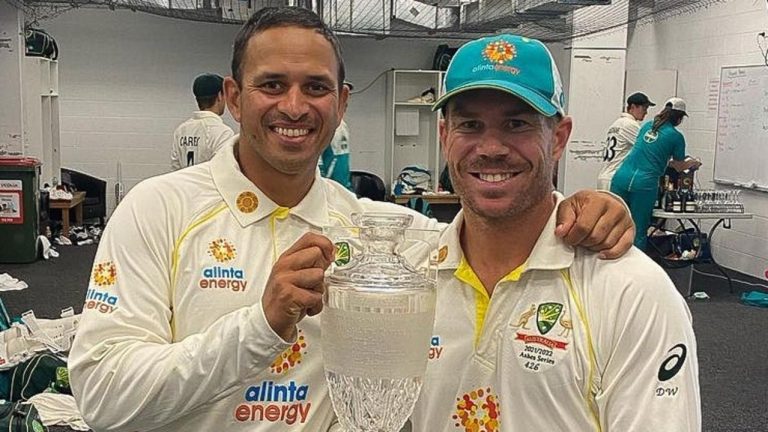
Australia opener Usman Khawaja has responded to Mitchell Johnson’s criticism of Test teammate David Warner, calling the veteran opener a “hero” who has paid his dues in the ‘Sandpaper Gate’ incident.

Former Australia pacer Johnson launched a scathing attack against his former teammates David Warner and George Bailey, questioning why Warner is getting a Test farewell despite his struggles in red-ball cricket and accusing him of not owning up to his role in the ball-tampering scandal.

Writing for The West Australian, Johnson said that Warner’s current form and his involvement in the ball-tampering scandal, also known as the ‘Sandpaper Gate’, do not justify him getting a “hero’s send-off”.

Khawaja stated that he “strongly disagreed” with Johnson’s statement, saying that the opener and former skipper Steve Smith, who was also banned for a year, had paid the price for their blunders. In 20 Tests from 2022-23, Warner has scored 936 runs in 36 innings at an average of 26.74, with just one century and four half-centuries. This is in stark contrast with the opener’s white-ball form, which has been consistent in the 2020s as well.

“Davey Warner and Steve Smith are heroes in my mind. They missed a year of cricket through dark times in Australian cricket but they have paid their dues. No one is perfect. Mitchell Johnson isn’t perfect. I am not perfect. Steve Smith is not perfect. David Warner isn’t perfect. What they have done for the game and to grow the game far outweighs anything else they have done,” Khawaja was quoted as saying by ESPNcricinfo.

Warner has been named in the 14-man squad for the first Test against Pakistan, starting on December 14. The veteran opener this year expressed his desire to retire from the long format after the final Test at Sydney Cricket Ground (SCG), the home stadium of his first-class team, New South Wales.

“So for [Johnson] to imply that Dave Warner or anyone else involved in [the] Sandpaper [incident] is not a hero, I strongly disagree with that because I believe they have paid their dues,” he added.

Khawaja also stated that he disagreed with Johnson’s assertion that head of selectors George Bailey was too close to Warner and the other players.

He described Bailey as a “breath of fresh air” in the role. Under Bailey’s leadership, Australia won the Ashes in 2021-22 and retained them in 2023, as well as the 2021 T20 World Cup, this year’s World Test Championship, and the ODI World Cup.

“I’m not sure you can argue with that. [The criticism] is harsh,” Khawaja said.

Australia will face Pakistan in a three-match Test series, with the first game starting on December 14.

(This news report is published from a syndicated feed. Except for the headline, the content has not been written or edited by OpIndia staff)
Heavy flood situation in Chennai due to cyclone Michaung, airport submerged, Army helping in rescue and evacuation

0

Chennai has been experiencing heavy rain and flood situations ahead of the landfall of cyclone Michaung. On 4th December, the Tamil Nadu Water Resources Department (WRD) informed that they have increased the amount of surplus water discharged from Chembarambakkam Lake in Chennai from 3000 cusecs to 6000 cusecs due to bad weather conditions and heavy rainfall in the region, ahead of Cyclone Michaung hitting the state’s coastline, ANI reported.

The deep depression over the South Bay of Bengal which has intensified into a cyclonic storm ‘Michaung’ is likely to continue to move north-northwestward, intensify further, and reach the West-central Bay of Bengal off south Andhra Pradesh and adjoining north Tamil Nadu coasts by today in the afternoon.

As per the latest update by the Indian meteorological department, cyclonic storm ‘Michaung’ intensified to severe cyclonic storm at 8:30 am on December 4 about 90 km East northeast of Chennai.

An orange alert has been sounded for Andhra Pradesh and adjoining north Tamil Nadu-Puducherry coasts as cyclone Michaung approaches the south Andhra Pradesh coast, ANI reported.

The IMD has warned of heavy to very heavy rainfall on 4th and 5th December in north coastal Tamil Nadu and Puducherry.

The Heavy downpour in Chennai led to severe waterlogging in parts of Chennai and neighboring areas. Several areas of Chennai were left inundated due to heavy rainfall. As heavy rains lashed the city, cars have been swept away and waterlogging has been reported from several areas. NDRF teams are working on rescue and evacuation efforts.

The rainwater accumulated to the extent that the vehicles were completely submerged in water. The Heavy spell of rain throughout the night has caused waterlogging in the state due to which traffic jams were witnessed in several parts of the city. There was a heavy traffic jam on Chennai’s Chrompet GST Road following heavy rainfall in the region.

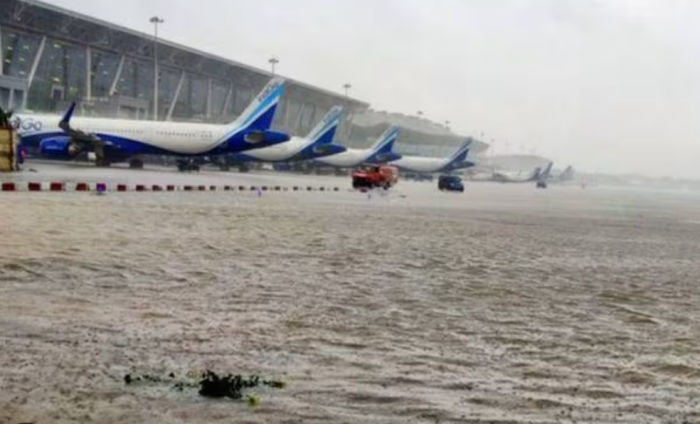
The Chennai airfield has been closed for arrival and departure operations in Chennai till 11 pm on Monday due to the harsh weather conditions in the city. Chennai airport’s runway is under water. In the visuals of the airport, ground staff were seen struggling to safeguard equipment as planes lay halted.

Eleven express trains from Chennai Central were cancelled on Monday after the water level reached the danger mark at Bridge No. 14 between Vyasarpadi and Basin Bridge owing to heavy downpours. 

As several parts of Chennai battle flood situations, Indian Army’s 12 Madras unit is helping in rescue and evacuation efforts.

As per reports, 10 districts in Northern Tamil Nadu, Pondicherry, and Andhra have been issued an alert. A total of 144 trains have been canceled.

IMD has stated that the severe cyclonic storm is likely to move northwards and cross the coast between Nellore and Machhilipatnam near Bapatla on December 5 before noon.

(With inputs from ANI)

Congress ecosystem plays up ‘north-south’ divide after humiliating poll drubbing in Rajasthan, MP, and Chhattisgarh

Following the humiliating losses in Rajasthan, Chhattisgarh, and Madhya Pradesh in the recently concluded assembly elections, the Congress ecosystem tried to rationalise the setbacks by amping up a dangerous narrative: stoking up the north-south divide and deepening fissures within the Indian society.

For decades, Congress and its ecosystem relied on pitting one caste and one religion against the other to further its political ambitions and maintain its grip on power, even if that means fomenting unrest and fuelling social disharmony.

Such divisive politics helped Congress remain in power for five decades, but ever since Modi came onto the national scene and upended the long-ossified methods of the Congress government, which included dismantling the caste divisions and providing a collective vision that bridged existing differences and brought people from different walks of life together, Congress and its ecosystem had been desperately seeking to find an issue that it could use to divide the society and cause a dent into BJP’s burgeoning vote share.

Therefore, when the BJP delivered an embarrassing pasting to the grand old party in the assembly elections in three states, namely, Rajasthan, Chhattisgarh, and Madhya Pradesh, a despondent ecosystem and its dispirited members, also identified as ‘darbaris’ and ‘coolies’ on X, formerly known as Twitter, quickly took to social media to brush aside the electoral setback by ridiculing and insulting the people of north India because the results of the three states did not went the way they wanted them to be.

A raft of social media users from the Congress ecosystem, including Congress leaders, resorted to inflaming the ‘north-south’ divide, a political construct long championed by the divisive parties in southern India to whip up regional chauvinism among the masses and ward off the threat of national parties making inroads in their home turfs. But for the Congress supporters and ecosystem, playing up the north-south divide was an easy way out to rationalise away their mortifying poll-drubbing after the rare political triumph in Karnataka, which had instilled an air of arrogance in Congress supporters. 

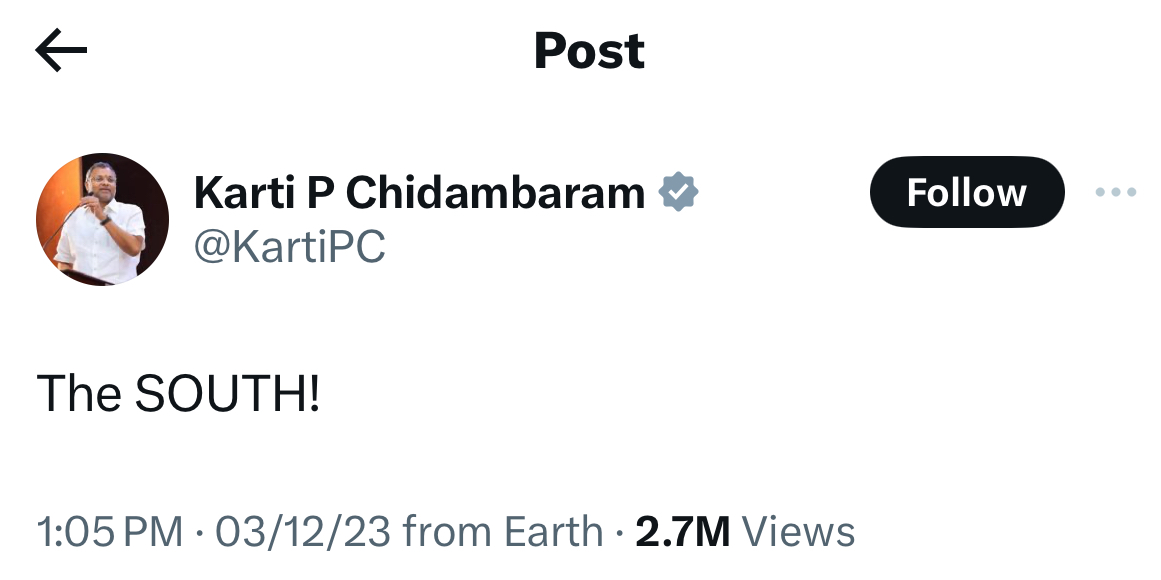
As trends of the assembly election results solidified at around noon on Sunday, Congress leader Karti Chidambaram tweeted, “The South.” This was after Congress was reduced to a shadow of its former self in Madhya Pradesh, lost Rajasthan, a surprising but emphatic loss in Chhattisgarh, but stormed its way to power in Telangana.

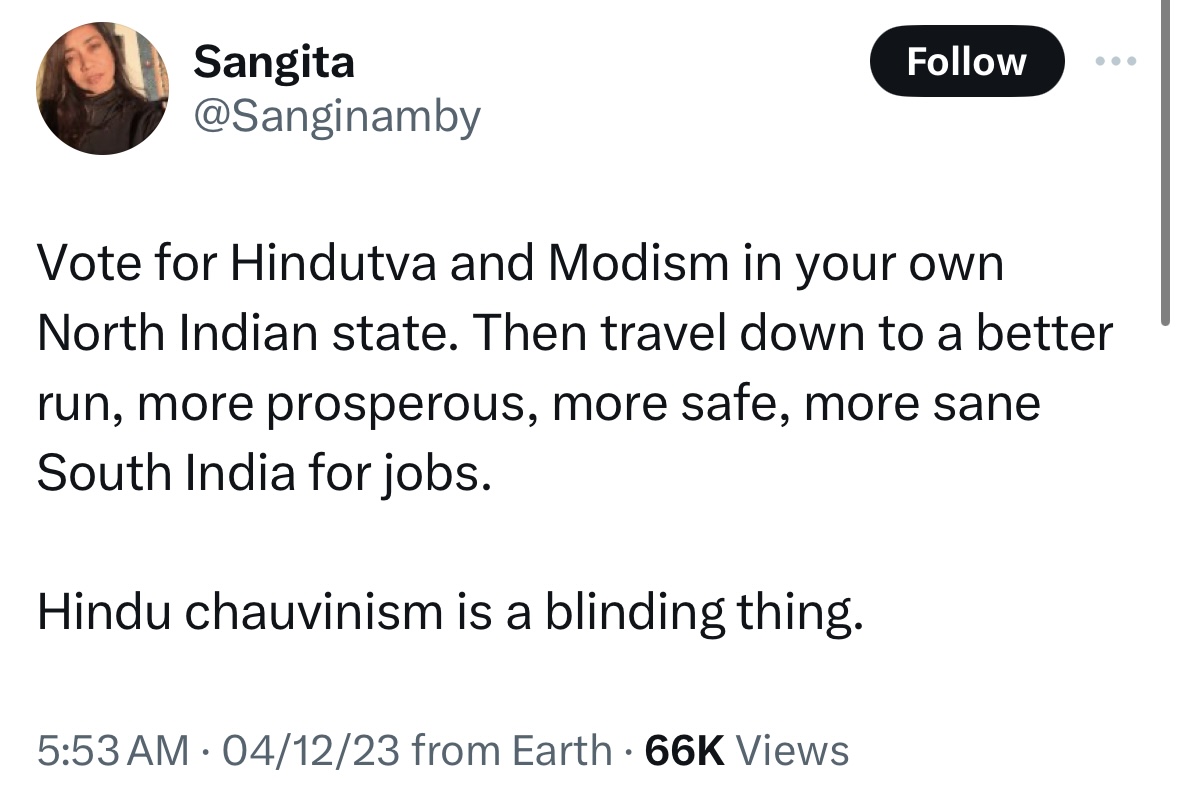
So Congress leaders and supporters alike proceeded to safeguard their supreme leader, Rahul Gandhi, and pin the blame for the losses on north Indians because they did not elect their party to power. Several Congress propagandists and IT cell members dissed North Indians, claiming that they travel to South India for more prosperous life and better jobs.

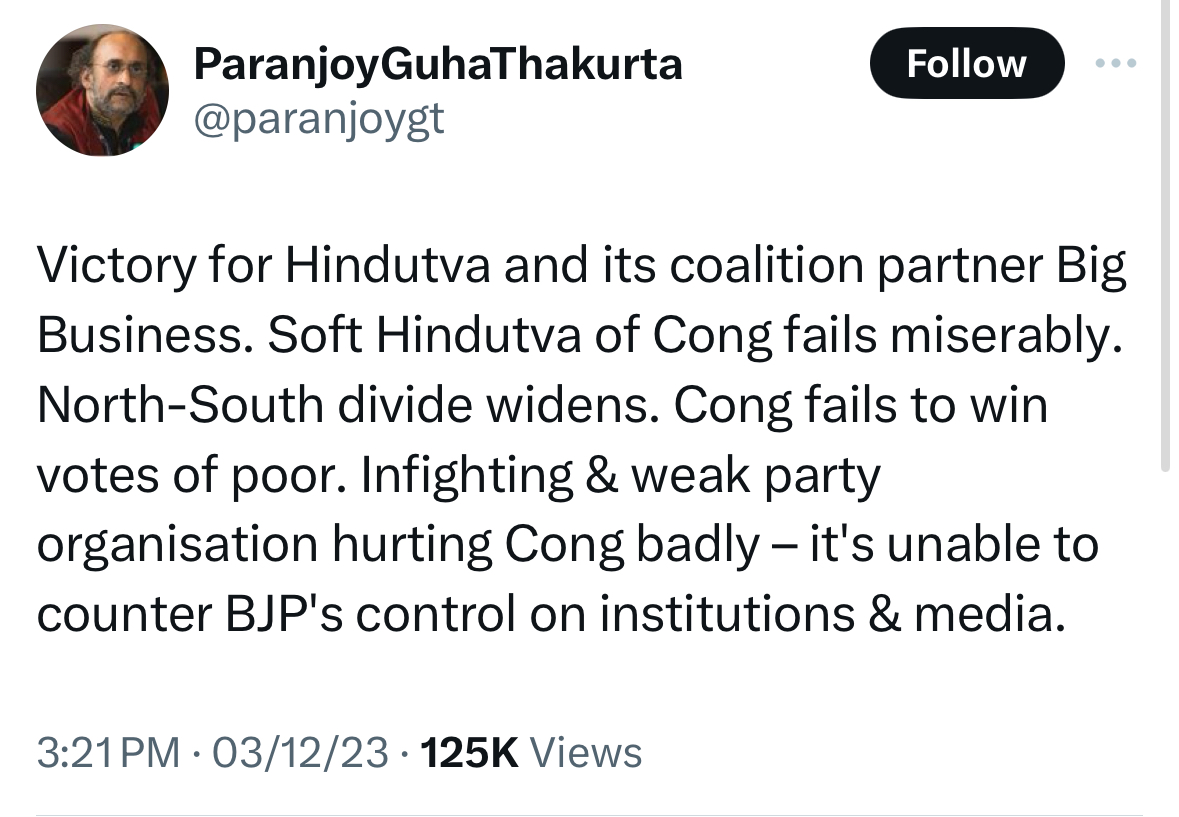
Paranjoy Thakurta Guha, infamous for the recent NewsClick-Chinese funding row, also pushed the leftwing propaganda theory that the election results have widened the North-South divide. 


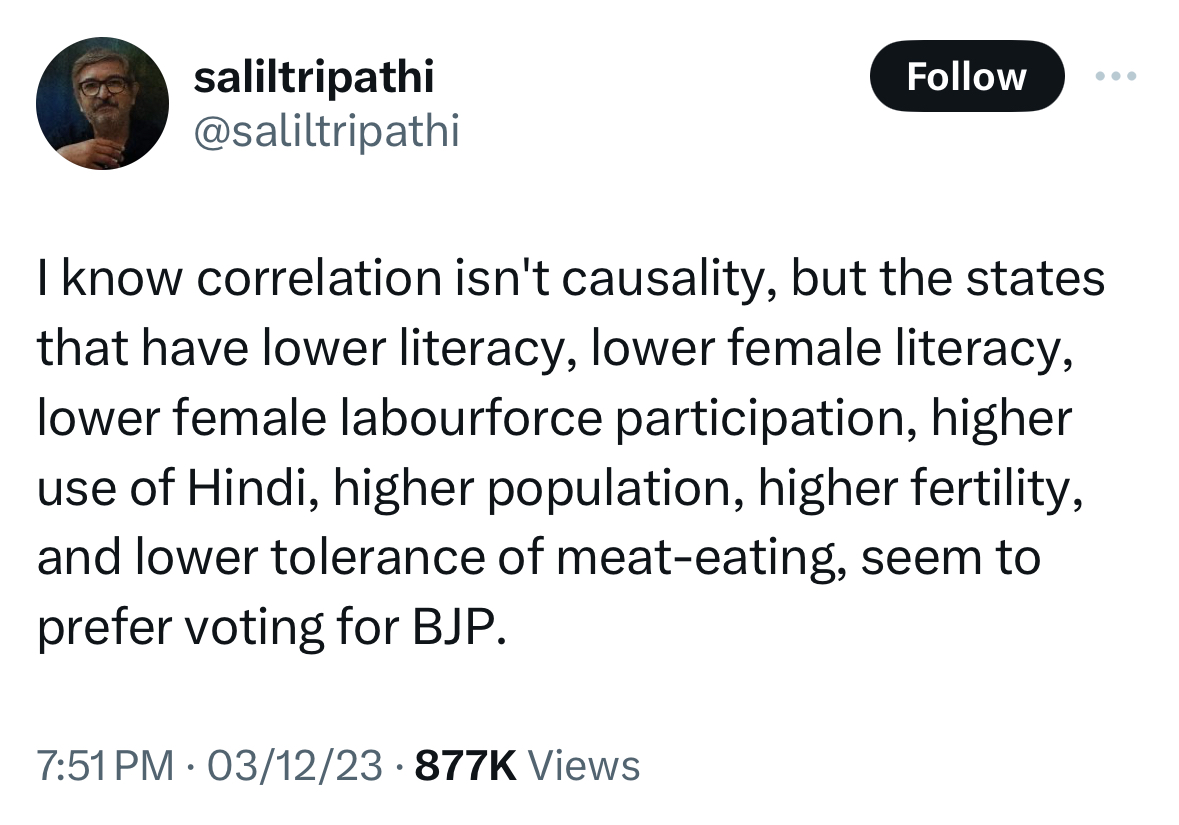
Many others trashed the populace of the states in which Congress lost in elections as lowly literate, lower female literacy, Hindi speaking, and BJP-voting.

BJP registered a landslide victory in Madhya Pradesh, winning 163 seats out of the 230-seat state assembly. In Rajasthan, too, the BJP dislodged the incumbent Ashok Gehlot-led Congress government by racking up 115 seats. In Chhattisgarh, where political pundits had predicted Congress’ return to power, the BJP pulled off a magnificent victory by winning 54 seats, nine more than the number required to form a government in the state.

The stunning victory of the saffron party was a resounding rejection of the Congress party’s poll campaign, which promised to conduct a caste-based census—another exercise in dividing the society—should it come to power in the states. 

As it turned out, the borrowed idea of conducting a caste-based census didn’t inspire the voters to rally behind the Congress. Instead, the voters were more enamoured by the promises made by PM Modi and his integrity, which tilted the scales in BJP’s favour. 

Realising that their rhetorics around caste-based census failed, the Congress ecosystem swiftly activated to segregate the society with yet another divisive narrative: the North vs South divide. 

As a part of this political campaign, scores of Congress sympathisers and supporters insulted and ridiculed the voters who rejected Congress and opted for the BJP. They disparaged northern Indians using the pejorative ‘cow belt’ and claimed that South India has long been paying for the “uninformed” and “illiterate” choices made by their northern counterpart. 

Seemingly, according to the disparagers, north Indians vote for the BJP because they are illiterate, uneducated, poor, backwards, Hindi-speaking, and supporters of Hindutva. What such presumptions reflect is the condescension and intolerance that the Congress ecosystem harbours for those who don’t align with their ideological beliefs. 

Instead of humbly accepting the public mandate and gracefully accepting their party’s rout in the state elections, the Congress ecosystem resorted to inflaming regional rifts and insulting those who did not vote for their party. 

The aim for such an exercise is two-pronged: To fuel the regional divide with the hope of capitalising on it in the subsequent elections, most notably the 2024 general elections, and to protect the Congress leadership, dominated by the Gandhi family, from public scrutiny. But to fulfil these myopic objectives, the Congress ecosystem finds no qualms in denigrating the north Indians and casting them as uneducated, uninformed, illiterate, Hindi-speaking, and bigoted. Only time will tell if such a divisive political policy will pay any dividends to the Congress party in the months to come.

Mizoram: Zoram People’s Movement (ZPM) crosses the majority mark, MNF trails far behind, CM Zoramthanga loses own seat

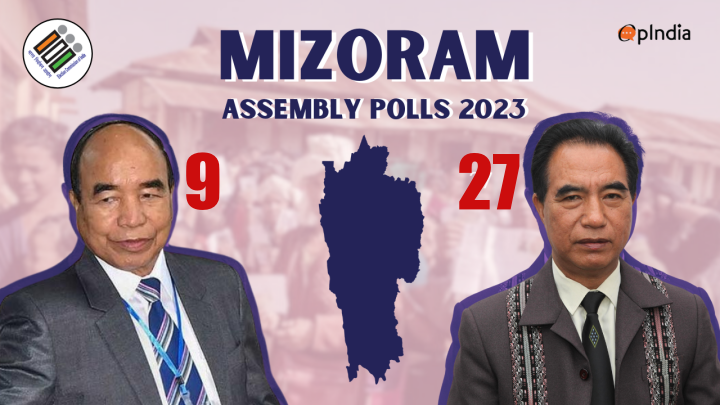
The Zoram People’s Movement (ZPM) has won 27 seats, surpassing the mandatory halfway mark in the 40-seat assembly required to constitute the upcoming government in Mizoram.

According to the Election Commission of India, the ZPM secured victory in 27 seats while the incumbent Mizo National Front (MNF) has marked victory only in 9 seats and is leading in 1.

In a big blow for the ruling Mizo National Front, a constituent of the BJP-helmed NDA, Chief Minister Zoramthanga lost Aizawl East-I seat to Lalthansanga of ZPM by 2,101 votes.

Mizoram’s political landscape has been dominated by the Congress and the Mizo National Front (MNF) since it attained full statehood in 1987.

The President of the MNF and Chief Minister, Zoramthanga has stood out as one of the most prominent figures in this election. He became Chief Minister after the 1998 Assembly polls, ending Congress’s 10-year rule. The MNF governed for a decade until Congress won in 2008 and 2013.

Deputy CM Tawnluia lost to ZPM candidate W Chhuanawma in the Tuichang seat by a margin of 909 votes. CM Zoramthanga was trailing in the Aizawl East-1 seat to ZPM’s Lalthansanga after two rounds of counting. Health Minister R. Lalthangliana was trailing in the South Tuipui seat, and ZPM candidate Jeje Lalpekhlua was leading.

Lalduhoma, ZPM’s Chief Ministerial candidate, has secured a clear victory in the Serchhip constituency.

Lalduhoma has registered a decisive win in the Serchhip constituency, defeating MNF candidate J Malsawmzuala Vanchhawng by 2982 votes.

Lalnghinglova Hmar of ZPM emerged victorious in the Aizawl West-II constituency, defeating state cabinet minister Lalruatkima. In Tuichang, ZPM’s W. Chhuanawma prevailed over the incumbent Deputy Chief Minister Tawnluia.

The incumbent MNF registered a win in seven assembly constituencies: Mamit, Serlui, Tuirial, Tuivawl, East Tuipui, West Tuipui and Thorang. The party is still leading in two seats.

However, the Bharatiya Janata Party (BJP) swept Siaha district bordering Myanmar with K. Beichhua winning the Saiha seat by defeating H.C. Lalmalsawma Zasai of MNF by 616 votes after K. Hrahmo won the Palak seat. This is the BJP’s best-ever performance in Mizoram.

Speaking about the performance of the BJP, state party chief Vanlalhmuaka said that the result is “little unexpected” for the party.
“…Earlier I said that people expected a hung assembly but after seeing the results, it is a little unexpected but we accept it and we respect the people’s mandate….Under the leadership of PM Modi and JP Nadda, BJP is progressing a lot in Mizoram. In 2018, we were getting only 1 seat but now we are about to get 3 seats, we have already secured 2…” he said.

Four major contenders were in fray in the northeastern state, which voted to elect its 40-member legislative assembly on November 7. These include the ruling Mizo National Front (MNF), the Zoram People’s Movement (ZPM), the Congress and the BJP.

The elections to the 40-member Mizoram assembly were held on November 7, with the ruling Mizo National Front (MNF) facing a stout challenge from the Zoram People’s Movement (ZPM), Congress, and the BJP. 

(This news report is published from a syndicated feed. Except for the headline, the content has not been written or edited by OpIndia staff)

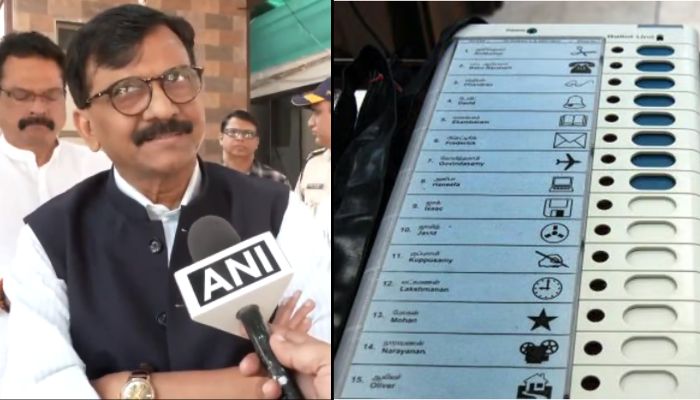
Conduct one election on ballot paper: ‘Loudmouth’ Sena UBT leader Sanjay Raut casts aspersions on EVMs after BJP trumps 3 States

A day after BJP won elections in 3 crucial States of Rajasthan, Madhya Pradesh and Chhattisgarh, Sanjay Raut courted controversy by casting aspersions on the integrity of the Electronic Voting Machines (EVMs) on Monday (4th December).

While speaking to ANI, the Shiv Sena UBT (Udhav Balasaheb Thackeray) leader claimed, “The public mandate in Telangana is different from that of 3 other States…The BJP has won big this year. We welcome the mandate even though EVM delivered it.”

“We always say that and people too have their suspicions – How is this result even possible, especially in Madhya Pradesh and Chhattisgarh? We say that if people have doubts (about the results), then, you must resolve them. Conduct one election on the ballot paper. Just one and resolve the public’s doubts.,” Raut brazened out.

“We demand one election on the ballot paper, whether Lok Sabha or Vidhan Sabha. After that, there will be no scope for people to question EVM,” he claimed, knowing well India’s history of misuse of ballot papers during elections.

Sanjay Raut however did not explain how its ally, Congress, managed to win in Telangana using the same Electronic Voting Machines (EVMs). He then challenged the BJP to conduct elections for Brihanmumbai Municipal Corporation (BMC) and see the results.

The Shiv Sena UBT (Udhav Balasaheb Thackeray) leader, who suggested that EVMS were unreliable, then dared the BJP to conduct elections through any means of their choice (including EVMs).