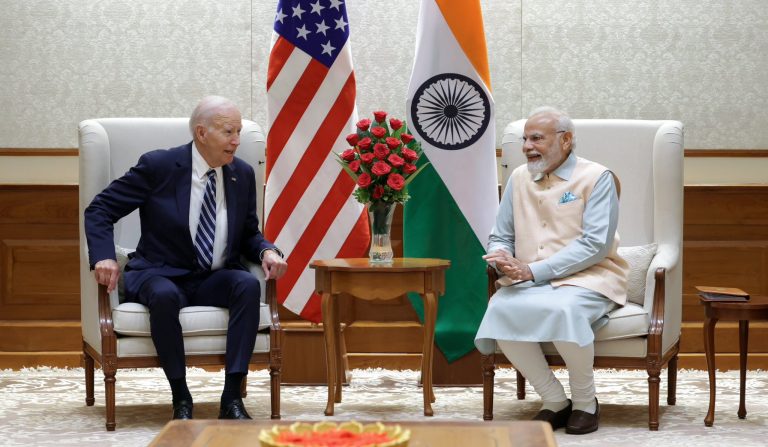
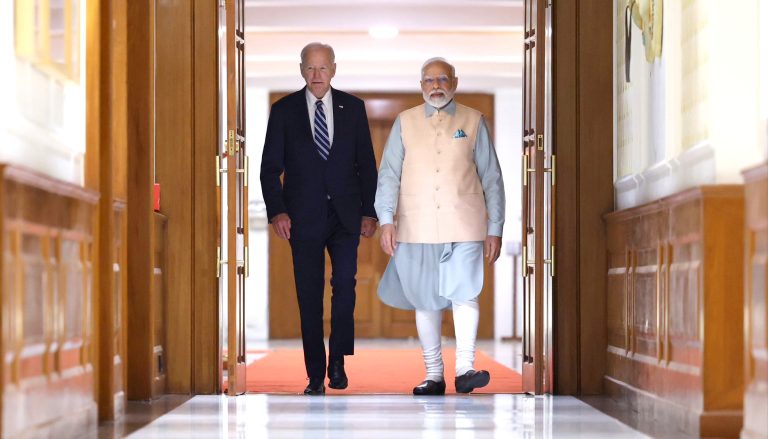
Prime Minister Narendra Modi held a bilateral meeting with US President Joe Biden at his official residence at 7, Lok Kalyan Marg in Delhi on Friday evening, 8 September, ahead of the G20 Summit on Saturday and Sunday. PM Modi tweeted about the meeting after it was concluded, saying that they were able to discuss on numerous topics.
Now a joint statement has issued by both countries after the meeting. The 29-para statement published by the White House covers a large number of issues, showing that both the leaders had a rather comprehensive talk, which was attended by US Treasury Secretary Janet Yellen, Secretary of State Anthony Blinken, US NSA Jake Sullivan, External Affairs Minister S Jaishankar and NSA Ajit Doval, among others.
The statement says that the leaders re-emphasized that the shared values of freedom, democracy, human rights, inclusion, pluralism, and equal opportunities for all citizens are critical to the success the countries enjoy and that these values strengthen the relationship.
President Biden lauded India’s G20 Presidency for further demonstrating how the G20 as a forum is delivering important outcomes. He also congratulated PM Modi and ISRO scientists for the successful Chandrayaan-3 mission.
PM Modi and President Biden reaffirmed the importance of the Quad, a strategic security dialogue between Australia, India, Japan and the USA, in supporting a free, open, inclusive, and resilient Indo-Pacific. Significantly, the US president has reaffirmed his support for a reformed UN Security Council with India as a permanent member.
The joint statement touches on collaborations on technology, space program, the semiconductor industry, telecommunication, Quantum science, Biotechnology, next generation communication systems, cyber-security, sustainability and green technologies, intelligent transportation systems, defence, education, gender issues, nuclear energy, renewable energy and many other topics.
The deal between GE Aerospace and Hindustan Aeronautical Limited to manufacture the GE F-414 jet engines in India found a special mention in the statement. US president also welcomed India’s order for MQ-9B drones.
The full joint statement is reproduced below:
1. Prime Minister Narendra Modi welcomed United States President Joseph R. Biden, Jr., to India today, reaffirming the close and enduring partnership between India and the United States. The leaders expressed their appreciation for the substantial progress underway to implement the ground breaking achievements of Prime Minister Modi’s historic, June 2023, visit to Washington.
2. The leaders called on their governments to continue the work of transforming the India-U.S. Strategic Partnership across all dimensions of our multifaceted global agenda, based on trust and mutual understanding. The leaders re-emphasized that the shared values of freedom, democracy, human rights, inclusion, pluralism, and equal opportunities for all citizens are critical to the success our countries enjoy and that these values strengthen our relationship.
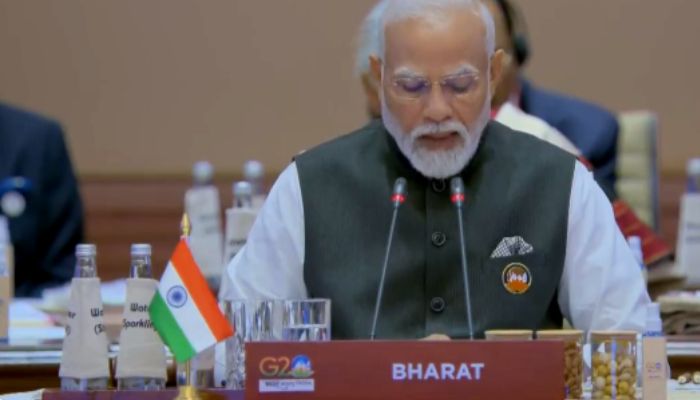
3. President Biden lauded India’s G20 Presidency for further demonstrating how the G20 as a forum is delivering important outcomes. The leaders reaffirmed their commitment to the G20 and expressed confidence that the outcomes of the G20 Leaders’ Summit in New Delhi will advance the shared goals of accelerating sustainable development, bolstering multilateral cooperation, and building global consensus around inclusive economic policies to address our greatest common challenges, including fundamentally reshaping and scaling up multilateral development banks.
4. Prime Minister Modi and President Biden reaffirmed the importance of the Quad in supporting a free, open, inclusive, and resilient Indo-Pacific. Prime Minister Modi looked forward to welcoming President Biden to the next Quad Leaders’ Summit to be hosted by India in 2024. India welcomed the U.S. decision to co-lead the Indo-Pacific Oceans Initiative Pillar on Trade Connectivity and Maritime Transport, further to the U.S. decision to join IPOI in June 2023.
5. Continuing to share the view that global governance must be more inclusive and representative, President Biden reaffirmed his support for a reformed UN Security Council with India as a permanent member, and, in this context, welcomed once again India’s candidature for the UNSC non-permanent seat in 2028-29. The leaders once again underscored the need to strengthen and reform the multilateral system so it may better reflect contemporary realities and remain committed to a comprehensive UN reform agenda, including through expansion in permanent and non-permanent categories of membership of the UN Security Council.
6. Prime Minister Modi and President Biden reaffirmed technology’s defining role in deepening our strategic partnership and lauded ongoing efforts through the India-U.S. Initiative on Critical and Emerging Technology (iCET) to build open, accessible, secure, and resilient technology ecosystems and value chains, based on mutual confidence and trust, which reinforce our shared values and democratic institutions. The United States and India intend to undertake a midterm review of iCET in September 2023 to continue to drive momentum toward the next annual iCET review, co-led by the National Security Advisors of both countries, in early 2024.
7. President Biden congratulated Prime Minister Modi and the scientists and engineers of the Indian Space Research Organisation (ISRO) on Chandrayaan-3’s historic landing at the south polar region of the Moon, as well as the successful launch of India’s first solar mission, Aditya-L1. Having set a course to reach new frontiers across all sectors of space cooperation, the leaders welcomed efforts towards establishment of a Working Group for commercial space collaboration under the existing India-U.S. Civil Space Joint Working Group. Determined to deepen our partnership in outer space exploration, ISRO and the National Aeronautics and Space Administration (NASA) have commenced discussions on modalities, capacity building, and training for mounting a joint effort to the International Space Station in 2024, and are continuing efforts to finalise a strategic framework for human space flight cooperation by the end of 2023. India and the United States also intend to increase coordination on planetary defence to protect planet Earth and space assets from the impact of asteroids and near-Earth objects, including U.S. support for India’s participation in asteroid detection and tracking via the Minor Planet Center.
8. The leaders reiterated their support for building resilient global semiconductor supply chains, noting in this respect a multi-year initiative of Microchip Technology, Inc., to invest approximately US$300 million in expanding its research and development presence in India and Advanced Micro Device’s announcement to invest US$400 million in India over the next five years to expand research, development, and engineering operations in India. The leaders expressed satisfaction at the ongoing implementation of announcements made in June 2023 by U.S. companies, Micron, LAM Research, and Applied Materials.
9. Sharing a vision of secure and trusted telecommunications, resilient supply chains, and global digital inclusion, Prime Minister Modi and President Biden welcomed the signing of a Memorandum of Understanding (MoU) between Bharat 6G Alliance and Next G Alliance, operated by Alliance for Telecommunications Industry Solutions, as a first step towards deepening public-private cooperation between vendors and operators. They further acknowledged the setting-up of two Joint Task Forces focused on collaboration in the field of Open RAN and research and development in 5G/6G technologies. A 5G Open RAN pilot in a leading Indian telecom operator will be undertaken by a U.S. Open RAN manufacturer before field deployment. The leaders continue to look forward to the participation of Indian companies in the U.S. Rip and Replace Program; President Biden also welcomed India’s support for a Rip and Replace pilot in the United States.
10. The United States reiterated its commitment to working together with India in the quantum domain, both bilaterally and through the Quantum Entanglement Exchange, a platform to facilitate international quantum exchange opportunities; and welcomed the participation of India’s S.N. Bose National Centre for Basic Sciences, Kolkata, as a member of the Quantum Economic Development Consortium. It was also recognized that the Indian Institute of Technology (IIT) Bombay joined the Chicago Quantum Exchange as an international partner.
11. The leaders hailed the signing of an Implementation Arrangement between the U.S. National Science Foundation (NSF) and India’s Department of Biotechnology to enable scientific and technological research collaborations in biotechnology and biomanufacturing innovations. They welcomed the call for proposals released by NSF and India’s Ministry of Electronics and Information Technology to foster academic and industrial collaboration in semiconductor research, next generation communication systems, cyber-security, sustainability and green technologies, and intelligent transportation systems.
12. Reaffirming their commitment to building resilient technology value chains and linking defence industrial ecosystems, the leaders recommitted their administrations to promoting policies and adapting regulations that facilitate greater technology sharing, co-development, and co-production opportunities between Indian and U.S. industry, government and academic institutions. They also welcomed continued engagement through an inter-agency monitoring mechanism under the auspices of the bilateral Strategic Trade Dialogue, launched in June 2023.
13. The leaders welcomed the signing of an MoU between Indian universities, represented by the Council of Indian Institutes of Technology (IIT Council), and the Association of American Universities (AAU) to establish the India-U.S. Global Challenges Institute, with a combined initial commitment of at least US$10 million. The Global Challenges Institute will bring together leading research and higher-education institutions from across our two nations, including beyond AAU and IIT membership, to advance new frontiers in science and technology, spanning collaboration in sustainable energy and agriculture, health and pandemic preparedness, semiconductor technology and manufacturing, advanced materials, telecommunications, artificial intelligence, and quantum science.
14. The leaders also welcomed the growing number of multi-institutional collaborative education partnerships, such as those between New York University-Tandon and IIT Kanpur Advanced Research Center, and the Joint Research Centers of the State University of New York at Buffalo and IIT Delhi, Kanpur, Jodhpur, and BHU, in the areas of critical and emerging technologies.
15. The leaders affirmed the importance of efforts to close the gender digital divide in the digital economy, noting a G20 commitment to halve the digital gender gap by 2030 and expressed support for the Women in the Digital Economy Initiative, which brings together governments, private sector companies, foundations civil society and multilateral organizations to accelerate progress toward the closure of the digital gender divide.
16. Prime Minister Modi and President Biden reaffirmed their commitment to deepen and diversify the India-U.S. Major Defence Partnership through expanded cooperation in new and emerging domains such as space and AI, and accelerated defence industrial collaboration.
17. The leaders welcomed completion of the Congressional Notification process on 29 August 2023 and the commencement of negotiations for a commercial agreement between GE Aerospace and Hindustan Aeronautical Limited (HAL) to manufacture GE F-414 jet engines in India, and recommitted to work collaboratively and expeditiously to support the advancement of this unprecedented co-production and technology transfer proposal.
18. The leaders applauded the conclusion of a second Master Ship Repair Agreement, with the most recent agreement signed by the U.S. Navy and Mazgaon Dock Shipbuilders, Ltd., in August 2023. Both sides recommitted to advancing India’s emergence as a hub for the maintenance and repair of forward-deployed U.S. Navy assets and other aircraft and vessels. The leaders also welcomed further commitments from U.S. industry to invest more in India’s maintenance, repair, and overhaul capabilities and facilities for aircraft.
19. The leaders commended the India-U.S. Defence Acceleration Ecosystem (INDUS-X) team for establishing a robust collaboration agenda to harness the innovative work of the U.S. and Indian defence sectors to address shared security challenges. INDUS-X convened the inaugural Academia Start-up Partnership at IIT Kanpur, with the participation of Penn State University, and initiated the Joint Accelerator Program for Indian Startups, through a workshop led by U.S. accelerator M/s Hacking 4 Allies (H4x) and IIT Hyderabad in August 2023. Both sides also welcomed the announcement by the Indian Ministry of Defence’s Innovations for Defence Excellence and the U.S. Department of Defense’s Defense Innovation Unit to launch two joint challenges, which will invite start-ups to develop solutions to shared defence technology challenges.
20. President Biden welcomed the issuance of a Letter of Request from the Ministry of Defence of India to procure 31 General Atomics MQ-9B (16 Sky Guardian and 15 Sea Guardian) remotely piloted aircraft and their associated equipment, which will enhance the intelligence, surveillance and reconnaissance (ISR) capabilities of India’s armed forces across all domains.
21. Reiterating the importance of nuclear energy as a necessary resource to meet our nations’ climate, energy transition, and energy security needs, Prime Minister Modi and President Biden welcomed intensified consultations between the relevant entities on both sides to expand opportunities for facilitating India-U.S. collaboration in nuclear energy, including in development of next generation small modular reactor technologies in a collaborative mode. The United States reaffirmed its support for India’s membership in the Nuclear Suppliers Group and committed to continue engagement with like-minded partners to advance this goal.
22. The leaders welcomed the inaugural meeting of the India-U.S. Renewable Energy Technologies Action Platform [RE-TAP], in August 2023, under which the two countries will engage in lab-to-lab collaboration, piloting, and testing of innovative technologies; collaboration on policy and planning to advance renewable energy and enabling technologies; investment, incubation and outreach programmes; and training and skill development to accelerate the uptake and adoption of new and emerging renewable technologies and energy systems.
23. Reiterating the importance of decarbonizing the transport sector, the leaders welcomed progress to expand electric mobility in India, including joint support for a payment security mechanism financed through both public and private funds. This will accelerate the procurement of 10,000 made-in India electric buses including those for the Indian PM e-Bus Sewa program that will include the associated charging infrastructure. The two countries are committed to working together to help diversify the global supply chain for e-mobility.
24. India and the United States are also advancing the creation of investment platforms to lower the cost of capital and accelerate the deployment of greenfield renewable energy, battery storage and emerging green technology projects in India. Towards this end, India’s National Investment and Infrastructure Fund and the U.S. Development Finance Corporation exchanged letters of intent to each provide up to US$500 million to anchor a renewable infrastructure investment fund.
25. The leaders lauded the settlement of the seventh and last outstanding World Trade Organisation (WTO) dispute between India and the United States. This follows the unprecedented settlement of six outstanding bilateral trade disputes in the WTO in June 2023.
26. The leaders welcomed efforts to develop an ambitious “Innovation Handshake” agenda under the India-U.S. Commercial Dialogue, to include two anchor events in the fall (one in India and one in the United States), in which our two sides will collaborate to bring together start-ups, private equity and venture capital firms, corporate investment departments, and government officials to forge connections between the two countries’ innovation ecosystems.
27. The leaders welcomed our growing bilateral cooperation in cancer research, prevention, control, and management, and looked forward to the launch of the India-U.S. Cancer Dialogue in November 2023. This dialogue will focus on advancing knowledge in cancer genomics, developing new diagnostics and therapeutics to enhance and strengthen cancer care including for underserved urban and rural communities. The leaders also highlighted the upcoming U.S.-India Health Dialogue, taking place in October 2023 in Washington, D.C., underscoring their joint commitment to strengthening and facilitating scientific, regulatory, and health cooperation between our two nations.
28. The leaders welcomed the renewal of a Memorandum of Arrangement between the U.S. Department of Defense POW/MIA Accounting Agency and the Anthropological Survey of India (AnSI) to facilitate recovery from India of the remains of fallen U.S. service members who served in World War II.
29. Prime Minister Modi and President Biden pledged to sustain the high-level of engagement between our governments, industries, and academic institutions and realize their ambitious vision for an enduring India-U.S. partnership that advances the aspirations of our people for a bright and prosperous future, serves the global good, and contributes to a free, open, inclusive, and resilient Indo-Pacific.