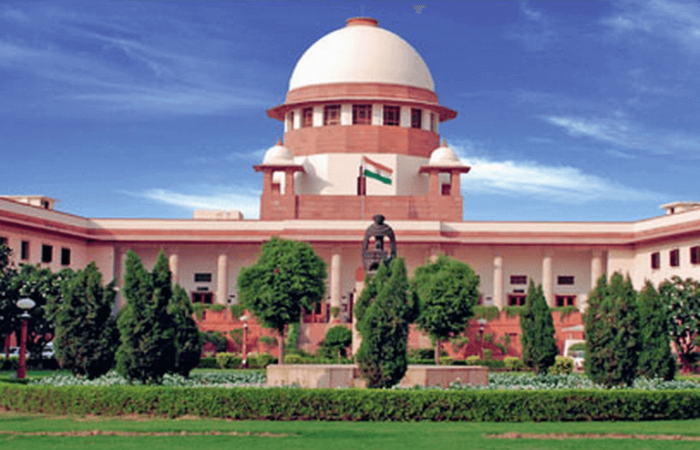
The Supreme Court of India is holding a continued hearing to give the final verdict on Article 370 of the constitution of India. One such hearing session was held on Thursday, 24th August 2023. In this hearing, Solicitor General Tushar Mehta who was representing the government of India quoted certain remarks by Sardar Vallabhbhai Patel on the issue of Jammu and Kashmir and the stand taken by then Prime Minister Jawaharlal Nehru.
As Nehru was getting exposed by the arguments being presented by SG Tushar Mehta, petitioner lawyer Kapil Sibal objected to it and created disturbances in the hearing. In response to this, the CJI instructed him not to impede in the middle of the government’s argument. Kapil Sibal and other arguing lawyers also challenged the books quoted by Tushar Mehta to which the solicitor general replied saying that anything can be cited in the courtroom. The constitutional bench of the Supreme Court hearing this matter consists of Justice BR Gavai, Justice Surya Kant, Justice SK Kaul, and Justice Sanjeev Khanna. The bench is headed by CJI DY Chandrachud.
SG Tushar Mehta was illustrating Sardar Patel's position on Kashmir citing some book/newspaper reference. Italian Bouncer Sibal & gang blew their top since it put their demigod Nehru in bad light
In his argument, SG Tushar Mehta said, “Please note this milord that after acceptance of 370, V Shankar expressed his disappointment at the passing of the special provision. Sardar Vallabhbhai Patel summoned him to lunch. The description of the said meeting in ‘My Reminiscences of Sardar Patel’ by Vishnu Shankar is as under. V Shankar is a principal secretary, who was secretary of Jammu and Kashmir and became the cabinet secretary. Please note this milord. One by one. Beautiful words.” After this, SG Tushar Mehta quoted from the book.
As soon as I was seated, Sardar spoke. “So you are annoyed with me for having accepted the Gopalaswami formula?” I queried that if he felt that way, why did he not indicate his mind earlier?
SG Tushar Mehta said, “Milord, see the maturity of the man and the statesmanship.” Then he continued reading from the book.
He (Patel) said, “I was deeply concerned at the situation. Gopalaswami had acted under Pandit Ji’s advice. If Jawaharlal were here, we could have had it out of him. But how could I do so with Gopalaswami who was only acting under orders? If I did, people would have said that I was taking revenge on his confidence when he was away. Gopalaswami had appealed to me for help. How could I have let him down in the absence of his chief.”
SG Tushar Mehta said, “Since my prime minister is not present, I will not let him down, since my prime minister argues outside – out of the country.” Then he continued reading from the book.
I then asked why he had let down the country and other states whose constituent assemblies had been scrapped in accordance with his advice and policy. He considered the validity of the criticism but pointed out the delicate international position of the state and the issue of its relationship with India, we felt that the present situation had to be tied over without giving the eventuality and this had been done under the formula.
SG Tushar Mehta said, “Please note this milord. This only Sardar could have spoken. And now milord, it has proved to be prophetic.” Then he continued reading from the book.
He (Patel) said that after all neither Sheikh Abdulla nor Gopalaswami was permanent. The future would depend on the strength and guts of the Indian government and if we cannot have confidence in our strength, we do not deserve to exist as a nation.
The opposition lawyer accompanying Kapil Sibal objected to this book quoted by SG Tushar Mehta. CJI DY Chandrachud told the petitioner’s lawyer to let the SG continue his arguments. Justice BR Gavai said, “When your side argued, at that time there was no interruption by either the attorney or the solicitor.”
SG Tushar Mehta said, “Whenever any of them provided any documents or additional judgments, we never objected.”
CJI DY Chandrachud said, “These are well-known books. Whenever we are deciding on a matter, we give preference to primary sources and primary matter such as the instruments of accession. These are also other such documents that he is relying on to explain it.”
SG Tushar Mehta said, “Neither of us was not even born when all of this happened. I did not object to even Noorani being quoted here.”
It is notable that the opposition lawyers accompanying Kapil Sibal raised the objection as soon as they knew that the book quoted by SG Tushar Mehta exposes the errors committed by Jawaharlal Nehru and that the step of the Modi government to abrogate Article 370 and Annexure 35a was a step that showed the strength and guts Sardar Patel was talking about.
After this, the opposition counsel opposed saying that the book quoted by SG Tushar Mehta is not even on the list of the documents mentioned in the dates list of the court. SG Tushar Mehta said that he would send a copy of the book to the petitioner’s lawyers.
The opposition lawyer said, “That is not the point. I am saying that it can just keep getting enlarged. We are saying that please stick to the records.”
Replying to this, SG Tushar Mehta said, “If AG Noorani can be read, even a newspaper can be read. I am sorry but I am saying this with seriousness. I have read AG Noorani. It is a one-sided book. But we didn’t object to it.”
CJI DY Chandrachud taking control of the argument said, “No, no. Mr. Solicitor General. You do not have to go this far.” Then addressing the opposition lawyers he said, “All that he (SG Mehta) is saying just indicates that it’s not like any conclusive evidence or report material. This is his way of demonstrating that there were different points of view and different perspectives that were present at that time.”
Kapil Sibal countered it saying, “We may have historic perspectives. Even at that time, one side was expressing one view and the other side was strongly opposed to it. Ultimately we have to interpret the provision in the constitution. How did this all come about? That is what we all are discussing.”
To this, the court said, “Then you were also referring to some documents. These documents give us some air of the background and different perspectives to the background.”
Concluding the heated debate, SG Tushar Mehta said, “Several new facts were stated. I didn’t object because I did not want to trivialise the dialogue.”
A 5-judge Supreme Court bench headed by Chief Justice of India DY Chandrachud and comprising Justices Sanjay Kishan Kaul, Sanjiv Khanna, BR Gavai, and Surya Kant is hearing a batch of petitions challenging the abrogation of Article 370 of the Constitution which conferred special status on the erstwhile State of Jammu and Kashmir. More than 20 petitions are pending before the Supreme Court challenging the Centre’s decision to abrogate Article 370. The hearing in the given case began on August 2. So far, 10 hearings have been completed in the month of August. The CJI stated that the Court would only examine if there is a violation of the constitution and would not reassess the basis of the government’s decision to abrogate Article 370 from the former state of Jammu and Kashmir. The next hearing in this case will be on 28 August 2023.
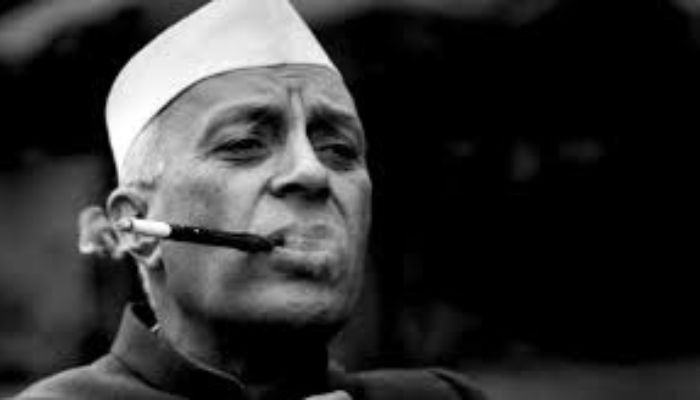
Nehru was repeatedly apprised of the misappropriation of Netaji’s funds at the hands of two former INA officials after Netaji’s mysterious demise. Instead of heeding these alarms, the Nehru government granted ostentatious positions to a former INA official suspected of embezzling Netaji’s treasure. Another former INA official suspected of embezzlement was given a free run despite his moving back to India from Japan. Here’s another account of how Netaji’s jewels and funds, and questions pertaining to the same were handled by the Nehru government.
On 21 May 1951, former Indian Ambassador to Japan KK Chettur wrote to the then commonwealth relations secretary BN Chakravarty alleging that two key aides of Bose could have played a role in the misappropriation of INA funds. The suspects were INA publicity and propaganda minister SA Ayer and the head of the Indian Independence League in Tokyo Munga Ramamurti.
Chettar reportedly wrote, “As you are no doubt aware, there have been serious allegations against Ramamurti with regard to the misappropriation of the funds of the late Indian Independence League, as also the personal property of the late Subhas Chandra Bose, consisting of considerable quantities of diamonds, jewellery, gold, and other valuable articles. Rightly or wrongly, Ayer’s name has also been associated with these charges…”
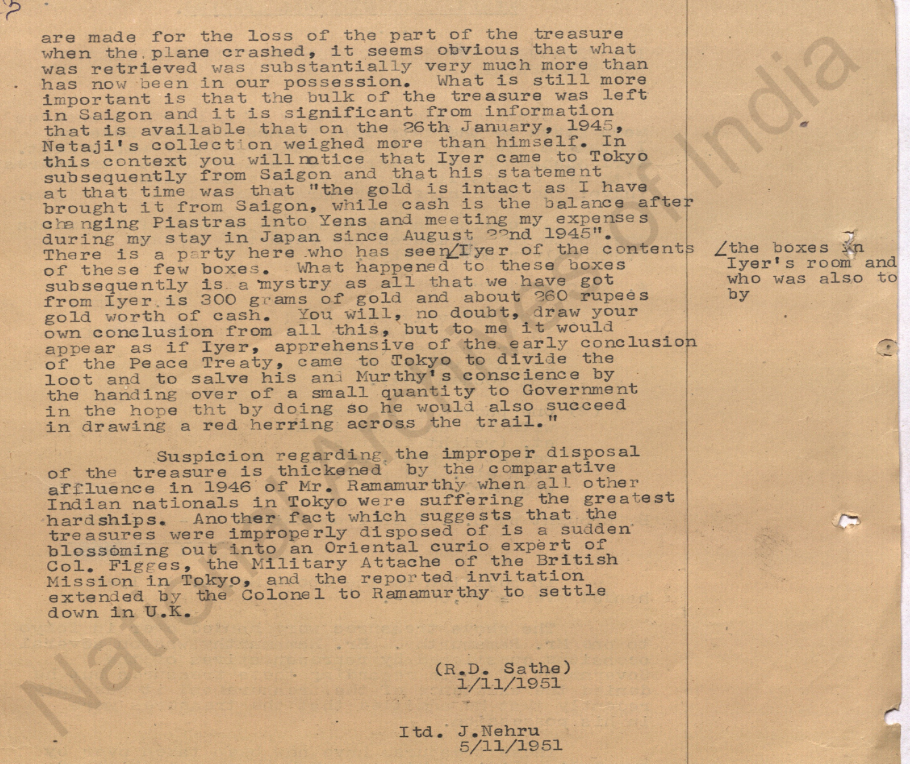
Letter by RD Sathe, an undersecretary, later appointed foreign secretary in MEA, raising concerns about the INA funds with SA Ayer and Ramamurti (Source: netajipapers.gov.in)
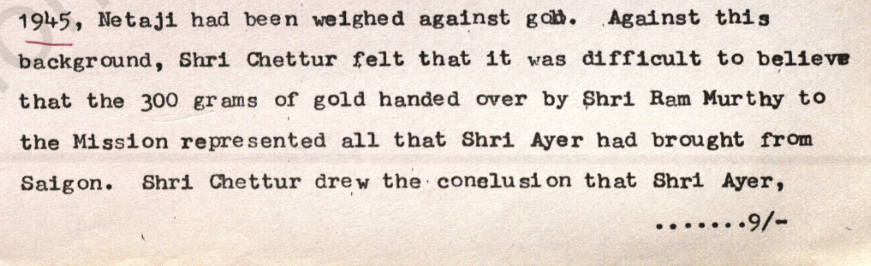
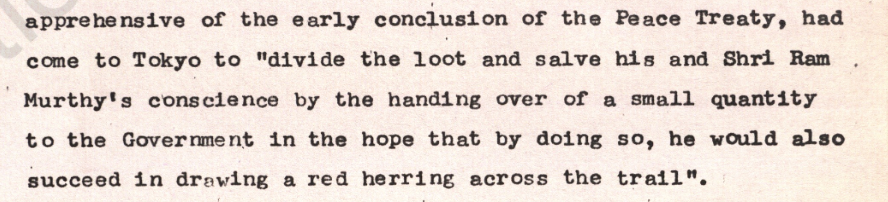
Letter by RD Sathe, an undersecretary, later appointed foreign secretary in MEA, quoting the concerns raised by then Indian Ambassador to Japan Mr Chettur. (Source: netajipapers.gov.in)
Letter by RD Sathe, an undersecretary, later appointed foreign secretary in MEA, raising concerns about the INA funds with SA Ayer and Ramamurti (Source: netajipapers.gov.in)
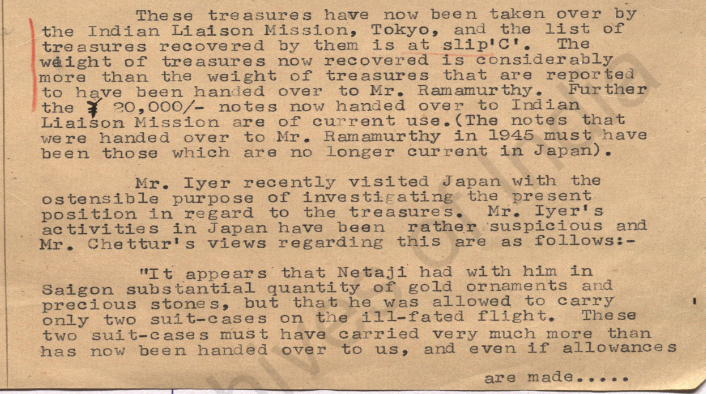
The report by the Indian embassy in Tokyo also mentioned that a certain party there had seen the treasure boxes in Ayer’s room, the same man later chosen by Nehru as his aide. “There is a party here who has seen the (treasure) boxes in Ayer’s rooms and who was also to buy off the contents of these few boxes. What happened to these boxes subsequently is a mystery as all that we have got from Ayer is 300 gms of gold and about 260 rupees worth of cash,” Chettur stated adding that “Bose must have carried very much more that has now been handed over to us (by Murti and Ayer), and even if allowances are made for the loss of the part of the treasures when the plane crashed.”
Government’s reply to a question on Netaji’s treasure in 1978 detailing concerns raised by former Indian Envoy in Japan Mr Chettur (Source: netajipapers.gov.in)
Government’s reply to a question on Netaji’s treasure in 1978 detailing concerns raised by former Indian Envoy in Japan Mr Chettur (Source: netajipapers.gov.in)
Again, in 1953, former secretary of the Indian Independence League (IIL) in Japan, VB Seth repeatedly reached out to the Nehru government drawing attention to Ramamurti’s activities in the country and demanding that action be taken against him to recover the amount (of INA funds) misappropriated by him.
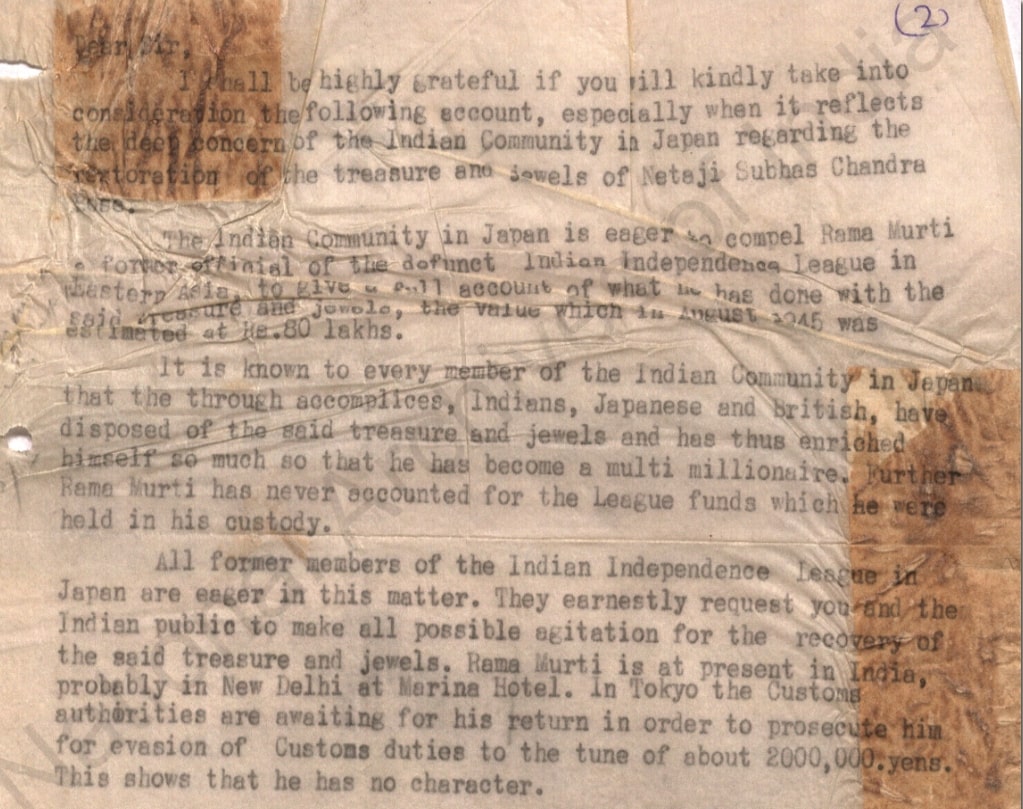
In a letter to the then Home Minister dated 18th February 1953, Sheth wrote, “The Indian community in Japan is eager to compel Rama Murti a former official of the defunct IIL in Eastern Asia to give a full account of what he has done with the treasure and jewels of Netaji, the value of which in August 1945 was estimated at Rs 80 lakhs.”
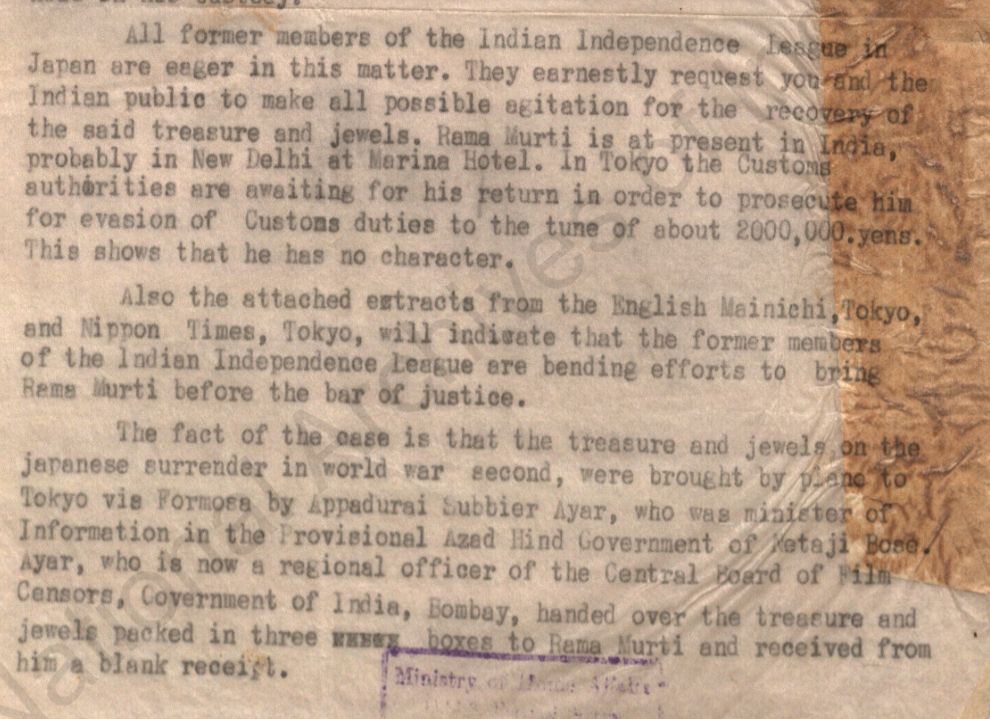
Letter written to the then Home Minister in 1953 by former secretary of IIL, VB Shether demanding probe against Ramamurti over misappropriation of INA funds (Source: netajipapers.gov.in)
According to Sheth, Ramamurti disposed of the treasure through his Indian, Japanese, and British accomplices, and enriched himself overnight becoming a multi-millionaire. He said that the Customs authorities in Tokyo were awaiting Murti’s return in order to prosecute him for evading duties amounting to about 2000,000 yen.
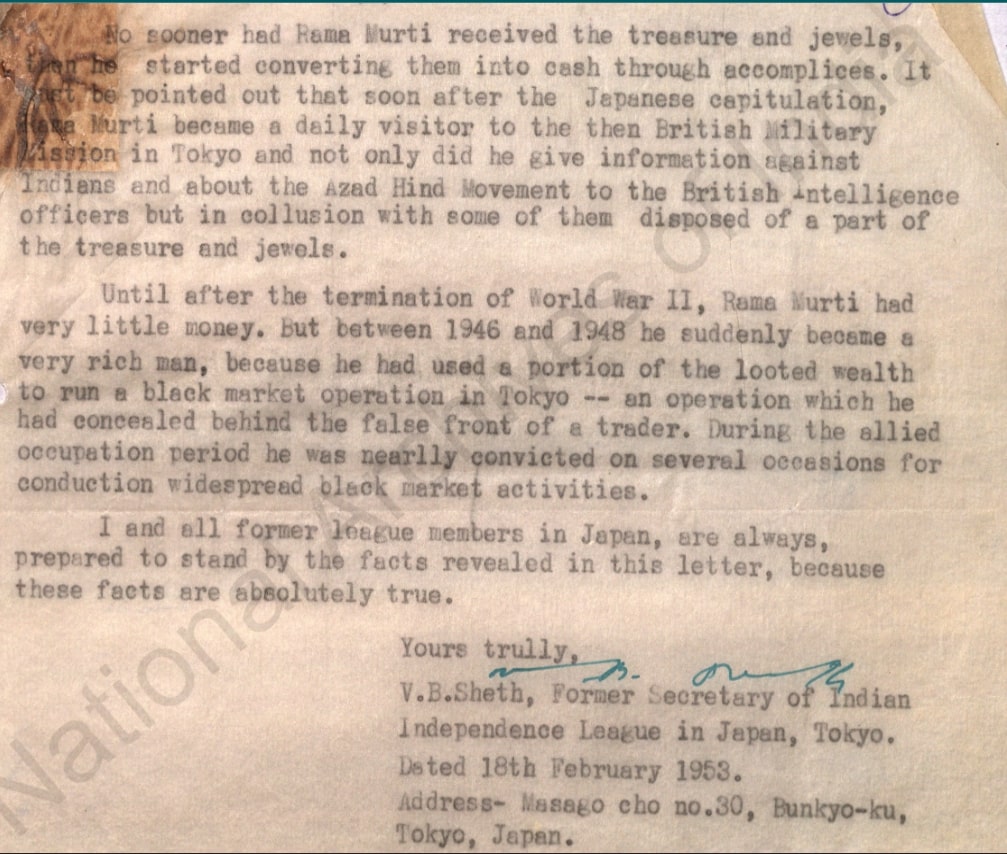
Letter written to the then Home Minister in 1953 by former secretary of IIL, VB Shether demanding probe against Ramamurti over misappropriation of INA funds (Source: netajipapers.gov.in)
The treasure that was in Ramamurti’s hold, documents show, belonged to Netaji and was recovered by another suspect named SA Ayer, information minister in the INA, after the Taihoku plane crash in which Netaji is said to have died.
Letter written to the then Home Minister in 1953 by former secretary of IIL, VB Shether demanding probe against Ramamurti over misappropriation of INA funds (Source: netajipapers.gov.in)
Ayer – who was the regional officer of the Central Board of Film Censors (Bombay) at the time Sheth wrote to the Centre – gave Netaji’s treasure and jewels packed in three boxes to Ramamurti in return for a blank receipt. The details have been revealed in the declassified files on Netaji in 2016.
“No Sooner had Rama Murti received the treasure and jewels, than he started converting them into cash through accomplices. It must be pointed out that soon after the Japanese capitulation, Rama Murti became a daily visitor to the then British Military Mission in Tokyo, and not only did he give information against Indians and about the Azad Hind Movement to the British Intelligence officers but in collusion with some of them disposed of a part of the treasure and jewels,” Sheth wrote in his letter.
He further underlined how Ramamurti had very little money till the termination of World War 2, but suddenly became rich between 1946 and 1948. Sheth attributed Ramamurti’s sudden riches to a “portion of the looted wealth he had used to run a black market operation in Tokyo concealed behind the false front of a trader.”
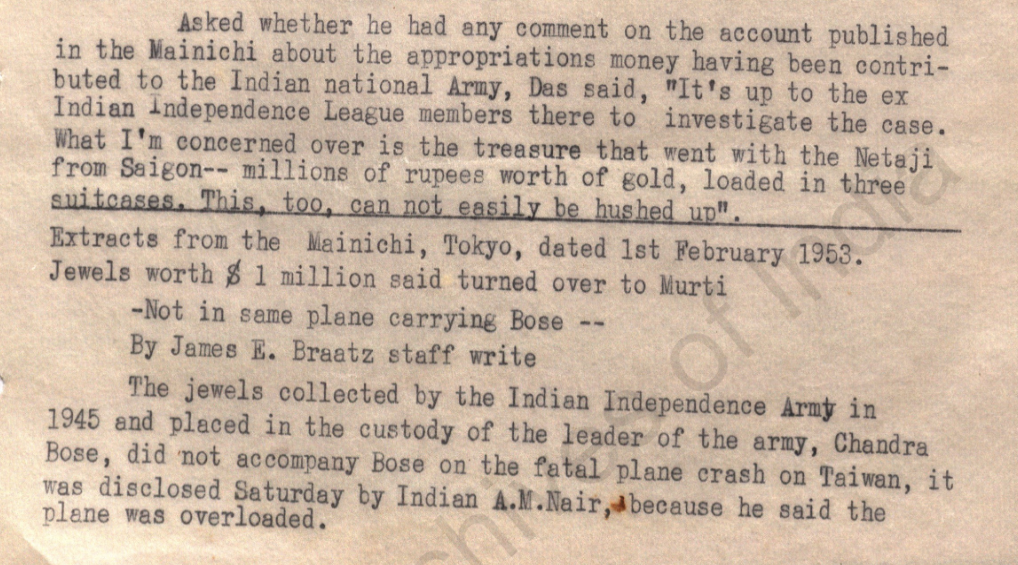
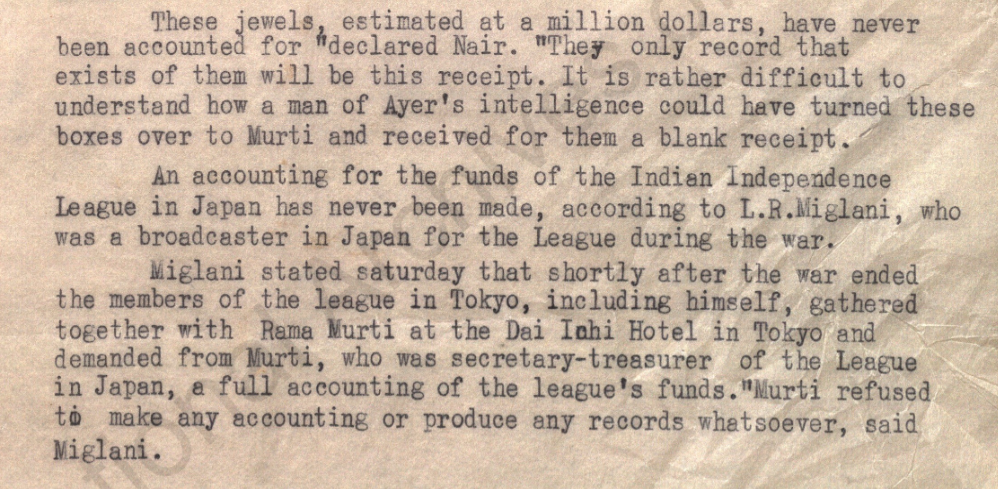
A report dated 1st February 1953 published in the Japanese daily ‘The Mainichi’ quoted AM Nair, who was a liaison officer in 1945 between the IIL and the Japanese. “The jewels, collected mostly from the Indians of Burma, were packed for an airdrop if necessary into three boxes. They were put in the case of Appadurai Subbier Ayer (SA Ayer),” Naird reportedly said.
Japanese media reports on embezzlement of Netaji’s treasure by Ramamurti (Source: netajipapers.gov.in)
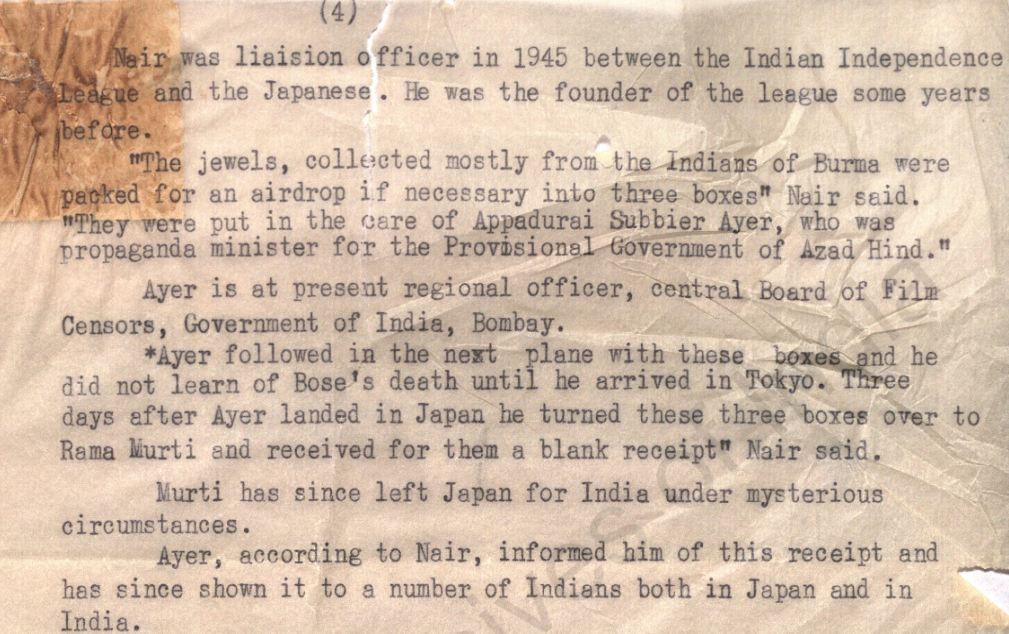
He added in his statement to ‘The Mainichi’, “Ayer followed in the next plane (after Bose) with these boxes and he did not learn of Bose’s death until he arrived in Tokyo. Three days after Ayer landed in Japan he turned these three boxes over to Rama Murti and received for them a blank receipt.”
Japanese media reports on embezzlement of Netaji’s treasure by Ramamurti (Source: netajipapers.gov.in)
Nair was further quoted as saying that “the jewels, with an estimated value of a million dollars, had never been accounted for.” He said, “The only record that exists of them will be this receipt. It is rather difficult to understand how a man of Ayer’s intelligence could have turned these boxes over to Murti and received for them a blank receipt.”
Japanese media reports on embezzlement of Netaji’s treasure by Ramamurti (Source: netajipapers.gov.in)
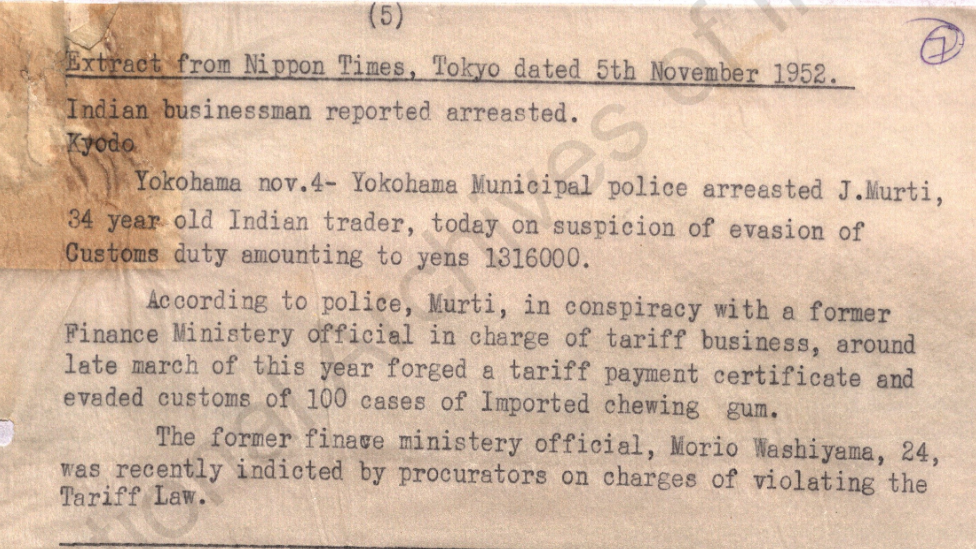
Ramamurti’s brother J Murti in November 1952 was arrested by the Japanese police for evading Customs duty amounting to 1316000 yen. He was accused of conspiring with a former Japanese finance ministry official for forging a tariff payment certificate.
Japanese media report on arrest of Ramamurti’s brother (Source: netajipapers.gov.in)
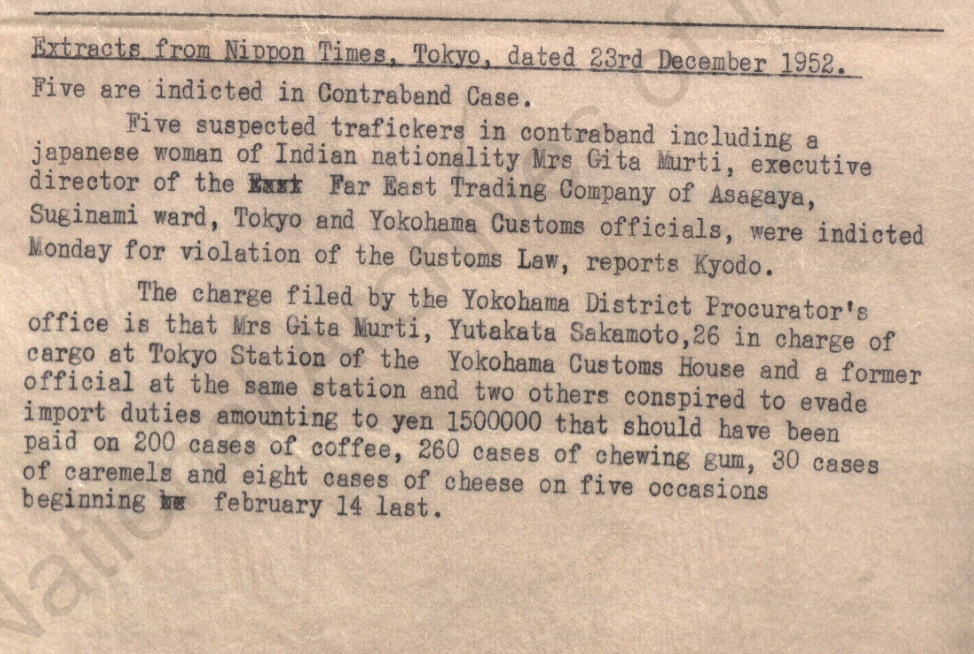
Ramamurti’s wife Gita Murti was indicted in December 1952 by the Japanese government for violating Customs Law by conspiring to evade import duties amounting to yen 1500000.
Japanese media report on arrest of Ramamurti’s wife (Source: netajipapers.gov.in)
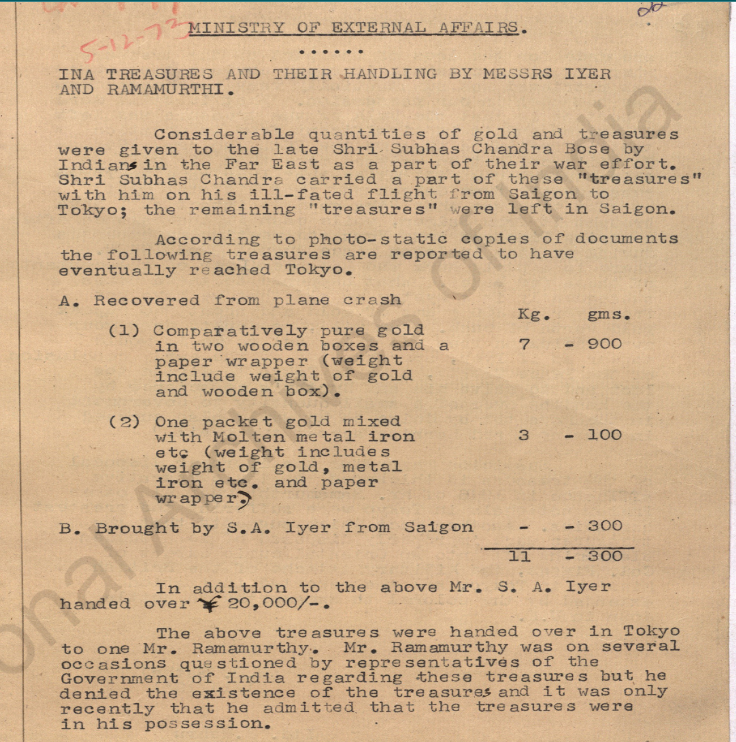
Furthermore, on 1 November 1955, another secret report was filed in the Ministry of External Affairs for the reference of the Prime Minister who was kept in the loop throughout. The report titled, “INA treasure and their handling by Messrs Ayer and Ramammurti” was authored by RD Sathe and confirmed that “Mr Ayer’s activities in Japan have been rather suspicious.”
The note, which was signed by then PM Nehru dated 5 November 1951 and had a noting of the foreign secretary that the PM had seen it, further stated underlined “the affluence of Mr Ramamurti which turned many heads in Tokyo.”
Despite such damning allegations and cause for suspicion coming from the Indian community in Tokyo, including INA and IIL veterans and Indian government officials, records show that SA Ayer was made the regional manager of the Central Board of Film Censors, Bombay, and was made the publicity advisor for Nehru’s flagship five-year plan. Meanwhile, Ramamurti after enjoying a lavish lifestyle in Japan returned to Chennai in India as the Nehru government displayed a complete inability to even probe the veracity of the very serious charges against him.
This also raises suspicion about the intent of the Nehru government over the silent treatment meted out to a raging issue of the time, as it continues to be one today.
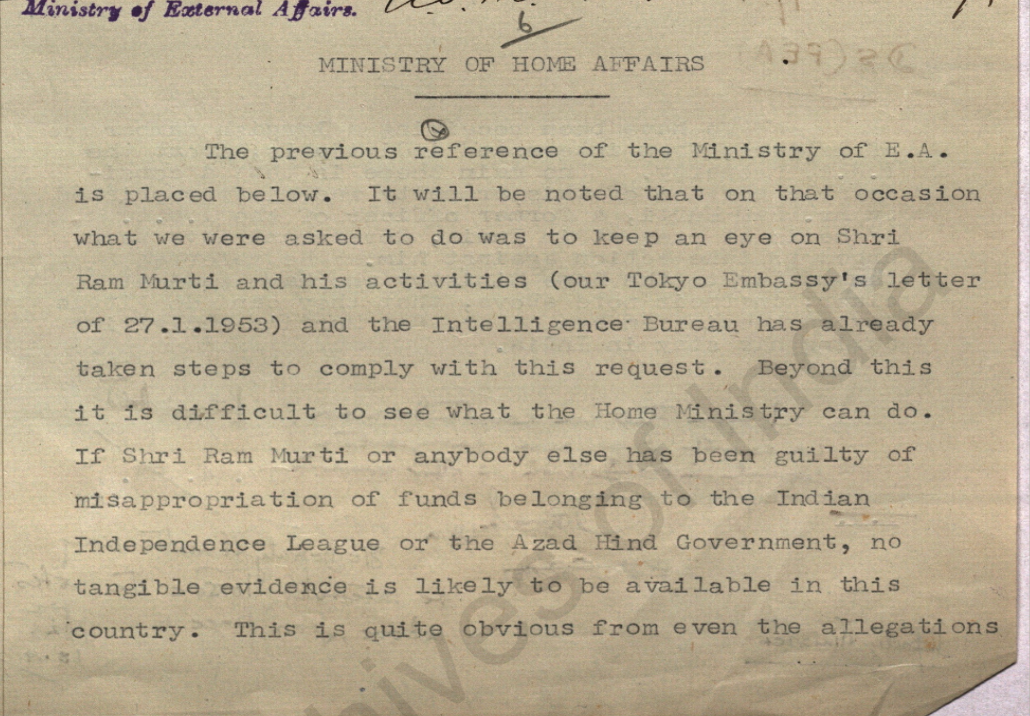
Letter by MHA in 1953 expressing the inability to initiate probe against Ramamurti (Source: netajipapers.gov.in)
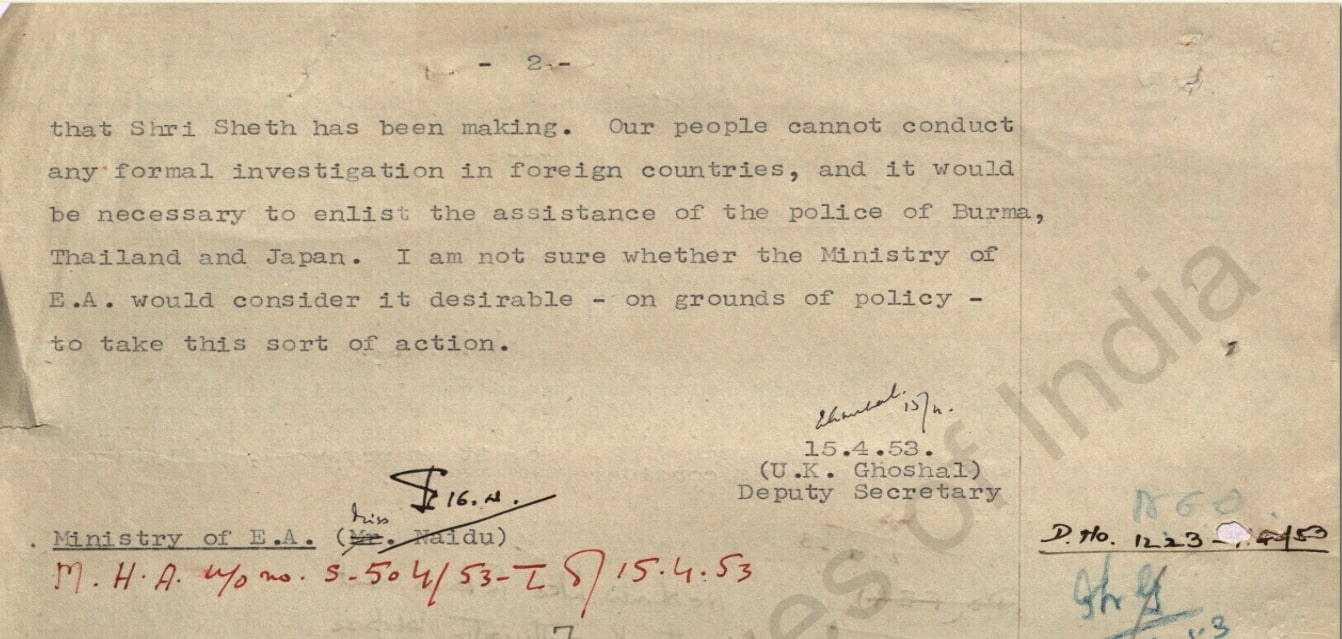
In response to a correspondence by the Ministry of External Affairs on VB Sheth’s letter, the Ministry of Home Affairs said that they were asked to keep an eye on Ramamurti and his activities, and referred to the Indian Embassy’s (in Tokyo) letter dated 27th January 1953. The Home Ministry’s letter signed by the then Under Secretary UK Ghoshal dated 15th April 1953, read:
“The Intelligence Bureau has already taken steps to comply with this request (VB Seth’s request). Beyond this, it is difficult to see what the Home Ministry can do. If Ramamurti or anybody else has been guilty of misappropriation of funds belonging to the Indian Independence League or the Azad Hind Government, no tangible evidence is likely to be available in this country. This is quite obvious from even the allegations that Shri Sheth has been making. Our people cannot conduct any formal investigation in foreign countries, and it would be necessary to enlist the assistance of the police of Burma, Thailand, and Japan. I am not sure whether the Ministry of External Affairs would consider it desirable – on grounds of policy – to take this sort of action.“
Letter by MHA in 1953 expressing the inability to initiate probe against Ramamurti (Source: netajipapers.gov.in)
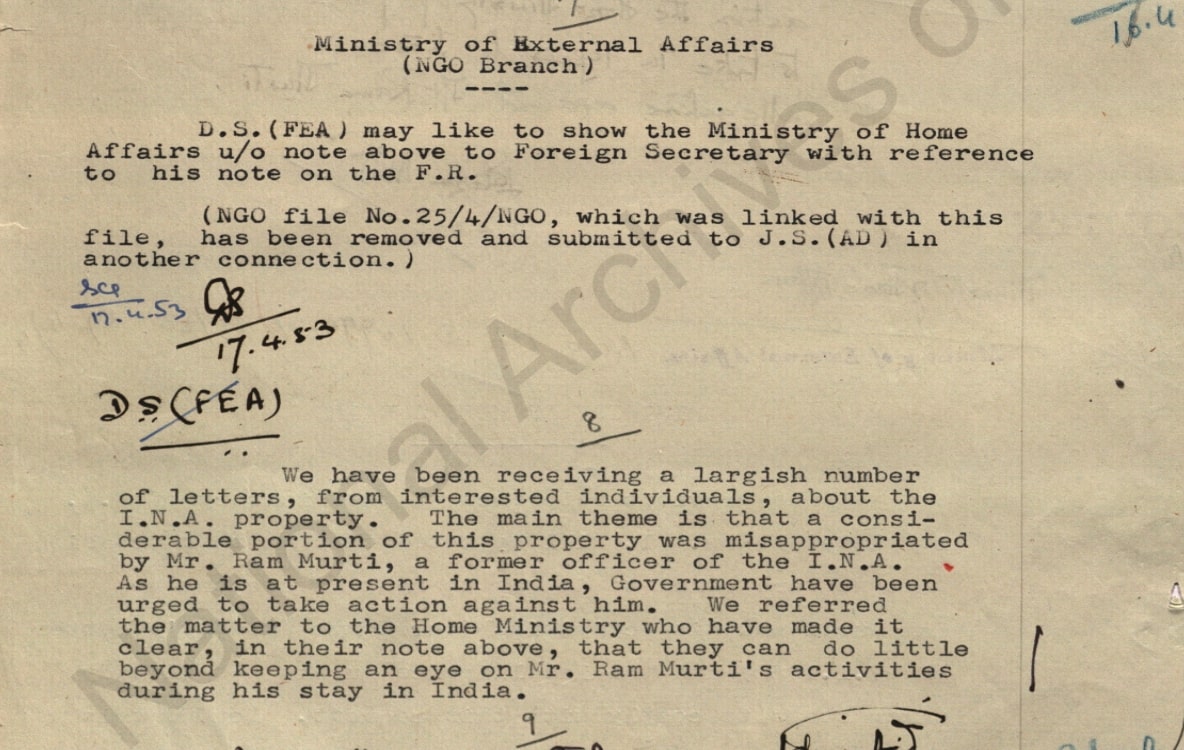
Two days later, on 17th April 1953, the MEA responded by saying, “We referred the matter to the Home Ministry who have made it clear, in their note above, that they can do little beyond keeping an eye on Mr. Ram Murti’s activities during his stay in India.”
The two correspondences show how the MHA and the MEA, the latter portfolio held by Nehru himself, were engaged in shifting accountability of the matter under Nehru’s regime. But the basic approach was that of denial to take action even when Ramamurti was in India and was charged by Japanese authorities too.
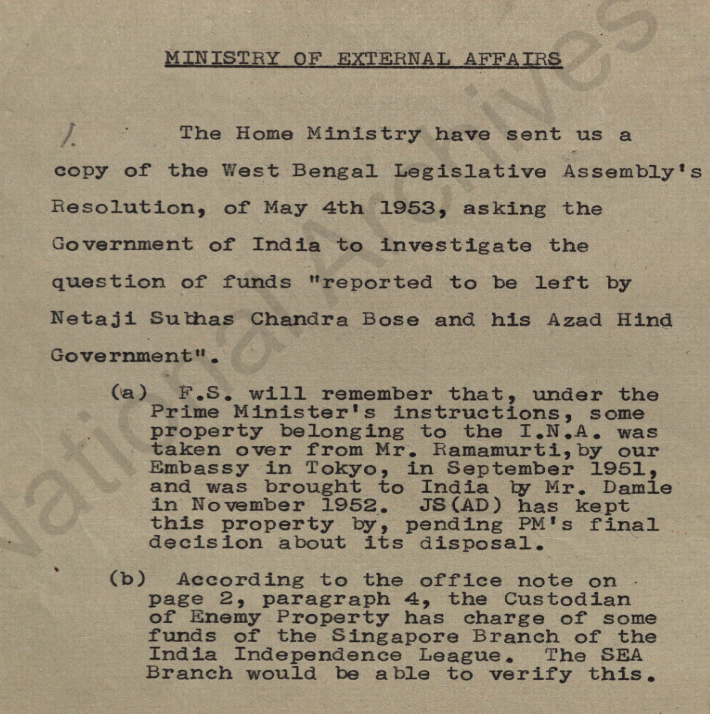
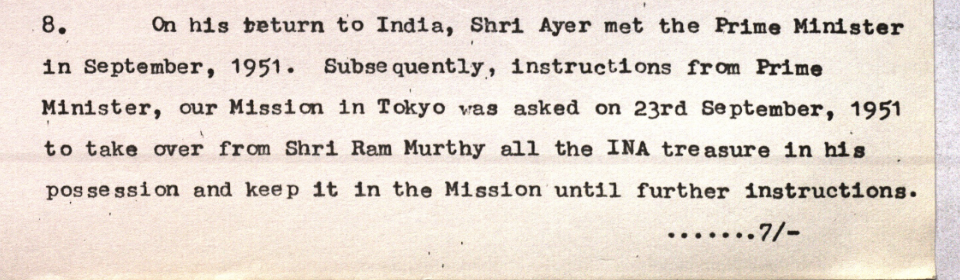
MEA correspondence detailing Nehru’s instructions to take over Netaji’s treasure from Ramamurti (Source: netajipapers.gov.in)
In September 1951, Nehru met SA Ayer following which on 23rd September 1951 he instructed the Indian Embassy in Tokyo to take Netaji’s treasure from Ramamurti and keep it in the Mission until further instructions.
Government’s response to question in Parliament 1978 informing that Nehru met Ayer in September 1951 (Source: netajipapers.gov.in)
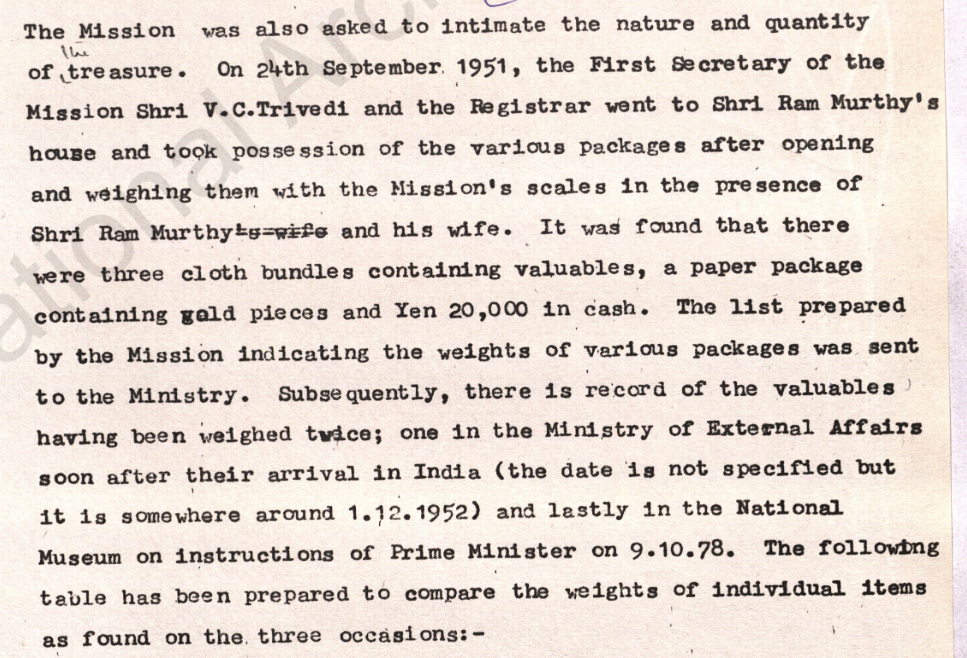
Records show that the nature and quantity of the treasure were shared by the Mission with Nehru and on 24th September, the first secretary of the embassy, VC Trivedi along with the Registrar, went to Ramamurti’s residence, opened and weighed the contents, and took possession of the same.
Government in 1978 responding to question regarding Netaji’s treasure in Parliament (Source: netajipapers.gov.in)
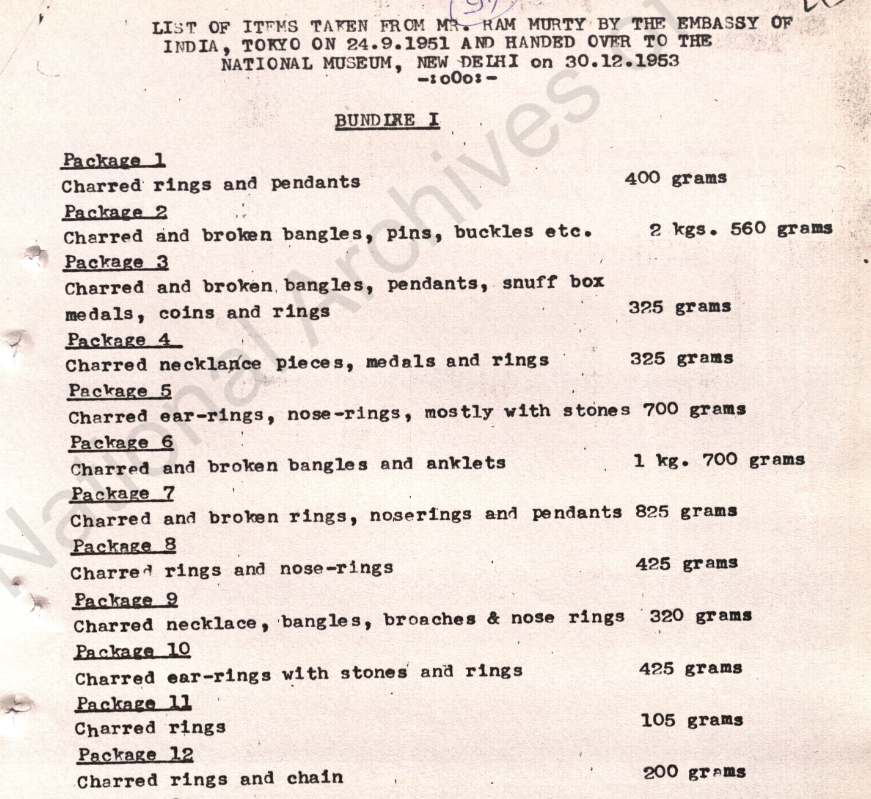
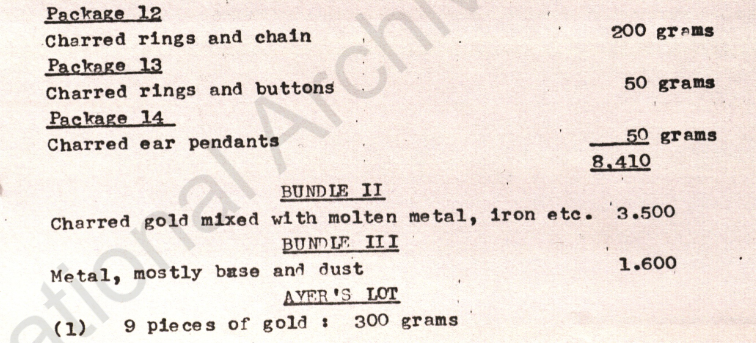
Documents show that three cloth bundles containing valuables, a paper package containing gold pieces, and cash amounting to 20,000 yen were found. The list of the same including the weight of the packages was sent to the government. The contents were weighed again in the MEA on an “unspecified date”, which the then govt said was valued at Rs 90,000.
It was brought to India in November 1952 by Mr Damle, then Joint Secretary in the Ministry of Food and Agriculture, again under Nehru’s instructions. The box was put under the custody of the National Museum on 30th December 1953. Nehru instructed that the treasure would be kept as evidence of the aircraft accident in which Bose supposedly lost his life. Here is what Nehru had to say after inspecting the treasure:
“I saw this treasure. It made a poor show. Apart from some gold pieces, it consisted of charred remains of some rather cheap jewellery chiefly some silver and gold articles, all broken up. I think that this should be kept as it is. Apart from everything else, it is some evidence of the aircraft accident and subsequent fire.”
Government in 1978 details contents of Netaji’s treasure box which was brought by Nehru govt from Tokyo (Source: netajipapers.gov.in)
Government in 1978 details contents of Netaji’s treasure box which was brought by Nehru govt from Tokyo (Source: netajipapers.gov.in)
Notably, Ambassador Chettur had drawn the conclusion that “Ayer, apprehensive of the early conclusion of the Peace Treaty, had come to Tokyo to “divide the loot and salve his and Ramamurti’s conscience by the handing over of a small quantity to the Government in the hope that by doing so, he would also succeed in drawing a red herring across the trail.”
And it seems that Ayer, as Chettur feared, did succeed in his pursuit for it won him Nehru’s attention and a big fat raise with the government at that.
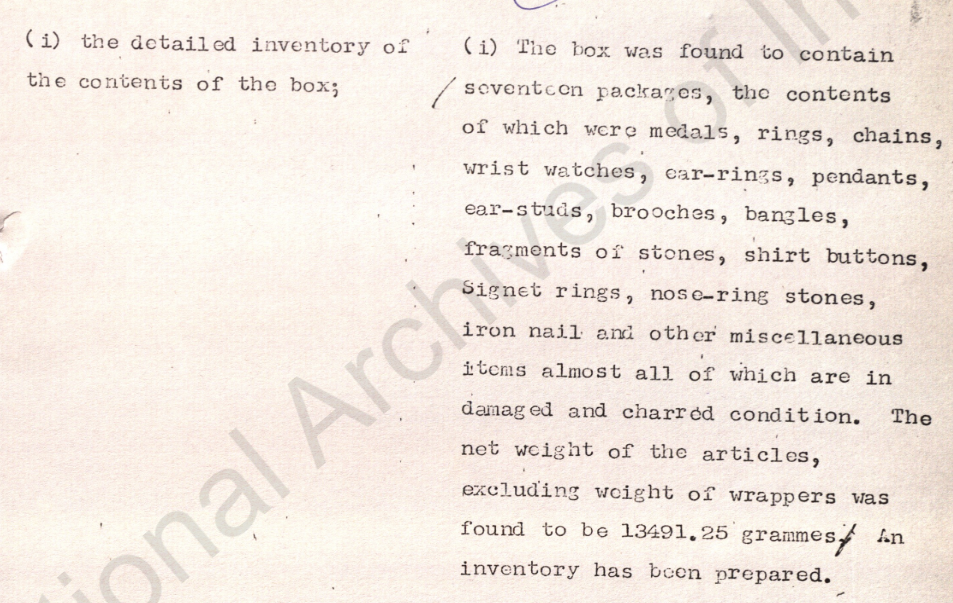
Meanwhile, on 9th October 1978, the box was opened again by the Morarji Desai administration to check the contents of the treasure brought from Tokyo in 1952. As per government records, the box contained 17 packages which included medals, rings, chains, wristwatches, car rings, pendants, ear studs, brooches, bangles, fragments of stones, shirt buttons. signet rings, nose ring stones, iron nail and other miscellaneous items in damaged or charred condition.
Government in 1978 details contents of Netaji’s treasure box which was brought by Nehru govt from Tokyo (Source: netajipapers.gov.in)
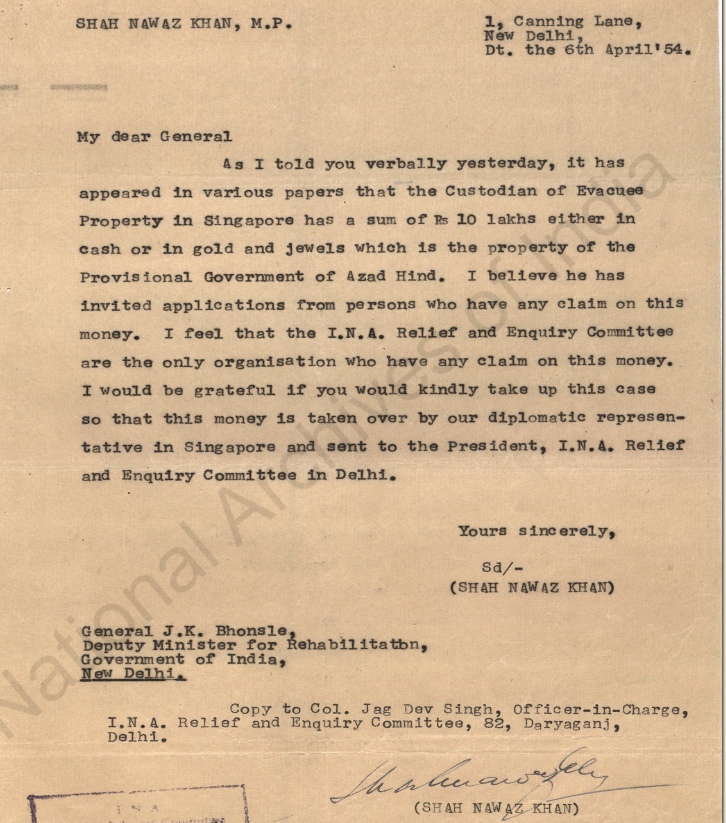
Shockingly, Nehru’s dubious response and position on the matter continued for quite some time. On 6th April 1954, former INA officer Shah Nawaz Khan, MP from Meerut, wrote to his colleague General JK Bhonsle, the Deputy Minister for Rehabilitation, pointing out that an amount of Rs 10 lakh either in cash or gold and jewels belonging to the Azad Hind Fauj was in Singapore waiting to be claimed.
Letter by Shah Nawaz Khan to General JK Bhonsle recommending that INA treasure in Singapore be transferred to INA relief fund (Source: netajipapers.gov.in)
Khan categorically stated that he feels that “INA Relief and Enquiry Committee is the only organisation who have any claim on this money.” “I would be grateful if you would kindly take up this case so that this money is taken over by our diplomatic representative in Singapore and sent to the President, INA Relief and Enquiry Committee in Delhi.”
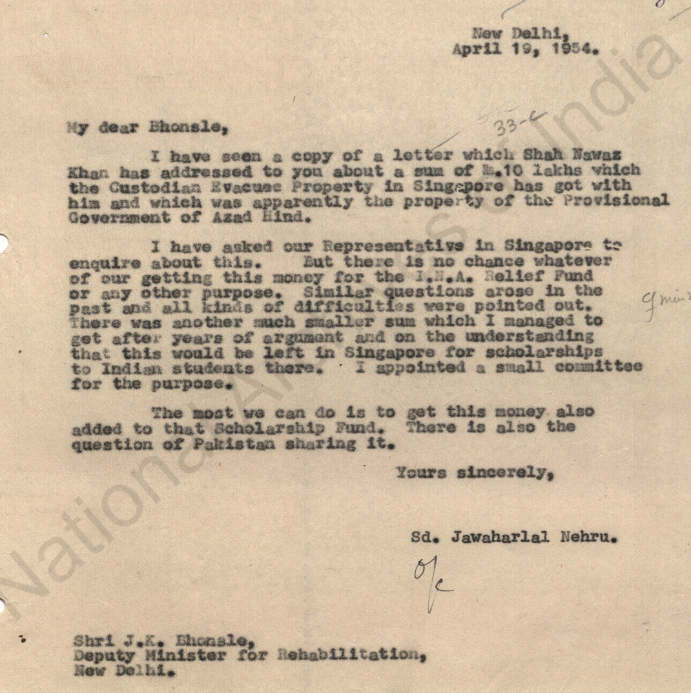
13 days later, on 19th April 1954, Nehru wrote to Bhonsle against Khan’s recommendation. He wrote, “I have asked our Representative in Singapore to enquire about this. But there is no chance whatever of our getting this money for the INA Relief Fund or any other purpose. Similar questions arose in the past, and all kinds of difficulties were pointed out. There was another much smaller sum which I managed to get after years of argument and on the understanding that this would be left in Singapore for scholarships to Indian students there. I appointed a small committee for the purpose. The most we can do is to get this money also added to that scholarship fund. There is also the question of Pakistan sharing it.”
Letter from Nehru to General RK Bhonsle writing against accepting the recommendation of Shah Nawaz Khan (Source: netajipapers.gov.in)
It must be noted that Nehru had hired INA veteran General JK Bhonsle with the intention to spy on him and extract information from him as was the case with several other INA veterans and Netaji’s very family for a good 10 plus years.
What happened to the INA/IIL treasure stored abroad?
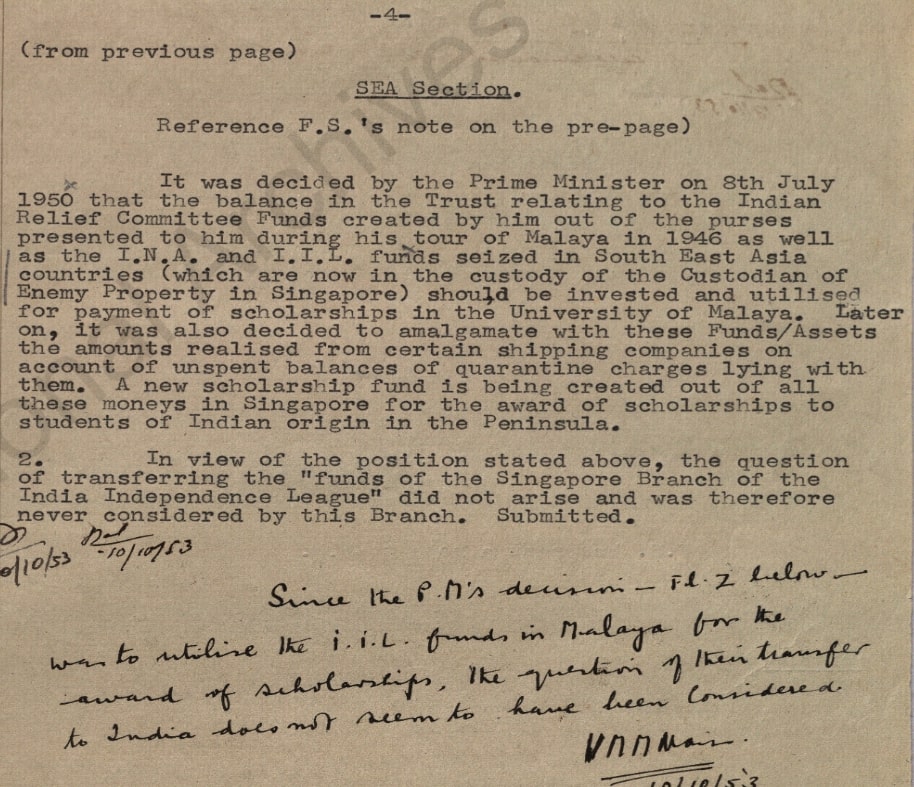
Interestingly, during his tour to the British-occupied Malaya in 1946, a year before India officially gained Independence, Nehru was “presented with purses” using which he created the Indian Relief Committee (IRC). Records show that on 8th July 1950, Nehru “decided that the balance in the Trust relating to the IRC funds as well as the INA and IIL funds seized in South East Asia countries should be invested and utilised for payment of scholarships in the University of Malaya.”
Government letter mentioning the “trust fund” created by Nehru (Source: netajipapers.gov.in)
These funds were combined with unspecified balance amounts pending from certain shipping companies. In a government note dated 10th October 1953, it was stated, “Since the PM’s decision was to utilise the IIL funds in Malaya for the award of scholarships, the question of their transfer to India does not seem to have been considered.” The scholarship was meant for Indian students studying in Singapore.
Note attached with Nehru’s letter to WB CM making the case for Pakistan’s share from the unspecified amount of INA funds in Singapore (Source: netajipapers.gov.in)
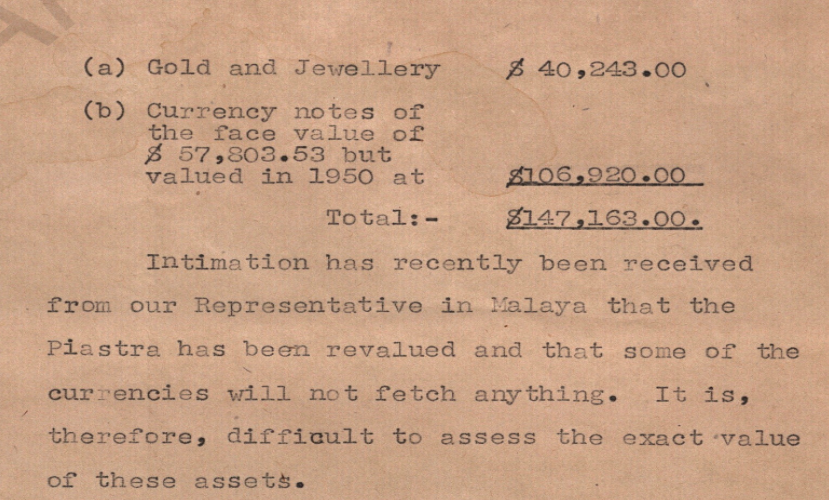
The above-mentioned funds are the same ones that were with the Custodian of Enemy Property in Singapore and accounted for Straits $147,163 in 1950. The Nehru govt had said that their representative in Malaya informed them that the currency had been revalued and therefore it was difficult to assess the exact value of these assets. Then came the point of sharing these “unaccounted” funds with Pakistan. And then, it was decided, that the amount that will accrue to India will be amalgamated with the IRC funds as soon as it is obtained from Singapore.
However, the previous correspondence says that the question of the transfer of these funds was never considered as it was decided that the funds would be used for scholarships for Indian students in the Peninsula.
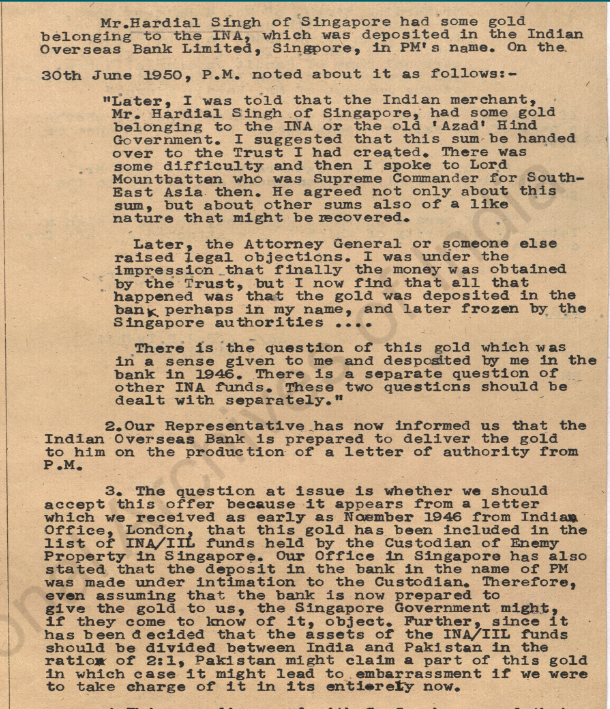
Suspiciously, a Mr Hardial Singh had also deposited “some gold belonging to the INA”, in Nehru’s name. On 30th June 1950, Nehru took a note of the same and wrote, “There is the question of this gold which was in a sense given to me and deposited by me in the bank in 1946. There is a separate question of other INA funds. These two questions should be dealt with separately.”
Correspondence reveals how INA funds were also transferred in Nehru’s name (Source: netajipapers.gov.in)
Whether these funds were the same as those with the Custodian of Enemy Property in Singapore and why they were deposited in Nehru’s name is again mysterious.
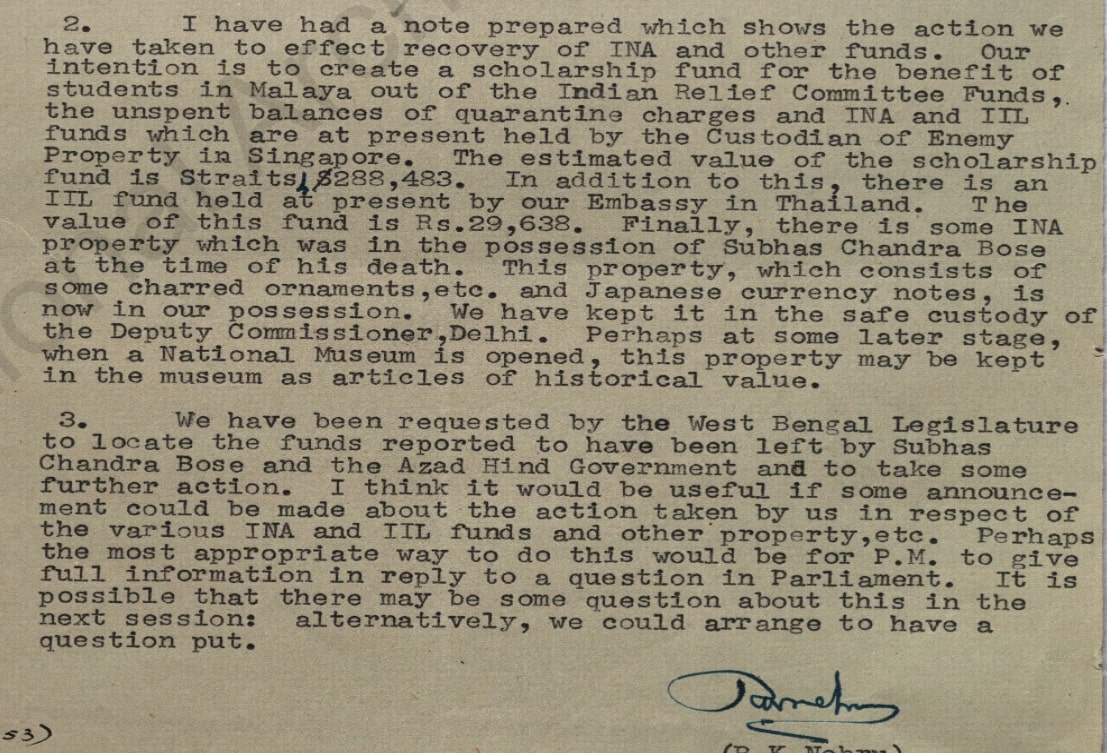
Moreover, correspondence from the then Foreign Secretary RK Nehru to Nehru says that the estimated value of the scholarship funds is Straits $288,483. But of the combined amount, how much accounted specifically for the INA/IIL funds has not been clearly mentioned in the several letters exchanged on the matter thereby raising suspicion about both the amalgamation of a certain part of the funds with other money and its disposal.
Foreign Secretary RK Nehru’s letter to Jawaharlal Nehru regarding WB assembly’s resolution demanding probe into whereabout of Netaji treasure (Source: netajipapers.gov.in)
The unspecific nature of information shared by the Nehru government, the lack of accountability of funds in Singapore, convoluted versions of their exchanges/whereabouts, and questionable disposal of the funds raise serious concerns about Nehru’s intention for the legacy of INA and IIL at large.
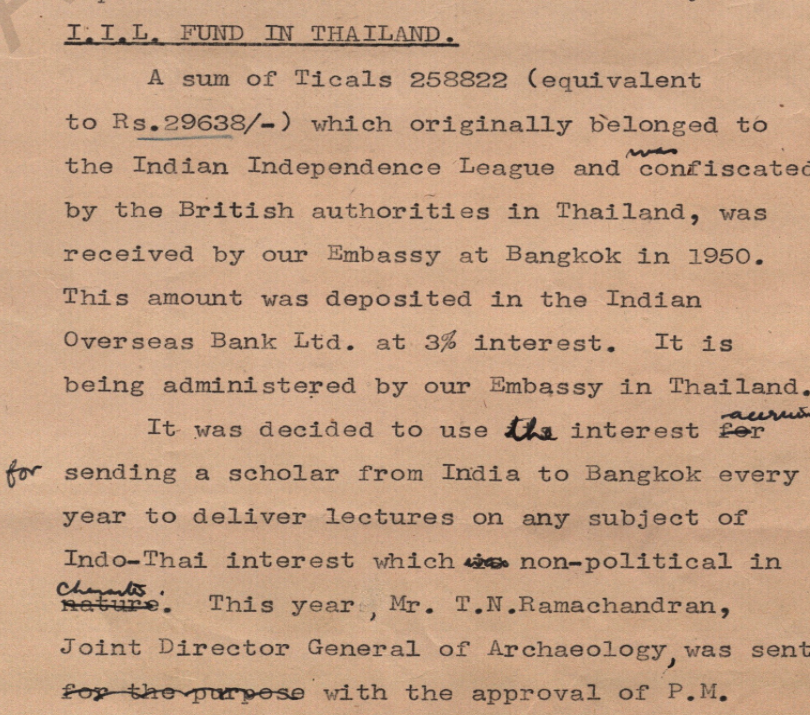
Another sum that belonged to the Indian Independence League (IIL) was confiscated by the British in Thailand in 1949 after the surrender of the Japanese, and received by the Indian Embassy in Bangkok in 1950 after making an appeal. The amount was deposited in the Indian Overseas Bank Ltd at three per cent interest. The note attached to Nehru’s letter to WB CM mentions the amount in Thailand to be Rs 29638 while another note with the same contents was sent to another department which mentions the amount to be Rs 79638, pointing at a huge discrepency.
It is surprising that two years after Independence, the British were still cracking down on the Indians living abroad who had contributed to the freedom struggle. Did the Nehru government establish no communication with its people abroad? Did the Nehru government not settle the matter of its citizens abroad with the British or in British colonies post-independence? Couldn’t the Nehru government have directly contacted its citizens abroad and directed them to account for such financial matters which concerned India?
Note attached with Nehru’s letter to WB CM talking about the INA funds in Thailand (source: netajipapers.gov.in)
Where does the issue stand now?
When the Modi government declassified documents on Netaji and INA, his family member Chandra Bose reportedly demanded an independent inquiry into the whereabouts of INA funds. “Who else but the Congress under Nehru received a portion of this fund? There were two other black sheep in the INA who misused the money in their possession. I want an independent inquiry on this issue,” Bose said.
The above-mentioned details of the management of INA funds came after Nehru formed an INA Relief and Enquiry Committee in 1946, strangely, at the Congress House; a trust was formed under the same. Reportedly, the trust was set up to handle a sum of two lakh rupees out of the INA fund, and Nehru and Bidhan Chandra Roy were among the signatories of the trust deed. But the INA funds which were transferred to India were reportedly much more.
According to this report, the PMO records show that a VKC Ramalingam Nadar chase the issue with the RBI in Mumbai which did not respond. In 1987, claims were made that then PM Rajiv Gandhi received Rs 48 crore from Japan, Myanmar, and Singapore. A proposal was then made to set up a Netaji memorial in the capital.
A letter by former CPM MP Basudev Achariya to Rajiv Gandhi welcomed the return of the assets on 11th June 1987 which accumulated an interest estimated up to Rs 114 crore.
On 29 July 2016, a PIL was filed in the Calcutta HC asking for an inquiry commission to look into the disappearance of the INA treasure “received by the government after transfer of power and submit a report to the court.” After submitting the PIL, advocate Rudrajyoti Bhattacharya alleged that “there has been extensive embezzlement of INA funds at various stages.”
Aruna Chatterjee, a member of the INA Jhansi Brigade, had reportedly recalled an occasion in Rangoon where huge gold ornaments were heaped on one end of a scale while Netaji stood on the other end thereby corroborating the Indian Ambassador Chettur’s claims. “Where has this huge wealth gone? I understand that the INA used some of this wealth during the War while it was fighting the battle. But then a portion of it was transferred to India. The country wants to know who is the custodian of this wealth. The government needs to come clear,” she had said.
A deceptive approach seems to have been taken by Nehru himself owing to the INA funds lying abroad including the treasure Netaji was carrying with him. Every correspondence, as unclear as it appeared, gave a different account of the matter. No follow-up seems to have been done about the funds but a rush to move the money was apparent in the correspondences. The limited declassified documents, although studied in detail, reveal another very dubious and possibly corrupt side of Nehru who ensured that the exact whereabouts of INA funds were kept under wraps at all times.
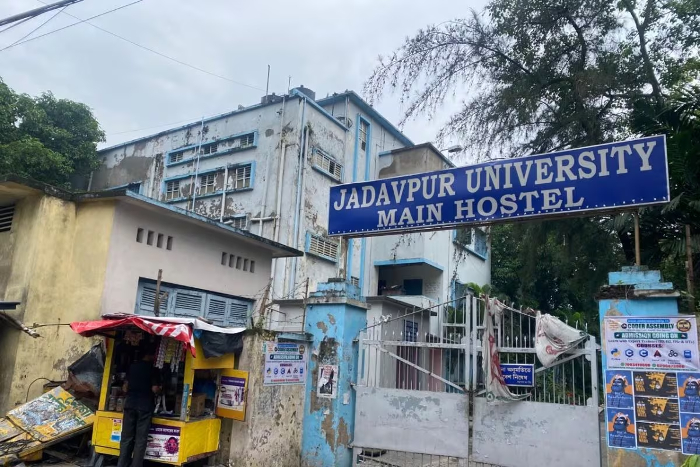
The death of 17-year-old Swapnadeep Kundu has shed light on the many illegal activities that have been unfolding on the Jadavpur University (JU) campus. One such menace that has come to the fore is the cultivation of cannabis.
The Kolkata police investigating Kundu’s mysterious fall from the second floor of the hostel in JU has reportedly uncovered suspicious images from a mobile phone of one of the students which shows cannabis cultivation on the hostel’s balcony. The image, according to sources cited by India Today, has now been deleted.
As per police sources, several mobile phones of students and residents of the hostel were seized to get electronic evidence of ragging. The phones were sent for forensic examination and to recover deleted data if any including chats. An image was found during this examination giving rise to the suspicion that the illegal substance is being cultivated in the JU campus premises.
“A photo came to our notice while recovering the deleted digital evidence from a student’s mobile in the forensic lab. That still picture shows cannabis being cultivated in a flowerpot. The photo was deleted from the mobile phone for unknown reasons after the first-year student died. It seems to be suspicious; we are probing the matter,” a Kolkata police official reportedly said.
The University reportedly stands to face another big charge under relevant sections of the Narcotic Drugs and Psychotropic Substances Act if the authenticity of the said image is proved.
On Wednesday (23rd August), the Kolkata Police revealed that the 17-year-old student was forced to run naked from one room to another in the hostel building before his death. The officials confirmed that he was ragged and ran from one room to another to hide before his unfortunate death.
The police have pieced together the sequence of events that took place at the JU Main Hostel on the evening of August 9 just before the 17-year-old’s tragic fall.
Investigators claim they have proof of ragging against the 12 accused who have been arrested so far, and they believe that the student was “disrobed, bullied, and abused with homosexual slurs.” Police reportedly learned that moments before his death, Swapnadeep was heard screaming “I am not gay…I am not gay”, claim sources.
The 17-year-old, who was now naked, walked to Room No. 65 and attempted to lock himself out but was unsuccessful. Senior students began pursuing him as he began to run between rooms on the second level, according to the police. The cops said that this went on until 11 p.m. However, the mystery surrounding the 17-year-old’s tragic fall from the hostel building’s second level remains unsolved.
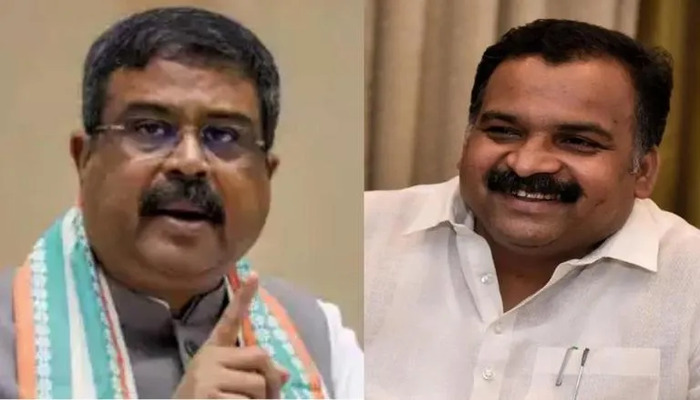
On Thursday, August 24, Congress leader Manickam Tagore said that he has written a letter to Union Education Minister Dharmendra Pradhan in which he requested that the Central Board of Secondary Education (CBSE) rethink its decision to hold an exhibition on themes pertaining to Indo-Pak partition.
In his letter dated August 21st, the Congress MP from Tamil Nadu’s Virudhunagar raised concern over CBSE’s decision to hold exhibitions on the theme of partition saying that such a move would instil hatred into the minds of India’s younger generations. Tagore urged the Centre to ‘preserve’ social harmony by withdrawing its decision in this regard.
“I express my concern towards the decision made by the Central Board of Secondary Education (CBSE) regarding the organization of exhibitions on the theme of ‘Partition’ in schools. I earnestly urge you to reconsider and withdraw this decision so as not to spread hatred among the minds of our younger generations and to preserve the social harmony of our society,” Tagore stated in his letter.
The Congress MP further asserted that although it is important to learn from the events of the country’s history, this subject should be approached with “sensitivity and consideration for the impressionable minds of our youths.”
Moreover, the letter seemed like a balancing act where the Congress MP on one hand is talking about the importance of learning about historical events, and on the other, he is stressing that young students be taught about history in such a manner that “fosters understanding, compassion, and a sense of unity among our young generations.”
Wrote to Education Minister Pradhan requesting him to withdraw the decision taken by the @CBSEINDIA to organise exhibition on partition themes in CBSE schools . Hate shouldn’t be planted in the young minds.#StopHatepic.twitter.com/orKyZx9dio
— Manickam Tagore .B??✋மாணிக்கம் தாகூர்.ப (@manickamtagore) August 24, 2023
The letter also stresses that exhibitions centred around the bloodshed and atrocities that transpired during the partition in 1947 could “inadvertently perpetuate negative emotions and divisive sentiments” adding that such a move would be in stark opposition to India’s goal of nurturing responsible citizens who value harmony and unity.
As reported earlier, CBSE had on August 14th issued a circular stating that exhibitions be held based on themes related to partition in observance of “Partition Horrors Remembrance Day”.
While Congress’s Manickam Tagore asserted that holding such exhibitions would spread hatred in the minds of young students, the CBSE circular had already stated that “the exhibition be showcased with the sobriety and solemnness that it deserves. It may be specifically ensured that the sentiments of any section of society are not to be hurt”.
The Congress leader further argued that the education system should play a pivotal role in shaping the minds of young students in such a manner that they embrace diversity.
Manickam Tagore concluded the letter urging Minister Pradhan to withdraw CBSE’s decision.
Interestingly, Tagore urged the Centre to teach students about historical events, in this context, events centred around India’s partition, in such a manner that it fosters compassion and a sense of unity. The question here arises of how will CBSE present the horrors of Direct Action Day, the massacre of Hindus by the Islamists, and how on August 14th, 1947, united India was cruelly divided into 3 parts- India, West Pakistan and East Pakistan on religious grounds at a cost of genocide of more than 2 million Indians, in such a manner that would foster unity and compassion.
The truth should come out the way it is, the young minds of India deserve to know the horrors endured by their ancestors while the Britishers simply looked on, some Congress leaders and of course, Mohammad Ali Jinnah were deciding their power share.
It is notable that just days back, Nationalist Congress Party (NCP) chief Sharad Pawar had also made similar comments about CBSE’s decision to hold exhibitions on partition. The NCP leader has said that he is worried about CBSE’s circular claiming that “it will not be suitable to imbibe a history in the minds of the young generation which includes bloodshed and bitterness.”
The argument that teaching the younger generation about the bloodshed and horrors of partition will instil bitterness and hatred in their minds, preventing them from becoming responsible citizens, does not hold water as it is only when the younger minds who will become India’s future leaders know their history free of bias, cover-ups, and propaganda that they will understand what mistakes made in the past must not be repeated in the future. OpIndia recently published a comprehensive article on the vital lessons that may be learned to ensure that the country is never partitioned again.
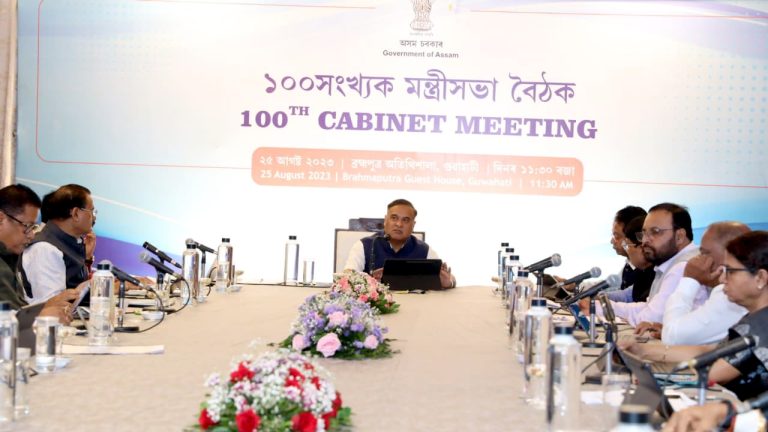
The Himanta Biswa Sarma government in Assam today held the 100th cabinet meeting, marking a significant milestone in governance. The state government has held 100 cabinet meetings in just 2 years and 4 months, since the government came to power in May 2021.
Elaborating on how this is a massive jump in the number of cabinet meetings by the state government, CM Himanta Biswa Sarma said that in comparison, in the last 20 years before his government took oath, a total of 264 cabinet meetings had taken place. Against that, 100 meetings have taken place in just 28 months.
Addressing a press conference after the over 5-hour meeting in Guwahati, Himanta Biswa Sarma said that 1238 decisions have been made in the last 99 meetings, and out of them, 1217 decisions have been implemented either fully or partially. That means the govt has been able to implement 98% of the decisions taken by the Assam cabinet.
The government has also published a booklet detailing the decisions taken in the cabinet meetings and their implementation details in the last 2 years and 4 months. As per the record, the state cabinet has taken 119 decisions for the Revenue and Disaster Management Department, 109 decisions for the Education Department, 67 decisions for the Housing and Urban Affairs Department, 57 decisions for the Industries and Commerce Department, 50 decisions for Power department, 37 decisions for PWD (B & NH) department.
Similarly, 35 decisions for the Transport Department, 31 decisions for the Sports and Youth Welfare Department, 27 each for PWD (R) and ARTPPG departments, 22 decisions for the Agriculture and Horticulture Department, 21 decisions for the CM secretariat department, 19 decisions for Welfare of Plain Tribes and Backward Classes Department, 16 decisions each of Tourism and Water Resources departments have been taken by the cabinet.
Apart from this, the cabinet has also taken decisions on Act East Policy, Soil Conservation and Indigenous and Tribal Faith and Culture departments, Animal Husbandry and Veterinary department, Bodoland Welfare and Implementation of Assam Accord departments, of Women and Child Development and Information and PR departments, Science and Technology and Information Technology departments, Cooperation and Border Protection and Development departments, and Public Health Engineering and Irrigation departments.
It is notable that after taking charge of the BJP-led government in May 2021, CM Himanta Biswa Sarma had announced that his cabinet would sit every week on Wednesdays. This was decided in the first cabinet meeting held on 11 May 2021. The govt has been largely been able to maintain this schedule. However, not all meetings were held on Wednesdays due to various issues and there were no meetings in some weeks.
The state govt had also decided that out of 4 meetings in a month, one will be held in a town outside Guwahati. Accordingly, several meetings have been held at district headquarters and other towns. Several convention halls also have been built at several places for this purpose.
One cabinet meeting earlier this year was held at the British-era Polo Gymkhana Club in Panery Tea Estate in Udalguri district.
In December last year, a cabinet meeting was held at the Gandhi Mandap in Guwahati, a monument dedicated to MK Gandhi located on a hilltop inside the city. In another first, the ministers sat on the floor during this meeting.
Some of the meetings of the Assam cabinet were also held in Delhi when the CM and a significant number of other cabinet ministers were in the national capital for various reasons. In those meetings, those who were not in Delhi attended the meetings through video conferencing. The 98th cabinet meeting on 9th August was also held in Delhi.
Apart from his cabinet sitting 100 times in 28 months, the office of CM Himanta Biswa Sarma remains open 24 hours a day. The CMO staff has been split into 3 shifts of 8 hours each, and the office remains open 24 hours a day. The CM visits various places outside Guwahati almost every day, returns to Guwahati in the evening and attends office. He often goes on a tour of the capital city well after midnight, sometimes inspecting construction works.
In the press conference, CM Sarma said that the 100th cabinet meeting was also the longest, from 11 AM to 4 PM, which was cut short by an hour as media had already assembled for the press conference. He briefly detailed the major decisions taken in today’s meeting.
He said that Assam govt has decided to introduce a semiconductor policy for Assam, under which a production linked incentive scheme to set up semiconductor manufacturing plants in the state.
In the 100th cabinet meeting we have taken an important decision to introduce a semi conductor policy for Assam – a production linked incentive scheme to manufacture semi conductors in the State: HCM Dr @himantabiswa#AssamCabinetAt100
In a major administrative reform, the cabinet decided to introduce new Rules for Executive Business to govern administration in the State. Himanta Biswa Sarma said that the existing rules were made during the British raj, and they needed major reforms as only minor changes were made to them.
In another major decision, the state cabinet decided to form 4 new districts, which were merged with other districts ahead of the delamination exercise by the Election Commission. As the EC has completed the exercise and published the final list of assembly and parliamentary constituencies, the 4 abolished districts have been formed against, however with changes in their geographical areas as per the newly formed assembly constituencies.
On Thursday (August 24), media reports suggested that the Organised Crime and Corruption Reporting Project (OCCRP) is planning a shakedown of India’s financial markets, following the footsteps of US-based short seller ‘Hindenburg Research’.
According to media reports, OCCRP is planning an exposé on an unidentified corporate house in India over the investment of ‘overseas funds’. Citing sources, one such report stated, “The identity of the corporate house wasn’t immediately known but agencies are said to be keeping a tight vigil on the capital market.”
Founded in 2006, OCCRP claims to have a network of journalists across 6 continents who specialise in reporting on organised crime and corruption.
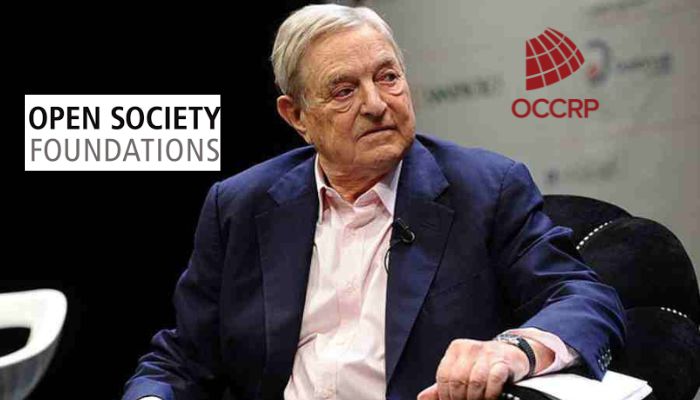
While it might seem like an independent, non-partisan organisation, OCCRP is funded by the likes of George Soros’ Open Society Foundations (OSF), the Ford Foundation and the Rockefeller Brothers Foundation.
This becomes evident from the website of the organisation, where the names of more than a dozen ‘institutional donors’ are listed under the heading ‘Who Support our Work.’ OCCRP said in a note, “We are incredibly grateful to the following institutional donors that make our work possible.”
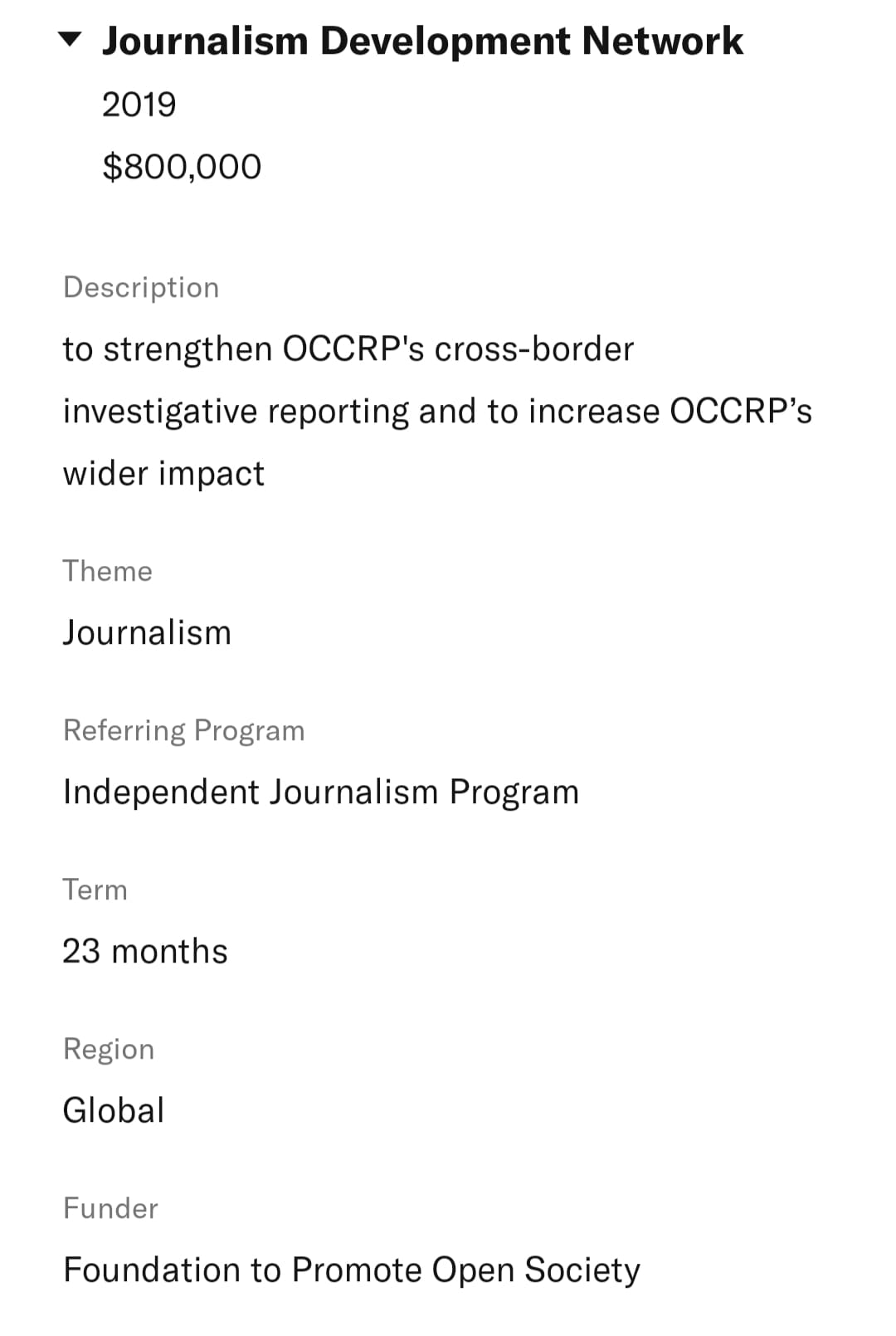
It has now come to light that the OSF gave a grant of $8,00,000 (~ ₹6.61 crores) to the Organised Crime and Corruption Reporting Project for ‘strengthening’ the organisation’s cross-border reporting and increasing the wider impact.
OSF’s funding to OCCRP
Opindia also found the 2019 annual report [pdf] of OCCRP, which made it clear that the funds provided by George Soros’ Open Society Foundations were being used for establishing ties of the Global Anti-Corruption Consortium (GACC) to civil society across various countries.
Page 24 of the report stated, “In the next year, the GACC will go farther to advance legal action and build ties with civil society partners at the global and local levels, growing its reach and impact. We are grateful to our partners who have supported this unique partnership: the governments of Argentina, Australia, Denmark, Norway, and the United States and the Open Society Foundations“
This is in line with the textbook approach adopted by George Soros and his Open Society Foundations to influence civil society and ‘distort’ public perspectives across different nations.
George Soros and his anti-India agenda
India has been fighting a ‘perception war’ on all fronts since the start of 2023. On February 16 this year, George Soros exploited the Adani-Hindenburg controversy and launched a scathing attack on the Indian government.
He claimed, “Modi and business tycoon Adani are close allies. Their fate is intertwined…Adani Enterprises tried to raise funds in the stock market, but it failed. Adani is accused of stock manipulation and his stock collapsed like a house of cards.”
Soros accused Prime Minister Narendra Modi of crony capitalism. “Modi is silent on the subject, but he will have to answer questions from foreign investors and in parliament,” he added.
The Hungarian-American billionaire also said that the ‘shakedown’ caused to the Indian markets due to the Hindenburg Research report will result in ‘much needed institutional reforms’ and ‘democratic revival’.
George Soros and his vicious ecosystem of NGOs, activists and journalists had been trying to prove PM Modi as an ‘electoral autocrat’ who needed to be ousted for the ‘greater good’ of this country. And it has been a work in progress for a long time.
The Hungarian-American billionaire has also tried to use international institutions, which are funded by him, including Freedom House and V-Dem (Varieties of Democracy) Institute to tarnish the image of India at a global level.
In January 2020, the American billionaire committed $1 billion to start a global university to “fight nationalists” and climate change, calling them twin challenges that threaten the survival of our civilisation.
OCCRP also funded by Ford
Besides the Open Society Foundations, the Organised Crime and Corruption Reporting Project also receives funding from the Ford Foundation.
In 2015, the Government of Gujarat, while investigating Teesta Setalvad’s embezzlement case, came across funding by the Ford Foundation to her entities. It was found that her trust had violated FCRA norms.
Sabrang Communication and Publishing Pvt Limited, with which Teesta is associated, received $ 2.9 lakh from the Ford Foundation as a grant to “address communalism, caste-based discrimination in India, including media strategies”.
Later, a letter was issued by the Gujarat Police, following which the Ministry of Home Affairs (MHA) expressed its intention to probe the activities of the Ford Foundation. This probably set off a chain of events, most of which happened in the background and were later revealed by Wikileaks.
Ford Foundation claimed that it was embroiled in a controversy over its funding to Sabrang Trusts managed by Teesta Setalvad. The letter titled Ford Foundation in India: Notes to John Podesta dated May 26, 2015, also mentioned their funding to Arvind Kejriwal’s NGO before he got into politics as a possible reason for the Government’s action.
This was confirmed by none other than one of the leading luminaries of the Indian left-wing firmament, Ms Arundhati Roy. In an interview with Sagarika Ghose, Roy talked about one of the articles that she wrote for The Hindu in which she alleged that the NGOs of Kejriwal and Sisodia had received over $400,000 from the Ford Foundation in three years.
Roy claimed that the group of ten people who were the top ‘management’ of the movement had well-funded NGOs. She said that three core members of the team had won the Magsaysay Award which is also funded by the Ford Foundation.
As interesting as it might sound, NDTV news anchor Ravish Kumar also coincidentally received the Ramon Magsaysay Award in 2019. Last year, whistle-blower emails quoted by Christopher Brunet on his Substack ‘KarlStack’ revealed that The Ford Foundation is a cesspool of intolerant and bigoted left-wing extremists.
Hindenburg Research report and possible strategy of OCCRP
On January 24 this year, a US-based short seller named Hindenburg Research published a 32,000-word report, accusing the Adani Group of stock manipulation and use of tax havens. The contentious report led to a fall of over $100 billion in the market cap of the Indian conglomerate.
The Adani Group trashed the report as a ‘malicious combination of selective misinformation and stale, baseless and discredited allegations’. Later, it published a 413-page response and pointed out how the US-based investment research firm sought to benefit from its damning report.
“This is rife with conflict of interest and intended only to create a false market in securities to enable Hindenburg, an admitted short seller, to book massive financial gain through wrongful means at the cost of countless investors,” the Indian conglomerate had said back then.
So Adani has just released a 413 page statement in response to Hindenburg allegations pic.twitter.com/uV2U1KreT8
Nonetheless, the Hindenburg Research report caused a temporary shakedown of the Adani group and wiped out $100 billion of wealth from the Indian stock market. While the share price of Adani Enterprises has recovered considerably, it is still below the price level before the report was out.
Citing sources, several media organisations have reported about the possibility of ‘Hindenburg 2.0’. They have expressed anticipation of a similar contentious report by the Organised Crime and Corruption Reporting Project (OCCRP), targeting Indian business houses.
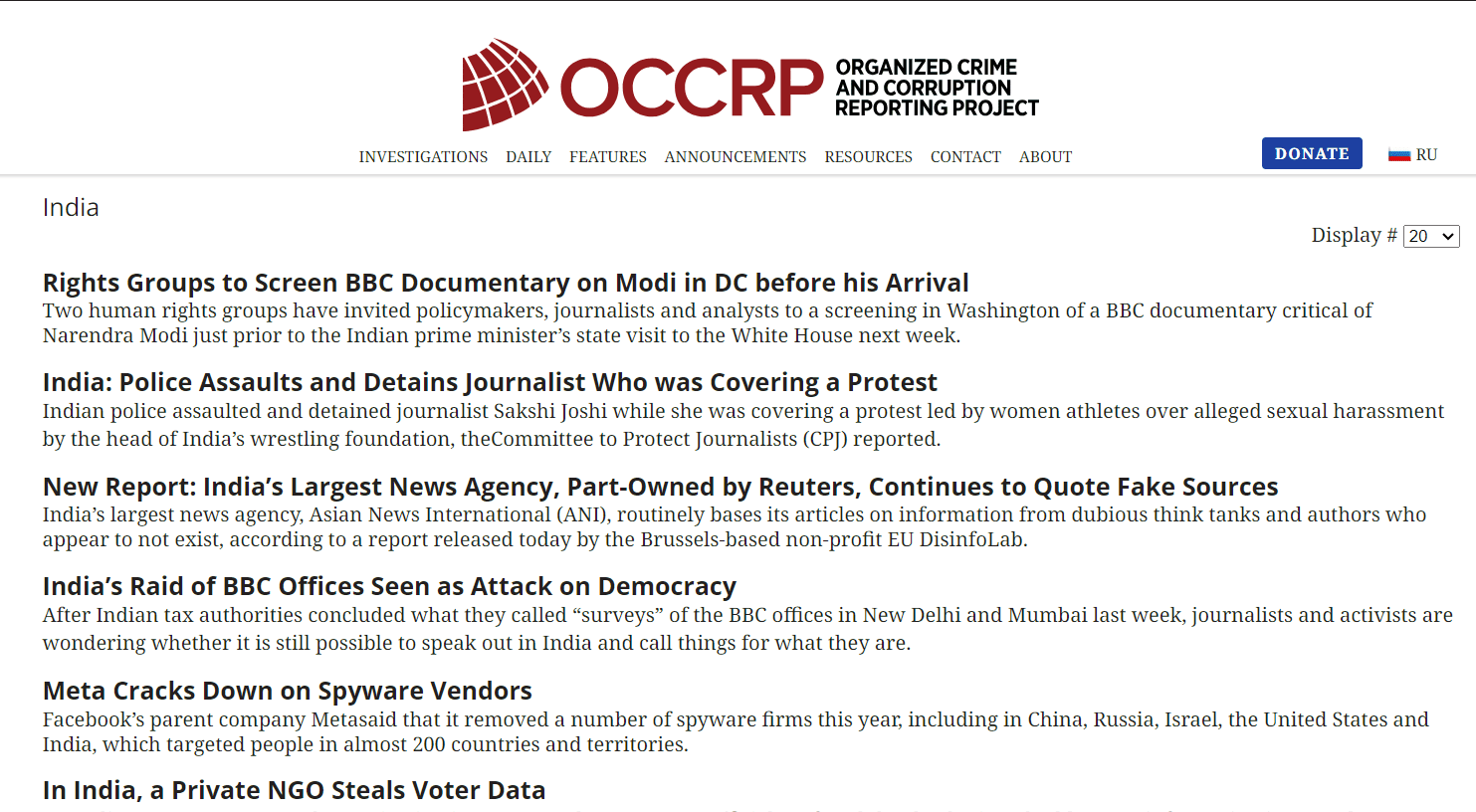
A cursory glance at the ‘India’ page of the organisation reveals the organisation’s fixation with the BBC documentary on PM Narendra Modi, which was nefariously designed to shield Islamists involved in the Godhra carnage and present the Indian Prime Minister as a ‘demagogue’ (despite the clean chit by Supreme Court-appointed SIT).
Screengrab of the articles published by OCCRP
The organisation was also seen fearmongering about the State of democracy in India and reiterating propaganda of dubious fact-checkers of Alt News about news agency, ANI.
Given that the anti-India antecedents of OCCRP are clear, one can anticipate attempts at similar shakedown of India’s financial markets by the George Soros-funded organisation.
South Asian Editor of OCCRP wrote extensively for NewsClick
During our research, Opindia found that the South Asian (Regional) Editor of OCCRP, Anand Mangnale, was a partnerships and strategy consultant at the contentious left-propaganda outlet NewsClick
As per the information posted on the website of OCCRP, he has been working with the organisation since 2021. “Anand has worked on several investigations exposing corporate and government corruption, abuse of power, and government misinformation and fake news campaigns,” the profile bio read.
“Anand was a partnerships and strategy consultant with online news platform Newsclick.in, focusing on exposing corporate fraud and corruption.” it further added.
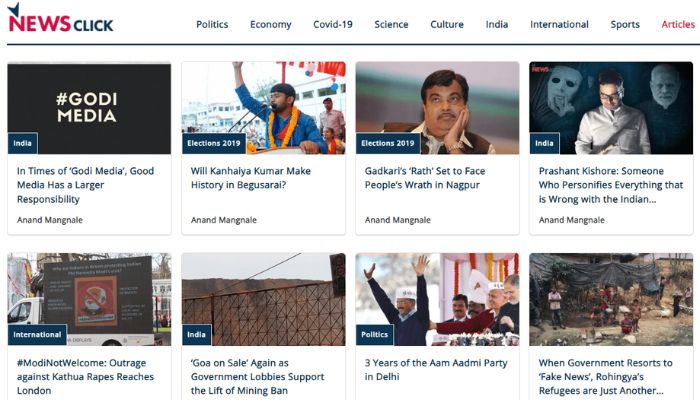
Articles written by Anand Manglale for NewsClick
We also found that Anand Mangnale wrote 15 articles for NewsClick between August 2017 and March 2020. A closer inspection of his Twitter profile reveals his political and ideological inclination, besides his propensity to fearmonger about India and its democracy.
In one tweet, he was shielding Islamists who unleashed mayhem in Nuh district (Mewat region) of Haryana and attempted to portray the Hindu community as the aggressors.
What’s happening in the country isn’t random. Its part of a grand plan.
It is state sponsored violence against Muslims & your & my silence is complicity in these times.
He was also seen labelling terrorists as ‘tribals’ in the State of Manipur and dubbing their neutralisation as a ‘State-sponsored massacre’ of the tribal community.
What happened in Manipur, the violence against Tribals is exactly what happened in #Gujarat. It was ‘State Sponsored Massacre’. @NBirenSingh has learned from @narendramodi
Anand Mangnale, who works for the Organised Crime and Corruption Reporting Project (OCCRP), was also seen going on a tirade against the new Parliament building. “It actually represents apathy & insensitivity of the Modi Regime, not #Democracy,” he lamented.
NewsClick is financed by Chinese Communist Party supporter
On August 5 this year, The New York Timespublished a detailed article, revealing the ties of an American businessman with the Chinese government and his financial support to an Indian leftist propaganda outlet named NewsClick.
According to the US-based newspaper, a millionaire named Neville Roy Singham is funding several news publications across the world (including India) to peddle Chinese propaganda.
“What is less known, and is hidden amid a tangle of nonprofit groups and shell companies, is that Mr. Singham works closely with the Chinese government media machine and is financing its propaganda worldwide,” the article stated.
The New York Times pointed out that Singham has been successful in disseminating Chinese government talking points under the pretext of ‘progressive advocacy’ in countries such as India, Brazil, South Africa and the United States.
Screengrab of the news report by The New York Times
Neville Roy Singham, who holds strong ties with the Chinese Communist Party (CCP), is at the forefront of China’s smokeless war.
In its article, The New York Times stated, “Under the rule of Xi Jinping, China has expanded state media operations, teamed up with overseas outlets and cultivated foreign influencers. The goal is to disguise propaganda as independent content.”
It further added, “The result is a seemingly organic bloom of far-left groups that echo Chinese government talking points, echo one another, and are echoed in turn by the Chinese state media.”
During its investigation, the American newspaper found that Neville Roy Singham had financed an India-based leftist propaganda outlet named NewsClick. It noted that the news outlet had repeated the talking points of the CCP in the past.
“In New Delhi, corporate filings show, Mr. Singham’s network financed a news site, NewsClick, that sprinkled its coverage with Chinese government talking points. “China’s history continues to inspire the working classes,” one video said,” noted The New York Times.
In July 2021, the ED informed that the investigation into the money laundering case against ‘NewsClick’ had revealed that the promoters of the media outlet received nearly ₹38 crores from entities, that might be associated with the Communist Party of China.
We now have mail transcripts, which suggest that NewsClick owner Prabir Purkayastha was instructed to praise China’s handling of Covid-19.
Conclusion
NewsClick has been under the scanner of the Enforcement Directorate since 2021. The revelations by The New York Times have rattled the left-liberal ecosystem, with many finding excuses to defend the left propagandist outlet.
We now know that the Organised Crime and Corruption Reporting Project (OCCRP) has a regional Editor, who worked with the Chinese Communist Party (CCP) funded NewsClick.
With media reports now suggesting a possible ‘expose’ by OCCRP targeting an Indian corporate house, the Chinese funding angle cannot be ruled out.
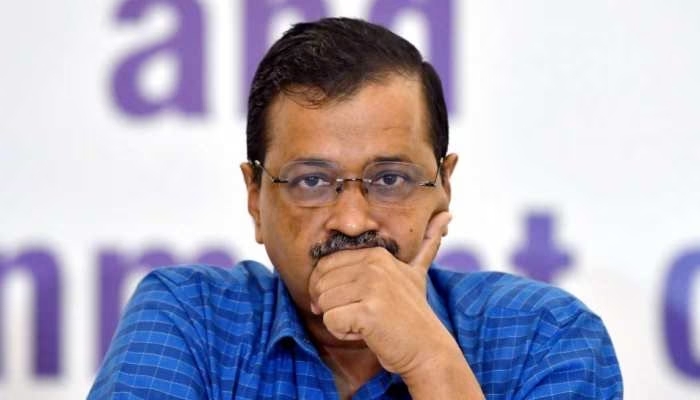
On Friday, August 25, the Supreme Court refused to stay the trial in the criminal defamation case filed by the Gujarat University against Delhi Chief Minister Arvind Kejriwal over the remarks made by him in connection with the academic degree of Prime Minister Narendra Modi.
BREAKING: Supreme Court refuses to stay the trial against Arvind Kejriwal in the defamation case for his remarks on PM Modi's degree. Court refuses to issue notice saying Gujarat HC is scheduled to hear the case and SC "hopes & trusts" that HC will decide it on the same date. pic.twitter.com/4Oyw9jTa5T
“We are not inclined to issue a notice in the present special leave petition as the matter is still subjudice before the High Court and fixed for hearing on August 29,” ordered the apex court bench comprising Justices Sanjiv Khanna and S.V.N Bhatti.
The Supreme Court stated that it hopes and trusts that the Gujarat High Court will decide on the pending petition on August 29 while allowing Gujarat University’s attorney, Solicitor General Tushar Mehta, to present all of his arguments to the High Court.
While Congress leader and senior advocate Abhishek Manu Singhvi was representing the AAP leaders in the Supreme Court, Solicitor General of India Tushar Mehta was appearing for the University. While presenting his arguments, Mehta submitted that there were “innuendos” in the comments made by Kejriwal. He contended that there was serious suppression of facts in the case.
The SG argued that the trial court had approved a waiver of the requirement for personal appearance; however, Kejriwal failed to include this information in his plea to the High Court, adding that this matter should be allowed to be raised before the High Court.
Considering this request, the bench recorded in the order, “We must record that a number of pleas have been raised by the Solicitor General on behalf of the Gujarat University. The said pleas can be raised before the High Court”.
Notably, the defamation case stems from derogatory statements made by AAP supremo and Delhi CM Arvind Kejriwal and his party senior leader Sanjay Singh concerning Prime Minister Modi’s academic degree.
On August 11, the Gujarat HC rejected AAP leaders Arvind Kejriwal and Sanjay Singh’s plea seeking an interim stay on criminal defamation proceedings against them filed by Gujarat University in connection with remarks on PM Narendra Modi’s degree. The court stated that until their revised plea, which challenges the Metropolitan Court’s order issuing summons to them in a sessions court, is not resolved, there cannot be any relief.
The metropolitan court had summoned the two AAP leaders after observing that prima facie there appeared to be a case against them under section 500 (defamation) of the Indian Penal Code (IPC). The summon came after Gujarat University’s registrar Piyush Patel filed a defamation lawsuit against the two AAP politicians for their remarks.
Gujarat HC pulls up AAP supremo Arvind Kejriwal in Modi degree row
The defamation case was filed after the Gujarat High Court, on March 31, 2023, overturned the 2016 Chief Information Commissioner’s (CIC) order, by which it directed the Gujarat University to supply Prime Minister Narendra Modi’s post-graduation degree to Delhi Chief Minister under the provisions of the Right to Information Act (RTI).
While quashing the CIC’s order, the court said PM Modi’s degree certificates were available on media, social media, and on the University website, adding that the respondent (Arvind Kejriwal) never questioned the authenticity of the degree during the pendency of the proceedings or even during the final hearing. The court also fined Arvind Kejriwal Rs 25,000 and concluded that there has been an indiscriminate misuse of the salutary provisions of the RTI Act.
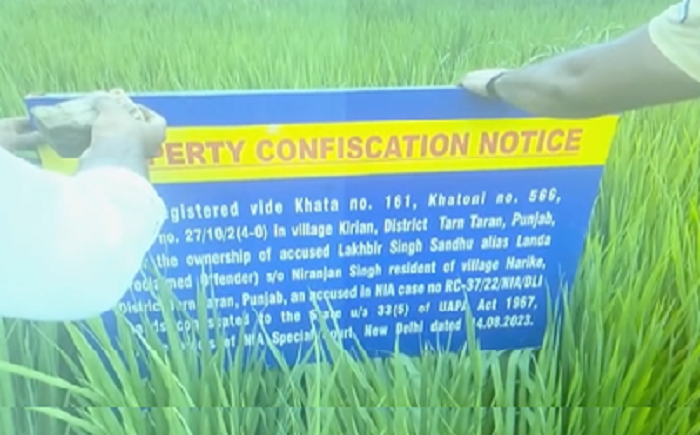
On August 25, the National Investigation of Agency (NIA) confiscated the land belonging to Khalistani terrorist Lakhbir Singh Landa in Punjab’s Tarn Taran region. As per the exclusive report by Republic TV, this is a big crackdown on the Khalistani elements in Punjab.
This comes months after the NIA announced a cash reward of Rs 15 lakh for anybody providing information leading to the arrest of Canada-based terrorist Lakhbir Singh Sandhu aka ‘Landa’, who is wanted in connection with a terror case in Punjab.
The NIA recently issued an arrest warrant for Sandhu, a Tarn Taran native who is currently thought to be living in Edmonton, Alberta, Canada. Sandhu is wanted in connection with the 2022 grenade attack on the Punjab Police intelligence headquarters in Mohali.
The NIA opened the probe in 2022 when it became clear that terrorist groups and foreign-based terrorist components were collaborating with the heads and members of organized crime gangs operating in the country’s northern states to carry out targeted killings and violent crimes.
The NIA had also registered a case against Landa on August 20 last year under Sections 120B, 121, 121A of the Indian Penal Code (IPC) and sections 17, 18, 18-B, and 38 of the Unlawful Activities Prevention Act, 1967 (UAPA) for his involvement in unlawful activities in various parts of the country.
Landa, who is in his early 30s, hails from the Tarn Taran district’s Harike Pattan village. According to reports, the first action against him arose from the Arms Act more than ten years ago. He had already been charged with 18 criminal offenses prior to this year, including attempted murder, murder, and drug trafficking.
Tarn Taran district is where he has the most impact. Additionally, he has some power in Ferozepur and Amritsar Rural. He is alleged to have gone to Canada, where his wife had been residing, in 2017. According to the reports, Landa was inactive between 2016 and 2020.
Along with putting an IED beneath a sub-inspector car in Amritsar, Landa is also looked at as a key conspirator in the RPG attack on the intelligence headquarters of the Punjab Police in Mohali. As per the latest update in the case, his land in Punjab’s Tarn Taran region has been seized.
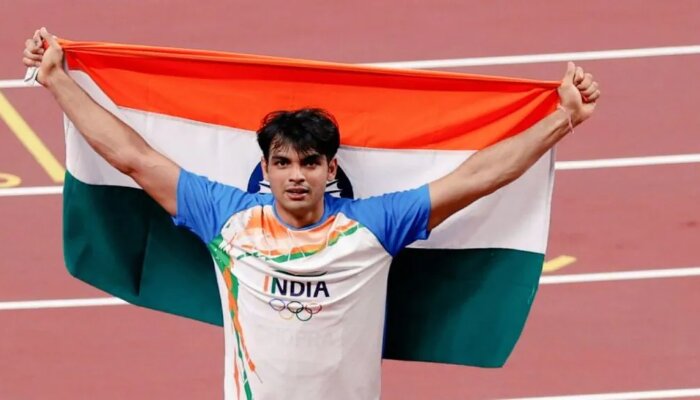
Olympic gold medalist Neeraj Chopra, India’s star javelin thrower qualified for the Paris Olympics 2024 on 25 August after a massive throw in the World Championships 2023. He surpassed the qualification record of 85.50 meters for the Paris Games by sending his javelin to a magnificent 88.77 meters mark on his very first attempt.
On Day 6⃣ of World #Athletics Championships, Golden boy @Neeraj_chopra1 keeps up with our expectations ?
The Olympic gold medallist registered a season-best and his fourth-best career throw in Group A of the qualification round at the competition in Budapest, Hungary. Meanwhile, he also secured a spot in the World Athletics Championships finals in the interim.
The 25-year-old won a silver medal in the competition last year. This year has been fruitful for him so far, however, a muscle strain caused him to miss a month of action. He accomplished his goal of reaching the peak in the World Athletics Championships admirably. He didn’t waste any time in advancing to the top of the qualification round. He broke his own season’s record of 87.67 meters and improved it by 10 cm in the central European city.
Notably, Chopra was the only competitor in his group to make it into the final without a qualifying round. His qualifying round lasted just a few minutes as he sent the spear to his season’s and fourth career-best distance.
With the exception of Neeraj Chopra, no one crossed the automatic eligibility standard of 83.0 meters. After Julian Weber of Germany, who threw his javelin to 82.39 meters, another Indian, DP Manu, finished third with 81.31 meters.
Notably, Anderson Peters, the defending champion is at risk of being knocked out. The 2022 Champion came in eighth place in Group A and didn’t get an automatic berth. His best throw was 78.49 metres. Now, he has to rely on Group B’s performance if he wants to participate to defend his crown in the 12-man final.
It is important to note that the competitors who throw further than 83 metres automatically qualify for the final, while everyone else must wait for the best throws of the other participants in the competition to determine who would move on further.
Neeraj Chopra made history after becoming the first Asian athlete to win an Olympic gold medal in men’s javelin throw in the 2020 Tokyo Olympics.
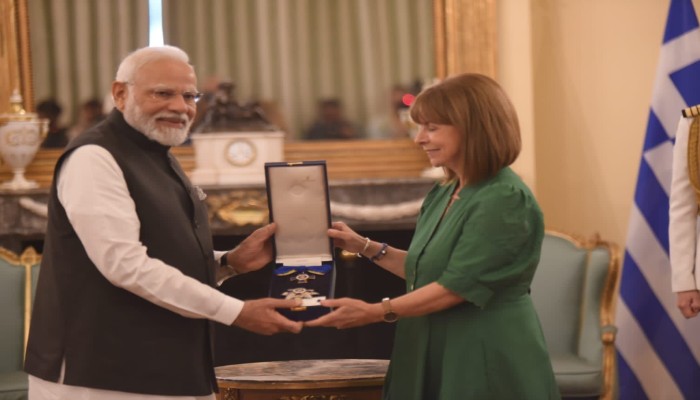
Prime Minister Narendra Modi has been conferred with the Grand Cross of the Order of Honour by the President of Greece during his one-day visit to the Balkan country.
PM Narendra Modi conferred with the Grand Cross of the Order of Honour by Greek President Katerina N. Sakellaropoulou in Athens
“I thank the President Katerina Sakellaropoulou, the Government and the people of Greece for awarding me the Grand Cross of the Order of Honor. This shows the respect that the Greek people have for India. @PresidencyGR,” PM Modi tweeted.
Ευχαριστώ την Πρόεδρο Κατερίνα Σακελλαροπούλου, την Κυβέρνηση και το λαό της Ελλάδας που μου απένειμαν τον Μεγαλόσταυρο του Τάγματος της Τιμής. Αυτό δείχνει τον σεβασμό που έχει ο ελληνικός λαός προς την Ινδία. @PresidencyGRpic.twitter.com/pxi82gAHQk
The Grand Cross of the Order of Honour is conferred by the President of Greece to Prime Ministers and eminent personalities who by reason of their distinguished position, have contributed to enhancing the stature of Greece.
The Order of Honour was established in 1975. The head of the goddess Athena is depicted on the front side of the Star with the inscription “ONLY THE RIGHTEOUS SHOULD BE HONOURED”.
The citation says– “In the person of Prime Minister Narendra Modi, an honour is bestowed upon the friendly people of India.” It further adds, “On the occasion of this visit, the Greek State Honours the Prime Minister of India, a statesman who has tirelessly promoted the global reach of his country and who works systematically for India’s economic progress and prosperity, bringing about bold reforms. A statesman who has brought environmental protection and climate change among the top priorities of international activity.”
PM Modi’s decisive contribution to the strategic promotion of Greek-Indian friendship in areas of mutual interest was also recognised by Greece.
The President of Greece congratulated India on the success of Chandrayaan-3. Modi and Sakellaropoulou also discussed the countries’ shared values of democracy, women-led development, and India’s G20 presidency.
Glad to have met President Katerina Sakellaropoulou in Athens. We discussed several issues which will strengthen the India-Greece friendship. We also discussed ways to boost sustainable development. She congratulated India on the success of Chandrayaan-3. @PresidencyGRpic.twitter.com/aoQFtKMdQq
PM Modi on Friday arrived in Greece for his maiden visit at the invitation of his Greek counterpart Kyriakos Mitsotakis. He was received by Greek Foreign Minister George Gerapetritis at the Athens International Airport and was accorded a grand ceremonial welcome upon his arrival. PM Modi also received a guard of honour.
Shortly after his arrival, PM Modi held bilateral talks with his counterpart Kyriakos Mitsotakis. The leaders discussed ways to further strengthen bilateral ties. PM Modi is the first Indian Prime Minister to visit the country in 40 years.
PM’s visit to Greece was particularly special for the Indian community which organised a grand welcome for Modi in Athens. He landed in Athens amid chants of “Modi, Modi”, and “Bharat Mata ki Jai”. A video of the same was shared by Modi’s X handle.
A number of agreements are expected to be signed during the significant visit which took place at the invitation of Greek Prime Minister Kyriakos Mitsotakis and emphasis on subjects like trade and investment, shipping, migration, and defence cooperation. Greece could also approach India for assistance in the privatisation of its seaports and airports in an effort to become India’s gateway to Europe.