Home Blog Page 1949

Kolhapur: Curious case of a Madarsa built on Pavangad fort’s govt land, Hindu groups raise voice against ‘illegal encroachment’, crucial discoveries from ground

The city of Kolhapur in Maharashtra is known for its rich cultural heritage, the glory of the Hindu temples and old forts built by Chhatrapati Shivaji Maharaj. The city is home to several Hindu temples like the ancient Mahalakshmi Temple and the hilltop Jyotiba Temple complex which attracts a large number of devotees to date. But some of the areas in the city like the Pavangad and Panhalgad, despite of having significant historic importance are usually left ignored, therefore attracting ‘illegal’ encroachment and invasion by the non-Hindu community.

In one such major incident, the local Hindu community residing in the Panhalgad town of the city have complained that a Madarsa has been ‘illegally’ built on the fort of Pavangad which was built by Chhatrapati Shivaji Maharaj in the year 1673. The Madarsa named the “Madarsa Arbiya Zinatul-Quran” has been established on the government land and is said to have been registered under the Societies Registration Act, 1860.

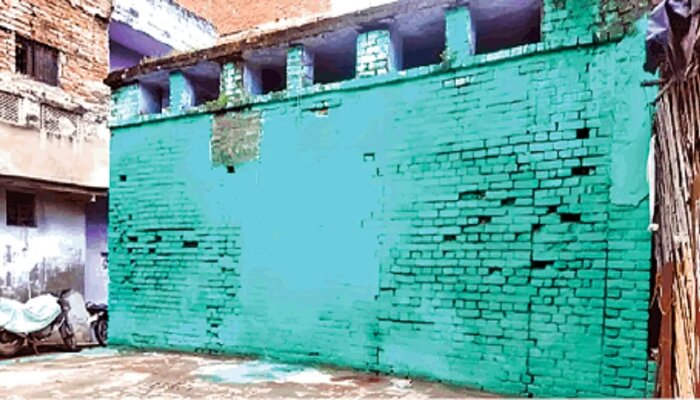
Madarsa Arbiya Zinatul- Quran (Image obtained by OpIndia)

The students in the Madarsa are not local. They hail from various regions of Delhi, Bihar and West Bengal. “The Madarsa on the historic fort of Pavangad is illegal and the students studying here are not from Maharashtra. The historic significance of the fort is being maligned by such illegal encroachments. Many Muslims have also constructed their residences on the fort. We demand strict action against such illegal encroachments and also demand removal of these structures to maintain the sanctity of the historic fort,” the letter by Bajrang Dal to the District and the State Administration read.

Letter submitted by Bajrang Dal in January this year (OpIndia)

Accordingly, the District Administration has taken cognizance of the incident and has confirmed that the land on which the Madarsa Arbiya Zinatul-Quran is built belongs to the government. “It is govt wasteland (mulki pad jameen) which falls under the government’s control. We have begun the probe in the case. Action will be taken against any kind of illegality if any,” Panhalgad Tehsildar Manavi Shinde said while talking exclusively to OpIndia.

History of Pavangad and the Hindu Temples

The fort of Pavangad is said to have been built by Chhatrapati Shivaji Maharaj in the year 1673 alongside the main fort area of Panhalgad. In the later years, the fort was invaded by the Britishers. The fort built by the Chhatrapati to protect the main Panhalgad fort had three steep rock entrances two of which were destroyed by the Britishers after the invasion in the year 1844. The fort of Panhalgad was also dismantled. Today the said land falls under the government’s control.

A short ravine isolates Pavangad fort from the Panhala fort which has now become a home town to around 3,121 people (2021 census). As of today, the estimated population of the Panhala town is around 4,200. 

The chief defence of the fort is a scarped rock fifteen to twenty-five feet high. It also is an attraction to see several ancient Hindu temples beautifully carved in the rocks that still exist on the Pavangad fort and people from the Hindu community visit these temples like the Shiv Mandir, Hanuman Mandir, Narsimha Mandir and Lakshmi mandir from time to time to worship the deities.

Ancient Hindu temple of lord Shiva on Pavangad

Recently in the month of February, the Hindu community members organized the holy event on the occasion of Mahashivratri in the old Shiva temple on Pavangad. Notably, this temple is super close to the Madarsa in question, only at the distance of around 45-50 meters. The Hindu community members talked to OpIndia and said that the event was organized under police protection to avoid any trouble.

Madarsa houses 40 minors, all from Delhi, Bihar and West Bengal

Team OpIndia visited the Pavangad fort to confirm that several residents living in the area belong to the Muslim community and that they have built houses surrounding the ancient Hindu temple of Lord Shiva. A mosque has also been established at the old southern gate of the fort. As per the Hindu community members, the mosque is also an encroachment and has been built on the ancient cave of Hindu sage Rishi Markandeya.

On talking to the operators of the Madarsa on July 20, it was revealed that the Madarsa has been registered under the Societies Registration Act, 1860 but has been built on government land (mulki pad jameen). However, the authorities at the Madarsa refuted the allegation of it being built on government land. “This is a registered Madarsa and it’s not at all illegal. It does not encroach on the govt land and is very old. We have been running this for more than 50 years now,” claimed the Madarsa authority.

Image of the Maradsa obtained by OpIndia

The team also communicated to Yusuf Mujawar and brother Dawood of the Madarsa who said that the Madarsa had been registered in the year 1979 and that it has been on the Pavangad since then. On asking about the other details, it was discovered that the Madarsa houses around 40 minor children and none of them are from Kolhapur or Maharashtra. All the minor students studying in the Madarsa Arbiya Zinatul-Quran are from Delhi, Bihar or West Bengal.

Teachers at Madarsa teach Arab, Quran and no other course or language

As per the sources, the students here are taught the Islamic way of life and only the Arab language. No other language like Hindi, English, not even the local language Marathi is taught to them. “Around 40 students stay here. Some big people associated with the Madarsa help us with the resources. Three teachers teach here. All of them are from outside the state. The students studying here are Yatims (orphans) and we are just helping them with basic needs,” Yusuf Mujawar said.

On inquiring about the registration of the Madarsa, he said that it was yet to be done and was delayed due to their father’s death. However, his brother Dawood asserted that the Madarsa was registered under the Education department and that it has been built on a valid piece of land. “Nothing is illegal here. We are doing a good service,” Dawood was quoted as saying.

Meanwhile, the team on the ground was made to sit inside the Madarsa office where the certificate of registration of the Madarsa was shown. As per the document, the said Madarsa has been registered as society under the Societies Registration Act, 1860 in the year 1979.

Students of Madarsa say we get good food, taught Arabic only

One of the workers at the Madarsa was also questioned about the well-being of the children studying at the ‘institution’. When asked whether permission of respective parents is obtained before bringing the minors here for education, the worker claimed that all the children have been brought here only after valid permission from the parents. Notably, Yusuf earlier had said that the Madarsa is engaged in imparting education to Yatims (orphans).

OpIndia also obtained a video of students studying in the Madarsa where they confirmed that they were taught Arabic only and no other language. They also confirmed that none of the students in the Madarsa are from Maharashtra. “All are either from Bihar, West Bengal or Maharashtra,” they could be heard saying.

Kolhapur Police takes cognizance, says probe underway to know if its illegal

The Kolhapur Police is said to have taken cognizance of the incident and has directed the Panhala Police to look into the matter immediately. “In this regard, Panhala Police Station has been informed to take appropriate action,” the tweet by Kolhapur Police read on July 17.

Kolhapur Police on July 20 was also approached for comment on the issue. Officer Ganesh Patil who is looking into the case was not available for comment. However, the team was informed that the investigation in the case is underway.

Screenshot of tweet by Kolhapur Police

“The incident has recently come to the fore. Some of the members on social media are posting that the Madarsa is illegal. But this is yet to be proven. The city police has directed investigaon into the case and it is underway. The land has been measured at present and the illegality will be proven only after the reports are attained,” Kolhapur Police said.

Tahsildar confirms govt land, says land measured, awaiting TLR report

OpIndia also talked to Tahsildar Manavi Shinde in the given case. “The case was brought to our notice on July 17. The office immediately measured the land and the reports are still not out. If any illegality is proven, action will be taken. But the situation will only be clear once the report from the Taluka President Land Records is obtained,” Shinde added.

She also added that the Muslim population residing on the Pavangad is civic and that there never has been any issue from their side. “Even when we inquired on July 17, the Madarsa members submissively co-operated with us and said that they would remove or hand over the land if any illegality is proven,” she added.

However, the officer also confirmed that the land on which the Madarsa has been built is a govt wasteland (mulki pad jameen) and that it falls under the control of the government.

Tahsildar Office, Panhala

Who gave them the permission; clear case of Land Jihad : Bajrang Dal

Speaking exclusively to OpIndia, Bajrang Dal District President Suresh Rokade pressed that any illegal encroachment on the historic fort of Pavangad should be taken down. “This is clear case of Land Jihad. Pavangad and Panhalgad are historic forts representing the glory of Chhatrapati Shivaji Maharaj. Who gave these people permission to establish a Madarsa here is a big question. The Madarsa is built on the mulki pad jameen of survey no. 128 which falls under the government control. The madarsa is not legally built,” Rokade said.

“We had given the letter demanding removal of such illegal encroachment in January this year but no action has been taken by the department in this case. We tried to follow up twice over the case but we were told that the investigation in the case is underway. The Hindu temple here is on the forest department’s land and the Madarsa is close to it on the mulki pad jameen. Around 40 students study here and none are from Maharashtra,” he confirmed.

He also opined that there should be no Madarsa on the historic fort. “No Madarsa is there on any historic fort. This is probably the first of its kind encroachment. Just clear case of Land jihad,” he said.

Houses made of roofing sheets denied permission on Pavangad

Notably, while on the Pavangad fort, team OpIndia observed that there are several Muslim residents staying in the homes that are constructed using roofing sheets. However, no information regarding the official permission given to them to built such residences could be obtained.

Recently, one such under construction house at the south gate of the Pavangad fort was asked to be taken down by the Panhalgad Municipal Corporation given the hazardous location close to the steep valley, as informed to OpIndia by the local Hindu group. “This property is near the south gate of the fort. The government didn’t allow them to build a house here. But there is a dargah on the edge of the south gate. Muslims have also made changes to the old fort secret roads. This is unacceptable,” Rokade indicated.

Dargah on the edge of the South gate of Pavangad (R); roofing sheet house denied permission (L)

Conclusion

The Madarsa in question, Madarsa Arbiya Zinatul-Quran is registered but is built and expanded using the roofing sheets on the land that falls under the control of the government. Several contradictory statements were obtained from the Madarsa operators. While one of the Madarsa authorities said that the students studying at the ‘institution’ were Yatims (orphans), other one said that the permission of the parents were obtained before bringing the minors here for education. One of the authorities also said that the Madarsa was registered under the Education’s department however the other one said that the registration was yet to be done and it was delayed due to their father’s death.

However, it was learnt that the Madarsa is registered under the Societies Registration Act, 1860 and is built on the Mulki Pad Jameen which falls under the government’s control.

Further, who gave the Madarsa authorities permission to built an ‘institution’ on the government land is unclear as the Madarsa was just in possession of the Society’s Registration Certificate which has been obtained by OpIndia. The matter would have been much clear if any document regarding the ownership of the land could be obtained from the Madarsa authorities. But later it was confirmed from the Tahsildar office that the land on which the Madarsa has been built belongs to the government and that it is a mulki pad jameen.

The legality of the Madarsa remains in question until the arrival of the Taluka President Land Records (TLR) report sought by the Tahsildar. However, the Tahsildar and the Police have confirmed that the land on which the Madarsa is built is a government land and that strict action will be taken ‘if any’ illegality is found.

Also, the operators of Madarsa have stated that they would remove the Madarsa and submissively hand over the land if any illegality is proven, as informed to OpIndia by the Tahsildar.

Similar reports reported in the past

Earlier, a similar incident was reported from the city of Nashik, where a local Hindu group had objected to the presence of ‘Sayyed Shah Vali Baba Dargah’ in the premises of an 18th-century-old historical monument that once served as the administrative headquarters of the Peshwas, the Sarkarwada.

Rushikesh Dapse (Bapu), a social activist associated with a local Hindu organization, had claimed that the Dargah in the Sarkarwada, which was once home to Peshwas, is an ‘illegal encroachment’ and that it shall be removed as it represents the wrong history of the Peshwas.

Also, an illegal Mazar had surfaced at the Mahim coast area in Mumbai, Maharashtra. The Brihanmumbai Municipal Corporation on March 23 employed bulldozers to demolish the illegal construction around the Mazar. This is after Maharashtra Navnirman Sena (MNS) chief Raj Thackeray played a clip in his Gudi Padwa address and exposed that an ‘illegal dargah’ has come up off the Mahim coast in Mumbai. He demanded the removal of the illegal dargah and said that if it is not demolished immediately, then his party would construct a huge Ganpati temple at the same place.

Illegal structures had also been built inside the Pratapgarh Fort where Chhatrapati Shivaji Maharaj had killed Afzal Khan. The old grave has been over the years converted into a religious shrine by Islamic groups. Despite orders by the Bombay High Court, the Maharashtra government was hesitant to remove the illegal structures inside the important historical monument.

In November 2022, the Shinde government finally sent police and local administration to remove the illegal structures around the grave.

NOTE: Required documents, audio and video recordings related to the case are in possession of OpIndia.

Muslim mob beat street hawker Ram Vilas to death over petty fight in Delhi’s Jahangirpuri, the latest hub of illegal Muslim immigrants from Bangladesh: Details

While the scars of the Islamist violence that took place on the day of Hanuman Jayanti in Jahangirpuri, Delhi last year have not yet faded away, yet another similar incident was reported from the area late on Thursday (July 20) night. A Hindu hawker named Ram Vilas was mercilessly murdered by an Islamist mob in Jahangirpuri’s C Block area. Besides, stones were also pelted in the area in which some others were also left injured.

Incidentally, Jahangirpuri’s C Block area, where yesterday’s incident took place, is the same block where Islamists had unleashed terror during the Hanuman Jayanti procession last year.

When the police learned about the communal clash that occurred late on Thursday night, a large number of officers was dispatched to the area to ensure that the situation does not worsen considering that the Jahangirpuri neighbourhood of Delhi is thought to be a communally sensitive area, particularly in light of the widespread communal violence that broke out last year.

Ram Vilas, a street vendor, reportedly got into a small altercation with some local Muslims over where to place his onion cart on the street, and they ended up viciously beating him till he died. According to reports, the Muslim youths ordered Ram Vilas to remove his onion cart from the street corner where he had set it up to do his business that evening. When he refused to comply with their demands, the Muslim youths started beating him up. The accused were soon joined by other people from their community, who also began to viciously assault Ram Vilas.

The victim’s wife, who was with him when he was assaulted, kept pleading for mercy, but the enraged Muslim youths kept hitting Ram Vilas until he started bleeding profusely. Within no time, Ram Vilas collapsed and fell to the ground. The assaulters fled the spot leaving Ram Vilas in a pool of blood.

Some local Hindus picked him up and rushed him to Babu Jagjivan Ram Hospital, but here the doctors declared him brought dead.

Media reports suggest that prior to assaulting Ram Vilas, these Muslim youths had gotten into a brawl with some members of the Hindu community. The brawl soon turned into a full-fledged communal attack with stones being pelted from both sides. Several people were left injured in this incident.

According to the authorities, it all began when some Muslim youths got into a fight with a Hindu resident named Sanjay when they were raising money for a Tazia procession. The Muslim youths began hitting Sanjay as the argument got heated. Some Hindu youngsters rushed to Sanjay’s defence after spotting the Muslim youths attacking him. Within no time, the Muslim youths were also joined by several other people of their community.

Soon after coming face to face, members of the Muslim and Hindu communities began throwing stones at one another, and the incident which started with a small altercation culminated into a full-fledged communal fight. The incident left many hurt.

Reportedly, it was after this incident, that a group of infuriated Muslim youths approached Ram Vilas and killed him after he refused to give in to their demands.

The deceased’s Ram Vilas’ inconsolable wife told the media how her innocent husband, who was simply selling onions on one corner of the street fell prey to the Islamist rage on the fateful night of Thursday (July 20).

The spine-chilling incident that occurred last night in North Delhi’s Jahangirpuri area, brings back memories of the vicious attack Islamists had unleashed on Hindu Devotees taking out the Shobha Yatra during last year’s Hanuman Jayanti.

The attack on Hanuman Jayanti Shobha Yatra in Jahangirpuri

When the Hanuman Jayanti Shobhayatra was passing through the C block of the Jahangiurpuri, suddenly some people pelted stones on the process from the rooftops in the area. After the attack, the people in the process also started pelting stones at the attackers in retaliation and triggering communal violence in the process.

Several people and police personnel were injured. The police had arrested 40 accused in the case. The Delhi police filed a 2,063-page chargesheet in the case, that stated that the riots were pre-planned. It said that the main conspirators — Mohd. Ansar, 35, Tabrez, 40 and Ishrafil, 50 — “controlled and coordinated the pre-planned conspiracy to orchestrate the riot” and also exerted influence over youths by “radicalising” them to take part in the violence.

Jahangirpuri a hub of rapes, and illegal activities; Rohingyas and Bangladeshis responsible for all crimes here: What locals told OpIndia

OpIndia then talked to locals regarding the violence. H Block resident Dinesh told OpIndia that such incidents were not new for Jahangirpuri.

He said there had been several major incidents in the area that were not even discussed in the media. He told how young boys are seen harassing women. He claimed several Hindu women have been raped in the area and when they try to file a complaint, the Police start harassing them. He further claimed a woman in Jahagirpuri was raped for 15 days some time ago.

He termed the stone-pelting incident on Hindu devotees a conspiracy and said Police personnel have been beaten up several times in Jahangirpuri. 

He added small children carry knives and commit crimes in the area. There was an incident where a boy forcefully married a Hindu girl at knifepoint and raped her. He said they have no hopes from the Police and demanded appropriate action against the culprits. 

Apart from Dinesh, some local owners of small businesses who were also attacked by the mob of Muslims in this area held the Rohingyas and Bangladeshi Muslims responsible for the crimes that took place in the area. In a video shared by Pradeep Bhandari on Twitter, a local owner of a small shop is seen informing about the atrocities caused by the rioters to the small businesses there. 

The shop owner said that they are facing atrocities by the Rohingyas just because they are Hindus. 

The communal violence that took place in Jahangirpuri last year brought to light how the neighbourhood has developed over time into a hotspot for illegal immigration, criminal activities, demographic upheaval, and radicalization.

Fact-finding report on Jahangirpuri violence

In fact, a fact-finding report on the Jahangirpuri communal violence had called the area a ‘ticking bomb’ of illegal immigrants, radicalisation, demographic stress and illegal encroachments. The fact-finding was undertaken by the Group of Intellectuals and Academicians (GIA). 

The report further warned that the area in Jahangirpuri is a crime-prone area due to thriving encroachment and illegal trade. Despite repeated complaints from local people, the local police (in the area) have turned a blind eye to such acts. This is a no-go zone for women. Crimes such as chain and handbag snatching are fairly widespread. People are hesitant to go out after dark.

It read that the local residents reported a major surge of illegal Bangladeshi immigrants in the area, who have illegally settled here over the course of several years.

BJP candidate groped, sexually assaulted by TMC workers on the day of West Bengal panchayat election result: Amit Malviya

On Monday (July 21), BJP national spokesperson Amit Malviya informed that a woman candidate of his party was groped and assaulted by workers of the ruling Trinamool Congress (TMC) government in West Bengal.

He had shared the screenshot of an online police complaint, filed by the victim wherein she accused two TMC workers, namely Arun Thakur and Shuvankar Malik of sexually assaulting her.

The complaint filed with the Domjur police stated, “This said persons touched the secret part of my body throughout the counting and as well beat me during the counting.”

“As per the guideline of respected High Court a male was not supposed to touch a female, but this said persons continuously beaten me and touched the secret parts of my body which is against law and order,” it added.

The victim said that the assault was orchestrated by TMC Block (Jagatballavpur) President Subir Chatterjee and Dibyendu Chatterjee, TMC President for Makardah-1 Anchal. She also requested to police to analyse the CCTV footage of Room No 2 and Table No 9 (Round 1) in the Domjur counting hall.

“This is also to inform you that we have requested many times verbally to Domjur BDO Gargi Das but she has not taken any satisfactory action against this. Hope you will take necessary action against the said person and will continue with your legal steps against this said persons to save the democracy of India,” the BJP candidate said in her complaint.

BJP candidate stripped, paraded naked in Howrah

On Thursday (July 20), a BJP gram sabha candidate in West Bengal informed that she was physically assaulted, stripped and paraded naked by workers of the ruling Trinamool Congress (TMC) party during the panchayat elections.

As per a report by ANI, the incident took place on July 8, 2023, in Dakshin Panchla in the Howrah district of West Bengal. In her official complaint filed with the Panchla police, the victim narrated that the assault was carried out by TMC gram sabha candidate Hemanta Roy at the polling station.

She further added that Roy was accompanied by other 40-50 TMC workers, including Noor Alam, Sanju Das, Ranabir Panja, Sukamal Panja, Alfi Sk. The copy of the First Information Report (FIR), as reported by Republic TV, read, “They hit me on my chest, and head with sticks and pushed me out of the polling booth.”

The victim pointed out that the TMC gram sabha candidate instigated party workers such as Sukamal Panja and Ali Sheikh to tear her saree and inner dress. “They further assaulted me and forced me to undress naked and molested me in front of other people,” she emphasised.

Adipurush movie controversy: Supreme Court declines PIL seeking revocation CBFC certificate

The Supreme Court on Friday declined a PIL seeking to revoke the CBFC certificate of the film ‘Adipurush’ for public exhibition for allegedly hurting religious sentiments.

A bench headed by Justice Sanjay Kishan Kaul said that these are not matters for this court to hear and sit in appeal of certification. Justice Kaul remarked, “Why should we interfere under Article 32? Everybody is now touchy on everything. Should we scrutinise everything? Tolerance for films, books these days is going down.”

Dismissing the plea, the bench said, the apex court should not become some kind of appellant authority for such matters.
“We may hold here that cinematographic depictions play with the original material, to what extent it is permissible a body is there. It is not possible for this court to interfere for each person’s sensibilities under Article 32. These are not matters for this court to hear and sit in appeal of certification. If anyone is aggrieved by the decision of appellate authority they can pursue remedies under law,” it added.

The top court was hearing a PIL filed by lawyer Mamta Rani seeking direction to revoke the certificate of the film ‘Adipurush’. The plea said that exhibition of Om Raut’s ‘Adipurush’ hurt the sentiments of Hindus and devotees of various deities depicted in the movie by “destroying their fundamental values and characters” and modifying the basic structure of Valmiki Ramayana.

The plea filed through advocates Shailendra Mani Tripathi, Ratnesh Kumar Shukla and Akash Awana sought direction “to protect and preserve all the religious manuscripts and texts in their original form at all platforms and prohibit distortion of the above-said texts/manuscripts by anyone.”

The plea also strongly objected to some dialogues in the movie, saying that only ‘gully boys’ use such ‘derogatory’ language.

“The sacred fundamental texts and manuscripts are the basic spiritual and physical tenets of a cultured and civilised society which a common man of such a society relies (on) and lives (by). A man becomes an orphan like a fallen leave from the branch of a tree without his culture and traditions,” the petitioner has stated.

It added, “Besides this, the depiction of the physical features and communication styles of Hindu gods – Rama and Hanuman – are complete distortions of not only the characters but also the very fundamental values for which they are worshipped”.

The petitioner expressed the apprehension that such a depiction would influence the general public into believing in “different value and morals”.

It further alleged that the depiction of Sita is “inappropriate and vulgar”.

The petitioner has contended that ‘Adipurush’ is a mockery of Valmiki Ramayana, which has been fuelled by personal commercial gain.

“The whole story of the film has destroyed and modified every aspect of the core values of the characters, their language and each authentic event,” it stated. The movie, which draws inspiration from the revered Hindu epic Ramayana, faced heavy criticism post-release. The film stars Prabhas as Lord Ram, Kriti as Goddess Sita, Sunny Singh as Laxman, and Saif Ali Khan as Ravana, the mythical hydra-headed demon king in the epic.

  (This news report is published from a syndicated feed. Except for the headline, the content has not been written or edited by OpIndia staff)

Delhi HC sets aside lower court order directing FIR against VHP leader Alok Kumar in 2019 hate speech case filed by Harsh Mandar

On Friday, 21st July 2023, the Delhi High Court set aside the trial court’s order directing Delhi Police to register an FIR against Vishwa Hindu Parishad (VHP) leader Alok Kumar on a complaint filed by activist Harsh Mander for allegedly giving a hate speech during a VHP rally in 2019.

Justice Swarana Kanta Sharma said in the order, “Harsh Mander had not levelled any allegation against Kumar in the complaint which he had lodged with the police. The single line averred against Kumar in his complaint filed before the magistrate on the face of it does not constitute any offence, or make out any case against Kumar.”

She further noted, “Even if the allegations made in the complaint are determined to be true, even then, no offence was disclosed to have been committed by the petitioner (Alok Kumar).”

The court also remarked, “Records of the case will also reveal that it is a case which is not a case for insufficient evidence, but of no incriminating material against him (Alok Kumar) at all.”

Justice Sharma observed, “In a country like India know one or two rather, all communities have respected each other and have lived a harmonious life. While passing such cases the magistrates even if they disagree with the detailed action report filed on record, the court while focusing on non-discrimination, has to take into consideration that communal peace cannot be taken lightly and tolerance of cultural and religious values between different communities has to be kept in mind.”

She further said, “In this backdrop, this court notes that in this case, the police had found that there was no material against the present petitioner or having either delivered a speech or to have ignited any communal disharmony. This court, therefore, cautions that while passing such orders, the judges have to be careful that in case there is no disharmony due to any speech, which was allegedly delivered, and not a past as the present one, could have rather ignited communal disharmony.”


In 2020, VHP leader Alok Kumar approached the court seeking the quashing of a trial court order passed on 8th February 2020. On 20th March 2020, Justice Yogesh Khanna issued a stay on the trial court order. The trial court’s order had directed the registration of an FIR against Alok Kumar and a Hindu seer from Kashi. The allegations were related to Alok Kumar allegedly inciting violence against members of the Muslim community in connection with the vandalisation of a temple in Lal Kuan, Old Delhi, in July 2019.

During the court proceedings, Senior Advocates Mohit Mathur and Abhishek Attrey, along with Advocates Manisha Agarwal, Varun Maheshwari, Amit Kumar Singh, Manan Soni, Rahul Madan, Deepak Mittal, Rabi Kumar, Divyansh Vajpayee, Rakshita Goyal, Sandeep Singh, Ajay Saini, Sumit Mishra, Nirmala Singh, and Harsh Gautam, represented Alok Kumar. Advocate Daniyal Khan appeared for Mander, while APP Satish Kumar represented Delhi Police.

VHP issues statement

Vishwa Hindu Parishad’s National Spokesperson Vinod Bansal issued a press statement after the verdict was out. According to the statement, Harsh Mander, “who was a member of Sonia Gandhi’s kitchen cabinet,” had written a letter to Delhi Police alleging that a Sanyasi had given a provocative speech in a meeting of Vishwa Hindu Parishad. While Mandar demanded an FIR against him, the name of Alok Kumar was not mentioned in the letter.

The statement states that after a probe, police found nothing objectionable in the speech by the Sanyasi. After that, Mandar moved to court demanding FIR against the Sanyasi, and also included Alok Kumar’s name in his plea. But Harsh Mandar didn’t allege that Alok Kumar had given any speech in that meeting, he also didn’t claim that the VHP leader was present in the meeting, or that he had organized this meeting. It was only written in the petition that Alok Kumar is the working president of Vishwa Hindu Parishad. Despite this, the magistrate ordered that an FIR be registered against him.

Therefore, Kumar moved the High Court challenging the magistrate’s order, and the order was stayed by the court in the first hearing itself. The High Court observed that there was no allegation against Alok Kumar in the petition. The court noted that even if if everything written in Mander’s petition is to be accepted as true, no blame can be made out against Kumar, as the petition has no allegation against him.

Love Jihad in Gujarat: Firoz lures a minor Hindu girl under false pretences; gives her a Muslim name after taking her to Bihar

A case of love jihad has surfaced in the Singhia block of Bihar’s Samastipur district. An 18-year-old Muslim individual named Guddu alias Firoz, son of Mohammed Bechan, from Basti Patti hamlet in the Thana region, is reported to have married a 15-year-old Hindu girl after he pretended to be from the same religion. Afterwards, he took her to his place in Bihar and assigned her a Muslim name.

The matter came to light when Bajrang Dal members of Gujarat informed the Darbhanga unit about the case. The Bajrang Dal and Vishwa Hindu Parishad leaders arrived in Basti Patti village on 20 July, evaluated the situation and then alerted the police.

Krishnakant Mandal, the in-charge of Singhia Police Station, led the police to the location under his direction after they received the information from the Hindu organisations. They retrieved the victim and sent her back to her house. The accused is now absconding. According to the official, raids are being carried out to capture him.

The minor is a native of Fatehpur in Uttar Pradesh and lived with her mother in Surat, Gujarat. She doesn’t have a father. The perpetrator was also staying in the same neighbourhood. He posed as a Hindu to lure the girl, pursued her to elope with him and brought her to his hamlet.

Meanwhile, his father fraudulently obtained a residency certificate from the Zonal Office. Along with being given a Muslim name, her parents were given false identities.

Uniform Civil Code, the 21st Law Commission and the loopholes: Here is what the strategy of opposition might be while they rally against UCC

The debate around Uniform Civil Code (UCC) has once again blown the lid off of Islamists. The extent of their aversion to anything that equates them to the “kafirs” has been revealed ever since Prime Minister Narendra Modi on 27th June underlined the need for UCC.

The All India Muslim Personal Law Board (AIMPLB) on 6th June while responding to a media channel’s question in the context of UCC said that there are already over 100 Sharia courts in India and that it is planning to establish more Sharia courts in Muslim-populated areas.

This rather brash statement came following the AIMPLB’s meeting with Congress, NCP, and Shiv Sena (UBT) earlier on 6th June. AIMPLB spokesperson Qasim Rasool Ilyas claimed that Congress had assured them that their concerns regarding UCC will be considered should the subject come up for debate in the Parliament. He said that NCP chief Sharad Pawar said that they are not in favour of UCC and “only agree with the 21st Law Commission’s conclusion”.

If Qasim Ilyas is quoting Congress and NCP correctly, then the strategy of the Opposition on the Uniform Civil Code is quite clear – collude with the defying Islamists, base their own politics on the latter’s arguments, play the minority card, and selectively use the 21st Law Commission’s recommendations to sound institutionally credible and viable.

The Congress has already started using the last strategy. On 15th June, a day after the 22nd Law Commission invited suggestions, Congress issued a statement saying that the “Centre is desperate because the 21st Law Commission report deemed UCC unnecessary”.

The 21st Law Commission report in its conclusive take on UCC and indecisive arguments for the same has unintentionally given the Opposition reasons to use the report as grounds for objection to the Uniform Civil Code (UCC). Here are some excerpts from the report which give an overall idea about the direction that the Opposition might possibly take on UCC.

What is the 21st Law Commission report on UCC?

Article 44 of the Indian Constitution says that the State “shall endeavour to secure for the citizens a uniform civil code throughout the territory of India”. UCC basically deals with bringing personal laws under the ambit of the Constitution.

The Ministry of Law and Justice made a reference to the 21st Law Commission of India on 17th June 2016 to examine matters in relation to Uniform Civil Code. The commission, led by former Supreme Court Judge Justice Balbir Singh Chauhan, did “detailed” research and held a number of consultations over the course of two years, and presented its recommendations on 31st August 2018.

The 21st Law Commission put forth its questionnaire in the public domain in November 2016 and received more than 75,378 responses. The majority of these responses, as per the Commission, dealt specifically with the issue of triple talaq or talaq-ul-biddat. The report has published research on the following topics: Marriage & Divorce, Custody and Guardianship, Adoption and Maintenance, and Succession and Inheritance.

Report Introduction: Misplaced priorities and loopholes

The 21st Law Commission report begins by saying that the consultation paper has been “an endeavor to understand, acknowledge and finally suggest potential legislative actions which would address discriminatory provisions under all family laws.” But it fails to specify as to what extent this would pave the way, if at all, for a level playing field amongst personal laws and not merely within personal laws.

The commission urges the legislature to “consider guaranteeing equality ‘within communities’ between men and women, rather than ‘equality between’ communities.” It would be no surprise should the Opposition base its argument on similar grounds demanding to make gender disparity alone the criteria for UCC as against the larger need to bring certain personal laws under the ambit of the Indian Constitution.

The Congress in its closed-door meeting on UCC rejected the idea of uniformity of all personal laws. This comes along the lines of the 21st Law Commission’s attempt to argue against uniformity when it says, “…this way some of the differences within personal laws which are meaningful can be preserved and inequality can be weeded out to the greatest extent possible without absolute uniformity.”

Given the resistance by the Opposition and the previous committee towards the term ‘uniformity’, it is imperative that the Centre in its UCC draft publishes a detailed definition of the term in the context of equality not only within but also amongst personal laws.

On the point of the Right to Equality, the report says that “equity and not mere equality would mean that preferential rights and protections are maintained for vulnerable or historically subordinated sections of the society, for there is no equality in treating unequals as equals.”

Such an observation can potentially justify and be used to justify the minority-majority argument, which has already been made by the AIMPLB demanding that minorities be excluded from UCC. No doubt that equity must be ensured to protect the vulnerable sections of society but this too would require defining which sections amount to “vulnerable sections ” independent of the “minority rights” narrative.

In point 1.18., the report says “There are also a number of issues that are brought up frequently in public debate but cannot be and need not be dealt with the law. For instance, the recent case of a Kerala church where the father exploited a woman blackmailing her for the confessions she made to him led to a widespread demand for declaring the practice of confessions altogether illegal. These are precisely the type of knee-jerk reactions we must be wary of. It’s a far more progressive and sensible suggestion to eventually also include nuns as individuals who can hear confessions. This need not be enforced by law, but the brought in through consensus building within communities.”

The last line is outright problematic as the Commission seems to be easily given into the archdiocese of Bombay, Father Nigel Barrett. The statement is from the same report the Commission has referred to. In the statement on the demand by activists to let women confess to nuns in view of a case of exploitation of a Christian woman, the Father reportedly said, “Any change in India cannot be effected by the local Church or Indian government. It is a matter of personal law.”

In saying that the activists’ demand “need not be enforced by law”, the Commission has made its case for simply denying uniformity in not just the law but also in delivering justice to an extent.

Discounting the personal laws of a certain minority community?

A little further on to point 1.18., the Commission says, “It is important to separate the disease from the symptom of the disease. The issue itself is not about religion for the individuals who indulged in such exploitation (the case about a father exploiting a woman who was confessing in church) also do not have the patronage of any religion.” Such a statement seems devoid of ground realities.

Not limiting the argument to the above-mentioned Christian woman’s case, can the statement “…for the individuals who indulged in such exploitation also do not have the patronage of any religion”, be applied to Nikah Halala and polygamy and similar practices in Islam which are currently validated under Section 2 of the Muslim Personal Law (Shariat) Application Act, 1937?

Surprisingly, the Commission further adds, “Thus, such criminal cases cannot be seen as a problem with family law. The law already exists on the matter”, reflecting its disconnect with the grassroots and ground reality.

While talking about the Sixth schedule, the 2018 report says that “cultural diversity cannot be compromised to the extent that our urge for uniformity itself becomes a reason for threat to the territorial integrity of the nation.” How uniformity can become the reason for a threat to the territorial integrity of a nation battling illegal infiltration is a point lost upon one.

In point 1.21., the Commission sings the minority tune as it says, “The term secularism only has meaning if it can also assure that the expression of any form of difference, not just religious but also regional does not get subsumed under the louder voice of the majority; and at the same time no discriminatory practice hides behind the cloak of religion to gain legitimacy.” While the first half of this sentence is based on the fear of a problem that does not exist, the second half seems like wishful thinking so far as minorities are concerned.

The observations of Hindu Laws versus observations of Muslim Laws

Adding to the above-mentioned loopholes is the instant and spirited criticism of Hindu personal laws. The same spirit appears to be lacking in points on Muslim personal laws in the report.

In point 1.8., the Commission says, “One of the foremost social legislations that were introduced in independent India was, in fact, the amendments to Hindu law. These amendments generated enormous protests in many parts of India and most notable and vociferous opposition came from the Hindu Mahasabha. Despite sustained protests, the Hindu Law Committee continued to contemplate reforms, under the stewardship of Nehru and Ambedkar.”

Why should there be the need to draw a comparative line between “opposition from the Hindu Mahasabha” and “reforms in Hindu law under the stewardship of Nehru and Ambedkar” is difficult to understand. The report goes on to refer to excerpts from BR Ambedkar’s recommendations on UCC, which essentially means that Ambedkar wasn’t entirely against the idea of a uniform civil code, or was at least supportive of the idea of a “voluntary uniformity” in personal laws if not uniformity alone unlike the report.

Further, in point 2.3., under Marriage and Divorce, it says that “the relatively easier procedure of divorce under Islamic law for men and women is also reflected in the relatively open attitudes towards remarriage of divorced and widowed women, a right that most Hindu women achieved through legislation.” Such a careful and crafty observation of “open attitudes” in divorce under Islamic law, only to point out that Hindu women achieved the same only through legislation displays a lack of objectivity.

While talking about adultery in Muslim law, the Commission takes a surprisingly brief stand and a soft tone even when talking against it. “The Dissolution of Muslim Marriage Act, 1939, also requires an amendment to explicitly include adultery as a ground for divorce for both spouses,” the report respectfully recommends.

Even when the report notes that “under Muslim law, adultery is not recognised as a ground for divorce unless it is committed with women of evil repute or leads an infamous life”, it concludes in point 2.10., that “all family laws include adultery as a ground for divorce”, furthering recommending that “it is important to ensure that the provision is accessible to both spouses.”

Point 2.49., under the Hindu Law section states that the significant reforms brought about by the Hindu Marriage Act, of 1955 remained far from satisfactory. “Reform of Hindu law which has historically been celebrated as a watershed moment has in the recent decades also been viewed with a critical lens, which highlighted that codification of Hindu law, in essence, was a codification of North Indian upper caste morality”, it reads.

It goes on to critique in great detail the Hindu customs and traditions, and by all means it is free to. But the point of contention arises when the report mentions the 1994 Sarla Mudgal v.Union of India case which highlighted data suggesting that many Hindus convert to Islam in order to practice bigamy. As per the report, “Anthropological evidence has shown that bigamous arrangements among Hindus continue to exist and have local recognition despite there being a law against it.”

While this serves as evidence of attempts to put the blame of bigamy on Hindus, who have always accepted laws against such practices, the point that polygamy is a custom codified under the law and is still very much prevalent amongst Muslims is not even suggested.

It is preposterous to note that the report, point 2.91., in the succeeding section on Polygamy in Muslim Law, paints a rather colourful picture. “Although polygamy is permitted within Islam, it is a rare practice among Indian Muslims, on the other hand, it is frequently misused by persons of other religions who convert as Muslims solely for the purpose of solemnising another marriage rather than Muslim themselves. Comparative law suggests that only a few Muslim countries have continued to protect the right to polygamy but with strict measures of control.”

The Commission has even gone on to refer to the law and cases in the Banana Republic of Pakistan.

Despite the fact that the Shariat Act prioritises the “Nikahnama” instead of a govt authorised documentation in order to register a marriage, the Commission suggests that, “The Nikahnama itself should make it clear that polygamy is a criminal offense and section 494 of IPC and it will apply to all communities.” Instead of suggesting that the documented proof of marriage in Muslims should also be under the ambit of a govt authority, the report rather calls for the Nikahnama to be the judge and declare polygamy as a criminal offense.

Even in the section on Adoption, the report has a highly objectionable approach towards Hindu Laws as against Muslim Laws and sometimes even Christian Laws.

No observations nor objections on matters of property in Islam

There is much to be mentioned yet about the report with regard to its questionable direction furthermore on issues of succession, inheritance, and property.

For example, the Commission should have addressed the scope of Waqf Act in relation to the Shariat Act. This considering the provision in the Shariat Act which says that matters of waqf (other than charities and charitable institutions and charitable and religious endowments) shall be decided by the Muslim Personal Law (Shariat).”

As per Sharia law, once Waqf is established, and the property is dedicated to Waqf, it remains as Waqf property forever. This means that Sharia law can essentially make provision to stake claim on public and private land by invoking the Waqf Act, 1995.

The Waqf Act, 1995 was enacted and implemented on November 22, 1995. This act provides for the power and functions of the Waqf Council, the State Waqf Boards, and the Chief Executive Officer, and also the duties of mutawalli.

This Act also describes the power and restrictions of a Waqf Tribunal that acts in lieu of a civil court under its jurisdiction. The Waqf Tribunals are deemed to be a civil court and required to exercise all the powers and functions exercised by a civil court under the Code of Civil Procedure, 1908. The decision of a Tribunal shall be final and binding on the parties. No suit or legal proceedings shall lie under any civil court which this act requires to be determined by a Tribunal. Thus, making the Waqf Tribunal decisions above any civil court.

Since the ownership of the property is transferred to Allah from the waqif in the case of Waqf, and property can not be taken back from Allah, once a property becomes Waqf, it will always stay Waqf.

As seen in the case of Bengaluru Eidgah ground, even though there was no title transfer to any Muslim organisation as per the government, Waqf’s claims that it was a Waqf property from the 1850s means that it is now forever a Waqf property.

The Gujarat Waqf Board had staked claim to the Surat Municipal Corporation building which is now the property of the Waqf because the documents were not updated. As per Waqf, back during the Mughal era, the Surat Municipal Corporation building was a sarai and used during the Hajj travels. The property then belonged to British Empire during British rule. However, when India got independence in 1947, the properties were then shifted to the government of India. However, since the documents were not updated, the SMC building then became Waqf property, and as Waqf Board says, once a Waqf, always a Waqf.

So, what now?

Let’s make it clear that Uniform Civil Code is required largely to bring Muslim personal law under the ambit of Constitutional morality, which it currently isn’t quite. UCC cannot be written off simply for the fear of losing cultural diversity and to caution against majoritarianism, which we all know is a superficial term in India used frequently by the left-liberal ecosystem.

The 21st Law Commission report says too much about Hindus laws which are very much in accordance with the Constitution. But it speaks rather carefully as it suggests how Muslim personal laws can be aligned even when in their application they are far removed from the very idea of equality and rights. The report could very well be a perfect recipe for the Opposition as it prepares its case against UCC in the Parliament.

West Bengal is a part of India: Locket Chatterjee breaks down while talking about Manipur-like naked parade of BJP candidate by TMC workers in Howrah

On Friday (July 21), BJP leader Locket Chatterjee broke down while talking about the plight of party candidate, who was physically assaulted, stripped and paraded naked in Howrah by TMC workers during panchayat elections.

“We are also women. We want our daughters to be protected. We are the daughters of this country. The victims of Manipur are also the daughters of India,” she emphasised.

While trying to hold back her tears, Chatterjee added, “West Bengal is a part of India. It is not an outside State. Yesterday, PM Modi spoke not only about Manipur but all States. He reiterated the need for strong law enforcement.”

“Just like the victim in Manipur is a daughter of India, similarly, we want all of you to speak about us. Our gram sabha candidate was assaulted during the panchayat election,” the BJP leader noted.

On Thursday (July 20), a BJP gram sabha candidate in West Bengal informed that she was physically assaulted, stripped and paraded naked by workers of the ruling Trinamool Congress (TMC) party during the panchayat elections.

As per a report by ANI, the incident took place on July 8, 2023, in Dakshin Panchla in the Howrah district of West Bengal. In her official complaint filed with the Panchla police, the victim narrated that the assault was carried out by TMC gram sabha candidate Hemanta Roy at the polling station.

She further added that Roy was accompanied by other 40-50 TMC workers, including Noor Alam, Sanju Das, Ranabir Panja, Sukamal Panja, Alfi Sk. The copy of the First Information Report (FIR), as reported by Republic TV, read, “They hit me on my chest, and head with sticks and pushed me out of the polling booth.”

The victim pointed out that the TMC gram sabha candidate instigated party workers such as Sukamal Panja and Ali Sheikh to tear her saree and inner dress. “They further assaulted me and forced me to undress naked and molested me in front of other people,” she emphasised.

The development came amid public outrage over a viral video from Manipur wherein two women were gang-raped and paraded naked by a mob of men

Varanasi court pronounces verdict in favour of the Hindu side, allows the scientific survey of Gyanvapi premises

On Friday, July 21, the Varanasi court gave a nod to the petition filed by the Hindu side, seeking a scientific survey of the Gynvapi structure in Varanasi by the Archaeological Survey of India (ASI).

Notably, as per the verdict, the ASI would now conduct a scientific survey on the entire Gyanvapi premises, except the area that was sealed after the discovery of the Shivling within the Varanasi Gyanvapi complex.

Vishnu Shankar Jain, representing the Hindu side in the Gyanvapi mosque case, said, “I have been informed that my application has been approved and the court has directed to conduct an ASI survey of the Gyanvapi mosque complex, excluding the Wazu tank which has been sealed.”

The district court had heard both Hindu and Muslim sides on July 14 and reserved its order for July 21.

Speaking to the media before the court verdict, Advocate Subhash Nandan Chaturvedi, the Hindu side’s lawyer on the Gyanvapi matter had said, “The decision that is supposed to be pronounced today is on the ASI survey that we had demanded, except on the sealed area in the premises. The sealed area’s matter is pending before the Supreme Court and the SC said that an ASI survey should not be done in the area until the decision is pronounced on the same…Both parties had argued their sides and the Muslim side had raised its objection…Today’s decision will be a turning point for us…”

Notably, the application demanding the scientific survey was submitted to the district court on May 16 by Vishnu Shankar Jain, the attorney for 4 women Hindu worshippers who are plaintiffs in the Shringar Gauri-Gyanvapi case. Later, the Anjuman Intezamia Masjid Committee (AIMC) filed an objection in the matter.

“The court heard the arguments of both sides in the application seeking ASI survey in the barricaded area of Gyanvapi and the hearing was completed on Friday,” said Rajesh Mishra, the special attorney for the Uttar Pradesh (UP) government in the Shringar Gauri-Gyanvapi issue. The court set July 21 as the date for its decision.

Supreme Court postpones hearing on Gyanvapi disputed structure

Notably, prior to this, the Supreme Court postponed the hearing of the application related to the Gynvapi structure in Varanasi and directed the Muslim side to file their response in the case. During the hearing on July 11, the bench of Chief Justice DY Chandrachud, Justice PS Narasimha, and Justice Manoj Mishra said that the response of the Muslim side to the petition is awaited.

This had come a day after the Hindu parties in its affidavit informed the Supreme Court that calling the Shivling discovered within the Varanasi Gyanvapi complex a “fountain” amounted to demeaning it and that a scientific investigation of the Shivling should be carried out to end the controversy.

The Hindu parties had requested a survey of the entire Gyanvapi mosque premises by the Archaeological Survey of India (ASI) to determine whether the mosque had been built over an earlier structure of the Hindu temple. On May 16, the Varanasi District Court granted the committee until May 19 to file their reply or objection, if any.

The ‘Wazu’ area of the Gyanvapi mosque is the centre of the Gyanvapi mosque-Kashi Vishwanath temple dispute between Hindus and Muslims since the Hindu parties assert that ‘Shivling’ has been found in that spot, however, the Muslim side disputed the same and claim that it is only a water fountain.

Notably, the request for a scientific investigation of the Shivling was filed previously before the Varanasi Court in September 2022, but it was denied in light of the Supreme Court’s decision to safeguard the location where the Shiva Linga was allegedly discovered on May 17, 2022.

The Hindu parties had requested a survey of the entire Gyanvapi mosque premises by the Archaeological Survey of India (ASI) to determine whether the mosque had been built over an earlier structure of the Hindu temple. On May 16, the Varanasi District Court granted the committee until May 19 to file their reply or objection, if any.

Aditya Sachdeva murder case: Patna HC overturns conviction of former JD(U) MLC’s son Rocky Yadav and two others, accused walk free for ‘lack of evidence’

On Wednesday, July 19, Patna High Court acquitted Rocky Yadav, the son of former JD(U) MLC Manorama Devi, and two others convicted in 2017 for murdering an 18-year-old boy named Aditya Sachdeva in a road rage incident in 2016. 

A high court bench comprising Justice AM Badar and Justice Harish Kumar on Wednesday allowed the accused Rakesh Ranjan Yadav alias Rocky, Rajiv Kumar alias Teni Yadav, and Rajesh Kumar the ‘benefit of doubt’.

“Benefit of doubt as the prosecution has failed to establish their guilt by adducing clear, cogent, trustworthy and clinching evidence. All of the appellants are acquitted of the charges levelled against them, which the learned trial court found to be proved against them. They be set at liberty forthwith if not required in any other case,” the court ruled.

Aditya Sachdeva murder

On May 7, 2016, Rocky Yadav was returning to Gaya from Bodhgaya in an SUV with his bodyguard Rajesh Kumar when the incident occurred. Rocky got into a heated verbal confrontation with the people inside of a Swift Dzire car including victim Aditya Sachdeva and his four friends near Gaya’s Rampur police station for allegedly refusing to let him pass. Following this, Rocky Yadav overtook the Swift Dzire car and stopped it, which sparked an argument between Aditya and his friends and Rocky Yadav. Rocky following the outbreak shot Aditya Sachdeva with his licensed Beretta gun in a fit of rage.

Accused Rocky Yadav was apprehended three days after the crime, from his father’s mixer plant in Bodhgaya by Gaya police, and a Beretta gun registered in his name and used to perpetrate the crime was confiscated. A Gaya court then sentenced him to 14 days in judicial custody. Later, Rocky Yadav’s bodyguard Rajesh Kumar and his father, Bindeshwari Prasad alias Bindi Yadav, were all arrested by the police.

Aditya Sachdeva’s parents with his picture (Image via PTI)

Friends and police turned hostile 

As the case progressed, several of Sachdeva’s friends turned hostile during court appearances, which changed the course of the case. Aditya’s friends Ayush Agrawal, Ankit, Nasser Hussain, and Mohammed Kaifi took a u-turn and refused to testify that it was Rocky Yadav who shot Aditya dead saying that it was dark when the incident transpired and they could not see clearly if it was Rocky Yadav who fired the bullet.

On the day of the incident, Aditya’s friend Nasser Hussain was driving the car and overtook Rocky Yadav’s car. Nasser Hussain, an eye witness in the case backtracked from his original statement indicting Rocky Yadav. It is reported that Hussain’s father Hasnu Miyan had close ties with Rocky’s father Bindi Yadav.

Sunil Kumar, a police constable, became hostile in December 2016 after making an earlier testimony in which he said he observed Bindeshwari Prasad Yadav helping his son Rocky in escaping after the crime.

Days later, Tej Narain Singh Yadav, a police constable posted at MLC Manorama Devi’s AP Colony residence, retracted his prior statement in which he stated that on the evening of May 7, he saw Rocky Yadav very disturbed at his residence and that his father Bindi Yadav facilitated his escape. However, in court, the constable categorically denied making any such statement.

Rocky Yadav and Teni Yadav’s conviction in 2017

A Gaya district court convicted Rakesh Ranjan Yadav aka Rocky Yadav and two others to life in jail in September 2016 for the murder of class XII student Aditya Sachdeva. Bindeshwari Prasad Yadav aka Bindi Yadav, a former Gaya zilla councillor, was sentenced to five years in prison for harboring the perpetrator and providing false information to the court. Bindi Yadav died due to Covid in July 2020.

Rocky is the son of former JD(U) MLC Manorama Devi, who was ousted from the party as the matter sparked outrage. Rocky and three others were found guilty by the court on the basis of the findings of the recovery of the firearm used in the crime and subsequent findings of the forensic team, with Additional District and Sessions Judge (ADJ) Sachchidanand Singh pronouncing the verdict in the high-profile case.

Rocky Yadav after being convicted in Aditya Sachdeva murder case in 2017 (Image via PTI)

Rocky, a member of the Delhi Rifle Club, had obtained the pistol’s permit through a sports quota. The address on the license was from the Maoist-affected Chatra area of Jharkhand. The prosecution claimed that the licenced pistol confiscated from Rocky, along with 19 live cartridges, was used in the murder of Aditya.

The court, however, noted that FSL expert Dilip Kumar failed to provide any material to back up his assertion that retrieved two deformed bullets were fired from the Beretta pistol, which was seized from the Hot Mixed Plant of Bodh Gaya,” the division bench stated overturning the conviction and allowed the Rocky Yadav and others to walk free.