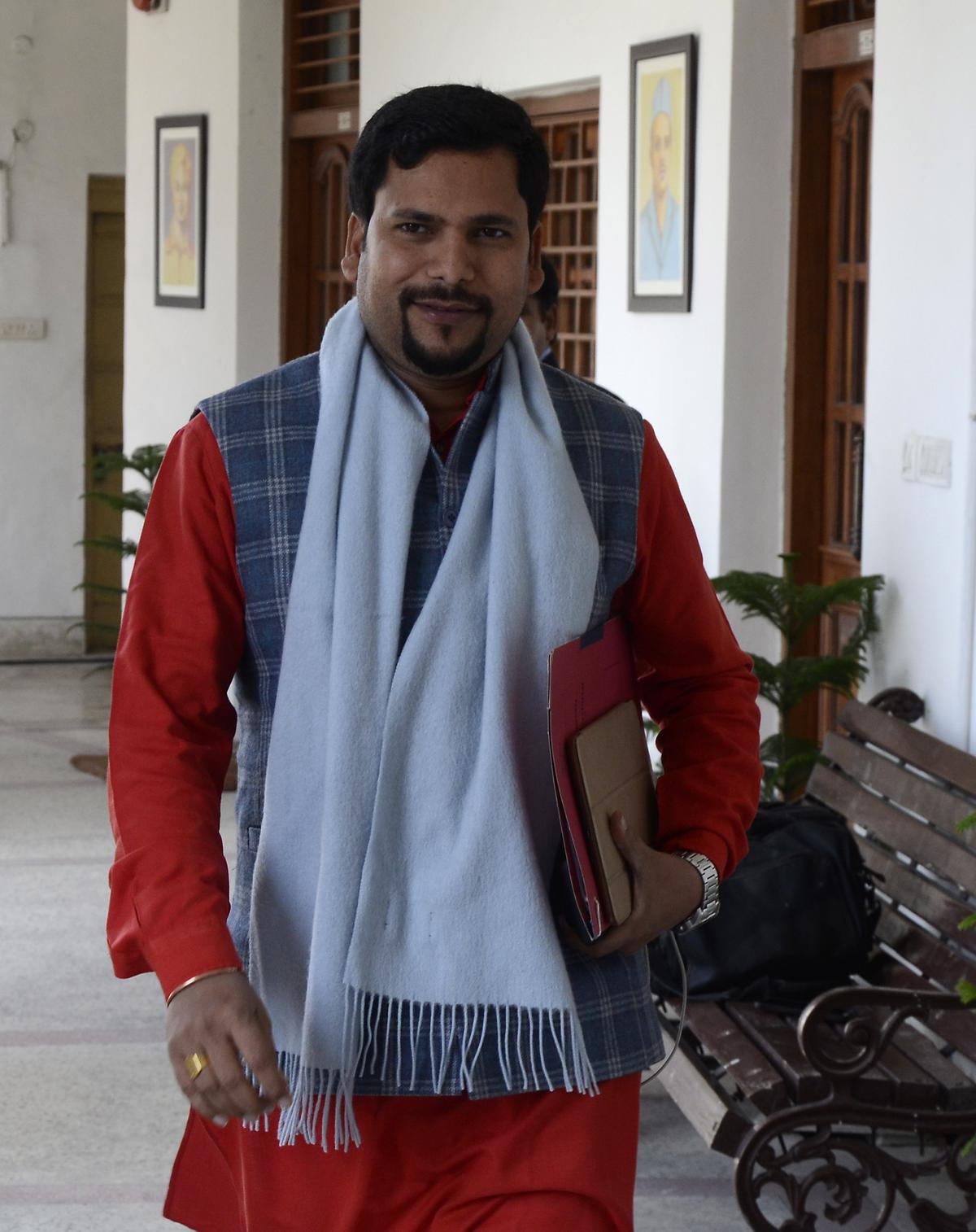
Rajasthan’s Rural Development Minister, Rajendra Singh Gudha, was dismissed by the Congress government in the state after he conceded in the state assembly that they have failed in women’s safety. The ex-minister emphasised that rather than laying blame on Manipur, the government should prioritize ensuring the safety of women, a responsibility it has consistently fallen short of fulfilling.
On Friday, during the debate on the Minimum Income Guarantee Bill in the Legislative Assembly, Gudha accused his own government of failing in women’s safety. In protest against an incident of stripping women in Manipur, Congress legislators raised slogans in the assembly.
In response, Gudha said, “It is true & should be accepted that we have failed in women’s safety. Instead of Manipur, we should look within ourselves that atrocities on women have increased in Rajasthan.”
#WATCH | Rajasthan Minister & Congress leader Rajendra Singh Gudha says, "It is true & should be accepted that we have failed in women's safety. Instead of Manipur, we should look within ourselves that atrocities on women have increased in Rajasthan."
Rajendra Rathore, the Leader of the Opposition, addressed the accusations levelled by Gudha, asserting that the government functions based on collective responsibility, as enshrined in Article 164(2) of the Constitution. He stressed that when a minister speaks, it reflects the unified position of the entire government. Rathore acknowledged the minister’s revelation of the government’s shortcomings and, while commending him for it, he also expressed a sense of shame over the matter.
After his remarks over the abject state of women’s safety in Rajasthan, the decision to remove Rajendra Gudha was taken by the party in consultation with the party high command. Gudha’s “year-long deviation” from the party’s official stance was cited as a reason for his dismissal.
According to sources, the state in-charge, Sukhjinder Singh Randhawa, sent an immediate report to Delhi and discussed the matter with the high command. Chief Minister Gehlot also consulted with the high command. Following the green signal, the file for Gudha’s dismissal was sent to the Governor’s office shortly after his statements in the assembly.
In a major security risk, Kashmiri separatist leader Yasin Malik was physically presented at the Supreme Court today (21st July) for a hearing, even though the apex court did not summon him. Yasin Malik is undergoing a life sentence in Tihar jail after being convicted in a terror funding case, and he appeared at the court in the hearing of an appeal by CBI against a Jammu court order.
A bench of justices, Surya Kant and Dipankar Datta, recused from hearing the matter but noted that there was no such order passed by it asking Yasin Malik to present before it. The court expressed shocked at the presence of Malik in the court.
The top court remarked there are virtual modes available for appearance in the court, and Malik need not be brought to the court physically.
Appearing for Centre, Solicitor General Tushar Mehta, apprised the court that there was no order passed by the top court that Yasin Malik has to be presented before the apex court physically in the matter. Solicitor General Tushar Mehta apprised the top court that the Ministry of Home Affairs has issued a direction that he would not be brought out from jail.
Additional Solicitor General SV Raju called it a serious security issue.
Later in the day, Solicitor General Tushar Mehta wrote a letter to Home Secretary Ajay Bhalla, flagging the issue of security to Malik. Stating that Yasin Malik’s presence in Supreme Court was a serious security lapse raising apprehension that he could have escaped, forcibly taken away or could have been killed, Mehta said, “It is my firm view that this is a serious security lapse. A person with a terrorist and secessionist background like Mr Yasin Malik who is not only a convict in a terror funding case but has known connections with terror organisations in Pakistan could have escaped, could have been forcibly taken away or could have been killed.”
In his letter to Bhalla, Mehta further said that even the security of the Supreme Court also would have been put at serious risk if any untoward incident were to happen.
“In any view of the matter so long as the order under section 268 of CrP Code subsists, jail authorities had no power to bring him out of jail premises nor did they have any reason to do so,” the SG said.
The Solicitor General further said that considering this to be a matter serious enough to once again bring it to your personal notice so that suitable action and steps can be taken at your end.
In the letter, it was mentioned about an order passed by the Ministry of Home Affairs with regard to the said Yasin Malik under section 268 Criminal Code of Procedure which prevents the jail authorities to bring the said convict out of the jail premises for security reasons.
“Everyone was shocked when news was received that the jail authorities are bringing Yasin Malik personally to appear before the Supreme Court as per his desire to appear as party in person,” he said.
The letter also mentioned that the SG had telephonically intimated Home Secretary about this fact, however, by that time Yasin Malik had already reached the precincts of the Supreme Court of India.
Neither the Court had summoned his personal presence nor was any permission taken from any authority of the Supreme Court of India in this regard.
“When I enquired from the officer who was in charge of the security of Mr Yasin Malik in the Supreme Court, the only thing he could show me was a printed notice in a general format of the Supreme Court which is sent with regard to every party to any matter in the Court. The said printed notice informs the recipients of the notice to appear before the Court either in person or through an authorised Advocate,” SG said.
He also said that printed notice in a general format of the Supreme Court is not either the permission of the Supreme Court to bring a convict facing an order under section 268 of CrP Code to come out of jail nor it is requiring mandatory personal presence of the recipient of the order. way or could have been killed.”
It is notable that CBI has filed an appeal against the order of Additional Sessions Judge, Jammu(TADA/POTA) dated September 20 and September 21 issuing a production warrant against him in two different cases.
Jammu Court has sought Malik’s physical appearance for cross-examination of witnesses in relation to the killing of four Indian Air Force (IAF) personnel and abduction of Rubaiya Sayeed, daughter of Mufti Muhammad Sayeed in 1989. However, the top court in the last hearing stayed the Jammu’s court order.
An attempt by a Muslim individual identified as Monjurul Haque to kidnap a minor Hindu girl was thwarted on the evening of 20 July by vigilant residents of Karimganj City in Southern Assam. They managed to free her from the grasp of the accused who tried to take her away on Silchar Road at about 8 pm.
According to a report in the Organiser, she was on her way home from tuition classes when the kidnapper attempted to yank her onto his two-wheeler. Upon being pulled by him, she screamed which notified the locals. Many people in the area stepped forward immediately to save her and caught the offender as well. Following a call to the local police, a team of officials hurried to the location of the incident and arrested him.
At the police station, hundreds of citizens gathered and called for the guilty to receive harsh punishment. A strong force was utilised by the police to get the situation under control. Her family informed her that the culprit had been following their daughter for a while.
A minor Hindu girl was earlier kidnapped and raped by a Muslim guy in the nearby Hailakandi district on 5 July. She passed away in the hospital the next day, on 6 July. A 26-year-old named Zubair Ahmed Talukdar of Bornibridge Grant in Algapur, along with his associates, 21-year-old Jabir Ahmed Barbhuiya and 22- year-old Ansar Uddin Majumder, both locals of Vill Barnee Breese gram, Alagpur, were charged with the abduction and rape of two minor Hindu females when they were en route to their school.
They were taken by the perpetrators to the Noonibali tea garden in the Cachar district. One of the victims, a 13-year-old student was later discovered to be in critical condition by the locals. The Hailakandi police were alerted that Zubair Ahmed escaped the scene after he abandoned her when her medical condition deteriorated.
The neighbourhood people collected and delivered the young girl to her parents at her school. The family members called the police after her health started declining at home. She was rushed to the Hailakandi civic hospital in an emergency, however, the doctors referred her to Silchar Medical College Hospital due to her critical condition. She, unfortunately, succumbed to her injuries there on 5 July.
Hailakandi police apprehended Jabir Ahmed and Ansar Uddin, however, Zubair Ahmed eluded capture for a number of days. He was eventually arrested on the night of 18 July under Section 366/376/302/34 Indian Penal Code and Section 4 of the POCSO (Protection of Children from Sexual Offences) Act.
by the O/C, Algapur PS along with the I/C, Mohanpur PP, and staff.
The Ashok Gehlot-led Congress administration in Rajasthan passed a bill on Thursday, July 20, that forbids individuals from using a family member’s dead body for sit-in protests and stipulates a two-year jail sentence as punishment for violators.
Amid a furor over the lawlessness in Rajasthan, the Ashok Gehlot-led Govt in the state passes the Honour of Dead Body Bill, 2023, which penalizes protests with a dead body.
The Rajasthan Honour of Dead Body Bill-2023, which was introduced on Tuesday, reads that the family members who fail to take possession of a body may be sentenced to up to one year in prison, a fine, or both. Family members who use the body for protest purposes or authorise anyone else to do so may also be sentenced to up to two years in prison and a fine.
Likewise, any political leader who joins or becomes a party to such protests may also face a jail term of 5 years.
The Bill also allows police the authority to seize a body if they have grounds to suspect that it will be used by an illegal assembly or family members as a means of protest.
“Human dignity with which living human being is expected to be treated should also be extended to a person, who is dead and the right to accord decent burial or cremation to the dead body of a person, should be taken to be a part of the right to such dignity.
Since the incidents of remonstration for unjustified demands are increasing in the State and in this matter there are no adequate provisions in the existing law, likewise, to keep a record of unclaimed bodies, protection of genetic data information through DNA profiling and digitization and confidentiality of information are need of the hour,” the bill said.
Additionally, any authorised person who violates the confidentiality of any genetic data will be penalised with a fine and a prison sentence ranging from three to ten years.
Parliamentary Affairs Minister Shanti Dhariwal said the government brought the bill as dead bodies are used to get “unjustified demands” fulfilled and such incidents have been increasing.
“Till now, there was no such act and there was no provision in regard to any other act,” Dhariwal said during a debate on the bill.
The House passed the Rajasthan Honour of Dead Body Bill-2023 by voice vote after the minister’s reply.
BJP slams Rajasthan Congress Govt for the draconian law
Leader of the opposition, Rajendra Rathore, criticised the Gehlot administration and compared the law to the Defence of India Act (DIR) and Maintenance of Internal Security Act (MISA) that were introduced under the state of emergency.
अब राजस्थान में जनता की हक़ की लड़ाई को कुचलने के लिए क्रूर क़ानून बनाये जा रहे हैं।
अगर न्याय के लिए किसी ने शव को सड़क पर रखकर प्रदर्शन किया तो उसे 2 साल की जेल होगी, अगर नेता शामिल हुए तो 5 साल की जेल होगी… अगर शव लेने से परिजन इनकार करते हैं और एक साल की जेल होगी।
BJP leader Amit Malviya also slammed the Ashok Gehlot government for introducing such a draconian law that will stifle the struggle for human rights. “Now cruel laws are being made in Rajasthan to crush the fight for the rights of the people. If someone protests by keeping the dead body on the road for justice, then he will be jailed for 2 years, if the leader joins, then he will be jailed for 5 years… If the family refuses to take the dead body, he will be jailed for one year. The time has come for the ‘last rites’ of the Congress government in Rajasthan,” the BJP leader tweeted.
Banks from 22 countries have opened special Rupee vostro accounts in Indian banks in order to trade in local currency as part of gradual de-dollarisation plans, the Parliament was informed on Friday.
Simply put, vostro accounts enable domestic banks to provide international banking services to clients who have global banking needs. In a written reply in Lok Sabha, Union Minister of State (External Affairs) Rajkumar Ranjan Singh listed out the names of the countries. They include Belarus, Botswana, Fiji, Germany, Guyana, Israel, Kenya, Malaysia, Mauritius, Myanmar, New Zealand, Oman, Russia, Seychelles, Singapore, Sri Lanka, Tanzania, Uganda, Bangladesh, Maldives, Kazakhstan and United Kingdom.
“Government is engaged with Indian trading community including the Small and Medium Enterprises (SMEs) to simplify the administrative procedures to implement this mechanism,” the minister said.
The Reserve Bank of India last year put in place an arrangement, allowing transactions in domestic currencies to promote growth of global trade with emphasis on exports from India and to bring in increasing interest towards rupee.
The internationalisation of the rupee gathered steam following the Reserve Bank of India’s (RBI) announcement of a mechanism to settle payments for international trade in rupees, especially for India’s exports. The RBI allowed invoicing and payments for international trade in Indian Rupee on July 11, 2022.
Experts widely believe if the mechanism fructifies then it may go a long way in internationalizing the Indian currency rupee in the long run.
A currency can be termed “international” if it is widely accepted worldwide as a medium of exchange.
To examine issues related to internationalisation of INR and suggest a way forward, the RBI had constituted an Inter-Departmental Group (IDG) in December 2021.
The panel has recently come up with a report, where it made various short-term and long-term recommendations.
In the short-run, the members of the Group recommended enabling rupee as an additional settlement currency in existing multilateral mechanisms; integrating Indian payment systems with other countries for cross-border transactions; inclusion of G-Secs (or government bonds) in global bond indices; and providing equitable incentives to exporters for rupee trade settlement.
In the long-run, its recommendations included a review of taxes on Masala bonds (Masala bonds are rupee-denominated bonds issued outside India by Indian entities); international use of Real Time Gross Settlement (RTGS) for cross-border trade transactions; examining taxation issues in financial markets to harmonise tax regimes of India and other financial centers; and allowing banking services in rupee outside India through off-shore branches of Indian banks.
Stating India as one of the fastest-growing countries which showed remarkable resilience even in the face of major headwinds, the IDG said it feels that the rupee has the potential to become an internationalised currency.
(This news report is published from a syndicated feed. Except for the headline, the content has not been written or edited by OpIndia staff)
On Thursday, authorities in the Potsdam region, located on the outskirts of Berlin, reported the sighting of a “loose, dangerous animal,” suspected to be an escaped large cat. In response, police have initiated a search operation using helicopters to track what they believe to be a female lion, and they have issued a precautionary advisory for residents to stay indoors during the search.
As per reports, the suspected cat is still at large, more than 24 hours since it was first sighted, causing panic among the residents. As of Friday afternoon (local time), the search operation is still underway to locate the carnivore. The suspected cat was reportedly first sighted on Thursday morning. The authorities issued a warning, asking residents in a region south of the German capital to stay indoors until the whereabouts of the alleged cat is known.
However, later on Friday, after extensive searches on the outskirts of Berlin for a lioness, the officers now hold the belief that the enigmatic animal is, in fact, a wild boar. The search effort involved the use of heat-seeking equipment, yet no evidence supporting the presence of a big cat has been discovered.
The search effort has been bolstered by security forces, who have employed a diverse range of cutting-edge tools, as reported by the German tabloid BILD. These include an armored vehicle, drones, and infrared cameras. In addition, the operation has been strengthened by the involvement of veterinary specialists and seasoned hunters, all working together to track down the elusive animal.
With the aim of expediting the search process and ensuring thorough coverage of large areas, the police have incorporated the use of drones. This approach helps bypass the time-consuming task of manually combing through forested regions on foot, enabling them to survey extensive areas more efficiently.
As of Thursday evening, approximately 220 officers were actively searching the wooded areas near the municipalities of Kleinmachnow, Teltow, and Stahnsdorf, situated at the southern periphery of Berlin. The operation is set to continue throughout the night, aided by night vision devices to enhance visibility in the dark.
A police spokesperson asserted their commitment to the search, stating that they would persevere until the animal is located. Late on Thursday, they issued renewed warnings, urging people to steer clear of forested areas around the southern edges of Berlin.
The search efforts are set to carry on the following day, with an intensified focus on Friday. Professional animal trackers are extensively scouring the forested regions to increase the chances of finding the elusive creature.
Earlier, residents in the area received cautionary messages through warning apps, advising them on various safety measures. Specifically, they were urged not to venture into the woods for walks and to immediately seek shelter in their houses or vehicles if they happen to spot the animal.
Officers have been utilizing loudspeakers to issue warnings to residents in the regions of Kleinmachnow, Teltow, and Stahnsdorf.
The city of Kolhapur in Maharashtra is known for its rich cultural heritage, the glory of the Hindu temples and old forts built by Chhatrapati Shivaji Maharaj. The city is home to several Hindu temples like the ancient Mahalakshmi Temple and the hilltop Jyotiba Temple complex which attracts a large number of devotees to date. But some of the areas in the city like the Pavangad and Panhalgad, despite of having significant historic importance are usually left ignored, therefore attracting ‘illegal’ encroachment and invasion by the non-Hindu community.
In one such major incident, the local Hindu community residing in the Panhalgad town of the city have complained that a Madarsa has been ‘illegally’ built on the fort of Pavangad which was built by Chhatrapati Shivaji Maharaj in the year 1673. The Madarsa named the “Madarsa Arbiya Zinatul-Quran” has been established on the government land and is said to have been registered under the Societies Registration Act, 1860.
Madarsa Arbiya Zinatul- Quran (Image obtained by OpIndia)
The students in the Madarsa are not local. They hail from various regions of Delhi, Bihar and West Bengal. “The Madarsa on the historic fort of Pavangad is illegal and the students studying here are not from Maharashtra. The historic significance of the fort is being maligned by such illegal encroachments. Many Muslims have also constructed their residences on the fort. We demand strict action against such illegal encroachments and also demand removal of these structures to maintain the sanctity of the historic fort,” the letter by Bajrang Dal to the District and the State Administration read.
Letter submitted by Bajrang Dal in January this year (OpIndia)
Accordingly, the District Administration has taken cognizance of the incident and has confirmed that the land on which the Madarsa Arbiya Zinatul-Quran is built belongs to the government. “It is govt wasteland (mulki pad jameen) which falls under the government’s control. We have begun the probe in the case. Action will be taken against any kind of illegality if any,” Panhalgad Tehsildar Manavi Shinde said while talking exclusively to OpIndia.
History of Pavangad and the Hindu Temples
The fort of Pavangad is said to have been built by Chhatrapati Shivaji Maharaj in the year 1673 alongside the main fort area of Panhalgad. In the later years, the fort was invaded by the Britishers. The fort built by the Chhatrapati to protect the main Panhalgad fort had three steep rock entrances two of which were destroyed by the Britishers after the invasion in the year 1844. The fort of Panhalgad was also dismantled. Today the said land falls under the government’s control.
A short ravine isolates Pavangad fort from the Panhala fort which has now become a home town to around 3,121 people (2021 census). As of today, the estimated population of the Panhala town is around 4,200.
The chief defence of the fort is a scarped rock fifteen to twenty-five feet high. It also is an attraction to see several ancient Hindu temples beautifully carved in the rocks that still exist on the Pavangad fort and people from the Hindu community visit these temples like the Shiv Mandir, Hanuman Mandir, Narsimha Mandir and Lakshmi mandir from time to time to worship the deities.
Ancient Hindu temple of lord Shiva on Pavangad
Recently in the month of February, the Hindu community members organized the holy event on the occasion of Mahashivratri in the old Shiva temple on Pavangad. Notably, this temple is super close to the Madarsa in question, only at the distance of around 45-50 meters. The Hindu community members talked to OpIndia and said that the event was organized under police protection to avoid any trouble.
Madarsa houses 40 minors, all from Delhi, Bihar and West Bengal
Team OpIndia visited the Pavangad fort to confirm that several residents living in the area belong to the Muslim community and that they have built houses surrounding the ancient Hindu temple of Lord Shiva. A mosque has also been established at the old southern gate of the fort. As per the Hindu community members, the mosque is also an encroachment and has been built on the ancient cave of Hindu sage Rishi Markandeya.
On talking to the operators of the Madarsa on July 20, it was revealed that the Madarsa has been registered under the Societies Registration Act, 1860 but has been built on government land (mulki pad jameen). However, the authorities at the Madarsa refuted the allegation of it being built on government land. “This is a registered Madarsa and it’s not at all illegal. It does not encroach on the govt land and is very old. We have been running this for more than 50 years now,” claimed the Madarsa authority.
Image of the Maradsa obtained by OpIndia
The team also communicated to Yusuf Mujawar and brother Dawood of the Madarsa who said that the Madarsa had been registered in the year 1979 and that it has been on the Pavangad since then. On asking about the other details, it was discovered that the Madarsa houses around 40 minor children and none of them are from Kolhapur or Maharashtra. All the minor students studying in the Madarsa Arbiya Zinatul-Quran are from Delhi, Bihar or West Bengal.
Teachers at Madarsa teach Arab, Quran and no other course or language
As per the sources, the students here are taught the Islamic way of life and only the Arab language. No other language like Hindi, English, not even the local language Marathi is taught to them. “Around 40 students stay here. Some big people associated with the Madarsa help us with the resources. Three teachers teach here. All of them are from outside the state. The students studying here are Yatims (orphans) and we are just helping them with basic needs,” Yusuf Mujawar said.
On inquiring about the registration of the Madarsa, he said that it was yet to be done and was delayed due to their father’s death. However, his brother Dawood asserted that the Madarsa was registered under the Education department and that it has been built on a valid piece of land. “Nothing is illegal here. We are doing a good service,” Dawood was quoted as saying.
Meanwhile, the team on the ground was made to sit inside the Madarsa office where the certificate of registration of the Madarsa was shown. As per the document, the said Madarsa has been registered as society under the Societies Registration Act, 1860 in the year 1979.
Students of Madarsa say we get good food, taught Arabic only
One of the workers at the Madarsa was also questioned about the well-being of the children studying at the ‘institution’. When asked whether permission of respective parents is obtained before bringing the minors here for education, the worker claimed that all the children have been brought here only after valid permission from the parents. Notably, Yusuf earlier had said that the Madarsa is engaged in imparting education to Yatims (orphans).
OpIndia also obtained a video of students studying in the Madarsa where they confirmed that they were taught Arabic only and no other language. They also confirmed that none of the students in the Madarsa are from Maharashtra. “All are either from Bihar, West Bengal or Maharashtra,” they could be heard saying.
Kolhapur Police takes cognizance, says probe underway to know if its illegal
The Kolhapur Police is said to have taken cognizance of the incident and has directed the Panhala Police to look into the matter immediately. “In this regard, Panhala Police Station has been informed to take appropriate action,” the tweet by Kolhapur Police read on July 17.
Kolhapur Police on July 20 was also approached for comment on the issue. Officer Ganesh Patil who is looking into the case was not available for comment. However, the team was informed that the investigation in the case is underway.
Screenshot of tweet by Kolhapur Police
“The incident has recently come to the fore. Some of the members on social media are posting that the Madarsa is illegal. But this is yet to be proven. The city police has directed investigaon into the case and it is underway. The land has been measured at present and the illegality will be proven only after the reports are attained,” Kolhapur Police said.
Tahsildar confirms govt land, says land measured, awaiting TLR report
OpIndia also talked to Tahsildar Manavi Shinde in the given case. “The case was brought to our notice on July 17. The office immediately measured the land and the reports are still not out. If any illegality is proven, action will be taken. But the situation will only be clear once the report from the Taluka President Land Records is obtained,” Shinde added.
She also added that the Muslim population residing on the Pavangad is civic and that there never has been any issue from their side. “Even when we inquired on July 17, the Madarsa members submissively co-operated with us and said that they would remove or hand over the land if any illegality is proven,” she added.
However, the officer also confirmed that the land on which the Madarsa has been built is a govt wasteland (mulki pad jameen) and that it falls under the control of the government.
Tahsildar Office, Panhala
Who gave them the permission; clear case of Land Jihad : Bajrang Dal
Speaking exclusively to OpIndia, Bajrang Dal District President Suresh Rokade pressed that any illegal encroachment on the historic fort of Pavangad should be taken down. “This is clear case of Land Jihad. Pavangad and Panhalgad are historic forts representing the glory of Chhatrapati Shivaji Maharaj. Who gave these people permission to establish a Madarsa here is a big question. The Madarsa is built on the mulki pad jameen of survey no. 128 which falls under the government control. The madarsa is not legally built,” Rokade said.
“We had given the letter demanding removal of such illegal encroachment in January this year but no action has been taken by the department in this case. We tried to follow up twice over the case but we were told that the investigation in the case is underway. The Hindu temple here is on the forest department’s land and the Madarsa is close to it on the mulki pad jameen. Around 40 students study here and none are from Maharashtra,” he confirmed.
He also opined that there should be no Madarsa on the historic fort. “No Madarsa is there on any historic fort. This is probably the first of its kind encroachment. Just clear case of Land jihad,” he said.
Houses made of roofing sheets denied permission on Pavangad
Notably, while on the Pavangad fort, team OpIndia observed that there are several Muslim residents staying in the homes that are constructed using roofing sheets. However, no information regarding the official permission given to them to built such residences could be obtained.
Recently, one such under construction house at the south gate of the Pavangad fort was asked to be taken down by the Panhalgad Municipal Corporation given the hazardous location close to the steep valley, as informed to OpIndia by the local Hindu group. “This property is near the south gate of the fort. The government didn’t allow them to build a house here. But there is a dargah on the edge of the south gate. Muslims have also made changes to the old fort secret roads. This is unacceptable,” Rokade indicated.
Dargah on the edge of the South gate of Pavangad (R); roofing sheet house denied permission (L)
Conclusion
The Madarsa in question, Madarsa Arbiya Zinatul-Quran is registered but is built and expanded using the roofing sheets on the land that falls under the control of the government. Several contradictory statements were obtained from the Madarsa operators. While one of the Madarsa authorities said that the students studying at the ‘institution’ were Yatims (orphans), other one said that the permission of the parents were obtained before bringing the minors here for education. One of the authorities also said that the Madarsa was registered under the Education’s department however the other one said that the registration was yet to be done and it was delayed due to their father’s death.
However, it was learnt that the Madarsa is registered under the Societies Registration Act, 1860 and is built on the Mulki Pad Jameen which falls under the government’s control.
Further, who gave the Madarsa authorities permission to built an ‘institution’ on the government land is unclear as the Madarsa was just in possession of the Society’s Registration Certificate which has been obtained by OpIndia. The matter would have been much clear if any document regarding the ownership of the land could be obtained from the Madarsa authorities. But later it was confirmed from the Tahsildar office that the land on which the Madarsa has been built belongs to the government and that it is a mulki pad jameen.
The legality of the Madarsa remains in question until the arrival of the Taluka President Land Records (TLR) report sought by the Tahsildar. However, the Tahsildar and the Police have confirmed that the land on which the Madarsa is built is a government land and that strict action will be taken ‘if any’ illegality is found.
Also, the operators of Madarsa have stated that they would remove the Madarsa and submissively hand over the land if any illegality is proven, as informed to OpIndia by the Tahsildar.
Similar reports reported in the past
Earlier, a similar incident was reported from the city of Nashik, where a local Hindu group had objected to the presence of ‘Sayyed Shah Vali Baba Dargah’ in the premises of an 18th-century-old historical monument that once served as the administrative headquarters of the Peshwas, the Sarkarwada.
Rushikesh Dapse (Bapu), a social activist associated with a local Hindu organization, had claimed that the Dargah in the Sarkarwada, which was once home to Peshwas, is an ‘illegal encroachment’ and that it shall be removed as it represents the wrong history of the Peshwas.
Also, an illegal Mazar had surfaced at the Mahim coast area in Mumbai, Maharashtra. The Brihanmumbai Municipal Corporation on March 23 employed bulldozers to demolish the illegal construction around the Mazar. This is after Maharashtra Navnirman Sena (MNS) chief Raj Thackeray played a clip in his Gudi Padwa address and exposed that an ‘illegal dargah’ has come up off the Mahim coast in Mumbai. He demanded the removal of the illegal dargah and said that if it is not demolished immediately, then his party would construct a huge Ganpati temple at the same place.
Illegal structures had also been built inside the Pratapgarh Fort where Chhatrapati Shivaji Maharaj had killed Afzal Khan. The old grave has been over the years converted into a religious shrine by Islamic groups. Despite orders by the Bombay High Court, the Maharashtra government was hesitant to remove the illegal structures inside the important historical monument.
In November 2022, the Shinde government finally sent police and local administration to remove the illegal structures around the grave.
NOTE: Required documents, audio and video recordings related to the case are in possession of OpIndia.
While the scars of the Islamist violence that took place on the day of Hanuman Jayanti in Jahangirpuri, Delhi last year have not yet faded away, yet another similar incident was reported from the area late on Thursday (July 20) night. A Hindu hawker named Ram Vilas was mercilessly murdered by an Islamist mob in Jahangirpuri’s C Block area. Besides, stones were also pelted in the area in which some others were also left injured.
Incidentally, Jahangirpuri’s C Block area, where yesterday’s incident took place, is the same block where Islamists had unleashed terror during the Hanuman Jayanti procession last year.
When the police learned about the communal clash that occurred late on Thursday night, a large number of officers was dispatched to the area to ensure that the situation does not worsen considering that the Jahangirpuri neighbourhood of Delhi is thought to be a communally sensitive area, particularly in light of the widespread communal violence that broke out last year.
Ram Vilas, a street vendor, reportedly got into a small altercation with some local Muslims over where to place his onion cart on the street, and they ended up viciously beating him till he died. According to reports, the Muslim youths ordered Ram Vilas to remove his onion cart from the street corner where he had set it up to do his business that evening. When he refused to comply with their demands, the Muslim youths started beating him up. The accused were soon joined by other people from their community, who also began to viciously assault Ram Vilas.
The victim’s wife, who was with him when he was assaulted, kept pleading for mercy, but the enraged Muslim youths kept hitting Ram Vilas until he started bleeding profusely. Within no time, Ram Vilas collapsed and fell to the ground. The assaulters fled the spot leaving Ram Vilas in a pool of blood.
Some local Hindus picked him up and rushed him to Babu Jagjivan Ram Hospital, but here the doctors declared him brought dead.
Media reports suggest that prior to assaulting Ram Vilas, these Muslim youths had gotten into a brawl with some members of the Hindu community. The brawl soon turned into a full-fledged communal attack with stones being pelted from both sides. Several people were left injured in this incident.
According to the authorities, it all began when some Muslim youths got into a fight with a Hindu resident named Sanjay when they were raising money for a Tazia procession. The Muslim youths began hitting Sanjay as the argument got heated. Some Hindu youngsters rushed to Sanjay’s defence after spotting the Muslim youths attacking him. Within no time, the Muslim youths were also joined by several other people of their community.
Soon after coming face to face, members of the Muslim and Hindu communities began throwing stones at one another, and the incident which started with a small altercation culminated into a full-fledged communal fight. The incident left many hurt.
Reportedly, it was after this incident, that a group of infuriated Muslim youths approached Ram Vilas and killed him after he refused to give in to their demands.
The deceased’s Ram Vilas’ inconsolable wife told the media how her innocent husband, who was simply selling onions on one corner of the street fell prey to the Islamist rage on the fateful night of Thursday (July 20).
जहांगीर पूरी में बांग्लादेसी घुसपैठियों का आतंक हिंदू राम की पीट पीट कर हत्या।
— Sagar Kumar “Sudarshan News” (@KumaarSaagar) July 21, 2023
The spine-chilling incident that occurred last night in North Delhi’s Jahangirpuri area, brings back memories of the vicious attack Islamists had unleashed on Hindu Devotees taking out the Shobha Yatra during last year’s Hanuman Jayanti.
The attack on Hanuman Jayanti Shobha Yatra in Jahangirpuri
When the Hanuman Jayanti Shobhayatra was passing through the C block of the Jahangiurpuri, suddenly some people pelted stones on the process from the rooftops in the area. After the attack, the people in the process also started pelting stones at the attackers in retaliation and triggering communal violence in the process.
Several people and police personnel were injured. The police had arrested 40 accused in the case. The Delhi police filed a 2,063-page chargesheet in the case, that stated that the riots were pre-planned. It said that the main conspirators — Mohd. Ansar, 35, Tabrez, 40 and Ishrafil, 50 — “controlled and coordinated the pre-planned conspiracy to orchestrate the riot” and also exerted influence over youths by “radicalising” them to take part in the violence.
Jahangirpuri a hub of rapes, and illegal activities; Rohingyas and Bangladeshis responsible for all crimes here: What locals told OpIndia
OpIndia then talked to locals regarding the violence. H Block resident Dinesh told OpIndia that such incidents were not new for Jahangirpuri.
He said there had been several major incidents in the area that were not even discussed in the media. He told how young boys are seen harassing women. He claimed several Hindu women have been raped in the area and when they try to file a complaint, the Police start harassing them. He further claimed a woman in Jahagirpuri was raped for 15 days some time ago.
He termed the stone-pelting incident on Hindu devotees a conspiracy and said Police personnel have been beaten up several times in Jahangirpuri.
He added small children carry knives and commit crimes in the area. There was an incident where a boy forcefully married a Hindu girl at knifepoint and raped her. He said they have no hopes from the Police and demanded appropriate action against the culprits.
Apart from Dinesh, some local owners of small businesses who were also attacked by the mob of Muslims in this area held the Rohingyas and Bangladeshi Muslims responsible for the crimes that took place in the area. In a video shared by Pradeep Bhandari on Twitter, a local owner of a small shop is seen informing about the atrocities caused by the rioters to the small businesses there.
The shop owner said that they are facing atrocities by the Rohingyas just because they are Hindus.
The communal violence that took place in Jahangirpuri last year brought to light how the neighbourhood has developed over time into a hotspot for illegal immigration, criminal activities, demographic upheaval, and radicalization.
Fact-finding report on Jahangirpuri violence
In fact, a fact-finding report on the Jahangirpuri communal violence had called the area a ‘ticking bomb’ of illegal immigrants, radicalisation, demographic stress and illegal encroachments. The fact-finding was undertaken by the Group of Intellectuals and Academicians (GIA).
The report further warned that the area in Jahangirpuri is a crime-prone area due to thriving encroachment and illegal trade. Despite repeated complaints from local people, the local police (in the area) have turned a blind eye to such acts. This is a no-go zone for women. Crimes such as chain and handbag snatching are fairly widespread. People are hesitant to go out after dark.
It read that the local residents reported a major surge of illegal Bangladeshi immigrants in the area, who have illegally settled here over the course of several years.
On Monday (July 21), BJP national spokesperson Amit Malviya informed that a woman candidate of his party was groped and assaulted by workers of the ruling Trinamool Congress (TMC) government in West Bengal.
He had shared the screenshot of an online police complaint, filed by the victim wherein she accused two TMC workers, namely Arun Thakur and Shuvankar Malik of sexually assaulting her.
The complaint filed with the Domjur police stated, “This said persons touched the secret part of my body throughout the counting and as well beat me during the counting.”
Another complaint filed by a woman candidate of BJP, in Howrah’s Domjur… She was groped and assaulted, by TMC candidate and his agents, inside the counting center on 11th Jul 2023. Mamata Banerjee’s police is still to file an FIR. These are not isolated instances of crimes… pic.twitter.com/EL27FlYY6j
“As per the guideline of respected High Court a male was not supposed to touch a female, but this said persons continuously beaten me and touched the secret parts of my body which is against law and order,” it added.
The victim said that the assault was orchestrated by TMC Block (Jagatballavpur) President Subir Chatterjee and Dibyendu Chatterjee, TMC President for Makardah-1 Anchal. She also requested to police to analyse the CCTV footage of Room No 2 and Table No 9 (Round 1) in the Domjur counting hall.
“This is also to inform you that we have requested many times verbally to Domjur BDO Gargi Das but she has not taken any satisfactory action against this. Hope you will take necessary action against the said person and will continue with your legal steps against this said persons to save the democracy of India,” the BJP candidate said in her complaint.
BJP candidate stripped, paraded naked in Howrah
On Thursday (July 20), a BJP gram sabha candidate in West Bengal informed that she was physically assaulted, stripped and paraded naked by workers of the ruling Trinamool Congress (TMC) party during the panchayat elections.
As per a report by ANI, the incident took place on July 8, 2023, in Dakshin Panchla in the Howrah district of West Bengal. In her official complaint filed with the Panchla police, the victim narrated that the assault was carried out by TMC gram sabha candidate Hemanta Roy at the polling station.
She further added that Roy was accompanied by other 40-50 TMC workers, including Noor Alam, Sanju Das, Ranabir Panja, Sukamal Panja, Alfi Sk. The copy of the First Information Report (FIR), as reported by Republic TV, read, “They hit me on my chest, and head with sticks and pushed me out of the polling booth.”
The victim pointed out that the TMC gram sabha candidate instigated party workers such as Sukamal Panja and Ali Sheikh to tear her saree and inner dress. “They further assaulted me and forced me to undress naked and molested me in front of other people,” she emphasised.
The Supreme Court on Friday declined a PIL seeking to revoke the CBFC certificate of the film ‘Adipurush’ for public exhibition for allegedly hurting religious sentiments.
A bench headed by Justice Sanjay Kishan Kaul said that these are not matters for this court to hear and sit in appeal of certification. Justice Kaul remarked, “Why should we interfere under Article 32? Everybody is now touchy on everything. Should we scrutinise everything? Tolerance for films, books these days is going down.”
Dismissing the plea, the bench said, the apex court should not become some kind of appellant authority for such matters. “We may hold here that cinematographic depictions play with the original material, to what extent it is permissible a body is there. It is not possible for this court to interfere for each person’s sensibilities under Article 32. These are not matters for this court to hear and sit in appeal of certification. If anyone is aggrieved by the decision of appellate authority they can pursue remedies under law,” it added.
The top court was hearing a PIL filed by lawyer Mamta Rani seeking direction to revoke the certificate of the film ‘Adipurush’. The plea said that exhibition of Om Raut’s ‘Adipurush’ hurt the sentiments of Hindus and devotees of various deities depicted in the movie by “destroying their fundamental values and characters” and modifying the basic structure of Valmiki Ramayana.
The plea filed through advocates Shailendra Mani Tripathi, Ratnesh Kumar Shukla and Akash Awana sought direction “to protect and preserve all the religious manuscripts and texts in their original form at all platforms and prohibit distortion of the above-said texts/manuscripts by anyone.”
The plea also strongly objected to some dialogues in the movie, saying that only ‘gully boys’ use such ‘derogatory’ language.
“The sacred fundamental texts and manuscripts are the basic spiritual and physical tenets of a cultured and civilised society which a common man of such a society relies (on) and lives (by). A man becomes an orphan like a fallen leave from the branch of a tree without his culture and traditions,” the petitioner has stated.
It added, “Besides this, the depiction of the physical features and communication styles of Hindu gods – Rama and Hanuman – are complete distortions of not only the characters but also the very fundamental values for which they are worshipped”.
The petitioner expressed the apprehension that such a depiction would influence the general public into believing in “different value and morals”.
It further alleged that the depiction of Sita is “inappropriate and vulgar”.
The petitioner has contended that ‘Adipurush’ is a mockery of Valmiki Ramayana, which has been fuelled by personal commercial gain.
“The whole story of the film has destroyed and modified every aspect of the core values of the characters, their language and each authentic event,” it stated. The movie, which draws inspiration from the revered Hindu epic Ramayana, faced heavy criticism post-release. The film stars Prabhas as Lord Ram, Kriti as Goddess Sita, Sunny Singh as Laxman, and Saif Ali Khan as Ravana, the mythical hydra-headed demon king in the epic.
(This news report is published from a syndicated feed. Except for the headline, the content has not been written or edited by OpIndia staff)