On Friday, 4th August 2023, the National Investigation Agency (NIA) arrested a Trinamool Congress worker named Islam Chowdhury in connection with the case involving the illegal consignment of explosive materials. According to the probe agency, Islam Chowdhury played a crucial role as a key conspirator and facilitator in the supply of explosives in the 2022 incident.
Islam Chowdhury was arrested after the NIA conducted a raid in West Bengal’s Birbhum district. The raid was based on information obtained from another arrested TMC leader, Manoj Ghosh. Manoj Ghosh had won during the recently-concluded panchayat elections in the state. Ghosh was arrested by the NIA for possessing illegal explosive materials and firearms in his godown.
According to a spokesperson of the NIA, during the raid in Birbhum, the agency seized Rs 1.50 lakh in cash, bank transaction documents, paper slips with mobile numbers, SIM cards, three mobile phones, and incriminating documents. In a statement, the NIA revealed that the arrest of Islam Chowdhary was a result of the interrogation of two other accused individuals, Merajuddin Ali Khan and Mir Md Nuruzzaman. They had been nabbed earlier by the NIA.
According to the NIA, its investigations have unveiled the significant involvement of Islam Chowdhary as a conspirator and facilitator in the supply of explosives in the case. The agency registered the case in September 2022, after the seizure of a substantial cache of electric detonators and explosives.
In the Md Bazar Police Station area of Birbhum, a team of the Special Task Force (STF), West Bengal, conducted a raid and initially seized around 81,000 electric detonators from a vehicle, leading to the arrest of the driver, Ashish Keora. Following this operation, subsequent searches were carried out, uncovering an additional 2,525 electric detonators, 27,000 kg of ammonium nitrate, and 1,625 kg of gelatin sticks. Among the findings were also one pistol with a magazine and 4 live rounds of ammunition, 16.25 kg of gelatin sticks (totalling 130), and a bag containing 50 kg of ammonium nitrate from illegal godowns. As a result of these searches, law enforcement apprehended additional suspects. The NIA continues its ongoing investigation into the case.
Earlier in the day, OpIndia accessed the FIR filed in the brutal killing of Bajrang Dal activist Pradeep Kumar. Kumar was the third Hindu who fell prey to Islamist violence that convulsed Haryana on July 31 following an attack on a Hindu precession in the Nuh district.
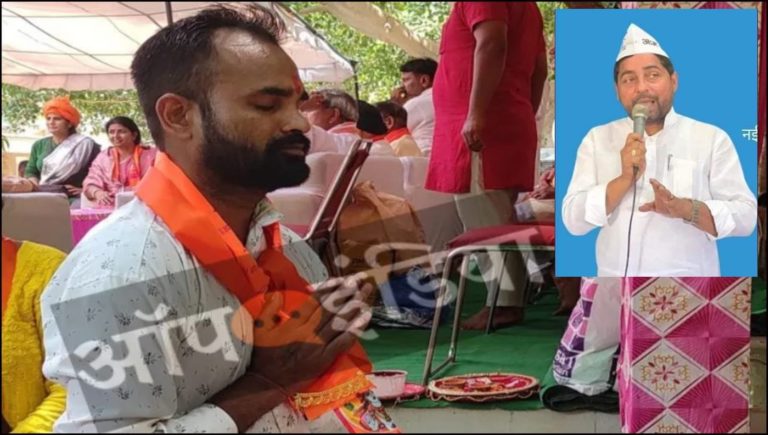
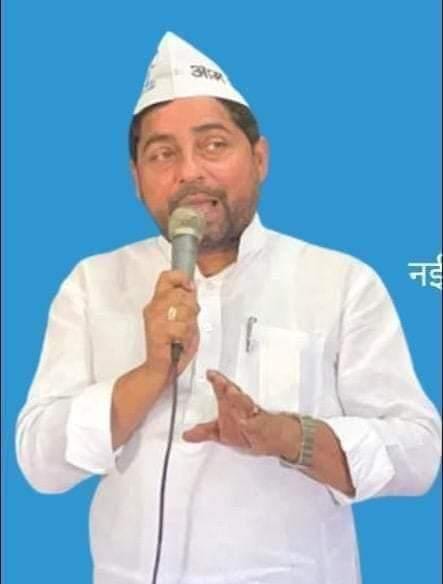
The FIR was filed by Pawan Kumar, another Bajrang Dal activist who was accompanying Pradeep Kumar when he was attacked and killed. Pawan Kumar, in his complaint named one Javed Ahmed as the prime accused. OpIndia in its report gave ample evidence to prove that the accused Javed Ahmed is a leader of the Aam Aadmi Party.
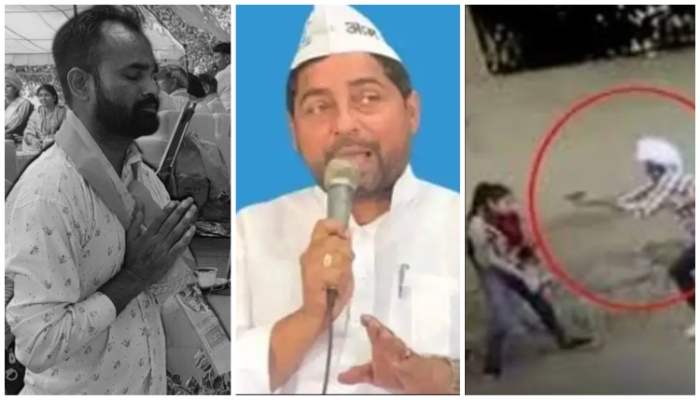
Now, according to new details that have emerged in the case, Javed Ahmed, the AAP leader, also has links with Tauseef, the prime accused in the Nikita Tomar murder case. Javed Ahmed isthe uncle of Tauseef alias Sajeed, who was caught on camera shooting Nikita Tomar.
It may be recalled that in October 2020, a 21-year-old student named Nikita Tomar was shot dead in full public view by two men outside the Aggarwal College in Ballabgarh, Faridabad. The brutal murder made national headlines after CCTV footage of the murder emerged. The family of Nikita Tomar had alleged that Tauseef was forcing her to convert to Islam and marry him.
The accused had allegedly started hounding her and pressuring her to embrace Islam. The relative confirmed that the accused initially wanted to abduct her but killed her when she resisted his demands.
As the investigation into the case progressed, details of Tauseef’s political connections came to the fore.
OpIndia had then, in one of its reports on Nikita Tomar’s murder case detailed how Tauseef’s uncle Javed Ahmed had out rightly denied the allegations of Love Jihad and said that there was no angle of religious conversion in the matter. That time, Javed Ahmed had contested the election from Sohna on Bahujan Samaj Party’s ticket.
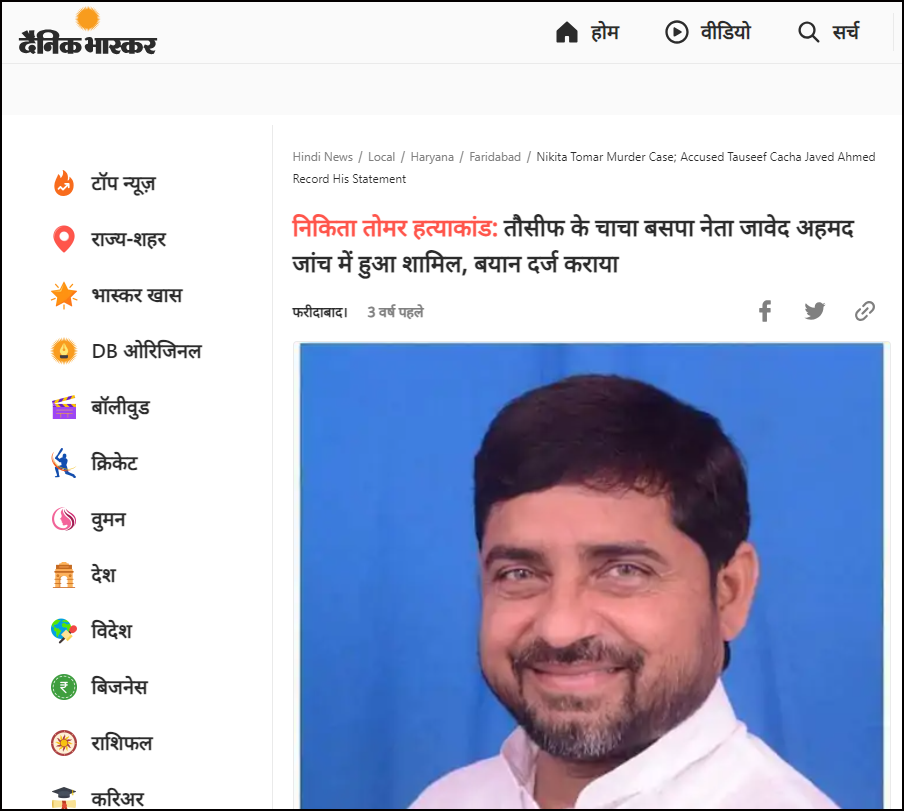
In fact, a report published by Dainik Bhaskar in the year 2020, when the Nikita Tomar murder happened, also identified Javed Ahmed, who was then a Bahujan Samaj Party leader, as Tauseef’s uncle. The report shared the picture of Javed Ahmed and carried the headline in Hindi, which roughly translated to “Nikita Tomar murder: Tauseef’s uncle BSP leader Javed Ahmed joins investigation, records statement.”
Screenshot of the Dainik Bhaskar report published in 2020, soon after the murder of Nikita Tomar
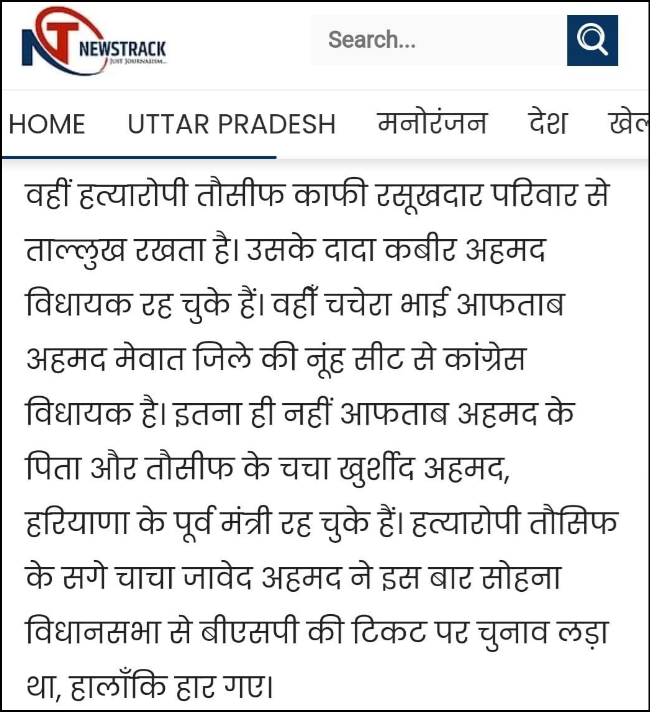
Another report published by Newstrack also identified Javed Ahmed as Tauseef’s uncle. Since he was associated with the Bahujan Samaj Party then (in 2020), these reports mention him as a BSP leader.
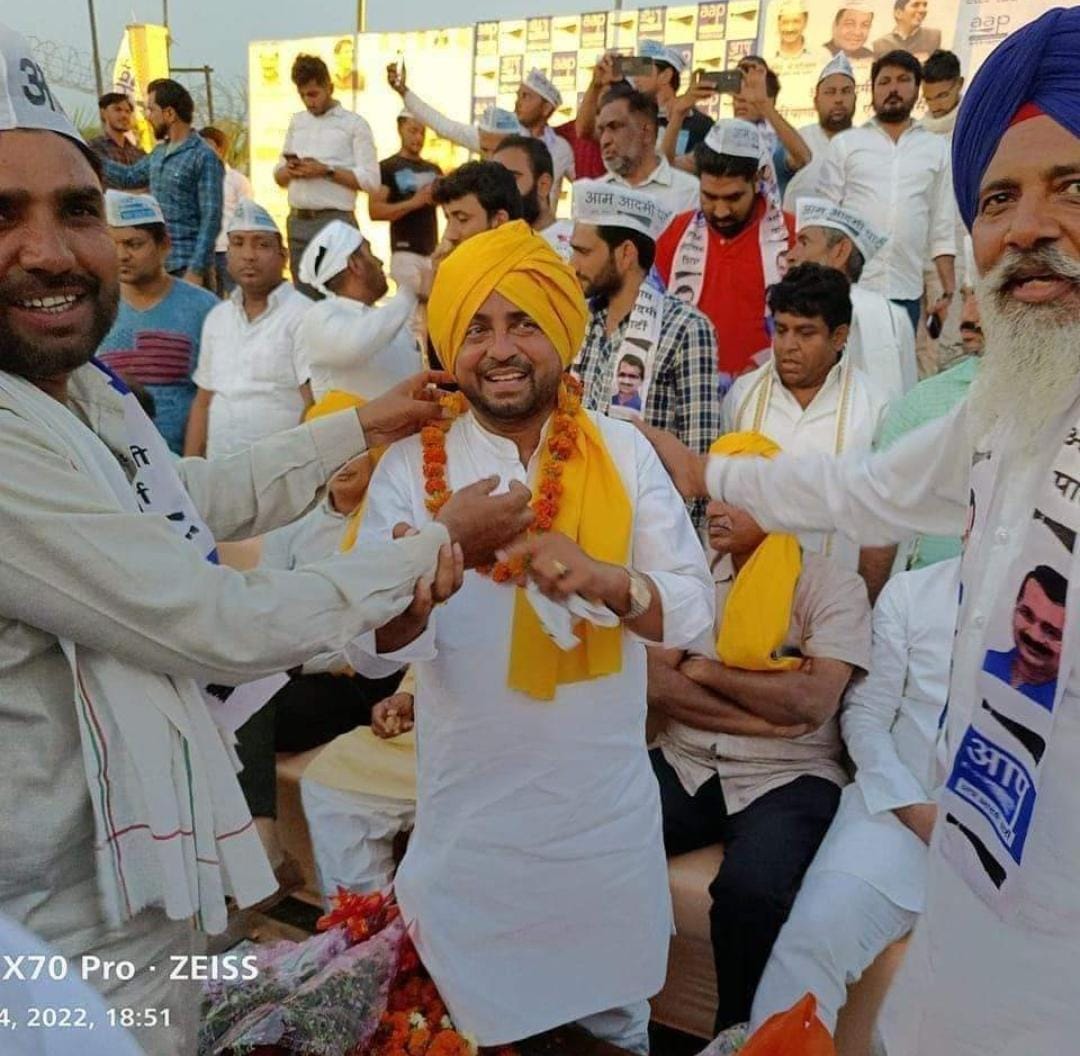
On March 14, 2022, however, Javed Ahmed who was previously Sohna assembly’s BSP candidate joined AAP during an event held at the Aam Aadmi Party (AAP) headquarters in Delhi.
हरियाणा से कई नेता आम आदमी पार्टी में हुए शामिल।
समालखा से पूर्व निर्दलीय विधायक रविंद्र मछरौली आम आदमी पार्टी में हुए शामिल।
सोहना से BSP से चुनाव लड़ 40,000 वोट लेने वाले जावेद अहमद आम आदमी पार्टी में हुए शामिल। pic.twitter.com/CcRKmbJNNy
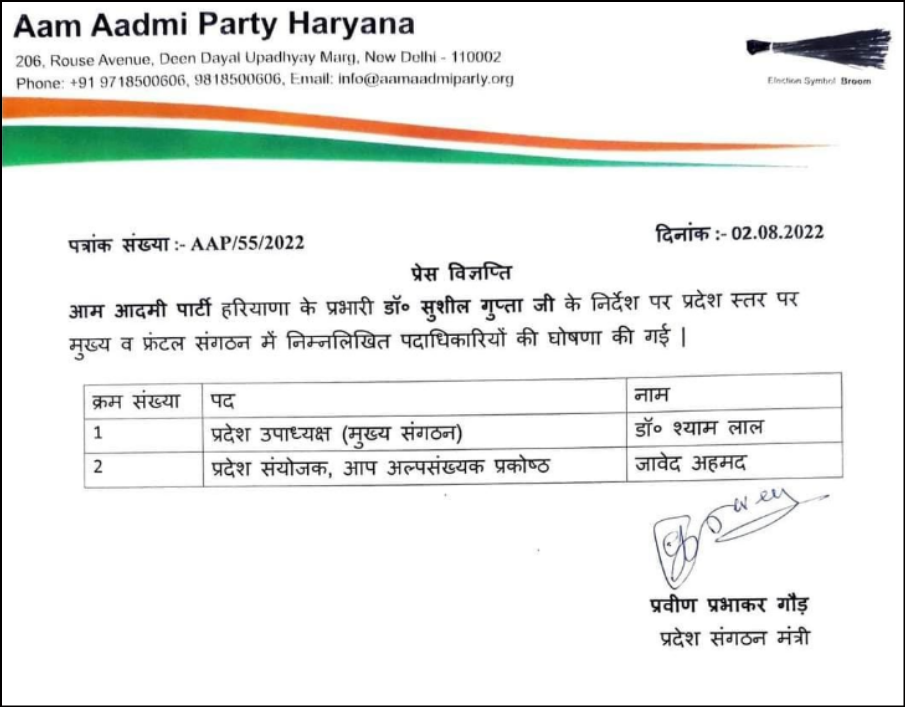
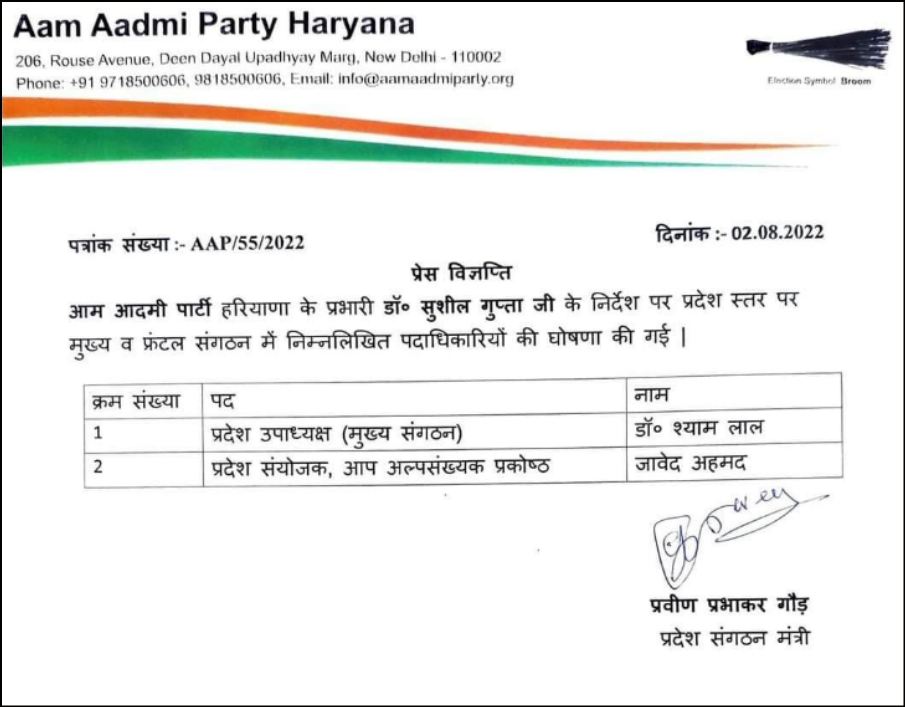
While searching, OpIndia also came across a press note released by the Aam Aadmi Party, Haryana unit on August 2, 2022, which announced Javed Ahmed’s appointment as the state coordinator of AAP’s minority cell.
AAP leader Javed Ahmed’s link with Nikita Tomar’s murder accused Tauseef and the Congress connection
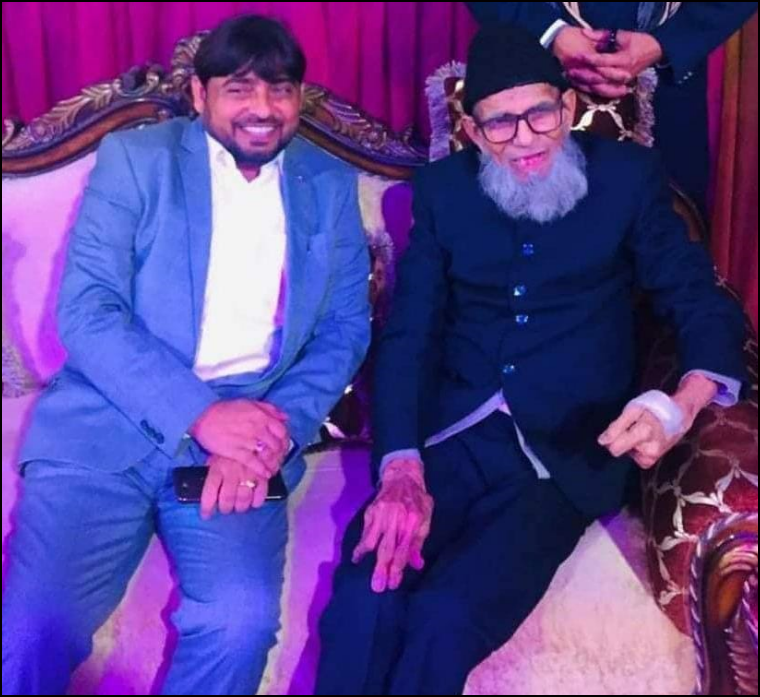
Interestingly, OpIndia also accessed a photo where AAP leader Javed Ahmed is seen sitting with his brother and Congress leader Zakir Hussain.
AAP leader Javed Ahmed with brother and Congress leader Zakir Hussain
It may be noted here that while covering the Nikita Tomar murder case, OpIndia had detailed how Tauseef, the prime accused in the case, reportedly belongs to a family of influential Congress politicians.
Here it would be interesting to note that Zakir Hussain, whom you can see sitting beside AAP leader Javed Ahmed in the picture above is the father of Tauseef, accused of killing Nikita.
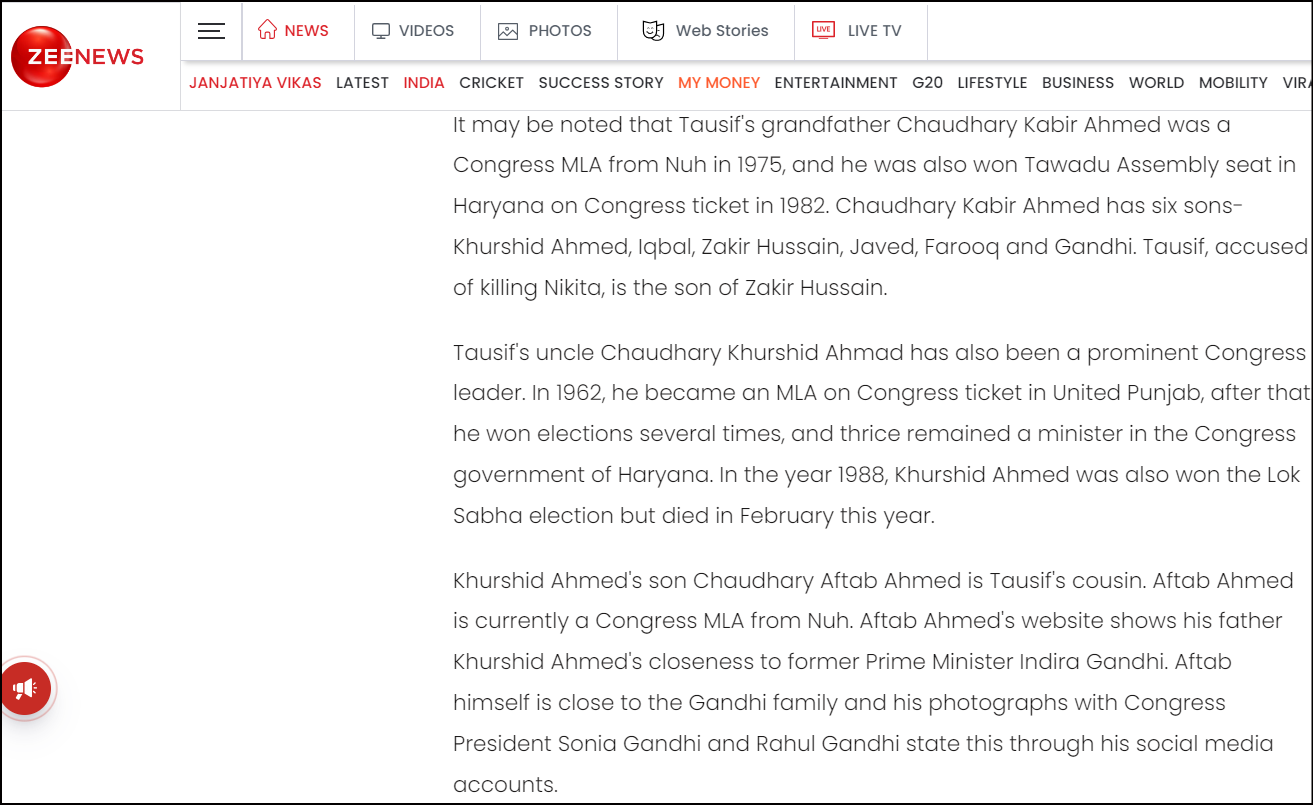
According to reports, Tauseef is the grandson of Kabir Ahmed, a Congress leader who was elected as an MLA from Haryana’s Nuh constituency in 1975 and from the Tauru constituency in 1982. He continued to be Khanpur and Raisika village sarpanch for almost 20 years. Khanpur and Raisika are located in Nuh Tehsil of Mewat district in Haryana.
Moreover, Tauseef’s late uncle Khurshid Ahmad was a Congress MP of Haryana and was an ex-Cabinet minister of Haryana. Khurshid Ahmed’s son and Taufeeq’s cousin brother Aftab Ahmed was elected as MLA from Nuh, Mewat on the ticket of the Congress Party and has been a Minister as well.
Report published by Zee News in 2020 explaining Nikita Tomar’s murder accused Tauseef’s Congress connection
So with the information shared above, it is evidently clear that the AAP leader Javed Ahmed, who is currently the prime accused in the Pradeep Kumar murder case is a close relative of Tauseef, the prime accused in the Nikita Tomar murder case and belongs to a family of Congress veterans and leaders.
AAP leader Javed Ahmed led the Islamist mob which killed Pradeep Kumar during Nuh violence: What does the FIR say
Notably, the FIR filed in the Bajrang Dal activist Pradeep Kumar’s murder case, whom Islamists ruthlessly killed him on the intervening night of July 31 (Monday) and August 1 (Tuesday), while he was returning from the police station during the Nuh violence, the complainant, Pawan Kumar, stated that the mob had launched the vicious attack on Pradeep Kumar and other Bajrang Dal members accompanying him, on Javed Ahmed’s orders.
Pawan Kumar further stated that Javed Ahmed, who was leading the mob shouted- “Kill them all, I will take care of the consequences.”
“Responding to the clarion call made by Javed Ahmed, 20-25 Islamists armed with iron rods, stones, guns and other weapons rushed towards us and started thrashing us,” he added in the FIR.
Since the FIR only mentioned the name of the accused, OpIndia, in its effort to try and get some more information about him, spoke to the complainant Pawan Kumar.
Pawan Kumar confirmed to OpIndia that Javed Ahmed in no other than the Aam Aadmi Party leader from the Sohna constituency in Haryana. He said that he was the one who had orchestrated the crowd and instigated them to launch a murderous attack on Pradeep Kumar and other Bajrang Dal activists.
Pawan Kumar continued, “The Islamist mob responded to his clarion call and charged at us and other defenceless Hindus present there while shouting ‘Allah hu Abar’ and ‘Pakistan Zindabad’.”
When we asked Pawan Kumar if he was certain that the AAP leader was leading the Islamists, he responded in the affirmative. He claimed that he recognises him very well since he has often seen him and his family members moving around through the lanes of Haryana’s Sohna district.
Raigad police officials have registered a case against 5 people in art director Nitin Desai’s suicide case.
Raigad police said in a statement that a case has been registered on the basis of the complaint of Neha Desai, wife of Nitin Desai.
Police said Neha Desai told them that Nitin Desai died by suicide due to mental pressure from the officials of ECL Finance Company and Edelweiss Group regarding debt recovery.
“Based on the complaint, the police registered a case under sections 306 and 34 of the IPC against 5 people, including officials of ECL Finance Company and Edelweiss,” as per the Police statement.
The Khalapur police are probing the matter.
Desai was found dead on Wednesday in his studio in Maharashtra’s Raigad district, police said on Wednesday. According to the police, Desai’s body was found hanging in his ND Studio in Karjat, some 80 km outside Mumbai.
The preliminary findings in the postmortem revealed that the cause of death is hanging.
“Postmortem of art director Nitin Desai has been conducted by a team of four doctors. As per preliminary findings, the cause of death is hanging. Further investigation is underway,” police said.
On Thursday Maharashtra Deputy Chief Minister Devendra Fadnavis said that all possible angles will be investigated in the Art Director Nitin Desai’s death case.
While replying to a question in the Maharashtra state assembly, Devendra Fadnavis said, “We will investigate all angles– whether he was pressurised. We will see if any thing can be done for him as far as the studio is concerned. At present we can’t make any announcement on it. We will also investigate the people whom he used to meet too.”
Desai, 57, had worked as an art director in several big-budget films such as ‘Devdas’, ‘Hum Dil De Chuke Sanam’, ‘Jodhaa Akbar’, ‘Prem Ratan Dhan Payo’, ‘Once Upon A Time in Mumbai’, and ‘Panipat’.
(This news report is published from a syndicated feed. Except for the headline, the content has not been written or edited by OpIndia staff)
Bharatiya Janata Party on Friday issued a three-line whip to its Lok Sabha MPs asking them to be present in the House from August 7 to August 11 as some bills apart from the no-confidence is due to come in the House next week.
The debate on the no-confidence motion against the BJP-led government is likely to take place on August 8 and 9 in the Lok Sabha and Prime Minister Narendra Modi is expected to give a reply on August 10.
The no-confidence motion moved by opposition parties belonging to I.N.D.I.A was accepted by Lok Sabha Speaker Om Birla last week.
The opposition had given notice for the no-confidence motion after days of protest over their demand for a detailed discussion on violence in Manipur and a statement from the Prime Minister.
Congress MP Gaurav Gogoi had given notice for a no-confidence motion on July 26 on behalf of opposition parties of the Indian National Developmental Inclusive Alliance (I.N.D.I.A) alliance.
After the motion was admitted, the Speaker said that the day and time of the debate will be decided later.
The government has said it is ready for debate on the no-confidence motion. The monsoon session will conclude on August 11.
(This news report is published from a syndicated feed. Except for the headline, the content has not been written or edited by OpIndia staff)
Days after Islamists executed a sinister pre-planned conspiracy to attack Hindu devotees of Jalabhishek Yatra in Haryana’s Nuh, their intellectual allies among the Left ecosystem, who are always ready to shield Islamists, made a beeline to soft-pedal their role and portray Muslims as the predominant victims of the violence. The Quint, in its recent article authored by one Fatima Khan, slyly tried to push the propaganda of Muslim victimhood concerning Nuh violence.
While reporting about the victims of the violence that engulfed Nuh, a Muslim-majority region in Haryana’s Mewat district and known for cow smuggling, love jihad, and assorted criminal activities, The Quint writer deviously mentioned the identity of the lone Muslim victim while describing the other dead as mere “locals” and “home guards”.
“A total of five have been reported dead in the state so far, including two home guards and two locals in Nuh and one Naib Imam in Gurugam’s Sector 57,” read The Quint article that also sought to deny Yatris were held hostage at the temple by Islamists.
OpIndia debunked the claim here, referring to the temple priest who said that his statement was misused by the leftists to spread propaganda.
It is worth noting that while Naib Imam was named as a victim, the others killed due to violence were reduced to being just ‘home-guards’ or ‘ locals’ as if they had no names and no religious identities.
The Quint and Fatima Khan perhaps did not bother mentioning the religious identities of two home guards and the two locals killed due to the Islamist violence because, after all, they were not Muslims and citing their identities would puncture the narrative of Muslim victimhood that they had been assiduously pushing ever since violence first broke in Nuh on July 31.
In fact, they even got the count of victims wrong. Not 5 but 6 people perished in the violence after Islamist mobs, as per a preplanned conspiracy, attacked a Hindu procession that was on its way to Nalhar Shiva Temple.
But since none of the others killed in the violence were Muslims, The Quint and Khan probably did not bother to verify the numbers first, much less reveal their identities.
For the unversed, here’s the lowdown of the remaining 5 non-Muslim victims of Nuh violence
Among those killed by the Islamist mob include two home guards, Neeraj and Gurusewak. Gursewak sustained an injury on his liver which led to his death, as per the post-mortem report. The cause of his injury was blunt force impact as the officials were attempting to control the Islamist mob which went on a killing spree following an attack on a peaceful Hindu Shobha Yatra.
Another Homeguard Neeraj Khan lost his life while trying to do his duty. His autopsy report mentions blunt force impact as the cause of death. Several large-scale injuries were also found on his body indicating the severity of the attack launched at him by the jihadis.
Abhishek Rajput, a Hindu devotee who participated in the Jalabhishek Yatra, was another victim of the bloodthirsty mob of Islamists that not only shot at him but also slit his throat and crushed his head with stones, a stark resemblance to the methods Taliban and ISIS terrorists to kill their victims.
Not just Hindu devotees who participated in the procession but local Hindus, too, were caught in the crosshair of the Islamists, who remained indiscriminate in killing and attacking Hindus regardless of whether they took part in the Jalabhishek Yatra or not. A sweet seller Shakti Saini was also killed by the Islamist mob. As per eyewitness accounts, Saini was abducted from the shop and taken elsewhere and later killed and then the dead body was dumped at the same Badkali square around which his shop was located.
Similarly, Pradeep Kumar, a Hindu devotee and a Bajrang Dal activist, was the sixth victim of the violence that Islamists had planned as an interrogation of the arrested youth has revealed, who confessed that WhatsApp groups were created as early as July 21 to July 23 and responsibilities assigned to group admins to gather stones and collect glass bottles to attack Hindu procession scheduled to take place on July 31.
Pradeep Kumar, as per an eyewitness account, was rescued safely from the Nalhar temple, where several Hindus were hiding to save themselves from the Islamist mob, and brought to the Nuh police lines. The Islamists, however, ruthlessly killed him on Tuesday, August 1, while he was returning from the police station.
Kapil Tyagi, another Bajrang Dal activist who was accompanying Pradeep Kumar when he was attacked and killed, spoke to Opindia. Recalling how the murderous Islamist mob launched a vicious attack on their car while they were returning from Nuh police lines in the early hours of Tuesday, Kapil Tyagi said that it appeared as if these Islamists were waiting in ambush the entire night. “When they saw our car, they launched a murderous attack on us. Pradeep Kumar, who could not defend himself due to being badly injured, died.” Kapil Tyagi also suffered a lot of injuries in this attack and is undergoing treatment.
The duplicity of leftwing media when victims are Hindu and perpetrators are Muslims
Ever since PM Modi ascended to the country’s highest office, the leftwing media has been consciously driving a narrative of Muslim victimhood—to allege that Muslims are perpetually facing the threat of persecution under the BJP government. This narrative demands the dehumanising of Hindu victims of Islamist violence while whitewashing Islamists of the religious fanaticism they routinely indulge in.
Last year, when Mohammed Zubair’s dog-whistling against Nupur Sharma triggered Sar Tan Se Juda violence by Islamists across the country, leading to the deaths of at least 6 Hindus, including Kanhaiya Lal,Umesh Kolhe, etc., the left-leaning liberals invested all their energies in painting a target behind Nupur Sharma and accusing her of making derogatory remarks against Prophet Muhammad without once fact-checking her comments. The victims such as Kanhaiya Lal and Umesh Kolhe hardly featured in their discourse. And when they did talk about them, it was only to blame Nupur Sharma for their deaths, conveniently giving a clean chit to Zubair and the Islamists who were responsible for their brutal murders.
Apparently, for the Indian Left, Hindu victims of hate crime, be it Kanhaiya Lal, Kishan Bharwad, Umesh Kolhe, Abhishek Rajput, Pradeep Kumar, or Shakti Saini, are just a mere statistics, whose deaths do not evoke the same degree of poignancy as someone like Naib Imam’s death does, because they are kaafirs after all.
As Karnataka Police tries to bury the Udupi washroom video case calling it a ‘prank’, BJP today urged the governor to intervene in the matter. A delegation of BJP MLAs met Karnataka Governor Thaawarchand Gehlot on Friday and requested him to order the state government to conduct an SIT probe into the matter.
Senior BJP leader Kota Shrinivas Poojari, who led the delegation said, “Unfortunately, the government is conducting an investigation by a Deputy Superintendent level officer. If there is pressure from the government, a proper investigation by a Deputy Superintendent level officer is impossible. Therefore, we have demanded an SIT probe.”
Poojari said that the home minister of the state have taken the issue as a joke, and CM Siddaramaiah has also not taken the case seriously. “As the government was hesitant on the issue, today we met the Governor, and requested him to direct an SIT probe”, he added.
The BJP leader said that the governor was told about deteriorating law and order situation, chaotic atmosphere in Karnataka and the bail given to the girl students who filmed the video. He also appraised the governor about the possibility of connections of the accused girls with banned group PFI. “We have requested to issue directions for a SIT probe, for a comprehensive investigation,” he said.
In response, the governor assured that he will issue appropriate directions, he added.
However, responding to the protest by BJP, Chief Minister Siddaramaiah said, “Nobody had lodged the complaint– either parents of the so called victim or the so called victim. The police had registered the case suo-moto against the three accused persons, they are out on bail now. The case is entrusted to a DySP level officer, who is investigating it.”
“Whoever has committed an offence will be punished in accordance with law. We have already taken steps, the investigation is on by a DySP level officer. Let the chargesheet come, let the investigation complete, we will take action,” the CM added.
Notably, in Udupi, videos of Hindu girls were recorded in the women’s washroom of Netrajyoti College in Udupi by 3 Muslim women. The college management supposedly conducted an inquiry into the matter and concluded that the video had been deleted, closing the case. However, the case assumed massive proportions after several social media users, including Rashmi Samant and Shefali Vaidya, raised the matter and demanded an impartial inquiry into the matter. Following the public outrage, two suo moto cases have been registered at the Malpe Police Station in the Udupi district. The FIR was registered against the 3 Muslim women and the college administration also for the destruction of evidence and for not providing information to the police.
A Bajrang Dal activist named Pradeep Kumar was the third Hindu who fell prey to Islamist violence that convulsed Haryana on July 31 following an attack on a Hindu precession in the Nuh district.
In our previous report, we detailed how Pradeep Kumar was rescued safely from the Nalhar temple, where several Hindus were hiding to save themselves from the Islamist mob, and brought to the Nuh police lines. The Islamists, however, ruthlessly killed him on the intervening night of July 31 (Monday) and August 1 (Tuesday), while he was returning from the police station.
Besides Pradeep Kumar, the unrest killed two other Hindus namely Shakti Saini and Abhishek Rajput and two Homeguards.
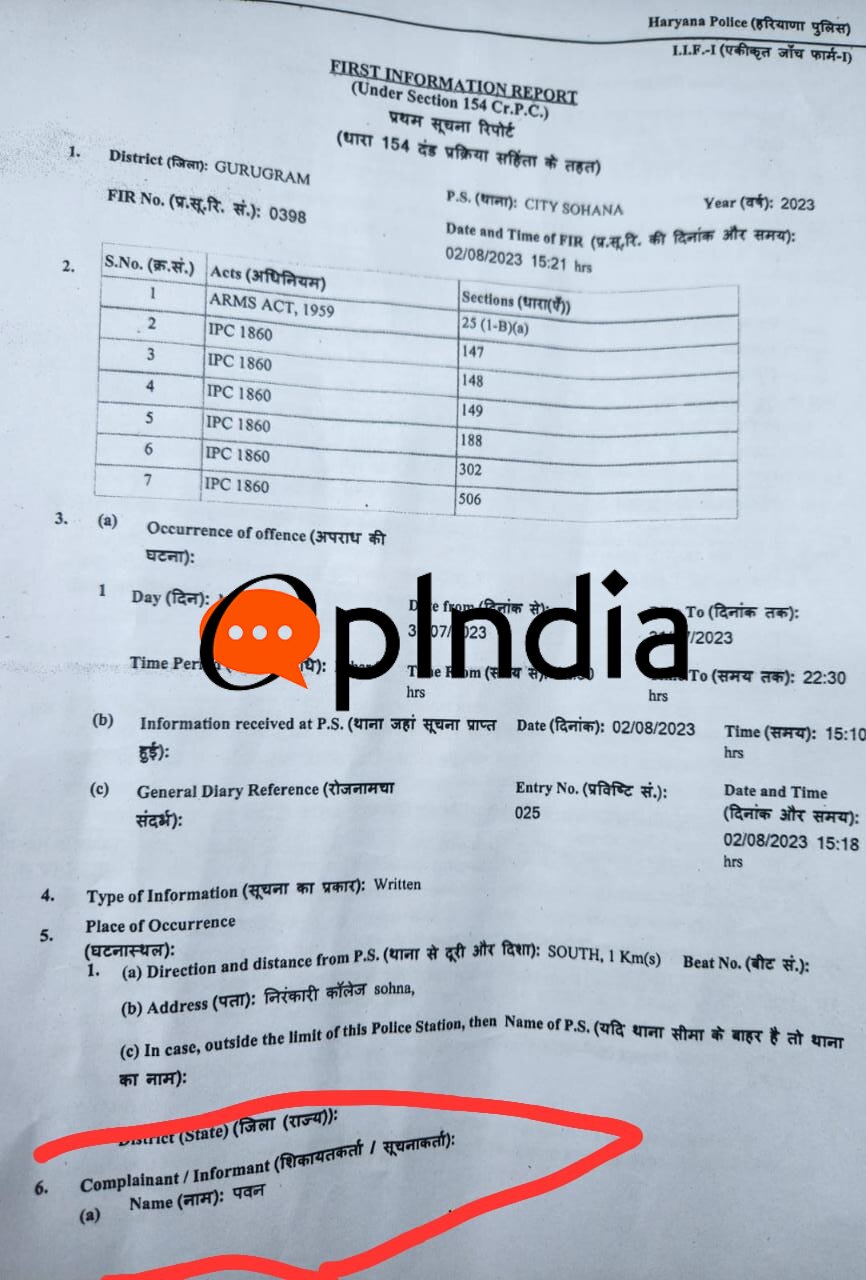
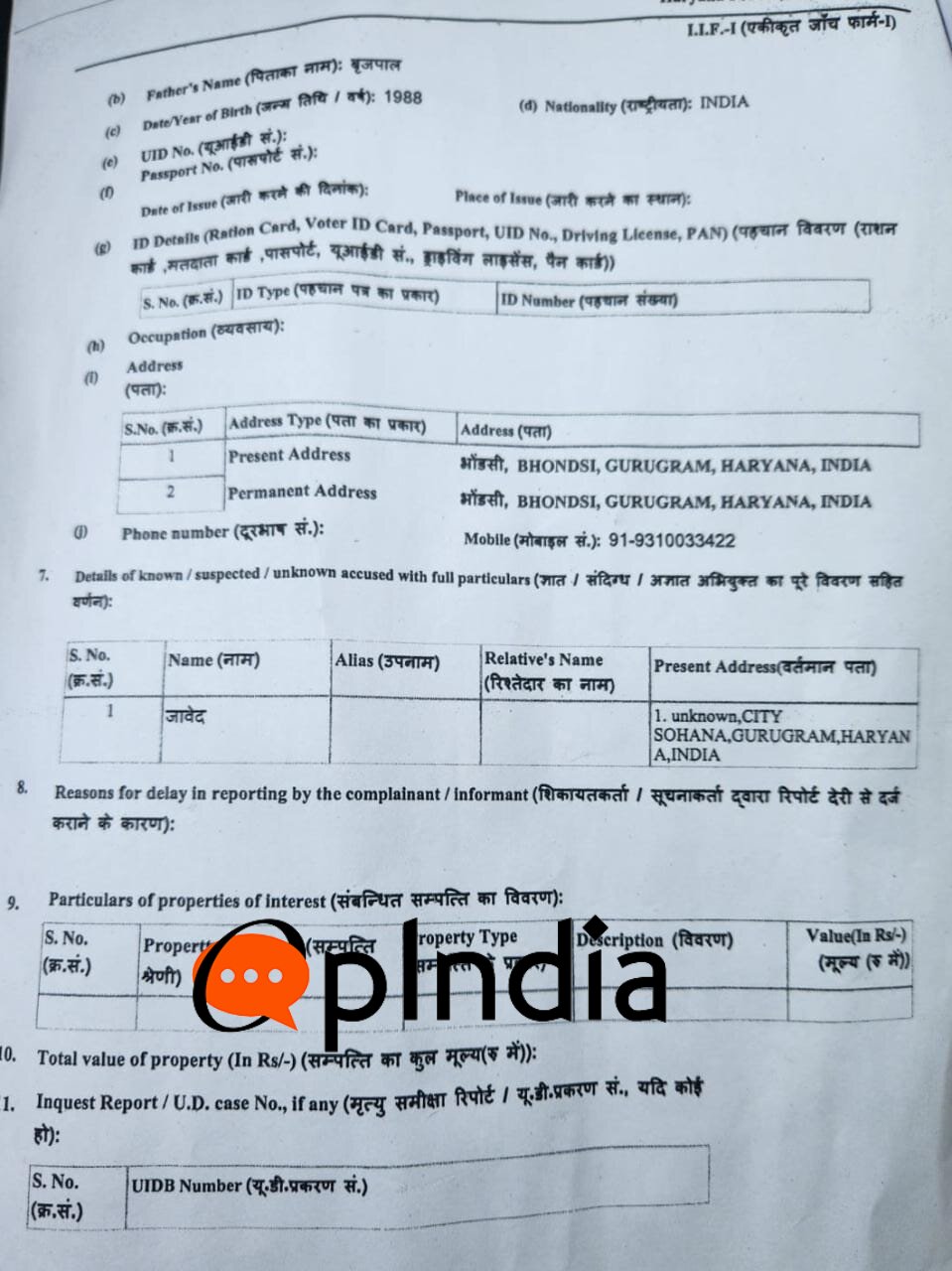
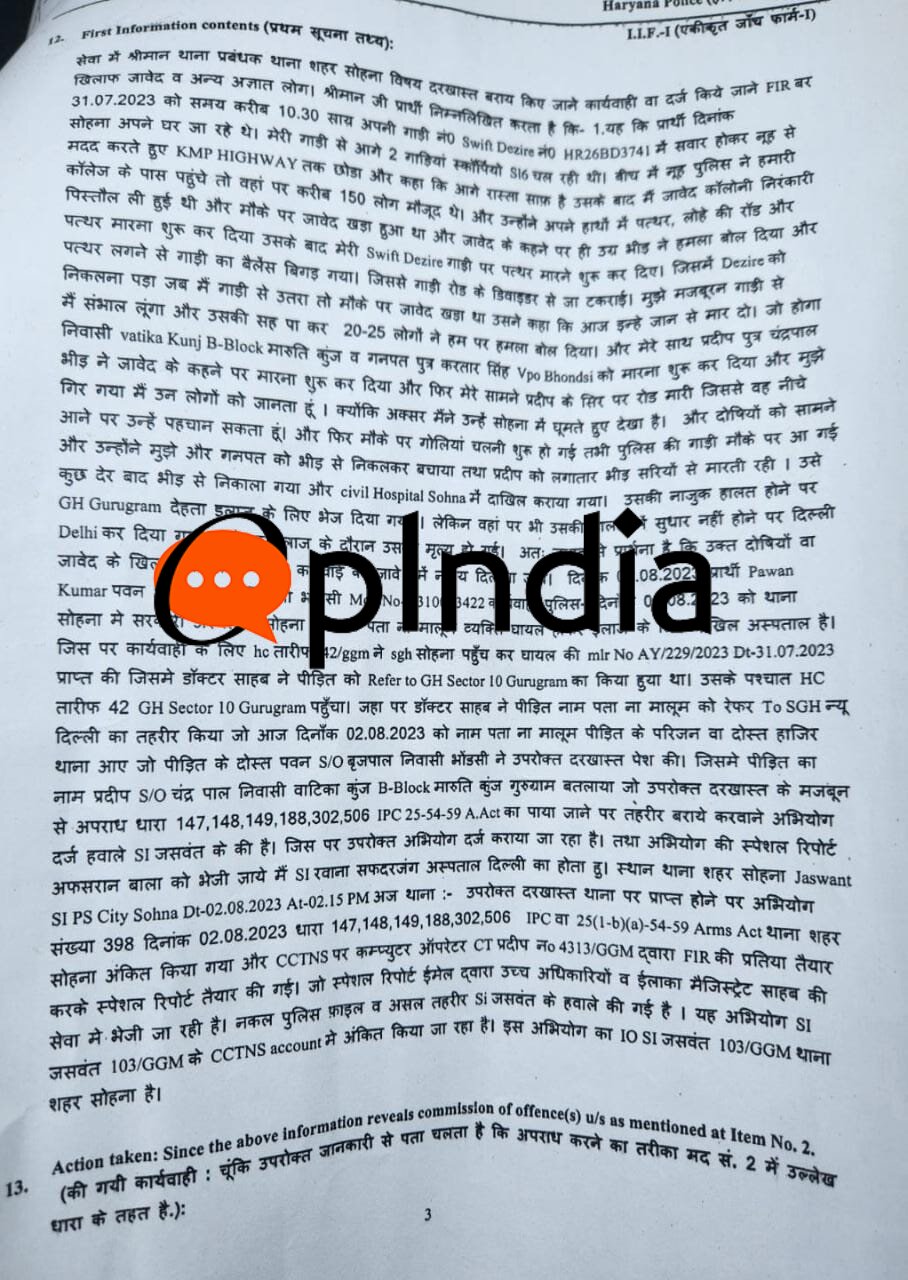
OpIndia has now accessed the FIR registered in the murder case of Pradeep Kumar. The FIR was filed on August 2, 2023, a day after he was killed by a murderous mob of over 200 people. The FIR was filed by Pawan Kumar, another Bajrang Dal activist who was accompanying Pradeep Kumar when he was attacked and killed.
Copy of FIR accessed by OpIndia
Pawan Kumar, in his complaint named one Javed Ahmed as the prime accused. He said that the mob had launched the vicious attack on Pradeep Kumar and other Bajrang Dal members accompanying him, on Javed Ahmed’s orders. Notably, the accused Javed Ahmed is a leader of the Aam Aadmi Party.
Copy of the FIR accessed by OpIndia
The complaint Pawan Kumar in the FIR, the copy of which is with OpIndia, stated that on the night of July 31 at around 10.30 pm, he, Pradeep Kumar and other Bajrang Dal activists were returning home in the complainant’s Swift Dzire car when the Islamists mob launched a vicious attack on their car. His car was being followed by two cars belonging to other Bajrang Dal activists and a police van was also escorting them.
He said that when their car reached Sohna Road, the police asked the Bajrang Dal members to proceed on their own. They assured them that the police officers stationed in the Sohna area had done all required security checks and the route was clear.
Copy of the FIR accessed by OpIndia
They had only travelled a short distance without the police when an unfamiliar speeding Scorpio car started following them. Their car must have travelled only a kilometre or two on the Kundli–Manesar–Palwal Expressway (KMP Expressway), when, suddenly the Scorpio car intercepted them. Within seconds, from nowhere, a mob of around 150 Islamists came and started pelting stones at their car, because of which they lost control of the car and it went and hit the divider on the road.
Pawan Kumar further stated when the car stopped he was forced to get out of the car. Javed Ahmed, who was leading the mob shouted- “Kill them all, I will take care of the consequences.”
“Responding to the clarion call made by Javed Ahmed, 20-25 Islamists armed with iron rods, stones, guns and other weapons rushed towards us and started thrashing us,” Pawan Kumar stated in the FIR, adding that the mob opened the car door, dragged Pradeep Kumar out, and started to beat him as well.
The complainant further stated in the FIR that when the police saved him and were taking him to the hospital, he saw Islamists continuously thrashing Pradeep Kumar with iron rods and sticks. The police later rescued Pradeep Kumar and took him to the Safdarjung Hospital in Delhi where he succumbed to his injuries.
Who is Javed Ahmed mentioned as the prime accused in the FIR
The complainant in the FIR specifically mentioned not once but many times that the prime accused behind the attack and murder of Bajrang Dal activist Pradeep Kumar was a man identified as Javed Ahmed. Since the FIR only mentioned the name of the accused, OpIndia, in its effort to try and get some more information about him, spoke to the complainant Pawan Kumar.
Pawan Kumar confirmed to OpIndia that Javed Ahmed in no other than the Aam Aadmi Party leader from the Sohna constituency in Haryana. He said that he was the one who had orchestrated the crowd and instigated them to launch a murderous attack on Pradeep Kumar and other Bajrang Dal activists.
Pawan Kumar continued, “The Islamist mob responded to his clarion call and charged at us and other defenceless Hindus present there while shouting ‘Allah hu Abar’ and ‘Pakistan Zindabad’.”
When we asked Pawan Kumar if he was certain that the AAP leader was leading the Islamists, he responded in the affirmative. He claimed that he recognises him very well since he has often seen him and his family members moving around through the lanes of Haryana’s Sohna district.
After speaking to Pawan Kumar, we tried to dig further to gather some more information about the accused Javed Ahmed. While searching, we came across a press note released by the Aam Aadmi Party, Haryana unit on August 2, 2022, which announced Javed Ahmed’s appointment as the state coordinator of AAP’s minority cell.
Notably, after Aam Aadmi Party won the Punjab elections in 2022, several ex-ministers, MLAs of Haryana and their followers joined the party. Javed Ahmed who was previously Sohna assembly’s BSP candidate also joined AAP during an event held at the Aam Aadmi Party (AAP) headquarters in Delhi on March 14, 2022.
हरियाणा से कई नेता आम आदमी पार्टी में हुए शामिल।
समालखा से पूर्व निर्दलीय विधायक रविंद्र मछरौली आम आदमी पार्टी में हुए शामिल।
सोहना से BSP से चुनाव लड़ 40,000 वोट लेने वाले जावेद अहमद आम आदमी पार्टी में हुए शामिल। pic.twitter.com/CcRKmbJNNy
Meanwhile, Pradeep Kumar, a resident of the Baghpat district of Uttar Pradesh, was an office bearer of the Bajrang Dal unit in Gurugram. Being the sole breadwinner of his family, he used to do odd jobs to support them. People associated with the Gurugram unit of Bajrang Dal said that the police will be sending the deceased’s body directly to his native village Baghpat after the autopsy is done and other legal formalities are completed.
As the religious procession came under attack in Nuh, Haryana on July 31, 2023, Hindu devotees revealed to OpIndia and several other platforms that stones were pelted at them from the rooftops, young Muslim boys and men had taken to the mountainous area and were shooting at them from the peaks, acid bottles were thrown at them and several women were harassed. During the violence, several women and children (ranging anywhere between 2000-2500) had taken shelter at the Temple and were rescued only hours later by the police.
OpIndia reported how another Bajrang Dal activist named Abhishek Rajput was shot dead in the violence that the mob unleashed against thousands of Hindu devotees who were participating in the VHP Shobha Yatra on Monday. After shooting Abhishek Rajput, Islamists slit his throat with a sharp weapon and crushed his head with stones, the extent of brutality which is normally associated with terror outfits like the Taliban.
Notably, it has been revealed about Nuh violence that its preparations were being done for 6 months. During the attack, AK-47 was fired on the people surrounding the temple premises. A 14-year-old boy was also shooting.
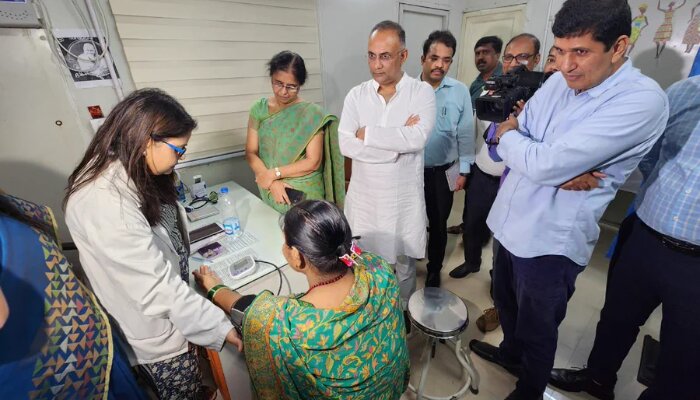
In an interesting turn of events, senior Congressmen and the minister for health and family welfare in the government of Karnataka, Dinesh Gundu Rao visited the Delhi government’s mohalla clinic at Panchsheel Park on 4 August and termed it “overhyped.” He even went one step ahead and called his experience “disappointing.”
While he had said that he visited the Mohalla clinic to see how they can improve the similar namma clinics in Karnataka, it was taken as praise of the Mohalla clinics by the media. However, within hours he gave his verdict and said that the clinics are overhyped.
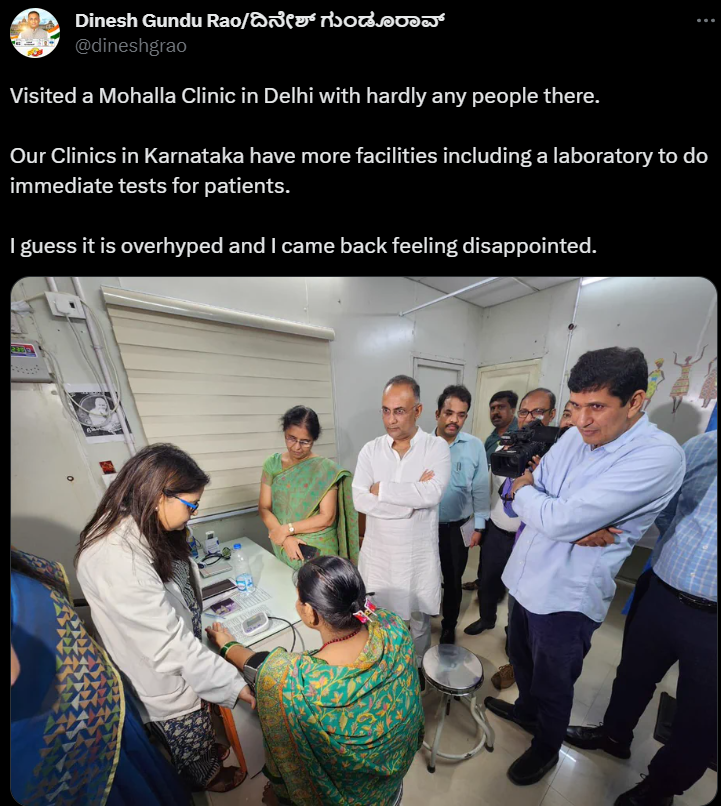
The politician took to Twitter to express his opinion. He posted, “Visited a mohalla clinic in Delhi with hardly any people there. Our clinics in Karnataka have more facilities including a laboratory to do immediate tests for patients. I guess it is overhyped and I came back feeling disappointed.”
Source: Dinesh Gundu Rao’s Twitter account
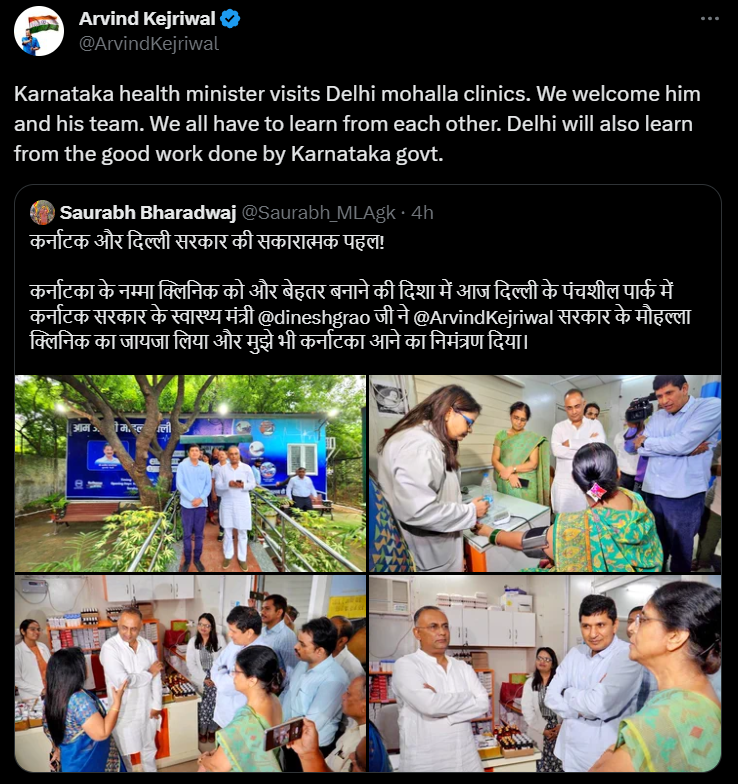
Interestingly, the Aam Aadmi Party supremo and Delhi chief minister Arvind Kejriwal had already tweeted a self-congratulatory post, labelling the visit a learning experience for the minister from the southern state.
He commented, “Karnataka health minister visits Delhi mohalla clinics. We welcome him and his team. We all have to learn from each other. Delhi will also learn from the good work done by Karnataka govt,” on a tweet by Minister of Health, Urban development and water in Delhi government, Saurabh Bhardwaj.
Source: Arvind Kejriwal’s Twitter account
Saurabh Bhardwaj posted images where he is accompanying the Congress stalwart on social media and wrote, “Positive initiative by the Government of Karnataka and Delhi! In order to further improve the namma clinic of Karnataka, today at Panchsheel Park, Delhi, Health Minister Dinesh Gundu Rao of the Government of Karnataka visited the mohalla clinic of the Arvind Kejriwal Government and invited me to visit Karnataka.”
कर्नाटक और दिल्ली सरकार की सकारात्मक पहल!
कर्नाटका के नम्मा क्लिनिक को और बेहतर बनाने की दिशा में आज दिल्ली के पंचशील पार्क में कर्नाटक सरकार के स्वास्थ्य मंत्री @dineshgrao जी ने @ArvindKejriwal सरकार के मौहल्ला क्लिनिक का जायजा लिया और मुझे भी कर्नाटका आने का निमंत्रण दिया। pic.twitter.com/rXaKEZjmqa
Dinesh Gundu Rao was accompanied by Delhi Health Minister Saurabh Bharadwaj during his visit to facilities at mohalla clinics. Talking to reporters during the visit, he had said “I had heard a lot about mohalla clinics and I wanted to see them. I wanted to discuss how they (AAP govt) are implementing health policies.”
“In southern states like Tamil Nadu, Kerala and Karnataka, health has always been a priority. Every state has got something good that we can learn from. We have something similar… we have namma clinics. We wanted to see how we can improve our system,” Dinesh Gundu Rao was quoted as saying by news agency PTI.
It is notable that the Karnataka govt runs 438 Namma clinics across the state, out of which 225 are in Bengaluru. Each Namma clinic consist of a doctor, a nurse, a lab technician, and a Group D employee.
The Delhi government’s mohalla clinic is a neighbourhood facility for providing free primary healthcare to residents. They are one of the flagship initiatives of Arvind Kejriwal’s administration to allegedly boost the primary healthcare system in Delhi.
Notably, Congress and AAP are allies in the I.N.D.I.A. bloc, a grand alliance of 26 opposition parties and now the alliance partners are sparring over mohalla clinics in the national capital.
A murderous Muslim mob entered a hospital in Haryana’s Nuh and thrashed doctors and victims of violence after identifying them as Hindus, a report published in the Hindi daily Jagran said.
As per the report, more than fifty rioters barged into the hospital and assaulted the patients, health workers and doctors after segregating them on the basis of their religion. They assaulted Hindu doctors and victims after separating them from Muslims, the report added. A doctor’s three-year-old daughter was also beaten with sticks.
A pregnant woman admitted to the hospital was also reportedly attacked by the mob, which attacked her with sticks on her arms and legs. The woman collapsed after she was pushed and shoved for trying to escape the mob.
The police identified two accused, Nadir and Anjum, after scouring through the CCTV camera installed outside the hospital. The two were subsequently arrested for indulging in riots and violence.
The Jagran report is yet another evidence of the extent of the barbarity that Islamists went to carry out a preplanned attack on Hindu devotees.
Mewat Shobha Yatra attack
On Monday (July 31), violence broke out in Haryana’s Nuh district during the ‘Brij Mandal Jalabhishek Yatra,’ which was organized by Vishwa Hindu Parishad and Bajrang Dal. The death toll from the clashes has now reached 5, including two personnel from the Haryana home guard. The deputy commissioner urged people to stay indoors, venture outside only for essential tasks, and disregard any circulating rumours.
Vehicles were burnt and stones pelted at the Vishwa Hindu Parishad’s Jalabhishek Yatra as clashes erupted between two communities in the Muslim-majority region of Mewat in Haryana.
“Religious Brajmandal Yatra” organized annually by Bajrang Dal, Islamic Jihadis pelted heavy stones, violence, arson and direct bullets from the hills on the pilgrims on the ancient “Religious Yatra” of Nallahad Shiv Temple, the centre of faith and reverence of Hindus in Nuh, Mewat. In which hundreds of vehicles were damaged and burnt to ashes,” said a statement shared by Bajrang Dal on Twitter.
The preplanned nature of the attack and the use of WhatsApp to mobilise mob and collect stones, glass bottles
While Islamists and their supporters had widely used social media platforms to mobile rioters, a report published by Hindustan Times sheds light on the extent the assailants went in the nefarious designs to attack Hindu processions in Haryana’s Muslim-majority region of Nuh.
As early as July 21, roughly ten days before the Jalabhishek Yatra was to take place, Islamists had been scheming to attack the devotees, laying elaborate plans on how to go about with their evil ploy.
Those arrested by the police over the violence that erupted in Nuh earlier this week have revealed in their interrogation that meetings were held and WhatsApp groups were created, and responsibilities were assigned to group leaders to collect stones and bottles to attack Hindu processions between July 21 to July 23, yet another corroboration of the preplanned nature of the violence that has engulfed the region since July 31.
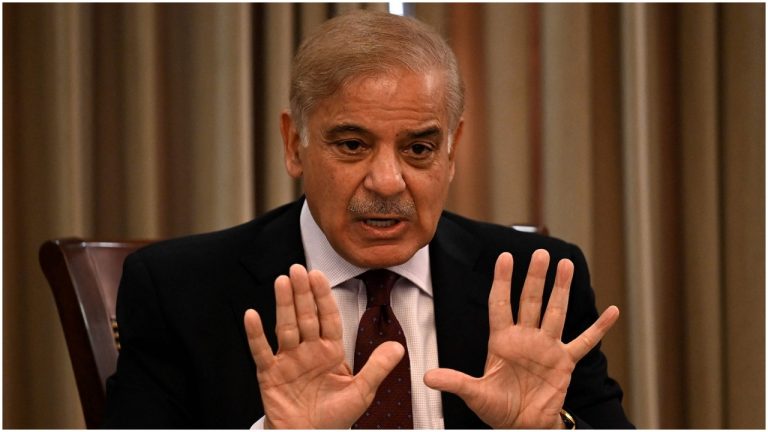
On Thursday, August 3, Prime Minister of Pakistan Shehbaz Sharif announced that Pakistan’s National Assembly will be dissolved on August 9. The move will come three days prior to the scheduled date of end of term of the govt. As the five-year term of the government comes to an end, fresh elections will be held in the country within 90 days.
According to the Pakistani constitution, elections must be held within 60 days if the assembly completes its term. However, if the assembly is dissolved prematurely, as will be the case here, this period is extended to 90 days.
The Pakistani PM informed those in attendance at the reception that the ruling PML-N had completed internal consultations and that a final round of discussions with allies on the caretaker setup will be held today, a process that is expected to take at least three days. A meeting with allies on the caretaker set-up is also expected to be held on Friday through video conferencing.
At the dinner, the prime minister of Pakistan updated his allies on the coalition government’s performance, claiming that the government had improved revenue collection by 13% in 15 months as more than 1.3 million additional taxpayers were added to the tax net.
Sharif further claimed that electricity sector recoveries remained above 90%. However, it should be highlighted that the circular debt has increased by 18% which is Rs393 billion in the last 11 months.
Moreover, Sharif claimed that tremendous progress has been made in the IT industry over the last four months and that the total volume of IT exports increased to $2.6 billion during the previous financial year.
Shehbaz Sharif criticised past governments for wasting billions of rupees from the national exchequer owing to obstacles to public projects such as the Haveli Bahadur Shah Power Plant.
The dinner on August 3 was attended by Pakistani Senate Chairman Sadiq Sanjrani, Speaker of National Assembly Raja Pervaiz Ashraf, PPP leaders Yousuf Raza Gilani, MQM Convener Khalid Maqbool Siddiqui, JUI-F leader Asad Mehmood, Balochistan Awami Party leaders Khalid Magsi and Senator Ahmed Khan, Jamhoori Watan Party (JWP) Chairman Shahzain Bugti, Aslam Bhootani, Mohsin Dawar.