Home Blog Page 2447

Aryan Invasion Theory: Let us revive the debate again

The last thirty years, there have been plenty of lectures, papers and now online videos promising to “debunk the Aryan Invasion Theory” (AIT). Their impact has been very poor, essentially limited to Hindu students, not even Hindu politicians. But outsiders, particularly the champions of that same AIT, have barely noticed this wave of attempted refutations, and certainly haven’t felt moved by them to rethink their assumptions.

Let us first get our terminology straight. Squeamish AIT scholars are making everyone toe their line that instead of an “invasion” there was an “immigration”. They have to, for unlike in Europe, where the “Aryan” (meaning Indo-European-speaking, IE) invasion from the steppes ca. 2800 BCE was a dramatic and sometimes genocidal event, India presents no evidence at all of such foreign conquest in the period considered. So they shifted to the thesis of a subtle infiltration under the archaeological radar, yet revolutionary in its impact: unlike the Scythians, Greeks, Huns or Kushanas, these intruders succeeded in not just conserving their language and religion, but imposing both on the far more numerous natives. Well, the word “invasion” is not about the means used, but the resulting power equation: it’s an “immigration” if the foreigners adapt, but an “invasion” if they take power. And this is clearly what the supposed Aryan invaders did. So it was definitely an invasion, but we won’t insist: even with an “immigration”, it remains the “AIT”.

The IE language family was discovered by a French Jesuit living in South India, Gaston-Laurent Coeurdoux. In 1767, he sent a paper to the Academy in Paris in which he showed the close kinship of Sanskrit with Latin and Greek. The French freethinker Voltaire soon publicized it and concluded that European culture and its treasures had originated on the banks of the Ganga. This was taken over by other leading intellectuals like Immanuel Kant, and note that they spontaneously assumed India as the land of origin of the IE family. The Out-of-India Theory (OIT) is not a recent “concoction” by Hindu Nationalists, as widely alleged, but was thought up by 18th-century Europeans.

In India, the new insight was given currency by justice William Jones speaking in Kolkata 1786. Note about his speech what admiration he expresses for the Sanskrit language, deemed superior to Latin and Greek. Indomania was widespread at the time, best represented by Friedrich Schlegel’s 1808 book Language and Wisdom of the Indians. This goes completely against the widespread Hindu rumour that IE linguistics stemmed from “racist colonialism”. Most of India was not a colony yet, and the heyday of racial thought contaminating “Aryan” studies had yet to arrive.

However, another consideration started to undermine the dominant position of the OIT. Linguists realized that Sanskrit was not the mother but merely an elder sister of the other branches. There was a distance between the putative language of origin (Proto-Indo-European, PIE) and Vedic Sanskrit, and this translated into a possible distance between the Homeland and India. Not really compelling logic, for languages can evolve while staying in the same place; but this change of opinion won through.

What made the scales tip was probably August Schlegel’s proposal in 1834 that the Homeland lay in or near the Caucasus mountains. Bible-thumpers had already thought of Armenia, where Noah’s Ark had landed: the Aryans were deemed the descendants of Noah’s son Jafeth. Successive Homeland theories after this would rarely move away sharply from the Caucasus area. Since Gordon Childe’s choice in 1926 for the Don-Volga region, this area has mostly remained the favourite, today known as the Yamnaya (“pit-grave”) culture.

But the OIT school did not give up. The defence was taken up again by Europeans living in India. The most prominent and surprising figure here is Mountstuart Elphinstone, a proverbial colonialist. After his retirement as governor of Bombay, he wrote a History of India. Among his arguments, the most compelling is that no Hindu scripture gives any indication of a foreign origin: “There is no reason whatever for thinking that the Hindus ever inhabited any country but their present.” (1841)

Yet this could not save the OIT. In the mid-19th century, two developments served as nails in its coffin. One was the start of Linguistic Paleontology, the “science” of discovering a language’s habitat from its vocabulary. Thus, it was realized that PIE flourished in a society familiar with wheeled transport: six words for the cart and its parts exist throughout the daughter languages and must have existed in PIE. Now for the Homeland question, it was deemed significant that there were words for cold-climate species like birch tree, wolf and bear. This doesn’t really refute the idea of an Indian Homeland, for these species also occur in India, which has islands of cold climate. Recently, OIT mastermind Shrikant Talageri has shown that hot-climate species like ape, lion and elephant are equally present in the PIE lexicon, and they are hard to reconcile with a northern climate zone. But back then, the exclusion of India as a Homeland candidate won the day.

The other factor was the appearance of Veda translations which followed the then-emerging racial paradigm. Thus, in the Rg-Vedic description of the Battle of the Ten Kings, it was commonly pretended that the enemies were “black aboriginals”. In reality, the names of the kings and of their tribes (most notably Dâsa, Dasyu) are recognizably Iranian, and their characterization as “the black tribe” is a mistranslation. The word Asiknī does not refer to a skin colour, but to the area they come from, the basin of “the Black River”, the Vedic name of the Chenab. This way, several racialist distortions, perhaps made in good faith because of the racialist Zeitgeist, created the impression that an Aryan invasion into India had been described by the Vedic composers themselves. It thus became futile to deny the AIT.

The ensuing political abuse of the AIT by the British colonialists and even by the National-Socialists could not inspire the Indo-Europeanists to a rethink. After 1945, the “Aryan” political discourse went out of fashion in the West, but in India its political use by Christian missionaries, Ambedkarites (though not BR Ambedkar himself, an articulate opponent of the AIT), Dravidianists and Nehruvians continued. In the West this has not been noticed till today. Hilariously, the few Western scholars who have heard of the OIT at all, claim that it is “a politicized concoction”, when in fact it is their own AIT that has played a poisonous role in Indian politics all along.

The OIT started a second life in 1982, when KD Sethna published the book Karpasa (cotton), showing that cotton was common in the Harappan cities (starting 2600 BCE), and in Sanskrit writings younger than them, but not yet in the Rg-Veda. He concluded that the Rg-Veda largely predated them. This high chronology is detrimental to the AIT, which postulates an Aryan invasion (importing the Vedic language) only in the 2nd millennium.

In 1984 the US archaeologist James Shaffer showed that there is zero archaeological proof for an Aryan invasion, including a peaceful immigration. Indian archaeologists became more outspoken about their findings to the same effect. Even BB Lal, long the main archaeological supporter of the AIT, shifted to the position: “Vedic and Harappan are two sides of the same coin.” Several linguists and historians joined in, and latterly some geneticists: people of the same academic rank as any pro-AIT professors you can cite.

Until the millennium year 2000, there had been many voices doubting or plainly rejecting the AIT, and contributing many little arguments from linguistics or archaeology, all indirect evidence, but a clear alternative was lacking. Shrikant Talageri, after a preparatory book in 1993, then broke through the wall of ignorance about the enigmatic Vedic age. In The Rigveda, an Analysis, and its 2008 sequel, The Veda and the Avesta, he pioneered a convincing OIT, which should henceforth count as the OIT.

This work is, as I have been able to verify at Indo-Europeanist conferences, completely unknown in the West and also in India’s AIT camp. Whereas the mere handful of OIT thinkers know the AIT quite well and often write answers to it, the well-established AIT doesn’t really get beyond derogatory comments on the OIT and stonewalls all arguments in its favour. Around the year 2000 there was a little bit of dialogue, mostly thanks to the American scholar Edwin Bryant (the coiner of the term “OIT”), but this has remained a blip.

Today, the AIT camp is a happy valley protected from the rising waters of counter-evidence by a protective dam. But the waters keep rising, and the time can’t be far off when the waters will overcome the dam and drastically impact the cosy life in the valley.

Dr. Koenraad ELST, °Leuven (Belgium) 1959, is an Oriental Philologist & Historian and a prominent old hand in the “Aryan” debate.
Pakistan chose extremist Islam over economic stability: Foreign Policy report

0

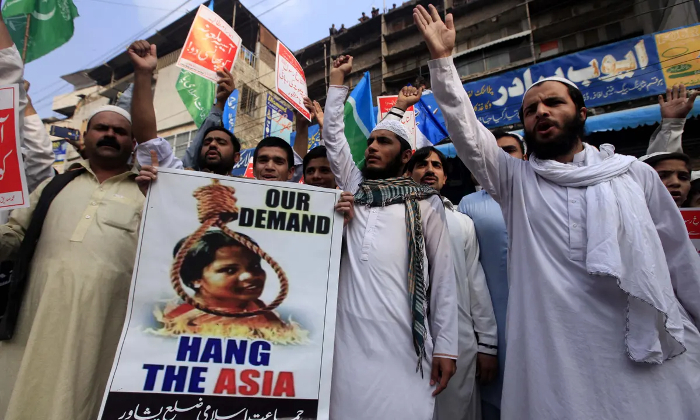
The Pakistan Telecommunication Authority (PTA), on February 3, blocked Wikipedia nationwide. Although the ban was overturned three days later, in its statement the PTA said that Wikipedia refused to remove “sacrilegious contents” from the website. By curtailing free speech and doubling down on blasphemy laws, Islamabad is endangering its relationship with Europe and the United States, Foreignpolicy.com reported.

In 2020, Pakistan threatened legal action against Google and Wikipedia for “disseminating sacrilegious content,” regarding Islamic beliefs held by minority Muslim sects. On February 11, a man was lynched by a mob in the eastern city of Nankana Sahib over allegations of blasphemy. The victim was killed inside the local police station, with the law enforcement authorities being hapless bystanders.

The Pakistan Penal Code (PPC) was co-opted after Partition in 1947 from the Indian Penal Code (IPC) of 1860, with Sections 295 and 298 dedicated to desecrating worship places and outraging religious sensibilities, respectively. The original sections in the IPC are equally applicable to all religions. But in the 1980s Pakistan added Islam-specific clauses.

In January 2023, the National Assembly of Pakistan amended PPC to expand its blasphemy laws. One of those amendments, the Criminal Laws (Amendment) Bill, 2023, ups the penalty from three years to life imprisonment.

The PPC criminalizes any sacrilege against the Quran and the prophet, with penalties including capital punishment.

Foreignpolicy.com reported that even though Pakistan is yet to execute anyone for sacrilege, its blasphemy laws continue to encourage mob violence. The most high-profile victim of the blasphemy laws was one of their staunchest critics, former Punjab Gov. Salman Taseer, who was gunned down by his security guard in 2011.

Last year, a teacher was attacked and killed by her colleague and students in an all-girls school, a mentally unstable man was stoned to death by a mob, and a man born without arms was drowned, in separate incidents of blasphemy killings.

Last month, a Muslim man threatened to incite mobs against a Christian security officer working at the Karachi airport. He accused her of blasphemy after the woman denied his acquaintance entry into the premises.

While the blasphemy laws have disproportionately harmed non-Muslims and Muslims in Pakistan. The man was killed for blasphemy in October for expressing devotion at the graves of Sufi saints that the vast majority of South Asian Muslims have traditionally adhered to.

The ideology of takfir, or excommunicating Muslims, is based on outlawing divergent beliefs and penalizing those deemed guilty per sharia, with punishments for apostasy that include execution.

The takfiri ideology fuels murderous sharia codes and jihadi groups alike. Outfits such as the Islamic State and its Pakistani Taliban affiliates have bombed Sufi shrines over the years, deeming the mystic practices heretical. The Islamic State-orchestrated 2017 bombing at the Lal Shahbaz Qalandar shrine in Sehwan, killing at least 90 people, remains one of the deadliest terrorist attacks in Pakistan’s history.

The Islamic State and the Pakistani Taliban have similarly targeted Shiite mosques across the country, dubbing Shiites, comprising the second-largest sect of Islam, collectively guilty of blasphemy. And the Criminal Laws (Amendment) Bill, 2023, passed last month, is the systematization of this anti-Shiite narrative, which borders on the codification of the entire sect’s ex-communication, Foreignpolicy.com reported.

The amendment passed by the National Assembly outlaws Shiite beliefs by enforcing Sunni theology and tradition. Following the enactment of the Prevention of Electronic Crimes Act in 2016, the state initiated a war on nonbelief, sending official texts nationwide asking users to report any form of blasphemy.

Just as Shiites today are being compelled into shunning their beliefs so as to be accepted as Muslims in Pakistan, Ahmadis were forced to do the same with their faith in their sect’s 19th-century founder, Mirza Ghulam Ahmad, via the Second Amendment to the Pakistani Constitution in 1974.

The official declaration of Ahmadis as non-Muslims was followed by Sections 298-B and 298-C a decade later, banning the community from “posing as Muslims,” including referring to Islamic literature or expressions.

This veritable apartheid against Ahmadi Muslims over the past four decades has seen members of the community killed, their mosques vandalized, and graves desecrated. Ahmadis have to be declared non-Muslims for individuals to obtain a passport, exercise the right to vote, or even get a marriage certificate. Among the Wikipedia contents flagged by the PTA are pages on Ahmadiyya Islam.

While Shiites and Ahmadis are subjugated owing to their beliefs, nonbelievers are also targeted in Pakistan. Atheism and apostasy, as an extension of blasphemy, are punishable by death in Pakistan.

Within a month of the Punjab bill being passed, 42 blasphemy cases were lodged, predominantly against the Shiite community, including against a 3-year-old. The toddler, Syed Fazal Abbas Naqvi, was taken into custody along with his father and uncle, with all of them facing terrorism charges before being released on bail.

The Criminal Laws (Amendment) Bill, of 2023 has been followed by a spike in Shiite killings in the town of Dera Ismail Khan.

While the financially motivated Arab states that historically spread radical Salafism worldwide are now embracing moderation, Pakistan appears to be wholly invested in being the bastion of Sunni fundamentalism.

The United States, despite its withdrawal from the region, wouldn’t want a Pakistan that spirals further into radical Islamist disintegration at a time when the Western powers are still mulling the fate of the jihadi takeover in Afghanistan. Pakistan’s devastating economic crisis can further push the United States to condition any financial support to human rights advancements.

The Saudi and U.S. petrodollars that helped sustain Pakistan’s jihadi structure are no longer on the table. Global institutions are mulling sanctions over Pakistan’s human rights abuses, especially its blasphemy laws. Any government expanding these codes in a way that risks increasing global sanctions is clearly not invested in Pakistan’s economic well-being.

(This news report is published from a syndicated feed. Except for the headline, the content has not been written or edited by OpIndia staff)

Chhattisgarh: Two police personnel killed in Naxal attack in Rajnandgaon, search operation underway

0

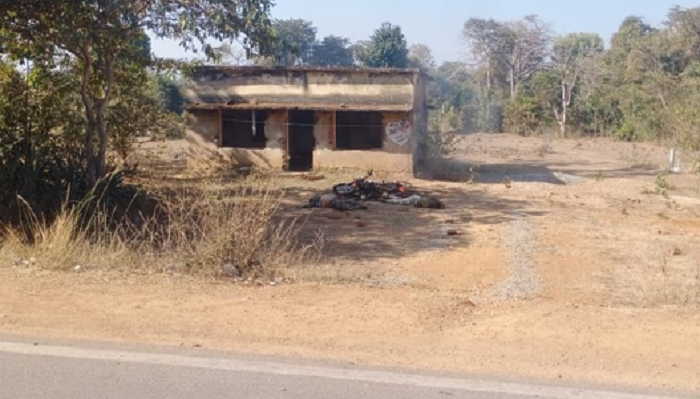
On Monday, two policemen lost their lives in an early-morning Naxalite attack in the Rajnandgaon region of Chhattisgarh. According to the joint ITBP-district force investigation, Naxals fired 20 rounds at Head Constable Rajesh Singh and another officer while they were on their way to work at the checkpoint between Chandsuraj and Bortalav. 

According to the reports, Singh was posted at the Bortalav Police Station. The event is said to have happened between 7 and 8 in the morning as the two officers were traveling on a motorcycle in the Bortalav police station area in the region close to the state of Maharashtra, confirmed Abhishek Meena, the superintendent of police at Rajnandgaon.

He said that the two were traveling from the Bortalav police camp to the Maharashtra border without any weapons. The two have been identified as head constable Rajesh Singh Rajput and Chhattisgarh Armed Forces constable Anil Kumar Samrat. 

The official stated that one of the personnel passed away immediately and the other succumbed to injuries while being rushed to a nearby hospital. He said that the Naxalites also set their motorcycle on fire before fleeing the area, which is 180 kilometers from Raipur, the state capital.

Several Naxal attacks have been reported from the state of Chhattisgarh in recent times. Recently, three BJP workers identified as Neelkanth Kakkem, Sagar Sahu, and Ramdhar Alami were murdered by the Naxalites in the month of February. Chhattisgarh BJP president Arun Sao raised the issue in the Lok Sabha and urged the Centre to direct the Chhattisgarh government to ensure the safety of the people. He said that the murders of BJP members were a result of targeted killings and political conspiracy.

In the current case, Abhishek Meena, the superintendent of police at Rajnandgaon confirmed the death of two policemen and said that a search operation is being conducted in the area to try and nab the accused.

Congress-Soros saga continues as Rahul Gandhi to give lecture at Cambridge, where Soros is a donor, to hold closed-door meetings about India-China relations

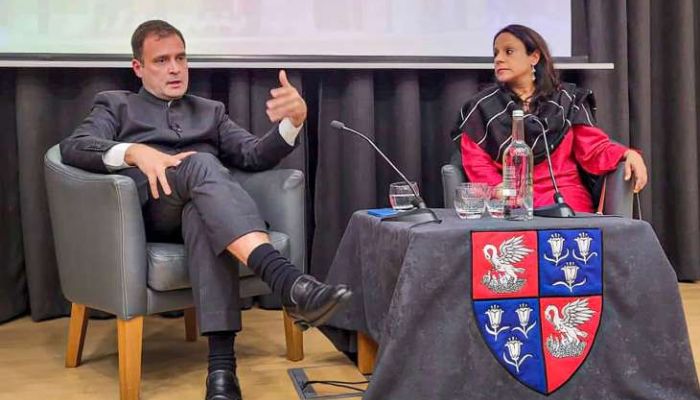
Congress scion Rahul Gandhi is scheduled to address the ‘Judge Business School’ of the University of Cambridge in the United Kingdom, later in February 2023.

In a tweet on Thursday (February 16), the business school informed, “Delighted to welcome back Rahul Gandhi to Cambridge University later this month. He will lecture on @CambridgeMBA and hold closed-door sessions on Big Data and Democracy and India-China relations, with Shruti Kapila…”

The archive of the tweet can be accessed here. Interestingly, Shruti Kapila is the same Congress apologist who had earlier urged Rahul Gandhi to hold ‘scripted interviews‘ for high-impact messaging.

The Congress scion acknowledged the tweet by ‘Judge Business School’ and wrote, “Looking forward to visiting my alma mater Cambridge University and delivering a lecture at CambridgeJBS.”

He further added, “Happy to engage with some of the brightest minds in various domains, including geopolitics, international relations, big data and democracy.”

As per the tweet by the Judge business school, Rahul Gandhi would hold close-door meetings about Indo-China relations. It must be mentioned that the Congress party had signed an MoU in 2008 with the Communist Party of China in Beijing to ‘exchange’ high-level information.

George Soros is connected to the University of Cambridge

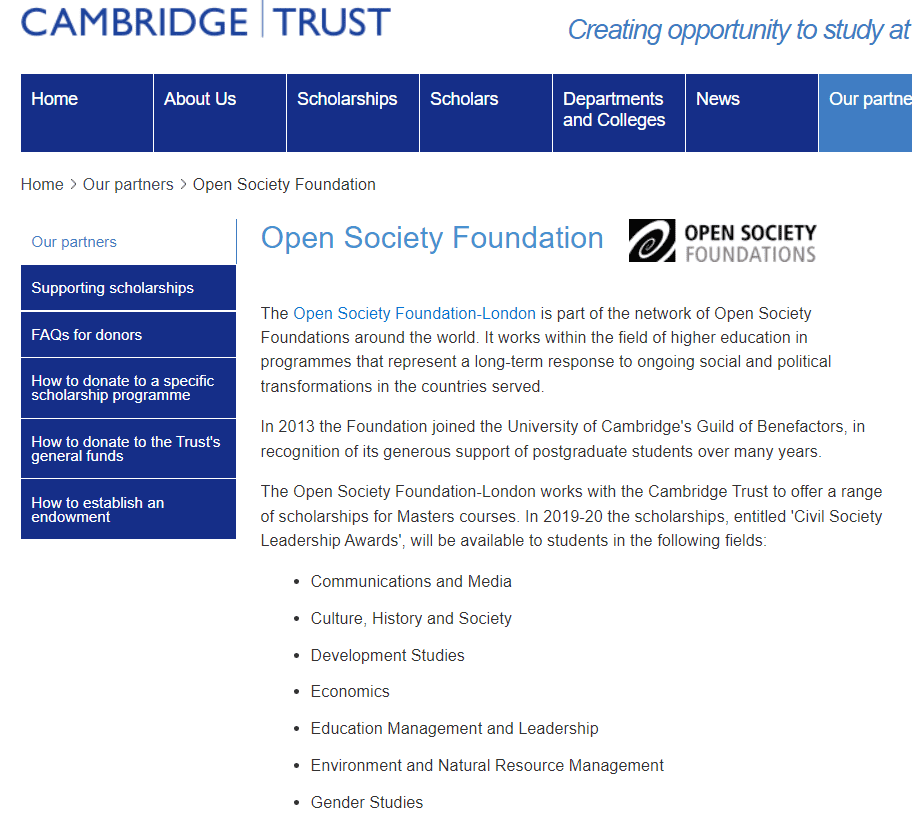
Coincidentally, the Open Society Foundations (OSF) of Hungarian-American billionaire George Soros is a member of the University of Cambridge’s Guild of Benefactors since 2013.

The foundation provides post-graduate scholarships in “programmes that represent a long-term response to ongoing social and political transformations in the countries served.”

OSF is a member of the University of Cambridge’s Guild of Benefactors since 2013.

Rahul Gandhi’s visit to the University of Cambridge, subsequent lecture at its business schools and closed-door meetings about India-China relations come at a time when Soros has targeted India and alleged collusion between the Modi government and the Adani Group. The Adani controversy is also being played up by Congress and their leaders, leading to people wonder if Congress is working in tandem with foreigners who might be interested in regime change with 2024 general elections right around the corner.

The nefarious anti-India agenda of the Hungarian-American billionarie

George Soros has several intellectuals on his payroll, including the former PM Manmohan Singh’s daughter Amrita Singh. Not to forget the curious case of ‘author’ and ‘social activist’ Harsh Mander who had been at the forefront of creating civil unrest during the Anti-CAA protests.

In 2018, George Soros-funded NGO, Sherpa, had attempted to thwart India’s defence deal with France and stall the delivery of Rafale fighter jets.

Moreover, Open Society Foundations (OSF) run by the billionaire had funded the Socio-Legal Information Centre (SLIC), which had been active in seeking the repeal of the sedition law currently used against anti-India elements.

In September 2019, George Soros also met Pakistani Prime Minister Imran Khan shortly after US President Donald Trump attended Narendra Modi’s ‘Howdy Modi’ event in Houston, Texas.

Interestingly, he is also friends with prominent Congressman Shashi Tharoor, who also happens to have a Pakistani connection. In 2021, there was a hullabaloo in India over allegations of snooping by the Modi government through the use of Israeli spyware, Pegasus.

These allegations stemmed from a report by the leftist-propaganda news outlet, The Wire, which in turn was fed the story by ‘Forbidden Stories (FS). Coincidentally, George Soros’ Open Society Foundations (OSF) happens to be one of the donors of the organisation.

eorge Soros had been unabashed in his attempt to fuel a dangerous anti-India narrative through media and ‘civil society. Organisations funded by him played a key role in creating chaos and unrest under the pretext of anti-farm law protests.

In 1999, the Open Society Foundation began activities in India by providing scholarships and fellowships to pursue studies and research at Indian colleges. Through the OSF, George Soros made significant contributions towards the spread of instability in India.

The Hungarian-American billionaire has also tried to use international institutions, which are funded by him, including Freedom House and  V-Dem (Varieties of Democracy) Institute to tarnish the image of India at a global level.

As India retains KL Rahul as opener for next two Tests against Australia, Venkatesh Prasad once again highlights his poor Test record

0

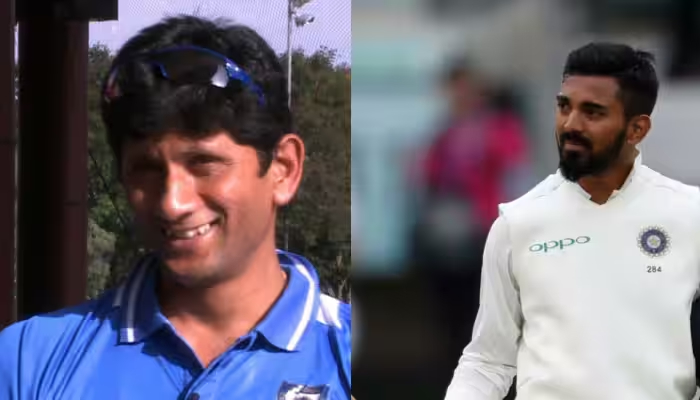
Former India seamer Venkatesh Prasad fired a fresh salvo at struggling India opener KL Rahul for his inconsistent performances in the longest format of the game, pointing out the batter’s modest overseas record and comparing it with home/overseas statistics of players such as Shikhar Dhawan, Mayank Agarwal, Shubman Gill and Ajinkya Rahane, three of whom have turned out for India as openers in Test cricket.

Rahul’s last century in Tests came in December 2021, against South Africa at Centurion. His horror run with the willow in international cricket continued in the second Test of the ongoing series for the Border-Gavaskar trophy, at Delhi’s Arun Jaitley stadium, as the right-hander could aggregate just 18 runs across two innings.

Chasing just 115 runs to take an unassailable 2-0 lead in the series, fans would have expected Rahul and Rohit Sharma to romp home without much hassle. However, Rahul fell to the spin of Nathan Lyon, who trapped him in front of the stumps for just one run.

“There is a view that KL Rahul has an outstanding overseas Test record. But stats speak otherwise. He has a test avg of 30 overseas in 56 innings. He has scored 6 overseas centuries but followed it up with a string of low scores that’s why averaging 30. Let’s look at a few others,” tweeted Prasad on Monday.

He brought up veteran Shikhar’s solid overseas records, pointing out his average of “nearly 40, with 5 100s”.

“Shikhar Dhawan has the best overseas average amongst recent openers. Avg of nearly 40 with 5 100’s. Though he too hasn’t been consistent in Test but had Outstanding centuries in SL and NZ, plus a much better home record,” the former India seamer wrote in another tweet.

He also brought up Mayank Agarwal, who as opener has fared exceedingly well in home conditions.

“Mayank Agarwal after the brilliant start in Aust did struggle in away test matches. But he has by far the best home record. Avg of nearly 70 in 13 innings,2 double 100’s & a 150 on a Wankhede pitch where everyone else struggled. Great against spin & had a prolific domestic season,” Prasad tweeted.

He further pointed out that young opener Shubman Gill averages 37 in his brief overseas run in Tests, with the knock of 91 against Australia at The Gabba in Brisbane being “one of the best overseas fourth innings”.

“Shubhman Gill has had a brief international career and in 14 overseas innings averages 37, with his 91 at Gabba amongst the best overseas 4th innings and has been in outstanding form,” he tweeted.

He also pointed to veteran Ajinkya Rahane’s overseas record, saying he averages “over 40 overseas in 50 Test matches”.

“And if overseas performance is a criteria, Ajinkya Rahane, despite being out of form and also inconsistent before being dropped had one of the best overseas Test record, averaging over 40 overseas in 50 test matches. Was out of form and dropped …,” the former India seamer added in another tweet.

He added that after being retained for the final two Tests of the ongoing series for the Border-Gavaskar Trophy, Rahul’s best chance of coming back to form is the third Test at Indore or else he should play county cricket, perform well and earn back his place in the national side.

“But with KL being retained for the remaining 2 test matches, if he is picked in the playing 11, Indore is his best chance of coming back to form and silencing critics like me. Else needs to play county cricket, perform well and make a comeback in the Test side,” Prasad tweeted.

The opener had a horror 2022. After missing nearly six months of action, Rahul blew hot and cold ever since Asia Cup 2022. He did score some half-centuries but drew criticism from fans and veteran India cricketers for his lack of attacking intent and inability to deliver in big matches.

Rahul played four Tests last year, aggregating 137 runs at an average of 17.12, with just one fifty. In 10 ODIs last year, he scored 251 runs at an average of 27.88, with two half-centuries and a best score of 73. In 16 T20Is in 2022, he scored 434 runs at an average of 28.93 and six half-centuries, with a best score of 62. Overall in 30 matches last year, he aggregated 822 runs at an average of 25.68, with nine half-centuries.

This year, he has scored a paltry 38 runs in three Test innings. Overall, he has totaled just 148 runs across five international matches at an average of 29.60, with one half-century and the best score of 64*.

India’s squad for the final two Test matches and three ODIs against Australia was announced on Sunday.

India’s Test squad for the third and fourth Test against Australia: Rohit Sharma (Captain), K L Rahul, Shubman Gill, Cheteshwar Pujara, Virat Kohli, KS Bharat (wk), Ishan Kishan (wk), Ravichandran Ashwin, Axar Patel, Kuldeep Yadav, Ravindra Jadeja, Mohd. Shami, Mohd. Siraj, Shreyas Iyer, Suryakumar Yadav, Umesh Yadav and Jaydev Unadkat.

India’s ODI squad against Australia: Rohit Sharma (Captain), Shubman Gill, Virat Kohli, Shreyas Iyer, Suryakumar Yadav, K L Rahul, Ishan Kishan (wk), Hardik Pandya (Vice-captain), Ravindra Jadeja, Kuldeep Yadav, Washington Sundar, Yuzvendra Chahal, Mohd. Shami, Mohd. Siraj, Umran Malik, Shardul Thakur, Axar Patel and Jaydev Unadkat.

(This news report is published from a syndicated feed. Except for the headline, the content has not been written or edited by OpIndia staff)

Guwahati: Woman kills husband and mother-in-law, chops them and stores in fridge, later dumps parts in mountains

While the investigation in the sensational Shraddha murder case continues, an even more sensational case of one dual murder has emerged from Guwahati. In this case, a woman killed her husband and mother-in-law 7 months ago, cut the bodies into pieces and stored them in a refrigerator, and later dumped the body parts. The incident came to light on 19 February after police arrested the accused Bandana Kalita.

She has confessed to the police that she killed her husband Amarjyoti Dey and mother-in-law Shankari Dey with the assistance of her lover and a friend on 17 August last year. She also told the police that after killing and chopping her husband and his mother, she along with her two partners dumped the body parts in the mountains of Meghalaya. While the investigation is in the preliminary stage, the motive of the crime was an extramarital affair and greed for property, according to police.

According to the reports, Amarjyoti Dey married Bandana Kalita a few years ago, and they were living in Narengi in the eastern part of Guwahati city. While the marriage lasted peacefully for some years, it turned sour after Amrjyoti discovered that Bandana was having an affair with a youth named Dhanjit Deka. This resulted in frequent fights between the husband and wife.

On the other hand, Amarjyoti’s mother Shankari Dey owns five buildings in the Chandmari area in the middle of the city. She lived alone in one of the houses, while the other four are given on rent. The rents for these buildings are collected by Shankari Dey’s brother, as he manages her finances. Bandana was not satisfied with this arrangement also.

As the marital dispute grew over these issues, Amarjyoti and Bandana were preparing for a divorce. But seven months ago, Bandana lodged a complaint with the Noonmati Police station saying that her husband and mother-in-law have gone missing. The police started a probe based on the complaint, but could not find them or any clue about their whereabouts.

After some time, Bandana filed another complaint, alleging that Shankari Dey’s brother was misusing money kept in the five bank accounts of Shankari Dey. However, this proved to be a mistake for her. When police looked into the bank accounts, they found that Bandana Kalita herself had withdrawn Rs five lakh from her mother-in-law’s bank account by using ATM cards. This led to police suspecting her, and after receiving more evidence against her following further probe, they arrested her on 17 February.

During the police interrogation, Bandana finally confessed to the crime yesterday. She told police that on 17 August, she had killed Shankari Dey in her house in Chandmari with the help of a youth named Arup Das. After that, they chopped the body into pieces and kept the body parts in the fridge.

Then on 21 August, Bandana Kalita killed her husband with the help of her lover Dhanjit Deka by strangulating him. Then they cut his body also in pieces and stuffed the body parts in polythene bags. After that, the other partner Arup Das joined them, and they collected the body parts of Shankari Dey.

They drove towards Meghalaya and dumped the parts in deep gorges at the Dawki area near Cherapunji. After that, she returned to her house and cleaned the crime scene. Neighbours said that they saw her burning mattress and clothes on the terrace of the house on that day.

After the murders, Bandana Kalita was staying with her parents at their house in the Panikhaiti area in Guwahati, from where she was arrested. Following the confession of Bandana Kalita, Dhanjit Deka was arrested from Tinsukia and Arup Deka was caught at Khanapara in Guwahati.

A large police team moved to Meghalaya to locate the remains of the victims, and some body parts have been recovered from Dawki. According to reports, the headless body of Shankari Dey has been recovered, along with some blankets and clothes in a polythene bag. The hand and the head of the body are missing. The body of Amarjyoti Dey is yet to be located.

Slogans of ‘Jai Bhavani, Jai Shivaji’ echo in the UK as Indian students celebrate Shiv Jayanti at Parliament Square in London

0

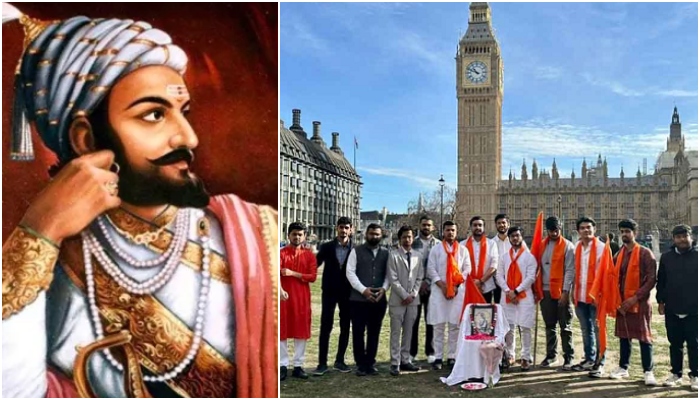
On Sunday, while the state of Maharashtra enthusiastically celebrated Shiv Jayanti, the birth anniversary of Chhatrapati Shivaji Maharaj, the cries of ‘Jai Bhavani, Jai Shivaji’ could also be heard in the United Kingdom as several Indian students studying in London celebrated Shiv Jayanti with great zeal and warmth.

Adv Sangram Shewale, who shifted to London for his further studies gathered Indian students and celebrated Shiv Jayanti at London City Parliament Square. Several students from Queen Mary University, Soyas University, and the London School of Economics gathered and remembered the founder of Hindavi Swarajya, Chhatrapati Shivaji Maharaj.

The students, dressed in white and orange scarf could be seen raising slogans like, “Jai Bhavani, Jai Shivaji”, and “Jai Jai Shivrai” in the City Parliament Square, the video of which went viral over the internet.

Shivaji Maharaj was born on February 19, 1630, at the Shivneri fort in the Junnar Taluka of Maharashtra’s Pune district. His father, Shahajiraje Bhosle, was a commander of Ahmednagar’s Nizamshah. Rajmata Jijabai, his mother, instilled dharmic and patriotic ideals in him since infancy. She nurtured him by telling stories from the Ramayana and Mahabharata and also instilled in him the characteristics of heroism and morality.

She taught her son, Shivba (as a child) the importance of Shastra and Shaastra. Shivaji Maharaj then happened to swear his oath at the temple of Rayareshwar at the age of 16 to build a Hindu state as the supreme Lord intended.

By 1659, Shivaji Maharaj had taken control of several forts in both the Adilshahi and Nizamshahi kingdoms. He also killed Adilshahi commander Afzal khan who was sent by the Adilshahi court to assassinate him. This left Islamic rulers terrified and they started recognizing Shivaji Maharaj’s valor and became fearful of him.

Shivaji Maharaj, while on his mission to establish Hindavi Swarajya, recaptured lost Maratha areas and reclaimed around 350 forts that were illegally grabbed and controlled by the Mughal sultanate. On June 6, 1674, he was coronated as the first Chhatrapati of the Hindavi Swarajya with Hindu religious ceremonies. He then built a powerful and progressive state on the strength of a disciplined army and a well-organized administrative system.

The Indian students in London remembered the courage and valor of Chhatrapati Shivaji Maharaj and paid homage to him on his 393rd birth anniversary. “Scholars from many countries come to India to study all these things and this is the tradition of Maharashtra and we paid tribute to Shivaji Maharaj at Parliament Square in London,” informed Adv Shewale who organized the event at the London City Parliament Square yesterday.

Local reports mention that Omkar Kokate, Darishsheel Kale, Vinayak Garje, Adv Deepak Chatap, and Dr Rishikesh Andhalkar aided Adv Sangram Shewale in organizing the event in London.

AIMIM chief Asaduddin Owaisi claims stones pelted at his house in Delhi, here is what we know

0

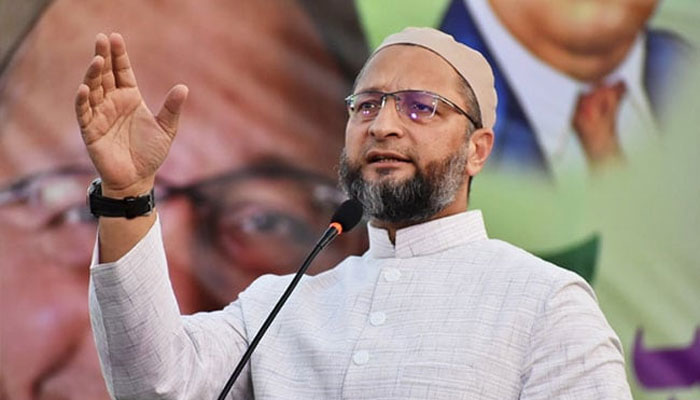
Asaduddin Owaisi, the head of All India Majlis-E-Ittehadul Muslimeen (AIMIM), claimed, that late on Sunday night unknown intruders threw stones at his Delhi residence, breaking its windows. “This is the fourth incident since 2014,” he added in his tweet. His domestic help informed him that his house had been stoned by anonymous miscreants when he returned from Jaipur late at night.

The incident occurred at his Delhi home in the Ashoka Road locality from around 5:30 to 6 in the evening. “It’s concerning that this has happened in a so-called ‘high security’ zone,” the member of Parliament, from Hyderabad, stated in another tweet. He also informed that a complaint has been registered with the Delhi Police. Police officers can be seen collecting evidence and conducting their investigation in the video.

Owaisi in his complaint to Parliament Street Police Station wrote, “I reached my residence at 11:30 pm. Upon returning I found the glass of the windows broken and stones/rocks lying around. My domestic help informed that a group of miscreants threw stones at around at the residence around 5:30 pm.”

It continued, “This is the fourth time such an attack has taken place. The area surrounding my house has enough CCTV cameras, and the same may be accessed, and the culprits should be apprehended immediately. It is conceived that such acts of vandalism are happening in such a high-security zone.”

The complaint concluded by saying, “Immediate action must be taken, and the culprits should be arrested at the earliest.”

Senior police officials reported, that a team, led by an Additional deputy commissioner of police, was dispatched to Owaisi’s house immediately, and the inquiry into the matter had already begun. Furthermore, a crime unit was deployed to gather samples and examine CCTVs.

“We have received a complaint and are registering an FIR. The vandals will be identified soon. They came in the evening and pelted stones. They left within a few minutes,” said an officer.

Pakistan: Lecturer asks students to write an essay on ‘Is it ok for brother-sister to have sex’, university fires him after uproar on social media

0

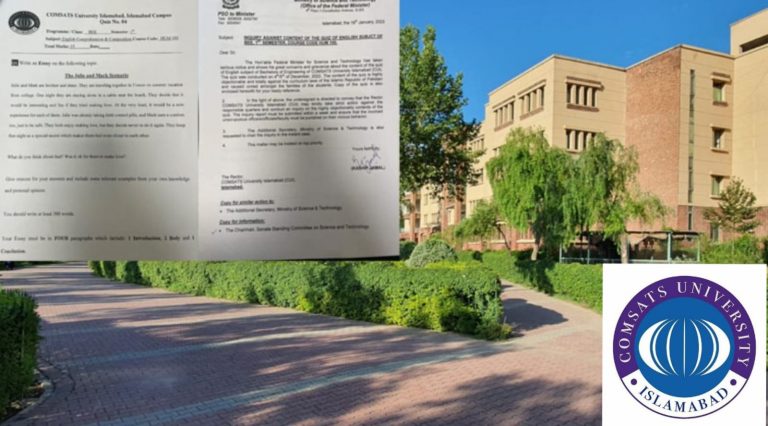
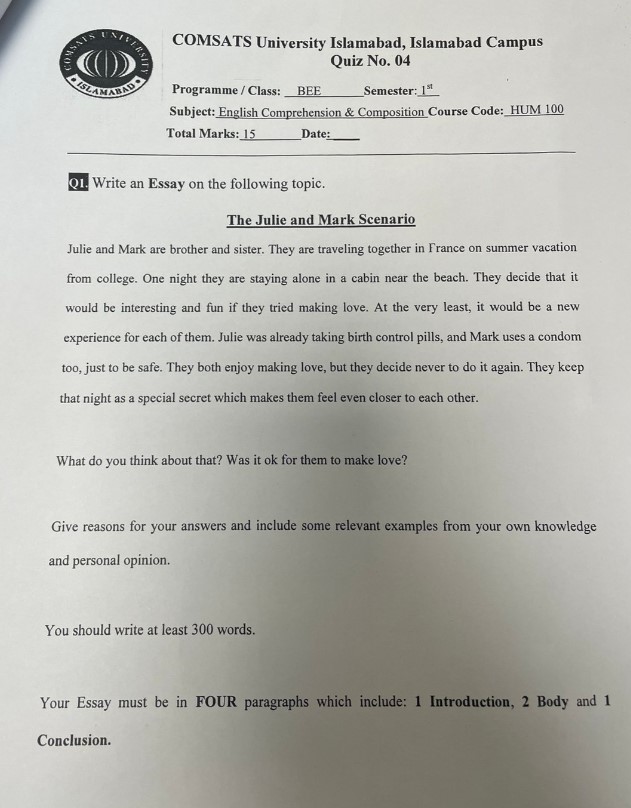
COMSATS Univesity in Islamabad, Pakistan, has come under fire after one of its faculty members encouraged students to write an essay on incestuous relationships. The uproar arose after a picture of the university test paper went viral on social media.

The question paper asked students to write an essay about the incestuous relationship between a brother and a sister. The images of the paper spread like wildfire on social media platforms, with netizens demanding strict action against the teacher.

Screenshot of the question paper (Source: @ShehryarReal)

Following the uproar, the university administration informed the Ministry of Science and Technology that the services of a faculty member who had asked the contentious question in the English composition exam had been terminated.

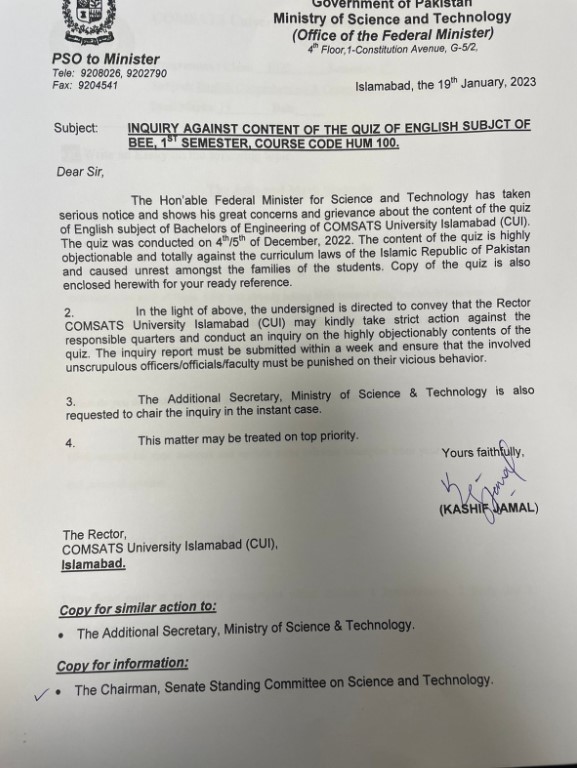
In a letter dated February 2,  the university said, “[An] inquiry against the content of the quiz of English Subject of BEE, 1st Semester Course Code HUM 100. I am directed to refer to the Ministry of Science and Technology letter dated January 19, 2023, on the above subject and convey that action on the matter has already been taken and the service of the Lecturer (visiting faculty) has been terminated with effect from January 5, 2023.” It further said that faculty member has also been blacklisted.

The university responded after Pakistan’s Ministry of Science and Technology took note of the offensive content of the BEE quiz. “The content of the quiz is highly objectionable and totally against the curriculum laws of the Islamic Republic of Pakistan and caused unrest amongst the families of students,” read the letter sent to the varsity by Pakistan’s Ministry of Science and Technology on January 19, 2023.

The copy of the letter sent to the University by Pakistan’s Ministry of Science and Technology (Source: @ShehryarReal)

The ministry demanded that the institution initiate an investigation and take stern measures against those guilty. The ministry had given the university administration a week to submit the inquiry findings to them.

According to reports, Assistant Registrar Naveed Ahmed Khan acknowledged that a “very unpleasant question” was asked to BEE English Composition students.

He claimed that the rector held a meeting the next day and requested the faculty member to explain why he had asked such a “stupid question” to students. He stated that the faculty member admitted his mistake and that the CUI terminated his services.

“What else could we do? His services were terminated, and the quiz was retaken,” he stated, adding that the faculty member plagiarised the question from Google.

Lahore University students celebrate ‘Bollywood Day’, get slammed by Pakistanis for showing love for India

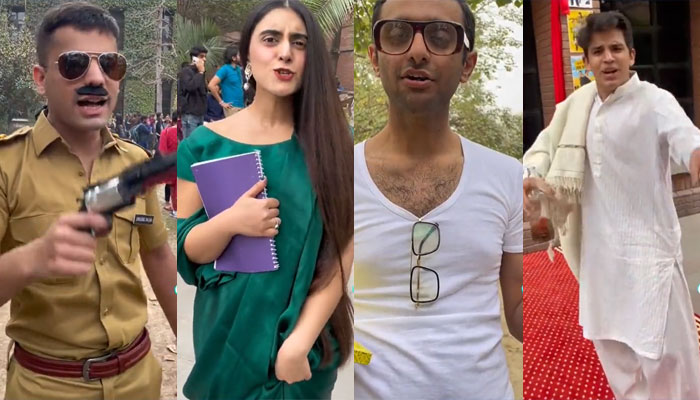
On February 19, Lahore University of Management Sciences (LUMS) celebrated ‘Bollywood Day’, where students dressed as “iconic” characters from Bollywood films. The Photography Club of LUMS (Photolums) shared a compilation video of the event on TikTok, where it went viral on other social media platforms. From iconic Baburao from Hera Pheri to Devdas, students were seen having a fun day at the University.

However, not everyone in Pakistan was pleased with students celebrating Bollywood. Twitter user RAShahzaddk said in Urdu, “LUMS, the most elite University of Pakistan, which has produced a large number of students, is promoting Indian civilisation, Bollywood Week is being celebrated, see the scenes yourself. We were told how to protect children from a free environment in Europe while the Islamic environment is in front of you in the state of Medina.”

In a video, one Malik Ali said, “Our friendly nations are questioning what we have to compare their best IT Universities. We proudly tell them we have LUMS. The same LUMS that celebrated Bollywood Day. The same Bollywood that is the film industry of an enemy nation and ridicules us in every other movie.”

Twitter user Amir Awan criticised LUMS students and shared Hadith Dawood 4031 to support his views. As per Dawood 4301, “He who copies anyone is one of them”.

Twitter user Kabeer said, “Why do students from LUMS look & act like that? No Naheed, you don’t have to dress up as a churail for “Bollywood Day”, you’re already a churail [witch].”

Twitter user Usmanmaalik17 said, “This University’s name should be changed from LUMS to DUMBS.”

Indian movies are very popular in Pakistan. Recently, some Pakistanis were seen on social media declaring their eternal support for Shah Rukh Khan and Pathan movie. There is a considerable section of Pakistanis, including former PM Imran Khan, however, who think that Pakistanis should stop watching Bollywood and instead get inspired by products of Turkish entertainment industry, like Ertugrul.