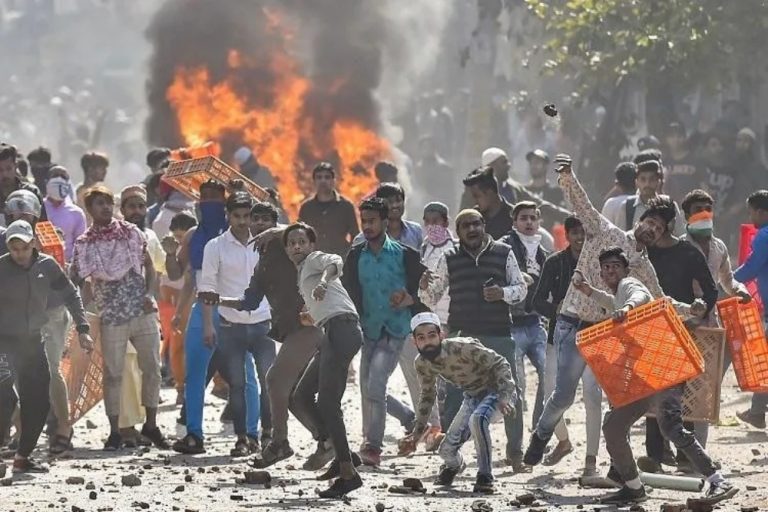
On the 30th of January 2022, Karkardooma Court in Delhi extended the ‘benefit of the doubt’ to 9 Muslim accused in the Delhi anti-Hindu Riots and acquitted them from charges of rioting, arson and illegal assembly. They were accused of setting a shop and house on fire during the riots and police charge-sheeted them for committing offences punishable under Sections 147-149, 188, 427 and 436 IPC.
The acquitted persons are Mohd. Shahnawaz alias Shanu, Shahrukh, Mohd. Shoaib alias Chhutwa, Azad, Md. Faisal, Rashid alias Raja, Ashraf Ali, Parvej and Rashid alias Monu.
At the hear of it, the Judge held that the testimony of a sole witness cannot suffice in this case to convict the 9 accused and therefore, acquitted them giving them the benefit of the doubt.
While the wisdom of the court must be respected, the judgement raises a question about the law being applied unequally in different cases. Only a few months ago, a Hindu accused, Dinesh Yadav, was convicted on the basis of the shaky testimony of two police officers who were on riot control duty in the area. In fact, from their statements themselves, it was evident that there was no evidence against Yadav whatsoever.
As Dinesh Yadav was convicted and sent to jail for 5 years, based on a different interpretation of Section 149 IPC, Muslim accused of the murder of Dilbar Negi were given bail. This, coupled with the judgement acquitting the 9 accused recently, makes it imperative for us to analyse whether the law is being applied equally in different cases pertaining to Delhi anti-Hindu riots 2020.
In order to do that, we first need to analyse the basis on which the Karkardooma court acquitted the 9 accused recently.
Brief facts of the case: What had happened
On the 28th of February 2020, an FIR was filed on the basis of a written complaint received by the Gokulpuri police station. The complaint, drafted on the 27th of February 2020, was by one Yatender Kumar Sharma. In his complaint, he said that his shop in the name of “Priyanka Copy House” was burnt down on the night of the 25th of February 2020. On the 28th of February, the complaint was endorsed and a case was registered under Section 147/148/149/427 IPC.
On the 7th of March 2020, Priyanka Copy House was inspected by the police. A site plan was readied and the crime team was called, which collected several pieces of evidence and took several photographs of the site as well. After discussion, section 436 IPC was added to the case. Section 436 pertains to “Mischief by fire or explosive substance with intent to destroy the house, etc”.
Further, the investigating officer (IO) questioned the two witnesses in the case – Ct. Vipin and HC Hari Babu. It was the two witnesses who named the accused persons in their statements.
The order says, “IO came to know about the arrest of accused persons by crime branch and he formally arrested accused Mohd. Shahnawaz @ Shanu, Mohd. Shoaib, Shahrukh and Rashid, from Mandoli Jail, Delhi, on 15.04.2020. On 16.04.2020, accused Azad, Ashraf Ali and Parvez, were formally arrested in Mandoli Jail. Accused Faisal and Rashid @ Monu were arrested in Tihar Jail on 20.04.2020. During the further course of the investigation, more witnesses including PCR callers were examined”. This means that the accused were already in jail in another case and they were subsequently also charged in the present case.
After the investigation was completed, it was on the 13th of July 2020 that a chargesheet was filed in the present case. On the 22nd of December 2020, the Karkardooma Court took cognisance of the case. The case was committed to the sessions court on 14th January 2021. On 18th October 2021, the first supplementary chargesheet was filed before Link MM (North East), Karkardooma Courts, Delhi, along with a complaint under Section 195 Cr.P.C and other documents. This supplementary chargesheet was also sent to this court. Subsequently, one more supplementary chargesheet with an additional charge for an offence under Section 380/454 IPC, was filed before this court directly.
On the 6th December 2021, charges were framed against the accused in the following terms:
“’That from 24.02.2020 to 26.02.2020 at Main Road, Chaman Park, Shiv Vihar Tiraha, Delhi within the jurisdiction of PS Gokalpuri, all of you from a particular community formed an unlawful assembly, the object whereof was to commit robbery and arson in the properties of the persons from other community by use of force or violence in the prosecution of the common object of such assembly and committed rioting and you all knew being members of the aforesaid unlawful assembly that an offence was likely to be committed in prosecution of that common object and thereby committed offences punishable under Section(s) 147/148 read with Section 149 IPC and within my cognizance. Secondly, on 25.02.2020 at around 9 a.m.onwards, you all being members of unlawful assembly in furtherance of your common object entered into property *address retracted*, belonging to complainant Yatinder Kumar Sharma and dishonestly removed the various articles lying therein and thereafter also committed mischief by fire or explosive substance with the intent to destroy the aforesaid shop and thereby committed an offence punishable under Section 424/436 IPC to read with Section 149 IPC and within my cognizance.”
The charges further said”
“That, from 24.02.2020 to 26.02.2020 and particularly on 25.02.2020 at and around 9 a.m. at and around the area of the main road, Chaman Park, Shiv Vihar, Delhi, within the jurisdiction of PS Gokalpuri, you all accused persons being a member of an unlawful assembly along with your other associates (unidentified) were present at the aforesaid place, in the prosecution of the common object of an unlawful assembly and in violation of the proclamation issued u/s 144 CrPc by the competent authority/DCP, North East vide order dated 24.02.2020 bearing no.10094-170 X-1, North East, Delhi dt.24.02.2020, which was duly announced in all the localities of District North East including the area of PS Gokalpuri, thereby you all committed an offence punishable under Section 188 IPC and within my cognizance.”
What did the accused, acquitted by the court in this case of the Delhi anti-Hindu Riots, say in their defence
As is the case with all accused, the 9 of them denied the charges summarily. The order says, “All accused persons denied all the allegations and pleaded innocence, taking the plea that they were not present at the spot and they have been falsely implicated in this case. They also took plea that their name was implicated in this case just to work out the case. Accused persons did not opt to lead any evidence in their defence”.
It is pertinent to note here that even the order acquitting them says that the accused did not proffer any evidence to defend themselves.
- Defence for Mohd. Shahnawaz @ Shanu, Parvez and Azad: They said that there were only two witnesses who identified the accused. He said that the information, that they saw the accused at the spot, was not communicated to the IO earlier. Further, he argued that these witnesses were planted by the police. It was further argued that one of the witnesses did not identify the accused in another FIR filed but identified the accused in this case, and therefore, the testimony was not reliable.
- Defence for Rashid @ Raja, Shahrukh and Shoaib @ Chhutwa: The argument made in this case was bizarre, to say the least. The defence argued that the police officer inspecting the site and the photographer did not confirm the address of the place visited and that the witnesses were planted by the police. That the two witnesses who saw the crime take place did not file a complaint or inform the IO of this information. It was further argued that before examination in the court, the time of the incident was not disclosed in any document and that it is not possible to identify 4-5 persons from the mob of 400-500 persons.
- Defence for Mohd. Faisal, Ashraf Ali and Rashid @ Monu: Same arguments were made.
It is pertinent to note here that none of the Defence teams actually presented any evidence to prove the innocence of the accused. There are several ways that the defence counsel could have done that. One of the ways would be to submit CDR to prove that the accused were not at the spot where the mob was to prove their innocence. Other would be to get witnesses to prove their location. However, none of this was done by the Defence. The only line of argument taken was conjecture.
What the lead prosecution argued
The prosecution argued that two witnesses had identified all the accused and that one witness not identifying the culprits in another FIR should have no bearing on the current case. He further argued that the time of the incident was mentioned in the statement under Section 161 Cr.P.C. of PW9 and PW10 (Public Witness 9 and 10). He further argued that there cannot be fixed parameters for all persons to identify persons in a mob. About one of the witnesses who gave a different statement in a separate FIR, the prosecution said that he had mentioned he was unwell and was suffering from memory loss and therefore, he should not have been examined when he was unwell in that case.
What the court said about the incident of arson during Delhi anti-Hindu Riots
- The testimony of the complainant about his house and shop being burnt to ashes has remained unchallenged by the defence. The judge, after examining all the evidence, conceded that the incident of arson and rioting actually did take place.
- The court said that the photographs of the burnt property were accurate. The defence had alleged that the photographs cannot be considered evidence because the photographer did not confirm the location with the complainant – the court did not agree with this submission. The court said, “I do not find any need for these witnesses to verify the address of the scene of the crime from other sources. They were called there by the IO and a particular of the place was to be furnished by the IO. Secondly, the photographs show that there was already a board showing address of this place. Neither is there any suggestion that such board was falsely put there nor do I find any material on the record to show that photograph of a different place was taken by PW4”.
It is therefore clear to the court that the incident of rioting, unlawful assembly and arson actually did take place – as the court mentioned in its order. The court said, “On the appreciation of all this evidence I come to the conclusion that there was an unlawful assembly, which vandalized and set on fire the property bearing *address redacted* on 25.02.2020 somewhere around 05:00-06:00 PM”.
The main question – what the court said about identification of the accused and the standards it applied to acquit the accused
For the purpose of identification of the accused, there were two main witnesses who were of consequence and both were police officers – PW 9 and PW 10 (Public Witness).
The case of PW 10
PW10 vouches that he was on duty in the area along with PW9. He identified the accused Shahnawaz and Azad, saying that he knew them from before. He identified other accused persons also in the court, stating that he knew them by their faces, but he did not know their names, except that of Ashraf Ali.
This witness identified several of the accused in the current case (FIR 83). But, when he was examined in connection with FIR 40 earlier, where the accused persons were the same, he said that he could not identify some of them because he was suffering from memory loss and was taking medicines for the same. The court said that there was a difference in these two versions and therefore, his testimony cannot be relied upon.
The case of PW 9
The court said that after not relying on the testimony of PW 10, the only witness that remained was PW 9. The court first and foremost dismissed the notion of the defence that this witness was planted and said it found no evidence to support this claim.
The court then cited two cases Masalti v. State of U.P., AIR 1965 SC 202 (which it said applies to this case) and State of Maharashtra v. Ramlal Devappa Rathod, (2015) 15 SCC 77 (which it said ratifies the observations in the previous case mentioned).
In the Masalti case, the court cited a portion that pertained to how many witnesses were needed to identify the accused from a mob. The lawyer, in this case, argued to the High Court that the credible testimony of one witness should also be enough as opposed to the questionable testimony of a dozen witnesses, saying that applying the test that 2 or 3 or more witnesses were needed is a mechanical test that does not make much sense. The court said that the test might be mechanical “but it is difficult to see how it can be considered irrational”. “
“If at all the prosecution may be entitled to say that the seven accused persons were acquitted because their cases did not satisfy the mechanical test of four witnesses, and if the said test had not been applied, they might as well have been convicted. It is, no doubt, the quality of the evidence that matters and not the number of witnesses who give such evidence. But sometimes it is useful to adopt a test like the one which the High Court has adopted in dealing with the present case“, the High Court had held in the Masalti case.
This, the judge in the present case said applies – essentially saying that the testimony of one witness would not suffice in this particular case and the test, that the identification should be consistent and done by multiple witnesses should be applied.
Talking about the State of Maharashtra v. Ramlal Devappa Rathod, (2015) 15 SCC 77 case, the court in this case spoke about two aspects:
Deciding the culpability of those who were a part of the illegal crowd but did not necessarily commit a direct offence: The Supreme Court in the Ramlal Devappa Rathod case had said the vicarious culpability of the accused can be ascertained depending on the facts of the circumstances. For example, if 5 people storm into a house and only a few of them are armed, the others, who are not armed, are also guilty. However, when the crime is committed by a large crowd, it may be difficult to ascertain the common objective held by those who were a part of the mob but did not necessarily commit a direct crime. And it is in such cases, that the test applied in the Masalti case must be applied.
“We do not find anything in Masalti [Masalti State of U.P., AIR 1965 SC 202 : (1965) 1 Cri LJ 226 : (1964) 8 SCR 133] which in any way qualifies the well-settled principle that the conviction can be founded upon the testimony of even a single witness if it establishes in clear and precise terms, the overt acts constituting the offence as committed by certain named assailants and if such testimony is otherwise reliable. The test adopted in Masalti [Masalti v. State of U.P., AIR 1965 SC 202 : (1965) 1 Cri LJ 226 : (1964) 8 SCR 133] is required to be applied while dealing with cases of those accused who are sought to be made vicariously responsible for the acts committed by others, only by virtue of their alleged presence as members of the unlawful assembly without any specific allegations of overt acts committed by them, or where, given the nature of assault by the mob, the Court comes to the conclusion that it would have been impossible for any particular witness to have witnessed the relevant facets constituting the offence. The test adopted in Masalti [Masalti of U.P., AIR 1965 SC 202 : (1965) 1 Cri LJ 226 : (1964) 8 SCR 133] as a rule of prudence cannot mean that in every case of mob violence, there must be more than one eye witness”, the SC had observed.
Depending on these observations by the Supreme Court, the Judge in the present case said that though the court has said that direct crime is not a necessary ingredient for conviction under Section 149, the SC has said prudence must be used in such cases (where no direct crime has been committed but the accused were part of the mob). It admits that this was mentioned as a “precaution” and not a “hard and fast rule”.
The court’s conclusion acquitting the 9 Muslim accused in a case of arson and rioting during Delhi anti-Hindu Riots
The court said that PW9 said that he knew some of the accused and identified them, however, he did not bring it to the notice of his seniors even though there were regular briefings at the police station.
The court said:
PW9 had though knowledge of the names and particulars of the accused persons, but he did not take any steps to formally get this information recorded, before 07.04.2020. In his cross examination, PW9 conceded that there had been briefing in the police station every day, which was attended by him as well as IOs. Still, the knowledge about involvement of the accused persons were not formally recorded anywhere, till 07.04.2020. PW9 stated that he had orally informed his senior officers about informations with him, after about a week or 15 days from riots. No explanation has been offered for such delay in passing on such a crucial information to senior officers by this witness. Moreover, if actually such information was given to the senior officers, then what prevented the senior officers to get such information recorded in formal manner.
Keeping this in mind, the court, in its wisdom decided to give the “benefit of the doubt” to the 9 accused and not reply on the testimony of PW9 alone (essentially saying that to convict these accused, it would need to testiomony of more than 1 witness).
“In such situation, accused persons are given benefit of doubt”, said the court.
Concerning inconsistency by the Court in three cases – Dinesh Yadav convicted, accused in Dilbar Negi murder given bail, 9 accused in this case acquitted
There are three cases in question here. The present case where 9 accused were acquitted, the case of Dinesh Yadav, where he was convicted and the case of Dilbar Negi murder, where the accused were given bail.
In all these three cases, section 149 is at the heart of it and in all three cases, the section has been interpreted differently.
Section 149 basically says that even if a person is not committing violence but is a part of an illegal assembly creating violence and if he has the intention to further the same illegal goal of the illegal crowd, he should be held liable
Let us understand how it was interpreted in the previous cases.
Conviction of Dinesh Yadav
In the case of Dinesh Yadav, the lady whose house was vandalised and burnt down, Manori, was not present in her house when the incident took place. Her sons, Ashiq and Asif could not recognise the mob at all, let alone Dinesh Yadav. The police personnel, Vipin and Sanoj, named Dinesh because they saw him in the vicinity of the mob. They have admitted that Dinesh was in no way involved in the violence. They said they him with a wooden danda, however, no such danda was recovered from Dinesh. In fact, there was no incriminating material found on his person.
The court in its wisdom said that even though there is no evidence to suggest that Dinesh was involved in the violence, he was a part of the mob and therefore, assumed his intention to further the common goal of the illegal mob – vandalise and commit violence against Muslims.
The court predicated this conclusion on two factors – a) Section 149 applies, which basically says that even if a person is not committing violence but is a part of an illegal assembly creating violence and if he has the intention to further the same illegal goal of the illegal crowd, he should be held liable, b) the mob was Hindu and since he was Hindu too, it can be assumed that he wanted to further the same cause as that of the rest of the mob.
A comprehensive analysis of the judgement convicting Dinesh Yadav can be read here.
Bail to the Muslim accused in the case of Dilbar Negi, murdered by mob during Delhi anti-Hindu riots
On January 18th, the Delhi High Court granted bail to six persons named Mohd Tahir, Shahrukh, Mohd Faizal, Mohd Shoaib, Rashid and Parvez in the Gokulpuri murder case related to the Delhi Riots of February 2020. The bail was granted by Justice Subramonium Prasad. The six were accused of vandalism and setting Anil Sweet Corner on fire “resulting in the death of 22-year-old Dilbar Negi”.
The judgement by the court said that during the course of the investigation, two CCTV footage were discovered by the police. One from the corner wall of the school covering the sweet shop between Rajdhani Public School and Anil Pastry Shop, and another inside Rajdhani School near the main entry gate. The judgement said that though the murder of Dilbar Negi was committed on the 24th of February, the FIR was filed on the 28th of February and the charge sheet in the case clearly states that the murder was a part of a well-hatched conspiracy. For the uninitiated, Dilbar Negi’s hands and legs were chopped off by the murderers and he was then burnt alive.
The judgement states:
The chargesheet additionally states that the CDR of the Petitioner places him at the location of the scene of the crime. Further, the statement of Amit Pal under Section 161 Cr.P.C. ascertains that the Petitioner was in front of Rajdhani Public School, raising slogans against Hindus and provoking a crowd of Muslim boys. It states that the Petitioner was involved in pelting stones and setting fire to the shops. A perusal of the video footage shows that the Petitioner was seen on the CCTV camera of CP IP Cam at 03:41:59 PM which shows him before Rajdhani Public School on the day of the incident. It indicates the Petitioner herein calling out to others present in the mob.
In this case, it is important to keep in mind that there was actual evidence in this case that placed the accused as a part of the mob – CCTV footage and witnesses. However, the court in this case took an exception to Section 149 IPC.
In the case where Md Tahir and others were given bail, the court also interpreted Section 149 but in a manner diametrically opposed to the interpretation used by the court in the Dinesh Yadav case.
In the case of giving bail to the Muslim accused in the Dilbar Negi case, the court said categorically that “…clear finding needs to be given by the Court regarding the nature of an unlawful common object. Furthermore, if any such finding is absent or if there is no overt act on behalf of the accused, the mere fact that the accused was present or armed would not be sufficient to prove common object”.
It went so far as to say that the court has to be circumspect of the personal liberty of individuals and therefore, granting bail is the norm that the court must follow. One has to also bear in mind that in the case of the Muslim accused, the court judgement says that there are over 70 witnesses to examine.
Even if we keep in mind that the case of Dinesh Yadav was that of rioting and the case of Tahir and others was that of murder, the fact remains that Section 149 was interpreted in diametrically opposite ways in both these cases.
A comprehensive report analysing the conviction of Dinesh Yadav and bail to accused in Dilbar Negi case can be read here.
How do the two cases measure up in the current case in the Delhi anti-Hindu Riots trial, where 9 accused were acquitted
In the present case, the court, as explained above, extended the benefit of the doubt to the 9 accused while acquitting them, citing SC observations to say that in his wisdom, the judge thinks that to convict the 9 Muslim accused, more than 1 witnesses would be needed. To come to this conclusion, he says that if there is direct evidence that a crime could have been committed by the accused, then 1 witness is sufficient, however, if the case is one where a common object needs to be proved, then the burden of proof essentially increases and 3-4 witnesses with solid proof has to be relied upon.
If this is to be considered sacrosanct, one has to ask why the same benefit of the doubt was not extended to Dinesh Yadav and why this parameter was not considered while granting bail to Tahir and others in the Dilbar Negi case.
In the Dinesh Yadav case, the complainant and her family were declared hostile witnesses since they changed the version of their statement in court. There were two witnesses, both police officers, who on record said that they had no evidence to prove any wrongdoing on the part of Dinesh Yadav. The court held that simply because he was a Hindu, and the mob was comprised of Hindus as well, he “must be” guilty. A conclusion is essentially drawn on the basis of presumption, rather than evidence.
If Dinesh Yadav’s conviction is to be considered an accurate application of the law, the same standard should have been applied to the other two cases. In the present case, since the accused were Muslim and the court itself admitted that the incident of mob violence actually did take place in the area, their guilt should have been assumed on the basis of identification by PW 10 and PW 9. However, the Court chose to rely on different observations of the Supreme Court to declare them innocent.
Similarly, in the case of Tahir and others, accused in the Dilbar Negi murder, the fact that Anil Sweets was vandalised and Dilbar Negi was murdered by a Muslim mob is not disputed. To add to that, there is CCTV footage of the accused and over 70 witnesses that need to be examined. In this case, the court interpreted section 149 in a completely different manner to grant bail to the accused, going so far as to say that even if the accused are a part of the mob and are holding weapons and there is evidence and witnesses proving these facts, it cannot be assumed that they are guilty – and this observation was made at the time of giving bail, not even deciding the merits of the case.
The following questions therefore emerge as far as Section 149 is concerned:
- Is a shaky testimony of 2 witnesses, who go on record to say that there is no direct evidence against an individual sufficient to convict an individual as being a part of the mob and sharing the criminal objectives of the mob itself by virtue of the fact that the accused belonged to the same religion as the mob?
- If it is, why in the case of Tahir and others, did the court say that even if there is evidence of the individuals holding weapons, it is not enough to prove a common objective as per Section 149?
- If the second interpretation as used in the Dilbar Negi case is true, then on what basis was Dinesh Yadav convicted?
- If Dinesh Yadav’s conviction was accurate, and the Dilbar Negi case is different because it was a case where section 302 was also applied, then what explains the discrepancy in the interpretation in the present case where 9 Muslim accused were acquitted?
The glaring difference in interpretation of Section 149 and the standard of burden of evidence points towards a gross miscarriage of justice. Now, whether the miscarriage of justice was in the conviction of Dinesh Yadav, or the Muslim accused in the Dilbar Negi case getting bail or the current case where 9 Muslim accused were acquitted, only the court can tell us. Regardless, it does appear as if conviction and acquittal, based on more or less the same legal provision, are based far more on the value judgement made by the court instead of the law and the standards that should be uniformly applied to all accused.