Home Blog Page 2560

Nihang Sikhs removed Hindu idols from Sindhi temples in Indore because Guru Granth Sahib was also kept there, video goes viral

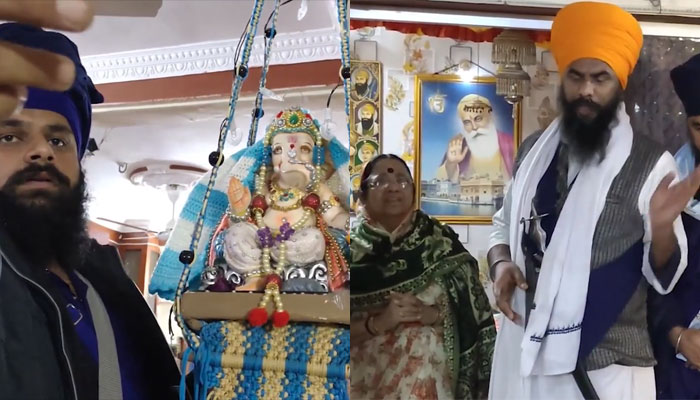
Days after the Sindhi community in Indore removed Guru Granth Sahid from their temples and handed them over to a Gurudwara as demanded by Nihang Sikhs, a new video of Nihangs removing idols from a Sindhi temple in Indore has gone viral on social media. The undated videos are of ‘Poonam Didi Ka Gurudwara’ located at 65 Ex Rajmahal Colony, Indore, Madhya Pradesh. As per social media posts, this particular incident took place on December 19, 2022, a day after Nihangs Shiromani Panth Akali Budha Dal Panjva Takht 96 Crori Chkarvarti visited a Tikana (Sindhi Temple) located in Parshwanath Colony, Indore. However, OpIndia could not verify the exact date.

It is notable that a group of Nihang Sikhs had visited several Sindhi temples in Indore, and objected to the presence of both idols of Hindu deities and the Guru Granth Sahib in those temples. After that, they demanded that the idols should be removed if the Sindhi community wants to keep the Granth in their temples, or else the Granth should be removed from the Sidhi temples and deposited with a Gurudwara by January 12. The Sindhi community decided to return the Granth, and submitted over 80 Shri Guru Granth Sahib at Gurudwara Imli Sahib at Jawahar Marg in Indore on January 11, a day before the deadline.

Now it has been revealed that the Nihang Sikh merely didn’t demand to remove idols of Hindu deities from the temples where the Guru Granth Sahib is also kept, as per Sindhi tradition, but actually forcefully removed idols from some temples.

In the latest video, Nihang Singhs of Sarkar Committee, Punjab, could be seen removing Hindu idols and asking the family to stop following Hindu practices if they want to worship Sikh Gurus. Multiple Punjabi News Channels on YouTube have shared the videos, and there are additional videos on the Facebook page of Satkar Committee’s member Dawinder Singh who was also seen in the videos.

OpIndia examined multiple videos by India Sikh Channel, TF News, Akaal Channel and others to understand what happened at the Sindhi Temple. A video of ‘Poonam Didi Ka Gurudwara’ appeared on social media, where a woman has seen blessing devotees while sitting next to Shri Guru Granth Sahib. The video reached to Satkar Committee, and their team visited Indore to verify the claims in the video.

As per the reports, when members of the Satkar Committee reached the Sindhi Temple, they found multiple Swaroop of Shri Guru Granth Sahib and Hindu idols in the same room. There were idols of Sikh Gurus as well, which is prohibited in Sikhism as the religion is against idol worship. Nihang Sikhs asked the family that is administering the Temple to follow Maryada (Dignity) and maintain the sanctity of Shri Guru Granth Sahib as per the regulations set by Akal Takht.

Meanwhile, some of the members of the Satkar Committee started removing Hindu idols. The members of the Sindhi family could be seen opposing the step and repeatedly requested them not to remove the Hindu idols. One of the senior Nihang, who was part of the team, asked the other Nihangs not to remove the idols as the family promised they would remove themselves.

A senior member of the team also asked the Sindhi Hindu family not to “ride on two boats”. He told them if they had faith in Sikh Gurus, they should stop following “Pakhand” or Imposture, that is, Hinduism. The remarks by Nihang Sikh are being criticized over social media. On multiple occasions in the video(s), the members of the Satkar Committee could be seen asking the family not to follow the Hindu rituals if they want to follow Sikhism, which is being objected to by the Hindus on social media.

Furthermore, in one video, it appears the team again visited the Sindhi temple later to check if the directions they provided were followed or not. However, upon seeing some Hindu idols, including Bhagwan Ganpati and Sindhi Bhagwan Jhoolelal, still in the room, they decided to take away copies of Shri Guru Granth Sahib. While leaving the premises with Guru Granth Sahib, they again told the Sindhi Hindu family to stop following the rituals of Hinduism. A clip of that conversation has also been shared in our previous report.

The group reportedly visited other Sindhi Temples in Indore and took away copies of Shri Guru Granth Sahib with them. All the copies were submitted to Shri Imli Sahib Gurudwara. Following that, many Sindhi Temples have submitted copies of Shri Guru Granth Sahib after multiple meetings were held between a 5-member committee from the Sindhi community and Sikh religious leaders.

Notably, Satkar Committee has made headlines several times in the past. In 2021, Sri Guru Granth Sahib Satkar Committee leader Tarlochan Singh in a statement claimed that they are not sorry for what happened with Lakhbir Singh, who was killed by Nihang Sikhs. When asked if lynching someone for alleged sacrilege was justified, Tarlochan said, “Yes, absolutely. For us, our religion, our faith, our Granth holds more value than a person’s life.” “We have no remorse for what happened. We will do it again if anyone touches our Granth, doesn’t matter if he is a government agent or some minister himself,” added the committee leader. Lakhbir Singh was allegedly killed by Nihang Sikh during the farmers’ protests for allegedly committing sacrilege of Holy Sikh Scripture Sarbloh Granth. They also objected to letting his cremation done as per Sikh rituals.

The committee was also accused of taking away rare Bir of Shri Guru Granth Sahib on multiple occasions and not returning it despite multiple requests. A 2020 report in Times Of India noted how they took away a handwritten Bir of Shri Guru Granth Sahib in 2016 and did not return it for years claiming the family that had the Bir committed sacrilege (Beadbi).

Unable to follow regulations

The Sindhi community has said in multiple statements that they can’t follow the regulations laid down by the Nihang Sikhs to ensure the sanctity is maintained while keeping Guru Granth Sahib at Tikana or Sindhi Temples. For example, the Nihangs told them to remove all the Hindu idols. Furthermore, only an Amritdhari Sikh can do Sewa, whereas Guru Granth Sahib is ‘Virajmaan’. It was not possible for the Sindhi families who had Guru Granth Sahib at their temples to follow all the regulations; thus, they decided it would be better to give Guru Granth Sahib to the Gurudwara. In a statement, Sindhi community leader Prakash Rajdev said, “We can always visit Gurudwara to do darshan of Guru Granth Sahib, and no one can stop us from doing that.”

Notably, it has been reported that some of the Guru Granth Sahib copies were torn and had tapes pasted on it. As per Sikh norms, in such cases, Guru Granth Sahib’s Bir has to be submitted to Agni as per the rituals. There have been many reports where Satkar Committee members or Akal Takht leaders took away copies of Guru Granth Sahib from the houses of Sikhs on the pretext of not maintaining the sanctity of Guru Granth Sahib.

Sindhi Temples in other cities started giving up Guru Granth Sahib

Following multiple incidents in Indore, Sindhi Temples in other cities have reportedly started giving up Guru Granth Sahib. As per a report by Sindhu Prabhat News, Baba Karandas Darbar, Raipur, Chattisgarh, has also submitted a copy of Guru Granth Sahib to the Gurudwara. Speaking to OpIndia, Naresh Vasvani of Sindhu Prabhat News said, “The Sindhi Temples in other cities have started the process, and it appears every Temple will submit their copies in 2023 itself”. Vasvani added that over 70 copies of Guru Granth Sahib had been given up by the Sindhi community.

It is notable that the Sindhi community is keeping the Granth in their temples for a long time, and it has become a part of their ritual to worship the Granth. The reason for it goes back several hundreds of years, when most of the Sindh community used to live in present-day Pakistan.

The Sindhi Hindus were greatly influenced by Guru Nanak’s teachings as he had visited the Sindh region and had spread his philosophy in the area. From that period onwards, Sindhi people have been following Guru Nanak and Guru Granth Sahib in their temples. They keep the Granth along with other Hindu scriptures in their temples. But now the Nihang Sikhs have started to object this, and as a result, the Sindhi community is having to give up an ancient tradition.

OpIndia is trying to get in touch with the administration of Poonam Didi Ka Gurudwara and Baba Karandas Darbar. We will update the reports accordingly.
‘If the Governor does not read speech given by govt, go to Kashmir, we will send terrorists so that they gun you down’: DMK leader spews venom against TN Governor

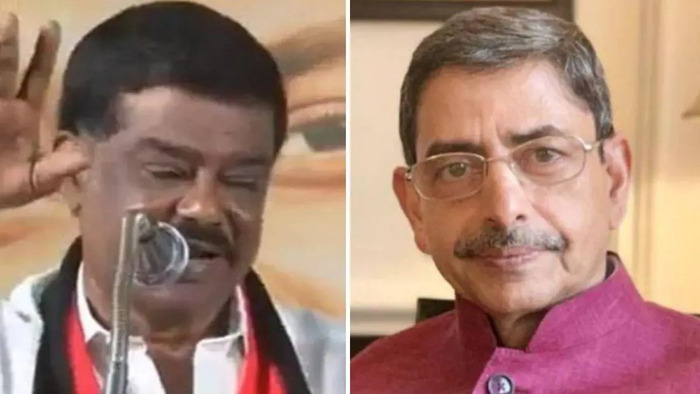
Following the face-off between Tamil Nadu Chief Minister MK Stalin and state Governor RN Ravi recently in the state assembly, a DMK Minister has stoked a fresh controversy by making abusive and threatening remarks against Governor Ravi. 

While speaking at an event, Shivaji Krishnamoorthy said, “Don’t I have the right to assault the Governor if he refuses to utter Ambedkar’s name in his address to the Assembly? Go to Kashmir and we’ll send terrorists so that they will gun you down there if you (governor) don’t read the speech given by the Tamil Nadu government.”

Furthermore, DMK’s motormouth Krishnamoorthy also went on to abuse Leader of Opposition (LoP) E Palaniswami saying that “a man is truly masculine only when he has sons.”

“Our ex-CM Karunanidhi, current CM MK Stalin, and Udhayanidhi Stalin are all men because they brought sons into the world, “ the DMK leader said.

On Friday, BJP state vice-president Narayana Thirupathy responded to Krishnamoorthy’s derogatory remarks and said, “It’s in the DNA of the DMK to use abusive and filthy language. The state governor was abused by Shivaji Krishnamoorthy and R S Bharathi, who also threatened to kill him. We wonder if the DMK has any connections to terrorists.”

BJP’s state President K Annamalai issued a statement condemning the vile remarks made by Shivaji Krishnamoorthy against the Tamil Nadu governor and also stated that the Police’s inaction in the matter would be assumed as the endorsement of the views expressed by Krishnamoorthy.

The rift between Tamil Nadu CM Stalin and Governor RN Ravi came out in the open on January 9 when the governor addressed this year’s first session of the Tamil Nadu state’s legislative assembly. A paragraph of the printed copy of his speech mentioned Ramaswami Periyar, Dr. BR Ambedkar, K Kamaraj, and CN Annadurai. It also mentioned the so-called Dravidian model of government. The governor skipped that paragraph while delivering the speech.

It is notable that the first session of the Assembly held every year begins with the Governor’s address. This provision is in force under 176(1) of the Constitution. The state cabinet expected the governor to read out the speech prepared by the cabinet. The Governor skipped some portions while speaking in the House. It was objected to by Chief Minister Stalin. Stalin moved a resolution that the official address prepared by the state cabinet would be on the table of the House and it was passed. As a result, the speech made by the governor was not recorded in the assembly. Since then, DMK cadres have been protesting against the governor. On Thursday, DMK and its allies skipped a Pongal event that was organized by Governor Ravi.

Governor RN Ravi, while interacting with a batch of civil services aspirants who have cleared their Civil Services (Main) Exam and were looking forward to their interviews, expressed his disagreement with the Tamil term ‘ondirya arasu‘ used by the state government to denote the union government.

He said he was fine with people using the term “Union government” to refer to the Government of India, but he felt the term being translated into Tamil as ‘ondirya arasu‘ was not acceptable. He said that this term referred to a sub-district, sub-divisional level structure in the hierarchy and was used for the Union government perhaps with an intention to belittle and be disrespectful to the Union government.

Human Rights Watch advises governments not to move trade from China to India alleging human rights violations, repeats familiar lies

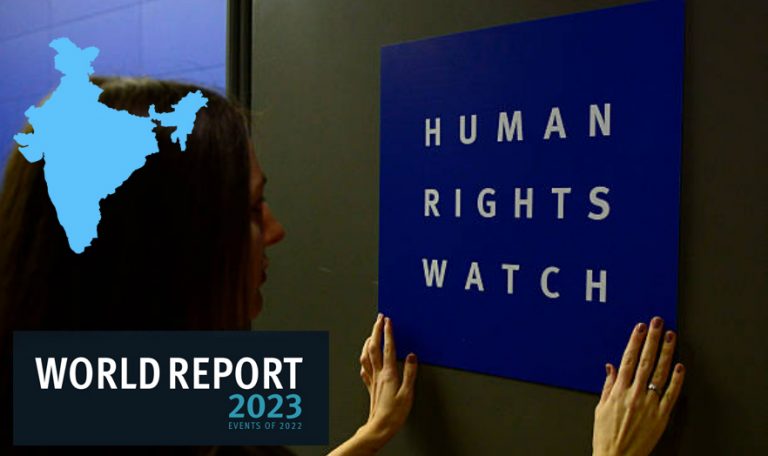
Yet another international organisation has come up with a report alleging that the Narendra Modi government in India is discriminating against minorities, stifling dissent and suppressing free speech. In its recently released Word Report 2023, Human Rights Watch, self-proclaimed defenders of human rights, made these comments while asking the Western Powers to not shift supply chains from China to India.

The report has been authored by activist Tirana Hassan, the Executive Director at Human Rights Watch. She was earlier associated with Amnesty International and several other organisations.

The anti-India comments were made by Human Rights Watch in a section on China titled ‘A Brighter Spotlight on Beijing’, where it talked in detail about the authoritative regime of Xi Jinping, including the atrocities on Uyghur Muslims in Xinjiang region. The report notes the increasing global focus on the dismal human rights situation in China, including discussions on the matter in the United Nations.

However, the report then says that due to increasing discomfort around the Chinese government’s repressive ambitions, several governments have started to expand trade relations with India, and Human Rights Watch warns the governments against it.

HRW says that several governments, including those of Australia, Japan, Canada, the UK, EU, and US have looked to cultivate trade and security alliances with India, “taking cover behind its brand as the “world’s largest democracy.””

It has advised these governments against it, claiming that the Narendra Modi-led BJP government has “mimicked many of the same abuses that have enabled Chinese state repression—systematic discrimination against religious minorities, stifling of peaceful dissent, and use of technology to suppress free expression—to tighten its grip on power.”

The report alleges that world leaders are making careless trade-offs on human rights, accusing them of justifying it at the cost of doing business. HRW further alleges that world leaders are ignoring “the longer-term implications of their compromises”. It further claims that “Deepening ties with the Modi government while avoiding its troubling rights record squanders valuable leverage to protect the precious, but increasingly endangered, civic space on which India’s democracy relies.”

Elsewhere in the report, HRW criticised the Biden administration for allegedly tempering “criticism of abuses and increasing authoritarianism in India, Thailand, the Philippines, and elsewhere in the region for security and economic reasons, instead of recognizing that all are linked.”

In the report on India, HRW has written what has become familiar rants by such left-liberal organisations against the Modi government, that the BJP government is continuing with “its systematic discrimination and stigmatization of religious and other minorities, particularly Muslims.” It alleges attack on freedom of speech because the govt has taken action against NGOs violating various norms including foreign funding norms, and for actions of people accused of links with terror groups.

The allegations by HRW against India are familiar ones, and all of them are baseless. Ever since Modi government came to power in 2014, Islamists and left-liberals have been spreading the propaganda that Muslims are being oppressed. Even reform measures, like ban on triple talaq, are cited as attack on Muslims. Citing a couple of random criminal incidents where the victims were Muslims, the Islamist-left-liberal ecosystem has been able to create the propaganda that Muslims are oppressed in India groups like Human Rights Watch are furthering their propaganda.

In fact, the ecosystem has been caught using lies to attack the Modi govt, like the so called “use of technology to suppress free expression” mentioned in the HRW report. Although not mentioned, it is clear that they are referring to allegations that BJP used a app named Tek Fog to manipulate social media, and that BJP had special access to social media platforms giving them unlimited powers to manipulate content.

Both these allegations were made by leftist propaganda outlet The Wire, but they have been proven false and the outlet has taken down their Tek Fog and Meta stories. But this fact does not prevent Human Rights Watch to allege that Modi government is using technology to supress free speech.

Similarly, HRW also mentions Pegasus, ignoring the fact that a probe found no evidence of its use against Indian citizens by the government.

Indian media and social media is filled with Islamists and left-liberals that continue to attack the Modi government daily, often with fake allegations, but HRW alleges there is oppression on free speech.

HRW mentions that several Kashmiri Hindus and other minorities like Sikhs have been killed in terror attacks in Kashmir in recent times, but fails to mention who killed them, and the religious ideology behind these attacks. Instead, the group criticises the government for action against some ‘journalists’ for their links with terrorists.

The report claims that the journalists, including Sajad Gul and Fahad Shah, were arrested for reporting about public protests and ‘contradictory claims’ of security forces. This is a complete lie, Sajad Gul is an associate of journalist turned terrorist Mukhtar Baba, and was involved in attacks on other journalists in the region. On the other hand, Fahad Shah was spreading anti-India propaganda on social media, instigating terror attacks. No journalist was arrested for some reports as the HRW report claims.

Like all such reports by such groups, HRW also does not fail to mention that Md Zubair of Alt News was arrested, citing it as an example of crackdown on dissent and free speech. But they fail to mention that it is Zubair who cause several deaths and widespread riots in India because he didn’t think former BJP leader Nupur Sharma had the right of free speech to talk about Prophet Mohammed, even if it is a fact mentioned in Islamic texts.

The report does mention the incident, but only to slam police action on Islamist rioters against Nupur Sharma. It does not mention how Islamists killed multiple people for supporting Nupur Sharma online, but criticised the police instead for controlling the riots demanding beheading of Nupur Sharma.

HRW also resorts to lies to target in India. A photo caption in the main report says ‘Hijab-wearing students arrive to attend classes as a policewoman stands guard outside a government school after the recent hijab ban, in Udupi town in the southern state of Karnataka, India.’ This text gives the impression that there was a ban on hijab in Karnataka, which is completely false. The hijab was only banned in schools where there are uniform norms, and there was never a ban on hijab outside schools.

While the India report mentions the fact, it still criticises the move, ignoring the fact the hijab is nothing but an attack on human rights of Muslim women.

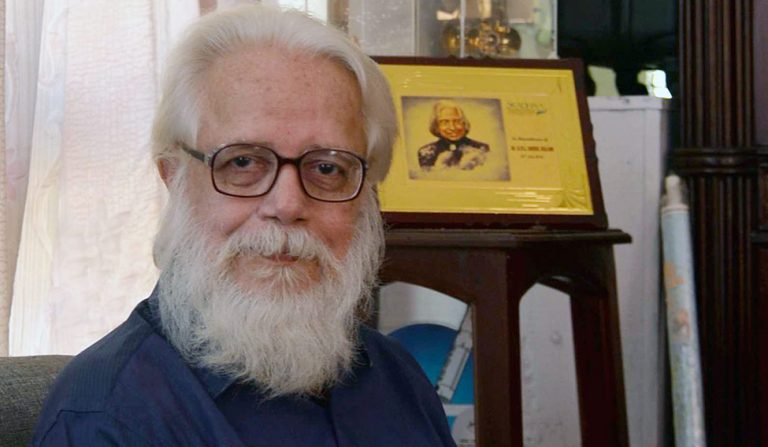
1994 ISRO espionage case: Allegations of spying against Nambi Narayanan false, part of an international conspiracy, CBI tells Kerala HC

The Central Bureau of Intelligence (CBI) has recently declared that the espionage charges against aerospace scientist Nambi Narayanan, which caused a stir in 1994, are false and part of a larger “international conspiracy.”

According to a report from the Times of India, the CBI stated during a hearing at the Kerala High Court that the arrest of Nambi Narayanan in the 1994 Indian Space Research Organisation (ISRO) espionage case was fake as the charges against him were fabricated.

The CBI has announced that they will release a case diary that proves Nambi Narayanan’s arrest in the 1994 ISRO espionage case was part of an international conspiracy. Prior to his arrest, Narayanan was a well-known liquid propellant engine scientist at ISRO, India’s space agency. He was falsely accused and subsequently arrested.

The Kerala High Court is currently hearing a plea for anticipatory bail for those being investigated for their alleged involvement in framing Nambi Narayanan in the 1994 ISRO espionage case. The CBI is opposing the granting of bail to the accused individuals.

How Nambi Narayanan was framed in the ISRO espionage case

In 1994, ISRO scientist S Nambi Narayanan was arrested by Kerala police with some of his fellows including D Sasikumaran, K Chandrashekhar, and a few others on the charges of selling classified information about India’s cryogenic engine program to Russia and Pakistan’s ISI. The Kerala police had launched the case on the basis of input received from the Intelligence Bureau (IB). However, when the case was soon handed over to the CBI, the CBI found that the case was fabricated and the defendants were being falsely accused by the Kerala police. The CBI probe revealed that there was no case within a month of their apprehension. However, the matter lingered on because of its involvement with Kerala politics.

The role played by IB had come into question, as the so-called evidence of spying had come from the agency, based on which the police had acted.

The CBI eventually informed the chief judicial magistrate in May 1996 that the espionage case was untrue and that there was no supporting proof. The report was approved by the court, and all of the accused were cleared. However, the newly elected CPI(M)-led government chose to play by its own rules and ordered more investigations until, in May 1998, the Supreme Court struck down Kerala’s request for a new probe.

Since then, the Kerala government has shielded the corrupt cops and delayed paying the compensation that was mandated by the High Court and the National Human Rights Commission. In order to begin criminal procedures against the police officers who allegedly falsified evidence against him, Narayanan filed a petition in April 2017. RB Sreekumar, who was recently arrested with Teesta Setalvad on 25th June 2022 for his false testimony in the Gujarat riots case, was one of those police officers.

Based on the petition of Narayanan, the Supreme Court appointed a three-member committee to look into the matter. After the D.K. Jain Committee report pointed out a conspiracy by Kerala police and others to frame the scientist, the apex court ordered CBI to probe the case last year. Accordingly, CBI conducted an in-depth investigation and filed an FIR against several police officials based on the committee report.

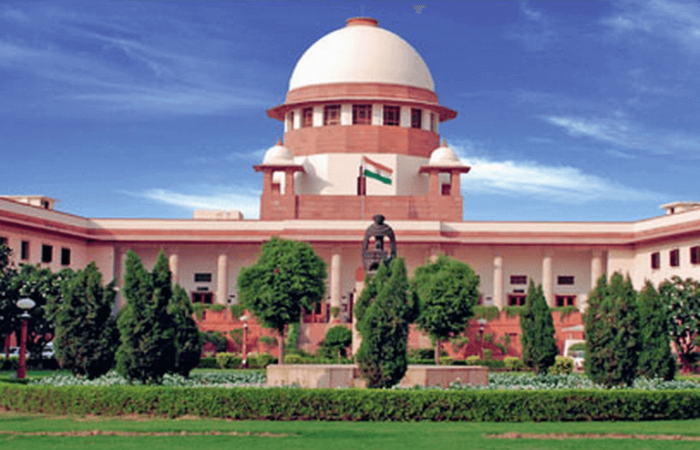
‘Nobody should be denigrated, everyone has the right to dignity’, SC criticises media trial of man accused of peeing in Air India flight

0

On Friday, January 13, the Supreme Court came down heavily on media outlets for sensationalising news in order to increase their television ratings (TRPs). Expressing concern over the media trial in the recent incident where a man allegedly urinated on an Air India flight, the bench of Justices KM Joseph and BV Nagarathna said, “He was called names. He was denigrated. Everyone has the right to dignity.”

Justice Joseph said TV channels are competing with each other as news coverage is TRP-driven.

The remark came while the bench was hearing a batch of petitions seeking a curb on hate speech incidents across the country and action against the culprits.

Media driven by TRP ratings: SC

The Supreme Court, meanwhile, hearing the pleas filed in relation to hate speech incidents, stated that hate speech is a “complete menace” and bemoaned the lack of regulatory oversight over TV news coverage, noting that it desires a “free and balanced press in India.”

The Supreme Court further argued that everything nowadays is driven by Television Rating Point (TRP) and that channels are competing with one another and “dividing society.” It also questioned why a TV news anchor cannot be taken off air if they contribute to the problem of spreading hate speech.

“We want free speech, but at what cost,” the court said noting that, unlike print media, there is no Press Council of India for news channels. 

Justice Nagarathna stated that often times during live discussions, anchors become part of the problem by either muting the voice of a panelist or not allowing them to make a counter-point.

If TV channels are proven to be violating the program code by promoting hate speech, action can be taken against their management, he said.

Action has been taken against several media channels: News Broadcasters Association

The News Broadcasters Association’s counsel indicated that thousands of complaints were received in the previous year and that action was taken against the networks.

“In a live program, the key to the fairness of the program is held by the anchor. If the anchor is not fair, he would not allow the counter view to come by either muting the speaker or by not asking the question to the other side. This is an insignia of bias. How many times action has been taken against the anchor? Media people must learn that they are occupying positions of great strength and they have an impact on society. They cannot be part of the problem and speak their mind whichever way they want,” the bench said.

According to Justice Joseph, if action is taken against the news anchor or their management, everything would fall into place.

The court reminded Additional Solicitor General KM Nataraj, who was representing the Centre, that freedom of expression is a very vital and delicate subject, and that the government must take some action without actually interfering with it.

Center committed to dealing with hate speech issues

General KM Nataraj stated that the Centre is aware of the problem and is considering amending the Code of Criminal Procedure (CrPC) to address the issue of hate speech.

The bench informed him that the government must take action against broadcasts that have an impact on the nation and undermine fraternity and unity while remaining within the bounds of the law and employing some out-of-the-box thinking.

Justice Nagarathna said, “TV has been now in India for decades but still it has no regulations and has become free for all. You don’t have something like the Press Council of India for channels like newspapers.”

SC directs 3 state govts to take suo moto action against hate speeches irrespective of religion

It may be recalled that on 21st October 2022, the Supreme Court instructed the law enforcement agencies of Delhi, Uttarakhand, and Uttar Pradesh governments to take suo moto action in cases regarding hate speech without waiting for complaints to be filed.

A Supreme Court bench comprising Justices KM Joseph and Hrishikesh Roy also directed the Governments of Delhi, Uttarakhand, and Uttar Pradesh to file a report before the Court regarding the actions taken on the hate speech crimes that took place in these states.

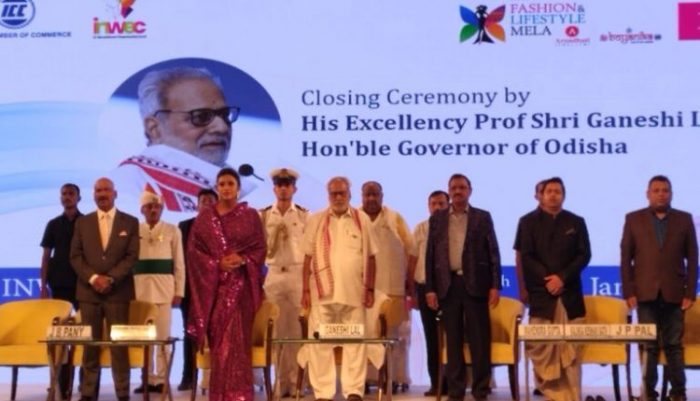
Odisha governor backs non-Hindu entry into Puri Jagannath Temple despite devotees’ opposition: Here is why they are barred

On Friday, January 13, the Governor of Odisha, Ganeshi Lal urged Puri Gajapati Dibyasingha Deb and Adi Guru Shankaracharya to permit foreign devotees to enter the Jagannath Temple in Puri and offer prayers.

While speaking at the inaugural function of the Odisha Vision 2036 Conclave on Friday in Bhubaneswar, Governor Lal said, “Foreign devotees are allowed to meet Puri Gajapati, Adi Shankaracharya, and servitors and as a result, they should not be barred from paying obeisance to the Lords at the 12th-century shrine.”

Governor Lal stated that despite knowing that many people are opposed to allowing entry to non-Hindus into the temple, he proposed to allow them entry due to his association with Odisha. 

It is pertinent to know that the term Hindu includes all the communities that are covered by the Hindu Marriage Act that is Buddhists, Jains, and Sikhs other than the followers of Sanatan Dharma (Hinduism). It means that the temple allows entry to followers of Indic religions.

What Supreme Court said

In 2018, the management of the Jagannath Temple was asked by the Supreme Court to consider allowing non-Hindus entry, with the caveat that they adhere to a dress code or promise to uphold the traditions of the temple

The Supreme Court bench comprising Justices A K Goel and S Abdul Nazeer had said back then that, “we also discussed the issue whether the Temple Management can consider allowing every visitor, regardless of his or her faith, to pay respects and make offerings to the Deity, subject to such regulatory measures with regard to dress code, furnishing of a declaration, or such other prerequisites as found necessary.”

The Supreme Court’s ‘consideration’ however, was opposed by the Sevayats (servitors) of the temple. “This is a conspiracy by a group of mischief mongers to deny sevayats their rights,” Binayak Dasmohapatra, joint secretary of the Chhattisa Nijog ( a group of servitors of the temple).

What the  Sevayats and the Gajapati Maharaj of Puri said

It is notable that those in favour of continuing the restriction argue that allowing entry to non-Hindus into the Jagannath temple is against the temple’s traditions. 

The Gajapati King (Gajapati Maharaja) of Puri Dibyasingha Deb who is also the first servitor of Lord Jagannath and chief of temple management had also opposed Supreme Court’s consideration back then. He said that the sibling deities Lord Jagannath, Lord Balaram, and Devi Subhadra bless all their devotees regardless of their religion during the annual Rath Yatra, adding lakhs of devotees also get the Darshan of the deities during  ‘Snan Utsav’ (bathing festival).

Besides, he also raised concerns over the security of the temple. “Let me say for the sake of argument that if the Shankaracharya implies there is no issue with allowing entry of people of all faith into the temple, then also the government has to think carefully while keeping the temple’s security in mind, the Gajapati King said. 

When the world is under the threat of terrorism, he questioned, “Can the government provide total security to Temple?”

18 invasions of the Jagannath Temple and restriction on entry of non-Hindus

Destroying the temples and idols of the Kafirs was upheld by the invaders as their “religious duty” during the Islamic invasions of India. Two temples, Somnath in Gujarat and Jagannath in Odisha, have each been invaded 17 and 18 times, respectively, while vast numbers of temples have been desecrated, plundered, and destroyed during that time.

Illias Shah, the Sultan of Bengal, launched the first Muslim invasion of the Jagannath temple in 1340. Around 1360, Firoz Shah Tughlaq destroyed the Jagannath temple and desecrated the idols. In 1509, Ismail Ghazi, the commander of Bengal’s Sultan Husain Shah seized Puri and demolished the idols in the Jaganath Temple. Although Hindu King Prataprudradev chased out Ismail Ghazi, the temple witnessed multiple invasions even after this. Amir Fateh Khan conducted the fifteenth invasion in 1647. It was only after the Marathas made their way into Odisha that the constant invasions of the Jagannath temple stopped. 

During the repeated invasions and pillages, the temple’s idols were moved and hidden at distant places. The repeated attacks and destruction of the temple have led the people of Odisha to protect their temple and restrict entry only to the Hindus. 

The restriction is followed so strictly that even a Gajapati King was not allowed to enter the temple since he was married to a Mughal soldier’s daughter. 

As per Madala Panji, the palm leaf chronicles of the Jagannath temple, one of the Gajapati King Ramachandra Deb was denied entry into the Shri Mandir despite being the first servitor of Lord Jagannath as he was married to Rejiya, who was a Mughal soldier’s daughter. 

In 1984 When Indira Gandhi was prime minister, priests objected because she was married to a non-Hindu, consequently, she had darshan from the Raghunandan Library. Even Vinoba Bhave and Mohandas Karamchand Gandhi were refused entry into the temple in 1934 when they tried to do so while traveling with foreigners and non-Hindu followers.

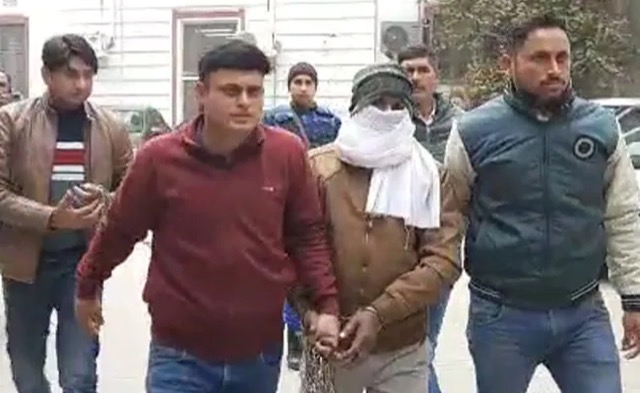
Delhi: Suspected Khalistani and Islamist terrorist arrested from Bhalswa Dairy area over links with terror outfits, two hand grenades recovered

0

The Delhi Police arrested two ‘suspicious’ men and recovered two hand grenades from their house in the Bhalswa Dairy area of Jahangirpuri in the national capital.

The Special cell of the Delhi police arrested the two — identified as Jagjit Singh (29) and Naushad (56) — on Thursday. They were produced before the Patiala House Court on Friday and sent to police remand for 14 days. Amid the interrogation of the suspects, the police said they carried out a raid at their rented house at Shradha Nand Colony in the Bhalswa Dairy police station limits on Friday, under relevant sections of the Unlawful Activities (Prevention) Act (UAPA) and recovered the hand grenades.

The police also recovered three pistols and 22 live cartridges from the suspects.

A team from the Forensic Science Laboratory (FSL) also visited the house and collected blood samples.

According to sources, it is alleged that the suspects killed a person in the house and shared a video of the killing with their handler.

The police said they were in the process of finding out who was killed.

Further, Delhi Police said it has information that Jagjit Singh has links to Khalistani terrorist Arshdeep Dall. He is also a member of the notorious Bambiha gang and has been receiving instructions from anti-national elements based abroad, the city police said, adding that he is also a parole jumper in a murder case in Uttarakhand.

Naushad is also associated with Harkat-ul-Ansar (HUA), a terror group which is based in Pakistan and primarily operates in Jammu and Kashmir.

He has been a life convict in two counts of murder and has also served a 10-year sentence in connection with a case under the Explosive Act.

Their neighbours alleged that the accused took up residence at the rented house last year, during Diwali, adding that the construction of their own house is ongoing.

Quoting their neighbours, the police said they bought a new refrigerator only to return it a week later. On being asked why they were returning the refrigerator, they said it was not functioning properly.

The police suspect that they killed the person, chopped off the body and stored it in a refrigerator, adding that further investigation was underway.

More details are awaited.

(This news report is published from a syndicated feed. Except for the headline, the content has not been written or edited by OpIndia staff)

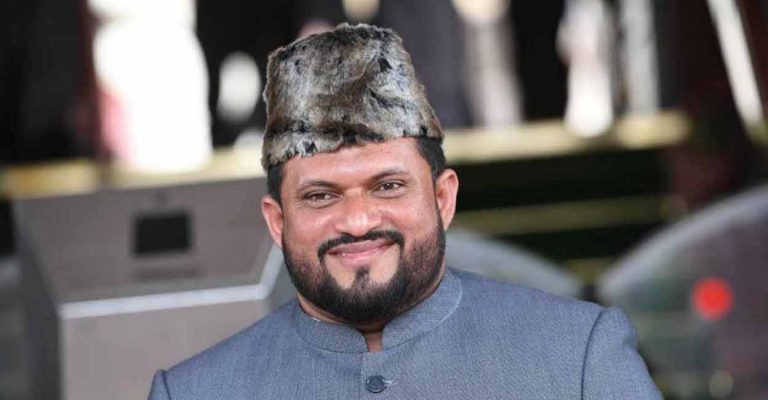
Lakshadweep MP Mohammed Faizal disqualified from Lok Sabha after being convicted in an attempt to murder case: Details

0

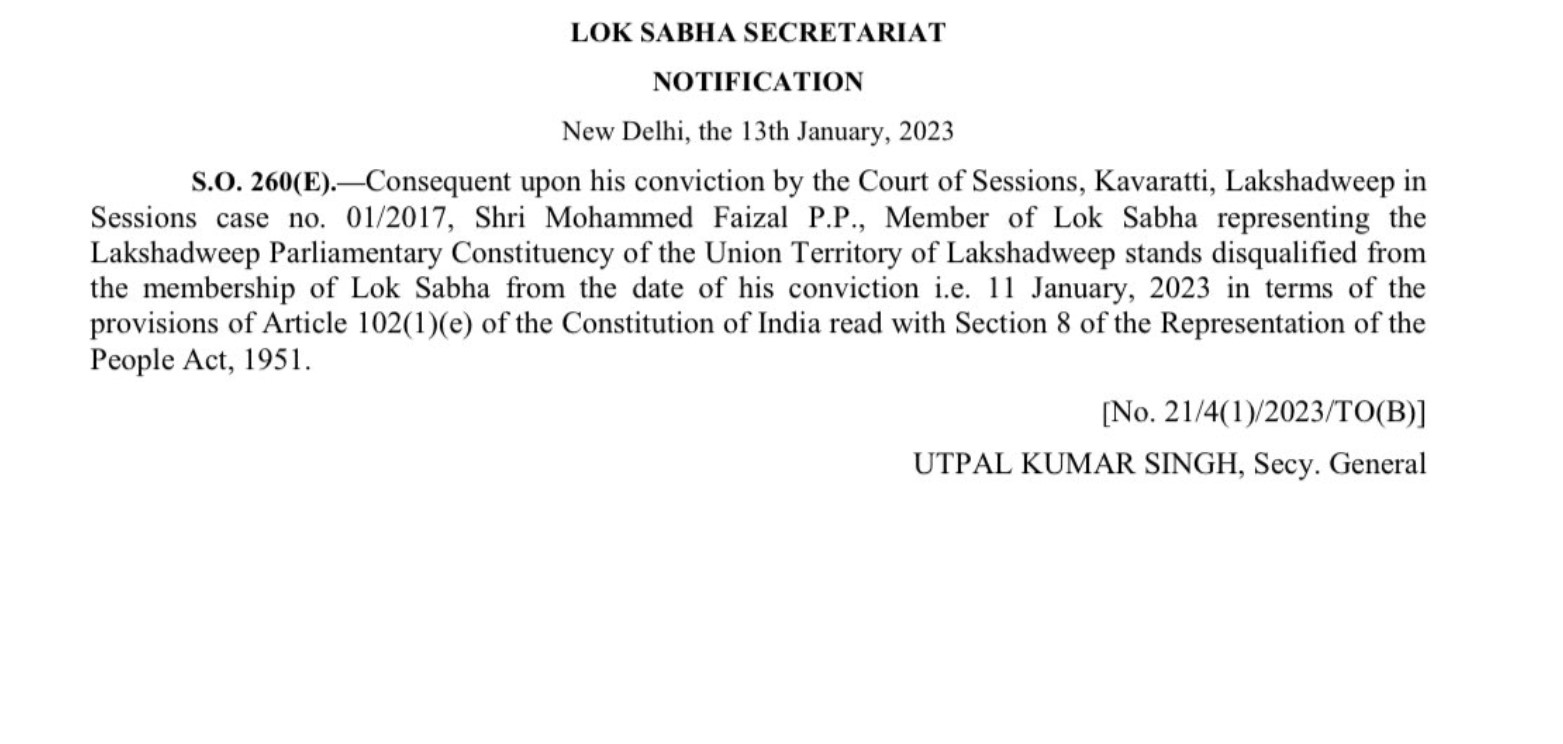
On January 13, Friday, the Lok Sabha Secretariat issued a notification disqualifying Mohammed Faizal, NCP MP from Lakshadweep, after he was convicted in an attempt to murder case by a court in the union territory. As per the notification, the MP’s disqualification came into effect on January 11, the day he was convicted by the sessions court in Kavaratti.

The decision to disqualify the MP from the Lok Sabha was taken under the provisions of Article 102 (l) (e) of the Constitution, read with Section 8 of the Representation of the People Act, 1951.

“Consequent upon his conviction by the Court of Sessions, Kavaratti, Lakshadweep in Sessions case no. 01/2017, Shri Mohammed Faizal P.P., Member of Lok Sabha representing the Lakshadweep Parliamentary Constituency of the Union Territory of Lakshadweep stands disqualified from the membership of Lok Sabha from the date of his conviction i.e. 11 January 2023 in terms of the provisions of Article 102(l)(e) of the Constitution of India read with Section 8 of the Representation of the People Act, 1951,” the notification read.

Notification issued by Lok Sabha Secretariat (source: @arvindgunasekar)

Notably, the court in Lakshadweep had on Wednesday sentenced four people, including the NCP MP Mohammed Faizal, to 10 years in jail after they were found guilty in an attempt to murder case.

The others convicted in the case are Sayed Mohammed Noorul Ameen and Faizal’s brothers Mohammed Hussain and Mohammed Basheer Thangal. Besides awarding a 10-year jail term, the court also fined the convicts Rs 1 lakh each for attempting to kill Mohammed Salih, son-in-law of late Congress leader and former Union Minister PM Sayeed, during the 2009 Lok Sabha polls.

CBI had registered a case against NCP MP Mohammed Faizal in tuna fish scam

Notably, in July last year, the Central Bureau of Investigation (CBI) lodged a complaint against Lakshadweep MP and NCP leader Mohammed Faizal, his nephew, and others over charges of corruption and irregularities. The allegations included an alleged scheme about the shipment of tuna fish to a Sri Lankan business. The CBI conducted searches at six locations linked to MP Mohammed Faisal across Delhi, Calicut, and Lakshadweep.

It is important to note that amid the progressive reforms brought up by the Lakshadweep Administrator Praful Patel in the year 2021, MP Mohammed Faisal declared that beef-eating was a constitutional right of the Lakshadweep people.

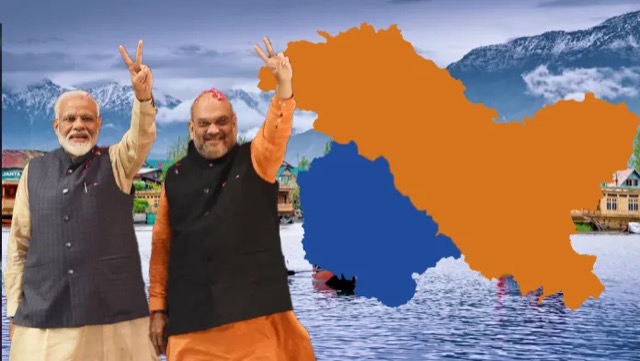
Abrogation of Article 370 helped in lifting the economic state of people of Jammu and Kashmir: Report

0

The Indian government has been successful in changing general perceptions around the Union Territory of Jammu and Kashmir and lifting its people from their erstwhile economic state since the abrogation of Article 370 in 2019, Asian Lite, an Asian daily published in the United Kingdom reported.

According to the report, Jammu and Kashmir Lieutenant Governor Manoj Sinha recently claimed that the UT administration has removed all obstacles to the implementation of people-friendly policies and setting up new businesses and industries in the region. The L-G said the steps taken by his administration have found favour with locals, the report stated.

With reference to developments in Jammu and Kashmir since the abrogation of Article 370, the report quoted the L-G as saying, “Article 370 was the root cause of secessionism, terrorism, nepotism, discrimination & corruption and kept J&K underdeveloped. Three years after breaking from the past, it is moving forward on a new developmental journey.”

Citing a local media report by Kashmir Observer, the Asian Lite further quoted the L-G as saying, “We have removed the difficulties that had cropped up in the implementation of people-friendly governance, setting up new businesses and industries. It is our responsibility to provide equal opportunities to all.”

“Article 370 was the root cause of secessionism, terrorism, nepotism, discrimination & corruption and kept J&K underdeveloped. Three years after breaking from the past, it is moving forward on a new developmental journey,” the L-G was further quoted as saying in the report.

He also mentioned that the policies of the administration have been designed to empower the youth and each and every section of society while providing equal opportunities, the report stated further.

“Accelerated pace of development, improved socio-economic parameters, unprecedented progress in all priority sectors, massive tourist influx, and industrial investment is the testimony of peaceful and prosperous Jammu Kashmir,” the report quoted the L-G as saying.

Also, to put the poultry sector on the path of sustainability and self-reliance, the Agriculture Production Department of Jammu and Kashmir approved a ‘Roadmap for Poultry Development in J&K’ under its mission for Holistic Development of Agriculture and Allied Sectors, in the UT on Friday, the report stated.

“Every year, the Union Territory experiences a flight of capital on account of poultry imports in the state. The amount totals Rs. 1273 crore per year. Among these, eggs account for Rs. 473 crores, day-old chicks for Rs. 110 crores, poultry feed worth Rs. 300 crore and broiler birds for Rs. 390 crores,” Atal Dulloo, additional chief secretary, Agriculture Production and Farmers Welfare Department (APD), was quoted as saying in the report.

He said under the roadmap for poultry development, a total of 420 enterprises and 4,250 direct jobs would be created in the next five years, the report stated further.

‘Roadmap for Poultry Development in J&K’ is one among 29 projects approved by the administration.

(This news report is published from a syndicated feed. Except for the headline, the content has not been written or edited by OpIndia staff)

Pakistan: 3 police officials killed in Peshawar after terrorists attack a police station

0

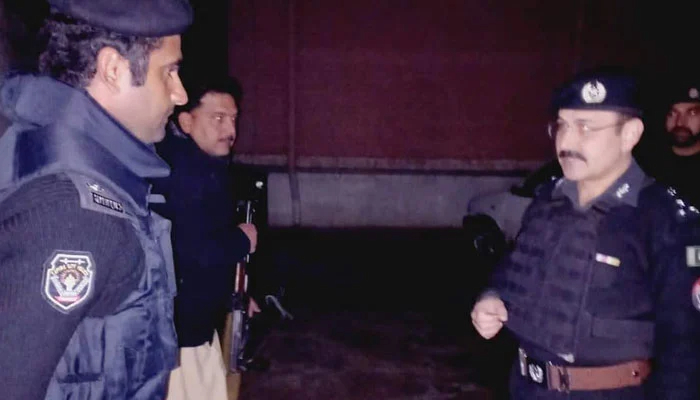
At least three police officials have been killed, including a deputy superintendent of police (DSP) in exchange of fire with terrorists in Peshawar on Saturday, ARY News reported.

The assailants attacked the police station in Peshawar’s Sarband area with long-range rifles and hand grenades in the early hours, ARY News reported. The deceased were identified as DSP Badaber Sardar Hussain, Irshad and Jehanzeb, according to ARY News.

The attack on the Sarband police station was confirmed by senior superintendent of police operations Kashif Aftab Abbasi.

He stated that “terrorists attacked the police station from two sides with hand grenades and sniper rifles equipped with night vision goggles,” as per the local media.

14 police officers were present at the police station at the time of the attack, according to SSP operations, and at least six to eight terrorists were part of the attack. The attackers, however, fled the scene later.

At least six police officers were killed in a similar attack on November 16 in the Lakki Marwat District of Khyber Pakhtunkhwa’s Wanda Shahab Khel neighbourhood, ARY News reported.

With the rise of TTP in Pakistan, attacks on security personnel and explosions across the country have become a regular affair. 

(This news report is published from a syndicated feed. Except for the headline, the content has not been written or edited by OpIndia staff)