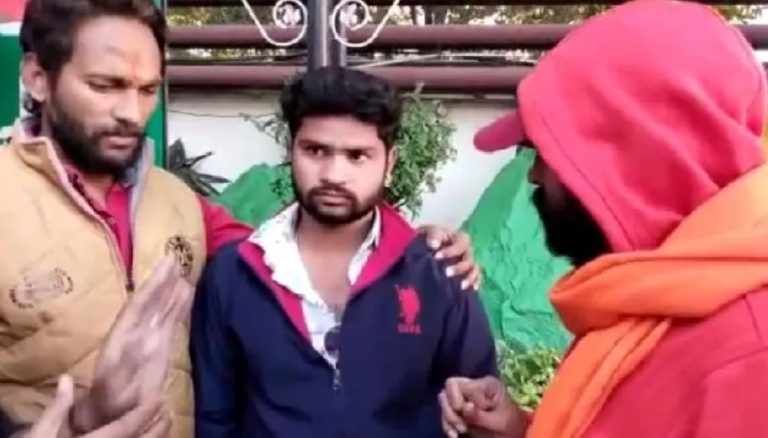
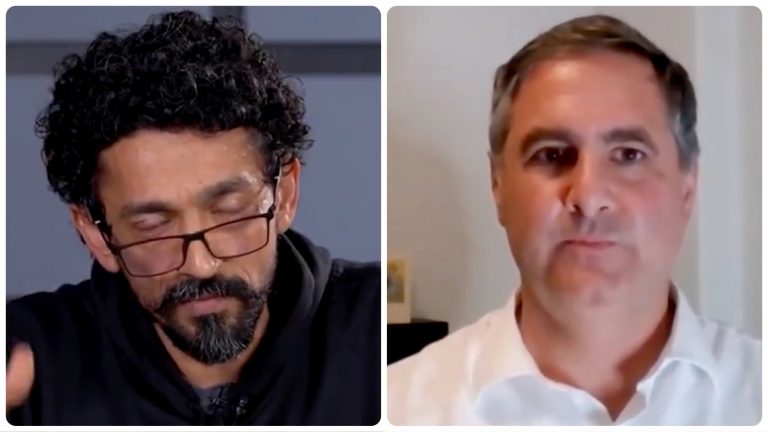
In a video message that is being widely shared on Twitter, YouTuber and musician Shubham Shikari alleged that the Kota police in Rajasthan recently detained and harassed him over a song. Shubham shared the song “Tera Mandir Banaenge Shivaay” on his channel four months ago following the discovery of a Shivling inside the disputed Gyanvapi structure in Varanasi.
The man in video is Shubham Shikari, a YouTube singer, 4 months ago he sang a song on “Gyanvapi (Kashi Vishwanath)” with lyrics: ‘Tera Mandir Banaenge Shivay”. @KotaPolice registered a case against him and even arrested him, seized his phone.
The video message has been doing the rounds on social media for the past few days. Many prominent users have shared the 0.48-second video message in which the devoted Hindu and ardent Shiv devotee Shubham Shikari is heard narrating his ordeal after he released the song celebrating the vindication of the long-held belief about the presence of a Shivling inside the disputed Gyanvapi structure.
The YouTuber is heard saying that after learning that a Shivling had been found inside the disputed Gyanvapi structure in Varanasi, he, like many other Hindus, expressed his happiness by uploading a song titled “Tera Mandir Banaenge Shivaay” on his YouTube channel. He added that he also released a poster to promote his song.
He added that recently, the Anantpura police in Kota, Rajasthan, detained him and took away his phone, which they are now refusing to give back. He asserted that the arbitrary action against him was taken for the aforementioned song he released on his YouTube channel.
Speaking further about the harassment he is experiencing, the YouTuber is heard saying that the court is continuously shifting the hearing date for his case since the court has not yet received the challan from the police. The police, on the other hand, have seized his phone, which has all of his musical creations and bhajans, and they are not giving it back.
Shubham Shikari also bemoans the fact that he is jobless for the last six months because his employer fired him since his case is still pending in court.
Shikari made an appeal to the Kota police to end the persecution and return his phone so that he can record his songs and restart his life, which has come to a standstill owing to the action taken against him.
The song for which the YouTuber alleged he is being intimidated and harassed by the Kota police can be viewed here.
Disputed Gyanvapi structure sealed, CRPF deployed as Shivling found inside during survey
OpIndia reported that on Monday, 16th of May, Civil Judge (Senior Division) Ravi Kumar Diwakar ordered the sealing of the disputed Gyanvapi structure. The court stated in its order that the Shivling discovery in the premises is significant evidence and it directed the CRPF commandant to guard the complex and prevent Muslims from entering. After counsel Hari Shankar Jain representing the Hindu side informed the court that a Shivling had been discovered inside the Gyanvapi premises during the survey, the court took this decision.
Advocate Hari Shankar Jain made the request to secure the premises after a Shivling was found inside the premises. Madan Mohan Yadav, another lawyer representing the Hindu side, said the Shivling is 12 feet by 8 inches in diameter and is in the direction where Nandi is facing, as is customary.
Clashes broke out between the Indian and Chinese troops on December 9 in the border area of the Tawang sector in Arunachal Pradesh, an official statement by the Indian Army said.
There have been reports of multiple injuries on both sides. There have been no reports of deaths. Chinese had come heavily prepared with around 300 soldiers but didn’t expect the Indian side also to be well prepared, ANI quoted sources as saying.
Indian troops in area of face-off in Tawang gave befitting response to Chinese troops.Number of Chinese soldiers injured is more than that of Indian soldiers.Chinese had come heavily prepared with around 300 soldiers but didn’t expect Indian side also to be well prepared: Sources pic.twitter.com/hKVVIQlSp4
According to a report published by News 18, the Chinese PLA contacted the LAC in the Tawang sector, which was contested by Indian troops in a firm and resolute manner that led to a stand-off between the two sides.
“In certain areas along the LAC in the Tawang Sector in Arunachal Pradesh there are areas of differing perception, wherein both sides patrol the area up to their claim lines. This has been the trend since 2006. On 09 December 2022, PLA troops contacted the LAC in Tawang Sector which was contested by their own troops in a firm and resolute manner. This face-off led to minor injuries to few personnel from both sides,” News 18 quoted sources as saying.
It is further reported that both sides immediately disengaged from the area after the clashes. However, news reports said the Chinese PLA suffered more injuries than the Indian Army troopers.
MoD issues statement on latest clashes between Indian, Chinese troops
The Defence Ministry issued a statement over the media reports on clashes between Indian, and Chinese forces along the Line of Actual Control in the Tawang sector of Arunachal Pradesh. “In certain areas along the LAC in the Tawang Sector in Arunachal Pradesh there are areas of differing perception, wherein both sides patrol the area up to their claim lines. This has been the trend since 2006, the statement said.
BREAKING: Official MoD statement on the Dec 9 clash between Indian & Chinese troops at LAC Yangtse, Tawang sector, Arunachal Pradesh pic.twitter.com/zO1sJp7YsO
“On 09 December 2022, PLA troops contacted the LAC in Tawang Sector which was contested by own troops in a firm and resolute manner. This face-off led to minor injuries to a few personnel from both sides,” the statement added.
The Defence Ministry said both sides immediately disengaged from the area. “As a follow up of the incident, own Commander in the area held a Flag Meeting with his counterpart to discuss the issue in accordance with structured mechanisms to restore peace and tranquility,” it added.
Galwan Valley clashes
The scuffle assumes significance given that it is the first such incident since the Galwan Valley clashes between India and China more than two years ago, heightening tensions between the two countries. On June 15, 2020, the Chinese troops attacked the Indian troops along the LAC near the Ladakh border. The clashes resulted in India losing 20 of its soldiers. Estimates suggest China had lost 43 of its men. However, after months of denial, China officially acknowledged the loss of at least 5 of its soldiers.
The killing of the Indian soldiers marked the Indian Army’s worst losses since the Kargil War in 1999 and signified the most intense military combat between India and China since 1967 when about 80 Indian soldiers and at least 300 Chinese PLA troops were killed in the course of the savage skirmishes that broke out near the Nathu La and Cho Lo passes, the strategic gateway to the crucial Chumbi valley.
The fallen Indian soldiers in the Galwan Valley clashes were honoured by the government and their last rites were performed in the presence of government representatives and were accorded the due status of martyrs. PM Modi and the then COAS Bipin Rawat had also visited to meet and speak to the injured soldiers.
Under the IT Rules 2021, the Indian Ministry of Information & Broadcasting issued directions on 12 December 2022 for the immediate blocking of the website, 2and related apps of the #Pakistan-based OTT Platform Vidly TV in India.
This action followed after Vidly TV recently released a web series titled “Sevak: The Confessions”, which was supposed to target the sovereignty and integrity of India and even the defence of India along with hurting India’s friendly relations with foreign States. The web series also attempted to disrupt the public order in India. Three episodes of the web series have been released to date.
It was suspected that the web series was sponsored by Pakistan’s secret agency ISI because the first episode of the series was released on 26th November, on the anniversary of the 26/11 terror attack in Mumbai.
The web series portrayed an anti-India narrative on sensitive historical events like Operation Blue Star, the demolition of the Babri Masjid at Ayodhya, the killing of controversial Christian missionary named Graham Staines, Malegaon blasts, Samjhauta Express blasts, inter-state river water dispute related to Sutlej Yamuna Link canal, etc.
The web series portrayed many other anti-India situations as well, forcing the Indian I&B ministry to eventually ban the show, as well as the TV channel airing it.
26/11 terror attack
The 26/11/2008 Mumbai attacks were a series of terrorist attacks that took place in November 2008, when 10 members of Lashkar-e-Taiba, an Islamist terrorist organisation from Pakistan, carried out a terror attack lasting four days across the posh South Mumbai. The attacks began on 26/11 and lasted until 29/11 in 2008. A total of 175 people died, including nine attackers, and more than 300 were wounded during the attack.
Bollywood actor Nora Fatehi moved a defamation suit of Rs 200 crores against another actor, Jacqueline Fernandes, and 15 media houses, alleging that the actor made false statements with malicious intent.
Both the actors were questioned by the Enforcement Directorate in a money laundering case of Rs 200 crores. Fernandes has been charge-sheeted in the matter.
Nora Fatehi moves a defamation suit of Rs 200 cr against Jacqueline Fernandes alleging that Fernandes made false statements with malicious intent. Both were questioned by ED in a money laundering case of Rs 200 cr. Jacqueline has been charge-sheeted in the matter.
Fatehi slammed the media organisations for circulating claims made by Jacqueline Fernandes and accused the actor and media houses of working in “connivance with each other”.
“A conspiracy by the accused No. 1 (Jacqueline Fernandez) to ensure the financial, social, and personal downfall of the complainant was hatched, and enacted by the said action,” the petition filed by Fatehi read.
The petition further alleged that Nora’s “rapidly progressing career quite obviously has threatened her rivals who are unable to compete with her on a fair footing.”
“It has started to become evident that the aforementioned rivals being unable to compete with the complainant fairly in the industry have started to try and tarnish her reputation which would cause her loss of work and hence would open up greener pastures for her rivals in the industry,” the petition further added.
Fatehi’s suit is linked to remarks made over the Rs 200 crore extortion case probed by central agencies, where conman Sukesh Chandrashekhar is the main accused. Both Nora Fatehi and Jacqueline Fernandes have been summoned by the agencies, and Ms Fernandes is named as an accused in the case after it came to light that she had received expensive gifts from the conman.
In August this year, Bollywood Actress Jacqueline Fernandez in a plea before the Appellate Authority of PMLA stated that it is surprising that like her some other celebrities, notably, Norah Fatehi, was also conned by main accused Sukesh Chandrashekhar in the Rs 200 crore extortion case. But while Nora Fatehi and other celebrities who received gifts from Sukesh Chandrashekhar are made witnesses, she is sought to be dragged as an accused, Ms Fernandes had alleged.
In its supplementary chargesheet filed in the extortion case against conman Sukesh, the Enforcement Directorate had mentioned Jacqueline Fernandez’s name as an accused. ED’s earlier chargesheet did not mention her name as an accused but provided details of the statement recorded by Jacqueline Fernandez and Nora Fatehi in the matter.
Delhi anti-Hindu riots accused and former JNU student Umar Khalid has been granted interim bail by the Delhi Court.
Delhi court grants interim bail to Umar Khalid for attending his sister's marriage. He has been granted bail for the period of one week from 23rd to 30th December. He has to surrender on December 30. He is an accused in the larger conspiracy of Delhi riots of 2020.
He has been granted bail from December 23 to December 30 to attend his sister’s wedding. He will have to surrender on December 30. He is currently in jail and one of the accused in larger conspiracy of Delhi riots.
Earlier in November he had sought 2 weeks bail to attend his sister’s wedding. He is currently in jail in a case pertaining to the bigger conspiracy in the 2020 Delhi riots, involving offences under the Indian Penal Code and UAPA (Unlawful Activities Prevention Act). Khalid has been in custody since September 2020.
Miracle in the typical Christian missionaries’ style is happening in the erstwhile Hindu Kingdom of Nepal. The magic of this miracle embedded in the infamous aggressive proselytising has made Christianity the fastest-growing religion in this Himalayan country. From 458 Christians in 1961 to constituting around 1.4 per cent (2011 Census) till 2011 and now touching around 10 per cent of the total population (Federation of National Churches of Nepal), the number of people finding ‘new meaning’ to their lives by abandoning their traditional religions is growing rapidly. This huge change in the demography of Nepal comes with serious socio-religious and political consequences.
Political and socio-religious stability ensured by the erstwhile Hindu kingdom prevented the conversions to Abrahamic faiths. But the dismantling of the monarchy in 2006 and the subsequent establishment of Nepal as a ‘secular’ state provided them with an opportunity and led to the sudden rise in evangelical activities. Today, this issue of religious conversions has assumed serious and contentious proportions in this nation. It has led to societal tensions among various ethnic and religious communities. Hindus, Buddhists and practitioners of the traditional Kiranta faith have repeatedly resented these conversions. Though the Nepalese constitution makes religious conversion a punishable offence, very few get prosecuted under this law. Flush with foreign funds with tactical support from foreign NGOs, international organisations, foreign diplomatic missions and domestic political set-ups, Christian missionaries have found the best possible climate for conversions in ‘secular’ Nepal.
Proselytising in the grab of welfare and poverty alleviation programs has been one of the time-tested tools deployed by the missionaries. In this context, the infamous role of the United Mission to Nepal (UMN) is worth mentioning. With a history of more than 65 years of serving in the name of Jesus, United Mission to Nepal has a stated mission of “to make Christ known by word and life”.
Firstly, with partnership and funding support from international organisations, churches and individuals particularly from Western countries, it has strategically divided Nepal into different divisions to spread the Gospel of truth via serving in the name of poverty alleviation programme and other projects. The given map below shows their area of work mostly lying in the backward northern mountainous and southern foothills.
Source: United Mission to Nepal
It is interesting to note that these are the areas where Nepal has recorded the highest conversion to Christianity. The second thing about their so-called serving as can be observed in below infographic is the vast majority of funding comes from churches from across the world. It is very obvious that Churches don’t fund any programme or project just for the sake of it but proselytization forms an important part of it.
Thirdly, most beneficiaries of UMN’s programmes are Christians. The rampant proselytization can be observed in the northern districts and there is a stark difference between the households who have fallen prey to Christian missionaries’ propaganda and those who have resisted the lure. Those who have succumbed to the lure have better living standards and jobs with Western agencies and their neighbours who stayed with their traditional faith struggle to make a decent living. Thus all these points clearly demonstrate that the real intent behind these so-called social and welfare services by Christian groups is to lure the poor into Christianity by using monetary and other material enticements.
For Abrahamic faiths, freedom of religion in the form of the right to conversion has always been on their agendas and they make a lot of noise about it. Similar noise is being made in Nepal with different Islamic and Christian religious leaders and groups demanding that the right to change religion be guaranteed. However, this appeal for the right to change religion is not limited just to religious leaders of the said faiths foreign high commissions also indulge in this. For example, in 2014, British ambassador to Nepal, Andrew Sparks while appealing to members of the constituent assembly remarked, “We encourage you to ensure that the right to change religion is protected and that the right to hold opinions and to express them freely will remain strong”. This interference in Nepal’s internal affairs by various foreign NGOs and organisations is routine now.
According to Kamal Thapa, then chairman of the Rashtriya Prajatantra Party-Nepal, these types of interference by these groups are aimed at “ensure proselytising Christian missionaries face no hurdles in their activities and would have a field day converting Nepal’s poor people using blatant blandishments. Or else what business do they have with religious matters? Their only objective is to ensure that Christian missionaries from Europe and the West are free to proselytise in Nepal”.
Flush with foreign funds, the poor are the easiest prey for Christian evangelical activities. While Christian groups claim that they are not indulging in forceful conversions but Hindu, Buddhist and Kiranta groups allege that financial and other kinds of material enticements along with superstitious methods are used for conversions. They ask, if their only concern is to improve the lives of the poor and ameliorate their sufferings, why are only the beneficiaries of such programmes converting to Christianity? Why is the Bible gifted along with financial doles? Why is Mother Teresa’s style Gospel of truth preached while serving them? And no doubt, these fundamental questions go unanswered.
Another standard modus operandi for these missionaries is to make full use of natural tragedies under the grab of relief work. In the case of Nepal, be it the earthquake of 2015 or COVID-19 of recent times, maximum conversions have happened during these grim times. In this context, Diana Riboli, an Italian anthropologist points out that “After the earthquakes, Christian missions in Chepang areas became more and more active and the number of churches is dramatically increasing”. She also informs about the negative consequences of these conversions in the form of socio-religious conflicts as Christian missionaries’ term their faiths as “regressive” and “pagan”. She states, “Missionaries emphasise the healing aspect of Christianity, trying to put an end to the traditional rituals and charismatic power of shamans”. Thus Riboli rightly points out that conversions are “creating an alarming situation” in Chepang communities, where internal conflicts are becoming more frequent. Also, in poorer and fewer literacy areas, missionaries indulge in the superstitious methods of miracles and faith healings.
Another aspect of rampant proselytization in Nepal is the fact that Christian missionaries are hand in glove with communists. Senior leadership from communist parties have close financial relations with foreign NGOs and Western donor agencies. For example, in 2018, former Prime Minister Oli attended the Asia Pacific Summit which was organised by Universal Peace Foundation, a South Korean NGO which has been accused of funding and promoting conversions to Christianity.
The negative consequences of evangelical activities are becoming more apparent in the form of changing demography, inflaming passions by hurting the religious sentiments of the majority, and creating socio-religious divides and conflicts within communities. It also increases outside interference in Nepal’s internal affairs and further changes demography or reduces the Hindu population also favours Chinese designs in the Himalayan republic.
Against this background, a call to junk the ‘Secular’ tag and return to ‘Hindu Rashtra’ is becoming louder. Many prominent civil society members including social activists, journalists, bureaucrats and politicians feel that turning the country to an alien ethos like a ‘secular republic’ was a poor and hasty decision made by Maoists without much consultation with civil society members and opposition leaders. These people point out the fact that the 1990s constitution proclaimed Nepal as ‘Hindu Rashtra’ but Hinduism was not a state religion and no one was discriminated against on the basis of their religious identity as religious tolerance was the norm. Similar views are echoed by the prominent medical practitioner, Suraj Shrestha when he contends, “Hinduism, by its very nature, is a secular, tolerant and all-encompassing religion. So there was no need to make Nepal a secular country”.
The demand to return to Hindu Rastra is getting support from across the party and religious lines. Many factions in Communist parties also support it. Among religious communities, even Muslims who constitute around 5 per cent of the population and are victims of evangelical activities have come out in its support. For example, the chairperson of the Rastrabadi Muslim Manch Nepalgunj, Babu Khan Pathan is of opinion that “We don’t need a secular identity, but want to see the country called Hindu State as this ensures safety and security for all”.
Effective implementation of anti-conversions laws, and keeping an eye on funding mechanisms and proselytization activities of foreign NGOs and agencies is the way forward for Nepal to stop the impending challenge of demography imbalance and resultant socio-religious conflicts. However, returning to the status of Hindus Rastra is the ultimate solution to the evil designs of conversion mafias.
On Monday, December 12, West Bengal’s Leader of Opposition and BJP leader Suvendu Adhikari said that Trinamool Congress (TMC) workers attacked Hindu devotees during a ‘Rath Yatra’ procession in West Bengal’s South 24 Parganas.
The BJP leader, in a thread of tweets, didn’t just share pictures of people injured in the alleged attack, but also accused the West Bengal police. Suvendu Adhikari accused the police of working at the behest of TMC supremo Mamata Banerjee, and failing to report the incident at hand. He lashed out at Mamata Banerjee’s leadership’s callousness toward the state’s worsening law and order situation.
According to Adhikari, the Radha Madan Mohan Temple in Betberia, Baruipur, South 24 Parganas, has been hosting Gita Jayanti Mahotsav celebrations for the past 20 years. “Yesterday a 10 day celebration was supposed to be culminated with a Rath Yatra. Goons attacked Sanatani Devotees during the Rath Parikrama,” he said.
Gita Jayanti Mahotsav has been celebrated at the Radha Madan Mohan Temple in Betberia; Baruipur, South 24 Parganas for the past 20 years. Yesterday a 10 day celebration was supposed to be culminated with a Rath Yatra. “Goons” attacked Sanatani Devotees during the Rath Parikrama. pic.twitter.com/MNvqjJyiML
— Suvendu Adhikari • শুভেন্দু অধিকারী (@SuvenduWB) December 12, 2022
In his subsequent tweet, Adhikari said that the TMC goons first blocked the roads, then obstructed the Rath, forcefully initiated a scuffle, and then attacked the devotees with iron rods, swords, and lathis.
“The Devotees had no clue about this pre-planned onslaught. Several Sanatanis got heavily injured. Guess what the Administration did?” asked the BJP leader further highlighting the state police’s apathy in handling the situation.
Police refused to register a complaint. TMC MLA met the “Goons” but didn’t bother to meet the Devotees. Mamata Police even lathi-charged to disperse the Devotees when they gathered to protest. Is the Law & Order situation of WB so bad that Devotees can’t take out a Rath Yatra?
— Suvendu Adhikari • শুভেন্দু অধিকারী (@SuvenduWB) December 12, 2022
“Police refused to register a complaint. TMC MLA met the “Goons” but didn’t bother to meet the Devotees. Mamata Police even lathi-charged to disperse the Devotees when they gathered to protest. Is the Law & Order situation of WB so bad that Devotees can’t take out a Rath Yatra?” tweeted Adhikari.
Notably, this incident came two days after Sukanta Majumdar, the president of the West Bengal BJP, alleged that TMC activists had attacked his convoy. He alleged that some men brandishing TMC flags attacked his car.
Anti-Hindu attacks in West Bengal
West Bengal has always been a hotbed of communal politics, which has only worsened since TMC led by Mamata Banerjee assumed power. Violent attacks against the Hindu community have been reported from Bengal multiple times over the years.
On October 9, the Hindu community in the Mominpore locality of Kolkata in West Bengal came under attack as they geared up to celebrate the annual Lakshmi Puja.
Sukanta Majumdar, BJP Chief of West Bengal, informed that bikes and shops belonging to Hindus were vandalised by Islamists at Maila Depot in Mominpore. In a video shared by him, bikes and nearby shops could be spotted in a damaged condition.
A total of 100 cases of forced faith conversion, forced and child marriage and abduction of girls and women belonging to the Christian community have been reported in Pakistan between January 2019 and October 2022, a new report said.
According to the report titled “Conversion without Consent” released by Conversion without Consent on Saturday, the 100 cases took place over a span of more than three years, of which 27 were recorded in 2019, 12 in 2020, 42 in 2021 and 19 till October 2022. The data showed that the highest number of 86, were reported in Punjab, followed by 11 in Sindh, two in Islamabad and one in Khyber Pakhtunkhwa, and no case was reported from Balochistan, reports DAWN.
According to the data, 67 per cent of the cases were reported from five districts alone. The districts, Lahore, Gujranwala, Sheikhupura from Punjab, Karachi from Sindh and Faisalabad, exhibit a high rate of cases of underage girls from the Minority community.
According to the report, sixty-one per cent of the girls were targeted before reaching 16 years of age, while 18 per cent became victims between the ages of 16 and 18 and 14 per cent became victims when they were above 18 years old of age. The ages of seven victims are not known.
According to DAWN, the report reveals that the majority victims of forced faith conversions and child marriage are minors, however, the fabricated age of all victims is deliberately altered to 18 years or above by perpetrators on certificates of marriage to avoid criminal conviction under the Child Marriage Restraint Act 1929 according to which marriage to an underage child is illegal and punishable by imprisonment.
The report states that all minor girls are presented as economically independent adults. It also revealed that the marriages were executed without consent of a legal guardian or in the absence of a lawyer.
The cases of Zarvia Parvaiz, Saba Nadeem, Chashman Kanwal and Sunaina James, underage girls who became victims of forced faith conversions, are also included in the report.
Zarvia Parvaiz told the court that she was heavily drugged, raped, beaten with a stick, burnt with cigarettes, and electrocuted by her abductors, according to a report in DAWN.
Saba Nadeem said she was abducted and raped. Her thumb impression was taken on the certificate of marriage and conversion without her consent. Nadeem’s perpetrator’s threatened her with dire consequences if she revealed the assault to anyone.
The report recommends that affirmative action must be taken for the protection, promotion, and fulfilment of minority rights, particularly in the context of reforming the existing civil and criminal justice system to render it more sensitive to the needs of victims of forced conversions and their families, writes DAWN.
The report “Conversion without Consent” says that it is the duty of the authorities to ensure that the observance of a state religion does not affect any minority religion or results in discrimination in law, policy, and jurisprudence against those who profess a faith or set of beliefs contrary to the majority religion.
(This news report is published from a syndicated feed. Except for the headline, the content has not been written or edited by OpIndia staff)
On December 11, a Police official said in a statement that a complaint had been filed against social media influencer and actor Urfi Javed for allegedly committing illegal and obscene acts on social media and public places. Advocate Ali Kaashif Khan Deshmukh filed the complaint at Andheri Police Station against the actor. As per the police official, the complaint was filed on Friday, December 9.
On December 8, Adv Khan published multiple tweets questioning why no action was taken against her by the police. He wrote, “What actor Urfi Javed is doing in public is not obscene as per section 294 of IPC, then what is? When action against such similar act can be taken again Actor Ranveer Singh then why not her? Mumbai Police Is it not the moral duty of us to file report against such illicit acts?”
What actor Urfi Javed is doing in public is not obscene as per section 294 of IPC, then what is? When action against such similar act can be taken again Actor Ranveer Singh then why not her?@MumbaiPolice Is it not the moral duty of us to file report against such illicit acts?
Khan is also representing one of the accused Munmun Dhamecha in the Mumbai drug case in which Shah Rukh Khan’s son Aryan Khan was also booked as an accused.
Uorfi’s spat with author Chetan Bhagat
Uorfi recently got into a controversy after author Chetan Bhagat mentioned her at a literary festival. Bhagat called her a distraction for the young boys. In a series of Instagram stories, Uorfi lashed out at Bhagat for his remarks and shared his leaked chats from a few years ago that went viral during the MeToo campaign.
The remarks passed by the author did not garner many headlines or attract a reaction from Uorfi. However, following an op-ed in Firstpost where the author called out Bhagat for the remarks that were published on November 25, had got the attention of the actress. In a series of stories, Uorfi lashed out at Bhagat.
She also uploaded a video on her Instagram stories where she said, “I do not understand the need of mentioning my name at a literature festival. I am not an author. Also, you said youth is getting distracted by watching my photos. Leave that aside. First, tell me why you, who is double the age of youth, were sending messages to girls half of your age? Was that not distracting? Were your marriage and your children not getting affected by it?”
In a tweet quoting Firstpost, Bhagat alleged his statement was taken out of context by Firstpost. He said, “I told guys to focus on fitness and their career and not waste their time on Instagram. Apparently, that’s not ok! So they cut my statement, said it out of context, the headline with adding things I never said and do a click-bait piece with ageism thrown in too. Of course.”
Uorfi attracted fans and critics equally for her fashion sense
Though her fashion choices might not go well with many, Uorfi is among the popular social media influencers among the youth. She started making headlines ever since she appeared on the reality show Bigg Boss OTT. Currently, she is one of the participants in ‘Splitsvilla X4’ hosted by Sunny Leone and Arjun Bijlani. Leone, who is herself famous for bold avatars and her controversial past, praised Uorfi for her fashion sense. In one of the episodes, she said, “Uorfi, your outfit is amazing and absolutely perfect as beachwear. I love your choice of outfits, and this looks fab.” Taking the compliment boldly, Uorfi replied, “I am known for my unique dress sense. You can compete with me, but you can’t compete with my outfit, as it is always out of anyone’s imagination.”
Notably, as per Google Trends, Uorfi is more popular than actresses like Taapse Pannu, Richa Chaddha and Swara Bhaskar.
Even though the crime data raises serious questions about the state of law and order situation in Bihar, supporters of Nitish Kumar nevertheless refer to him by ‘good governance’ and ‘Sushan babu’ tags. But the tragedy does not end here. About three months ago, a minor Hindu girl was kidnapped from Siwan, a town 100 kilometres away from the capital Patna.
The allegations in the case say one Salman Ansari kidnapped the Hindu minor girl. The victim’s father had run from pillar to post, begging for the return of his daughter but to no avail. Instead, the victim’s family are receiving threats for raising their voice against the kidnapping, as per reports.
The case has brought forth the apathy of the Bihar Police in providing justice to the father, whose minor daughter has gone missing for over three months. On the one hand, the Bihar Police have admitted that the abducted girl is a minor. On the other, it says she has become Muskaan Khatoon. The police say the girl has been sending messages requesting that she be left to her devices. It is also reported that the girl has been frequently changing sim cards, which has made detection and tracking her all but impossible.
The minor Hindu was abducted on 17 October 2022. Her father had lodged a complaint regarding the matter at the Maharajganj police station. Salman Ansari, Shahabuddin Ansari, Hazrat Ansari, Ishaq Miyan, Sadina and Ladli have been named in the complaint. The victim’s father has alleged that police had not taken requisite action in the matter. He said instead of arresting the culprits and recovering his daughter, the police had started harassing him. According to him, some of the accused named in the case were caught by the police on the first day. But left within 3 days.
OpIndia spoke to the distraught father, who has accused the police of being hand-in-gloves with the culprits. He said he was informed that his daughter is in Mumbai but despite knowing everything, the police administration is not taking any concrete action for the recovery of his daughter. He further alleged that he shared his daughter’s Mumbai with the police, who assured him of raiding the said place but did not bother to do so. He said the police had demanded fare for their travel to Mumbai, to which the victim’s family had agreed, yet the law enforcement officials did not act on the information shared by him.
The victim’s father says he has spent about Rs 90,000 to gather information about his daughter. He has also accused Salman’s elder brother, Hazrat, of threatening and abusing Hindus. It was also told that Salman’s family has refused to return the girl thrice in the Village Panchayat. He has expressed the possibility of shifting the girl from Mumbai to Pune. According to the victim’s father, a policeman from Maharajganj police station called and threatened them on 11 December 2022 after the people of Bajrang Dal came to his house for a visit.
Police dismiss allegations of inaction; claim they are made in anger
OpIndia also spoke to the in charge of the Maharajganj police station regarding the allegations made by the victim’s father. They say that the allegations are made in anger over the non-recovery of the girl. The station in charge claimed that they have received messages from the girl calling herself Muskaan Khatoon. In the message, she is requesting to leave herself free, the police official said. Describing the girl as a minor, the police station chief said that due to continuous changes in SIM cards, there is a problem in recovering the accused and the girl.
Regarding the allegation of police threatening the victim’s father, he said that all the employees of the police station are responsible and no one would indulge in such an act where a victim is being harassed. When OpIndia called the number from which the victim’s father was threatened, no one picked up the call.
Significantly, Salman, who is accused of abducting the girl along with his family members, works in Mumbai to make belts. His brother and other family members live in the village. Salman and the girl’s house are nearby. The police have registered a case under sections 363, 366 (A) and 34 of the IPC in this matter. OpIndia has a copy of the FIR.