Home Blog Page 2842

Maharashtra: Hindu man Deepak Barde murdered over relationship with a Muslim woman. Majnu Shaikh, Imran, and five others arrested

0

On Tuesday, the Maharashtra Police arrested seven persons for allegedly murdering a Hindu boy named Deepak Barde from Shrirampur, Ahmednagar. The accused allegedly killed Deepak Barde for having a relationship with a Muslim girl named Saniya Shaikh and fleeing from home to marry her a month ago. The Police are interrogating all the arrested accused in the case.

According to the reports, the accused, who are relatives of the girl, brutally murdered Deepak and threw his body into the Godavari river. The Police are investigating the case and are searching for his dead body in the river. The deceased belonged to the Adivasi Bhil community and was a resident of the Bhokar village in Shrirampur taluka of Ahmednagar district. He had gone missing since August 31 and the incident came to light after the father of the deceased, Raosaheb Barde filed an FIR at the Shrirampur Police Station.

Deepak’s family suspected that the family members of the woman had killed Deepak as they both had fled from home a month ago. Father Raosaheb Barde in the FIR mentioned that Deepak was kidnapped by Saniya’s family members with the intention of murder. He said that his son had gone to Pune for some work and then never returned from there. “He (Deepak) talked to me last at 8:30 pm and on the next day a few people from our village informed me that Saniya’s father Majnu Shaikh and uncle Imran had abducted my son”, Deepak’s father said.

“I thought they nabbed my son because he had fled with their daughter. I went to the Shrirampur taluka police station but did not share the entire thing, as I felt the complaint, in this case, would be lodged in Pune”, he said adding that Deepak was forcibly brought to Majnu’s house in Bhokar village and was brutally beaten for being in a relationship with Saniya. “Deepak has been untraceable since then”, the FIR signed by Raosaheb Barde read.

The Police began an investigation into the case and found out that Deepak and Saniya Shaikh had fled from home a month ago to marry each other. However, the Police have no evidence confirming that the duo had married each other. “The statement of the woman has also not been recorded yet. But they had a relationship and had escaped together earlier”, the Police quoted.

Meanwhile, Raosaheb, the father of the deceased stated that the duo had fled together but later returned to the village as Saniya’s family members were not happy with their relationship.

Based on a complaint filed by Deepak’s father, the Police had earlier arrested four persons, including Saniya’s father Majnu Shaikh, uncle Imran, and family members Samir Shaikh, and Ajij Shaikh. A case under sections 342, 364 (kidnapping or abducting to murder), 34 of the Indian Penal Code, and sections of the SC & ST (Prevention of Atrocities) Act had also been filed against them.

Earlier, BJP MLA Nitesh Rane took cognizance of the incident and had asked the Shrirampur Police to conduct a thorough investigation into the case. “Deepak has been killed because he was a Hindu. We’ll not spare anyone who targets the people from the Hindu community. We Hindus should come together for victims like Deepak. We must show our strength. The accused have been arrested but Deepak is still missing. We will not tolerate this. A thorough investigation should be done in the case and Deepak and his family should get justice”, Rane had said.

In the current case, after the initial investigation, the Maharashtra Police have arrested three more persons and have booked all seven accused under the relevant sections of the law. However, the Police are still looking for the dead body of the deceased in the Godavari river and are further investigating the case. OpIndia tried to contact the Police for additional information but the calls remained unanswered.

Kejriwal’s three-wheeled wonder and his leg hanging out: The role autorickshaws in his rise as politician

One of the most iconic things about Karnavati, or as some people call it Amdavad/Ahmedabad, are the autorickshaw-walas. They’re so iconic that one of the quite popular Gujarati songs is an ode to the rickshawwala.

The above song is sung by Kishore Kumar and is one of the favourites of mine.

Aam Aadmi Party today put up a cartoon of a rickshawwala with his leg sticking out trying to show Kejriwal is unstoppable. I am not sure about other cities, but the leg sticking out gesture by rickshawwalas has been a quintessential Amdavadi thing. It is their way of showing side signal.

The autorickshaw in the cartoon has ‘I :heart: Kejriwal’ written on it along with a ‘danger’ symbol on the green paint part it. It also has 3 heart emojis. Interestingly, the autorickshaw number here is also 999, like in the above song where Asrani is shown singing. Similar image was shared by another AAP leader Saurabh Bharadwaj.

While base image is the same, there is a typo in ‘Kejariwal’ here and one random Gujarati sentence on the rickshaw which reads ‘side ma hend alya‘ (come here, this side) instead of ‘side aap alya‘ (give side). This is what happens when you try to be cool but get references wrong.

He also added a caption ‘Kejriwal rukega nahi‘ (Kejriwal won’t stop). Obviously, this was a free hit for those who do not leave a chance to mock the Delhi CM.

Some were not so subtle about the innuendos.

So as third person looking in, if Arvind Kejriwal is playing up the ‘autorickshawwala is common man’ part, it would be quite a smart thing.

Except, that is not it.

Kejriwal is not trying to tap into average Amdavadi’s emotions. He is playing his old trick of ‘autowalas as votebank’ politics.

Arvind Kejriwal, in what he wanted everyone to believe was an ‘impromptu’ decision, went for a meal at an autorickshaw driver’s home in Ahmedabad. He went there after he invited him over for a meal during a meet-and-greet session he had with ‘common man of Ahmedabad’ along with Punjab CM Bhagwant Mann.

Except, in November 2021, similar such ‘impromptu’ dinner invitation was extended by yet another autorickshaw driver in Punjab when he was on a campaign trail for Punjab elections.

Same modus operandi. While it is not yet out if the Ahmedabad rickshawwala was an AAP worker, the Punjab one turned out to be one. So clearly, it was a staged thing to make it appear like Kejriwal is a ‘common man’. One of the AAP insiders told me how this has been their long time strategy of ‘planting’ people who would say such things or ask ‘tough questions’ – the answers of which are already decided. An elaborate rehearsal is also carried out before such events to make sure things go as per planned.

Which is fine, as it is all politics and Kejriwal wants to portray a certain brand image for himself. But then why keep the pretence of being a ‘common man’.

Because turns out in Delhi, those are his ‘vote bank’. Ahead of 2013 Delhi state assembly elections, when AAP formed government in Delhi for first time with support of Congress (only to have Kejriwal resign and go contest general elections against Modi from Varanasi), AAP had roped in thousands of autorickshaw drivers and put up party advertisement on them. He had made huge promises to autorickshaw drivers in Delhi. Which is why they supported him even when he broke his own government in 49 days.

As per this report, around 90% of autorickshaw driver in Delhi had supported him back in 2013. Only to be disillusioned a year later after the promises were broken. In February 2014, autorickshaw union in Delhi had already withdrawn support to Kejriwal for not taking any steps to better their lives.

And while Kejriwal did come to power again in Delhi after 2014 general elections disaster, for 2020 elections he again reached out to his core base, the faithful autorickshaw drivers. See, many of the autorickshaw drivers come from economically weak section and live in shanties/jhuggis. The ‘free bijli, free water’ lollypop is very attractive move in a country where even after 75 years, people are deprived of basic amenities. In June 2019, days after 2019 general elections and just months ahead of state assembly elections, Kejriwal had again lured the autorickshaw drivers by arranging 18.75% hike in fares.

Political posters on autorickshaws are a great, not so expensive, tool for campaigning. You are bound to see an autorickshaw when you step out of the house. So obviously it makes for great marketing material (as if Kejriwal was not spending crores on PR anyway). Which is why these planned ‘candid’ PR stunts where he goes for meals at the homes of autorickshaw drivers.

Not because he genuinely cares but because it makes for great advertising.

You know it, I know it, mainstream media knows it and even Kejriwal knows it. But he still thinks an average voter will fall for his tricks.

UK, which criticised India over CAA, passes a law that allows them to take people’s citizenship away without notice: Here is what the law says

On April 28, 2022, a new law was passed in the United Kingdom titled Nationality and Borders Act. The new law gave powers to the Home Minister of the UK to strip British people’s citizenship without warning. Though the law does not allow the British government to leave anyone stateless, the law, however, gives power to Home Office to take away the citizenship of those who already have dual citizenship or have the eligibility to apply for citizenship in any other country.

To understand the act passed by the UK House of Lords, it is first essential to understand what citizenship is. Citizenship can be defined as a legal status or legal right that a person has to live in a particular country. A citizen has the right to have easy access to welfare, education, healthcare and voting rights. Citizenship provides a person’s identity and a sense of self and belonging.

In the UK those who are not citizens but have the right to live in the country permanently with many of the same rights have the legal status as ‘settled’ or ‘leave to remain’. In other countries, it is also known as permanent residency. In the case of asylum seekers, they are provided with the status settled before giving them citizenship after following the due process. It is same in more or less same in most countries.

Can a person born in the UK lose citizenship?

It is one of the most crucial questions that came up since the law was passed. A person can lose his or her citizenship in the UK even if that person was born in the UK but the descendants were from another country. According to New Statesman’s report, around six million people living in the UK could be affected by the new law. Furthermore, out of these six million over 400,000 people who were born in the UK but from a non-white ethnic minority background were at risk of losing citizenship if the Home Office thinks there it is for national security.

Source: New Stateman

Notably, the UK authorities are bound to ensure as per international law that any person losing the citizenship of the UK does not become stateless. That means the person should either have dual citizenship or has an option to apply for citizenship in another country. The case of ISIS bride Shamima Begum was a classic example as she was born in the UK but her parents were of Bangladeshi descent. Her citizenship was stripped based on the argument that she could apply for citizenship in Bangladesh.

Changes brought by Nationality and Borders Act in the citizenship system in the UK

The government of the UK already had the power to remove the citizenship of anyone in the UK. The government had used its powers many times especially when it comes to individuals associated with proscribed organizations including Islamic State and Al-Qaeda. The government also stripped the citizenship of several individuals who obtained citizenship using fraudulent methods.

In these cases, the government had to inform the person that such a process was being initiated against them. Those individuals then had the right to appeal against the decision of the government. In many cases, it took several years for the courts to decide on the petitions filed by the individuals who lost their citizenship.

The new law provided the Home Office power to strip anyone’s citizenship without prior warning or informing the person in question. Though the government has said that it will use the particular clause only in “exceptional” cases, such as if someone was in a war zone, hiding or impossible to trace, it has been claimed by the activists that this act would target ethnic minorities.

In fact, in a recent report released by the Institute of Race Relations (IRR) pointed out that the new law targets “almost exclusively Muslims, mostly of south Asian heritage, embedding discrimination and creating a lesser form of citizenship.”

Reasons that may lead to stripping a person’s citizenship

Under the new law, the home secretary can strip anyone of his or her citizenship if the case is deemed fit for the following reasons:

  1. It will be in the public interest and would not make the person ‘stateless’
  2. If the person obtained citizenship through fraud
  3. If the person has indulged in activities that may harm the interests of the UK
  4. If the person can claim citizenship elsewhere. It is notable that the UK has an obligation under international law to avoid leaving people stateless. Unless the authorities are satisfied that the person has or can apply for citizenship of another country, it will not strip the person’s citizenship of the UK.

Can the person appeal against the decision?

The right to appeal against the decision of the government is still intact. However, if the person is not informed, unlike before, the government can still go ahead and strip the citizenship of the particular person. The person upon receiving the information after getting stripped of citizenship will have the right to appeal against the decision of the government in the court in the UK.

How many people lost citizenship in the UK?

According to the Home Office, on average 19 people were stripped of their citizenship between 2010 to 2018 as it was in the “public interest”. On average, 17 people lost their citizenship during the same period as they obtained the same using fraudulent methods.

As per the immigration law website Free Movement, over 460 people were stripped of their citizenship in the UK between 2006 and 2020. Out of these 460 people, 289 were removed for fraud and 175 lost citizenship for security reasons.

The high profile cases where citizenship was stripped of

There have been several high-profile cases that made headlines where people were stripped of their citizenship. The first case is of Shamima Begum the Bethnal Green schoolgirl, who was only 15 years old when she fled to Syria and joined the terrorist group ISIS in 2015. In February 2020, her citizenship was stripped stating she was a citizen of Bangladesh by descent and removing her citizenship would not make her stateless. Bangladesh, on the other hand, denied it and said it would not allow Begum to enter the country. In February 2021, the Supreme Court of the UK decided against Begum and did not allow her to enter the UK to appeal against the government’s decision.

Another high-profile case was that of Tauqir Sharif, an alleged aid worker from Walthamstow. His citizenship was removed for national security reasons based on the fact that he had moved to Syria with his wife in 2012. His citizenship was removed in 2017. As per the Home Office, it was believed that Sharif had links to Al-Qaeda.

The division of asylum seekers

According to the new law, asylum seekers have been divided into two groups named “group 1” and “group 2”. Here group 1 consists of people who meet the new entry requirements while group 2 is made up of those who do not. If a person fails to get a visa in the UK, he or she applies for asylum. These are the people who come from countries UK authorities mostly avoid giving out visas. These people are now designated as “group 2”.

As per the new law, the right to claim asylum in the country is based on how they entered the UK. Those crossing the English Channel on small boats are to be considered committing an offence and these people will be liable for prosecution. The idea behind this particular section is to put a stop to illegal immigration into the country.

Group 2 people are more likely to send to a safe country for asylum, most probably Rwanda. Though there are a lot of aspects to what the law intercepts for the people who lost their citizenship, residential rights or immigration status based on how they entered and what their background or associations are, the law is, in fact, made to deal with the menace of illegal immigration.

The offshore asylum

One of the interesting aspects of the new law was those who seek asylum in the UK can be provided offshore asylum in the African nation Rwanda. In April 2022, before the Nationality and Borders Act was passed by the UK House of Lords, a Memorandum of Understanding was signed between the UK and Rwanda that allowed the UK to send asylum seekers to Rwanda on a temporary basis to seek asylum in the African nation.

As per the Memorandum of Understanding (MoU), the UK is responsible for making the arrangements for the transportation of the individual along with other formalities. After the law was passed, those who ought to claim asylum and later citizenship in the country can be sent to Rwanda. Those who are waiting for the ruling on the asylum status are included in the list.

It is interesting to see that the UK, a nation that criticized India for bringing in a law to give citizenship to the immigrants who faced religious persecution in neighbouring Islamic countries, brought a law that according to a think tank targets Muslims. In its criticism of India, the UK echoed the baseless allegations of the activists and opposition parties that the government of India left out Muslims from CAA despite the fact that Muslims do not get persecuted in the countries included in CAA on the basis of religion.

MP: EOW arrests Bishop PC Singh in misappropriation of funds case, recovers Rs 2.02 crores FD, 174 linked bank accounts

0

On Monday, the Economic Offences Wing of Madhya Pradesh police arrested the bishop of the Church of North India’s Jabalpur Diocese PC Singh, and registered a case of cheating against him. This is after the Police detained Singh for questioning from the Nagpur Airport, Maharashtra.

Earlier on Thursday, the EOW had conducted raids at the residential premises of the bishop to recover crores of cash and foreign currency. The EOW also raided the office of the Church to recover documents related to the alleged misappropriation of funds. PC Singh has been charged with cheating and engaging in the misappropriation of funds in running an educational society.

The EOW official stated that the Board of Education Church of North India Jabalpur Diocese chairman Bishop PC Singh forged the documents to change the original name of the educational society and illegally diverted student fees collected by the society. Preliminary investigations revealed that Singh had illegally transferred around Rs 2.7 crores collected as students’ fees by the society between 2004-05 and 2011-12 to religious institutions and misused the money to fulfilling his personal needs.

However, on Monday the Police confirmed that it recovered Rs 1.65 crore and USD 18,000 (Rs 14.3 lakh) from PC Singh’s residence and also found a total of Rs 2.02 crore worth of Fixed Deposit Receipts. The Police said that there are around 174 bank accounts linked to him out of which 128 are personal or under various organizations, he is tied with, and the remaining 46 are attached to educational institutions.

“It has been found that money from educational institutions transactions has taken place and gone into personal accounts. We have a lot of information, but as the investigation progresses, we will work it out. But our first step is the educational institutions and looking into siphoning of funds from them. And also looking into the source of where the money has come from and where it has been spent. Whatever illegal activities that the money has been spent on will be taken into account and action will be taken”, SP Devendra Singh Rajput noted in the case.

To note, Bishop PC Singh was also involved in a land scam that had come to light in the year 2019. It was reported that Bishop Peter Baldev of the Church of North India and his 16 other associates had illegally sold land worth Rs 10,000 crores in Prayagraj, Uttar Pradesh, and surrounding areas.

An FIR was also registered against Bishop Peter Baldev and 16 others including P.C. Singh, P.P. Marandi, P.K. Samanta Roy, general secretary Alwin Masih, Jayant Agarwal, Pal Dupahre, P.P. Habil, Suresh Jacob, Rajiv Chand, A.R. Stephen, H.R. Mal, Marvin Masih, Prem Masih, Ashok Vishwas, Prabal Dutta, and Shashi Prakash

In the current case, an FIR against Bishop PC Singh and former assistant registrar of Firms and Societies BS Solanki has been registered in the case. The duo has been booked under Indian Penal Code Sections 420 (cheating), 406 (criminal breach of trust), 468 (forgery for purpose of cheating), 471 (using a forged document or electronic record), and 120 B (punishment for criminal conspiracy).

CBI carries out raids in connection with Sub-Inspector recruitment scam in Jammu and Kashmir. Here is what we know so far

0

On Tuesday (September 13), the Central Bureau of Investigation (CBI) raided 33 locations across various states regarding the Sub-Inspector recruitment scam in Jammu and Kashmir.

As per reports, searches were conducted in Bengaluru, Ghaziabad, Gandhinagar, Rewari, Karnal, and Srinagar among other places. The central agency raided the properties belonging to Ashok Kumar, Khalid Jehangir, and Jammu and Kashmir police officials (including a CRPF officer and a DSP).

While Khalid is the ex-Chairman of the Jammu and Kashmir Services Selection Board (JKSSB), Kumar is the Controller of Examination of JKSSB.

SI recruitment scam: Background and the case so far

The exam for the appointment of Sub Inspectors was conducted on March 27, 2022, while the results were announced on June 4 this year. A total of 1200 candidates were selected out of 97000 candidates, who appeared for the exam.

The recruitment scam led to the selection of a large number of candidates from the Jammu, Samba, and Rajouri districts of the Union territory. The unsuccessful candidates reportedly took to the streets to protest against the scam.

A month later, the exam was cancelled by the Jammu and Kashmir administration. Manoj Sinha, Lieutenant Governor of Jammu and Kashmir, recommended a CBI investigation into the matter on July 8. Soon after, an Inquiry Committee was constituted to unearth the identity of those involved in the scam.

In August, the CBI raided 30 locations and booked Ashwani Kumar (ex CRPF officer), Dr Karnail Singh (a BSF medical officer), and 3 officials (Narayan Dutt, Bishan Dass, Anju Raina) of the Jammu and Kashmir Services Selection Board. In total, the central agency booked a whopping 33 people and entities.

A CBI spokesperson informed that some candidates, with the help of Board officials and a Bengaluru-based private company, caused irregularities during the exam for the post of Sub-Inspector. “Violation of rules by JKSSB was allegedly found in assigning the task of setting question paper to Bengaluru based private company,” the official added.

Umesh Kolhe murder case: NIA announces Rs 2 lakh reward for details on absconding accused Shaheem Ahmed

0

On Monday, the National Investigation Agency (NIA) investigating into the murder case of pharmacist Umesh Kolhe declared monetary reward of Rs 2 lakh to anyone who would provide leading information to arrest the absconding accused. The NIA has already arrested 10 accused in the case and is now looking for accused Shaheem Ahmed who is absconding at present.

According to the reports, Shaheem Ahmed is a resident of Zakir Colony in Amravati and is absconding since he has been identified as an accused in the case. “The NIA has declared a cash reward of Rs 2 lakh for any kind of information leading to the arrest of Ahmed (22)”, the NIA official was quoted as saying.

The investigation into Umesh Kolhe’s murder began in Police Station City Kotvali in Amaravati, Maharashtra. On July 2 this year, the NIA re-registered the case and took over the investigation. The case has been registered under the Unlawful Activities Prevention Act (UAPA) Sections 16, 18, and 20 and the Indian Penal Code (IPC) Sections 34, 153 (A), 153 (B), 120 (B), and 302.

Earlier in August, the NIA arrested two more accused in the case. The duo was identified as 23-year-old Abdul Arbaz and 41-year-Maulavi Mushfique Ahmad. Both Arbaz and Ahmad are residents of Amaravati. The NIA informed that the duo went to a biriyani party, shortly after killing Umesh Kolhe, and how the incident was a reflection of their conduct.

Accused Shaheem Ahmed who is absconding (Image source- One India)

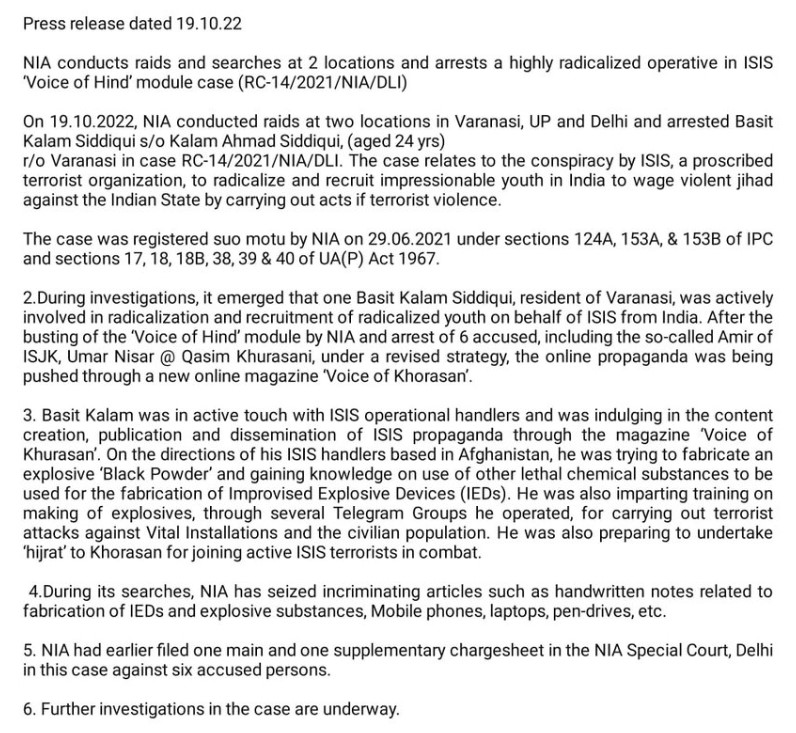
The other arrested accused in the case include Irfan Khan (age 35), Yusuf Khan (age 44), Muddsir Ahmad (age 22), Shahrukh Pathan (age 25), Abdul Thoufique (age 24) Shoaib Khan (age 22), and Atib Rashid (age 22). Umesh Kolhe, 54, was stabbed to death on June 21 this year for purportedly sending a post supporting the former spokesperson of Bharatiya Janata Party Nupur Sharma on a social messaging platform.

As per what is known about the case so far, Umesh Kolhe’s friend Yusuf Khan had spotted Kolhe’s WhatsApp message supporting Nupur Sharma and had circulated it in other WhatsApp groups. He had also informed about it to Sheikh Irfan Khan, who runs an NGO. Irfan Khan then plotted the murder and entrusted the responsibility of recce to Maulana Mudassir Ahmed alias Sonu Raza Sheikh Ibrahim. After that, Irfan Khan engaged four daily wage workers Shahrukh Pathan, Abdul Taufiq, Shoaib Khan, and Atib Rashid, who had worked for his NGO earlier, for the execution of his plan.

On the night of June 21, Shoaib stabbed Umesh Kolhe in his neck. Initially, the police had said that it was a case of robbery gone awry, but after there was a change in the government in Maharashtra, the police admitted that Kolhe was killed for supporting Nupur Sharma.

Rajasthan Congress again facing risks of ‘todo’ while Rahul Gandhi does Bharat Jodo in Kerala

0

On September 12, shoes, slippers and empty water bottles were hurled at Congress leader and Rajasthan sports minister Ashok Chandna, allegedly by Sachin Pilot camp at Asthi Visarjan program of late Gurjar leader Kirori Singh Bainsla. Had it not been Kirori Singh Bainsla’s son Vijay Singh Bainsla who stopped the crowd from getting violent, the situation could have been worse, as per reports.

Both Bharatiya Janata Party and Congress leaders were present at the mass meeting organized by the MBC community in memory of the late Gurjar leader. Apart from Ashok Chandna, BJP MP and Lok Sabha Speaker Om Birla, BJP state president Satish Poonia, Congress MLA and industries minister Shakuntala Rawat were present at the meeting. However, Sachin Pilot, who himself comes from the same community, was not present at the program.

The series of events at the mass meeting

Vijay Singh Bainsla was on a Kalash Yatra with the ashes of the late Gurjar leader and travelled across the state so that the community members can pay their last respects to the leader. The Asthi Visarjan program was scheduled for September 12 in Pushkar, Ajmer, for which several leaders irrespective of their political affiliation were invited.

During the mass meeting, the leaders addressed the attendees and paid their respects to the late Kirori Singh Bainsla. However, when Rajasthan minister and Congress leader Ashok Chandna came to the dais, some attendees started raising slogans in favour of Congress leader Sachin Pilot. When asked to stop, they started hurdling shoes, slippers and water bottles toward Chandna. As there was a lot of distance between the stage and the hooligans, none of the shoes etc reached the stage. To ensure Chandna’s safety, he was taken away from the stage along with other Congress leaders Shakuntala Rawat.

Irked by the series of events that took place in Pushkar, Chandna wrote on Twitter, “If Sachin Pilot becomes the chief minister by throwing a shoe at me, then he should be made soon because today I do not feel like fighting. The day I come to fight, then only one will be left and I do not want this.”

In another tweet, he wrote, “Today a wonderful sight was seen- When Rajendra Rathod, (then cabinet member) who ordered the killing of 72 persons came on the stage, was applauded and shoes were thrown at those whose family members went to jail during the ‘Gurjar reservation’ agitation.”

“The family members of the martyrs were sitting on the platform on which the shoes were thrown, at least they should have been taken care of,” he added.

Sachin Pilot failed to attend Asthi Visarjan of prominent Gurjar leader

Speaking to OpIndia, Vijay Singh Bainsla said, “It was not a place to settle political scores.” He added on August 12, days before the Yatra started, he had personally contacted every leader to invite them to the Asthi Visarjan Program scheduled for September 12. Bainsla said, “Sachin was the first person I called to invite. However, he did not receive my call. At that time, members of the Gurjar community from his camp were with me. I requested them to call his PA and arrange the call. After a few attempts they managed to reach out to the PA and I finally talked to him and personally invited him to the event. However, it was sad to see that he missed such an important event for the community that he belongs to.”

Pilot had though tweeted about the program. He said, “Tributes to Late Col. Kirori Singh Bainsla ji on his birth anniversary. Today, on the occasion of his ashes immersion, I offer my heartfelt tributes.”

OpIndia’s source in the Gurjar community linked to the Congress party said on the assurance of anonymity that a group of local Gurjar leaders of Sachin Pilot camp went to meet him and invite him for the event but he put a condition that it should not be about MBC community. He said, “Pilot told them to remove ‘MBC community from the posters’ as he does not want to project himself as a leader of a community.”

He further added, “When Asthi Kalash of Late Shri Kirori Singh Bainsla reach Tonk, which is Sachin Pilot’s constituency, it was visible how much love the people of the community had for the late Gurjar leader. Sachin Pilot did not come for the Tonk procession as well. The leaders from other locations had joined irrespective of their political affiliation.”

Notably, Vijay along with his late father had joined BJP before the 2019 Lok Sabha elections. Gurjars had played a vital role in Congress’s win in the last Assembly elections.

Islamists begin their fear-mongering after the Gyanvapi verdict, Owaisi claims ‘another Babri’, AIMPLB says it will lead to violence

Hours after the district court in Varanasi ruled that the suit in the Gyanvapi-Shringar Gauri case is maintainable and that the facts presented by the Hindu side are acceptable, Islamic outfit ‘All India Muslim Personal Law Board (AIMPLB)’ resorted to fear-mongering about the verdict.

In a statement on Monday (September 12), it informed, “General Secretary Maulana Khalid Saifullah Rahmani has said that in his press note that the verdict of the court is disappointing.”

AIMPLB claimed that the contentious Places of Worship Act of 1991, enacted by the Parliament, called for upholding the status quo of all religious structures (with the exception of the Ram Janmabhoomi case) and accused the Varanasi court of “ignoring the law”.

The Islamic outfit cast aspersions on the integrity of the Judiciary and accused it of making the path easier for ‘Hindu extremists’ to reclaim the disputed structure. While hinting at the possibility of Muslim mobs going berserk, AIMPLB said that the verdict will affect India’s unity and communal harmony.

“Extremism and violence will increase, and lead to conflict in cities,” it continued. “The government should implement the 1991 law with full force. All stakeholders must be made to follow this law. Minorities should not feel that all doors of justice are closed for them,” AIMPLB concluded.

PFI cries foul

The radical organisation, Popular Front of India (PFI), has cried foul after the Varanasi district court passed its verdict in the favour of the Hindu side. PFI President Oma Salam extended his support to the Anjuman Islamia Masjid Committee, which challenged the maintainability of the Gyanvapi-Shringar Gauri suit filed by five Hindu women.

He called upon the Committee to protect the disputed structure from being reclaimed by Hindus and supported the decision to appeal against the verdict in High Court. With an intent to create unrest in the country, PFI accused the court of encouraging supposed ‘fascist attacks’ against the country’s minorities.

Asaduddin Owaisi draws parallels to the Babri Masjid case

Following the historic verdict, AIMIM chief Asaduddin Owaisi told NDTV, “I was hoping that the court will nip these issues in the bud. Now it appears that more such litigations will be coming and this is going the way the Babri Masjid legal issue went.”

He claimed that the order by the Varanasi district court will ‘set off many things’. Owaisi further alleged that the objective behind the Places of Religious Act would fail and hoped that Anjuman Intezamia Masjid Committee would appeal against the order.

The AIMIM leader remarked, “Everyone will say that we have been here before 15 August 1947. Then the aim of the 1991 Places of Religious Worship Act will be defeated. The 1991 Act was made so that such conflicts end.”

“But after today’s (September 12) order, it seems there will be more litigations on this issue and we will be back to the ’80s and it will create a destabilising effect,” he concluded.

When Owaisi provoked Muslims against court-ordered proceedings 

In May this year, AIMIM chief Asaduddin Owaisi called upon Muslims to not lose the disputed Gyanvapi mosque at any cost. He made the contentious remarks after a Shivling was discovered inside the disputed structure.

“When I was 19-21, the Babri Masjid was snatched away from me. But we will never lose a Masjid again in front of the 19-20-year-olds. Do you take an oath that we will not lose any more mosque?” he asked a frenzied crowd.

Amidst chants of ‘Naara-e-Takbeer’ and ‘Allahu Akbar’, his supporters vowed to protect the disputed structure of the Gyanvapi mosque. “They must know that we will not lose any more of our mosques. We know all your tactics,” Owaisi remarked.

“A Momin is someone who doesn’t get bitten by the same snake twice. We will not allow them to bite us again. It (Gyanvapi) was a masjid and it will remain so till Qayamat (the Day of Judgment),” he continued to rage.

Asaduddin Owaisi added, “It is our responsibility to keep our mosques free.” He further called upon Muslims to visit mosques frequently all throughout the year and not just during the month of Ramzan.

While dubbing the whole exercise of videography of Gyanvapi as the work of shaitan, the AIMIM leader remarked, “If we keep our mosques filled with worshippers, then, these Satanic forces who want to deprive us of our culture will understand that Indian Muslims are now not ready to lose their mosques.”

It is notable here that the case of Hindu women seeking right to worship at the Shrigar Gauri shrine inside the Gyanvapi premises has only been deemed “maintainable” by the Varanasi District Court in the recent order.

Gyanvapi-Shringar Gauri case: Explaining the arguments of Masjid Committee application, objections of the Hindu side and the Court verdict

A Varanasi court on the 12th of September gave the verdict dismissing the application by Anjuman Intezamia Masjid Committee challenging a plea by Hindu women, seeking permission to worship the Hindu deities residing in the Gyanvapi complex. The decision by the Varanasi court is being considered a massive win for Hindus in the Gyanvapi-Shringar Gauri case and the Hindu side may now ask for a court-mandated ASI survey of the premises and also, carbon dating of the Shivling found inside the “wuzukhana” of the disputed premises, where thousands of Muslims would wash their hands and feet.

The verdict comes after a district court in Varanasi reserved its order in August on a plea brought by the Anjuman Islamia Masjid Committee, which challenged the maintainability of the Gyanvapi-Shringar Gauri suit filed by five Hindu women. The Court heard arguments on the merits of a petition filed by five Hindu women seeking permission to worship at the Shringar Gauri Sthal in the disputed Gyanvapi complex of Kashi Vishwanath on a daily basis.

It is in this case that the Varanasi court ordered a video survey of the disputed complex on May 12 this year. Stunning revelations were made after the survey including the discovery of a Shivling in the Wuzukhana of the disputed Gyanvapi complex. Following the survey, Civil Judge (Senior Division) Ravi Kumar Diwakar ordered the sealing of the disputed Gyanvapi structure as requested by Advocate Hari Shankar Jain to safeguard the premises.

Ajay Mishra, the court-appointed commissioner entrusted with inspecting the Gyanvapi complex, stated in his report that there are stone sculptures of Hindu Gods and Goddesses on the walls of the disputed edifice. According to Mishra’s report, the stone carvings on the eastern and western sides of the so-called masjid are comparable, indicating that they were all part of a bigger edifice that was destroyed.

The present litigation regarding the disputed Gyanvapi complex is centred on five female petitioners. On April 18, 2021, Rakhi Singh, Laxmi Devi, Sita Sahu, Manju Vyas, and Rekha Pathak filed a lawsuit demanding the right to regularly worship and perform rituals at Shringar Gauri, Lord Ganesh, Lord Hanuman, and Nandi, as well as prohibiting opponents from harming the statues inside the disputed Gyanvapi structure.

Gyanvapi verdict: What did the Anjuman Intezamia Masjid Committee say in its application against the Hindu side

The application by the Masjid committee was filed under Order 7 Rule 11 of the CPC. This rule was essentially cited to claim that the suit (by the Hindu women) was barred in law. One of the provisions of Order 7 Rule 11 or CPC says that the suit will be dismissed by the court “where the suit appears from the statement in the plaint to be barred by any law”. The application by the Masjid committee said, “In this mosque, the common Muslims of Varanasi city and the nearby area have been offering Namaz of five times and Namaz of Eid & Jumma without any interference. The Parliament enacted the Places of Worship (Special Provisions) Act, 1991 in the year 1991. In this Act, it has been provided that the places of worship will remain in the same position in which they were on 15th August 1947 and regarding such places of worship, no suit will be maintainable in any court. Further, in 1983, Shri Kashi Vishwanath Act, 1983 was enacted in Uttar Pradesh. In this Act, it has been provided that Board of Trustees will be created which will look after Shri Kashi Vishwanath Mandir and all Gods and Goddesses in its compound”. The Masjid Committee said that the Gyanvapi Mosque (disputed) has been situated in the same place for 600 years and therefore, such suits are barred by the Places of Worship Act 1991.

The Masjid committee further said, “It has also been mentioned in application 35C that Gyanvapi Mosque, which has been described in para 12 of the plaint and its sub-paragraphs from I to XIV, is a Waqf property and it has been entered at Sl. No. 100 (Varanasi) as property of U.P. Sunni Central Board of Waqf, Lucknow. It has also been alleged in the application that the suit is barred by Act no.42 of 1991 and Act no.29 of 1983 and Act no.43 of 1995”.

Therefore, the Masjid Committee claimed that the suit by the Hindu women should be dismissed since it is barred by 3 acts – the Places of Worship (Special Provisions) Act, 1991; the Waqf Act, 1995 and the Uttar Pradesh Shri Kashi Vishwanath Temple Act, 1983.

Gyanvapi verdict: What was the Hindu side’s arguments in their objection to the application by the Masjid committee

The Hindu side, in its objection to the application filed by the Masjid Committee made the following points, in essence:

  1. The Hindu side said that the plea based on the Places of Worship Act 1991 has been made by the Masjid Committee only to prolong the proceedings because they do not want the suit to be heard and decided on its merits.
  2. There is no Mosque within settlement plot no. 9130 situated in the area of Dashashwamedh ward Police Station-Dashashwamedh, District Varanasi which has been described as the property in question in the suit. It has been averred in the suit that the entire property in question vests in the deity from time immemorial.
  3. The suit says that if any person without the sanction of law, occupies a place and starts offering namaz, it does not turn the property into a mosque automatically.
  4. Nobody has the right to encroach upon the land/property already vesting in the deity. The principle of ‘first in existence’ or ‘prior in existence’ is the paramount consideration for determining the right of worship at a particular place where two communities are claiming the right to worship. 
  5. The nature of the suit has been specified clearly – The suit has been filed inter alia for restraining the defendants from interfering in the performance of Darshan, Pooja of Goddess Maa Shringar Gauri, Lord Ganesha, Lord Hanuman, Nandi Ji, Visible and Invisible deities, Mandaps and Shrines existing within the whole temple complex i.e. at the property in question.
  6. The plaintiffs (Hindu women) have said that the deities existed on the premises before 15-08-1947 and the devotees have the right to protect and worship the same. The right in question here flows from Article 25 of the Constitution of India (Freedom of conscience and free profession, practice and propagation of religion).
  7. The Hindu side has argued that Shri Adi Visheshwar Jyotirlingam exists along with the images of Maa Shringar Gauri, Lord Hanuman, Lord Ganesh and other Visible and invisible deities within the temple complex at land no. 9130 commonly known as Shri Adi Visheshwar Temple which are being worshipped by devotees of Lord Shiva from time immemorial despite the fact that Aurangzeb during his barbarous rule got demolished a portion of the Temple, over which Muslims without any authority of law raised some constructions over the land of the deities but the deities continued to be dejure owner of the property.
  8. The image of Maa Shringar Gauri exists within the property in question at the back side of Gyanvapi in Ishan Kon. The Hindus are continuously performing pooja of Maa Gauri, Lord Hanuman, Lord Ganesha and other Visible and invisible deities with rituals and are doing circumambulation (Parikrama) of the temple of Lord Visheshwar. The Hindus continued in the possession of the cellar (Tehkhana) towards South and other parts of the demolished Temple with its ruins and Lord Adi Visheshwar is still in existence in its original shape in the western part of the old Temple at the property in question. The plaintiffs have already moved an application for appointing an Advocate Commissioner for an inspection of the property in question in the light of the averments made in the plaint.
  9. The Hindu side argued that according to Order 7 Rule 11 of the CPC, the court is supposed to take cognisance of the arguments made in the suit, not the arguments made by the defendants (in this case, the Masjid committee). Hindus said that from the arguments made in the suit, it is clear that the deities have existed within the temple property before 15th August 1947 and therefore, the Places of Worship Act 1991 cannot be applicable to the case.
  10. Under Hindu law, the property once vested in the deities shall continue to be the deity’s property and its destruction, if any, cannot change the nature of the property.
  11. Further detailing why the Places of Worship (Special Provisions) Act, 1991 does not apply to this case, the Hindu side cited the Ayodhya judgement. The Supreme Court had, in their verdict, said that the “idol constitutes the embodiment or expression of the pious purpose upon which legal personality is conferred”. Therefore, even if the idol is destroyed, it does not end the property from being vested with the idol.
  12. The Hindu side has said that Shri Kashi Vishwanath Act, 1983 has not taken any step for proper Darshan, Pooja and performance of rituals of Maa Shringar Gauri, Lord Ganesh, Lord Hanuman and other visible and invisible deities within the whole temple complex. In the Ayodhya case, the Supreme Court had made clear that a devotee can bring a suit to protect the rights of the deities and the devotees if the shabait/trust fails in its duties.
  13. Section 4 of the Places of Worship Act 1991 says that the ‘religious character of a place of worship existing on the 15th Day of August 1947’ shall remain unchanged. Now, what the nature of the place of worship was on that day has to be proven in court. The Hindu side says that they have laid the foundation for the argument that the premises were indeed a Hindu temple on that date.
  14. The premises mentioned in the suit is already a ‘temple’ as defined in Section 4 (9) of the Uttar Pradesh Kashi Vishwanath Temple Act, 1983. The religious character of the entire property in the suit has already been declared by the U.P. State Legislature and there is no question of applicability of the provisions of the Act of 1991. The U.P. State Legislature has already recognised the existence of Jyotirlinga within the definition of a ‘temple’ which is in existence beneath the disputed structure and is being called Gyanvapi Mosque by Muslims.
  15. The property is not a Waqf property and the registration of this property as such is illegal and void.

The Hindu side, in detail, refuted all the points that were presented by the Anjuman Intezamia Masjid Committee challenging the plea of the Hindu women, who wanted their right to worship in the temple.

Gyanvapi verdict: What did the court rule after listening to the Masjid Committee and the Hindu side

The Muslim side had three contentions mainly:

(a) The suit of the plaintiffs is barred by Section 4 of the Places of Worship (Special Provisions) Act, 1991 (Act no.42 of 1991).

(b) The suit of the plaintiffs is barred by Section 85 of the Waqf Act, 1995 (Act no.43 of 1995).

(c) The suit of the plaintiffs is barred by the Uttar Pradesh Shri Kashi Vishwanath Temple Act, 1983 (Act no.29 of 1983).

The court went into the details of each act, explaining why the suit is not barred under any of the three laws.

Places of Worship Act 1991

Sections 3 and 4 of the Places of Worship (Special Provisions) Act, 1991, says that conversion of any place of worship of any religious denomination or any section thereto into a place of worship of a different section of the same religious denomination or of a different religious denomination is prohibited. It is also noteworthy that the religious character of a place of worship as it existed on 15th August 1947 shall remain the same and it will not be allowed to be changed.

The court then proceeded to examine if the relief sought in the suit is barred by the Places of Worship Act.

The 4 main reliefs sought by the Hindus are as follows:

  1. Deities are entitled to worship the deities present, visible and invisible, on the premises.
  2. The Muslim side cannot create any hindrance to the Darshan, Aarti, puja etc by the Hindus.
  3. Restraining the defendants from demolishing, damaging, destroying or causing any damage to the images of deities Goddess Maa Sringar Gauri at Asthan of Lord Adi Visheshwar along with Lord Ganesh, Lord Hanuman, Nandiji and other visible and invisible deities within the old temple complex situated at settlement Plot No. 9130 in the area of Ward and P.S. Dashashwamedh, District Varanasi.
  4. Directing the Government of Uttar Pradesh and District Administration to make security arrangements for devotees doing Darshana, puja, etc.

Taking into account that Hindus have been worshipping the deities, it is after 16/4/2021 that devotees have been stopped from doing puja, that the government of Uttar Pradesh in 1993, without any sanction of the law, directed authorities to stop devotees from performing daily puja and entering the premises after the Ayodhya movement in 1990 to appease Muslims and that the Hindus have had continuous possession of the Taikhana, the Court said according to plaintiffs, “even after 15th August 1947 they were worshipping Maa Sringar Gauri, Lord Ganesh and Lord Hanuman daily up to the year 1993. If this contention is proved then the suit is not barred by Section 4 of the Places of Worship (Special Provisions) Act, 1991. At this stage, the averments made in the plaint are to be seen and plaintiffs will have the right to prove their averments by cogent evidence”.

The court said, “The main argument of the learned counsel for the plaintiffs is that the plaintiffs have not sought declaration or injunction over the property/land plot no.9130. They have not sought relief for converting the place of worship from a Mosque to Temple. The plaintiffs are only demanding the right to worship Maa Sringar Gauri and other visible and invisible deities which were being worshipped incessantly till 1993 and after 1993 till now once a year under the regulatory of the State of Uttar Pradesh. Therefore, the Places of Worship (Special Provisions) Act, 1991 does not operate as the bar on the suit of plaintiffs. The suit of the plaintiffs is limited and confined to the right of worship as a civil right and fundamental right as well as customary and religious right. I agree with the learned counsel for the plaintiffs”.

Section 85 of The Waqf Act 1995

The Masjid Committee argued that the suit of the Hindus (plaintiffs) is barred by Section 85 of The Waqf Act 1995 because the subject matter of the suit is a Waqf property and only Waqf Tribunal Lucknow has right to decide the suit.

Section 85 of the Waqf Act says ‘no suit or other legal proceeding shall lie in any Civil Court, revenue Court and other authority in respect of any dispute, question or other matter relating to any waqf, waqf property or other matter which is required by or under this Act to be determined by a Tribunal’.

The Muslim side cited several case laws to claim that whether a property is a Waqf property or not cannot be decided by the Civil Court, but only a Tribunal constituted under Waqf Act can adjudicate such cases and therefore, the Hindu side suit should be dismissed. The contention of the Muslim side is that the said property of Gyanvapi is Waqf property. It is pertinent to note that the Hindu side has claimed that the said registration as Waqf property is void and illegal.

Against this argument, the Hindu side argued that in para 7 of the plaint, it is mentioned that it is undisputed that no waqf can be created over the property belonging to and vested in the deity. A mosque can be constructed only on waqf property. There is no evidence up till now that Aurangzeb had created any waqf for the construction of the mosque. Therefore, the Muslim community is an encroacher on the land and they have no right to use the land for the performance of any religious act concerning the Muslims. The. Hindu side also cited several case laws to bolster its position.

Taking this into consideration, the court ruled:

“In the present case, the plaintiffs have claimed relief that they should be allowed to worship the deities of Maa Sringar Gauri and other Gods and Goddesses in the disputed property but such relief is not covered under Sections 33, 35, 47, 48, 51, 54, 61, 64, 67, 72, & 73 of the Waqf Act. Therefore, the jurisdiction of this court to entertain the present suit is not barred. Therefore, I have come to the conclusion that the bar under Section 85 of the Waqf Act does not operate in the present case because the plaintiffs are non-Muslims and strangers to the alleged Waqf created at the disputed property and the relief claimed in the suit is not covered under Sections 33, 35, 47, 48, 51, 54, 61, 64, 67, 72 & 73 of the Waqf Act. Hence, suit of the plaintiffs is not barred by Section 85 of the Waqf Act 1995”.

Uttar Pradesh Sri Kashi Vishwanath Temple Act, 1983

“In my view, the defendant no.4 failed to prove that the suit of the plaintiffs is barred by the U.P. Kashi Vishwanath Temple Act, 1983 (Act no.29 of 1983). Section 5 of the Act declares that the ownership of the temple and its endowment shall vest in the deity of Shri Kashi Vishwanath. Section 6 of the Act provides that with effect from the appointed date, the administration and governance of the Temple and its endowments shall vest in a Board to be called the Board of Trustees for Shri Kashi Vishwanath Temple”, said the court.

The court cited Section 4(5), saying that endowment includes any property, movable or immovable, endowed for the support of the Temple or to perform rituals etc. Section 4(9) defines the “temple” as, the “Temple of Adi Visheshwar, popularly known as Sri Kashi Vishwanath Temple, situated in the City of Varanasi which is used as a place of public religious worship, and dedicated to or for the benefit of or used as of right by the Hindus, as a place of public religious worship of the Jyotirlinga and includes all subordinate temple, shrines, sub-shrines and the Asthan of all other images and deities, mandaps, wells, tanks and other necessary structures and land appurtenant thereto and additions which may be made thereto after the appointed date”.

The court said that from the perusal of these sections, that no bar has been placed on a suit asking for the right to worship at the endowment within the temple or outside the temple.

Concluding their observations, the court said, “In view of the above discussions and analysis, I have come to the conclusion that the suit of the plaintiffs is not barred by the Places of Worship (Special Provisions) Act, 1991 (Act no.42 of 1991), The Waqf Act 1995 (Act no.43 of 1995) and the U.P. Shri Kashi Vishwanath Temple Act, 1983 (Act no.29 of 1983) and the application 35C filed by the defendant no.4 is liable to be dismissed”.

The court then fixed 22nd September 2022 as the date for filing of written arguments and framing of the matter presented by the Hindu side.

Auto ride drama: After demanding additional security, Kejriwal seen misbehaving with Ahmedabad police, says he doesn’t want protection

On September 12, Chief Minister of Delhi and Aam Aadmi Party’s National Convener Arvind Kejriwal was seen arguing with the Ahmedabad Police over his security. The video was shared by AAP’s official account that attracted criticism as netizens accused him of using unparliamentarily language for the officers on duty.

Kejriwal was in Ahmedabad to promote his party for the upcoming Gujarat Assembly elections. During a meeting with the locals, he accepted a dinner invitation by an auto driver in the exact same manner he had done in Punjab before Assembly Elections. Kejriwal wanted to go to the auto driver’s house in his auto with two other AAP Gujarat leaders but the Ahmedabad Police urged him to avoid travelling in an Auto for security reasons. This was the moment Kejriwal got ‘irked’ and lashed out at the Police officers.

While the Police officer in conversation with him was calm and tried to convince him to follow the protocol in place for VIPs, Kejriwal kept on accusing Gujarat Police of stopping him to meet the public. He said, “Why can’t we go? What kind of security will you give? This is a blot on you. You should feel ashamed. The people of Gujarat are suffering because your leaders do not go and meet them. We are going to meet the public and you are stopping us. You have kept us hostage.”

When the Police officer said there was communication to the state government seeking security as per protocol, he said, “I do not want your security. You are forcefully providing security. I want to go in public. Give your security to your ministers. You cannot arrest me. This is an arrest. I have given you in writing I do not want your security but you are forcefully giving it. You are keeping me hostage. You are arresting me.”

The Police officer mentioned he was a Z category protectee and the Police are duty bound to provide a security cover, he said, “I do not want your Z protection. Keep it to yourself.” During the whole conversation, Kejriwal kept shouting at the officer as he tried to do his duty.

The whole drama ended after that and two Police vehicles escorted the Auto to his destination. A Police officer also accompanied the Delhi CM inside the auto. Sadly, as three of the AAP leaders including Kejriwal were sitting in the back seat of the auto, the Police officer had to sit with the driver in a very dangerous position which was visible in another video shared by AAP.

Netizens fumed over Kejriwal’s language

Assam Minister Pijush Hazarika said, “The mockery created by Delhi CM Arvind Kejriwal ji yesterday in Gujarat is a testimony to the fact that how great actor Kejriwal ji is! Any award show on this planet will be low to recognise his talent!”

BJP leader Tajinder Singh Bagga said, “Stop defaming Gujarat. Your party itself had written a letter seeking protection from the Gujarat Police and expressed the possibility of an attack on Kejriwal. Now due to hunger for publicity in front of media cameras you started drama in front of Gujarat Police.”

BJP leader Priti Gandhi said, “Aam Aadmi Party Gujarat unit wrote a letter demanding special protection for Kejriwal on his Gujarat visit. They emphasized that there is a possibility of a violent attack on him. Now when Gujarat Police is giving him protection, he is accusing them of holding him hostage!!

AAP Gujarat had sought security for Kejriwal

Interestingly, AAP Gujarat had sought security for Arvind Kejriwal. In April 2022, when Arvind Kejriwal started his campaigning in Gujarat, AAP’s Gujarat wing sought security for him. The letter submitted seeking security for Delhi CM was shared by the official handle of AAP Gujarat. They wrote, “The Aam Aadmi Party has informed the Commissioner to maintain proper security vigilance in view of the possibility of a violent attack by anti-social elements at any place or time during the entire Gujarat tour program of Chief Minister Shri Arvind Kejriwal and Chief Minister Shri Bhagwant Maan Sahib.”

As the Police officer mentioned, they had a communication to provide security to the VIP, in this case, Arvind Kejriwal, who is Chief Minister of Delhi. Not to forget, Kejriwal himself had said in Delhi Assembly targeting Prime Minister Narendra Modi that if PM cannot provide security to Kejriwal, he should leave his post.