Home Blog Page 32

WhatsApp chats, petrol bomb plans, and targeted attacks: Inside the conspiracy fueling Manesar violence and a larger pattern across industrial hubs

Police uncovered a larger conspiracy behind the violent protests of IMT Manesar and arrested six key accused on Monday, 13th April. What began as a protest over salary hikes quickly turned violent on 9th April, in the industrial area of Manesar. Workers from multiple companies gathered in the IMT area demanding better wages and working conditions. The situation escalated when a section of the crowd turned aggressive, leading to stone pelting, vandalism, and arson.

WhatsApp chats reveal a larger conspiracy

As the investigation progressed, police uncovered a much bigger conspiracy behind the violence on Monday, 13th April. According to officials, several provocative messages were shared in WhatsApp groups that included workers from different factories. These messages played a key role in inciting the crowd.

According to media reports, many of these messages were sent by “outsiders” who were not linked to the companies. These individuals tried to provoke workers and push them towards violence. Some messages even talked about targeting specific individuals. 

In one such message, there was a call to bring out a manager named Rambir, suggesting plans to attack him to trigger chaos.

Image via Dainik Bhaskar

More alarming were messages suggesting planned attacks at night. One message said to “wait till night and then set fire,” indicating that the violence may have been pre-planned to escalate after police presence was reduced.

Image via Dainik Bhaskar

There were also clear references to petrol bomb attacks. Messages instructed people to bring beer bottles, fill them with petrol, and throw them at the factory premises. Police believe this shows a deliberate attempt to target multiple industrial units and create large-scale disruption.

Officials said that so far, 61 people have been arrested in connection with the violence, including 15 women. While some have been granted bail, others are currently lodged in Bhondsi jail.

Six key accused arrested, identified

In a breakthrough, police on Monday, 13th April, arrested six “primary conspirators” linked to the violence. These accused have been identified as Akash from Rohtak, Harish Chand from Pauri Garhwal, Pintu Kumar Yadav from Madhubani, Raju Singh from Udham Singh Nagar, Shyambir from Badaun, and Ajit Singh from Jind.

According to investigators, these individuals were not workers and had no professional connection with the companies in Gurugram. “The investigation further revealed that most of the arrested individuals are not labourers… they are accused of infiltrating the strike to incite workers toward violence,” an officer said.

Police added that the violence on 9th April targeted three branches of a private company in Sector 7. Protesters damaged company property, attacked staff, and pelted stones at police personnel “with the intent to murder.”

Digital evidence, especially WhatsApp chats, played a crucial role in identifying the accused and exposing the conspiracy.

Police had already imposed restrictions under Section 163, asking workers not to protest. However, tensions continued to rise. During the clash, some protesters attacked a company’s premises, after which police resorted to a lathi-charge to control the situation. In retaliation, a police bike was set on fire, and several vehicles were damaged.

The protests were not sudden. Just days earlier, on 6th April, workers at a major automobile company had gone on strike over wages, and their demands were accepted the next day. This encouraged workers from other companies in the Manesar industrial belt to begin similar protests, which eventually led to the large-scale unrest on 9th April.

Administration steps in with strict directives

Following the violence, authorities moved quickly to prevent further unrest. Senior officials, including DCP Manesar Prabina, SDM Darshan Yadav, and Labour Commissioner Naveen Kaushik, met with company owners and contractors.

The administration has issued a set of instructions to industrial units to ensure smooth functioning and avoid further issues. Companies and contractors have been clearly told to pay workers their salaries and honorariums as per the government’s rules.

They have also been asked to display wage details on notice boards outside their premises so that workers can easily check and understand what they are supposed to be paid.

At the same time, management has been strictly directed to make sure that no worker faces harassment, unfair treatment, or any kind of victimisation at the workplace.

To maintain peace in the area, companies have also been advised to keep a calm environment and ask workers not to pay attention to rumours being spread by outsiders.

Police appeal and ongoing investigation

Police have registered FIRs at the IMT Manesar Sector 7 police station, and the investigation is still ongoing. Police spokesperson Sandeep Kumar said the WhatsApp messages clearly indicate that there was a “large conspiracy” behind the violence.

“We appeal to all workers not to be misled by non-workers or outsiders who attempt to disrupt the peace for their own motives,” the police said in a statement. “If any external element tries to incite you, please inform the police immediately.”

Meanwhile, the Centre of Indian Trade Unions (CITU) has criticised the police action and demanded the release of 55 workers, including 20 women, who were detained after the protest. CITU leader Suresh Nouhra claimed that workers were protesting peacefully but were met with a lathi-charge. He said, “Cases have been registered against 55 workers… and labour leaders are being issued notices and arrested.”

The union has also demanded a minimum monthly wage of ₹30,000 and announced statewide protests on 16th April.

Protests spread to Noida and nearby regions

The unrest in Manesar has not remained limited to Gurugram. Similar violent protests have now been reported from other parts of the National Capital Region, especially Noida.

In Noida, protests that began a few days earlier turned violent on Monday, 13th April. Workers in areas like Phase 2 and Sector 60 were involved in stone pelting, arson, and vandalism. Several vehicles were set on fire, and industrial units were damaged.

By evening, over 300 protesters were arrested under preventive provisions for arson and vandalism, while more than 100 were detained for questioning.

The protests also disrupted traffic, with long queues seen on roads leading to Delhi. In some areas, protesters blocked National Highway 9, causing major inconvenience to commuters.

The authorities revealed that the protestors in Noida have similar demands as the protestors in Manesar, mainly an increase in wages. The Uttar Pradesh government has denied the factory workers’ pay hike demand, saying they had increased the prices on 1st April. The interim rates fixed by the government in Gautam Buddha Nagar and Ghaziabad had increased to ₹13,690 for unskilled workers, ₹15,059 for semi-skilled workers, and ₹16,868 for skilled workers.

The nature of the protest has made some speculate if there are some similar elements trying to foment trouble in the industrial area.

“I look at Sangh with a sense of belongingness”: What Ambedkar said after RSS visit in Satara and his lesser-known association with the organisation

14th April marks the birth anniversary of Bharat Ratna Dr Bhimrao Ramji Ambedkar, commonly known as BR Ambedkar, who is widely acknowledged as the chief architect of the Indian Constitution. His efforts towards nation-building are deeply motivating. His life and work continue to inspire generations to build a just and progressive society,” Prime Minister Narendra Modi wrote on the occasion.

Interestingly, while certain aspects of Ambedkar’s life have been excessively publicised, there are numerous notable occurrences associated with him that remain unknown to many, either due to deliberate concealment for political reasons or other factors.

A significant incident pertained to his interactions with the country’s largest voluntary outfit, Rashtriya Swayamsevak Sangh (RSS), which held its centenary celebrations last October and the event was also graced by PM Modi. A document recently revealed that Ambedkar visited Karad in the Satara district on 2nd January 1940. He went to the Sangh Shakha (local unit) there and addressed the swayamsevaks.

“Even though there are differences in some matters, I look at Sangh with affection or belongingness,” he expressed. The news was covered in the Kesari, a Marathi newspaper located in Pune, on 9th January of that year. It was also published in the Vidarbha chapter of the Vishwa Samvad Kendra (VSK) of the RSS in 2025.

Image via Arise Bharat

On 2nd January 2025, the Lok Kalyan Mandal Trust held an ideological gathering at “Shri Bhavani Sangh Sthan” named the “Bandhutva Parishad” in remembrance of the momentous development.

The relationship between the two is also explained in author Dattopant Thengadi’s book, “Dr Ambedkar and the Journey of Social Revolution.” He mentioned, “Dr Ambedkar was fully aware of Sangh. Its volunteers were in constant contact with him. He used to discuss with them. He was also informed that the Sangh is an all-India organisation of Hindus. He knew it was different than other Hindu-oriented parties or organisations. He only had a doubt in his mind about the pace of Sangh’s growth. In this view, Dr Ambedkar and RSS need to be analysed.” The eighth chapter commenced with the observation.

Dattopant Thengadi asserted that Dr Keshav Baliram Hedgewar, who established RSS, demonstrated the ideal of a caste-free, socially equitable society. He explicitly declared that a system that has not yet been embraced by anyone can establish social equality grounded in psychology. Ambedkar shared his belief that peace among people is a prerequisite for achieving social equality, reported Organiser. These exemplifies the similar outlook of the two towering stalwarts who aspired for a progressive India.

Furthermore, this is not the earliest recorded instance of Ambedkar’s attendance at the Hindu group’s programs. “Aamche Saheb” featured previous such instances regarding an RSS camp in 1939 on pages 25 and 53, according to Arise Bharat. The book is a collection of memories and is written by Balasaheb Salunke, a former member of parliament and close friend of Ambedkar.

Ambedkar was joined by Salunke, who had no connections with the RSS, on the trip. The book provides in-depth details of the exchanges between the duo and was put together by Salunke’s son, Kashyap Salunke along with Bhanudas Gaikwad.

Image via Arise Bharat

“Dr Babasaheb Ambedkar and Dr. Hedgewar (founder of RSS) met at Bhausaheb Gadkari’s home in Pune. Sri Bhausaheb Abhyankar took all of us (including Balasaheb Salunke) to the summer camp. Dr. Ambedkar addressed the swayamsevaks on military discipline and organisation,” read the last paragraph of page 25.

“I had the fortune of meeting two great individuals who were dedicated to the upliftment of the depressed classes, Pujya Babasaheb Ambedkar and Dr Hedgewar, the founder of the Rashtriya Swayamsevak Sangh, at Bhausaheb Gadkari’s residence (Pratapgarh) on 12th May,” Salunke highlighted on page 53.

Image via Arise Bharat

“There were accusations of RSS being anti-Dalit and misinformation was spread about Dr Babasaheb Ambedkar and RSS. But now, a new document about them has emerged, which enlightens the relationship between the two” the media wing of the RSS had emphasised in relation to Ambedkar’s arrival at Sangh Shakha.

It pointed out that the RSS “faced a number of challenges in its journey so far and many accusations were levelled against it, but it proved all these charges wrong and reaffirmed its identity as a social organisation.”

MK Gandhi had a similar experience with RSS

The Vishwa Samvad Kendra remarked that the contention that Sangh is only for Brahmins has been refuted. It stated that when Mohandas Karamchand Gandhi went to the RSS camp in Wardha of Maharashtra, in 1934, he noted that it had members from a variety of castes and faiths.

“He experienced first-hand that no swayamsevak in the camp was interested in knowing his own caste or that of other swayamsevaks. There was only one feeling in everyone’s mind – that we were all Hindus. That’s why, the volunteers carried out their daily activity spontaneously. Gandhi was very surprised to see this. The next day, he held a meeting with (RSS founder) Dr Hedgewar, where he congratulated the latter for the successful implementation of the programme to eradicate untouchability,” it outlined.

Additionally, the VSK denied the complaints that RSS failed to recognise the national flag and raise it on 15th August and 26th January. However, it was disclosed that Hedgewar participated in the freedom movement through “Jungle Satyagraha” while working for the Indian National Congress after which the detractors and opponents were forced to believe.

Between Reverence and Realpolitik: The Savarkar–Ambedkar Samanvaya Question

Today, a serious churn is underway within the Hindutva movement regarding the viability of a samanvaya between V.D. Savarkar (hereafter referred to as ‘Savarkar’) and B. R. Ambedkar (hereafter referred to as ‘Ambedkar’). A growing section now openly questions whether such a harmonization is either intellectually sound or strategically wise. This internal divide, however, is not simplistic. Those who advocate this samanvaya fall broadly into two camps.

The first supports it for electoral and pragmatic reasons. They view Ambedkar’s symbolic capital as socially and politically indispensable and believe that integrating him into the Hindutva narrative strengthens coalition-building and expands outreach. The second camp, however, supports this samanvaya on ideological grounds. For them, Ambedkar isn’t limited to just being a Dalit emancipator or the architect of the Constitution. He is a Hindu civilizational icon. He is deified as Bodhisattva Babasaheb Ambedkar. It is this ideological position that requires closer scrutiny. 

This article will primarily engage the latter claim: the attempt to present Ambedkar as organically and ideologically aligned with Savarkarite thought. At the same time, it will argue that the electoral pragmatism adopted by the BJP–Sangh ecosystem in this regard is a double-edged sword, carrying long-term risks alongside short-term gains. 

While the electoral motivations of the first camp are transparent, the second camp, which frames this project as a matter of civilizational synthesis, must explain why Ambedkar, in particular, is elevated as the necessary counterpart to Savarkar. Is it based on the belief that both Savarkar and Ambedkar grasped partial truths, and that their harmonization would produce a more complete civilizational framework? Or is it an attempt to draw Ambedkar’s admirers into the Hindutva fold by asserting that the two figures were fundamentally aligned? That burden of explanation rests with them.

We will consider the arguments which support their hypothesis of samanvaya:

  1. Savarkar & Ambedkar diagnosed caste as a civilisational pathology that needed to be dismantled and overcome.
  2. Ambedkar, even though he converted out of Hinduism, converted to Buddhism, thereby staying within the Dharmic fold.
  3. Ambedkar adopted the Savarkarite definition of the Hindu as the legal definition.
  4. Savarkar praised Ambedkar’s efforts to emancipate the Depressed classes.
  5. Savarkar & Ambedkar both shared a concern for Muslim communal politics.

On Hinduism and Caste

While it is true that both Savarkar and Ambedkar called for the dismantling of the caste order, the similarity largely ends there. The structural divergence lies in their diagnosis of the problem and the civilizational conclusions they drew from it.

Without entering into the merits of their historical claims, the central question is this: Did they view caste as an internal degeneration of Hindu society, for which responsibility lay collectively across the community? Or did they view it as a system rooted in Brahmanism?

A reading of Ambedkar’s works, particularly ‘Who Were the Shudras?’, makes his position clear. He argued that the Shudras were originally part of the Kshatriya order and were later degraded following conflict with Brahmins, who denied them ritual status and pushed them into the fourth varna. Caste, in this telling, was the outcome of historical struggle and power consolidation. In his unfinished manuscript ‘Revolution and Counter-Revolution in Ancient India’, Ambedkar framed Indian history as a prolonged struggle between Brahmanism and Buddhism. Brahmanism embodied ritual supremacy and graded hierarchy. Buddhism represented egalitarian and anti-caste impulses. Caste thus emerged, in his framework, as the product of a dominant priestly order entrenching itself. The oppression of lower castes was interpreted in structural, almost class-like terms. Essentially, Marxist dialectics of oppressor and oppressed were mapped onto the caste order.

Those who seek to establish samanvaya must therefore confront an uncomfortable question. Are they overlooking the implications of importing such dialectics into the civilizational reading of Hindu history? Or is the situation more serious? Do they implicitly accept this framing, wherein large stretches of Indian history are reduced to a moral drama of a malevolent priestly class subjugating the rest of society? If the latter is conceded, then the very civilizational continuity that Hindutva seeks to defend is reinterpreted through the lens of structural oppression rather than organic evolution.

One cannot simultaneously defend Hindu civilization as a continuous cultural inheritance and endorse a framework that treats its foundational institutions as instruments of systemic domination. That tension must be addressed without emotive rhetoric.

But the battle is not lost for Ambedkar’s Hindutvavadi admirers. They posit that Ambedkar posited that a “tectonic shift” occurred within the Hindu social fabric: a transition from a Guna-Karma (merit and action) framework of Varna to a rigid, birth-based system of caste. But even this wasn’t acceptable to Ambedkar. He wrote,

‘…. if under the Chaturvarnya of the Arya Samajists an individual is to take his place in the Hindu Society according to his worth, I do not understand why the Arya Samajists insist upon labelling men as Brahmin, Kshatriya, Vaishya and Shudra. A learned man would be honoured without his being labelled a Brahmin. A soldier would be respected without his being designated a Kshatriya. If European society honours its soldiers and its servants without giving them permanent labels, why should Hindu Society find it difficult to do so, is a question which Arya Samajists have not cared to consider.’

– Annihilation of Caste: The Annotated Critical Edition (Navayana, 2014), p. 222.

He questioned the very nature of what was called “Hindu religion,” writing:

‘What is this Hindu Religion? … What is called Religion by the Hindus is nothing but a multitude of commands and prohibitions… To put it in plain language, what the Hindus call Religion is really Law, or at best legalized class-ethics.’

– Annihilation of Caste: The Annotated Critical Edition (Navayana, 2014), p. 252.

He went further:

‘I have, therefore, no hesitation in saying that such a religion must be destroyed… There is nothing irreligious in working for the destruction of such a religion.’

– Annihilation of Caste: The Annotated Critical Edition (Navayana, 2014), p. 253.

It is a foundational critique. Though some argue that he intended only to reject caste-sanctioning portions of scripture, his own words reveal a broader indictment. He saw the Shastric framework itself as intrinsically juridical, hierarchical, and morally stifling. And before the typical retort comes from within Hindutva circles that Shastra here refers to only Smritis, Ambedkar categorically included Vedas, Ramayana, Mahabharata, Gita as part of the Brahminical literature. Consequently, a part of Brahminism.

Savarkar’s framing was fundamentally different. He rejected the notion that caste oppression could be attributed to one varna or to “Brahmanism” as a conspiratorial force. For him, caste discrimination was a collective Hindu failing. Savarkar did not treat the Dharma Shastras as eternally binding mandates. He was willing to reject injunctions that harmed social cohesion. But Savarkar opposed retrospective interpretations that portray the entire civilizational past as uniformly oppressive. In his view, many scriptural injunctions were contextual and may have served social purposes in their own time. However, he regarded them as historical documents of Hindu civilization. When Ambedkar publicly burned the Manusmriti, Savarkar condemned the act, comparing it to the destruction of Nalanda by Islamic invaders (Samagra Savarkar Vangmaya, Vol. 7, pg: 265). For Savarkar, even seemingly flawed texts were part of a civilizational archive. 

Their divergence extends to Buddhism. Ambedkar embraced Buddhism as a civilizational alternative. It was looked at as a moral and social revolution against Brahmanical hierarchy. Savarkar, by contrast, criticized what he saw as the political consequences of Buddhist dominance, arguing that excessive pacifism weakened India’s martial capacity. In Six Glorious Epochs of Indian History, he presented a counter-narrative of Hindu resurgence and valor, implicitly challenging depictions of Hindu history as one of continuous oppression or defeat. Incidentally, Savarkar, in ‘Randundubhi’, dedicated a whole chapter to counter Ambedkar’s assertion of ‘The Hindus’ has been a life of continuous defeat (Babasaheb Ambedkar writings and speeches, Volume 17, Part 2, pg: 19).

The divergence, therefore, is not over whether caste should be annihilated, but over how Hindu civilization & its history itself is to be interpreted. One figure looked at Hindu history as as organic evolution marred by error while the other saw it as a long struggle shaped by rivalry & structural domination. This difference in diagnosis of caste & history of Hindu civilization cannot be brushed aside as ‘tactical differences.’

On Ambedkar’s conversion to Buddhism & Savarkar’s praise of Ambedkar

On the question of Ambedkar’s conversion out of Hinduism, proponents of samanvayaoften argue that his embrace of Buddhism did not constitute a civilizational rupture. They contend that by converting to Buddhism, Ambedkar remained within the broader Dharmic fold. The conversion, they say, was motivated by a quest for equality and dignity, not hostility toward Hindu civilization. Some even repeat the formulation that Ambedkar likened the shift to “moving from one room to another within the same house,” whereas conversion to Christianity would have meant vacating the house altogether.

But it is striking that the very thinker with whom they seek to harmonize Ambedkar did not interpret the event in such benign terms.

In a Kesari article dated 30 October 1956, Savarkar wrote bluntly (Samagra Savarkar Vangmaya, Vol. 7, pg: 273. (English Translation done by Pritam Golatkar):

‘Ambedkar did not do us any favour by not converting to Islam or Christianity.’

Savarkar did not treat the conversion as a harmless internal rearrangement within a common civilizational home. More pointedly, Savarkar recalled Ambedkar’s earlier public considerations of conversion to Islam, Christianity, and Sikhism. He wrote:

‘Ambedkar in his newspapers and speeches has been declaring that Buddhism is the best of all religions, but this same doctor once sang the sweetness of the Muslim religion and his determination that I am going to adopt the best religion of Islam. Didn’t he say so? Didn’t he once announce that ‘I am going to accept the best Christianity’? After that, didn’t he raise the hull that ‘I am going to accept Sikh religion? At that time Dr. Ambedkar was not an immature child studying in some school. Even then he was wearing the title of doctor. Did he not know then that Buddhism is the best of all religions in the world? And if he says that he did not know, is it not obvious that those declarations of that time of his were not an indication of the profound wisdom of religion, but the declarations of immature wisdom & pure misdirection.’

This is not the language of someone who believed Ambedkar’s conversion was civilizationally seamless. It is curious whether Ambedkar’s Savarkarite admirers are fully aware of this indictment. If not, they would do well to consult the complete article in Samagra Savarkar before invoking selective quotations (before Ambedkar’s conversion) to suggest deep ideological consonance.

Indeed, admirers frequently cite Savarkar’s praise of Ambedkar’s efforts against untouchability (Veer Savarkar Historical Statements: 15-1-1942):

“… this uprooting of untouchability is bound to contribute in-evitably to the solidarity and strength of the PanHindu cause even if some may not be aiming at this ultimate effect. That is why I appreciate highly the Herculian efforts of Dr. Ambedkar to raise the depressed classes to the level of full citizenship and am confident that even his occasional anti-Hindu utterances and attitude cannot but lead ultimately to the strengthening of the Hindu sanghatan movement”.

The admirers argue that as a visionary Sanghatanist, Veer Savarkar dismissed Ambedkar’s “anti-Hindu utterances” as secondary to the ultimate goal of Hindu Sanghatan. They also point to Savarkar’s advocacy for Ambedkar’s inclusion in the Viceroy’s Executive Council during World War II as evidence of respect. But respect for political competence or social reform is not identical to civilizational agreement. In the same 1956 article, Savarkar wrote unambiguously:

“It is foolishness for Hindus to appreciate these ‘bāṭagā’.” (bāṭagā means those who leave their own sect or religion and embrace other sect or religion)

This was his view after Ambedkar’s conversion. Savarkar did not confine his criticism merely to Ambedkar’s act of conversion. His indictment extended to what he perceived as a sustained polemical assault on Hinduism itself. He wrote:

“…. under the guise of propagating Buddhism, Dr. Ambedkar in his newspapers and speeches, has been hurling abuses against Hinduism and Hindu society. We read their newspaper on purpose. In it, he and his preachers have been criticizing Hindu scriptures like Veda Puranas, Sri Rama-Krishna and other incarnations, hindu religious practices and traditions for years in such a harsh, unjust and sometimes even in lowly filthy language that no non-Hindu society would have listened to such criticism except for the Hindu Dharma which is infected with the disease of tolerance. That is why, while asserting the superiority of Buddhism over all religions, these Ambedkari preachers do not dare to utter a single word against the Muslim or Christian scriptures and their traditions in such language. Because if Dr. Ambedkar had taken such a stand against the non-Hindu scriptures & the non-Hindu society he would have been made into another Kanhaiyalal Munshi.”

It is a direct and severe rebuke. Savarkar was objecting to what he saw as systematic denunciation of Hindu scriptures, traditions, and civilizational symbols.

Yet in contemporary discourse, when certain individuals in online circles cite the polemical passages of Ambedkar from Riddles in Hinduism to question the feasibility of a Savarkar–Ambedkar samanvaya, they are often dismissed by Ambedkarite-Hindutvavadis as “modern casteist detractors.” The claim is that such critics cherry-pick Ambedkar’s harshest lines and fail to appreciate the supposed totality of his intellectual journey.

But here lies the irony: the so-called “modern detractors” are raising concerns strikingly similar to those voiced by Savarkar himself in 1956. The anti-caste Savarkar was unambiguous in criticizing what he viewed as Ambedkar’s relentless attacks on Hindu scripture and tradition. If acknowledging those polemical passages makes one a “casteist detractor,” then Savarkar’s own published words must fall under the same indictment. This is the tension that proponents of samanvaya must resolve. One cannot selectively quote Savarkar’s praise of Ambedkar’s social reform efforts while ignoring his explicit denunciations of Ambedkar’s theological and civilizational critiques. Nor can one dismiss contemporary critics for highlighting those very tensions when Savarkar himself articulated them without hesitation.

On Ambedkar’s adoption of Savarkarite definition of a Hindu

Perhaps the weakest argument given for the samanvaya is Ambedkar’s adoption of Savarkarite definition of who a Hindu is. From this, they infer a deeper ideological alignment. But this inference does not necessarily follow.

Ambedkar’s use of an expansive legal definition of “Hindu” in legislative drafting was a matter of juridical clarity and administrative necessity. Legal codification does not automatically signal theological or civilizational endorsement.

If adoption of textual or traditional categories is taken as proof of ideological convergence, then one must also note that Ambedkar cited authorities such as Yajnavalkya and the Manusmriti while working on aspects of Hindu law reform. Yet this did not prevent him from calling for the rejection of Shastric authority.

On Ambedkar’s criticism of political Islam

In discussions about the Savarkar–Ambedkar samanvaya, one line of argument often deployed by Ambedkarite Hindutvavadis is that Ambedkar shared with Savarkar a skepticism toward political Islam or Muslim communal politics in colonial India. In Pakistan or the Partition of India and related writings, he made observations (Ambedkar, Pakistan or the Partition of India, second edition, (Treasure of Ambedkar Series: 3), pg: 302) such as:

“Hinduism is said to divide people and in contrast Islam is said to bind people together. This is only a half-truth. For Islam divides as inexorably as it binds. Islam is a close corporation and the distinction that it makes between Muslims and non-Muslims is a very real, very positive and very alienating distinction… The brotherhood of Islam is not the universal brotherhood of man… For those who are outside the corporation, there is nothing but contempt and enmity.”

Another oft-cited episode in contemporary debates is Ambedkar’s position on Article 370. Some argue that he opposed it; however, counter research alleges that claims of Ambedkar calling it a betrayal of India are not supported by official records, and attributed quotations appear to derive from secondary political sources rather than his own speeches or writings. A full examination of Article 370’s constitutional history and Ambedkar’s role fall outside the scope of this discussion, and the contested nature of such claims whether for or against underscores the complexity of reading his views through contemporary political lenses. In India’s intellectual landscape, there are multiple streams of thought that critique Islam, or any religion, from various angles. But criticism of Islam as a religion or as a political force does not, in itself, create a coherent ideological bridge between Savarkar and Ambedkar. After all, Ambedkar did challenge Savarkar’s stands when it came to his attitude towards the two-nation theory (Sampath, Savarkar (Part 2): A Contested Legacy, 1924-1966, pg: 277).

Suffice it to say, we have examined every major argument advanced by the Ambedkarite Hindutvavadis in defence of a Savarkar–Ambedkar samanvaya. When confronted with the apparent contradictions in Ambedkar’s positions, they respond that he saw rank hypocrisy and injustice perversely using the sanctity of the Vedic texts, and when the monopolistic hold of casteist theoreticians used the spiritual splendour of the Vedic texts to derive their authority, he did call the Vedas worthless texts. It is precisely here that the argument becomes tendentious. This defence is an exercise in rhetorical insulation. Repeated invocation of “casteist theoreticians” functions as a convenient abstraction & a morally charged phrase that avoids naming, specifying, or substantiating its referent. If such a category is being invoked as the true target of Ambedkar’s denunciations, intellectual honesty demands clarity. Who precisely are these “casteist theoreticians”? Are they historical figures? Scriptural commentators? Entire communities? Contemporary practitioners? We would suggest that those advancing this justificatory framework abandon the comfort of insinuation. If the claim is that particular communities, traditions, or scholars uniquely weaponised scripture for oppression, then that claim should be made openly and defended with evidence. Dogwhistles and elastic categories merely reveal the bias of those attempting to construct the samanvaya

On the realpolitik within the Hindutva fold

Now we will consider the arguments presented by the political pragmatists within the Hindutva fold. The pragmatist begins from a hard political premise: for better or worse, Ambedkar is an icon for a very large section of Scheduled Castes. That symbolic capital cannot be ignored in a democratic polity. Electoral politics is conducted through icons, memory, and emotional allegiance. If an overwhelming number of SC voters revere Ambedkar, then any party aspiring to national power must engage with that reality rather than pretend it does not exist.

From this vantage point, the outreach is seen as strategic normalization. Political pragmatists argue that refusing to engage with Ambedkar would cede that space entirely to rival formations. Engagement, even if selective, prevents monopolization of his legacy by adversarial political streams. It has been argued that the presence of RSS in a region historically helped blunt the influence of Dalit Panthers and their radical-militant movement.

That argument is internally coherent. But it is incomplete. The first caution concerns messaging. When the polity and its influencers elevate a historical personality, they rarely attach disclaimers. They do not say: “These ideas are admirable; those ideas are not.” Public glorification is emotive, symbolic, and sweeping. In an open discourse ecosystem, it becomes difficult to sift between calibrated political signalling and genuine, total adulation. And here lies the risk. If Ambedkar is presented as an unquestioned civilizational icon within the Hindutva pantheon, what exactly is being transmitted to devout Hindu SCs who also revere their traditions? Does such inclusion subtly normalize his 22 Vows, many of which explicitly repudiate core Hindu deities and practices? Political strategists may intend to foreground only his constitutionalism or his emphasis on modernization. But discourse is not so easily compartmentalized. Followers, especially younger ones, often consume personalities wholesale. When the state or dominant political voices sanctify a figure, they implicitly legitimize the entirety of that figure’s intellectual and symbolic legacy.

This becomes particularly sensitive when the emphasis shifts from “modernization” to samajik nyaya. The rhetoric of social justice, when framed in certain ways, frequently operates through deconstruction of scriptures, of traditional authorities, of saints and deities. Whether one agrees with that method or not is a separate question. The political question is different: does unqualified elevation of Ambedkar inadvertently strengthen interpretive frameworks that treat Hindu civilizational texts primarily as instruments of oppression? Consider how symbolic acts are framed in public discourse. When Swami Prasad Maurya publicly attacked the Ramcharitmanas and referenced controversial passages, it was widely narrated by some supporters as being in continuity with Ambedkar’s burning of the Manu smriti. The comparison is made openly in the narrative space. Once such analogies take root, the legacy of Ambedkar becomes about a legitimized template for scriptural confrontation.

This is the deeper concern: inclusion is not occurring in a vacuum. Ambedkar’s legacy is not controlled by one political formation. It is invoked across ideological spectrums. When a political movement incorporates such a figure, it also inherits the contestations surrounding that legacy.

Pragmatists may respond that politics always involves risk. Co-option is a time-tested strategy. Symbols can be reframed. Narratives can be managed. And perhaps, electorally, they are correct in the short term.

But the caution is structural. Dangerous ideas, once normalized in public discourse, are difficult to contain within neat political boundaries. When leaders and influencers glorify a personality without articulating which aspects are to be emulated and which are not, ideological ambiguity sets in. In such an environment, party supporters may internalize every aspect of that personality’s worldview including those fundamentally at odds with traditional religious sentiment.

A shrewd political operator may accept these trade-offs as the price of electoral consolidation. But a long-term movement must ask a harder question: does short-term symbolic expansion subtly reshape the ideological core in ways that are not immediately visible? Political pragmatism cannot afford to be naïve about narrative consequences. If symbolism matters (in democratic politics it unquestionably does) then it is worth considering whether alternative icons, whose legacies are less polarising and less civilizationally contentious, should be given greater intellectual and cultural space. The stature of Ambedkar as an icon in today’s India is undeniable. Yet his steep ascent into the center of national political symbolism occurred largely after his death, shaped significantly by post-independence political mobilization and identity consolidation. That rise was also mediated by electoral incentives, institutional endorsements, and competitive symbolic politics. If that is so, then political capital can likewise be built patiently and deliberately around other reformers and thinkers whose contributions to social reform do not carry the same degree of civilizational tension.

This is the harder path. It demands groundwork, sustained engagement, and long-term narrative building rather than immediate electoral dividends. But movements that see themselves as civilizational rather than merely political have historically prided themselves on patient cadre-building and social consolidation. If ideological coherence is to be preserved alongside political expansion, then the task is to also cultivate a broader and more stable symbolic framework over time. Strategic success and ideological clarity can coexist. In this coexistence, foresight should temper expediency and long-term civilizational thinking should guide short-term political action.

Dalit woman first victim in Nashik TCS conversion-sexual exploitation racket: How ‘caste warriors’ abandon performative Dalit activism when accused are Muslims

The harrowing revelation of sexual harassment and a conversion racket at TCS BPO in Maharashtra’s Nashik has stunned the nation. The police have apprehended several individuals, including Danish Sheikh, Tausif Attar, Raza Memon, Shahrukh Qureshi, Asif Ansari, Shafi Sheikh and Ashwini Chanani. Nida Khan continues to be at large while the other identified perpetrators are in police custody.

Furthermore, 9 victims have come forward, including a male, and 9 FIRs (First Information Reports) have been registered between 26th March and 3rd April. Notably, the first person to step forward with the alarming accusations was an unmarried Hindu woman belonging to the Dalit community, leading to police involvement, reported Organiser.

A gruesome tale of exploitation, Hindumisia and coercion

The young Dalit woman met Danish in January 2022, and the two instantly struck up a conversation because they attended the same college. He promised her a position at the firm where he worked, and they started having frequent meetings. She was eventually hired in the same office. One fateful day, he held her and planted a kiss on her lips without her permission, declaring his wish to wed her.

“In July 2022, when Danish came to meet me at Deolali Camp, he demanded physical intercourse with me, forcibly pulled me close and kissed me on the lips. When I tried to resist, he expressed his desire,” the complainant stated and disclosed that he phoned her or met her periodically at Devlali Camp after she graduated from college. She completed her BCA (Bachelor of Computer Applications), arrived at the corporation for an interview at Danish’s recommendation and was employed as an associate.

“Since Danish was also in the same company, we would meet and talk constantly. His friends Tausif and Nida also lived with us. We used to go to the canteen and go for walks together. During that time, Danish and Tausif would explain to me the difference between Hindu dharma and Islam and convince me about how their religion was better,” she recounted.

They insulted Sanatan and would refer to Shivling as a “male genital” and claimed that it is vulgar to worship it. Draupadi was termed an “adulterer” since she had 5 husbands, and Bhagwan Krishna was called a “womaniser” by Danish. He took the woman to Trambak Road on his bike without informing her and pushed her into intimate relations in August 2024.

Tausif found out about this and blackmailed her by threatening that he would expose everything to her family if she did not have similar relations with him. “He would catch me in the lobby and pantry while I was in the office and would have sex with me to make me feel ashamed,” she expressed. Afterwards, he and Danish persistently mocked Hinduism and maintained that her life would change after conversion, as they sexually exploited her simultaneously.

To the woman’s further astonishment, she uncovered that Danish has two children and a wife, Mahirin, who reached out to her in February of this year. She then confronted him, but he responded with vague answers, emphasising that he lied and was never interested in marrying her.

Danish, Tausif and Nida are accused of hurting her religious feelings between July 2022 and February 2026 by making offensive comments about Hindu gods. Additionally, she pointed out that Danish made marriage promises, won her trust via frequent meetings, but later deceived her.

Of course, the incident would have provided an ideal opportunity for the Ambedkarites and the left-liberal ecosystem to capitalise and launch a fierce attack. However, this is an unconventional scenario for figures like Chandra Shekhar Aazad, earlier known as Chandra Shekhar Aazad Ravan, his Bhim Army (Bharat Ekta Mission) and Azad Samaj Party (Kanshiram), alongside other members of this faction, due to their commitment to the non-existent “Dalit and Muslim unity.”

As a result, people whose entire ideology and political activism focus on Dalits and who are in the business of making a mountain out of a molehill have chosen to remain quiet on a development that truly warranted their strongest support and loud voices. Their pro-Dalit stance is as selective and opportunistic as the secularism of India, which is only a means to subjugate the Hindu community while accommodating and accommodating others.

Their outrage is similarly reserved for specific instances where Muslims are not the accused; otherwise, how would they maintain the facade of a united front? Moreover, this is not a rarity but the usual behaviour for this cabal to turn a blind eye to the crimes perpetrated by individuals from their preferred community.

Muslims continually attack Dalits while Ambedkarites, liberals and leftists look the other way

Last month, the murder of 26-year-old Dalit youth Tarun Kumar Khatik by Islamists in Delhi’s Uttam Nagar sent shockwaves throughout the country, as condolences and outrage poured from across the nation. He was lynched to death as a small amount of water accidentally splashed on a Muslim woman after a balloon was thrown by a little girl during Holi celebrations.

Ravan and his gang maintained a deafening silence for several days, but their hypocrisy was called out, pushing him to react to the occurrence. However, as anticipated, he tactfully blamed the government, the authorities, the law-and-order condition and whatnot except the killers.

A routine statement was made to seek action against the murderers, as is customary for these individuals. Ravan also invoked the matter in the Parliament, but again failed to address the brutality that he would have firmly outlined and condemned had the violence not been carried out by Muslims.

On 24th February, the police in Uttar Pradesh’s Bulandshahr nabbed 12 individuals from the Muslim community for their involvement in an attack on Dalit Hindus during a Kuaan Poojan and Devi Jagran event. The accused initiated the attack over the DJ music, which was halted at their request in the name of namaz. However, the music resumed after their prayers were concluded, and it provoked the Muslims.

A heated exchange was sparked between both parties, resulting in a physical assault on Dalit Hindus. Afterwards, Bharatiya Nyaya Sanhita (BNS) and the Scheduled Castes and Scheduled Tribes (Prevention of Atrocities) Act were brought against 15 known and 50 anonymous persons. Ambedkarites and the liberal ecosystem appear indifferent to atrocities and oppressions, terms they are quick to use but not in cases where they are actually relevant.

Likewise, a disturbing incident of religious conversion was recently reported in which Dalits were compelled and threatened into changing their faith in the Dhobahi village of the Siddharthnagar district of the state. Two Hindu brothers, Babulal Vishwakarma and Omprakash Vishwakarma, were warned of severe consequences if they did not comply with the demands after their brother and his family were successfully converted.

Maulvi Ghulam Hussain, Hadisullah, who is the former village chief, and Farooq had been booked by the authorities. Nevertheless, such actions are not perceived as an assault on the religious freedom of the scheduled castes by the advocates of Dalit rights as the accused are Muslim.

On 2nd February, a 15-year-old Dalit girl was rescued from Indore after she had disappeared for two days from Ujjain. A minor Muslim boy had kept her at a relative’s house, disguising her in a burqa with the assistance of his friend Moin. However, since the religion of the accused interprets the perception of Dalit victimhood, why should the minor girl from be treated in any other manner? Thus, the “grooming jihad” was overlooked by these politicians, ideologues and “activists” who take every chance to portray themselves as the foremost champions of Dalit rights, in glaring disparity to the truth.

However, since the religion of the accused interprets the perception of Dalit victimhood, why should the minor girl be treated in any other manner? Thus, the “grooming jihad” was overlooked by these politicians, ideologues and “activists” who take every chance to portray themselves as the foremost champions of Dalit rights, in glaring disparity to the truth.

The alliance between Dalits and Muslims was once more proven to be a farce when a youth passed away from injuries inflicted by the family of his girlfriend over their interfaith bond. This event took place in Saidhari village in the Lakhimpur Kheri district of Uttar Pradesh last August.

Nitish was with his Muslim lover when her family showed up. They ripped his clothes as he sustained neck injuries and lost consciousness. His family hurriedly transported him to the hospital, but the doctors could not save him owing to the severity of the attack. The caste warriors obviously fell silent, as their outbursts can never be aimed at the Muslim community because of their exclusive devotion to this illusory coalition.

“Dalit-Muslim” unity, akin to the “Hindu-Muslim” brotherhood, is an illusion created by those who benefit from these artificial relationships, which are in direct contradiction to the prevailing realities.

Sexual offences through the lens of caste and religion

The feminists in this group exhibit a level of hypocrisy and double standards similar to that of their male counterparts. They approach the serious issue of sexual crimes not with the intent to pursue justice, but rather through a casteist or religious prism, allowing an accused to evade punishment, thereby enabling him to continue his repulsive behaviour towards other women.

Congress troll and anti-Brahmin propagandist Dr Meena Kandasamy confessed to a similar act in 2022 when she chose to spare her molester after obtaining her first paycheck from his wife and insisting that demanding justice would somehow enhance Brahminism. Thereafter, she continued her anti-Brahmin campaign over the years.

Dr Ruchika Sharma, another pro-Dalit propagandist, infamous for her provocative videos disguised as history lessons, also let go of a predator not due to fear, but out of concern for “fanning Islamophobia.” The flaws in the arguments clearly reflect how these women are lacking in any rational thought or sense, instead only thriving on and acting out of hatred and propaganda.

The decision to prioritise optics over justice reveals the true intentions behind their activism and the reality of their commitment to their cause, which might be illustrated as supportive of marginalised or Dalit persons, but is, in fact, a hateful agenda against the Hindu community.

In addition to this, the self-styled messiah of Dalits, Ravan, faces allegations of stealing money and destroying the lives of numerous girls from the community, including Rohini Ghavari. It has been reported that he trapped her in a relationship. He kept his child and marriage a secret from her, tricked her with false promises of a political career and subjected her to sexual harassment.

Evidently, every element of this ecosystem is driven by pretences instead of genuine efforts for the community they claim to advocate for so passionately. On the other hand, their actions have potentially caused distress to the people of this community. However, they care about the politics and optics, but not the community or the victims. They just exploit the same to shape narratives for their personal and political benefits.

Background of the fresh matter

This criminal syndicate was active for 4 years and was executed by the accused, who acted as team leaders at the BPO unit. Hindu women were compelled to consume beef, made to offer Namaz and converted to Islam. As per FIRs filed in the case, sustained sexual harassment was accompanied by anti-Hindu bigotry and insulting remarks toward Hindu Gods and Goddesses. A covert sting by seven women police officers in disguise exposed the long-running sexual harassment and religious persecution racket, and eventually led to the arrests.

It has been disclosed that the Muslim HR (Human Resources) manager told the targeted women to remain “calm” and manipulated them into believing that this was standard conduct in multinational businesses.

TCS stated the case, cleverly omitting any reference to the jihadi conspiracy that centred on Hindu staff and attempted to exonerate itself from any misconduct while distancing itself from the controversy by alleging that the offenders had been promptly suspended.

A Special Investigation Team (SIT) has been formed for the inquiry. The HR manager is remanded to police custody till 15th April, while the others have been sent to a 14-day judicial custody.

Conclusion

The details of the case that ought to have united all pro-Dalit voices have not succeeded in this due to the religious identity of the perpetrators. Ravan, whose entire career is a product of Dalit politics, Ambedkarites and others like them hardly show any concern for the community when it does not allow them to perpetuate divisive caste politics and align with their agenda.

They are following the same pattern yet again, and it is only a matter of time before they exploit a favourable situation to advance their caste-driven agenda, all while masquerading as defenders of Dalit interests. In reality, Dalits are reduced to instruments in a larger political game. When support is determined by the caste or religion of the accused rather than by facts and justice, it reflects a profound collapse of political integrity. What is presented as advocacy is, in effect, little more than opportunism, part spectacle, part propaganda, with little genuine concern for the rights or welfare of any community.

BBC peddles Muslim exclusion propaganda over deletion of 90 lakh voter names in West Bengal SIR: Read how the pro-TMC author ignored facts and highlighted a false Muslim victimhood

The Special Intensive Revision (SIR) exercise in the poll-bound West Bengal has resulted in the deletion of nearly 90 lakh voter names. The Election Commission’s confirmation that 27,16,393 voters were found ineligible during the final stage of the revision process became the trigger for the Islamo-leftist political and media cabal to peddle the Muslim victimhood bogey. In this vein, Snigdhendu Bhattacharya wrote a propaganda article for the BBC, wherein he casts aspersions on the integrity of the ECI while pushing an apocryphal narrative that around 2.7 million Muslims were deliberately disenfranchised.

In the article headlined, “Political turmoil in Indian border state as nine million lose voting rights”, Bhattacharya pushed a border state panic narrative and framed the name deletions as a politically motivated “loss of voting rights” that could “shape state policies”. Staying true to the objective of the propaganda piece, the Kolkata-based ‘independent journalist’ emphasised the imaginary targeting of Muslims.

The article shrewdly drops numbers, geography, political statements and sympathy-evoking personal stories as dots for readers to connect and see through a supposed conspiracy at play to ‘snatch away the voting rights’ of West Bengal’s Muslims, who traditionally vote against the BJP.

“India shares a 4,096km (2,545-mile) largely porous and partly riverine border with Bangladesh, and a significant stretch of it runs through West Bengal. This has added a fraught political edge to debates over migration and voter rolls in the state,” the BBC article published on 12th April reads.

Sniddhendu Bhattacharya insinuated that the Supreme Court took a wrong decision in allowing the voting to be conducted later this April “without settling all disputes over the deletions”, leaving “the fate of 2.7 million voters remains undecided.”

91 lakh voters in West Bengal declared ineligible in SIR exercise: Transparent scrutiny or targeted disenfranchisement of Muslims?

Notably, in December 2025,  the ECI deleted 58.25 lakh voters who were found to be deceased, absent, shifted, or had duplicate entries in the draft rolls. This slashed the total voter base down from 7.66 crore to 7.04 crore. Subsequently, an additional 5 lakh names were removed from the final rolls on 28th February, taking the overall number of deletions to just under 91 lakh.

Of 60.06 lakh voters who were initially put under adjudication, nearly half were found ineligible. The highest number of deletions was recorded in Muslim-dominated Murshidabad, where more than 4.55 lakh voters were found ineligible out of 11 lakhs marked for adjudication. Murshidabad district shares a border with Bangladesh. Muslim mob violence and Bangladeshi Muslim infiltration are major issues here. Apparently, that explains the high number of ineligible voters being detected and weeded out of the electoral roll. Similar has been the story of Malda and other border area districts.

The large number of voter name deletions in border districts and a massive increase in the influx of Bangladeshi Muslims via the porous Indo-Bangladesh border indicate a systematic conspiracy to alter the religious demography of these districts. However, to cover up this conspiracy, the Islamo-leftist cabal is concocting a false narrative that ECI and the BJP have colluded to arbitrarily disenfranchise Muslims.

The official ECI breakdown demonstrates that the vast majority were standard clean-up categories like dead, absent, permanently shifted, untraceable at registered addresses, or bogus. These are routine issues in electoral rolls, the SIR, not just in West Bengal, but all the 13 states and UTs covered so far, were explicitly designed to address issues like ghost voters, migration, and outdated entries, etc. The ECI followed the laid procedure during the SIR exercise, even while facing threats and pressure from the local TMC government. However, the BBC article makes no mention of how the ECI officials were under constant duress, and even judicial officers in Malda were harassed by Muslim mobs for doing their jobs, since doing so does not align with the Muslim victimhood narrative.

“Constituency-wide data compiled by political parties suggests that around 65% of the 2.7 million in limbo are Muslims. Overall, Muslims account for 3.11 million – about 34% – of the nine million removed, significantly higher than their 27% share in West Bengal’s population, according to the 2011 census,” the BBC article reads.

Contrary to the narrative pushed by the BBC, the 2.7 million “undecided” cases, or the 27,16,393 voters deleted, underwent judicial scrutiny and not blanket exclusion. These were flagged for discrepancies and reviewed by around 705 judicial officers under the Calcutta High Court monitoring, as well as Supreme Court oversight. Of the 60.06 lakh cases, 32.68 lakh were retained as eligible, while 27.16 lakh were ruled excludable. However, the door for objections is not shut. Those who believe that their names were erroneously excluded could and still can appeal through 19 dedicated tribunals.

The Supreme Court has indeed allowed the polling to take place on 23rd and 29th April, and noted that the SIR exercise “went off smoothly” in other states, with West Bengal as an “outlier” due to the litigation. The top court, however, has consistently laid emphasis on ensuring safeguards and timelines while halting the SIR process or the polling itself.

Also, the BBC article cited data compiled by ‘political parties’ to claim that “Muslims account for 3.11 million – about 34% – of the nine million removed, significantly higher than their 27% share in West Bengal’s population…”.

The BBC, however, downplayed the fact that it is Hindus who comprised 63% of the deletions in absolute terms. Even some Hindu-dominated areas like Paschim Bardhaman and the Matua community pockets in North 24-Parganas saw significant deletions. Despite this, the BBC article, though, acknowledges Hindu voter deletions, frames the SIR exercise around Bangladeshi Muslim infiltration and pushes an anti-Muslim conspiracy narrative, almost as if to incite panic and violence in a state where Islamist-orchestrated lawlessness is more normal than peace.

The Election Commission has also said that deletions followed verification and not any playbook of targeting Muslims. There is zero evidence of any deliberate foul play to exclusively target and disenfranchise Muslim voters, and yet the BBC relied on lame AI and opacity excuses to lend credence to their conspiracy theory.

Even if, for argument’s sake, it is assumed that the ECI and the BJP indeed joined hands to influence the electoral roll in the BJP’s favour, why would a political party that posits itself as pro-Hindu let the SIR process result in Hindus accounting for 63% of deletions? Why would BJP, a party hungry for a maiden victory in West Bengal than its rivals, commit such a suicidal blunder?

Despite this, Snigdhendu Bhattacharya, who regularly writes for Islamo-leftist rags like The Wire, Newslaundry, The Quint, Article-14, etc, and in a Quint article called the SIR in Bengal, “undeclared NRC”, decided to rely on anecdotal cases and TMC/ party sources rather than ECI’s official data and the Supreme Court’s oversight.  

Electoral roll frozen, deleted voters cannot vote in upcoming assembly elections

There’s no way permanently deleted voters can be allowed to partake in the electoral process just because a significant portion of them happen to be Muslims. The ECI has already frozen the West Bengal voter list, and no fresh additions can be made to the electoral roll until the Supreme Court directs so.

This has essentially been confirmed even by the Supreme Court on 13th April.

A bench of CJI Surya Kant and Justice Jomalya Bagchi said that people whose names have been removed from the voter list and whose application for re-inclusion is still pending, such people cannot be allowed to vote in the upcoming Bengal Assembly elections. The apex court said this while hearing the petition moved by 13 people who sought the court’s intervention in the deletion of their names from the electoral roll. The court, however, termed their plea as “premature”, directing them to approach the appellate tribunals instead.

In response to TMC leader Kalyan Bannerjee’s request that 1.6 million appeals have been filed and that these people be allowed to vote in the coming election, CJI Suryakant said, “That is entirely out of the question. If we were to permit this, then the voting rights of the individuals involved would have to be suspended.”

Meanwhile, Justice Bagchi noted that around 3.4 million appeals have been filed in the SIR exercise. “Since the petitioners (Quaraisha Yeasmin and others) have already approached the appellate tribunals… in our considered view, the apprehensions expressed in the petition are premature. If the plea is allowed, then necessary consequences will follow,” the court said.

Pertinently, the court clarified that if the application for adding a name is approved on 9th April 2026 or even a few days thereafter, then the name of such a person will appear in the voter list, and then he can vote. However, the court made it abundantly clear that people whose cases are still pending cannot be allowed to vote in the elections.

The author of the BBC article has the habit of writing anti-Hindu, anti-BJP and sometimes pro-TMC pieces

However, Snigdhendu Bhattacharya’s special dedication to pushing the Muslim victimhood narrative is understandable given that he has a record of writing anti-Hindu and anti-Hindutva propaganda articles.

Bhattacharya also has a track record of writing pro-TMC propaganda pieces, particularly during elections.

West Bengal is among the states with the highest numbers of illegal Bangladeshi immigrants. In the last three years, over 2600 Bangladeshi nationals were apprehended and sent back to Bangladesh. There are ten districts of West Bengal which share a border with Bangladesh, namely North 24 Paraganas, Nadia, Murshidabad, Malda, North Dinajpur, South Dinajpur, Darjilling, Koochbihar and Jalpaiguri. 

The ethnic and linguistic similarities make cross-border movement historically difficult to track. Many such Bangladeshi infiltrators, mostly Muslims, have managed to obtain local identity documents and get their names added to voter lists. What better way there could have been than conducting an SIR and weeding them out of the electoral roll and eventually deporting them, unless there is a political party and its ideological media allies that want infiltrators-turned-votebank to stay and thrive?

It was seen last year that there was panic among illegal infiltrators right after the ECI announced the house-to-house enumeration for the second phase of the SIR in November 2025. Many even admitted to having illegally entered India and not having any valid documents. The sudden self-imposed exodus indicated the fear among these Bangladeshi illegals of getting caught.

It, however, is not surprising that the BBC platformed a biased ‘independent journalist’, Snigdhendu Bhattacharya, to peddle Muslim victimhood propaganda about West Bengal SIR. The UK-based media outlet has a track record of publishing anti-India and anti-Hindu content, be it their 2022 Leicester violence coverage, 2020 anti-Hindu Delhi Riots reportage, humanisation of Hindu-hating Pakistani Field Marshal Asim Munir, the recent fear mongering about India’s oil reserves amidst the global energy crisis caused by the Iran war or the whitewashing of the 2024 anti-Hindu pogrom orchestrated by Muslim mobs in Bangladesh.

From ‘meet Ajmer maulvi for childbirth’ to sexual innuendos and religious insults: How Shahrukh, Raza, Asif, Tausif and Shafi harassed Hindu women at Nashik TCS — Exclusive FIR details

A disturbing pattern of sexual harassment, physical misconduct, and religious targeting against Hindu women has emerged from the BPO unit of Tata Consultancy Services (TCS) located on Ashoka Marg, Nashik. Within a span of just 48 hours, several FIRs were registered at Mumbai Naka Police Station against five male employees from the same department. Notably, copies of these FIRs, exclusively accessed by OpIndia, detail the years-long sexual harassment and religious persecution faced by Hindu women employees working at the TCS-run BPO in Nashik.

The accused, Shahrukh Qureshi, Raza Meman, Asif Ansari, Tausif Attar, and Shafi Sheikh, are all associated with the ODC-02 unit handling Axis Bank credit card collections via tele-calling. Across the complaints, three Hindu women employees, two 23-year-old associates and a 36-year-old Team Leader, have described a deeply hostile work environment marked by persistent sexual harassment, invasive personal questioning, physical advances, and derogatory remarks targeting Hindu religious practices.

FIR 164/2026: Team Leader mentions years of harassment ignored

Registered on April 2, 2026, the complaint was filed by a Hindu woman (36), a Team Leader with over 11 years at TCS. In her complaint, she accused Shafi Sheikh of inappropriate conduct dating back to 2022, including leering at her chest during meetings and smirking suggestively. Despite escalating the matter to senior management, including Senior Manager Nitin Kapoor and Team Leader Deepak Singh, no meaningful corrective action was taken apart from a transfer.

A copy of FIR accessed by OpIndia

According to her, Sheikh continued to approach her even after the transfer, and multiple female employees had raised oral complaints against him, suggesting a recurring pattern that went unaddressed.

She further stated that Tausif Attar engaged in deeply intrusive behaviour following her miscarriage in early 2026. He subjected her to uncomfortable, lingering stares and repeatedly suggested that she contact a “Maulvi in Ajmer,” claiming that visiting him would “guarantee” childbirth. These remarks, she said, amounted to an unwarranted intrusion into her personal and medical circumstances.

FIR 171/2026: Young associate details targeted harassment, sexual innuendos, and religious affronts

Filed on April 3, 2026, by 23-year-old associate, another Hindu woman, the complaint centres on the conduct of Raza Meman and Shahrukh Qureshi. She added that both men frequently called her to their desks under work-related pretexts but then steered conversations toward her personal life, asking whether she had a boyfriend or relationships within the office. She was also subjected to body-shaming remarks, including comments about her being “too thin” and suggestions that she join a gym.

A copy of FIR accessed by OpIndia

According to the complaint, the harassment extended beyond verbal comments into suggestive behaviour. In one instance, Raza told Qureshi, “Isko tere liye ready kar,” implying an intent to groom her for him. On the occasion of Gudi Padwa on March 19, 2026, she said that Raza publicly called her over, looked her up and down, and made remarks mocking Hindu customs by questioning whether she performed puja or merely dressed up for appearances. She further stated that Qureshi persistently asked her out despite repeated refusals, creating sustained mental pressure. Fear of retaliation and the perceived dominance of the accused within the workplace prevented her from raising internal complaints.

FIR 168/2026: Detailed complaint states physical assault, sexual comments, and religious insults

The third FIR, registered on April 2, 2026, was filed by another 23 year old Hindu woman, a recently married process associate, and contains the most detailed account, naming all five accused. She stated that during her training period in June 2025, Shahrukh Qureshi and Raza Meman repeatedly questioned her about her honeymoon, sexual life, and past relationships in an intrusive and inappropriate manner, at times accompanied by veiled threats of exposure. Raza referred to her as a “player” and insinuated that he could “help” in her husband’s absence.

Nagare further accused Asif Ansari of repeated physical harassment, including inappropriate touching of her thighs, waist, shoulders, and stomach, forcing a hug, and making sexually explicit remarks about her body and clothing. She also added that Ansari made derogatory comments about Hindu practices, including statements suggesting that sexual violence occurs in Hindu communities because women do not wear burqas, along with remarks mocking Hindu deities.

“Asif Ansari told me that because you people don’t wear a burqa in your religion, rapes happen… Your gods roam naked (ugde nagde firtat), how do you even like such gods?” said the FIR, quoting the victim.

A copy of FIR accessed by OpIndia

Tausif Attar was accused of misusing work interactions to establish physical proximity, including touching her cheek-to-cheek under the guise of training and making sexually suggestive comments. Shafi Sheikh, she said, engaged in repeated lewd staring and intimidating conduct, including circling her workspace. On Gudi Padwa, she further added that Raza Meman pulled her saree pallu while Attar and Ansari made obscene remarks. She stated that fear of losing her job forced her to endure the harassment silently, leading to significant mental trauma.

Legal sections and investigation

All three FIRs invoke Sections 74, 75, 79, and 3(5) of the Bharatiya Nyaya Sanhita, relating to sexual harassment and outraging the modesty of a woman. FIR 168 additionally includes Sections 299 and 302 in its formal listing.

The pattern of systemic failure

The emergence of three FIRs within 48 hours, all naming the same accused individuals from a single department, points to what appears to be a systemic workplace failure rather than isolated incidents. The complainants have indicated that sexually inappropriate remarks, persistent harassment, and targeting of Hindu women were part of a broader office culture that went unchecked despite prior complaints.

Nashik TCS scandal: Sexual relations on pretext of marriage, sexual advances at office, derogatory remarks on Hindu deities; read how Danish Sheikh, Tausif Attar and Nida Khan targeted Hindu woman – FIR details

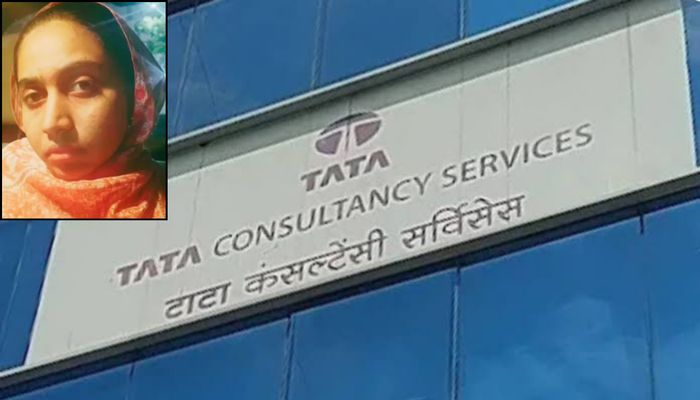
A massive sexual harassment and conversion racket has been exposed in Nashik, Maharashtra. According to media reports, the racket was underway for four years at the BPO unit of one of the biggest tech firms in India, Tata Consultancy Services, TCS. Six Muslim employees working as team leaders and two women, including a Muslim, have been accused of forcing Hindu women to convert to Islam, offer namaz and eat beef.

The accused have been identified as Asif Ansari, Shafi Sheikh, Shah Rukh Qureshi, Raza Memon, Tausif Attar, Danish Sheikh, Nida Khan and Ashwini Chainani. The victims in the case have accused Nida Khan, the HR Manager, of telling the victims to remain calm and gaslighting them into believing that such practices were normal in multinational companies.

The first FIR in the matter was registered on 23rd March at Deolali Camp Police Station in Nashik. After the registration of the FIR, women cops went undercover in the company to investigate the matter. As the investigation revealed the nexus, more victims came forward. So far, nine FIRs have been registered in the matter. OpIndia accessed several FIRs, including the first one that laid the foundation of the expose.

The FIR was registered on the complaint of a Hindu woman against Danish Sheikh, Tausif Akhtar and Nida Khan.

Source: Nashik Police

Initially, the FIR was registered under Sections 69, 75, 299 and 3(5) of Bharatiya Nyaya Sanhita, BNS, and Sections 3(1)(w)(i), 3(1)(w)(ii), 3(2)(va), 3(2)(v) and 3(1)(s) of the SC/ST Act were added later.

Source: Nashik Police

According to the FIR, the complainant is a 23 year old Hindu woman working as an associate at TCS Nashik. In her complaint, she stated that she first met Danish Sheikh in January 2022 at Lavit Market in Deolali Camp. The two developed friendly relations after discovering that they had graduated from the same college. Danish reportedly told her that he worked at TCS and assured her that he could help her secure a job at the company.

Later, in July 2022, Danish called her to Khandoba Tekdi in Deolali Camp where he demanded physical relations and forcibly kissed her. When she resisted, he expressed his intention to marry her. The complainant stated that after she completed her BCA degree, she appeared for an interview at TCS on his suggestion and was selected for the post of Associate. Danish was already working in the same company and after she joined, interactions between them increased.

The complainant further stated that Danish’s associates, Tausif Akhtar and Nida Khan, were also part of the same group. They frequently interacted with the complainant. During this period, the accused attempted to influence her religious beliefs. The complainant stated that they repeatedly told her that Islam was superior to Hinduism. They also made objectionable remarks about Hindu deities.

According to the FIR, Nida Khan and Tausif allegedly told the complainant that the Shivling represented male genitalia and that worshipping it was obscene. Danish Sheikh allegedly made objectionable remarks about Lord Krishna and Draupadi, which the complainant said hurt her religious sentiments.

Furthermore, in August 2024, Danish Sheikh reportedly took the complainant to Hotel Anand Resort on Trimbak Road without prior information and forced her into physical relations. The complainant stated that Tausif later came to know about the relationship and threatened to inform her family unless she agreed to his demand for physical relations.

She said in her complaint that Tausif repeatedly caught hold of her in the office lobby and pantry and made sexual advances which caused embarrassment and distress. The complainant further stated that the accused continued to speak against Hindu religion and attempted to persuade her to accept Islam. Simultaneously, he maintained physical proximity with her.

In February 2026, a woman named Mahirin contacted the complainant and informed her that she was the wife of Danish and that he had two children. When the complainant confronted Danish, he admitted that he had no intention of marrying her.

The complainant stated that between July 2022 and February 2026, Danish, Tausif and Nida made objectionable statements about Hindu deities and hurt the religious sentiments of the complainant. Danish established physical relations on the pretext of marriage despite being already married. Tausif continuously made sexual advances in the office premises.

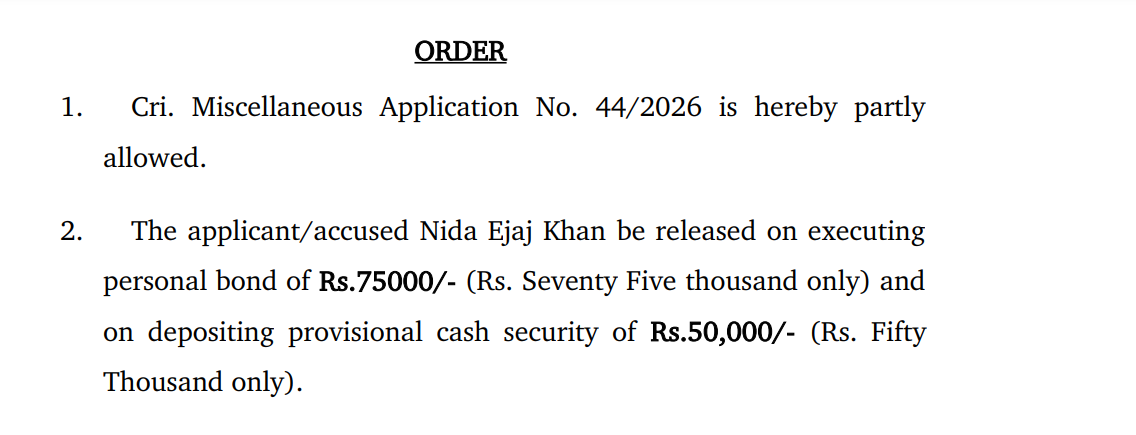
Danish filed bail plea, hearing in May

During research, OpIndia found that Danish has already filed a bail plea in the Nashik Road Sessions Court. Advocate Deore Prashant A is representing him in the matter. The plea was filed on 9th April and on 10th April the court heard the matter. The application was moved before Additional Sessions Judge K G Joshi, who directed the police and the prosecutor to file their response, and ordered the applicant to provide copies of the plea to the concerned side. Next date of the bail plea is 2nd May 2026.

Source: Nashik Road Sessions Court

The allegations in the FIR also point towards a pattern often seen in similar cases, where Hindu women are allegedly lured into relationships on the pretext of marriage and later subjected to physical exploitation. In several such cases, it has emerged that the accused were already married. In hundreds of documented instances, the accused have also been found to have concealed their Muslim identity while befriending Hindu women, only to later reveal their identity and allegedly blackmail them using obscene images and videos. Such cases, investigators have noted, often involve coercion, emotional manipulation and pressure to convert after the relationship has been established.

OpIndia has accessed multiple FIRs in the matter and more details will follow in separate reports.

Special Intensive Revision: Over 5.2 crore names purged across 12 states and 3 UTs; Uttar Pradesh leads deletions, followed by West Bengal and Tamil Nadu. Full details inside

0

The Election Commission of India (ECI) has recently completed the Special Intensive Revision (SIR) across 12 states and three Union Territories (UTs). What started with Bihar last year before Assembly Elections has resulted in a large scale clean up of electoral rolls.

According to the data provided by the ECI and media reports, the exercise has identified ineligible electors including those who were deceased, shifted, duplicated, or unverifiable. Across these states and UTs, the total number of voters came down to approximately 45.8 crore from 51 crore.

Source: ECI

During the process, 7.2 crore names were removed during verification. Once the draft list was published by the commission, claims, objections and fresh registrations resulted in the addition of around 2 crore electors, leading to a net reduction of around 5.2 crore voters or 10% of the total number of electors before SIR.

Source: ECI

Here is the state and UT wise outcome of the revision.

Uttar Pradesh

Bharatiya Janata Party ruled Uttar Pradesh, the largest state in the country in terms of population, recorded the biggest change in absolute numbers. Before SIR, the state had 15.44 crore electors. However, after SIR, the final electoral roll stood at 13.39 crore voters, which is a reduction of around 2.05 crore names from the voter lists across the state.

Data Source: ECI

The draft roll in UP had seen higher provisional deletions. However, additions during the claims and objections stage resulted in a net decline of around 13.2%. UP also recorded the highest number of additions after verification.

Tamil Nadu

DMK led Tamil Nadu recorded the second largest reductions in electoral rolls. The number of voters declined from around 6.41 crore to 5.67 crore after completion of the SIR. A total of 97.37 lakh names were deleted following verification. The final electorate stood at 5.67 crore voters after additions and corrections.

Data Source: ECI

West Bengal

Trinamool Congress ruled West Bengal saw around 90.93 lakh voters removed during the SIR. The number of voters came down from 7.66 crore before the SIR to around 6.75 crore after the exercise.

Data Source: ECi

Notably, judicial adjudication played a vital role in the final numbers. According to the data, over 60 lakh cases were examined. In the end, over 27 lakh names were removed following verification. Muslim dominant Murshidabad, a region which has made headlines in recent years for all the wrong reasons, recorded the highest deletions among districts.

Throughout the process, current Chief Minister of the state, Mamata Banerjee, continued to make controversial statements against the ECI and also challenged the process in the Supreme Court.

Gujarat

BJP ruled Gujarat also witnessed a large number of voters being removed from the electoral lists following SIR. The number of voters in Gujarat came down to 4.40 crore from 5.08 crore. Around 13.39% names were removed from the voter lists across the state after the exercise, making it among the states that saw the largest proportional decline.

Data Source: ECI

Madhya Pradesh

BJP ruled Madhya Pradesh recorded deletion of around 34.25 lakh voters after the Special Intensive Revision. The electorate declined from approximately 5.74 crore to about 5.39 crore voters. The drop showed a reduction of around 6% after claims, objections and the verification stage.

Data Source: ECI

Rajasthan

BJP ruled Rajasthan reported removal of around 31.36 lakh voters during the Special Intensive Revision. The final electoral roll stood at approximately 5.15 crore voters after completion of the exercise. The decline represents about 5.7% of the electorate.

Data Source: ECI

Chhattisgarh

BJP ruled Chhattisgarh recorded deletion of 24.99 lakh names after the Special Intensive Revision. The electorate declined from 2.12 crore voters to 1.87 crore in the final roll. This corresponds to a reduction of roughly 11.8%.

Data Source: ECI

Kerala

LDF ruled Kerala saw a comparatively smaller reduction. A total of 8.97 lakh names were deleted from the electoral roll during the Special Intensive Revision. The final roll stood at around 2.71 crore voters after additions. The overall reduction was approximately 3.2%.

Data Source: ECI

Goa

BJP ruled Goa saw a decline of 1.27 lakh voters following the exercise. The number before the SIR was 11.85 lakh, which came down to 10.57 lakh in the final roll, which makes around 10.76% reduction.

Data Source: ECI

Andaman and Nicobar Islands

The Andaman and Nicobar Islands saw a reduction of 52,364 voters after the Special Intensive Revision. The electorate declined from 3,10,404 voters to 2,58,040 in the final roll. This represents one of the highest proportional reductions at around 16.6%.

Data Source: ECI

Puducherry

In Puducherry, the number of voters came down from 10.21 lakh to 9.44 lakh, which makes around 7.5% reduction following the SIR.

Data Source: ECI

Lakshadweep

Lakshadweep recorded the smallest change in electoral rolls. The electorate declined from 57,813 voters to 57,607 after the Special Intensive Revision. This represents a reduction of just 206 voters, or around 0.36%.

Data Source: ECI

Comparison across states and UTs

The proportional reduction varied significantly across regions. The highest percentage decline was recorded in the Andaman and Nicobar Islands at around 16.6%, followed by Gujarat with around 13.39%, while UP recorded a reduction of around 13.2%. Chhattisgarh saw around 11.8% decline, followed by West Bengal at around 11%, Tamil Nadu at around 10.6%, and Goa at around 10.76%.

Source: ECI

Mid range reductions were observed in Madhya Pradesh at around 6 per cent and Rajasthan at approximately 5.7%. Puducherry recorded a decline of about 7.5%. Kerala saw a smaller reduction of roughly 3.2%.

Lakshadweep recorded the lowest reduction at around 0.36%.

Conclusion

The Special Intensive Revision (SIR) resulted in one of the most extensive updates of electoral rolls across multiple states and UTs. The exercise is yet to commence in several states that will see Assembly elections in coming years including Punjab, which is scheduled for state polls in the first quarter of 2027.

The exercise removed entries due to several reasons including death of the electors, shifted residents, duplicate enrolments and unverifiable electors. However, those voters who saw deletion of their names from the list had a chance to challenge it. Fresh registrations were also done for voters who attained the age of 18 years.

The variation in percentage reductions across states indicates differences in migration patterns, urbanisation levels, verification outcomes and the scale of legacy entries in electoral rolls. With updated rolls, the exercise is expected to reduce duplication, minimise bogus voting risks and improve accuracy of voter databases. The cleaned electoral rolls will also assist in better polling station planning, more accurate turnout assessment and smoother conduct of elections.

US-Trump flip-flop on Strait of Hormuz blockade and Iran war, how it endangers the region and worsens the energy crisis for Asia

The expected failure of the much-hyped ‘Islamabad Talks’ between the warring nations of Iran and the US has resulted in the exacerbation of the ongoing global energy crisis. On 12th April, US President Donald Trump announced an immediate ‘blockade of the Strait of Hormuz’ starting 13th April, stating that the US Navy will immediately move to enforce the blockade.

The US Central Command soon clarified that the blockade is not for all ships in the Persian Gulf, nor is it exactly a blockade of the Strait of Hormuz; rather, it will block only those ships that are entering or leaving Iranian ports and coastal areas. The clarification was more of a U-turn from Trump’s complete blockade of the Strait of Hormuz announcement, given that it would have caused a full shutdown of global shipping.

Just a day after the ceasefire announcement, Trump had floated the idea of a joint Iran-US toll framework in the Strait of Hormuz. However, after the Iranian and American delegations returned from Pakistan without a deal, Trump remembered that Iran is levying an “illegal toll” on vessels passing through the Strait of Hormuz. Since the possibility of a joint Iran-US venture collapsed, Trump took the task upon himself to end the Iranian ‘extortion’.

 “The US Navy would begin blockading all ships attempting to enter or leave the Strait of Hormuz. Vessels that had paid an “illegal toll” to Iran in international waters would be interdicted. American forces would also destroy Iranian mines in the strait, and any Iranian personnel firing on US or peaceful vessels will be BLOWN TO HELL!”, Trump announced on Truth Social.

The US claim of blockading the Strait of Hormuz and the presence of American forces in the region

The US blockade in response to the Iranian blockade of the Strait of Hormuz was announced to start from 13 April. It essentially applies to all vessels of any nationality entering or exiting Iranian ports and coastal areas.

Non-Iranian ports like those of Saudi Arabia, United Arab Emirates (UAE), Iraq, Kuwait, Qatar, etc., remain fully open and unaffected by the US naval blockade. This means that ships can transit the Strait of Hormuz for those destinations.

In addition, the US naval forces will interdict ships in international waters that have paid an “illegal toll” to Iran, as per Trump’s announcement. The US authorities have said that commercial sailors will get formal notices with details.

While the US blockade on the Strait of Hormuz, which is already blockaded by the Iranian forces, is not a complete closure of the passage, which carries around 20% of the global seaborne oil and LNG, the counter-blockade is going to have global implications.

The American rationale behind the counterblockade is putting pressure on Iran’s oil exports and revenue. During the war, Iran exported around 1.84 million barrels of crude a day in March this year, which is about 100,000 barrels a day extra, compared to the last three months, a Kpler analysis shows.

An increase in Iranian output before the war began on 28th February has resulted in near-record levels of Iranian oil loaded on ships, with over 180 million barrels floating so far in April.

Thus, blocking Iranian oil exports would essentially help crippling the already economically distraught Iran’s revenues.

However, the US CENTCOM clarification indicates that outside Trump’s Truth Social echo chamber, the American leadership understands that a full blockade, even if somehow physically achieved, would cause a global disruption. The IRGC, meanwhile, has dubbed US naval vessels near the Strait of Hormuz a ceasefire violation and vowed a strong response.

Before delving into the practicality of a US naval blockade of the Strait of Hormuz, it is pertinent to know about the current American military presence in the CENTCOM area, which comprises the Arabian Sea, the Persian Gulf, and the Gulf of Oman.

Infographic via X @/ShivAroor

In recent weeks, the Pentagon has been rapidly fortifying its forward presence in the Gulf states, Kuwait, Qatar, Bahrain, UAE, and Saudi Arabia, as staging grounds and logistics hubs for contingencies. As per the US Central Command, the USS Tripoli, carrying 3,500 sailors and Marines from the 31st Marine Expeditionary Unit, had arrived in recent weeks. More than 5,000 United States troops, including 2,500 Marines, have made their way to West Asia, waiting for a go-ahead from the American Commander-in-Chief to launch a ground invasion against Iran.

In the last week of March 2026, around 2,000 to 4,000 paratroopers from the elite 82nd Airborne Division were being flown in as an “Immediate Response Force” prepared for quick insertion operations, in addition to over 4,000 Marines and sailors onboard USS Tripoli and USS Boxer (2,500 Marines and sailors). USS Abraham Lincoln Carrier Strike Group (CSG) is operating in the Arabian Sea. USS George H.W. Bush has also been reportedly repositioned. It is notable that each CSG contains at least 1 carrier, 4 to 6 guided-missile destroyers/cruisers, submarines, support ships and 60 to 90 aircraft.

Besides the multiple CSGs, the US forces are reported to have deployed surface combatants in the region. Guided-missile destroyers like USS Michael Murphy and USS Frank E Peterson recently transited the Hormuz Strait. In addition, littoral combat ships (LCS) are present in Bahrain with mine-countermeasure packages, alongside other warships.

If we look at the overall posture, this marks one of the largest US naval concentrations in West Asia in recent decades, comparable only to the disastrous American campaign during the Iraq War. Headquartered in Bahrain, the US 5th Fleet routinely maintains over 10 to 10 warships alongside aviation and special operations assets. Moreover, amphibious ready groups (ARGs) with Marines are also reported to be heading to the theatre.

While time alone will tell if this force level will be sufficient for sustained interdiction patrols, surveillance, rapid response and boarding operations, reports suggest that the blockade enforcement will involve LCS and destroyers near Iranian port approaches backed by carrier air wings for drones, intelligence and overwatch.

Meanwhile, the US is also reported to be in talks with Indonesia for seeking US military access over Indonesian airspace. A Reuters report says that the Indonesian President Prabowo Subianto have even approved the proposal seeking “blanket overnight access” for ⁠American military aircraft .

President Trump has told Fox News that NATO, which has remained reluctant so far to enter the war to aid US forces in clearing the Hormuz blockade by Iran, have offered to help “clean out” the Strait. In addition, Trump claimed that the UK, a NATO member, which recently announced that it will not be dragged into the Iran war directly, would deploy minesweepers. However, UK PM Keir Starmer told the BBC, “We’re not supporting the blockade.”:

Speaking about why the US is pivoting towards blockading the very Strait it wanted to reopen, Trump said, “we’re not going to let Iran make money on selling oil to people that they like and not people that they don’t like.”

The enforcement of the US blockade will involve standard practices like warnings through radio, visual signals, boarding teams or disabling fire if the vessels ignore warnings. The interdiction will be a selective and targeted and not necessarily involve the erection of a literal wall of mines across the entire 21-mile-wide Strait of Hormuz.

The war has been targeting critical energy infra in the region

It should, however, not be forgotten that the Iranian forces will not sit back and let the Americans dominate the theatre. The IRGC employs asymmetric tactics like fast boats, cheap drones, mines and anti-ship missiles, etc. Their countermeasure could involve harassing the patrols, using proxies or laying drifting mines. Iran’s mines strategy has proven to be a success in disrupting shipping earlier. There is a possibility that the war Trump recently said would end in a week or two could get prolonged, stretching up to weeks and even months if Iran tests the blockade, pivoting to other escalation points for proxy attacks.

Iran’s unified armed forces command has already declared an American counterblockade of Iranian ports “illegal and amounts to piracy”.

Iran’s Khatam al-Anbiya Central Headquarters spokesperson reportedly said that either the ports in West Asia are secure for everyone or for no one.

“The security of ports in the Persian Gulf and the Sea of Oman is either for everyone or for no one. No port in the Persian Gulf and the Sea of Oman will be safe,” the spokesperson said.

Iran has made it clear that it will “resolutely implement a permanent mechanism to control the Strait of Hormuz” during and after the war (whenever it ends).

“Enemy-affiliated vessels do not and will not have the right to pass through the Strait of Hormuz, while other vessels will continue to be allowed passage through the strait subject to compliance with Islamic Republic of Iran armed forces regulations,” the Iranian authorities said.

Notably, Iranian media reports that the existing authorities is planning to impose a $2m toll for each ship transiting the Strait of Hormuz. Iran has reportedly collected at least two tolls for ships in Chinese Yuan, in an apparent attempt to not only make money during war but also weaken the US dollar. China has already transitioned to Renminbi or Yuan-based payments for Iranian energy, with over 80-90% of Iran’s oil exports now heading to China settled in Yuan.

The revenues generated would obviously be utilised for rebuilding military and civilian infrastructure destroyed by the joint US-Israel strikes. Oman, however, has already rejected Iran’s idea.

It is apparently, for this reason, Trump, who was more than eager to get the Hormuz Strait reopened, has changed the approach and ordered its blockade. It seems that the US is not blockading the Strait of Hormuz and targeting Iranian ports as a quick fix and a pressure tactic to bend Iran to its terms, but also squeeze Chinese economy.

The Iranian ‘alternate’ route, Source: Al Jazeera

The IRGC on the other hand, has released a navigation map indicating safer routes for vessels planning on transiting the Strait of Hormuz, highlighting “the likelihood of the presence of various types of anti-ship mines in the main traffic zone”.

Global energy crisis and supply disruptions

The global energy markets are already strained by the Iran war. The US naval blockade adds fresh pressure, even if the move is selective. The Strait of Hormuz witnesses around 20 million barrels per day of oil and LNG, there will be immediate price hikes and supply chain chaos for Asia-heavy importers, although countries like India, that do not pay any ‘toll’ to Iran due to the friendship between the two nations, may not essentially be in a tough spot. The US blockade could also result in higher energy costs rippling into global inflation, particularly for fuel and petrochemicals.

However, if Iran decides to cause a disruption to dilute the American blockade, India could be at risk. India significantly relies on Gulf suppliers for its energy requirements, and is now importing even Iranian oil after a 7-year hiatus. Thin buffers could cause shortages and diesel, petrol, and LPG price hikes if the war escalates. This could have happened in March, when amidst the raging, however, the India-Iran friendship, as well as the strategy of ramping up of Russian oil imports as a hedge, paid off well.

Beyond the bravado and posturing, even the US is not immune from the crisis that will potentially escalate the American blockade of the Strait of Hormuz.

Mohammad Bagher Ghalibaf, the Speaker of the Iranian Parliament who participated in the Islamabad talks, has posted a mocking tweet, telling Trump that fuel prices are going to skyrocket and that Trump will feel the pressure.

Sharing a Google Maps screenshot showing gas stations around White House, Ghalibaf posted a mathematical expression, insinuating how the ‘Blockade of Strait of Hormuz’ will affect the gas prices in the USA with a compounding function, rapidly escalating so that people will be nostalgic for $5 per gallon.

The failed Islamabad talks

The failure of the Iran-US negotiation talks under the ‘drafted’ mediation of Pakistan has made the ceasefire agreement fragile. Iran’s reluctance to give up its nuclear ambitions and demand for cessation of Israel attacks on Lebanon causes an impasse in the negotiations with the US and Israel, maintaining that the Lebanon conflict was never a part of the ceasefire. Now, Israel and Iran-backed Hezbollah are fighting each other in Lebanon, making the collapse of the fragile ceasefire nearly inevitable.

On Monday, European stock markets opened lower after Trump’s Hormuz blockade announcement. In the United Kingdom, the FTSE 100 index slumped by 0.38%. France’s Cac 40 dropped 0.95%, while Germany’s Dax index was down 1%.  Meanwhile, Brent crude prices rose by more than 7% to $102 a barrel.

In conclusion, Donald Trump has played a high-stakes game. America has unleashed a calibrated design to squeeze Iran economically without triggering an immediate absolute oil shock. The tactic might work short-term to cut Tehran’s revenues, however, any miscalculation and Iranian retaliation could birth prolonged regional instability wherein a narrow and congested waterway will be the theatre of war and crisis mired by the presence of armed and recalcitrant actors.

Trump has already begun marketing American oil as a better and ‘sweet’ alternative, with claims that vessels are lining up to have their fill. The US President’s failure to secure a joint Iran-US toll deal and the advertising of American oil while blockading the Strait of Hormuz, reinforces the speculations that for Trump, the Iran war is not simply about eliminating Iran’s nuclear dreams but also seizing control of the Iranian oil. However, the nuclear ambition of Iran, Israel’s fear of a threat to existence, and America’s oil and geopolitical interests are essentially pushing the whole world toward a supply chain crisis for the foreseeable future.

As West Bengal goes to polls, read about 40 incidents of rapes, murders and vandalism committed by TMC goons following the 2021 Vidhan Sabha election

Under the Trinamool Congress rule in West Bengal, elections are not just a routine democratic exercise but a real battle for survival for those who do not support the party’s ideology. Be it the state assembly elections or any local body elections, targeted post-poll violence against political rivals has become a norm for the TMC in the Mamata Banerjee-ruled state. While organising free and fair elections in the state is a challenge in itself, the announcement of the election results unleashes a phase of TMC-enabled carnage against political rivals.

Numerous horror stories of assaults, killings and rapes emerged from across the state after the results of the 2021 West Bengal Assembly elections were announced. Here are 40 terrifying incidents of post-poll violence reported in the state between May 2021 and July 2021 against BJP cadres after the TMC formed the government in the state for the third time:

1. BJP worker Avijit Sarkar was lynched to death by TMC workers

BJP worker Avijit Sarkar was lynched to death by some TMC goons on May 2, 2021, hours after he uploaded two videos on Facebook. The video showed TMC workers vandalising his house and NGO office in Ward no. 30 in the Beleghata neighbourhood in Kolkata. Sarkar was a dog-lover and had adopted several stray dogs, one of whom had given birth to 5 puppies. The TMC members did not spare his dogs and brutally thrashed the 5 puppies.

Sarkar, an office-bearer of the Bhartiya Mazdoor Trade Union Council, had responded to a knock at his door. He was then dragged outside, brutally assaulted, and strangled with a cable TV wire. His dead body was later discovered at some distance from his house. Sarkar’s only fault was that he was a supporter of the BJP.

2. The house of a BJP worker, Bishwanath Dhar vandalised

In another act of post-poll violence, several TMC goons attacked the house of an active BJP worker, Bishwanath Dhar, on May 2, 2021. The incident took place in Ghola Mallikpara in Panihati municipality in the North 24 Parganas district of West Bengal.

The TMC goons broke into Dhar’s house and vandalised his property. The hoodlums first destroyed the CCTV cameras and then began looting the BJP worker’s residence. They broke open the almirah and stole cash and ornaments. On their way out, they also damaged his Maruti car and a Royal Enfield (Bullet) bike.

3. A BJP worker was assaulted mercilessly at his own house

In one such incident that has now come to light, a BJP worker was assaulted mercilessly at his own residence, allegedly by the workers of the ruling TMC. The incident took place in Kismatdapat village of Trimohini in the South Dinajpur district of West Bengal. The area falls under the Balurghat Vidhan Sabha constituency.

TMC goons ambushed the victim’s house and attacked him. The BJP worker sustained head injuries and bled profusely. The miscreants also entered his house and vandalised the property. A video of the video surfaced online, showing a visibly drunken man abusing the victim and his wife with the choicest of expletives. Referring to the BJP worker as a ‘son of a pig’, he proceeded to hit him with a bamboo shaft. “BJP dekhachis (Showing me the might of BJP). How much power do you? Do you think you came to power?” the miscreant threatened.

4. BJP candidate Scientist Gobardhan Das, trapped inside his house by TMC goons

After the elections, TMC goons surrounded and attacked several belonging to the BJP volunteers in the village of Gobardhan Das, a BJP candidate who contested from Purbasthalu Uttar constituency. Das, a scientist and a Professor of Molecular Medicine at Jawaharlal Nehru University in Delhi. Das faced a life-threatening situation on May 4, 2021, after he was trapped in his own house by TMC goons. His residence was also ambushed by the miscreants, resulting in him being trapped in his own house along with other family members. The TMC goons hurled country-made crude bombs at his house. 

5. TMC workers attacked the houses of BSF personnel

TMC goons not only targeted BJP workers but also did not spare security personnel, who did not even qualify as their political rivals. The house of BSF jawan Kamal Sen was attacked, plundered and ransacked by the TMC hooligans in Raniparhat in the Jalpaiguri district. The jawan, who was on leave, and his family were assaulted, and his house, tractor and bike were set on fire.

Similar violence was unleashed against BSF jawan Sushant Burman in Cooch Behar. Burman was attacked and looted by TMC workers, simply because his brother was a BJP supporter. His family members had to flee home to save their lives.

6. TMC hooligans vandalised the ABVP office

After the TMC swept the 2021 state assembly elections, TMC goons set out to settle scores with their political rivals. They attacked the office of Akhil Bharatiya Vidyarthi Parishad (ABVP) in Kolkata. Over 20 goons from TMC stormed into the ABVP Office, attacking ABVP workers, including the National Joint Secretary of ABVP. The TMC workers are said to have vandalised several idols of deities and thought leaders alike. The ABVP said that the attack was pre-planned, as more than 150 bikes of TMC goons were circling the ABVP office several times.

7. Sunil Baksi attacked

In another case of post-poll violence, the house of Sunil Baksi, a booth worker of the BJP, was attacked by a Muslim mob in July 2021. The mob entered his house, destroyed furniture and other items, molested the women and even threatened to rape his wife. Around 15 houses were set on fire, as per the complaint. Following the incident, they fled the village. When Baksi approached the Police, he was threatened that the consequences would be much worse if he chose to file a complaint. The Police also tried to have them write that the houses were burnt due to lightning, the complaint says.

Earlier, on May 3, 2021, Baksi was attacked by goons associated with the Trinamool Congress. He said that he was hit on the head but was eventually saved by his brother. When he approached the police to make a complaint, they declined to register his complaint and instead filed cases against him. Sunil Baksi had filed a complaint with the National Commission of Scheduled Tribes (NCST) as well.

8. BJP worker Joy Prakash Yadav killed in crude bomb attack

In the TMC-sponsored post-poll violence, a 28-year-old BJP worker named Joy Prakash Yadav was murdered during a crude bomb attack in Bhatpara in North 24 Parganas district in West Bengal in July 2021. Joy Prakash Yadav had a heated argument with the two men before he was killed after a crude bomb hit his head. Before his murder, one of the men could be heard as saying, “Forget police…. You are doing too much BJP, BJP… leave it.”

The incident was recorded on camera by Yadav’s 17-year-old niece, Swapna. During the deadly attack on the victim, his mother, Rajmati Devi, also suffered from hearing loss.

9. BJP workers converted to Islam and went missing

In another case of targeting of BJP workers in West Bengal, two BJP leaders were supposedly given a ‘punishment’ for supporting the BJP by forcefully converting them to Islam. Subsequently, the two BJP leaders, who were brothers, went missing. A petition was filed before the Calcutta High Court by their wives who wanted to know their husbands’ whereabouts.

The Calcutta High Court transferred the case to the CBI and NIA after serious lapses in the investigation were detected in a case. The petitioners told the High Court that their husbands went missing and were not traceable. After that, they filed two complaints, first at the Mothabari Police Station and subsequently to the Kaliachak Police Station. They said that one complaint was filed, which was received by the police station; however, it was torn up by a ‘civic volunteer’, who informed the petitioners that their husbands had converted to Islam.

10. BJP worker Anil Barman found mysteriously hanging from a tree in Cooch Behar

The body of a BJP worker was found mysteriously hanging from a tree in Sitai in Adabari in the Cooch Behar district of West Bengal on May 30, 2021. His dead body was spotted by locals in a garden, which is located near his residence. The BJP accused the ruling Trinamool Congress dispensation of murdering its party worker. The party informed that Anil Barman was on the hitlist of the TMC during the time of elections. It also claimed that the TMC hoodlums had earlier vandalised the deceased’s house.

11. BJP supporter Kush Khetrapal killed by TMC goons

26-year-old Kush Khetrapal, who was a BJP supporter, went missing on May 5, 2021. His dead body was found lying near the Baishtam pond, behind a Ganesha idol, two days later, on May 8, 2021. As per the FIR, there were various stab marks on his body. His brother, Srikanta Khetrapal, said that he was killed by TMC goons, who took him to their Raibhagini party office before killing him. Srikanta stated that Kush worked at a hotel and was frequently approached by TMC members Kanan Khetrapal, Sukumar Khetrapal, and Dilip Khetrapal on his way back home from work. They had warned Kush of grave repercussions if he did not join TMC.

12. TMC goons attacked BJP worker Rajib Pally’s house

Soon after the state assembly elections were declared, some TMC goons hurled bombs at BJP worker Rajib Pally’s house in Howrah. They looted cash and jewellery from the victim’s house and also allegedly molested the women members of the house.

13. Woman BJP Chandana Haldar beaten to death by TMC workers

BJP worker Chandana Haldar was beaten to death by TMC goons on July 2, 2021, in West Bengal’s South 24 Paragana district. Haldar was a resident of Ramchandarpur Village, which falls under the Satgachhia Vidhan Sabha constituency of West Bengal. Speaking to OpIndia, her husband Gautam Haldar said that he and his wife were BJP workers. On the day of the incident, TMC goons first attacked his cousin, Swarup Haldar. When he and his wife came to save him, they were also brutally beaten, and his wife died as a result.

14. BJP booth president Raja Samonto beaten to death

In another incident of TMC-enabled post-pill violence, a BJP booth president, Raja Samonto, was brutally beaten to death at Sadhurghat village in South 24 Parganas’ Diamond Harbour on 29th May.

15. BJP worker Dhiren Barman murdered by TMC members

After the state assembly results, Suvendu Adhikari, the leader of the opposition in West Bengal, informed on X (formerly) that a BJP supporter, Dhiren Barman (34), belonging to the SC Rajbangshi of Sitalkuchi Assembly, was brutally murdered by TMC goons. Condemning the attack on BJP workers, Adhikari criticised Mamata Banerjee for providing tactical support to the TMC goons.

16. BJP activist Prosenjit Das commits suicide due to torture by TMC goons

In another horrible incident, a BJP worker, Prosenjit Das, committed suicide after facing mental and physical harassment by some TMC members. His family said that TMC goons had beaten him twice and threatened him with dire consequences. Mentally traumatised, Das, a resident of Harijan Palli in the Gopalpur area in Rajarhat, could not handle the pressure and decided to commit suicide.

17. BJP Nirmal Mandal worker Nirmal Mandal beaten to death

In yet another similar incident, a BJP worker named Nirmal Mandal was beaten to death by his political rivals in Sonarpur North Assembly constituency. The mother of the deceased BJP worker said that the local councillor, Shampa Chakraborty, instead of penalising the accused, rebuked them for not being able to take care of their son.

18. BJP worker Ghanshyam Rana first shot and then brutally stabbed outside his own house

A similar case of an attack on a BJP worker came to light in Khanakul in Arambagh town, Hooghly. Victim Ghanshyam Rana was first shot, then brutally stabbed outside his own house. He was rushed to the hospital in extremely critical condition. The BJP accused TMC goons of killing Rana.

19. Arindam Midya hanged to death by TMC goons

A young BJP supporter named Arindam Midya was hanged to death by Islamist supporters of West Bengal’s ruling dispensation after the state assembly election results. Midya was a resident of Panchkoli village, falling in the Falta assembly constituency in Diamond Harbour.

20. BJP worker Dharma Mandal, attacked by the TMC goons, died

On May 14, 2021, a BJP worker named Dharma Mandal was mercilessly attacked by the TMC goons at his own house in Nadia district of West Bengal. He was hospitalised after being critically injured by the TMC cadres, but succumbed to his injuries in a Kolkata hospital on May 16, 2021.

21. BJP worker Manoj Jaiswal found murdered

On the same day, another BJP activist named Manoj Jaiswal of Nalhati Assembly Constituency under Bhirbhum district was found murdered. The BJP alleged that Jaiswal was murdered by the TMC goons.

22. Twin murder of BJP supporters in West Bengal

The West Bengal BJP accused TMC goons of murdering two of its karyakartas in Uttar Lakshmipur, Malda. According to BJP Bengal, the deceased has been identified as Manoj Mandal and Chaitanya Mandal. The gruesome image shared by the BJP shows that the two workers were hanged from a tree, tied together with a rope. Despite the widespread TMC-sponsored violence, senior TMC leaders denied it, accusing the BJP of spreading falsehoods. Mamata Banerjee, however, eventually acknowledged the violence and promised compensation to the victims’ families.

23. BJP worker Arup Ruidas killed and hanged from a tree

In yet another case of political killings, a BJP worker named Arup Ruidas was killed and hanged from a tree in Bankura district. According to the reports, Arup Ruidas, who was a booth agent from the Indus Assembly of West Bengal, had allegedly been murdered by TMC workers.

24. BJP worker Debabrata Maity brutally killed in the post-poll violence

On May 3, 2021, a BJP worker named Debabrata Maity was brutally attacked by TMC goons in the post-poll violence. Maity, who hailed from Nandigram, was rushed to the hospital in critical condition after being attacked by Trinamool Congress hoodlums, where he succumbed to his injuries on May 13, 2021.

25. Gaurav Sarkar killed by TMC hoodlums

Similarly, a BJP worker named Gaurav Sarkar from Bolpur, in Birbhum district in West Bengal, also fell prey to the post-poll violence in the state.

26. BJP karyakarta Manik Mondal killed in Sitalkuchi

In a similar incident, BJP karyakarta Manik Mondal was killed in post-poll violence in the Sitalkuchi Legislative Assembly in West Bengal. The incident happened in the first week of May, 2021, soon after the assembly results were announced.

27. 80-year-old mother of BJP worker killed while trying to save her son from TMC goons

In another incident, an eighty-year-old lady, namely Sova Rani Mondal, mother of Jagaddal BJP worker Kamal Mondal, was killed while trying to save her son from the TMC cadres. The TMC goons were beating up Kamal Mandal and his wife for being affiliated with the BJP when his mother intervened to save her son. She was injured in the ensuing scuffle and later succumbed to her injuries.

28. BJP Karyakarta Uttam Ghosh murdered in post-poll violence

One Uttam Ghosh, a BJP Karyakarta, was murdered by TMC workers at midnight on May 2, 2021, at Gangnapur, Ranaghat.

29. BJP worker Horom Adhikari brutally murdered in West Bengal post-poll violence

Horom Adhikari was a BJP supporter, employed in the South 24 Parganas district of Sonarpur Dakshin. He was brutally murdered in the post-poll violence.

30. BJP’s Momik Moitra was brutally killed by TMC goons after the counting of votes

A BJP karyakarta named Momik Moitra was brutally killed by TMC goons after the counting of votes on May 2, 2021. The incident occurred in the Sitalkuchi Legislative Assembly of Cooch Behar district, where a mob had attacked the Central Industrial Security Force (CISF) during the fourth phase of elections in West Bengal after TMC supremo Mamata Banerjee asked her followers to gherao the central forces.

31. BJP supporters, Chandan Roy and Haradhon Ray, murdered by TMC workers

BJP supporters, Chandan Roy and Haradhon Ray, were murdered by TMC workers at Chooch Behar and Dinhata respectively,, after the poll results were announced in West Bengal on May 2, 2021.

32. BJP worker Mintu Burman beaten to death by TMC goons in West Bengal

In another incident of political violence, a BJP worker named Mintu Burman was beaten to death by TMC goons in Cooch Behar. Mintu Burman was hurriedly taken to the hospital, where he died during treatment.

33. Girl gangraped by TMC goons in front of her father

A young Ritu (name changed) was subjected to horrendous violence and sexual abuse by TMC goons, in front of her helpless father, after the state assembly results were announced in West Bengal. On May 2, 2021, as Ritu and her father, who were BJP supporters, were preparing to leave their house, anticipating a possible attack by TMC goons, a group of Muslim men barged into their house. They mercilessly beat her father and then gangraped her in front of her father.

She narrated her harrowing ordeal and alleged lack of support and action by the police while speaking to OpIndia.

34. A 60-year-old woman gangraped by TMC goons in front of her grandson

In another such incident, a 60-year-old woman was brutally raped in front of her six-year-old grandson. The victim said that after the results were declared, TMC workers forcefully entered her house and raped her. The incident happened on the intervening night of May 4 and 5, 2021, just two days after the election results were declared. The TMC workers also allegedly robbed her of the valuables.

35. Woman BJP supporter dodged a rape attempt as her husband was killed in front of her

On May 14, 2021, Purnima Mondal and her husband, Dharama Mondal, who had campaigned for the BJP, were identified and assaulted with axes. Purnima was made to witness the assault on her husband and brother-in-law, while she was disrobed, grabbed and faced a rape attempt. She said that the mob was led by a local elected representative, Kalu Shaikh. Her husband succumbed to his injuries on May 16, 2021.

36. A teenage girl gangraped by TMC members

On May 9, 2021, a 17-year-old minor girl from the Scheduled Caste community was gang-raped by TMC workers and left to die in a jungle. The next day, a TMC leader, Bahadur SK, went to her house and threatened her family members against not lodging a complaint. He threatened that he would burn their house and kill them if they did.

37. RSS worker Balaram Majhi,

22-year-old RSS worker Balaram Majhi was mercilessly beaten by TMC goons at his house in Sripur village in the Ketugram Tehsil in East Bardhaman district after the state assembly elections results. Manjhi succumbed to injuries later that day.

38. Exodus of BJP workers due to TMC violence

As the TMC registered a sweeping victory in the 2021 assembly elections, several BJP workers and their families left their houses in West Bengal and moved to the neighbouring state of Assam, fearing violence from TMC cadres. Around 300-400 people entered the Dhubri district in Assam from North Bengal by crossing the border. The BJP supporters and their families were sheltered in refugee camps. Several BJP leaders visited these camps and distributed relief material and food essentials.

The Assam government provided temporary aid to the party workers in Dhubri. The government also set up a centre for COVID-19 testing as the unfortunate exodus took place amidst the second wave of the coronavirus pandemic.

39. Houses of BJP workers vandalised

In another incident, bombs were hurled at the residence of a BJP worker in the Kankinara area of Bhatpara after the 2021 West Bengal assembly election results. Raj Biswas, a BJP worker, said three people hurled bombs at his home. In a separate incident, TMC party workers attacked Jadavpur BJP candidate Rinku Naskar’s house. The TMC goons entered the house of the BJP candidate to vandalise following her defeat in the elections.

40. A BJP worker forced out of West Bengal, his property vandalised

In another incident, a BJP worker, Ganesh Ghosh, was forced to leave the state after the 2021 assembly election results in West Bengal. He was forced to flee West Bengal along with his family members after the Trinamool Congress goons wrought havoc at his resort. The miscreants attacked Ghosh’s resort in Shakuntala village in Khoai Haat in Shantinektan. The resort is located just 5 minutes away from the Vishwa Bharati University.

With TMC’s consistent track record of post-poll violence in West Bengal, it remains to be seen whether the post-election scenario in the state will be any different this time, both in terms of poll results and the resultant political environment.