Home Blog Page 3289

Shaheen Bagh woman calls Republic TV journalist ‘digital tawaif’: How Liberals celebrate abuse of journalists they don’t agree with

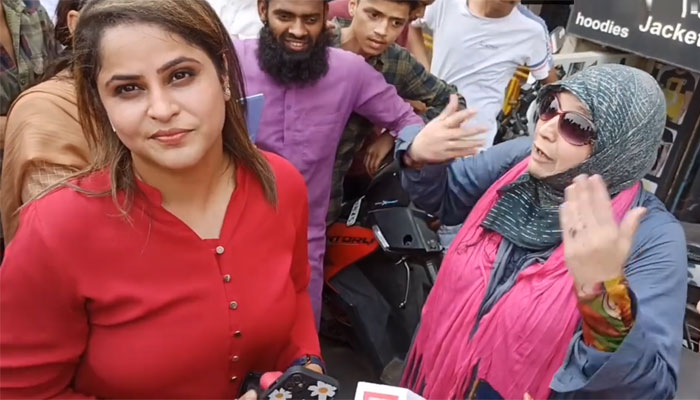
A video is being circulated on social media in which a Shaheen Bagh protester was hackling Republic Bharat’s journalist and called her “Digital Tawaif” (Digital Prostitute). The video was published by YouTube-based news channel The Nation Voice on May 9. In the video, the infamous Shaheen Bagh protester Aiman Rizvi could be seen hackling the female journalist from Republic Bharat. Rizvi is the same woman who had urged Muslims to pray for Home Minister Amit Shah’s death when he had contracted Covid-19 in August 2020.

In the video, the journalist kept requesting Rizvi to leave her alone, but Rizvi kept on staying close to her and abused her. Rizvi said, “The Bulldozer comes here and goes back without taking any action. These Digital Tawaifs of godi media keep waiting to show historic win.”

In another video by the same channel, the female journalist was circled by angry men who came really close to her while verbally abusing her. She kept requesting them to maintain a distance, but the man who was trying to hackle her did not budge. The people standing there kept watching, but no one tried to save her from the abusers. In a statement to Bharat News 91, the man said, “You are saying that you are a woman, and we are trying to create a scene by hackling a woman. If you want to play the woman card, why are you here? Why, being a woman, you came here?”

He further added other women journalists were not being abused by anyone. He said, “These people from Republic have a problem with Muslims. She could not show anything wrong here, which is why she was trying to create a scene.

Liberals celebrate hackling of a female journalist

Liberals seem to be enjoying hackling of a female journalist just because they do not agree with them. Twitter use Natiq Haque wrote, “This woman of Shaheen Bagh drove Bulldozer on the upright anchor of godi media. These people from Republic Bharat have become bells. Wherever they go, people start to ring them.”

Twitter user Naim Chouhan wrote, “Shaheen Bagh showing their worth to godi media.”

In another video shared by Asrar Ahmad, the Twitter user mocked the Republic Bharat journalist for falling down.

Who is Aiman Rizvi?

Aiman Rizvi is a controversial YouTuber and Muslim influencer who often make derogatory videos on Hindus and target BJP leaders, including PM Modi, HM Shah, CM Yogi and others. In August 2020, she wished and urged Muslims to wish for HM Shah’s death when he contracted Covid. She called Covid a conspiracy as no BJP leader had died of the disease. She also called CM Yogi a ‘terrorist’ and claimed that the coronavirus is created as a hype so that they can hide the fact that crores of Muslims are beaten, jailed and killed on Bakri Eid.

‘I did not run away with 8 crore rupees’: Former Congress social media chief Divya Spandana says the story was ‘planted’ in media

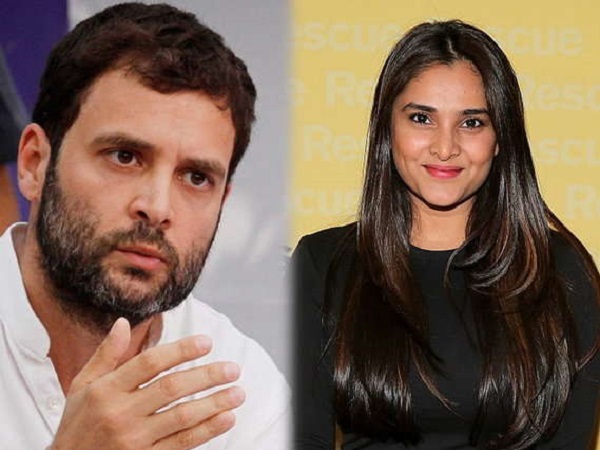
After remaining out of the spotlight for a while, ex-Congress IT cell chief and former MP, Divya Spandana ‘Ramya’ has taken to Twitter to launch a scathing attack on her former colleagues. She has accused them of using media to malign her reputation.

In a Tweet posted on May 12, Thursday, the Kannada actor alleged that fake news has been planted in the media after she quit the party in an attempt to destroy her credibility. She stated that she didn’t run away and regretted remaining silent all this time.

“After I quit, ‘she duped the congress of 8 crores & ran away’ was planted in the news esp Kannada channels in an attempt to destroy my credibility. I didn’t run away. I resigned for personal reasons. I certainly did not dupe the party of 8 crores. My mistake was staying silent,” wrote Divya Spandana.

The former Congress loyalist requested Congress leader KC Venugopal to clear her name in the media regarding reports which said that she had duped the Congress of Rs. 8 crores when she quit the national party.

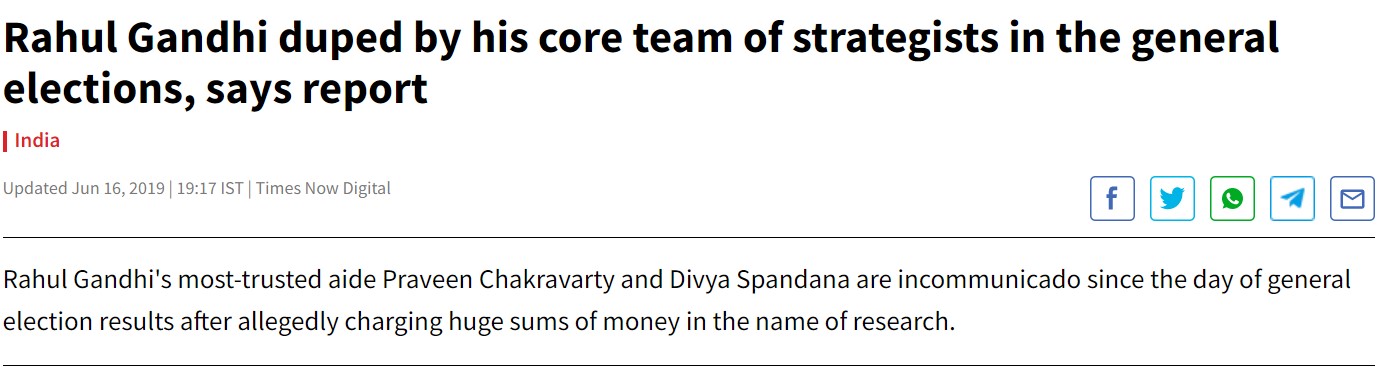
Divya Spandana’s Tweet was probably in response to 2019 media reports that claimed that Rahul Gandhi’s “most-trusted aide Praveen Chakravarty and Divya Spandana went incommunicado since the day of the general election results after allegedly charging huge sums of money in the name of research.”

The 2019 Times Now report

The Times Now report had further claimed that the Divya Spandana is “said to have received Rs 8 crore for her research and social media drive during the electioneering phase. She is not just missing from the scene but she has also deleted both her Twitter and Instagram accounts.”

‘These opportunists have only backstabbed & tried to suppress me’: Ramya on her ex-party colleagues

In response to her previous Tweet, she further wrote, “If there’s anyone who gave me opportunities & stood by me it’s @RahulGandhi anyone else claiming to have ‘given’ me opportunities is an opportunist. These opportunists have only backstabbed & tried to suppress me. Everything you see on tv is a farce to conceal their devious mind.”

Notably, on Wednesday, the ex-Congress IT cell chief had also alleged that the Congress instructed its workers to troll her on social media for a remark she’d made against Karnataka Congress President DK Shivakumar earlier in the day.

Taking to Twitter, Ramya alleged that the Congress “circulated” messages amongst its leaders and volunteers to get her trolled.

“So the ‘office’ has circulated these messages among the congress leaders & volunteers asking them troll me. Save yourself the trouble — I’ll do it myself”, Ramya wrote. She attached screenshots of several messages in English and Kannada that were purportedly disseminated to troll her. She also tagged Shivakumar and Congress’ Srivatsa YB, who is currently a member of Rahul Gandhi’s team and was previously the Karnataka Congress’ social media chief, in her Tweet thread.

Earlier in the day, Ramya chastised the Karnataka Pradesh Congress (KPCC) chief, DK Shivakumar for a statement he made on Tuesday against Karnataka’s Higher Education Minister and BJP leader Ashwathnarayan CN alleging that the minister met with Congress leader MB Patil to “seek protection” from being questioned on public platforms in the PSI recruitment scam.

Divya Spandana, the ex-Congress IT cell head and her stint in Congress

Divya Spandana, better known by her moniker, Ramya, also a well-known actor in Kannada and Tamil film industry had taken over as the social media head of the Congress party in the year 2017. During her stint as the party’s social media head, many Congress enthusiast journalists wrote accolades calling her a vintage politician and credited her with singlehandedly reviving Congress’ social media presence.

In 2019, following Congress’ humiliating defeat in the 2019 general elections, Spandana had deleted her Twitter and Instagram accounts citing a “break from politics.” She even ceased speaking with party leaders. She nearly vanished from public view after the Congress announced that none of its leaders would participate in television discussions after a row over her Tweet congratulating Nirmala Sitharaman. She was afterwards fired from her position, as per reports.

During her tenure as the Congress social media head, Congress’ Twitter handle saw a series of slip-ups over the time, which made them the butt of all jokes on Twitter. Besides, like her innumerable other party members, Divya Spandana had often indulged in sharing fake news to malign the BJP government at the centre.

In 2019, Spandana was caught sharing a digitally edited image of German dictator Hitler ‘posing’ like he is pulling a child’s ears to compare him with Prime Minister Modi.

In fact, Congress’s social media team when headed by Divya Spandana use to regularly use morphed images. In the same year, Congress posted a shocking image which mocked the victims of the Pulwama terror attacks and India’s first prime minister Jawaharlal Nehru with a single digitally edited image. This faux pas of Divya followed by various other misadventures had sparked speculation that Spandana was on her way out as Congress IT cell head.

In 2018, Congress IT cell head, Divya Spandana’s name had been cropped up in a charge sheet that was filed in the Congress sexual harassment case, in which a former party worker had accused the right-hand man of social media chief Divya Spandana of molestation at the workplace. She had also alleged that Spandana had not taken any action, but instead had “mentally harassed” her.

China devising new ways to harass and intimidate foreign journalists, says a report by Committee to Protect Journalists

The Chinese government is finding new ways to intimidate and bully foreign correspondents, their counterparts in China and their sources by accusing them of “spreading rumours” and “smearing” China, reports Committee to Protect Journalists.

In a report, the CPJ has highlighted how foreign correspondents are usually harassed in China by the Communist Party regime claiming that they spread rumours against China. The CPJ recounts how international journalists were intimidated by the Chinese locals on the instructions of a lower-level organisation of the Communist Party of China.

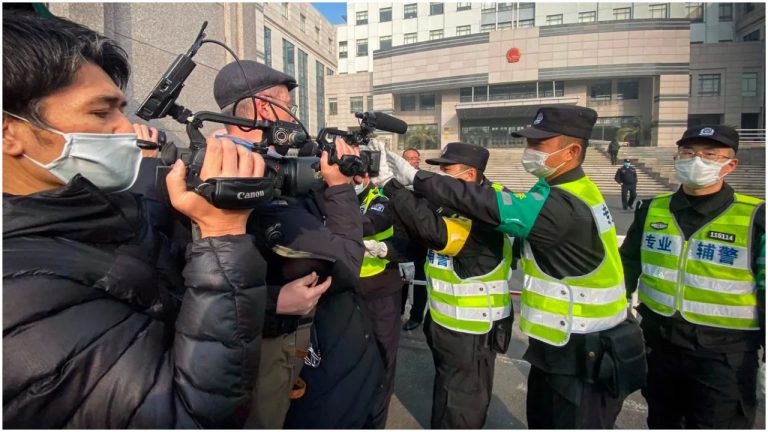
The report cited the harassment meted out to several international media outlets by citizens on the streets of Zhengzhou for covering severe flooding in the Chinese city in July 2021. The CPJ report suggests that the Henan Communist Youth League, a lower-level official organisation of the CPC, had propped up several citizens to harass journalists on the streets of China for reporting about floods.

Several Chinese nationals had taken to the social media platform Weibo then to post angry posts criticising the BBC’s China Correspondent Robin Brant for questioning government policies after a dozen people died in a train carriage amid the flooding. Over the last few months, many have also received such messages on social media and intimidating calls, according to the Foreign Correspondents’ Club of China. 

Instead of condemning such attacks on foreign journalists, the Chinese Foreign Ministry had accused Brant of “distorting the real situation of the Chinese government’s efforts to organise rescues and local people’s courage to save themselves, and insinuating attacks on the Chinese government, full of ideological prejudice against and double standards.”

The threats to foreign correspondents covering last year’s flood are just one example of how tough it is for foreign journalists to report from China. The intimidation, trolling, and physical attacks on journalists have been the latest tool in the Chinese playbook.

China jailed the most number of journalists in the world

According to CPJ’s annual prison census, China has detained the most number of journalists globally. According to the report, there are 274 journalists lodged in prisons across the globe this year as compared to 272 journalists imprisoned in 2016.

China has a history of censoring not just the country’s domestic media space, thanks to state-supervised content delivery, but also the global media by way of harassment and intimidation of foreign correspondents working in the country. However, it is often difficult for China to force the foreign media to toe the establishment’s line. Hence, the Chinese government resorts to intimidation and scare tactics to bully them.

As China is more sensitive to its international image, especially after its grave mismanagement of the Covid-19 pandemic, they are not taking any risks anymore. The Chinese government are now expelling journalists and sometimes refusing to recognise reporters.

“Going after foreign journalists is part of a broad strategy to control all information, including online voices, which has indeed become more challenging for them on all fronts as the methods of communication increase and diversify,” said Beach, who added that it is also part of their strategy to proactively rewrite the global narrative about China, especially with the COVID story.

As part of their latest new tactic, the Chinese-state run news organisations and tabloids, as well as popular anonymous social media users on Weibo, often leak the identities of foreign journalists who “smear and attack China”, calling their coverage “biased” or “dishonest”.

Media outlets cannot publish reports not approved by the Communist party

According to a CPJ report published last year, the Chinese government had imposed restrictions on free speech and the freedom of media outlets to publish reports not approved by the Communist party. The situation is said to have worsened under the Jinping regime as, in 2016, he had directed the state-owned media outlets to have the party name as their family name.

The CPJ attributed the deteriorated situation of journalists in China working with foreign news outlets to the growing hostility in the relations between China with other major countries. In August this year, an Australian news anchor Cheng Lei was detained in China on suspicion of endangering national security. A journalist, Haze Fan, who was working for Bloomberg in Beijing, was detained last week on similar charges. Chinese officials had declared the case an internal affair of China.

Similarly, when NPR’s Beijing correspondent Emily Feng went to Liuzhou in the Guanxi autonomous region in southern China to report about the Chinese delicacy “luosifen” or snail noodles, she was stopped from writing on what was supposed to be a ‘fun’ story. After the story was published, Feng had to face online harassment as she was called “anti-China foreign citizen of Chinese descent” on Weibo.

In December 2021, the Chinese propaganda outlet Global Times described Chinese-born New York Times visual investigative reporter Muyi Xiao as an example of a journalist who uses Western media to “ambush their comrades and motherland from behind.”  

The article attacked Xiao’s work and accused the organisation associated with her of “anti-China” NGOs, accusing Xiao of “lying to her heart” or acting with the ‘zeal of a convert” in her affiliation with them. 

Again, in March 2021, the BBC’s Beijing correspondent John Sudworth had t. leave China, where he had been based for nine years, due to the surveillance, obstruction, intimidation, and threats of legal action against him and his team. Sudworth became a target of online propaganda campaigns for reporting on the origins of Covid-19, Xinjiang’s re-education camps, and forced labour in Xinjiang’s cotton industry. 

During the 2022 Beijing Winter Olympics, foreign journalists faced further harassment as Washington Post China bureau chief Lily Kuo received severe blowback on Twitter over her story on China’s promotion of previously-mocked mascot Bing Dwen Dwen. The trolling was such to the extent that she was forced to make her tweets temporarily private.

“These kinds of nationalistic attacks against people seen as criticising China have happened for years, against journalists, human rights activists, and others, in different ways,” said Sophie Beach, operations and communications manager at the China Digital Times, a US-based media organisation that archives and translates content censored on China’s internet.

During the inaugural session of the Winter Olympics in Beijing, a Chinese official had also assaulted a Dutch reporter Sjoerd den Daas. Daas, a journalist for the Dutch newspaper NOS Nieuws, was doing live coverage for the Winter Games on Friday when a Chinese security guard moved in front of the camera and began to push him away.

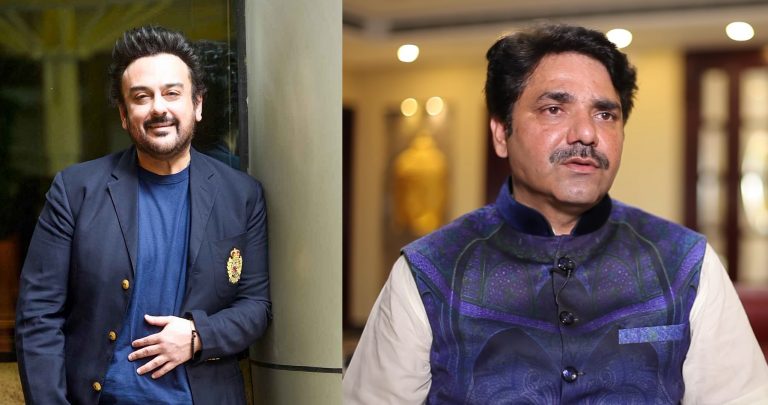
‘Goray chale gaye, gadhey chor gaye’: Singer Adnan Sami takes on AAP MLA Naresh Balyan over ‘ex-Pakistani’ jibe

On May 12, Singer-composer and Padma Shri recipient Adnan Sami took on Aam Aadmi Party MLA Naresh Balyan for comments on him by the AAP leader. In a tweet quoting Balyan, Sami said, “Goray chale gaye aur Gadhay chor gaay!! (The White went away and left donkeys behind),” and urged him to show love for the country once to feel better.

How did it all start?

The Twitter war between the singer and MLA started on May 10 when Sami posted the gaffe of Punjab Chief Minister Bhagwant Mann where he said ‘Hayward’ instead of ‘Harvard’ during a speech. The CM had said that his govt will send teachers to Switzerland, Finland, Singapore, and institutions such as Oxford and ‘Hayward’ for professional training at the cost of the government. Responding to this, Sami wrote, “Punjab Teachers to be trained in no less an institution as ‘Hayward’… Cool.”

Irked by the tweet, MLA Balyan decided to jump and call Sami a Pakistani. He wrote, “The breed of Pakistani Army should not interfere in our internal matters. Go to Pakistan and speak.”

Sami, who is known for his wittiness online, said, “When a person is unable to argue, he comes down to stupid comments, and his thinking attains a lower standard.”

His comments further irked Balyan, who said, “I can understand your helplessness. ‘Oh Pakistani’, you were born in England. Even beggars did not pay attention to your nasal singing, that is why you had to come to India. Now a Pakistani like you got Indian citizenship from the Modi government. You have to show loyalty.”

Sami took the chance to further mock MLA Balyan and said, “So you are saying that England has a bigger authority in our Indian music. So much so that they are more intelligent than 1.2 billion people? Wow, the White went away and left donkeys behind. Some day you should try to show loyalty to the country. You will get a lot of love.”

Later, Sami posted a tweet with an image that read, “Without freedom of speech we would never know who the idiots are.”

Adnan Sami became an Indian citizen in 2016

On January 1, 2016, Adnan Sami became an Indian citizen. He was granted citizenship by the Ministry of Home Affairs on Humanitarian grounds. In May 2015, Sami had applied for citizenship after the Pakistani government refused to renew his visa in 2015. Adnan first landed in India in 2001 and continued to win the hearts of music lovers for over one and a half decades before becoming an Indian citizen.

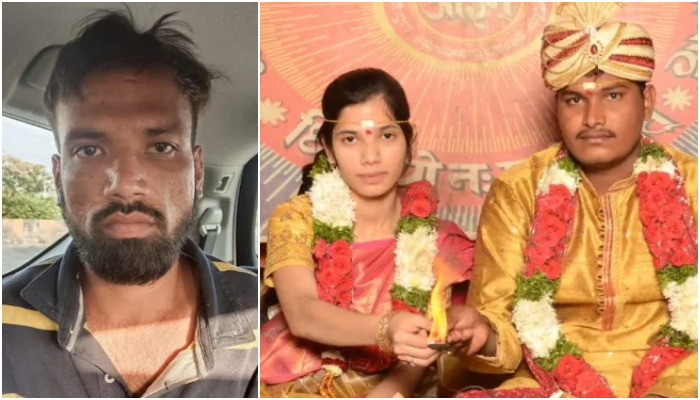
Hyderabad hate crime: ‘Murder was planned’, police report says Mubin Ahmed had used spyware to track Nagaraju

On Thursday, the remand report by the Hyderabad police revealed that the accused Syed Mubin Ahmed had planned the murder of B Nagaraju, the Hindu man who was brutally killed in full public view over an inter-faith marriage with his Muslim wife. Syed Mubin Ahmed had killed Nagaraju brutally in full public view because he was angered over the interfaith marriage of his sister Ashrin Sulthana.

According to reports, the accused had used a mobile spyware to track and locate Nagaraju on the day of his murder. The accused had first planned to kill Nagaraju outside a car showroom where he used to work but could not execute the plan due to heavy traffic. Later he along with an accomplice attacked Nagaraju and his wife when they were on their way to home from the residence of a relative.

Sulthana, wife of Nagaraju has 2 sisters and a brother who is the prime accused in the case. The police report mentions that Ahmed had beat up his sister on multiple occasions and had warned her to stay away from the Hindu man. Sulthana then left her home on January 30 and married Nagaraju in Arya Samaj as per Hindu traditions.

The brother Mubin Ahmed got furious when he heard of his sister’s marriage to a Hindu boy. He also got furious as his sister changed her name from Sulthana to Pallavi. Mubin Ahmed had threatened Nagaraju to leave his sister, but Sulthana and Nagaraju refused to do so. Ahmed then began keeping a watch on Nagaraju. He had hatched a conspiracy to kill the 25-year-old Nagaraju along with his other brother-in-law.

The duo used digital technology to keep a watch on Nagaraju and Sulthana. Mubin Ahmed had reportedly met Nagaraju on an earlier occasion and had pretended to cooperate with him. He had installed spyware on Nagaraju’s phone under the pretext of checking his phone to see if he had other women in his life, as per a report in the Deccan Chronicle. On May 4, he spotted Nagaraju at the Saroornagar area and called his other brother-in-law Mansoor Ahmed to execute the plan.

The duo arranged for a knife and iron rods and proceeded to the Saroornagar area. They meanwhile traced his exact location and reached the Maruti showroom in the city. They allowed him to complete his working hours and later followed him on the street. However, the plan was dismissed as the duo failed to spot the target in heavy traffic.

Later they again traced his location and stabbed him to death while Nagaraju was on his way home with his wife from a relative’s residence. Reportedly, the incident took place in the outside the Saroornagar Tehsildar’s office in Hyderabad on Wednesday. The assailants fled the scene and were later arrested by the Hyderabad Police.

Earlier, on May 7, Sulthana, wife of the deceased Nagaraju had stated that her own family had threatened her to kill if she ever married the Hindu guy. She also said that her brother tried to kill her twice before she had eloped to marry Nagaraju. The couple were in a relationship for nearly a decade and got married this January. Ahmed has been seeking revenge since January. The Hyderabad Police so far have arrested two accused in the case. Further investigations are underway.

Sanskrit added to Google translate, Assamese, Maithili, Konkani, Mizo, Dogri, Meiteilon, and Bhojpuri among other Indian languages in the new list

Google’s language-translation tool Google Translate has been recently updated with 24 new languages added to its list to take the total number of supported languages across the globe to 133. Along with Sanskrit, the newly added 24 languages include other Indian languages Assamese, Maithili, Konkani, Mizo, Dogri, Meiteilon which is Manipuri, and Bhojpuri. Now a total 19 of Indian languages are available on the language-translation platform of the big tech giant Google.

According to a report by Economic Times, Isaac Caswell, senior software engineer at Google Research, said, “Sanskrit is the number one, most requested language at Google Translate, and we are finally adding it. We are also adding the first languages from northeast India, which is another rather underrepresented place.”

The latest update has text translation facilities for the 19 Indian languages in all. The company will be working on rolling out voice to text, camera mode, and other features very soon. The latest update though does not cover all the 22 scheduled Indian languages. About this, Isaac Caswell said, “We have significantly closed the gap for at least the scheduled languages.”

He further said, “We are working on other features too, but they are not yet supported for all of these languages. We are trying to understand (the problems) better, and hopefully get our model to shift towards more colloquial output rather than this old-fashioned or stilted type of thing. But we know there are other issues as well that we are trying to get our fingers on more closely.”

The recently added languages in Google Translate are the first ones that have been added using the zero-shot machine translation technology. In this technique, the machine learning model only sees monolingual text. It learns to translate into another language without even seeing an example.

Isaac Caswell said about this, “While this technology is impressive, it isn’t perfect. And we’ll keep improving these models to deliver the same experience you’re used to with a Spanish or German translation, for example.”

According to a report by India Today, Sanskrit is used by around 20000 people in India. However, being the source of most of the languages in the Indo-European class, bringing Sanskrit to the Google Translate platform holds importance. Among other languages, 25 million people use Assamese, 50 million people use Bhojpuri, 3 million people use Dogri, 2 million people use Konkani, 34 million people use Maithili, 2 million people use Manipuri and around 0.83 million people use Mizo language.

The list of newly added languages contains 16 other languages from different parts of the world.

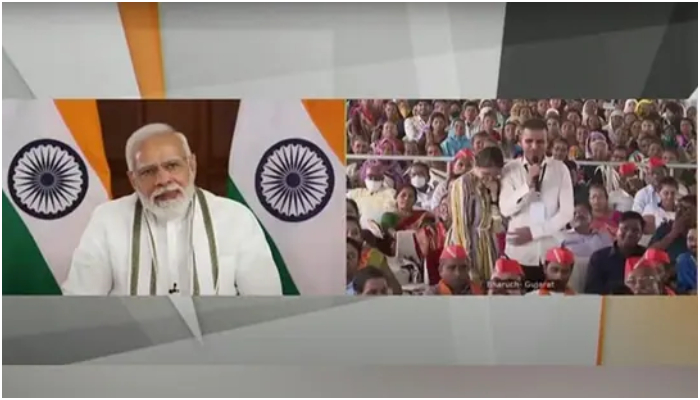
This is why PM Modi got emotional while speaking to Ayub Patel and his daughter during the ‘Utkarsh Samaroh’ in Bharuch

On Thursday, Prime Minister Narendra Modi got emotional while talking to an aspiring doctor and her visually challenged father at the virtual event of Utkarsh Samaroh in Gujarat’s Bharuch. The father, Ayub Patel, said that both his daughters were beneficiaries of the government scheme and that they were able to study because of the scholarship money being provided by the government.

The Prime Minister, while interacting with the visually challenged Ayub Patel asked about his daughter’s ambition. He said that his daughters are studying, one in class 8 and the other in class 12, and the third one in class 1. “The government will take care of the youngest one’s education till class 8. The other two also get a scholarship”, he said. He added that his elder daughter wants to become a doctor in the future. On asking the daughter, she said that she always wanted to become a doctor because of the medical problems faced by her father.

Getting emotional, the daughter said, “I have seen my father in problem, so.. “, she sat down as she could not control her tears. Seeing the young girl cry, PM Modi also could not control his emotions and maintained a teary silence amid the conversation. He lauded the little girl for her courage and compassion. “Your compassion is your strength”, PM Modi said to the girl.

Patel meanwhile also shared with PM Modi about how his eyesight got affected when he was in Saudi Arabia. “I used some eye drop when I had gone to Saudi Arabia. Doctors say that there’s no solution now, its glaucoma”, he said. He also expressed gratitude towards the Prime Minister for showing care towards the citizens. “You are in Delhi but you care for everybody. You always think of the nation’s development. Thank you sir”, he said.

Later, the Prime Minister extended his support to the man and his family, and said “Let me know if you need any help to fulfill the dream of your daughters”. According to the reports, PM Modi was virtually addressing Utkarsh Samaroh, an event that was organised to mark the 100 percent saturation of four key state government schemes in Bharuch. The schemes will help provide timely financial assistance to those in need.

Reportedly, the Bharuch district administration had carried out a ‘Utkarsh Initiative’ drive from January 1 to March 31 to ensure the complete coverage of schemes providing assistance to widows, elderly and destitute citizens. According to the PMO’s office, a total of 12,854 beneficiaries have benefited due to the government schemes.

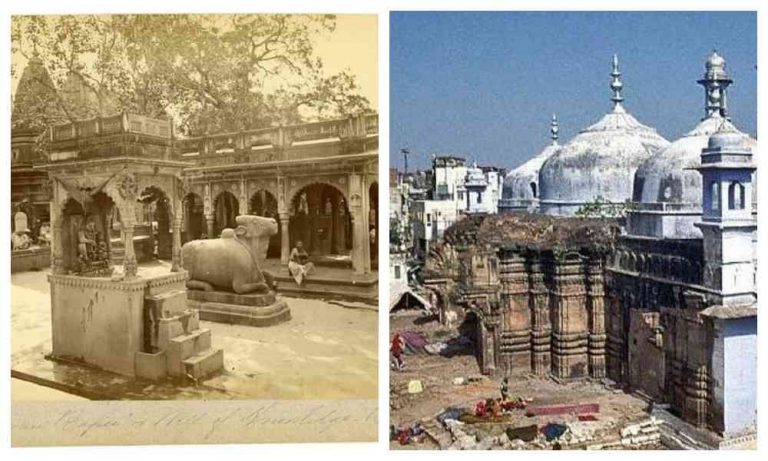
Gyanvapi verdict: Court allows videographic survey of premises, orders opening of basement

A Varanasi court on Thursday allowed videographic survey of the disputed structure known as ‘Gyanvapi Masjid’ days after the same was halted amid opposition. Varanasi’s Civil Judge (Senior Division) Ravi Kumar Diwakar has issued guidelines for the same and added that the survey will now be held and a report to be submitted by May 17.

The court also refused to remove court commissioner Ajay Kumar Mishra in spite of opposition from the Gyanvapi mosque management committee. 

As per the report, it is also reported that the basement of the disputed structure has also been directed to be opened.

Earlier this week, the court ordered video survey of the disputed structure which is believed to be the original Kashi Vishwanath Mandir, destroyed by Mughals, was halted after Muslim mob blocked gate and prevented the team from entering the premises.

After stopping the court-directed documentation for the day in Varanasi, a videographer who accompanied the survey team involved in the process has revealed the presence of Hindu motifs including the Swastika, Nandi (bull associated with Shiva) and lotus motifs all over the outer side of the mosque walls.

The videographer said, “Today, we saw Swastik symbols at two places on the walls of the temple. There are a number of lotus symbols all over.” When asked whether he saw images of Goddesses, Ganesh on the western wall of the temple (as claimed), he said, “Yes. We saw Nandi while doing a Parikrama and other Hindu religious symbols.”

The team members said that the mob prevented them from going inside by blocking the door, and therefore the local administration officials didn’t allow them to entre the premises.

Earlier, the Allahabad High Court had ordered the Uttar Pradesh Sunni Central Waqf Board to present on record all the documentary evidence pertaining to State surveys wherein allegedly the property was declared as waqf property. Advocate Rastogi, the appointed next friend of Lord Vishweshwar, asserted that the property was always a Hindu property as the land belongs to ‘swayambhu’ (self-manifested) Lord Vishweshwar and Aurangzeb had no right to acquire the land. The Gyanvapi Mosque is located in the Kashi Vishwanath temple complex where Hindus believe that Vishveshwara still sits in the disputed complex. 

AAP MLA Amanatullah Khan and aides create ruckus during anti-encroachment drive in Madanpur Khadar in Delhi, was booked for similar acts at Shaheen Bagh

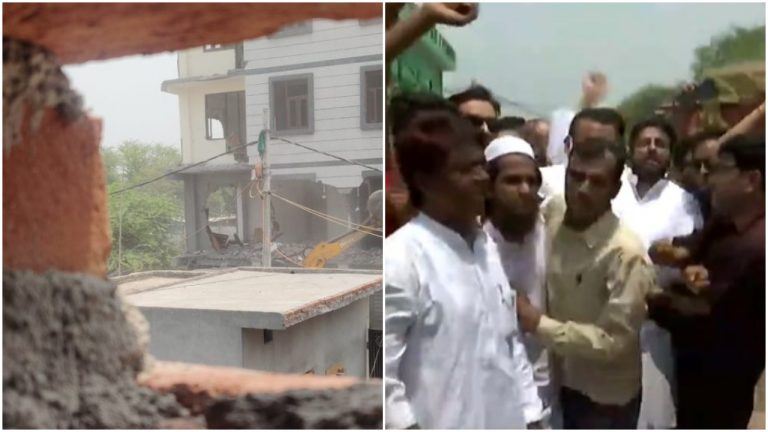
The officials of the South Delhi Municipal Corporation (SDMC) on Thursday, reached the south Delhi ward of Madanpur Khadar to execute the anti-encroachment drive as part of its 10-day action plan to remove illegal encroachment from several areas in all four zones in the national capital. AAP MLA Amanatullah Khan, who was booked for obstructing the demolition drive in Shaheen Bagh earlier this week, also reached the area with his aides and raised slogans against the MCD officials.

Speaking to the media, Amanatullah Khan said, “I am ready to go to jail if it saves the houses of poor people. There is no encroachment here. I will support them (civic body) in demolition if there is any encroachment.”

However, as per the latest reports, despite the resistance from the AAP supporters, the authorities have already demolished two five-storey under-construction buildings in the Madanpur Khadar area amidst the presence of police personnel. “The building was being constructed for the past one year,” a local said.

Besides Madanpur Khadar, civic authorities have also carried out another planned anti-encroachment drive in the Prem Nagar area of Delhi’s Patel Nagar today.

It is pertinent to note here that the AAP MLA had created a similar ruckus during the anti-encroachment drive that was carried out in Delhi’s Shaheen Bagh area the other day. On May 9, a massive drama unfolded when the MDC officials reached Shaheen Bagh to take action against the illegally constructed infrastructures in the area. Hundreds of Aam Aadmi Party (AAP) supporters led by Amanatullah Khan and Congress workers staged protests in the area to obstruct the civic body’s ongoing anti-encroachment drive.

Protesters raised slogans against the South Delhi Municipal Corporation (SDMC) and the Central government, demanding that the action be halted. Some of the female protesters even stood in front of the bulldozers to prevent the exercise from taking place. Visuals from the site showed how political party workers began climbing onto the claws of the bulldozer to prevent the civic body from carrying out its duties.

Following the ruckus, the SDMC’s Central Zone licensing inspector filed a complaint against the AAP MLA and his aides with the SHO of Shaheen Bagh. In the complaint, the licensing inspector wrote, “Amanatullah Khan MLA (Okhla) along with his supporters present did not allow the field staff of the zone SDMC to remove the encroachment. In view of the above, you are requested to take appropriate legal action against Amanatullah Khan and his supporters for interfering in the discharge of official duties by public servants.” 

Based on the complaint an FIR was filed against the AAP MLA. Deputy Commissioner of Police (Southeast) Esha Pandey said, “Based on the complaint received from SDMC, an FIR has been registered against Aamanatullah Khan and his supporters under sections 186 (obstructing public servant in discharge of public functions), 353 (assault or criminal force to deter public servant from discharge of his duty) and 34 (common intention) of the Indian Penal Code.”

The Communist Party of India (CPI-M) Marxist had earlier filed a petition in the Supreme Court against the decision by the civic body to remove illegal settlements in Okhla, Shaheen Bagh in South Delhi.

However, in a huge blow to groups opposing the demolition effort in Delhi’s Shaheen Bagh, the Supreme Court refused to hear the petition. A court led by Justice N Nageshwar Rao slammed the Communist Party for politicising the case and advised it to go to the High Court instead.

The New York Times changes its factually correct headline on Al Jazeera journalist’s death in West Bank after outrage

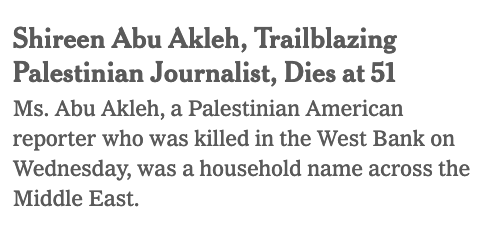
On Wednesday, Shireen Abu Akleh (51), a senior journalist at Al Jazeera, was shot dead amid gunfire between Israeli forces and Palestinian gunmen in the West Bank. The New York Times reported the incident profiling the journalist with a title, “Shireen Abu Akleh, Trailblazing Palestinian Journalist, Dies at 51.” The headline didn’t reflect that the journalist was killed by gunshot while covering a conflict, causing an outrage. Therefore, the news agency was forced to change the headline after netizens, mostly Palestinians or Palestine supporters, objected to it, pointing out that she was shot dead. The netizens also alleged that she was shot by Israel Defence Forces.

Earlier NYT News article on Shireen Abu Akleh’s death

Soon after the death of Shireen Abu Akleh in a shooting in the West Bank, her employer Al Jazeera in consonance with the Palestinian National Authority (PA) was quick to hold the Israeli government responsible for the killing of the American-Palestinian Journalist. However, The Israeli authorities have denied the allegations. The Israeli Foreign Ministry further stated that the initial investigation of the event revealed that the journalists were hit by the Palestinian gunmen.

While the air around Abu Alekh’s death is not clear yet, Palestine sympathizers have already started blaming Israel for the Journalist’s death. Calling Abu Akleh’s death a heinous crime, the Qatar-based news organisation said, “We hold the Israeli government and the occupation forces responsible for the killing of the late colleague Shireen”. The statement also called on the international community to hold the Israeli occupation forces accountable for their ‘intentional targeting and killing’ of Abu Akleh.

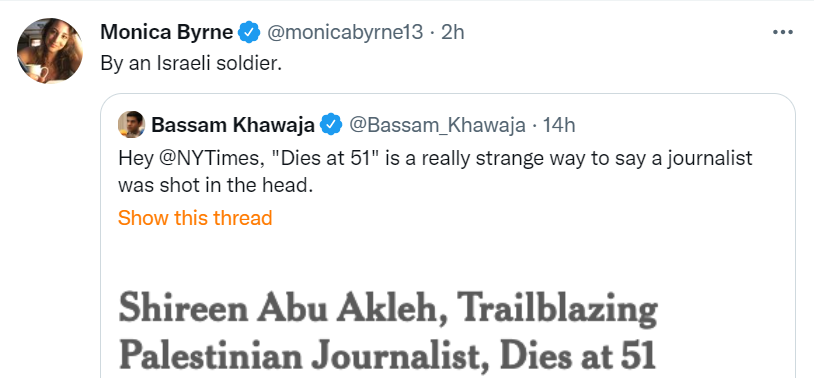
Many including Bassam Khwaja, Co-director at the Human Rights and Privatization Project at NYU said that the NYT report on the journalist’s death reads like an obituary headline. Soon, reactions poured on Twitter with users trying to claim that it was the Israeli side which killed the journalist. Abu Alekh, on Wednesday, was reporting on a raid in the city of Jenin which escalated into gunfighting between the Israel and Palestine sides.

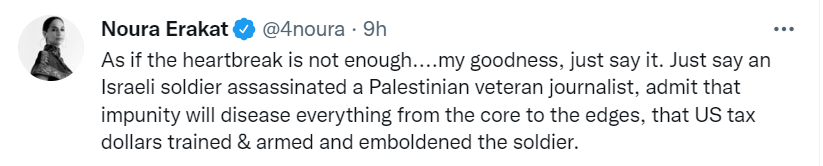
Screengrab of the Tweet from @4noura
Screengrab of the Tweet from @monicabyrne13

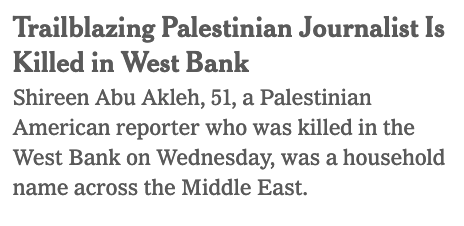
After the backlash, The New York times decided to change the headline for its piece to “Trailblazing Palestinian Journalist Is Killed in West Bank,” with the insertion of ‘killed’ in the title. While it was known that the journalist was shot dead, either deliberately or mistakenly, either by Palestinians of by Israelis, it is strange that NYT chose to omit it from the headline that she was killed by a bullet.

Edited NYT News article on Shireen Abu Akleh’s death after outrage on the Internet

New York Times has a history of toning down conflict reports, and often omit crucial details while reporting on terrorism related events. For example, in a 2019 article, the paper had written that the twin towers were taken by aeroplanes on 9/11, choosing to not mention that those aeroplanes were piloted by trained terrorists. The NYT often blames guns, knifes, cars etc for killing and hurting people, not the actual perpetuators behind the attacks.