Home Blog Page 3436

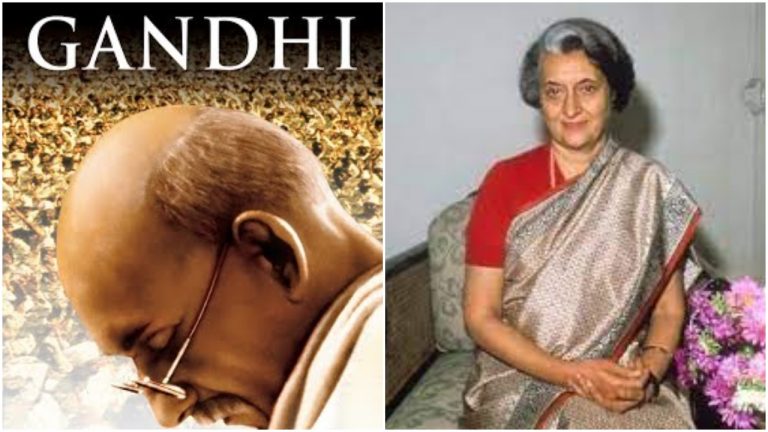
Did you know: I&B Ministry under former PM Indira Gandhi had provided $10 million to make the film ‘Gandhi’

0

While Vivek Agnihotri’s film The Kashmir Files, which was released last week, continues to have a record-breaking run, some detractors have targeted the film for receiving significant government support. Critics have questioned BJP-ruled states such as Gujarat, Madhya Pradesh, and Haryana, as well as Karnataka, which has announced that the film ‘Kashmir Files’ will be tax-free in the state.

NDTV’s senior journalist Sreenivasan Jain took a jibe at the BJP government for supporting the movie The Kashmir Files, which brings the brutally honest account of the Kashmiri Pandit genocide to the big screen. “Genuine q: can anyone recall the last time the Indian state threw its entire weight in promoting a privately produced movie while using it to target its political opponents?” the NDTV journalists tweeted, mocking the government.

The NDTV journalist implied that no government prior to this one has ever in the history of Indian cinema thrown its entire weight in promoting a privately produced movie. He further said that the government was using the movie to target its political opponents.

So, to get his facts straight, Jain was informed by popular Twitter user Vikrant that Congress leader and then Prime Minister Indira Gandhi provided funding to Richard Attenborough for making the film ‘Gandhi’ in 1980.

“1980 – PM Indira Gandhi financed ($7 Million) to Richard Attenborough for making the Movie Gandhi The Script was especially vetted by I&B ministry The idea was to capture Indian mind with Gandhism & glorify the role of Congress in freedom struggle We are still paying for it..,” Tweeted Vikrant.

As rightly pointed out by Vikrant, the National Film Development Corporation of India (NFDC) was indeed one of the producers of the movie ‘Gandhi’.

Screenshot taken from YouTube

The National Film Development Corporation of India (NFDC), headquartered in Mumbai, is the central agency responsible for promoting Indian cinema since 1975.  It is part of the Government of India’s Ministry of Information and Broadcasting and is responsible for film financing, production, and distribution.

In 1982, the National Film Development Corporation of India presided over by DVS Raju, was one of the production companies that financed the film ‘Gandhi’.

According to publicly available information, the decision was made after Rani Dube, the film’s co-producer, persuaded Prime Minister Indira Gandhi to provide the first $10 million from the National Film Development Corporation of India, on the back of which the remainder of the funding was eventually raised.

Directed and produced by Richard Attenborough, ‘Gandhi’ was released in India on November 30, 1982. Besides being based on the life of Mahatma Gandhi, the movie was also a tribute to Lord Louis Mountbatten, the last Viceroy of India, Motilal Kothari, an Indian-born civil servant working with the Indian High Commission in London and a devout follower of Gandhi and the then Prime Minister of India and Congress leader, Jawaharlal Nehru.

‘Gandhi’ was director Richard Attenborough’s dream project, which he worked on for several years before finally finishing. According to media reports, two previous attempts to make the movie ‘Gandhi’ had failed. Gabriel Pascal, a Hungarian film producer and director, secured an agreement with India’s Prime Minister at the time, Pandit Jawaharlal Nehru, to produce a film about Mahatma Gandhi’s life in 1952. However, Pascal died in 1954, and the film could not be made.

Through a connection with Lord Louis Mountbatten, the last Viceroy of India, Attenborough met then-Prime Minister of India Jawaharlal Nehru and his daughter Indira Gandhi in 1962. Nehru appeared to have approved of the film and promised to help fund its production, but his death in 1964 was one of the film’s many setbacks.

That wasn’t the only time Attenborough struggled to finish his dream film. In 1976, Attenborough attempted to resurrect the project with the help of Warner Brothers. However, then-Prime Minister Indira Gandhi declared a state of emergency in India, making filming for the project impossible.

Then, 20 years later, Indira Gandhi not only gave him permission to make the film but also provided him with the money for making it. Rani Dube, the film’s co-producer, persuaded Indira Gandhi to provide $10 million from the National Film Development Corporation of India because the budget was falling short.

Likewise, in response to Sreenivasan Jain’s Tweet, another Twitter user reminded the NDTV journalist how some other movies that were made on the Emergency of 1975, that was imposed by the then Prime Minister Indira Gandhi, had also been then funded by the Films Division of India under the I&B ministry. “Do you recall how Films Division of India under MIIB had produced movies such as ‘The Prime Minister’, ‘Kaisa Andhera’, ‘Maa Ki Pukaar’ etc., during emergency with the sole motive of justifying emergency? Using state exchequer for personal political goals is even worse,” wrote one Satish Verma.

Pertinently, while the movie ‘The Kashmir Files’ has been receiving an overwhelming response from the public and the government, with many states declaring it tax-free, the Congress party has been from the very start maintaining a controversial stance on the film.

On March 13, INC Kerala Twitter handle sparked controversy by alleging, “Pandits left the valley en masse under the direction of Governor Jagmohan who was an RSS man. The migration started under the BJP-supported VP Singh government.”

Today (March 16), AIUDF chief and ex-Congress ally Badruddin Ajmal demanded ban on ‘The Kashmir Files’, saying that the movie will stoke communal tensions.
Hinduphobic event ‘Holi against Hindutva’ to be held yet again, was accused of appropriating Hindu festival for political protests on US campuses earlier

0

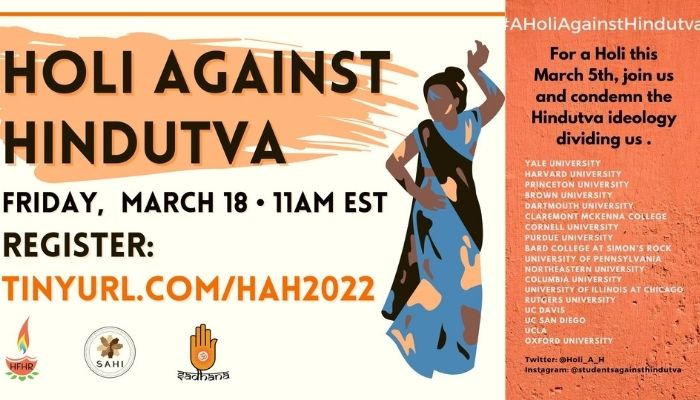
The hinduphobic event ‘Holi against Hindutva’ which had earlier tried to appropriate the Hindu festival of Holi for political protesting on American college campuses will be organised this year as well. A poster calling ‘Holi against Hindutva 2022’ for a webinar invite on the morning of March 18 was posted by groups ‘Hindus for Human Rights’ (HfHR), ‘SAHI – Students against Hindutva Ideology’ and ‘Sadhana: Coalition of Progressive Hindus’ who were earlier seen taking part in anti-India activities while stationed in foreign campuses.

The organisation ‘Holi against Hindutva’ was formed in December 2019, to organise agitations in the US against the Citizenship Amendment Act (CAA) passed by the Central Government in the same year. Founded by Shreya Singh from Yale University, with a social media account based in the United States of America, India and Pakistan, the group was renamed ‘Students against Hindutva Ideology’ or SAHI later. Organisations including SAHI, HfHR and Sadhna collectively organised protests against CAA and NRC in American Univerity Campuses including Yale, Columbia, Cornell, Princeton, Wellesley, Michigan State, Duke and Rutgers.

The 2020 edition of ‘Holi against Hindutva’ saw the politicisation of the Hindu festival with an intent to target Hindu students on US campuses and peddle anti-India rhetoric. Diaspora Hindu organisation ‘Hindu on Campus’ alleged that Holi, which has been one the most popular Hindu festivals on U.S. college campuses, was been highjacked to target students from the same Hindu community. While the activist groups claimed at the outset that they are not against ‘Holi’, they engaged in a crude appropriation of the festival by wearing ‘black clothes’ as opposed to white and played only with white coloured powder to further a political move.

“This is not a celebration, but a condemnation,” the poster read. Going beyond protesting against the CAA or the NRC, the protest became a platform to spread hateful propaganda against India and Hinduism. Some of the posters held by the members read ‘Stop the Genocide in India’, ‘Stop State Sanctioned violence in India’. At Harvard University, Dalit activist Suraj Yengde attacked that the Men in Uniform (Police and the Army) and those not in the uniform (Civilians) both needed to be struck against.

Under the banner ‘Holi against Hindutva’ the organisation with the support of 44 South Asian, Muslim, Sikh and Democratic student groups, wrote an open letter to the US Congress for attracting sanctions against Indian government officials. Appropriating Holi as a ‘multicultural’ festival (though celebrated commonly in India by all faiths), organiser Vedant Behl said, “The celebrations won’t be the same in India this year. The festival that previously brought together Hindus, Muslims, Christians and people from all castes and backgrounds — or at least was imagined to be such — is not going to be that in these months of communal hatred and open polarization. We are reclaiming Holi from the forces of Hindutva that have broken it down.”

The invite for the current webinar registration describes, “As we honour the 2nd anniversary of the historic #HoliAgainstHindutva protesters, join us for this special webinar event featuring student activists from India, USA, Canada, and the UK who will be speaking about the history of student activism and resistance against Hindutva ideology!” The same was shared by Rutgers University professor Audrey Truschke on Twitter who is infamous for misappropriating Indology, glorifying Islamic genociders like Aurangazeb and targeting students from the Hindu community on her campus.

Hindu Academics, Activists and Professionals have earlier raised their voice against the groups misappropriating the festival of Holi for their political gains. Talking about one such incident, Suhag Shukla, founder of the Hindu American Foundation wrote, “A Holi Against Hindutva hashtag was created, protesters of various religious backgrounds wore black on Holi, and a story alleging a casteist conspiracy in the burning of Holika was disseminated to shame any Hindu student who sought to celebrate on campus.”

The ‘Holi Against Hindutva’ continues to remain an active conspiracy hatched against the Hindu diaspora by Liberal fundamentalism which has garnered support from South Asian Islamists, Radical Dalit activists and shreds of the Indian Left. By appropriating a Hindu Festival for protest it not only targets Hindus worldwide but also meddles in India’s soverign interests.

‘Fight for your ideology alone’: Congress shows Kapil Sibal his place for asking Gandhis to step aside

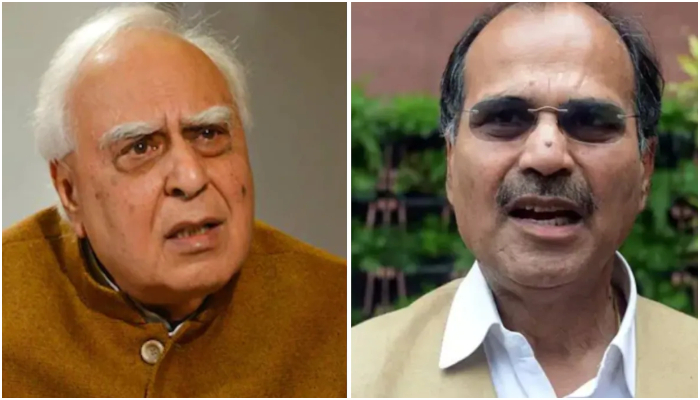
On Wednesday, Congress leader Adhir Ranjan Chowdhury launched a blistering attack on Former Union Minister Kapil Sibal, saying that he should leave the party and prove his identity without the support of the Congress party. “Fight for your ideology on your own, there’s no outcome of just giving interviews”, he added. This is a day after Sibal in an interview to the Indian Express, expressed his displeasure over the party leadership’s inability to reach out to the senior leaders or use them properly for reviving the party.

“Who is Kapil Sibal? What kind of leader is he? He got many advancements because of the Congress party. Earlier, when UPA was in power, everything was good for him. Now, suddenly when UPA is not in power, he is feeling bad”, Chowdhury stated on March 16. He also added that the G-23 members of the Congress party don’t have a habit of staying out of the governing power and suggested they stop criticizing the party.

Kapil Sibal on Tuesday fired salvos against Rahul Gandhi and the party high command. He questioned how Rahul Gandhi, who doesn’t hold any formal position in the party, went to Punjab and announced Charanjit Singh Channi’s name as the chief ministerial candidate. He also said that the Gandhis should step away from the leadership of the party.

Speaking about the CWC meeting that was held on Monday, Sibal said it had been eight years since the party had lost the Lok Sabha elections. If the leadership still needed ‘Chintan shivir’ to find out what went wrong, they are living in cuckoo land. He further claimed that prominent party leaders in CWC genuinely feel that Congress would not survive without the Gandhis. He said in his personal view that he would want ‘sab ki Congress’ and not ‘Ghar ki Congress’. By ‘sab ki Congress’, he meant to bring old Congress members who left and formed their parties together and fight against BJP.

This also comes as the G-23 meeting is scheduled on Wednesday to discuss the situation in the party after the humiliating losses in five states. The G-23 meeting is set to see the senior leaders, who first formed a grouping when 23 people wrote to Sonia Gandhi in 2020 demanding internal elections and reform, planning their next move amid rumblings in the party.

It is important to note that last year in December, ahead of the Punjab Assembly elections, Kapil Sibal in a press meet had criticized the Congress’ central leadership. The loyalists of Sonia Gandhi and Rahul Gandhi had then held massive protests outside his residence yelling, ‘Gaddaron, party choro (traitors leave the party)’. Senior Congress leader Anand Sharma had expressed shock over hooliganism and had termed the act as ‘disgusting’. Also, Ghulam Nabi Azad, a prominent face of G-23 of the Congress had written to Sonia Gandhi demanding an organizational overhaul of the party.

According to the reports, several Congress leaders such as Mukul Wasnik or Shashi Tharoor have stopped attending G-23 meetings as some members continue to question the high command. Recently, former Karnataka CM Veerappa Moily also disassociated himself from the group saying that G-23 had been institutionalized which was never the idea. “I don’t approve their relentless attack on the Congress leadership in this hour of crisis,” he had said.

Congress leadership has been facing a hard time since the Assembly election results for five states were announced on March 10. With the losing hope of revival, the senior leaders of the party are reiterating their demand of giving control of the party to someone other than Gandhis.

Muslims are the majority, they must ensure harmony and assure that minorities in Assam will not face the fate of Kashmiri Pandits: Himanta Biswa Sarma

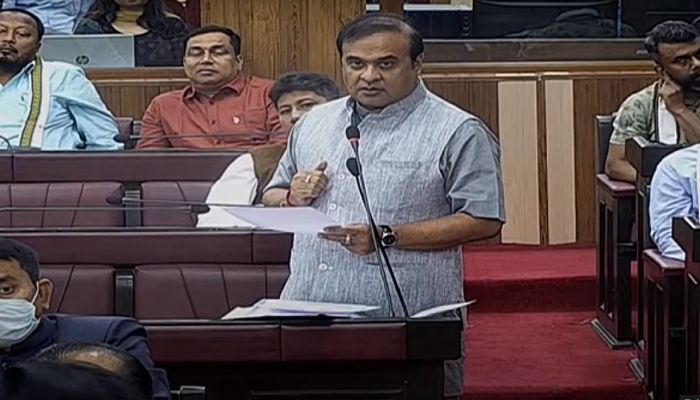
Rejecting the claims of the Muslim community in Assam that they are a minority community, Assam CM Himanta Biswa Sarma said that Muslims are not the minority but have become the largest community in the state. The CM said that with 35% of the population, it is their responsibility to ensure communal harmony and alley the fears of minority communities like Brahmins and Tribal communities in the state. He said this while speaking during a debate on the Governor’s address in the budget session of the Assam assembly yesterday.

In his detailed address, Himanta Biswa Sarma said, “Today people from Muslim community are leaders in opposition, MLAs and have equal opportunity and wield power. So it is their duty to ensure that rights of tribal people are protected and their lands are not encroached upon.”

The CM raised this issue while responding to allegations that his govt is anti-Muslim, citing the anti-encroachment drives of the govt, where Muslims were evicted from govt and public land. He pointed out that it the Muslims in the state who are encroaching land, while the so-called majority people don’t encroach.

He said, “There is no need to encroach on the lands of tribals residing in the sixth schedule area. If Bora and Kalita (Assamese surnames) have not settled on those land, Islam and Rahman (Muslim surnames) must also refrain from settling in those lands.”

CM Himanta Biswa Sarma further said, “Power comes with responsibility, and as Muslims constitute 35 percent of the Assam’s population, with roughly one crore populace, Muslims should realize that the state’s progress is inextricably related to their actions, and they should try to reduce the state’s difficulties by focusing on poverty alleviation, population control, and other issues. They should stop thinking of themselves as “outsiders” and concentrate on communal integration and harmony.”

Explaining how Muslims are the majority community in Assam, Himanta Biswa Sarma that Brahmins constitute barely 2-3% of the population, while Kalitas (a non-Brahmin caste-Hindi Assamese community) may constitute around 10%. Similarly, he said that number of people from other groups like Ahoms, Tribals are also much less compared to numbers of Muslims in the state.

Inviting Muslims for sharing equal responsibility in the protection of cultural diversity, he added, “The Assamese people are under fear. There is fear that culture and civilization will be protected. Harmony is two-way traffic. Let Muslims talk about the protection of Sankari culture, Sattriya culture. There will be harmony. Ten years back, we were not minorities but now we are.”

He further said, “You are the largest community, and it is the responsibility of the largest community to create harmony in society. Now it is not our duty, that responsibility has shifted towards you. Therefore you must start controlling the population growth to eliminate poverty in future in Assam. You should take these initiatives yourself, why should we tell you this?”

Urging the Muslims to contribute towards development of the state, Himanta Biswa Sarma said that Assam will belong to Muslims only in future, and therefore they should ensure that the state is developed.

CM Himanta Biswa Sarma also underlined the problems of indigenous Muslims. He said, “Indigenous Muslims are also in fear of losing their identity. Around 4% out of the total Muslim population in Assam are indigenous Assamese Muslims and a large part are mostly Bengali-speaking Muslims.”

CM Himanta Biswa Sarma also took cognizance of the recently released film ‘The Kashmir Files’ in his detailed speech. He said, “People ask me if Assamese people will face the same fate as Kashmiri Pandits. Ten years down the line will Assam be like it is shown in the Bollywood movie Kashmir Files. It is the duty of Muslims to allay our fear. Muslims must behave like a majority and give us assurance that there will be no repeat of Kashmir here.”

Ukrainian TV show host Fakhrudin Sharafmal cites Nazi ideologue Adolf Eichmann to call for extermination of all Russians, including children

0

As Russia takes control of Ukrainian cities nearly three weeks after launching a “military operation” in Ukraine, the Ukrainian population are resorting to desperate measures to stop the advancing Russians.

The Ukrainian population are baying the blood of not just the Russian forces, but the west-backed regime is now threatening to carry out a genocide of Russians after Russian President Vladimir Putin announced that they would ‘demilitarise’ and ‘denazify’ Ukraine. On similar lines, a Ukrainian TV show host last week was seen calling for genocide against Russians, especially the Russian children.

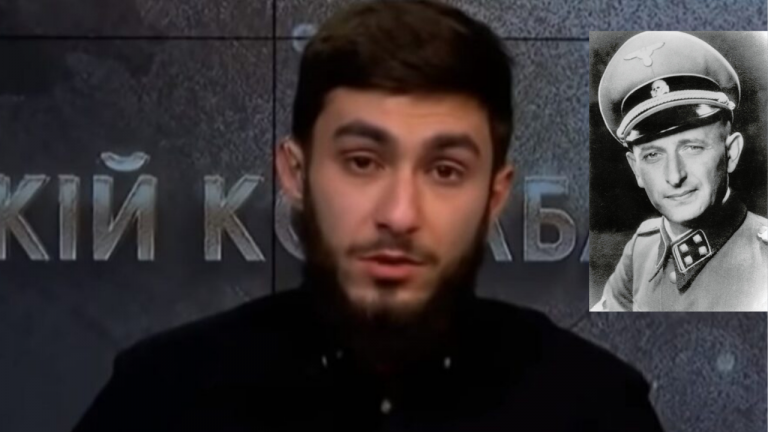
Fakhrudin Sharafmal, a broadcaster at Channel 24, did a show in which he was reportedly heard saying that he was ready to personally kill all Russians, not only invaders who came to Ukrainian land, but also everyone else, along with their children.

Quoting the Nazi ideologist Adolf Eichmann’s statement – ‘In order to destroy a nation, you must destroy, first of all, children,’ Sharafmal said, “I know that as a journalist, I have to be objective, I have to be balanced, in order to report information to you with a cold heart, but to tell you the truth, it’s very hard to hold on now, especially at a time like this, and since we are called Nazis, fascists, and so on in Russia – I will allow myself to quote Adolf Eichmann, who said that in order to destroy a nation, you must destroy, first of all, children.

The Ukrainian TV host said if someone kills their parents, the children will grow up and take revenge. However, by killing children, they will never grow up, and the nation will disappear.

“The Armed Forces of Ukraine cannot kill Russian children because the rules of war forbid it, and it is prohibited by various conventions, including the Geneva Convention. But I am not from the Armed Forces of Ukraine. And when I get the chance to take down Russians, I will definitely do it. Since you call me a Nazi, I adhere to the doctrine of Adolf Eichmann, and I will do everything in my power to ensure that you and your children never live on this earth so that you can feel what it is like when innocent civilians die and bear all the pain and suffering,” the angry TV broadcaster said.

Continuing to call for genocide of innocent Russian, Sharafmal said, “We need victory. And if we have to slaughter at your families to do it – I’ll be one of the first to do it. Glory to the nation! And hope that there will never be such a nation as Russia and the Russians on this earth again because they are just scum who are destroying this land. If the Ukrainians have the opportunity, which they are basically doing right now, to destroy, slaughter, kill, and strangle the Muscovites. And I hope that everyone contributes and whacks at least one Moskal”

The angry rant by the Ukrainian TV show host came after one of his friends – Pavel Sbitov, a company commander of the 503rd Separate Marine Battalion, was killed by the Russian forces in the ongoing Russia-Ukraine conflict.

Following the outrage over his statements, Fakhrudin Sharafmal apologised on Channel 24 the next day.

He stated that his statements were unacceptable both for a journalist and as a person.

“The pain of loss and sadness for a friend spoke in me. Once again, I apologise. We will not allow the genocide that is happening in our country,” Sharafmal emphatically said.

AgustaWestland chopper scam: Supplementary charge sheet filed against former defence secretary Shashikant Sharma, four others

0

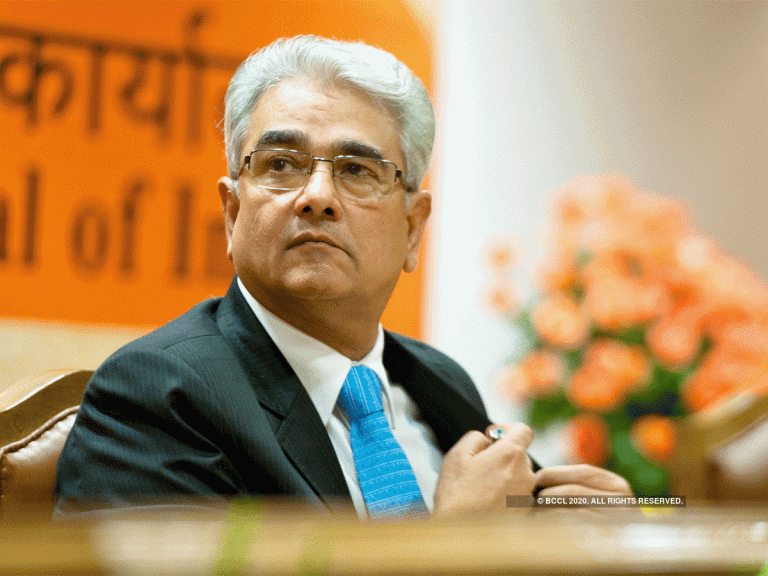
The Central Bureau of Investigation (CBI) filed a supplementary charge sheet on Wednesday against former Comptroller and Auditor General (CAG) and Defence Secretary Shashikant Sharma, as well as four Indian Air Force (IAF) personnel in connection with the AgustaWestland VVIP chopper scam, according to news agency ANI.

According to officials, the CBI has requested permission to prosecute Sharma in connection with the UPA-era AgustaWestland chopper scam.

Prior to this, the agency had filed a supplementary chargesheet in the case in June 2020 wherein it named key middlemen Christian Michel James, Rajiv Saxena and 13 others. Notably, this was the second charge sheet filed in the case, and it elaborates in detail about the alleged role played by Michel in receiving and routing the alleged kickbacks through a web of entities to alleged beneficiaries, which include bureaucrats and politicians. The agency had until then not charge-sheeted any politician in this scam.

In March 2020, the CBI had sought prosecution sanction from the Union government against former defence secretary and Comptroller and Auditor General of India Shashikant Sharma, former Air-Vice Marshal Jasbir Singh Panesar, and three other Indian Air Force (IAF) officers in connection with the multi-crore chopper scam.

In the same year, the CBI had sought prosecution sanction against former defence secretary Shashi Kant Sharma, former Air vice-marshal Jasbir Singh Panesar and three other IAF officers – deputy chief test pilot SA Kunte, wing commander Thomas Mathew and former group captain N Santosh. However, it went ahead and filed its charge sheet without awaiting the prosecution sanction against the aforesaid individuals. However, now again the CBI has filed its third charge sheet in which it has named the former defence secretary Shashi Kant Sharma, former Air vice-marshal Jasbir Singh Panesar and three other IAF officers – deputy chief test pilot SA Kunte, wing commander Thomas Mathew and former group captain N Santosh.

According to Section 19 of the Prevention of Corruption Act, it is mandatory for CBI to seek a prosecution sanction from the concerned department before filing a charge sheet against a government official.

Shashikant Sharma was Joint Secretary (Air) in the Ministry of Defence when the contract was under consideration. Sharma had reportedly finalised the operational requirements (OR) for the deal. 

Sharma later became India’s defence secretary, between July 2011 and May 2013, and went on to become CAG till 2017. The alleged violations and kickbacks in the UPA era scam was one of the biggest controversies during the Manmohan Singh government.

Reportedly, the CBI has stated that the five officers had taken “key decisions” and were actively involved in the procurement process of VVIP chopper deal which took place during UPA-II.

UPA era AgustaWestland Scam

India had signed a deal in 2010 under the UPA regime to buy 12 AgustaWestland AW101 helicopters for the service of the Prime Minister, the President and other VVIPs. It is alleged that some politicians and public servants had abused their official positions to reduce the service ceiling of the VVIPs helicopter from 6000 metres to 4500 metres to make AgustaWestland eligible for the contract and had awarded the contract for an amount of Euro 556.262 million in 2010. The deal was cancelled in 2013 after the scam was revealed.

The AgustaWestland VVIP chopper scam has been nothing less of a blistering drama ever since middleman Christian Michel was extradited to India from Dubai.

Several revelations came to light, from the names of “Italian Lady”, to “Italian Lady’s son R“. From how Christian Michel was lobbying for the Eurofighter and against the Rafale deal, to how he had unbridled access to the PMO under Congress regime, the CCS and even the investigative agencies.

Chhattisgarh: Congress CM Bhupesh Baghel urges PM Modi to declare ‘The Kashmir Files’ tax-free, invites all MLAs to watch the movie together

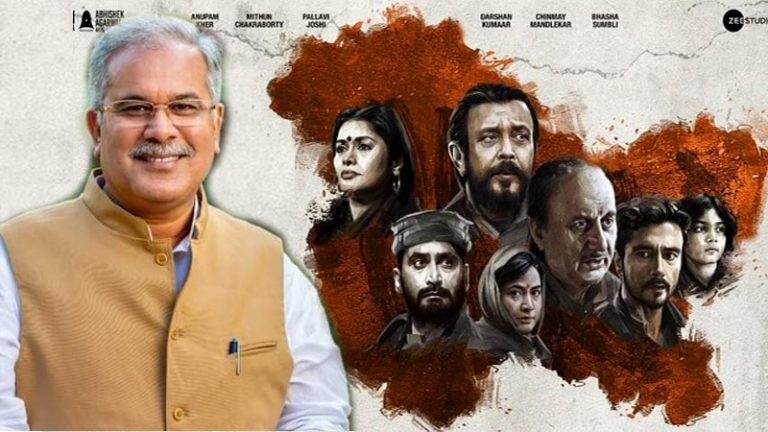
After seven state governments declared the film ‘The Kashmir Files’ tax-free in their states, Congress CM of Chhattisgarh, Bhupesh Baghel has urged PM Modi to declare the film tax-free on the national level. He has requested the PM to remove the central GST on this film and make it a tax-free film pan-India. The individuals have

Bhupesh Baghel made the demand on Twitter by saying in a tweet, “BJP MLAs have demanded that ‘The Kashmir Files’ be made tax-free. I request the Hon’ble Prime Minister to announce the removal of Central GST from this film. The film will be tax-free across the country.”

Bhupesh Baghel has also invited all the MLAs of Chhattisgarh to watch the film today. Informing about this on Twitter, he wrote, “Today all the esteemed members of the Assembly (including our party and the opposition) have been invited to watch the film ‘Kashmir Files’ together. Today at 8 pm, all of us MLAs/invited citizens will watch the film together at a cinema hall in the capital.”

‘The Kashmir Files’, directed by Vivek Ranjan Agnihotri, has been declared tax-free by seven state governments viz. Uttar Pradesh, Goa, Gujarat, Haryana, Madhya Pradesh, Karnataka, and Uttarakhand. The film depicts the genocide of the Kashmiri Hindus by Islamic terrorists that happened in the 1990s and their subsequent exodus. The film is released on 11th March 2022 and within less than a week it has become a massive hit on the box office.

Congress uses Al Jazeera to claim democracy is in danger, read how it is full of loopholes and load of cr*p

Qatar state media Al Jazeera has started a series of reports where they have alleged that social media giants like Facebook and prominent corporate houses like Mukesh Ambani owned Reliance Jio are helping Bharatiya Janata Party (BJP) to win the elections. In its first report published on March 14, Aj Jazeera alleged that Reliance Jio, in which Facebook is an investor, used its subsidiary named NEWJ to promote reports in favour of BJP on Facebook.

NEWJ, a news portal launched by one Shalabh Upadhyay and his sister Deeksha in 2018, was taken over by Reliance Industrial Investment and Holdings Limited (RIIHL). NEWJ transferred 75% of the equity to RIIHL and got $1.1 million as investment from Reliance. In 2020, Reliance invested another $1.63 million into the company.

Al Jazeera alleged that NEWJ used the money invested by Reliance in promoting reports that favoured BJP. It published multiple screenshots in the report that were aimed at allegedly downgrading the reputation of the opposition parties and leaders.

The media house alleged that the Election Commission of India and Facebook decided not to look at the loopholes used by NEWJ to promote BJP. They said in the 2013 notification, ECI had made it compulsory for the political parties to get their social media ads pre-certified from the commission, however, no such regulations are in place for the third-party advertisers with no link to political parties. It was alleged that the lack of regulations left a loophole for the political parties, especially BJP and its allies, to use these platforms during elections.

The highly problematic writers behind the report

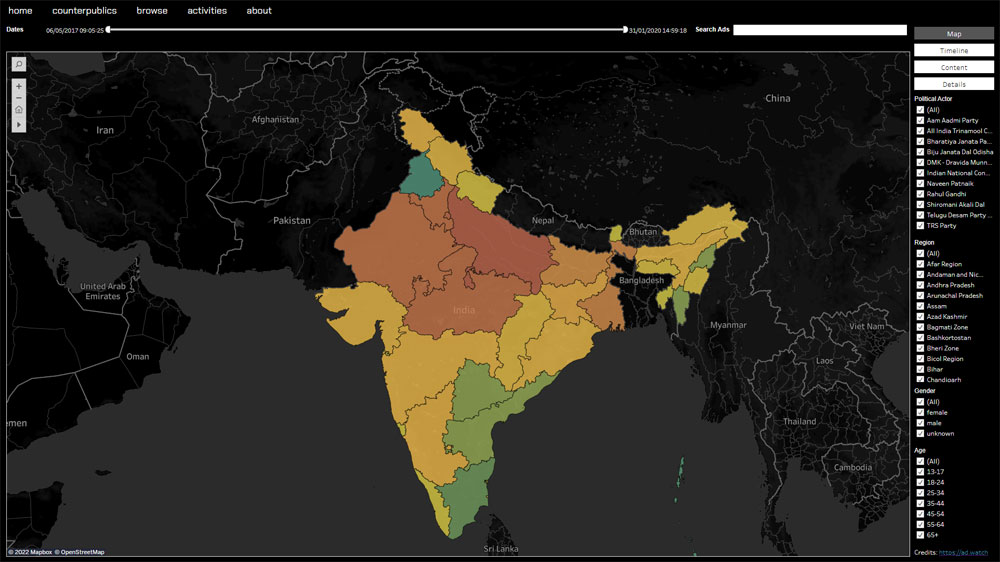
First of all, let’s talk about the writers who penned the report on Al Jazeera. Nayantara Ranganathan, one of the writers, is a researcher at ad.watch, a portal that claims to expose how the world is exposed to political ads and their impact on different age groups. While the idea behind the ad.watch is appreciable, there are a lot of red flags in the reports where its researchers are involved.

First of all, when we looked at India’s page on the ad.watch’s website, we found it was using a distorted map of India with many regions missing from the map. A large portion of union territory of Ladakh which is illegally under occupation of Pakistan and China is not included in the map. Notably, neighbouring countries Pakistan and China have claimed these regions as their own on several occasions that were strongly rebutted by the Government of India.

The second writer, Kumar Sambhav, is a member of The Reporters Collective, a media house that has contributed extensively to anti-BJP and anti-Modi reports.

Selective data to defame Reliance and BJP

During our research, we noticed that the researchers used selective data to prove their points. They tried to show that BJP was the only party that has been using social media platforms for advertising, and other parties or their allies are not doing anything to promote leaders and parties of their choice.

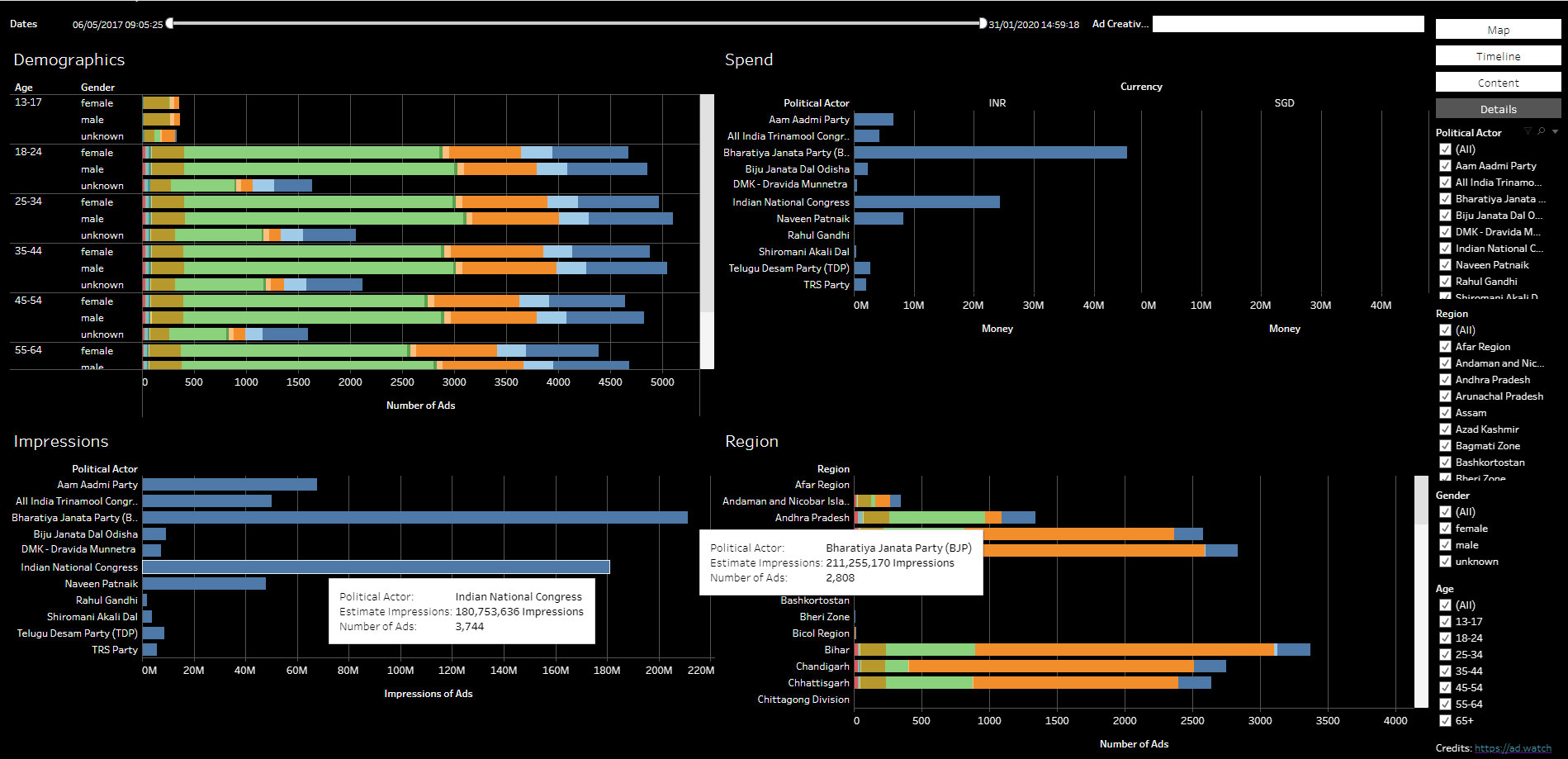
Let’s use the data available at the ad.watch to prove how biased the writers are towards BJP. We checked the ads between May 6, 2017, and January 31, 2020. This is the maximum range available on the ad.watch for the political parties ads in India. Interestingly, it showed Indian National Congress (INC) placed 3,744 ads on social media whereas BJP placed 2,808 ads. That means BJP invested in 35% lesser ads compared to Congress.

The reach of BJP was better compared to Congress which could be because people like BJP over Congress, as can be seen in the number of elections since 2014 where Congress has been reduced to irrelevance.

No mention of surrogate advertisers for Congress or other parties

Surrogate advertising is a system used by brands to promote their product under the disguise of another product. For example, in India, it is not allowed to promote alcohol or tobacco products. The brands use other products to promote the brand name and make it popular among the masses. Best examples could be elaichi when main product of brand is gutkha, or for soda and when main product is alcohol.

In the case of political parties, surrogate advertisers would be the companies that do not have a direct link to any political party but promote reports that either promote the political party or defame the opposition party or leader. Here, NEWJ is accused of doing such advertising for BJP. Interestingly, the researchers used selective data to prove their point and conveniently ignored media houses that promoted reports that either defame BJP or promote the opposition parties.

Media houses and their anti-BJP ads

During our research, we found multiple media houses promoting anti-Modi, anti-RSS, anti-BJP and similar ads across platforms. We noticed such ads being promoted, especially during the elections. As they were aimed to spread anger towards BJP, they easily fall under the same category NEWJ falls as per Aj Jazeera.

“Those who have glass walls…” – the proverb fits on Al Jazeera

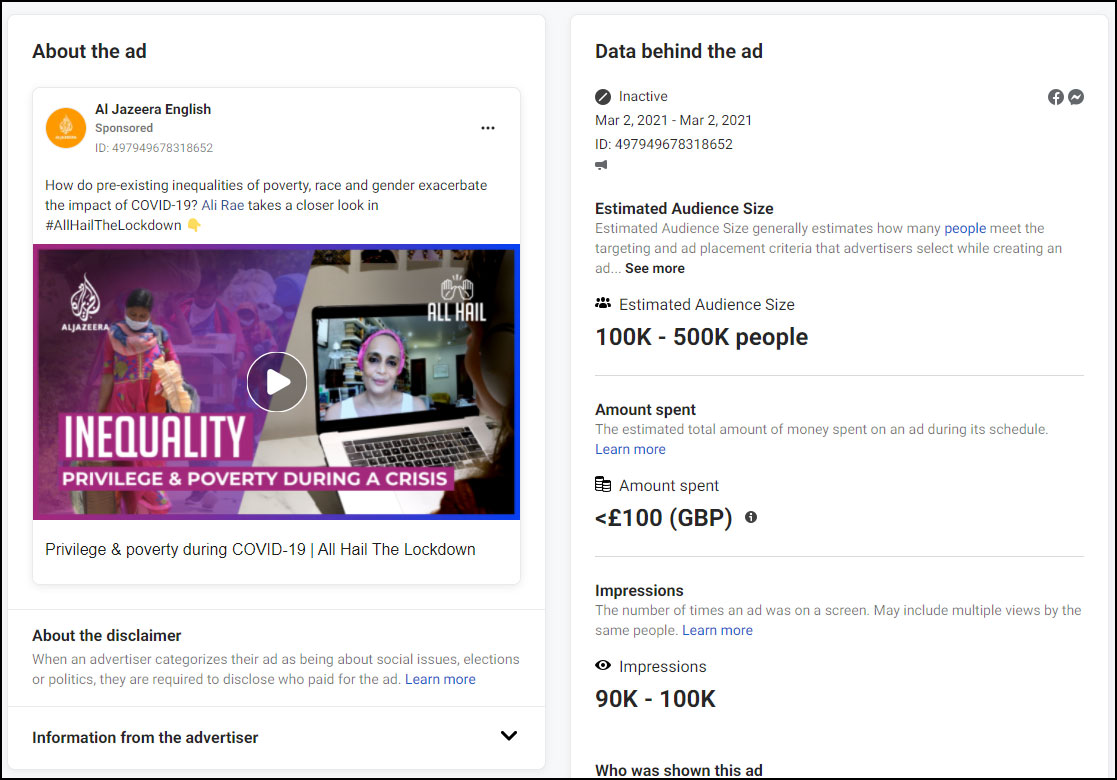
OpIndia research found that Al Jazeera itself had promoted content against PM Modi-led government and BJP. The screenshot below shows the details of the ad by Al Jazeera accusing the BJP of poor Covid-19 management. The video promoted by the media house included an interview of so-called activist Arundhati Roy, who is known for spreading misinformation and hate against Hindus. In her interview with Al Jazeera, Roy alleged Hate and Sectarianism were being promoted, and the lockdown was used for the same.

Source: Facebook Ad Library

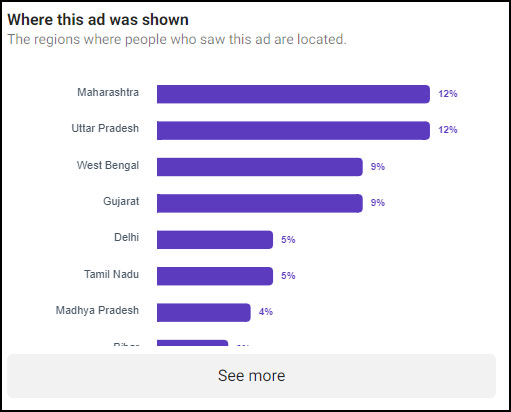
The top five regions where the ad was run were Maharashtra, Uttar Pradesh, West Bengal, Gujarat and Delhi. All these regions either had a maximum influx of migrant labours or were home states of the migrant labours. The ad was running on March 2, 2021, i.e. during the second wave of Covid. By that time, Uttar Pradesh, the largest state population-wise, had already entered the election mood that was scheduled for early 2022.

Source: Facebook Ad Library

Further, the migrant crisis took place in April-May 2020, a full year prior to above video. This was around second wave when the Delta variant was creating havoc in these above states mostly. Holier than thou, anyone?

The Wire and its anti-Modi promotion during Lok Sabha elections

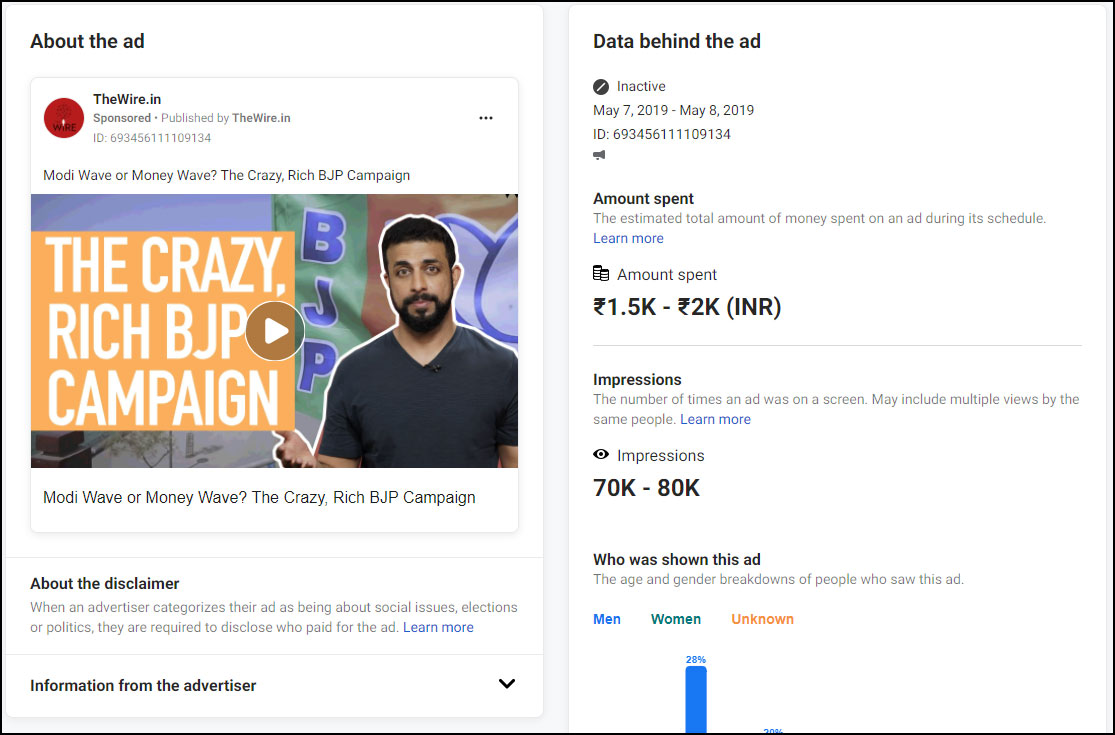
From time to time, The Wire has promoted posts that were anti-BJP. During the Lok Sabha elections, they promoted a video where they targeted BJP for the donations it had received via electoral bonds. The figures in the video were not verifiable. 

Source: Facebook Ad Library

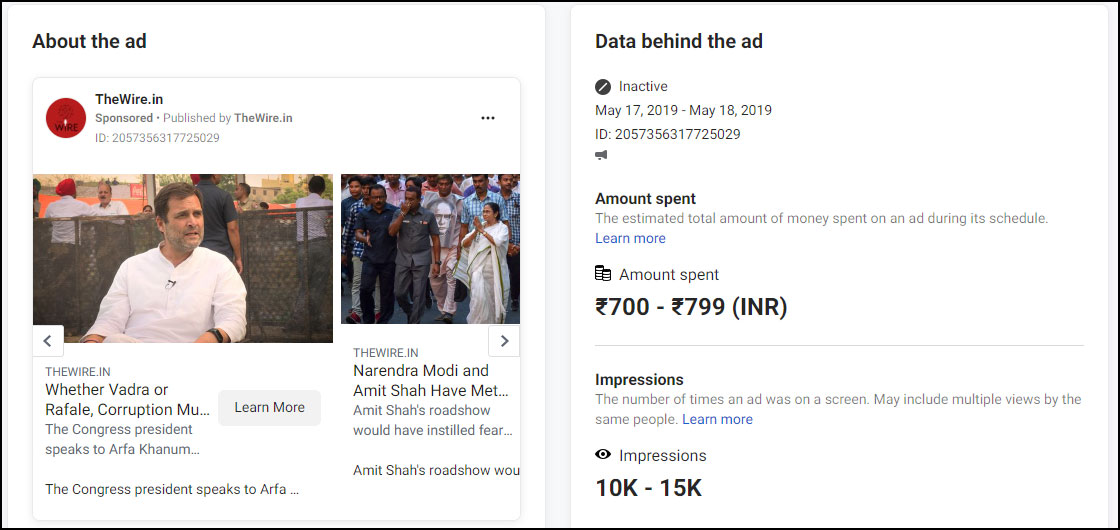
Another set of The Wire’s posts were promoted between May 17, 2019, and May 19, 2019, the last phase of the Lok Sabha elections. These posts promoted Rahul Gandhi and Mamata Banerjee. In the interview of Rahul Gandhi promoted in the ad, he had said people did not prefer the BJP.

Source: Facebook Ad Library

But anti-Modi ads are pious and uphold democracy, it seems because Al Jazeera does not think it is important to show this side of media bias.

The case of Newsclick

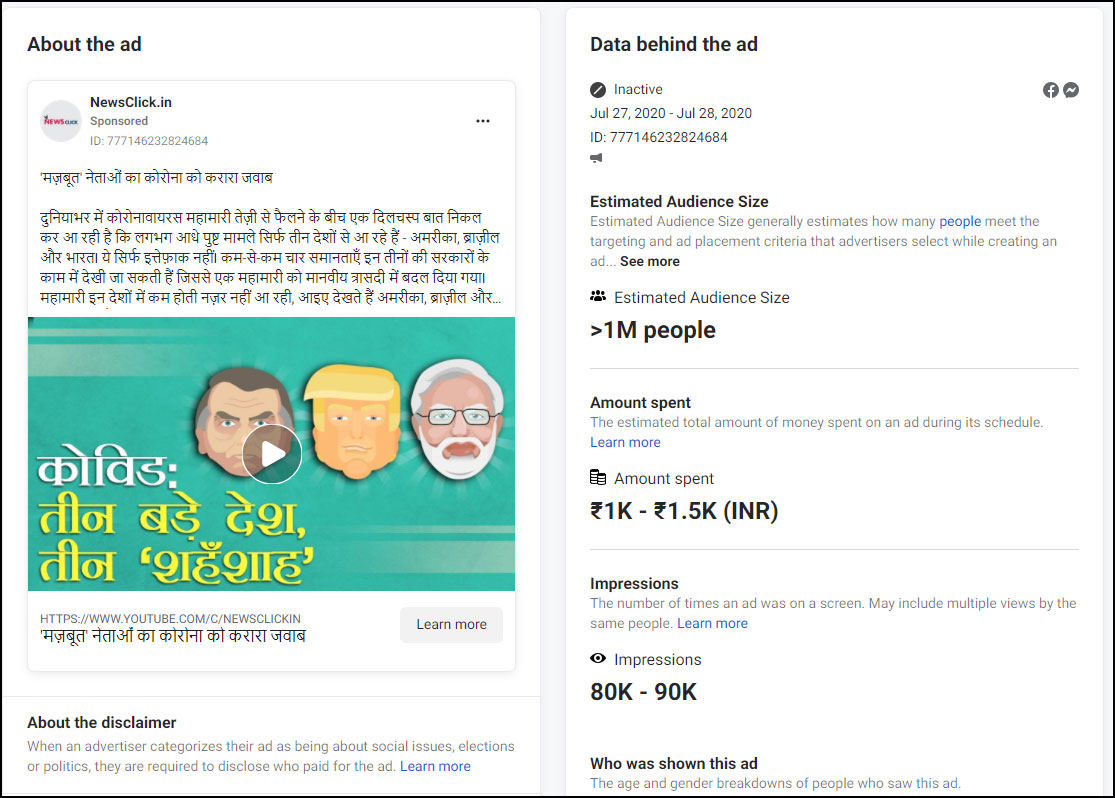
During the Covid-19 pandemic, Newsclick promoted a video accusing PM Modi-led government of India of mismanagement. It made a point that India, USA and Brazil, countries led by populist leaders, could not manage the pandemic properly. The ad ran in June and July 2020, just before the Bihar Assembly elections.

Source: Facebook Ad Library

As usual, another anti-Modi ad religiously ignored by Al Jazeera.

The case of Maktoob Media, a pro-Islamic website which often spreads fake news

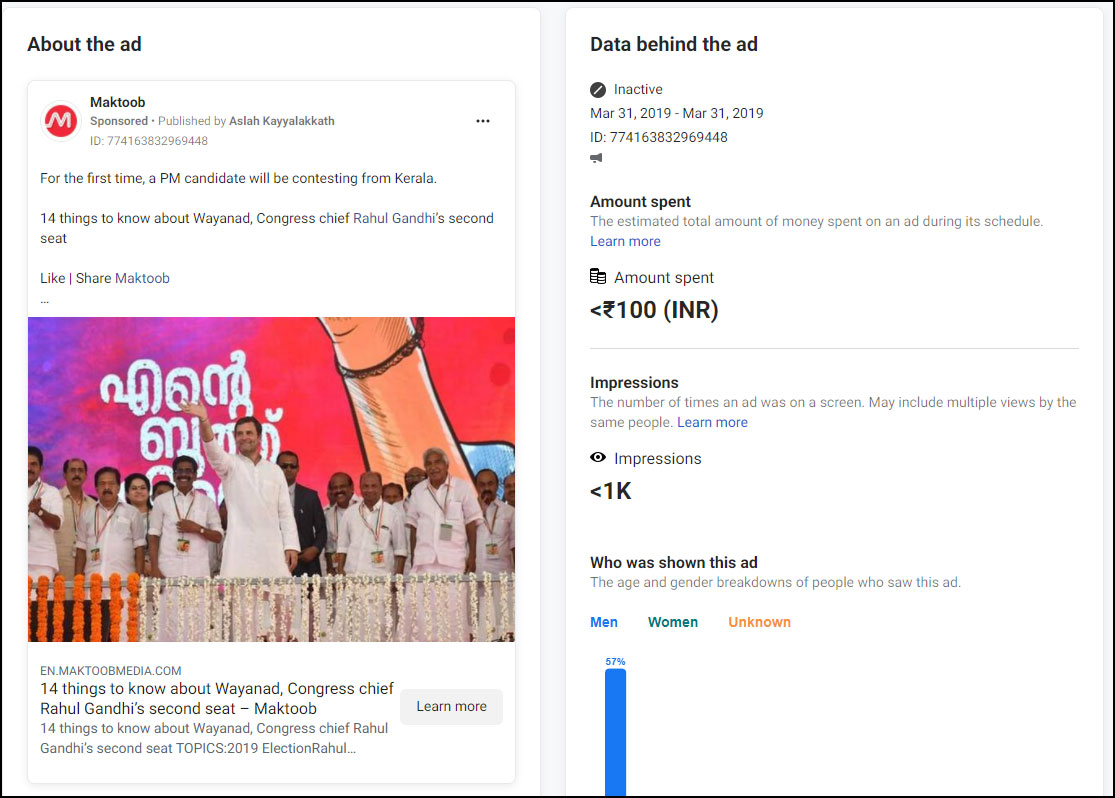
Another known anti-BJP, pro-Islamist portal, Maktoob, also promoted a series of ads against BJP and in favour of Congress during the Lok Sabha elections. Some of the screenshots can be seen below.

Source: Facebook Ad Library

Maktoob media had portrayed Rahul Gandhi as PM candidate contesting from Wayanad. He was also contesting from Amethi, his family bastion, which he eventually lost to BJP’s Smriti Irani.

Source: Facebook Ad Library

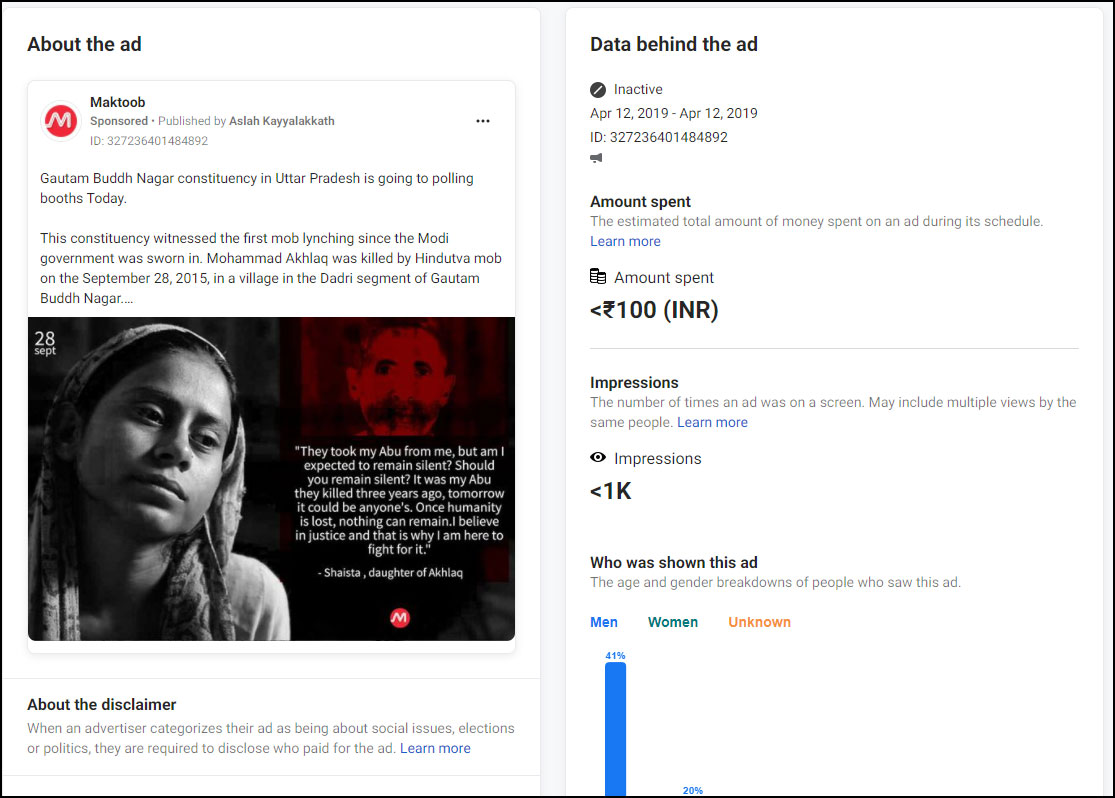
Another ad just ahead of 2019 Lok Sabha elections was about Md Akhlaq, who died in 2015 after scuffle. Gautam Buddh Nagar was going to polls the day the ad was published.

NEWJ promoted non-BJP content that Al Jazeera’s researchers missed

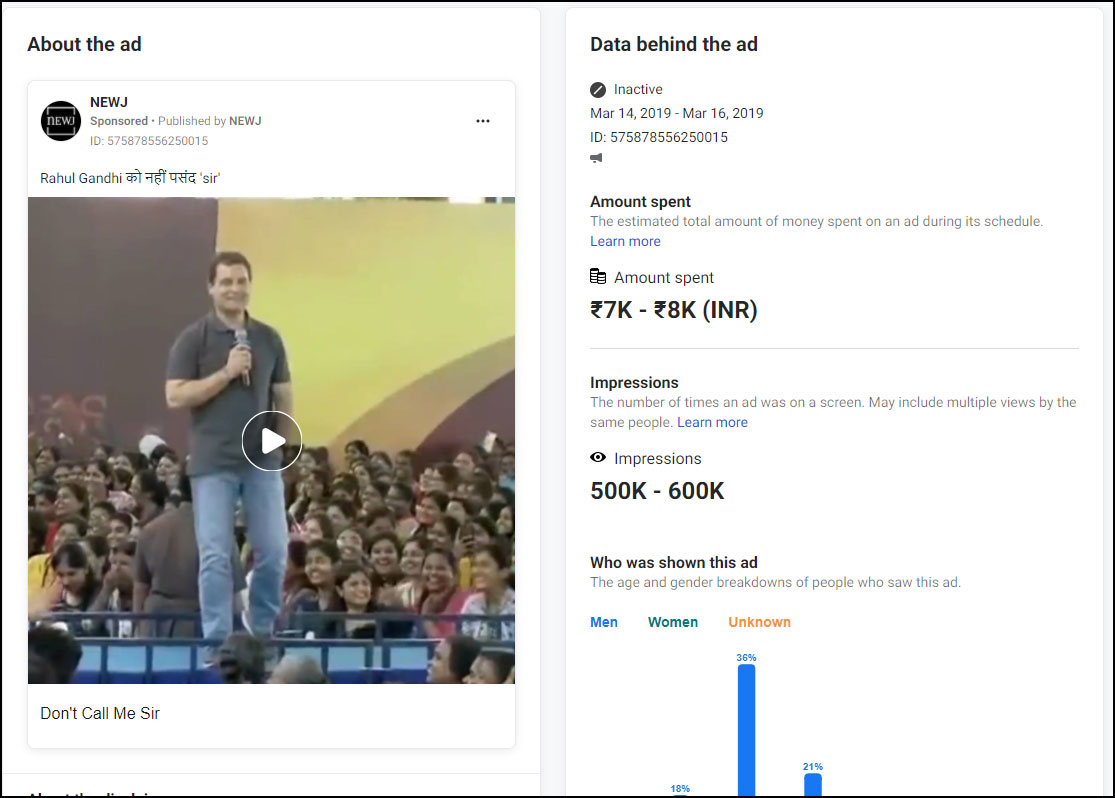
NEWJ promoted all sorts of reports and not only pro-BJP content. For example, during the Lok Sabha elections 2019, they promoted a video of Rahul Gandhi where he had requested a woman not to call him sir. The ad had got over 500,000 impressions.

Source: Facebook Ad Library

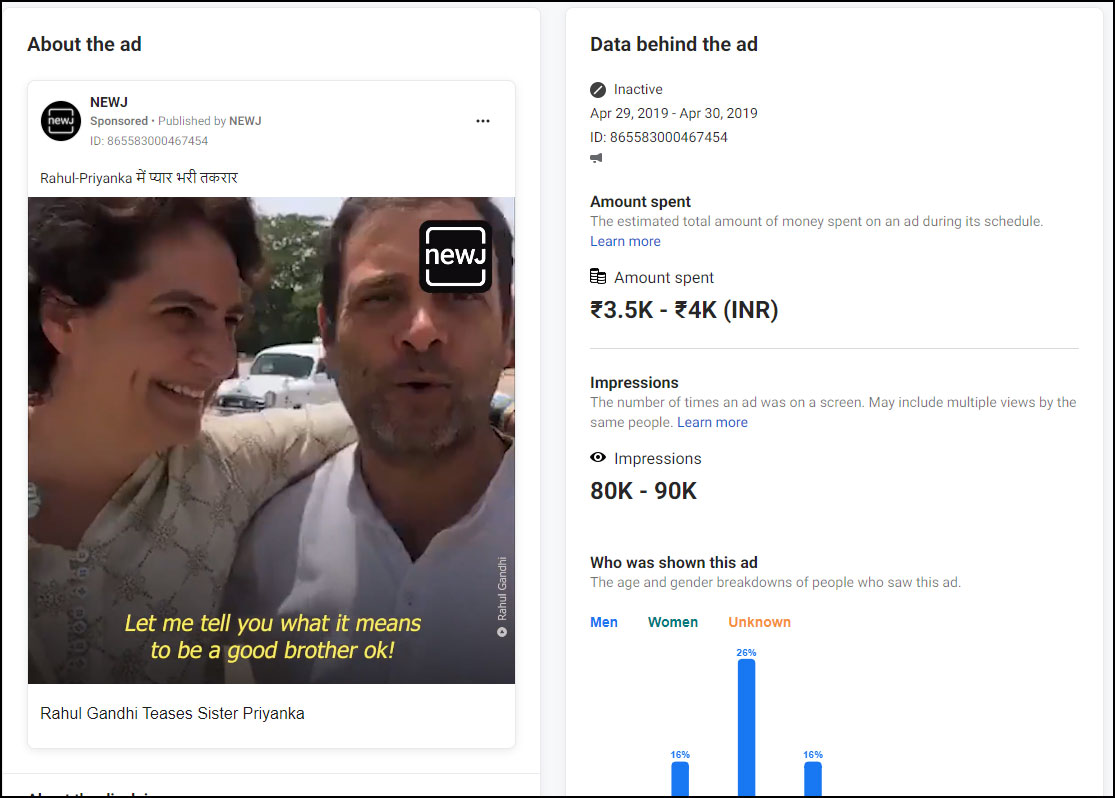
During the same elections, they also promoted a video of Rahul and Priyanka Gandhi having a light-hearted moment. The ad had received over 80,000 impressions.

Source: Facebook Ad Library

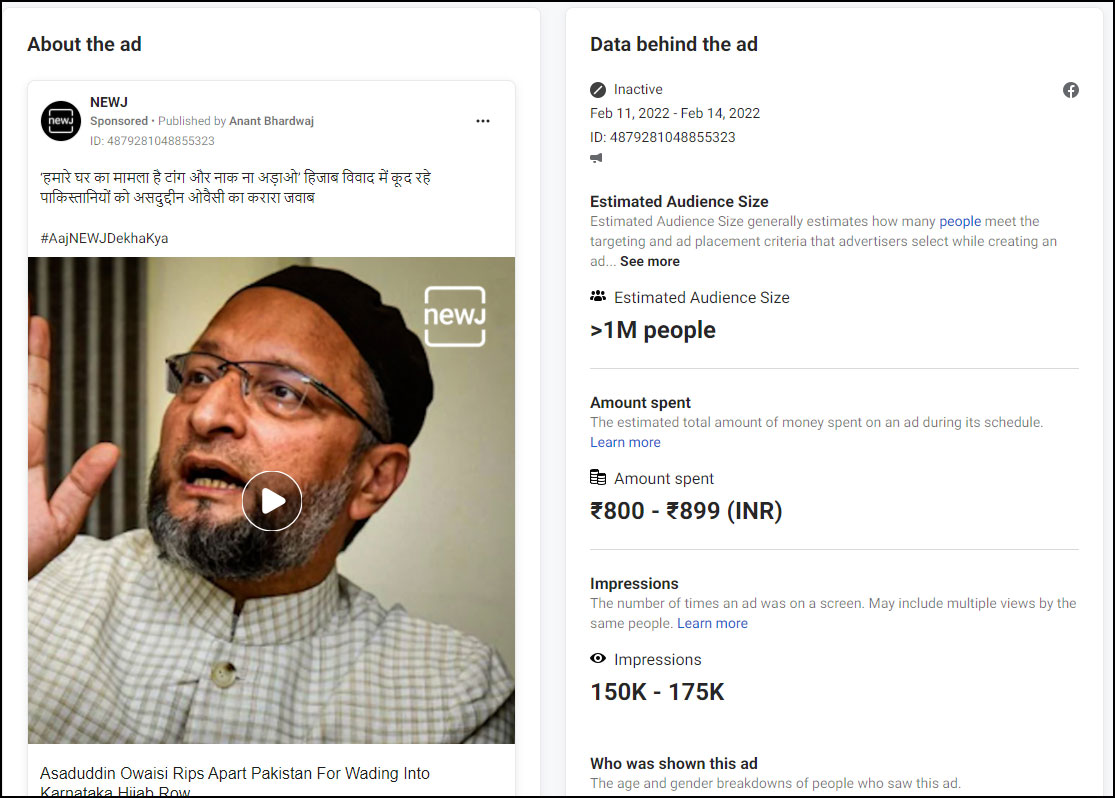
Just recently, they had promoted a video of AIMIM chief Assadudin Owaisi targeting Pakistan for poking its nose in the Hijab controversy.

Source: Facebook Ad Library

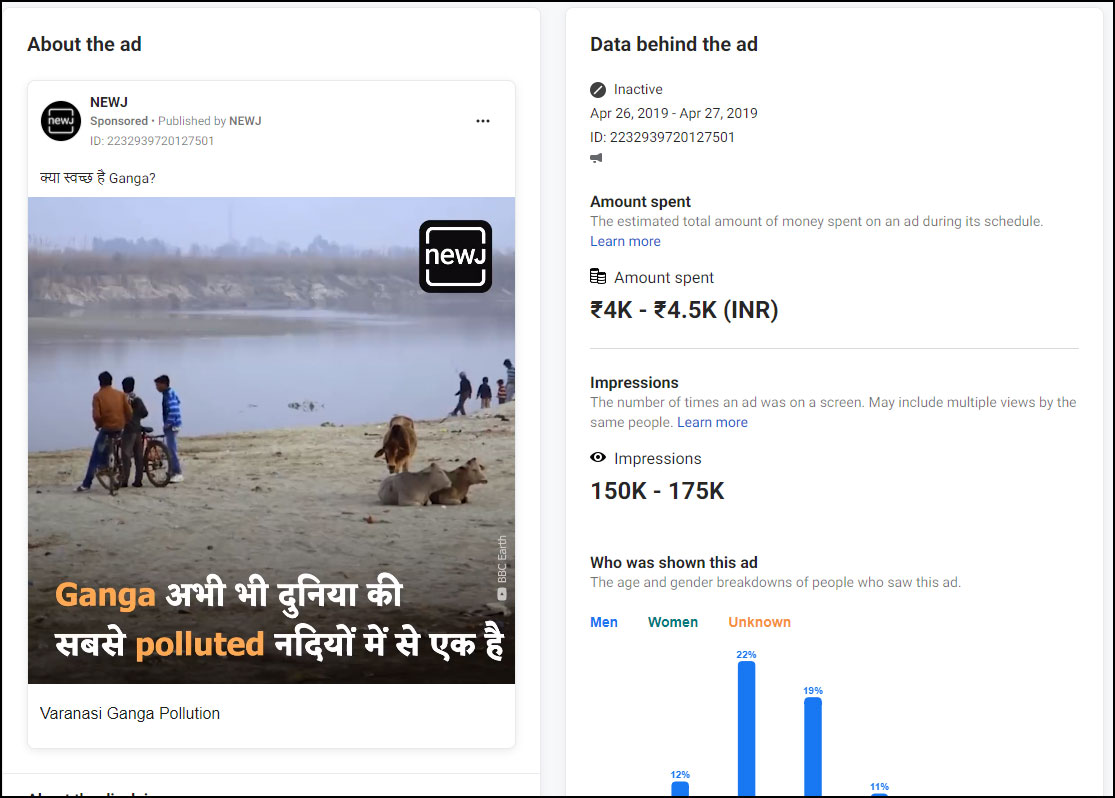
Interestingly, some posts promoted by NEWJ were targeted for its inability to fulfil promises. For example, in 2019, it promoted a video showing how the mission to clean the Ganga river was lagging behind.

Source: Facebook Ad Library

Founder and CEO of NEWJ, Shalabh Upadhyay, also pointed out the fact that they promote posts of all political parties and leaders. Responding to Congress leader Mallikarjun Kharge, he said, “Dear Mallikarjun Kharge, sir, we are an independent news organisation. NEWJ covers all stories relevant to our Indian viewers.” He added several screenshots of stories that Al Jazeera did not include in its reports.

Sonia Gandhi’s statement in Lok Sabha and the hypocrisy

On March 16, Congress leader Sonia Gandhi pointed out in Lok Sabha that the social media platforms have systematic interference in the election process. Legitimising the reports by Al Jazeera, she said, “I urge the government to put an end to the systematic interference and influence of Facebook and other social media giants in the electoral politics of the world’s largest democracy. This is beyond partisan politics.”

Not to forget, Congress had launched a campaign to hire over 5 lakh individuals as ‘social media warriors’ in 2021. That included 50,000 office bearers to lead the rest of the ‘trolls’. It was obvious the 50,000 office bearers were to be paid, but it is still unclear if the rest of the trolls hired by Congress were paid or not.

Congress has used foreign media and agencies to malign the central government on multiple occasions. Earlier, it had cited an unsubstantiated report published in The New York Times, which claimed that the sale of a package of sophisticated weapons and intelligence gear worth $2 billion of Pegasus spyware was a centrepiece of PM Modi’s visit to Israel in 2017. It accused the government of “hijacking democracy”. The party alleged the central government had bought the spyware as a part of a $2-billion deal in 2017.

It is also worth mentioning that one of the significant revelations made in the toolkit that was in circulation on social media in May 2021 and was allegedly linked to the Congress party called for the use of the international media and ‘friendly’ journalists to propagate anti-Modi propaganda. The document instructed the supporters to rope in the international media to criticise and amplify the perceived COVID-19 mismanagement by the Modi government.

Media houses choose posts that would please the audience

Every media house and agency has a different set of audiences. At the end of it, media houses are also business houses and it will make business sense for the owners to put money in advertising for product the audience might actually like. If a publication knows the audience base will not like Congress related news or news on Rahul Gandhi, it will make little sense to put money on a bad product.

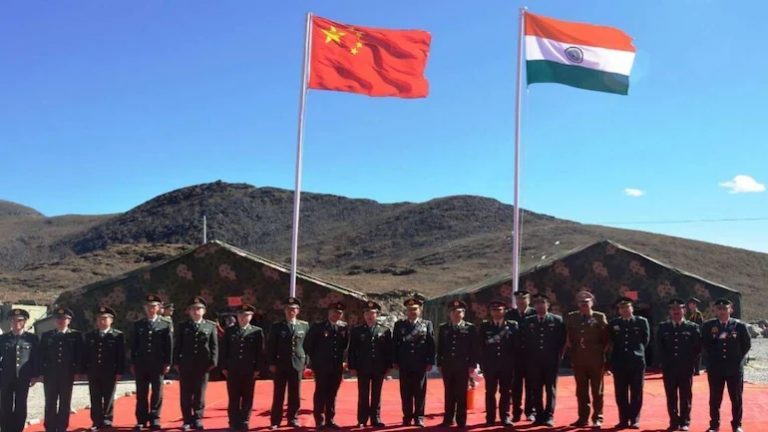
India and China: Revisiting the 1962 war and 2020 Galwan attack

The simultaneous emergence of China and India as economic powers is one of the greatest events of the first decades of the 21st century. Both the countries are one of the oldest civilizations of the world and have co-existed in peace most of the time in millennia. Along with being the ancient civilizations, India and China have a colonial past, current challenges, and future potentials. In the history of India-China relations, the year 1962 was a “Himalayan” blunder.

As of 2022, it has been 60 years since the incident took place. Yet even after 60 years of horrific war, again in the year 2020, China once again surprised India in a violent clash at the Line of Actual Control (LAC) in the Galwan valley. Against this backdrop, this article attempts to explore the bilateral relations, draw parallels between the 1962 War and the 2020 Galwan standoff while analysing the success of diplomatic dialogues between the two countries.

Establishing Bilateral Relations

Contemporary relations began when India and China achieved independence in 1947 and 1949 respectively. India was one of the first countries to recognize the People’s Republic of China (PRC) shortly after the latter was founded and on April 1, 1950, it became the first non-communist country to establish diplomatic relations. The two nations had cordial relations in the 1950s at a time when Prime Minister Jawaharlal Nehru and Premier Zhou Enlai were key advocates of strong solidarity between the two countries. In fact, during 12 days visit to China, the then PM, Mr Nehru was welcomed with thousands of Chinese waving Indian as well as Chinese flags at the airport. This era could be termed as the era of “Hindi Chini Bhai Bhai” (Indians and Chinese are brothers) as the two sides developed the “Five Principles of Peaceful Coexistence” (Panchsheel, or Panch Shila) that still guide today’s foreign policies. However, the tensions between these two countries commenced towards the end of the 1950s, and war broke out in the year 1962, deeply hurting the bilateral relationship, the repercussions of which are still felt today. 

Origins of the conflict

The year 1962 is embedded in the collective memory of India as national humiliation when Beijing “surprised” Delhi and sent its troops over disputed territory across the LAC. The main cause of the 1962 war was a dispute over the sovereignty of the widely separated Aksai Chin and Arunachal Pradesh border regions, while the escape of the Dalai Lama to India in 1959 acted as a catalyst. Aksai Chin, a disputed area between India and China is the significant geopolitical reason for the 1962 war.

This dispute goes back to even before Indian independence, at a time when William Johnson, a civil servant with the Survey of India, proposed the “Johnson Line” in 1865, which put Aksai Chin in Kashmir. However, this map was not shared with China since Xinjiang prefecture at that time was not under the control of China. It came under Chinese control years later and it was not until 1892 that China erected boundary markers at Karakoram Pass.

Following in the year 1897, British military officer, Sir John Ardagh, proposed a boundary line along the crest of the Kun Lun Mountains, north of the Yarkand River. This line accounts for territory further north to the Sanju Pass in the Kun Lun Mountains. The strategic importance of this area became prominent when the Chinese constructed a road from Tibet to Xinjiang province in 1950, which was left unattended from the Indian side. Despite the Aksai Chin region being uninhabitable owing to a lack of life-sustaining resources, it remains supremely strategically important for China as it connects Tibet to Xinjiang province

58 years after the 1962 war, in a violent clash between India-China at the Line of Actual Control (LAC) near the Galwan valley, nearly 20 Indian soldiers were martyred. While the reasons behind the recent face-off remain uncertain, several incidents and developments may have provoked Chinese aggression. Firstly, in 2018-19, the Ministry of Defence in its annual report stated that the government will be constructing the roads along the India-China border of which Phase 1 of this project has been completed. The 2nd phase encourages 32 roads to be built along the border. China has been opposing this construction as it doesn’t want India to fully utilize the road. Secondly, On August 5, 2019, India scraped Article 370. After the abrogation of Article 370, two separate Union Territories were created- first Jammu and Kashmir and second Ladakh which was opposed by China, claiming that India has included the Chinese territory (Ladakh) in its administrative jurisdiction.

China has been receiving a lot of international criticism on the issue of Human rights violations of Uighur Muslims. Besides, China passed the Hong Kong National Security Law which faced widespread criticism both at the national and international levels. China is also facing international pressure over the origin and spread of the COVID-19 pandemic. Besides, in the year 2014, a joint statement made by India and the USA addressed their concerns regarding the South China Sea. Further, during the Trump administration, a response to the Chinese construction of the military facilities, including airstrips and radar towers, on the artificial islands, was necessary. Hence, Prime Minister Narendra Modi and American President Donald Trump also sent out a message to China, underscoring in a joint statement that a close partnership between their two nations was “central to a free, open, inclusive, peaceful, and prosperous Indo- Pacific region.” These international tensions may have contributed to the regional escalations, indirectly or directly, attacking Chinese expansionist policy and Xi Jinping’s Chinese dream that led to the border face-off.

Drawing parallels

Despite the six decades gap between 1962 and 2020 and a series of agreements after resuming diplomatic activity in 1976, both the incidents have certain parallels in between. The foremost parallels between 1962 and 2020 are the geopolitical importance of the region where the 1962 war and border faceoff in 2020 occurred. The Galwan River Valley situated in the Sub Sector North (SSN) is considered a point of great strategic importance for both India and China. Indian construction activities such as the bridge across the Shyok river and the 255km Darbuk-Shyok-DBO road will provide a crucial connection between Leh and Daulat Beg Oldie. It is an advanced landing ground that lies quite close to the Line of Actual Control (LAC) with China which irked the Chinese. The valley is also an important connecting factor with Chinese-controlled Aksai Chin. Thus, India’s presence in Aksai Chin irks China which withholds the crucial Xinjiang-Tibet highway passing through the river valley.  

The second most commonality between the two face-offs is the element of surprise and betrayal. To resolve the long withstanding unresolved border dispute, negotiations were underway between Chou En-lai and Nehru, right up till 1961. However, this bonhomie did not contain the Chinese to invade India in October 1962. The lack of reading Chinese intentions or missing intelligence analysis has put us on the backfoot since Independence. India completely missed the construction of Trans- the Karakorum Highway. It was only on August 31, 1959, that Nehru informed the Rajya Sabha that according to an announcement made in China, the Yehcheng-Gartok Road, which is also called the Sinkiang-Tibet Highway, was completed in September 1957.

Lastly, an interesting parallel between Mao Zedong’s and Xi Jinping’s China could be observed by looking at their domestic situation in 1961 and 2020. Xi Jinping envisaged the China Dream in his speech at the 19th Party Congress which included (1) A powerful and rich state (Guo Jia fuqiang 国家富强), (2) Renewal of the nation (minzu Fuxing 民 族复兴) and (3) Happiness of the people (Renmin xingfu 人民幸福). In reality, looking at the economic condition, none of these three components is qualifiable as China’s economic activity is based on export and as per World Bank analysis, the global economy was in a deep recession. Consequently, the Chinese economic growth rate dropped by 6.8 per cent year on year in the first quarter of 2020, with a negative growth rate of 3 per cent, wherein investment shows a negative 10 per cent growth year on year, and 600 million Chinese people are not “well off”.

Similarly, in Mao’s China, his Great Leap Forward policies were a catastrophic failure. Between 35-45 million Chinese people had died because of the Great Leap Forward, which caused a famine instead of the imagined rapid industrialization. Mao thought that the best way to regain power and legitimacy was by unifying the nation, especially the armed forces against an outside enemy which happened to be India due to the accusations of a forward troops movement. In the case of Xi, unemployment, mismanagement of covid19, a decline in investment and Hong Kong protests led to questions to Xi’s leadership. Like the conditions leading up to the border skirmish with India in 1962, an external enemy was found yet again in India in 2020

The success of diplomatic dialogues and India’s heavy hedge against China

While there have been certain parallels between the two face-offs, somewhat success of bilateral relations has worked in our favour to contain the loss of soldiers. For instance, the two nuclear-armed neighbours have fought without conventional firearms on the border, following the treaties signed by the two countries. However, the military escalation in Ladakh should be treated with equal importance by both sides.

Besides, Prime Minister Narendra Modi in a statement made in 2020 made it crystal clear that “India would respond firmly to any attempts to transgress the Line of Actual Control (LAC)”. He specifically emphasised that in contrast to the past neglect of such challenges, Indian forces now decisively counter any violations of LAC, the statement further said.

In addition, in light of the Galwan standoff and engagements near Pangong Tso lake area, the Indian Army has bought 17 flat bottomed boats, the majority of them to be deployed at the Pangong Tso in eastern Ladakh for rapid deployment of troops in case of contingencies as well as patrolling. Before its recent deployment, The Army had seven-eight years ago inducted 17 QRT (quick-reaction team boats) for patrolling the Pangong Tso. However, it was only in the year 2020 that the army inked two contracts for the specialized boats.

Plus, in October 2020, Prime Minister Narendra Modi inaugurated Atal Tunnel which holds strategic importance for the Indian Army. The Atal Tunnel has put China at discomfort as the 9.02-km long tunnel, the longest highway tunnel in the world, connects Manali and the Lahaul-Spiti valley throughout the year, which earlier was cut off for nearly six months every year due to heavy snowfall. India is giving a major push to boosting connectivity and use of high-tech surveillance along the nearly 1,350-km Line of Actual Control in the Arunachal Pradesh sector to ensure quick mobilisation of troops and heavy weaponry to deal with any eventuality in the face of the standoff with China in eastern Ladakh. In fact, around 20 bridges, a number of tunnels, airbases and several key roads are being developed in strategically key areas in Arunachal Pradesh.

Furthermore, as late Sushma Swaraj ji once said, “if China expects India to adhere to One China Policy then China must respect the One India Policy“. Apart from bilateral arrangements between India and China, India should continue to work aggressively upon “Neighbourhood First” and form strategic partnerships like QUAD, ASEAN, BIMSTEC etc. In addition to military rebuttal, India also needs to explore economic and diplomatic actions. For instance, India depends on China for about 70 per cent of the APIs that it uses in pharmaceutical manufacturing. While banning Chinese products could be seen as a temporary solution, more crucial sectors like health and manufacturing could be explored to reduce dependency on China. India also needs to strengthen the QUAD, further, its economic and diplomatic ties with Taiwan, express greater support to Hong Kong, and strategically address the issue of the South China sea to maintain peace and order at the border as well as rise in South Asia further a global power. 

Kerala: SFI goons attack KSU woman leader over election results in Trivandrum law college

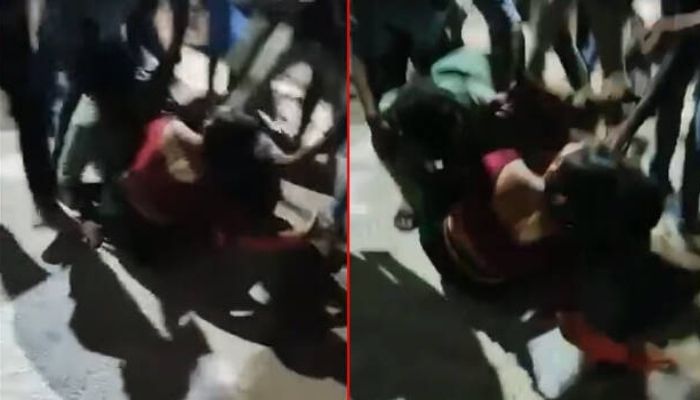
The goons of the Marxist students union SFI (Students Federation of India) have allegedly attacked a woman leader of Kerala Students Union (KSU) over the election results in a law college in Trivandrum on Tuesday 15th March 2022, in the night. The video of the incident has gone viral.

According to reports, KSU unit president Safna Yakub, general secretary Ashik Ashraf, Nithin Thampi, and SFI committee member Anandu were admitted to the medical college hospital.

Safna Yakub is the KSU unit president at Trivandrum Law College. She was publicly assaulted by a group of SFI goons on Tuesday night. In the video, she is seen dragged and beaten by the goons. The violence had erupted after some members of the SFI and KSU got into a heated argument.

The two unions have been involved in a tussle after the results of the college union elections were announced. Although SFI had won the union election this year, KSU had secured the seat of vice-chairperson in the union. Already conflicts were brewing up on the campus. The incident happened amid the celebrations of students union inauguration at 8.15 pm on Tuesday 15th March 2022. The programs were conducted in the classrooms due to rain. Later, SFI goons assaulted a KSU activist Ashik Ashraf on the campus. Safna Yakub, who attempted to save Ashik Ashraf, was also beaten up by SFI goons.

Kerala Students Union is a students organization affiliated with the Congress party. NSUI has posted the video of this incident from its Twitter handle saying, “We strongly condemn the attack on Trivandrum Law College KSU Unit President Safna Yakub and other KSU activists by SFI goons. SFI must erase the words Independence, Democracy & Socialism from their flag and replace it with Goondaism, Terror & Fascism.”

Union Minister of State for External Affairs & Parliamentary Affairs has tweeted, “SFI in Kerala has been attacking rival student unions with the help of the CPIM Govt in Kerala. Attack on KSU workers is the latest example. Kerala Congress that has jumped to criticize Yogi Adityanath Ji for pointing out this fact must answer whether they hold the same view now?”

On the other hand, the Kerala state unit of the Congress party has posted from its official Twitter handle saying, “CPI(M) brutal violence against women in Thiruvananthapuram Law College. Safna Yakub, a woman leader of the Kerala Students Union was rounded up and attacked by SFI goons. Pinarayi Vijayan, is this the woman safety & Kerala model you want to show the world? Shame!”

A conflict had erupted at the medical college hospital. Police reached the spot and controlled the situation. Both SFI and KSU have lodged complaints at the museum police station.