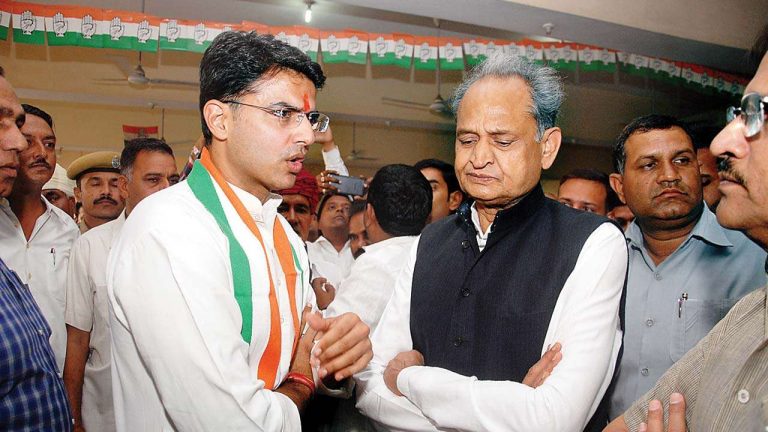
Rajasthan Chief Minister Ashok Gehlot has accepted the resignation letters of all the ministers in his council before the Cabinet Reshuffle which is scheduled to take place tomorrow, according to reports. Three ministers had earlier submitted their resignations on Friday and moved a proposal during a meeting after which all the council ministers have submitted their resignation.
All the ministers have resigned. When it comes to re-formation, the process has now been completed. This is a process. There is a PCC meeting at 2 pm tomorrow, everyone will go there. Further directions to us will be issued there: Pratap Khachariyawas pic.twitter.com/nPhcBiLul9
Pratap Khachariyawas said, “All the ministers have resigned. When it comes to re-formation, the process has now been completed. This is a process. There is a PCC meeting at 2 pm tomorrow, everyone will go there. Further directions to us will be issued there.”
As per reports, ten new ministers would most likely be inducted at the cabinet in a bid to maintain the power balance between Gehlot and Pilot camps. The swearing-in ceremony is expected to take place at the governor’s house at 4pm on Sunday.
The three ministers who had resigned on Friday include state education minister Govind Singh Dotasra, Harish Chaudhary and Raghu Sharma.
Govind Singh Dotasra told ANI, “Keeping the ‘Ek Pad Ek Vyakti’ discipline of the Congress party, we have given our resignations to party president Sonia Gandhi. I will work as a party worker to see that the people in Rajasthan are getting the benefits of the state government’s schemes.”
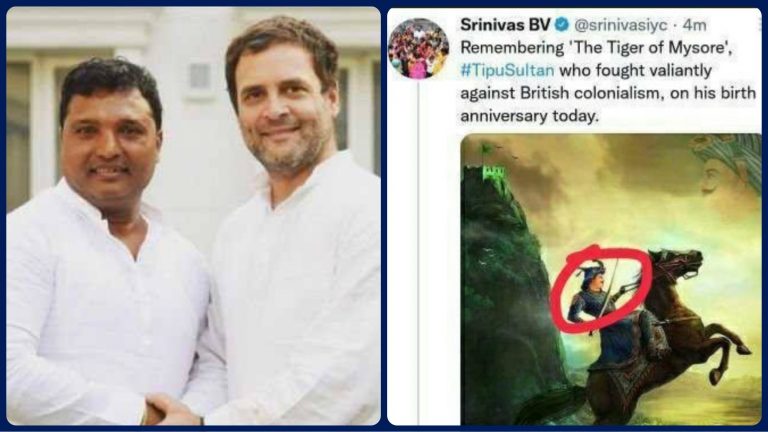
The National President of the Indian Youth Congress Srinivas BV today shared a photoshopped image of Chhatrapati Shivaji Maharaj to wish Tipu Sultan on his birth anniversary.
In a tweet wishing Tipu Jayanti, Srinivas shared a popular picture portraying Chhatrapati Shivaji Maharaj where the Maratha icon is seen sitting atop a rearing horse. Except, the face of Chhatrapati Shivaji Maharaj was morphed with that of Tipu Sultan.
“Remembering ‘The Tiger of Mysore’ #TipuJayanti who fought valiantly against British colonialism, on his birth anniversary today,” Srinivas tweeted along with the photoshopped image.
However, this did not sit well with the admirers of Chhatrapati Shivaji Maharaj, who were furious and appalled by the insult meted out on their hero by attributing his image to the Islamist ruler Tipu Sultan.
Social media users slam Srinivas for sharing a photoshopped image of Chhatrapati Shivaji Maharaj, he quietly deletes it later
Many shared the actual image of the Marathi ruler and slammed the Congress functionary for sharing a distorted image.
After his post garnered criticism, Srinivas quietly deleted the tweet without offering an apology. However, a google search on the topic still showed Srinivas’ treachery.
While the Congress party displays unmatched alacrity in painting Tipu Sultan with a nationalist brush, often crediting him for leading India’s first battle against the Britishers, the rosy legacy of Tipu Sultan as painted by Congress is as corrupted as the photoshopped image of Chhatrapati Shivaji Maharaj shared by IYC president Srinivas BV.
Tipu Sultan was one of the most ruthless Islamic invaders in South India. There have been several recorded instances of Tipu’s army forcefully converting, raping and kidnapping Hindus on his orders. Many temples are recorded to have been demolished under his reign. Historians such as Khan Hussain Ali Kirmani have pointed out that Tipu Sultan had animosity for the local Hindus and tribals in the area.
Bhind police in Madhya Pradesh have registered a case against the e-commerce giant Amazon for the online supply of Marijuana after one week of investigating the two accused arrested in the online marijuana smuggling racket, according to reports.
As per sources, the case has been registered against the tech giant under the section 38 of the NDPS Act. Reportedly, the executive directors of Amazon India too have been booked by the authorities. It is also claimed that 20 packets of the illegal drug was hidden by Amazon during the transit.
Ganja consignment being delivered via Amazon busted in Bhind, Madhya Pradesh | Bhind Police makes e-commerce company Amazon India’s Executive Directors accused in the matter under NDPS Act: Bhind SP Manoj Kumar Singh
The state Home Minister had also said the tech giant is not cooperating with authorities over the matter. Narottam Mishra said, “There are no guidelines for online businesses. We’ll make guidelines for MP. Amazon was called but they’re not cooperating. We will bring them. I appeal to Amazon’s MD-CEO to cooperate or else we’ll initiate action.” Consequently, the police had issued a 20-point notice to Amazon.
Earlier, the Madhya Pradesh police busted an online marijuana smuggling racket and arrested two men in Bhind district in connection to the case. MP police had summoned Amazon Inc’s local executives as investigations revealed that around a tonne of ganja worth Rs 1.10 crores was smuggled through online shopping platform Amazon over the past four months. Amazon’s executives were asked to give an explanation on how their platform could be used for the sale of banned substances by the Bhind district police superintendent, Manoj Kumar Singh.
On November 13, FIR was filed against two accused- Suraj alias Kallu Pavaiya from Morar in Gwalior, and Pintu alias Bijendra Singh Tomar from Bhind district. The FIR was filed after a complaint was lodged against the duo by Ashish Yadav. FIR was lodged under the 29 NDPS Act.
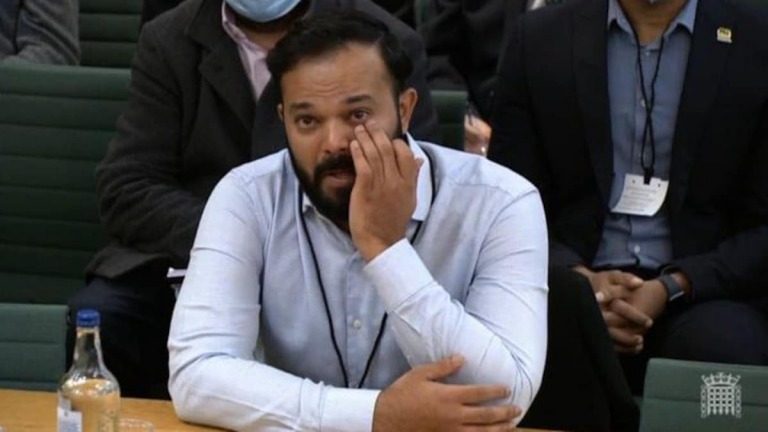
Azeem Rafiq, who is at the center of the racism controversy in Yorkshire cricket, has been accused of sending ‘creepy’ text messages to a woman when she was 16 years old, the Yorkshire Post reported. The woman in question, one Gayathri Ajith, has said that the cricketer of Pakistani origin sent inappropriate texts to her.
Gayathri Ajith was 16 years old when she met Azeem Rafiq but told him she was 17 in order to appear a “bit older”. She said that she agreed to have coke vodka with him on the plane but refused an invite to have dinner with him in Dubai.
Azeem Rafiq sent her texts that read “u know what I wanted to do on the plane?” and “I want to grab you push u up against wall and kiss you”. Ajith responded saying, “do you realise that I’m only 17?” To that, the cricketer responded, “Does tht mean it not allowed to want to kiss me”. Another text said, “Wud u have let me kiss u?”.
Ajith, creeped out, asked him, “How do I know that you’re no some absolute pervert”. She told the Yorkshire Post, “I was just kind of shocked by the crudity of those messages. They were just so vulgar.” She also said that some of the allegations of racism he labeled do not sit right with her.
She said, “If he was being forced to drink by his teammates, then surely that wouldn’t then mean he would be drinking alone on a flight and encouraging a 17-year-old girl to be drinking with him.” “His behaviour towards me was a direct contradiction really of what he said in his testimony,” she added.
Rafiq was accused of “contributing to the problem of the vulgar attitudes towards women”. The allegations by Ajith comes right after the cricketer had to apologise for making anti-Semitic comments on social media in the past.
The cricketer of Pakistani origin had earlier accused Yorkshire Cricket Club of racism. “I know how close I was to committing suicide during my time at Yorkshire. I was living my family’s dream as a professional cricketer, but inside I was dying. I was dreading going to work. I was in pain every day,” he had said in an interview last year.
Rafiq claimed that he regretted doing un-Islamic things in order to fit in. “But as soon as I stopped trying to fit in, I was an outsider. There were no coaches on the staff from a similar background who understood what it was like,” he narrated.
Saudi Arabia is considered the epicentre of the Muslim world. Infamous for its strict enforcement of the Sharia law, gender segregation and restrictions on women, the Arabian nation remains a model of inspiration for Islamic hardliners across the globe. As such, even slight amendments to the regressive practices and baby steps towards modernity draw the wrath of Islamists.
It thus came as no surprise when Islamist outfit Raza Academy ran a social media campaign, urging Saudi Crown Prince Mohammed bin Salman to revoke the decision of opening cinema halls in the city of Medina. The Islamist outfit also held a protest march outside Minara Masjid in Mumbai. The protestors were heard raising slogans of “Saudi Hukumat Murdabad” and holding placards that read, “Saudi Government Must Stop Desecration of The Holy City of Madina Munawwarah.”
Unlike his predecessors, Crown Prince Mohammed bin Salman quickly realised the need of the country to reduce dependency on oil and diversify it to other sectors such as health, education, recreation and tourism. In an interview with CBS News, he said, “(Before 1979) We were living a normal life like the rest of the Gulf countries, women were driving cars, there were movie theatres in Saudi Arabia.”
This begs the question: What happened in 1979 that took Saudi Arabia afar from modernity and into the depths of desert tribalism (something that inspires Islamic fundamentalists across the globe to date)? The answer lies in the Grand Mosque seizure of November 20, 1979. It remains the deadliest terror attack faced by the Saudi Kingdom to date. A large group of radical Islamists, led by a 40-year-old preacher Juhayman al-Otaybi laid siege on one of the holiest sites of the Islamic world – the Masjid Al-Haram.
The motives behind the terror attack
Despite being poorly educated, coupled with a lack of proficiency in classical Arabic, Otaybi had a charismatic effect on his followers. “He was true to his mission, and he gave his whole life to Allah, day and night,” recounted a religious student Mutwali Saleh. Juhayman al-Otaybi founded an association named the ‘al-Jamaa al-Salafiya al-Muhtasiba (JSM)’, which condemned the increasing Westernisation of Saudi Arabia.
Under the leadership of the Saudi royal family (House of Saud) and the increasing oil exports, the Kingdom had become prosperous. JSM members, who lived a life of austerity, dubbed the increased consumerism of Saudi Arabians as ‘degeneration of social and religious values.’ Otaybi was of the belief that the Saudi culture had become corrupt, and ostentatious under the Saudi royal family. He vowed to restore the true legacy of Islam in the Kingdom. He declared a soft-spoken Islamic preacher (later turned brother-in-law) Abdullah al-Qahtan as the ‘Mahdi’ (redeemer of Islam).
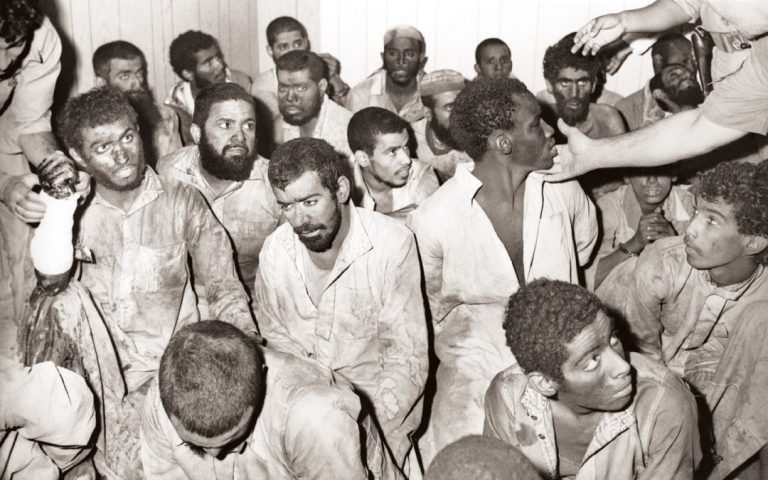
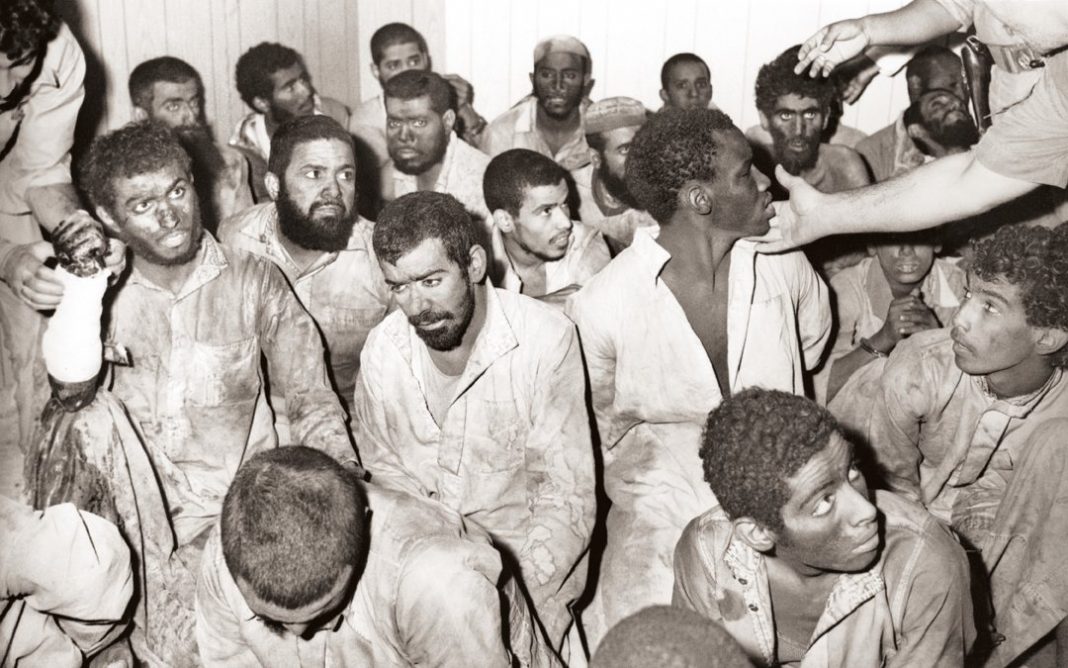
The arrested gunmen (Image Credit: AFP)
In Islamic culture, a Mahdi is one who appears before Judgment day to establish the Kingdom of Allah. Otaybi had military training during his stint with the Saudi National Guard. His plan was to lay siege on the holiest site in the Islamic world and his military experience proved useful. November 20, 1979, was chosen for the execution of his plans as it marked the first day of the year 1400, according to the Islamic calendar. As per Muslim traditions, a person referred to as ‘Mujaddid’ appears at the turn of each century to revive Islam and restore it to its pristine glory.
The Seizure of the Masjd al-Haram and resistance by Saudi Arabia forces
On the fateful day of November 20 that year, about 50000 Muslims from across the globe had gathered in the courtyard near Kaaba for the dawn prayers. The prayers were being led by the Sheikh Mohammed al-Subayil, the then imam of the Masjid al-Haram. Juhayman al-Otaybi and his 200 odd followers were among the gathering. As the prayers ended, the Islamists quickly took control of the microphone and pushed al-Subayil aside.
From the closed coffins kept in the centre of the yard, the extremists took out handguns and rifles. They were quickly distributed among his followers. “Fellow Muslims, we announce today the coming of the Mahdi… who shall reign with justice and fairness on Earth after it has been filled with injustice and oppression,” one of Otaybi’s followers read out a prepared speech. Otaybi directed his men to shut the doors of the mosque and take up sniper positions in the minarets.
”Attention brothers! Ahmad al-Lehebi, go up on the roof. If you see someone resisting at the gates, shoot them!” he directed. The worshippers were stunned at the sight of armed gunmen in the mosque. Within a span of an hour, Juhayman al-Otaybi took complete control of the Grand Mosque. Given the absence of Crown Prince Fahd bin Abdulaziz al-Saud and National Guard head Prince Abdullah who were on a visit to Tunisia and Morocco respectively, King Khalid and Defence Minister Prince Sultan initiated the counter-response.
First, the Saudi police sent patrol cars to the mosque to understand the gravity of the situation. On being bombarded with bullets, the Saudi National Guard was called in to take back control of the mosque. It became clear to the Saudi authorities that the seizure of the Grand Mosque was well-planned. In response, special troops, paratroopers and armoured vehicles were dispatched to free the hostages. The Saudi military launched frontal assault but Otaybi and his men continued to put up resistance.
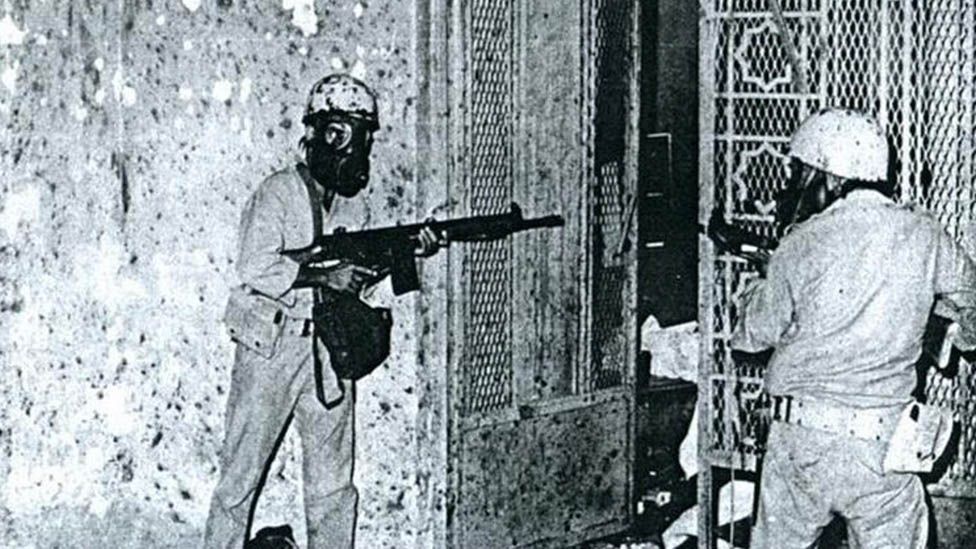
Saudi forces respond to the offensive carried out by the Islamists, image via BBC/Alamy
A heavy cloud of smoke was generated by the Islamists by setting carpet and rubber tires on fire. They took refuge behind columns and occasionally came out to ambush the Saudi forces. Major Mohammad al-Nufai recounted, “This was a man-to-man confrontation, within a limited space. A combat situation with bullets whizzing by, left and right – it’s something unbelievable.” The mosque had turned into a ‘killing zone.’ The Mahdi aka Abdullah al-Qahtan believed that he was invincible. His overconfidence led to his eventual doom when he was killed in the gunfire.
To keep the morale of his men high, Juhayman al-Otaybi misled them into believing that the Mahdi was alive. “The smells surrounded us from the dead or the injuries that had rotted. In the beginning, water was available, but later on they started to ration supplies. Then the dates ran out so they started eating balls of raw dough… It was a terrifying atmosphere. It was like you were in a horror movie,” a witness recounted. It was finally on the 6th day that the Saudi forces gained control of the mosque’s courtyard.
The French intervention and execution of the Islamists
The Islamists took shelter into the cells underneath the mosque and it was becoming difficult to remove Otaybi and his men from the Grand Mosque. King Khalid of Saudi Arabia reached out to French President Valéry Giscard d’Estaing. After realising that the homegrown conflict in the Kingdom could impact oil exports in the world, Estaing dispatched three advisers from France’s counter-terrorism unit (GIGN) to Saudi Arabia.
“Our ambassador told me that it was obvious the Saudi forces were very disorganised and didn’t know how to react. It seemed to me to be dangerous, because of the weakness of the system, its unpreparedness and the repercussions this could have on the global oil market,” the French President told the BBC. The French military advisers took shelter at a hotel in Taif town. They recommended the use of gas canisters to make air unbreathable in basements, where Otaybi and his men were hiding.
“Holes were dug every 50m in order to reach the basement. Gas was injected through these holes. The gas was dispersed with the help of grenade explosions into every corner where the rebels were hiding,” informed French Capt Paul Barril, who headed the mission.” Otaybi and his men soon ran out of food and ammunition. With the constant dispatch of smoke bombs, the Islamist, who set out to free Saudi Arabia of moral corruptness, surrendered with 63 other men.
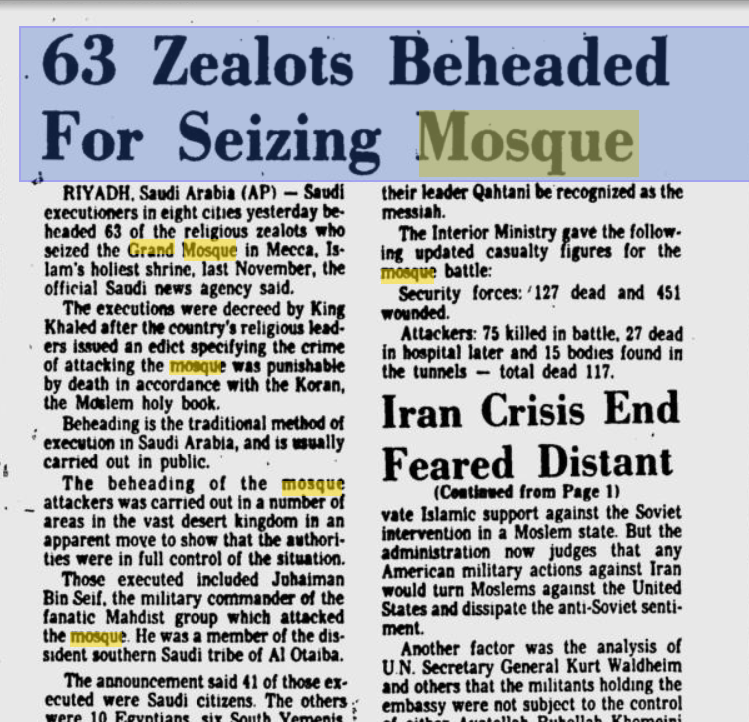
Pittsburg Post- Gazette newspaper report about the execution of the Islamic terrorists
The seizure came to an end on December 4, 1979. 117 of Otaybi’s men were killed in the gunfight while 63 were executed by the Saudi government. Juhayman al-Otaybi was one of the first Islamists to be publicly beheaded. Reportedly, the beheading was carried out in 8 Saudi Arabian cities of Mecca, Medina, Riyadh, Buraidah, Dammam, Abha, Ha’il and Tabuk.
Cultural implications on Saudi Arabia after the Grand Mosque Seizure
One of the direct consequences of the terror attack was the giant leap of the Kingdom towards religious dogmatism and archaic mindset. Having fully realised the potential of future attacks against the monarchy, King Khalid bin Abdulaziz Al Saud took refuge of Islamism. After the Grand Mosque seizure of 1979, Saudi Arabia rebranded itself as the Guardian of Islam and defenders of Faith. King Khalid took measures to listen to the grievances of the clerics.
Reportedly, the Kingdom renewed ties with Wahabi clerics and appointed them to important positions in education, judiciary and religious guidance. The House of Saud also made efforts to globally propagate the tenets of Wahabism and gave into to the demands of the Ulemas against increasing modernisation of the Kingdom. In that way, King Khalid was able to nullify domestic criticism of the monarchy.
Prior to the seizure, there were talks about increasing women’s freedom, right to participate in public life, and education. All of that ended with the strict adherence to 7th century Sharia law. In hindsight, Juhayman al-Otaybi was successful in making the Kingdom adopt his regressive ideas about life. The Islamists had set out to restore the pristine purity of Islam, something which was made possible by banning public concerts, movie theatres, enforcing strict dress codes on women.
According to Nasser al-Huzaimi, all measures towards achieving modernisation came to a halt after the cease. He recounted, “Let me give you a simple example. One of the things he demanded from the Saudi government was the removal of female presenters from TV. After the Haram incident, no female presenter appeared on TV again.” The Grand Mosque seizure also inspired the likes of slain Al-Qaeda terrorist Osama bin Laden, who went on to execute the 9/11 attacks in 2001.
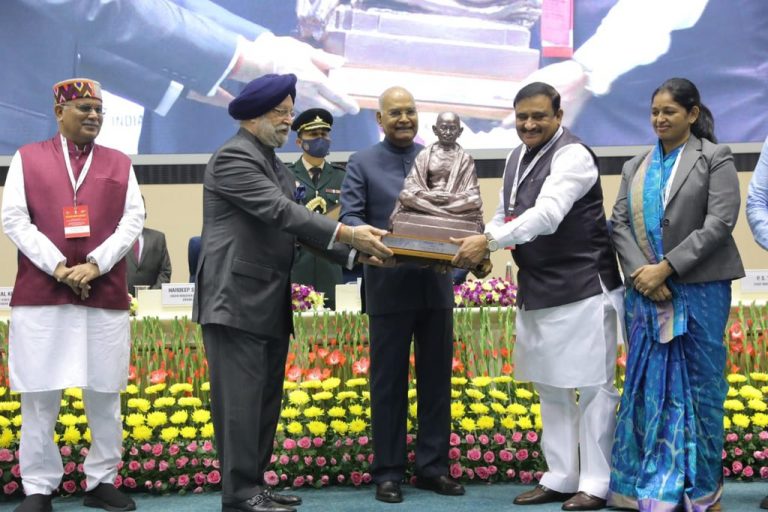
Indore in Madhya Pradesh bagged India’s cleanest city award for the fifth consecutive term as the results of the Swachh Survekshan 2021 were declared by President Ram Nath Kovind. In the 10 top-ranked cleanest cities having a population of more than one million, Indore is followed by Surat, Vijaywada, Navi Mumbai, New Delhi, Ambikapur, Tirupati, Pune, Noida and Ujjain.
Under the Swachh Bharat Abhiyan (Clean India Mission) that was launched in 2014, the central government carries the cleanliness survey to promote sanitation in urban centres. According to the Ministry of Housing and Urban Affairs, the result was decided on the basis of 28 days long nationwide cleanliness survey covering 4,320 cities and feedback was taken from 4.2 core people.
The President applauded the local administration and municipal body of Indore. “This year Indore city has secured the first position for the fifth time in a row. It is commendable to get the first position in the whole country, it is even more commendable to maintain that position continuously,” the President said during thre award ceremony in his address.
इस वर्ष इंदौर शहर ने लगातार पाँचवी बार प्रथम स्थान प्राप्त किया है। पूरे देश में प्रथम स्थान प्राप्त करना तो सराहनीय है ही, उस स्थान को निरंतर बनाए रखना उससे भी अधिक प्रशंसनीय है। pic.twitter.com/lOcWT1x5WZ
While Madhya Pradesh Chief Minister Shivraj Singh Chouhan expressed gratitude on behalf of people as Indore was adjudged the cleanest city, the employees of Indore Municipal Corporation celebrated since their dedication has yielded results.
#WATCH | Employees of Indore Municipal Corporation celebrate after President Ram Nath Kovind conferred the cleanest city award to Indore, at Swachh Survekshan Awards 2021 today
Varanasi, the parliamentary constituency of Prime Minister Narendra Modi has been declared the “cleanest Ganga town” followed by Munger and Patna of Bihar ranked second and third respectively in this category.
In the category of smaller cities with a population between 1-10 lakh, New Delhi has ranked the first position whereas Ambikapur (Chhattisgarh) and Tirupati (Andhra Pradesh) came second and third.
Among the cities having less than one lakh population, Vita city in Sangli district of Maharashtra has secured the cleanest city award followed by Lonavala and Sasvad. Under the cantonment board category, Ahmedabad got the first rank followed by Meerut and Delhi.
In the State awards, Chhattisgarh, for the third consecutive year emerged as the ‘Cleanest State’ in the category of “more than 100 Urban Local Bodies” while Jharkhand, for the second time, won the Cleanest State award in the “less than 100 ULBs category”. Karnataka and Mizoram became the ‘Fastest Mover States’ in the big (more than 100 ULBs) and small (less than 100 ULBs) state category respectively.
Swachh Bharat Abhiyan a gamechanger
On 2nd October 2014, Swachh Bharat Mission was launched as a national movement. The campaign aims to achieve the vision of a ‘Clean India’ by 2nd October 2019. The Swachh Bharat Abhiyan is the most significant cleanliness campaign is one of the important projects launched by the Narendra Modi government.
The first survey was conducted in 2016, ranking 73 cities (urban local bodies). But in the same year, the government conducted the second survey in 434 cities to expand its base. In the Swachh Survekshan survey held in 2018, a total of 4,203 cities were included. In 2019 a total of 4,237 cities were covered for the survey. This will further boost the vision of a Garbage-Free India of Modi.
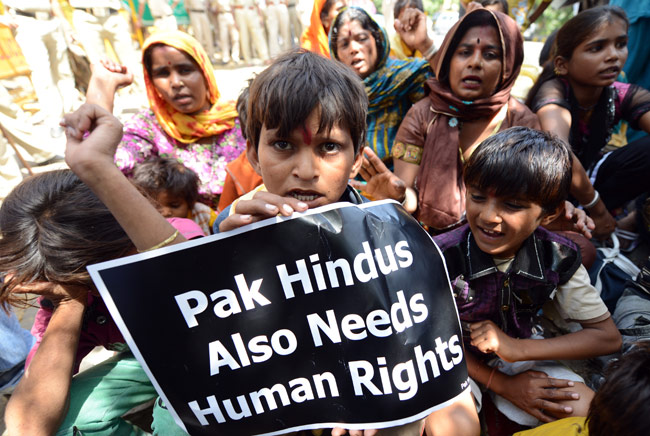
The Hindu refugee families who came from Pakistan’s Sindh province a few years ago and settled in the floodplains near Majnu ka Tila gurdwara, due to the continuous persecution they faced in the neighbouring country, are now facing the threat of religious conversion by Christian missionary organisations active in the refugee camp.
According to the news website News India 24X7, Christian missionaries are targeting the uneducated and gullible Hindu refugees and trying to convert them by offering them food and other basic facilities.
The residents believe that the Christian missionaries are working in and around the camp are gathering information on the Hindu immigrants in order to convert as many as possible.
A Hindu refugee named Urmila Rani, residing at the Majnu Ka Tila camp stated clearly that the camp has been subjected to a conversion racket for some time. She revealed how three people had already fallen into the trap laid by the Christian missionaries. She claimed that they were initially successful in preventing missionary organisations from entering the camp, but that subsequently, the same persons returned in the name of new institutions.
Priests affiliated with the temple also claim that these impoverished Pakistani Hindus are under a lot of pressure to convert. Going against these missionaries entails creating trouble for one’s own survival.
The report by News India 24X7 also suggests that these Hindu refugees families at Manju ka Tila camp are not even allowed to celebrate Hindu festivals. The Christian missionaries active in the camp, forbid them from organising functions like Ram Leela during the Hindu festival of Dussehra. However, they compel the Hindu refugees to celebrate Christmas. Poverty and the miserable conditions they are having to live in leave them with no option but to surrender to the demands put forth by these Christian missionaries.
The media report further claimed that thumb impressions were being taken as a method to collect data for conversion activity. This information, the report says, was given by the refugees to the reporter. The logo on one of the thumb impression sheets showed the logo of HAI.
Hi Mr Mishra, I watched your video completely which was brought to my notice. I am approaching you to seek explanation as you have constantly used logo of our organisation. I am attaching the screenshot: pic.twitter.com/lmNHnnhfSz
The founder of HAI, Sudhanshu S Singh took to Twitter to clarify that thumb impressions are taken after humanitarian aid is handed over to the refugees.
7. Simultaneously, they put their sign/thumb impression in the record maintained by us, for cross verification.
Yes, all the women are illiterate. Did you find out who is teaching them? Do you know who is ensuring that every child goes to school?
This is done to maintain transparency and maintain records of the supplies being given to them. He also said that each family has a passbook and whenever they receive any support from HAI, an entry is made in the passbook.
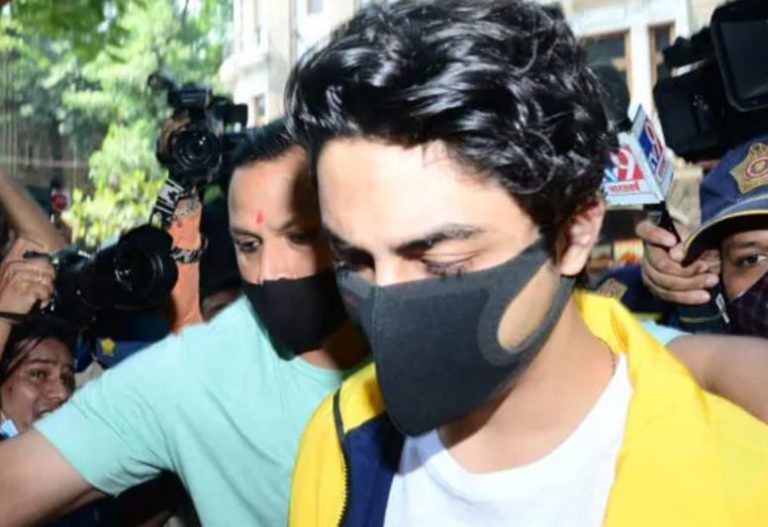
The Bombay High Court on Saturday released the detailed 14-page bail order of Bollywood actor Shahrukh Khan’s son Aryan Khan, his friends Arbaaz Merchant and Munmun Dhamecha who was arrested on October 2 following a raid conducted by the Narcotics Control Bureau (NCB) on a Mumbai cruise.
In the order, the Bombay HC noted that Aryan Khan was “not found in possession of any objectionable substance” and that no evidence of conspiracy was found between Aryan Khan, Arbaaz Merchant and Munmun Dhamecha, the other accused in the case.
According to the court, a review of WhatsApp chats taken from Aryan Khan’s phone reveals that nothing objectionable was found to suggest that he, Merchant, and Dhamecha, along with other accused, plotted to commit the crime in question.
“After having gone through the WhatsApp chats extracted from Applicant/Accused no. 1’s [Aryan Khan] phone, nothing objectionable could be noticed to suggest that applicant nos. 1 & 2 [Arbaaz and Munmun Dhamecha] or all three applicants along with other accused persons in the agreement have a meeting of minds and have hatched conspiracy committing the offence in question,” the court order read.
We had reported earlier on how Anil Singh, representing NCB, referred to a sensitive Whatsapp chat of Aryan Khan and hinted at the involvement of foreign nationals regarding bulk procurement of hard drugs.
Merely because Aryan Khan, Arbaaz Merchant and Munmun Dhamecha were travelling in the same cruise, that by itself cannot be a foundation for the charge of conspiracy against them : Bombay High Court.#NCB#NDPS#AryanKhanBail#SameerWankhede
Merely because Aryan Khan, Arbaaz Merchant, and Munmun Dhamecha were travelling in the same cruise, that by itself cannot be a foundation for the charge of conspiracy against them,” the court said explaining the rationale behind granting bail to Khan and others.
Aryan Khan, Arbaaz Merchant and Munmun Dhamecha were not even subjected to medical examination so as to determine whether, at the relevant time, they had consumed drugs, observed Bombay High Court in the bail order.
Regarding NCB’s argument that the accused had admitted committing the crime, the Bombay HC observed that the agency cannot rely on the alleged confessional statements recorded by the investigating officer as it is not binding. “However, in view of submissions made by Mr Singh, [NCB’s lawyer] it is worth to clarify here that such confessional statements can be considered by the investigating agency only for the investigation purpose and cannot be used as a tool for drawing an inference that applicants have committed an offence under the NDPS Act as has been alleged against them,” said the court.
“…it is difficult to infer that applicants are involved in an offence of commercial quantity [of drugs]. As such, parameters laid down under Section 37 of the NDPS act will be of hardly any consequence while considering the prayer for grant of bail of the applicants,” Justice Nitin Sambre concluded a saying.
Aryan Khan arrested in the drug bust case
The Narcotics Control Bureau (NCB) apprehended Aryan Khan, son of Bollywood superstar Shah Rukh Khan, on October 2, 2021, after raiding a cruise ship en route to Goa from Mumbai.
He was arrested for violating the Narcotic Drugs and Psychotropic Substances (NDPS) Act’s Sections 8(c), 20(b), 27, 28, 29, and 35 after NCB alleged that it has seized 13 grams of cocaine, 5 grams of mephedrone MD, 21 gram charas and 22 pills of MDMA ecstasy.
Aryan Khan’s bail was delayed as Mumbai’s Special NDPS Court had on Wednesday, October 20 rejected his bail plea in connection with the high-profile Mumbai Cruise drug bust case.
On the same day NDPS Court rejected Aryan Khan’s bail plea, his lawyers moved Bombay High Court seeking an urgent hearing in the case. The court, in turn, had agreed to hear the case on October 26.
A battery of India’s top lawyers including former attorney general for India Mukul Rohatgi, Karanjawala & Co. team and eminent lawyer Satish Maneshinde and his team had steered the bail proceedings in the Bombay HC on October 28. Finally, Bombay HC granted bail, however, imposing 14 stringent bail conditions on him.
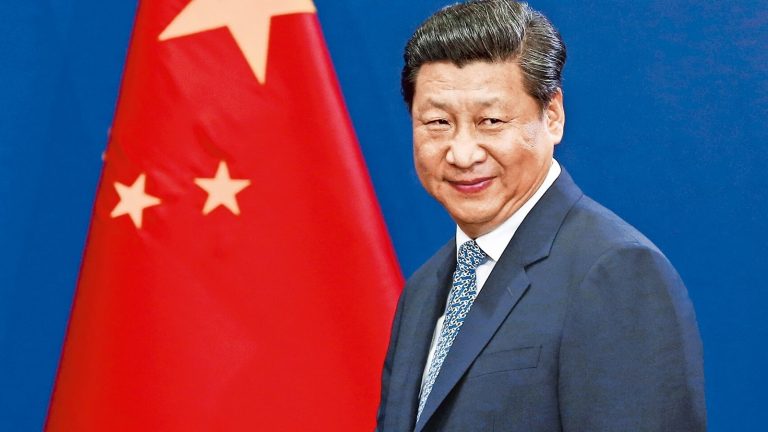
Not just Muslim Uighurs, Kaifeng Jews in the Henan province of China face systematic suppression from the Kaifeng authorities and denial of basic rights ahead of the upcoming Jewish festival Hanukkah, according to reports. Last year, while China blamed the US for religious intolerance during a United Nations panel on human rights, the Chinese authorities have quietly removed the remnants of a 12th-century synagogue in Kaifeng and put pictures of Chinese President Xi Jinping in the place of Kaifeng’s Jewish heritage in a local museum.
Kaifeng is situated along the southern banks of the Yellow River and lies southwest of Beijing. It has been home to Jews who have migrated to the place around the 7th or 8th century CE or even earlier. Most of the Jews from the Kaifeng community have assimilated with the Chinese community over the years because of inter-marriages with the local Chinese population with a small part of the existing Kaifeng Jews shrugged off by the Chinese as Han Chinese.
Notably, China recognizes only five religions in the country including Buddhism, Catholicism, Daoism, Islam and Protestantism which are highly regulated. The Kaifeng Jews who numbered around 1000, with only 1 out of 100 practising the religion have been severely restricted. Apparently, the crackdown started one year after Xi Jinping had declared a revolutionary era for the Chinese citizens in February 2018 as per reports. Government agents have allegedly destroyed a metal Star of David from the entryway and scrapped Hebrew scriptural quotations from the walls. A well that had served as a Jewish mikveh (ritual bath) was filled up with dirt and stones with all foreign plans to organize Jewish Community support of Kaifeng cancelled.
In 2019 US Sen. Tom Cotton at the Hudson Institute in Washington DC said, “The Chinese government is spending tens of billions on facial recognition software, electronic spying, and coercive DNA collection, to create a database capable of tracking a person’s every move. This is the definition of a totalitarian system – one that exercises total control of your person, down to the very strands of your DNA.”
Last year, one man from Kaifeng under the assumed name of Amir told the Telegraph, “Every time we celebrate, we are scared,” adding, “Whatever we do, we’re always very careful to make sure the authorities don’t find out.” Another man said, “It’s government policy. China doesn’t want to recognize us as Jews,” noting “Their goal is to make sure the next generation doesn’t have any Jewish identity.”
However, then, the Chinese Ministry of Foreign Affairs denied such allegations in a written response to the Telegraph. As per reports, even though persecuted Jews could return to Israel, the Kaifeng Jews do not satisfy the official criteria needed under the country’s Law of Return with additional financial troubles.
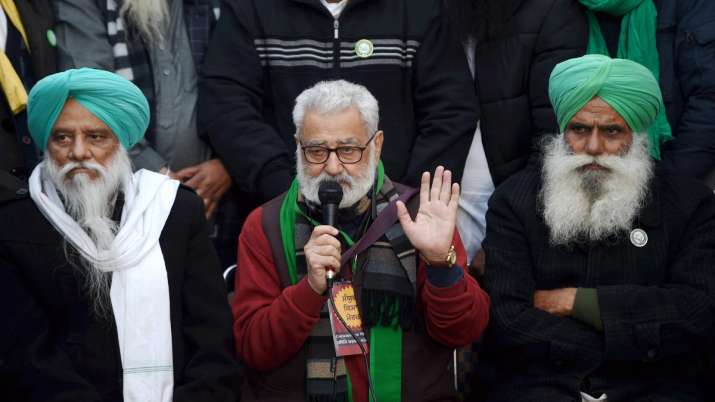
Darshan Pal Singh, leader of the Krantikari Kisan Union, that the ‘farmer’ agitation will continue even after Prime Minister Narendra Modi announced that the farm laws will be repealed. Darshan Pal Singh said that the programs planned for the 22nd, 25th and 29th of November will be conducted as per schedule.
Our programs for 22nd, 26th & 29th Nov will continue as usual. Lucknow rally on 22nd, a gathering on 26th when one yr (of farmers' agitation) will be marked across the nation & tractor march (to Parliament) on 29. Agitation will continue: Darshan Pal Singh, Krantikari Kisan Union pic.twitter.com/GnUG7Mq8hC
The planned tractor march to the Parliament will also continue as per schedule. The agitation will now move on to issues such as MSP, withdrawal of cases and the withdrawal of Power Bill 2020 and Air Quality Ordinance.
Our issues besides farm laws, especially MSP, withdrawal of cases against us, rollback of Power Bill 2020 & Air Quality Ordinance, & allotment of a location for a memorial for our friends who died, are pending. We hope Govt calls a meeting to resolve the issues: Darshan Pal Singh pic.twitter.com/qiPtyeEU9v
Earlier, Rakesh Tikait had asserted that the protests will continue even after the announcement by the Prime Minister. “The farmers’ protest will not stop immediately, we will wait till the day when agricultural laws are repealed in Parliament. Besides MSP, the Centre should also discuss other issues with the farmers,” he had said on social media.
PM Modi, addressing the nation, had said that by the end of this month, the government would complete the process of repealing the three farm laws. He then appealed to the protesting farmers and middlemen to return to their homes on Gurupurab and stop their protest.