Home Blog Page 3769

Odisha: Groom absconds on wedding day, bride stages Dharna outside his house, threatens suicide

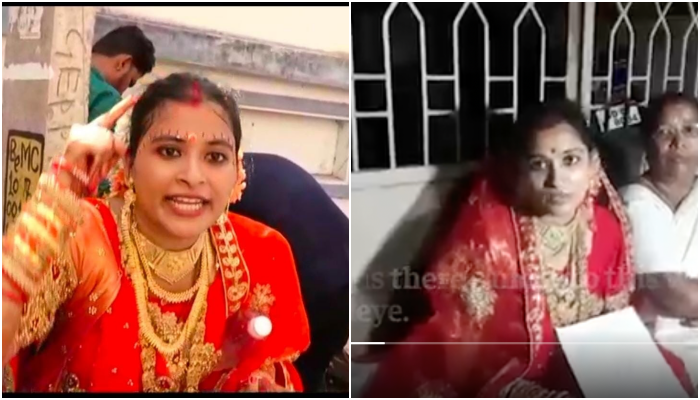
In Odisha’s Berhampur city, a family drama has unfolded in strange ways. A bride who was ditched by the groom on her wedding day has sat in protest outside the groom’s house, threatening that if her husband doesn’t take her to his home, she will commit suicide.

As per reports, a man named Sumit Sahu was scheduled to marry a woman named Dimple Dash as per traditional Hindu customs on Monday, November 22, at Berhampur’s Brahmanagar area. However, for some reason, Sahu did not turn up at the venue. Enraged by the betrayal, the bride has been staging a dharna outside the groom’s house.

Couple already legally married, traditional wedding was to happen

It is notable here that Sumit and Dimple are reportedly already married legally and their marriage has been registered. However, they were supposed to get married as per Hindu customs on Monday when Sumit dramatically absconded. Reports say that there has been some dispute between the couple and the families and local marriage counsellors have been involved too.

Dimple has stated that the groom’s family has bribed the counsellors as they did not want Sumit to go ahead with the wedding. Threatening to commit suicide, she has been camping outside the groom’s house.

Dimple has stated that she and her husband have been married legally for over a year, and had been in a relationship for three years. She has added that she has all the documentary proof of her marriage and it is Sumit’s family that is preventing them from being together saying that he is a doctor and he should stay away from the wedding.

As per reports, Sumit and Dimple’s marriage was registered under the Special Marriage Act (1954), on September 7, 2020.

The police stated that the couple had a marital discord going on and there is a case registered under 498A regarding the issue. The groom’s family has also filed a case and both matters are currently sub judice. Police clarified that there is nothing much they can do in the case since the matter is already sub judice. “We have to act as per court order,” said Berhampur SP.

Kevin Spacey to pay ‘House of Cards’ studio over 30 million dollars after breach of contract due to sexual harassment allegations

0

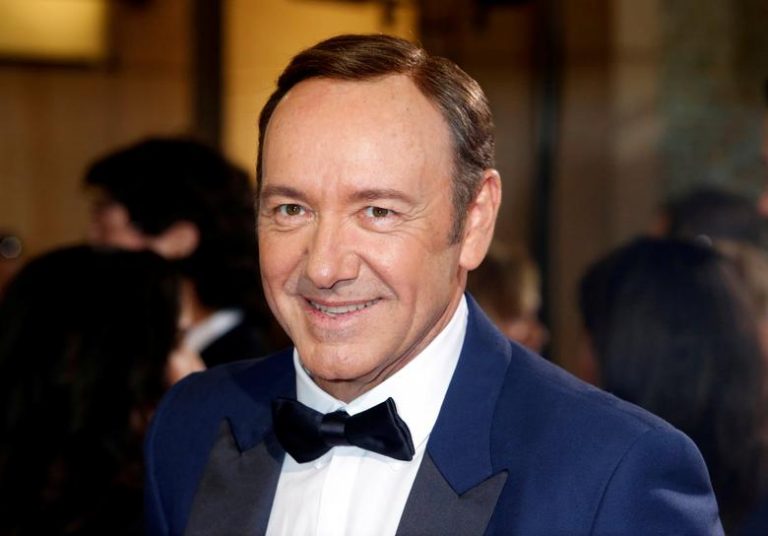
US Actor of the hit Netflix show House of Cards, Kevin Spacey, has been ordered to pay $31m (£23.2m) to the owners of the studio following breach of contract after several allegations of sexual abuse were levelled against the actor. The order was made public on Monday after a court petition was filed for the same by MRC studio.

A document from the Los Angeles court submitted for the Judge’s approval said the actor had violated terms of his contract by involving in “certain conduct in connection with several crew members in each of the five seasons that he starred in and executive produced House of Cards”. The court’s ruling was made last year.

Kevin Spacey had faced a series of allegations after 2017. He was one of the first actors in Hollywood to be publicly accused of misconduct during the Harvey Weinstein Scandal and the #MeToo movement. The actor was removed from the Netflix show amidst allegations while Netflix and MRC had to rewrite the Show script, halt the production of the sixth season and then shorten the season to 8 episodes from the previous 13 episodes.

MRC said in its statement, “The safety of our employees, sets and work environments is of paramount importance to MRC and why we set out to push for accountability.” The studio had said that it had lost millions of dollars because of the actor’s misconduct and breach of the contract as the final show was already under development.

Plaintiff attorney Michael Kump noted, “MRC stood its ground, pursued this case doggedly, and obtained the right result in the end.” 

Notably, Kevin Spacey was accused of making sexual advances towards actor Anthony Rapp in 1986 when Mr Rapp was 14. Spacey said in his statement that he did not remember anything about the incident but apologized. Independent investigations revealed several cases of harassment of people working under him. Spacey had lost many of his acting roles and projects after the allegations including the popular Netflix show House of Cards where he played the role of Frank Underwood, a congressman who wanted to become President.

Delhi: How Hindus in Kalindi Kunj are harassed by their Muslim neighbours, threatened with dire consequences for performing Hindu rituals

On October 19, one Muslim youth named Danish and his friends had stormed into a Hindu family’s home in Madanpur Khadar in Kalindi Kunj in Delhi and threatened them with dire consequences if they did not stop performing pooja. According to the complaint filed by Shanti Pathak, her daughter Natasha was doing the aarti when Danish and his associates barged into their house and threatened to kill the entire family and break the idol kept in the house if they dared to blow the conch and ring the bell.

It was reported that despite the fact that Shanti Pathak filed a complaint with the Kalindi Kunj police, the latter did not file an FIR in the case.

Hindu victim family completely satisfied with Delhi police’s action

OpIndia got in touch with Roshan Pathak, Shanti Pathak’s husband, to learn more about the matter. He claimed that both Danish and he were summoned to the police station following the event.

He added that Danish had been warned by the police not to repeat the incident. With this, both parties signed a consent document, which was deposited in the office of then-ACP Bijender Singh. As a result, FIR was not registered. The Pathak family, however, was not given a copy of the consent document.

When asked how the Delhi Police handled his case, Roshan stated that he was completely satisfied with their actions. His family was content with the actions of ACP Bijender Singh and SHO Inspector Bhushan Kumar. He stated that his family is not under any fear or pressure at the moment.

He claims that the police respond quickly to their calls and offer all sorts of assistance and support. Roshan stated that since the police intervened, they are being able to worship freely and neither Danish nor anybody else in the colony has tried to bully them.

According to Roshan Pathak, Hindu organizations like Bajrang Dal had provided complete assistance and support to his family at the time of duress.

Natasha Pathak, Roshan Pathak’s daughter, told us that the police had also given her the numbers of their officers in case of any need. She too confirmed that Danish did not dare to create any ruckus after the October 19th incident.

They who threaten us against blowing conch themselves play loudspeakers in full volume: Delhi victim reveals

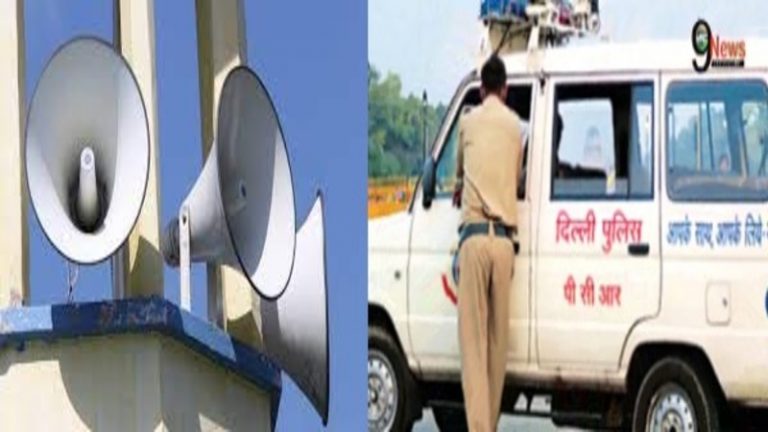
Natasha, however, bemoaned the growing presence of Muslims in her neighbourhood, recalling how, 4-5 days ago, a resident named Mohammad Shafi and his wife Gulab Jahan began playing the loudspeaker in full volume in their locality. She said that they were requested to turn down the volume but to no avail. The resident gave a written complaint to the Kalindi Kunj police in Delhi. Only when the SHO arrived in their locality, did the Muslim family stop playing the loudspeaker, said Natasha.

Speaking to OpIndia, Bhushan, the SHO of the Kalindi Kunj police station, stated that the victim family’s concerns have been settled and law and order have been restored in the locality. He said that since the issue was resolved amicably by both parties, the police did not find the need to register an FIR in the case.

Roshan Pathak, a native of Siliguri, West Bengal, has been living in Madanpur Khadar for over two decades. He has one daughter and two sons. Roshan drives an electric rickshaw for a living.

Muslims getting freehand due to political leaders like AAP MLA Amanatullah Khan

According to Roshan Pathak, there were once very few Muslims in his neighbourhood, but now they are the majority. Due to incidents like the one that transpired with his family, many Hindu families have migrated from the locality and settled elsewhere. He, however, said that his family would not flee.

Roshan said that people like Danish have been emboldened to terrorize and harass Hindus in the area with the assistance of their families and encouragement from political leaders like the Aam Aadmi Party MLA Amanatullah Khan.

It may be noted that after the incident Shanti Pathak had revealed that this wasn’t the first time Danish and his associates had threatened them. She said that his threats and menacing had grown more brazen and serious with time.

She has rued that earlier they were able to perform pooja in the house, but since the number of Muslims in the area started increasing, they started posing threats to her family. In her complaint filed in the Kalindi Kunj police station, Shanti had written: “These people have fought with us two-three times in the past too. They have also threatened to kill my elder son.”

She had revealed how Danish had not only threatened to kill the entire family but had also warned of breaking the idol kept in the house if they dared to blow the conch and ring the bell. She also said that on the day of the incident, Danish had gathered many Muslims from the locality in order to intimidate her family.

Danish, on the other hand, told the police that his sleep use to get interrupted due to the sound of the conch and bells coming from Roshan and Shanti Pathak’s home, prompting him to do what he did.

Uttar Pradesh to become only state in India with five international airports after PM Modi lays foundation stone of the Noida International Airport

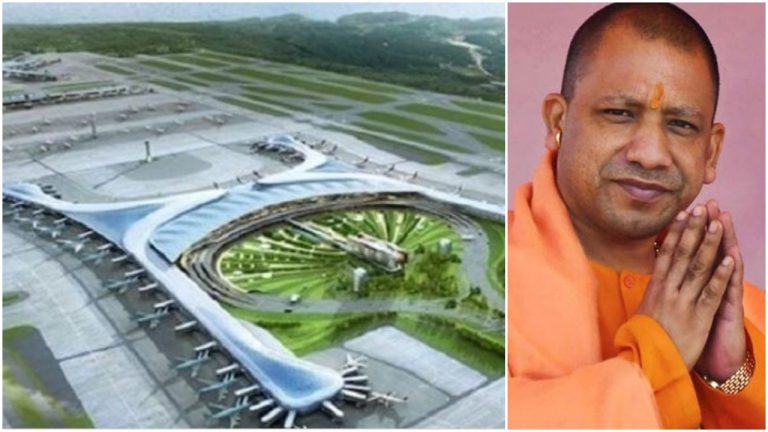
After recently inaugurating the 340.82-km-long Purvanchal Expressway in Uttar Pradesh, Prime Minister Narendra Modi will be laying the foundation stone of the Noida International Airport (NIA) in Jewar, Gautam Buddha Nagar, Uttar Pradesh on Thursday, 25 November 2021, making Uttar Pradesh the only state in India to have five international airports. 

A statement released by the Uttar Pradesh state administration said on Monday: “With the groundbreaking and foundation laying ceremony of the Noida International Airport scheduled on November 25, the state is now on its way to have five international airports – the highest for any state in India,” the BJP-led state government said in a statement. “The Prime Minister’s Gati Shakti National Master Plan has infused a sense of urgency into the plans for infrastructure development in the state,” the statement said. 

On October 20, Prime Minister Modi had inaugurated the Kushinagar Airport in Uttar Pradesh, the state’s third international airport. Besides, the state has two operational international airports in Lucknow and Varanasi. With the Ayodhya Airport scheduled to open in 2022 and the Noida Airport in 2024, Uttar Pradesh will become the only state in India with five international airports.

Uttar Pradesh currently has eight operational airports, while another 13 airports and seven airstrips are in the works.

Noida International Airport (NIA) will make Uttar Pradesh the only state to house 5 international airports

Projected as India’s largest airport after its completion, NIA (Noida International Airport) is located about 72 kilometres from the existing IGI airport in New Delhi, 40 km from Noida and about 40 km from the multi-modal logistics hub at Dadri. 

The airport will be built and operated by the Switzerland-based Zurich Airport International AG.

Source: India TV

According to reports, the work on the first phase of the Noida airport is expected to be completed by 2024 at a cost of around Rs 10,050 crore. The finished first phase of the airport, which spans over 1300 hectares of land, will be able to service roughly 1.2 million passengers per year.

The airport will increase in each phase to service 70 million passengers by the end of phase 4, depending on passenger growth and traffic. Besides that, the complex will include an airport hotel, a VVIP terminal, an open-access fuel farm, airport rescue and firefighting structure, and a large rain harvesting pond.

The Jewar airport is projected to come up as a big civil aviation hub with four helipads and five runways.

The NIA will have multi-modal connectivity as it is close to the existing Yamuna Expressway (Greater Noida to Agra), close to Eastern Peripheral Expressway and it will have a link with Delhi-Mumbai Expressway at Ballabhgarh, Khurja-Jewar NH 91, link to dedicated freight corridor, Metro Extension from Noida to NIA and link with the proposed High-Speed Rail (Delhi-Varanasi) at the airport terminal.

This airport will be India’s first net-zero emissions airport. It has set aside space to be created as a forest park with trees harvested from the project site. NIA will protect all native species and be environmentally conscious throughout the airport’s construction.

The airport will be the logistics gateway of northern India. Due to its scale and capacity, the airport will be a game-changer for Uttar Pradesh.

For the first time, an airport in India is being conceptualised with an integrated multi-modal cargo hub, with a focus on reducing total cost and time for logistics.

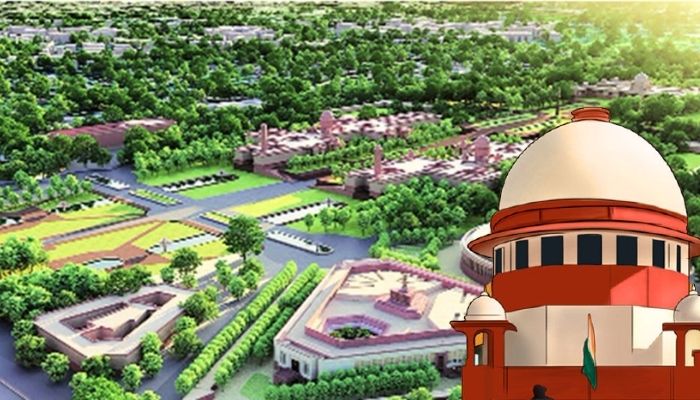
Central Vista project: Supreme Court rejects plea which sought to stall construction of new residences for PM, VP

On Monday (November 22), the Supreme Court of India rejected a petition that sought to challenge the change in land use on a plot in the Central Vista area.

The petitioner named Rajeev Suri had alleged that the said plot of land was a recreational area, which is to be used for constructing the new residences of the Prime Minister and Vice-President as part of the Central Vista Project. He claimed that the change in land use, as directed by the Union of India, violated Article 21 (Protection of life and personal liberty). Suri added that the notification denied recreational opportunities to children and Delhi residents to access green and open spaces in the Central Vista area.

“Respondent No. 1 (Union of India) malafidely issued Notification S.O. 3848 (E) dated 28.10.2020 notifying the change in land use, which will deprive residents of Delhi and citizens of India a vast chunk of highly treasured open and green space in the Central Vista area available for social and recreational activity, stands against Article 21, Right to Life the right to enjoyment of a wholesome life,” the petition read.

Rajeev Suri also claimed, “The Central Vista is the most cherished open space in New Delhi and perhaps India, a symbol of their nationhood, and the publicness of this cherished open spaces land is being compromised which is a great betrayal of the Public Trust Doctrine.” He had originally filed the petition, seeking quashing of notification allowing change in land use, in March last year. It was rejected by the court on August 28, 2020.

Supreme Court rejects plea with 2:1 majority vote

However, the apex Court had asked the petitioner to approach it when a final decision on the matter would be taken. The fresh petition was heard by a 3-Judge Bench, comprising of Justices AM Khanwilkar, Dinesh Maheshwari and CT Ravikumar. The Court stated, “Petitioner has not argued that change in land use is in a malafide manner. It is the argument of the petitioner that since in the past it was a recreational area it should have been retained like that. This cannot be the scope of judicial review. It is for the authority concerned and is a matter of public policy.”

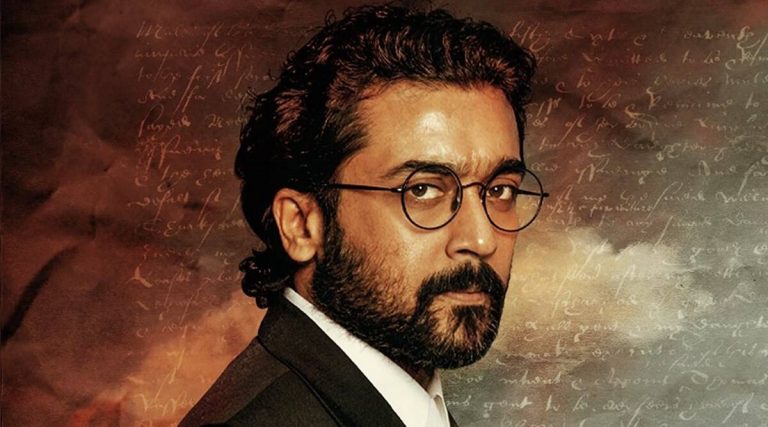
Does Amazon-Prime’s new Tamil film deserve the backlash? The ‘Jai Bhim’ controversy

The Kollywood flick ‘Jai Bhim’ (a legal drama), a new kid in the block. The film was launched on Amazon Prime Video (OTT platform) on November 2nd, just in time for Diwali, and received rave reviews. So what is the film ultimately about? The film was inspired by true eventsof a tribal man (Rajakannu) who was wrongly accused and arrested in a theft case and died in custody as a result of police abuse and brutality in Tamil Nadu in 1993 (Case History in the High Court of Madras H.C.P. No. # 711 of 1993).

The film follows his wife Senggeni (original name was Parvathi) and the advocate K Chandru (currently, a retired high court judge) as they struggle for justice to Senggeni, the main protagonist. Advocate Chandru files a habeas corpus petition (Under Article 226 of the Constitution of India) and cite another similar case, and fight for justice. The film has received a resoundingly enthusiastic response from viewers both inside and outside of the country, and it has won the hearts of many because of the tragic real-life incident that occurred in the early 1990s. But does the movie, however, deserve the backlash it received?

The film Jai Bhim has been a source of controversy for many reasons. This write-up is not a movie review per se, however, meant to highlight the controversies and setbacks that are surrounding this movie. Readers who want additional information about the film should not expect to find it here.

On the surface, it looks that the film had a positive message for the masses, but it appears that it has a personal agenda and distinct political purpose hiding beneath the carpet. The attention-grabbing title, ‘Jai Bhim,’ is a slogan popularized by the followers and supporters of Bhimrao Ramji Ambedkar, an Indian academic, social reformer, and the principal architect of the Indian Constitution. Some politicians even claimed that the film’s title was unsuitable. With pictures of Karl Marx, Dr. Ambedkar, and E.V. Ramasamy Naicker (‘Periyar’), the film has the typical hallmark characteristics of ‘porali’ films. According to the promos, all of the characters’ genuine names were used in the film. However, that was not the case here.

The controversies surrounding Jai Bhim

To begin with, Parvathi Ammal was not informed, consulted, and her formal approval was not obtained. The film crew never approached her to show their interest in making a film out of her life’s events, or to try to assess her current financial situation or secure her with proper housing arrangements, or to initially offer financial compensation. Her current living situation was, to put it mildly, dreadful. Several of the critics were under the view that the name Parvathi was purposefully changed to Senggeni, and the protagonist’s caste was altered from Kuravar to Irular to avoid any potential legal consequences. Thus, the film undercut and twisted the Kuravar community’s identity, history, and pride.

The storylines were changed to kindle the emotion and gain the sympathy of the viewers. For example, the village chief was depicted as an arrogant man. However, in reality, he was very kind and helpful to the villagers and the couple, Rajakannu and Senggeni.

Some say, the film negatively painted the Vanniyar caste. The movie was said to have harmed the Vanniyar community’s reputation, thus they demanded an unequivocal apology. For example, the inclusion of ‘Agni kalasam’ (fire pot) and a character named, ‘Gurumoorthy’ who was a harsh, vicious sub-inspector of police. Out of the all available calendars used in the film, an ‘Agni Kalasam’ daily sheet calendar was chosen in a scene, and later it was transformed to a Hindu Goddess after a legal notice was issued against the film for allegedly distorting and maligning the Vanniyar community.

Subsequently, the film director released a letter of regret, but both Suriya and the director made no apology for hurting the sentiments of the Vanniyar community. Following that, when the calendar’s ‘Agni Kalasam’ image was changed to ‘Hindu Goddess,’ numerous Hindus mistook the film crew for causing injustice to all Hindus, reigniting the controversy. They began to wonder, “Why Hindus and why not a neutrally sounding image as a replacement?”.

The Agaram Foundation, which received philanthropic contributions from the public, made a donation of one crore rupees to the Irular Foundation, which sparked more controversy. According to critics, actor Surya never paid the money out of his own pocket. His ethics and integrity were also questioned for not helping Kuravas, who were the actual victims.

Despite the removal of the said scene, the popular Tamil dialogue writer, who framed the dialogues according to the contemporary dialects of the region in question, was involved in the film and has returned his payment, claiming that the film crew had betrayed him because the originally proposed title ‘Eli Vettai (Rat hunting) was changed. He even consulted on possible titles, according to reports.

The real name of the sub-inspector of police who was involved in the custodial torture and death of a member of an impoverished community who was wrongfully accused and framed was “Anthonisami” (a Christian), but he was portrayed in the film as Gurumurthy (a Hindu). The film crew, thus, allegedly and conveniently avoided using the real name of the sub-inspector of police. Additionally, critiques question the use of vanniyar symbolism that was brought into the picture. This is the question the film crew failed to address.

Early on, when Suriya published the Hindi trailer, netizens chastised him for releasing his films in Hindi, pointing out that he was the one who had forcefully condemned the supposed “Hindi Imposition” (#HindiTheriyadhuPoda) when the new National Education Policy was released. In one scenario, a character was slapped in one contentious moment for speaking in Hindi. It also sparked a dispute on social media, with netizens calling it “hypocrisy,” “propaganda,” and “heartbreaking,” stating that it fosters anti-Hindi sentiment, while others defended it, claiming that it must be seen in context with the rest of the film. On this note, actor Suriya has also gotten a flood of support from his fans and fraternities, who have voiced their solidarity in this situation.

Some of the critics felt that the work of litigating lawyer Chandru was overemphasized in the movie (perhaps as a result of his political activities, involvement with left-wing politics during his legal career, and his current political sentiments) but shadowed the contribution of other legal counsels. Throughout the film, there is a lot of communist iconographies. Despite his tireless efforts, KR Govindan, a local CPI(M) leader, was eclipsed in this case.

Caste-based movies in the movie industry

While everyone agrees that someone can be proud of their caste or religion in India, they should not, however, disparage other castes or religions. This film, like many others in the genre, has succeeded in bringing caste and religion to the screen (To name a few, Orey Oru Gramathiley, Paruthiveeran, Pariyerum Perumal, Asuran, Karnan, Soorarai Potru, Draupadi, Rudra Thandavam, and many others). Some films have a positive outlook on ending disparity and segregation, while others are entirely profit-driven and will go to any length to achieve this.

As a result, evaluation of the true intent is crucial. Producing and directing a caste-based film has its own set of benefits to some since it will have an immediate client base, the film will most likely be successful, and the return on investment (ROI) and the breakeven point will be reached at the earliest.

The film crew has done Parvathi Ammal an injustice by not consulting her, obtaining her approval, and failing to pay royalties. Even though the film’s premise was social justice, their objective was utterly failed because Parvathi Ammal, who still lives on the edge, was not fairly compensated. Even after decades of the fateful event, her post-traumatic stress and repressed memories may never have been fully healed. When the news started to spread on social media platforms, in addition to several unknown philanthropists, Raghava Lawrence, a popular socially-conscious Tamil dancer, choreographer, actor, director, composer, decided to assist her financially and construct and gift a house for her.

When the public began questioning the Jai Bhim film crew, Parvathi Ammal was paid a pittance of ten lakh rupees to defend her image and for branding purposes. This isn’t a true sense of social justice. However, the film highlights the need for social awareness and social justice. Would Bhimrao Ambedkar, a well-known social reformer, approve of such conduct if he were still alive? On that note, the movie is a colossal flop. While reviewing the motives of the movie, an inspirational story entitled, “Breaking the Sugar Habit,” which was attributed to Mahatma Gandhi, comes to one’s mind, i.e. “How can we counsel someone on perfection if we aren’t even near to perfection?”

In the Tamil-language film industry (Kollywood), it has become the norm that for a film to succeed, caste and religion must be blended, the film must be controversial, and the film must almost surely be a hit. Caste-based films, particularly in Tamil Nadu, are cash cows. Every producer and director is aware of this. Critics say that some of the people of film industry  simply care about making money and have no regard for people, culture, tradition, morals, or feelings. The movie Jai Bhim is no exception to the rule.

Suriya’s films have included similar themes in recent years: caste politics, linguistic politics, and religious politics. For example, the original hero of one of his earlier films, ‘Soorarai Potru,’ was inspired in part by occurrences in the life of Simplifly Deccan founder G. R. Gopinath, who was a Brahmin. Suriya, who acted as the hero of that movie, on the other hand, is from a lower caste household in the film. Why would he do it? What might have been the motive behind it? Suriya’s works frequently show inequities and disparities, even though he has never said that he is linked with any of Tamil Nadu’s political organizations. People who challenge his political ideologies say that he was biased and will dare not direct a movie on other real-life politically-motivated incidences where human life was lost.

Over the years, some critics pointed to the fact that Davidian ideologies and anti-BJP sentiments (e.g. his views on NEET, Hindi, Centers educational policies) have been expressed by him. Themes or scenes related to Communism and Periyarism (e.g. social justice) can also be seen recently in Suriya’s movies. As a result, critics questioned why he wouldn’t support local film distributors, instead, he chose to sell his picture on Amazon’s over-the-top (OTT) media platform (considered one of the most recognized, powerful, and feared multi-billion-dollar companies in tech and beyond).

What Jai Bhim tells us about social inequality

Injustice in society is a social blight. It is ethically and morally wrong. However, it still exists in large numbers, albeit in isolated instances. The film eventually exposes two things. First, E.V. Ramasamy, the ‘Father of the Dravidian Movement’ and a well-known Tamil Nadu social activist, was unsuccessful (or at least the efforts were not enough) in eliminating social inequality. Secondly, the year of the incidence highlights the failure of Dravidian politics to eliminate caste- and religion-based discrimination over the several decades of ruling in the State of Tamil Nadu. However, critics question the need of a film such as Jai Bhim to remind the people and politicians of Tamil Nadu alike to take the much-needed action. If this wasn’t the motive, what else might be?

The existence of the caste system, which has been constitutionally warranted to protect downtrodden communities. The issue is, many people in power misuse them. If caste system were to be completely abolished, social injustices and inequalities will begin to go away. This, on the other hand, is unlikely to happen anytime soon. Despite the passing of several decades, a sector of society continues to be ‘marginalized,’ and their quality of life never gets improved. In Tamil Nadu, certain Tamil politicians from various political parties, as well as members of the Tamil film industry, work hard to make people aware of caste division for financial gain. People must be integrated, not segregated, using lessons learned in the past. However, this is not what these folks normally do. They show the problem again and again but offer no solution to it.

Supporters of the film Jai Bhim give it glowing accolades, oblivious to the elephant in the room. One thing became clear in a decade defined by the rise of social media platforms: Moving forward, the producers, directors, and studio houses will be held more vigorously accountable for their actions, particularly for irresponsible content, taking polarized positions in terms of caste, religion, language, and political opinions, and much more. Many supporters of this movie are confident that this film is impressive enough to be nominated for some awards. Over the years, many such caste- and religion-based films have become box office hits and have received national and international prizes in a variety of categories, according to history.

The awarding panels’ motivations must be investigated. As a result of their acts, films with comparable themes are still being made. Regrettably, the true core motives shouldn’t be overlooked. While most of us want caste, religious, race, and ethnic differences among Indians, particularly in the State of Tamil Nadu to vanish, any accolades given to films like this that focus on caste and/or religion will indirectly encourage and endorse other producers and directors to jump on the bandwagon and make more caste-based films for making millions by inciting animosity between different groups. We’ll all find out soon enough.

Finally, and most importantly, police brutality continues to be a problem in Tamil Nadu. In the recent past, there have been reports of unlawful assaults, torture, and horrific custodial murders. It is necessary to design and implement more severe standard operating procedures (SOPs), guidelines, standards, frameworks, and methodologies. Proper documentation of the events, periodic training, psychological and mental health counseling, and constant supervision from the higher authorities to the police officers are very much needed to eliminate such issues in the future. Because the perpetrators will jeopardize the reputation of the entire police force in Tamil Nadu, harsh punishment should also be implemented. As a consequence, more transparency and accountability are needed.


Finance Ministry notifies 12 per cent GST to bring uniformity in textiles, apparels, says it will correct duty anomaly: Details

The Finance Ministry of India on Monday said the uniform GST rate of 12 per cent on manmade fibre(MMF) yarns, MMF fabrics and apparel will reduce the reduce the compliance burden of the industry, providing a clarity and settling for once the chronic issues arising from the inverted tax structure.

The changed rates will come into effect from 1st January, 2022. It will help unlock the potential of the MMF segment and emerge as a big job provider in the country, the press note released by the government said. The GST on MMF, MMF Yarns and MMF Fabrics were 18 per cent, 12 per cent and 5 per cent respectively.

“The Textiles & Apparel (T&A) industry was having long pending (first under sales tax then, under VAT and finally under GST regime) demand for removal of inverted tax structure on manmade fibre (MMF) value chain, the press note said, adding, “The taxation of inputs at higher rates than finished products created build up of credits and cascading costs. It further led to accumulation of taxes at various stages of MMF value chain and blockage of crucial working capital for the industry.”

The statement further added that though there was an option of claiming the untilised Input Tax Credit(ITC) as a refund, there were attendant complications and ensuing compliance burden. “The inverted tax structure caused effective increase in rate of taxation of the sector. The world textiles trade has been moving towards MMF but India was not able to take advantage of the trend as its MMF segment was throttled by inverted tax regime,” the note further added.

The statement said the uniform imposition of 12 per cent GST rates will be benefitting and saving a lot of working capital. Besides, the uniformity in GST rates on job work related to dying and printing services will benefit the industry to absorb and recover unutilised ITC.

According to the released statement, a significant portion of MMF products (output) is expected to be exported, which will lend a better scope for encashing the untilised ITC. Also since tax on input will get refunded, on output (export) which will be zero rated, it would not add to cost and make exports competitive.

In addition to this, uniform 12% GST will help the industry having huge portion of piled up opening ITC by enabling them to encash the same progressively.

Highlighting that the differential rates for garment creates problem in compliance of tax regime, it said MMF garment cannot be identified easily and cannot be taxed differently, hence there is need for uniform rate as it would make it simple and since there is so much high potential of value addition in garment segment would absorb the increase in rate in value addition. 

Kejriwal’s ‘free money’ to ’empower women’ only plays to the patriarchal prejudice against women who are already fighting various battles

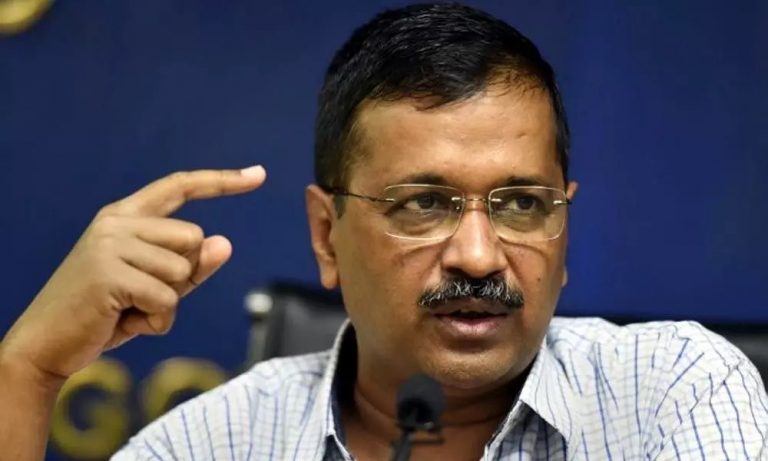
On Monday, Delhi Chief Minister Arvind Kejriwal announced ‘free money’ to all women in Punjab, irrespective of their financial status or requirement, should Aam Aadmi Party come to power in the state.

He promised Rs 1,000 every month to every woman. “Imagine, 18-20 year old girls want to go to college but father does not have money. Now they will be able to go to college when they get Rs 1,000. Many girls wish to buy new clothes but hesitate in asking their father for money. What if father does not give. Now she wont need to go ask her father, she can go to market and buy it. Many housewives are not able to give anything to their children because husband does not give money. Now she won’t have to check her husband’s mood before getting things for her children,” he said.

“She wants to buy a new saree. It has been many years since her husband bought her a saree. Now she will be able to buy the saree with the money this brother will give her. There are old mothers save money by saving Rs 10, 20 to give them to their married daughter secretly when they visit home. Now these mothers will be able to give Rs 1,000 to their daughters saying my son has given the money,” he said.

Kejriwal then claimed that this particular scheme will empower women. “Rs 1,000 is not too much,” he said. He claimed that the money for it will come when he ends transport and other mafia.

Economics of the ‘free money’ scheme

Before we begin to discuss how problematic this scheme is, let me briefly touch upon the economics of this scheme and how absolutely unreal it is to make such promise. Approximate adult female population of Punjab as of 2021 stands at about 1 crore 10 lakh. Rs 1,000 per month, or about Rs 12,000 per year for 1 crore 10 lakh women would be Rs 13,200 crore. And this is just one year. Who pays for this free money? Tax payers, including women (who might also get Rs 12,000 back as free money?).

‘Free money’ is not empowerment

If you listen closely Kejriwal’s speech while announcing the free money, you can see how it is so deeply rooted in patriarchy, the very system women across India and world are fighting day in and day out. All his statements are how women are in complete control of men and it is men who dictate how women should live and how women need men to take care of their needs.

Kejriwal speaks about girls not being able to go to college because father will not give money for college fees and with the free money, the girls will then be able to go to college. So, if higher education is a criteria, why not give subsidy on education? Why not waive off fees for girls if their economic condition is the only reason they’re not able to study further? Also Rs 12,000 per year is not sending any girl to college when the family is already preventing her education. At best, considering the family situation being painted here (severe financial crisis+patriarchy), it will be snatched from her and added to family’s grocery expenses or worse, drugs and alcohol.

He speaks about how girls want to buy new clothes but father may not agree to buy new clothes, but with free money girls will be able to buy new clothes, without having to be dependent on father. Again, it is just accepted and given that women live their lives as per the wishes of the male figure in their lives. Who are these men who don’t let their daughters go to college? Or get them clothes? AAP voters?

Instead, why not promise employment opportunities, self help groups, skilled workforce, seed capital to start their own businesses? How is ‘free money’ better than opportunity to create wealth and further employment opportunities? If the girl earns her own money, she will not only buy the ‘suit’ she wants to but also save some and maybe buy her own house too.

Kejriwal then moves on to housewives who are again subservient to their husbands who never gives money for small expenses or does not buy her a saree. Firstly, let us question whether this is an abusive relationship? Does the husband not do this because he has no money or he does not do it because he’s abusive? If former, perhaps offer them both employment opportunities (always a better option than free money) and if latter, offer her security and safety and ways to get out of abusive relationship. ‘Here, take free money every month and get yourself a saree’ is not really a great idea.

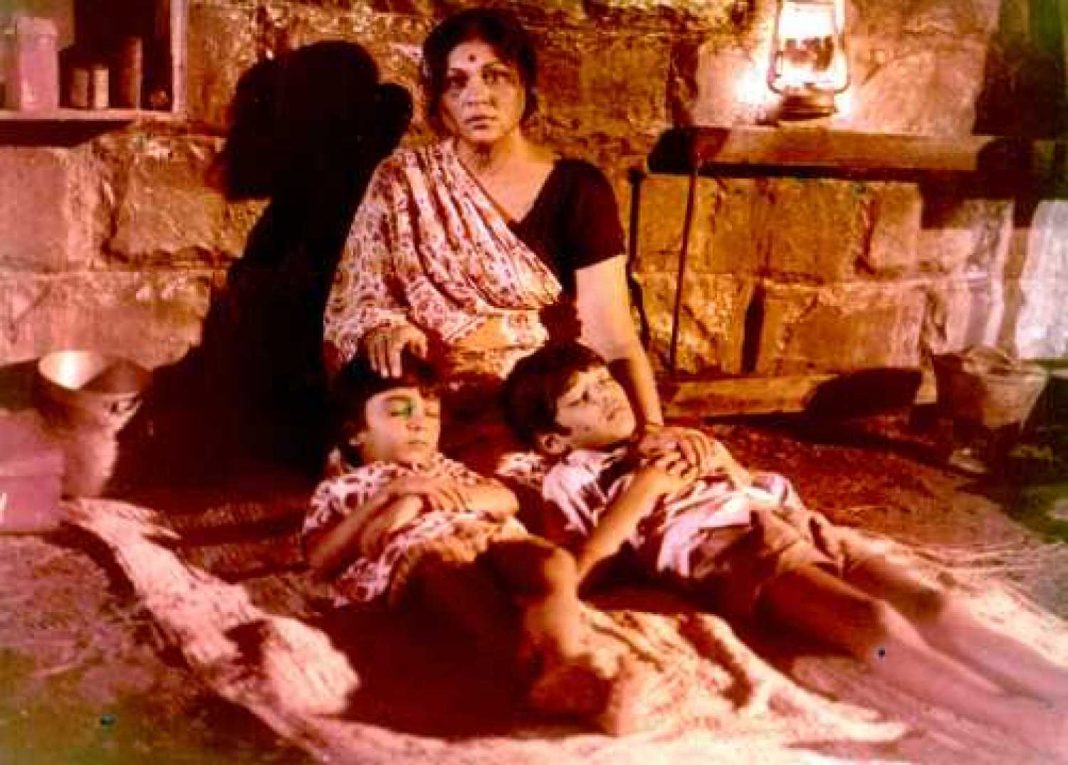
And lastly he speaks about the quintessential filmy boodhi maa who has no money to give her married daughter visiting home.

Nirupa Roy as poor mother in some film

Now, it begs the question whether this married daughter is in Punjab? If yes, isn’t she also getting free money from Kejriwal? If yes, why is she being such a leech and mooching off free money from Kejriwal from her boodhi maa?

Smashing the patriarchy

What is even worse about this ‘free money’ scheme is playing right into the patriarchal society women like you and I are trying to fight each and every day. Right from equal pay to right to equal job opportunities. You know how absolutely normalised it is for women to be asked ‘are you married?’ and ‘do you have children/plan to have children?’ during job interviews? Because those things are considered before hiring women. Men, on the other hand, don’t usually get this question. It is just assumed that even if he does get married, or have children, his efficiency wont get affected. Women, on the other hand, will prioritise children and home and hence are kept away from the top management.

Last evening Kejriwal went on an auto ride in Punjab and then went for dinner at the auto driver’s home. Though eventually it turned out that the said auto driver was an AAP worker. However, the fact that Kejriwal and his gang can be safe when the auto driver or anyone for that matter takes a detour and not get into absolute panic mode is male privilege.

Last weekend, I was walking on a main road near Jawaharlal Nehru University in Vasant Kunj area of New Delhi. A car coming from behind slowed down. My first thought was I was getting kidnapped. Considering the crime rate situation in Delhi, my fears were not misplaced. The car eventually sped off and I did not end up being a victim of any crime, but that’s the difference between being Kejriwal, a man, and me, a woman. A man can take a nap during long commute on metro, cab, bus but a woman wouldn’t. That’s male privilege. And that is what we are fighting every day.

Survival is a struggle. Surviving as a woman even more so. From home to society to work place to even social media – we have to fight prejudice and patriarchy at every step. The Rs 1000 every month free money only adds to the battle. The constant ‘taunts’ one would get to hear because, ‘well, why don’t you sit at home and take the free money instead of using your knees in office?’ The knee jibe is often given to tell women that they think from their knee because unka dimaag ghutno mein hai – I have personally heard this jibe from a qualified chartered accountant, no less.

So when we are already fighting multiple battles on various fronts, why add to our woes? Instead why not create an environment where women feel safe, secured and don’t have to live in a Talibaneque environment where they’ve do depend on the men of the house for their basic needs.

Charity, they say, begins from home. How about having a woman deputy chief minister? Or let a woman be the national convener for Aam Aadmi Party? To put things in perspective, the Delhi government cabinet, where Aam Aadmi Party has 62 out of 70 MLAs in the Delhi Assembly and not a single woman MLA is a minister in the Kejriwal cabinet. Why are women in his government not given more responsible work? Does Kejriwal think women are only interested in buying new suit and saree?

Foreign policy journalist spreads Pakistani propaganda against Group Captain Abhinandan using debunked claims

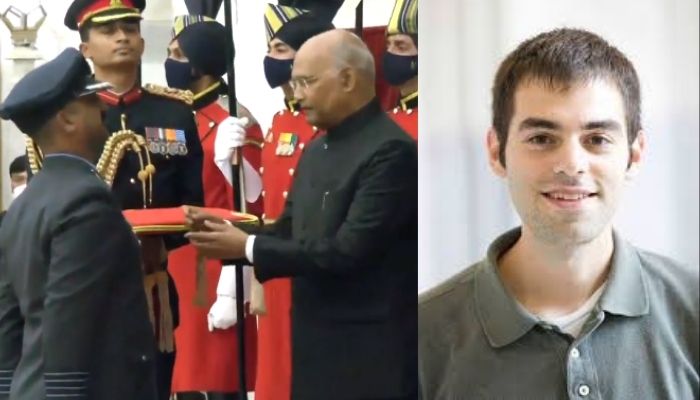
On Monday (November 22), Group Captain (former Wing Commander) of the Indian Air Force (IAF) Ahinandan Varthaman was felicitated with the Vir Chakra award by the President of India, Ram Nath Kovind. He has been accorded the wartime military bravery award for shooting down a Pakistani F-16 fighter jet during aerial combat on February 27, 2019, after the Pulwama terror attack.

On 26th February 2019, India retaliated with an airstrike at terror camps in Balakot. A day later, Pakistan sent its jets, one which Wing Commander Varthaman shot down. In the process, he flew his MiG 21 over to Pakistan-Occupied-Kashmir. He was eventually captured by the Pakistani forces and held in captivity until his safe return to India.

Anti-India propaganda by Michael Kugelman and Foreign Policy

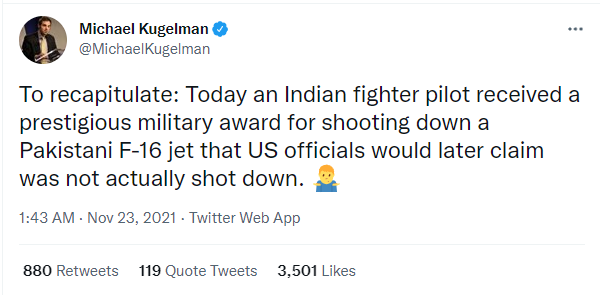
A day after IAF Group Captain Abhinandan Varthaman was awarded the Vir Chakra award, ‘journalist’ Michael Kugelman took to Twitter to cast aspersions about India’s success in shooting down a Pakistani F-16 jet. In a tweet on Tuesday (November 23), Kungelman alleged, “To recapitulate: Today an Indian fighter pilot received a prestigious military award for shooting down a Pakistani F-16 jet that US officials would later claim was not actually shot down.”

Screengrab of the tweet by Michael Kugelman

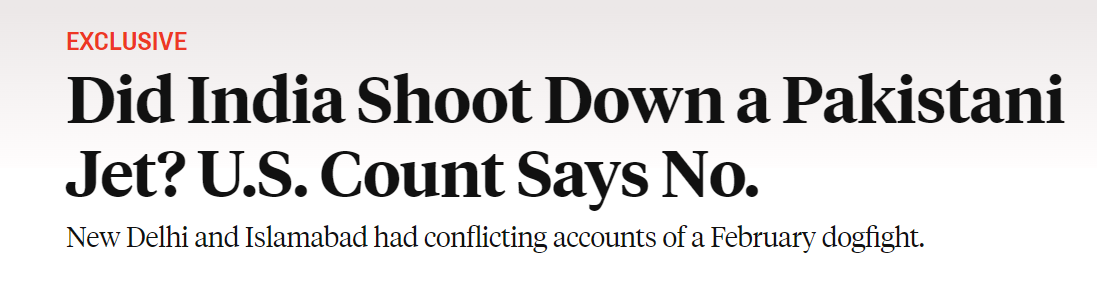
Interestingly, he is the writer of the weekly ‘South Asia Brief’ of Foreign Policy. The American news publication had been at the forefront of a disinformation campaign following the aerial skirmish between India and Pakistan in February 2019. In a bid to discredit India’s stance that a Pakistani F-16 jet was shot down, Foreign Policy published a source-based, exclusive news story titled, “Did India Shoot Down a Pakistani Jet? U.S. Count Says No.”

The contentious article, published on April 9, 2019, alleged, “India’s claim that one of its fighter pilots shot down a Pakistani F-16 fighter jet in an aerial battle between the two nuclear powers in February appears to be wrong. Two senior U.S. defense officials with direct knowledge of the situation told Foreign Policy that U.S. personnel recently counted Islamabad’s F-16s and found none missing.”

Foreign Policy accused the Indian government of misleading the international community. “But the count, conducted by U.S. authorities on the ground in Pakistan, sheds doubt on New Delhi’s version of events, suggesting that Indian authorities may have misled the international community about what happened that day,” the publication cast aspersions on the authenticity of India’s claims.

Screengrab of the contentious article by Foreign Policy

Pentagon debunked fake claims of Foreign Policy

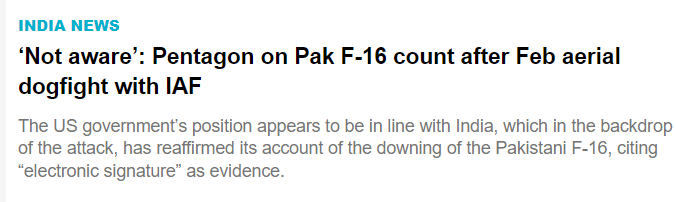
Two days after Foreign Policy published its propaganda news story, the United States defence department dismissed having any knowledge of such a counting exercise of F-16 fighter jets. While speaking to Hindustan Times, a US defence department spokesman said, ” (We) weren’t aware of any investigation like that.”

Screengrab of the news report by the Hindustan Times

The US Defence Department also distanced itself from the claims made by Foreign Policy. It said, “As a matter of policy, the Department does not publicly comment on details of government-to-government agreements on end-use monitoring of US-origin defence articles…It is important to note that since January 2018, the United States government has suspended security assistance to Pakistan.”

Pakistanis target India using the fake news peddled by Michael Kungelman

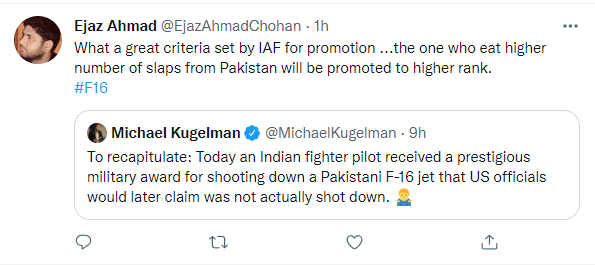
Despite the misleading assertions of ‘Foreign policy’ journalist Michael Kungelman, Pakistanis were quick to exploit the opportunity to further their agenda. One Ejaz Ahmad claimed, “What a great criteria set by IAF for promotion…the one who eat a higher number of slaps from Pakistan will be promoted to high rank.”

Screengrab of the tweet

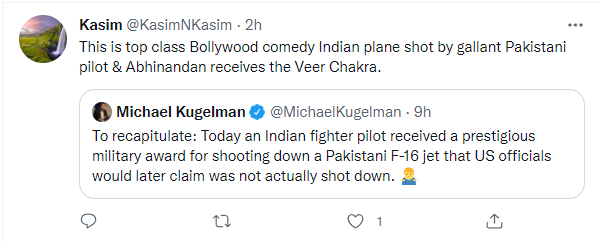
One Kasim had tweeted, “This is top class Bollywood comedy. Indian plane shot by gallant Pakistani pilot and Abhinandan receives the Veer Chakra.”

Screengrab of the tweet

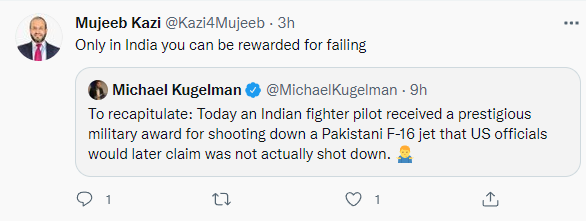
“Only in India, you can be rewarded for failing,” alleged one Pakistani named Mujeeb Kazi.

Screengrab of the tweet

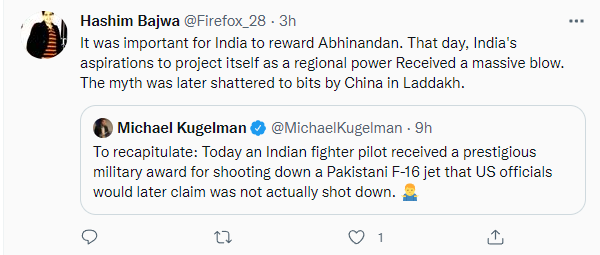
Another Pakistani claimed that it was important for India to reward Abhinandan Varthaman to project itself as a regional power. “The myth was later shattered to bits by China in Ladakh,” he asserted.

Screengrab of the tweet

It must be mentioned that Pakistan Army was forced to release Abhinandan Varthaman due to pressure exerted by the Indian side along with international intervention into the matter. On 28th February 2019, Pakistan PM Imran Khan announced that the country would release Wing Commander Varthaman as a ‘peace gesture’ and on March 1, 2019, he returned to India through the Wagah Border in Atari.

Weak listing of Paytm on stock markets: Here is what could have gone wrong

The current flavor of the season is transition of startups and fintech companies into public listed companies with their ever growing valuations getting the spotlight. We had recently seen the successful listings of startups and digital companies like PolicyBazaar, Nykaa and Zomato. Many like Delhivery, Mobikwik, etc are in the pipeline for their IPOs.

One company, Paytm cannot be ignored at any cost. There was quite the hullabaloo generated during the IPO which was the largest in India’s capital market history. The fervor was such that Paytm’s parent company One97 Communications upped the Initial Public Offering (IPO) size from Rs. 16,600 crore to Rs. 18,300 crore.

Paytm founder and CEO Vijay Shekhar Sharma started his ambitious journey with the Paytm app in 2010 and was slowly capturing users’ attention, although demonetization gave a lion’s share of boost in the success of Paytm’s growth, as all of us witnessed a humongous rise in online payments. Post November 2016, Paytm became a preferred choice for a lot of consumers and merchants for cashless transactions. Paytm seized the moment and scaled up to mark it’s presence as a leading player in the digital transactions ecosystem, thus diversifying further into other avenues like Payments Bank, UPI, E Commerce, Movie ticket booking, etc.

While it is natural for a company to get listed in the equity markets and help retail investors too, to be a part of their economic journey, there seems to be a lot of things that went wrong in the public listing of Paytm.

Investors deep-dive into a lot of things to analyze before buying the shares of any company. The company’s revenue and revenue growth, expense and expense growth, profit, assets and liabilities, Price-earning (PE) Ratio, promoter shareholding, market-cap and such technicals are taken into consideration. These help the investors gauge whether there is something in it for them to invest in the company or not. Each metric serves a different purpose for a different investor.

Cashflow, confidence of promoters, competing companies, growth prospects and all such factors are looked into. Since there was a lot of noise for Paytm, these pointers for Paytm were scrutinized even more granularly.

Factors responsible for PayTM’s disappointing share market debut

The issue price of Rs. 2150 turned out to be quite a spoilsport for Paytm. Since the size of the IPO was the largest in Indian history, the time for it to reach 1.00X subscription also took longer. Experts highlighted that the high valuation seemed to be a mood killer for investors. Another point to ponder was the future prospects of a positive cash-flow.

A decade long presence in the market and still not having a vision of profitability is a challenge in itself, noted experts in many financial research reports. Another point of concern is the growing competition. There are a number of popular apps which support UPI based payments. The consumption behavior of customers/users and merchants can surely be pretty volatile in such a scenario.

Yet another reason that is strongly suspected by analysts as one of the primary causes for the issue’s failure was the receding liquidity in the market. This year had witnessed listing of quite a number of companies, leading investors, both institutional and retail, park their money in profitable prospects. As per Value Research Data, in this calendar year itself, 49 IPOs had raised Rs 1,01,053 crore, in which Rs 62,077 crore was Offer For Sale(OFS). PayTM IPO alone has Rs 10,000 crores as an OFS component, which translates into roughly 16.66 per cent of the entire OFS component of all the listed companies. In layman terms, investors had already invested their lion’s share in the IPOs that preceded Paytm, resulting in a lack of liquidity in the market. This acted as a damper for the Paytm IPO and resulted in its tepid debut.

These points show there were enough red flags for people to avoid the IPO and only those with a very high risk appetite could have placed their applications to buy shares of Paytm.

The result was for everyone to see, on the listing day Paytm showed a tepid and a disappointed performance by opening at a 9% discount and further falling nearly 28% of the initial price. This fall wiped out about 38,000 crore from the market cap. On Monday, 22 November, stock of Paytm fell even more and it last traded at Rs. 1362 in NSE during closure.

The recent bull run of stocks made people dream that markets were invincible, but Paytm listing has forced the investor to wake up and wash their face to come to the reality. Performance of the stock has a lot to do with the technicals and not just hype built around it.