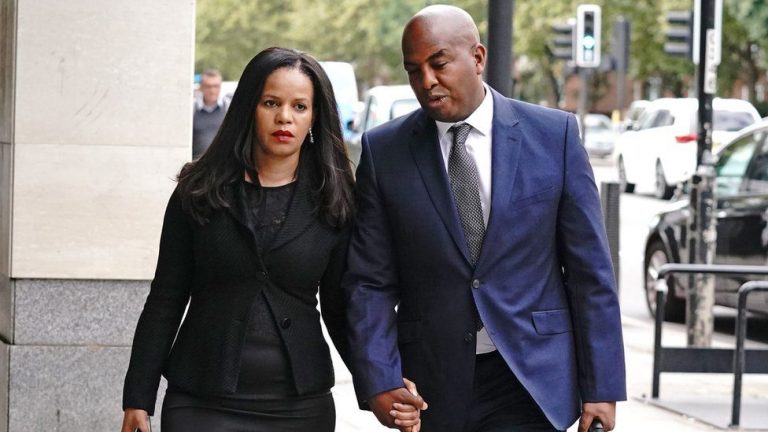
Claudia Webbe (56), MP from Labour Party for Leicester East has been handed a 10-week jail sentence and 200 hours of community service at Westminster Magistrates’ Court for harassing a female friend of her boyfriend. Webbe, a diligent supporter of the violent farmers’ protests in India, has been accused of harassing Michelle Merritt (59), a long-term friend of her boyfriend, Lester Thomas. Reportedly, Webbe threatened Merritt with an acid attack and leaked naked images of Merritt in a string of calls since 2018.
The 56-year-old politician had made 16 threatening calls to Merritt between September 2018 and April 2020 purely out of jealousy, the court heard.
Labour’s national campaign coordinator Shabana Mahmood confirmed that Webbe had been expelled from the party. The party had called for her to resign as an MP. Webbe had been sitting in the Commons as an Independent MP after being suspended by the party over the case.
Merritt said she is ‘very scared’
The victim, who never met Webbe in person alleged that she has become a ‘hermit’ due to the incessant harassment by the MP. Addressing the court, Merritt said that she has been left “very scared”, struggling to work and even socialize.
Webbe on one occasion made an angry call to Merritt, used a derogatory term and added, “You should be acid.” She also often yelled at the victim asking her to “get out of the relationship”.
“No woman should be threatened and harassed as Ms Webbe has done to me over the years, let alone by a politician,” said Merritt.
‘Showed little remorse’
Sentencing Webbe on Thursday, Paul Goldspring, the chief magistrate, described Webbe’s behaviour as “callous.” He said Webbe “showed little remorse or contrition” and suggested the politician would have been jailed immediately were it not for her previous good character.
“Very disappointed by the decision”
Webbe, after the judgment, said that she was “very disappointed by the decision of the magistrate” and claimed innocence.
“I am lodging an appeal and despite today’s sentence I fully expect the appeal to be granted and that, ultimately, it will be successful. Throughout this process I have received numerous threats to my life and vile racist abuse,” she said in a statement.
“The cowards responsible for these attacks will not deter me from clearing my name,” Webbe added further.
Webbe had supported violent farmers’ protest in India
Webbe, an MP for Leicester East, a significant British Indian constituency, in February had endorsed an e-petition calling for a UK government’s statement over the farmers’ protests in India.
The MP was extremely vocal about the violent ‘peaceful protests’ in India. “Huge congratulations to all who supported this petition in defence of Farmers Protest. The right to peaceful protest is a fundamental human right. Farmers must be protected,” Webbe had tweeted.
Huge congratulations to all who supported this petition in defence of Farmers Protest
The right to peaceful protest is a fundamental human right
“Boom We’re taking this to parliament. The petition has reached 100,000 & qualifies for a debate in Parliament,” she had said in another tweet.
It is imperative to note that the so-called peaceful protests on January 26 this year had left 300 security personnel injured and properties worth crores damaged.
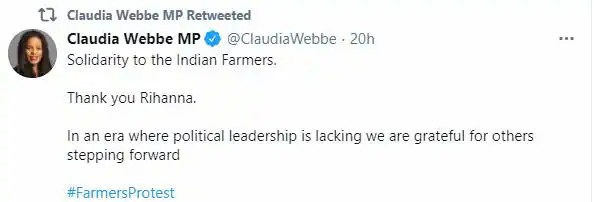
Not just this, the British MP had also thanked global celebrities like Rihanna for Tweeting (paid) in support of the farmers in India.
Claudia Webbe’s Tweet
She had also demanded the release of alleged “activists”, who had conspired against India, in the “toolkit” case.
In an article on her website titled ‘The international community must show solidarity with Indian farmers,’ Webbe had propagated misinformation.
“Video footage demonstrates that police and violent mobs are assaulting peaceful protesters, destroying their living areas,” claimed Webbe in her writeup.
The British politician went further to claim that the “protestors were being killed, injured and unjustly imprisoned.”
On Thursday (November 4), aspiring actor Harsh Varddhan Kapoor courted controversy after he resorted to virtue-signalling on the auspicious occasion of Diwali. Harsh is the son of actor Anil Kapoor.
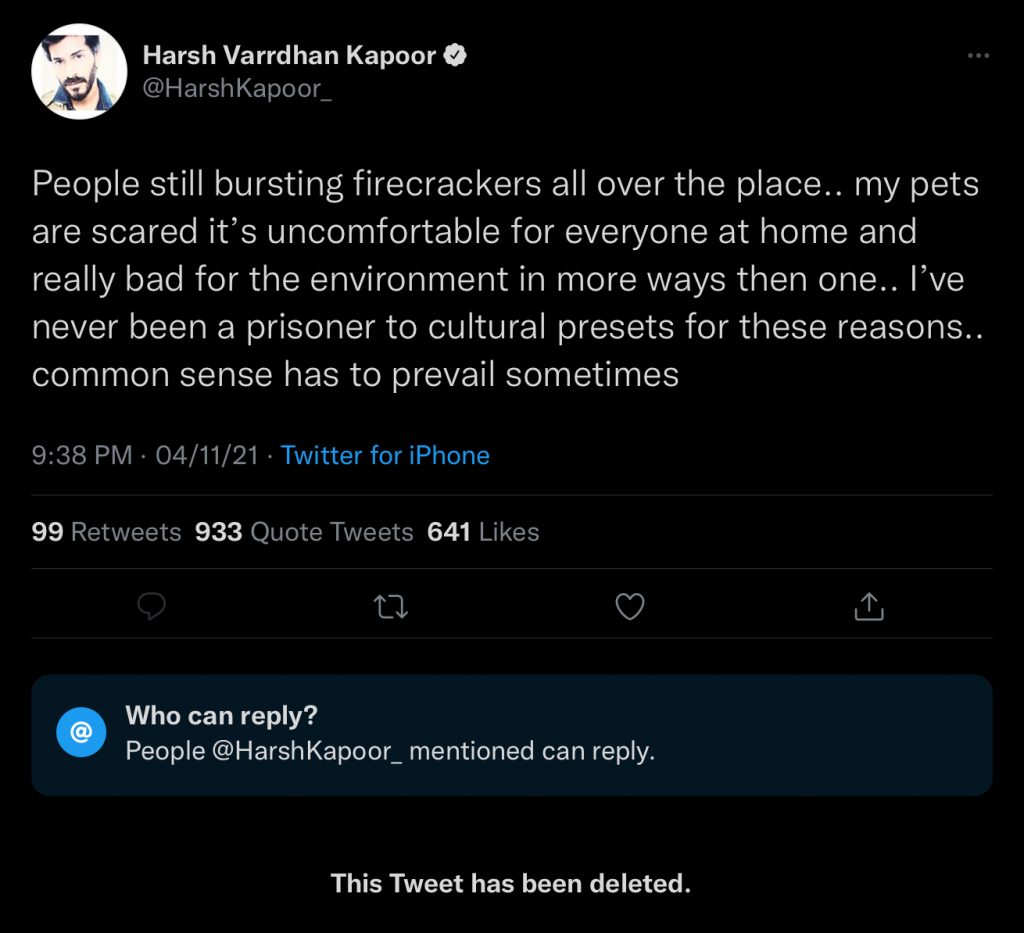
In a tweet, he alleged, “People still bursting firecrackers all over the place…my pets are scared it’s uncomfortable for everyone at home and really bad for the environment in more ways than one.” While taking a high moral ground, the actor claimed, “I’ve never been a prisoner to cultural presets for these reasons…Common sense ”
Screengrab of the tweet by Harsh Kapoor
Social media users question Harsh Kapoor, point out his hypocrisy
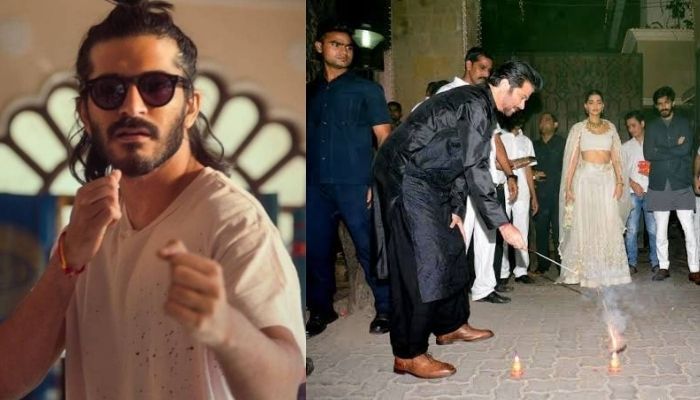
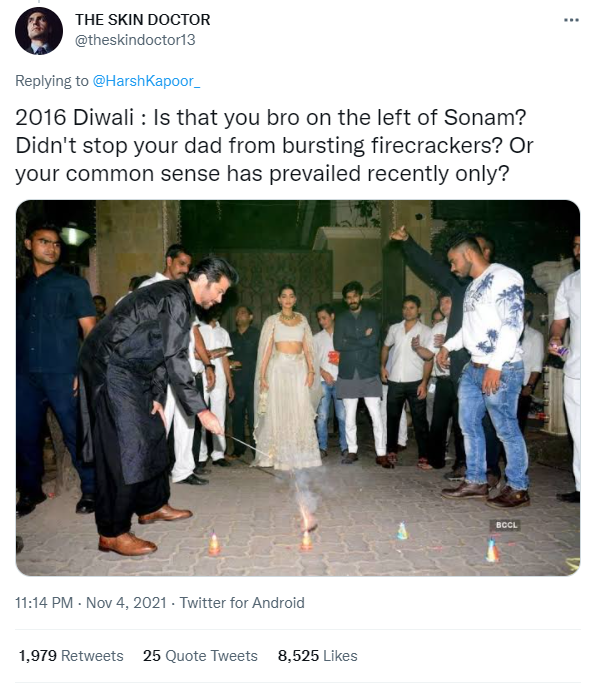
His holier-than-thou attitude on Diwali night did not go well with the netizens. Social media users slammed the actor and his family for their hypocrisy. Popular Twitter user (@theskindoctor13) shared a 2016 picture wherein Anil Kapoor could be seen burning firecrackers. In the background of the image, actor Harsh Kapoor and his sister Sonam Kapoor could be seen watching their father.
The Twitter user questioned, “2016 Diwali: Is that you bro on the left of Sonam? Didn’t stop your dad from bursting firecrackers? Or your common sense has prevailed recently only?”
Screengrab of the tweet
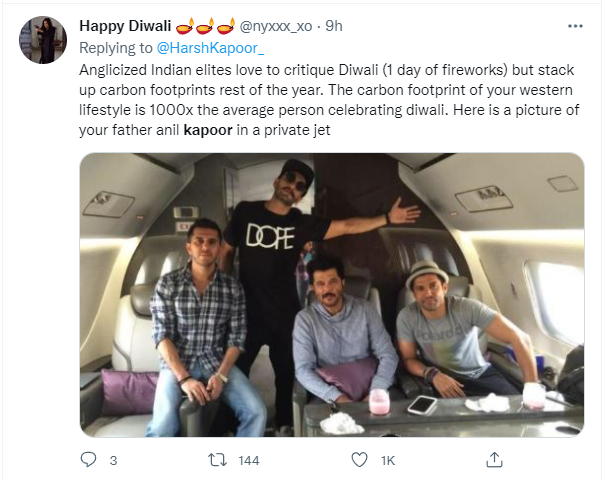
Another Twitter user had shared a picture of Harsh Kapoor in a private jet and pointed out how the actor did not care about carbon emissions in reality. “Anglicised Indian elites love to critique Diwali (1 day of fireworks) but stack up carbon footprints the rest of the year. The carbon footprint of your western lifestyle is 1000s the average person celebrating Diwali. Here is a picture of your father Anil Kapoor in a private jet.”
Screengrab of the tweet
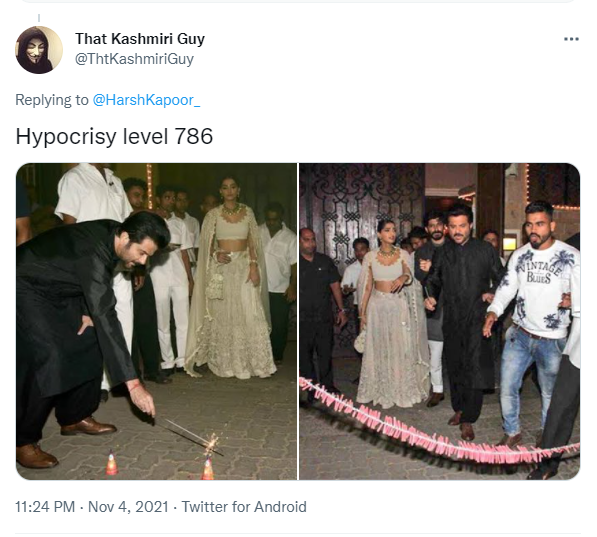
Another social media user shared pictures of Anil Kapoor celebrating Diwali and emphasised on the hypocrisy in the statement of Harsh Kapoor.
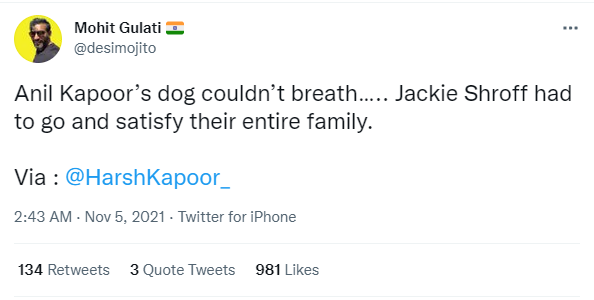
Another popular Twitter user (@desimojito) wrote, “Anil Kapoor’s dog couldn’t breathe… Jackie Shroff had to go and satisfy their entire family.”
Screengrab of the tweet
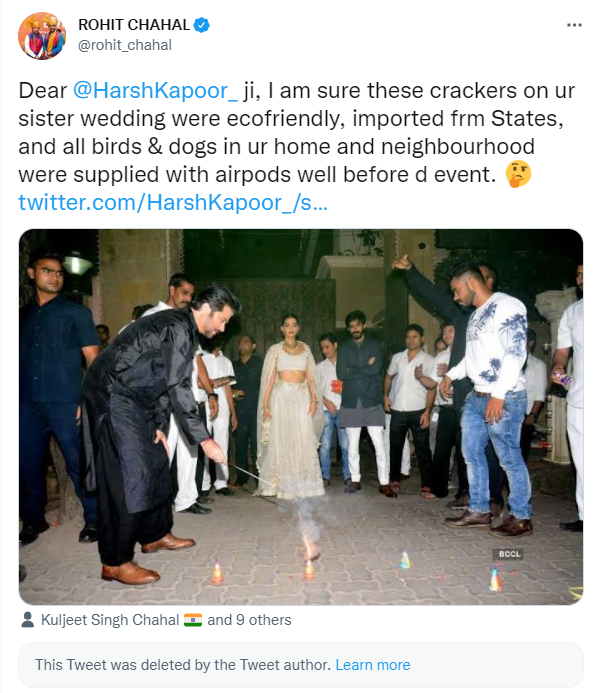
BJP leader Rohit Chahal reminded Harsh of the firecrackers at his sister’s wedding. “I am sure these crackers on your sister’s wedding were ecofriendly, imported from States, and all birds and dogs in your home and neighbourhood were supplied with airpods well before the event.”
Screengrab of the tweet
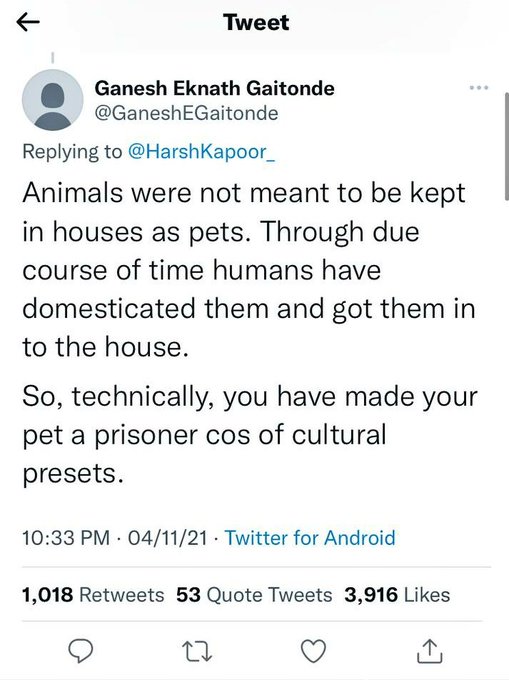
Another Twitter user questioned the hypocrisy of the star kid using terms like ‘cultural presets’
via Twitter
Actor cites ‘environmental awareness’ in his defense, deletes tweets after outrage
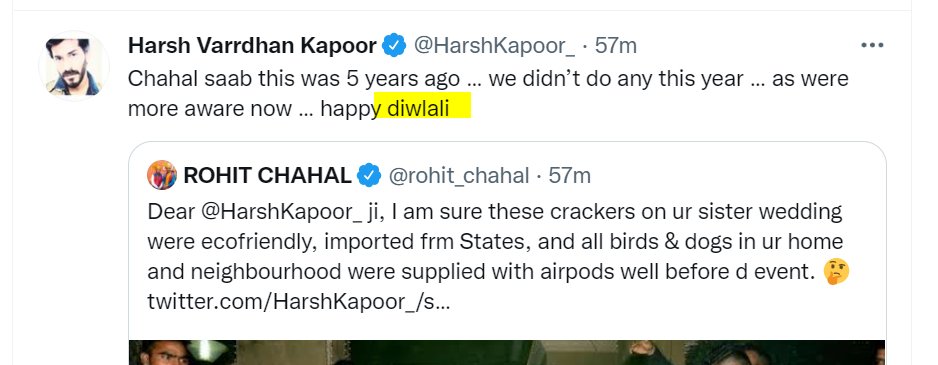
After being caught off guard, Harsh Varrdhan Kapoor defended his tweet by claiming that the pictures were 5 years old. “We didn’t do any this year…as were more aware now… Happy Diwali”. At the time of writing the article, the actor had deleted both of his tweets.
Screengrab of the tweet
Diwali and liberal sermons on environmentalism
Diwali is a once in a year celebration for the Hindu community where people burst firecrackers in the evening to celebrate Lord Ram’s return to Ayodhya. While multiple governments, organisations and courts are launching a systematic attack against the Hindu festival, painting it as the evil cause behind air pollution, the claims are not supported by research and are dishonest, to say the least.
While year-round industrial pollution, stubble burning and vehicle emissions are the major contributors of air pollution and go on unchecked, Bollywood celebs and some ‘secular’ activists try every year to paint Diwali celebrations as the prime contributor towards air pollution. Their selective concern that ignores everything else, and finds only one Hindu festival to defame is what irritates most people.
It is notable here that in 2016, a research study by IIT Kanpur had found that firecrackers are not the top contributors to Delhi’s poor air quality. The study had pegged construction dust as the top cause, followed by vehicular pollution and bad infrastructure, the next worst cause was stubble burning. However, during a hearing in a plea against the NGT order of ban against firecrackers this July, the Supreme Court had rejected the study, saying they do not need IIT Kanpur to decide that firecrackers cause pollution.
The pollution data of Delhi analysed by IIT Kanpur had suggested that suggest that the pollution caused by Diwali is extremely short-lived (less than 24 hrs), and is no worse than the usual spikes of pollutants that are present in Delhi’s air almost all the year.
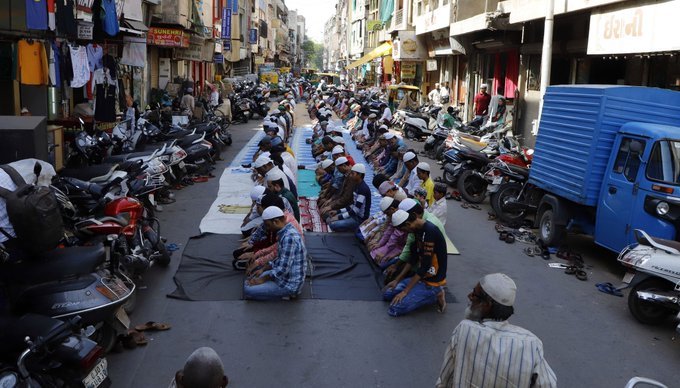
For the past few weeks, conscientious locals and residents have been resolutely protesting against the public offering of namaz by Muslims. The opposition to namaz at public places reached a crescendo this week as the demonstrators organised a protest to rail against the Gurugram administration for allowing Muslims to continue using public places for their religious activities.
The protesters said they would continue demonstrating and thwarting Muslims from encroaching upon the public place and using it for their religious activities. In response, the Gurugram administration deployed more than 500 police personnel to man namaz sites amidst intensifying protests against the public offering of namaz.
And predictably, the opposition to the public offering of namaz has stirred a debate, raising questions on whether public places can be allowed to be hijacked by influential groups and communities, including religious ones, and used for personal purposes.
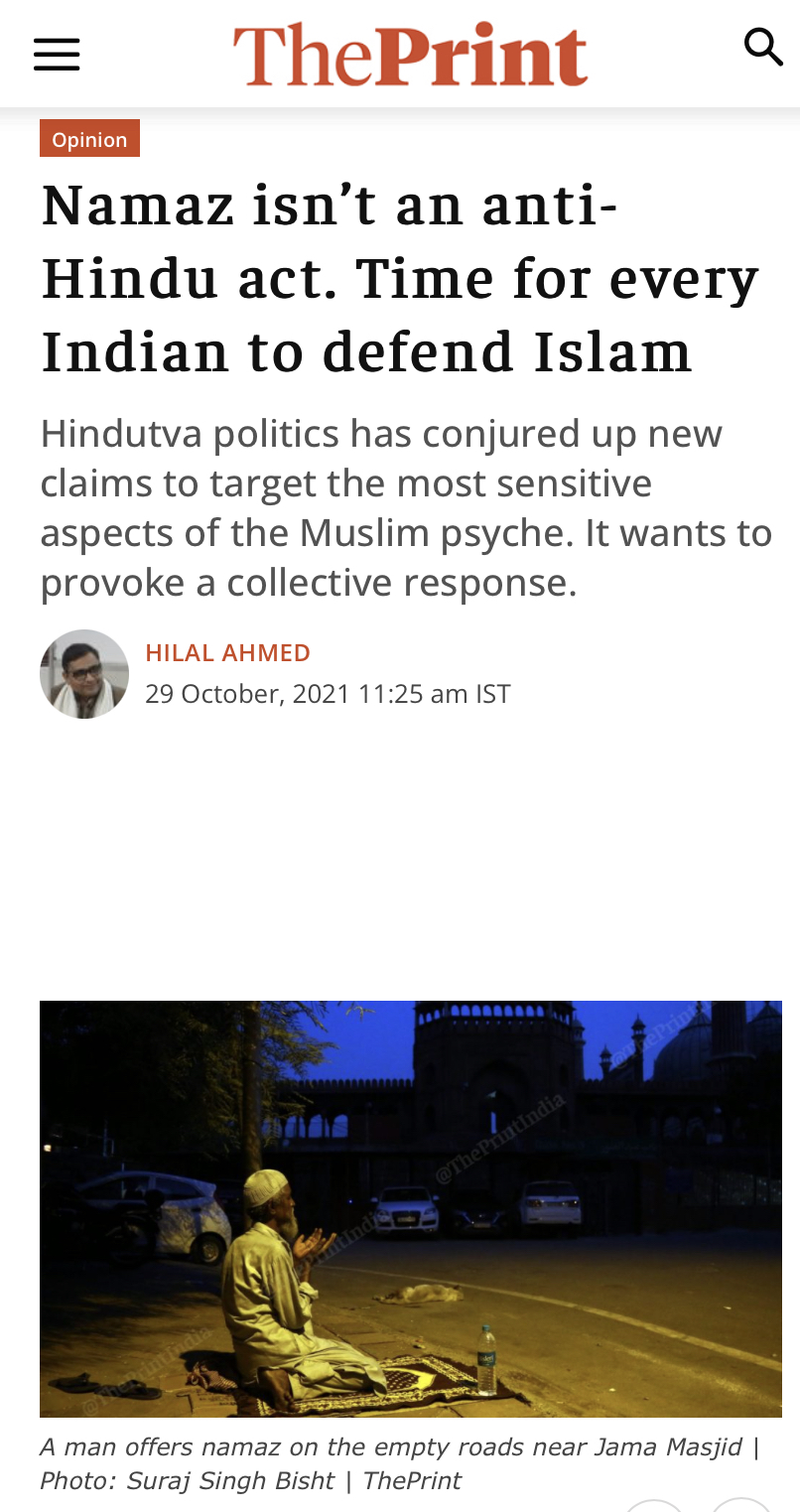
On October 29, Shekhar Gupta’s The Print published an article that batted in favour of the public offering of namaz. Even though the article was meant to defend namaz in open and at public places, it ended up arguing that Hindus are an acceptable part of society so long as they behave like dhimmis—a pejorative reference to non-Muslims living in an Islamic state.
The article titled ‘Namaz isn’t an anti-Hindu act. Time for every Indian to defend Islam’ and authored by Hilal Ahmed sought to not only deflect criticism away from the Muslims squatting public properties to observe their religious rituals but also attempted to paint Hindus as an intolerant community for simply standing up for preserving their rights.
Source: The Print
The Print article paints opposing Hindus as aggressors, accuses them of protesting against Namaz in totality
Ahmed comes up with a straw man argument in his opinion piece in The Print, accusing Hindus of opposing namaz in its entirety. The author cunningly and very conveniently extrapolates opposition to namaz in public places to a blanket objection to the Islamic ritual of namaz. There are obvious differences between practising rituals in designated places of worship and occupying open spaces to observe one’s religious customs.
Those protesting against the observance of namaz in open spaces are not opposing the practice of namaz in its entirety. They are simply opposing the occupation of public places that infringes upon the rights of other people, causes them inconvenience and sets a dangerous precedent for other groups and communities to follow. But this nuance is expediently swept under the rug as Ahmed characterises outrage against namaz in open places as a blanket opposition to Islam.
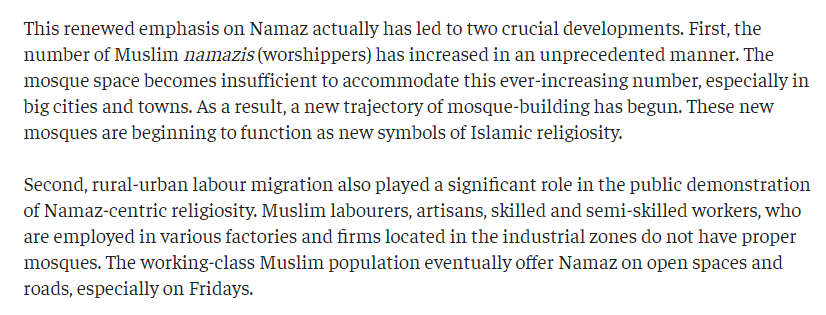
Then, he goes on to provide a lousy defence to why Muslims have started performing namaz in makeshift venues and open places. He says the ever-increasing number of devout Muslims who believe in offering namaz has increased significantly, making it difficult to accommodate them in existing mosques.
Source: The Print
Coupled with this phenomenon, Ahmed cites the rural-urban migration dynamic that has thrust Muslim artisans, labourers, skilled and semi-skilled workers in places and industrial zones that do not have proper mosques. Hilal says owing to these developments, Muslim people have to eventually offer namaz in open spaces and public roads.
It is worth noting how casually Hilal tries to normalise and mainstream the observance of Muslim religious practices in public. According to him, Muslims who could not find proper mosques in areas where they live and work are entitled to seize public roads and open places for performing their namaz rituals. However, Hilal also glosses over the fact that Muslims occupying streets and causing inconvenience 5 times a day is not a new phenomenon. We have always seen Muslims observe Namaaz on the roads and in public places. This essentially happens because the Muslim community believes that Allah is omnipresent and when it’s time to do Namaaz (5 times a day), it is their religious duty to offer prayers no matter where they are.
The unabashed justification of allowing Muslims to occupy government properties bears stark resemblance to the defence of Shaheen Bagh protest
Apparently, this is the same premise that is used to justify the Shaheen Bagh protests, where anti-CAA rioters had squatted on one of the busiest thoroughfares in Delhi to railroad the Centre into rescinding the CAA bill. They defended their flagrant violation of individual rights and grave inconvenience caused to the people of Delhi by portraying Muslims as a dispossessed community fighting the alleged discrimination meted out on them.
Notwithstanding Supreme Court’s scathing remarks on illegal and indefinite occupation of public land, the proponents of Shaheen Bagh protests have continued to throw their weight behind the demonstrations, at times even accusing the judiciary of being saffronised under the Modi government. They cite constitutional provisions to justify such an unlawful assembly of people on public roads while turning a blind eye to provisions that criminalises holding the centre to ransom and contravening on the rights of fellow citizens.
In his article for The Print defending namaz in public spaces, Hilal seems to take a cue from the unapologetic supporters of the Shaheen Bagh protests by arguing in favour of offering namaz on public roads and open places, even if that runs counter to the constitutional norms and has a potential to disrupt public law and order.
India’s history is replete with instances where places of worship have held profound significance. In fact, religion has always been a significant part of the lives of Indians since time immemorial. Indians of all strands—be it Hindus, Muslims, Christians, Jains, Buddhists and others—are normally considered to be devout followers of their respective religions. So, when a public place is associated with religious practice, it takes no time for the adherents of that religion to come up with a makeshift shrine or a temporary Mazar, which becomes permanent over time.
Therefore, it then becomes incredibly difficult for the authorities and locals to demand the removal of concrete structures or the banning of the assembly of people from places that are in reality public properties. Feelings and sentiments of people are linked to that place and the forced eviction of people or removal of shrines could touch off a wave of violence that would spread across large swathes of the country in a jiffy.
Normalisation of squatting on public places for religious rituals holds the potential to create further fault lines within the society
It also ought to be considered that the reason behind staunch public opposition to offering namaz in public has its roots in India’s troubled history. India has endured centuries of rule by foreign rulers who have displayed little regard for the indigenous people and their religion. They have forced locals to convert religion, arrogated lands and demolished temples and idols to convey the superiority of their religion, For instance, it took close to 500 years for Hindus to reclaim the birthplace of Lord Ram in Ayodhya where a structure attributed to the Mughal ruler Babur was erected in the fifteenth century after demolishing a magnificent Ram Temple that once stood there.
It was only in 2019 that the Supreme Court of India awarded the protracted dispute in favour of Hindus and gave them the authority to build a Ram Temple over it. However, secularists and Islamists still resent the fact that the apex court awarded the site to Hindus. Similarly, there are thousands of other sites across India, most notably the Gyanvapi mosque, which are disputed over. In such a scenario, when intellectuals seek to normalise the occupation of public places for religious worship, they are opening a pandora’s box that has the potential to deepen the existing social fissures further and create more fault lines within the society.
It is but natural then that Hindus and others are concerned over public places being turned into spaces for religious congregations. When people regularise a public venue as a place for offering namaz, they are just a step away from sanctifying that place as an official area of worship. As such, we have seen many cases when secularists have gone gaga over incidents when temples had opened their doors to Muslim worshippers for offering namaz. It could be allowed in some circumstances, but it should never become a routine practice.
Hindus being considered admissible part of society only as dhimmis
However, Hilal disregards this genuine disquiet among Hindus and proceeds to stereotype them as an insecure community that is protesting against the public manifestation of Islamic practice. Whether Hindus demand reclamation of their now-occupied holy sites or oppose the occupation of public places for religious purposes, they are invariably dubbed as extremists. Hilal does not grant them the same privilege that he gives to “disadvantaged Muslims” when he argues in favour of opening up public places for namaz. He defends his stance saying namaz is not against Hindu practices but conveniently refrains from citing the Quranic verses that endorse violence and savagery against non-Muslims.
On the surface, The Print appears to make a case for Muslims offering namaz in open spaces, but in reality, it is vilifying the Hindus who are opposing it and treating them as second-class citizens, akin to dhimmis, a term that refers to minorities or non-Muslims who are considered inferior in status to the Muslims in an Islamic state. Hilal, who is remarkably glib in his article on The Print, glosses over the historical discrimination faced by Hindus under Muslim rule. Yet, he wants Hindus to meekly accept the occupation of public places by Muslims for their religious worship.
In essence, Hilal is perpetuating the culture of Dhimmitude that is characteristic of nations and societies where Islam is the state religion and all other faiths are considered secondary and therefore fair game. Dhimmitude is a pejorative expression characterising the status of non-Muslims under Muslim rule. The concept was popularised by writer Bat Ye’or in the 1980s and 1990s and it consigns non-Muslims to permanent subjugation under Islamic rule. Their rights and privileges are severely curtailed vis-a-vis their Muslim counterparts, and they are forced to accept this discrimination or face forced conversion, slavery or even a mortal threat in the form of death.
However, there is a case to be made about how Dhimmitude is prevalent even in societies where Islam is not the dominant religion. Author Bat Ye’or wrote a book in 1985 that explained this phenomenon perfectly. Essentially, Dhimmitude, while earlier it was the inferior status of other religions under Islamic rule, is a phenomenon even when Islam is not the dominant religion as it becomes the default state of mind. Hindus, for example, are asked to give up their rights repeatedly to buy peace of mind and maintain “harmony”. Essentially, the state demands that Hindus pay the Jaziya in form of giving up their rights so that the Muslim community feels placated and does not go on a rampage.
This state of Dhimmitude also comes from the rampant street veto that Muslims hold, not just in India but almost everywhere, even when they are not the dominant religion. While we Hindus trend hashtags and write articles to boycott brands when an ad insulting their faith is published, Muslims take to the streets demanding the ‘blasphemes’ head on a platter. When Kamlesh Tiwari insulted the ‘Prophet’, Muslims took out marches on the roads screaming at the top of their lungs – ‘Gustakh-e-rasool ki sazaa, sar tan se juda’. Now, one could say that both Hindus and Muslims are only screaming into the empty, gaping hole without any tangible effect on the ground or on the brotherhood between Hindus and Muslims. However, while Hindus failed to even cancel the individuals insulting their faith, the Muslim radicals beheaded Tiwari and sent a chilling message to the Hindus.
It is this veto of violence, because of which, Hindus are repeatedly asked to pay Jiziya with their rights. “Don’t oppose Namaz, or it might compromise peace”. “Don’t celebrate the Ram Janmabhoomi verdict, or it may cause violence”. “Don’t talk about radical Islam, or you might be in danger”. These are statements one often heard because the Muslim community exercises the veto of violence and therefore, it is the “responsibility” of the Hindus to be perennial Dhimmis and forego their rights (or give Muslims every privilege that they demand, like offering Namaz in public places) to maintain peace.
Even though The Print article claims it is arguing in favour of the public offering of namaz, it is effectively promoting the notion that Hindus are an acceptable part of society only when they behave like dhimmis and extend their subservience to the Muslim community. They are expected to accommodate the demands of the Muslims, no matter how unreasonable they might be and even if they infringe upon the individual rights of the majority Hindus. The moment they assert themselves and stand up for their rights, they are branded as communal bigots and considered as reasonable targets for attack and slander. This, in a nutshell, is the great Indian secularism project, where Hindus are perpetually saddled with the burden of protecting the secular fabric of the country while other communities are allowed to act as per their whims and fancies.
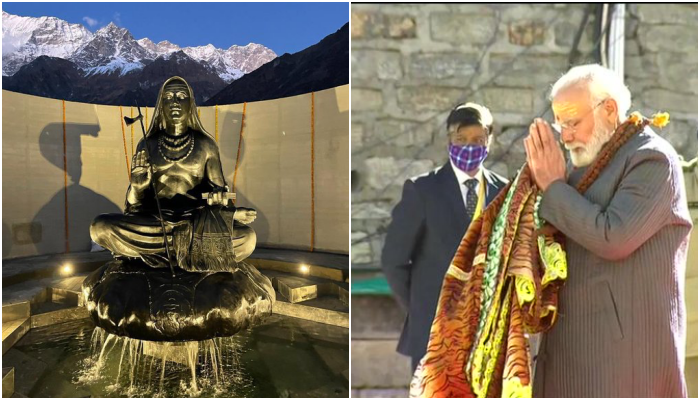
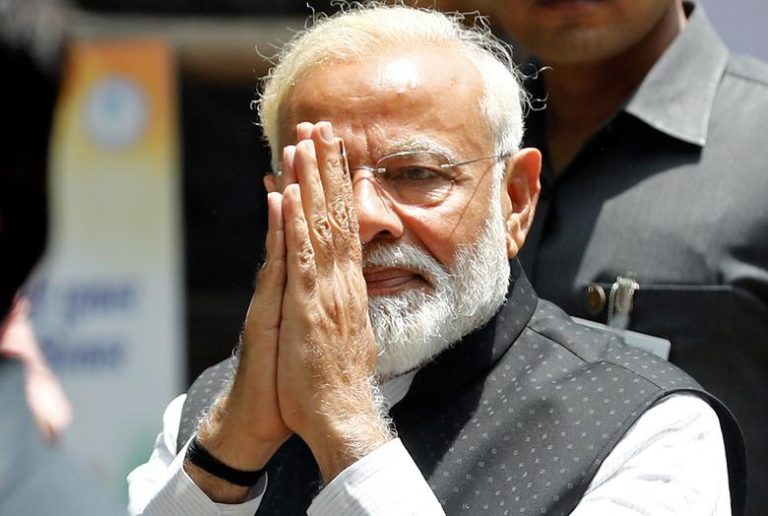
After spending Diwali with the jawans at Nowshera, Prime Minister Narendra Modi has now arrived in Kedarnath to unveil the 12 feet statue of Adi Shankaracharya in Kedarnath Dham.
The Prime Minister arrived at Dehradun early on Friday morning, where he was received by Uttarakhand Governor Lt Gen Gurmit Singh (Retd) and Chief Minister Pushkar Singh Dhami.
PM Shri @narendramodi arrives at Kedarnath, to offer prayers at the shrine and also inaugurate Adi Shankaracharya Samadhi shortly. pic.twitter.com/4IPR92RDt8
PM Modi is first offered prayers at the temple, performed aarti before proceeding to inaugurate the reconstructed samadhi of Guru Shankaracharya and lay the foundation of infrastructure projects worth 450 crores at and around the shrine.
PM Modi unveiled the statue of Adi Shankara near the temple shrine. The samadhi of Adi Shankara has been rebuit after it was damaged in the 2013 floods in Uttarakhand.
Prime Minister Narendra Modi unveils the statue of Shri Adi Shankaracharya at Kedarnath in Uttarakhand pic.twitter.com/7yX0Ft7fOO
Awaiting PM Modi’s visit to one of the shrines of the Chardham, Bagish Ling, a priest of Kedarnath Temple, while speaking with ANI said, “We will all welcome Prime Minister Narendra Modi. PM Modi will reach here in the morning. He will do the Maha Rudra Abhishek and pray for the welfare of the nation. He will also unveil the statue of Adi Shankaracharya. The temple has been decorated with flowers.”
Uttarakhand Chief Minister Pushkar Singh Dhami on Thursday took to Twitter to share an update on the program. “The Samadhi site of Adi Guru Shankaracharya has been completed. Prime Minister Narendra Modi will inaugurate it tomorrow. Along with this, Saraswati Ghat, the residence of the pilgrimage priests, has also been ready, which will be dedicated tomorrow. PM will reach here at 6:30 am,” the CM said in a video.
2013 में आई आपदा के कारण नष्ट हुए स्थानों का भव्य पुनर्निर्माण कार्य लगभग पूर्ण हो चुका है। कल माननीय प्रधानमंत्री श्री @narendramodi जी के कर कमलों से श्री आदि शंकराचार्य जी की समाधि एवं प्रतिमा के साथ-साथ 400 करोड़ से अधिक की योजनाओं का लोकार्पण होने वाला है। pic.twitter.com/Uo8B5wImnR
The statue measuring 12 feet and weighing 28 tonnes, is carved out of a single rock and is significant for the people of Mysuru.
The magnificent statue has been built by Arun Yogiraj, a fifth-generation sculptor and an MBA graduate who used to work with a private firm. However, he had quit his job to take up his family tradition.
Talking about his experience sculpting that statue of Adi Shankaracharya for the Kedarnath Shrine, Arun said, “I was given a 3D model photograph, but I was not happy. I did my own model, a 2-ft prototype which was sent to PM Modi, as did many other sculptors. My model was selected.”
The redeveloped Samadhi of Jagadguru Adi Shankaracharya will be dedicated to the nation by PM @narendramodi on Nov 5 when he visits Shri Kedarnath Dham for darshans.
The 12 feet statue of Adi Shankara was scuplted in Mysuru & airlifted to Kedarnath by a Chinook Helicopter. pic.twitter.com/9GMpvdw2o7
“We got Krishna Shile from HD Kote (town in Mysuru district). This rock can withstand rain, sun, fire, air and harsh climate. I didn’t take a single day off. I was told to make a 360-degree view, which was most challenging. He is a sanyasi, with no hair on his head and wearing a kaavi. I had to make his face look divine, and even sent all my helpers out for a few days as I wanted to focus on it,” narrated Arun further.
Yogiraj’s family has made many statues for the Mysuru Wadiyar family and the city of Mysuru. The project was taken up by Jindal Steel Works who then approached Arun and his father.
In a tragic loss for Arun, his father passed away just two weeks ago and he will not be attending the inauguration program.
“It is what many sculptors dream about, and PM Modi himself is unveiling it,” remarked Arun.
The statue was airlifted to Kedarnath Dham in a Chinook, traveling a distance of more than 2000 kilometers.
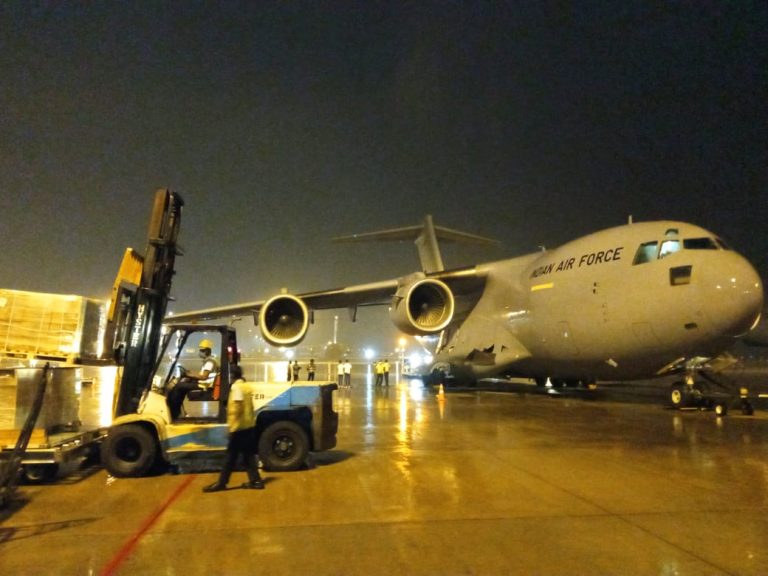
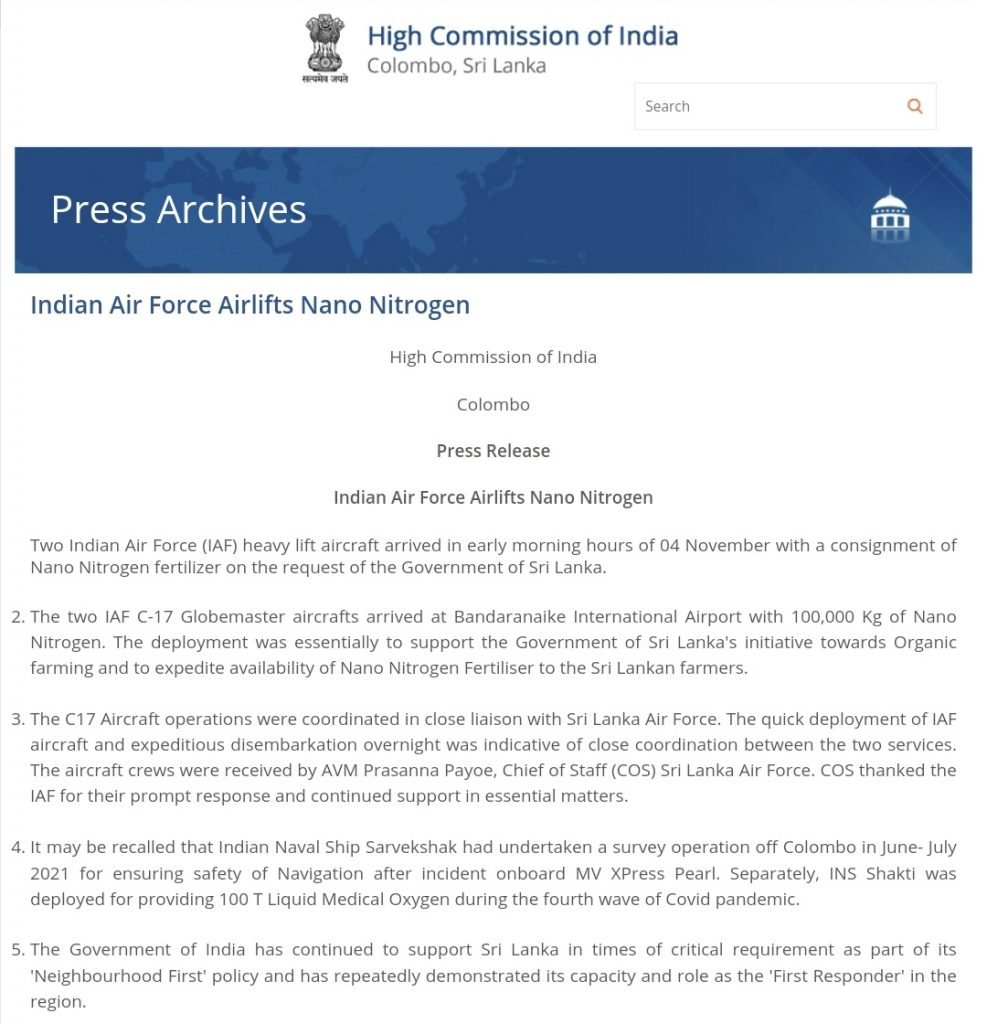
The Indian Air Force has lifted 100,000 kilograms of Nano Nitrogen fertilizer to Sri Lanka after the Government of Sri Lanka requested the same. The Sri Lankan Government requested the supply of Nano Nitrogen after they detected contamination in the organic fertilizer supplied by China.
Source: Sidhant Sibal/WION
The High Commission of India in Colombo, Sri Lanka said in a statement, “Two Indian Air Force (IAF) heavy lift aircraft arrived in early morning hours of 04 November with a consignment of Nano Nitrogen fertilizer on the request of the Government of Sri Lanka.”
The statement stated further, “The two IAF C-17 Globemaster aircrafts arrived at Bandaranaike International Airport with 100,000 Kg of Nano Nitrogen. The deployment was essentially to support the Government of Sri Lanka’s initiative towards Organic farming and to expedite availability of Nano Nitrogen Fertiliser to the Sri Lankan farmers.”
“The Government of India has continued to support Sri Lanka in times of critical requirement as part of its ‘Neighbourhood First’ policy and has repeatedly demonstrated its capacity and role as the ‘First Responder’ in the region,” it added.
As we had reported earlier, Sri Lanka had rejected a consignment of Chinese fertiliser stating that it was contaminated and it did not pass its quality standards. Sri Lanka’s Plant Protection Ordinance prohibits the government from importing any product that is found to host microbes or other harmful microorganisms. However, tests carried out on Chinese samples showed the batch was contaminated with harmful microbes. The Chinese officials, however, asked Sri Lanka to re-test the contaminated batch claiming the standards on the island nation did not meet the international standards.
Sri Lanka conveyed its decision to China with a non-compliance report, informing Beijing that it has not allowed for bulk permit to the Chinese batch of fertilisers, which prevents it from entering or loading in Sri Lanka.
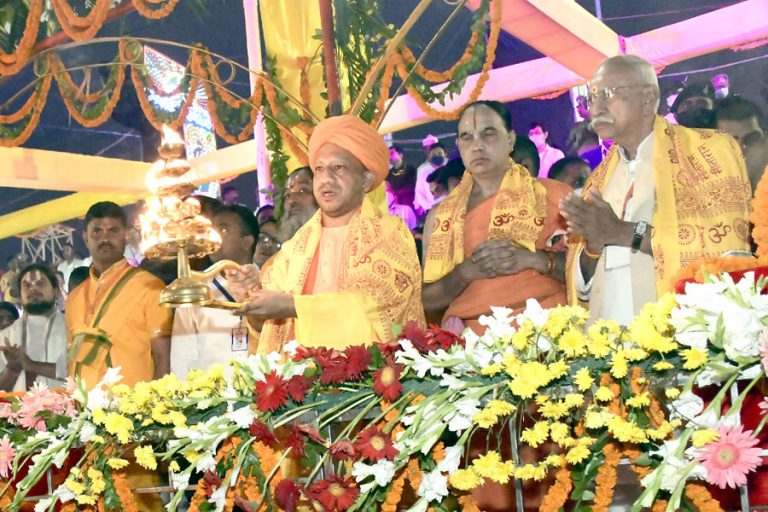
Uttar Pradesh Chief Minister Yogi Adityanath personally visited the homes of the beneficiaries of Pradhan Mantri Jan Awas Yojana and gifted them firecrackers and sweets for Diwali. ‘It is our promise to fulfill all your dreams,’ Yogi said.
'आत्मीयता' के धरातल पर जब खड़ी होती हैं 'सम्मान' की दीवारें और उस पर पड़ती है 'सुरक्षा' की छत, तब पूरा होता है 'अपने घर' का स्वप्न।
श्री भगत लाल जी को PM अवास योजना के तहत मिले 'अपने घर' में दीपावली मनाने की ढेरों बधाई।
The saffron-clad monk could be seen interacting with the child in the family and saying that the crackers were for him. The child looked happy with the gifts the Mahant of Gorakhnath Muth brought for him.
The woman said that since Yogi Adityanath has visited them on the auspicious occasion, then he must enter their home. The Uttar Pradesh CM gladly obliged her wish.
Earlier in October, Prime Minister Narendra Modi had digitally handed over the keys to 75000 PMAY beneficiaries across all districts of Uttar Pradesh. The Prime Minister had said that he was happy and satisfied that these beneficiaries will be able to celebrate all upcoming festivals, like Diwali, Chat Puja etc in their new houses.
The Prime Minister had further said that what makes him even happier is that the ownership rights of at least 75 per cent of the houses provided to beneficiaries under the Pradhan Mantri Awas Yojana have been awarded to females or at least they are joint owners.
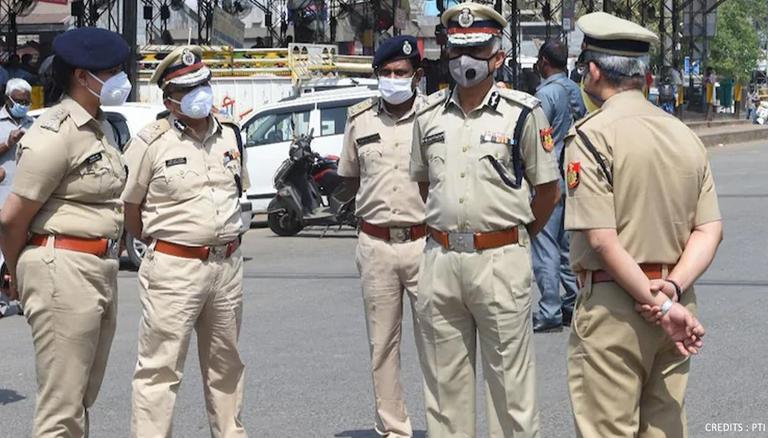
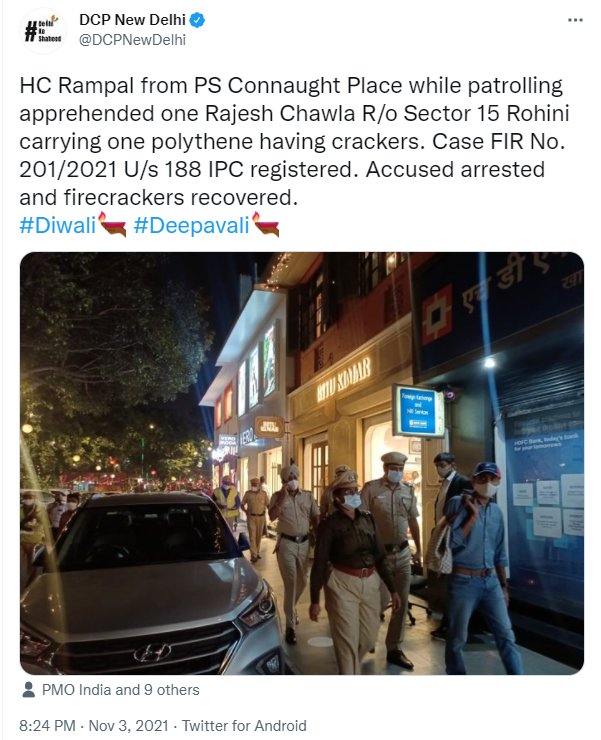
On Thursday (November 4), the Delhi police arrested a man for carrying a bag of firecrackers on the occasion of Diwali. The cops have also recovered the firecrackers from the accused.
In a tweet, the official Twitter handle of DCP (New Delhi) informed that HC Rampal of Connaught Place police station had apprehended a man named Rajesh Chawla for carrying one polythene of firecrackers. Chawla is a resident of Rohini Sector 15. A First Information Report (FIR) no. 201/2021 was lodged against him under Indian Penal Code Section 188 (Disobedience to order duly promulgated by public servant).
Screengrab of the tweet by Delhi police
The ‘brave’ crackdown on firecrackers by Delhi police could not stop ‘farmer protestors’ from wrecking havoc on Republic Day. In January this year, the cops had given permission to 5000 tractors to participate in the rally on the condition of abiding by the mapped routes on Republic Day.
Both sides had agreed on 36 points regarding the route, the number of people allowed and other law and order conditions. However, what followed after that is regarded as one of the darkest days in India’s democracy. During the riots, some of the ‘farmers’ had unfurled the Sikh religious flag called the Nishan Sahib on top of the Red Fort where traditionally the PM unfurls the national flag on Independence Day.
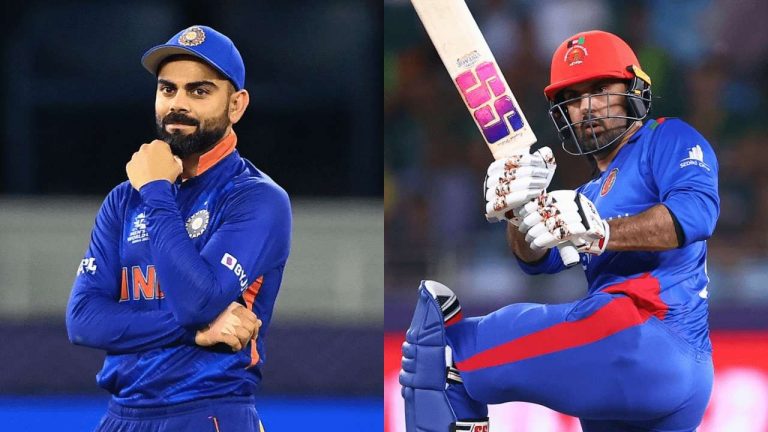
Following the victory of India against Afghanistan by a margin of 66 runs in the group stage match of T20 World Cup 2021, Pakistani cricket fans tried to sour India’s celebrations. They alleged that the Board of Cricket Control in India (BCCI) fixed the match in its favour and that Afghan players complied with such wrongdoing for lucrative IPL contracts.
Afghanistan won the toss and decided to bowl first. With a strong partnership at the very onset, India managed to post a mammoth score of 210 runs on the scoreboard in 20 overs. In reply, Afghanistan could only score 144 runs for the loss of 7 wickets. Soon after, Pakistanis began peddling conspiracy theories to tarnish the credibility of the Indian team.
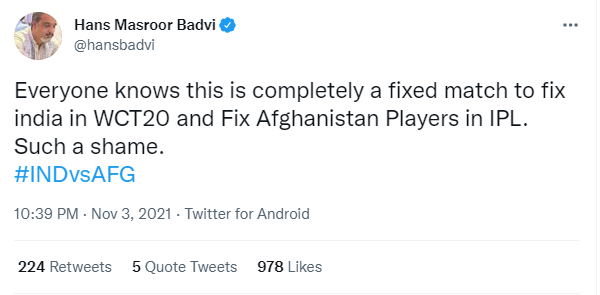
Hans Masroor Badvi, a network security professional, claimed that the match between India and Afghanistan was fixed to ensure the place of Afghan players in the next edition of the Indian Premier League (IPL). “Everyone knows this is completely a fixed match to fix India in WCT20 and Fix Afghanistan Players in IPL. Such a shame. #INDvsAFG,” he wrote.
Screengrab of the tweet
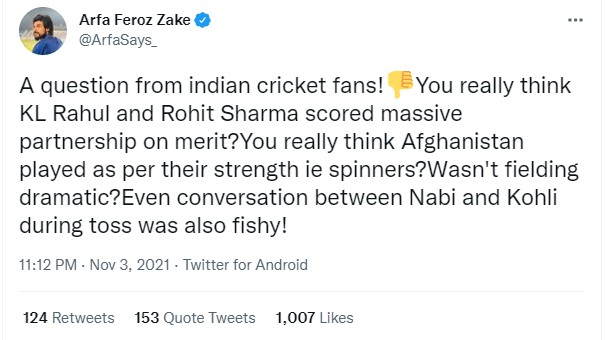
Arfa Feroz Zake, a Pakistani journalist, also tried to peddle conspiracy theories. He alleged, “You really think KL Rahul and Rohit Sharma scored massive partnership on merit? You really think Afghanistan played as per their strength ie spinners? Wasn’t fielding dramatic?” The journalist also claimed that the casual chat between the skippers of both the teams during the toss was ‘fishy’, suggesting that the alleged ‘fixing plan’ must have been made at that point in time.
Screengrab of the tweet
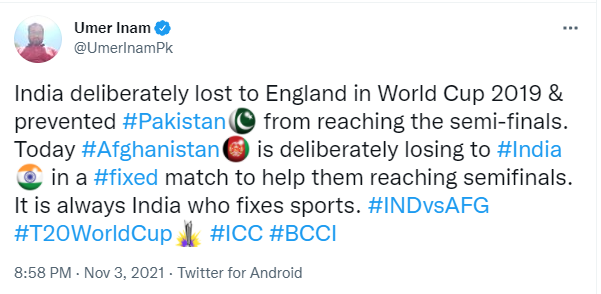
Another Pakistani journalist tried to cast aspersions about the integrity of the Indian cricket team. “India deliberately lost to England in World Cup 2019 & prevented #Pakistan from reaching the semi-finals. Today Afghanistan is deliberately losing to India in a fixed match to help them reaching the semifinals. It is always India who fixes sports,” wrote Umer Inam.
Screengrab of the tweet
Another Pakistani shared a clip of a misfielding by an Afghan cricketer to claim that BCCI had fixed the India Vs Afghanistan match.
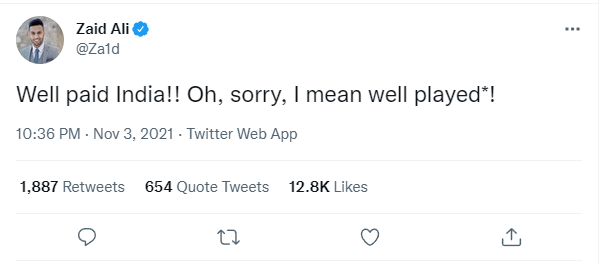
Popular Twitter user Zaid Ali claimed, “Well paid India!! Oh sorry, I mean well played*!”
Screengrab of the tweet
It must be mentioned that Pakistan has qualified for the semi-finals while India’s hopes rest on the loss of New Zealand against Nambia or Afghanistan.
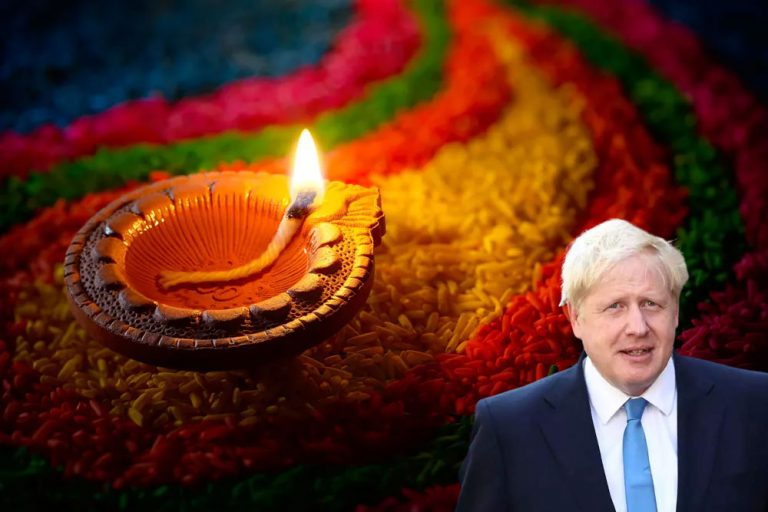
United Kingdom’s Prime Minister Boris Johnson has greeted Hindus on the eve of Diwali. Mentioning Bhagwan Ram’s return to Ayodhya, he said, “Hi folks, this is Boris Johnson wishing everybody a very happy Diwali. The lights are on in Leicester’s Golden Mile, the samosas and sweet treats are being handed out, and people are taking in all the wonderful sights, smells and sounds that make this festival so luminous and exciting. And, of course, so meaningful. Because Today marks the moment when Lord Rama and Sita – their way lit by many thousands of lamps – returned triumphantly to their home after the Demon King Ravana had been roundly defeated.”
Boris Johnson: “its very simple, Britain would be a lesser country today, without the huge contribution of Indians living here. Shubh Diwali.”@BorisJohnsonpic.twitter.com/0CqTiBnQA7
He further added, “And, of course, running through this occasion is the central message of good over evil, hope over despair, knowledge over ignorance, an uplifting message that I believe we can all take to our hearts. And with the autumnal nights growing ever longer and darker across Britain, this spectacular festival usher in a new mood and a new spirit of optimism and joy. So whether you have been celebrating on Soho Road in Birmingham, enjoying a ride on the Wheel of Light in Leicester, or you’re going alone to watch the fireworks later this week, this really is a festival that can bring all of us together.”
He thanked British Indians for their contributions and said Britain would have been a lesser country without them. He said, “And to British Indians for whom this festival means so much, I want to express my personal admiration and respect for everything you do for our country. Quite simply, Britain would be a lesser country without your contribution. From running most of our successful businesses to leading scientific research, serving the public in our NHS, our police, our Armed Forces, at every turn making our country more prosperous, healthy, generous and secure. So to everyone celebrating Diwali here in Britain and around the world, I want to wish you all a happy Diwali and a joyful and successful new year. Shubh Diwali!”
Boris Johnson’s address for Sikhs on Bandi Chhor Diwas
In another address, he wished Sikhs on Bandi Chhor Diwas and Jains on Diwali. He said, “Namaste, it’s Boris Johnson here, sending my best wishes to everyone celebrating this year’s Festival of Lights, and after the tough times we’ve all had, I hope that this Diwali and Bandi Chhor Divas for our Sikh friends are truly special.”
“Of course, this time of the year is about getting together with family and friends, and when we think back to last November, there’s no doubt we’ve come a long way. So I want once again to say a huge thank you to Britain’s Hindus, Sikhs, Jains for everything you have done to support the vulnerable and help keep people safe over the past 18 months.”
PM Johnson further reminded people that Covid is not over yet, and one much follow guidelines while enjoying festivities and meeting people. He said, “This year the Wheel of Lights is back up in Leicester, events are being held across the country, and as you look forward to the celebrations and to feating, perhaps some delicious mithai, we can all reflect on the powerful message at the heart of this festival, of good triumphing over evil, light over darkness, knowledge over ignorance.
And, of course, its knowledge in the form of a vaccine that’s allowing us to get on with our lives in the face of COVID. Of course, the pandemic isn’t over yet, and I urge everyone to keep sticking to the guidance. Wash your hands, keep fresh air flowing, consider using a face covering in a crowded place, where meeting people you don’t normally meet and get that booster jab as soon as you’re called for it.”
Remembering the struggle India faced at the beginning of 2021 due to the second wave of Covid, he said, “But for now, I simply want to wish everyone in the UK and around the world and particularly our friends in India who suffered so much earlier this year, a very happy Diwali. May your year be filled with light and joy and prosperity.”
On November 3, after the centre announced cut in excise duty on petrol and diesel, the NDA-ruled states followed suit and reduced VAT on the fuel. The BJP/NDA-ruled stated announced new fuel prices almost immediately after the Government of India said that the petrol price would be reduced by Rs 5 and diesel price would go down by Rs 10 from November 4.
Uttar Pradesh
Poll-bound Uttar Pradesh’s Chief Minister Office announced that prices of diesel and petrol in the state would be reduced by Rs 12 per litre each.
Prices of diesel and petrol in UP will be reduced by Rs 12 per litre each: Chief Minister’s Office
Before announcing the additional reduction in the price of fuel, Chief Minister Yogi Adityanath thanked Prime Minister Modi for reducing excise duty. In a tweet in Hindi, he said, “Honorable Prime Minister Shri Narendra Modi Ji’s decision to reduce excise duty on petrol and diesel in the public interest has brought more happiness on Diwali. The decision is going to bring relief to every section of society. Heartfelt thanks to the respected Prime Minister on behalf of all the people of the state.”
आदरणीय प्रधानमंत्री श्री @narendramodi जी द्वारा जनहित में पेट्रोल और डीजल पर एक्साइज ड्यूटी कम करने के निर्णय ने दीपावली को अतिरिक्त उल्लास से भर दिया है।
यह निर्णय समाज के हर वर्ग को राहत पहुंचाने वाला है।
सभी प्रदेशवासियों की ओर से आदरणीय प्रधानमंत्री जी का हार्दिक आभार।
Chief Minister of Karnataka, Basavaraj S Bommai, thanked Prime Minister Modi for the decision. He further added that the state of Karnataka has decided to reduce the price of diesel and petrol by Rs 7 per litre. The petrol price in the state would go down to Rs 95.50 and diesel price would be Rs 81.50.
ರಾಜ್ಯ ಸರಕಾರದ ಈ ನಿರ್ದಾರ ನಾಳೆ ಸಾಯಂಕಾಲದಿಂದ ಅನ್ವಯವಾಗುವುದು. ಇದು ಕೇಂದ್ರ ಮತ್ತು ರಾಜ್ಯ ಸರಕಾರದಿಂದ ರಾಜ್ಯದ ಜನತೆಗೆ ದೀಪಾವಳಿಯ ಉಡುಗೊರೆ. ಸರ್ವರಿಗೂ ದೀಪಾವಳಿಯ ಹಾರ್ದಿಕ ಶುಭಾಶಯಗಳು. 3/3@CMofKarnataka
It will be applicable across the state from the evening of November 4. “It is the gift of Diwali to the people of the state by the central and state government,” he added.
ಶ್ರೀ @narendramodi ಅವರ ನೇತೃತ್ವದ ಕೇಂದ್ರ ಸರಕಾರ ಡೀಸಲ್ ಮೇಲೆ 10 ರೂ ಹಾಗೂ ಪೆಟ್ರೋಲ್ 05 ರೂ ಕಡಿಮೆ ಗೊಳಿಸಿದ್ದು ಸ್ವಾಗತಾರ್ಹ ಜನರಿಗೆ ದೀಪಾವಳಿಯ ಉಡಗೊರೆ ಕೊಟ್ಟಿದ್ದಾರೆ ಪ್ರಧಾನಿ ನರೇಂದ್ರ ಮೋದಿ ಅವರಿಗೆ ಅಭಿನಂದನೆಗಳು, 1/3
Himanta Biswa Sarma, Chief Minister of Assam, thanked PM Modi and announced an additional reduction of Rs 7 on VAT for both petrol and diesel. In a tweet, he said, “Heartening to learn Central Govt decision to reduce excise duty on petrol and diesel. In consonance with the decision of Hon’ble PM Narendra Modi, I am pleased to announce that Assam Govt will also reduce VAT on petrol and diesel by Rs 7/- with immediate effect.”
Heartening to learn Central Govt decision to reduce excise duty on petrol and diesel. In consonance with the decision of Honble PM @narendramodi ,I am pleased to announce that Assam Govt will also reduce VAT on petrol and diesel by Rs 7/- with immediate effect @nsitharaman
Biplab Kumar Deb, Chief Minister of Tripura, also welcomed the decision by the central government. He said, “Following Hon’ble PM Shri Narendra Modi Ji led central govt’s decision on reduction of excise duty on petrol & diesel. Tripura govt has also decided to reduce petrol & diesel cost by ₹ 7 from tomorrow.”
Following Hon’ble PM Shri @narendramodi Ji led central govt’s decision on reduction of excise duty on petrol & diesel. #Tripura govt has also decided to reduce petrol & diesel cost by ₹ 7 from tomorrow.
Sushil Kumar Modi, former deputy CM of Bihar, announced a reduction of VAT by Rs 1.30 on petrol and 1.90 on diesel. The total price of the fuel will go down by Rs 6.30 for petrol and Rs 11.90 for diesel in the state.
In Bihar there will be further reduction of state VAT by 1.30 Rs.on Petrol and 1.90 Rs .on Diesel apart from Rs5 & 10 Rs reduction on excise duty .Effectively Petrol will be cheaper by Rs.6.30 & Diesel by 11.90 in Bihar.@ABPNews@ANI@ZeeBiharNews@News18Bihar
Dr Pramod Sawant, Chief Minister of thanked PM Modi for the Diwali gift to all Indians by reducing excise duty on the fuel. He announced an additional reduction of VAT by Rs 7 on both petrol and diesel. He said. “The Modi Govt. has given a great Diwali gift to all Indians by announcing a reduction in Excise Duty on Petrol and Diesel. I thank the Hon’ble PM Narendra Modi Ji as this decision shall give great relief to the common man and help control inflation.”
In addition, Government of Goa shall reduce an additional Rs 7 on Petrol and Rs 7 on Diesel, thereby reducing the price of diesel by Rs 17 per litre and petrol by Rs 12 per litre. 2/2
He further added, “In addition, Government of Goa shall reduce an additional Rs 7 on petrol and Rs 7 on Diesel, thereby reducing the price of diesel by Rs 17 per litre and petrol by Rs 12 per litre.”
Gujarat
Bhupendra Patel, Chief Minister of Gujarat, thanked PM Modi for the announcement.
દેશવાસીઓને દિપાવલી ભેટ આપતા પ્રધાનમંત્રી શ્રી @narendramodi જી એ પેટ્રોલ અને ડીઝલ પરની એકસાઈઝ ડ્યુટી ઘટાડી પેટ્રોલમાં લિટરે ૫ રૂપિયા અને ડીઝલમાં 10 રૂપિયા ઘટાડવાના કરેલા પ્રજાલક્ષી નિર્ણય બદલ સમગ્ર ગુજરાતની જનતા જનાર્દન આપનો હ્દયપૂર્વક આભાર માને છે.
He also announced an additional reduction of Rs 7 on VAT and said, “Today, the state has announced an additional reduction of Rs 7 per litre in petrol and diesel prices.”
આજે રાજ્યમાં પેટ્રોલ ડીઝલના ભાવમાં લિટરે વધારાનો 7 રૂપિયાનો ઘટાડો કરવાની જાહેરાત કરી છે.પ્રધાનમંત્રી શ્રી @narendramodi જી એ કેન્દ્ર સરકાર દ્વારા પેટ્રોલ-ડીઝલ પર લેવાની થતી એકસાઈઝ ડ્યુટીમાં ઘટાડો કરવાના કરેલા નિર્ણયને આજે મધ્યરાત્રીથી આ ભાવ ઘટાડા નો અમલ કરવાનો નિર્ણય કર્યો છે.
He added, “Gujarat Administration has decided to implement the central government’s decision to reduce the excise duty on petrol and diesel from midnight today.”
Manipur
N Biren Singh, Chief Minister of Manipur, thanked PM Modi for the decision and announced an additional reduction of Rs 7 on VAT for both petrol and diesel.
Heartily welcome PM @narendramodi Ji’s decision to reduce excise duty on petrol & diesel as a gift to the people of this Nation on this Diwali.
I’m also please to announce that the Govt. of Manipur will also reduce VAT on petrol and diesel each by Rs 7/- with immediate effect.
Pushkar Singh Dhami, Chief Minister of Uttarakhand, announced an additional reduction of Rs 2 on VAT, making it a total price drop of Rs 7 for petrol in the state.
उत्तराखण्ड सरकार ने भी पेट्रोल पर ₹2 प्रति लीटर की अतिरिक्त राहत देने का निर्णय लिया है।
Prem Singh Tamang (Golay), chief Minister of Sikkim, also announced an additional price drop of the fuel.
In view of this decision & on the auspicious occasion of Diwali, I would like to announce that the State Government will be reducing the prices of Petrol & Diesel in the state by Rs.7/(seven) per liter as a Diwali gift. This will come into effect starting today i.e 04/11/2021 2/2
He said, “I would like to announce that the State Government will be reducing the prices of Petrol & Diesel in the state by Rs.7/(seven) per litre as a Diwali gift.”
Madhya Pradesh
Madhya Pradesh government, too, announced reduction of 4% reduction in VAT on petrol and diesel.
Madhya Pradesh government announces reduction of Value Added Tax (VAT) on petrol and diesel by 4%: Chief Minister Shivraj Singh Chouhan pic.twitter.com/6tgAR17z4X
NDA-ruled Haryana government, too, reduced VAT making petrol and diesel cheaper by Rs 12 per litre.
दीपावली के अवसर पर केंद्र सरकार ने पैट्रोल व डीज़ल की कीमतों में कमी की घोषणा की है, उसे आगे बढाते हुए हरियाणा सरकार ने भी राज्य में पैट्रोल व डीज़ल में VAT को कम कर दिया है, अब पूरे हरियाणा प्रदेश में पेट्रोल एवं डीज़ल, दोनों 12 रु प्रति लीटर सस्ते हो जाएँगे।
Haryana Chief Minister Manohar Lal Khattar took to Twitter to say that on occasion of Diwali, the state government of Haryana, after Central government cut Excise, has decided to reduce VAT and now both, petrol, as well as diesel will be cheaper by Rs 12/litre.