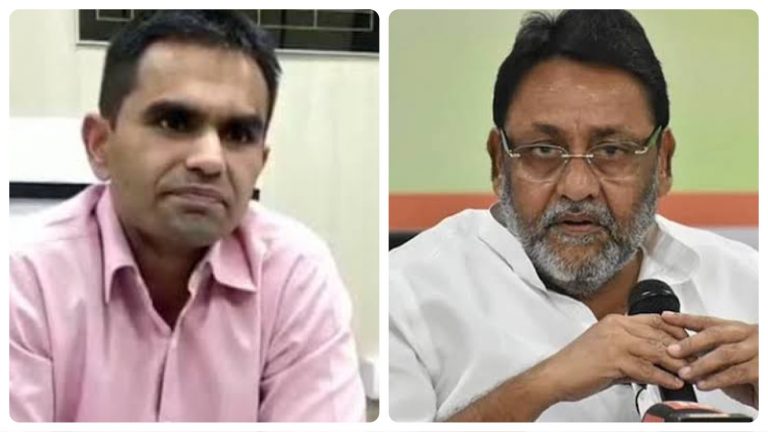
The National Commission for Scheduled Castes on Friday took cognisance of the complaint filed by the Zonal Director of Mumbai’s NCB Sameer Wankhede over the continuous harassment meted out to him by Maharashtra government minister and Nationalist Congress Party leader Nawab Malik.
The commission has written to the Maharashtra government asking them to present a report on the matter within 7 days.
#JustIn | National Commission for Scheduled Castes takes note of #SameerWankhede’s complaint, writes to #Maharashtra Govt. State Goct has been asked to submit its report within 7 days.
Sameer Wankhede writes to SC Commission against harassment by Maharashtra Minister Nawab Malik
NCB Mumbai Zonal Director Sameer Wankhede had on Thursday written a letter to the National Commission for Scheduled Castes alleging his continuous harassment by Maharashtra government minister and Nationalist Congress Party leader Nawab Malik.
Sameer Wankhede has been facing a barrage of allegations and harassment right after Aryan Khan, son of Bollywood actor Shah Rukh Khan, was arrested in the Cordelia Cruise drugs bust case early in October.
Nawab Malik trains his guns at Sameer Wankhede, accuses the NCB officer of forging his identity to claim caste benefits
Interestingly, Malik going personal against Wankhede and hitting below the belt could stem from the fact that Wankhede had arrested Sameer Khan, son-in-law of the minister in a separate drugs case earlier in January 2021.
Malik released some documents in the public domain to claim that Wankhede was actually a Muslim who took benefit of reservation for Scheduled Caste to get the coveted job in Indian Revenue Service. Malik released his purported birth certificate and Nikahnama. Malik claimed that on December 7, 2006, when Wankhede was married to Shabana Qureshi his name was mentioned as Sameer Dawood Wankhede in the Nikahnama.
Malik had further alleged Wankhede had tried to extort money from Shah Rukh Khan. He raised suspicions on Maldives visit of the officer and later on shared a letter against Wankhede purportedly written by an NCB officer. Malik has been aimlessly shooting in the hope that some of them might work against Wankhede and he may be withdrawn from the investigation.
The NCB officer writing to the SC Commission has come after he had approached the Bombay High Court for protection. Fearing his arrest by Mumbai police, Wankhede on Thursday had requested that any investigation against him should be conducted only by CBI or NIA, and not by Mumbai Police.
On Friday (October 29), the Calcutta High Court ordered a complete ban on all kinds of firecrackers throughout the state of West Bengal during Diwali/Kali Puja. According to reports, the ban on firecrackers would also apply for all other upcoming festivities in the state including Guru Nanak Jayanti, Christmas and New Year’s celebrations. The development came after a PIL was filed in the Court by a traveller cum filmmaker Roshni Ali.
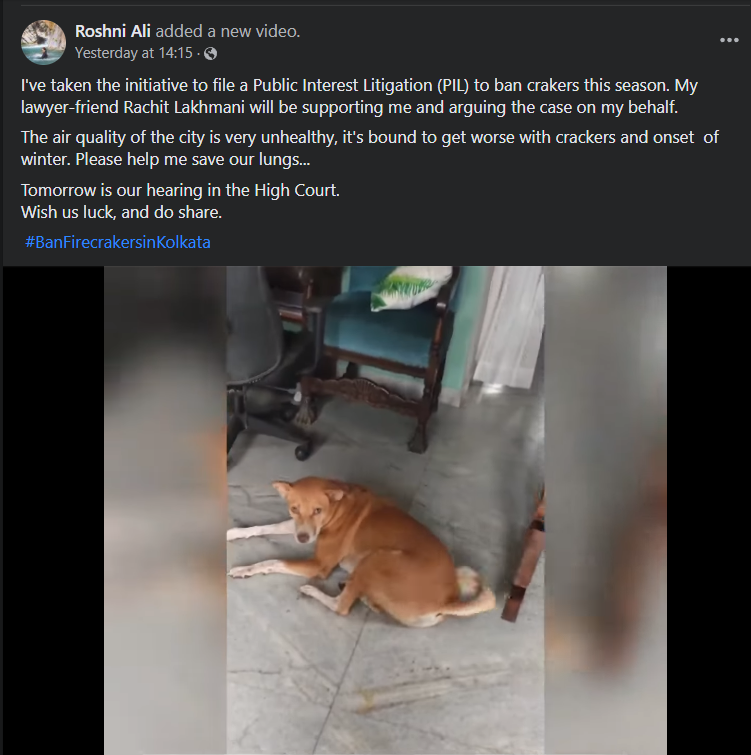
In a Facebook post on Thursday (October 28), Roshni Ali had confirmed that she had filed a Public Interest Litigation (PIL) before the Calcutta High Court to ban the use of crackers ahead of Diwali. “My lawyer-friend Rachit Lakhmani will be supporting me and arguing the case on my behalf. The air quality of the city is very unhealthy, it’s bound to get worse with crackers and the onset of winter. Please help me save our lungs. Tomorrow is our hearing in the High Court. Wish me luck and do share,” she wrote.
Screengrab of the Facebook post of Roshni Ali
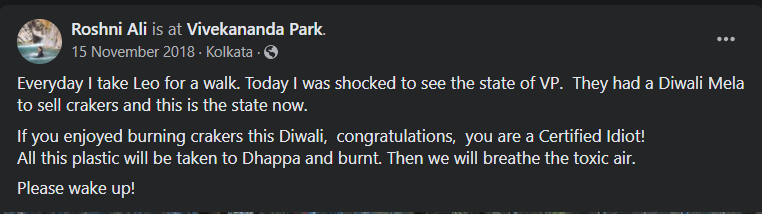
This is however not the first time that the traveler-cum-filmmaker had turned to environmental activism during Diwali. In a Facebook post dated November 15, 2018, Roshni Ali had demonised those who celebrated Diwali by burning crackers as ‘certified idiots.’ She had claimed, “All this plastic will be taken to Dhapa and burnt. Then, we will breathe the toxic air. Please wake up.”
Screengrab of the Facebook post of Roshni Ali
Love for Beef and patronising behaviour towards Hindus
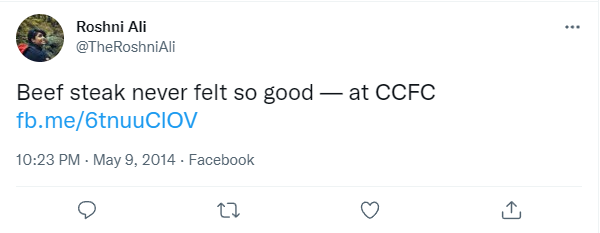
Despite her concerns about the rapidly-changing climate, Roshni Ali did not shy away from letting her followers know about her love for beef steak. In a tweet posted 7 years ago, she had written “Beefsteak never felt so good – at CCFC.” Interestingly, meat consumption accounts for about 60% of all greenhouse gases from food production.
Screengrab of the Twitter post by Roshni Ali
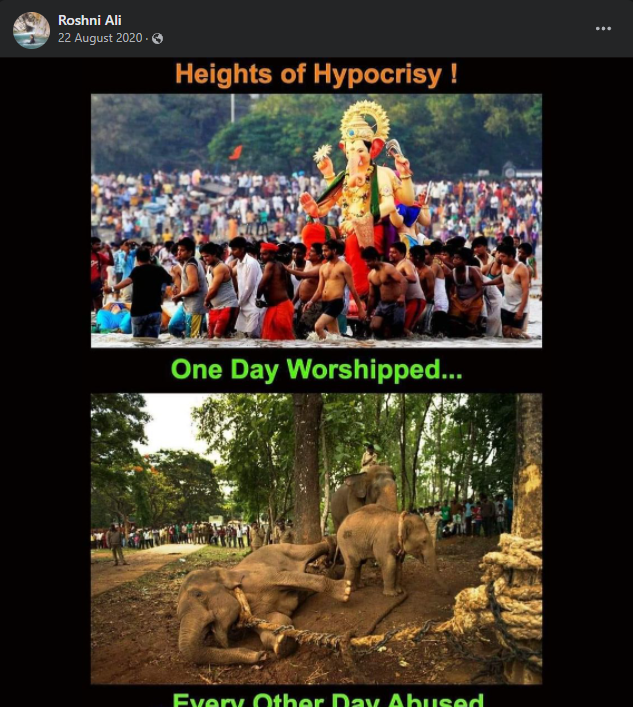
Not just Diwali, Ali had resorted to patronising behaviour before other Hindu festivals as well. During Ganesh Chaturthi in August last year, she suggested that the celebration of Lord Ganesha was meaningless, given that elephants are supposedly ‘abused’ each day.
Screengrab of the Facebook post of Roshni Ali
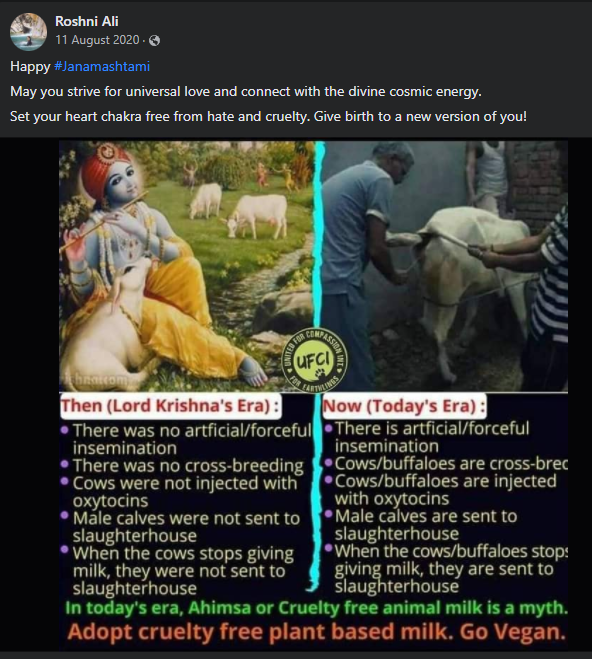
During Janamashtami last year, she propagated that the idea of ‘cruelty-free milk’ was a hoax and urged Hindus to go vegan and drink plant-based milk. She has shared a post citing differences in attitudes towards cow in present era and during the reign of Lord Krishna.
Screengrab of the Facebook post of Roshni Ali
Evoking ‘Hindu guilt’ and display of ‘secular credentials’
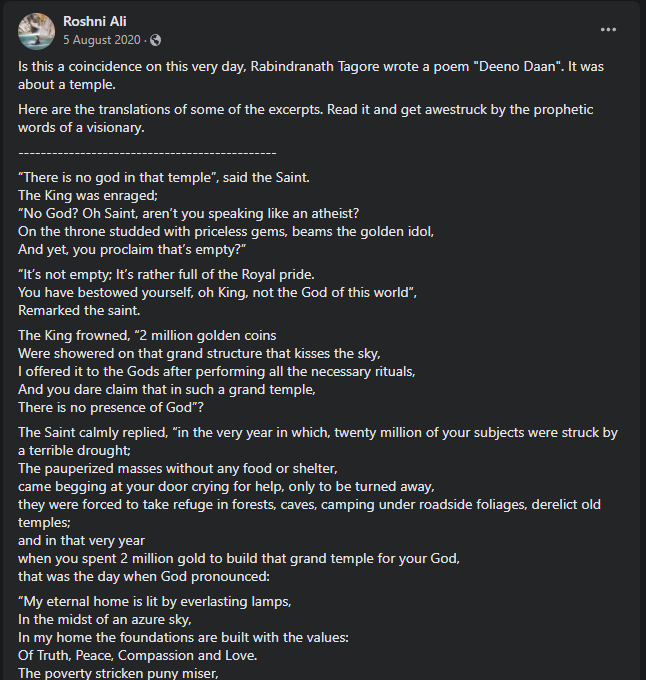
On the day of ‘Bhoomi Pujan‘ of the majestic Ram Mandir in August 2020, Roshni Ali took to Facebook to evoke a sense of ‘guilt’ among her Hindu followers. To propagate the idea that the construction of the much-anticipated Hindu temple was wrong, she had shared a poem titled ‘Deeno Daan‘ by Rabindranath Tagore. “There is no God in that temple, said the Saint,” read the first line of the translated version of the poem. Using it in the context of Bhoomi Pujan to mock Hindu sentiments, she claimed that Tagore’s poem was the prophecy of a visionary leader.
Screengrab of the Facebook post of Roshni Ali
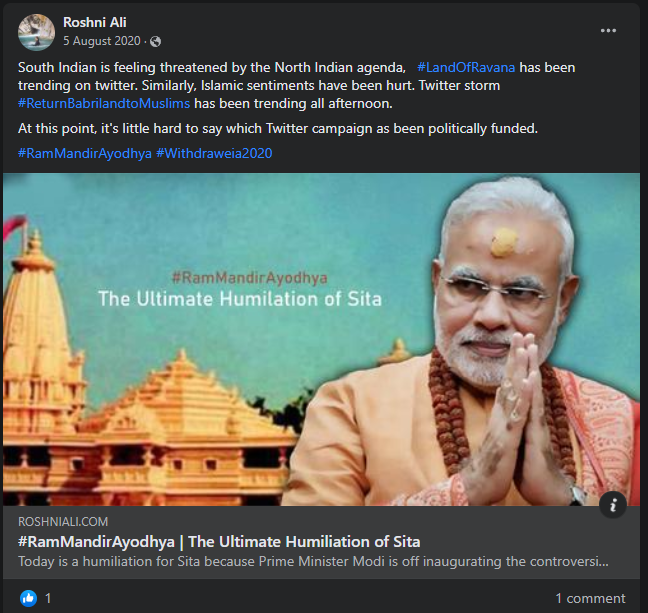
On August 5 last year, she had also penned a blog titled, ‘#RamMandirAyodhya | The Ultimate Humiliation of Sita’ on her website. At the time of writing this article, the blog stands deleted.
Screengrab of the Facebook post of Roshni Ali
While sharing it on Facebook, she had written, “South Indian is feeling threatened by the North Indian agenda, #LandOfRavana has been trending on Twitter. Similarly, Islamic sentiments have been hurt. Twitter storm #ReturnBabrilandtoMuslims has been trending all afternoon At this point, it’s a little hard to say which Twitter campaign has been politically funded.”
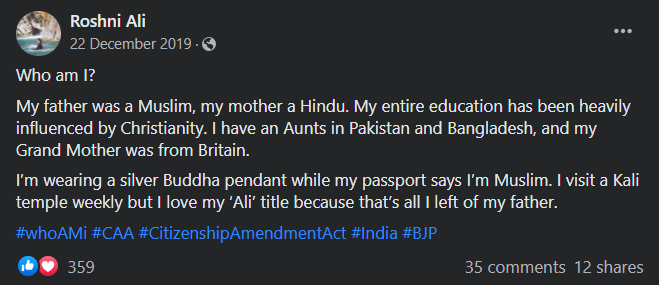
Ali, who clearly opposed the idea of Hindus reclaiming their lost culture and heritage, had earlier cited her own example to display her tolerance to diversity, and the concept of pluralism. She had opposed the humanitarian Citizenship Amendment Act (CAA) that sought to fast track the citizenship of persecuted religious minorities, from the three neighbouring countries of Bangladesh, Pakistan and Afghanistan, living illegally in India before December 31, 2014.
Screengrab of the Facebook post of Roshni Ali
She had claimed, “Who am I? My father was a Muslim, my mother was a Hindu. My entire education has been heavily influenced by Christianity. I have aunts in Pakistan and Bangladesh and my grandmother was from Britain. I’m wearing a silver Buddha pendant while my passport says I’m Muslim. I visit a Kali temple weekly about I love my ‘Ali’ title because that’s all I left of my father.”
Political views of Roshni Ali
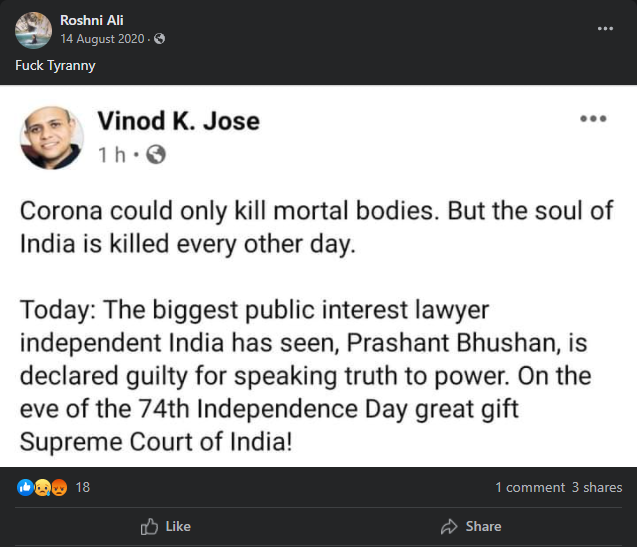
A quick glance at the Facebook and Twitter profiles of Roshni Ali clearly shows her anti-BJP stance and her against the Modi-led government on an array of issues. In August last year, the Supreme Court had held advocate Prashant Bhushan guilty of contempt of court. The case pertained to two tweets where Prashant Bhushan had cast aspersions against the Supreme Court and specifically, CJI Bobde. However, Ali had dubbed the apex Court’s action as an act of ‘tyranny’.
Screengrab of the Facebook post of Roshni Ali
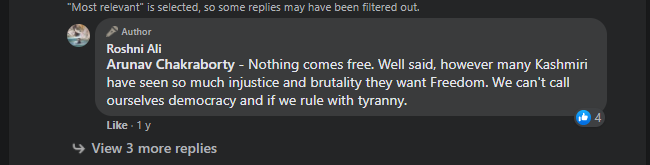
While speaking on the Kashmir issue, Ali parroted the usual lines of the left-Islamist bandwagon in India. While responding to one Facebook user, she had remarked, “…Many Kashmiri have seen so much injustice and brutality, they want Freedom. We can’t call ourselves democracy and if we rule with tyranny.”
Screengrab of the Facebook post of Roshni Ali
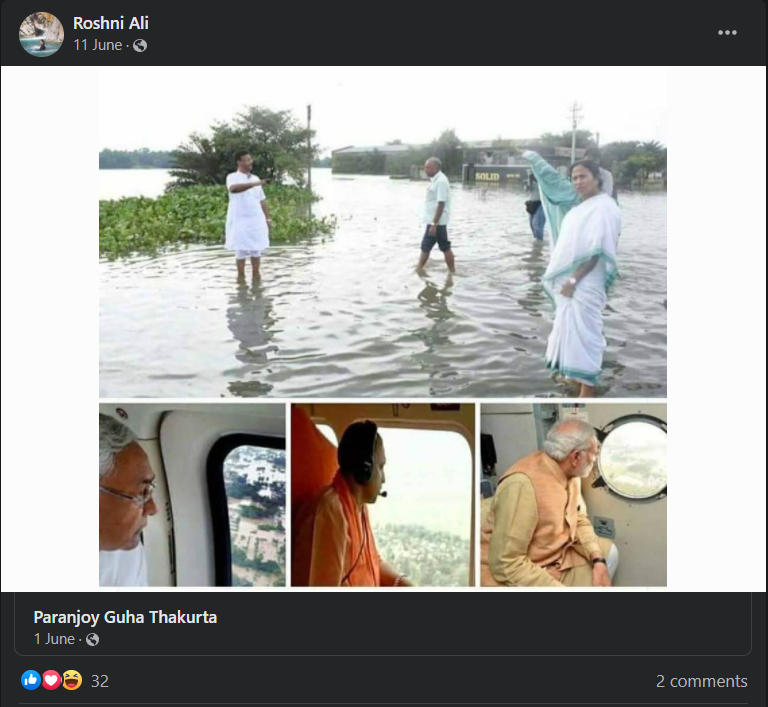
Roshni Ali had also shared a ‘propaganda’ picture, which was originally posted by ‘journalist’ Paranjoy Guha Thakurta. The traveller cum filmmaker tried to suggest that only Mamata Banerjee, of all political leaders, believed in the ground survey while others relied on aerial survey.
Screengrab of the Facebook post of Roshni Ali
Diwali is the festival of ‘lights, which is celebrated in memory of the homecoming of Lord Ram to Ayodhya from Lanka after defeating Ravana. Roshni Ali had earlier opposed the construction of the Ram temple, tried to evoke a sense of guilt among Hindus and stooped to patronising behaviour during Ganesh Chaturthi and Janmashtami. It thus should come as no surprise while Ali’s activism has sharpened once again before Diwali.
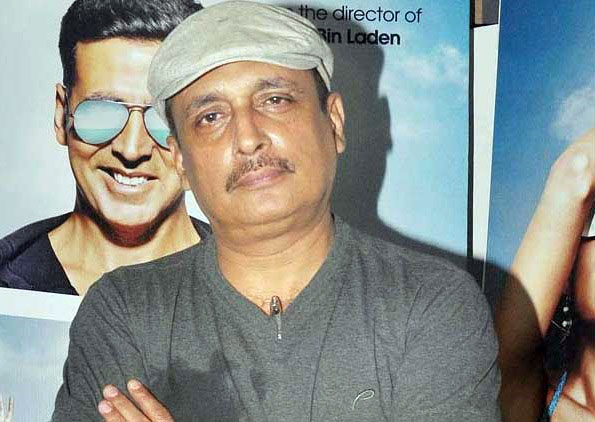
Noted actor Piyush Mishra said that Bollywood celebrities should take care of their children in response to being questioned about Aryan Khan during an interview with Hindustan Times. Aryan Khan, son of Bollywood superstar Shah Rukh Khan, had received bail in the case drug case on Thursday.
“What will be my reaction? He did it, he has got the bail and he is out now. Now Shah Rukh Khan, his son or NCB zonal directorate Sameer Wankhede know better. What have I to do with it? It’s ok, it’s done now. You reap what you sow. Handle your children, that’s it,” Piyush Mishra said.
His comment has come at a time when entire Bollywood has come out in Aryan’s support. Piyush Mishra is an acclaimed actor, composer and singer who has featured in movies such as Gulaal, Dil Se, Rockstar, Gangs of Wasseypur among others. He notably composed, sang and wrote the popular song ‘Aarambh hai Prachand’ from the movie Gulaal.
Aryan Khan along with his friend Arbaaz Merchant and others were arrested by Narcotics Control Bureau on October 2 on the Cordelia Cruise ship which was on its way to Goa. Aryan was subsequently detained along with several others before he was ultimately arrested.
Aryan Was awarded bail by the Bombay High Court on Thursday with 14 conditions attached. The court specified that even if one condition is violated, NCB would be entitled to apply to the special court for cancellation of bail.
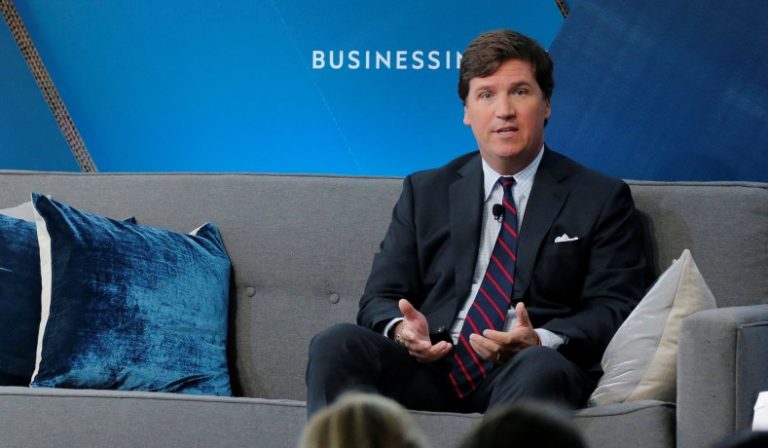
Fox News anchor Tucker Carlson has come under fire from Democrats after releasing the trailer of a documentary series on the Capitol Hill riots on January 6th earlier this year. The series titled ‘Patriot Purge’ is set to begin airing from the 1st of November on Tucker Carlson Originals on Fox Nation.
However, the trailer itself has angered Democrats and anti-Donald Trump Republicans alike, who are now accusing the Fox News anchor of producing terrorist propaganda. Representative Eric Swalwell accused Carlson of “radicalizing terrorists”. He said that the terrorists are ready to commit violence against “whoever Tucker says the target is.”
Tucker Carlson is radicalizing terrorists. They’re making bombs, loading guns, and sharpening their knives and ready to aim their venom at whoever Tucker says the target is. https://t.co/Wrq7S8l6pT
Republican Representative Liz Cheney, daughter of former US Vice President Dick Cheney, said that Fox News was providing platform to the same kind of lies that “provoked” January 6 riots. Liz Cheney has not seen the documentary yet, therefore, it is not clear how she can make that claim.
On an unrelated note, her father Dick Cheney was at the forefront of peddling the ‘Weapons of Mass Destruction’ hoax that was used a justification for the US invasion of Iraq. The disastrous war ultimately ended up destabilizing the whole region and fueled the rise of ISIS.
Alexander S. Vindman, an anti-Trump activist and Former Director for European Affairs for the United States National Security Council, claimed Tucker Carlson is an “anarchist” and “an arsonist of American democracy”.
He is an anarchist; an arsonist of American democracy. How is this different than yelling fire in a crowded theater? Carlson is attempting to incite a riotous mob. He should be censured. I’d like to hear the arguments for/against this being protected speech. https://t.co/xHTaxXo2p2
Ahmed Baba, co-founder of ‘Rantt media’, claimed that the documentary series “might be the most dangerous piece of content dropped since the insurrection.”
I finally just watched that Tucker Carlson documentary trailer and my god. I won't share it to add more views, but this might be the most dangerous piece of content dropped since the insurrection. Tucker and the Murdochs are tapping into the absolute worst of the American psyche.
CNN reporter Oliver Darcy compared Tucker Carlson to Alex Jones and Infowars.
Tucker Carlson says he is actually doing an entire "week-long event" devoted to 1/6 trutherism.
Again, what is the difference between this stuff and what airs on InfoWars? The only key difference I can think of is that Tucker Carlson has a much larger platform. https://t.co/0iX6bxvQDC
CEO of ADL, Jonathan Greenblatt, went on to write a letter to Fox News asserting that the documentary is absurd.
I wrote to @FOXNews that this “documentary” is nothing short of absurd and it will continue to fan the flames of extremists and conspiracy theorists. This is dangerous, and it’s no surprise that Tucker Carlson is leading the charge bringing fringe ideas to the masses. pic.twitter.com/aSIpHuxz43
Professor of Constitutional Law at Harvard, Laurence Tribe, said, “Tucker Carlson is a dangerous anti-democracy demagogue who poses as the libertarian voice of ordinary people, a fabricator who wraps himself in a fake flag of truth, a self-promoter whose duplicity is coated in gelatinous unctuousness. And that’s the best I can say about him.”
Tucker Carlson is a dangerous anti-democracy demagogue who poses as the libertarian voice of ordinary people, a fabricator who wraps himself in a fake flag of truth, a self-promoter whose duplicity is coated in gelatinous unctuousness. And that's the best I can say about him. https://t.co/QTNeZP6UxE
Scott Dworkin, co-founder and Executive Director at The Democratic Coalition, said that the documentary on January 6th must be completely banned from social media.
Tucker Carlson’s Jan 6 propaganda needs to be completely banned from social media forever. Not even the trailer should be allowed to be posted.
However, Carlson received support amid calls to censor him from conservatives and non-establishment Leftists. Journalist Glenn Greenwald slammed those attempting to censor the Fox News anchor.
Greenwald said, “The reason this Fox program on 1/6 is provoking such fury — aside from the fact that 1/6 has taken on quasi-religious significance for liberals and is the basis for their second War on Terror — is questions about what the FBI knew in advance and what its role was are taboo.”
He explained, “It’s an established fact that the FBI engineered right-wing groups to join a plot to kidnap Gov. Whitmer. It’s an established fact that the FBI had at least two informants at the Capitol (NYT). It’s established fact that FBI had its hooks in the 3 key groups associated with 1/6.”
Greenwald concluded that the only appropriate response to those attempting to censor questions about the FBI’s role in the events of Capitol Hill riots is “to tell them to go f*ck themselves, and then proceed with the journalism.”
There have been attempts recently to censor media coverage that Democrats do not find palatable to their interests. Weeks before election, social media giants had censored a report by the New York Post that revealed some startling details about Hunter Biden since it was believed that it might damage Joe Biden’s chances of becoming President. Since then, the report has been authenticated.
The recent calls for Tucker Carlson to be fired and censored for the documentary is the latest effort to crack down on independent media in the United States of America.
The Calcutta High Court ordered a complete ban on all kinds of firecrackers throughout the state of West Bengal during Diwali/Kali Puja. According to reports, the ban on firecrackers would also apply for all other upcoming festivities in the state including Guru Nanak Jayanti, Christmas and New Year’s celebrations.
#Breaking| #CalcuttaHighCourt orders a complete ban on usage/sale of all kinds of firecrackers including green crackers during the upcoming festivities – Kali Puja/Diwali/Chhat Puja/Christmas. Police instructed to keep a strict vigil on use/sale of firecrackers @ZeeNews
Earlier the state government had allowed green crackers for the upcoming celebrations but the court noted, “Keeping in mind the practical realities, we find that there is no mechanism in place to ascertain whether the crackers being sold/burst are only green crackers in compliance with the norms set in place by the relevant certifying body”.
The order further added, “That apart it would be an impossible task by police and law enforcement bodies to inspect classification of firecrackers under which they are sold…Laying the window open for green crackers to be used would positively entail abundant abuse”,
#CalcuttaHighCourt orders a complete ban on usage/sale of all kinds of firecrackers including green crackers during the upcoming Diwali/Kali Puja festivities. Only wax or oil based diyas permitted to be used. Police instructed to keep a strict vigil on use/sale of firecrackers. pic.twitter.com/sRV4vuytrh
Notably, a PIL ( Public Interest Litigation) was filed by a so-called social worker and ‘environmental activist’ Roshni Ali in the Calcutta High Court, seeking a complete ban on firecrackers due to the existing pandemic situation.
According to reports, the petitioner also cited the 2020 order that had banned firecrackers and stated that Covid situation would worsen in the state if crackers were not banned.
Division bench including Justices Sabyasachi Bhattacharya and Aniruddha Roy passed the order noting the difficulties in establishing that only green crackers as permitted by the Supreme Court are burnt.
The Bombay High Court on Friday dictated the conditions of Aryan Khan’s bail, setting 14 conditions that Bollywood actor Shah Rukh Khan’s son need to strictly comply with.
After three days of the hearing, the Bombay High Court had finally granted bail to Aryan Khan, Munmun Dhamecha and Arbaz Merchant in the cruise ship drug bust case on October 28. While the bail was granted on Thursday evening, Justice Nitin Sambre had said that he would deliver an order setting out the bail conditions today.
The bail order states that Aryan Khan needs to pay a surety of Rs 1 lakh.
According to the bail conditions, Aryan Khan and two other accused Arbaaz Merchantt and fashion model Munmun Dhamecha are also not allowed to travel out ofGreater Mumbai without informing the investigating officer (IO) and should give itinerary of travel to IO.
The accused should not leave the country without permission from a special judge for Narcotic Drugs and Psychotropic Substance Act (NDPS Act) at Greater Mumbai.
Accused shall not indulge in any activity similar to the activities on the basis of which the said CR stands registered against them for offences under the NDPS Act.
He should not try to establish contact with co-accused.
He should surrender his passport before the Special Court immediately.
He should not undertake any action which is prejudicial to the trial/proceedings before the special court.
The accused should not attempt to influence witnesses or tamper with evidence.
They should not make any statement to the media about the case.
They have to attend the office of the Narcotics Control Bureau every Friday between 11 am and 2 pm to mark their presence.
Should attend court on all dates.
Should join the investigation as and when called upon to do so before NCB authorities’.
Should not delay the trial.
NCB could apply for cancellation of bail even if one bail condition is flouted: Bombay HC
The court specified that even if one condition is violated, NCB would be entitled to apply to the special court for cancellation of bail.
Yesterday, Justice NW Sambre of the High Court stated that bail is allowed in the case of the three arrested individuals and the detailed order in the matter will be given later.
Aryan Khan granted bail 25 days after arrest in drug bust case
Aryan Khan, Arbaz and Dhamecha were arrested by NCB on October 3, following a raid on the cruise ship Cordelia in Mumbai by the bureau on October 2. It is after 25 days that Shah Rukh Khan’s son Aryan Khan and two others (Arbaaz Merchantt, Munmun Dhamecha) were granted bail by the Bombay High Court. Former Advocate General Mukul Rohatgi had appeared for Aryan Khan in Bombay High court.
Aryan, Arbaz and Munmun had moved to the Bombay High Court on October 20 after the NDPS court in Mumbai refused to grant bail.
The NCB had arrested over a dozen people in the cruise ship drug case. NCB had stated in Court that Aryan Khan has international links and has been in contact with drug peddlers.
The Court had noted that no drugs were found on Aryan’s person, though the NCB had stated that he was aware that Arbaz had concealed drugs in his shoes.
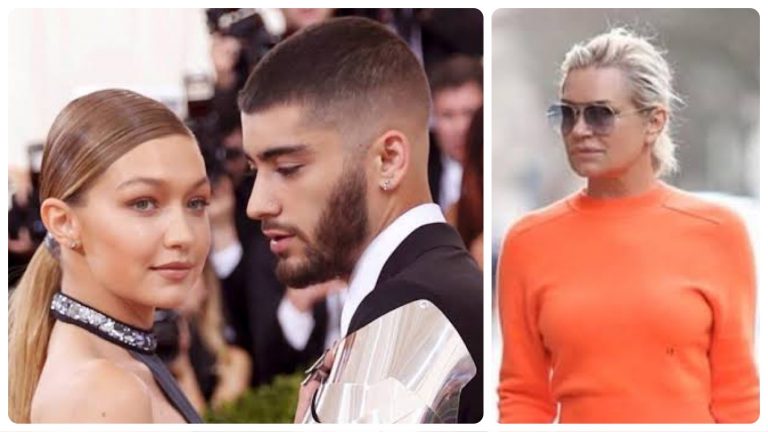
Pop sensation Zayn Malik is parting ways with his girlfriend Gigi Hadid after being together for almost six years. According to the reports, the couple had a fallout after Zayn allegedly hit Gigi’s mother, Yolanda Hadid. Zayn later denied having any scuffle with Gigi’s mother but sources cited by multiple news agencies claim Yolanda came close to filing a police complaint against the singer for punching her in the face.
Malik has “adamantly” denied those allegations and alleged that the singer said in a statement that there was nothing more than an “exchange of harsh words” during an argument over his 1-year-old daughter’s safety and privacy.
“I firmly deny striking Yolanda Hadid, and I decline to provide any further specifics for the sake of my daughter, and I hope that Yolanda will reconsider her false charges and move towards healing these family issues in private,” he told TMZ.
As rumours started doing the rounds, Zayn rushed to social media and published a lengthy response. In the post, the former One Direction star claims that something happened after Yolanda entered his and Gigi’s home while Gigi, 26, was away, but he did not elaborate on what actually transpired in the house that led to his separation with Gigi Hadid.
“As you all know I am a private person and I very much want to create a safe and private space for my daughter to grow up in. A place where private family matters aren’t thrown on the world stage for all to poke and pick apart. In an effort to protect that space for her I agreed to not contest claims arising from an argument I had with a family member of my partner’s who entered our home while my partner was away several weeks ago,” Zayn said in his statement.
“This was and still should be a private matter but it seems for now there is divisiveness and despite my efforts to restore us to a peaceful family environment that will allow for me to co-parent my daughter in a manner in which she deserves, this has been “leaked” to the press. I am hopeful though for healing for all involved with the harsh words shared and more importantly, I remain vigilant to protect Khai and give her the privacy she deserves,” he added.
Gigi has so far chosen to maintain silence on the reported altercation. However, a source close to her was reported as saying that the model had requested “privacy” as the family was working its way through the complicated situation.
“Gigi is only concerned with what is best for Khai. “She requests privacy throughout this period,” her representative said.
While Gigi has remained muted on the controversy, her sister Bella took to Instagram and shared a cryptic message after Zayn issued the statement. Bella shared a picture that spoke of working ‘on yourself’. It read, “I can do nothing for you but work on myself. You can do nothing for me but work on yourself.”
Gigi and Zayn had been in an on and off relationship since 2015. The rumour mill about their romantic link up had kicked up into high gear after they were pictured leaving an American Music Awards after-party together in November 2015. In December of the same year, the couple opened up about their relationship on social media.
The couple had gone through several highs and troughs before Gigi announced reconciliation with Zayn in February 2020. Later in September, they welcomed their child, a girl they named Khai, whom have jealously guarded from prying media eyes.
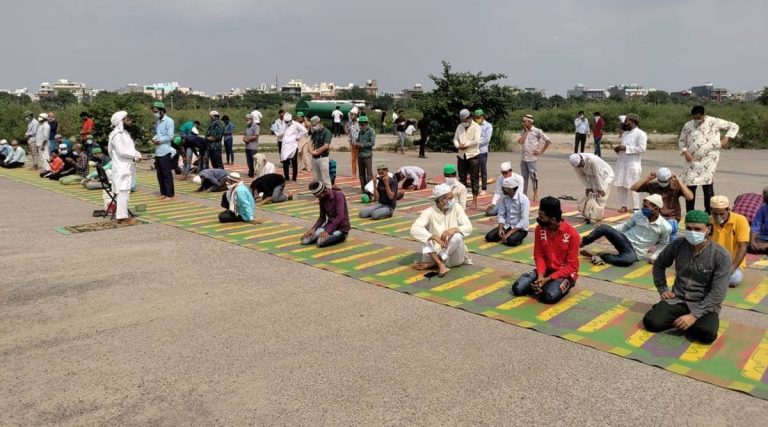
Local Muslims in Gurugram, Haryana want the Namaz in public places to end as they believe it is vitiating the communal atmosphere in the area. Local Muslims in Sector 12 have told Gurugram News that they want things to go back to as they were before when Namaz was not offered in the area.
A shopkeeper in the area, Raees Khan, has said that Namaz is offered in front of his shop which affects business. He said that he has told people to not offer Namaz there but his pleas go unheeded. He further says that Namaz has only been offered there 5 or 6 times, which has caused tensions in the area.
Another shopkeeper, Mahmood Khan, also says the offering of Namaz in the area has created a lot of problems for them. He said that it has affected their business. Mahmood said that he does not know the people who offer Namaz there but only knows Haji Shahzad Khan.
One Mahmood Khan told Hindustan Times, “A group of Muslims has been offering namaz in front of my furniture shop for the past few months. I had requested maulvi in the past not to conduct Friday prayers here, but they ignored my request stating that they were not offering prayer on private land but on government land.” It is not clear if it is the same Mahmood Khan interviewed by Gurugram News but it appears likely.
Another elderly woman said that they have been living there for 40 years and they just want the Namaz to stop. Advocate Kulbhushan Bhardwaj, who has been opposing Namaz in the area, said that he was called there by “Islam Bhai”. Bhardwaj said that he was told by the Muslims there that they had told Shahzad several times to not offer Namaz there.
“Islam Bhai” has passed away four months previously but his sons are now opposing the same. It is being alleged Namaz is being offered forcibly there. Bhardwaj also said that Shahzad goes to all places where Namaz is offered, be it Sector 12, Sector 47 or Sector 40.
Local Muslims and Bhardwaj, both, alleged that Shahzad was behind the entire plot to offer Namaz at the public place in Gurugram. Bhardwaj questioned where is the funding for Shahzad coming from. Haji Shahzad Khan, however, denies the allegations and claimed that he is being targeted.
On the 29th of October, Haryana Police deployed 500 personnel to ensure that Namaz could be offered peacefully at the public places. However, like previous weeks, Hindus protested against the same this Friday as well. The Police have detained dozens of Hindus over the same and the prayers were offered under police protection.
According to a Hindustan Times report, Muslim groups had called Muslims from Nuh and Pataudi for ‘support’. However, it is not clear whether the calls were answered.
France shuts down a supposed anti-Islamophobia organization CRI for spreading “hatred, violence and discrimination”. According to reports, the organization CRI (Co-ordination against Racism and Islamophobia) is accused of provoking violent acts through social networks by the French authorities. In its statement, the Council of Ministers noted that the organization was actively participating in cultivating the suspicions of Islamophobia within the French society.
Speaking against the actions taken by the French government, CRI said, “We are dismayed by the fallacious arguments put forward by the government, and for those who know our actions since our creation in 2008 this despicable attack is in fact only a PR exercise with an electoral aim..” and also added that the association always worked to support victims and had never supported terrorism hatred or violence.
The move by the French government against anti-Islamophobia organizations is part of the French crackdown on radical Islamists after Samuel Paty, a school teacher, was publicly beheaded by radical Islamists last year.
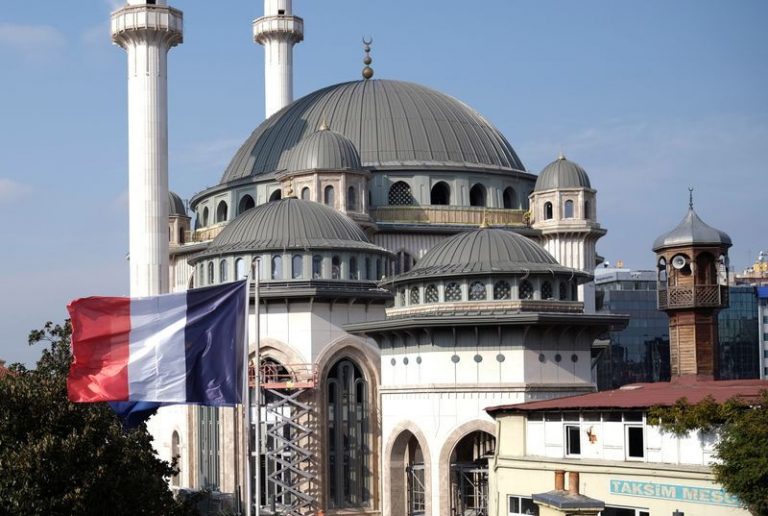
The French government had also ordered the closure of a mosque in Allonnes near Le Mans for harbouring ‘radical Islam’ and ‘legitimising terrorist attacks’. Interior minister Gerald Darmanin had informed that the managers and imams at the mosque allowed actions that run counter to the ‘values of the Republic’.
Interior Minister Darmanin said that the mosque had been shut down for six months and that the bank accounts of the mosque’s administrators were seized.
The mosque faced charges of inciting hatred towards France, Westerners, Christians, and Jews. Darmanin said, “The sermons propagated in this mosque cultivating hatred toward France,” while the administration also noted that besides hatred and discrimination, the mosque promoted “the establishment of sharia” in France.
A case of alleged grooming jihad (love jihad) has come to the fore in the Sivasagar district of upper Assam where a Hindu girl has approached the Sivasagar Sadar police station on Thursday, October 28, with a complaint against a man named Rafiul Hussain. The girl has accused Rafiul Hussain of fraud, forced conversion and torture, reports Organiser. Based on her complaint, the Sivasagar police has registered a case against Hussain and started investigating the matter.
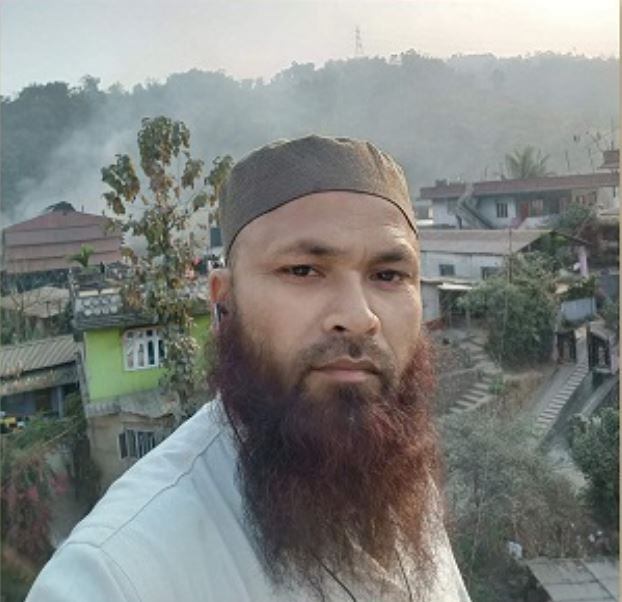
The girl in her complaint alleged that Rafiul Hussain befriended her on Facebook in the year 2016 by posing as Rajiv Hazarika alias Raj Hazarika. He had shaved off his beard to mask his Muslim identity and instead posed as a Hindu. Gradually, she started meeting Hussain and both fell in love.
The accused, source: Organiser
As per the Organiser report, the duo got married in the year 2017. However, things did not remain the same post marriage. After three months of marriage, the victim discovered that Rajiv aka Raj’s real name is Rafiqul Islam. However, it was too late by then. By then, Rafiul had started physically and mentally tormenting her. He compelled her to convert to Islam and changed her name to ‘Ayesha’. She was also forced to wear a Burkha to conceal her identity.
Subsequently, it was revealed that Rafiul was already married four times before he married the victim.
The victim further told the police that when she started revolting against her husband, Rafiqul abandoned her and went back to live with his previous wives. She added that she is now living alone in Sivasagar town in a rented house.
The girl further revealed that her paternal family had also abandoned her for marrying a Muslim man without their permission and now Rafiul was also not providing her with the basic expenses. Worried about her future, she approached the police for help.
Divulging details regarding Rafiul Hussain’s modus operandi, the girl said Rafiul Hussain changed his name to Rajiv Hazarika alias Raj Hazarika in 2016 to trap Hindu Assamese girls. He created a fake Facebook account in the name of Rajiv alias Raj to befriend Hindu girls. He even shaved his long beard to give himself a Hindu identity.
Speaking to media outlet Organiser, the victim revealed that Rafiul is again trying to trap another Hindu girl and that this is one of the reasons for their conflict. She said the Rafiul had threatened her with life if she disclosed his secret to anyone. Narrating her ordeal, she appealed to the Assam government to protect Hindu girls in the state so that impostors like Rafiul Hussain could not ruin any Hindu girl’s life.
The victim appealed to the Assam police to immediately arrest Rafiul and save her and other girls’ lives.
Last week, in another similar case of alleged love jihad, a Muslim man had been arrested in the Hojai district of Assam for marrying a woman by faking his identity pretending to be a Hindu. According to reports, after staying with the woman for some time, the accused named Jasimuddin robbed the woman of her money and jewellery and fled to his home in Hojai District of Assam.