Home Blog Page 3806

Lawyer writes to CJI over targeted killing of minorities in Jammu and Kashmir, demands security and compensation

A Delhi based lawyer Vineet Jindal has sent a petition to Chief of Justice of India N V Ramana to take cognizance of the “target killings” of Hindu and Sikh minorities in Jammu and Kashmir by Islamic terrorists. 

He urged the court to treat his letter as PIL and demanded adequate security for minorities in Jammu and Kashmir on immediate basis. He also demanded Rs 1 crore compensation and a government job to a member of the family of victims. In his letter sent on Saturday, the lawyer pointed out that in the last five days seven civilians, Hindu and Sikh minorities have been killed in Kashmir and the case must be investigated by national security agencies. He further demanded a special delegated unit to structure and administer a system to ensure the safety and security to minority groups in Kashmir.

“The target killings of Pharmacist Makhan Lal Bindroo, Supinder Kaur, Sikh principal of Government Boys Higher Secondary School in Sangam Eidgah area of Srinagar district, and Deepak Chand, a Hindu teacher of the same school has evoked a feeling of agony, fear and insecurity among the minorities of Hindu and Sikhs residing in Kashmir,” the letter states. 

The lawyer pointed out that “targeted killing of the members of minority communities had once again reminded of the gory incident of massacre of 36 Sikhs in Chattisinghpora village of Anantnag in 2000.”

The petition states that such barbaric killing would have an indelible impact on these minority groups who will feel threatened by the situation and would be shadowed by the fear of death all the time in Kashmir. The systematic targeting of minorities have created a sense of fear, vulnerability and insecurity among the minority communities living in Kashmir.

Jindal has quoted a news article to explain sense of insecurity among minorities in the Valley. “A scared school teacher did not go to work. He says his school told him to stay away for a week because of the recent attacks on minorities Sikhs and Hindus,” the petition reads.

The lawyer has further said that many government employees, who had found jobs in J&K under the Prime Minister’s special employment scheme for Kashmiri migrants, have quietly left accommodations with the fear of losing their lives and for the sake of their families well being.

Lakhimpur Kheri Violence: Ashish Mishra arrested after 12 hours of questioning, to remain in judicial custody till Monday

Union Minister of State for Home Affairs Ajay Mishra’s son Ashish Mishra who was arrested on Saturday night in connection to the Lakhimpur Kheri violence will continue to remain in judicial custody. He has currently been lodged in district jail.

Deputy Inspector General of Police (DIG) Upendra Agarwal cited ‘non-cooperation & evasive replies’ as the reason for Mishra’s arrest. 

As per Mishra’s lawyer, the court will hear his matter on October 11 on whether he should be sent to police custody. “He will be in judicial custody for the time being. He was produced before the judicial magistrate and the police had demanded three-day custody, to which we objected,” said lawyer Awadesh Singh representing Ashish Mishra. 

Ashish Mishra arrested

The minister’s son who has been charged with murder was arrested on Saturday night following a 12-hour interrogation by the Uttar Pradesh police. He was asked about his location and involvement in the Lakhimpur Kheri violence which led to the death of three Bhartiya Janta Party workers, a journalist and four farmers. 

A police official informed that a nine-member investigation committee was constituted that prepared 40 questions for Ashish. Reportedly, Mishra failed to clarify his location at the time of the incident. His driver, Ankit Das, has also been taken into custody. He has provided many videos in pen drive to police as evidence that he was not present on the site.

Meanwhile, certain section of the media had claimed he had fled to Nepal to evade questioning and arrest.

Lakhimpur Kheri violence

On October 3, a ‘farmer’ mob attacked a BJP convoy with stones and sticks. The windshield of one of the cars broke and the driver seemingly lost control, thereby running over the crowd. A total of eight people lost their lives in the violence. 

The UP police on Thursday had arrested two of the seven people mentioned in the FIR. 

Kashmiri Pandits hold protest, candlelight march in Delhi against targeted killings of Hindus and Sikhs in Kashmir

0

Kashmir Pandits held a protest and a candlelight march at the Jantar Mantar and Connaught Place in Delhi on Saturday, protesting against the recent targeting killings of Hindus and Sikhs in Kashmir. The protesters had gathered at Jantar Mantar where they began the agitation and later ended with a candle march across the inner circle of the Connaught Place in the national capital.

Slogans of ‘Vande Mataram’ and ‘Bharat Mata Ki Jai’ were raised at the march, slogans of “We Want Justice” and “Pakistan Haay Haay” were also raised at the march. The protesters said that the fresh wave of terror attacks are targeted and meant to create a wedge between communities in Kashmir. They said that the terrorists want to convey a message to the Kashmiri Hindus that they will not be welcomed back in the valley.

The Vishwa Hindu Parishad (VHP) and Bajrang Dal also protested against the same and burnt effigies to register their anguish over the concerted campaign of murder in Kashmir. Demonstrations were held across 3500 sites and it was vowed that Islamic Terrorism will be buried in India.

There has been a spate of targeted attacks on the Kashmiri non-Muslim civilians in the valley recently. On October 7, two teachers, a Hindu and a Sikh, were sorted out on basis of their religions in a school and then shot by the Islamic terrorists while the Muslim teachers were allowed to go.

Before that, Kashmiri Pandit Makhan Lal Bindroo was also shot dead by the terrorists, apart from several others, in the last week.

Media propaganda 101: How Times of India turned positive news about India’s vaccination drive into a gloom and doom headline

At a time when India is inoculating more than 5 million people each day, several media houses are hellbent on showcasing India’s massive vaccination drive in a poor light. On Saturday (October 9), The Times of India attempted to downplay India’s fight against the Coronavirus pandemic through an article titled, ‘25% of adults may not get fully vaccinated by the year.’

The article, authored by Rema Nagarajan, claimed that about 26 crores out of India’s total adult population (94 crores) cannot be ‘fully vaccinated’ this year. While relying on the assumption that Bharat Biotech cannot scale the production of India’s indigenous vaccine ‘Covaxin’, Nagarajan asserted that its share in total vaccination will remain around 11.4%. The article, therefore, argued that a majority of people will be administered doses of Covishield (manufactured by Serum Institute of India) which requires a gap of 12-16 weeks between the two doses.

Rema Nagarajan in her article in The Times of India stated that only 12 weeks have remained for the year 2021 to conclude. As such, even if someone was to take the first dose of Covishield, he/she could get the 2nd dose only after a period of 12-16 weeks i.e. in the next year. The author further pointed out that about 28% of the total adult population i.e. about 26 crore people have not received even the first dose. The Times of India reported that the number of such people is highest in Jharkhand (43.1%) and 0% in Himachal Pradesh.

Screengrab of the article tweeted by the Times of India

While TOI says that 25% of adults may not get fully vaccinated by the year, conversely, it can be argued that 75% of India’s adult population can be ‘fully vaccinated’ this year, using the same statistics and arguments. As per the data available on the CoWIN app, India has administered a whopping 94 crore vaccine doses. About 26.51 crore adult Indians have been fully vaccinated in the ongoing drive.

The Times of India article argued that 28% (26 crore) of people have not yet received a single dose. Assuming that they do not get vaccinated, the Indian government still has the potential to fully vaccinate the remaining 44 crore, people, out of the total 94 crore population.

Fully vaccinating 75% of eligible people in the country in less than a year will not be a small feat, as the TOI article tries to suggest. In fact, it will still be one of the most successful vaccination campaigns.

Data on vaccination doses and total registration, image via CoWIN dashboard

On September 17 last month, it was reported that the government has plans to administer 100 crore doses by mid-October this year. If the government achieves the feat, it is indeed possible to fully vaccinate 75% of adult Indians by the year-end. Again, the number can be greater if more unvaccinated adult Indians choose Covaxin over Covishield since the former requires a gap of 4-6 weeks between two doses. In any case, India is going to fully vaccinate 70% of the country’s adults by the end of 2021. It will be a historic feat and a success story for other nations to emulate.

At a time, when doctors and health professionals are putting in all-out efforts to ensure everyone is fully vaccinated, The Times of India deliberately chose a pessimistic headline. For a country with an estimated 140 crore population, a feat of 70-75% fully vaccinated people isn’t a trivial one. But, Rema Nagarajan somehow managed to sour India’s achievement by giving a dull and gloomy colour. Instead of seeing the glass as 75% full, they preferred to see it as 25% empty.

Propaganda by media works in subtle ways and sometimes fail to catch the eye of a naive reader. The article by The Times of India happens to be one of such several anti-India propaganda tools of journalism.

Action-Reaction: Rakesh Tikait justifies mob lynching of BJP workers in Lakhimpur Kheri, says their killers are not guilty

0

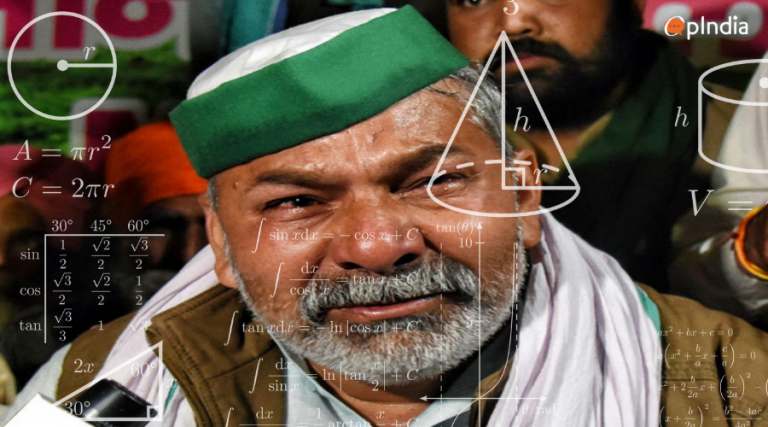
Bharatiya Kisan Union leader Rakesh Tikait has justified the mob lynching of BJP workers and a driver in the Lakhimpur Kheri case citing it was a reaction to an action. While addressing a press conference on Saturday, Tikait said that they were killed by the farmer protestors as a reaction to the death of farmers by a vehicle carrying the BJP workers, and therefore it was a justified act.

He said that people who killed the BJP workers and the driver were not guilty as it was not a pre-planned murder.

Tikait said, ‘Who were those in the vehicle that killed people? It was a reaction to an action, there was no plan. Here those who hit people with their vehicle are guilty. This was a reaction, this was not murder, I do not find them guilty.’

Earlier, Congress leader Kamru Choudhary had also justified the brutal mob lynching of Bharatiya Janta Party (BJP) workers in a Times Now debate, branding them as ‘murderers’ who deserved it. Choudhary then called the BJP workers criminals and when the anchor asked him about the basis of his claims, he said, “You want me to call the murderers as gardeners who had come to plant lotus flowers?” 

Choudhary was open about his support towards ‘lynching’ and ‘mob justice’ in the News Hour debate.

Also, a Congress leader from Karnataka, Amaregouda Patil Bayyapur said, ‘let BJP workers die and the Congress party will give them a compensation of Rs 1 crore.’

Last Sunday eight people were killed including four farmers during the farmers’ protest at Tikunia in Lakhimpur Kheri district of Uttar Pradesh. While four people were killed by a speeding vehicle, four were killed in retaliatory violence, including two BJP workers, a driver and a journalist. The UP government has announced a judicial inquiry under a retired High Court judge. It was also announced by the government that a compensation of Rs 45 lakh would be given to the family of deceased farmers and a job to a member of the family.

Cow smugglers open fire on police in Rajasthan in two separate incidents injuring two cops, four arrested

In two different incidents in Bharatpur district of Congress-ruled Rajasthan, cow smugglers opened fire and pelted stones on police teams on Thursday and Friday where two cops were injured.

SP of Bharatpur Devendra Kumar Bishnoi confirmed this to OpIndia stating that the two incidents took place under two different police station areas, namely Sewar and Bharatpur town police station.

“There was information of the illegal transportation of cattle as well as movement of inter-state criminals from Sikari to the town area. Further investigation is going on,” Bharatpur SP said.

In both incidents, police arrested four cow smugglers and forwarded them to jail. Four cows were rescued from their possession besides a pickup van and bike (one each), three country-made pistols, 13 live bullets and 10 litre liquor.

In Sewar police station case, two constables Sanjay Kumar and Rahul Katara were injured when cow smugglers opened fire and pelted stones on a police party at Gandhi Nagar Colony during the patrolling on Friday night.

Sanjay Kumar was hit by a bullet whereas Rahul Katara suffered stone injuries. But both are out of danger. In this case, the police arrested one accused identified as Irshad (36), a native of Uthawad in Haryana and rescued four cows from a pickup van used for smuggling. Four other cow smugglers managed to escape taking advantage of darkness.

The Officer in charge of Sewar police station Arun Choudhary told the media that during patrolling, a police team spotted a cow laden pick-up van. When asked to stop the cow smugglers they opened fire. The police also fired in self-defence.

In the second incident reported on Thursday evening, three cow smugglers opened 25 rounds of fire on the police. Bharatpur police had inputs about the movement of some criminals involved in cow smuggling. Police laid a barricade in front of Anar Devi Government Senior Secondary School on Deeg Main Road. Criminals broke past barricading and when asked to stop they started firing on police. After an hour-long encounter and chase, police arrested them. One of them jumped in a pond to escape but was caught by police. Police had a tough time keeping civilians away from cross-firing as police also fired seven rounds of bullets.   

Country-made pistols, liquor, live bullets and a bike was recovered from them. All three arrested, Taufique, Sahun and Rishal, are dreaded criminals who are wanted in over a dozen cases of cow smuggling lodged at 15 police stations in Bharatpur and Alwar of Rajasthan besides 3 police stations in Haryana.

Bharatpur is part of the Mewat region forming the part of Rajasthan and Harayana which is a sensitive zone in terms of organised crime, cattle smuggling, illegal Rohingyas and mob violence against police.

In February 2020, a police sub-inspector was injured when cow smugglers opened fire at cops when they were acting on specific input of cow smuggling. In August this year cow smugglers had again fired on cops.

Uttar Pradesh: Man arrested for making derogatory remarks against Goddess Durga during Navratri

A man named Vansh Bahadur was arrested by Uttar Pradesh Police for sharing disparaging messages against Goddess Durga on social media. The man has been accused of disturbing the communal harmony of the society amidst the Navratri festivities by sharing the messages. A case has been filed against the accused and his mobile phone has been confiscated.

The official Twitter account of Prayagraj Police took to Twitter to inform that accused Vansh Bahadur has been arrested by the police. He has been charged under Section 295A of the Indian Penal Code and Section 67 of the IT Act.

The arrest was made after several social media users flagged indecent remarks made by Vansh Bahadur in a Whatsapp group against Goddess Durga and demanded his arrest for insulting the Hindu God. The name of the Whatsapp group was ‘Mission 2022’, an apparent reference to the year when assembly elections are to be held in Uttar Pradesh.

The vulgar post had sought to mislead the readers about the essence of the Navratri festival. It also demeaned Goddess Durga, the deity who is worshipped by lakhs of Hindus around the world during the nine days of festivities.

Some of the aggrieved social media users even demanded action against the admin of the Whatsapp group where such deprecatory and patently misleading remarks against Goddess Durga were allowed to be disseminated.

The police swung into action after social media users objected to the scurrilous post that was doing the rounds on Whatsapp. It arrested Vansh Bahadur, the originator of the message, and filed a case against him. Legal action will be taken against him, the police informed.

As Air India comes home to the Tatas, read about Jawaharlal Nehru’s blunder and how JRD Tata was anguished by the move

On Friday (October 8), Department of Investment and Asset Management (DIPAM) secretary Tuhin Kanta announced that Talace Pvt Ltd (a wholly-owned subsidiary of Tata Sons Pvt Ltd) made the winning bid for Air India. The EV quote by Talace was ₹ 18,000 crores, which included a debt of ₹15,300 crores and a cash component of ₹2700 crores.

Ratan Tata, the former chairman of the Tata Group shared a tweet saying ‘Welcome back, Air India’. In a heartfelt note, he stated, “…Air India, under the leadership of JRD Tata, at one time, had gained the reputation of being one of the most prestigious airlines of the world. Tatas will have the opportunity of regaining the image and reputation it enjoyed in earlier years. Mr JRD Tata would have been overjoyed if he was in our midst today.”

Foundation of Air India and the role of JRD Tata in shaping it

The story of Air India began in 1932 when the visionary industrialist JRD Tata laid the foundation of Tata Aviation Service. Dubbed as the ‘Tata Air Mail’, he started the airline with an investment of ₹2 lac rupees. His fascination for the airline business began in 1927 while sketching Charles Lindbergh (who had crossed the Atlantic solo that year). When Flying Club opened in Mumbai 2 years later in 1929, JRD Tata enrolled on a flying programme. He spent hours mastering the art to fly a plane.

The flying licence of JRD Tata, image via Tata.com

In 1932, he piloted the first cargo flight (carrying 25 kg of airmail) of Tata Aviation Service from Karachi to Madras through Ahmedabad, Pune, Bombay, Bellary, Kolhapur and Bangalore. It was a three-seater, single-engine, unpressurised de Havilland Puss Moth. It was a historical moment for the Indian aviation industry and JRD Tata saw to it that his airline business turned it into a profit-making venture. Within 5 years, the airline had made ₹6 lac in profits.

In 1938, the name of the airline was changed to ‘Tata Airlines’ from ‘Tata Aviation Service’. However, World War II broke out the following year. And the British government took control of all the aircraft that were owned by JRD Tata. It was only after the end of WWII that he restored control over his own company. In 1946, he renamed ‘Tata Airlines’ to ‘Air India’ and relaunched it as a joint-stock company.

The first flight in Indian aviation history, image via Tata.com

A Himalayan blunder and Nehru’s treacherous ways

Perhaps, the first ‘nail in the coffin’ came from the end of Tata Group who were oblivious to Pandit Jawaharlal Nehru’s treacherous ways. In 1947, the Tatas gave the Congress government a proposal to acquire a 49% stake in Air India Ltd, with a provision to later increase it by 2% (i.e. a total of 51% majority stake). Tata Group was to hold 25% ownership in the company while the rest was to be publicly traded.

JRD Tata was not a fan of ‘nationalisation.’ When talks were rife about nationalising private entities in India, he had remarked, “There is an overwhelming case against nationalisation of India airlines.” By 1948, the Nehru-led-Indian government held a 49% stake in Air India Ltd. JRD Tata was unable to fathom the drastic move by Nehru which was to wreak havoc on the airline industry and the empire he built.

The year was 1953. The Indian government decided to nationalise Air India and the airline industry. In his own words, Tata recounted, “(I was) indignant at the manner in which the government had treated the air transport industry.”

Nehru acquired the remaining 2% to become the majority stakeholder in Air India Ltd. At a mere ₹2.8 crores, the then Indian government purchased the stocks of Air India. By shelling out an additional ₹3 crore of taxpayer money, PM Nehru purchased other domestic airlines and nationalised the entire industry. As a gesture of tokenism, the Congress government allowed him to remain the ‘unpaid’ Chief/Chairman of the airlines for 25 years until 1978. Later, the Indira Gandhi government re-appointed him as the Chairman between 1980-1986.

Nehru used backdoor channels to get Air India nationalised, upset JRD Tata

Interestingly, the decision of ‘nationalisation’ was made by Nehru without consulting the Tata Group. Air India was a successful private venture, which was even invited by the Singapore government to set up the Singapore airlines. It thus came as a surprise when the first Prime Minister insisted that there was no option other than nationalisation. “(The government was) driven to the conclusion that there was no other way out except to organise [the airlines] together under the State,” Nehru claimed in a letter to JRD Tata.

“My friend Nehru stabbed me in my back. I can only deplore that so vital a step was taken without giving us a proper hearing,” JRD Tata lamented on the betrayal of his ‘friend’. And the rest remains history. The once successful private player in the airline industry was reduced to a loss-making venture. With subsequent government interference and bureaucratic red tapeism, Air India ended up with an accumulated loss of ₹80,000 crores.

Nationalisation of Air India and Aftermath

Alok Bhatt, in an article in News18, quantified the loss and provided a fresh perspective. He estimated that ₹80,000 crores (had it not been a lost cause) could provide ₹ 5 lakh Ayushman health benefit to almost 10 crore citizens or could have been used for the construction of 9,000-km long (4-lane highway)/ 5,250-km long(6-lane highway). He added that the bailout package provided to Air India in the last decade could support the Union government’s POSHAN project for 2 long years.

JRD Tata on 50th anniversary of his first airmail flight, image via HT

In his parting note, JRD Tata said, “And now the time has come to say goodbye. As we turn the last page and put away the book, regret or bitterness has no place in our hearts. Instead, we may find content in the thought that what we did was worth doing, that we set our standards high and would not lower them, that we never need part with our memories…” From being an excellent aviator to pioneering India’s first airline enterprise to losing his dream and hard work to the government, JRD Tata saw it all in his lifetime. With the Tatas finally acquiring Air India from the government, a historical wrong has been set right. In his heavenly abode, JRD Tata can now take a sigh of relief.

Kerala governor Arif Mohammad Khan hits back at Rajdeep Sardesai over ‘Hindu-Muslim’ discourse

India Today journalist Rajdeep Sardesai was left red-faced on Saturday after Kerala Governor Arif Mohammad Khan gave a befitting response to his question on the binary of Hindu majority and Muslim minority. Khan expressed his disapproval over the question of majority-minority and stated that when it comes to India, all its citizens regardless of their religion enjoy “equal rights”.  

When Sardesai asked Khan how he saw his identity as an Indian Muslim, the Kerala governor appeared thoroughly exasperated by the question asked of him by the India Today journalist. Nevertheless, he responded by saying, “We are celebrating the Azadi Ka Amrit Mahotsav. Our independence did not come for free. It was accompanied by the partition of the country, a bloody partition of the country. There was a lot of bad blood and violence between the communities then…I think the partition happened because of this imaginary Muslim question, because of this question over majority and minority.”

Expressing his anguish over the media’s persistent efforts to divide the society on the basis of religion, Khan said that after 75 years of India’s independence, it is pitiful that the media was still drumming up the divisive discourse instead of discussing Sabka Saath Sabka Vikaas Sabka Vishwas.

“The British never considered India as a nation. They always considered it as a conglomeration of communities. But this constitution considered citizens as the constituent unit of India. Where is the question of communities now? Come to my village and ask a Muslim about what is this Muslim question. He will be perplexed. Because he is facing the same problems as those faced by peasants belonging to other communities. Just because someone in Hyderabad said there exists a Muslim question, we have taken it seriously,” Arif Mohammad Khan said.

Speaking on the segment ‘Majority, Minority: The Battle of Belonging’ during the India Today conclave in Delhi, Khan said the Indian civilisation and “our cultural heritage” has no concept of discrimination on the grounds of one’s religion.

“Indian civilisation has never been defined by religion, all other civilisations were defined either by religion, mostly by religion, and also before that by race and language,” he said while citing a few shlokas to back his claim.

When asked whether Indian politics has moved from resorting to minority appeasement to majoritarianism in the last few decades, Khan said it is just India’s constitution but its millennia-old traditions that have never subscribed to the ideology of division and segregation.

“It is not only our Constitution that gives equal rights to people, but more than that our cultural heritage, the Indian civilisation, has no concept of discrimination on the basis of the religion, therefore to link the two, I find it preposterous,” he said.

Tej Pratap Yadav is at it again, claims he was a pilot before joining politics because he had dropped out of a flying school

Tej Pratap Yadav, the eldest son of Lalu Prasad Yadav, remains on the news most of the time, however most of it for non-political reasons. This time he has become a subject of memes by claiming that before joining politics, he was a pilot who was selected for the Indian Air Force, and he used to fly the Cessna aircraft.

Addressing workers of his Chatra Janshakti Parishad on October 7, talked about his student life, Tej Pratap Yadav said that he has a background of pilot. He said that he had filled the form for Indian Air Force, and he was selected. After that, he joined the Bihar Flying Institute in Patna for a three-year flying course, out of which he had completed two years.

His comments can be heard in the original full video below posted by Chhatra Janshakti Parishad, from 15 minutes mark.

Tej Pratap Yadav said that he used to fly Cessna aircraft during his training at the Flying school. Then he claimed that he had an ID card with ‘captain’ prefixed to his name, and he was known as ‘Captain Tej Pratap’.

Tej Pratap had made similar claims last year too during an interview with Quint during the Bihar elections. ‘I used to be pilot before joining politics’, he had said during the interview, adding that he had joined the Bihar Flying Institute for a flying course, adding that after completing 2 years, he had to leave as he joined politics.

Both the videos are being circulated on social media, implying that he is lying as it is known that both sons of Lalu Pratap in politics didn’t progress much ahead in politics. However, he is not lying completely, although he had made some very tall claims.

Contrary to popular belief, Tej Pratap Yadav has actually completed 12th, which means he is eligible to join a flying course. It is his brother Tejashwi Yadav who is 9th pass. One can become a commercial pilot by joining any DGCA approved private commercial pilot training centre, including the Bihar Flying Institute. After completing the course, one has to go through physical and written tests to get a licence as a pilot.

Tej Pratap Yadav had actually joined the Bihar Flying Institute, and therefore he is not lying on that point. A profile on him The Quint had said that he had got himself enrolled in Patna’s Bihar Flying Institute for a course, which would enable him to get a commercial pilot license. It further said that he underwent the pre-solo stage of training during which a trainee flies an aircraft with an instructor on board. This means, Tej Pratap didn’t fly the Cessna plane alone, however he flew a Cessna 172 plane with an instructor on board.

The rest of his comments are vastly exaggerated. As he had dropped out of the course after two years, he can’t call himself a ‘former pilot’. He was not a pilot before joining politics as he was claiming. He had only half completed the first stage of becoming a pilot. Just like people who drop out of medical or engineering colleges can’t call themselves doctors or engineers, people who drop out of a flying school can’t call themselves pilot.

The other claim of Tej Pratap Yadav, that he had an ID card with ‘captain’ prefixed to his name is even more curious. In Commercial pilots, the captain prefix is used only for the senior pilot in an aircraft who is in overall charge of the aircraft. Flying students definitely can’t be called captain, they are called cadets. It is not sure whether Tej Pratap Yadav mistook cadet for captain, or he was given a special privilege.

The claim that he was selected for IAF is also questionable, because just filling the form is not enough to be selected. One needs to clear a highly competitive entrance exam to get admitted to the Air Force Academy. While one can take the NDA (National Defence Academy) exam after 12th, one can take the Combined Defence Services (CDS) after graduation. There is no evidence that Tej Pratap Yadav had cleared the NDA exam after his 12th, therefore there is huge doubt over his claimed that he was ‘selected for Indian Air Force’.