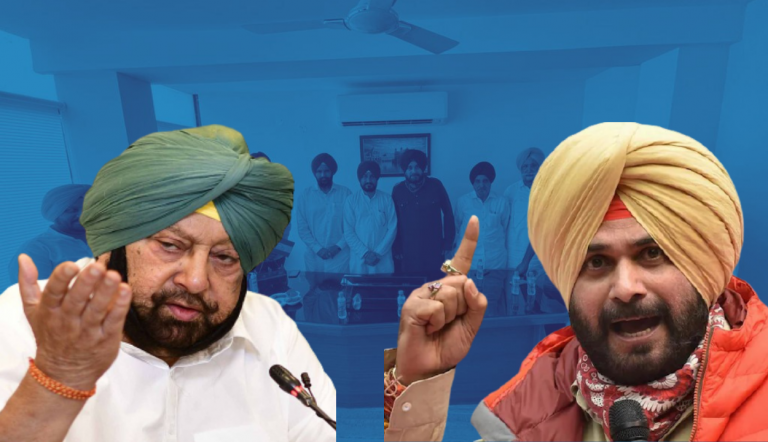
The internal rift within the Congress Punjab widened further on Tuesday after nearly 30 MLAs, including four cabinet ministers, openly revolted against Chief Minister Captain Amarinder Singh and declared that they no longer have faith in his ability to deliver on election promises.
Ahead of the assembly elections in Punjab, the Congress party is in deep trouble in Punjab as some of its MLAs have now reportedly expressed their discontent against Captain Amarinder’s leadership. At least 30 MLAs, including four powerful ministers, have now dissented against the Chief Minister saying that they do not trust him anymore.
The dissenting MLAs had gathered at Rural Development Minister Tript Rajinder Singh Bajwa’s residence in Chandigarh on Tuesday seeking change in the party leadership just ahead of the crucial polls. The majority of the rebel MLAs are believed to be supporters of Navjot Singh Sidhu in his ongoing leadership battle against Singh.
The rebel MLAs said that the Chief Minister has failed to resolve the issues in Punjab and accused him of not fulfilling poll promises made during the 2017 state election.
Interestingly, the rebel MLAs has also met Navjot Singh Sidhu, who later in the day, tweeted that he held an emergency meeting with Tript Rajinder Bajwa.
Got a call from Tripat Bajwa ji asking for an emergency meeting… Met him along with other colleagues at the PPCC office. Will appraise the high command of the situation. pic.twitter.com/n98QacvQhd
The rebel camp has accused Captain Amarinder Singh of being “hand in glove with Shiromani Akali Dal president Sukhbir Singh Badal. It is being said that the full-scale revolt against Amarinder Singh has intensified after Navjot Singh Sidhu was made the state Congress chief.
A five-member committee representing the dissenting camp is scheduled to meet the Congress high command in New Delhi to seek Amarinder’s removal, just six months ahead of assembly polls in Punjab. Interestingly, the rebel camp has not yet named their choice for the alternate leader if Captain Amarinder Singh is replaced.
Jails and Cooperation Minister Sukhjinder Singh Randhawa, Technical education and Industrial Training Minister Charanjit Singh Channi, Revenue minister Sukhbinder Singh Sarkaria and Jalandhar Cantt MLA Pargat Singh joined Bajwa in demanding Amarinder’s removal. The rebel MLAs fear that they might be dropped from the cabinet in the reshuffle as they are in Sidhu’s camp.
Currently, Congress has 80 MLAs in the 117-seat Punjab assembly.
“If the high command does not listen to us, we will decide the next course of action,” Bajwa threatened the party leadership on Tuesday. Responding to the question on the alternate leader, Bajwa said it was the high command’s decision to pick a new CM. His colleague Channi said, “We are not getting solutions to our problems from this chief minister.”
Questioning Amarinder’s ability to lead the government, Randhawa, who was once very close to the CM, said, “Wars cannot be fought by sitting in a drawing-room or just by tweeting. Wars are fought on the ground. Day by day, SAD and AAP are attacking Congress on the Bargari sacrilege issue. People ask us about the cancellation of the power purchase agreements and other unfulfilled promises.”
The rebel MLA also alleged that Amarinder would not meet his cabinet colleagues, but always found time to be part of gatherings in Amritsar and other places.
Sidhu vs Captain tussle escalates
The tensions between Punjab CM Captain Amarinder Singh and the President of Punjab Pradesh Congress Committee Navjot Singh Sidhu have been building up since the last few weeks. A few days back, the tussle took another turn after the later slammed Singh-led government in Punjab and hailed BJP-ruled states for higher State Assured Prices(SAP) for Sugarcane.
Navjot Sidhu on Monday had posted a tweet calling for an increase in State Agreed Price (SAP) for sugarcane in Punjab, asserting that despite the higher cost of cultivation in the state, the SAP is lower than that received by farmers in BJP ruled states of Haryana, Uttar Pradesh and Uttarakhand.
“The sugarcane farmers issue needs to be immediately resolved amicably…Strange that despite the higher cost of cultivation in Punjab the state assured price is too low as compared to Haryana/UP/Uttarakhand. As a torchbearer of agriculture, the Punjab SAP should be better!” Sidhu tweeted.
Sidhu’s tweet came in the wake of indefinite protests carried out by thousands of farmers and sugarcane producers affiliated to nearly 32 farmers’ organisations demanding the clearance of pending dues of sugarcane and enhancement in the State Agreed Price(SAP).
As many as 20,000 farmers participated in the protests on the first day of the agitation on the Dhanowali Road on the Jalandhar-Phagwara highway on Friday. Many farmers sat on dharna on rail tracks also.
The latest fight once again brought to fore the infighting within the Punjab Congress unit, with Sidhu and Singh allegedly involved in a perpetual tussle to exert their dominance over the party.
Union Minister and BJP leader Narayan Rane, who was arrested over a statement against Maharashtra CM Uddhav Thackeray was granted bail at midnight by a Raigad Magistrate Court. The Court directed the Minister to furnish a bail bond of Rs 15,000 after which he was released.
Court has directed Rane to furnish bail bond of Rs. 15,000 with surety of like amount.
Rane has now reached Mumbai and his lawyer Aniket Nikam while speaking with CNN News18 hinted at a further legal recourse with respect to multiple FIRs filed against him.
Narayan Rane’s criticism of Uddhav Thackeray
Union Minister Narayan Rane while speaking at the ‘Jan Ashirwad Yatra’ in Raigad district of Maharashtra, had condemned the Maharashtra CM for his sheer ignorance.
“It is shameful that the chief minister does not know the year of independence. He leaned back to enquire about the count of years of independence during his speech. Had I been there, I would have given him a tight slap,” Rane had remarked, triggering multiple FIRs, and arrest orders against him by the Shiv Sena-led MVA government.
Shiv Sena gets violent
Almost instantly, the Shiv Sena launched multiple attacks on the BJP leader. Several FIRs were filed against Rane demanding immediate arrest of the Minister.
To protest against the ‘slap remark’, Shiv Sena goons pelted stones and bricks at BJP’s Nashik office.
#WATCH | Maharashtra: A group of Shiv Sena workers pelt stones at BJP party office in Nashik & raise slogans against Union Minister Narayan Rane.
The Union Minister and BJP leader had given a statement against CM Uddhav Thackeray yesterday. pic.twitter.com/Y3A3cWZbTa
A BJP corporator in Ulhasnagar was thrashed brutally and his had face blackened by the Sena goons to avenge Rane’s statement against their leader.
What on earth? BJP corporator beaten by Shiv Sena workers in Ulhasnagar. Allegedly, because they were angry over Narayan Rane comment. Members of ruling party running amok? pic.twitter.com/ZPv6lW4BBV
A huge crowd amassed outside Rane’s home in Juhu to protest against him shortly after CM Uddhav Thackeray cancelled Hindu festival celebrations claiming ‘saving lives is a priority amidst the pandemic.’
The Minister had approached the Bombay High Court to seek interim relief from arrest and other or any coercive action. However, a Bench comprising Justices SS Shinde and N J Jamadar refused to hear his petition asking the advocate to follow due ‘procedure.’
Narayan Rane arrested
Rane who was addressing a yatra under BJP’s Jan Ashirwad campaign in Ratnagiri’s Chiplun was arrested by Ratnagiri police while he was having food. Visuals of Rane being surrounded by police force and detained while eating resulted in a huge uproar.
As per reports, Rane was handed over to Nashik police by Ratnagiri police later.
Union Minister Narayan Rane has been sent to judicial custody (in connection with his alleged statement against Maharashtra CM Uddhav Thackeray): BJP MLC Prasad Lad pic.twitter.com/asDqtG4aen
BJP leader Prasad Lad also revealed that the Minister was ‘manhandled’ by police. “Rane was arrested while he was having lunch. The arrest is illegal. We are afraid that he may be harassed by the police if kept inside the police station overnight. He was manhandled by police while he was having his lunch. The cops did not even allow doctors to complete his check up,” informed Lad.
Another BJP leader Pramod Jathar alleged that the Ratnagiri police was under ‘immense pressure’ to arrest the BJP leader.
State Minister seen giving instructions for Rane’s arrest
In a shocking revelation, BJP spokesperson Suresh Nakhua shared visuals where State Transport Minister Anil Parab was caught giving instructions to arrest Rane.
The visual captured by TV9 Digital shows Parab taking instructions of Rane’s arrest from someone on phone. He can be heard saying that he will speak with the police and get Rane arrested.
Minister Parab giving instructions for Rane arrest.
Parab then dials to someone and instructs him to detain Rane using ‘police force.’ He also says that both the High Court and Sessions Court have rejected Rane’s bail plea and that they can go ahead with the arrest.
As Parab was sitting with his microphone on, his conversations were audible. He asks why Rane has not been arrested yet. Then he is asked for updates by a Sena legislator sitting next to him. Parab was seen telling that Police is there and Rane will be brought out now. But when the media asks Parab about Rane, he was seen telling that he does not have all the details.
JP Nadda says ‘arrest unconstitutional’
National President of BJP JP Nadda in a Twitter post claimed that Rane’s detention was unlawful and unconstitutional. “The arrest of Union Minister Narayan Rane ji by the Maharashtra government is a violation of constitutional values. We will neither be scared nor suppressed by such action. These people are troubled by the immense support the BJP is getting in the Jan-Aashirvad Yatra. We will continue to fight democratically, the journey will continue,” Nadda said in a Tweet.
महाराष्ट्र सरकार द्वारा केंद्रीय मंत्री नारायण राणे जी की गिरफ़्तारी संवैधानिक मूल्यों का हनन है। इस तरह की कार्यवाही से ना तो हम डरेंगे, ना दबेंगे। भाजपा को जन-आशीर्वाद यात्रा में मिल रहे अपार समर्थन से ये लोग परेशान है। हम लोकतांत्रिक ढंग से लड़ते रहेंगे, यात्रा जारी रहेंगी।
Leader of Opposition and former Maharashtra Chief Minister Devendra Fadnavis slammed the Maharashtra government for using police force against Rane.
“We do not support Narayan Rane’s statements. But looking at the way the government is using police force to act in a lawless manner, we will support Rane as an individual and the whole party is with him,” said Fadnavis while addressing the media.
“This is ‘policejivi’ government. It is state-sponsored violence just like in Bengal,” he said further.
Sena mocks Rane
Going berserk over Rane’s statement, Shiv Sena through its official handle mocked the Union Minister.
The hospitals in the United States are struggling to manage the ongoing Delta wave, stoking a fresh health crisis in the country. The Covid-19 cases have soared well over to 1.5 lakh infections on an average day, even as the health authorities in the United States are struggling to inoculate its population with the vaccine.
With large swathes of the country unprotected against the deadly virus, there has been a surge in infections in the United States. On Tuesday alone, the US recorded 2.66 lakh fresh Covid-19 infections, the highest in the last month.
America’s delta-driven surge of Covid-19 has entered a deadlier phase in the last week. The fresh infections have risen in 42 of the 50 states, while deaths are now increasing in 43 states – the worst tally since December, before America’s deadliest month of the pandemic.
Daily cases in the US are at an average of 1,50,000-mark per day since the last month, with the Centers for Disease Control and Prevention (CD) issuing a warning to health authorities about a possible wave of the Covid-19 pandemic in the country.
Rising Covid-19 cases in the United States/ Image Source: Google/NYT
Despite the high number of Covid-19 cases in the United States, the US media outlets seem to have found no courage at all to question the authorities over their failure to manage the pandemic in the country. The media outlets that were extensively reporting on the pandemic outbreak in other countries, especially India by predicting doomsday scenarios, have chosen silence over the failure of the “superpower” United States to handle the pandemic effectively.
So far, the USA has recorded over 3.8 crore cases and over 6.3 lakh deaths due to the Covid pandemic.
USA tope health expert Anthony Fauci, who had earlier claimed the country will have good control over Covid by the fall of 2022, has now corrected his stand. Speaking to NPR, the chief medical advisor to the White House stated that if an ‘overwhelming population’ gets vaccinated, they can ‘start to really get a good control over’ Covid by the fall of 2022.
Western media that predicted doomsday scenario for India, remains silent over Covid-19 disaster in the US
As India battled the second wave of the Covid-19 pandemic, western media outlets had unleashed a concerted campaign to discredit the Indian government’s efforts to tackle the pandemic. In an effort to humiliate and discredit the country, the western media had come up with dubious research to imagine higher deaths in the country.
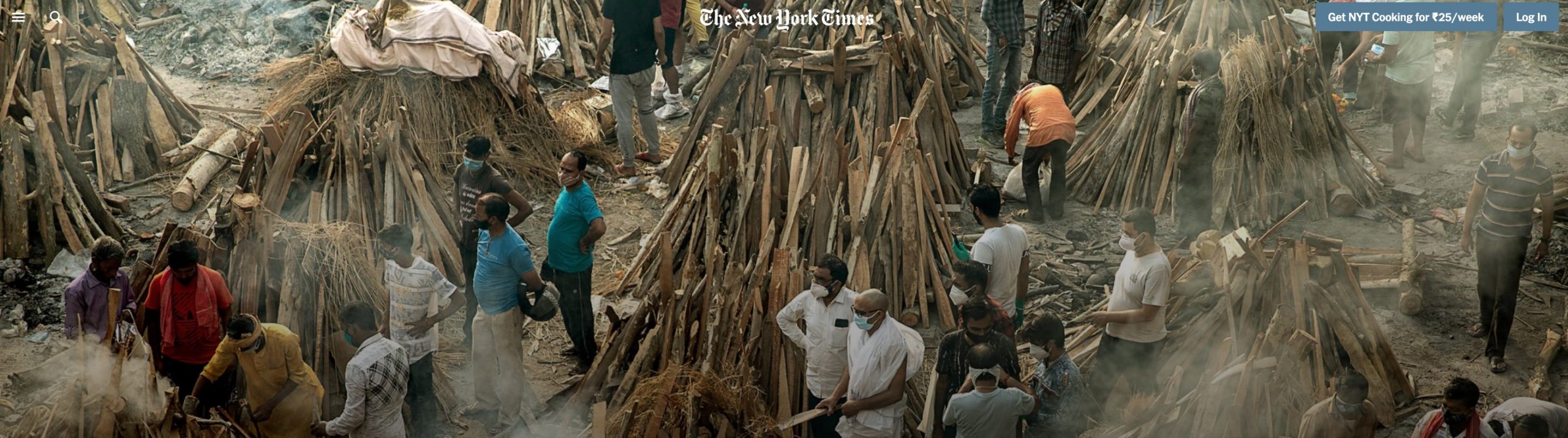
The foreign liberal media displayed a strange attitude while reporting on India. The Indian government was scrutinised to the most over its management of the pandemic, and India became the centre of attention for media worldwide. The western press focused on the deaths and captured images of funeral pyres to proclaim that India was one of the worst affected countries globally, thus creating a wave of “shock” among their non-Indian audience.
New York Times coverage over India’s Covid–19 crisis/ Image Source: NYT
India, which put up a brave fight against the Chinese pandemic, also had to cope with a massive misinformation war initiated by the global left-liberal establishment.
A few months back, controversial left-wing US media outlet New York Times had come up with imaginary numbers, claiming that India’s actual Covid-19 death numbers are exponentially more than the officially published numbers. The NYT had predicted that India’s death numbers range between 6 lakh to 42 lakh, against the official number of 3 lakh.
However, the Indian government swiftly took on the misinformation warfare being propagated by a certain section of western media by providing them factual and logical explanations.
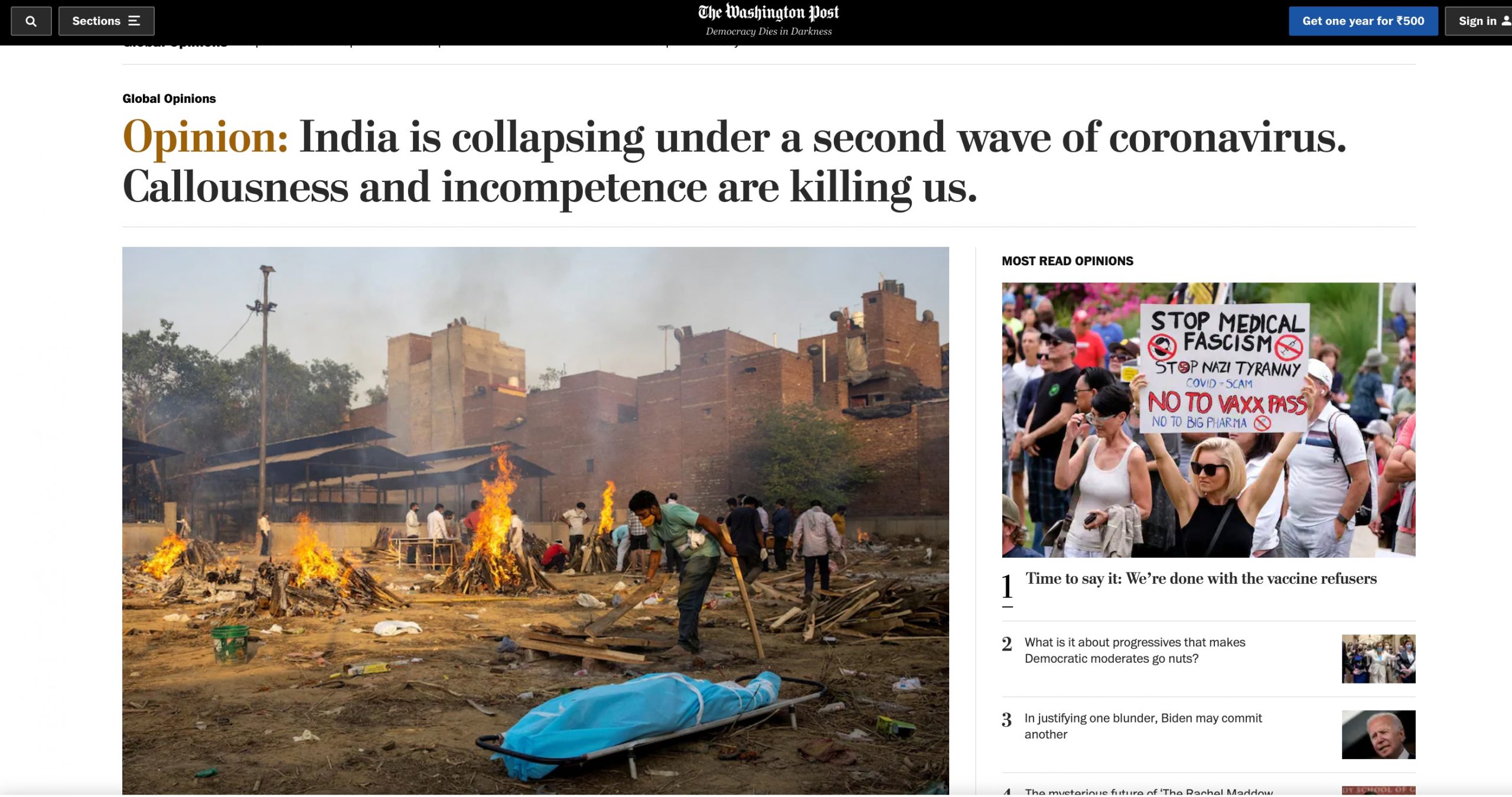
Here is a similar sinister campaign by the Washington Post against India during the pandemic:
Image Source: Washington Post
However, it looks like all the ridicule and criticism of the western press over the mishandling of the Covid-19 pandemic is limited to only ‘brown’ countries. As the United States struggles to cope-up with the Covid-19 pandemic, the US media that claim to speak ‘truth to power’ have chosen to ignore to mention that the world’s alleged “superpower” has failed to control the Chinese pandemic in its own country.
No coverage by the Western media on US Covid disaster
In contrast to their extensive coverage over the second wave of the pandemic in India, the US media has almost zero coverage on the US Covid-19 disaster. Even as the US records over 2.5 lakhs cases of Covid-19 on Tuesday, not a single media outlet has made it their primetime story to hold authorities in the country accountable. The very same media that was humiliating Indians by displaying dead bodies and funeral pyres has not even reported on the raging Covid-19 infections in the country.
Not a single publication that was predicting doomsday for India a few months ago suggesting that the country would record over a million deaths due to Covid-19 is reporting the looming threat of Covid-19 in the United States. Instead, the foreign press is trying to cover up for the humiliating loss of the Biden administration at the hands of the Taliban in Afghanistan by over-emphasizing on plain rhetorics.
Hence, most of the media space in the left-wing publications such as Washington Post, New York Times or CNN is being reserved for defending Biden’s administration’s Afghan disaster rather than reporting on the Covid-19 disaster in the country.
Here are the screenshots of landing pages of prominent news websites in the US that have absolutely ignored the reportage on the US’s Covid-19 disaster:
The Washington Post that reported widely on India has not even reported on the increasing Covid-19 cases on its front page, in contrast to its aggressive tweets and reports on India’s Covid-19 story.
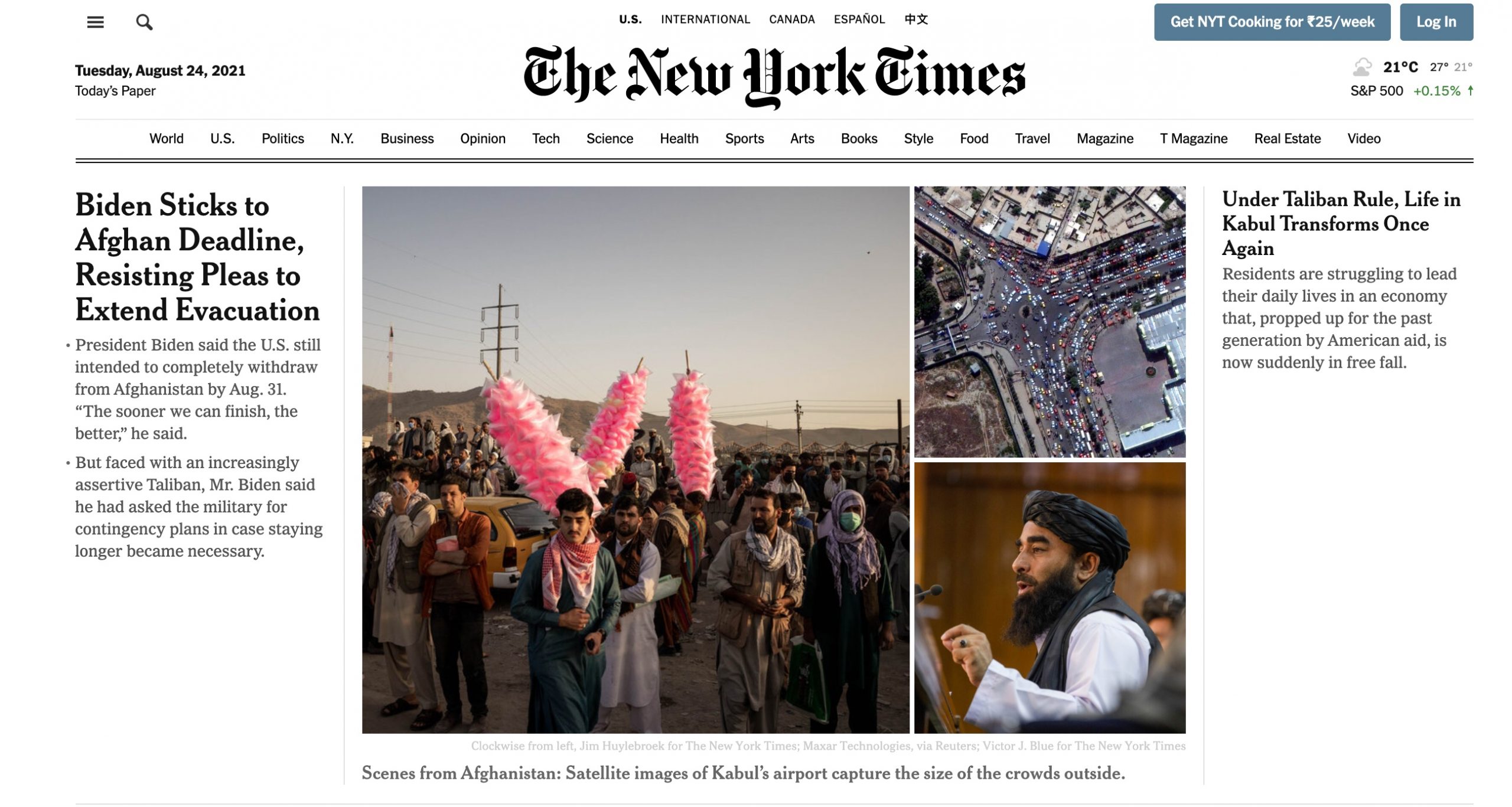
Well, the same goes with the New York Times. There is not even a single report on the rise in Covid-19 cases in the United States. Instead, most of the media space is dedicated to cover up the US disaster in Afghanistan.
CNN, accused of being a mouthpiece of the Democrats, has also chosen silence over its Covid-19 reportage ever since Joe Biden became the president of the United States. No images of graveyards or dead bodies have been posted on their website that shows the abysmal handling of the Covid-19 pandemic in the United States.
Well, it seems like all the heroics of the western ‘liberal’ media are limited to trying to malign and humiliate the so-called ‘third world’ countries, spread misinformation while completely ignoring the situation in their own countries.
On August 24, Surat Police arrested a man identified as one Rahul Gandhi for creating ruckus on the road under the influence of alcohol. A resident of Panas Gam, Gandhi was held after he caused a disturbance in the Khatodara area, Surat. He had reportedly consumed alcohol in his car. Notably, alcohol is banned in the state of Gujarat.
As reported by online portal Loktej, ‘Rahul Gandhi’ reached police station and barged into the cabin of Police Inspector Tarun Patel. He then introduced himself as Rahul Chandrakant Gandhi. He was in an inebriated state because of which the police officer asked for a case to be registered against him under the prohibition law. On hearing that, Gandhi got upset and created a ruckus in the police station. Report suggests he had come to file a complaint to police station after having discussed same over a phone call. However, he ended up being a criminal himself.
The World Bank has suspended financial aid to Afghanistan and stated it is deeply concerned about the situation in the country, especially women’s rights since the Taliban took over. Agence France-Presse (AFP) quoted a World Bank official saying, “We have paused disbursements in our operations in Afghanistan, and we are closely monitoring and assessing the situation. We are deeply concerned about the situation in Afghanistan and the impact on the country’s development prospects, especially for women.”
World Bank ‘deeply concerned,’ pauses aid to Afghanistan: AFP news agency quoting an official
The World Bank did not release the statement earlier as its personnel were in the country. The evacuation process was completed on Friday, which was then followed by the process of suspending the aid. The spokesperson added the World Bank would continue to consult with the development partners and international community. He said, “Together with our partners, we are exploring ways we can remain engaged to preserve hard-won development gains and continue to support the people of Afghanistan.”
The International Monetary Fund (IMF) also announced the suspension of its operations with Afghanistan, including the existing loan program worth $370 million. It also suspended the funds under Special Drawing Rights (SDR) worth $340 million that Kabul was supposed to receive on Monday.
Reportedly, the US has decided to stick to its plan to withdraw the forces completely by the previously announced deadline that is August 31. Last week, the US government had announced that the Taliban would not have access to the gold and cash reserves that are mostly held overseas.
There are over two dozen development projects underway in Afghanistan under the World Bank. According to reports, the lender has provided over $5.2 billion for development projects, mostly in grants since 2002.
Taliban takeover in Afghanistan
Amidst the ongoing withdrawal of US forces from Afghanistan, the Taliban swiftly took over power by taking control of the majority of the large cities in the country. It resulted in people trying to flee the country, including women who feared a return of 1990s-type Taliban rule where they had to stay at home, entertainment was banned, and public executions as punishments were common.
Since the Taliban took over, though they promised to grant some rights to women under strict Sharia law. Women have been told to wear a burqa. Female employees were told to leave business premises, including radio stations. A woman was killed for not wearing a burqa, while another was reportedly killed as she did not cook well. Reports also suggested that the Taliban has been conducting door-to-door search operations hunting girls and women between the age of 12 to 45 to use them as sex slaves.
Panic and fear gripped Afghanistan after the fall of capital Kabul, following which a multitude of city residents flocked to the airport, in a desperate attempt to fly out of the country. Chaotic scenes had emerged from Kabul airport as wary Afghans scrambled to get a flight out of the country, with some of them clinging to the fuselage of planes, from which they fell to their tragic deaths.
Ever since the Taliban formally seized Kabul and declared its rule over Afghanistan, bloodcurdling pictures of people frantically trying to fly the country to escape the ensuing repression have been doing the rounds on the internet.
Although the Talibani leadership promised to have a more moderate approach this time around, the images that are in circulation on social media websites belie their assurance and hark back to their iron fist rule from 1996 to 2001.
As people around the world in Afghanistan fear that the Taliban’s claims of being restrained are nothing but a smokescreen, their apologists and sympathisers have fallen over themselves to come to the rescue of the Islamist group. Elaborate “fact-checks” are being bandied around to assert that some of the images and visuals that are going viral as ‘Taliban atrocities’ are either not from Afghanistan or are from the past.
These ‘fact-checks’ work as a propaganda tool in such a way that it casts a shadow of doubt in one’s mind that perhaps the images say for example, Afghans falling from sky as they clung on to planes taking off may not be real, because well, that viral video of Talibani beating up women was a decade old from Swat Valley in Pakistan. That perhaps, the video of woman passing over her infant to US Marine in a desperate attempt to save the child’s life is not from Afghanistan, because ‘fact-checkers’ fact-checked similar video and concluded that that video was from another war torn country and not recent from Afghanistan.
Unfortunately, a lot of these viral, heartbreaking images and visuals making rounds are real and from past few days and from Afghanistan too. Do not let these Islamist apologists masquerading as ‘fact-checkers’ water down the atrocities, panic and fear unleashed by the Islamist group.
Below are 5 images that have gone viral in the wake of the Taliban takeover of Afghanistan. Let’s fact-check whether these images are recently clicked or are from the time before the American troops routed the Taliban in 2001, as alleged by many “fact-checkers”, who are presumably bothered that the past instances of savagery could “malign” the terror group and dissuade people from believing their claims to moderation.
A bunch of people milling about on runway as a US aircraft prepares to take off
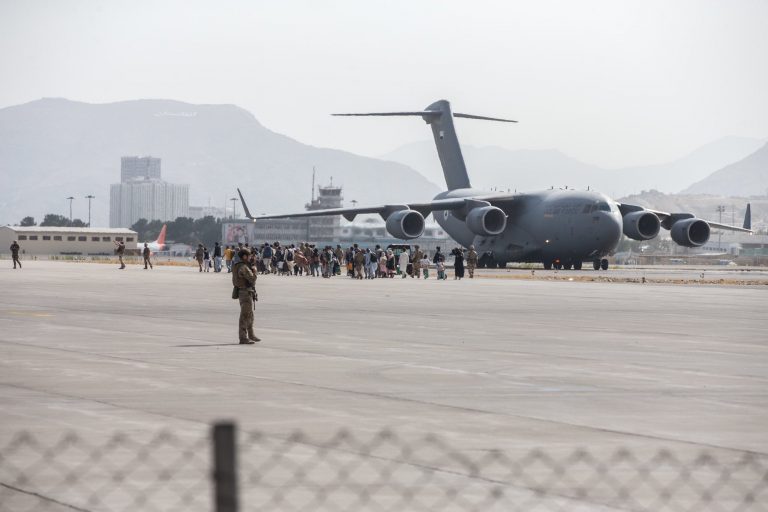
One of the images that instantly went viral soon after the Taliban walked into Kabul and declared its rule over Afghanistan was that of a US Air Force C-17 Globemaster III taxing on the runway, with a straggly mass of people milling around the aircraft.
A large number of people run around on the runway at the Kabul Airport as a C -17 prepares to depart
On scrutiny, it was found that the image that was being shared on social media websites was a recent one, clicked on August 15, 2021, the day when the Taliban took over Kabul and formally announced its seizure of Afghanistan. The image was a screengrab of a video that was shot to highlight the chaotic scenes from the Kabul Airport, where a large number of people, desperate to fly out of the country to escape the Talibani atrocities were running around the US aircraft that was about to take off.
Scores of people clinging precariously at the steps leading to an aeroplane
Another image that went viral on the internet was about the unfolding crisis at the Kabul airport, where a group of men clung to the steps that led inside an aeroplane that was presumably evacuating people from Afghanistan.
A straggly mass of people precariously clinging on to the steps leading to an aeroplane at the Kabul airport
In our investigation, we found that the image was recently taken, capturing the despair and desperation among people at the Kabul airport who wanted to eagerly escape the return of the Taliban rule. This picture was again shared by a raft of mainstream media organisations in India, including The Tribune, Free Press Journal and several others. It was also shared by international media organisations such as CNN, The Guardian, NBC News etc.
Hundreds of people crammed inside a US Air Force’s C-17 Globemaster III
Then there was the image from inside the US Air Force’s C-17 Globemaster III carrying evacuees from Kabul to Qatar. The picture showed a large number of people, into their hundreds, including men, women and children, sitting on the floor of what seemed like the inside of a carrier aircraft.
640 people fleeing the Taliban being rescued in an American C-17 Globemaster
The extraordinary image of people being packed to capacity inside an aeroplane had gone instantly viral on the internet. It was shared by notable personalities across the world, highlighting the crisis unfolding in Afghanistan and underscoring the fear among Afghans desperate to escape an impending Talibani regime.
The picture was shared by the US defence and security news site Defense One and showed 640 people crammed into a C-17 Globemaster III, among the highest number of people ever carried in such an aircraft.
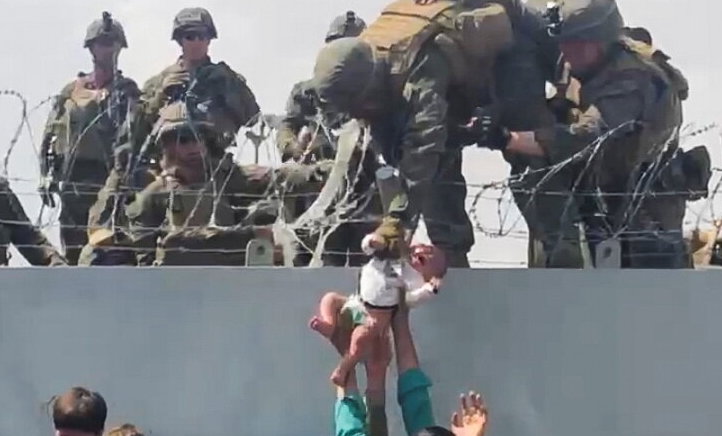
Image of an infant being handed over to US Marine Corps at the Kabul Airport
One more poignant image that captured the imagination of the world and drew their attention towards the Afghanistan crisis was that of an infant being raised on outstretched arms and plucked by a Marine on the other side of a razor wire-topped wall. The image triggered an emotional wave of reactions from netizens online, with many expressing their concern over the safety of the baby away from its parents and the fate of hundreds and thousands of children caught in the war between the Afghan armed forces and the Taliban.
An infant being handed over to US Marine Corps at the Kabul Airport
Since many gut-wrenching videos and images have been doing the rounds on the internet, especially about infants and children being handed over to the Armed Forces stationed at the Kabul Airport, we tried to ascertain the authenticity of the above-shared image.
We found that the image was indeed from the Kabul airport and the security personnel in the picture belong to the US Armed Forces. Later, Major James Stenger of the US Armed Forces told the New York Times in an email that the baby had been reunited with the father and is safe at the airport. He said the baby seen in the visuals was taken to a medical treatment facility on-site and cared for by medical professionals, after which it was returned to the father.
Afghan men fall to their deaths from a C-17 aircraft
Another extremely unpleasant visuals being shared online was about men falling to their deaths from an aeroplane after it took off from the Kabul airport.
Afghan men falling to their death after a C-17 took off on Monday last week
In our examination, we again found the images to be real. The pictures showed two dots falling away from the soaring aeroplane. It was later found out that two men, who had clung to the fuselage of the aeroplane at the time of departure had fallen to their deaths shortly after the C-17 Globemaster III had taken off from the Kabul Airport.
One of those who died after unsuccessfully clinging from the plane’s exterior was a 17-year-old Zaki Anwari, a footballer of the Afghanistan Youth National Team. Anwari was one of the two persons falling from a USAF Boeing C-17 plane while it had just taken off, and his identity was confirmed by the Afghan Directorate of Sports.
“Fact-checkers” understate Talibani atrocities by “fact-checking” old videos and images of their savagery
Even though the above images underscore the crisis that Afghanistan finds itself in after the Taliban takeover, there have been countless “fact-checks” being done about past videos and images to play down the bestiality and brutality associated with the terror outfit. Several so-called “fact-checkers” have tried to understate the Afghanistan crisis and downplay the fear and panic that has gripped Afghans by “fact-checking” old videos and images, essentially insinuating that their apprehensions are unfounded and the new-age Taliban is wrongly being defamed with the circulation of their old videos of cruelty.
Now, a dedicated bunch of “fact-checkers” are busy washing the Taliban’s laundry. They are sifting through the millions of images, videos shared on social media and trying to check whether the precise date, timestamp and geographical locations are in accordance with the current group of Talibani forces active in Afghanistan. The parameters obviously do not match, so the “fact-checkers” declare that X claim against the Taliban is fake, Y picture is from 2018, THAT image is not THIS Taliban at all. Here are some examples.
Recently, AP, Reuters and AltNews took it upon themselves to “clarify” that an image of where three women were seen with chains tied to their ankles and a man leading the chain was fake. It was apparently from Iraq and the chain was morphed. Fine. but does that mean Taliban atrocities against women were false claims? No. But by ‘fact-checking’ an old, unrelated image, the Taliban sympathising fact-checkers create an environment that perhaps videos and images of other atrocities are not real either.
This is also how innocent men and women are radicalised and made to believe that what the world is showing them is incorrect. That’s how ISIS propaganda worked. Thousands of young women from all over Europe willingly went to Syria to join the ISIS because they were told great things about Sharia as well as the Caliphate. They were also told that the reports in western media about the ISIS are fake and untrue and that they do not unleash such atrocities. Perhaps they had their own set of ‘fact-checkers’.
It is worth noting that just because some social media users have shared images from the past does not mean that the Taliban has suddenly transformed itself into a pacifist organisation, averse to violence and brutality. Regardless of what these “fact-checkers” try to prove with their mind-numbing “fact-checks”, the reality is that the Taliban continues to be a terror outfit that has little regard for human life and human rights. As the above images from the Afghanistan crisis prove, a sizeable population in the country still consider the Taliban as a repressive organisation, notwithstanding their claims to moderation and peace.
A 20-year-old Hindu girl named Trushna Rani Nath, a resident of Mirzapur Nathasahi village in Bhadrak district, Odisha, committed suicide after being molested by 65-year-old Muskin Sheikh, reported Rashtra Jyoti, a media initiative by Swati Goel Sharma and Sanjeev Newar. According to the report, Muskin Sheikh is a powerful, influential and well-connected person because of which the police have been protecting the accused.
The victim and her family were reportedly threatened with dire consequences by Muskin Sheikh and his sons after the police acted against Sheikh, following a complaint filed by the victim. Sheikh was arrested, however, released on bail a few days later.
Even though local social and political groups have rallied behind the victim’s family, the tragic case of Trushna Rani Nath from Odisha has received scant coverage in the media https://t.co/H7vLnAffgb
The victim’s father told the media that they are being pressurised by the police to take back their complaint against the accused. The Odisha police cited the high profile contacts of Shiekh to intimidate them.
Though the police arrested Muskin Shiekh once again after Trushna Rani Nath’s suicide, her family alleged that the police continue to shield the accused and are cooking up fake stories about Trushna.
The incident
Narrating what had transpired, Trushna’s father Rajendra Nath said on 2 August, Trushna had gone along with two of her friends Debina and Rubi Nath to a Shiva temple in the Purana Bazar area around nine in the morning. On her way home Trushna decided to buy chocolates for her two younger sisters from a nearby paan shop. It was a hot day and Trushna asked her friends to wait under a tree till she returned.
Trushna requested the elderly shopkeeper for five rupees worth of chocolates, but he urged her to take them out of the box herself. The shopkeeper, 65-year-old Muskin, grabbed her hand and dragged her into a narrow tunnel beside his shop as soon as she put her hand into the box. Trushna raised an alarm, but Muskin raised the volume of the music playing in his shop to muzzle her voice, said Rajendra.
“He (Muskin) touched my daughter inappropriately and tried to rape her. He tried to do bad things with her. She screamed and shouted for help but he covered her face with his hands,” said the distraught father in his choked voice.
Trushna’s friends were worried when she did not return for long and began looking for her. Trushna’s desperate shouts were finally heard by her friends, who rushed to the shop. The accused was seen clutching Trushna’s neck and covering her lips with his hands. The two girls screamed for aid and, in desperation, struck Muskin with their slippers, forcing Muskin to let her go.
The father confirmed that whatever information he was sharing was based on what he was told by his daughter. The victim’s friends, who had rescued her from Muskin Sheikh had also testified the father’s statement.
The aggrieved father further added that the accused had warned Trushna to not disclose what happened with her. He threatened to kill Trushna’s family members if she didn’t pay heed to his demands, reminisced the father.
Trushna narrated her ordeal to her mother Basanti Nath, who in turn, informed Rajendra after he returned home from work.
Nath filed an FIR (number 0264/2021) at Purana Bazar Police Station after learning about the incident.
On the basis of Trushna’s statement, the police arrested Muskin and charged him with violating sections 341 (wrongful restraint), 323 (voluntarily causing harm), and 354 (outraging a woman’s modesty) of the Indian Penal Code, said the father adding that this was just the beginning of their predicaments.
Odisha police protecting the accused, asking victim’s family to compromise
On one side the Odisha police were pressurising the victim’s family to take back the complaint and settle the matter with the accused’s family which was ready to compensate them monetarily and on the other side, Muskin’s sons Sameer and Tunnu kept threatening them with dire consequences had they not taken back their complaint.
Rajendra Nath recalled how the threats became more frequent after Muskin was let out on bail. When the threats became an everyday affair, Trushna could not handle the pressure and took the drastic decision of ending her life on August 8th morning.
The distressed father said that since Muskin was re-arrested after Trushna’s death under IPC section 306 (abetment of suicide), the police has been concocting various stories to defame Trushna and absolve Muskin from the crime.
He said that the police have been trying hard to prove that Trushna was in love with a boy with whom she was in touch over mobile and finally took her life when things didn’t work out. Rajendra, however, said the theory is false as Trushna did not even possess a mobile phone.
Police inspector Prakash Chandra Prusty who is probing the case refused to respond to queries regarding allegations levelled by Rajendra.
After the news spread, many Hindu outfits, including Akhil Bharatiya Vidyarthi Parishad (ABVP) protested and held candlelight marches to ensure justice for Trushna.
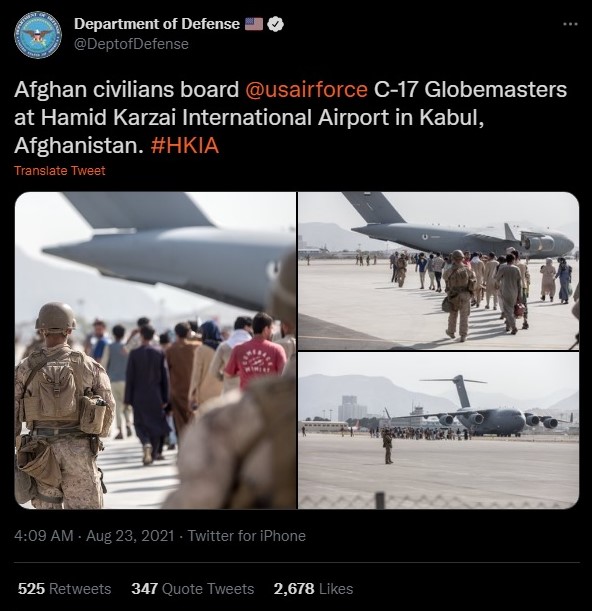
The official Twitter account of the Department of Defense of the United States of America posted a tweet on Monday where it claimed a C-17 Globemaster aircraft as its own which actually belonged to the United Arab Emirates (UAE). The US Department of Defense claimed that the photographs showed American C-17 Globemasters evacuating Afghan civilians from the Kabul Airport but the aircraft was UAE’s.
Source: Twitter
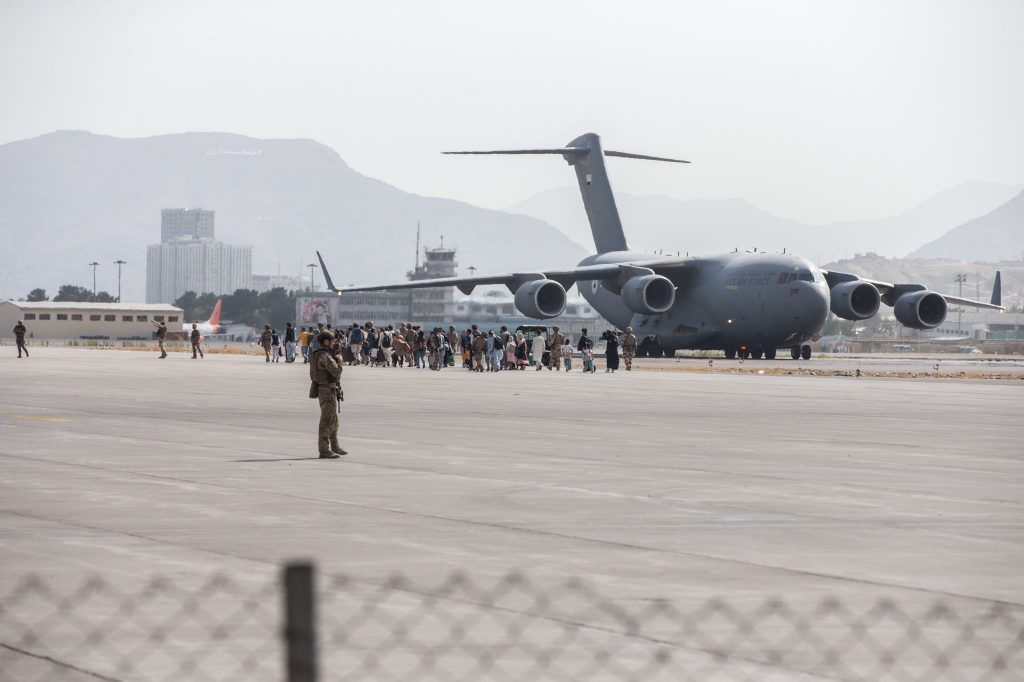
The US DoD shared three photographs in its tweet. While it is not discernible in the first two photographs which country the aircraft belongs to, the third photograph gives it away. It clearly shows ‘UAE Air Force’ written on the body.
Source: US Dept of Defense/Twitter
US Department of Defense called out on social media
People on social media called out the US Department of Defense over its gaffe. They were mocked over it by people across the board, who pointed out that the aircraft did not belong to USA.
That’s not a @usairforce C-17, @DeptofDefense. Wrong country. Glad to know you guys are in command of the situation.
A citizen of UAE, while pointing out the gaffe, said that he was proud to see his country participating in the evacuation.
That’s a UAE Air Force ?? C-17 Globemaster III aircraft… very proud to see Emirati @modgovae participating in such a noble cause at #HKIA#Kabul airport along side our American ?? partners. #GodSpeedhttps://t.co/CsM1nscY6w
— حسن سجواني ?? Hassan Sajwani (@HSajwanization) August 23, 2021
The C-17 Globemaster III was initially developed for the United States Air Force but since then, has been bought by other countries as well. The Indian Air Force uses the aircraft for its operations too. Apart from the UAE, Kuwait and Qatar have it too.
Days after the video of a young CISF officer Somnath Mohanty stopping Bollywood actor Salman Khan at the Mumbai airport went viral on social media, several mainstream media houses claimed that the officer was being harassed for speaking about the incident to the media. Mohanty had stopped the actor, bound for Russia, from flouting security protocols at the airport.
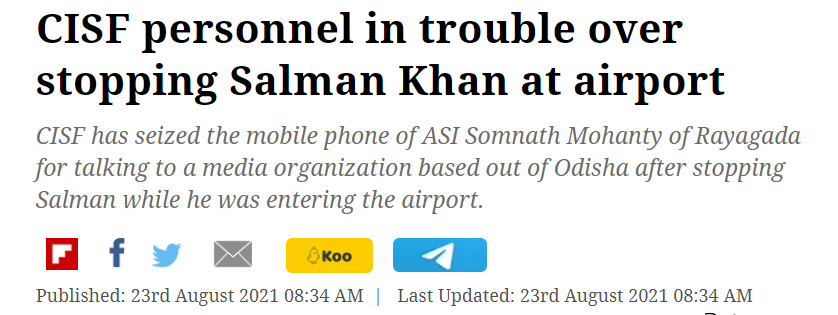
On Monday (August 23), the New Indian Expressreported that the CISF officer ‘landed in trouble’ for talking to media organisations. While quoting an anonymous CISF personnel, the newspaper claimed, “The mobile phone of Mohanty has been seized as he interacted with the media and it is a breach of protocol. His mobile phone was seized to ensure he is not able to speak with the media further about the incident.” A resident of the Rayagada district, Somnath Mohanty had interacted with a media channel based in Odisha.
Screengrab of the New Indian Express report
A similar claim was made by the leading national daily, ‘The Times of India.‘ It reported, “The CISF officer who recently rocked headlines for stopping superstar Selman Khan at the airport for the mandatory security checkup has landed in trouble. According to the reports, the CISF has seized his phone for talking to the media organisation of Odisha. Reportedly, the phone has been seized for the breach of protocol and to make sure that he would not talk to the media about the incident in future.” Unlike the New Indian Express, TOI did not cite any source and based it on unknown ‘reports.’
Screengrab of the report by the Times of India
CISF debunks claims made by mainstream media
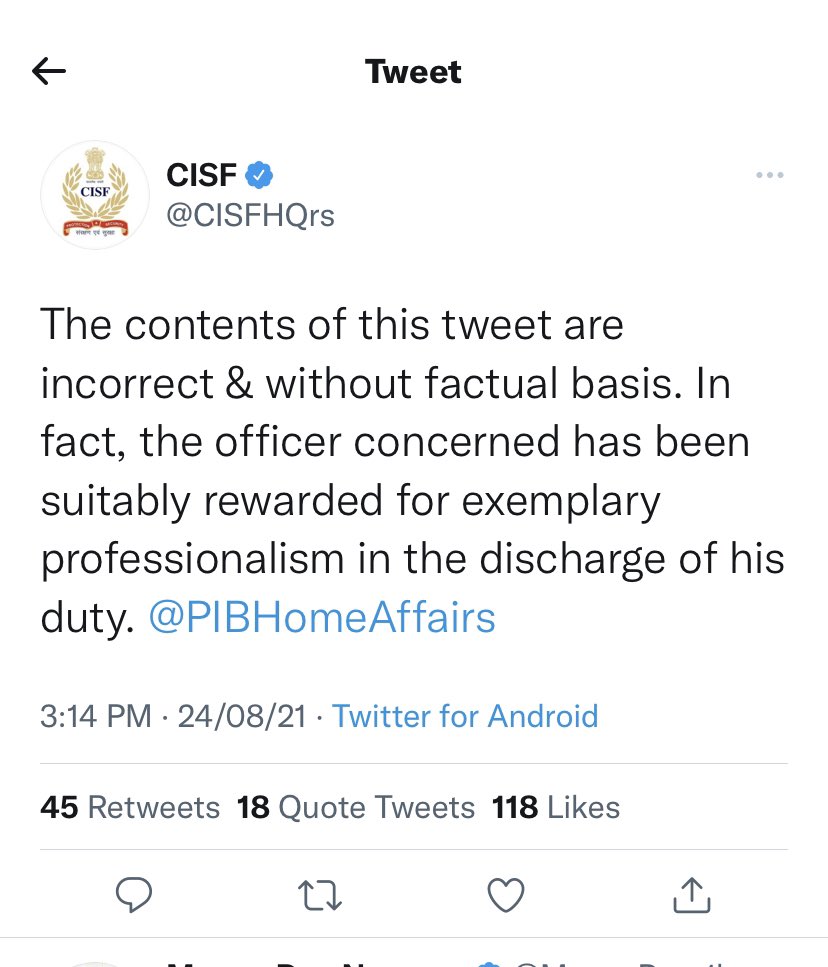
In a tweet on Tuesday (August 24), the Central Industrial Security Force (CISF) clarified that all such reports were factually incorrect and that the officer was instead rewarded for his professionalism. “The contents of this tweet are incorrect & without factual basis. In fact, the officer concerned has been suitably rewarded for exemplary professionalism in the discharge of his duty,” it emphasised.
Screengrab of the tweet by CISF
Earlier, a video of Bollywood actor Salman Khan went viral on the internet where he was stopped by a CISF officer named Somnath Mohanty to first complete the security check before entering the Mumbai airport. In the video, Salman Khan was seen reaching the Mumbai Airport to leave for Russia for the shoot of his upcoming movie Tiger 3. As he reached the airport, Salman Khan tried to breezily walk into the airport without completing the mandatory security check at the entrance.
With photographers screaming at him for pictures, Salman Khan, with his entourage, shows paltry respect for the security check while others waited in line. At that time, the young CISF officer stopped the actor from entering the airport, asking him to get in line and complete his security check first. He was also seen asking the photographers to take a step back. The video that went viral on social media was posted by celebrity Bollywood photographer Viral Bhayani. The video of Salman Khan and Katrina Kaif arriving at the airport had received over 88,000 views.
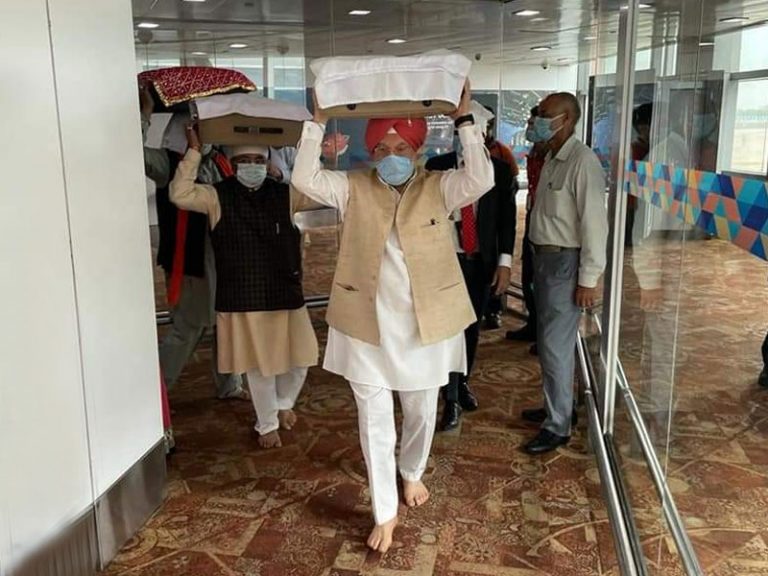
On August 24, Afghan Sikhs brought three hand-written Swaroop of Shri Guru Granth Sahib Ji from Afghanistan to India. Union Minister Hardeep Singh Puri and Minister of State and V Muraleedharan, Ministry of External Affairs were at the airport to receive them. Puri respectfully carried one of the Swaroops and led the Afghan Sikhs to the room where all three Swaroops are being kept before shifting them to Gurudwara. Reportedly, only three such Swaroops are left in Afghanistan, which would be brought to India soon.
प्रधानमंत्री @narendramodi जी के प्रयास से अफगानिस्तान से आए श्री गुरु ग्रंथ साहेब जी के तीन पवित्र स्वरूप को दिल्ली एयरपोर्ट पर केंद्रीय मंत्री भारत सरकार श्री @HardeepSPuri जी एवं श्री @VMBJP जी के साथ स्वगत किया। pic.twitter.com/uwZlNVC5Dz
Before leaving Afghanistan, Sikhs thanked PM Modi and the Government of India for their support.
#WATCH | Three Sri Guru Granth Sahib being brought to India from Afghanistan’s Kabul, along with stranded Indian nationals and 46 Afghan Hindus & Sikhs, on an Indian Air Force aircraft.
Puri and others shared videos of Swaroop reaching Delhi
Union Minister Puri shared a video of himself carrying Swaroop of Shri Guru Granth Sahib Ji on Twitter and said, “Deeply privileged & fortunate to welcome the three holy Swaroop of Sri Guru Granth Sahib Ji from Kabul at Delhi Airport along with Shri V Muraleedharan and Dushyantt Gautam Ji & members of Sikh Sangat.”
Puri also thanked Prime Minister Narendra Modi for making it possible to carry out rescue operations. He said, “I want to start by thanking PM, who made it possible to carry out these rescue ops to bring our brethren who are in difficult circumstances there (Afghanistan). Arrangements are also being put in place for the remaining people. We’re in constant touch with them.”
I want to start by thanking PM who made it possible to carry out these rescue ops to bring our brethren who are in difficult circumstances there (Afghanistan). Arrangements also being put in place for the remaining people. We’re in constant touch with them: Union Minister HS Puri pic.twitter.com/jVaj9nIZao
Puri’s wife said on Twitter, “This holy & poignant privilege of गुरु दी सेवा, comes as a once in a lifetime moment to cherish, so special & proud that could bring a tear to anyone’s eye. Heartening to see the holy scriptures in a safe haven now.”
धन धन श्री गुरु ग्रंथ साहिब जी ते धन धन साड्डे भाग?
This holy & poignant privilege of गुरु दी सेवा, comes as a once in a lifetime moment to cherish, so special & proud that could bring a tear to anyone’s eye.
V Muraleedharan, MOS MEA, wrote, “Feel blessed to have joined Shri Hardeep Singh Puri to receive the Swaroops of Shri Guru Granth Sahib Ji, brought from Kabul at New Delhi Airport today.”
Others praised Union Minister for his devotion and dedication to serve and ensure Guru Granth Sahib Ji’s safe arrival in the country and thanked PM Modi for the safe evacuation process.
श्री गुरु ग्रंथ साहिब जी की तीन पवित्र प्रतियां काबुल से दिल्ली लाई गईं। जिसमे खुद केंद्रीय मंत्री @HardeepSPuri सबसे आगे रहे। जय हो ? pic.twitter.com/PIQRQcT2WM
Amid chanting of #Satnam Waheguru, the Ministers @HardeepSPuri & @MOS_MEA carrying the old handwritten Saroops of Sri Guru Granth Sahib, as per Sikh religious code of conduct, on their heads from the plane. The saroops of have been brought to India from war-ravaged Afghanistan. pic.twitter.com/IvFd9MHrc0
— Ravinder Singh Robin ਰਵਿੰਦਰ ਸਿੰਘ راویندرسنگھ روبن (@rsrobin1) August 24, 2021
Seven Swaroop were shifted to India last year
Reports suggest that earlier, there were a total of 13 Swaroop of Shri Guru Granth Sahib Ji in Afghanistan. After the attack at Gurudwara Har Rai Sahib in Kabul on March 25, 2020, in which 25 Sikhs were killed by terrorists of Islamic State, seven Swaroop were shifted from different Gurudwaras to India. At present, there are three more Swaroops in Afghanistan.
Chhabol Singh, a member Karte Parwan Gurdwara committee, said that the remaining three Swaroop would be soon shifted to India. He said, “There were 13 Swaroops of Guru Granth Sahib in Afghanistan, of which seven were already shifted to India earlier. Three have been shifted today, and now just three more remain in Afghanistan. Those too will be shifted soon.”
Importance of Guru Granth Sahib
Shri Guru Granth Sahib Ji is considered the Supreme Spiritual Authority and Head of the Sikh religion. It is the only scripture in this world that not only has works of the founders but also writings from spiritual leaders of other faiths. Considered to be the “living Guru” of the Sikhs, Granth Sahib Ji is treated with the utmost respect by all Sikhs. Guru Granth Sahib Ji has a collection of devotional hymns and poems that emphasises the importance of meditation on the True Guru or God. The book contains moral and ethical rules for the spiritual salvation of the soul and its unity with God.
Why did Guru Granth Sahib Ji’s Swaroops shift to India?
There are several protocols that Sikhs follow while taking care of Shri Guru Granth Sahib. As per the rules set by the spiritual leaders of Sikhism, Shri Guru Granth Sahib Ji should not be left behind alone if the caretakers are shifting to another place. In such a case, the Swaroop must be either taken by caretakers with them or shifted to a nearby Gurudwara. In this case, to ensure the safety of Guru Granth Sahib Ji, the three Swaroops have been shifted to India with Afghan Sikhs.
While talking to OpIndia, Impreet Singh Bakshi, Secretary BJP Delhi, said that these Swaroops are hand-written thus hold historical importance for Sikhs around the world. He said, “As Taliban now controls Afghanistan and there was a possibility of an attack on places of worship of other religions including Gurudwaras, three Guru Granth Sahib Ji’s Swaroops have been shifted to India. Mahavir Nagar Gurudwara will take care of the three Swaroops of Shri Guru Granth Sahib Ji.”
Bakshi added that there are few Sikhs left in Afghanistan to protect Gurudwaras. If and when they request Indian authorities for evacuation, they would be brought to India. Bakshi had went to airport to pay respect to the Swaroops.
Afghanistan has a long history associated with Sikhism. Shri Guru Nanak Dev Ji went to Afghanistan to spread the message of brotherhood, tolerance and peace in the early 16th century. His visit laid the foundation of Sikhism in the country. Based on his recorded travel history, he went to Afghanistan during his fourth ‘Udaasi’ (travel) from 1519-1521. Bhai Mardana accompanied him during his journey. He visited present-day Kabul, Jalalabad, Kandahar and Sultanpur. At present, all these places have historic Gurudwaras.
The heartbreaking situation for Afghan Sikhs to leave their homeland
Indian Express quoted one of the 46 Sikhs who came to India, saying, “We are also carrying three Swaroops of Sri Guru Granth Sahib with us. We cannot leave our Guru behind when all of us are leaving the country. It is heartbreaking to see the end of Sikhism in our country, but we have no other option. We can’t leave behind the Swaroops as there would be no one left to do their sewa. We have packed them safely in suitcases.”
Paramjit Singh Sarna, president, SAD (Delhi), said in a tweet that it is the end of Sikhi in Afghanistan. He said, “End of an era of #Sikhi in #Afghanistan. Taliban takeover of Afghanistan has forced Sikhs to flee their homes. Saroop of Sri Guru Granth Sahib Ji from the Kabul, Ghazni and Jalalabad Gurdwaras leave for India with a heavy heart by our #Sikh minority brothers in order to preserve it for future generations. This marks the end of Sikhi in Afghanistan but also a new beginning for our Sikh brothers in India.”