Union Health Minister Mansukh Mandaviya on Tuesday said the Covid-19 vaccine for children is likely to be launched in the country by August. Mandaviya shared the information at the BJP Parliamentary party meeting, also attended by Prime Minister Narendra Modi.
He also said that India is soon going to be the largest vaccine-producing country as more companies will get production licenses.
Experts believe vaccinating children and teens will play a big role in developing the herd immunity that a society needs to ward off a contagion like the COVID-19 outbreak. The third wave of COVID-19 is expected to hit the nation in September-October. However, children may not have a severe infection, AIIMS director Randeep Guleria had said.
Earlier last week, Dr Randeep Guleria, the director of the All India Institute of Medical Sciences (AIIMS), also said that the trials of Bharat Biotech’s Covaxin on children were underway and the results were expected by September. As of now, Covaxin trials are underway on children aged between 2 to 6 in Delhi AIIMS.
In June this year, the AIIMS started screening children aged 2 to 17 for trials of the COVID-19 vaccine. The move came a month after the DGCI granted permission to Bharat Biotech to carry out phase 2, phase 3 trials of Covaxin on children as young as two.
Along with Covaxin, clinical trials of the vaccine developed by Zydus Cadila is also underway. Dr NK Arora, who heads the National Expert Group on Vaccines, had earlier this month said that vaccination for children will start by September with the Zydus vaccine for 12 to 18-year-olds.
India has so far authorised the emergency use of COVID-19 vaccines on citizens above the age of 18.
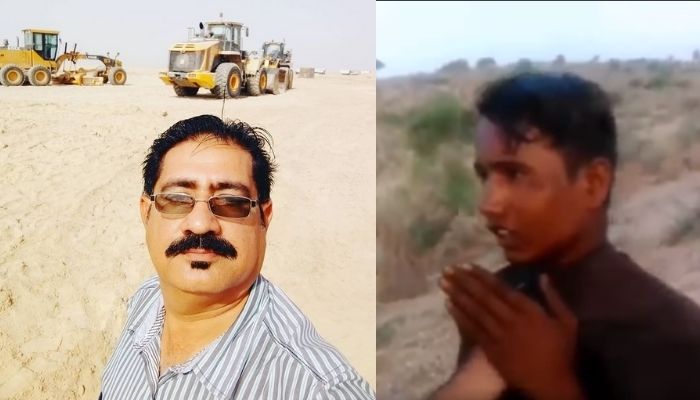
In a disturbing video that has now surfaced on social media, a Pakistani Muslim man was seen threatening and forcing a Hindu boy to chant ‘Allahu Akbar’. The victim was also coerced into abusing Hindu Gods and Goddesses.
The video was uploaded on social media by a popular Facebook user named Prakash Heerani. The accused, Abdul Salam Abu Dawood, was seen grabbing the victim by the collar and ordering him to chant Allahu Akbar. When the boy complied, the accused asked him to utter expletives directed at Hindu Gods. “Abuse your deities in the name of mother and sister…Say your God is a sister f*cker. You guys have polluted the entire Pakistan,” Dawood was heard as saying.
Abdul Salam Abu Dawood, a native of Rahim Yar Khan in Pakistan, had uploaded the video on his Youtube channel with the caption, “Hindu torture by Muslim in Pakistan.” Following public outrage, he was quick to delete the video.
Dawood was also seen threatening Hindus with genocide and complete annihilation. In a video posted in April this year, he warned, “If we start killing Hindus in Pakistan it would only take 30 minutes…We will kill Hindu men and take Hindu women. We will procreate from these women and make them ‘mujahid’ (fighters/Islamic terrorists ). Don’t mess with us we have a lot of people (Muslims) in India that would not take time to kill you (Hindus).”
The particular video has now been deleted from YouTube.
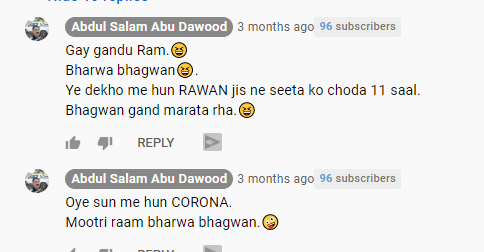
In his Youtube comment section, Dawood was seen using despicable language for Lord Ram and Goddess Sita. He had compared the Hindu deities to homosexuals, pimps, and rape victims.
Screengrab of the Youtube comments by Abdul Salam Abu Dawood
In a video posted in February 2019, he was seen intimidating a Hindu kid named Raju Krishnan. While addressing his subscribers, he said, “This kid is a Hindu. If I want, I can do many things to this kid. If I beat or thrash him, what will be the use?” Dawood then went on to boast about his decision to not assault the child and how it proved that he is a virtuous man.
(Video Courtesy: Youtube/ Abdul Salam Abu Dawood)
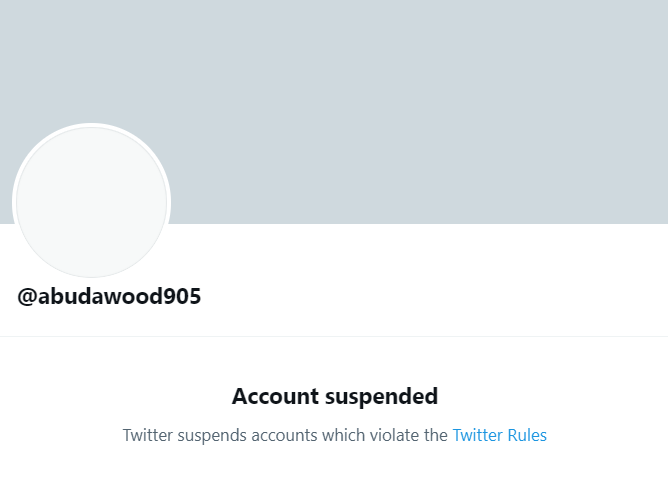
As per his Facebook profile, Dawood currently lives in Hyderabad in the Sindh province of Pakistan. He is employed with the Thar-Coal projects. His Twitter profile has been suspended for violating the terms and conditions of the microblogging platform. At the time of writing, his Instagram profile was found to be active.
Screengrab of the suspended Twitter account of Abdul Salam Abu Dawood
60 Hindus mass converted to Islam in Sindh
On July 7, as many as 60 Hindus were mass converted to Islam in the Sindh province of Pakistan. A man, identified as one Abdul Rauf Nizamani, had been the facilitator of the mass conversion process. In a Facebook post, the accused rejoiced, “Alhamdullilah aj meri nigrani me 60 log musalman hui hain inke liye dua karen (Today, 60 people accepted Islam under my watch. Please pray for them.” According to the Facebook profile of Abdul Rauf Nizamani, he is the Chairman of the Municipal Committee in Matli in Sindh of Pakistan. The accused boasts of 4,275 followers on his personal profile.
In a video posted by him, an Islamic cleric could be seen making the 60-odd Hindus chant Kalma (Islamic oath of allegiance) and ensuring their full-fledged conversion. In a subsequent video, the said Islamic cleric could be seen claiming that it was their recitation of the first-ever Namaz. “The only objective in the life of a Muslim is to make Allah happy. Only then, the purpose of your life will be fulfilled. Only the lives of those, approved by Allah, move forward,” the cleric could be seen speaking to the new converts.
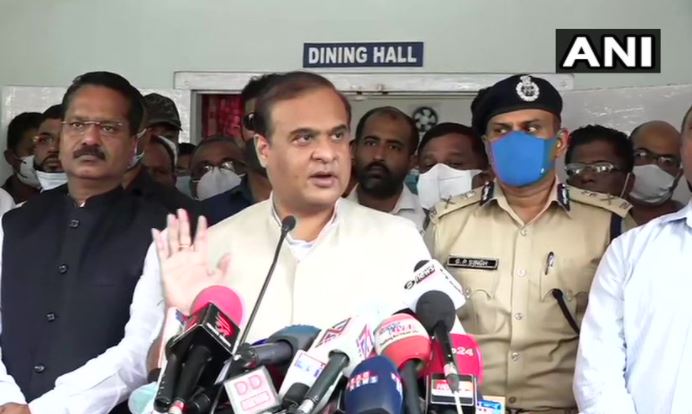
Assam CM Himanta Biswa Sarma today laid wreaths to pay homage to the slain police personnel who lost their lives in the Assam-Mizoram border clash on July 26 (Monday) night. He declared a financial support of Rs 50 lakhs each to families of the cops who died in the clash. He also announced that the injured will be given Rs 1 lakh each. OpIndia reported that six police personnel lost their lives in the ongoing Assam-Mizoram border dispute.
Assam Govt will provide financial assistance of Rs 50 lakhs each to families of the police personnel who died in clashes at the border with Mizoram yesterday. The injured will be given Rs 1 lakh each. Govt has sent the injured SP to Mumbai for treatment: CM Himanta Biswa Sarma pic.twitter.com/txt82Up5n1
According to reports, Himanta Sarma had revealed that civilians were in army fatigues carrying arms, including sniper rifles, therefore the Assam Police has been ordered to conduct an investigation into the matter. “It will be investigated that where did the civilians get the arms from”, said Biswa Sarma.
During his address to the media, Sarma repeatedly asserted that the Assam government is committed to securing the state’s territory. He also informed that his Mizoram counterpart has invited him for talks in Aizawl.
“This is not a political issue. This is a boundary dispute between two states. This is a long-standing border dispute. There was dispute even at the time when Congres govt was there on both sides. This is a dispute between two states, not between two political parties”, said the CM.
This is not a political issue. This is a boundary dispute between two states. This is a long-standing border dispute. There was dispute even at the time when Congres govt was there on both sides. This is a dispute between two states, not between two political parties: Assam CM pic.twitter.com/dhuBpwDfbq
Tensions rose along the Assam-Mizoram border after reports of firing between the police of both states emerged. According to Assam Police, their Mizo counterparts opened fire at them at Lailapur.
Six police personnel lost their lives in the ongoing Assam-Mizoram border dispute, chief minister of Assam Himanta Biswa Sarma informed on Monday evening.
A 58-year-old nurse employed at the Urban Primary Health Centre (UPHC) in Tamil Nadu’s Karur was suspended for stealing Covishield vaccine doses. As per reports, the nurse fled with the vaccines to administer them to relatives and local residents for money.
The nurse, P Dhanalakshmi, who worked as a maternity assistant in Karur is a resident of Vedasandur in Dindigul district of Tamil Nadu. As per a report in Times Now, the incident came to light when block medical officer, Dr Maheshwari received information that Dhanalakshmi was administrating Covid-19 vaccines privately at her residence.
On Sunday, the health department officials raided her residence and the block medical officer informed the deputy director of public health. The Karur Municipality Commissioner informed that eight vials of the Covishield vaccine were recovered from the nurse’s residence.
Commenting on the probe and Dhanalakshmi’s suspension, the official said, “Based on the initial reports, we have suspended her. The investigation is underway, details about how she managed to get vaccines to her home, are there any other persons involved in this needs to be ascertained.”
Karur district deputy director of health services (DDHS) S Santosh while speaking with The Times of India informed, “A report will be submitted by the team after collecting details like the number of people vaccinated by the maternity assistant.”
The official also informed that action has been initiated against the nurse and an official complaint has been lodged.
Dhanalakshmi’s colleagues at UPHC informed that she had been working there for over 10 years.
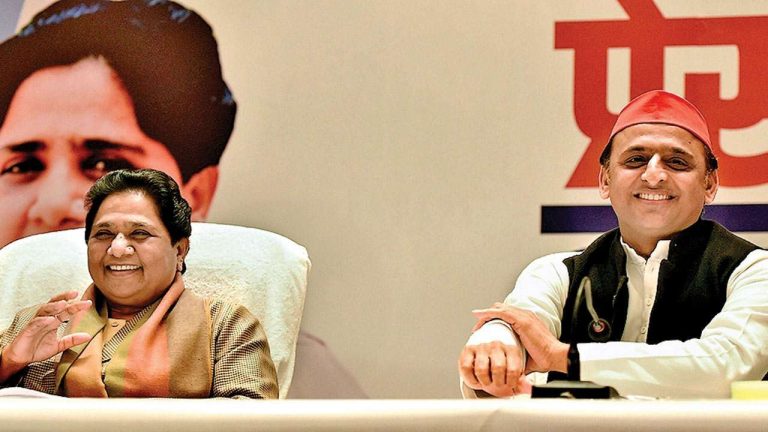
As the crucial Uttar Pradesh Assembly elections inches closer, Bahujan Samaj Party (BSP) chief Mayawati is attempting to make a paradigm shift in her political strategy. The Dalit leader is all set to woo the Brahmin voters by organising ‘Brahmin Sammelans’ across the state.
As part of her charm offensive to lure Brahmin voters to its fold, Mayawati has announced the second ‘Brahmin Sammelan’ to be held at the holy town Vrindavan, where Hindu deity Lord Krishna is said to have spent his childhood, from August 1. Satish Kumar Mishra, the party’s general secretary and in charge of this drive, will be visiting the famous Banke Bihari temple before taking part in the event.
Earlier on July 23, Satish Kumar Mishra had offered prayers at the Ram Janmabhoomi in Ayodhya before commencing the party’s first phase of the campaign to woo Brahmin voters.
At each such event, the BSP leaders have strategized to first go for temple darshan in the respective city and then address the gathering. Local Brahmin organisations, BSP Brahmin workers and several intellectuals of the same caste will be invited.
Speaking about what appears as BSP’s stratagem to compete with Yogi Adityanath, the icon of Hindutva, in the upcoming state Assembly elections, Satish Kumar Mishra “Brahmin community constitute 13 per cent of the state population but are still marginalised because Brahmins are not united”. He stressed that the real power will come only when Brahmins and Dalits in UP come together.
Moreover, talking about the party’s sudden Hindu turn, a senior BSP leader said it’s “high time the BSP understands the local sentiments.”
“Many of our Dalit brothers voted for Modi on nationalism and Hinduism. We have to counter this narrative. Somehow a section of Jatavs, especially youngsters, are now turned into Hindu voters. So to keep them with us we have to show them that we agree with their thoughts. We are not different. So these Brahmin Sammelans and religious places connection are correlated,” said the leader.
In the 2017 Uttar Pradesh Assembly election, BJP won a whopping 312 seats in the 403-member House, whereas BSP could win only 19 seats. Now, eyeing a comeback in the state, after staying out of power for 9 years, Mayawati’s BSP is all geared to shed its Dalit-only image as it has started talking about fostering unity between Brahmin and Dalit communities. In an attempt to woo Hindus, the party is not only organising these ‘Brahmin Seminars’ but interestingly, has also come up with posters with pictures of Ram Lalla along with the under-construction Ram Temple.
And not just BSP, even Akhilesh Yadav’s Samajwadi Party (SP) is putting it all in to woo the Brahmin voters by playing the soft Hindutva card. Recently, SP announced a statue of Lord Parshuram to be installed inside the party headquarters in Lucknow. Another SP leader had met a few Brahmin leaders and formed a committee to deal with the community’s problems. In fact, SP is also set to hold such ‘Brahmin Sammelans’ in various districts as a part of the outreach programme.
The founder and editor-in-chief of Earshot, Abhijit Majumder, has schooled Marxist ‘historian’ Irfan Habib for his remark on the recent clashes reported from the Assam-Mizoram border. 6 Assam police personnel have lost their lives in the clashes while about 65 people, including civilians, were injured.
The left-leaning historian, taking a sarcastic jibe at PM Modi’s ‘New India’ vision, wrote that he had “never heard before that the armed forces of two neighbouring states kill each other in a deadly clash”.
Never heard before that the armed forces of two neighbouring states kill each other in a deadly clash. This is surely ‘New India’ for many of us.#AssamMizoramBorder
Reacting to Irfan Habib’s Tweet, the journalist reminded the ‘historian’ about the Nagaland-Assam clashes in 1985, in which over 41 people in Assam were murdered, including 28 Assam police personnel.
The journalist helped Irfan Habib reminiscence how the 1985 clash had taken place when the Congress party was at the helm of affairs, not only of both the states but also of the nation.
He mocked the ‘historian’, remarking that the 1985 clash had taken place during the days which people like him, considered India’s ‘Golden Age’ under the Nehru-Gandhi dynasty of Congress Party.
1985. Naga-Assam clashes. At least 41 killed, 28 of them police personnel. 27,000 made homeless. Prime Minister: Rajiv Gandhi. Assam CM: Hiteswar Saikia (Congress). Nagaland CM: SC Jamir (UDF-P and then Congress). For some of us, India’s ‘Golden Age’. https://t.co/LdPNstsTrs
In June 1985, a major flare-up at Merapani, also in Golaghat, left 41 persons dead on the Assam side. These included 28 Assam Police personnel. Assam had claimed that the attackers included Nagaland Police personnel.
Assam-Nagaland border issue
The border dispute between Assam and Nagaland had begun right at the inception of Nagaland state in 1963 after a 16-point agreement between Prime Minister Jawaharlal Nehru and the leaders of the Naga People’s Convention was signed in 1960.
The government of India pledged to return all Naga territories that had been annexed by Britain and made part of Assam, but this did not happen and Nagas allegedly encroached on vast swathes of land in the upper Assam districts of Sivasagar, Jorhat and Golaghat. Over 60,000 hectares of Assam forest land has been reportedly under the occupation of Nagaland, and this stretch has ever since, become the bone of contention for the two states.
Since then, violent clashes along the Assam-Nagaland border have become a regular feature, with major armed conflicts reported in 1968, 1979, 1985, 2007, 2014 and many more.
Assam-Mizoram dispute
Like Assam has had border conflicts with Nagaland, it also has been facing similar conflicts with Mizoram. The recent clash was also a fallout of the altercation that occurred over land encroachment between the people of the two states.
The long-standing territorial dispute began when Mizoram used to be a district of Assam. In the colonial era, Mizoram was known as Lushai Hills and was demarcated from the Cachar plains in accordance with an 1875 notification. Subsequently, another notification was released by the British government in 1933 that drew a boundary between the Lushai Hills and Manipur. Mizoram wants the boundary demarcation to be followed as per the 1875 notification. In their defence, they claim that the Mizo society was not consulted prior to the 1933 notification. However, the Assam government follows the 1993 demarcation, which has become a bone of contention between the two States. Read more about the background of the Assam-Mizoram conflict here.
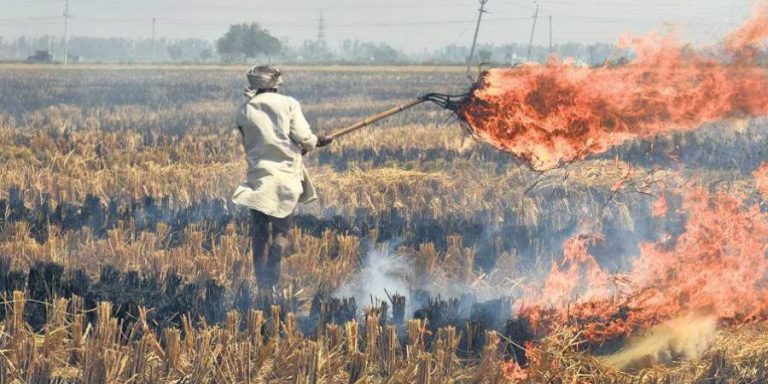
Stubble burning by farmers in Punjab and Haryana may have contributed to the spike in Covid-19 cases in Delhi between October and November, a new study suggests. SARS-COV-2, the virus that causes Covid-19, could have ‘piggybacked’ on Black Carbon, a major constituent of soot from stubble burning, leading to the spike in winter.
The researchers from Indian Institute of Tropical Meteorology (IITM) in Pune discovered that the pollutant concentration in the air corresponded directly with the speed of the spread of Covid-19 during winter after the stubble-burning period.
“We hypothesise that the third Covid peak in Delhi was linked to the increase in pollution levels due to stubble burning in Punjab and Haryana,” one of the authors of the study told ThePrint. According to the study, Covid-19 aerosols get attached to ‘aged’ black carbon particles. ‘Ageing’ in this context refers to the fact the black carbon particles grow in size and combine with other molecules after its generation.
When these particles are inhaled, the viral load delivered is greater and the duration for which it stays deep in the respiratory system is longer. The soot causes inflammation in the lungs as well, thus, posing a ‘double whammy’ for the respiratory system.
While the study discovered that the rise and fall of Covid-19 cases coincided with concentration of pollutants in one of the waves in Delhi, the researchers did not conduct any experiment to confirm their hypothesis. The infectivity of the virus in black-carbon rich environment has not been studied clinically. Thus, further research is warranted in the area.
It has long been suspected that stubble-burning would adversely impact the Covid-19 pandemic due to the increase in air pollution. However, Punjab, one of the major contributors, has failed to take measures to curb the practice.
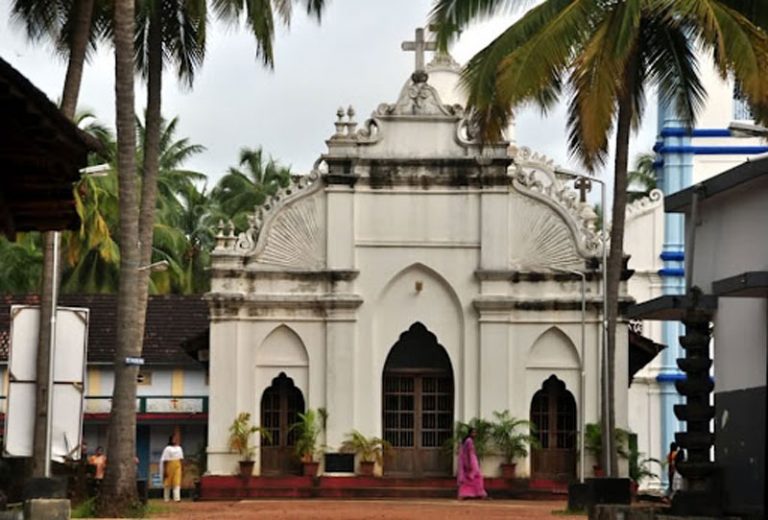
On July 26, the Syro-Malabar Catholic Church diocese in Kerala announced a welfare scheme for families that have five or more kids. The aim is believed to encourage the community to increase its population. Under the scheme, Rs 1,500 would be provided for the couple married after the year 2000 and have five or more children.
Additionally, the fourth and succeeding children in the family would get a scholarship for higher studies at St Joseph’s College of Engineering and Technology, Pala. The cost of pregnancy-related expenses for such families would be covered by the Mar Sleeva Medicity hospital in Pala. Notably, both college and hospital are being administered by the Church.
Bishop Joseph Kallarangatt, head of Syro-Malabar Eparchy of Pala, announced the scheme during the online meeting, which was a part of the family celebrations at the Church.
The scheme is for families associated with Syro-Malabar church
Rev Joseph Kuttiyankal, director of the Family Apostolate, said in a statement that the scheme is specifically for the families associated with the Pala diocese of Syro-Malabar church. It covers Meenachil taluk and some parts of Kottayam taluk, areas from Koothattukulam to Piravom in Ernakulam district, Arakkulam panchayat and some parts of Velliyamattam panchayat in Idukki district.
Iemalayalam quoted Rev Kuttiyankal saying, “The scheme has been prepared with the aim of promoting families in different ways. Traditionally, the Church and the faithful have expressed the thought of having more children. That’s mainly why this (scheme) is being done. Also, many families are under financial strain due to Covid. We plan to solve that as well.”
He added, “There is a need to take our community forward. If not to increase the community’s population growth rate, we aim to retain the present growth. Even at the KCBC [Kerala Catholic Bishops Council] level, it was decided to encourage families to have more children. As of now, the population growth rate of the community is declining.”
Rev Kuttiyankal claimed that there is no need for scientific studies to determine the declining birth rate among the community. “The Church has bonds going down to the grassroots within our community. In conversations with priests of our diocese, we have realised that the strength of the community is declining,” he added.
He told The Hindu that the Church is yet to consider the actual number of families eligible for the scheme. Notably, in 2019, the Changanacherry Archdiocese had issued a letter in which they had said that the Christian population in Kerala was on the decline at an alarming rate.
The letter issued by Archbishop Mar Joseph Perumthottam read, “During the formation of Kerala, Christians were the second-largest community in the state. But now, the community is only 18.38% of the state’s total population. In recent years, the birth rate in the Christian community has decreased to 14%.”
On the 2nd of May, Mamata Banerjee came back to power in the state of West Bengal with a thumping majority. Almost immediately, just as the trends became clear, rampant violence erupted in the state with TMC goons unleashing brutality on those who worked for BJP or voted for them in the state elections. The National Human Rights Commission (NHRC) submitted its final report on Bengal post-poll violence to the Calcutta High Court on the 14th of July.
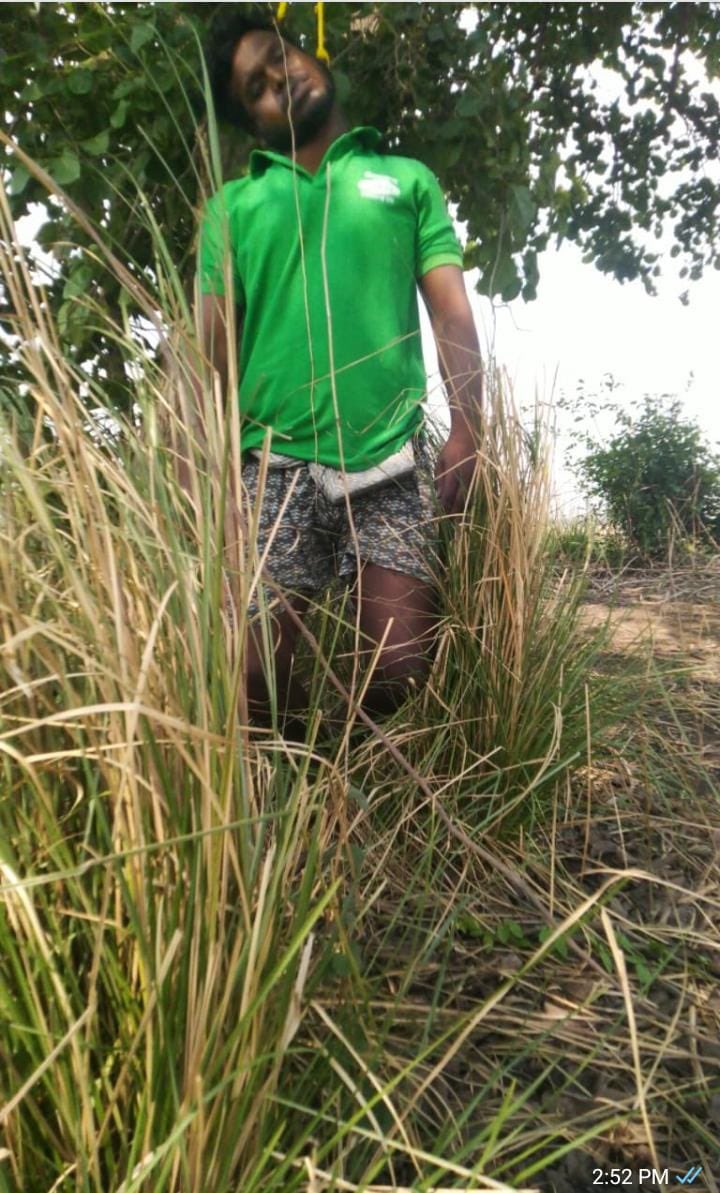
In the report, the National Human Rights Commission recorded hundreds of cases of political violence that was perpetrated in the state. One of the cases was that of 30-year-old Arup Das from Narrah village in Bankura district. Arup was found hanging from a tree, lifeless, on the 5th of May 2021.
Arup Das
According to the NHRC report where it cites the statement of Arup Das’ father, on the 4th of May, several TMC goons entered the house of Arup Das and started damaging his property. The goons, who all belonged to TMC according to Das’ father, then started beating up all the family members mercilessly. According to his statement, the goons did not even spare his brothers’ family that lived with them.
In a shocking revelation, the father of Arup Das said that the TMC criminals who had entered the house to damage property and attack Arup Das molested the women in the family. The blouse of his brother’s wife was torn and the goons disrobed her by undraping her saree.
Further, after wreaking havoc in the house, the TMC goons dragged Arup Das and kidnapped him. According to the complaint, on the 5th of May, only a day after they had kidnapped him, Das was found dead, hanging from a tree.
A saga of police inaction in this case detailed in NHRC report on Bengal violence
Arup Das’ father in his statement to the NRHC claimed that while he had filed a police complaint, the police showed no interest in the investigation and an FIR was filed only after the Calcutta High Court came down heavily on the police.
The NHRC, after due perusal of the papers, has observed in this case that Arup Das’ father had filed a police complaint on the 5th of May, the day his son was found murdered, in Police Station Khandaghosh. However, the FIR was filed only on the 10th of June, over a month after the filing of the complaint. The NHRC also says that the FIR in the case was filed only after the court issued directions to take action. The NHRC also says that a case has been registered against 21 people, however, nobody has been arrested to date.
The NHRC observations in the case
While detailing this case, the NHRC in its Bengal violence report has made 4 observations pertaining to the case.
1. NHRC says that in his complaint on the 5th of May, the father of Arup Das had actually written that Das (his son) had committed suicide because of the lack of employment. However, since while talking to the NHRC he did not mention any of that, they suspect that he did not know about the contents of the complaint exactly.
There could be several explanations for this. It is entirely possible that someone misled Arup Das’ father, who was presumably in shock after finding his son hanging from the tree. The other explanation is the rampant fear that had gripped BJP workers and supporters in the face of mounting violence. OpIndia had recently spoken to a woman BJP worker who was gang-raped by TMC workers on the 2nd of May. She had told OpIndia that once when the police called her up to ask her whether she was gang-raped, she had first told them that she indeed was, and after a bit of intimidation, she had told them that nothing of the sort had happened with her. She had also mentioned several other women who were gang-raped but have denied that they were because they were scared of the backlash.
In this situation too, it is possible that the truth came out only when talking to the NHRC team (the woman too had only told the truth to the NHRC team and not the police).
2. The NHRC team confirms that several people from the same village corroborated the version of events as dictated by the father of Arup Das, however, they did not wish to come on the record and give their statements. They were allegedly scared of the TMC workers who had murdered Arup Das.
3. Initially, the case was investigated as an “unnatural death” case and it was only after the intervention of the court was an FIR filed by the police.
4. None of the accused have been arrested so far.
NHRC makes damning disclosures on post-poll violence in West Bengal
The admonition from the NCST comes in the wake of a damning report submitted by the National Human Rights Commission to the Calcutta High Court on July 14 regarding the post-poll violence in West Bengal.
The statutory public body said in its report that, after visiting 311 spots in 20 days and carrying out an extensive inquiry in the matter, the seven-member committee constituted to probe the post-poll violence in West Bengal concluded that the current situation of the state is a manifestation of ‘Law of Ruler’, instead of ‘Rule of Law’. It added that the loss of faith in state administration among victims is very evident.
Attaching details of the same, the NHRC report stated that it collected a whopping 1979 number of complaints from 23 districts where incidents of violence had taken place post-Mamata Banerjee’s May 2 win.
Most complaints are from Cooch Behar, Birbhum, Bardhaman, North 24 Parganas and Kolkata, said that NHRC reports adding that most of the complaints related to rape, molestation, and vandalism and were received through local sources in West Bengal while the team was camping there. The statutory body added that a list of 57 complaints related to women was received from the National Women Commission.
The year 1979 is one of the most important years in the history of global politics. Not one but three major events took place that changed geopolitics altogether. The three major events that took place in the year 1979 are – Iranian Revolution in April 1979, the Grand Mosque seizure in Mecca that occurred in November 1979 and finally, the invasion of Afghanistan by the Soviet Red Army.
Each of the above events had its own impact on global strategic affairs. The Iranian Revolutions altered the fundamentals of the Islamic Republic of Iran altogether and its relevance in global affairs at that time, while the Mecca Masjid seizure brought radical Islamic terrorism into the mainstream.
However, it was the Soviet invasion of Afghanistan, which set the course for one of the longest civil wars in the history of the world in recent times. However, the country’s descent into chaos is a complicated story, the foundations of which were laid two decades before the 1979 events.
The internal dynamics of Afghanistan :
The popular belief suggests that the instability in Afghanistan began only after the Soviet invasion. However, it would be wrong to construe that the Soviet actions in 1979 and the subsequent counter-offensive operations from the US-led coalition pulled Afghanistan down into a state of perpetual anarchy.
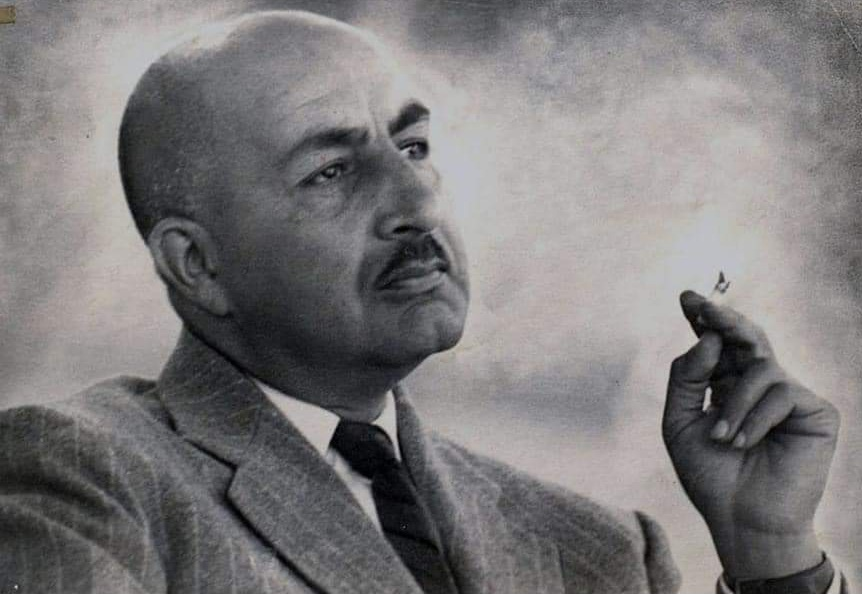
It is a long story, and it all began after the end of the second world war. In 1953, Afghanistan King Haji Mohammed Zahir Shah appointed his close relative, the 43-year-old Muhammad Daoud Khan, as the Prime Minister. During his tenure as the Prime Minister of Afghanistan, Daoud undertook several economic and political reforms. Khan tried to bring in some reforms in the Afghan society, comprising of diverse ethnic, linguistic, tribal and religious factions, however, the conservative society opposed his societal reformative measures.
Md Daoud Khan, image via Wikipedia
Both the Soviet Union and the United States tried to establish control over Afghanistan and provided Afghanistan with economic and technical assistance. During the next few years, Daoud’s government initiated military reforms and sought arms from the United States several times. However, the Eisenhower administration in the United States was reluctant to reach an agreement with Afghanistan unless they sign the anti-Communist Baghdad Pact or at least a Mutual Security Pact with Washington.
The Soviet Union, the nemesis of the United States, did not miss their chance. The USSR was very much eager to supply the arms Daoud needed. As years went by, Daoud intended to change Afghanistan’s neutrality in the cold war era and sought closer relations with the Soviet Union.
In 1956, Afghanistan purchased millions worth of tanks, aeroplanes, helicopters, and small arms from the Soviets, while Soviet experts helped construct military bases and airfields in northern Afghanistan. As a result, the “cold war” between the two superpowers finally arrived in Afghanistan.
As Afghans began to up the military might, its relations with neighbouring Pakistan deteriorated as Daoud’s administration increasingly saw Pakistan as both a competitor and a threat. In fact, the modernisation of the Afghan military was largely driven by its own cold war with Pakistan. However, it was Daoud’s support for a Pushtun nationalist movement in Pakistan that would have the greatest lasting repercussions.
The Pasthun question:
According to Michael Rubin, the Afghanistan expert at the Washington Institute, the root of the ‘Pushtunistan’ problem goes back to the 1890s. In 1893, Sir Henry Mortimer Durand, the then Foreign Secretary of India, demarcated what became known as the Durand line, separating British India and Afghanistan, and in the process divided the Pushtun tribes into two countries. The issue did not become glaring until 1947 when the British Empire declared independence to British India, dividing it into two countries – India and Pakistan.
Many Pushtuns in Pakistan, joined by the Pashtuns in Afghanistan, wanted a separate motherland for Pashtuns and argued that if Pakistan could be independent of India, then the Pushtun areas of Pakistan should likewise have the option for independence as an entity to be called “Pushtunistan”. Once independent of Pakistan, the new nation – “Pushtunistan” would include Pushtun-dominated areas in Afghanistan to form a “Greater Pushtunistan”.
Prime Minister Daoud supported the Pushtun claims, however, the issue ended up becoming another matter of cold war rivalry. In 1955, Pakistan decided to merge all provinces in West Pakistan into a single unit to create a balance between East and West Pakistan. Daoud viewed this as an attempt by Pakistan to absorb and marginalize the Pushtuns of the Northwest Frontier Province. The tensions rose to the extent that Afghanistan began to mobilize its reserves for war.
For the next two years, Afghanistan and Pakistan traded barbs and even exchanged fires amidst fights between Afghan-supported insurgents, who fought the Pakistani Army inside the Northwest Frontier Province. The vitriol continued for the next few years, however, nothing substantial on the Pashtun front happened.
In 1973, Daoud overthrew his cousin Zahir Shah and declared Afghanistan a republic. Pakistan, still recovering from the humiliation of the 1971 war defeat from India that resulted in the secession of Bangladesh, feared that Daoud would once again try instigating Pashtuns. Moreover, the 1971 war had reinforced the point that ethnicity trumped religion in Pakistan, founded on Islam. Accordingly, Pakistan viewed Daoud’s Pushtunistan agenda, his support to Baluchi separatists, as well as his generally pro-India foreign policy as a serious threat to Pakistani security.
In response, Pakistani Prime Minister Zulfiqar Ali Bhutto supported an Islamist movement in Afghanistan, a strategy that Islamabad would replicate two decades later in Afghanistan, this time with the Taliban. For Islamabad, the strategy was two-fold. One: By instigating an Islamist movement in Afghanistan, Pakistan could prevent Afghan expansionism by pressuring Afghanistan from within. Second, a religious opposition in a Muslim country like Afghanistan will act as a check against the ethnic-nationalist ambitions of Pashtuns.
A few years later, the Islamist movement set up Pakistan’s Inter-Services Intelligence (ISI), which would work with the United States in its fight against the Soviets. The important mujahideen leaders such as Burhanuddin Rabbani, Ahmad Shah Massoud, and Gulbuddin Hikmatyar were all propped by Pakistan’s ISI as a counterweight to Afghan ruler Daoud.
In 1974, on the instigation of the ISI, these Islamists took the matter into their own hands and plotted a military coup. However, Daoud’s regime discovered the plot and imprisoned some of them, while some fled to Pakistan. However, the military coup by Islamists, however, created a fertile ground for a future revolution in Afghanistan in the form of the Saur Revolution.
The 1978 Saur Revolution:
The foundations of the future conflicts in Afghanistan were laid by the Saur Revolution, a 1978 coup led by Afghanistan’s communist party. Under Daoud’s presidency, Afghanistan had become increasingly polarized. Along with Islamists, several others wanted to remove Daoud. As Pakistan backed the Islamist opposition, the Soviet Union threw its hat behind the People’s Democratic Party of Afghanistan (PDPA), which had two factions, the Khalq and the Parcham. The Khalq and the Parcham were hostile to each other between 1967 and 1977, but the Soviet Union pressured them to reunite.
In 1978, Mir Akbar Khyber, the chief ideologue of the Parcham faction, was assassinated. The Daoud government was blamed for Khyber’s killing, which initiated a chain of events. Several people flocked the streets against Daoud and the United States, which Parcham blamed for the killing. Daoud responded by arresting the PDPA leadership, which led to a military coup by officers sympathetic to the PDPA. On April 27, 1978, the PDPA seized power in a bloody coup. Three days later, a Revolutionary Council declared Afghanistan to be the Democratic Republic.
The Soviet Union promptly welcomed the new regime and showered them with a massive influx of aid. However, within a few months, the old cracks between the Khalqis, who dominated the new government, and the Parchamis, began to re-appear, crippling the regime. Hafizullah Amin, who had organised the coup and co-founded the Democratic Republic of Afghanistan (DRA), unleashed a reign of terror as he carried out Khaliq’s program, resulting in alienating many of his former partners.
Witnessing the chaos and anarchy in Afghanistan, Soviet Union sought to maintain their influence in Afghanistan by replacing Amin. However, Hafizullah Amin refused to accept Soviet dictates. Instead, he used the “American card” to try and negotiate a better deal with the Soviets.
The invasion of Afghanistan by the USSR
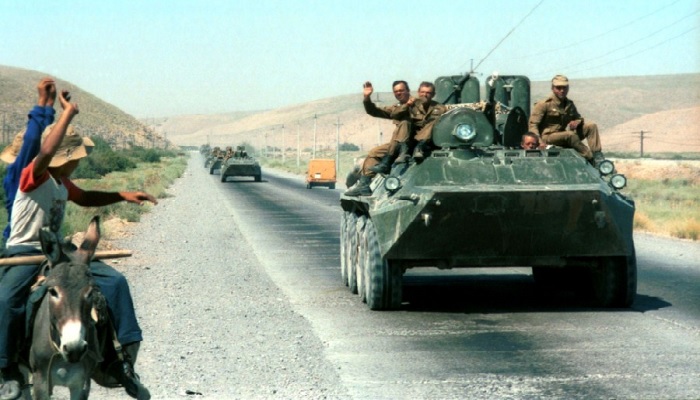
Triggered by the apparent threat to its interests in Afghanistan, Soviet Premier Leonid Brezhnev sent the Red Army into Afghanistan in December 1979. Hafizullah Amin still refused to relinquish power. As a result, Soviet Red Army stormed into his palace and executed him. The Red Army, with the help of its PDPA cronies, began to take control of the country, but the Soviets were never fully able to gain control over the countryside. The pockets of resistance continued despite all attempts to weed them out.
In a short time, nearly 100,000 Soviet soldiers captured major Afghan cities and highways. The Islamists joined hands with resistance groups to defend their lands. However, the Soviets dealt harshly with the Mujahideen rebels and those who supported them. They installed Soviet loyalist Babrak Karmal from the rival faction Parcham to rule the country on their behalf.
Soviet army in Afghanistan, image via E-International Relations
Underestimating the Afghans, the Soviets wrongly assumed that they would finish their task of instilling a Soviet-friendly leader in a span of a few weeks. However, it seems they did not have a clue that they have ignited a war that would last for the next four decades.
As the Afghans united around a common cause of resisting the Soviet invasion, foreign support soon propped up to back the diverse group of rebels, especially from Iran, Pakistan, China, and the United States. These powers began to unite and fund these Afghan resistance movements, which then went on to impose high military costs on Moscow.
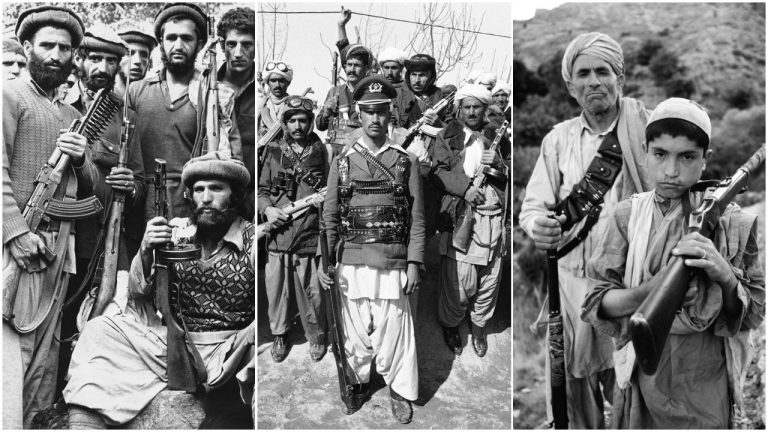
For centuries, many Afghans believed that resistance to foreign invaders was a form of “Jihad”, a struggle against the enemies of Islam. The Afghans proudly called them “mujahideen” – a struggler for Islam or a person who carried out “Jihad” against a Kafir, during their war against the Soviets. To their advantage, Afghanistan’s geography played a huge advantage giving them an edge to organise themselves against the heavily trained and armed Soviet Red Army.
Without any central leadership or strategy, the different regions of the country having different resistance groups led by charismatic leaderships proved to be a lethal force against the Soviets. In spite of their regional, ethnic, and political differences, they all referred to themselves as mujahideen.
Yet, strangely, over the years, the academia and security experts have oversimplified the Mujahideen story and the United States’ support to Islamists, according to whom the CIA simply created the mujahideen out of the blue in the aftermath of the Soviet invasion.
In reality, the Mujahideen already existed in Afghanistan, which foreign powers like the United States, United Kingdom, trained and armed to take on their ideological enemy Soviet Union. Thus, even before Red Army soldiers entered Kabul, a cadre of the Afghan mujahideen already existed. These Mujahideens, some who had escaped to Pakistani exile since their failed uprising four years before, returned to Afghanistan following the invasion.
US-Pakistan-Mujahideen axis: Arming the resistance
A year after the Soviet invasion, several foreign powers, including the US, the UK, Iran and China, decided to arm the resistance. In fact, the decision to arm the Afghan resistance came within two weeks of the Soviet invasion, however, a concrete plan only came later. It was first Saudi Arabia that began to fund these Islamists, which was matched by US contributions. During the 1980s, the annual American aid to the mujahideen reached almost $630 million.
In addition, many Islamic countries, who viewed this war through religious lenses, contributed millions to the Afghan resistance. In response, the Soviet Union poured huge resources, approximately close to $5 billion per year, into Afghanistan in an effort to support their counterinsurgency efforts and prop up the puppet government in Kabul.
In contrast, the Americans refused to provide arms to the resistance, seeking to maintain plausible deniability. The State Department had categorically rejected the CIA’s idea of American-made weapons as they did not want to anger the Soviets. Moreover, the CIA did not want to provide arms to the Afghan resistance movement to maintain the secrecy of its involvement. It was not until September 1986 that the Reagan administration decided to supply Stinger anti-aircraft missiles to the mujahideen, thereby breaking the embargo on “Made-in-America” arms.
Initially, the CIA only coordinated with the purchase of weapons and the initial training. It was Pakistan’s Inter-Services Intelligence (ISI) that micro-managed the shipping and distribution of weapons to Afghan resistance groups. The weapons would arrive at the port of Karachi or the Islamabad airport, which ISI would then ship to the Afghan border. The ISI’s involvement in arming resistance was such that the CIA initially had very limited interaction with the mujahideen. Even at the height of American involvement in Afghanistan, very few CIA specialists operated in the field.
According to Michael Rubin, the ISI, often described as a “state within a state”, used its goodwill with the Mujahideen position to promote Pakistani interests as it saw them instead of the intended objective. The ISI recognised radical Islamist groups and armed them well while refusing to distribute funds and aid to any other Afghan resistance group that was not Islamic. Gulbuddin Hekmatyar, the most prominent Jihadist of all the mujahideen, became the blue-eyed boy of the ISI commanders for his strong support to the Pakistani-sponsored Islamic terrorism in Kashmir. So, ISI ensured that his faction got most of the resources to fight against the Soviets.
Pakistan kept others in the dark and gained disproportionate influence in Afghanistan through aid distribution. In fact, outsiders did not have a clue that the ISI’s approach to arm radical Islamic Mujahideen would give rise to long-term consequences not just in the region but worldwide.
Afghanistan became a bleeding wound for Soviet Union:
Afghanistan, the ‘graveyard of empires’, expectedly become a bleeding wound for the Soviet Union. With each passing year, the Red Army suffered thousands of casualties as soldiers died due to new diseases and, most importantly, drug addiction. The Soviets, who had grossly underestimated the Afghan resistance movement, began to receive military setbacks. The quick occupation had turned into a quagmire for the Soviets that drained huge resources, especially at a time when the USSR was at the cusp of disintegration.
Finally, in 1988, Soviet Premier Mikhail Gorbachev announced his intention to withdraw Soviet troops. With the withdrawal of Soviet troops from Afghanistan, the stage was set for Mujahideens to emerge towards the mainstream. Therefore, it was naturally expected that the Afghan government under Najibullah would quickly collapse.
However, Najibullah proved them all wrong as the Soviet-backed Afghan forces managed to halt their offence. Nevertheless, Washington continued to support mujahideen following the Soviet withdrawal, even as Saudi Arabia and Kuwaiti donors provided aid to Hikmaytar and other radical Islamic factions. By the 1990s, the United States began to withdraw from Afghanistan slowly and stopped military aid altogether. But, several individuals in the Gulf interested in the Afghan cause continued to provide millions annually to the mujahideen.
The sudden withdrawal of Washington and the lack of long-term strategy post the collapse of the Soviet Union created a policy void in Afghanistan, providing an opportunity for radical elements supported by the ISI to fill in. As the US ditched Afghanistan, the Mujahideen commanders previously backed by the US, like Hikmaytar, left frustrated and broke with their Saudi and Kuwait patrons and found new backers in Iran, Libya, and Iraq.
Now, mujahideen, with no one to hold them accountable, began taking back large swathes of land. Amidst this political vacuum rose the most radical Islamic Mujahideen outfit – the Taliban.
The rise of Taliban:
At first, Afghans backed the Taliban by giving them a chance. For Afghans, who had witnessed a long war, the Taliban promised two things. First, security to Afghans and secondly, a truce among mujahideen groups that continued to fight to control Afghan lands.
Even as Mujahideen continued to take control of Afghanistan city after city, Afghan president Najibullah maintained power for three years. Then, in 1992, the mujahideen forces seized Kabul and unseated the communist president. Then began the collapse as major cities such as Kandahar descended to a state of chaos, with numerous warlords claiming control over the city. The internal fighting among Mujahideen factions, especially in Kandahar, left the door open for the arrival of the Taliban.
As Pushtun and Tajik warlords fought with small resistance groups for territory, Afghanistan saw lawlessness with numerous kidnappings, murders, rapes, and robberies that became frequent. It was at this backdrop that Taliban arose in Afghanistan. The Afghan refugees and former mujahideen studying in madrasas in Pakistan united together to create a movement to restore peace, disarmament of the population, strict enforcement of the sharia, and defence of the “Islamic character” of Afghanistan.
Mullah Muhammad Umar, an Afghan Pushtun of the Hotak tribe, who had lost one of his eyes toward the end of the conflict with the Soviet army, became the movement’s leader. With active support from Pakistan, the Taliban began its conquest on October 12, 1994, when 200 Taliban seized the Afghan border post of Spin Baldak. Taliban relied extensively on Pakistan’s support to conquer Afghanistan.
In a swift offensive, the Taliban quickly seized large swathes of Afghanistan. Following the fall of Kandahar, many Afghan refugees, madrasa students, and Pakistani Jamiat-i Ulama supporters rushed to join the movement. Each subsequent Taliban victory brought new recruits.
Pakistan’s support for Taliban
Pakistan’s desperation to throw its weight behind a radical Islamic force rather than a nationalist-inclusive government in neighbouring Afghanistan is one of the main reasons for the Taliban’s successful consolidation of Afghanistan. The Taliban, which emerged in the madrasas of Pakistan, had the active backing of Pakistan. As the Taliban began to snatch territories, the Mujahideen commanders accused Pakistan of supporting the new group.
Over the years, Pakistan has supplied a constant flow of munitions and recruits for the Taliban’s war with the Northern Alliance, the coalition that came to formation in late 1996 to defend Afghanistan from the Taliban’s onslaught, and also lent crucial technical infrastructure support to allow the Taliban state to function.
Besides arms and funds, Pakistan also constantly sent new recruits to join. For example, several thousands from Pakistan’s heartland Punjab travelled to Afghanistan to supplement the fight against Ahmed Shah Massoud. In exchange, the Taliban operated several terrorist camps to train Pakistan-based terror groups such as Harakat ul-Mujahidin, at Rish Kor on the outskirts of Kabul, to wage a covert war against India in Kashmir.
It was the members of Harkat-ul-Mujahidin that hijacked an Air India flight from Nepal to Kandahar in December 1999. Harkat-ul-Mujahideen hijacked the IC-814 Indian Airlines flight with the support and active assistance of ISI before flying to several locations before landing in Kandahar, Afghanistan. The hostage crisis ended after seven days when India agreed to release three dreaded Islamic terrorists – Mushtaq Ahmed Zargar, Ahmed Omar Saeed Sheikh, and Maulana Masood Azhar.
For Pakistan, Afghanistan provided a perfect base not only to train pro-Pakistani terrorists covertly to field them against India but also, importantly, give them real field experience of carrying out terror attacks. The extent of Pakistan’s deep involvement in Afghanistan is such that it has even joined the Taliban to carry out illegal opium trade across its northern borders. For years, Pakistan remained the effective diplomatic and economic lifeline for the Taliban’s Islamic Emirate.
Pakistan viewed the Taliban as an extension of its age-old policy of instigating Islamist forces in Afghanistan to keep it under its control and did not seek any radical change in Pakistan’s Afghanistan policy post the Taliban’s conquest of Afghanistan. In addition to backing by ISI, sometimes the Pakistan government itself actively supported the terror group.
In fact, Former Prime Minister Benazir Bhutto, perceived as the ‘Mother of the Taliban’, staunchly supported the terror group. It was Bhutto who conceived the idea of the Taliban to provide a solution to Pakistan’s problems in Afghanistan. Year after year, the Taliban grew in strength with the active support of Pakistan and other rich donors from the Arab world.
While the Pakistani government was directly complicit in some forms of support for the Taliban, just as important was its indirect support. For example, in 1971, there were only 900 madrasas in Pakistan that trained Jihadis, however, by 1988, there were more than 8,000 official madrasas and other 25,000 unregistered religious schools that fed Islamism into the minds of Afghan Mujahideen terrorists.
The Arab Afghans and their role in Jihad against Soviets:
One of the greatest criticisms of the US’s Afghan policy, especially after the rise of the Taliban, has been that the United States directly supported Arab volunteers who came to Afghanistan to wage jihad against the Soviets. Critics point out that the US-funded these Arabs, who eventually used those American arms to engage in the terrorist war against the West.
But, the influence of “Afghan Arabs” in Afghanistan only emerged as a major force after the withdrawal of the Soviet Union. During the resistance against the Soviet occupation, Arab volunteers did not have major roles to play. According to the CIA, the Arab volunteers never took part in the fighting, leaving the local Afghans fighters frustrated. The CIA never recruited, trained, or used the Arab volunteers in its covert operations inside Afghanistan.
The relationship between the Afghans and the foreign fighters is extremely complicated. The Mujahideen never trusted the foreigners, fought their own war, and kept the outsiders on the sidelines. The Afghans used them for auxiliary services such as building roads, digging ditches, and cook food, etc., The combat role of Afghan Arabs was marginal at best, sometimes limiting to recording the videos to be sent back to Saudi.
For Afghans, the ‘Jihad’ against Soviets was a matter of pride, which was to be fought and won by real Afghans. They did not want foreign fighters, especially from the Arab, to take credit for a war they did not fight. Interestingly, Mujahideen commanders viewed Arabs as a nuisance, only slightly less than the Soviets. However, the work of fundraising by Arabs was welcomed.
The foreign fighters who joined the Afghan war came mainly from the Muslim Brotherhood or other radical Islamist organisations that were operating in other parts of the world. The Saudi Arabia-based Islamic Coordination Council was the mainstay behind Mujahideen’s new recruits and disbursement of assistance. These recruits were staffed in Pakistan, mainly through Saudi sponsorship.
Despite having no pivotal role in carrying out Jihad against the Soviets, Afghan Arabs made their contribution felt well by establishing a sophisticated financial structure to fund Jihad in Afghanistan. It is estimated that between 1982 and 1992, some 35,000 Islamists would serve in Afghanistan.
It would be wrong to claim the rise of the Taliban was due to Washington’s policy alone. There were several factors for radical Islamist groups such as the Taliban thrive in Afghanistan. These Mujahideen groups, influenced by radicalism in Islam, had their own objective from the beginning and flourished on the support they received from various sources at various points in time. Nevertheless, one of the biggest flaws of the US policy was to delegate major responsibilities such as coordinating arms supply and training of these mujahideen to the ISI.
The coming of Osama bin Laden:
Osama bin Laden, a Saudi millionaire who ran an influential Saudi family, is the founder and leader of an international terrorist organization known as Al-Qaeda or “the base”. Bin Laden came from an extremely wealthy and influential Saudi family. In the 1980s, he joined Mujahideen forces in Pakistan and had fought the war against the Soviet Union in Afghanistan. He helped to fund the Mujahideen by funnelling arms, money, and fighters from the Arab world into Afghanistan and gained popularity among many Arabs.
In 1992, he was banned from Saudi Arabia for his radical Islamic views and his efforts to raise a band of militants to take on Iraq. As a result, Bin Laden fled Saudi and ended up in Sudan. However, the US and Saudi governments demanded Sudan to hand bin Laden over, leading him to start his journey towards Afghanistan.
Osama Bin Laden shared several beliefs with the Taliban about an ideal Islamic society. As the Taliban resisted contact with the outside world, Bin Laden found it perfect for bringing his ideas into fruition in Afghanistan. Through his Al-Qaeda, Bin Laden dreamt of starting an international jihad to seek revenge against the western world.
However, the Taliban and Osama bin Ladin’s Al-Qaeda had distinct identities. Bin Laden was a seeming paradox for Afghanistan watchers. On the one hand, the Taliban was not interested in far enemies such as the western world or wanted to wage an international jihad. Instead, they focused on destroying the near-enemies of Islam within Afghanistan. However, it also recognized and gave shelter to international jihadist groups like Al-Qaeda, who intended to globalise Jihad against non-believers, particularly the West.
In Afghanistan, Osama bin Laden set up training camps to train thousands of Jihadists from Pakistan, the Middle East, and North Africa and joined hands with the Taliban to fight their internal battles against Ahmed Shah Massoud. Besides, Al-Qaeda also trained Pakistan-based terror outfits to fight against India in Kashmir. Pakistan’s ISI coordinated such attacks and provided logistic support to the Al-Qaeda-Taliban coalition to carry out attacks inside Afghanistan.
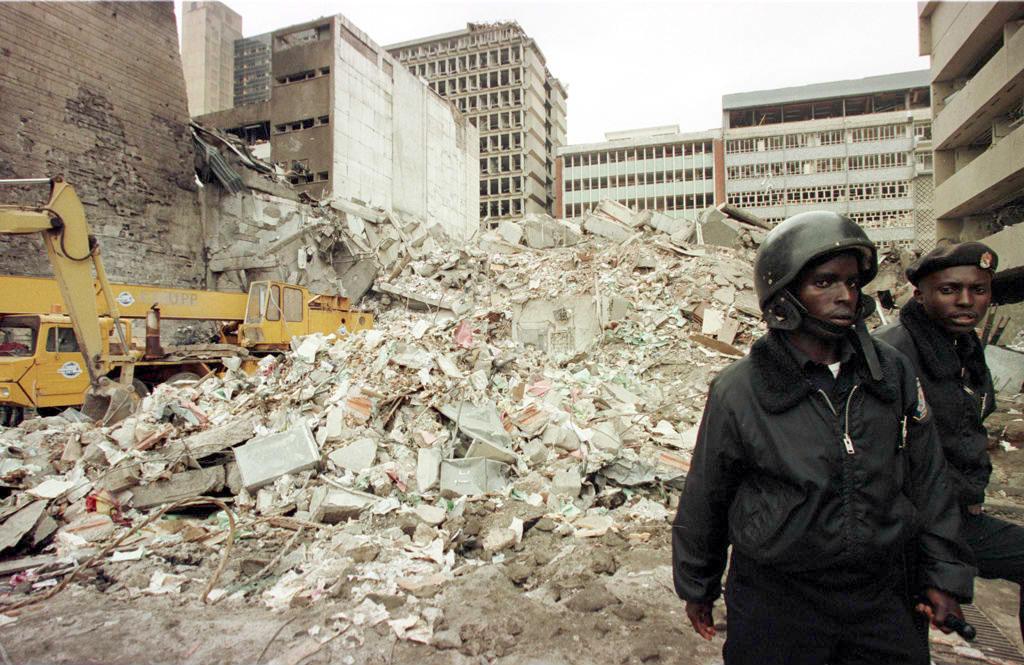
Motivated by the growing strength of his terror organisation, Bin Laden began organising international terror operations. From Afghan soil, he directed the attacks on the US embassies in Tanzania and Kenya in 1998. He was responsible for the suicide attack on the USS Cole in Yemen in 2000 that killed many US soldiers.
1998 US Embassy bombing by Al Qaeda in Nairobi, Kenya, Image via: ALEXANDER JOE, AFP, Getty
Osama Bin Laden had an extreme hatred for the west, especially the Americans, for waging war against Islam in the holy land of Arabia. Bin Laden justified the terror attacks against US citizens and others as he perceived their presence as a way to humiliate Islam in the region.
In his statements, Bin Laden always vowed to take revenge on the United States for humiliating Muslims. And, on September 11, 2001, Osama Bin Laden successfully hit deep inside America’s heartland by carrying four coordinated terrorist attacks. Bin Laden orchestrated these attacks and took responsibility for the attacks by admitting that he personally directed his followers to attack the World Trade Center and the Pentagon.
The 9/11 attacks changed the Afghanistan question forever. Following the attacks, President George W Bush issued an ultimatum to the Taliban to hand over Osama bin Laden. However, the Taliban rejected American diktat saying that the traditional Pashtun laws of hospitality protected Osama bin Laden.
The Taliban’s refusal to extradite Al-Qaeda leader Osama Bin Laden led to the United States invasion of Afghanistan under Operation Enduring Freedom on 7 October 2001. For the next twenty years, the stalemate continued, with ultimately the United States-led NATO forces deciding to withdraw from Afghanistan completely by the end of August 2021.
The return of Taliban 2.0:
As the NATO forces have started their withdrawal from the perennial battleground of Afghanistan, the Taliban is on the march again. The exit of the remainder of the US forces from Bagram, their Afghan airbase, earlier this month has given a major victory for the Taliban against the US in one of its longest wars.
With each passing day, the Taliban continues to gain ground ahead of the final withdrawal of US-led forces from Afghanistan, so much so that former military commanders predict the fall of Kabul within months. The ongoing swift offensive of the Taliban reminds one of the emergence of Mujahideen following the Soviet withdrawal in the 1990s. Essentially, the Taliban has become the de-facto ruler of Afghanistan with the imminent withdrawal of the US-led forces in Afghanistan.
As one of the longest-wars is coming to an end, the Taliban – a terror outfit expects to hold on to Afghanistan, which it won after a hard-fought battle against the most powerful military power in the world. For the common Afghans, the future looks bleak as the Taliban wants to impose Sharia on Afghanistan’s distinct and diverse society. One can only hope that the Afghan national government, backed by major powers, including India, negotiates a peace treaty with the Taliban to end the chaos and establish some kind of peace in an already ravaged country.