Haridwar city police on Thursday arrested six tourists hailing from Haryana and Uttar Pradesh for smoking hookah in Har Ki Pauri. The tourists were first spotted by the locals who snatched their hookah pots away and handed them over to the police.
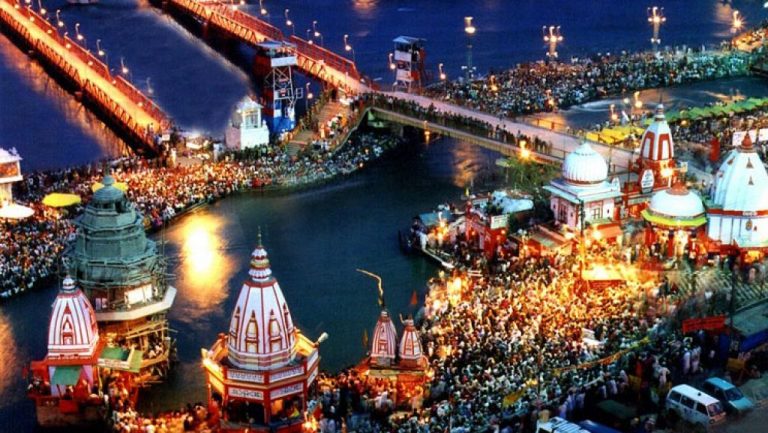
Har Ki Pauri is a famous ghat on the banks of the Ganga in Haridwar in Uttarakhand. It is considered extremely auspicious by Hindus as it literally translates to “God’s steps”.
As per ANI, the SP City Haridwar informed, “The incident (some people smoking hookah at Har Ki Pauri) happened yesterday (July 7) & we’ve arrested 6 tourists. A case has been registered & the investigation is on. We also want to send a message that we won’t tolerate such behaviour here.”
Uttarakhand | The incident (some people smoking hookah at Har Ki Pauri) happened yesterday (July 7) & we’ve arrested 6 tourists. A case has been registered & investigation is on. We also want to send a message that we won’t tolerate such behaviour here: SP City Haridwar (08.07) pic.twitter.com/VGDWpWh3OL
SHO, Haridwar city police station Rajesh Shah in an interaction with the Times of India informed that the miscreants were arrested under the relevant sections of the Indian Penal Code.
Details of the incident
A group of six youth was caught smoking hookah on the steps of Har Ki Pauri on July 07. When objected by the locals, the group got into a brawl with the locals.
The locals then snatched away the hookah pot and destroyed it and also thrashed the boys before handing them over to the police.
More CCTVs to be installed
Kamlesh Upadhyay, SP City Haridwar informed that more CCTVs would be deployed near the ghats to prevent such incidents as this was not the once time that unruly tourists mocked the sanctity of the holy place.
Ganga Sabha demands strict action
Prior to this, the local police had arrested two tourists for smoking hookah at Rishikul ghat on Wednesday night. A case was registered against one Himanshu Wadhwa, from Delhi’s Rohini sector 20, and Jitendra Kumar from Kasganj, Uttar Pradesh under the Disaster Management Act, 2005.
As per the police, the two were reportedly dancing to Bollywood songs and consuming hookah while celebrating a birthday party at the ghat.
Reacting to such incidents, Ganga Sabha, the apex body of priests in Haridwar has demanded strict action. They have also said that they will form ghat committees with the help of locals to make pilgrims and tourists aware of their responsibilities.
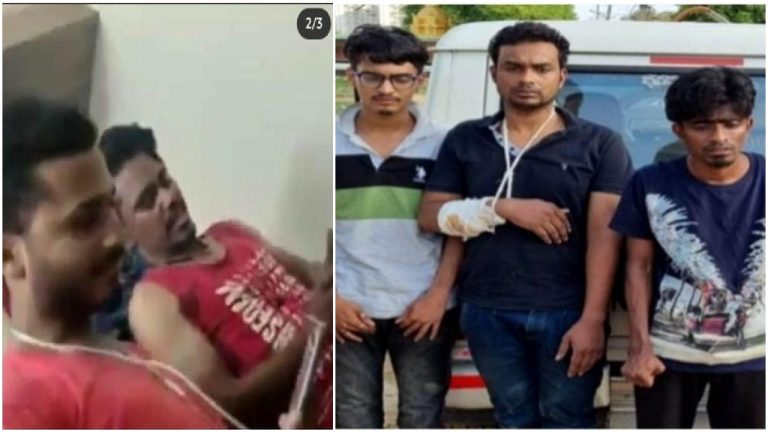
The Bengaluru police have arrested twelve people in connection with the gang rape and torture of a Bangladeshi woman in May. The 11 accused out of the 12 accused are Bangladeshi nationals and two are women, said Bengaluru police commissioner Kamal Pant said on Thursday.
Taking to Twitter, Bengaluru Police Commissioner Kamal Pant said that they had completed the investigation in a “short span of five weeks” and added that they have submitted a detailed and systemic 1019 page-charge sheet to the court. He praised the investigating team for the work and added that a reward of Rs.1 lakh has been sanctioned to the team.
..within a short span of 5 weeks.
The meticulous investigation conducted by N.B. Sakri, ACP sub-division, and his team under the close supervision of @DCPEASTBCP and the overall guidance of @AddlCPEast is highly commendable. (2/3)
According to the reports, the two main accused – Shobuj Sheik and Rafiq, alias Rafsan have been arrested. Their associates Ridoy Babu, Rakibul Islam Sagar, Mohammed Babu Shaik, Hakil, Ajim, Jamal, Dalim, Nasrath, Kajal and Tanya, have also been taken to custody, and they have been named in the charge sheet submitted before the 1st Additional Chief Metropolitan Magistrate (ACMM) court on Wednesday.
The rape and torture of a Bangladeshi women in Bengaluru
A horrific video of the woman’s assault had gone viral on social media in which four men and a woman were seen sexually assaulting and torturing a young woman. The footage had caused outrage and police officials in several states were alerted to find the culprits.
Reportedly, the accused had even inserted a bottle in her private parts. By tracing the chain of video forwards, the Assam police were able to locate its origin to a mobile phone in the city of Bengaluru. Immediately, the Bengaluru City Police was alerted, and special teams were deployed to track down the perpetrators. The four men and a female accused were arrested from a rented house in Avalahalli in Ramamurthy Nagar.
Reportedly, all the accused worked as labourers. According to the police, the victim, a Bangladeshi woman, was illegally trafficked to India under the pretext of a job and was later forced into prostitution. Although she was able to flee, the accused hunted her down. They had then assaulted and gang-raped her with the help of their female aide.
The Bangladesh Police had traced one of the suspects – Ridoy Babu, a Bangladeshi national based on his TikTok account and the video circulating online. Incidentally, two of the suspects were shot by the police after they had tried to escape from police custody last month.
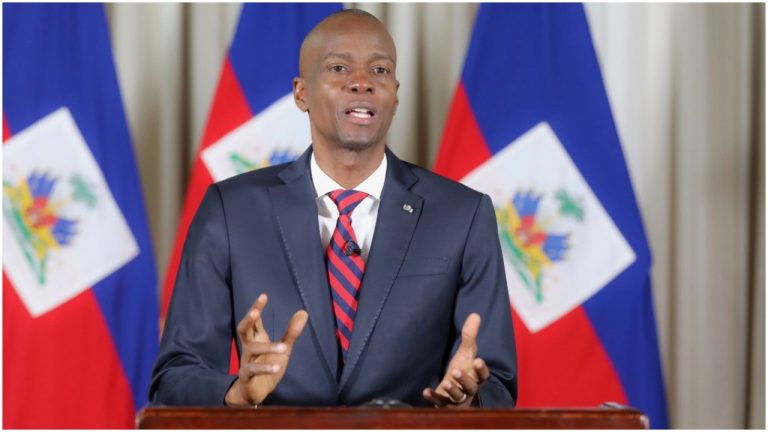
Two Haitian-Americans have been arrested in connection with the assassination of President Jovenel Moise on Thursday. Joseph Vincent and James Solages, two of the 28 accused, have been arrested in connection with the killing of Haitian President Moise.
According to the reports, the Haitian Police said that they believe at least 28 people were behind President Jovenel Moise’s assassination, adding that 26 of them were Colombian and two were Americans of Haitian origin. The two Haitian-Americans – James Solages and Joseph Vincent have now been arrested for the assassination of President Moise at his home on Wednesday.
Meanwhile, the Haitian police have also arrested fifteen others, who are believed to be from Colombia. According to the Haitian police, the police have killed three suspects, and eight others are on the run.
“We are going to bring them to justice,” said Leon Charles, chief of Haiti’s National Police, during a press conference on Thursday night.
On Thursday, the Colombian government had said six of the suspects in Haiti, including two of those killed, were retired members of Colombia’s army. The chief of the Colombian national police, General Jorge Luis Vargas Valencia, said President Iván Duque had instructed the Colombian military and police to cooperate with Haiti officials during the investigation.
“A team was formed with the best investigators … they are going to send dates, flight times, financial information that is already being collected to be sent to Port-au-Prince,” General Vargas said.
One of the Haiti Americans worked in Canadian Embassy
One of the arrested Haitian-Americans – 35-year-old James Solages, previously worked as a bodyguard at the Canadian Embassy in Haiti. Mathias Pierre, Haiti’s minister of elections, said Solages described himself as a “certified diplomatic agent” and an advocate for children.
On his website, Solages had also described himself as a “budding politician” and had started a charity in 2019 in South Florida to assist residents. Meanwhile, the US State Department said it is aware that Haitian-Americans have been taken into custody, however, it did not comment.
According to a witness, the two Haitian-Americans were found near bushes in Port-au-Prince by a crowd, who “grabbed them by their shirts and pants”. The crowd slapped and pushed them, said the witness, adding that the crowd chanted, “They killed the president! Give them to us. We’re going to burn them!’
Assassination of Haiti President Jovenel Moise
Haiti President Jovenel Moise was assassinated by unknown assailants at his home on Wednesday morning. In a statement issued by acting Prime Minister Claude Joseph, a group of unidentified individuals had attacked Moise’s home at around 1 AM and fatally wounded the head of state.
The First Lady of the nation, Martine Moise, was also shot in the attack, and she is currently receiving treatment.
“A group of unidentified individuals, some of them speaking Spanish, attacked the private residence of the president of the republic and thus fatally wounded the head of state,” the interim PM said.
The 53-year-old Jovenel Moise is a former banana exporter who became the president in 2017. In recent months, he has facing fierce opposition from opposition parties, who alleged that he was trying to install a dictatorship by overstaying his mandate and becoming more authoritarian.
The assassination of President Jovenel Moise has injected further uncertainty into the already deteriorating security and health situation in the country. The Caribbean country was already in a political crisis, as the president repeatedly failed to hold elections at local and national levels, which have left a significant portion of governance in the country unmanned.
The killing of Haiti’s President at his home has led to an escalation of political instability and gang violence. Fighting between armed gangs and police have begun in the capital, Port-au-Prince, displacing thousands of people. In addition, the Covid-19 pandemic has caused massive devastation to the country, which is plagued with weak health infrastructure and no access to coronavirus vaccines.
Haiti is the poorest nation in the western hemisphere, and it has grappled with a series of coups and foreign interventions.
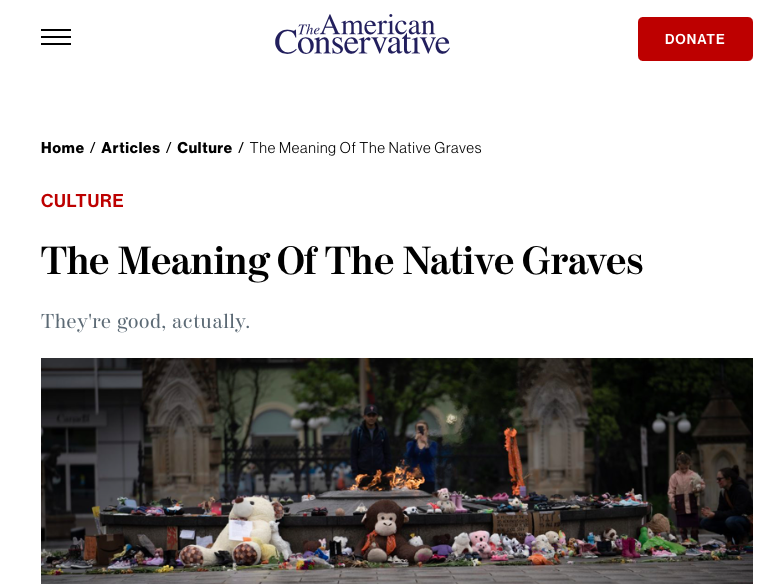
As the discovery of mass multiple burial sites and unmarked graves brings back the pain of centuries of torture, and genocide for the indigenous population in Canada, the Canadian society, in general, is facing a time of reckoning, of confronting old wounds and dealing with new fears.
The findings of the remains of over 1000 people, mostly indigenous children, buried in unmarked graves at sites of former residential schools that were run by the Church and funded by the Canadian government, has highlighted the deep injustice that the First Nation indigenous Canadians have faced in the hands of Christian priests in the past.
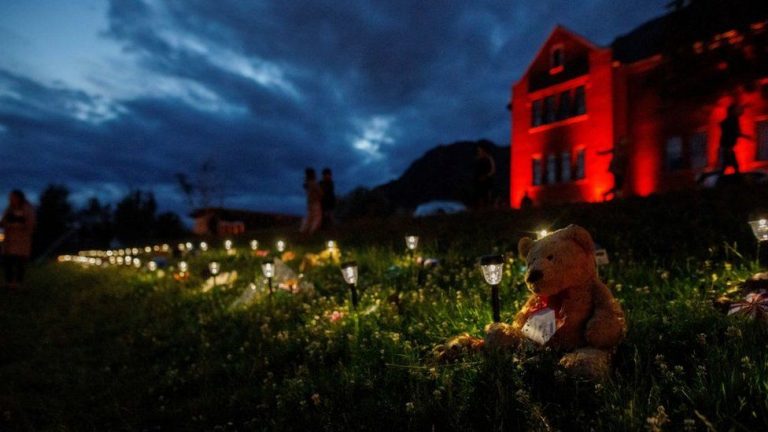
In the last few weeks, 3 major burial sites have been discovered in different parts of Canada. On June 30, the remains of 182 people were found in mass graves close to former St. Eugene’s Mission School in Cranbrook. Two mass graves had been found earlier, one with 215 graves in Kamloops was found on May 27, 2021, and 751 graves in Saskatchewan were found on June 24.
As pain and grief spread through the Canadian indigenous population, there have been incidents of Church burnings. In recent weeks, at least nine Churches, both Catholic and Anglican, have been burned down in Canada.
Canada’s Prime Minister Justine Trudeau has been expressing his apologies and anguish at each discovery of old burial sites near places where the infamous residential schools functioned. The Catholic Church officials have apologised too, some voices even asking the Pope in Vatican to come to Canada and formally apologise to the First Nation people.
However, among the White supremacist Christian population, there are many who do not believe they need to be sorry for those countless children who perished under torture, lack of care, hard labour and physical, emotional, and psychological harassment meted out to them at the residential schools. Instead, they believe that the First Nation people would be “grateful” that those children at least died as “Christians” because their “souls have been saved”.
No, it is not a joke. The American Conservative magazine, in an elaborate and sanctimonious article proudly asserts so.
The article in American Conservative
The article in American Conservative, published on July 8, titled “The Meaning of The Native Graves”, actually says the residential schools were dong ‘God’s work’. The article actually starts with paragraphs from The Bible, listing out lines where Jesus had apparently commanded to convert pagans and ‘save their souls’.
It then describes the ‘noble’ mission and deeds of French Jesuit Jean de Brebeuf, who had dared to venture into an “untamed” continent because he had to carry out a grave mission, “to bring the Christian Gospels to the natives”.
The article then narrates how a “caring and noble’ Jean de Brebeuf had preached the Gospels to the natives for 13 years, successfully baptizing dozens of natives, before the Church was attacked by another band of natives and the priests were killed.
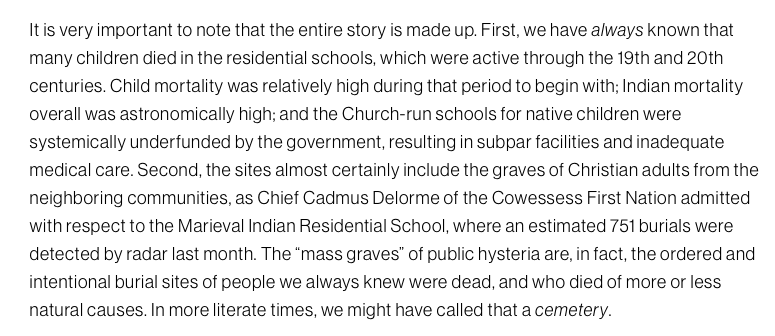
The article then declares the discovery of the mass burial sites and unmarked graves for those unnamed children from residential schools is “a made-up story”. It says that ‘many children died in residential schools because child mortality was quite high anyway in those days. Not just that, completely ignoring the fact that those children were forcibly taken away from their families and forced to stay in those residential schools, the article then blames the low funding by the government that caused substandard conditions in residential schools.
From the article in The American Conservative
It then argues that the sites “almost certainly” include graves of Christian adults from neighbouring communities. Calling the mass graves as nothing but ‘public hysteria’, it adds that they are burial sites of people we always knew were dead and those sites are actually ‘cemeteries’.
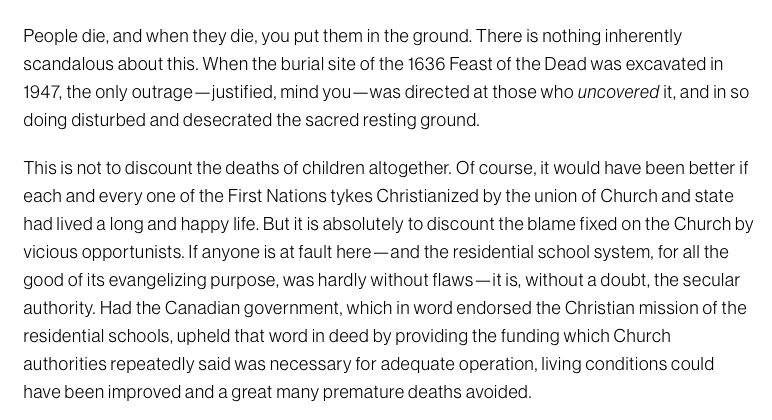
Article in The American Conservative
“People die, and when they die, you bury them in the ground”, is the articles argument about the graves.
It is not clear how that addresses the fact that those native children who perished in Canada’s Christian residential schools DID NOT deserve to be taken away from their families and the native population did not ask for their “souls to be saved”.
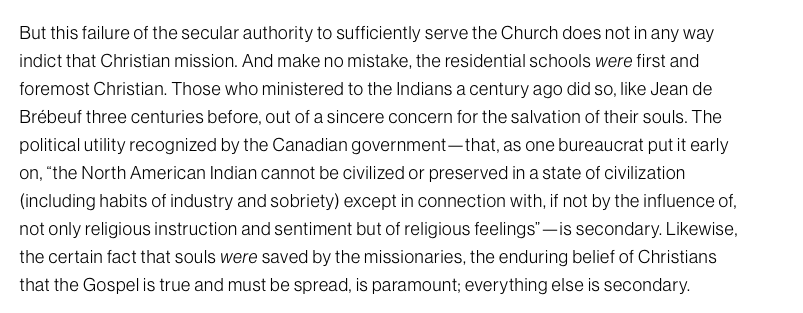
Further, the article goes on to defend the residential school system altogether. It actually asserts that ‘it was necessary to convert native people into Christianity because otherwise, “their souls could not have been saved” and the so-called “saving of the souls”, by converting the natives by any means, was the first and foremost duty of the Church and the government. Everything else was apparently secondary.
Finally, the article, before finishing off with another few paras from the Bible, proudly proclaims that whatever suffering and pain the native population had to suffer, was indeed nothing compared to the infinite grace and blessings they have received by converting to Christianity.
No, not kidding, the article actually seems to say that the natives must be grateful that they were looted, massacred, had their homes burnt, their lifestyle, faith and culture trampled upon and their children taken away to be ‘cleansed’ of the native culture and language, and killed, because, in return, they received the Christian Gospels.
Article in The American Conservative
“Whatever sacrifices were exacted in pursuit of that grace—the suffocation of a noble pagan culture; an increase in disease and bodily death due to government negligence; even the sundering of natural families—is worth it“
It is astounding indeed, the callousness, the blatant indifference with which the countless lives lost and the irreparable loss of the native language, and culture, is being defended, even hailed because apparently, it was more important to be a dead Christian than to be alive as a ‘pagan’.
The infamous residential schools of Canada
For uninitiated readers, the residential schools were government-funded and were operated by the Catholic church to “educate” and assimilate indigenous children in a ‘white, Christian society’. Children were separated from their families and were punished for speaking their native language and anything related to native culture and traditions were systematically wiped out.
As many as 150,000 children were taken away from their families to be “educated” in those residential schools that ran well up to the latter half of the 20th century.
In the 1920s, attending these schools was made mandatory by law for indigenous children. If refused, the parents would face prison. The students would live in the school premises from September to June and were allowed to meet family members only on Christmas and Easter.
The aim of these residential schools was to “clean” out the native culture, language and heritage of the children. Their main objective was to make the children denounce their ways of life and make them more ‘suitable’ for a white, Christian society. This objective was achieved by forcibly keeping the children away from their families, mental, physical and emotional torture and a complete ban on native language and lifestyle within the school premises. The children were often given minimal education and were forced to do hard agricultural labour.
In 2008, the government of Canada had formally apologised to First Nation people for running the residential schools.
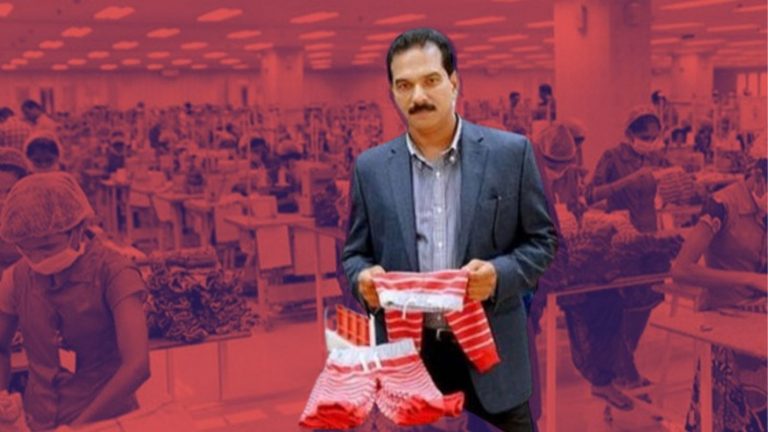
After a fallout with the Kerala government, a delegation from Kitex – a garment major – is on its way to Hyderabad in a ‘special flight’ sent by the Telangana government.
The standoff between the Kerala government and Kitex garments with regards to a Rs 3,500 crore project initially proposed for Kerala has taken a new turn with an invitation from Telangana’s K.T. Rama Rao, Industries Minister to hold discussions over the project.
As per reports, a delegation from Telangana will first arrive in Kochi on Friday to discuss possible investments, following which the delegation will accompany Kitex’s team to Hyderabad.
Kitex Managing Director Sabu Jacob informed that he along with a five-member team would be heading to Hyderabad Friday by a special jet flight sent by the Telangana government.
“We have already had one round of discussions with Telangana Industry Minister KT Rama Rao. They have offered excellent facilities and support for the Rs 3,500 crore project, which we have abandoned in Kerala. Telangana has invited us following our announcement to cancel the apparel project in Kerala,” he said.
Accusing leaders of the CPM and Congress in Kerala of seeing his firm “as traitors,” and elaborating on the existing hurdles, Jacob said, “We have no plan to make further investment in Kerala. It is already difficult for us to run the existing garment unit in Ernakulam. Then, how can we plan new investments? We have already spent Rs 200 crore for the proposed project, which would have given employment to 30,000 people, apart from developing 600 small-scale ventures in the sector.”
Proposals from several states
On June 29, the largest private-sector employer in Kerala, Kitex Group, announced the withdrawal of an Rs.3,500 crore investment project from Kerala. The company alleged that the state authorities are running a witch-hunt against them.
Jacob then announced that they have got informal invites from over ten states, including Gujarat and formal invites from the state of Tamil Nadu, to shift their investments.
Fallout with Kerala government
According to Sabu M Jacob, there have been repeated instances of harassment by the government at the existing garment processing plant in Kizhakkambalam panchayat of district Ernakulam. Just before the announcement of withdrawal was made, Sabu said 11 teams of officers from various departments raided the company in the last month, including teams from the Department of labour, factories and boilers, and even a team led by the district collector.
Government denies allegations
Criticizing Kitex’s move Kerala’s Industries Minister P Rajeev had told the media, “No government department has suo motu gone for inspection at the existing manufacturing units. There have been complaints, and hence various departments have inspected the units. The KITEX management could have taken up their woes with the government. Instead, they have been criticizing the government on social media, only to tarnish it.”
The Minister did assure support to the world’s second-largest kids’ apparel manufacturer, however, Kitex is already looking for alternatives.
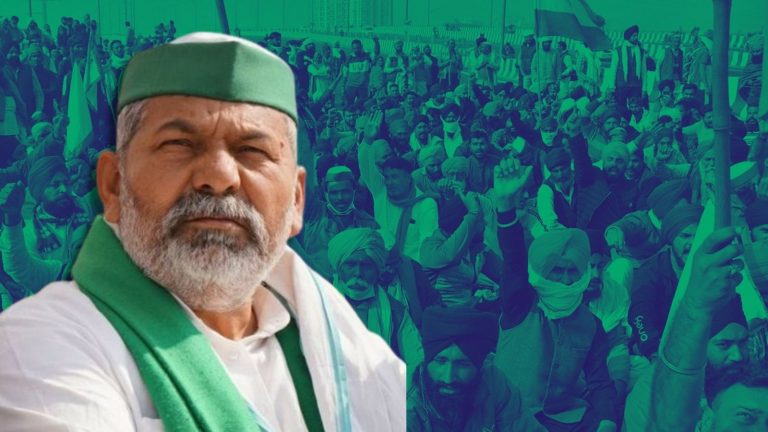
So-called farmer leader and BKU head Rakesh Tikait in an interaction with media said that the protests will end either with ‘talks’ or ‘bullets’. Tikait in a news clip can be heard saying that it is the Centre that is responsible for the protests. He further adds that if the centre wants, they can hold a ‘no condition’ talk and put an end to the protest or use bullets.
‘End stir with talks or bullets’: BKU’s #RakeshTikait tells Govt on #farmers‘ protest.
Tikait puts condition to hold a ‘no-condition’ talk
It is pertinent to note that the central government has repeatedly asserted that they are open to holding talks to discuss certain clauses of the Farm Bills as claimed by the protestors but will not roll back the laws.
However, Tikait who seems to be in no mood to bring the protests to a logical conclusion insists that they will end the stir or engage in dialogue only if the laws will be taken back.
“The farm laws will not be curbed, yet they are asking us to end the protest. Farmers are not protesting for 8 months so that they could follow govt’s orders. If they want to talk, they can talk, but no conditions should be imposed,” said Tikait while speaking with the media.
The farm laws will not be curbed, yet they are asking us to end the protest. Farmers are not protesting for 8 months so that they could follow govt’s orders. If they want to talk, they can talk, but no conditions should be imposed: BKU leader Rakesh Tikait pic.twitter.com/mCdDQxlPZf
“We have said earlier as well that we are ready for talks whenever the government is ready. But why are they making it conditional by saying that they will not take back the farm laws?” he added exposing the irony.
Yet again, Tikait asserted that the protest is just going to ‘intensify.’
Tomar invites protesting farmers for a talk
Tikait’s reactions came shortly after Union Agriculture Minister Narendra Singh Tomar assured that the three farms laws would bring revolutionary changes in the lives of farmers. He also made it clear that the government is ready to hold talks barring the demand for repealing these laws.
किसान संघ को मैंने एक बार नहीं कई बार कहा है कि तीन कानूनों को रद्द करने के अतिरिक्त वो कोई भी प्रस्ताव लेकर हमारे पास आए हम उस प्रस्ताव पर चर्चा करने के लिए तैयार हैं। APMC समाप्त नहीं होगी बल्कि APMC और मजबूत हो। इसके लिए मोदी सरकार प्रतिबद्ध है: कृषि मंत्री नरेंद्र सिंह तोमर pic.twitter.com/CKhrpjQnaD
“I have told the Kisan Sangh not once but many times that they come to us with any proposal except to repeal the three laws, we are ready to discuss that proposal. APMC will not end but APMC should be stronger. Modi government is committed for this,” said Tomar.
11 rounds of talks
It is imperative to note that the government had initiated 11 rounds of talks with the protesting farmers to reach an amicable solution. In the 10th round of talks, the Centre had proposed putting the Farm Bills on hold for 1.5 years, however, that too was not convincing enough for the farmers who have made ‘my way or the highway’ their motto.
The last round of talk was held in January after which no new date was determined for the next round. As the second wave of the pandemic receded, the Centre and the Union Minister have invited the farmers multiple times for the talks, however, the leaders have been adamant on their demand.
News ways and reasons for protesting
After the tractor rally, Red Fort siege, chakka jam, parliament gherao and making Tikri and Singhu border their permanent homes, Tikait was seen addressing a ‘pink dharna’ conducted by women activists in Rohtak in support of the farmers’ stir against the farm laws.
We reported how the farmers, protestors and their so-called leaders have protested against anything and everything under the sun including matters which are not of their concern. Pertinently, while Rakesh Tikait is not asking for ‘talks or bullet’, he had earlier asserted that their protest will last till 2024 elections, making it rather clear that their motive was purely political and had nothing to do with the Farm Laws at all.
On Wednesday, the Congress party appointed several Presidents and office-bearers for the party’s “international wing” – the Indian Overseas Congress. In a press release, the Congress party stated that it was glad to appoint President for a two year period in several countries in the European region. It is pertinent to note that the Congress party has appointed Presidents in European countries despite failing to appoint a President for its party in India.
The newly appointed Presidents of the Indian Overseas Congress has the responsibility to help build and expand the Indian Overseas Congress organization and institution in the respective countries, said the statement released by the Congress party.
@INCOverseas Hearty congratulations to the newly appointed Country Presidents of Indian Overseas Congress Europe team INCOverseas !
“In this capacity, you are expected to identify and work with qualified, capable, committed and concerned people to lead the various initiatives of the IOC,” the Congress party said.
Nine Congress party members have been appointed as Presidents of Indian Overseas Congress units in their respective countries.
The names are:
Dilbag Channa – Italy
Joy Kochattu – Switzerland
Dr Sonia Heldst – Sweden
Sunil Korah – Austria
Suldleevan Preet Singh – Belgium
Harpinder Singh Ging- Holland
Amarjit Singh (Amba) – Poland
Dr Komal Kumar Javarappa – Finland
Garisober Singh – Norway
In addition, the Congress party has appointed several office-bearers and Core committee members of the Indian Overseas Congress in Europe.
@INCOverseas Hearty congratulations to the newly appointed CORE committee of Indian Overseas Congress Europe team INCOverseas !
According to their website, the Indian Overseas Congress claims to be a group of “concerned, committed, diverse, capable and courageous Overseas Indians and friends of India” coming together in the form of a local cell at various key global cities to understand, educate, discuss, debate, learn, lead and promote Indian National Congress. Sam Pitroda, a veteran Congress leader and a close aide of Rahul Gandhi, is the Chairman of the Indian Overseas Congress.
The appointment of several Presidents for the party’s overseas wings come even as the Congress party has been struggling to appoint a full-time party president. Ever since Rahul Gandhi resigned from the post after a series of poll debacles, his mother Sonia Gandhi has taken the reigns of the party as interim chief. Sonia Gandhi has not been appointed as the full-time President of the party, however, she has been managing affairs of the party for over two years now.
Since then, the Congress party is struggling to find a leader to lead the party that is facing an existential crisis. However, despite serious infighting within the party and the continuing exodus of the leaders from the party, the Congress leadership has not shown any interest to appoint a party president, instead, they are busy appointing presidents for inconsequential overseas wings of the party.
Not just Europe: A sneak peak into Indian Overseas Congress and its controversial history
The Indian Overseas Congress, which claims to be the international wing of the Congress party, has been at the centre of several controversies in the last few years. The overseas wing of the Congress party has a history of joining hands with hostile countries and anti-India elements to interfere in India’s domestic politics.
In December last year, one of the senior members of the Indian Overseas Congress had unfurled a Pakistani flag at a protest against the Indian government over passing farm laws in Germany. The Indian Overseas Congress organised these anti-India protests in Germany in December 2020.
According to the BJP leader Suresh Nakhua, Raj Sharma, allegedly an office-bearer of the Indian Overseas Congress, was the person behind such protests in Germany, where the Pakistani flag was unfurled. Nakhua had also said that the IOC had recently donated Rs. 1 crore to the ‘farmer protests’, which subsequently resulted in the Republic Day riots and insurrection against the Indian state.
The IOC had claimed that their members were not present when the Pakistani flag was unfurled. However, Nakhua claimed to have video evidence of their participation which he says he will release soon.
The ‘farmer protests’ had provided an opportunity to India’s detractors across the globe, such as Indian Overseas Congress, to jump on the bandwagon to undermine Indian national interests and tarnish India’s reputation abroad.
In addition, the Congress party has also opened its overseas office in Turkey in 2019, a few days after Turkey had extended its support to Pakistan at the UN on the Kashmir issue. It is not an unknown fact that Turkey is a close ally of the terrorist-state of Pakistan and has often conspired to defame India in several global fora.
However, the Congress party went on to establish the Indian Overseas Congress (IOC) office in Istanbul even as Turkey continues to plot against India by joining hands with Pakistan.
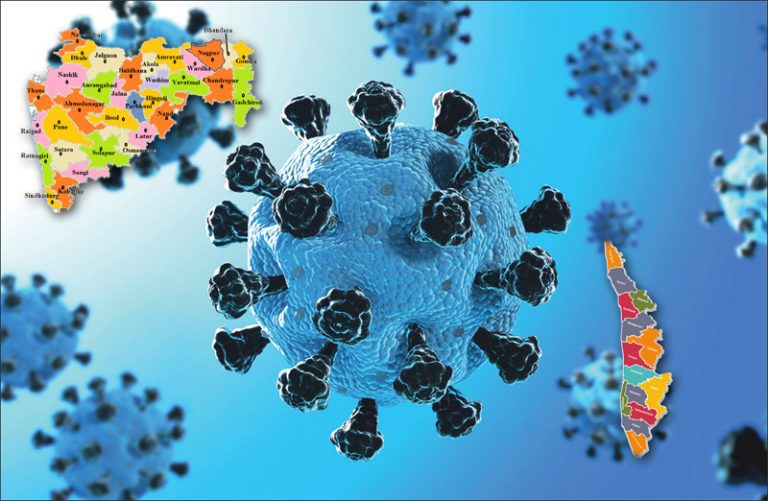
The majority of the states in India are quickly recovering from the overwhelming Covid-19 second wave crisis. Notably, states like Uttar Pradesh and Karnataka have done exponentially well in handling the rising number of Covid cases. On the other hand, the states of Maharashtra and Kerala have failed to bring down the number of daily cases reported to under 1000.
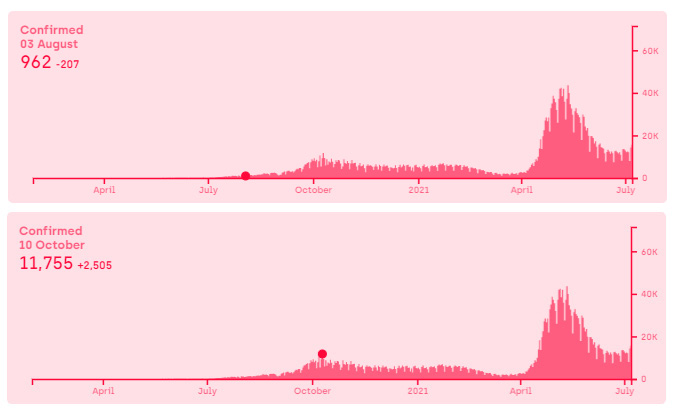
The last time Kerala reported less than 1000 new COVID19 cases in a single day was more than 11 months ago, on 3rd August 2020.
Interestingly, the Kerala model of Covid management is still being lauded among the liberal section of the media. Strangely, Kerala’s Ex-Health Minister is all set to give lessons on Covid management to IIM-B students while the pandemic is raging unhinged in the state.
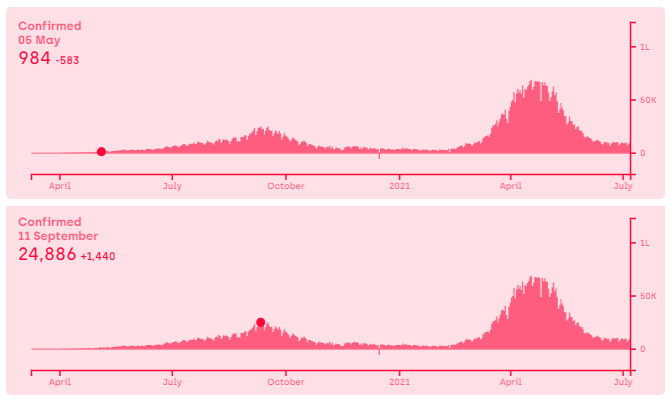
Maharashtra reported under 1000 cases only twice since May 2020
On May 5, 2020, the state of Maharashtra reported 984 cases in a single day. Since then, it has been reporting over 1000 cases per day consistently. During the peak of the first wave of Covid-19 in India, Maharashtra reported a maximum of 24,886 cases in a single day on September 11, 2020.
In first wave of covid-19, Maharashtra touched peak on September 11. Source: Covid19india.org
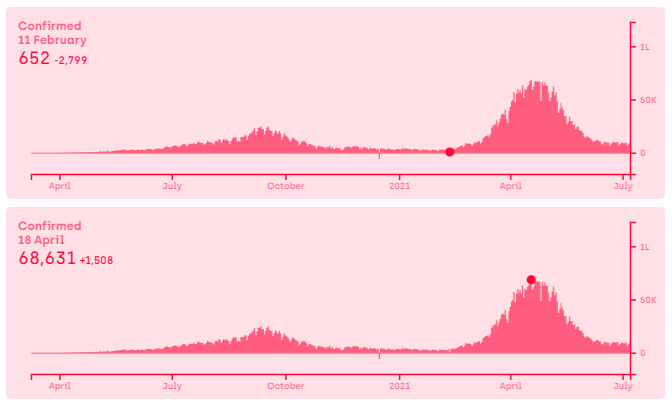
The cases declined at a persistent pace after that, and the situation started to get normal in the state. However, it was only for the time being. While the state was consistently reporting above 2000 cases per day, on February 11, 2021, it reported only 652 cases. The bubble burst the very next day, and the cases start to rise quickly.
In the second wave of Covid-19, Maharashtra touched peak on April 18. Source: Covid19india.org
Maharashtra became the top contributor of Covid-19 cases in the country, and at one time, it was contributing more than a major share of the total cases reported in a single day across India. At the peak of the second wave, the state reported 68,631 cases in a single day on April 18, 2021. Notably, there were 2,75,083 cases reported across the country on that day. The state is still registering close to 10,000 cases per day.
Kerala reported under 1000 cases a year ago
On August 3, 2020, Kerala had reported 962 cases in a single day. That was the last time when Kerala reported under 1000 cases. Since then, it has been a rollercoaster ride for the state in terms of new cases reports. During the peak of the first wave of coronavirus pandemic in India, Kerala reported a maximum of 11,755 cases in a single day on October 10, 2020.
In the first wave of Covid-19, Kerala touched the peak on October 10. Source: Covid19india.org
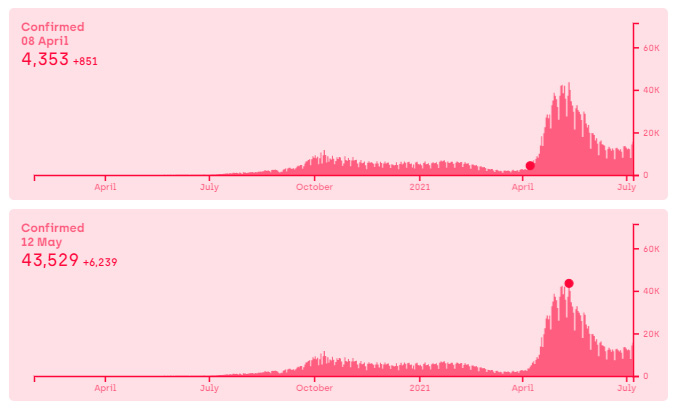
After that, the cases declined for a while. However, the state kept reporting 4000 to 6500 new cases every day till February 3 week. After that, the cases remained anywhere between 1200 to 3500 for few weeks. The situation started to get out of hand on April 8, 2021, when the state reported 4,353 cases in a single day. In just five weeks, Kerala touched the peak at 43,529 cases in a single day on May 12. On that day, India had reported 3,62,632 cases in a single day.
Kerala touched the peak in the second wave on May 12. Source: Covid19india.org
At one point, Kerala left Maharashtra behind and became the top contributor of new cases in the country. As of now, the state has been consistently reporting between 8,000 to 15,000 cases in a single day for the last two weeks.
Covid-19 in India
With Kerala (15,600) and Maharashtra (9,558) as the top contributors in the total Covid-19 cases reported in a single day, according to the Ministry of Health and Family Welfare, India reported 45,701 cases on July 7, 2021. There are around 4,57,000 active cases in the country. So far, 4,05,153 people have lost their lives to Covid-19. Notably, while Maharashtra has reported maximum deaths at 1,23,857 since the pandemic hit India, Kerala has managed to keep a tab on the number of deaths by Covid-19. So far, 14,108 have lost lives out of 30,11,694 total reported cases in the state.
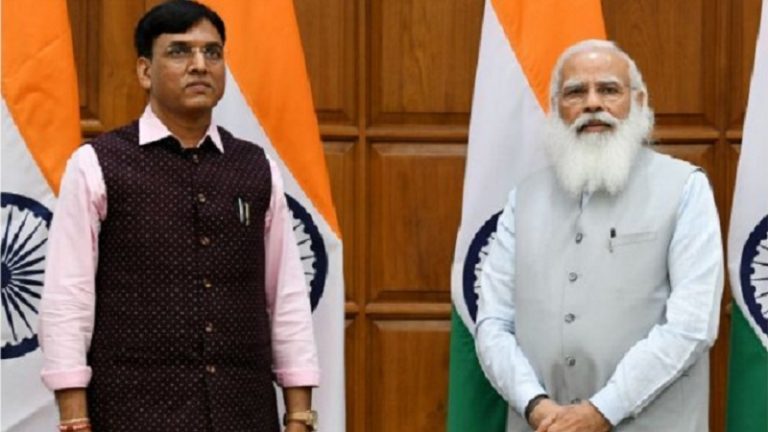
On Wednesday (July 7), a total of 43 leaders of the National Democratic Alliance (NDA) took oath as Ministers in the Narendra Modi government. While most of the ministers are new inductions, seven existing ministers of state have been promoted as cabinet ministers, one of them being BJP’s Rajya Sabha MP from Gujarat, Mansukh Mandaviya. Besides the Chemicals and Fertilizers portfolio, Mansukh Mandaviya has also been appointed as the country’s new health minister. He has replaced Dr Harsh Vardhan.
Though Mansukh Mandaviya, along with the rest of the Cabinet Ministers, assumed his new role from today, a very few people know that PM Narendra Modi had envisioned the political rise of Mandaviya back in the year 2012 when he himself was not aware that one day he would be sworn-in as the Prime Minister of India.
A video of an event held in Surat in April 2012, to honour Mansukh Mandaviya when he was elected to the Rajya Sabha is being widely shared on social media, in which Narendra Modi is confidently heard predicting a bright future for Mansukh Mandaviya.
Exhibiting his earnest faith and confidence in Mandaviya, Modi had said then: “Friends, today our brother has been nominated to the Rajya Sabha. It is a matter of utmost pride. However, this is just the beginning. Those who want to jot down what I am going to say after this in your diaries are free to do so”. Asking the public to take a note of the current date and time Modi furthered: “Remember today at 9:35, I am predicting that Mansukh Mandaviya has an extremely promising future. With his tremendous potentials, he will go a long way. I can foresee that a very bright future lies ahead of him”, said the then CM of Gujarat and today’s PM Narendra Modi.
Back in 2012, PM Narendra Modi had predicted about the rise of Mansukhbhai Mandaviya in the sanman rally of Mansukhbhai in Lalita Chowkdi, Surat when he was made RS MP. What a vision and confidence! pic.twitter.com/2sN4OlKfhe
As envisaged by Modi, Mansukh Mandaviya truly has come a long way in his political journey. He started as a member of the Akhil Bharatiya Vidyarthi Parishad, the RSS’s student wing, before joining the Bharatiya Janata Yuva Morcha, the youth wing of the BJP. Mandaviya became the youngest MLA in Gujarat in 2002 when he was elected from the Palitana constituency.
He then served as the chairman of Gujarat Agro Industries Corporation Ltd between January 2011 and March 2012. Mandaviya was first elected to the Rajya Sabha in April 2012 and served as a Member of the Committee on Petroleum and Natural Gas between May 2012 and May 2014 and again from September 2014 to July 2016. Between September 2014 and August 2015, he was made a member of the Committee on Industry. Mandaviya also served on the National Welfare Board for Seafarers and Committee on Chemicals and Fertilizers from December 2014 to July 2016.
Since 2016, Mandaviya has been an important young face in the Narendra Modi government at the Centre. He was first inducted in the Union cabinet as Minister of State for Road Transport and Highways, Shipping and Chemicals and Fertilizers on July 5, 2016. On May 30, 2019, he was again sworn in as MoS for Chemicals and Fertilizers with an independent charge of Ports, Shipping and waterways.
As Union minister, Mandaviya is credited with setting up over 5,100 Jan Aushadhi stores to provide more than 850 medicines at affordable rates and reducing the cost of heart stents and knee implants. He was honoured by UNICEF for his contribution to the cause of women’s menstrual hygiene by using the chain of Jan Aushadhi Kendras to sell 10 crore sanitary pads made with oxo-biodegradable technology at a nominal price.
Up until the Lok Sabha 2019 elections, the 47-year-old Mandaviya has successfully performed in whichever role he was entrusted with. Now, all eyes would be set on him as he embarks on his new journey as the Health Minister, especially at a time when India gears up to combat the impending third wave of COVID-19.
On Thursday, the Delhi Police registered an FIR against the unknown creators of an app named ‘Sulli Deals’, which was uploaded on the open-source software platform GitHub. The app had collected images of women along with their names from social media accounts without their consent, and allowed the users to share the images and participate in their ‘auction’.
After the app was spotted by social media users, some of them had alleged that Hindus were behind the app, which was made to collect and ‘auction’ images of Muslim girls. While at present it is not known who is behind this app, some social media users have noticed that Reddit, the news aggregation and discussion platform dominated by left-liberals, is filled with subreddits dedicated to sharing pornographic and nude images claiming that they are Hindu women lusting for Muslim men.
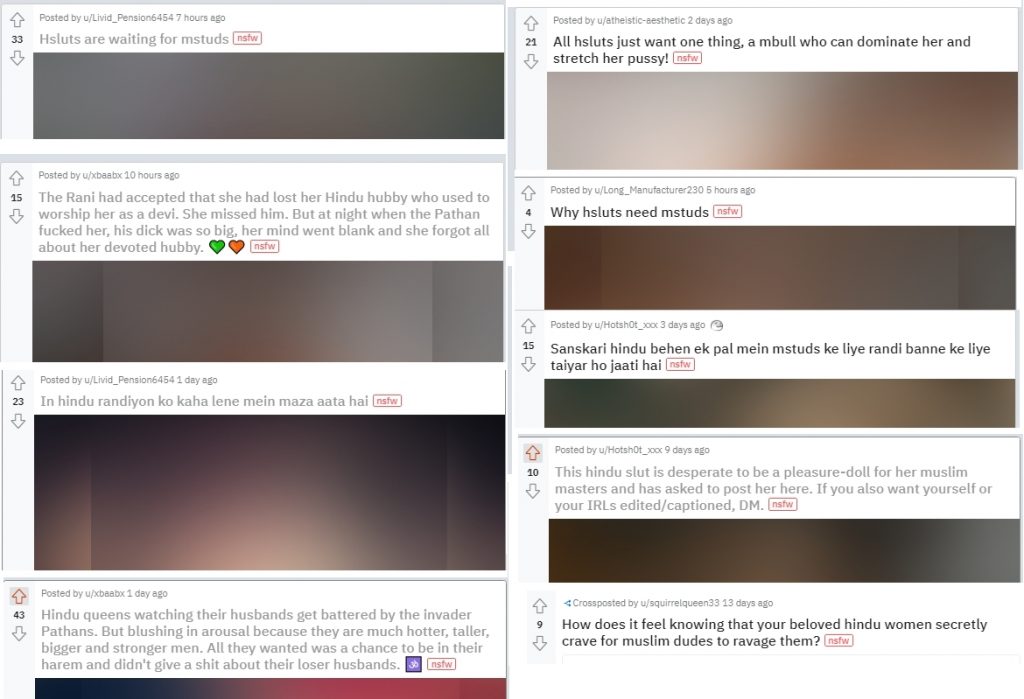
Several such subreddits have come on the platform, which claim that they share images of women claiming they are Hindus. The subreddits use explicit names, which call the Hindu women as sluts, who according to them are waiting for ‘Muslim studs’. Some of such groups on Reddit are r/dharmikrandis, r/Hinduslutsmuclimcock, r/Muslimbullvshinduslut, r/SanskariSlut, r/hindubitchmuslimbull and many more.
Screenshot of some captions with the images posted on the subreddits
In several of the images shared by Redditors, Hindu symbols like Om, Lotus flower etc superimposed on the body of the women supposed to be Hindu, while Islamic symbols like the star and the crescent are superimposed on the men supposed to be Muslims.
Please note that all these subreddits share NSFW pornographic content, therefore we are not linking them. As they are sharing adult content, it is needed to log in to the platform to access them. However, some of them are private groups, which means one needs to submit a request to join them.
These groups share images of women picked from social media, porn sites, and also share morphed images. But the images are accompanied with captions that made the same claim, that Hindu women lust for Muslim men. Apart from morphed images of celebrities, the identities of other women are not known, and therefore it is not known whether they are actually Hindus are not, but they are claimed to be Hindus by the people who are sharing them. The subreddits seem to be the result of the fantasy of Muslim men, who desire to sleep with Hindu women only with the purpose of dominating them.
Many of the captions accompanying the images also claim that during Islamic invasion of India, the Hindu queens had willingly submitted themselves to the Muslim invader, as Hindu queens found the invaders more ‘capable’ sexually. They claim that while they grieved for the defeat of their husbands, they were secretly happy to be captured by the invaders.
What these supposedly Muslim men are fantasising about is nothing else but hate sex. It is clear that they want to have sex with Hindu women out of hatred for Hindus, not love. Hate sex is defined as intercourse with someone one dislikes or hates. In simple words, a physical relationship between two people where there is no emotional connection between the two and at least one of the partners hates the other who is completely unaware of it. Therefore, the subreddits fits the definition desire of hate sex.
It is notable that just a few weeks ago, left-liberals were justifying hate sex. Last month, the left liberals were heard normalising ‘hate sex’, where they were discussing that ‘sanghi’ women are hot. In a clubhouse discussion among alleged ‘social media influencers’, they were heard debating whether right wing women are hot, after one among them said that he finds ‘sanghi’ women hot and wants to have sex with them.
After the matter stirred controversy, they had given the bizarre justification that ‘hate sex’ can be consensual, and there is nothing wrong with such sex.