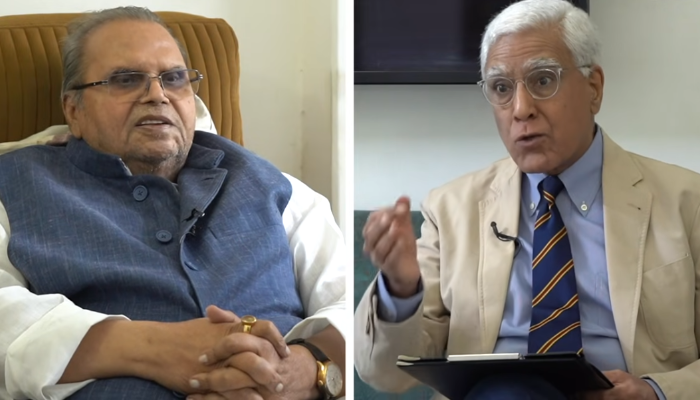
As Pakistan continues to grapple with the fallout of ongoing “Operation Sindoor” launched after the Pahalgam terror attack, there are elements within India that are supporting the enemy in crafting a spurious narrative for their own political motives and personal animosities. One notable individual is Satyapal Malik, the former Governor of Jammu and Kashmir, whose statements have been echoed in the Pakistan’s national assembly to bolster its false propaganda.
A parliamentarian highlighted that Satyapal Malik in a conversation with Karan Thapar alleged that Baisaran Valley is a very protected location. She declared, “Army and police should have been present there. Nevertheless, not a single officer was in attendance. He directed this inquiry towards the Modi administration. He asserted that Prime Minister Narendra Modi should feel a sense of shame and offer an apology for the security oversight. Such sentiments have been increasingly expressed within India, yet they are being suppressed.”
Dushman na kare dost ne vo kaam kiya hai.
Congratulations Satyapal Malik and Karan Thapar you made it to Pakistan assembly pic.twitter.com/wQ4XCilpKt
Malik called Prime Minister Modi “shameless” and “cowardly” in an interview with the contentious “The Wire,” on 6th May. He asserted that the latter must apologize to the country for the terror incident. He charged that earlier intelligence reports warning of a possible terror assault in Pahalgam had been received by the central administration. However, the centre did nothing to prevent it. He labeled the attack a major intelligence and national security failure.
Additionally, he attacked Union Home Minister Amit Shah, contending that his security meetings before the attack were “just for show” and that there was no real planning or action. He added that Lieutenant Governor Manoj Sinha should have resigned on ethical grounds and held him accountable for the security breach. Malik shrewdly exonerated Pakistan from its involvement in the attack and placed the blame on the Modi administration.
Similar to Malik, N Ram’s “The Hindu” also provided fodder to the hostile nation by publishing an unverified report alleging that three Indian fighter jets had crashed in the Akhnoor area of Jammu and Kashmir, referencing a government official. However, the article was later retracted and the publication expressed regret, affirming that there was no official information from India concerning this event. Nevertheless, the news only further contributed to the disinformation peddled by Pakistan which is frantically trying to preserve its image after facing global and domestic disgrace at the hands of India.
As India razed to the ground nine terrorist sites in Pakistan and PoJK, including the JeM headquarters in Bahawalpur, under Operation Sindoor, former Wall Street Journal (WSJ) journalist Asra Nomani recalled how her colleague American journalist Daniel Pearl was brutally assassinated by terrorists when he went to Bahawalpur to report on terrorist groups there. Nomani described Bahawalpur as a “base for homegrown domestic terrorists” of Pakistan.
“I still have chills in my heart from when I first heard that town’s name in late January 2002. For the 23 years since, I have reported on how Pakistani intelligence and military leaders have used that city — Bahawalpur — in the southern province of Punjab, as a base for its homegrown domestic terrorists,” Nomani wrote on X on Thursday (8th May). “When I heard India bombed training camps in Pakistan this week in Operation Sindoor, in response to a Pakistani terrorist rampage in India’s Kashmir state, I had one city’s name on my lips: Bahawalpur,” Nomani added.
“Bahawalpur.”
I still have chills in my heart from when I first heard that town’s name in late January 2002. For the 23 years since, I have reported on how Pakistani intelligence and military leaders have used that city — Bahawalpur — in the southern province of Punjab as a base… pic.twitter.com/nFF6geUTp7
Asra Nomani said that Daniel Pearl went to Bahawalpur just after Gen. Pervez Musharraf promised to shut down terrorist groups in the country after the terror attack on Indian parliament, and Pearl had reported on the terrorist camps in Bahawalpur. She wrote, “My friend, WSJ reporter Danny Pearl, went to Bahawalpur in December 2001 with a notebook and a pen. Gen. Pervez Musharraf had just promised he was shutting down Pakistan’s militant groups after a strike by Pakistan’s terrorists against the Parliament in India, and Danny reported on the militant offices in Bahawalpur.”
Notably, among the 9 sites targeted by India in Operation Sindoor, the most prominent site was Markaz Subhan Allah in Bahawalpur, the main centre of Jaish-e-Mohammad for training and indoctrination of youth. This centre serves as the operational headquarters of JeM, and is associated with terrorist planning, including the Pulwama attack on February 14, 2019. The Markaz also consists of residences of JeM Chief Maulana Masood Azhar, de-facto Chief of JeM Mufti Abdul Rauf Asghar, Maulana Ammar and other family members. Several family members and associates of Masood Azhar were killed in the Indian strike on this facility.
Nomani added in her post on X, “He literally knocked on their doors. Dear Dr. @yudapearl, this story is a window into Danny’s reporting enterprise. And because people will wonder: Danny was no cowboy. This was a calculated low-risk reporting trip because no journalist had been targeted for kidnapping in Pakistan. Around that time, Danny sent me an email: “I’m anxious to go to Afghanistan, but I’m not anxious to die.”
She wrote that Pearl found that militant training camps were open for business in Bahawalpur. As per her, one Asif Farooqi had arranged an interview for Daniel Pearl through Arif, a PR man for Harkutul Mujahadeen. “I learned Danny’s fixer, Asif Farooqi, had arranged an interview for Danny through a man named “Arif.” Danny didn’t know it but Arif was the PR man for a militant group, Harkutul Mujahadeen. What was Arif’s hometown? Bahawalpur. The police launched a manhunt to find Arif in Bahawalpur. We learned Arif’s family faked a funeral for Arif. Police found him trying to board a bus in Muzaffarabad, across the country by Pakistan’s border with Kashmir,” she wrote.
She added, “Arif had handed Danny off to Omar Sheikh, a British-Pakistani dropout from the London School of Economics, radicalised in the 1990s in London mosques.” Notably, Omar Sheikh was arrested and jailed in India, but was released in exchange for hostages of the hijacking of Indian Airlines Flight 814, along with Masood Azhar. Nomani said that Pakistan didn’t jail Omar Sheikh and Masood Azhar after their release from Indian jails, but gave them safe passage. “They used them as weapons against India,” she added.
Nomani said that under the obsession to take over Kashmir, Pakistan failed to act against terrorist bases on its land. “Pakistan has had a duty to dismantle those terrorist bases — for even the safety of its own people. What India is doing is a strategic attack on terrorist bases, Pakistani military and intelligence should have eliminated but never did in their obsession to take over Kashmir,” she said.
Who was Daniel Pearl?
Daniel Pearl was the South Asia Chief of the WSJ, who went to Pakistan in December 2001 in the aftermath of the 9/11 terrorist attack to work on stories about terrorist organisations there. He has taken a regional posting in Mumbai before travelling to Pakistan to cover the Global War on Terrorism, a military campaign launched by the US after 9/11. As Nomani tells in her post on X, Daniel Pearl was looking to get an interview with a member of a terrorist organisation. A man named Asif Farooqi had arranged an interview for Pearl through a man named Arif, who was a PR person for the terrorist group named Harkatul Mujahideen. According to Nomani, Pearl’s trip to Bahawalpur was supposed to be a low-risk reporting trip because no incident of kidnapping of a journalist by terrorists had been reported so far from Pakistan. During his visit to Bahawalpur, Pearl found terrorist camps being run in the area.
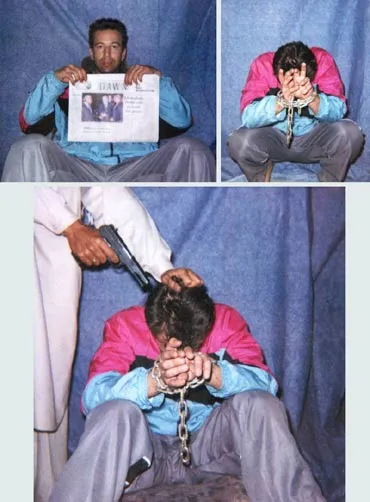
Pearl disappeared in Karachi, Pakistan, on January 23, 2001. He was taken into a car for what he believed was an exclusive interview with an Islamic leader. Unfortunately, he was abducted and held in captivity. Four days later, a terrorist group named ‘the National Movement for the Restoration of Pakistani Sovereignty’, said to be an offshoot of JeM, sent an email with the pictures of Pearl held in captivity with his hands chained. One of the pictures showed someone putting a gun to his head. Pearl was held in captivity for a week before being brutally killed. His assassination was recorded in a video by his killers. In the video, Pearl was seen condemning the US foreign policy and repeatedly saying that he and his family were Jewish. After this, his head was severed from his body.
Daniel Pearl in captivity
Days before his abduction, Pearl met a British-born Pakistani terrorist, Ahmed Omar Saeed Sheikh, who had a track record of kidnapping Westerners. Sheikh had reportedly used a fake name and pretended to be a follower of the Islamic cleric that Pearl wanted to interview. Sheikh, along with JeM founder Masood Azhar, was among the terrorists who were released in a trade-off for hostages by the Indian government during the hijacking of Indian Airlines Flight 814. “Omar Sheikh, a British-Pakistani dropout from the London School of Economics, radicalised in the 1990s in London mosques. He went to Pakistan to train in these militant training camps. Then he kidnapped tourists in India. He was caught and jailed, but on Dec. 31, 1999, he was traded for hostages in the hijacking of Indian Airlines Flight 814,” Nomani said.
Ironically, Pearl was known as someone who was particularly sensitive to sentiments in the Islamic world and was committed to explaining them to people in the West.
How Operation Sindoor brought justice for Pearl
Ahmed Omar Saeed Sheikh and three other suspects were charged on March 21, 2002, for their role in the kidnapping and murder of Daniel Pearl. They were convicted on July 15, 2002, and Sheikh was granted a death sentence. In April 2020, the High Court of Sindh acquitted Sheikh and his accomplices on the charges of murder and reduced the sentence to 7 years’ imprisonment for kidnapping. In February 2021, Pakistan’s Supreme Court ordered Sheikh to be put in a government safe house where he was allowed visits by his family and children.
On March 10, 2007, Khalid Sheikh Mohammed, an Al-Qaeda operative said to be third in command under Osama Bin Laden, claimed responsibility for personally beheading Pearl. “I decapitated with my blessed right hand the head of the American Jew Daniel Pearl, in the city of Karachi, Pakistan,” Sheikh Mohammed reportedly said during a confession. He is currently under the detention of the US authorities.
Though Daniel Pearl’s killers could not be brought to book and continued to walk free under the protection of their patrons in Pakistan, India’s Operation Sindoor against terror camps, in a way, avenged Pearl’s death. The operation has brought peace to those who suffered the effects of terrorism and who could not have hoped for justice through a legal course.
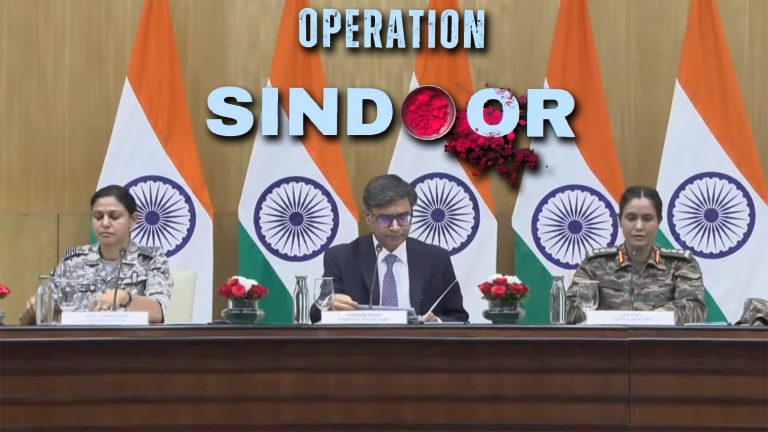
As India continues to hit targets inside Pakistan as part of Operation Sindoor, Foreign Secretary Vikram Misri held a special briefing on the operation on Thursday evening. Wing Commander Vyomika Singh and Colonel Sofia Qureshi joined him in the briefing, just like the first briefing by the Indian government on the operation.
Wing Commander Vyomika Singh and Colonel Sofia Qureshi said that between 7th and 8th May, Pakistani forces tried to attack several sites in India using drones and missiles. She said that Pakistan attempted to engage a number of military targets in Northern and Western India, including Awantipura, Srinagar, Jammu, Pathankot, Amritsar, Kapurthala, Jalandhar, Ludhiana, Adampur, Bhatinda, Chandigarh, Nal, Phalodi, Uttarlai, and Bhuj, using drones and missiles.
“These were neutralised by the Integrated Counter Unmanned Aerial Systems Grid and Air Defence systems. The debris of these attacks is now being recovered from a number of locations that prove the Pakistani attacks,” they added.
As already said in a statement issued by the defence ministry, they said that the Indian Armed Forces targeted Air Defence Radars and systems at a number of locations in Pakistan today morning. “It has been reliably learnt that an Air Defence system at Lahore has been neutralized,” they added.
Responding to Pakistan denying its role in terrorism in India, Vikram Misri said that Pakistan’s reputation as an epicentre of global terrorism is rooted in a number of instances where concrete evidence is available not just to India but to governments, agencies and authorities around the world. He said that Pakistan’s fingerprints have been found in several terror attacks in the world, adding that Osama Bina Laden was found to be living in India.
Misri also responded to Pakistan’s demand for an international probe on Pahalgam terror attack, reminding how Pakistan refused to cooperate in the investigation into Mumbai and Pathankot terror attacks, even after India provided them with evidence. He said that joint investigative team was formed after the Pathankot attack and Pakistani side was given unprecedented access, but there has been no movement from Pakistan.
Therefore, Pakistan can’t be trusted for a joint probe, Misri said, adding that it is a delaying tactic. He also said that Pakistan may use the information gained in such joint probe to cover its tracks and defend the terrorists.
Vikram Misri also denied Pakistani claims that only civilians were killed in the 7th May Operation Sindoor strikes, saying that only terrorist camps were carefully selected as target. He also referred to Pakistani military and ISI officials attending the funerals of the people who died in the strikes, asking why such state honour will be given for death for funerals.
“As far as we are concerned, the individuals eliminated in these facilities were terrorists, giving terrorists state funerals may be a practice in Pakistan, doesn’t seem to make much sense to us,” he said. He also denied Pakistani claims that India targeted religious sites, saying that the targets were terrorist facilities and locations clearly connected with incidents of cross-border terrorism into India.
Vikram Misri said that it is Pakistan that is misusing religious sites as cover to radicalise, indoctrinate and train terrorists. Contrary to Pakistan’s claim, they launched a targeted attack on the Sikh community by hitting a Gurudwara and several houses of Sikh community in Poonch, he added. He added how Pakistan is artillery shelling is hitting civilians in India, in which 16 people have died and 59 others have been injured.
The foreign secretary added that Pakistan is trying to give a communal angle to India’s response to Pahalgam attack, saying the religious profiling of victims in the Pahalgam attack and Pakistani Army Chief’s provocative comments earlier were actually communal in nature.
Responding the Pakistani claims of responding to Indian strike, Misri said that it is India which is responding to the Pahalgam terror attack. He also denied that India targeted a dam of the Neelum-Jhelum project in PoK, saying that India only targeted terrorist infrastructure. He said that such claims are pretext to target civilian infrastructure in India.
Talking about Indus water treaty, the foreign secretary said that there have been fundamental changes in the circumstances in which the treaty was concluded, and a reassessment of the obligations under the treaty has become necessary. He said that India has been talking with Pakistan over the issue for last 2 years, and Pakistan has been violating the terms of the treaty. India has been carrying out its responsibilities under the treaty despite the provocations of Pakistan, he said.
Misri also said that due to developments in technology, climate change, cross border terrorism and other issues, the Indus water treaty needs to be reviewed.
Hinting that operations are not over, Vikram Misri said that this is an evolving situation, saying he can’t reveal operational details. When asked by a journalist, he refused to disclose further operational details beyond what was said by the defence ministry statement earlier in the day.
When asked for official statement on Pakistan’s baseless claim of shooting down 5 or 6 Indian fighter jets including 3 Rafale jets, Misri said that official response will be issued on time. However, he said that he is not surprised by Pakistani misinformation, as it is known for lies and false propaganda.
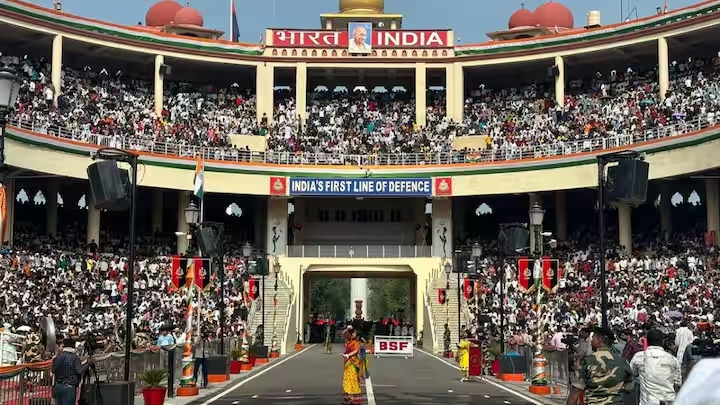
The Border Security Force (BSF) has stopped the Beating Retreat ceremonies at all three border check posts along Pakistan in Punjab– Attari-Wagah, Hussainwala, and Sadki– till further orders in view of public safety.
However, the daily lowering of the national flag at sunset will continue as usual, the BSF said in a statement.
The BSF’s decision came a day after nine terrorist bases in Pakistan and Pakistan-occupied Kashmir (PoJK) were destroyed by India as a retaliatory measure against the April 22 Pahalgam terror attack in Jammu and Kashmir in which 26 tourists were brutally killed.
The Indian Armed Forces launched Operation Sindoor in the early hours of Wednesday, targeting terrorist infrastructures in Pakistan and Pakistan-occupied Jammu and Kashmir (PoJK).
The strikes, executed by the Indian Armed Forces, targeted nine key terror camps linked to Jaish-e-Mohammed (JeM), Lashkar-e-Taiba (LeT), and Hizbul Mujahideen. Four of the targets were located inside Pakistan and the remaining five were situated in Pakistan-occupied Kashmir (PoK).
Earlier today, Prime Minister Narendra Modi chaired a high-level meeting with Secretaries of various Ministries and Departments of the Government of India to review national preparedness and inter-ministerial coordination in light of recent developments concerning national security.
PM Modi stressed the need for seamless coordination among ministries and agencies to uphold operational continuity and institutional resilience. PM reviewed the ministries’ planning and preparation for the current situation.
Secretaries have been directed to undertake a comprehensive review of their respective ministries’ operations and ensure the fool proof functioning of essential systems, with a special focus on readiness, emergency response, and internal communication protocols.
The Cabinet Secretary, senior officials from the Prime Minister’s Office, and Secretaries from key ministries, including Defence, Home Affairs, External Affairs, Information & Broadcasting, Power, Health, and Telecommunications, attended the meeting.
The Prime Minister called for continued alertness, institutional synergy, and clear communication as the nation navigates a sensitive period. He reaffirmed the government’s commitment to national security, operational preparedness, and citizen safety.
(This news report is published from a syndicated feed. Except for the headline, the content has not been written or edited by OpIndia staff)
India launched “Operation Sindoor” on 7th May early morning and targeted Pakistan’s terror infrastructure at nine locations in the aftermath of the Pahalgam terror attack which ended the lives of 26 Hindu tourists and injured several others. Following the attack, Pakistan has been making ridiculous assertions in international media while simultaneously attacking innocent people in Jammu and Kashmir in a bid to save face.
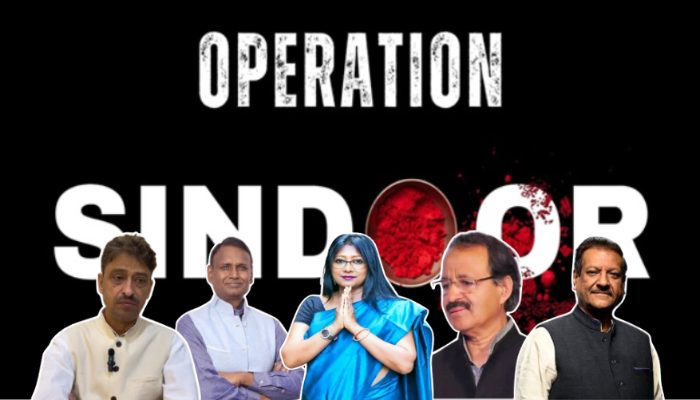
While Pakistan is under the spotlight for its lies, some Indian politicians have taken it upon themselves to challenge their own government in a shameful display of petty politics.
The very name ‘Operation Sindoor’ has become a problem for quite a few, including Delhi Congress leader Udit Raj. While talking to the media, he said, “During discussions with intellectuals, it was pointed out that Sindoor is associated with a specific religion, and it would have been better if a different name was chosen.”
However, he tried to claw himself out of the hole he had dug by saying, “What matters is that Pakistan has been taught a lesson.”
Delhi: When asked about the name "Operation Sindoor" for the operation targeting terrorists
Congress leader Udit Raj says, "During discussions with intellectuals, it was pointed out that Sindoor is associated with a specific religion, and it would have been better if a different… pic.twitter.com/ef58ZH3mph
“The operation is not just a name, it is a tribute to the victims of the Pahalgam attack. This is not the weak India of the past, but a strong, resolute India under Prime Minister Narendra Modi’s leadership,” Bharatiya Janata Party MLA Agnimitra Paul slammed Udit Raj and termed him “foolish and ignorant.”
Similar remarks were made by senior Congress politician and former Chief Minister of Maharashtra, Prithviraj Chavan, who said the government might have chosen the codename “Operation Sindoor” to garner “sentimental benefits.” Additionally, he insisted that emotions cannot win a battle. He further conveyed that the government should routinely provide information to the public to prevent the propagation of false information on social media following the destruction of terrorist camps in Pakistan and the Pakistan occupied Kashmir.
He alleged, “A war is fought with bombs, guns, and aircraft, and not on symbolism or tokenism. A war cannot be won through the name of the operation. The name of the operation is fine. Indian government might have thought that giving this name (Sindoor) to the operation, they might derive some sentimental benefits.” He added, “Names of the operations don’t matter, ultimately, you have to go to Pakistan and show that you have destroyed terrorist camps.”
Rashid Alvi and Imran Masood raise questions about the operation
Rashid Alvi, another veteran Congress leader sought to downplay the significant successes of India’s action in Pakistan. He contended that the operation was only the bare minimum response, attempting to diminish the considerable achievement of neutralizing terror launch pads in both Pakistan and Pakistan-occupied Kashmir. He failed to mention that during UPA government, even this “bare minimum” (as he puts it) response was not given to Pakistan after 26/11 attack.
“Much better reply needs to be given, this is bare minimum. Our forces did what govt of India told them to do, but the question again arises. Was every single terrorist killed? Will there won’t be another Pahalgam? PM Modi had said that the remaining land of terrorists will be destroyed if that has happened, then it is good,” he stated.
Controversial Congress Lok Sabha MP Imran Masood also questioned the operation, stating that he won’t be satisfied unless its specifics are made public. He asked the government to reveal the particulars of the operation, including the names and number of terrorists who were eliminated and the magnitude of damage caused by the strikes.
“Salute to Indian security forces, this was the kind of reply we expected. How many (terrorists) were killed and what all damages could they inflict, this also should be announced, then we will feel at peace. We had said several times, we are with govt and that they should give befitting reply,” he voiced. The parliamentarian is a habitual offender. He previously criticized the 2019 Balakot airstrike and 2016 surgical strike, which were carried out in response to the Pulwama and Uri terrorist attacks, respectively. In a TV interview with journalist Megha Prasad for the ABP News show Inside Out, he claimed that the Balakot surgical strike was ridiculed globally.
“The whole world mocked the air strike. Pakistanis were saying that they killed our three crows,” he answered when she inquired if he believed that India had conducted successful surgical strikes on terrorist launch pads based in Pakistan. Notably, he has a prolonged history of delivering objectionable statements. He first gained public attention in 2014 when he threatened to dismember Prime Minister Narendra Modi during the Lok Sabha elections.
JMM MP Mahua Maji sees politics over the operation
Mahua Maji, a Rajya Sabha MP from the Jharkhand Mukti Morcha, expressed her discontent with the operation’s name, suggesting it could have been more appropriately titled. She asserted that the name itself reeked of politics and emphasized that it could have been designated differently. She stated that this name was selected for women whose spouses lost their lives in the terrorist attack and adopting such a name aligns with their feelings.
“When the three armies were given a freedom to choose their own targets and time, then Prime Minister Narendra Modi named it ‘Operation Sindoor,’ therefore, some politics is definitely involved in it. There could have been some other name,” she stated. She shared her opinions about the airstrike on Pakistan, noting that it is a positive step to safeguard our nation’s integrity. However, she then urged the nation’s citizens to preserve communal harmony and even reiterated Pakistan’s nuclear threat.
“No country should attack civilians, because then this attack may take another direction. Since every country is equipped with nuclear power, therefore, it (Operation Sindoor) should not be given much importance and the life of civilians should be protected. If a nuclear war starts, not only India or Pakistan, but the entire world will have to bear its consequences. Therefore, we should act with patience,” the lawmaker warned.
Bharatiya Janata Party spokesperson Pradeep Sinha countered her commnets and declared, “This is nothing but a statement to demoralise the morale of the Indian Army by those who are running anti-India agenda in the country. BJP believes in sacrificing its life for the country stands with it.” He further highlighted, “This is the reason that the entire country stands with Prime Minister Narendra Modi in his support.”
India destroys terror camps in Pakistan
India launched “Operation Sindoor” at 1:05 am on 7th May and destroyed several camps associated with Pakistan and Pakistan occupied Kashmir (PoK) based terrorist organisations including Lashkar-e-Taiba (LeT) and Jaish-e-Mohammed (JeM) and their headquarters. The Indian government has informed that more than 100 terrorists have been eliminated, although this figure remains provisional as the operation continues to be in progress. Notably, it has been reported that at least 10 family members of Mohammad Masood Azhar, the founder of JeM, were killed in the assault along with 4 close associates.
The diplomatic relationship between the two countries is at its lowest point after the massacre of Hindu individuals in the Baisaran Valley of Pahalgam on 22nd April, by Pakistan-supported terrorists. The victims were ordered to provide their names and identification cards, they were also instructed to recite Islamic verses and their trousers were forcibly removed to verify their religious identity prior to merciless execution of the non-Muslim men by the assailants.
India has implemented various measures to isolate and penalize Pakistan since then, including the suspension of the Indus Waters Treaty, the downgrading of diplomatic relations, the halting of trade and the cancellation of visas for Pakistani nationals. Thereafter, “Operation Sindoor” was launched to strike against the terrorist factions that have been fostered in the country by its government, army, Inter-Services Intelligence (ISI) and civilian administration.
Amidst the ongoing India-Pakistan tensions triggered by the Pakistan-sponsored Jihadi terror attack in Pahalgam and retaliated by India’s Operation Sindoor targeting terrorist and their infrastructure in Pakistan, the hostile neighbour is peddling disinformation to evade embarrassment. While Pakistan making unfounded claims of shooting down multiple Indian fighter jets is not shocking per se, given the country thrives on lies and anti-India rhetoric, the foreign media is uncritically amplifying these imaginary claims.
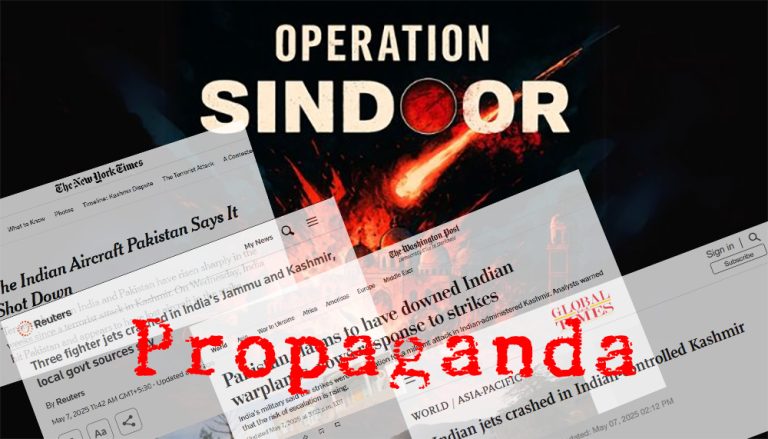
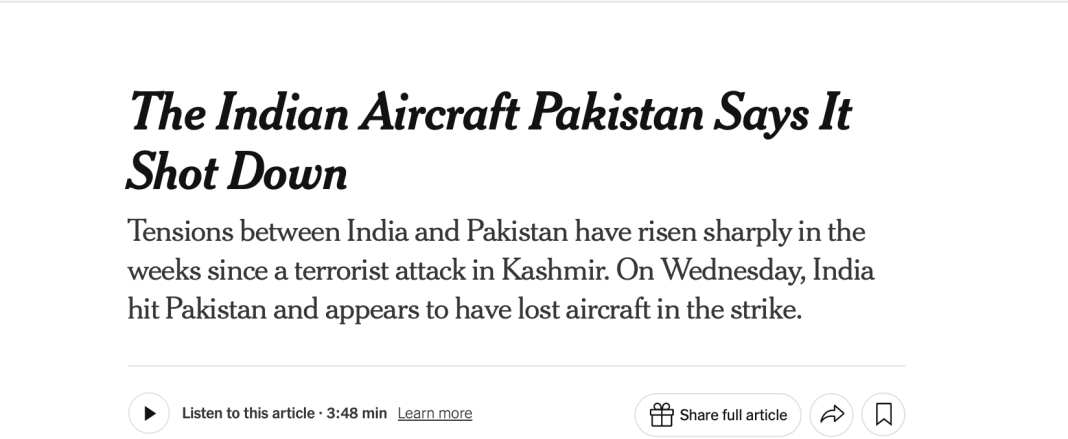
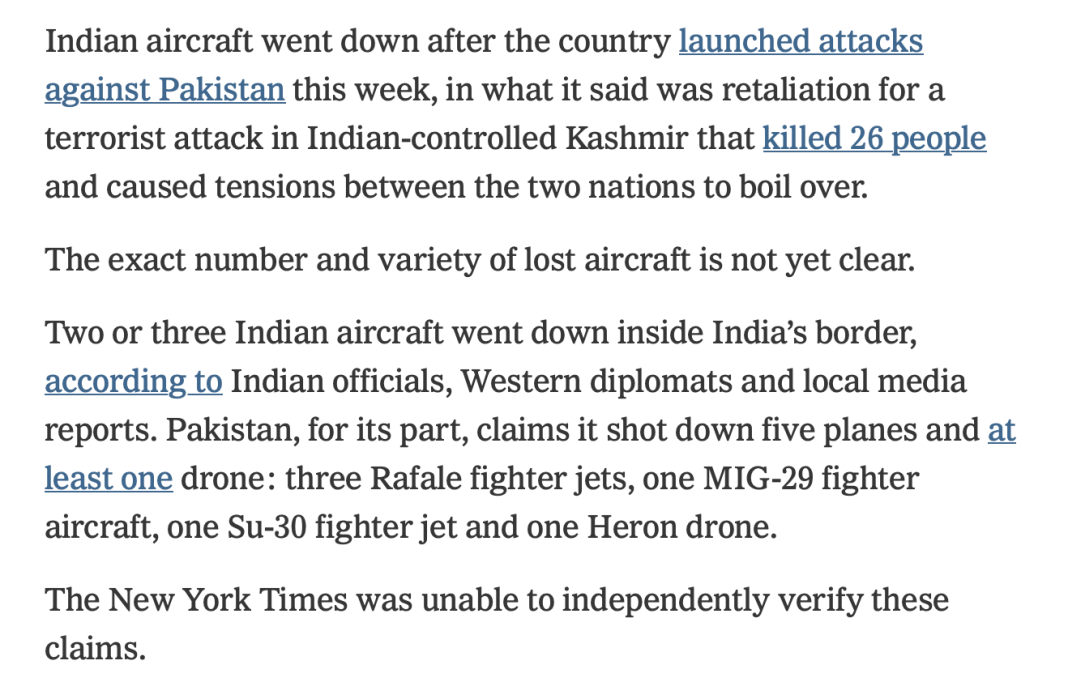
In this vein, The New York Times in its report “The Indian Aircraft Pakistan Says It Shot Down” amplified Pakistani lies of having shot down five Indian warplanes, including three Rafale fighter jets, one MIG-29 fighter aircraft, and one Su-30 fighter jet.
While Pakistan has failed to provide any substantial proof, including visuals of the wreckage of the supposedly downed Indian fighter jets, NYT decided to take ‘expert’ opinion of John E Pike, the director of Global Security, who speculated that those five aircraft and the drone could have been downed by surface-to-air or air-to-air missiles. Because “Pakistan has both”. There was no evidence to back Pakistan’s claims, zero visuals despite the flood of visuals of India’s successful target hits inside Pakistan, but the New York Times went with a baseless claim anyway.
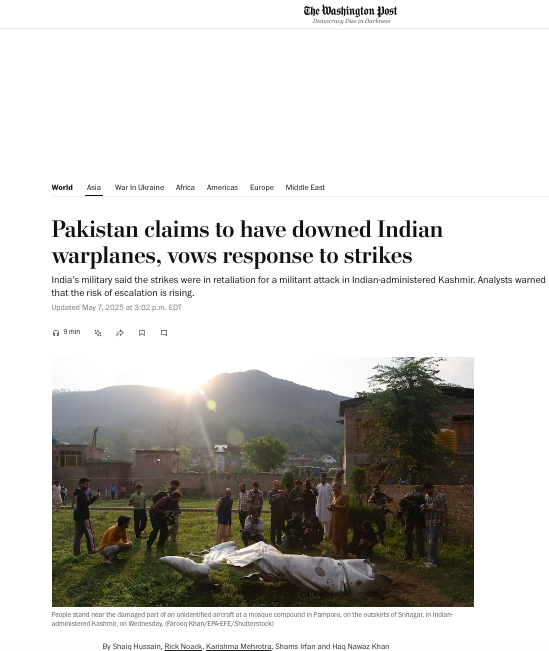
Similarly, the Washington Post published a report with the headline “Pakistan claims to have downed Indian warplanes, vows response to strikes.” However, the article only amplified the unfounded claims made by Pakistani Prime Minister Shehbaz Sharif that the Pakistan Air Force shot down five Indian warplanes, including three French-made Rafales.
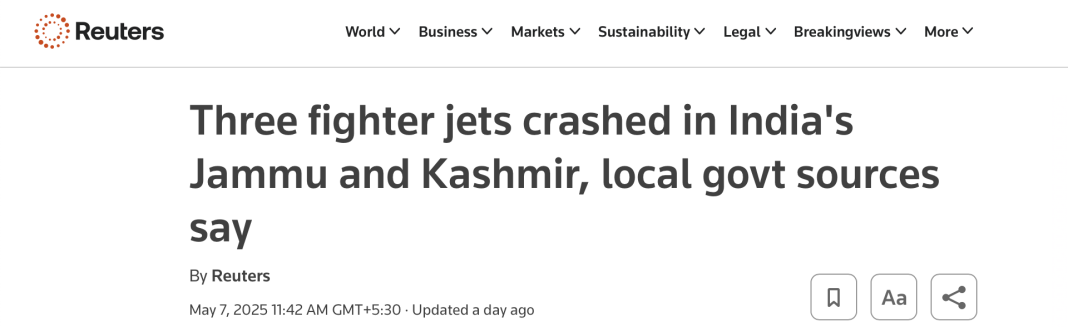
Meanwhile, Reuters decided to publish absolute lies even as the very visuals it attached in its report expose the publication’s falsehoods. On 7th May, Reuters put out a report with the headline, “Three fighter jets crashed in India’s Jammu and Kashmir, local govt sources say”.
In this article, Reuters cited ‘local sources’ to claim that three Indian fighter jets crashed in India’s Jammu and Kashmir territory. The news outlet quoted a Pakistani military spokesperson who claimed that PAF shot down Indian fighter jets.
In all these reports, the only featured image was the image of a discarded external fuel tank that is shed during flights by fighter jets, known as drop tanks.
Notably, Pakistan has failed to provide video proof or even a photograph of the Indian fighters that were attacked. One unconfirmed video that has gone viral on social media showed locals filming an airplane’s underwing. However, the picture was originally posted in September 2024.
Meanwhile, CNN also decided to jump on the bandwagon of pushing falsehoods about Indian warplanes by amplifying a circle loop of ‘claims’. In its report headlined: “India strikes deep inside Pakistan, Pakistan claims 5 Indian jets shot down, in major escalation”, CNN on 7th May cited Pakistani ‘military sources’ to claim that PAF shot down five Indian fighter jets and one drone in “self-defense,” claiming three Rafale jets – sophisticated multi-role fighters made in France – were among those downed as well as a MiG-29 and an SU-30 fighter.”
As if this much buffoonery was not enough, CNN also claimed that Indian aircraft had crashed in Jammu and Kashmir despite it being clear from the visuals themselves that the wreckage was not that of fighter jets but of a drop tank. It further mentioned that news agency AFP showed wreckage of the ‘aircraft’ lying in a field next to a red-brick building, however, it added that it was not clear to which side the aeroplane belonged.
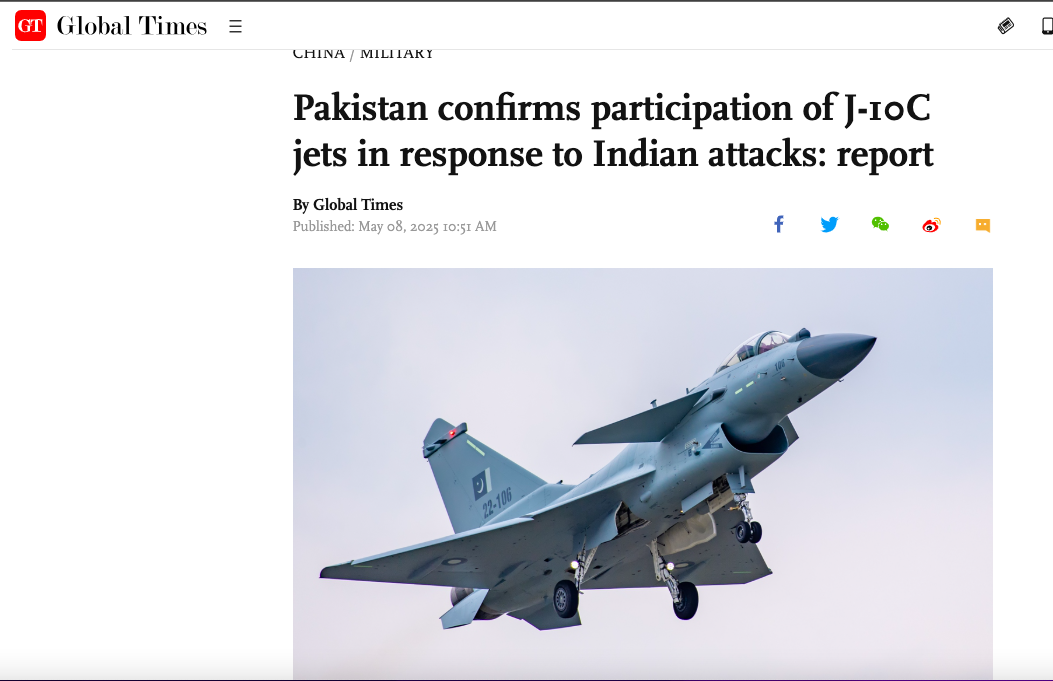
Besides Reuters, NYT and WaPo, and CNN, the Chinese media house Global Times also claimed that Pakistan reportedly shot down three Indian fighter jets.
However, the Indian Embassy in China promptly refuted them and asked the outlet to verify facts and scrutinise sources prior to sharing such disinformation. Community Notes also fact-checked the Chinese propaganda. “There’s no truth to claims about any Indian aircraft being shot down. No evidence, no official word, no credible sources. It’s all dis/misinformation designed to mislead and push fake narratives. Don’t fall for it. Always check the facts,” it read.
The Chinese propaganda outlet however, remains undeterred from peddling lies to save its ally cum vassal Pakistan from the embarrassment inflicted upon it by India through the successful execution of Operation Sindoor. Apparently, the desperation of the Chinese media outlet stems also from the fact that even Chinese equipment procured by Pakistan could be of no use in preventing India’s operation on Pakistani soil.
In a report, Global Times said, “Pakistan’s Deputy Prime Minister and Foreign Minister Ishaq Dar on Wednesday confirmed that J-10C jets participated in Pakistan’s response to Indian attacks, media reported, following wide speculations over if Pakistan’s equipment procured from China have played roles in the clash that led to the downing of several Indian aircraft.”
Global Times, taking a page from the Pakistani establishment’s Goebbelsian playbook, has, evidently, decided to peddle a lie a thousand times to make it seem true. No wreckage, no visuals, no Indian pilots caught or found dead yet, Pakistan and its Chinese masters want the world to believe that PAF downed Indian warplanes. In another report, Global Times published outright fake news citing The Hindu report, to claim that three Indian fighter jets crashed on Wednesday in Akhnoor, Ramban and Pampore areas of Jammu and Kashmir.
The Hindu initially reported that three Indian fighter jets had crashed in the Akhnoor region of Jammu and Kashmir, citing a government official. However, the report was subsequently removed, and the publication expressed regret, confirming that there was no official information on record from India regarding this incident.
The Hindu posted 4 photographs with the tweet, purportedly of the crashed Indian jets. In one of the images used in the report, the caption said, “Wreckage of Indian Air force fighter jet that crashed in Wuyan Pampore, South Kashmir on May 7, 2025.” The caption of another image says, “Firefighters douse smoke coming out from the debris of an aircraft near Akhnoor on the outskirts of Jammu, on May 7, 2025.
However, no such crash took place, and the Hindu report was completely baseless. A study of the images published by them shows that the object that crashed onto the ground is actually an external fuel tank, not a fighter jet. Fighter jets on longer missions carry such external fuel tanks under their wings. After the fuels are used, the tanks can be jettisoned, and they crash onto the ground. They are called ‘Drop tanks,’ as they can be dropped from the air after they are no longer needed. Therefore, this does not mean that the jets crashed; it just means the jets dumped their external fuel tanks inside Kashmir.
After the claim was found to be false, The Hindu deleted the post, and ‘regretted’ that it created confusion among people. While The Hindu retracted its factually baseless story and issued a clarification on the same, neither Global Times nor Reuters, which peddled the same falsehood, have retracted their stories devoid of facts.
For argument’s sake, even if we assume that Indian planes did fall on the Indian side, why are there no visuals? Jammu and Kashmir is now swarming with media and reporters everywhere, everyone has a phone and internet. If the incident was indeed true, there would have been no chance of hiding it from the cameras of the on-ground journalists and locals, since, unlike Pakistan, which concocts lies and coverups for its damages, Indian armed forces do not operate that way.
While foreign media are pushing Pakistani lies of having downed Indian fighter jets, the Pakistani defence minister says “It’s all over social media” when asked for proof
On one hand, the foreign leftist media is amplifying Pakistani fake claims of shooting down Indian warplanes and citing dubious Pakistani ‘sources’, the hostile neighbour’s Defence Minister Khwaja Asif attributed his nation’s claims of having downed five Indian fighter jets, including Rafales during “Operation Sindoor” to ‘social media posts’.
“It is all on social media, and Indian social media, not our social media. The debris of the jets fell on their side. It is all over the Indian media,” he replied when CNN interviewer Becky Anderson asked him for any concrete evidence to back the claims. “You’re the defence minister, sir. The reason to talk to you today is not to talk about content all over social media,” she interjected and pointed out that he was not summoned to talk about social media content but rather to present genuine proof.
When she again urged him to substantiate his statement with evidence, inquiring whether any Chinese equipment was utilised to bring down the Rafael jets, he denied and then continued to stumble over his words.
He stated that Pakistan possesses Chinese aircraft that are produced and assembled domestically. He subsequently launched into a tirade about India’s procurement of aircraft from France, declaring that his country could similarly acquire them from China, Russia, the United States, and the United Kingdom for their own use. “They have already admitted that their three planes are down,” he alleged, disregarding the issue of evidence entirely.
Evidently, the foreign media is grasping baseless, blatant lies of Pakistan to peddle false headlines either out of their genuine sympathy for the Jaish-e-Mohammad, Hizbul Mujahideen and Lashkar-e-Taiba terrorists killed by the Indian forces in Pakistan, including the relatives of Jaish chief Masood Azhar, or due to their unwarranted disdain for India.
While the Islamist-sympathising media is essentially pushing a pro-Pakistan narrative relying on imaginary bravado of having shot down Indian warplanes, in reality, Indian Air Force hitting terrorist targets deep inside Pakistan only shows the hard truth, that India has unmatched air dominance and Pakistani defence system has failed to stop Indian missiles from eliminating terrorists and their jihad factories.
Pakistan’s strategy is clear: push communally charged rhetoric and concoct a narrative of imaginary aerial victories to offset the embarrassment of India’s deep strikes on terrorist infrastructures in its country. Pakistani government has unbanned X, to turn it alongside other social media platforms into a breeding ground for unverified images and videos, to weaponise social media as many Pakistani X users circulated old and unrelated visuals of MiG-29 crash in Rajasthan from 2024 or from a similar inident from 2021 to pass it off as fresh evidence of downed Indian fighter jets. Even Pakistani media is peddling using old visuals as recycled propaganda, although independent fact-checkers and India’s PIB are continuously debunking their lies.
Defying all ethics of journalism, a significant section of foreign media is parroting Pakistan’s unverified claims, citing ‘officials’ or vague imagery and refraining from taking down the fake news despite Indian authorities debunking those claims. No matter what lies Pakistan and international media peddle, the fact is, India’s air dominance was unmistakable, yet the measured approach of targeting only terrorist infrastructure and not Pakistani military facilities clearly demonstrates the country’s commitment to counterterrorism,m not warmongering.
On early morning of May 7, India launched a devastating strike on terror targets inside Pakistan controlled territory. Jaish-e-Mohammed, Hizbul Mujhaideen, Lashkar-e-Taiba terror camps located in Bahawalpur, Muridke, and Muzaffarabad were hit by missiles from Indian forces. Following the attacks, a rattled Pakistani establishment and Pakistani media floated all sorts of fake news to try and save their face.
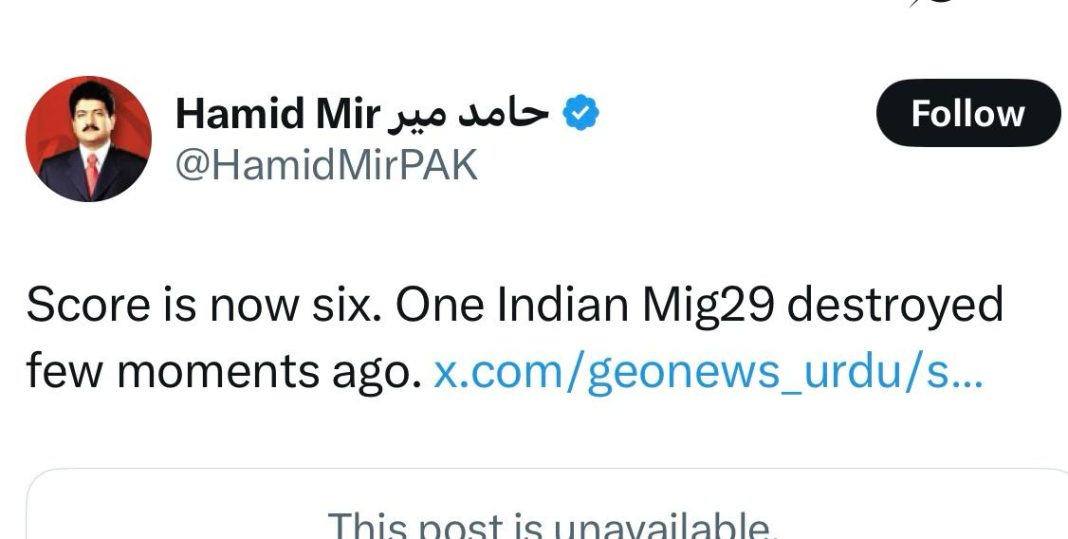
One such fake news that repeatedly surfaced, and continues to make the rounds, is that Pakistan downed several Indian Jets in retaliation. The number of jets downed by Pakistan varied from propagandist to propagandist depending on their individual lucky numbers. Some said 2, some said 3, some said 5, and leading journalist Hamid Mir thought he should lead here as well, and claimed 6 Indian Jets were shot down by Pakistan.
Pakistan Defense Minister Khawaja Asif also peddled the same fake news in an interview with CNN, and when asked if he has any evidence, he innocently said he had read it on Social Media, I repeat, he is the Defense Minister of the country which allegedly shot down 5 jets, he apparently gets his information from social media trolls.
CNN: Where is the evidence of five Indian fighter jets shot down by Pakistan?
Pak Defence Minister Khawaja Asif: It's all over social media. ?
Till now no official has confirmed about India losing any Rafale Jet. It is all fake news by Pakistan. pic.twitter.com/s5gZPPgrbH
The propaganda factory of Pakistan also claimed that 1 Rafale, India’s most advanced fighter jet, procured from France, was also shot down by Pakistan. Some more enthusiastic propagandists posted on social media that 3 Rafales have been shot down.
Even though debris of no Indian aircraft have been found, no photo or video evidence has been recorded, no pilots have been found who must have evacuated these jets, Pakistani propaganda accounts are diligently peddling this obvious fake news. While the rational part of the world is still waiting for some sort of evidence from Pakistan to support these claims, their all-weather friend (friend/owner, you decide) China has stepped in to promote the fake news peddled by Pakistan.
China Daily, a daily newspaper owned by the Central Propaganda Department of the Chinese Communist Party, repeated Khawaja Asif’s claims that 5 Indian jets have been shot down by Pakistan. As mentioned earlier, Khawaja Asif got this information from social media trolls. So now, the claims of these trolls are being reported as facts by China’s propaganda arm as they can cite Pakistan Defense Minister as the source.
Another Chinese state media ‘Global Times’ also promoted this fake news that Pakistan has shot down 5 Indian Jets after India launched ‘Operation Sindoor’. For good measure, Global Times added that Pakistan also shot down 4 Indian quadcopters in retaliatory fire. Embarrassingly for Global Times, they were publicly called out by Indian Embassy in China for spreading disinformation and fanning Pakistan propaganda.
While India-China border tensions have been long ongoing, which increased after Galwan confrontation, and China has always supported Pakistan, not just against India but even otherwise, it was rather surprising to see state propaganda arms pushing these Pakistani lies. Then the reason was revealed. Pakistan’s Deputy Prime Minister and Foreign Minister Ishaq Dar said in Pakistan’s National Assembly that Pakistan was using Made in China J-10C fighter jets against Indian jets.
A Chinese J-10C shooting down a Rafale would be a huge boost to the Made in China fighter jet, so it is hardly surprising that China is invested in keeping this fake news going.
Interestingly, Pakistan’s airspace was also guarded by Made in China products, the HQ-9 and LY-80 (HQ-16) air defense systems, that are often paraded by Islamabad as state-of-the-art solutions against aerial threats. The HQ-9, modeled after Russia’s S-300, is marketed as capable of detecting and neutralizing threats mid-air. Yet, during Operation Sindoor, these systems neither saw the missiles coming nor reacted when they did.
Now, this failure of their air defense systems delivered a serious blow to the reputation of Chinese defense industry so in such a situation, they needed something to defend their industry, and a J-10C shooting down 5 Indian Jets, including a Rafale, was just perfect.
J-10C, like most of the domestically-developed Chinese platforms had not yet been battle-tested till now, so they also needed this fake news of it bringing down a Rafale to show that this fighter jet is good for active combat.
Chinese defense stocks surge after Operation Sindoor
Pakistan is reliant on China for most of its defense requirements. Most of its arms and ammunitions come from China. Over the last 5 years, 81% of its defense hardware imports are reportedly from China. For China as well, Pakistan is a key market as 63% of its defense exports head to Pakistan. With Pakistan buying Billions of Dollars worth of defense equipment from China, it is invested in keeping their lie going that J-10C brought down 5 Indian jets, including Rafale.
In case of direct conflict between India-Pakistan, China is expected to supply more and more arms and ammunition to Pakistan Army to replace the losses suffered during the conflict. Expecting that rise in demand from Pakistan, Chinese defense stocks are surging after Operation Sindoor.
Stocks of AVIC Chengdu Aircraft, which manufactures J-10C have reportedly skyrocketed since Wednesday, when Operation Sindoor was launched by India. AVIC Aerospace, which produces military aircraft and helicopters, also reportedly saw its shares zooming in the Hong Kong market. China State Shipbuilding Corporation, which builds military and civilian vessels, also saw its shares inch up in last 2 days, but not as significantly as AVIC stocks.
That explains it, it is in China’s financial interest that the lie about J-10C shooting down several aircrafts keeps on growing, as it enables them to sell more fighter jets with this enhanced reputation, to not just Pakistan, but to other countries around the world who are in the market for fighter jets. Meanwhile, hopefully, one of these days we will find the debris of these 5 jets that Chinese jets shot down, or maybe the debris just did an MH-370 and disappeared forever.
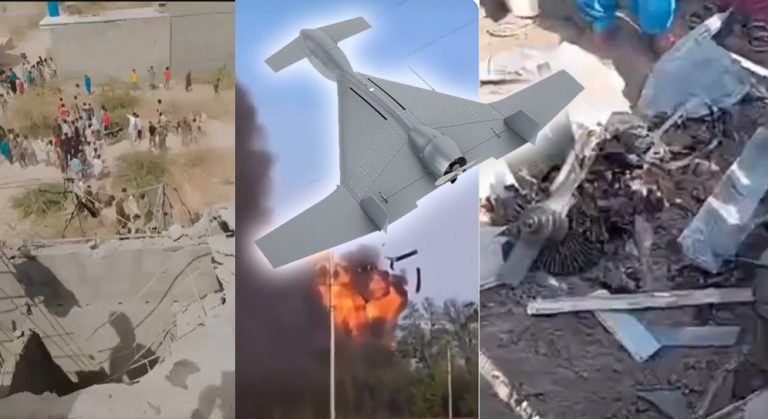
A day after India hit terror camps in Pakistan and Pakistan-occupied-Kashmir using missiles and drones under Operation Sindoor,the Pakistani Army has claimed that the attacks have continued for the second day. Addressing the media on Thursday, Pakistan Army spokesman Lt. Gen. Ahmed Sharif Chaudhry said that as many as 9 different places in Pakistan were targeted by Indian drones.
However, he claimed that Pakistani forces shot down 12 Harop drones, adding that they didn’t cause much damage. He said that one drone ‘partially’ engaged its target near Lahore, and four army personnel were injured. Similarly, one civilian was killed and another was injured in Sindh, he claimed.
Lt. Gen. Ahmed Sharif Chaudhry said that the drones targeted the sites in Pakistan in the night between 7 and 8 May. As per him, the drones targeted Karachi, Lahore, Rawalpindi, Gujranwala, Chakwal, Bahawalpur and other places. He also released visuals of what he claimed to be debris of the drones shot by Pakistani forces.
BIG? Pakistan’s DG ISPR Lt Gen Ahmed Sharif saying its cities & towns are under attack by Indian drones.
Several images and videos have emerged on social media showing the suicide drones crashing into targets in various places in Pakistan, including Lahore and Karachi.
As per social media users, the drone Lahore hit Walton Road which leads to Lahore cantonment. Similarly, visuals of purported debris of a Harop drone in Malir in Karachi were posted on X by Pakistani users, a day after Pakistan govt lifted the ban on X, formerly Twitter, in the country.
— سُہیل قمر (پِننگواں) (@SuhailQamarP) May 8, 2025
Notably, while the Pakistani army using the term Drone, the IAI Harop is actually a loitering munition, not a drone. It can hover over a target and then hit it on the operator’s command. Unlike drones, IAI Harop are launched from a canister, and they are not designed to return and land. They are actually like guided missiles controlled by an operator, and they are designed to crash into the target and explode, destroying the target.
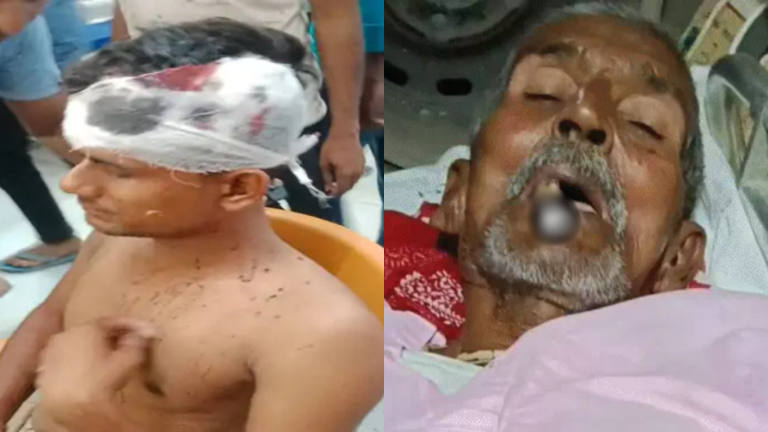
A shocking incident has come to light from Darbhanga, Bihar, when a group of Muslims reportedly attacked Hindus after verifying their religion. The incident happened on Tuesday (6th May) in the evening in the Jale Police Station when a group of Muslims attacked around a dozen Hindus with sticks and sharp weapons. An FIR has been lodged regarding the incident at the Jale Police Station. Four accused have been arrested by the police while a search for the remaining is going on.
Muslims asked about religion and attacked Hindus.
As per reports, on Tuesday, a minor scuffle happened after the bikes of Hrithik and Noor Alam collided. After the collision, Noor Alam fled. Hrithik, who wanted compensation from Alam, took his bike with him. Later on, their families resolved the dispute, and it was agreed that the bike would be returned the next day. However, a group of Muslims gathered on a local road and started attacking Hindus passing by. They asked the religion of all the people passing through there, and attacked only Hindus. The Muslims used sticks and sharp weapons to attack the Hindu passersby, leaving 11 people seriously injured.
Darbhanga: धर्म पूछ कर पिटाई का आरोप..
मुस्लिम और हिन्दू समुदाय के बीच का मामला.. बाइक की आपस में टक्कर के बाद विवाद pic.twitter.com/tOBNDlIECZ
Rajkishore Yadav, Ramsagar Yadav, Amit Kumar, Sumit Kumar, Ranjit Kumar, Hrithik Yadav, Akhilesh Yadav, Lakshman Yadav, Sonu Kumar and Dinesh Manjhi are among the injured. Three of them, Ramsagar Yadav, Hrithik Yadav, and Sumit Kumar, were referred to Darbhanga Medical College and Hospital. 21 people have been named in the FIR filed on the complaint of the injured. Mohd Irfan Qureshi, Mohd Ibran Qureshi, Mohd. Salman, Qurban Qureshi, Mohd Pappu Qureshi, Aman alias Arman Qureshi, Rizwan Darji, Mohd Meraj, Mohd Reyaz, Mohd Siraj, Mohd Aif, Mohd Imtiaz, Mohd Isahaq, Mohd Sarfaraz, Mohd Raju Qureshi, Mohd Azaz Ahmed, Mohd Shahnawaz Ahmed, Mohd Heera, Mohd Manour Darji, and Iqbal Darji are among the 21 accused named in the FIR.
Adani Green Energy Limited (AGEL) becomes world’s first renewable energy (RE) Independent Power Producer (IPP) with a massive over 14 GW operational portfolio to turn water positive across its entire operational portfolio.
The company in a statement on Thursday stated that it has achieved water positivity a year ahead of its FY26 target. It is the first and only among top global 10 (in terms of operational RE portfolio) to ever reach this milestone.
Being water positive means adopting practices that not only save water but also increase water availability in the surroundings.
The company also stated that it has been certified water positive by Intertek, a global assurance firm after conducting comprehensive audits and assessment of AGEL’s water accounting data across 103 operational sites, and 85 water conservation sites. It is also the only renewable energy company in India of this scale to be certified water positive
The development is noteworthy, since the majority of AGEL’s solar and wind plants are in landscapes where survival is a challenge and water is a luxury. Adani Green Energy Limited (AGEL) has achieved what few thought possible — turning India’s harshest terrains and into sustainability hubs.
From unforgiving and the barren expanses of Khavda, Gujarat, and the arid regions of the Thar desert, AGEL’s water positivity has emerged as an oasis of hope and innovation.
To understand the magnitude of this accomplishment, consider that AGEL’s water conservation is equivalent to about 467 Olympic-sized swimming pools and enough to exceed the half-yearly water demand of Lakshadweep. 85 revitalized ponds now benefit over 1,23,000 people including water-scarce communities.
Over 54 per cent of AGEL’s operational capacity employs robotic cleaning technology for solar modules, saving approximately 546 million litres of water annually.
AGEL’s journey towards this monumental achievement began with a visionary ESG goal to make more than 200 MW of their operational plants water positive. This goal was not only met in FY23 itself, AGEL set out to extend the water positivity goal to the entire operational portfolio by FY26. AGEL has achieved this remarkable target a full year ahead of schedule.
In a country where water scarcity affects millions, this milestone isn’t just corporate success, it’s a sustainability revolution. By leveraging advanced water-saving technologies, such as waterless robotic cleaning of solar panels, deepening of traditional water bodies, rainwater harvesting and various pilot projects such as the clean drinking water condensed from humid air, AGEL is proving that clean energy doesn’t have to come at the cost of precious natural resources.
“We don’t just generate green energy. We build it the greenest way possible” said an AGEL spokesperson.
He added “Climate change will intensify the global water stress and India is among the countries facing the highest level of water security challenges. India has low levels of freshwater available per capita and high levels of utilization. That’s why this achievement matters.”
AGEL’s operating portfolio is certified as water positive, single-use plastic free and zero waste-to-landfill, a testament to the company’s commitment of powering sustainable growth. What started as a bold ESG goal, has now become a nationwide benchmark, placing AGEL, India’s largest RE company at the forefront of the green energy and blue planet movement.
(This news report is published from a syndicated feed. Except for the headline, the content has not been written or edited by OpIndia staff)