Scrolling X is one of my favourite things to do when I am not writing anything. I come across a lot of voices—some genuinely good, and some so out of touch with reality that it pains my soul. A few days ago, I came across a post by one Asim Ali, who appears to be a columnist, as stated in his bio, for several media outlets, including The Times of India, The Diplomat, The Hindu, The New York Times, and others. A political researcher—that is what he calls himself.
Stems from the elitist view of Dharavi as a dump anyway. In reality, the culture of Dharavi is much richer than the vulgar complexes of Gurgaon & Navi Mumbai. Built up collaboratively by diverse sets of migrants, through adaptation & innovation. Even developed their own hip hop https://t.co/Q8PrKlvF7N
He had shared a report questioning the Dharavi redevelopment project and quoted that post to claim there is a “culture of Dharavi” which is much richer than the “vulgar complexes of Gurgaon and Navi Mumbai.” He further claimed it has been “built up collaboratively by diverse sets of migrants, through adaptation and innovation. Even developed their own hip hop.”
Romanticising misery as ‘culture’
Without going into the details of the redevelopment process, land constraints, or other technicalities, what angered me the most is the fact that the lifestyle of people living in Dharavi is being romanticised as “culture”. What culture are we talking about? Slums, disease, no access to clean drinking water, no sanitation, no proper education, and the worst possible living conditions—is this the “culture” we wish to preserve?
Dharavi is the largest slum in Asia. It is not a “record”; it is a blot on society. Preventing redevelopment for whatever reason should be deemed criminal. To people like Asim, I have only one question—would you take your family and live in a Dharavi jhuggi forever? Will Asim live in a place, or wish his family would live in a place where community toilet is shared by 300-500 people? No, you wouldn’t. And if you wouldn’t live there, why do you wish for it to continue to exist?
The myth of Dharavi’s organic culture
The entire notion that Dharavi has a “culture” that is organic and thriving is one of the most elitist constructs ever forced upon the urban poor. The construct is so out of touch that it finds romantic sights in stinking sewage water, leaking roofs, mosquito-filled jhuggis, and the fact that people living in slums have a life expectancy at least ten years lower than those in cleaner areas.
"In reality, the culture of Dharavi is much richer than the vulgar complexes of Gurgaon & Navi Mumbai". I am lost in it. can u tell us where is that rich culture of Dharavi ? pic.twitter.com/zagzcreROS
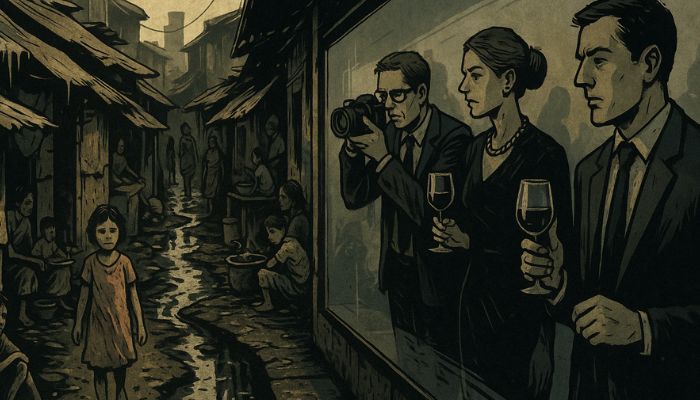
The desire to preserve Dharavi’s “culture” is not the voice of the people living in those jhuggis. It is the voice of those watching them from air-conditioned cars, DSLRs in hand, hunting for the next dose of poverty aesthetics they can click and sell for millions in a posh art gallery. Every now and then, some filmmaker or foreign academic lands up in Dharavi and documents the struggles of its residents. They call it “resilience”. The film gets an award. The research paper is acknowledged and published. They earn thousands, if not millions. What do the people of Dharavi get? A sense of false pride—nothing else. The drains remain open. The roofs rot and collapse. Drinking water? What the hell is clean drinking water? But sure, talk about Dharavi “culture”, bro.
Calling neglect creativity doesn’t make it so
Coming back to the seriousness of the topic, several studies on slums worldwide have clearly busted the myth of slum culture. Slums are often portrayed as sites of creativity and resistance. However, in reality, they are, at best, symptoms of systematic neglect by governments. In plain English, calling it a culture is just a fancy way to ignore the fact that people living in slums are suffering and dying a horrible death.
The dark underbelly of slum tourism
Another problematic aspect of the slum “culture” is the existence of slum tourism. In “When urban poverty becomes a tourist attraction: a systematic review of slum tourism research“, Tianhan Gui and Wei Zhong discuss the many issues associated with slum tourism. It is generally believed to be a new phenomenon, but in reality, slum tourism has deep colonial roots. It is not because Bollywood or the elite have recently developed an obsession with poverty aesthetics.
"Kulture of Dharavi is much richer than the vulgar complexes of Gurgaon & Navi Mumbai"
The practice goes as far back as Victorian England and early 20th-century America, where elites would “slum” their way through the poorest neighbourhoods of London and New York. Why? For the kick and thrill. It was a mix of moral superiority and curiosity. By the late 20th century, it had evolved into a booming global industry—especially in cities like Mumbai, Rio, Cape Town and many others.
Dharavi becomes a ‘tourist product’
Dharavi was not always as popular among slum tourists as it is now. Films like Slumdog Millionaire played a major role in making Dharavi a hotbed of slum tourism. Yes, there are tour operators who offer slum tourism packages—everything from “local delicacies” to guided walks through the containment zone known as Dharavi—showing the elites how poor people live and survive. Every detail, every step, every turn, and every sight is curated by these operators to ensure Dharavi feels like something that ought to be “romanticised”.
Exploitation disguised as ‘ethics’
Slum tourism is nothing but commercial voyeurism. According to Gui and Zhong, slum tourism thrives on portraying poverty as a spectacle. But what is so “spectacular” about hundreds of people sharing the same toilet and cooking food while their homes reek of sewage? NOTHING. And yet, it is presented as something so spectacular that it becomes “culture”.
Operators often label them “ethical tours” and claim that these excursions help “raise awareness” or “support local businesses”. However, the commodification of poverty turns human suffering into a consumable product. The “resilience” and “existence” of the people of Dharavi are romanticised so that the elite can sip their high tea and say, “Oh, how beautiful these pictures are! You deserve a Pulitzer or an exhibition in New York’s finest art gallery!” Amid these GoPro recordings, DSLRs clicking endless photos, and all the lights-camera-action, the desperate cry for dignity has been lost. Romanticising it, packaging it, and monetising it is not culture—it’s exploitation. And the only thing worse than living in a slum is being treated like you’re part of a sightseeing stop. Think about it. How is this any different from the “human zoos” once operated by the elites of the past, where children of enslaved humans were caged and displayed?
It’s not innovation, it’s adaptation for survival
The idea that Dharavi is a story of innovation and collaborative spirit collapses the moment you start digging into the work of academics like Jan Nijman. In his paper “India’s Urban Future: Views from the Slum“, he explains that slums in India, like Dharavi, are not the result of creative urban planning. They are spaces that have been “structurally shaped by economic necessity and institutional neglect.” Slums like Dharavi do not emerge because people come together to build something culturally rich—they emerge because the system gave them no other choice.
According to Nijman, slums like Dharavi are not merely a “labour reservoir” but have evolved into a “self-organising slum economy” that acts as a substitute for the missing growth of India’s formal manufacturing sector. On barely 2 square kilometres, it sustains livelihoods for half a million people through small-scale, labour-intensive activity, born out of exclusion, not empowerment. Calling this struggle a “culture” or “innovation” is romantic fiction. It is not progress. It is a coping mechanism, wrapped in neglect and sold as resilience.
The sad side of Dharavi hip-hop
As for the “hip-hop culture” that Asim mentioned—yes, it exists. But so does the fact that these artists are rapping not to glorify Dharavi, but to escape it. While it may carry the beat of ambition and the rhythm of resistance, it is less a celebration and more a scream muffled under basslines.
For example, in the lyrics of Straight Outta Dharavi by D Abdul, what sounds like cool street wisdom is actually trauma rendered in rhyme. There are lines about wearing only underwear yet “shining”, fighting with bare hands, living in a broken home where rain drops on your face… It all tells stories that are not of culture, but of collapse.
As Jan Nijman rightly argued, Dharavi is not a creative haven—it is a survival economy. These rappers do not glorify the slum; they endure it. There is a cry for help in their lyrics—sometimes loud, sometimes rhythmic—but always loaded with the unbearable weight of being left behind by the system.
Conclusion
Let’s stop calling this culture. Dharavi is not a canvas of creativity; it is a monument to the Indian state’s failure to provide a dignified life to its citizens. The children of Dharavi rap because nobody listened when they cried. Its people build micro-economies because no policy has ever truly reached their doors.
Yet, the elite romanticise their suffering as spirit, their desperation as resilience, and their poverty as pride. There is nothing noble about being forced into a 10×10 room with a dozen people, sharing toilets with hundreds, or eating chutney and roti while dodging death by disease. Culture is a choice. Dharavi is a compulsion. Pretending that poverty is beautiful is the greatest insult to its people. We do not need the preservation of slums. We need redemption from the fact that they ever existed.
The Telangana Waqf Board’s claim to land in the Boduppal area has left about 50,000 people in a state of shock and uncertainty. Approximately 10,000 households living in 21 colonies spread across 300 acres are facing an impending crisis, reported Times Now. The Waqf board verbally told the Registration Department in 2018 that the 300-acre plot of land is Waqf property, citing a 1989 gazette notice which led to a major controversy.
The residents, many of whom have lived there for more than 20 years with what they assert are legitimate government approvals and official land documents, such as pahanis and pattas from the 1950s, have been left stunned by the development. They contend that land records from 1954 and 1955 unequivocally identify the region as patta property.
They further note that over the years, authorization and approvals for property registrations, loans and constructions have been issued by multiple government departments, including the Municipal Corporation, the Water Board, the Electricity Department and the Registration and Stamps Department.
“Two decades ago we have purchased lands after going through all the records since year 1954, 1955 the land we are staying in was showed as patta land. We have taken loans, permission and approval from all govt departments for registration and construction,” a local said.
The matter arose in 2018 when a resident tried to sell his property and the registration office informed him that the Waqf Board had filed litigation for the land. The residents were startled because neither the initial land acquisition nor the building process had made reference to this claim. The Waqf Board did not formally declare ownership of the land in a letter until 2022.
The legitimacy of the Waqf Board’s claim to the land has been challenged by residents, who point to decades of documentation and government endorsements that designate it as patta land. Many are skeptical about the authenticity of the 1989 gazette that the board is using as a reference. According to residents, if the government publishes any gazette, it will be communicated to all departments. However, when they made the purchase, no department notified them that this land was under the jurisdiction of the Waqf board.
It was only after a decade, post-purchase and construction of the building, that the Waqf board laid claim to the land. Currently, as their homes and futures face significant risks, the impacted families are seeking justice. They are advocating for an investigation by a Joint Parliamentary Committee (JPC) and a revision of the Waqf Act, pointing out that the board should not possess unrestricted power to announce land claims many years after it has been developed and occupied.
The Layout Regularisation Scheme (LRS) was utilized to regularize unapproved plots. K Kiran Kumar Reddy, co-chairman of Joint Action Committee on Boduppal Waqf Lands informed the Times of India, “Citizens bought over 3,000 plots three decades ago and built houses on the land. HMDA (Hyderabad Metropolitan Development Authority) permitted layouts in Ghatkesar and implemented LRS after collecting a penal amount. Now, waqf board’s sudden claim over these plots and freezing of registrations is unacceptable,” in 2023.
According to him, numerous colonies in Boduppal have been designated as waqf property, including RNS Colony, Sri Sai Nagar Colony, Balajinagar, Shivapuri Colony, Maruthinagar, Vinayakanagar, Rajalingam Colony and other locations. The joint action committee has been holding rallies, vanta varpu programs and dharnas to make their point known to the state government.
Naragoni Praveen Kumar, president Telangana Realtors Association expressed, “The state government issued GO No. 15 in September 2020, banning registrations in waqf lands, which are notified in the gazette notification. Before the ban, the government should have reviewed the issue as it’s linked to nearly 6,000 families in Boduppal. These plot owners have paid taxes and fees towards registration, development charges, building fees and property taxes for two decades.”
Masiullah Khan, chairman of Telangana Waqf Board alleged, “The board is protecting land in survey numbers in gazette notifications. If there are claims by people, they can move court and get the order for removal of survey numbers from the gazette.”
The Federation of Boduppal Municipal Corporation Colonies Welfare Associations urged that 328 acres of residential land be taken off the Waqf property list by the state government, that same year. They said that residential colonies made about 95% of the land. Federation representatives disclosed that attempts to reach Labour Minister Chamakura Malla Reddy were unsuccessful and urged Chief Minister K. Chandrasekhar Rao to get involved. They added, “The Minister is avoiding such a serious issue rather than taking it up with the CM.”
The owners of the 328 acres in different survey numbers in Boduppal had pattadar passbooks and title deeds for the previous 50 years, according to federation chairman Rapolu Ramulu, vice-chairman Adla Srinivas Reddy, president Chenchala Narsing Rao, general secretary Gujjula Chandrashekhar, and treasurer K. Ramakrishna Reddy. This was also evident from revenue records and the proprietors were farmers. 95% of the land sold by the owners during the past thirty years has been developed into residential colonies.
The gram panchayat issued permissions for these residential complexes. These colonies received utilities like CC roads, drains and water and electricity lines with the establishment of the Boduppal Municipal Corporation. However, three years ago, plots and land parcels in these colonies were listed as prohibited land, indicating that they were Waqf land. These land lots were no longer for sale and even licenses for extensions of existing homes were being refused. They mentioned that the owners of the property were all middle-class or impoverished individuals who used their hard-earned money to purchase it.
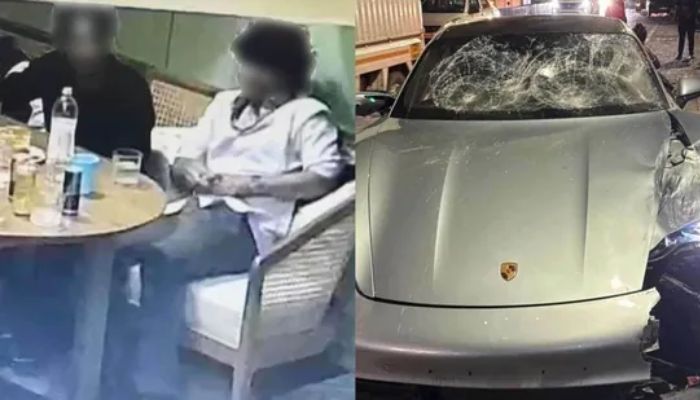
The Pune Porsche case, the accident that took place on 19th May 2024, in Maharashtra’s Pune, serves as a grim reminder of how influence, wealth, systemic corruption and a dash of insensitivity together undermine justice in India. A 17-year-old son of a builder, Vishal Agarwal of Brahma Realty and Infrastructure, rammed his Porsche Taycan car into a vehicle in an inebriated state and killed two people named Aneesh Awadhia and Ashwini Koshta.
Medics involved in Pune Porsche case accused’s blood sample swap suspended
This hit-and-run case sparked nationwide outrage for many reasons, starting with the accused getting bail within 15 hours of the incident and multiple cover-up attempts. In a latest development, the Maharashtra Medical Council (MMC) has suspended registrations of Sassoon General Hospital’s former head of forensic sciences department, Dr Ajay Taware, and former casualty medical officer (CMO) Dr Shrihari Halnor. The two are facing trial in the case of swapping the blood sample of the accused teenager.
This came after the MMC sought committee reports and documents from the Pune police and the medical education department. Based on these documents, the decision to suspend both licences was taken by the council.
Notably, Shrihari Halnor was the CMO who attended to the accused after the accident. The Pune Police has said that Halnor swapped the blood samples on the instruction of Taware. Both of them were arrested on 27th May 2024, after the accused teenager’s blood sample test conducted at two hospitals gave different results. The results confirmed the Pune Police’s suspicion that the samples at the Sassoon hospital were swapped.
Later, the probe established that in exchange for money, the accused teenager’s blood sample was swapped with that of his mother, a co-accused who is also currently in jail along with the accused’s father. The accused’s parents got two middlemen to hand over the money to Halnor through a mortuary staffer at the forensic science department. All those involved were arrested by the police last year. It was earlier reported that the accused teen’s parents gave Rs 3 lakhs to the accused medics for blood sample swapping.
Notably, the initial plan of the accused’s family was to use the blood sample of the accused teen’s brother or father; however, since both were in an inebriated state, they decided to swap the blood sample with that of his mother. Moreover, the blood samples of the friends accompanying the accused were also swapped.
The accused teen’s father, Vishal Agarwal, made as many as 14 calls to Dr Ajay Taware, head of the Sassoon Hospital’s forensic medicine department, within two hours before the blood sample collection of the minor.
The Agarwal family’s attempt to shift the blame
After arresting the father, the Pune Crime branch, on May 25 morning, also arrested SK Agarwal, the grandfather of the minor accused in the case. It may be recalled that the Pune teen’s grandfather’s link with the underworld had come to the fore earlier. The accused grandfather allegedly threatened Gangadhar, their driver, snatched his phone, and forcibly kept him confined in their bungalow in an attempt to force him to take responsibility for the crime instead of his minor grandson.
Two police officials caused delay in filing FIR and collecting blood samples, NCP leader tried to put political pressure on police
It was reported that NCP leader and then MLA, Sunil Tingre, was called to the police station by the accused teen’s father, Vishal Agarwal, apparently to pressurise the police to soften action against the accused. Tingre was later questioned by the police regarding this. Later, two cops, Inspector Rahul Jagdale and Assistant Inspector Vishwanath Todkari, were suspended for dereliction of duty, failing to inform seniors promptly, causing delays in registering a case and collecting blood samples, as confirmed by an internal inquiry against the two cops. It is interesting to note that while the medics involved in illegal blood swap have been suspended, no action has been taken against Sunil Tingre for his alleged role in asserting influence on police in favour of the accused.
Initially, the accused teen was booked under lighter IPC sections, such as Section 304a (causing death by negligence), rather than Section 304 (culpable homicide not amounting to murder). It must be mentioned that Section 304 was added only after a massive public outcry.
In March this year, the Pune Police Commissioner Amitesh Kumar said that a proposal has been sent to the state home department seeking the dismissal of these two suspended cops. It was reported last year that the accused teenager was provided with Pizzas and Burgers in the police station after being taken into custody.
Accused minor accessed alcohol, was riding car without registration
Notably, the accused and his friends consumed alcohol at two pubs, running up a Rs 48,000 bill. Back then, the police had arrested the pub owners and staff for serving liquor to a minor, violating the Juvenile Justice Act and the Motor Vehicles Act. While the Excise Department sealed both the pubs, the ease with which the accused minor got alcohol indicates laxity in law enforcement.
In addition to this, the police had revealed that the Porsche Taycan car, the accused teen was riding on the day of the incident, was being used since March 2024 without any registration. The owner did not pay the necessary registration fees while purchasing the vehicle.
Speaking about the same, Pune regional transport officer Sanjiv Bhor said last year, “The car was booked through a dealer in Bengaluru, which provided a temporary registration before delivering it to the owner in March this year. It was the responsibility of the owner to get it registered. The vehicle came to the Pune RTO, and an inspection was done. However, the owner didn’t pay the fee required for the registration. Since the fees were not paid, the registration number was not given.”
Juvenile ‘Justice’ Board granted bail to the accused on condition of writing a 300-word essay on road safety
The accused minor had obtained bail from the Juvenile Justice Board within 15 hours of his arrest, that too on conditions as outrageously trivial as two bonds of Rs 7500 each and writing a 300-word essay on road accidents, working with Yerwada traffic police for 15 days and undergoing de-addiction counselling. The JJB’s leniency indicated a clear dearth of empathy for the deceased and their family members, despite the severity of the crime. Later, however, the JJB revoked the accused teen’s bail on 22nd May, sending him to an observation home.
Such is the deplorable state of our society and the judiciary that a rich underage boy without a driving license driving a luxury Porsche Taycan car without any registration since March at its top speed, fails to control the vehicle while drunk and ends up killing two people, booked under IPC section 304A (causing death by negligence) among other sections get bail in a blink of an eye.
As if this was not enough, on 25th June 2024, the Bombay High Court decided that the accused teen’s detention was ‘illegal’ and ordered his release to the custody of his aunt, citing procedural errors.
Corruption, apathy, wealth and influence helped the rich to get away with the murder of two innocent people
The Pune Porsche case serves as a glaring example of how all it takes is wealth, influence and corruption within the ‘system’ to help an irresponsible rich brat get away with the murder of two innocent people. From RTO’s negligence, hospital staff’s corruption to judiciary’s apathy, the entire ‘system’ is collectively responsible for the killing of two innocent people who committed the only crime of stepping out on the road, knowing little that their lives are unimportant for drunk rich brat who would obtain bail within hours while munching pizza. From the Jessica Lal Murder case (1999), Sanjeev Nanda BMW hit-and-run case (1999), the 2017 Punjab and Haryana Court verdict reducing jail term of rash driver who killed one, the 2016 Mercedes hit and run case, or the one involving a Bollywood actor, there are numerous such cases wherein the police response was sluggish, punishments were minimal, hinting that we have a two-tiered justice system.
In the Pune Porsche case, while the public outrage and media scrutiny did force some accountability, however, the pace at which things are moving forward, justice remains elusive. In a fast-moving world where material gains and luxuries are more valuable than human life, incidents of hit-and-run cases in a country like India are, sadly, too common. The occurrence of hit-and-run cases is common to such an extent that in 2022, over 30,000 people died in such cases, while double the number were injured. While the number of cases has been high, the conviction rate in hit-and-run cases has been below 50% in 2022. A slow-moving legal system marked by lengthy wait times and gradual advancement allows a window for rich and powerful criminals to exploit the loopholes in the law and escape punishment for their crimes. Besides, the menace of corruption at multiple levels of the ‘system’ needs to be eradicated. Compassion should take precedence over corruption to ensure that no rich brat gets to exploit their privilege to evade or minimise punishment.
Just weeks ago, Nagpur was up in flames as Islamist mobs unleashed coordinated violence, targeting Hindu-owned shops, torching vehicles, and pelting stones at Hindu homes. Their provocation? A peaceful demand by Hindu advocacy groups to remove a tomb glorifying Aurangzeb, the Mughal tyrant notorious for temple destruction, forced conversions, and his brutal oppression of Hindus.
That ideological legacy came full circle on April 22 in Pahalgam, Kashmir. Islamic terrorists ambushed a group of unarmed tourists. According to eyewitnesses, the assailants checked IDs, pulled down pants to verify religion, and executed those identified as non-Muslims, point-blank.
This wasn’t an act of random violence. It was a ritual of hate— intentional, practised, scripturally sanctioned, and rooted in a centuries-old mindset that sees Hindus not as fellow citizens, but as targets in an interminable jihad to bring the whole of India under the fold of Islam.
It is important to bear in mind that what happened in Pahalgam wasn’t just a terror attack. It was a civilisational flashpoint that emerges now and then, reinforcing a centuries-old mindset that many believed died with tyrants like Aurangzeb and Alauddin Khilji, and even Bakhtiyar Khilji, the madman responsible for the annihilation of the Nalanda University. But which keeps rearing its ugly head as witnessed in protests around the country in support of Muslim invaders venerated as religious warriors who made significant contributions to spreading Islam.
To understand the horror of Pahalgam, we must revisit the ideological ancestors of such savagery. Aurangzeb wasn’t just a Mughal emperor—he was the face of brutal Islamic imperialism in India. His reign saw the destruction of temples, forced conversions, and jizya—a tax imposed on non-Muslims simply for existing.
Alauddin Khilji is similarly whitewashed in some history books as a military genius and an administrator par excellence. But behind that façade was a tyrant who enslaved Hindu women and children, treating them as war booty. These men didn’t just conquer—they dehumanised. They saw Hindus not just as rivals, but as enemies of the faith, fit only for subjugation or extinction.
The never-ending jihad
Fast forward to 2025, and that mindset is far from extinct. It thrives among a radicalised fringe that sees itself as completing Aurangzeb’s unfinished war. In Pahalgam, terrorists reportedly checked ID cards and forced victims to strip to identify Hindus. This wasn’t random cruelty; it was ideological warfare, with roots in a medieval mindset.
These are not just men with guns. They’re warriors of an ideological jihad bent on finishing the “unfinished business.” And they are not just limited to Kashmir. They are ubiquitous, as evidenced in the recent targeted killings of Hindus in West Bengal, to the riots that swept Nagpur last month. To them, every Hindu temple that still stands is a reminder of defeat. Every festival is an insult to their supremacist fantasy. Killing a Hindu isn’t murder—it’s “divine justice.”
Aurangzeb’s ideological and religious descendants
Aurangzeb is still celebrated in parts of the Islamic world and even in Indian academia, under the banner of “nuanced history.” His atrocities are downplayed, while his “administrative genius” is bizarrely praised, much like how Hitler’s punctual trains don’t excuse the Holocaust.
The terrorists in Pahalgam made no effort to hide their inspiration. They were simply following what the Mughal tyrant did centuries ago, and which is still revered by a section of society, legitimised by the leftwing intelligentsia by summoning tropes such as “Freedom of Speech” and “right to practice one’s religion”. Destruction of idolators drove the religious fanaticism of Aurangzeb and Muslim invaders who became before him. That same religious zealotry powered the cowardly attack witnessed in Pahalgam. This isn’t fringe thinking—it’s foundational to many Islamist outfits, both across the border and disturbingly, within.
Why are Hindus targeted?
The targeting of Hindus is not accidental—it’s central to the agenda. Hindus are seen as idolaters, as resisters to a millennium of conquest. They rebuilt what was razed, revived what was outlawed. Their refusal to kneel is what earns them the sword.
In Pahalgam, this manifested again, just as it did during the 1990 Kashmiri Pandit exodus. History doesn’t whisper in India; it screams. And unless confronted, it repeats.
Political correctness and perverse commitment to “secularism” empowering terror
Mainstream narratives often chant: terrorism has no religion. But Pahalgam was drenched in religious motive. From selective targeting to execution chants—this was jihad, plain and simple. Yet if you call it that, you’re labelled “communal.”
This moral cowardice is not just dishonest—it’s dangerous. It assures the jihadist that no matter how barbaric his act, society will rush to excuse it. That his victims will be forgotten, while he’ll be explained as a victim of poverty or “misunderstood” theology.
A civilisation under threat: Temples looted, idols desecrated, women taken as war booty
This isn’t just about lives lost—it’s about a civilisation under assault. Islamist invaders didn’t just loot—they desecrated. Temples were torn down, not just for gold, but to send a message: your gods are dead, your culture is dust. From Somnath in the west to Qutub Minar in Delhi, which was once a magnificent home to over 27 Jain and Hindu Temples, to the sprawling Ram Mandir in Ayodhya, every Hindu foundational pillar suffered the wrath of Islamic fanaticism.
Even today, mosques stand atop razed temples. This isn’t religion vs religion—it’s about whether a native civilisation is allowed to survive.
Hinduism and other Vedic faiths have never been expansionist. They don’t seek conversions. For thousands of years, people belonging to different Vedic faiths lived in relative harmony across the vast expanse of India. While pacifism was a hallmark of these faiths and a secret to their economic success, the recent spate of events shows it can no longer remain passive. Pahalgam is a warning: resistance is no longer optional.
Demanding the removal of remnants dedicated to religious zealots isn’t hate, it is resistance
Calling out this ideology isn’t Islamophobia—it’s civilizational self-respect. Wanting to survive is not extremism. Defending temples, remembering martyrs, and safeguarding traditions is not fascism. The real fascists are the ones demanding submission, wielding dogma, and justifying murder.
Hindus must no longer fear being called names for defending themselves. This isn’t revenge—it’s resistance. Resistance rooted in memory, truth, and unapologetic pride.
India can no longer afford polite silence. Hollow condemnations and candlelight vigils won’t cut it. We need hard policy changes—tougher anti-terror laws, swifter justice, and zero tolerance for ideological denial.
The media must stop glorifying monsters. Academia must stop sanitising genocidal emperors. And civil society must stop equating victims with their killers.
From Ghazni to Aurangzeb to Pahalgam: The scriptural hatred that glues the intergenerational bigotry
Pahalgam wasn’t an isolated incident. It was part of a civilizational war that began with Ghazni, Khilji, and Aurangzeb, and seeks revival today. During his reign, Aurangzeb similarly slaughtered Hindus with abandon. Chhatrapati Sambhaji Maharaj was brutally tortured before being killed by Aurangzeb. Sikh Guru Tegh Bahadur was also brazenly executed on the orders of Aurangzeb for his refusal to embrace Islam. These are but an indicative list of the brutality perpetrated by Aurangzeb and the ideology he represented.
However, instead of condemning Aurangzeb, just weeks ago in Nagpur, Islamists attacked Hindus for opposing a shrine dedicated to Aurangzeb. This is the same ideology, wearing new clothes.
But India is not weak. Hindus are not helpless. The same civilisation that withstood Khilji, Babur, and Aurangzeb will endure again. But survival is not enough. The time has come not just to remember, but to resist.
So that never again will someone have to prove their religion at gunpoint. That’s not hate. That’s resistance. That’s what learning from history means.
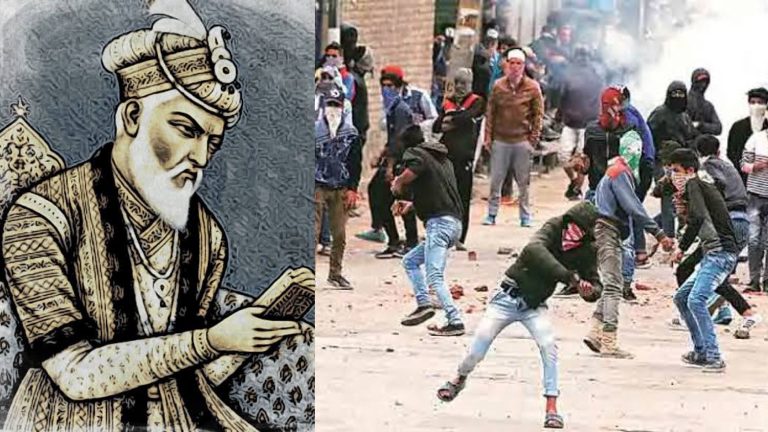
In this sense, there is little difference between terrorists who killed tourists after identifying them as Hindus and stone pelters who take to the streets to attack Hindu commercial establishments and public property when an honest reckoning of the Mughal emperor’s religiously motivated crimes is demanded. It is essentially the same ideology that underpins the terrorists and the stone pelters: a deep veneration for medieval-era bigots like Aurangzeb and a strong yearning to follow in their footsteps. It is just a matter of time before the so-called “innocuous” stone-pelters graduate to become Kalashnikov-wielding terrorists, wantonly killing Hindus in their perverse desire to ape their idols. In fact, in Kashmir, one cannot be sure whether a part-time stone-pelter is a full-time terrorist.
So when Hindus call for the removal of Aurangzeb’s tomb, it isn’t just about erasing the remnants of a tyrant who inflicted unspeakable torment on their ancestors. It’s about dismantling a symbol—a rallying point—for those who still revere him as a warrior of Islam and seek to walk the same blood-soaked path. It’s about cutting off the ideological oxygen that fuels modern-day jihad.
The West never built a tomb for Hitler—for good reason. They knew that even stones can be turned into shrines, and shrines can breed fanatics. India must learn the same lesson. As long as we continue to tolerate monuments that glorify the tormentors of our past, we will continue to bleed—whether in Nagpur, in Pahalgam, or wherever the next “Aurangzeb ki aulaad” decides to strike.
Hindenburg Research, the short-seller firm, people who make money from others’ misery, like George Soros for example, challenged the Adani Group of India couple of years back. Ultimately they lost as Hindenburg shut down while Adani Group continues to thrive.
In January 2023, Hindenburg published a report against the Adani Group, one of India’s largest conglomerates, led by Gautam Adani, as “the largest con in corporate history”.
Following Hindenburg report, stock prices of all Adani Group companies plummeted, benefiting short seller Hindenburg, and Adani group’s biggest public offering was abruptly scrapped. For a while, it seemed like Gautam Adani’s empire was on the brink due to these short-sellers.
However, that mood in the markets didn’t last long. Adani Group staged a swift comeback to restore investor confidence.
Interestingly, the Hindenburg report, which accused the Adani Group of stock manipulation and accounting fraud, dropped just a week before Gautam Adani was in Israel to finalise a USD 1.2-billion deal to acquire the Haifa seaport.
The privatisation of Haifa Port was Israel’s largest and most ambitious infrastructure and financial undertaking of the 2020s. Initially, 18 international bidders expressed interest, but only five were cleared to submit final proposals.
The winning bid — after passing Israel’s stringent security vetting — came from a joint venture between Gadot Masofim for Chemicals Ltd and Adani Ports and Special Economic Zone Ltd, with the Indian firm holding the majority stake.
The entire process took 18 months, and Israeli Prime Minister Benjamin Netanyahu was present at the signing on January 31, 2023.
According to PTI report, a top Israeli leader questioned Adani about the allegations against him, to which the Indian billionaire firmly responded that they were “absolute lies”.
As per reports, Eshel Armoni, the outgoing chairman of the port and a former high-ranking Mossad official, was present during the exchange.
Israeli establishment saw the Hindenburg report as a deliberate attempt to undermine the Haifa port deal with Adani, which Tel Aviv considered strategically vital for the India-Middle East-Europe Economic Corridor — a counterweight to growing Chinese influence in the region.
Meanwhile, the controversial short-seller Nathan (Nate) Anderson, who is behind the infamous Hindenburg Research,faced serious allegations of colluding with hedge funds like Canada’s Anson Funds. The information came to light via court filings submitted in Ontario courts as part of a defamation lawsuit. These documents pointed to coordinated efforts that may have violated securities laws. The revelations made in the court documents cast doubt on Anderson’s earlier claims that his organisation worked independently.The New York offices of Hindenburg Research and its founder, Nathan ‘Nate’ Anderson, a certified Chartered Financial Analyst, were watched, they said.
Notably, Nathan Anderson, the founder of the short-seller Hindenburg Research, announced on 15th January, 2025, that he would disband the firm.
In a chilling episode, terrorists in Pahalgam, Kashmir, targeted tourists after identifying them as non-Muslims. The attack came days after a video of Pakistan COAS Asim Munir ranting against Hindus had gone viral on the internet.
A heart-wrenching video of the incident surfaced online, showing tourists frantically calling out for help as dead bodies lying along the meadows can be seen in the video. Eyewitnesses to the attack could be heard saying that the attack was religiously motivated as terrorists shot tourists point blank after identifying them as Hindus.
One of the haunting pictures of the attack that has gone viral on social media is of a grief-stricken woman helplessly sitting beside his dead husband. According to reports, the woman was recently married and was on her honeymoon in Kashmir when the terrorists attacked and killed her husband.
According to unofficial sources who are privy to the attack, the number of casualties could exceed 25.
Prime Minister Narendra Modi has spoken with Union Home Minister Amit Shah in the wake of the Pahalgam terror attack, directing him to take all necessary actions and personally assess the situation on the ground.
Responding to the directive, Amit Shah announced he will soon depart for Srinagar to lead an emergency security review meeting with all concerned agencies. Shah confirmed that he had already briefed the Prime Minister and conducted a video conference with top security officials. Strongly condemning the attack, Shah vowed that the culprits will face severe consequences, assuring that no one involved will be spared. Security operations in the area have been significantly stepped up.
It is worth noting that the attack against Hindu tourists came days after Pakistan COAS Asim Munir’s video, making bigoted comments as he urged Pakistanis to tell their children about the stark difference between “Hindus and Muslims”, had gone viral on the internet.
Pakistan COAS Asim Munir’s anti-Hindu rants
In a fiery speech that has set off alarm bells across human rights circles, Pakistan’s Chief of Army Staff, General Asim Munir, declared that anyone not abiding by Sharia law cannot be considered a true Pakistani. Speaking at a national clerics’ conference in Islamabad, Munir didn’t mince words, tying Pakistan’s national identity directly and exclusively to Islamic principles. His message was clear: reject Sharia, and you reject Pakistan itself.
This hardline stance has sparked intense backlash, especially for its implications on Pakistan’s already marginalised non-Muslim minorities — including Hindus, Christians, and Sikhs. Critics are questioning: if adherence to Sharia is a precondition for citizenship, where does that leave millions who do not share the faith?
As if that weren’t enough, Munir doubled down by reviving the controversial Two-Nation Theory — the ideological backbone of Partition — claiming Pakistan and India remain fundamentally incompatible in religion, culture, and ideology. His remarks, steeped in divisive rhetoric, are being seen as a deliberate attempt to stir communal sentiments and reassert a theocratic vision of Pakistan at a time when calls for inclusivity and reform are growing louder.
With this speech, General Munir has not only drawn a line in the sand domestically — he’s sent a message to the world: Pakistan’s power elite still sees the country not as a diverse nation, but as a fortress of faith. And that, in today’s world, is a message many find deeply troubling.
The nefarious agenda of the Congress to divide the Hindu community along caste lines has backfired in the State of Karnataka, with party leaders fighting among themselves over a ‘caste survey’ conducted in 2015.
The Karnataka State Commission for Backward Classes, led by headed by H. Kantharaj, had conducted a caste census in Karnataka under the rule of Congress Chief Minister Siddaramiah a decade ago.
Interestingly, the Congress government ‘lost‘ the original report. And a revised report was submitted by K Jayaprakash Hegde in 2023 (again under the regime of Siddaramiah).
This was confirmed by none other than K Jayaprakash Hedge to reporters.
He pointed out, “It is true the original data compiled under the Kantharaj Commission could not be located. We had to rely on a sample-based methodology to compile the current report. It was the only viable option given the circumstances.“
The underlying causes behind infighting within Congress
OpIndia had previously reported how the Muslim population in Karnataka had increased by a whopping 5.16% in 4 years (2011-2015) as per this revised ‘caste census’ report of 2023.
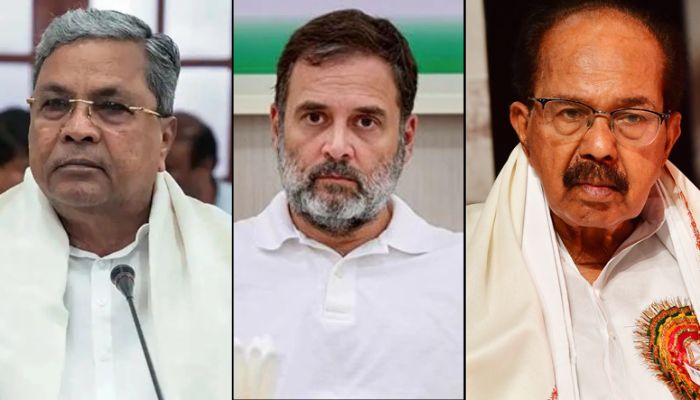
Additionally, the population of dominant caste groups such as Lingayats and Vokkaligas seem to have declined. This was highlighted by none other than veteran Congress leader and former Chief Minister of Karnataka, Veerappa Moily.
“Some of the ministers openly said that the population of large caste groups — such as Lingayats and Vokkaligas — was found to be lesser than what had been previously extrapolated. When I released the report of the Chinnappa Reddy Commission during my tenure as chief minister in 1992, the population of Lingayats was much higher than the current report. How can the numbers go down after so many years,” he questioned.
This had drawn the ire of other Lingayats and Vokkaligas Ministers and MLAs within the Congress party, which have questioned the scientific basis of the ‘caste survey.’
One of the recommendations of the 2023 report submitted by K Jayaprakash Hedge was to increase OBC reservation from the existing 32% to 51%. With the EWS reservation of 10% and the SC/ ST reservation of 24%, the net reservation in Karnataka would stand at 85%.
This has also become the bone of contention within the party, with representatives of ‘backward communities’ seeking immediate implementation of the report’s recommendations.
The final nail in the coffin of the ‘caste survey’ was the miraculous categorisation of the relatively well-off community of Kurubas (the one which CM Siddaramaiah represents) as ‘most backward.’
Veteran Congress leader Veerappa Moily did not mince words before attacking the sitting Congress CM in an interview with The New Indian Express.
“There are whispers that Siddaramaiah is downplaying the numbers of influential castes,” he stated.
Moily further emphasised, “There is an increase in quota of 7% for communities such as Kurubas, which Siddaramaiah belongs to. The Kuruba community is classified as a “more backward” category in the Chinnappa Reddy commission. The new survey report has classified it as “most backward”. How can a “more backward” person become “most backward”?“
Several Congress leaders including Moily have expressed fears of ‘polarisation’ arising out of the existing report and demanded a fresh, door-to-door caste survey.
While the grand old party set out to divide the Hindu vote bank, it ended up creating warring factions within the Congress.
This explains why an otherwise stern, decisive and loudmouth Siddaramiah is now taking a softer approach, placating his own party members and vowing to promptly correct errors in the existing survey.
Congress and its anti-national agenda
After having failed to counter the BJP on issues of development, national security and cultural preservation, Congress has taken it upon itself to divide the Hindu community by exploiting existing fault lines.
Besides promising a caste census, the party has also assured to lift the upper limit on reservation in its 2024 election manifesto.
Rahul Gandhi himself has been campaigning with the slogan‘Jitni abadi utna haq,‘ hinting at proportional representation in government jobs, admission to colleges and more.
This has the potential to further polarise and divide the society. Not only that, once such demands are fulfilled, it can extend to electoral politics.
Given that India’s demography is changing fast, it may not be long until certain religious communities like Muslims to demand fixed representation based on their population size. It would then be akin to setting the nation on the path to disaster.
The nefarious objective behind the caste census is to divide the Hindus into castes and unify the Muslims, rendering the Hindu majority helpless and weak in the face of Muslim vote bank consolidation.
The Congress party, led by Rahul Gandhi, thereby hopes to gain electorally through such a strategy and return to the corridors of power.
While the drastic implications of the exercise of ‘caste census’ may look far-fetched today, it will not take long for the country to plunge into chaos when dangerous ideas of proportional representation manifest in reality.
OpIndia had previously reported how the concept of ‘proportional representation’ turned out to be a disaster for a peaceful country like Lebanon and why India must be wary of it.
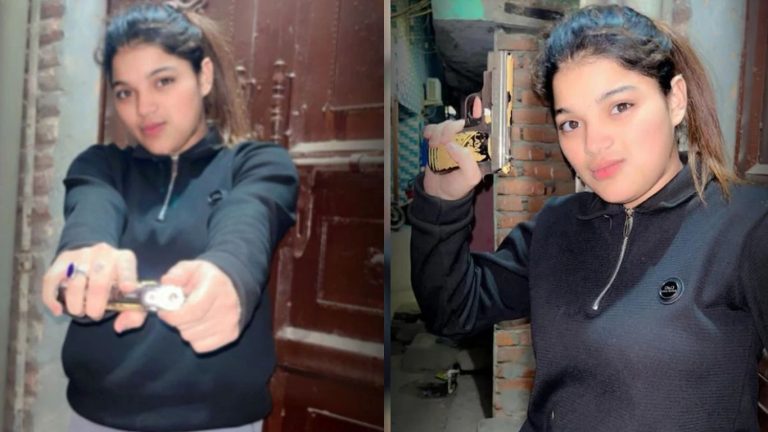
Lady Don of Seelampur, Delhi, Zikra, who was arrested in the murder case of Hindu boy Kunal, is now trying to escape responsibility in the murder. She has denied any involvement in the murder. Zikra claims that she is being falsely implicated. Meanwhile, the court has now sent her to 14 days of judicial custody.
While being taken to court, the dreaded don said, “I did not kill Kunal. I am being unnecessarily implicated.” Zikra’s brother Sahil has also been sent to two days of police remand. The police will now question Sahil about Kunal’s murder. Sahil is the main accused in this murder.
#WATCH | Delhi's Seelampur Murder Case | "I did not kill Kunal. I am being framed unnecessarily," says 'Lady don' Zikra, who was arrested by Delhi Police in connection with the murder of a 17-year-old boy in Delhi's Seelampur area pic.twitter.com/JLthIJxGL8
Delhi Police has so far arrested nine people, including two minors, in connection with Hindu youth Kunal’s murder in Seelampur area of Delhi. Those detained include 18-year-old Sahil, who has been identified as the main accused. Officials revealed that several suspects were trying to flee to Nepal via Uttarakhand but were nabbed at the border.
After Zikra’s denial and the arrest of nine people in the case, the police have now started further investigation to unearth the real motive behind the murder and the full truth about Zikra’s involvement. It is also known that Zikra has a two-year-old child and she reportedly lives separately from her husband.
She was earlier arrested under the Arms Act for posting a video on social media brandishing a weapon. It is worth noting that on April 16, 2025, Kunal, who had gone out of the house to get milk, was stabbed to death. After this, there were many protests in Seelampur against the brutal murder.
People had said that it is difficult for Hindus to live here. Now investigation and action is going on in this matter. During police interrogation, Zikra had told that her brother Sahil was attacked during Diwali. Kunal was murdered to avenge this attack.
Lauding the “deep connection” between the United States and India, US Vice President JD Vance on Tuesday said he is amazed by the richness of India’s history and tradition and the country’s “laser-like focus on the future”.
Speaking at an event in Jaipur on the second day of his visit to India, the US Vice President spoke of the growth in bilateral ties across a range of sectors, including energy, and said, “American energy can help realise India’s nuclear power production goals.”
He said like President Donald Trump, Prime Minister Narendra Modi inspires “remarkable loyalty because of the strength of his belief in his people and in his country”.
“In the United States, we’re proud of the deep connection between our nations, between India and the United States. Prime Minister Modi, as most of you probably know, was one of the first visitors welcomed into the Oval Office during President trump’s second term…we’re so grateful for Prime Minister Modi’s hospitality as well as the reception that he and everyone else in this country have given us on this first trip for me to India,” he said.
Vance also shared his personal connection with India. “This is my first time visiting the birthplace of my wife’s parents,” he said. Vance, who arrived in Delhi on Monday, is on a four-day visit to India.
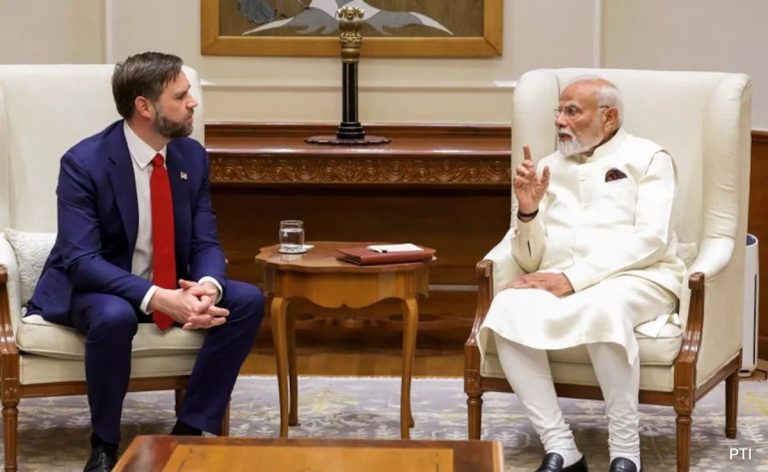
PM Modi on Monday evening met US Vice President, who was accompanied by the Second Lady Usha Vance, their children, and senior members of the US Administration. Vance and his family also visited the Akshardham Temple and Cottage Emporium earlier in the day.
In his speech, JD Vance recalled meeting with PM Modi. “Prime Minister Modi welcomed me. Usha and our three small children at his beautiful home. I’ve been amazed by the ancient beauty of the architecture of India, by the richness of India’s history and traditions, but also by India’s laser-like focus on the future. I think this appreciation for history and tradition and this focus on the future is very much something that, I think, animates this country in 2025,” he said.
Earlier in the day, the Vance family visited Amber Fort in Jaipur and received a warm welcome.
(This news report is published from a syndicated feed. Except for the headline, the content has not been written or edited by OpIndia staff)
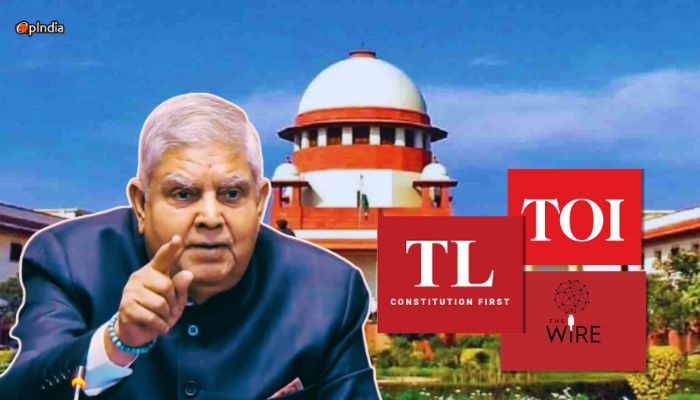
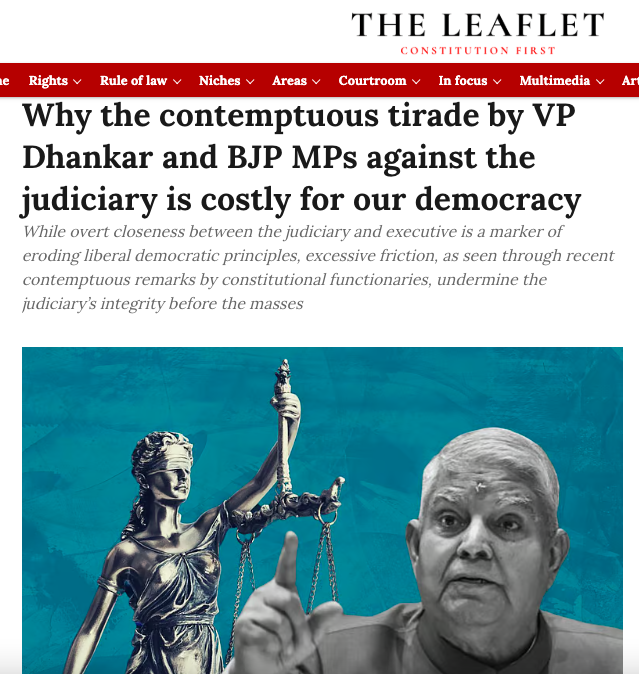
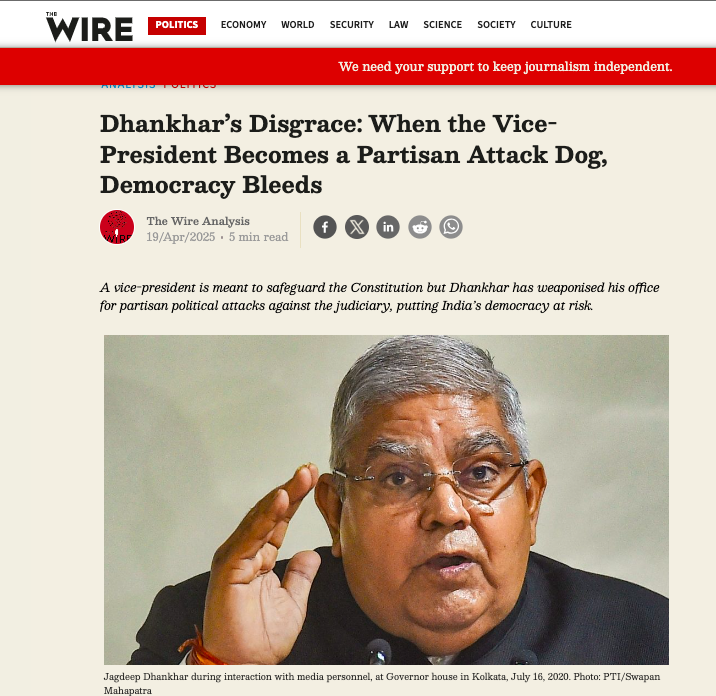
What is a leftist rhetoric if it is not seeped in hypocrisy? The Indian leftist media rages against people or institutions when it suits their agenda, but slanders others for daring to criticise the same entities, that too, on valid grounds. Several left-liberal propaganda outlets, including The Wire, The Leaflet, and a rather mainstream one—Times of India—have launched an ad hominem attack on Vice President Jagdeep Dhankhar over his recent criticism of the judiciary regarding the Supreme Court wielding Article 142 as “nuclear missile against democratic forces”.
Addressing the valedictory function of the 6th Rajya Sabha Internship Program, Vice President Jagdeep Dhankhar harshly criticised the recent Supreme Court verdict regarding the powers of the Governor and the President under Articles 200 and 201 of the Constitution. In the Judgment passed on 8th April, a division bench of the Supreme Court set a time limit, not envisaged in the Constitution, on the exercise of power to grant or refuse assent to a state Bill by the President and the Governor. The Supreme Court prescribed a deadline of 3 months on the President’s power to grant or refuse assent to a Bill reserved by the Governor for his consideration.
VP Dhankhar questioned the Supreme Court for issuing a direction to the President of India. He reminded the Supreme Court that its power is limited to interpreting the Constitution. “We cannot have a situation where you direct the President of India, and on what basis? The only right you have under the Constitution is to interpret the Constitution under Article 145(3). The President is called upon to decide in a time-bound manner, and if not, it becomes law. So we have judges who will legislate, who will perform executive functions, who will act as super-parliament, and absolutely have no accountability because the law of the land does not apply to them,” said the Vice President.
The Vice President further pointed out that the judgment, which had the effect of modifying the concerned provisions, was delivered by a bench of two judges, which did not represent the majority of the total number of judges in the Supreme Court.
“When Article 145(3) was there, the number of judges in the Supreme Court was eight, 5 out of 8, now 5 out of 30 and odd. But forget about it, the judges who issued a mandamus virtually to the President and presented a scenario that it will be the law of the land, have forgotten the power of the Constitution. How can that combination of judges deal with something under Article 145(3) if preserved, it was then for five out of eight. We need to make amends for that also now. Five out of eight would mean interpretation will be by majority. Well, five constitutes more than the majority in eight. But leave that aside. Article 142 has become a nuclear missile against Democratic forces, available to the judiciary 24 x 7,” Dhankhar stated.
Amidst a constitutional standoff in the DMK-ruled Tamil Nadu, where Governor RN Ravi delayed assent to 10 bills, after which the state government sought Supreme Court intervention, VP Dhankhar also raised concerns over the judges allegedly performing executive functions, acting like a “Super Parliament” with “zero accountability”.
“Recently there was a directive to the President, by a recent judgement. Where are we heading? What is happening in the country? We have to be extremely sensitive. It is not a question of someone filing a review or not. We never bargained for this. The President being called upon to decide in a time-bound manner, and if not, it becomes law. So we have judges who will legislate, who will perform executive functions, who will act as super Parliament, and absolutely have no accountability because law of the land does not apply to them,” VP Dhankhar said.
He also raised concerns over judicial impunity as he spoke about a lack of formal investigation in the Justice Yashwant Varma case, wherein semi-burnt cash was found at the judge’s residence.
The Vice President’s comments raising concern over judicial overreach, particularly, in matters involving a delicate balance of power among the judiciary, executive and legislature, did not sit well with leftists who take delight in masquerading as the champions of democracy, freedom of expression and whatnot but have qualms in muzzling the voice of those ideologically opposed to them, simply because the views of their do not align with the leftist agenda.
It should be a matter of national concern when the sitting Vice President of the country and Rajya Sabha chairman publicly questioned the actions of the Supreme Court, raising concerns regarding accountability in a democracy wherein elected representatives are subject to scrutiny but judges are nearly immune to all sorts of accountability and scrutiny. However, the leftist media cabal decided to do what it does best: attack the person speaking uncomfortable truths rather than addressing the concerns raised.
The Leaflet insinuates that the judiciary is sacrosanct, should not be criticised
In this vein, The Leaflet, a leftist propaganda outlet run by senior advocate Indira Jaising, published an article on 20th April 2025, attacking VP Dhankhar for criticising judicial overreach. The Leaflet suggested that Dhankhar’s strongly worded criticism of the judiciary in a particular context comes at a multi-faceted cost, including political, constitutional and legal, moral, as well as credibility.
“The most pressing question that props up amidst this unidirectional war of words against the Supreme Court is this: can constitutional officeholders, who are expected to act as neutral guardians of the Constitution, publicly question the provisions of the Constitution and actions of the judiciary in such a brazen and pointed manner?” The Leaflet asked in its piece titled “Why the contemptuous tirade by VP Dhankar and BJP MPs against the judiciary is costly for our democracy”.
Firstly, and most importantly, VP Dhankhar did not question the provisions of the Constitution. He only raised concerns over what he deemed as misuse of certain constitutional provisions. Secondly, the Vice President directing a sharp critique against the judiciary, does not imply that he has relinquished his neutrality as someone holding a constitutional office, although the opposition parties and the leftist ecosystem want to insinuate the same.
The Leaflet further made a case for how despite being procedurally shielded from court appearances under Section 133 of Code of Civil Procedure, 1908 by virtue of his office, the Supreme Court should initiate contempt action against the Vice President because how dare he question the Supreme Court’s action as if the latter is the One-True-God who must not be named.
The leftist portal further insinuated that, besides constitutionality, somehow, VP Dhankhar has also breached morality. The propaganda piece argued that as per Article 69, the Vice-President affirms to “preserve, protect and defend the Constitution and the law”, however, Dhankhar’s ‘politically charged’ rhetoric goes against the VP’s constitutional duty but also “betrays the dignity and responsibility that comes by virtue of holding public office”, Leaflet claimed.
It, however, failed to decipher that VP Dhankhar’s remarks were not politically charged or at odds with his constitutional duty, rather, his criticism of the judiciary was driven by a genuine concern over a pattern wherein the judiciary seems to be discharging the duties of President, and at times those of the Parliament as well. The Leaflet further delved into the supposed ‘credibility cost’, attempting to project the judiciary as an institution somehow sacrosanct to criticism.
“The judiciary, unlike the legislature and the executive, does not derive its authority from mass mobilisation, political rallies, or control over administrative machinery. It has no army to enforce its decisions, no monetary resources to appease people, and no electorate to appeal to. Its only real sources of strength are public trust and its intrinsic integrity. These are what lend legitimacy to its pronouncements and ensure compliance with its rulings,” The Leaflet argued.
It is amusing that The Leaflet emphasised that judiciary’s source of strength are “public trust and its intrinsic integrity”, however, the leftist propaganda outlet cries hoarse when the Vice President raises concern over the erosion of public trust and ‘intrinsic integrity’ when semi-burnt stash of unaccounted cash is found at a sitting judge’s house, and not a single FIR is registered against him, no concrete action is taken. Apparently, as per the liberal logic, such incidents and subsequent judicial nonchalance in acting against the judge don’t erode public trust in the judiciary, but raising questions over the same does.
The Wire calls Vice President Jagdeep Dhankhar a “partisan attack dog”
Another leftist propaganda outlet, The Wire, targeted VP Dhankhar’s criticism of the Supreme Court for using Article 142 and calling it a “nuclear missile against democratic forces”. The Wire being its authentic, dishonest self, twisted facts to suggest that VP Dhankhar criticised Article 142, a constitutional provision, contrary to the reality, that he did not decry the constitutional provision but its alleged misuse by the Supreme Court. The Wire further lamented that VP Dhankhar’s rhetoric aligns with the ‘grievances’ of the ruling party, arguing that he parroted the party (BJP) line. Just like The Leaflet, The Wire also presented Dhankhar’s criticism of the alleged judicial overreach as a ‘violation’ of constitutional morality and ‘betrayal’ of his oath to “preserve, protect, and defend the Constitution.”
“The vice-president’s job is to rise above party politics, not descend into the trenches as the executive’s attack dog,” The Wire said.
Notably, Article 142 is a one of its kind provision in the Indian Constitution which confers vast discretionary powers on the Supreme Court. The contours of the Supreme Court’s power under this provision transcend the boundaries of procedural and substantive law. The provision empowers the Court to fill any gaps in the existing statutory provisions and pass any decree or order which it deems “necessary for doing complete justice” in any case pending before it. In addition to that, the provision also says that the Supreme Court has the power to punish for its contempt. It is pertinent to note that even though the Supreme Court enjoys extraordinary powers under Article 142, they are not absolute. OpIndia’s crisp explainer on Article 142, instances when the Supreme Court evoked this provision and how its powers are not absolute can be read here.
After peddling the ‘judiciary under attack’ bogey, The Wire resorted to launching ad hominem attacks on the Vice President, casting aspersions on his ideological commitment, terming his tenure as the governor of West Bengal during which he repeatedly raised concern over post-poll violence in the state and severely criticised the TMC government for Birbhum massacre, ‘egregious’, and his appointment as the country’s Vice President, a reward for his ‘egregious’ conduct.
“Beginning with the Janata Dal in the late 1980s, he moved to the Congress party in 1991 to become an MLA in Rajasthan, only to later join the Bharatiya Janata Party in 2003. Such a trajectory across the political spectrum suggests that his loyalties have been shaped more by personal ambition and political expediency than by steadfast adherence to any core ideology. His opportunistic party-hopping and lack of a consistent ideological anchor render him an untrustworthy character, raising doubts about his motivations and reliability in upholding the principles he now vocally espouses,” The Wire piece asserts as if Dhankhar is only politician in the country who switched parties.
The leftist propaganda outlet’s deliberate attack on Dhankhar’s career trajectory and ideological commitments tries hard to assert that Dhankhar has been ideologically fickle; however, after becoming Vice President, he is acting like a loyal “lapdog” of the ruling BJP. The Wire outrightly accused VP Dhankhar of breaching constitutional propriety and aligning with the Modi government’s imaginary designs to undermine judicial checks on executive power.
The Wire argued that VP Dhankhar’s criticism contributes towards eroding public trust in the judiciary, and also asserted that he should be ‘sacked’ for his “partisan assaults”.
Times of India goes ‘out of line’ to trivialise the significance of the Vice President’s office as VP Dhankhar criticises “judicial overreach”, The Telegraph joins
In its editorial, the Times of India described VP Jagdeep Dhankhar’s remarks as the “butter icing on a unappetizing case”. The TOI went as far as to downplay the significance of the post of Vice President by calling it a ‘ceremonial constitutional post’.
“Before examining V-P’s comments in more detail, it’s necessary to restate certain things. The V-P post, aside from the job as presiding officer of the Upper House, is a ceremonial one. Therefore, a V-P has no locus standi when it comes to matters of policy, politics and judicial verdicts. That means all news consumers, the readers of this newspaper, for example, must realise no matter what any V-P says on any current affairs issue, his post means his comments must be discounted entirely. Similar constraints apply to those holding the job of president and governor,” the TOI editorial reads.
On one hand, the TOI downplayed the importance of the post of Vice President; on the other, it lamented how dare India’s Vice President make critical observations against the judiciary. In other words, how dare the Vice President question the judiciary?
Meanwhile, The Telegraph also decided to diminish the importance of the VP’s post, calling it a mere ceremonial one. In its editorial headlined, “Quiet, please: Editorial on Jagdeep Dhankhar’s criticism of Supreme Court verdict on state bills”, The Telegraph appeared as an advocate of the Supreme Court and treated VP Dhankhar like an accused blasphemer whose remarks are “patently objectionable”. Doubling down on its “Vice President is a ceremonial or simply insignificant post” assertion, The Telegraph wrote, “The occupants of even benign offices are expected to abide by constitutional conventions: mutual respect among institutions and their office-bearers is one such convention. But Mr Dhankhar seems not to care much about decorum.”
The media outlet further stated that the relations between the Modi government and the judiciary have not been ideal on many occasions, including the Centre’s assertion that there is a dearth of transparency in the judiciary and a need to get rid of the collegium system. The Telegraph also claimed that the Modi government sitting on the names of collegium-recommended judges is “an overreach of the judicial turf by the executive.”
Apparently, the Centre should keep mum when the country is questioning how come no concrete action is being taken against the judge at whose residence such a huge amount of cash was found. The Telegraph wants the Modi government to bury its head in the sand, even as the collegium continues to be a closed-door affair with hardly any proscribed norms pertaining to the eligibility criteria, or even the selection procedure. It seems like more than the antipathy between the executive and the judiciary, there is antipathy between common sense and The Telegraph.
Deccan Herald calls VP Jagdeep Dhankhar a ‘serial offender’, projects him as a blasphemer for having critiqued “the judiciary, its processes and the constitution”
Calling VP Dhankhar’s critical statement against the judiciary as “most improper”, and the one which amounts to a “gross violation” of the responsibilities of the Constitutional office he holds, Deccan Herald argued that the Vice President of India may criticise any judgement by the Supreme Court, however, he is somehow guilty of an unpardonable crime—criticising the judiciary, its processes and the constitution”.
Deccan Herald suggested that Dhankhar criticised the constitution when he proposed an amendment to Article 145 (3), as if the constitution has been immune to amendments since it first came into effect in independent India. “It is not wrong to criticise and comment on the judgments of the Supreme Court. But it is debatable whether a person holding a high Constitutional office should do that in public in such strong terms. Dhankhar has gone even beyond that and criticised the judiciary, its processes and the constitution,” the Deccan Herald editorial reads.
Leftist media criticise the Supreme Court when it aligns against their interests, sanctify the judiciary when its ideological opponents make critical comments
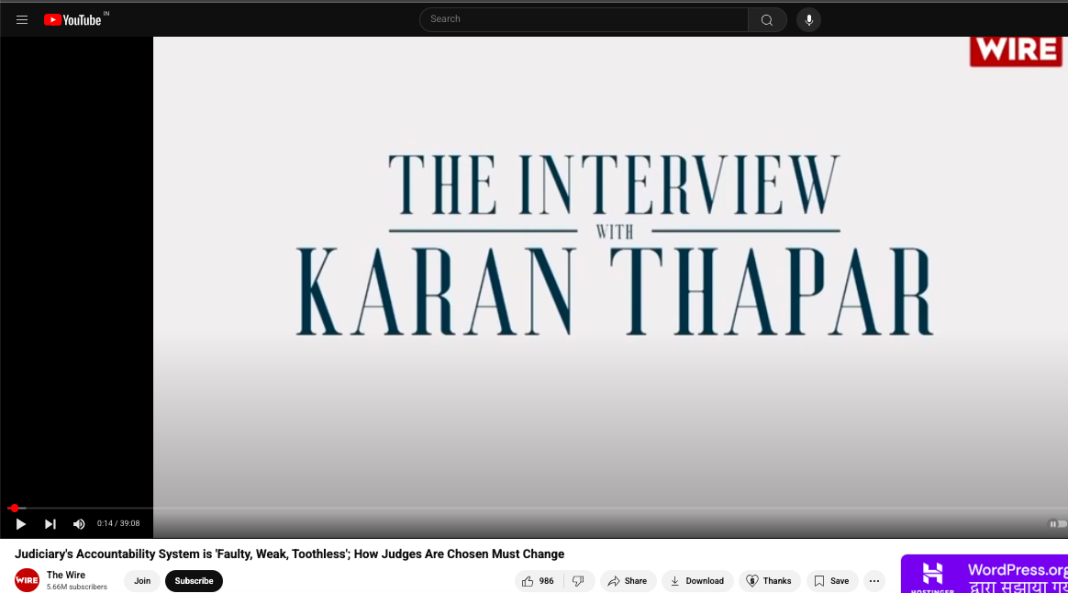
Interestingly, the same left liberal propaganda outlets sanctifying the Supreme Court while offering a hyperbolic and intellectually dishonest criticism of VP Dhankhar have a well-documented track record of criticising its rulings that clash with their ideological leanings. Just weeks back, The Wire did a program critiquing the judiciary’s accountability system, calling it faulty, weak and toothless, while also suggesting measures to change the way judges are appointed. In another program, in February this year, The Wire had a panel discussion over whether the judges are overstepping in various capacities.
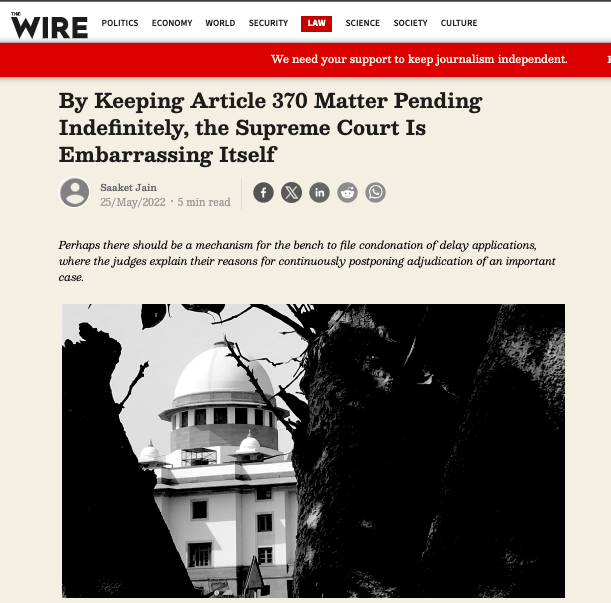
From the Supreme Court ruling on Article 370, which upheld the abrogation of Article 370 and Article 35a, Ram Janmabhoomi land dispute verdict wherein the apex court gave the disputed land to the Hindu side, to any other ruling which did not align with the leftist agenda, The Wire openly criticised the Supreme Court. Not to forget, back in May 2022, The Wire published an article wherein it argued that the Supreme Court is “embarrassing” itself by keeping the pleas challenging the striking down of Article 370 and 35a pending. The Wire accused the Supreme Court of “judicial insensitivity”.
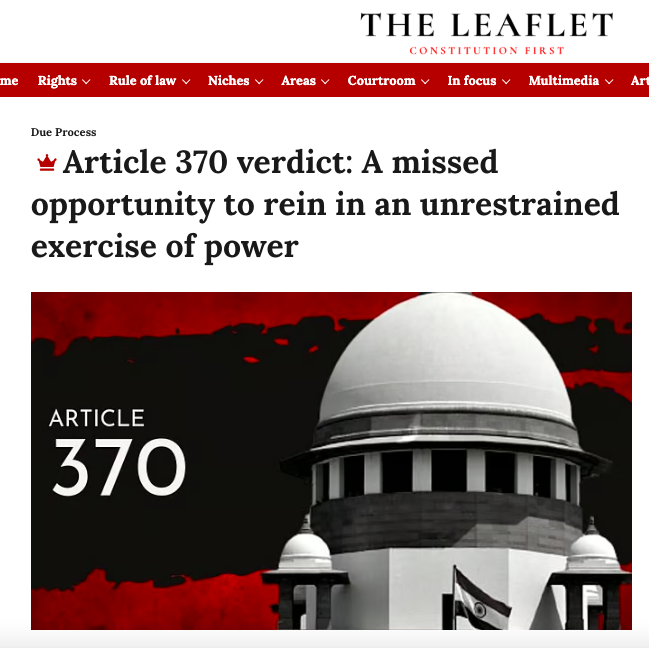
The Leaflet went as far as to question the integrity of the Supreme Court in upholding the abrogation of Article 370 and 35a, insinuating a judicial complicity in supposed executive ‘overreach’. “However, the rationale used by the Supreme Court to reach the conclusions was stretched and did little to enhance confidence in the judicial process,” The Leaflet article published in December 2023 read.
The entire leftist media ecosystem had accused the Supreme Court of capitulating to ‘majoritarian sentiments’ when it passed the Ayodhya verdict, accusing the top court of failing to uphold secular principles, which, according to them, could have only been saved if the court ordered reconstruction of Babri structure at the Ram Janmabhoomi site.
The leftist media ecosystem’s hypocrisy is amusing, when the judiciary hands verdicts that do not align with their ideological interests, then it becomes bad, flawed and insensitive and to an extent devoid of integrity, however, when it rules against the Centre or rules in favour of a political party they support, as in the Tamil Nadu bills case, these same propaganda outlets elevate judiciary to an unimpeachable pedestal. Apparently, the judiciary is sacrosanct only when it happens to align with the left liberal agenda, but can be subjected to criticism otherwise.
Is it the first time a person holding constitutional office has criticised the judiciary?
The opposition parties and the leftist media cabal are working overtime to vilify Vice President Jagdeep Dhankhar, mocking his career trajectory, his ideological commitment, even the value of the Vice President’s post, in order to push a narrative that somehow Dhankhar has violated a sacred rule by criticising the judiciary. However, a person holding constitutional office criticising the judiciary is not an unprecedented phenomenon in India’s democratic history.
Back in 2005, then Lok Sabha speaker Somnath Chatterjee launched a scathing attack on the Supreme Court following its order in the Anil Kumar Jha vs Union of India case, wherein it ordered the Jharkhand Legislative Assembly to conduct a floor test to determine the majority of the Shibu Soren-led state government. It must be recalled that in the 2005 state assembly elections, the BJP was by far the largest party, winning 30 seats out of the 63 seats it contested. The BJP’s pre-poll alliance partner JD(U) contested the other 18 seats and won 6. This took the NDA tally to 36 in the 81-member Assembly. The UPA parties were far behind with JMM winning 17 and Congress winning just 9 for a total of 27 seats, if you would like to include the NCP’s lone MLA as well. Immediately after the results, the BJP received the support of 5 other MLAs: 2 from the AJSU (All Jharkhand Students Union), the lone MLA from the Jharkhand Party and 2 other independents. This took the NDA tally to 41, which would be a clear majority.
The BJP duly staked claim to form the government and also physically presented the 5 supporting MLAs before the Honourable Governor of Jharkhand. However, Governor Syed Sibtey Razi invited JMM supremo Shibu Soren to form the government. Soren was sworn in as CM and Stephen Marandi as Deputy CM. The Soren government had three weeks to prove a majority, meanwhile, the NDA deemed the Governor’s act unconstitutional.
The NDA approached the Supreme Court, which issued an interim order in March 2005, directing the Jharkhand state assembly to advance the floor test on 11th March. The court ordered a video recording of the proceedings and directed the Pro-tem speaker to conduct the floor test. This, however, did not sit well with Somnath Chatterjee, who called the Supreme Court’s intervention “judicial overreach”. Chatterjee had alleged that the Supreme Court’s “interference” in the legislative process, particularly, dictating the time and manner in which the floor test proceedings were to be conducted, encroached on the autonomy of the legislature.
In an interview with Frontline, Chatterjee minced no words in criticising the judiciary as he said, “What I have done is to respond to my conscience as a parliamentarian of long service and to my present responsibilities as the Speaker of the House of People, the custodian of the constitutional rights and powers of legislators. What I have done is to highlight a serious encroachment by the Supreme Court on well-demarcated areas of powers of the legislatures.”
Chatterjee further accused the judiciary of intruding in the legislature’s power sphere by ordering a floor test, that too, under specific circumstances.
“The judiciary’s intrusion has blurred the contours of areas of supremacy of different constitutional institutions. Articles 122 and 212 of the Constitution symbolise the supremacy of the legislatures within their own sphere, and these provisions are equally binding on the Speaker as well as the Supreme Court. In short, the delicate constitutional balance between the executive, the judiciary and Parliament, which is extremely crucial for the maintenance and sustenance of parliamentary democracy, has been upset by the court order of March 9,” Chatterjee continued.
Was Chatterjee’s rhetoric any less critical and unapologetic than that of VP Jagdeep Dhankhar? No! In fact, in both cases, it comes across that neither Chatterjee nor Dhankhar essentially commented on the political merit of the respective cases they spoke about, however, they didn’t mince words in criticising what they deemed judicial overreach. Yet, for inherent leftist hypocrites, Chatterjee somehow remains an unparalleled defender of legislative autonomy and champion of constitutional supremacy, but Dhankhar is the BJP’s ‘partisan attack dog’ and his post is insignificant.
Former VP Hamid Ansari accused of betraying Indian intelligence officers is holier than thou, VP Dhankhar is a ‘partisan stooge’ for raising legitimate concern of SC’s conduct
The way the leftist media is slandering VP Jagdeep Dhankhar is in sharp contrast with their treatment of former Vice President Hamid Ansari, who faced grave allegations in the past. Hamid Ansari, who has been accused of lobbying for dreaded gangster Mukhtar Ansari by dialling the police station despite being VP, has been accused of links to questionable people and organisations, including outfits under scrutiny for anti-India activities. He has been accused of prioritising Islamism over Indian interests. Back in 2022, top diplomat Deepak Vohra had alleged that Ansari betrayed India’s intelligence officers in Iran, and when their family members begged him to intervene to get them released, he declined to act. Earlier, a Pakistani journalist, Nusrat Mirza, had claimed that he was invited to a seminar on terrorism by then-Vice President Hamid Ansari and spied on India, although he later claimed that he met former PM Manmohan Singh.
Ansari, even after his tenure as VP ended, continued to partake in events organised by Islamist outfits like IAMC, which is allegedly linked to Pakistan’s ISI and targeted the Modi government. Despite the grave allegations, the left liberal ecosystem never railed against Ansari, forget going absolutely unhinged as they went against VP Dhankhar. In fact, the liberal cabal often argued that Ansari was framed as a victim of right-wing propaganda solely due to his Muslim identity.
Despite serious allegations against him, Hamid Ansari remains holier-than-thou for the left liberal ecosystem, but VP Dhankhar becomes an ‘partisan stooge’ for making a legitimate constitutional argument rooted in democratic principles, not a political or personal vendetta, but about judicial overreach. The ‘liberal’ hypocrisy is palpable. In fact, the leftist media and the opposition parties are like witches of the same coven casting spells of outrage on EVMs and the judiciary, respectively, when it suits their agenda.
Conclusion
The Wire, The Leaflet, and other leftist propaganda outlets relentlessly attacking Vice President Jagdeep Dhankhar for criticising the judiciary set a dangerous precedent in many respects. Firstly, the kind of criticism Dhankhar is subjected to comes across as an attempt to silence constitutional functionaries from engaging in fair discourse about institutional balance. The idea behind framing Dhankhar’s comments as an attack on the judiciary’s independence and reputation is to close doors for an open debate, essentially placing the apex court beyond reproach. While the leftists accuse Dhankhar of violating constitutional principles, it is they who are undermining the constitutional principles, which suggest that in a healthy democracy, no institution, including the judiciary, is immune to criticism. Also, proposing an amendment is NOT an insult to the judiciary or the Constitution.
Secondly, the leftist media’s ad hominem attacks on VP Dhankhar calling him a ‘partisan attack dog’, ‘stooge’ and ‘lapdog’ or accusing him of breaching constitutional principles, more than their outrage, is actually an attempt to deflect focus from why Dhankhar said what he said to who and against whom was the statement made. It is a typical liberal tactic of prioritising sensationalism over substance. The personal attacks on VP Dhankhar and his integrity amount to character assassination, not fact-based counterarguments. While the leftist media displayed concern for the impact of Dhankhar’s critical comments on public trust in the judiciary and disrespect of the constitution, they themselves resorted to trivialising the importance of a constitutional post. The liberal critique sets a dangerous precedent that stifles open debates and criticism, especially in matters involving institutional scrutiny, and normalises launching ad hominem attacks on even the Vice President of India over ideological differences.