In the aftermath of the tragic terror attack that led to the death of many innocent lives on Tuesday, Union Home Minister Amit Shah on Wednesday reviewed the security situation at the site of the terror attack in Pahalgam’s Baisaran meadow.
The Union Minister first took an aerial stock of the region as he arrived at the site by helicopter, descending onto the meadow now bearing the scars of violence, earlier in the day.
Amit Shah walked around the area amid tight security and was briefed by top officials on the current situation and ongoing operations in the area.
The visit comes amid heightened alert across the Kashmir Valley following the attack, which targeted tourists in one of the region’s key travel destinations.
Tuesday’s incident is considered one of the most serious attacks in Jammu and Kashmir since the abrogation of Article 370 in 2019. The government is yet to release an official count of casualties.
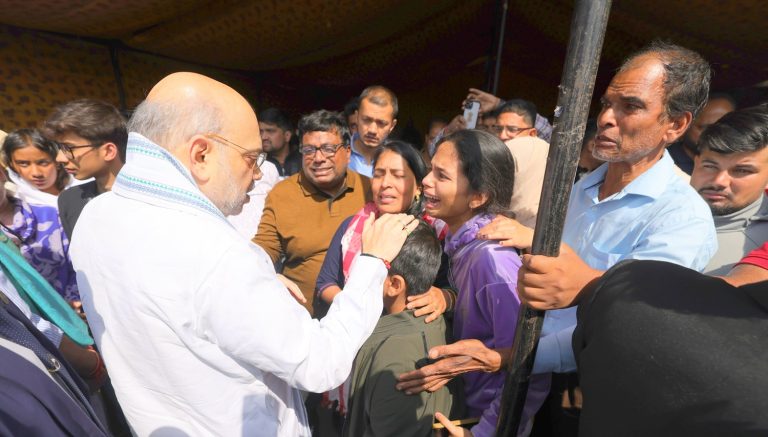
Before heading to Pahalgam, the Union Home Minister paid tribute to the victims with a “heavy heart” during a poignant ceremony and met with the families of the victims outside the Police Control Room in Srinagar.
Taking to X, Amit Shah expressed the centre’s firm resolve to combat terrorism, stating that “Bharat will not bend to terror.”
“With a heavy heart, paid last respects to the deceased of the Pahalgam terror attack. Bharat will not bend to terror. The culprits of this dastardly terror attack will not be spared,” Shah stated.
Meanwhile, a National Investigation Agency (NIA) team also arrived at the attack site to join the probe and assist the Jammu and Kashmir Police on the matter, which is considered the deadliest assault on civilians in the region in almost twenty years.
The NIA team – led by a Deputy Inspector General-rank officer – visited Baisaran a day after terrorists gunned down a group of tourists in the picturesque meadow, which is located around five kilometres from Pahalgam town in Kashmir’s Anantnag district.
Official sources privy to the development told ANI that “the NIA team members will be assisting the Jammu and Kashmir Police in the investigation.”
The NIA’s assistance to J-K Police underscores a key role in the overall investigation, as Pakistan-based terror outfit Lashkar-e-Taiba’s proxy, the Resistance Front (TRF), has claimed responsibility for the attack.
The NIA team is expected to conduct a thorough assessment of the attack site, collect forensic evidence, and help in identifying those responsible for the carnage.
(This news report is published from a syndicated feed. Except for the headline, the content has not been written or edited by OpIndia staff)
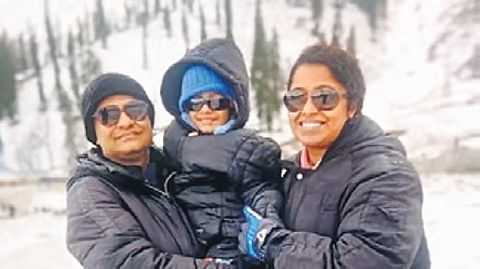
In one of the bloodiest terror strikes in recent times, 41-year-old Bharat Bhushan, a tech professional from Bengaluru, was brutally gunned down in front of his wife and three-year-old son in Jammu and Kashmir’s Pahalgam on Tuesday. The attack, carried out by terrorists suspected to be affiliated with Lashkar-e-Taiba’s proxy outfit, ‘The Resistance Front’, left 26 dead and dozens injured, turning a serene tourist haven into a nightmare.
According to Bhushan’s mother-in-law, who spoke to her daughter Sujatha after the incident, the terrorists coldly asked the victims whether they were Hindus before opening fire.
“They apparently asked, ‘Are you Hindu?’ and then shot them. My son-in-law was murdered because of his faith,” she said through tears. “They didn’t touch the women or children, but the men… they were shot in the head. They kept shooting till they fell.”
Sujatha, a doctor by profession, realised instantly that her husband was no more. Acting with incredible presence of mind amidst chaos and carnage, she picked up her husband’s phone and wallet and ran to safety with their child. The Indian Army quickly secured the area and moved the survivors to a safe location.
Bhushan, originally from Nellore in Andhra Pradesh, was the co-manager of a family-run diagnostic centre and had made a quiet life for himself in Bengaluru’s Mattikere with his young family. This vacation to Kashmir was supposed to be a break from routine — a chance to make memories. Instead, it turned into a tragedy that will haunt his loved ones forever.
Bengaluru South MP Tejasvi Surya confirmed he had spoken to the grieving Sujatha and coordinated with authorities for her safety.
“Her husband was shot dead in cold blood. She and her little boy survived. The local administration is providing all necessary support,” he posted on X.
Another tourist from Karnataka, Manjunath Rao, a realtor from Shivamogga, was also killed in the same attack. Like Bhushan, he too was travelling with his wife and son.
What was meant to be a tranquil day among Pahalgam’s green hills and lush orchards turned into a blood-soaked horror. Eyewitnesses recounted scenes of utter panic as multiple terrorists stormed the Baisaran Valley, firing indiscriminately. With no shelter in the wide-open landscape, tourists were left defenceless, caught between bullets and fear.
Among the dead were a recently-married Navy officer, an Intelligence Bureau agent shot dead before his wife, two foreign nationals from the UAE and Nepal, and two locals — their lives snuffed out in a matter of moments.
Security forces have since launched a full-scale manhunt. A photograph of four terrorists believed to be behind the attack has been released. Two are suspected to be foreign nationals. Though TRF, a Lashkar-backed proxy, has claimed responsibility, an official confirmation from the government is awaited.
This was not just an attack on individuals. It was a direct assault on the idea of peaceful coexistence, on the spirit of tourism, on the safety of innocents. And above all, it was a hate crime of the worst kind, targeting people for their faith.
Terrorists opened fire on a group of Hindu tourists in Pahalgam of Jammu and Kashmir, killing at least 28 people and injuring many others. This is among the biggest terror attacks after the abrogation of Article 370 in 2019. Six foreign terrorists, clad in army uniforms, reportedly used religion to identify their victims by asking them their names and identity cards. They were told to recite Islamic scriptures and even take off their pants before they were sprayed with bullets.
In light of the shocking and distressing event, Jammu & Kashmir National Conference (JKNC) leader and Srinagar Lok Sabha MP Aga Syed Ruhullah Mehdi also condemned the “barbaric attack on tourists and locals in Baisaran.” He stated that mindless acts of violence are an insult to common humanity and “stain the conscience of our society.” He added, “Kashmir has always opened its arms to guests. Those who seek to poison this bond only betray the values we hold dear.”
Strongly condemn the barbaric attack on tourists and locals in Baisaran, Pahalgam. Such acts of mindless violence are an affront to our shared humanity and stain the conscience of our society. Kashmir has always opened its arms to guests. Those who seek to poison this bond only…
— Office of Aga Syed Ruhullah Mehdi (@Office_ASRM) April 22, 2025
Notably, three months ago, during an interview with Nous Network, Mehdi articulated his profound disdain for the expanding tourism in Kashmir, referring to it as a cultural encroachment. “What is happening right now, which is being called tourism, it’s not that in my view. This is a cultural invasion. It’s happening by purpose and by design. A particular set of people are being brought intentionally, by design and for specific activities which are executed as part of a cultural invasion that is currently underway in Jammu and Kashmir, deliberately, with the aim of disturbing the environment,” he conveyed in the video which was released on 4th January.
He further complained about alcohol consumption in the region and claimed “it was unheard of” in Jammu and Kashmir and added, “The people of Jammu and Kashmir have always respected the choices of others. If someone came from outside, as a tourist, and belonged to a different faith than ours, maybe in their faith, alcohol consumption is not forbidden. There were confined areas and arrangements specifically for them, so they could consume it. Similarly, they also understood that in this society, in this culture drinking alcohol might not be considered appropriate.”
“I’ll name some specific areas, though it’s happening in many places, but these are known hotspots, which will give you an idea: the Dal Gate area, the area around Dal Lake, Boulevard Road. These places are now flooded with tourist activities. There, people come in shorts, sometimes even barely dressed and openly drink alcohol. They consume it to such an extent that alcohol-related abuses start to appear. You must have seen this during the summer, read reports, observed cases as many incidents came to light. People drink openly on the roads, in shikaras (houseboats) and even take it out into restaurants and consume it there. Videos of many such individuals have been recorded intentionally, and yes, these are tourists,” he further expanded his anti-tourist rhetoric. Obviously, the grand ideals of liberalism, tolerance and acceptance are eliminated by the harsh blade of Islamic extremism.
“There are many such examples which, in the current climate, people outside may not fully grasp. But the people of Jammu & Kashmir will understand the kind of apparent changes they’re witnessing. Changes in attire, in consumption habits and in behavior, an entire pattern of objectionable behaviour is imported in the area. A type of conduct that’s considered inappropriate even in places like UP or Bihar,” he added exposing the deep-rooted racism as if Uttar Pradesh and Bihar are inferior states.
“A person with the right mindset could never appreciate that kind of behaviour or appearance even in those places,” he declared and then disseminated a conspiracy theory indicating that the young people of Kashmir are being systematically led to substance abuse. He asserted that the entire system, encompassing the government, defence forces and administration, is accountable for the drug issue in Kashmir.
“This has consistently been a part of the strategy behind cultural invasions, power invasions or takeovers. Punjab is a major example of this within our own country. When you want to attack a society, when you want to take it over in any form, this is no hidden or secret matter, the RSS ideology aims to take over Jammu & Kashmir, specifically the Kashmiri Muslim identity. There is a direct move towards that goal and one major component of such invasions is to weaken or destroy a generation, to annihilate it. One of the key instruments used to achieve this is drug abuse. We’ve seen this happen in Punjab and now we are witnessing the same happening in Kashmir and it’s happening by purpose,” he claimed and even asserted that individuals are receiving calls from police stations if they prevent anyone from using drugs.
India wanted real estate, Kashmir a different civilisation
The MP described the accession of Jammu and Kashmir to India as unethical, asserting that India exploited the circumstances in the region for its own gain. “India took advantage of a pressing situation. It assumed control of a territory, capitalising on the vulnerability of its inhabitants. This was not a charitable act. It was a strategy for land acquisition. Therefore, it can be interpreted as a geopolitical arrangement. They obtained a piece of real estate by preying on the helplessness of the community. I recognise this reality and have come to terms with the pain as well,” he declared.
His disinclination to view Jammu and Kashmir as part of India is distinctly reflected in his statement and it is particularly alarming that he pledges allegiance to the constitution of a nation he evidently despises. He subsequently complained about the absence of a plebiscite in the territory, portraying it as a betrayal of its people. “Hand over your real estate to us, or else we’ll leave you to the dogs and throw you under the bus. So, if you want to survive, give up your area,” he added, claiming this is how Maharaja Hari Singh was blackmailed by the Indian state. The politician is unabashedly revealing his aversion to being part of the nation in which he holds a parliamentary seat.
He even went as far as to characterise India and Kashmir as two separate civilisations. The name Kashmir, rooted in Indian culture and historically ruled by significant Hindu kings, was represented as a distinct entity only due to demographic shifts that have caused the genocide and exodus of Kashmiri Hindus. “A particular culture, a society, a civilisation is handing itself over to another civilisation. This is not an interaction. This is an unwanted deal forced and pushed by circumstances between two civilisations,” he maintained, while shrewdly arguing that it is not a religious matter. However, what sets Kashmir apart from the rest of the nation, if not its predominantly Muslim population and Islamism?
Propaganda of demographic change accusing BJP-RSS
Mehdi claimed that the centre has orchestrated demographic changes in the area and remarked, “14 million cannot consume 1.4 billion in any way. I, coming from Kashmir, cannot consume the whole of India. I cannot change its identity. I cannot change its language. I cannot consume its land. I cannot consume its jobs. I cannot consume its resources. Now reverse it. Leave all those doors and gates, whatever you want to call them, open. Leave Kashmir, with its population of 14 million, open to 1.4 billion people. There can be demographic change, linguistic change, cultural change and religious changes. Your land will go, your jobs will go, your resources will go and we are already witnessing it.”
Echoing the sentiments of fellow Islamists, he wants to use India as a cash cow and a realm of opportunities for the people of the vallery, however, envisions Jammu and Kashmir as an independent state within the country that possesses its own autonomy and sovereignty, restricting entry to individuals from other parts of the nation. He fundamentally desires Kashmir to exist as an independent entity from India, which is merely recognised as part of the nation on paper, yet is completely disassociated in every practical sense.
Mehdi, in a bid to create a false equivalence, then stated how powerful countries, such as the United States, issue their own constitutions and flags and hand over special authorities to their states. However, he neglected to address the profoundly distinct historical backgrounds of the two countries. The United States was never divided along religious lines, nor has it encountered the magnitude of jihad and terrorism that India has been enduring to this day.
He asserted that Article 370 represented the limited leverage that the residents of the region possessed in their otherwise disadvantageous negotiations with the Indian state. He asserted that the homes and properties of Muslims were destroyed in various regions under the guise of beautification during the 1970s and 1980s and even blamed Jagmohan Malhotra, former governor of Jammu and Kashmir for it and accused him of sharing the ideology of Bharatiya Janata Party (BJP) and Rashtriya Swayamsevak Sangh (RSS).
As anticipated, following his vitriolic remarks against India, he commenced his agenda of playing victim while disparaging a democratically elected party and a social organization for not aligning with his ideology. He even made considerable efforts to portray India and Pakistan in a similar light, asserting that the terrorists who resorted to violence, along with stone pelters and others of their kind, did not wish to be associated with either nation.
The statement is quite in contrast to the ground realities, as Pakistan has been instrumental in perpetrating terrorism in Kashmir. Moreover, public declarations by hardliners like Syed Ali Shah Geelani about their love for the neighbouring country along with the display of Pakistani flags during protests and on the corpses of terrorists as well as substantial evidence indicating that the Islamic Republic has been fostering terrorism in the area, points towards the same.
India is not secular, shocking analogy with Draupadi
“Now, after 50 or 60 years, India is neither secular nor pluralistic. Neither does it behave that way, nor does it celebrate diversity. There is no right to equality,” he parliamentarian ironically voiced after stating that he does not want other people from other parts of India in Kashmir, as he desires the region to maintain its Muslim identity. He referred to the Indian administration as ‘trigger happy’ in relation to Muslims and spread the same untruths about police killings of Muslims during the Sambhal unrest, last year. Nevertheless, the authorities confirmed that they utilised only rubber bullets and conventional anti-riot equipment like tear gas and sticks.
“After 2014, they began to enforce things forcibly using the government and institutions to do so,” he charged as if evreything was honky dory in the valley and every issue originated after the BJP-led government came to power at the centre.
“I had heard, or read in school somewhere, the story of Draupadi, that episode where she was being humiliated and disrobed. I believe that’s the word used in Hindi, Vastraharan and the Kauravas were sitting there, laughing. What was done to us in the name of religion, what happened in 2019, was exactly that for me. Kashmir was Draupadi and her honor was being torn apart. This entire ecosystem, I’m not just talking about one moment or one act, but this entire idea, the right-wing ideology, and its ecosystem: the media, mainstream media, social media, all of it has been compromised including the institutions, the government and ministers,” he alleged.
It is strange that the violent killings of Kashmiri Hindus in the valley do not provoke any strong feelings, whereas a governmental effort to assimilate the area into the country triggers such vehement sentiments. He even denied the involvement of locals in the oppression of Kashmiri Pandits, claiming that more Muslims had lost their lives. He failed to mention that Pandits were specifically targeted due to their religious beliefs and were dubbed as agents of India.
The entire conversation was a thorough assault on the Indian government and its influence in Kashmir. He dismissed the developmental efforts undertaken by the center in the region, which are even envied by the people of Pakistan-occupied Jammu and Kashmir. He conveniently omitted to mention the number of Indians who purchased property in Kashmir and subsequently settled on the land as this would have revealed his falsehoods.
Nonetheless, his present opinions are not unexpected, as he made similar comments during an interview with The Wire’s Arfa Khanum Sherwani, last year. He warned the Indian government that the discontent among Kashmiris regarding the abrogation of Article 370 could resurface at any moment, similar to the events that unfolded 40 years post-independence. This “Indian leader” appears to act as a mouthpiece for Pakistan, consistently taking the chance to denounce his nation and instigate discord in the valley.
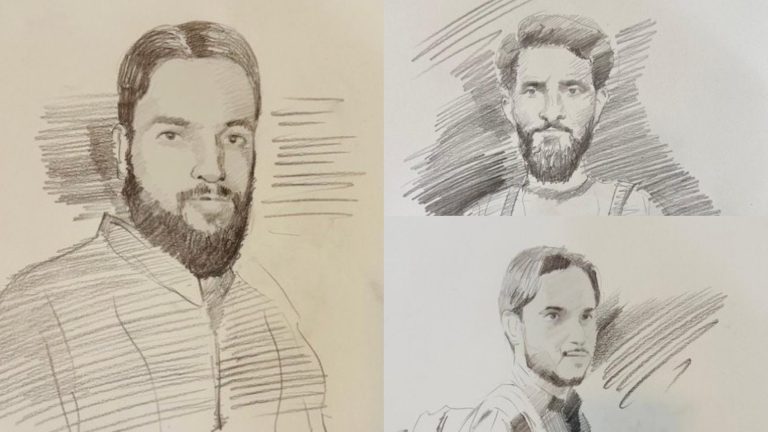
Security agencies have released sketches of three individuals believed to be responsible for Tuesday’s deadly terror attack in Pahalgam, Kashmir, which resulted in the deaths of 26 tourists and left many others injured. The suspects have been identified as Asif Fuji, Suleman Shah, and Abu Talha.
Affiliated with The Resistance Front—a proxy group linked to Lashkar-e-Taiba (LeT)—the terrorists targeted tourists at Baisaran meadow, a well-known scenic spot, in what is being termed one of the most devastating attacks in the region in recent times.
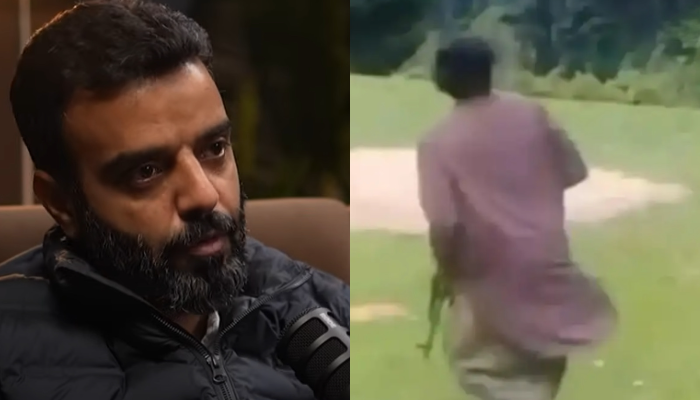
According to reports, a group of five to six militants, dressed in camouflage gear and traditional kurta-pyjamas, emerged from the thick pine forests surrounding the area and unleashed gunfire using AK-47 rifles.
Investigators have named Saifullah Kasuri, also known by the alias Khalid, a high-ranking Lashkar-e-Taiba (LeT) terrorist, as the mastermind behind the recent terror attack. Additionally, two other terrorists based in Pakistan-occupied Kashmir (PoK) are also believed to be involved in planning and executing the attack.
In response, security forces have launched a large-scale counter-terror operation, utilising helicopters to track down the assailants, who are believed to have fled through the dense forested terrain.
Preliminary forensic evidence, along with eyewitness testimonies, points to the use of military-grade weapons and advanced communication equipment, indicating that the attackers may have received backing from outside sources.
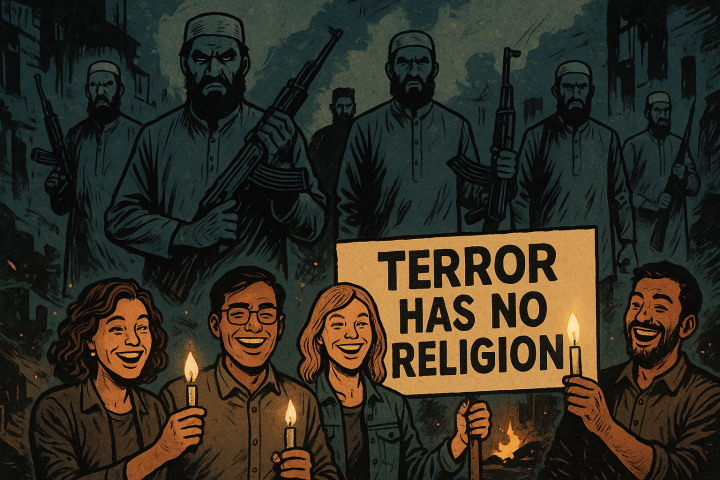
“Terrorism has no religion”. The secular liberal enablers of Islamists are at it again after Islamic terrorists ambushed a group of unarmed Hindu tourists in Jammu and Kashmir’s Pahalgam on 22nd April 2025. The Islamic terrorists belonging to the proxy of Pakistani terror outfit Lashkar-e-Taiba (LeT), The Resistance Force, checked IDs, pulled down pants to verify religion (by checking whether the men were circumcised or not), and executed those identified as non-Muslims, point-blank in Baisaran Valley.
Eyewitness statements have confirmed this.
While Islamic terrorists specifically targeted Hindus, the Indian ‘liberals’, ever-ready to whitewash Islamic violence, jumped like a spring to downplay the religious motivations of Islamists behind attacking Hindus, resorted to peddling the same old ‘Terrorism has no religion’ narrative.
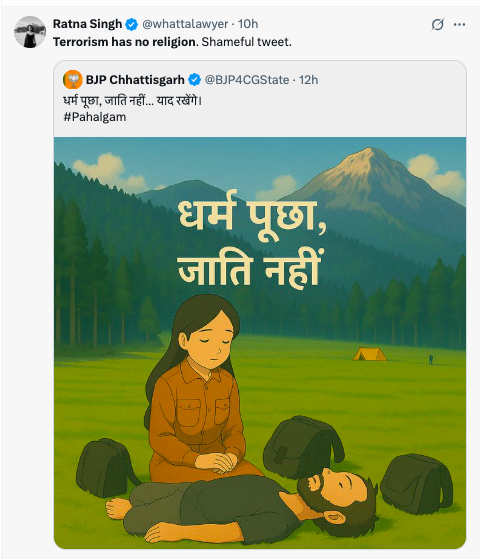
In this vein, Bar and Bench journalist Ratna Singh quoted a post by BJP Chhattisgarh wherein it said that the Islamic terrorists asked the religion of tourists, not caste, before shooting them dead, and said: “Terrorism has no religion. Shameful tweet”.
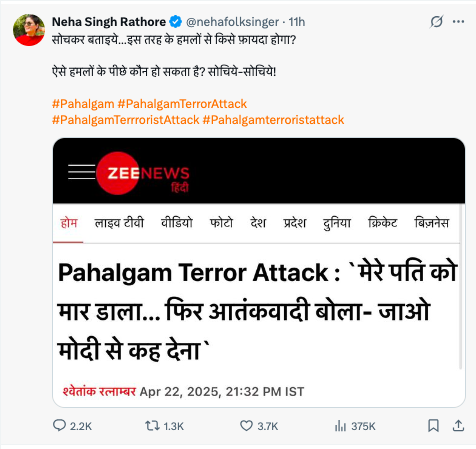
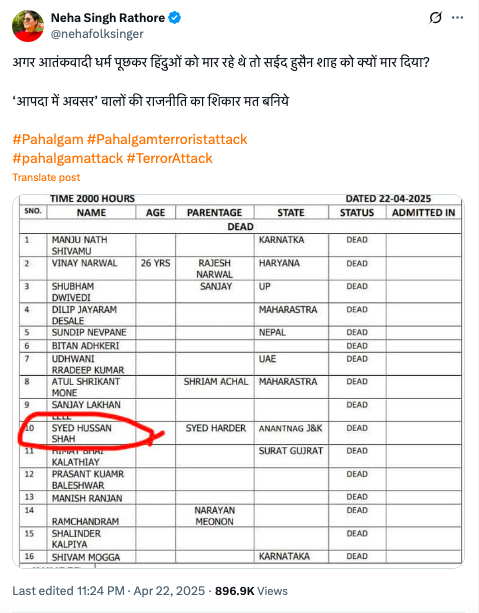
Pro-Congress ‘folk singer’ Neha Singh Rathore went a step ahead and decided to discredit the testimony of the Hindu victims who revealed that the Islamic terrorists confirmed the Hindu identity of the tourists before killing them. Rathore shared a list carrying the names of the victims, among whom one happened to be a local Muslim worker. While she did not explicitly write ‘terrorism has no religion’, her shameful attempt at politicising and secularising the jihadist attack on Hindus demonstrates that, being a typical Islamist cheerleader, her priority is to whitewash Pakistan-sponsored Islamic terrorism.
“If terrorists were killing Hindus after asking about their religion, then why was Saeed Hussain Shah killed? Don’t fall prey to the politics of those who see ‘opportunity in disaster’,” Rathore posted.
She has published many such posts which reminds one of how the Islamo-leftist cabal insinuated that the 2019 Pulwama attack wherein 40 Indian Army personnel martyred was orchestrated by Prime Minister Narendra Modi for electoral gains ahead of the 2019 Lok Sabha elections.
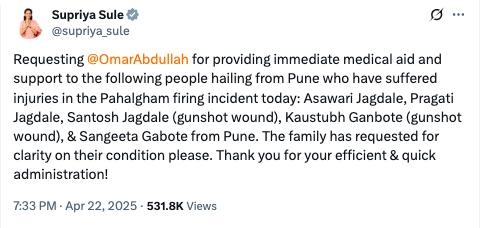
Meanwhile, Supriya Sule, the NCP leader, downplayed the Islamic terrorist attack in Pahalgam by calling it a “firing incident”.
Salman Nizami, the leader of the Democratic Progressive Azad Party (DPAP), also used the killing of a local Muslim during the attack to shield Islamic terrorism.
“Syed Hassan Shah- a brave Kashmiri Muslim was shot dead while saving tourists in Pahalgam. Once again, I say: terrorism has no religion. There are still people who believe in humanity. Islam does not allow the killing of innocents, nor does Kashmiriyat. Those who killed innocent people are not humans, they have nothing to do with Islam. They are enemies of Kashmir and of humanity!,” Nizami posted.
Syed Hassan Shah- a brave Kashmiri Muslim was shot dead while saving tourists in Pahalgam. Once again, I say: terrorism has no religion. There are still people who believe in humanity. Islam does not allow the killing of innocents, nor does Kashmiriyat. Those who killed innocent… pic.twitter.com/6dYg7lBrxV
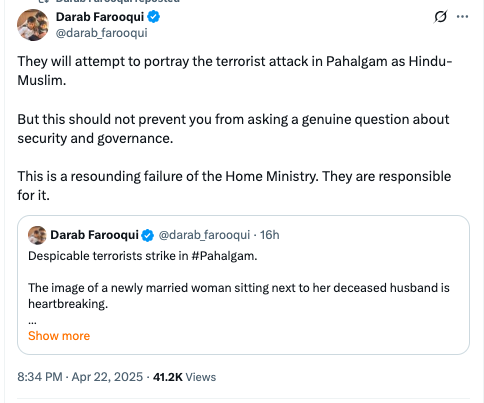
Darab Farooqui, a full-time radical and part-time Bollywood screenwriter, insinuated that the anti-Hindu terror attack in Pahalgam was not an act of Islamic terrorism against Hindus, but ‘they’ will attempt to portray it as one.
“They will attempt to portray the terrorist attack in Pahalgam as Hindu-Muslim. But this should not prevent you from asking a genuine question about security and governance. This is a resounding failure of the Home Ministry. They are responsible for it,” Farooqui posted.
Just like other Islamo-leftists, Farooqui also used Syed Hassan Shah’s killing to discredit the eyewitness accounts, which confirmed that the terrorists checked the religious identity of tourists before killing them. “When they were asking for names before shooting, by mistake, Hussain Shah must have given his name as Hemang Shah…” Farooqui posted.
While the terrorists did kill Syed Hassan Shah, unlike Hindu tourists, Shah was not killed for his religious identity, rather, he was unfortunately collateral damage. Also, it is not a new phenomenon for Islamic terrorists to kill local Muslims whom they do not deem “Muslim enough” or simply hate Hindus as much as they do.
From the Kashmir Hindu genocide in 1990s, the 1993 Kishtwar attack on a bus full pf passengers wherein Hindus were singled out and shot, the 1997 Wandhama wherein Kashmiri pandits were targeted, rounded up inside their homes and shot dead, the 1998 Prankote and Daikote 29 Hindus villagers identified and beheaded inside their houses, the 2000 Chittisinghpura attack wherein 36 Sikhs were killed, the 2000 Amarnath pilgrims attack, the 2003 Nandigram attack, the Doda massacre to the sporadic attacks on ‘nonlocal’ labourers in last few years, the 2021 incident wherein Jihadis killed a school principal and a teacher, Sikh and Hindu, after checking their identity, killings of Hindu businessmen and a chemist, attack on Gujarati pilgrims, and now Pahalgam attack, Hindus and other non-Muslims have been massacred by Islamic terrorists precisely for their religion.
The only variation has been that the Jihadis were either local Kashmiris or Pakistan-sent terrorists; even in these cases, they were backed by the Pakistani establishment to wage jihad against India.
While Islamo-leftists have their own agenda behind shielding Islamic terrorism and whitewashing Jihad against Kafirs, it is high time for Hindus and all non-Muslim communities to understand, terrorism is not a Kashmir specific problem, 26/11 Mumbai attacks, Sri Lanka Easter bombing, and many more, terror has always had one religion, and it kills those who do not follow that religion. No mollycoddling, no appeasement, no amount of pandering to Islam and Muslims, can change the Jihadist imperative to wage war on Kafirs, sanctioned by the religious beliefs of Islamic terrorists.
The anti-Hindu terror attack in Pahalgam by the Pakistani Islamic terrorist group LeT’s offshoot came just days after Pakistan Army Chief Asim Munir spewed venom against Hindus, invoked the divisive two-nation theory, and most importantly, he reiterated that Kashmir is and will continue to be the “jugular vein” of Islamabad. The sequence of events makes it evident that the Pakistan-backed terrorists attacked Hindus, not just Indians, but Hindus. They meticulously confirmed the religious identity of the tourists by pulling down their pants, asking them to recite Islamic Kalma, and shot them only after they were sure that the tourists were Hindus, and yet, the Islamist enablers masquerading as ‘secular liberals’ want Indians, particularly, Hindus to believe that ‘terrorism has no religion’. Muslim terrorists of the Islamic terror group TRF, driven by their hatred for Hindus, killed Hindus because of their Hindu identity, but ‘terror has no religion’. Muslim politicians like Ruhullah Mehdi portray increased tourism as ‘cultural invasion’ and an attempt to alter the demography of Kashmir, framing it as a threat to Muslim dominance in the region, but of course, terror has no religion. Kashmiri Pandits were killed and chased away from the valley with slogans of Raliv, Galiv, Chaliv (convert, die or flee), but of course, terror has no religion.
Ironically, the Islamic terrorists who carry out attacks against Hindus, explicitly boast their Jihadist religious beliefs and quote verses from their religious text before slaughtering Kafirs, but somehow their ‘secular’ cheerleaders know about the motivations of terrorists better than terrorists themselves and outrightly extricate religiosity that drives Islamic terrorism and used by Jihadis to justify violence. Liberals live in denial and want Hindus, too, to live in denial and perish at the hands of those who hate them for simply existing. However, this denial of religious-ideological fuel offers no communal harmony, no peace, no solution; rather, it only facilitates the perpetuation of anti-Hindu hatred and violence.
It is thus pertinent to reiterate that the terrorists in Pahalgam did not randomly open fire on tourists; they used religious markers to single out Hindus and shoot them. Anyone discrediting the testimony of victims who have lost their loved ones in this cowardly attack is an enemy of India and Hindus. Asavari Jagdale, a survivor, recounted how her father and uncle were killed after being identified as Hindus as they failed to recite the Kalma. Yet, the liberal brigade dares to invalidate the lived reality of Hindu victims.
While Islamo-leftists would want to conceal the jihadist designs of terrorists in Kashmir or Muslim rioters in other states as seen in Maharashtra’s Nagpur and West Bengal’s Murshidabad, it is essential to say it out loud that be Pahalgam attack was an act of Islamic terrorism carried out by Jihadi terrorists. Counterterrorism requires dismantling the propaganda, the networks, funding, and teachings that fuel terrorism. A problem can be solved only when it is identified in its entirety. Being apologetic and shying away from uncomfortable truths or pretending terrorism has no religion will not end the menace of Pakistan-sponsored Islamic terrorism. Admitting and strongly acting against the hateful ideology as well as its armed and unarmed proponents will. If liberals are more worried about adverse impact of terrorism on tourism in Kashmir, supposed surge in hostile sentiments towards Jihadis than about Hindu victims who bodies are yet to turn cold, then they are a part of the problem, the Jihadi problem.
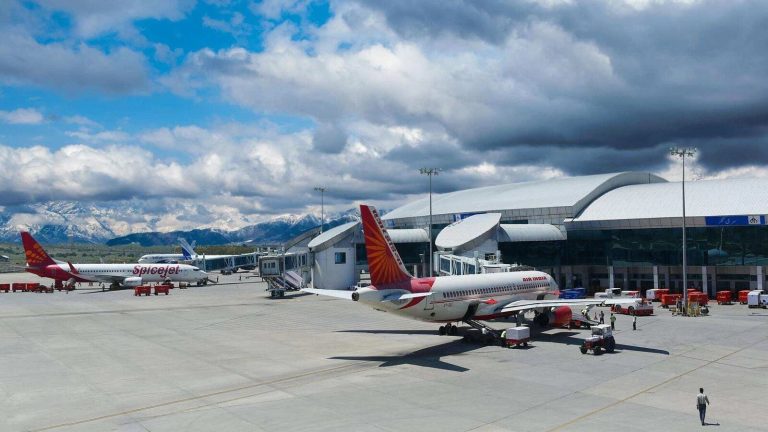
Following the deadly terror attack in Pahalgam in Kashmir, tourists have started to scramble to leave the region as soon as possible. Moreover, the Jammu-Srinagar National Highway has also been closed due to the Ramban landslide, leading to a surge in flight prices leaving Srinagar.
A search for Srinagar-Delhi flights shows that for next few days, flights are priced at the range of ₹8,000 to ₹9,000, more than double the usual ticket price for the route. On the other hand, Delhi-Srinagar flight tickets are available at ₹3,500-₹4,500, reflecting extremely low demand for that journey.
Amid this, the Directorate General of Civil Aviation under the Civil Aviation Ministry has asked the airlines to increase the number of flights from Srinagar to various destinations across India. The DGCA also urged the airlines to “consider waiving cancellation and rescheduling fees and provide all necessary assistance to tourists facing unexpected circumstances and challenges during this difficult time.”
Aftermath of Pahalgam terror attack, DGCA issues advisory to airlines over surge in pricing and waiving cancellation charges: DGCA pic.twitter.com/GHzerH1NSw
Additionally, Civil Aviation Minister K Rammohan Naidu has also issued a strong advisory to airlines against surge pricing on the Srinagar route. The minister held an emergency meeting with the airline operators, in which he directed them to maintain regular fares for flights taking off from Srinagar.
To help tourists leave Kashmir as soon as possible, airlines have also arranged for additional flights. As part of immediate relief measures, four special flights from Srinagar—two to Delhi and two to Mumbai—have been arranged by Air India and IndiGo. Additional flights have been kept on standby to cater to further evacuation needs.
Ram Mohan Naidu also directed all airlines to extend full cooperation for the transportation of deceased individuals to their respective home states, working in sync with state governments and local authorities.
Minister Naidu also talked to Home Minister Amit Shah, and he is monitoring the situation round the clock, working in close coordination with relevant authorities.
Jammu-Srinagar Highway
The Jammu-Srinagar Highway was blocked by landslides triggered by flash floods on Sunday, with hundreds of vehicles left stranded on the road. NHAI officials have said that it will take 5-6 days to remove the debris from the road, which is as high as over 20 feet at some places. The road has been blocked in 20 places, and work is ongoing to simultaneously at all those places.
However, the authorities on Monday reopened the Mughal Road, providing an alternative link between Kashmir and Jammu.
J&K CM Omar Abdullah said that the National Highway has also been reconnected partially for traffic in a single direction. He tweeted, “I’ve directed the administration to facilitate traffic between Srinagar & Jammu allowing tourist vehicles to leave. This will have to be done in a controlled & organised way because the road is still unstable in places and we are also working hard to clear all the stranded vehicles.”
It’s heartbreaking to see the exodus of our guests from the valley after yesterday’s tragic terror attack in Pahalgam but at the same time we totally understand why people would want to leave. While DGCA & the Ministry of Civil Aviation are working to organise extra flights,… pic.twitter.com/5O3i5U1rBh
CM Abdullah added that the government will not be able to permit completely free movement of vehicles at the moment, as the road has not been restored completely.
The Supreme Court on Tuesday (22nd April) commuted the death penalty of a man convicted of brutally murdering his entire family, including his wife and 4 children, in Kerala and raping his own daughter. The convict named Reji Kumar alias Reji was granted a death sentence in 2010 trial court, which found him guilty of the murdering his wife Lissy and 4 children, aged 12, 10, 9 and 3, and raping his eldest daughter before killing her.
Reji’s conviction and the death penalty were upheld by the Kerala High Court in 2014, which noted, “Here, the evidence is conclusive enough to hold that the appellant had no repentance at all.”
The convict moved the Supreme Court challenging the order of the High Court. Deciding on his appeal, a bench of Justices Vikram Nath, Sanjay Karol and Sandeep Mehta observed that the convict showed ‘significant improvement’ in his conduct during his imprisonment. The court noted that he did not have any criminal history, was given responsibilities by jail authorities, and donated ₹83,000 to various causes involving the bail of fellow prisoners. The Apex Court also took into account his childhood trauma due to neglect and family instability, and psychological reports. “Considering the facts that the convict-appellant had no prior antecedents, good conduct for the past 16-17 years of incarceration, difficulties in mental health, and consistent efforts at being a model prisoner, we find that the imposition of the death penalty would be unjustified. He is, therefore, removed from death row,” the Supreme Court said, altering his sentence from the death penalty to life imprisonment for the duration of his natural life.
“However, considering the severity of the crime, the number of persons killed, that out of five, four were his own children, we are of the view that he does not deserve to be set free and direct that he shall spend the remainder of his days in jail, till his last breath, hoping to do acts of penance to atone for the crimes he has committed and particularly for the fact that he extinguished four bright flames….The death sentence is commuted to life imprisonment till the end of natural life,” the Court said.
The convict had an affair with another woman and was suspected his wife of infidelity
Convict Reji, a chemistry graduate with a diploma in computer applications, used to work as an agricultural labourer. He had a wife, Lissy, and four children—three daughters (aged 12, 9, and 3) and a son (aged 10). In the course of his employment, he developed intimate relations with a woman named Usha. Besides, he suspected his wife of infidelity and believed that the youngest daughter was not his. The High Court observed that Reji wanted to live with Usha, and therefore, he killed his entire family to clear his way. “The evidence would indicate that the intention of the appellant was to live with PW24 (Usha) after annihilating his family,” the High Court noted.
While convicting him for the murder of his family, the trial court rejected his defence that he killed his family out of unhappiness and frustration and not due to criminal tendency. The court noted that the manner of commission of the crime was well-arranged and planned.
On 22nd April, a deadly attack by Islamic terrorists in Pahalgam in Kashmir left at least 28 dead and several injured. The majority of the dead were Hindus. The terrorists, affiliated with the Resistance Front (TRF), a Lashkar-e-Taiba offshoot, were behind the attack. Victims said on record and on camera that the tourists were killed because they were not Muslims.
Amidst the ghastly attack, the leftist media began covering up Islamic terrorism sponsored by Pakistan and referred to the terrorists as ‘gunmen’. Simultaneously, they used the phrase “India-administered Kashmir” for the Union Territory of Jammu and Kashmir to establish the notion that it is a disputed region between India and Pakistan.
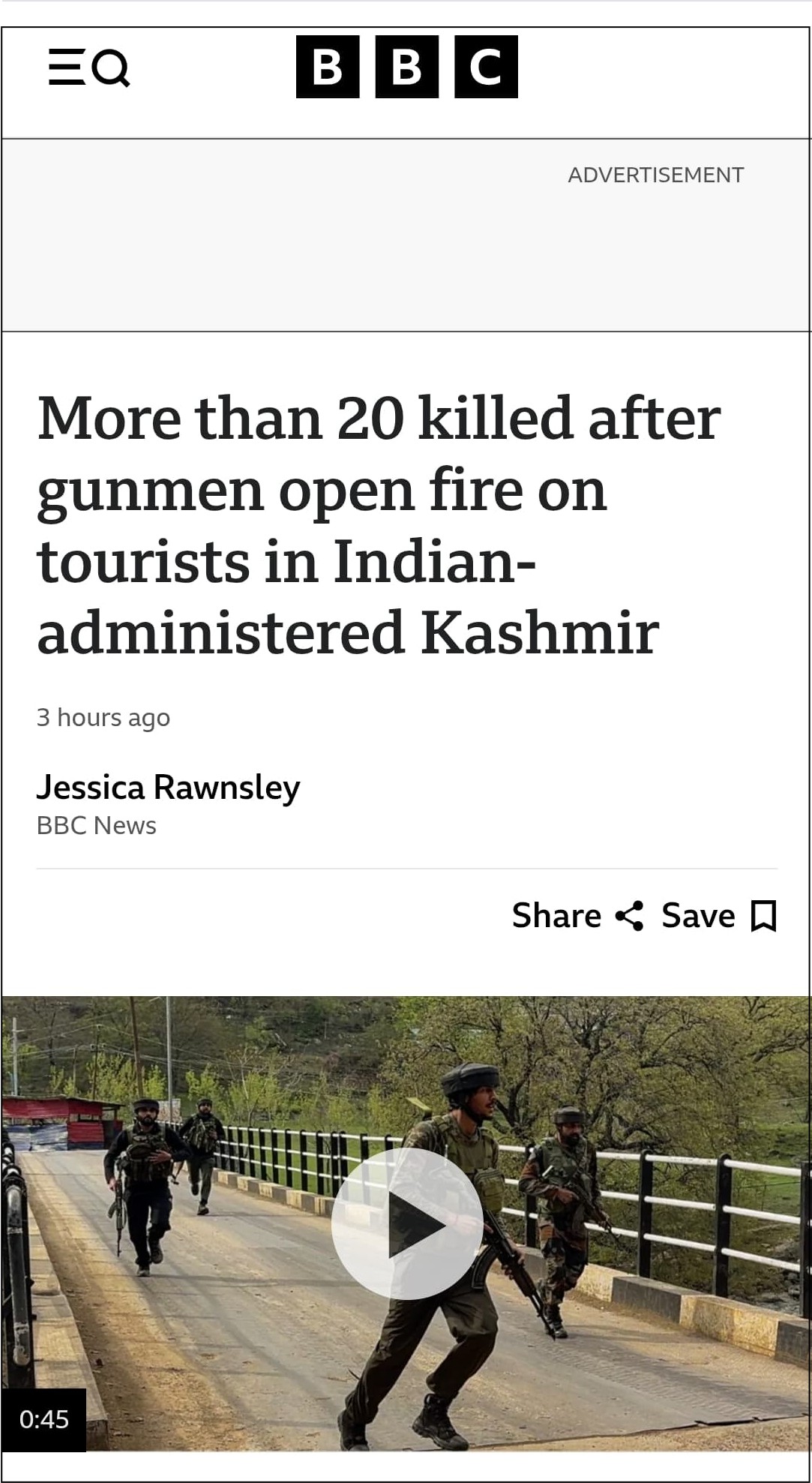
The BBC published the report on the terror attack with the title, “More than 20 killed after gunmen open fire on tourists in Indian-administered Kashmir”. In the report as well, they did not provide any clear indication—other than quoting someone—that it was a terrorist attack. The report read, “At least two dozen people have been killed after gunmen opened fire on a group of domestic tourists visiting a popular beauty spot in Indian-administered Kashmir.” Archived link of the BBC report can be checked here.
Source: BBC
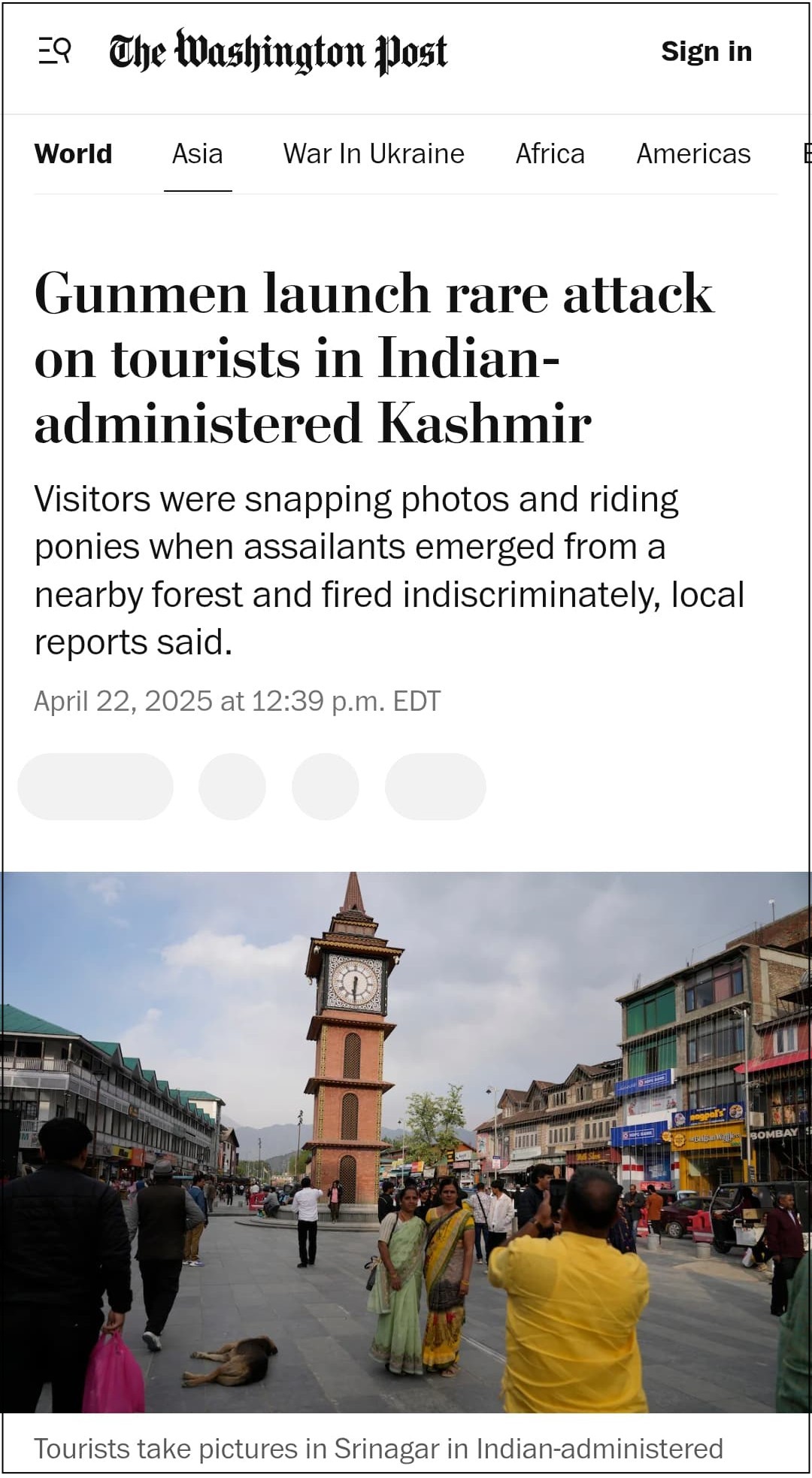
In its report titled “Gunmen launch rare attack on tourists in Indian-administered Kashmir”, The Washington Post not only watered down the fact that it was a terrorist attack, but also challenged the sovereignty of the Indian state by calling Kashmir “India-administered Kashmir”. WaPo also failed to call it a terror attack in the body of the report and mentioned “terrorism” only while quoting Prime Minister Narendra Modi. Archived link of the Washington Post report can be checked here.
Source: Washington Post
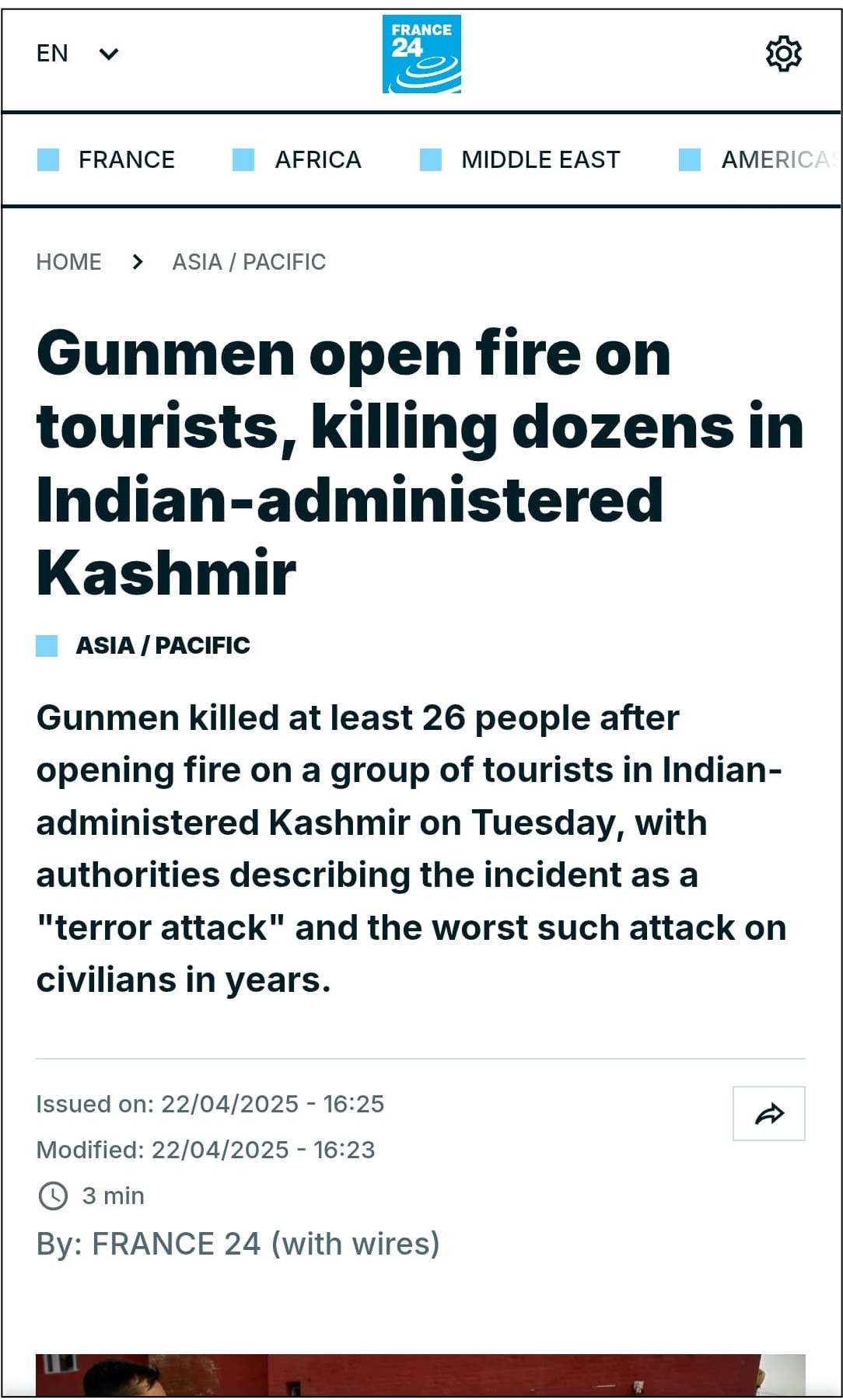
In its report, France 24 called the terrorists “gunmen” and referred to Kashmir as “Indian-administered Kashmir”. Similar to other media houses, France 24 mentioned it as a “terror attack” or “terrorist attack” only while quoting leaders. Archived link of the France 24 report can be checked here.
Source: France 24
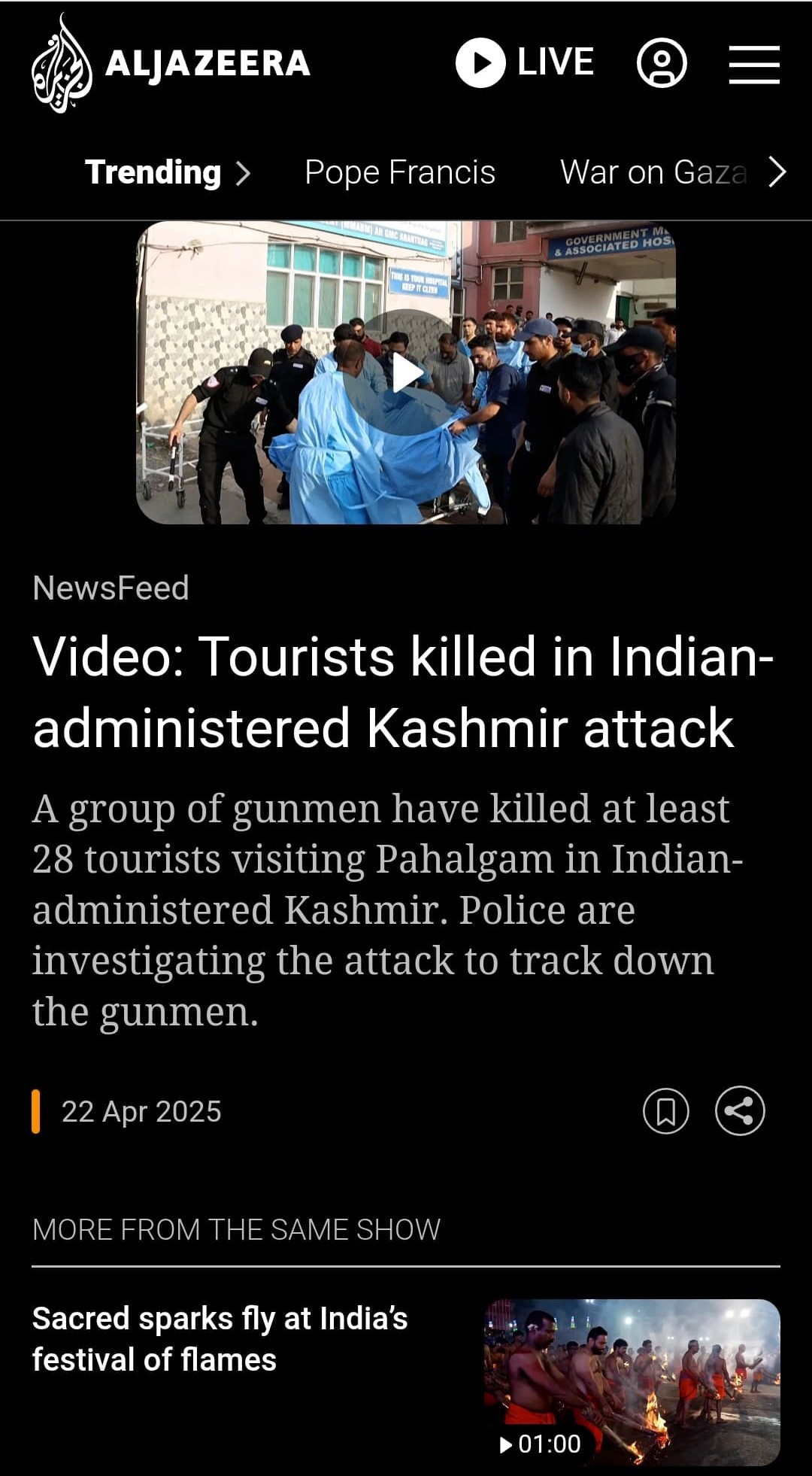
In a video report, Al Jazeera referred to Kashmir as “Indian-administered Kashmir” and described the terrorists as “gunmen”, thereby watering down the intensity and seriousness of the attack. In the video, Al Jazeera claimed no one had claimed responsibility for the attack, but stated that “the police blamed armed groups fighting against Indian rule”. Al Jazeera clearly attempted to shift the responsibility away from Islamic terrorists. Archived link of the Al Jazeera report can be checked here.
Source: Al Jazeera
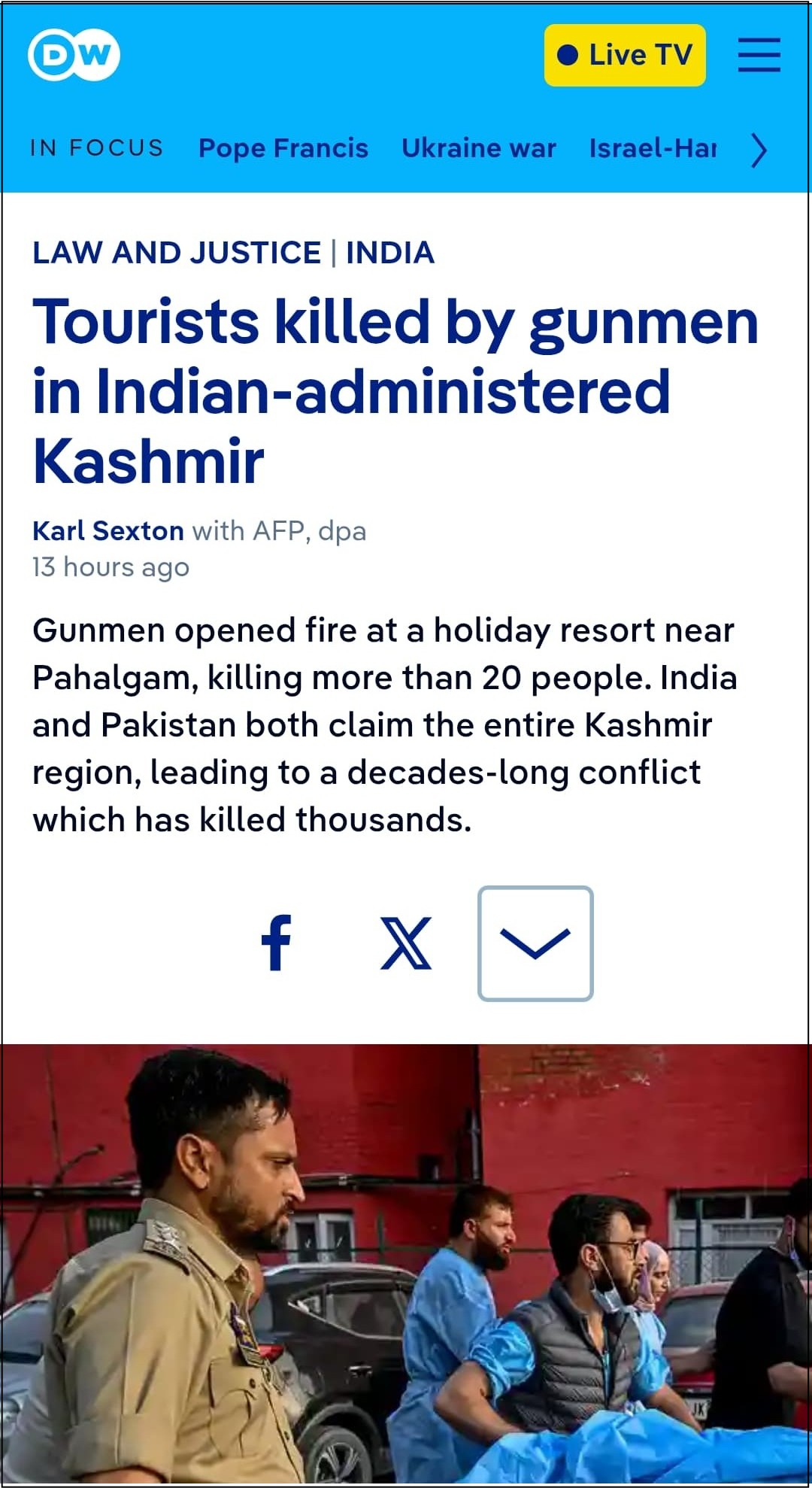
In a report covering the attack, DW referred to the terrorists as “gunmen” and Kashmir as “Indian-administered Kashmir”. DW described Lashkar-e-Taiba as a “militant group” rather than a terrorist outfit. It also failed to label the incident a terror attack or mention “terrorism” outside of quotes from leaders, including Prime Minister Narendra Modi. Archived link of the DW report can be checked here.
Source: DW
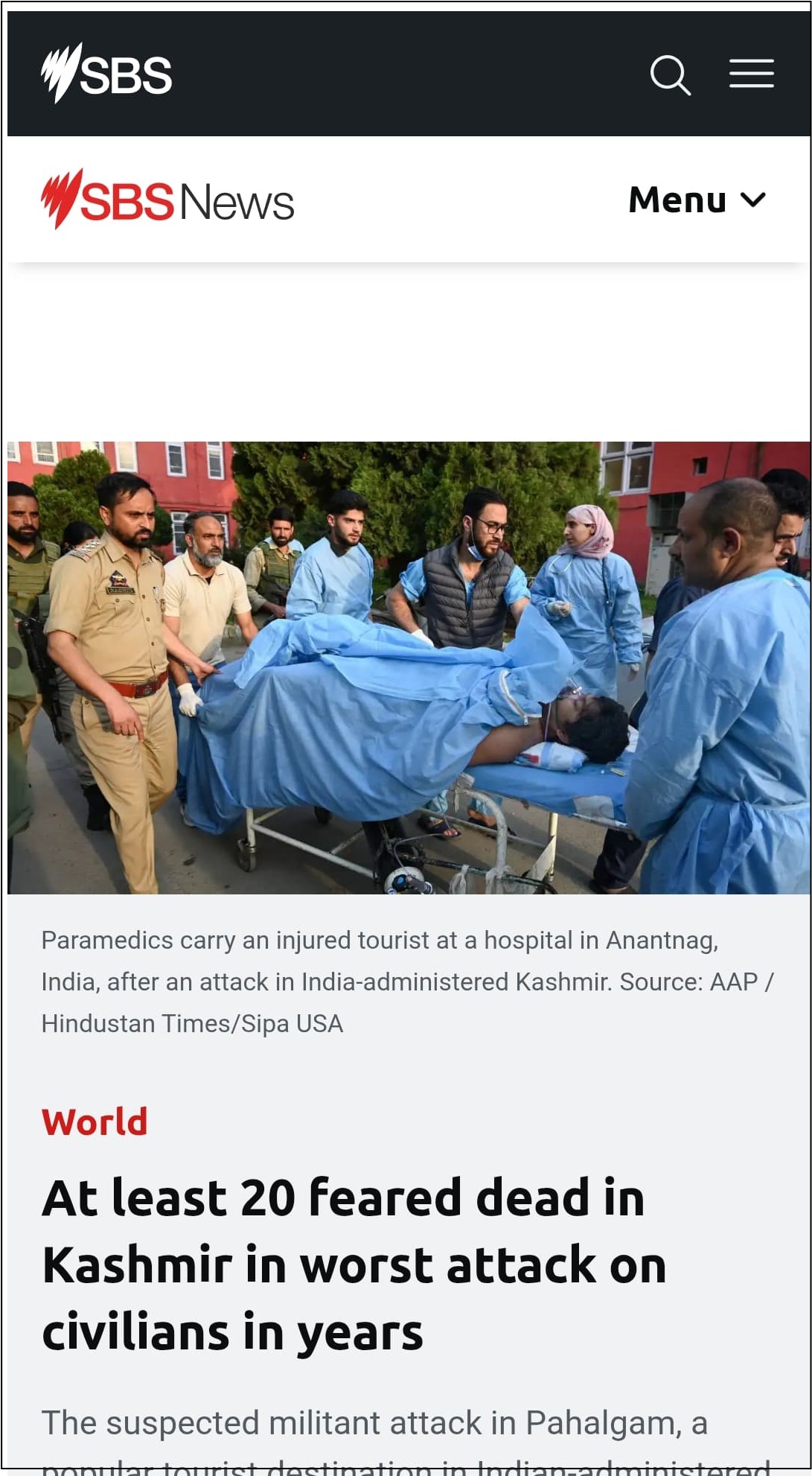
Though SBS did not use the phrase “Indian-administered Kashmir” in the title, it used it in the excerpt and body of the report. The report read, “At least 20 people are feared dead after suspected militants opened fire on tourists in Indian-administered Kashmir on Tuesday.” There was no mention of Islamic terrorists or even “terrorists”; they were referred to as “suspected militants”. Archived link of the SBS News report can be checked here.
Source: SBS
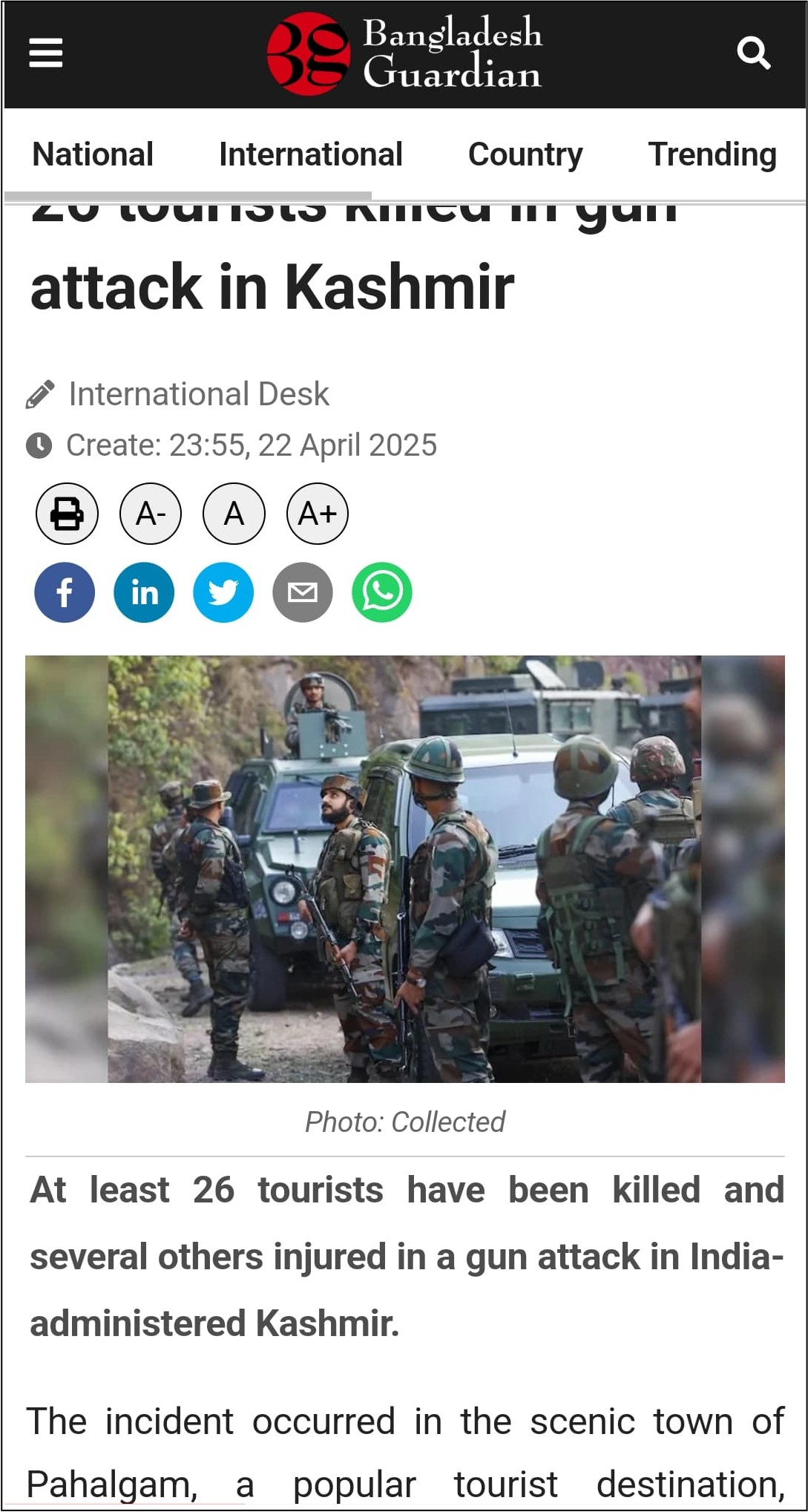
In its report, Bangladesh Guardian referred to the terrorist attack as a “gun attack” and described Kashmir as “Indian-administered Kashmir” in the body of the report. The attackers were referred to as “armed assailants”. Archived link of the Bangladesh Guardian report can be checked here.
Source: Bangladesh Guardian
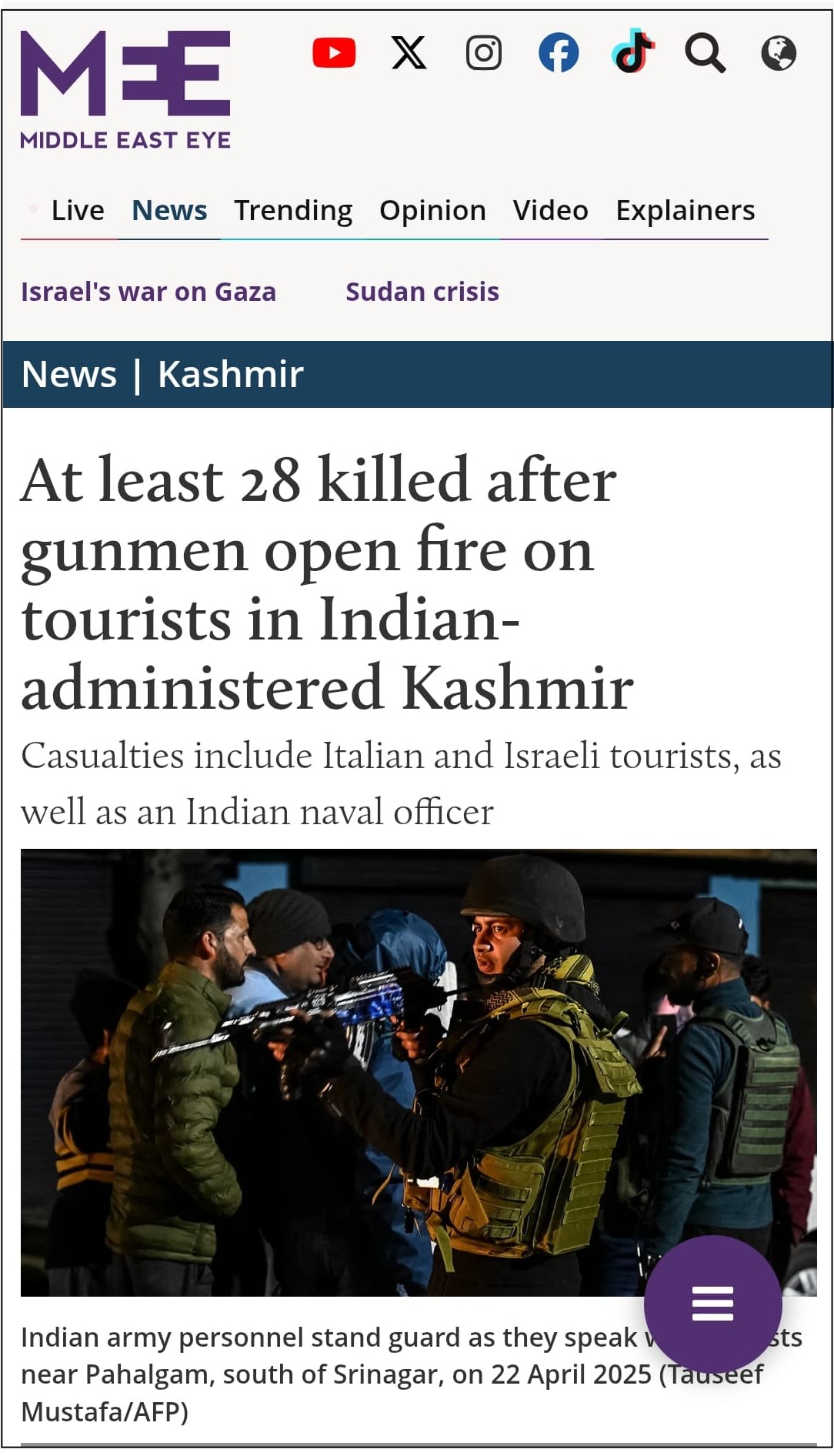
Similarly, Middle East Eye described Kashmir as “Indian-administered Kashmir” and the terrorists as “gunmen”. MEE further attempted to gaslight India by claiming Kashmir is “often dubbed the world’s most militarised zone”, and by quoting the dubious NGO Amnesty International, which claimed that “all credible, independent sources of information on Jammu and Kashmir” are being silenced following the abrogation of Article 370. Archived link of the Middle East Eye report can be checked here.
Source: MEE
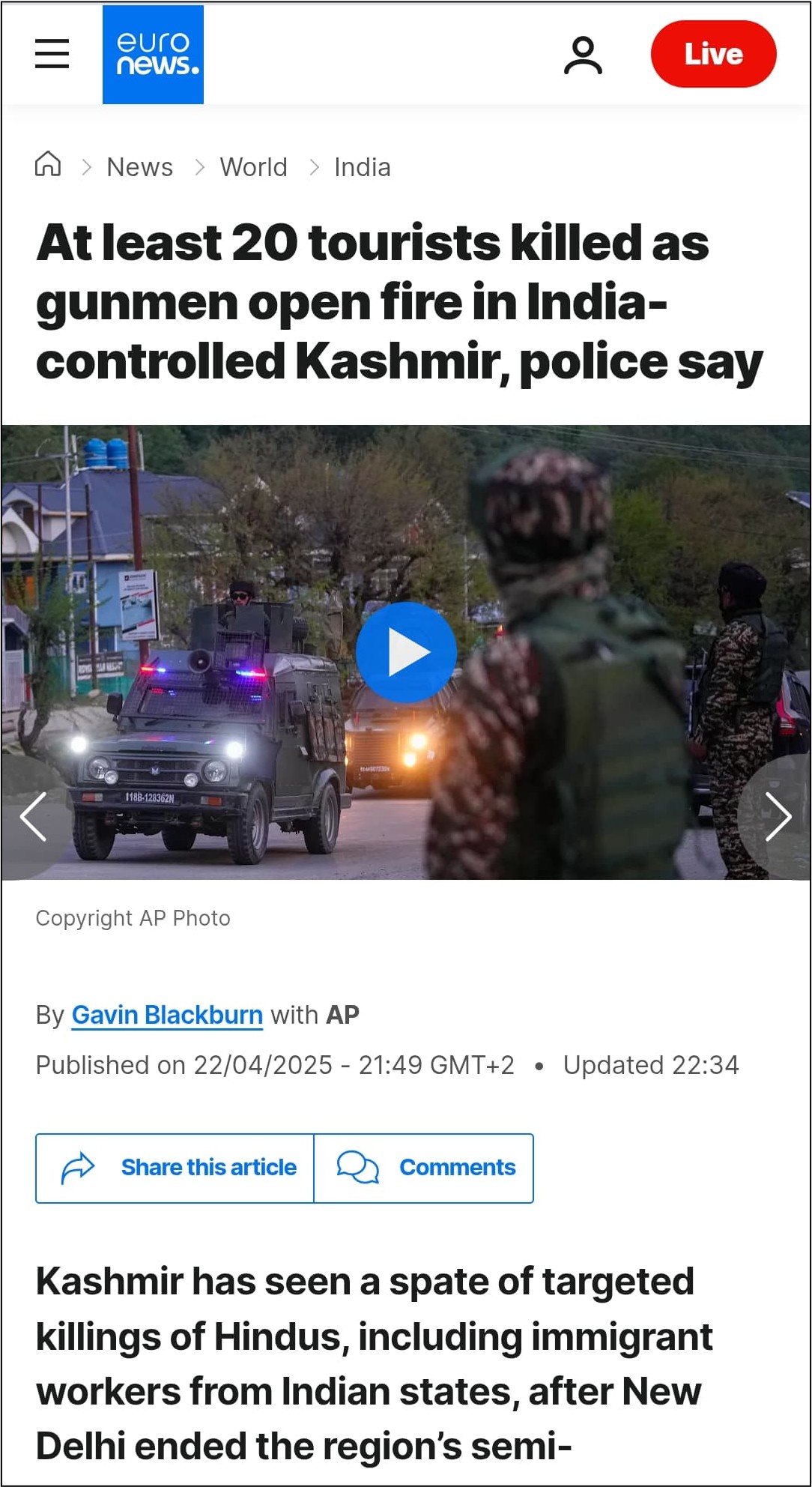
In its report, Euronews also used the phrase “Indian-administered Kashmir” and referred to the terrorists as “gunmen”. Furthermore, the report included the phrase “India-controlled portion of Kashmir”. Archived link of the Euro News report can be checked here.
Source: Euro News
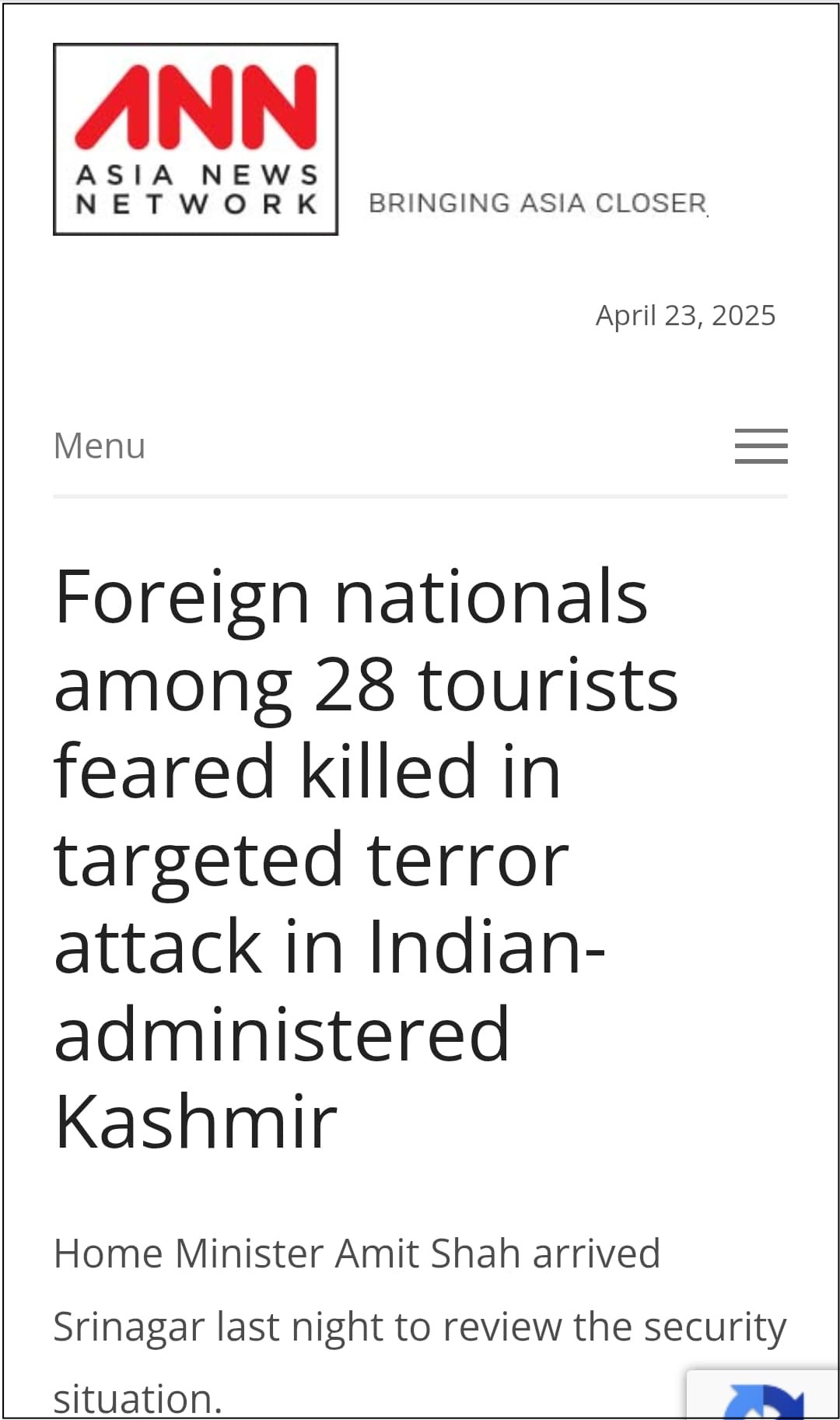
Asia News Network also used “Indian-administered Kashmir” and “gunmen”; however, it did state that it was a terror attack and referred to TRF as a terrorist outfit. Archived link of the Asia News Network report can be checked here.
Source: ANN
The deliberate editorial choices made by global media houses to downplay the Pahalgam attack as anything but a terror act raise serious ethical questions. By avoiding the term “terrorist” and repeatedly using “Indian-administered Kashmir”, these outlets not only diminish the horror faced by victims but also echo the narrative peddled by Pakistan. Such reportage undermines India’s sovereignty and downplays the systematic targeting of Hindus.
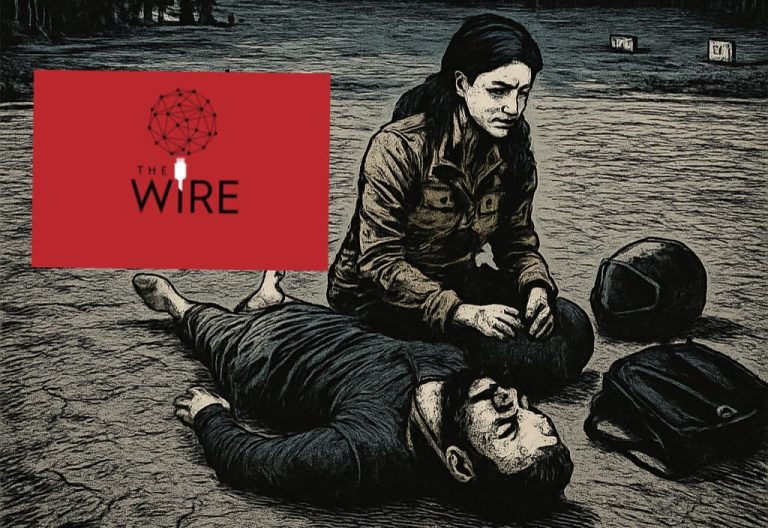
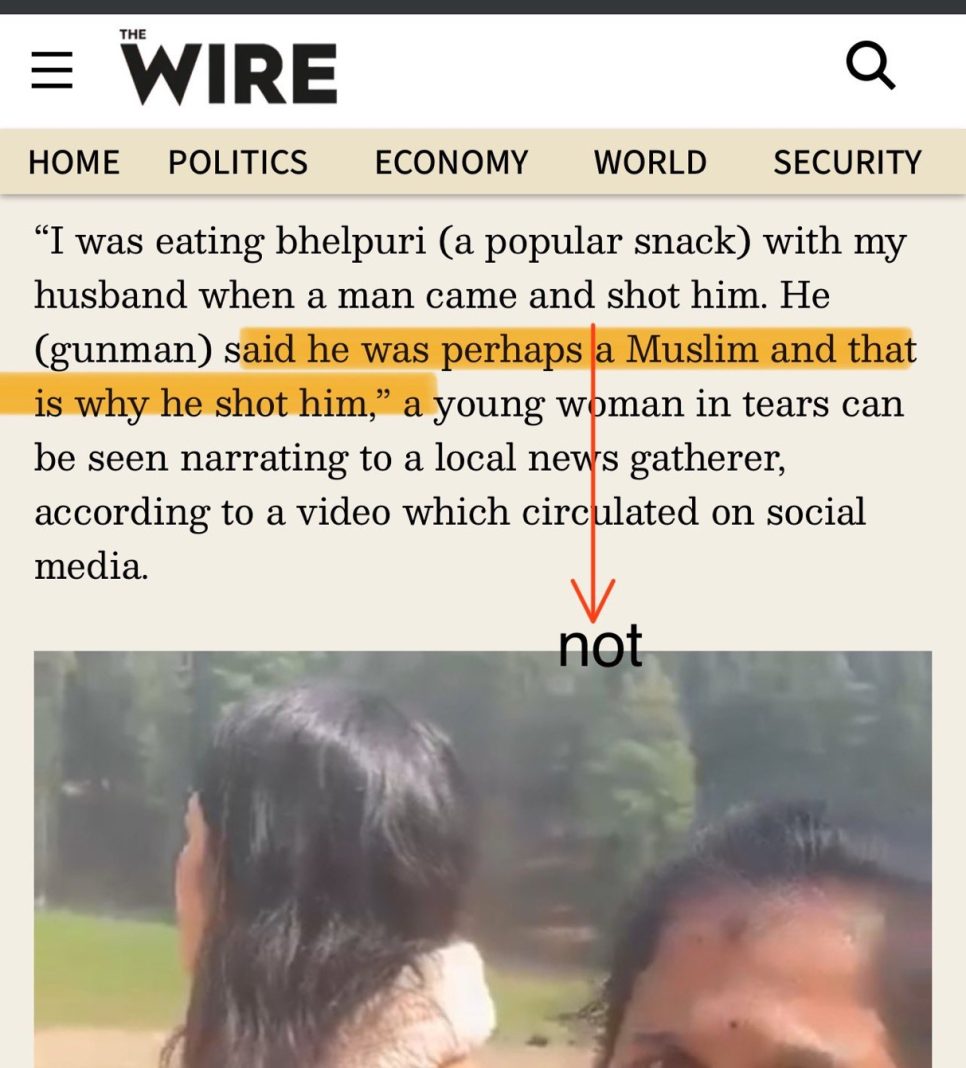
Leftwing propaganda portal The Wire has a history of shielding Islamists. But on April 22, Tuesday, sank to a new low, even by their own diminished standards, when it misquoted an eyewitness testimony that established the religious motive behind the Pahalgam terror attack.
More than 20 tourists were killed in a terror attack in Pahalgam, Kashmir, as terrorists opened fire after identifying them as non-Muslims. Reports and videos circulating online said terrorists checked ID cards and stripped tourists to confirm their religion, before finally shooting them, many of them point blank.
However, a report published by The Wire and authored by one Jehangir Ali quotes an eyewitness of the attack from a video that went viral minutes after it was uploaded online. In the video, a woman, clearly shocked by the attack, could be heard frantically saying that terrorists came and fired bullets at her husband after asking his name and saying he was not a Muslim.
The video also shows a man lying motionless with his pants pulled down. Another man, profusely bleeding from around his neck and his t-shirt stained with the crimson colour of blood, was also seen in the video.
However, the Wire article misquoted the woman, saying that her husband was probably targeted for being a Muslim.
screenshot from TheWire’s report
While the error was corrected following social media backlash, it still highlights The Wire’s well-known tendency to depict Muslims as victims of hate crimes driven by religion and whitewash atrocities committed when the perpetrators are Islamists.
In a chilling attack, terrorists in Pahalgam, Kashmir, targeted tourists after identifying them as non-Muslims. The attack came days after a video of Pakistan COAS Asim Munir ranting against Hindus had gone viral on the internet.
A heart-wrenching video of the incident surfaced online, showing tourists frantically calling out for help as dead bodies lying along the meadows can be seen in the video. Eyewitnesses to the attack could be heard saying that the attack was religiously motivated as terrorists shot tourists point blank after identifying them as Hindus.
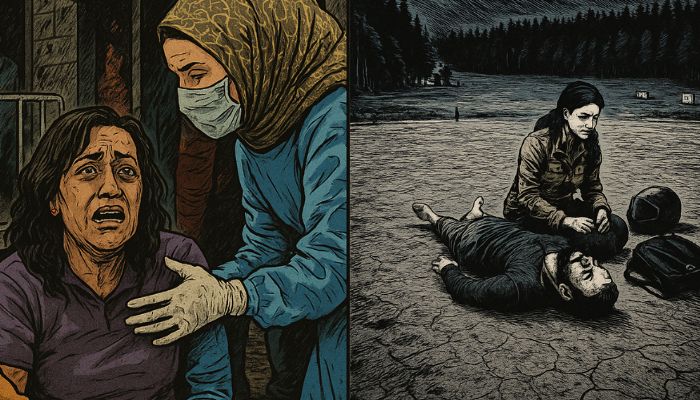
One of the haunting pictures of the attack that has gone viral on social media is of a grief-stricken woman helplessly sitting beside his dead husband. According to reports, the woman was recently married and was on her honeymoon in Kashmir when the terrorists attacked and killed her husband.
According to unofficial sources who are privy to the attack, the number of casualties could exceed 25.
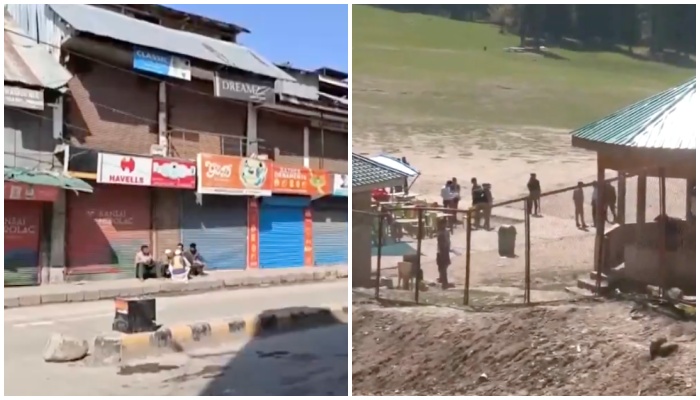
Following the terrorist attack in Kashmir’s Pahalgam on Tuesday, the political parties as well as traders’ unions in the region have collectively called for a complete shutdown in the Kashmir valley on Wednesday to show solidarity with the victims’ families and to condemn the attack.
Speaking to ANI on the complete shutdown in the valley, Bashir Ahmad Kongposh, General Secretary of the Kashmir Traders and Manufacturers Association, said that the complete shutdown was to show a strong condemnation and protest against the Pahalgam terror attack.
“Following the heart-wrenching incident that happened yesterday, the Kashmir traders and manufacturers association will be in complete shutdown today. We have protested against it and condemn this act as strongly as possible. Islam doesn’t allow such things where people get killed… It is the death of humanity… We are really against these acts… Yesterday we had a meeting on the shutdown… We also want to keep these acts away from the region… In solidarity, we have called for a total shutdown in response to the attack,” Kongposh said.
Business communities in Poonch also held protests, calling for a complete shutdown in response to the terror attack yesterday.
Ankit Maheshwari, a tourist from Rajasthan, stated that it was rare to witness such a shutdown in Kashmir; however, he noted that the locals have been very supportive despite the shutdown.
“This is a big incident, and it is very sad. This should not happen, as it is a very beautiful place, but it is very sad. It has never happened to tourists, and now it has happened for the first time. This should be condemned, and it is very rare that Kashmir has shut down… But the locals here are very supportive and are doing a lot despite the shutdown,” he said.
Ashiq Hussain, a resident of Srinagar, emphasised that the attack was the “murder of humanity” and questioned why such incidents take place, as it damages the name of the place.
“The news of the tourists who were attacked in Pahalgam is not a good thing because this is the murder of humanity… It is unclear why such incidents are occurring now. Currently, tourism is at its peak, but you will soon see the impact it has. Our name is being tarnished by this situation, which is worsening all over the world. If someone is making a mistake, then our name is getting worse. We don’t want such things to happen. This is absolutely wrong… We Kashmiris are all with them (the victims) right now, with their pain,” Hussain stated.
Earlier on Tuesday, several political parties in Jammu and Kashmir have extended their support to the call for a Kashmir Bandh (shutdown) on Wednesday to condemn the Pahalgam terror attack and show solidarity with the victims’ families.
Jammu and Kashmir National Conference (JKNC) has appealed to the people to make the Bandh a “complete success” and join in condemning the Pahalgam terror attack.
In a social media post on X, JKNC wrote, “On the instruction of the Party President, JKNC joins the collective call for a bandh in strong condemnation of the Pahalgam terror attack. We appeal to the people of J&K to ensure the hartal called by religious and social leaders is a complete success.”
Jammu and Kashmir Peoples Democratic Party (PDP) chief Mehbooba Mufti has expressed solidarity with the victims’ families and supported the shutdown, calling it an “attack on all of us.”
Jammu-Kashmir Students Association (JKSA) has termed the attack an “assault on the very soul of Jammu and Kashmir” and has also extended its support to the Bandh.
All Parties Hurriyat Conference Chairman Mirwaiz Umar Farooq urged the people of Jammu and Kashmir to support the shutdown and peacefully protest against the “heinous crime.”
Meanwhile, the Indian Army and Jammu and Kashmir Police have launched a search operation in the general area of Baisran, Pahalgam, Anantnag, to nab the perpetrators of the attack.
(This news report is published from a syndicated feed. Except for the headline, the content has not been written or edited by OpIndia staff)