Home Blog Page 4536

Congress ‘remembers’ Kamala Nehru on her ‘birth anniversary’ which is actually her death anniversary: The legacy of gaffes continues

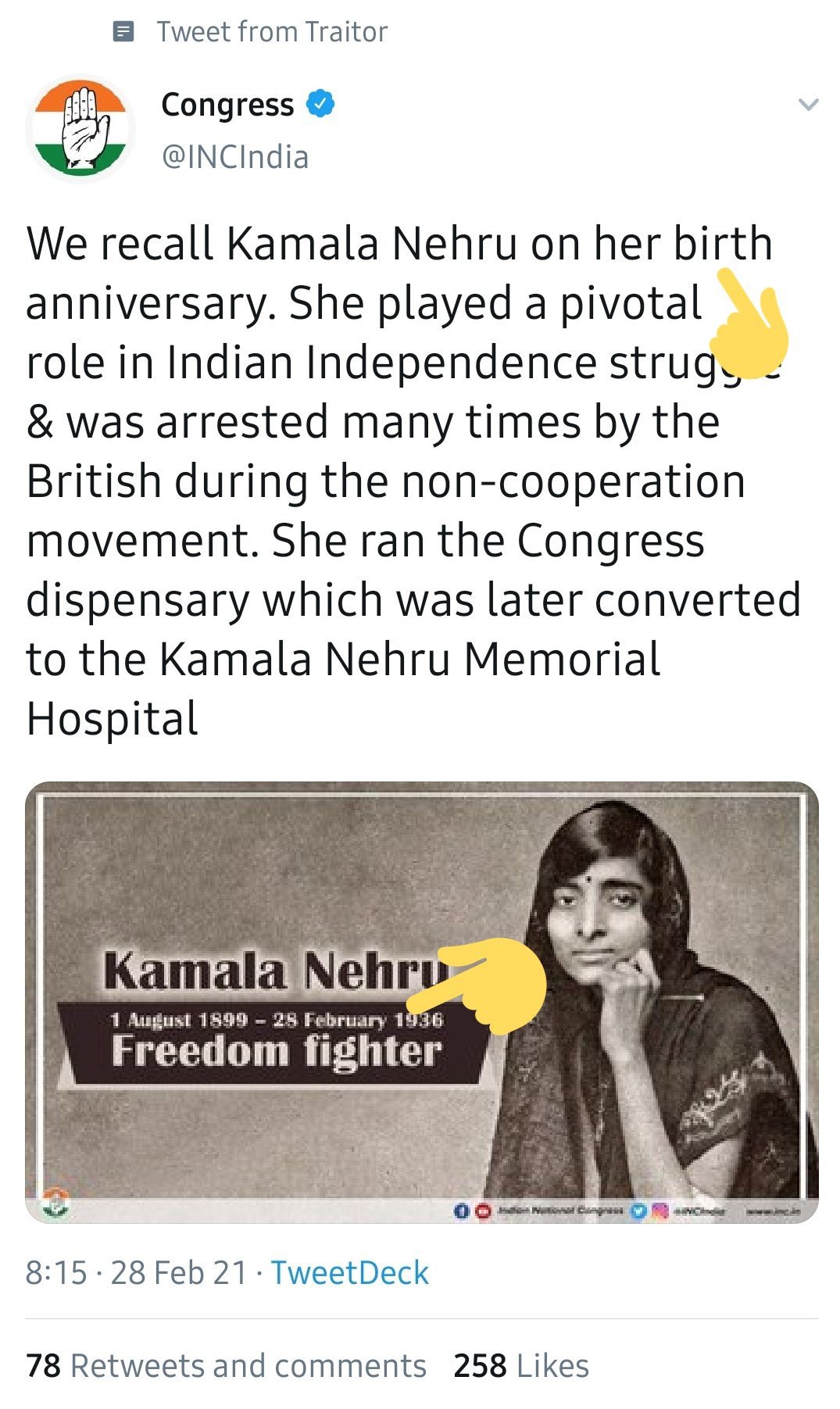
Giving tight competition to Congress leader Rahul Gandhi is the social media handle of the Grand Old Party which continues its legacy of gaffes. On Sunday, Congress Twitter account paid its respect to Jawaharlal Nehru’s wife, Kamala Nehru on her ‘birth anniversary’. Except, it was actually her death anniversary.

Congress’ tweet on Kamala Nehru’s ‘birth anniversary’ (image courtesy @befittingfacts on Twitter)

At 8:15 AM, Congress Twitter account tweeted that they recall Kamala Nehru on her birth anniversary. Except, 28th February is her death anniversary, not her birth anniversary. Her birthday falls on 1st August.

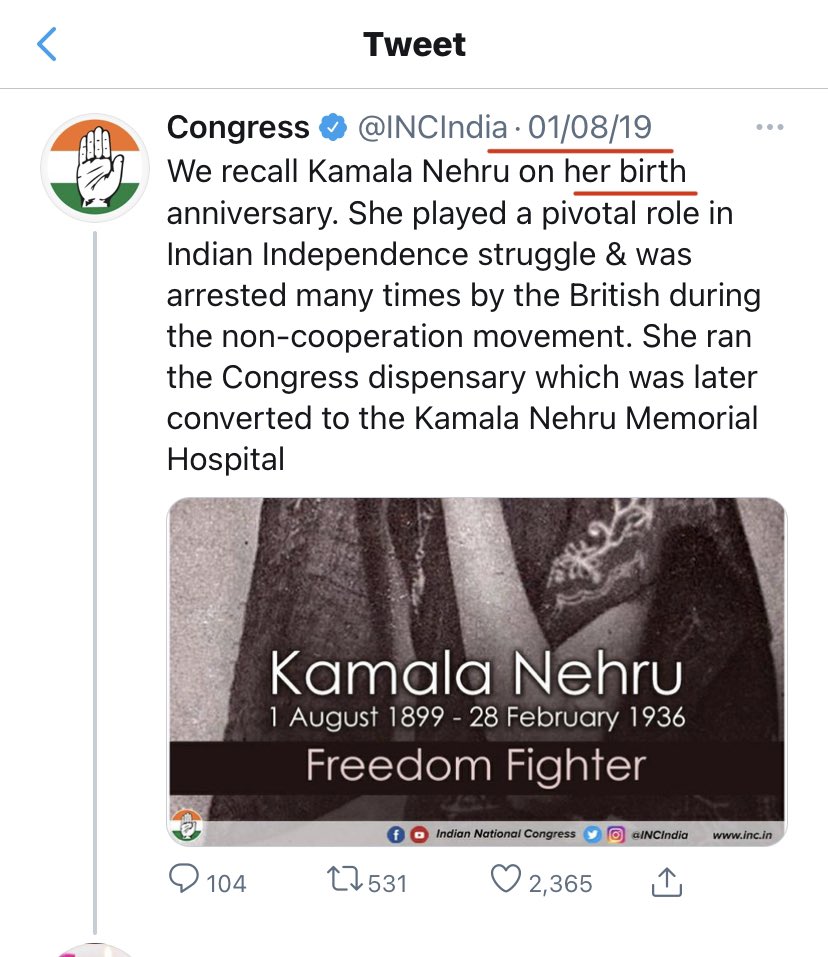
Interestingly, Congress had used the exact same text for her birth anniversary post in 2019.

Kamala Nehru’s birth anniversary tweet (image courtesy @befittingfacts on Twitter)

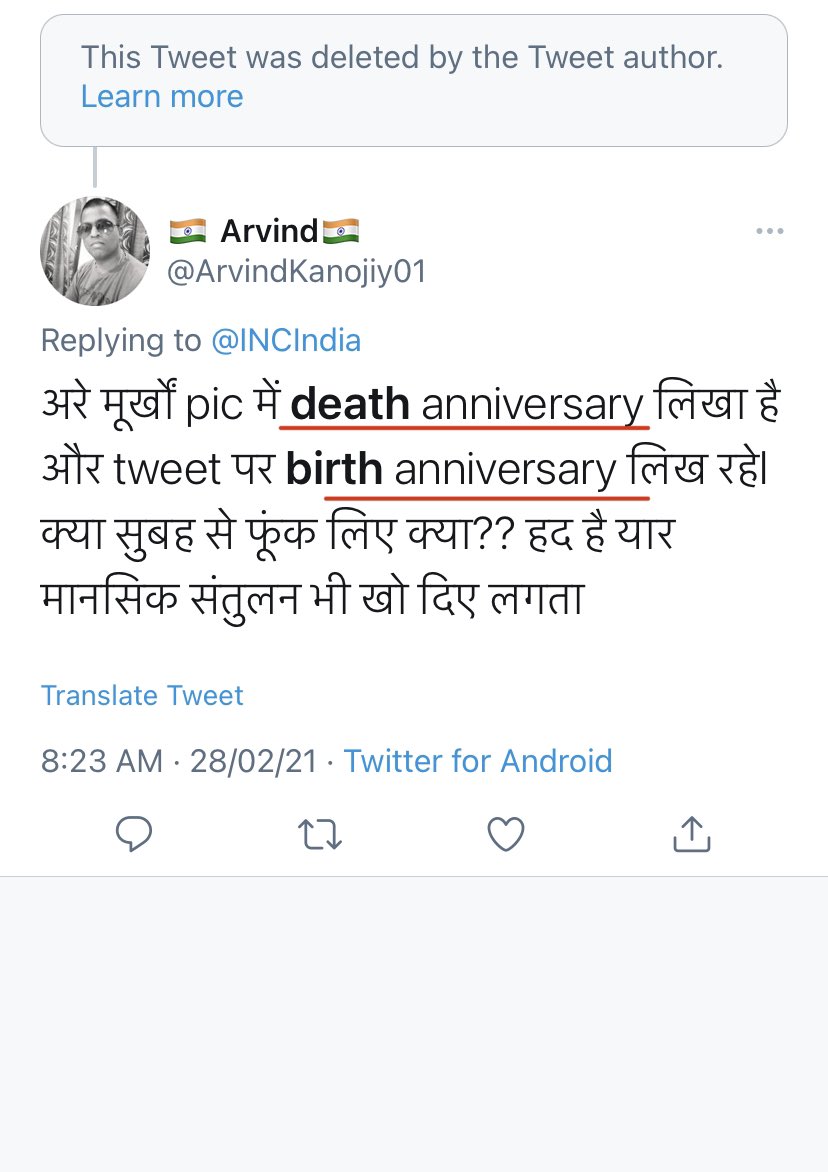
Many netizens pointed out Congress’ gaffe.

Netizens pointing out Congress’ gaffe (image courtesy: @befittingfacts on Twitter)

In fact, that was not all. Congress’ copy-paste mechanism has been a tried and tested formula.

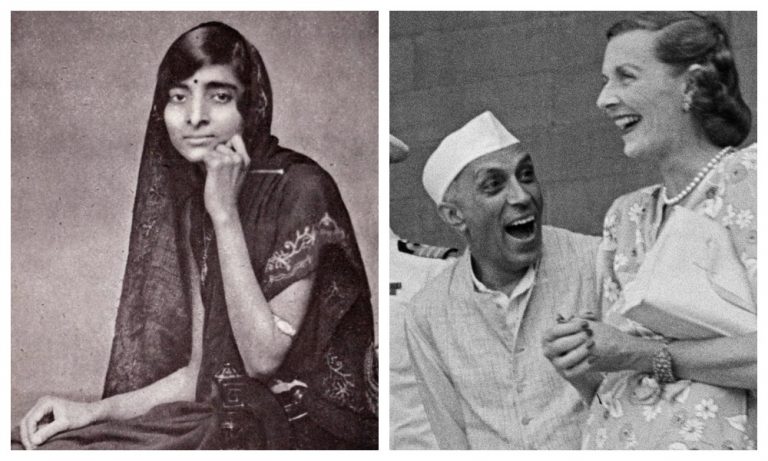
Some even took a dig at the ‘friendly’ relationship Nehru shared with Lady Mountbatten.

However, after many pointed out, Congress quietly deleted the tweet and posted another one with correct information that today was Kamala Nehru’s death anniversary.

It seems like Congress social media account has been inspired from Rahul Gandhi’s copy-paste promises like establishing Ministry of Fisheries, when it already exists.

Congress’ gaffe galore

Congress social media account has been quite synonymous with gaffes. In August 2018, Congress paid tribute to legendary singer Kishore Kumar who was banned by Indira Gandhi government for opposing Emergency. Just days before that, Congress Twitter account had referred to Subhadra as Lord Jagannath’s ‘brother’. Prior to that, Congress’ #KnowYourLegacy campaign got them trolled because of their goof-ups.

In fact, not only Congress, but even Rahul Gandhi’s relatives are prone to making gaffes. During 2019 general elections, Rahul Gandhi’s brother in law and Priyanka Gandhi’s husband Robert Vadra posted his inked selfie with Paraguay flag instead of Indian flag. He delete the tweet after being called out.

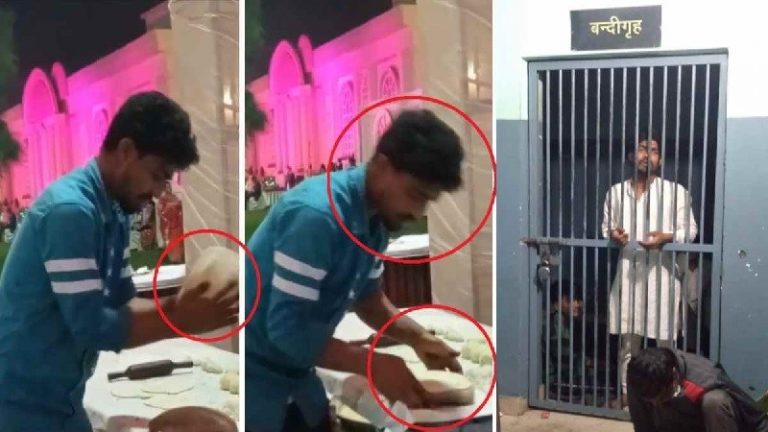
Naushad, who was caught spitting while cooking tandoori rotis in viral wedding video, to be booked under NSA

Naushad alias Suhail, who was caught spitting while cooking the tandoori rotis at weddings, will now be booked under the National Security Act (NSA). As per reports, the police has already started the procedure.

Earlier this month, a video of Naushad who appears to be spitting on the tandoori rotis before putting them inside the tandoor for cooking, while at a wedding function, had gone viral.

The video was of a wedding function from Aroma Garden party plot in Meerut which was held on 16th February 2021. Soon after he was caught and a case was registered under several sections including 269, 270, 188 of the Indian Penal Code and Section 3 of Epidemic Disease Act.

As per reports, Medical Thana’s Inspector Pramod Kumar has informed that the process to book him under the NSA is currently underway. Naushad is currently in 14 day judicial custody. He has been engaged in the work of making tandoori rotis since past 10 years.

Delhi Police arrests 2 men who were plotting to assassinate Kashmiri activist Sushil Pandit against payment

The Delhi Police on Saturday arrested two gunmen from Punjab on charges of planning to murder a Kashmiri activist, Sushil Pandit. The duo was arrested from Venkateshwara Road near RK Puram. The Delhi Police Special Cell later interrogated them.

Deputy Commissioner of Police for Southwest Delhi Devender Arya said Sukhvinder Singh, 25, and Lakhan, 21, were arrested in RK Puram on Saturday. According to the Delhi Police, during their interrogation, they told the police that a man identified as ‘Prince’ from Faridkot had hired them to kill Kashmiri activist Sushil Pandit. They were reportedly paid Rs 10 lakhs each for bumping off the activist.

Two pistols, two country-made guns and four live cartridges were recovered from the duo, the police said. The two arrested men were communicating on the Signal app to avoid detection. The police also added that the duo had planned to take down the activist near Qutub Institutional Area in New Delhi. In addition to the arrested men, two women are also suspected to be involved in the plot and attempts are underway to nab them.

The police have booked the duo for abetting an offence punishable with death or life term (Section 115) under the Indian Penal Code and the Arms Act.

Sushil Pandit is a Kashmiri activist based out of New Delhi. He has been vocal about issues pertaining to Jammu and Kashmir and has steadfastly supported the government’s decision to abrogate Article 370. According to the sources cited by Republic TV, plotters were reportedly miffed with the ‘pro-establishment’ speeches given by Sushil Pandit at the Jawarhal Nehru University recently where he had also spoken about the plight of the 3.50 lakh Kashmiri pandits who had to leave Kashmir in the face of mounting threats posed by Islamists during the 1990s.

Journalist Aditya Raj Kaul claims he was threatened by Khalistani elements last year

Following the arrests made by Delhi Police, Kashmiri journalist Aditya Raj Kaul took to Twitter to place on record a threat he had received last year by Khalistani elements based abroad. Kaul, who is a Kashmiri Pandit, urged the Ministry of Home Affairs to immediately provide security to prominent Kashmiri Pandit activists as per security protocol or threat analysis.

In a string of tweets, Kaul revealed that in 2020, his former boss and a journalist with an international news agency in New Delhi were called from an unidentified foreign number and given his name and asked to convey to him that he should mend his ways or face consequences.

Kaul further mentioned that he had shared the details of the incident with MHA, Delhi Police, and subsequently with the UP Police. Though the number was untraceable, the voice was identified as belonging to a known terror group, Kaul added.

Kaul, too, has been a vocal supporter of the measures initiated by the Modi government to snuff out the menace of Islamist terrorism in Jammu and Kashmir and has not shied away from criticising the Kashmiri separatists and anti-India forces.

Assam Congress MLA beats model code of conduct, lays foundation stone for 150 schemes hours before assembly election schedule announced by EC

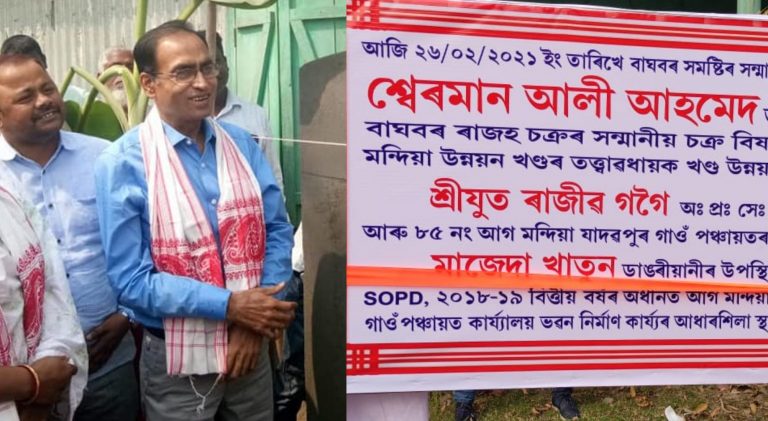
The Election Commission of India announced the schedule of upcoming assembly elections for four states and one union territory yesterday, and as a result model code of conduct came into force immediately. The announcement by the poll panel came as a surprise for most political parties in Assam, as it was expected that dates will be announced in the first week of March, like the last time. This sudden announcement ahead of anticipation meant cold water was poured on the plans of many politicians to announce to schemes ahead of polls. But it didn’t deter one Congress MLA in Assam, who announced as many as 150 schemes just hours before the EC held the press conference in Delhi to announce the election dates.

Sherman Ali, the Congress MLA from Baghbar in Assam, got active as soon as media started reporting that the poll panel will hold a press conference at 4.30 PM on Friday to announce the dates. He hurriedly arranged to lay the foundation stone for a record 150 different projects in his constituency, and he managed to complete the same before the EC press conference was started in Delhi.

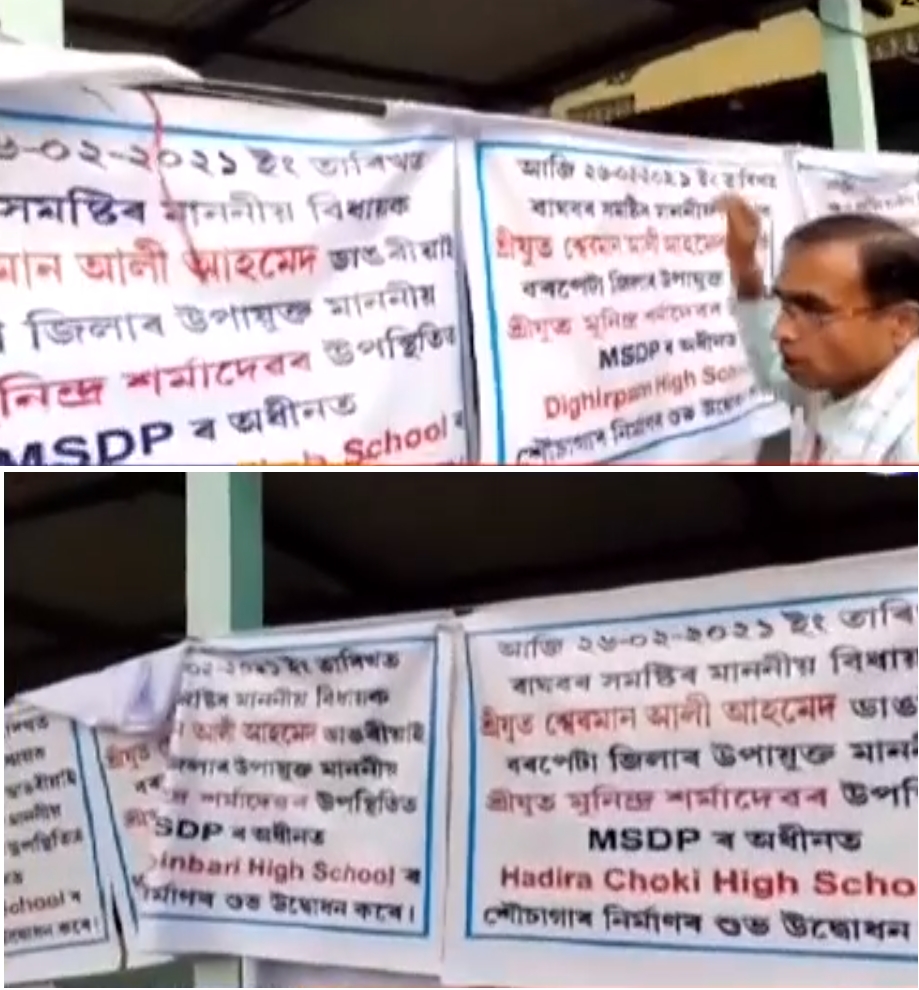
MLA Sherman Ali achieved this unique feat by laying the foundation stone for all the 150 schemes in one just place, a High School in his constituency. The MLA arranged to print banners for all the 150 schemes, got them hung on ropes on the ground of the school, and got them covered with pieces of white clothes. After reaching the school, he kept unveiling the banners by removing the cover on them one by one, thus launching the record number of schemes within a couple of hours.

Assam Congress MLA launches 150 schemes before poll dates are announced

All the schemes that he has announced are worth around Rs 50 crore in total. The schemes include a cultural complex, gram panchayat office buildings, residences for female TET teachers, social forestry schemes etc.

“Today we have laid foundation stones of 150 projects in the Baghbar constituency. I hope, the proper implementation of these projects will boost the development of the constituency,” Sherman Ali Ahmed said while talking to media after the event.

While Sherman Ali worked in a war footing to avoid the model code of conduct to announce schemes, his candidature is not confirmed yet. He has been one of the most controversial MLAs in Assam, who had started a massive controversy by demanding a ‘Miya Museum’ in the Srimanta Sankardev Kalakshetra in Guwahati. And media had asked what he proposes to keep in the ‘Miya Museum’, he had suggested things like blue lungi and green saree, typically worn by Bangladeshi Muslims in Assam. It may be noted that the word Miya is used to refer to Bangladeshi Muslims living in Assam, who immigrated into India both before and after the partition.

The poll dates came as surprise not only for the Congress MLA, but also for the BJP, as none other than prime minister Narendra Modi had speculated that EC will announce the dates in March. Addressing a rally at Silapathar in Assam on 22nd February, PM Modi had said that the dates for the Assam Assembly election are likely to be announced by the Election Commission of India in the first week of March. He had made this prediction based on the fact that in 2016, the dates were announced on 4th March.

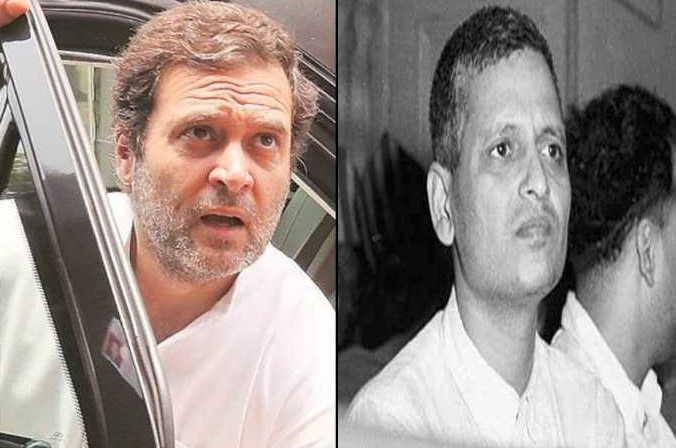
Hindu Mahasabha asks Rahul Gandhi to change Congress’ name to ‘Godsevadi Congress’ after Godse follower joined party: Read why

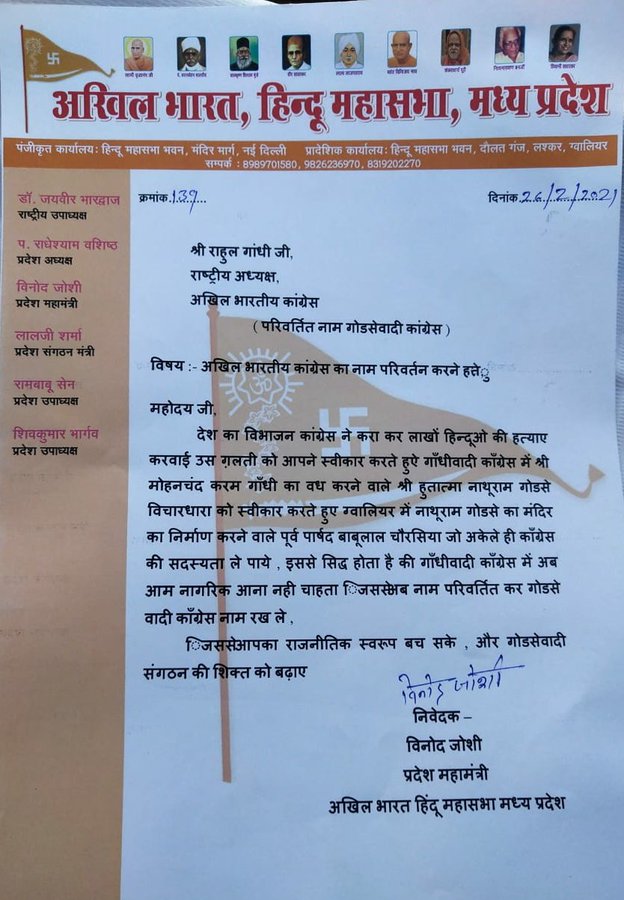
The Hindu Mahasabha has written a letter to former Congress president Rahul Gandhi and urged him to change the name of the Congress party to Godsevadi Congress days after a Godse follower was inducted into the party. The letter said that the Congress should change its name as no ordinary citizen wants to become a member of the ‘Gandhivadi’ party.

The letter states that the Congress party was responsible for the partition of the country and the deaths of hundreds and thousands of Hindus at the time. The letter states that changing the name to ‘Godsevadi Congress’ will help revive the political fortunes of the party.

Source: Sandeep Singh (journalist with ANI)

Babulal Chaurasia, the Hindu Mahasabha leader and a worshiper of MK Gandhi’s killer Nathuram Godse, had earlier joined the Congress party ahead of the Madhya Pradesh civic body elections. Former Madhya Pradesh Chief Minister Kamal Nath and other senior Congress leaders wholeheartedly welcomed the former Hindu Mahasabha leader to the party.

Babulal Chaurasia had contested the Gwalior municipal elections last time from a Hindu Mahasabha ticket and won the elections after being denied a ticket from the Congress party. The former Congress leader had rebelled from the party to contest in the Ward 44 of the Gwalior municipal elections. He had left Congress after being denied a ticket and had defeated Congress candidate Shammi Sharma.

The Hindu Mahasabha leader Babulal Chaurasia rose to fame after he had installed a statue of Nathuram Godse. Chaurasia had then organized a program called ‘Nathuram Godse’s 70th Sacrifice Day’.

Punjab police books Shiromani Akali Dal leader and 6 others for keeping a girl confined for 8 months, raping and selling her

In a major development, the Punjab police have lodged a case against 7 people, including a Shiromani Akali Dal (SAD) leader, for holding a 22-year-old girl in captivity and raping her for 8 months. As per reports, 3 police officials have also been suspended for threatening and intimidating the victim.

The victim’s brother informed that on June 24 last year, a female tenant staying in their house took his sister to the house of an Akali Dal leader’s brother. At that time, around 20-25 people were present at the house, including the SAD leader, a godman, and a few women. They had allegedly offered the victim a spiked drink, post which she lost consciousness. On the same day, she was gang-raped by the accused SAD leader, the godman, and several others.

The victim’s brother further said that his sister was kept in Pandhar village in Barnala for 17 days, following which she was taken to Sangrur for 3 days. She was then taken to Bhatinda and forcefully married off in exchange for ₹70000. When she was kept in captivity, the victim overheard a conversation by the accused wherein they were planning to sell her off for ₹3 lacs. The 22-year-old girl somehow managed to flee and contacted her mother. When her brother finally found her, she was in an intoxicated condition.

Victim’s family allege police intimidation

The family members then took her to a government hospital where she underwent a medical examination. The victim has also given her statement before the Magistrate. Fearing threats to their life, the family has demanded protection from the district administration. They alleged that the Station House Officer (SHO) at Barnala police station demanded money from them. The family members then requested to meet the Superintendent of Police but it was turned down. Meanwhile, the case was handed over to another SHO. They alleged that three police officials intimidated the victim to give a statement in favour of the accused.

Three police officials suspended, police investigation resumes

They have demanded stringent action against the 7 accused and the three police officials. DSP (Barnala) Lakhbir Singh Tiwana informed that a First Information Report (No. 340) was registered on July 10 last year. It was based on the complaint by the victim’s mother, who said that the victim was lured by her tenant. Tiwana emphasised that the accused woman was arrested and sent to jail. However, the victim, in her statement before the District magistrate, claimed that she wasn’t lured by anyone and had got married legally on her own accord. As such, the police probe came to a halt in the case.

On February 23 (Tuesday), the police received information that the victim was admitted at the Barnala government hospital. The Magistrate was called in and the victim’s statement was recorded. She has named several people for raping her and accused three police officials of intimidating her. The SP (Barnala) ordered the immediate suspension of the three police officials and directed the resumption of the police investigation. A case was thus registered against 7 people, who hail from different areas including Barnala, Bathinda, Panipat, and Ludhiana.

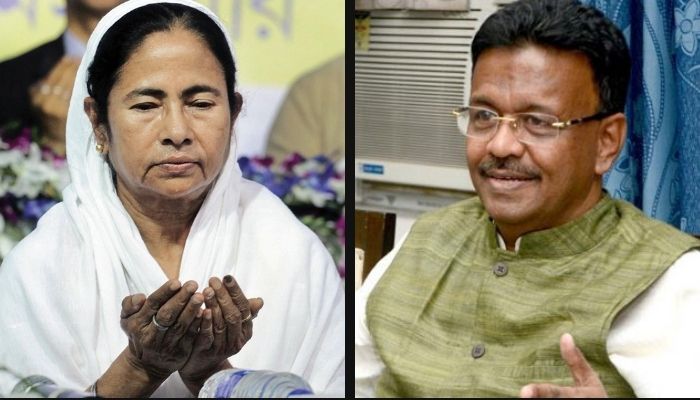
TMC leader Firhad Hakim spotted campaigning at masjid, promises to increase money paid to Imams, breaches model code of conduct

On Saturday, Trinamool Congress (TMC) leader Firhad Hakim was spotted delivering a political speech at a masjid in Kolkata ahead of the upcoming elections in West Bengal, in blatant violation of the Model Code of Conduct. Hakim is the Mayor of Kolkata and the Minister for Urban Development and Municipal Affairs.

The model of conduct clearly states, “There shall be no appeal to caste or communal feelings for securing votes. Mosques, Churches, Temples or other places of worship shall not be used as forum for election propaganda.”

In an exclusive news story, TV9 Bharatvarsh reported that the TMC leader raised political slogans at the masjid. In a bid to continue its stronghold over the Muslim vote bank in the State, Firhad Hakim raised the issue of Gujarat riots that took place 19 years ago. While casting aspersions about the rival BJP, he alleged that the rioting that took place in Gujarat in 2002 should not be allowed to repeat in West Bengal. He appealed to the Muslims gathered in the masjid to note vote for the BJP.

Furthermore, Firhad Hakim said that the honorarium (bhata) paid to Imams would be increased if the Mamata-Banerjee-run-TMC is voted back to power. He assured that he has plans to increase the monthly income of the Muslim clerics in the State. Interestingly, the Imam sitting next to him urged the audience to say ‘Ameen’ (as a gesture of agreement to Hakim’s political speech).

On being confronted by TV9 Bharatvarsh leader, the TMC leader claimed that he had come to the mosque to offer prayers (dua) so that the ‘divisive forces’ can be demolished in the state. He further said that around 2000 people died during the Gujarat riots, 52 during the Delhi riots, and how terrorist Ishrat Jahan was supposedly killed in a fake encounter case. When quizzed about his promise to increase honorarium for Imams, Hakim tried to dodge the question and said that he did not promise anything.

He claimed that only the ‘morally upright’ Muslims become Imams and that they suffer from financial crisis. The TMC leader added that while Mamata Banerjee made the initiative of ‘Imam bhata’, the funds available with Waqf board can solve their financial crisis. On being prodded further, Hakim reiterated that he was invited to the Imam Conference at the masjid premises and that he had come to only offer prayers. Hitting out at the TMC, the BJP has informed that they would approach the Election Commission and register a complaint against Firhad Hakim for violating the Model Code of Conduct.

The fight over Muslim vote bank in West Bengal

Mamata Banerjee’s Trinamool Congress party and Hyderabad MP Asaduddin Owaisi’s AIMIM have been locked in a battle for Muslim votes in Bengal.

It may be recalled how Mamata Banerjee had launched a scathing attack at Owaisi after the latter announced to enter the electoral fray in the state. She had accused AIMIM of being under the payroll of BJP, saying that they were indirectly helping BJP by dividing the Muslim votes. However, responding to the allegations of Mamata Banerjee, Asaduddin Owaisi had lambasted her by saying that he cannot be bought for money.

On one side, Asaduddin Owaisi is threatening to capture her Muslim vote bank while on the other, the Hindus have already consolidated behind the BJP due to her continuous Muslim appeasement. In such a precarious situation, it is only just that the unnerved Mamata Banerjee wants at least Owaisi to not enter the electoral fray of West Bengal. The Election Commission of India on Friday announced an eight-phased Assembly poll for West Bengal beginning March 27. The counting of votes will take place on May 2.

As desperate Pakistan welcomes the Indo-Pak ceasefire with much fanfare, India takes it with a caution

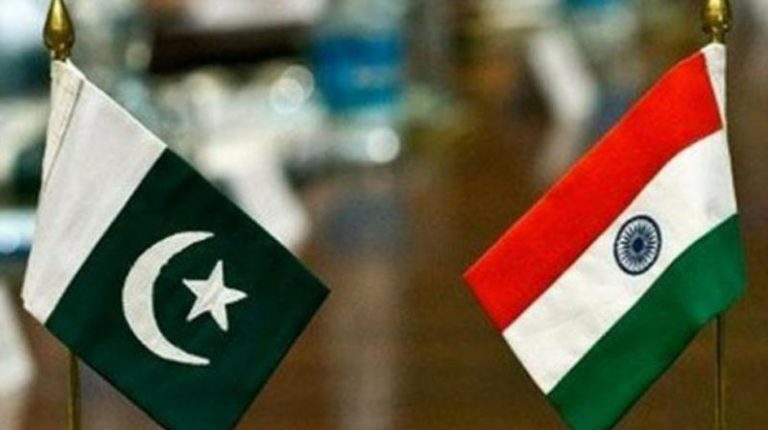
On Thursday, the Indian and Pakistan Armed Forces surprisingly announced a ceasefire agreement along the Line of Control (LoC) in Jammu and Kashmir. The Directors General of Military Operations of India and Pakistan released a joint statement saying that they have held discussions regarding establishing a hotline contact mechanism and agreed to a ceasefire along the LoC starting from February 25.

The latest ceasefire agreement between the two sides comes nearly 17 years after such an agreement was first signed between India and Pakistan, which was broadly held till the 2016 Uri attack. Since 2018, the tensions have only escalated between the two sides, causing a violation of the ceasefire agreement with more than 5,000 incidents reported this year alone.

Interestingly, the latest ceasefire agreements between the two militaries come when Pakistan faces its toughest challenges – both domestically and internationally. Even though the latest ceasefire is being observed in India with caution, strangely, the Pakistan government and its security establishment have welcomed it with much fanfare. Not just in Pakistan, even the peaceniks and pro-Pakistan sympathisers in India are excited about the ceasefire agreement hoping that this could open avenues for rapprochement between the two sides and lead to normalisation of the diplomatic relations.

Though such unwritten understanding does not hold any large value, the ceasefire along the LoC, for now, has given some breathing space for Pakistan. The desperation of Pakistan to achieve some peace along the LoC through a ceasefire was evident from the statements put out by Moeed Yusuf, Pakistan Prime Minister Imran Khan’s key advisor on security affairs. As the two sides announced the agreement, Yusuf said that the outcome was due to the “behind the scenes” contacts and hoped that the agreement would open more roads in future.

Desperate Pakistan ecstatic about ceasefire

Moeed Yusuf, who holds the post of special assistant to Khan on national security and strategic policy planning, revealed how Pakistan had to put all its efforts for many months and years to convince India on an agreement to have a ceasefire along the LoC. He also contended that the joint statement was a victory for Pakistan, as India did not initially agree to a ceasefire.

Most importantly, Yusuf stressed that Pakistan was “repeatedly saying that we want peace and we want that there should be a ceasefire at the LoC” so that innocent civilians are not killed. According to the people familiar with developments in Pakistan, Yusuf has played a key role in efforts to achieve a breakthrough with India and has the backing of the powerful military, including Pakistan Army chief Gen Qamar Bajwa.

If one takes a closer look at the latest ceasefire agreement and the subsequent statement released by the Pakistani establishment, it is rather evident that Pakistan seeks a ‘detente’ with India as it has become extremely costly for the terror-state to wage a proxy war against India continuously.

Why is Pakistan craving for ‘peace’ with India now?

It is not an unknown fact today that Pakistan is facing turmoil, both internationally and within the country. The internal dynamics in the Islamic republic has added to the increasing international pressure on the Pakistan government to act against the terror infrastructure it nurtured all these years. The mounting pressure on Pakistan seems to have a bearing on the ceasefire agreement as well. Multiple factors are behind Pakistan to engage in talks with India even as it continues to inflict terror in Kashmir.

The fear of sanctions by international watchdogs for failing to act on the terror appartus and the gradual decline of Pakistan’s relevance in the global power architecture due to its active support to terror has now been pushed the Islamic country into a corner. Facing the heat, Pakistan has been forced to take some tough decisions and rapproachment with India to achieve a short term peace is one of them.

The terror-state of Pakistan is imploding as it faces innumerable challenges both domestically and internationally. The influential role of the Pakistan military in its domestic politics and over-reliance on terror as a state policy to confront its neighbours has backfired the Islamic country. On its western front, where it shares borders with Afghanistan, there are no clear signs of any definitive policy as the United States continue to drag their feet on Afghan peace talks with the Taliban. Pakistan intends to play a major role in Afghan security once an agreement between the United States and Taliban is achieved and hence has invested more monetary resources and troops on its Western front.

On its eastern front, it is not an unknown fact that Pakistan has outsourced its ‘holy war’ against India to the Mujahideens and Islamic terror groups, which it often treats as its second-tier militia. Several POK and Kashmir-based terror groups have become a mainstay of Pakistan’s India policy and have used these terror groups to bleed India with thousand cuts.

‘Terror’ as a state-policy is not yielding results for Pakistan

The coming of Narendra Modi and the aggressive approach of the Indian Armed Forces, which is vigorously carrying out counter-terror operations both inside the valley and deep inside the enemy’s territory, has forced Pakistan to rethink its state-sponsored terror policy. With its conventional Army reluctant to face Indian troops and the terror-groups, it sponsored all along is being eliminated by Indian forces, Pakistan has no choice but to seek peace with India along the Line of Control.

Another important factor that has forced Pakistan to plead for peace also emanates from the ongoing actions by the global watchdogs such as FATF, which have been extremely critical of Pakistan’s dubious standards of using terror apparatus as a diplomatic tool to negotiate both in Afghanistan and India. The Financial Action Task Force (FATF), which monitors terror financing, has placed Pakistan on the grey-list for almost three years now, leading to massive losses worth billions for the country. There are possibilities that sanctions could be imposed against Pakistan and place it under FATF’s blacklist if it fails to act against terror groups.

Perhaps, Pakistan hopes that a thaw in relations with India could give them the much-needed space and time to address other issues that threaten the very survival of the country.

Adding to increasing global pressure, there have been reports that China is forcing the Imran Khan government to take steps to re-engage with India. China, which has invested billions in developing its ambitious CPEC corridor in the Indian territory of POK, has been facing tremendous security challenges, both in PoK and Balochistan, where it is building a port at Gwadar. The Chinese have run into deep trouble in Balochistan and Gilgit- Baltistan as they continue to face stiff resistance from the local people.

The massive loss of face for China in the recent stand-off with India along the LAC has also limited Pakistan’s options, which miscalculated India’s strategic response to China’s belligerence on the northern border. The China-India disengagement process has altered Pakistan’s choices now, leaving it with an option of seeking peace with India. With India has no incentive to talk to Pakistan, any dialogue on peace has to start from Pakistan, and it has made its first move by holding talks with the Indian DGMO to announce a ceasefire agreement.

Pakistan also understands that it has reached an endgame in Kashmir as normalcy is slowly returning in the valley. Today, the people of Jammu and Kashmir are gradually entering the mainstream by rejecting Pakistan-based separatists. The Kashmiris are rejoicing the progress that has been made ever since the controversial Article 370 was abrogated. The Kashmir landscape has gone a major shift in the last two years that is openly visible today. There are no more funerals for terrorists, incidents of stone-pelting have reduced as there is a visible change in the mindset of the people of Kashmir. The Kashmiris want long-lasting peace and are aware that it is definitely not Pakistan that is going to deliver it for them.

India negotiates on its strength, ready to tackle Pakistan challenge

Perhaps, Pakistan has now understood that it cannot continue to inflict terror on India without paying a cost to it. Narendra Modi government’s aggressive posture towards Pakistan, especially on the issue of inflicting terror inside Kashmir, has forced Pakistan to amend its way. Ever since the Modi government took reign at the centre, Pakistan’s policy has always been resolute. Soon after coming to power, PM Modi invited Pakistan Prime Minister to his swearing ceremony and followed it with his surprise visit to Pakistan. The goodwill gesture and the intent shown by PM Modi towards achieving peace with Pakistan was honest and real.

However, Pakistan’s treachery was out in the open when it carried out the Uri terror attacks in 2016 and trained terrorists to carry out the Pulwama terror attack in 2019. With Pakistan continuing to use terror as the state policy against India, the Modi government seems to have learnt its lesson the hard way.

When its come to active dialogue with Pakistan, the Indian government has categorically stated that talks and terror cannot go hand-in-hand. There is no engagement between the two sides today. India has nothing to gain from speaking to Pakistan or having an active engagement with the hostile neighbour. The Indian security establishment has reiterated that the talks between the two sides will happen on its terms and not how Pakistan wants it.

The latest ceasefire agreement, initiated by Pakistan, does not stop India from acting on terror groups emanating from Pakistan. The Indian security establishment is now closely watching how Pakistan would uphold the terms of the agreement. It also understands that such informal ceasefire agreements with Pakistan should be taken with extreme caution. Hence, it is not surprising to see that neither the Indian security establishment nor the strategic observers have shown any enthusiasm over the latest ceasefire agreement in contrast to the excitement shown by Pakistan and a few peaceniks in India.

One has to see whether Pakistan keeps its words to keep peace along the borders or indulge in its usual tricks of using terror as a state policy to inflict terror on India. Nevertheless, India seems to be well prepared to tackle the Pakistan challenge this time with more intent and vigour if Pakistan violates the ceasefire agreement in the near future.


Congress leader Hardik Patel, touted as ‘answer to Modi’ by neutral journalists, expresses anger against his party after Gujarat rout

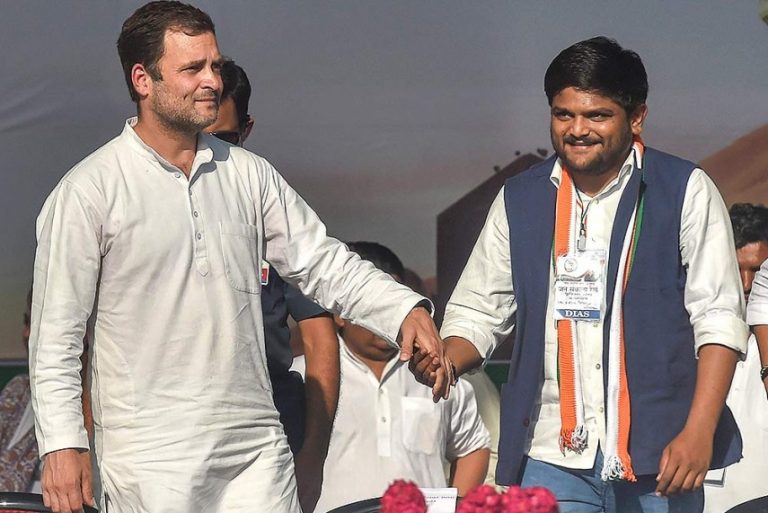
Long touted by ‘neutral journalists’ as an ‘answer to Modi’, Congress working president Hardik Patel is miffed with the Gujarat Congress unit for not using him enough. Patel, who rose to prominence after spearheading the Patidar quota agitation in 2015, is unhappy with the Gujarat Congress leaders and has made no bones about it.

“I am not used to the best of my abilities. I am associated with Congress and connected with their ideology. So I am working to help the party win the elections. I came to Congress because of the ideology of the party. I want to see the party winning elections,” Patel said.

Speaking in an interview with the Indian Express, Hardik stated that the Congress’s state leadership did not organise a single public meeting for him ahead of the local body elections. Patel, who was campaigning for the second phase of the local body polls, said he attended 27 public rallies, all on his own and not organised by the Congress party. Patel bemoaned that if Ahmed Patel were alive, the Congress loyalist would not have let the BJP gain 219 seats uncontested so far.

Highlighting that Gujarat Congress has underutilised him, Hardik said, “Many times I tell the party that when I joined the Congress, I thought Congress would utilise me. Even there, I feel that my Pradesh high command, the state party in-charge has failed. Organise my meetings, I am ready to do 25 meetings a day. You tell me from today you have to do a 500 km padayatra, assign me something, I tell the party, again and again, give me some work.”

“…Not a single one of my tours have been decided by the PCC (Pradesh Congress Committee). Still, I am on my toes because I want to strengthen the party, whether someone else does or not. They (Congress leaders) might be wanting to pull me down, push me and bring me down. Let them, I will stand up again,” Patel said.

BJP retains all six municipal corporations in Gujarat that went to polls on February 21

Patel’s lamentation comes after an embarrassing poll drubbing that Congress received in the six Municipal corporation elections in Gujarat and ahead of the second phase of the polls in which seats for 81 municipalities, 31 district panchayats and 231 taluka panchayats will be up for grabs on February 28. The results of the elections will be declared on March 2.

In the recently concluded local body polls, the ruling BJP retained power in all the six municipal corporations in the state — Ahmedabad, Surat, Vadodara, Rajkot, Jamnagar and Bhavnagar. The polls were held on February 21. Congress had a disastrous poll outcome, with other political parties such as AAP making impressive gains at its expense.

Encryption vs Compliance: The new IT Act guidelines put messaging services like WhatsApp in a tight situation

The recently announced guidelines for social media intermediaries under the IT Act are going to impact the concerned companies in a major away. While most of the talk is about how it will impact Facebook and Twitter, the two major social media companies, it will have a greater impact on messaging platforms like WhatsApp and Telegram. It may be noted that the new guidelines define ‘social media intermediary’ as an intermediary that allows two or more users to create, upload, share, disseminate, modify or access information using their services. This means that internet-based messaging services are also part of such intermediaries.

The most significant change that is being brought into the social media spectrum by the guidelines is the responsibility of the companies to not allow its users to post content which have been barred under the guidelines, and identify the origin of such objectionable content.

To combat the menace of fake news, and the trend of inciting violence, issuing threats etc through the intermediary platforms, the guidelines state that the companies will have to identify the user who had posted such content for the first time in India. The guidelines also have a long list of the type of content which are not to be allowed on the intermediary platforms, like contents which are defamatory, obscene, pornographic, paedophilic, inciting violence, against national integrity, misleading, false etc.

If the companies don’t comply with these rules, they will lose the safety harness that is provided to them under the IT Act, which shields them from any objectionable content on their networks. The same IT Act says that if the companies do not observe the due diligence defined under the act, the companies will lose the safety harness, and they will be deemed responsible for the content posted on their platforms, and their officials will be prosecuted and can be punished, including imprisonment.

Therefore, now the social media companies won’t be able to ignore orders by government or courts to remove objectionable content, and identify the originator of such content, like they had done earlier.

For social media companies, it is not a big issue to implement, as the content posted on those platforms are already in the public domain, and the companies will able to identify content that has been deemed objectionable as per the rules, and also to identify the origin of such content in India.

But it poses a serious challenge for the messaging platforms, which have been built around the concept of privacy and encryption. WhatsApp for example, which has the highest number of users in India among all intermediaries, offers end-to-end encryption. This mean, once a message is sent, it can be viewed only by the recipient, nobody can snoop on a message going through the network in between. WhatsApp claims that its encryption is so strong that, even the company itself can’t view the messages passing through its network. Other messaging services like Telegram or Signal also make similar claims of data privacy on their platforms.

Now this feature of data privacy directly comes into the way of the new guidelines under the IT Act. In order to identify objectionable content, and the originator of such content, now companies like WhatsApp will have to look into the content of the messages, and users who sent them.

The government says that it does not want the content of the messages, as it will be already in the public domain if any action will be initiated against it, and govt only want the originator of the message. But it does not solve the problem for the messaging platforms. Because, to find who sent a particular message, the company will still have to look into the messages.

This means, platforms like WhatsApp and Telegram, who advertise their encryption as their main USP, will be forced to break their encryption to comply with the Indian laws. Moreover, if the companies implement some measures to circumvent their encryption to look into the content, it will be potential security hazard, as hackers could take the advantage of such a measure.

In this regard, it is important to note that social media intermediaries will not be forced to reveal the originator for all cases. Government can ask to reveal the originator only in those cases where the content violates such an Indian law which have jail term of minimum 5 years as punishment. This means, companies will have to identify the origin for social media posts that threaten the sovereignty and integrity of India, friendly relations with other nations, public order, and offences related to rape, child sexual abuse material etc only. For cases like defamation, fake news, pornography etc, the companies will not be forced to reveal the originator.

In the past, when the Indian government had asked WhatsApp to identify the origin of fake news spread on the platform, the company had refused to do so citing its encryption policy. But now that disclosing such information when sought has been made mandatory, and refusing to do so will mean losing the safe harbour provision, the company will be in a very tough situation.

Even if the company decides to comply with the Indian laws and breaks its encryption, it will be breaking its own rules and regulations. It may also attract litigation from users for compromising with their privacy. It is notable that Supreme Court of India has declared that Right to Privacy is a fundamental right.

In case WhatsApp concedes and devises some way to break its encryption on India government’s demand, it may open a pandora’s box, and governments and law enforcement agencies in other countries will also start demanding the same. It will put the company in a difficult situation.

To maintain a balance between finding anti-social elements and ensuring privacy for general users, the government of India had suggested that every message on WhatsApp should have an ‘digital fingerprint’ attached to it, so that the messages can be traced back to its originator. While the government claims it is technically possible, WhatsApp claims its end-to-end encryption does not allow such traceability.

Caught in such a catch-22 position, the messaging services will have to find way out. If they don’t want to compromise with their encryption technology, they may even be forced to terminate their operations in India. Or may be the company can launch an India specific app without the encryption, and make the original app not available in India.

Although the guidelines were issued on Friday, the companies have been three months to implement them. It is possible that the companies will find a way around this mess. Also, companies may be able to negotiate with the government to tweak the rules which makes it easier to implement.