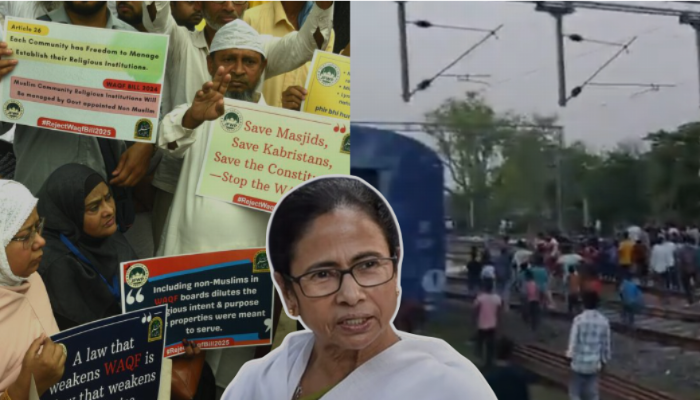
The Waqf Amendment Bill has been successfully passed in the Parliament. After President Droupadi Murmu gave her assent, it now becomes a law. However, the journey to this point has been fraught with challenges, as opposition parties, Islamist leaders and other vested interest groups disseminated disinformation and propaganda, branding the bill as “anti-Muslim” and “unconstitutional” to vitiate the atmosphere.
The All India Muslim Personal Law Board (AIMPLB) organized large-scale protests across the nation and the matter has now reached the Supreme Court. Meanwhile, Chief Minister Mamata Banerjee’s West Bengal has been witnessing unrest in the name of anti-Waqf bill agitation. This turmoil, however, is neither unprecedented nor unexpected, considering her history of communal politics and her courting of Islamists for electoral gain.
The agitation against the Waqf Amendment Bill turned volatile in different parts of the country, including Kolkata where large Muslim groups assembled on 4th April to voice their opposition to after it was passed by both houses of the Parliament. Thousands of demonstrators gathered at the Park Circus seven-point intersection in the center of Kolkata following congregational prayers on Friday to demonstrate their objection to the bill, which they described as “anti-Muslim.”
Javed Ahmed Khan, the Minister of Civil Defence and Disaster Management and attended the event and raised anti-bill slogans. According to him, Muslims have lost the most lives in India’s fight for independence. “It is a regret that today, their party (Bharatiya Janata Party) does not offer a single position to any Muslims, but they want to be our sympathisers. We will fight to keep our properties safe till our last breadth,” he declared. Additionally, he urged Muslims to stand together in peaceful protest of the bill.
“They are trying to take away our properties and capture our religious places of worship. Since the day this party (BJP) has come to power they have been against Muslims. We demand that they roll back this bill or we shall keep fighting till our last breath,” a protesting woman issued a subtle threat.
“This bill is a ploy by the BJP to divide the country. They have passed the bill in both Lok Sabha and Rajya Sabha due to their majority. We oppose this authoritarian approach. This is not just an attempt to seize Muslim properties but also malign us,” alleged another person. Traffic in the area was severely affected by the demonstration, which attracted a massive mob onto the streets.
The All India Trinamool Congress (AITC/TMC) leaders has described the bill as detrimental to Muslims, further inflaming the current unrest. “Once this government (BJP-led National Democratic Alliance) goes out of power and a new one comes to power this bill will be nullified,” announced Mamata Banerjee who has regularly spoken against the bill.
Meanwhile, BJP leader Amit Malviya slammed the TMC government for “complete collapse of law and order in West Bengal.” He charged that Chief Minister Mamata Banerjee’s divisive comments have sparked violent protests against the bill in many regions of the state. “At Malda’s Nimtita (Railway) Station, protesters have blocked the area for hours, chanting Allahu Akbar and preventing trains from passing,” he wrote.
“This is not the first time public safety has been put at risk,” Malviya added and highlighted that during the anti-CAA protests, which were also instigated by Mamata Banerjee, trains were attacked with stones, resulting in serious injuries to multiple passengers. He further remarked, “If any harm comes to passengers or if the general public suffers once again, the full responsibility will lie with Mamata Banerjee.”
Several protest marches have taken place throughout the state in recent months. Last November, Siddiqullah Chowdhury, the Minister of Mass Education Extension and Library Services of West Bengal and the president of the Jamiat-e-Ulama group in West Bengal held a meeting. “In the Waqf Amendment Bill, the government has directly attacked the Constitution. This is to rob Muslims of their rights and destroy all waqf properties,” Chowdhury claimed.
How anti-CAA agitation targeted Railways in West Bengal
Notably, the violent protests against the Citizenship Amendment Act/Bill (CAA/CAB), which soon spread across the country and escalated into the 2020 anti-Hindu riots of Delhi, originated in West Bengal. Likewise, train and railway stations were targeted by the violent mobs. In December 2019, thousands of anti-CAA protesters set fire to a railway station complex in the Murshidabad district of West Bengal. Furthermore, the demonstrators assaulted members of the Railway Police Force who were at the Beldanga train station complex.
A senior RPF official stated, “The protesters all of a sudden entered the railway station complex and set the platform, two-three buildings and railway offices on fire. When RPF personnel tried to stop them, they were brutally beaten up.” The district of Murshidabad, which borders Bangladesh saw disruptions in train services. “Several parts of the station, RPF kiosks were set on fire and the tracks vandalised. Services have come to a halt here,” informed an official.
The staff was forced to evacuate to protect their lives. Train service from Beldanga to Plassey was suspended as a result of protesters targeting the Beldanga railway station. Similar occurrences were reported when train traffic between Lalgola and Krishnanagar was also impeded by the blockade of the track. Empty train carriages were set ablaze at the Krishnapur and Lalgola stations of Murshidabad while protesters tried to remove the railway tracks in other areas including Suti. Train movements on the Howrah-Kharagpur section were affected due to the obstruction of the track, hampering both up and down lines.
The agitators vandalized stations and blocked railway tracks, leaving a number of travelers stranded during the day, in the minority-dominated areas of Diamond Harbour and Uluberia. The Howrah-Chennai Coromandel Express (12841), the Howrah-Digha Kandari Express (22897) and suburban locals were among the impacted trains. According to South Eastern Railway spokesman Sanjoy Ghosh, the protesters (around 250) blocked the up and down lines at Uluberia station and threw stones at the stranded trains, wounding a driver.
Several long-distance trains, such as the Falaknama Express, East Coast Express, Mumbai Duranta Express, Bhubaneswar Janshatabdi Express along with eleven suburban trains were immobilized at various stations. Guard of the Kandari Express disclosed, “Some people asked me to alight from the train as the train won’t go. Then they dragged me out. Then they ransacked the train.”
Moreover, the station manager expressed, “It was a terrifying experience. They broke the window panes. We all ran here and there. There is no chance of any train movement in the next three to four hours.” Long-distance train services were impacted by the obstructed railway tracks in the Kharagpur section as well.
Transportation under siege as passengers left to suffer
The state was rocked by violent protests over the Citizenship Amendment Act, with four districts, Murshidabad, Howrah, Malda and North 24 Parganas, turned into hotspots where demonstrators set fire to at least 17 buses, five empty trains, police cars, and fire engines, vandalized half a dozen rail stations, and threw stones at oncoming cars. National and state highways were blocked, at least 28 long-distance trains and more than 50 local trains were canceled and several more were stopped midway, rendering thousands of people stuck for hours around the state.
The ticket desk and signal (panel) room at Sankrail railway station were set ablaze by the rioters. Five empty trains were burned at Krishnapur station while Lalgola station at Murshidabad was partially destroyed. Santosh Kumar Das, the head constable of the Railway Protection Force (RPF), was gravely hurt by stone-throwing at Jangipur railway station, while the ticket counter at Nimtita station was looted. Similar incidents transpired at Malda, where a mob that initially stormed the Katihar-Malda Passenger train looted the ticket counter and signal room of Harishchandrapur station.
The state experienced considerable disruption to its train services as a result of the violence, with a minimum of 28 trains cancelled in a single day across the Eastern, South Eastern, and Northeast Frontier Railway networks. A South Eastern Railway zone (SER) officer mentioned, “Apart from Sankrail station, mobs also stormed the Chengail and Fuleswar stations, breaking the locks of the panel rooms and driving out railway staff. The Nalpur station was also ransacked. At Bauria, the electric locomotive of a goods train bound for Malda Town was damaged.”
The situation could take days to return to normal, according to railway officials, because damaged equipment had to be replaced or repaired.
Violent protests led to cancellation of trains
Central Railway suspended several express trains scheduled for 16th December 2019 traveling to and from Howrah in West Bengal due to the protests in the eastern state and a shortage of rakes or coaches including Howrah-Pune Duranto Express, Pune-Howrah Duranto Express, Howrah-CSMT Geetanjali Express and Shalimar-LTT Express. Hundreds of laborers from West Bengal and the Northeast flooded Chennai’s Central station as a result of the sudden cancellation of trains headed for Howrah following demonstrations against the Citizenship Amendment Act in several areas of West Bengal.
Trains heading towards the Eastern Railway zone from Guwahati, New Alipurduar and New Jalpaiguri stations were all canceled. According to Northeast Frontier Railway spokesperson Subhanan Chanda, the protests in West Bengal prompted the trains departing from these three stations and proceeding towards Kolkata to be canceled until further notice.
The train services on New Farakka-Azimganj and Rampurhat-Gumani sections were cancelled. The 15721 UP Digha-New Jalpaiguri Paharia Express, 13142 DN New Alipurduar-Sealdah Teesta Torsa Express, and 13146 DN Radhikapur-Kolkata Express were among the trains that were canceled on 14th December 2019.
13141 UP Sealdah-New Alipurduar Teesta Torsa Express, 13465 UP/13466 DN Howrah-Malda-Howrah Intercity Express, 13145 UP Kolkata-Radhikapur Express were canceled for 15th December. 13033 UP Howrah-Katihar Express, 12517 UP Kolkata-Guwahati Garib Rath Express, 13142 DN New Alipurduar-Sealdah Teesta Torsa Express were also cancelled for the same day.
Howrah, Sealdah and Malda, three Eastern Railways (ER) divisions, were severely damaged in a matter of four days. Nikhil Chakraborty, ER’s chief public relations officer expressed, “We are still assessing the damage. Our teams could not enter affected areas in the last few days, we have started assessment work from today.” 290 suburban trains, 190 passenger trains and 127 mail/express trains were canceled by ER.
According to a senior railway official, the Kharagpur division of South-Eastern Railways also sustained significant damage, worth at least Rs 16 crore. Five trains were set on fire, six stations were looted and 48 trains were canceled throughout these four days.
Shocking accounts of eyewitnesses
As West Bengal fell into disorder due to riots instigated by a Muslim mob opposing the Citizenship Amendment Bill (CAB), local resident Sankhadeep Shome, who witnessed the terrifying events near Howrah, has penned an in-depth post describing the savagery displayed by the demonstrators under the guise of protest. He was traveling on the UP Howrah-Chennai Central Coromandel Express, which arrived at Uluberia station on the Howrah-Kharagpur route when a group of approximately 500 to 700 individuals, including 7 and 8 year olds, gathered after Friday prayers at a nearby mosque.
They obstructed the entire railway line at a level crossing situated outside the station. “First, they shattered all the window panes of an empty rake of Humsafar Express. Then they got to our train and started to pelt it with stones. The elderly were traumatized, the children crying. A stone shattered the glass window of the adjacent coupe. My heart pounded as I heard them screaming,” he wrote on Facebook.
He added, “I saw them laughing sadistically as they poked the rods through the broken window panes to terrify the passengers. I ducked and stayed dead still. One stray stone, one swing of the rod is all it would take.” Shome mentioned that when the Muslim mob was on the rampage, the state police were nowhere to be seen. After 30 minutes, a contingent of the RPF arrived from Howrah and they used tear gas and unrelenting lathi charge to drive back the Muslim mob.
He further conveyed, “After a few broken legs and cracked skulls, the rioters again melted away into the slums by the railway line. When I finally emerged from the compartment after 4 hours of confinement, the station resembled a war zone. The locomotive was severely damaged and the loco pilot injured.”
Another witness boarded Budge Budge-Sealdah local train. The train significantly reduced its speed as it approached the platform at Akra, following an announcement broadcasted through loudspeakers from a nearby place of worship of a specific community. Subsequently, hundreds of individuals rushed toward the train and the railway tracks. A large group surged from the direction of the place of worship located on one side of the tracks while others emerged from the densely populated residential area on the opposite side.
A majority of the individuals moved towards the platform, where the ticket counter and the station superintendent’s office were located. Others stayed clustered outside the driver’s cabin doors on both sides of the train. The train compartments became encircled by groups of boys aged 10 to 15 and young men, all wielding stones gathered from the railway tracks. They were shouting, using profane language as well as making raucous and jubilant sounds.
Overcome by fear, some passengers rushed to close the window panes and doors as others jumped off the compartments and ran along the tracks in the opposite direction. Meanwhile, the Government Railway Police (GRP) only responded with “We got the news. We will see,” when they were contacted. The crowd began to pound furiously on the walls, as well as the securely closed doors and windows. They hurled stones at the train compartments.
In addition to children and young men and women, there were several senior citizens among the roughly forty passengers in a compartment. Dark clouds of smoke were rising from multiple spots on the railway tracks and platforms ahead, signaling that the station was on fire as the uncontrolled mob wreaked havoc.
Mamata Banerjee downplayed the assault on Railways
Mamata Banerjee had declared that she would not permit Citizenship Amendment Act in her state “under any circumstances” and planned multiple rallies against the act. She declared that “we will not allow the Citizenship Act in Bengal even though it has been passed in the parliament,” accusing the centre of attempting to impose a “unconstitutional” law on non-BJP states. “The Citizenship Act will divide India. As long as we are in power, not a single person in the state will have to leave the country,” she claimed.
The precarious situation was only exacerbated by the Muslim appeasement and the petty politics of such politicians, similar to the current controversy surrounding the waqf bill. Furthermore, the violence at the railway premises was downplayed by Mamata Banerjee, who also stated that the state government was not responsible for their protection. “There were some small incidents at some places. But they (central government) almost shut down railway services. People are facing serious problems due to the random cancellation of trains,” she claimed.
She added, “It is not our responsibility to protect the railways, but we tried to help them as much as possible. They have their force, RPF, to protect trains and stations.” She stated that the central government had proposed to provide her with central paramilitary forces for support, but she declined the offer.
Within four days from 13th December, protesters damaged or burned 19 stations and 20 trains, hurled stones at passing trains, looted ticket booths and besieged railroad tracks. The state saw the cancellation of about 655 trains. However, in relation to the rioting and torching occurrences at railway premises, only 17 FIRs (First Information Reports) were filed.
On the other hand, Vinod Kumar Yadav the Chairman of the Railway Board announced that protests against the citizenship law resulted in damage to railway property valued at ₹80 crore (₹84 crore per other reports) and the compensation for these losses will be sought from those responsible for the arson and violence. The Eastern Railways, based in Kolkata, suffered property loss totaling ₹70 crore.
“There has been damage of railway property worth ₹80 crore during anti-CAA protests. Of this, the Eastern Railway suffered damage worth ₹70 crore and the damage suffered by the Northeast Frontier Railway was worth ₹10 crore. The damage – panels were set on fire, signalling systems were damaged – will be recovered from those involved in arson and violence. This, however, is a preliminary estimate and the figure could go up after the final analysis,” he outlined.
Yadav added, “The RPF (Railway Police Force) is coordinating with state governments to identify culprits. Once identified, efforts will be made to recover the damage.” Director General of the Railway Protection Force Arun Kumar conveyed, “West Bengal has been the worst because the Eastern Railways largely falls in the state, the total loss there alone has been ₹72.19 crore.”
Conclusion
A concerning resemblance exists between the anti-CAA/CAB protests and the waqf bill, as both narratives revolve around a shared theme of imaginary Muslim victimhood concocted only to serve the political interests of “secular” parties at the cost of national security, peace and law and order.
Just as the Citizenship Amendment Act (CAA) had no bearing on Indian Muslims yet incited opposition that tends to exaggerate trivial matters for personal gain, the waqf bill which addresses the mismanagement, corruption and fraudulent claims regarding private and public properties, of the Waqf is not antagonistic towards any community, especially Muslims.
Similarly, no state government has the authority to alter laws that fall under central jurisdiction, such as the Citizenship Amendment Act (CAA) and the Waqf Bill. Nevertheless, opposition parties, including the Trinamool Congress (TMC), have not hesitated to make misleading assertions about the non-implementation of these laws in their states, seemingly to maintain the support of their Muslim voter base.
All opposition parties who are firmly against the CAA, allowed Islamist groups to cause chaos in the country and similar situation is being unfolded once more. The resurgence of attacks on railways, beginning yet again in West Bengal have offered a disturbing glimpse into what lies ahead.
The protests against the CAA not only caused extensive property damage and brought the country to a standstill but were also marked by anti-Hindu violence, stemming from unfounded fears spread by opposition factions, Muslim leaders and their ecosystem. Now, predictably a similar strategy is in operation to hurt the nation and undermine the BJP-led central government.