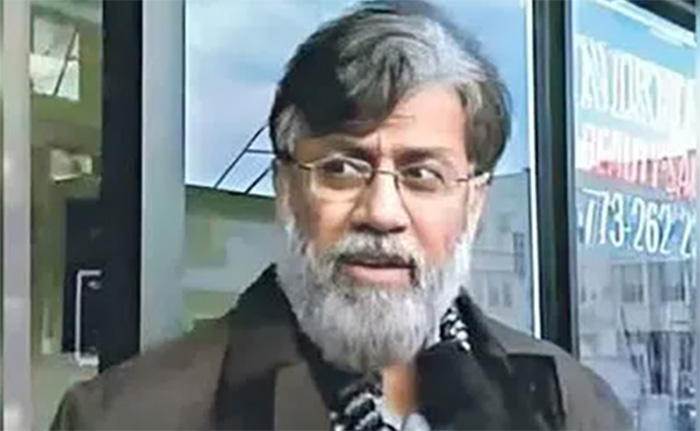
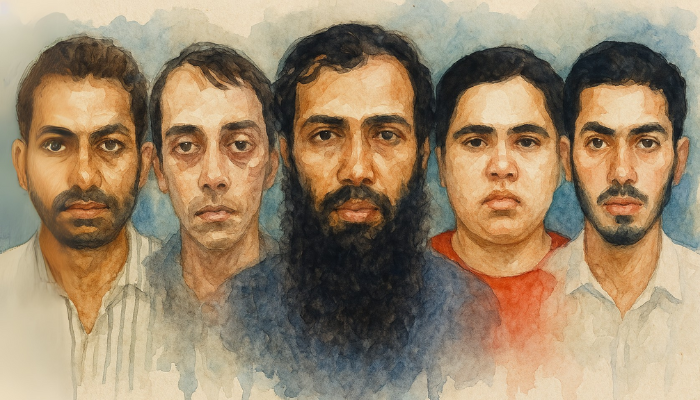
On 8th April 2025, the Telangana High Court upheld the death sentences awarded to five convicts in the 2013 Dilsukhnagar twin bomb blasts case. The Division Bench comprising Justice K Lakshman and Justice P Sree Sudha dismissed the criminal appeal filed by the convicts, who are linked to the Pakistan-based terror outfit. Founder of the terror organisation Indian Mujahideen, Yasin Bhatkal, is one of the convicts sentenced to death.
The Special Court of the National Investigation Agency had sentenced IM operatives Bhatkal, Zia-ur-Rehman alias Waqas, Asadullah Akhtar alias Haddi, Tehseen Akhtar and Aizaz Shaikh to death for the blasts that killed 18 people, including an unborn child. 130 people were reported injured in the incident. The explosions occurred seconds apart on 21st February 2013 at Dilsukhnagar market in Hyderabad.
Initially, FIRs were registered by local police before the case was transferred to the NIA by the Ministry of Home Affairs, Government of India. The accused were arrested between 2013 and 2014. Bhatkal and Akhtar were apprehended at the Indo-Nepal border and Pakistani national Waqas in Rajasthan.
OpIndia accessed a copy of the judgment.
Details of the case
The court upheld the judgment of the Special NIA Court dated 13th December 2016, in which Yasin Bhatkal (referred to as Accused No. 2), Zia-ur-Rehman alias Waqas (referred to as Accused No. 3), Asadullah Akhtar alias Haddi (referred to as Accused No. 4), Tehseen Akhtar alias Monu (referred to as Accused No. 5), and Aizaz Shaikh (referred to as Accused No. 6) were convicted. All of the accused were booked under relevant sections of the Indian Penal Code (IPC), the Explosive Substances Act (ES Act), the Prevention of Damage to Public Property Act (PPD Act), and the Unlawful Activities (Prevention) Act (UAPA). Mohd Riyaz alias Riyaz Bhaktal (referred to as Accused No 1) is still absconding.
In its Charge Sheet No. 1, the NIA pointed out that the accused were part of Indian Mujahideen, which was declared an unlawful association under the provisions of the Unlawful Activities (Prevention) Act (UAPA). The aim of the organisation was to gather individuals with a similar mindset and dedication towards activities including waging jihad or holy war against Hindus, other communities, and the Indian State. Regular meetings were held every Friday at Iqbal Bhatkal’s house, which included weapons training, financial planning, talent spotting, spiritual discourse, and more.
According to the charge sheet, IM’s role in terror activities was first revealed through an email sent to a media channel following the bombings in Varanasi, Ayodhya, and Lucknow. The motive cited for the attacks was the demolition of the disputed structure in Ayodhya and the Gujarat riots of 2002.
Details of the incident
On 21st February 2013, two bomb blasts took place in Dilsukhnagar, Hyderabad, at 6:58 PM, with a gap of six seconds between them. Eighteen people, including a quickborn child, were killed and 131 injured. The first blast occurred at a bus stop in Dilsukhnagar, followed by the second near the Al-Mirchi Centre.
Initially, Malakpet and Saroornagar Police Stations registered respective cases and began the investigation. However, on 13th March 2013, the Ministry of Home Affairs, Government of India, transferred the case to the National Investigation Agency (NIA). New cases were registered by the NIA on 14th March.
Details of arrest and investigation
Yasin and Tehseen were arrested by the NIA on 29th August 2013. Their involvement in the bombing was revealed during interrogation. The accused stated before the NIA that there was a conspiracy to wage war against the Government of India by committing terrorist attacks to kill innocent people, disrupt national security, and instil fear and insecurity among the general public. They further informed the NIA that their activities were funded by Pakistan’s Inter-Services Intelligence (ISI).
Riyaz and Yasin had entered India via Nepal in September 2010. Riyaz arranged funds for their terror activities through hawala and Western Union Money Transfer (WUMT), which Yasin received using fake identities.
In February 2013, the accused obtained explosives in Mangalore and travelled to Hyderabad on 16th February. After conducting reconnaissance of several locations, including Dilsukhnagar, they selected it as the target site.
A day before the blasts, the accused visited various locations to purchase materials required for the operation, including pressure cookers and old bicycles. The bombs were planted at around 4 PM on 21st February 2013. After planting the devices, they left for Bengaluru and subsequently reached Mangaluru on Riyaz’s instructions.
During the investigation, the NIA found that the accused were using chat messengers, including Yahoo Messenger, via proxy servers. They communicated using fake identities and coded language. In March 2013, before the arrests were made, Asadullah and Zia-ur-Rehman attempted to flee to Pakistan via Nepal using passports obtained from Kerala.
On 5th September 2014, Aizaz Sheikh was arrested by the Delhi Special Cell in connection with a 2011 case. It was revealed during the investigation that Sheikh, on the instructions of Riyaz, arranged hawala money, SIM cards, and mobile phones for the accused, and carried explosives to aid others involved in the case.
Furthermore, in 2010, Aizaz purchased a laptop in Mumbai and used it to prepare fake voter IDs, driving licences, and other documents using samples available on Google and Photoshop software. The fake documents were shared with Riyaz as per requirement. He was also involved in several previous bomb blasts in different parts of India. The documents prepared by Aizaz were used to procure SIM cards and to evade arrest both before and after the bomb blasts.
Interestingly, they used both Hindu (Girish Joshi) and Muslim names to withdraw funds from Western Union. Aizaz, an active member of Indian Mujahideen, was initiated by his father-in-law, Mohsin Choudhary—a jihadist and resident of Pakistan. He and Riyaz used to chat with Aizaz regularly to motivate him to engage in terror activities, including bomb blasts in India. Aizaz was also behind supplying explosives for the German Bakery blast in Pune. He also sent emails to media houses claiming responsibility for bomb blasts on behalf of IM.
Contentions of accused while challenging Trial Court’s judgment
While challenging the Trial Court’s judgment, the accused raised several objections. They claimed procedural lapses, including delays in FIR registration, contradictions in the reported timings of the blasts, and that the FIR lacked names and sufficient details. The complaint being in English was also questioned, given the complainant’s unfamiliarity with the language.
The accused argued that the seizure procedures were not properly followed and that dying declarations were not recorded. Furthermore, they alleged that FSL experts were not examined, and that the case rested solely on circumstantial evidence without forming a complete chain. They contended that the identification parade was delayed, improperly conducted, and that no eyewitnesses had identified them.
Further objections included the absence of proper sanctions, flawed charge framing, and procedural violations under the CrPC. They claimed that key witnesses were unreliable or not examined, expert opinions lacked credibility, and electronic evidence was unsupported by Section 65B certificates.
Analysis and findings of the court
While the prosecution examined 157 witnesses and submitted 507 documents and 201 material objects to prove the charges against the accused, the defence produced no witnesses, relying only on documents such as IP address and email records. The Court found no merit in the contention regarding delay in lodging the complaint, as the initial FIRs were promptly filed and later legally transferred to the NIA.
Statements by witnesses confirmed the procedural integrity of the seizure, site inspections, and forensic submissions. The Court noted that bomb squads, local police, and NIA officials worked in coordination, and the claims that the trial court lacked jurisdiction had already been rejected by both the High Court and Supreme Court.
Material seized from the scene—including cycle parts, metal splinters, and electronic devices—was properly documented and forwarded to the FSL. The Court concluded that the investigation and prosecution were conducted in accordance with the law.
Scene of occurrence / bomb blasts
The bomb blasts occurred at Dilsukhnagar on 21st February 2013, near the 107 Bus Stop and A-1 Mirchi Centre. A witness in the first case, an RTC driver, was having tea nearby when the blasts occurred. He witnessed chaos, scattered bodies, and injured persons. Along with others, he used buses to shift the victims to hospital. His complaint led to the first FIR at Malakpet Police Station.
A witness of the second blast, a local shopkeeper, heard both explosions and rushed to assist the victims. His complaint led to the second FIR at Saroornagar Police Station.
Cross-examinations of the witnesses revealed initial confusion, darkness, and public panic. The witnesses confirmed that the local police arrived within minutes. Later that night, the NIA team also arrived to examine the site. Despite minor procedural lapses, such as missing diary entries, both FIRs were promptly registered and were supported by eyewitness testimonies, establishing the occurrence and gravity of the blasts.
Conspiracy, involvement, participation and execution
The investigation revealed a deeply rooted conspiracy by IM operatives to wage war against India. The accused, funded by ISI, plotted and executed serial bombings to instil fear, disrupt public order, and target civilians. Yasin and Zia entered India via Nepal in 2010 under directions from Riyaz. They later joined Tehseen and Akhtar. They operated from hideouts in Bihar, Mangalore, and Hyderabad, frequently receiving funds via hawala and Western Union using fake identities.
In early 2013, they procured explosives in Mangalore, conducted test blasts near Abdullapurmet, and purchased pressure cookers and bicycles to assemble IEDs. Tehseen rented a house in Hyderabad. Yasin, Zia and Tehseen conducted recce at crowded locations and selected Dilsukhnagar as the target. On 21st February, they planted the bombs using bicycles. Both exploded within seconds, killing 18—including an unborn child—and injuring 131.
Evidence from multiple witnesses, along with CCTV footage, CDRs and forensic reports, confirmed their roles. Aizaz also played a key role in providing technical support and fake documents. The Court observed that the chain of events was clearly established beyond doubt.
Scene of offence and observation and seizure panchanamas
The prosecution meticulously documented the scene of the bomb blasts in the presence of independent witnesses. Seized items included critical material objects such as damaged cycle parts, detonator wires, blood-stained earth, and metallic fragments.
Furthermore, burnt two-wheelers and electronic remnants, a damaged bicycle, batteries, metal pieces, swabs, and other explosive remnants were recovered from the site. All recoveries were properly sealed, documented, and corroborated by eyewitnesses and panchas. The defence failed to counter these panchanamas during cross-examination. The Court held the seizures were legally valid, with minor inconsistencies being immaterial in such grave incidents.
Disclosures and confessions of the accused
The disclosure statements and confessions from the accused proved instrumental in establishing the conspiracy and execution of the terror incident.
Yasin detailed his travel from Mangalore to Hyderabad, recce operations, procurement of cycles, pressure cookers, explosives, and the planting of IEDs with Zia and Tehseen. His statement led to the recovery of critical evidence. He provided minute-by-minute details of his movement from Mangalore to Hyderabad. He confessed to booking his bus ticket under the alias ‘Danish’, staying at the shelter house in Abdullapurmet arranged by Tehseen, and conducting recce at crowded locations across the city. He admitted to participating in a test blast near Ramoji Film City, purchasing pressure cookers from Sri Mahalakshmi Steel Palace for preparing IEDs, and buying two bicycles to plant the bombs. He further detailed how the IEDs were assembled, transported, and placed at 107 Bus Stop and A1-Mirchi Centre.
Zia revealed Taliban-style training in Pakistan and his ability to assemble IEDs. He reconstructed the bomb-making process with dummy components under NIA supervision, which was videographed and documented. His disclosure confirmed his role in the test blast, procurement of explosive material, and delivery from Mangalore to Hyderabad. He revealed that he received terror training in North Waziristan, FATA, including bomb-making and handling explosives. He confessed to assembling the IEDs in Hyderabad using material received via hawala and WUMT. He also demonstrated the entire bomb-making process using dummy components.
Tehseen admitted to arranging shelter, purchasing cycles, and participating in planting the IED at A1-Mirchi Centre. The information provided by him matched locations and events. He confessed to scouting for a hideout, renting the Abdullapurmet house, arranging local logistics, and planting the bomb-laden cycle at A1-Mirchi Centre. His participation and provided digital mapping of key locations was confirmed by electronic evidence. He also identified the cycle sellers and shops where items used for the blasts were purchased.
Akhtar and Aizaz provided information about chats with Riyaz Bhatkal, financial and logistical support, and preparation of fake IDs. These confessions corroborated material evidence and witness testimonies. He revealed how they used coded language to coordinate the Hyderabad blasts. He revealed specific dates, discussions about bomb-making materials, the difficulty in sourcing explosives, and the involvement of other accused. He confirmed overseeing the preparations and acknowledged the successful execution of the blast.
Aizaz admitted to supplying fake IDs, SIM cards, mobile phones, and hawala funds on instructions from Mohsin Chaudhary and Riyaz Bhatkal. He confessed to preparing forged documents using Photoshop and encryption tools such as TrueCrypt and AxCrypt, storing jihadist material on encrypted drives, and sharing them via online platforms. His statements led to the recovery of fake voter cards, passports, and email accounts used for covert communication.
Each of these disclosures led to discoveries of places, materials, and digital evidence corroborated by independent witnesses and physical seizures. The Court held that these were not merely custodial statements but were supported by recoveries, site identifications, and consistent timelines. The minor contradictions were deemed insignificant.
Online chatting
During trial, it was established that the accused persons conspired through online chats to carry out the terror incident. Café owners confirmed Yasin and Tehseen accessed their premises using fake IDs. Their chat logs were retrieved, revealing detailed discussions between Riyaz and Akhtar about preparations, explosives, target locations, and timing. Chats showed Riyaz directing the others, with Akhtar offering suggestions and encouragement.
Tehseen’s arrival and rented house at Abdullapurmet
Their stay at a hideout at Abdullapurmet was confirmed by witnesses. They confirmed that Tehseen introduced himself as Sameer and stayed with them before renting the house via local contacts. Witnesses also confirmed Yasin and Zia joined Tehseen at the rented house before the bombings and vanished after the blast.
Purchase of pressure cookers
The prosecution established that Yasin and Tehseen purchased two large Ganga-brand pressure cookers, which was confirmed by the shop owner. The cookers were purchased a day before the blast. A technical expert confirmed that the fragments found at the crime scene matched the material of the cooker. Handles and whistles were later recovered from the Abdullapurmet hideout during a search by the investigating agency.
Conducting test blast
The prosecution proved that Yasin and Tehseen conducted a test blast near a hillock close to Abdullapurmet days before the Dilsukhnagar attack. There, remnants including detonator shells, wires, and soil samples were seized and recorded. The investigation confirmed the test was conducted to verify the explosive’s impact. As Yasin had specific knowledge of the site, the Court held the test blast as part of the preparation for the main terror attack.
Purchase of cycles
It was further established that Yasin and Tehseen purchased two old cycles that were used to plant the IEDs. They were bought from a cycle repairer two days before the blasts. Furthermore, another cycle was sold on the day of the blast, which was established as well. The recovered damaged cycle parts from the blast sites matched the purchased bicycles, firmly linking them to the accused and the explosions.
Parking of cycles at Malakpet Railway Station
An employee under the parking contractor testified that three persons parked a cycle on 20th February and two of them returned with another on 21st February. He identified the accused and recalled their physical appearances and interactions. The cycles were parked with receipts, retrieved later. His testimony confirmed the prosecution’s claim. This key evidence linked the movement of the accused directly to the bombing logistics and the placement of explosive-laden bicycles.
Leaving the rented house on the day of the blast
On the day of the blasts, Yasin and Tehseen vacated the rented house. An eyewitness confirmed that Tehseen handed him the keys, stating his mother was unwell and he was going to Mumbai. Their sudden departure, just hours before the explosions, was considered highly suspicious. The Court held that this conduct—leaving the hideout immediately after preparing and transporting the IEDs—was part of the conspiracy. The prosecution successfully proved that the accused intentionally abandoned the house to evade detection after executing the twin bomb blasts.
Recovery of explosives at Mangalore
Explosives and bomb-making materials were recovered from Zephyr Heights, Mangalore, where Yasin and Zia had stayed. An FSL expert from Karnataka confirmed that the materials matched those used in the blasts. Seized items included ANFO, gel explosives, detonators, wiring, digital timers, and bomb circuitry tools. The Court accepted this as strong corroborative evidence, directly linking the accused to the preparation and possession of explosives.
Receipt of hawala money
It was further proved that Yasin and Tehseen received hawala money through WUMT and other outlets using fake identities. Eyewitnesses confirmed Zia collected funds multiple times, including on 26th February 2013, 20th March 2013, and 12th April 2013. TRM forms and voter IDs were used for verification. The WUMT Manager confirmed similar transactions. All funds were received using aliases. The defence claim that such transactions occurred post-offence was rejected, as conspiracy evidence spans pre- and post-blast activities. The evidence confirmed financial support for executing the Dilsukhnagar bombings.
Use of Hindu identity by the accused
On 27th December 2012, Aizaz received a voter ID card in the name of Girish Joshi from Riyaz. He replaced the photograph on the voter card with that of Asadullah. The fake ID was used by him to withdraw money from Western Union two months prior to the blast.
A fake ID in the name of Lokesh Kumar was created with Yasin Bhatkal’s photo. A fake passport for Bhatkal was in the name of Ravi Sinha, while a fake passport for Asadullah was in the name of P. Kumar Lokesh. Fake IDs in the names of Narendra Kumar, Pravir Kartal, and Vikas Yadav were also created by Aizaz. Some of them were forwarded to Mohsin Chowdhury.
Final execution and planting of bombs
On 21st February, Yasin and Tehseen executed the bomb blasts. IEDs were assembled using pressure cookers and explosive material packed in white fruit cartons. Around 4 PM, they vacated the Abdullapurmet hideout and proceeded to Malakpet Railway Station. There, Yasin and Tehseen retrieved previously parked bicycles and mounted the IEDs. Zia planted the bomb at the 107 Bus Stop and Tehseen planted the bomb at A1-Mirchi Centre. Yasin supervised the operation.
Post-blast escape and movements
After the blasts, Yasin and Zia escaped from Hyderabad using pre-booked tickets under false names. They travelled to Lakdi-ka-pul by auto, then to Bangalore, and eventually reached Mangalore. Tehseen left separately and went to Ranchi by train. Later disclosures confirmed that Yasin fled to Nepal, where he was sheltered by Yasin Bhatkal. These escape movements were pre-planned, highlighting the calculated nature of the attack and efforts to evade detection immediately after the execution.
Zia’s expertise in preparing and blasting of IED
The prosecution established that Zia possessed technical expertise in assembling IEDs. The Assistant Director at CFSL testified to witnessing a voluntary demonstration by Zia at CRPF Camp, Hakimpet. Zia assembled an IED using components provided and completed a live circuit, verified when a bulb glowed in place of explosives. The demonstration confirmed his capability to construct functioning IEDs and substantiated his role in preparing the bombs used in the Dilsukhnagar twin blasts.
Retrieval of jihadi material, emails, and fake IDs
Disclosure by Aizaz led to the retrieval of vital evidence, including jihadi literature, draft emails on Indian Mujahideen letterhead, and fake identity documents used by Yasin and Tehseen. A Senior Assistant from the Collector’s Office confirmed that Aizaz unlocked his laptop using passwords and voluntarily accessed incriminating files. This digital material further established the conspiracy and support structure behind the blasts. The Court held that the recovery of such items at Aizaz’s instance was valid and demonstrated his active involvement in facilitating terrorist acts through logistical and technical support.
Eye-witnesses
The defence claimed that the blasts case lacked direct eyewitnesses and relied solely on circumstantial evidence. However, the prosecution presented Merugu as a direct witness. He recounted seeing a bearded man (later identified as Tehseen) park a cycle with a box near Anand Tiffin Centre moments before the explosion. He initially failed to identify the accused during the first Test Identification Parade on 28th June 2014 due to poor lighting and distance but successfully identified him in the second parade on 9th July 2014 when allowed closer access.
TV9 journalist T. Nageshwar Rao supported Merugu’s account. He testified that Merugu approached him post-blast and described witnessing someone park the suspicious cycle. Merugu agreed to a video interview with his face covered, which was aired on the same night.
The Court held that eyewitnesses like Merugu are crucial and their accounts remain intact and trustworthy. Consequently, it rejected the claim that no direct evidence existed and affirmed the findings of the trial court, drawing support from the Supreme Court’s position in Ramakant Roy v. Madan Rao that credible eyewitnesses outweigh hypothetical expert opinions.
Sentencing
The High Court independently evaluated the case and upheld the trial court’s judgment sentencing the accused to death, life imprisonment and other penalties. The Court found that the trial court had carefully weighed all aggravating and mitigating circumstances, including psychiatric evaluations and probationary reports, before concluding that this was a rarest of rare case warranting capital punishment. The discretion exercised was found neither arbitrary nor unreasonable.
Given the calculated and diabolical manner of the bombings, which killed 18 and injured 131, the Court held that life imprisonment would serve no purpose as the convicts were beyond reformation. The appeal was dismissed, and the sentence of death confirmed. Certified copies were ordered to be issued to the convicts, and they were informed of their right to appeal to the Supreme Court within 30 days. All pending applications stood closed.
Accused No 2, Mohd Ahmed Siddibapa alias Yasin Bhatkal, was awarded the death penalty for multiple offences including conspiracy to commit murder (Section 120B r/w 302 IPC), direct murder charges (302 r/w 34 IPC – two counts), under Section 3(b) of the Explosive Substances Act (ES Act), and for committing terrorist acts under Section 16 of the Unlawful Activities (Prevention) Act (UAPA). He was also sentenced to life imprisonment for offences under Sections 121, 121A, 122 IPC, 307 IPC (two counts), 436 IPC, Sections 5 of the ES Act (two counts), and Sections 17, 18 and 19 of the UAPA. Additionally, he received rigorous imprisonment ranging from 2 to 10 years for charges under Sections 316, 201, 466, 474 IPC, and Sections 14 of the Foreigners Act and 4 of the Prevention of Damage to Public Property (PPD) Act, along with corresponding fines and default imprisonment.
Accused No 3, Zia-ur-Rehman alias Waqas, received identical punishments as Yasin Bhatkal, including the death penalty for conspiracy and execution of the blasts, life imprisonment for related terror and criminal offences, and rigorous imprisonment for forgery, destruction of evidence, and use of fake documents. He too was held guilty under multiple provisions of the IPC, ES Act, Foreigners Act, PPD Act, and UAPA.
Accused No 4, Tehseen Akhtar alias Monu, was also sentenced to death under similar provisions as the other two, including for his direct role in executing one of the twin bomb blasts. He received life imprisonment for various terror-related and criminal acts and rigorous imprisonment for his role in forgery, destruction of evidence, and procuring fake IDs and shelter.
Accused No 5, Asadullah Akhtar alias Haddi, too was awarded the death penalty under Sections 120B r/w 302 IPC, Sections 3(b) ES Act r/w 109 IPC, and Section 16 of the UAPA r/w 109 IPC. Life imprisonment was imposed for conspiracy, shelter, aiding terror acts, and involvement in preparation and transport of explosives. Additional rigorous imprisonments were awarded for related offences involving fake identities, money transfers, and forged documents.
Accused No 6, Aizaz Shaikh, though not a direct executor of the blasts, was sentenced to death for his active role in the conspiracy, preparation of fake documents, financial facilitation, and aiding fugitives. His charges included capital punishment under 120B r/w 302 IPC, 302 r/w 109 IPC, Section 3(b) ES Act r/w 109 IPC, and Section 16 UAPA r/w 109 IPC. Life imprisonment was imposed under Sections 121A, 122, 307, 436, and multiple sections of the UAPA and ES Act. He also received rigorous imprisonment under forgery and ID laws.
All punishments included fines and default simple imprisonment in case of non-payment.