Monday, March 30, 2026
Home Blog Page 4643

‘The Economist has always been anti-India’: NDTV’s Sreenivasan Jain again left red faced while peddling anti-Modi agenda, this time by HDFC Chairman

0

NDTV anchor Sreenivasan Jain interviewed HDFC chairman Deepak Parekh recently in which the ‘journalist’ attempted to solicit a statement against the NDA Government at the center in his ongoing campaign against Prime Minister Modi. However, he was sorely disappointed.

In one of the clips from the interview that is going viral, Sreenivasan Jain moans the ‘stifling of dissent’. Deepak Parekh pointed out that the opposition parties in the country are failing to perform their democratic duties properly. Jain agreed with him on the matter but then went on to bemoan the ‘worries’ about stifling of criticism and dissent. It was then that he had to suffer a major embarrassment.

Deepak Parekh responded, “I think it is overstated and overemphasized or whatever. When we have meetings with the Prime Minister or recently, the Prime Minister had a meeting with sovereign wealth funds and some of us were asked to speak, and that time I think they are quite open to listen to things. I don’t think they are averse to listening.”

And that is how another attempt to drag an adverse comment against the central government by Lutyens journalists bit the dust. Earlier, Sreenivasan Jain had suffered an embarrassment after getting into an argument with investor and businessman Rakesh Jhunjhunwala.

He accused Jhunjhunwala of being biased in favour of Narendra Modi to which the bussinessman responded, “I am a fan of Mr. Modi – This is a well-known fact. As an Indian, I have a right to my political choices… But, I find you prejudiced. I find NDTV prejudiced against the government.” “Well, I am a political animal. The press is not a political animal. You are supposed to be unprejudiced,” he added.

Deepak Parekh praises Narendra Modi

Deepak Parekh was all praise for the reforms implemented by the central government since the pandemic began. He was supportive of the government’s moves on agricultural reforms and labour reforms. The HDFC Chairman also said that the worst is behind us in terms of the economy and a recovery is being witnessed across multiple sectors.

The HDFC Chairman also said that he is optimistic about the situation and he believes things will start getting much better very soon. He was also critical of The Economist which had recently claimed that democracy is facing a ‘downturn’, in the words of Sreenivasan Jain, in India and the rest of the world.

“It is certainly worrying what we are seeing but I will not put too much emphasis or stress on The Economist. I have not seen a single positive article written by Economist in the past 30 years. So I would not take Economist as a guiding principle or someone who said that because they have always been anti-India, irrespective of the government,” he said.

Congress celebrates no new COVID patients in Dharavi, consider it Maharashtra govt’s achievement that 70% already got infected

While Maharashtra remains the worst hit by the Coronavirus pandemic, the state government has at last something to cheer. Today, the Dharavi reported zero new cases of the pandemic, a first since the virus was first detected in the famous slum in April.

While this is a success story in the battle against the Chinese virus, the ruling party leaders seem to have gone overboard with celebrations. Senior Congress leader Milind Deora also celebrated the fact that around 70% people living in the state have already had Covid-19. He tweeted that today is the Today is a momentous day for Mumbai, as Dharavi, Asia’s biggest slum, reported 0 new COVID19 cases for the first time since the outbreak.

Deora also added that “based on serological findings, approximately 70% of residents of Mumbai’s slums are estimated to have already had COVID & possess antibodies.”

Although getting infected with the virus produces antibodies in the body, the effectiveness of the same is not yet confirmed by medical science. According to studies, the antibodies produced by the body as a reaction to the Covid-19 infection last only a few months. A study report published in the New England Journal of Medicine had found that antibody levels fall rapidly in previously Covid-19 infected persons, and the half-life period of antibodies has been estimated to be around 73 days.

This means, the people in Dharavi who was infected with the virus several months ago, may not have left with enough antibodies in their bodies to fight the virus. Due to this reason, experts say that even those who have recovered from Covid-19 need to take vaccines.

Therefore, the fact that 70% people in slums Mumbai have been estimated to have infected with the virus is no cause for celebration, as it does not guarantee that they will not be re-infected again. But the figure points how the Maharashtra government failed to contain the virus in slums in the state. It is ironical that the leader of the Congress, a constituent of the state government, is celebrating such a failure.

Faizal Khan who had offered namaz inside Nand Baba temple granted bail, says the temple priest had given him permission

0

Faizal Khan, who was arrested after offering namaz within the premises of Nandmahal temple in Nandgaon area in Mathura district’s Barsana, was granted bail by Allahabad High Court on December 18. Four people including Faizal Khan were booked by the Uttar Pradesh police for reading namaz in the temple premises after a complaint was registered.

Khan claimed that he offered namaz outside the temple with the consent of the priest

In his bail application, Faizal Khan said that on the day when he offered namaz in the temple, he had concluded his ‘Brij 84 Kosi Parikrama’ to spread the message of inter-faith harmony. Khan claimed that the head of the temple requested him to offer namaz inside the temple since the mosque was at a distance. However, the FIR claims that Khan and another accused read namaz inside the temple without the consent of the priest. Khan had moved the Magistrate Court, Chhata Tehsil on November 3 where his bail application was rejected. Later, he approached ADJ-02, Mathura District where his request for bail was again rejected through an order dated November 24.

Khan’s counsel submitted before the court that he was a ‘renowned activist’ who revived the Khudai Khidmatgar Movement in the country. He said that Khan had visited the temple in this connection and that he was offered prasad by the Chief Priest of the temple. Khan claimed that he did not enter the sanctum sanctorum of the temple and that he offered namaz outside the temple with the permission of the priest.

Khan had participated in anti-CAA protests

According to reports, Faizal Khan and three other entered the Nandmahal temple on October 29 where Faizal and Mohammed Chand read namaz and the other two recorded the video. All the four accused belong to a Delhi-based organisation called Khudai Khidmatgar founded by Khan. Faizal Khan had also participated in the anti-CAA protests in Shaheen Bagh and at several other locations. His organisation had also supported the anti-CAA protests spreading misinformation about the law. Khan and the other three were booked by the police under Sections 153-A, 295, and 505 of the Indian Penal Code (IPC).

Karnataka High Court orders SHO to clean road for failing to register FIR, cops to file appeal: Here are full details

0

The Karnataka High Court (HC) recently directed a Station House Officer (SHO) to clean the road in front of the police station he is in charge of for one week.

According to the reports, the SHO of Bazar Police station in Kalburgi was asked to do the community service for failing to register an FIR in connection with a kidnapping complaint.

The Kalaburgi bench of the Karnataka High Court issued the order on December 17 after petitioner Tarabai moved a habeas corpus petition contending that her son Suresh had gone missing on October 20, 2020.

A division bench of Justice S Sunil Dutt Yadav and Justice P Krishna Bhat while hearing a habeas corpus petition said that the entire development in the case after Suresh going missing disclosed that it was a very disturbing facet of the functioning of the police stations in this area of the State.

The court observed that the problem, primarily, is one of the police officers not complying with the procedure prescribed under the Code of Criminal Procedure, which places a high premium on the guarantee of liberty of the individuals.

The High Court also observed that SHO admitted that the petitioner had approached him in the police station with a grievance that her son had been abducted and thereafter he was not found.

Police personnel undertook to do some community service, court obliges

The Government advocate requested the court to take a lenient view of the case for the said violation of the procedure and further submitted that the police officer is prepared to file an undertaking to do some community service to atone for the same.

The police personnel filed the undertaking that read, “I the undersigned do hereby state that, as per the direction of the Hon’ble Court, I am ready to comply with the direction issued by the Hon’ble Court by cleaning the road in front of my Police Station for one week. That I render my unconditional apology for not registering the First Information Report and assure the Hon’ble Court that I will not repeat the same in the future”.

The court accepted the same and directed him to comply with the same. The Karnataka HC bench also directed the district superintendent of police to hold a workshop/orientation course to all the police officers working within the Kalaburagi District on the subject of “zero FIR”.

Following the controversial judgement, the Kalaburgi City Commissioner Satish said that they will file an appeal on the order given. We feel there were no lapses from our end, he added.

Was the resurrection of Jesus actually resuscitation? A Vedantic perspective on the Resurrection of Jesus Christ

Jesus Christ has transformed the lives of millions of people over a couple of millennia. From the days of his ministries in Galilee and Jerusalem to the recent proclamation by Pope Francis of the division among Christians as the ‘work of the father of lies (the devil)’ to promote better Catholic-Protestant relations, the message of Jesus Christ has been one of compassion, love, camaraderie and salvation [1-4]. What has, however, been a matter of debate recently has been whether the bodily resurrection of Jesus Christ was historical or purely a matter of faith, even as the resurrection of Jesus Christ remains central to Christianity, as best highlighted by the verses from 1 Corinthians 15:13-14.

But if there is no resurrection of the dead, not even Christ has been raised; and if Christ has not been raised, then our preaching is vain, your faith also is vain. 

From Burhenn to Licona, there have been many who have spoken for the historicity of this event [5, 6]. The stories in the Gospels, such as that of the empty tomb and the appearance(s) of a risen Jesus to his followers, have been analyzed and interpreted in myriad ways – from a literal event to visionary experiences to eschatological parables to complete fabrications of early Christian writers. 

Before moving forward on investigating the veracity of these disparate interpretations, it is important to understand the import and meaning of the word ‘resurrection‘. Specifically, let us look at what some of the scholars who claim that there is sufficient evidence to establish the historicity of Jesus Christ have to say. This included Gary R. Habermas [7], Murray J. Harris [8,9], William Lane Craig [10], Wolfhart Pannenberg [11] and George Eldon Ladd [12]. Broadly, the concept of resurrection expands on the transformation of a corpse into a soma pneumatikon (living supernatural body), in a process that is fundamentally different from resuscitation of a dead person to his/her ordinary, premortem state of life, like Lazarus in John 11:39-44 [13,14]. William Craig in his book Knowing the Truth about the Resurrection, published in 1988, says 

Jesus rose to eternal life in a radically transformed body that can be described as immortal, glorious, powerful, and supernatural. In this new mode of existence he was not bound by the physical limitations of this universe, but possessed superhuman powers.

The fact that this is not merely resuscitation being described (but something fundamentally different) is also seen in Luke 20:36

and they can no longer die; for they are like the angels. They are God’s children, since they are children of the resurrection.

The resurrected body is shown to be imperishable, even as it cannot suffer deformity or deterioration or any manner of physical indignity. This, beyond saying that Jesus came back from the dead, goes on to highlight that his was a supernatural body that could not die, could not age, could not be sick, could not be injured and could move at will instantaneously from place to place. This is a much stronger proposition to stand by than a simple revival or resuscitation or even a resurrection in the same human body as before death.

The belief that Jesus was raised from the dead arose fairly early in the history of Christianity. Scholars of the New Testament also attest to the idea that some of Jesus’ followers believed that they had seen Jesus alive only weeks or months after his death! For instance, Bart Denton Ehrman says [15].

“What is certain is that the earliest followers of Jesus believed that Jesus had come back to life, in the body, and that this was a body that had real bodily characteristics: It could be seen and touched, and it had a voice that could be heard.”

This is corroborated by other accounts in the New Testament, even one where 500 individuals were said to have seen Jesus Christ together. These claims, however, do not prove that Jesus was resurrected. It has been seen that people do ‘see’ their loved one who have died: in a recent study [16] of around 20,000 individuals, 13% are said to have reported seeing the dead. This could be due to the emotional strain and physical exhaustion that the death of a loved one can call to the belief that some aspects of the human personality can survive bodily death to simply hallucinatory episodes.

Therefore the claim of followers and others seeing a resurrected Jesus is not as strong a supporting claim as some scholars like to believe. Even the claim of the 500 people together seeing a resurrected Jesus is disputed by Professor Joseph A. Fitzmyer, a leading scholar on the New Testament, ancient Aramaic, and the Dead Sea Scrolls [17], suggesting that this event was probably added to the list of resurrection appearances by Paul and that its origins are uncertain.

In the assessment of possibilities, it is important to assess the textual and historical evidences on their independent merit as well as debunk and dismiss any inconsistent conspiracy theories that have emerged over the years, either for or against the resurrection, to obtain an impartial and honest idea about this subject. The Quran speaks of the ascension of Jesus without any description of crucifixion, death and resurrection of the Christ, as mentioned in Surah 4 (An-Nisa) ayat 157–158 [18].

That they said (in boast), “We killed Christ Jesus the son of Mary, the Messenger of Allah”;- but they killed him not, nor crucified him, but so it was made to appear to them, and those who differ therein are full of doubts, with no (certain) knowledge, but only conjecture to follow, for of a surety they killed him not:-

Nay, Allah raised him up unto Himself; and Allah is Exalted in Power, Wise;-

Ahmadiya Muslims also contend that Jesus fled to India, after he was brought down from the cross alive and resuscitated by his friends, and to this day there is apparently a shrine that marks his real burial place in Srinagar, Jammu and Kashmir in India [19]. In the eighteenth and nineteenth centuries, scholars like Karl Friedrich Bahrdt and Karl Venturini, among others, tried to promulgate what has come to be known as the Swoon Theory: Jesus fainted from exhaustion on the cross or he was given a drug that made him pass out on the cross. Those who promoted this view cited excerpts from the New Testament such as Mark 15:36

Someone ran, filled a sponge with wine vinegar, put it on a staff , and offered it to Jesus to drink.

and Mark 15:44-

Pilate was surprised to hear that he should have already died. And summoning the centurion, he asked him whether he was already dead.

thereby highlighting that Jesus had simply (and rather quickly) succumbed to some liquid given to him on a sponge, and therefore his reappearance was more fortuitous resuscitation rather than resurrection (which, as mentioned previously in this article, is fundamentally different from resuscitation, and particularly so in the case of Jesus, as per the New Testament). From Hugh Schonfield’s bestseller The Passover Plot to Donovan Joyce’s 1972 book The Jesus Scroll, the Swoon Theory has had many takers and has undergone numerous evolutions and changes. The verdict is still out about this particular line of thought, though a closer examination of events around the crucifixion can give us a better idea about what may have happened. 

It is interesting to note the possibility of explaining some of the occurrences with knowledge of physiology. For instance, Luke 22:44 says:

And being in anguish, he prayed more earnestly, and his sweat was like drops of blood falling to the ground.

This is medically akin to the condition known as Hematidrosis, which takes place due to severe mental stress and anxiety [20]. Is it possible that Jesus Christ had a premonition of the suffering he was about to undergo and, in a state of extreme stress, had this particular medical condition? The signs of being on the verge of collapse and with his excess thirst while carrying the cross, Jesus may have been enduring Hypovolemic Shock (a condition in which the liquid portion of the blood plasma is too low) due to the merciless flogging by the Roman soldiers. Nails being driven into the hands and legs of Jesus would not only have led to more blood loss but the intense pain arising out of the crushing of the nerves therein. All of this suffering is important to keep in mind but the primary element when discussing whether death actually came or the Swoon Theory or some such hypothesis could hold true is that of cause-of-death in a usual crucifixion in that age.

Read- Christmas, appropriation of pagan festival marked by violence against Jews, and why I am hurt as a Hindu: Time to reflect?

Strange as it may sound, the cause-of-death was asphyxiation, more than multifactorial pathology involving the after-effects of compulsory maiming and scourging, dehydration and hemorrhage [21]. When left in a vertical position, the person is usually undergoing stresses on the muscles and diaphragm that put the person in an inhaling position. To exhale, the person must push up on his feet, and in doing so the nail(s) in the feet would tear through the feet and cause pain around and in the tarsal bones [22]. This would continue to the point where the person is completely exhausted and cannot push up or breathe anymore. Respiratory acidosis sets in, wherein carbon dioxide in the blood gets dissolved as carbonic acid, which in turn increases the acidity of the blood [23].  This leads to an irregular heartbeat and possible cardiac arrest leading to death. The spear thrust by the Roman soldier who had come to check whether Jesus had died apparently went through the right lung and into the heart, with possibly the pleural effusion and pericardial effusion (which looks like water) emerging from the puncture and thrust [24]

Some people have claimed that crucified prisoners would not be nailed but only tied to the cross. This is found to not have been the case since there have been archaeological findings such as that from 1968 when archaeologists in Jerusalem found the remains of about 36 Jews who had died during an uprising against Rome in around 70 AD, with one victims (apparently known as Yohanan) having been crucified with seven-inch nails driven into his feet [25,26]. Therefore, it seems likely that Jesus Christ did die on the cross, going by the textual evidences that remain and modern medical knowledge and modelling of the sequence of events. What, however, raises a doubt about whether Jesus was yet another preacher in an age with a number of spiritual teachers and luminaries in Galilee and Jerusalem or really the Son of God who rose from the dead are the discrepancies between the Gospels as to what happened after Jesus died on the cross. Even for the portion about the sequence of events in the tomb of Christ, we have the following narration in the Gospels:

  • In the Gospel of Mark, which is considered the first Gospel to be written, three women go after dawn to the already-opened and unguarded tomb of Jesus Christ where an angel tells them Christ will appear in Galilee. The women flee from the spot and are too afraid to tell anyone. 
  • In the Gospel of Matthew, two women reach the well-guarded tomb of Jesus around dawn and seemingly witness the stone being rolled from its entrance by an angel. They run in happiness to tell others, but come across Jesus himself, who later appears to his disciples in Galilee.
  • In the Gospel of John, one woman goes to the open and unguarded tomb, and encounters no angel at first but informs John and Peter, who inspect the tomb. Later the woman sees two angels and also meets Jesus, who even appears twice to his disciples in Jerusalem. 

Certain other differences emerge between these accounts and the ones in the Gospel of Luke, the Acts of the Apostles and in Paul’s Letter to the Corinthians. The key question here is: Are these differences secondary or do they show that the factual basis of the narratives were entirely or majorly overlaid with elements added for metaphorical, philosophical, symbolic and even apologetic purposes? No Gospel provides any eyewitness description of the actual resurrection of Jesus Christ. We only find something like this, in significant detail, only in the Gospel of Peter, a non-canonical gospel that was rejected as apocryphal by the Catholic Church’s synods of Carthage and Rome.

The inconsistencies in accounts make certain scholars argue that the stories of the empty tomb and the resurrection of Jesus Christ may have been added later [27]. Even as the Swoon Theory has a very limited set of proponents, there is another theory that was first formulated by David Friedrich Strauss: Vision Theory, which has found traction among various scholars including Géza Vermes [28], Helmut Koester [29], Gerd Lüdemann [30] and Larry Hurtado [31]. This theory suggests that sightings of a risen Jesus were visionary experiences and not literal events. The Christophany or appearance of Jesus Christ to Paul and others was purported to have been ‘internal and subjective’ [32]. This theory has been criticized by scholars such as Craig and Habermas. 

The letters of Paul are one of the earliest examples of Christian literature, written perhaps 20 years after Jesus died, and it gives us some sense of what stories people were telling about him. The last appearance, alas, hardly counts for much, as it occurs on the Road to Damascus, where Paul hears a voice from the Lord, which says: “I am Jesus whom you persecute.” (Acts 9:5) When Paul opens his eyes, however, he sees nothing.

Does it matter if Jesus underwent resuscitation, bodily Resurrection or Gnostic Resurrection?

In the absence of any definitive contemporary writing from the period or even for some decades after, ascertaining the truth of the matter has led to a debate between the faithful Christians who have relied on the word of the Church, while skeptics have outright rejected even the concept of resurrection itself. Without either disrespecting the faith or rationale of people across the spiritual spectrum, I feel the whole question underlying the debate is pointless. From the perspective of historical accuracy, there is very little we can say for sure about Jesus beyond acknowledging his historical existence and some aspects of his life. This element of the ambiguity of knowing the details has brought in multiple interpretations, interpolations and investigations into aspects of his life.

In all likelihood, Jesus Christ was a historical spiritual leader in Roman-occupied Israel, who inspired masses to follow him with his distinct teaching that introduced the key element of oneness and love in the conception of divinity, thereby taking it beyond the perception of God as in the Old Testament that had an element of fear and punishment upon non-compliance with the divine laws and the covenant of man with God. He spoke of transcending the physicality and lower realities and truth of mankind to realize the divine Truth. His vision encapsulated the idea of resurrection from the darkness of ignorance and ‘death’ of not having realised the spiritual mooring of existence into the light of self-realisation and connecting with the Truth. In doing so, he invariably spoke the language that has often been spoken in humanity, from the Upanishadic texts and Vedanta to Merkebah mysticism and Sufi concepts such as Fanaa and Baqaa.

I feel that it is important to keep aside these differences of how or where and in what ways the divine Truth manifested its aspects, over the ages, be it as a person, a tradition, an idea or a school of spirituality. At the end of the day, I feel that it does not matter in the least. What matters is movement towards spiritual emancipation, remembering and thinking of this Truth every single moment of our lives, realising it in the workings of nature, in its beauties and symmetries, its components and their correlations. As per all traditions and schools of spirituality, in that Truth, everyone is one and inherently in union. There is no hierarchy, no up and down, no first and last, no my way or your way.

This is why Sri Ramakrishna Paramhansa, who was immensely devoted to Christ and his message (‘Ramakrishna came to understand that Jesus was an avatar, a divine incarnation’, according to Swami Prabhavananda), spoke of a ‘thousand ways to a thousand truths’ – as paradoxical as that may sound. But this inclusivism, nay cosmopolitanism, is symptomatic of self-realisation, since the one Truth may have many relative truths but the essence remains one. I feel that we must rid ourselves, at an individual level, of any exclusivist, regressive elements or tendencies that deny of this unfiltered truth and of compassion and love for our fellow beings, regardless of religion, form, class, nationality, gender, race or caste.

As One, we reside.

References
[1] A. E. McGrath. Christianity: an introduction. 2006. ISBN 978-1-4051-0901-7 pp. 16-22.
[2] A. J. Köstenberger, L. S. Kellum. The Cradle, the Cross, and the Crown: An Introduction to the New Testament. 2009. ISBN 978-0-8054-4365-3.
[3] J. Vardaman, E. M. Yamauchi. Chronos, kairos, Christos: nativity and chronological studies. 1989. ISBN 0-931464-50-1. 
[4] B. M. Metzger, M. D. Coogan, Oxford Companion to the Bible. Oxford University Press. 1993.
[5] Burhenn, H. (1972). Pannenberg’s Argument for the Historicity of the Resurrection. Journal of the American Academy of Religion40(3), 368-379.
[6] Licona, M. R. (2020). The resurrection of Jesus: A new historiographical approach. Inter-Varsity Press.
[7] Habermas, G. R., Flew, A., & Miethe, T. L. (2003). Did Jesus rise from the dead?: the resurrection debate. Wipf and Stock Publishers.
[8] Harris, M. J. (1983). Raised Immortal: Resurrection and Immortality in the New Testament. Marshall, Morgan & Scott.
[9] Harris, M. J. (2008). Three Crucial Questions about Jesus. Wipf and Stock Publishers.
[10] Craig, W. L., & Lüdemann, G. (2000). Jesus’ Resurrection: Fact Or Figment?: A Debate Between William Lane Craig & Gerd Ludemann. InterVarsity Press.
[11] Page, J. S. (2003). Critical realism and the theological science of Wolfhart Pannenberg: Exploring the commonalities. Bridges: An Interdisciplinary Journal of Philosophy, Theology, History and Science10(1/2), 71-84.
[12] Ladd, G. E. (1975). I Believe in the Resurrection of Jesus. Eerdmans.
[13] Segal, A. F. (1999). Paul’s” soma pneumatikon” and the worship of Jesus. The Jewish roots of christological monotheism, 258-276.
[14] Burkett, D. (1994). Two accounts of Lazarus’ resurrection in John 11. Novum testamentum36(3), 209-232.
[15] Ehrman, B. D. How Jesus became God: The Exaltation of a Jewish Preacher from Galilee. Harper Collins (2014). ISBN 0062252194, 9780062252197.
[16] Tien, A.Y. Distribution of hallucinations in the population. Soc Psychiatry Psychiatr Epidemiol 26, 287–292 (1991). https://doi.org/10.1007/BF00789221
[17] Fitzmyer, J. A. (2008). First Corinthians (Vol. 32). Yale University Press.
[18] Lawson, Todd (1 March 2009). The Crucifixion and the Quran: A Study in the History of Muslim Thought. Oneworld Publications. p. 12. ISBN 978-1851686353.
[19] Pappas, P. C. (1991). Jesus’ Tomb in India: The Debate on His Death and Resurrection. Jain Publishing Company.
[20] Praveen, B. K., & Vincent, J. (2012). Hematidrosis and hemolacria: a case report. The Indian Journal of Pediatrics79(1), 109-111.
[21] Retief, F. P., & Cilliers, L. (2003). The history and pathology of crucifixion. South African medical journal93(12), 938-941.
[22] Papaloucas, C. (2004). Anatomical, Physiological and Historical Aspects of the Crucifixion and Death of Jesus. Catholic Medical Quarterly54(3).
[23] Holoubek, J. E., & Holoubek, A. B. (1994). A Study of Death by Crucifixion With Attempted Explanation of the Death of Jesus Christ. The Linacre Quarterly61(1), 10-19.
[24] Retief, F. P., & Cilliers, L. (2006). Christ’s crucifixion as a medico-historical event. Acta Theologica26(2), 294-309.
[25] Martyr, J. (2017). Scandalum Crucis. The Cross: History, Art, and Controversy, 1.
[26] Strobel, L. (2004). The Case for Easter: A Journalist Investigates the Evidence for the Resurrection. Harper Collins.
[27] John K. Naland, “The First Easter: The Evidence for the Resurrection Evaluated,” Free Inquiry, Spring 1988, pp. 16-17.
[28] Vermes, Geza (2008), The Resurrection, London: Penguin
[29] Koester, Helmut (2000), Introduction to the New Testament, Vol. 2: History and Literature of Early Christianity, Walter de Gruyter
[30] Gerd Lüdemann, The Resurrection of Jesus, trans. John Bowden (Minneapolis: Fortress Press, 1994)
[31] Hurtado, Larry (2005), Lord Jesus Christ. Devotion to Jesus in Earliest Christianity, Eerdmans
[32] Garrett Jr, J. L. (2014). Systematic Theology, Volume 2: Biblical, Historical, and Evangelical. Wipf and Stock Publishers.

‘Girls have also suffered’: Rohtak court dismisses appeal seeking actions against ‘Rohtak Bravehearts’ who had falsely accused 3 boys

0

A Rohtak court Thursday rejected an appeal seeking action against Aarti and Pooja, the sisters from Haryana who were hailed as ‘Rohtak Bravehearts‘ by media, for lodging a false sexual harassment case against three boys of Aasan village in Rohtak district in a matter that had hogged headlines in 2014.

The appeal was filed by one Dr Subhash Vijayran. “The false complaint lodged by the Sonepat sisters has ruined the careers and prime years of Rohtak boys. I had sought legal action against the sisters so that it can be a deterrent for such bogus complainants and will pursue the matter till justice is delivered,” he asserted.

The court of Additional Chief Judicial Magistrate Isha Khatri had earlier dismissed Dr Vijayran’s application regarding the issue, against which he filed an appeal before the Sessions Court. Now, after the Sessions court also turned down his plea, Dr Vijayran maintained that he would move the Punjab and Haryana High Court and challenge the order passed by the Rohtak court.

While hearing the case, ADSJ Ritu YK Bahl said that the 2014 case had become ‘quite old’. While dismissing the case, Bahl said that along with the 3 boys, the 2 girls, who had made false allegations against the boys, had also supposedly ‘suffered enough’ and it was time to put the incident behind them and move on.

While the ADSJ seems to think that the sisters who made false allegations have also ‘suffered enough’ along with the boys, the case still haunts the youths, especially one of them – Kuldeep.

“We don’t know when this case will get off our back. Our son has been proved innocent and discharged by two courts, still he is suffering because of the case which was proved false in the police investigation,” Kuldeep’s father Balbir, an ex-serviceman had said in September.

The 2014 ‘Rohtak Bravehearts’ case

The case dates back to November 2014, when Aarti and Pooja, beat up three young men in a crowded Haryana Roadways bus over alleged sexual harassment. The incident was caught on video and widely shared, resulting in the sisters being lauded and labelled ‘Rohtak Bravehearts’ by the mainstream media and especially Times Now since they had spearheaded this entire campaign.

The three boys Deepak, Kuldeep and Mohit, all college students from Haryana’s Asana village, were demonised as molesters and sexual predators by pliant mainstream media and in the remorseless court of social media.

As the ‘Rohtak Braveheart’ story gained traction and voices demanding justice for the two sisters rose, an SIT was constituted to probe the case. But soon enough, doubts began to cloud the story offered by the sisters as other passengers of the bus stepped up in support of the boys.

First decision in the case came in March 2017, where the judge categorically stated that no crime was made out against any of the accused as the girls had lied about eve-teasing and molestation. They had not disclosed in their statements that the altercation began over seats and their complaint did not attract charges of molestation under section 354A of India Penal Code (IPC).

The court also observed that the polygraph tests conducted on the girls and the boys resulted in absolutely no deceptive statements by the boys, while the answers given by the complainants Aarti and Pooja were found to be deceptive.

On 11 September 2018, the sessions court also upheld the judgement of the lower court and the three boys were pronounced not-guilty in the case. However, the lives of these boys, shunned by the media, remains a standstill since then.

From MSP to APMCs, here are 5 lies about farm laws by opposition busted by PM Modi in his speech today

Prime Minister Narendra Modi on Friday addressed the nation and interacted with the farmers over the farm reforms initiated by the Union government following the passage of the three farm bills in September 2020.

As Prime Minister Modi interacted with the farmers from different parts of the country, he took the opportunity to dispel doubts and apprehensions concerning the three farm laws passed by his government. PM Modi slammed the opposition political parties, left-wing activists and detractors who have been weaving lies to mislead farmers on the newly introduced farm laws.

Are the three farm laws passed by the Modi government anti-farmer in nature as claimed by the opposition?

One of the most pernicious lies spread by the opposition parties and left-wing activists is that the farm-laws are patently anti-farmer in nature, enfeebling them and empowering the corporates. Busting this propaganda, PM Modi said his government has created such a robust system that strong laws would benefit the farmers.

Assuring the farmers, PM Modi told farmers that they can sell their agriculture produce to whomsoever they wish and the laws legislated by the central government would protect their interests.

Taking the heat on the naysayers, PM Modi asserted that those who are instigating the farmers against the central government are doing so to keep themselves relevant in the politics.

Opposition claims Modi government will shut down mandis. Here is the truth

The other sinister lie that opposition politicians and left-leaning ‘intellectuals’ are peddling is that the enforcement of the new laws would lead to closures of the APMCs. PM Modi addressed this lie too while speaking farmers from several states, as part of the virtual event after releasing the instalment of PM-KISAN to nine crore farmers. 

“I want to remind you again that many months have passed since these laws were implemented, have you heard any news of a single mandi being closed in any corner of the country?” PM Modi asked.

PM Modi assured farmers that the APMCs would continue to operate as normal and that they would be free to sell their agricultural produce in Mandis as they traditionally have been selling or to private buyers that the provisions in the new laws have enabled.

PM Modi debunks opposition’s lies surrounding guarantee on MSP prices

Interacting with the farmers from different states, PM Modi cautioned them against the lies that are being propagated regarding the Minimum Support Prices(MSP) on agricultural produce. He stated that confusion is being sowed in the minds of the farmers that the central government is going to abolish the MSP prices. Putting paid to these rumours, PM Modi assured that the MSP would stay like before and the government would continue to procure from the farmers at the pre-decided MSPs.

PM Modi also reiterated how his government is committed to the welfare of the farmers. He pointed out Centre’s efforts to ensure that farmers get a fair price for their produce. He also stated that his government implemented the Swaminathan Committee and raised the MSPs to one and a half times the actual costs incurred by farmers on their crops.

Will farmers be forced to sell their produce only to corporate buyers? PM Modi responds to the claims

Regarding the unfounded claims that the farmers will be forced to sell their produce to the large corporate buyers, PM Modi said that with the new farm laws his government has only tried to unlock new opportunities for the farmers of the country. He once again reiterated that the farmers will have complete authority over their produce and nobody can or would force them into selling it to any particular buyer. Farmers alone would decide where and to whom they want to sell their produce, PM Modi said.

“You want to sell your produce at MSP? You can sell it. You want to sell your produce in the market. Nobody is going to stop you from doing it. If you want to export your produce, you can go ahead and sell overseas. And if you want to sell it to a private businessman, you can even do that,” PM Modi explained while debunking lies and misinformation surrounding the rumours that farmers would be compelled to sell their produce to corporates.

The aim behind passing the new laws, PM Modi said, was to provide the farmers with new avenues to sell their produce. He stated that the central government has digitally linked more than 1,000 Mandis across the country, adding that business worth about Rs 1 lakh crores has already happened through them.

PM Modi dares opposition to speak truth on farm laws and implications on APMC act

Addressing the nation, Prime Minister Modi attacked the opposition parties for spreading misinformation and lies that the land of farmers will be snatched away if farmers enter into contract farming. PM Modi, interacting with farmers who cited benefits from new farm laws, said some parties were pushing political agenda by opposing new farm laws.

“Today, more than Rs 18,000 crores have been directly deposited in the accounts of farmers – no middlemen, no commissions,” said PM Modi.

PM Modi said that these opposition parties want to incite the farmers in Punjab, but do not want to talk about Kerala, where there is no APMC.

“Those who are waving their flags and attempting to gain political mileage will have to answer. You have time to mislead Punjab farmers, but no time for those of West Bengal and Kerala,” PM Modi dared the opposition.

Mumbai Police now accuses Republic TV of colluding with BARC to bring down Times Now ratings, the channel responds

In a new development in the TRP manipulation case, now Mumbai police have gone against the former officials of rating agency BARC, accusing it of colluding with Republic TV. The Mumbai police today upped its ante against Republic TV, levelling new allegations against the channel.

In a press conference today, Mumbai Police alleged that during the term of former BARC CEO Partho Dasgupta, who has been arrested in connection with the case, ratings for other English news channels were deliberately brought down to make Republic TV number one in the sector. The police said that BARC manipulated viewership and TRP data to bring down the ratings of Times Now, which was number one English news channel when Arnab Goswami was heading it, before he launched Republic TV.

Making serious allegations against BARC, Mumbai police said that ratings were pre-decided, and to achieve that, viewership data was manipulated. Police alleged there was cartelisation of top officials of BARC. Mumbai police also alleged that three methods were employed to manipulate data, outlier method, meta rule and channel audience control.

Quoting an internal mail, Mumbai police said, “As required Times Now no were changed, Republic remains the same as required”. Police claimed that numbers of Times Now and CNN News 18 were changed by BARC, which had resulted in dramatic changes of Times Ratings. They claimed that Times Now was deliberately made number 2, to favour Republic.

This is the latest in the twists and turns in the TRP manipulation case, where Mumbai police are acting completely ignoring the original FIR filed in the case. The FIR was filed by Hansa Research, a private company that manages the Bar-O-meters of BARC that measure television viewership. The FIR had mentioned that India Today was bribing households with the meters installed to watch the channel, to boost its TRP. But Mumbai police had accused Republic TV of the same, and refused to act against India Today TV.

Hansa Research has even gone to Bombay High Court alleging that Mumbai Police is forcing them to give false statements against Republic TV. But this has not stopped the police under the Uddhav Thackeray government from running its vendetta against Republic TV. Even BARC has sent emails to Republic TV confirming that there is no allegations of TRP manipulation against the channel, but Mumbai Police continues its relentless attack on the media house.

Republic TV denies allegations, exposes holes in Mumbai Police version

Just an hour after Mumbai police levelled fresh allegations against the channel, Republic TV issued a statement denying all the charges. It said BARC had written emails to them twice saying that there was no question of any manipulation by Republic TV. It also said that police version does not make any sense, as the forensic Report that the Mumbai Police is referring to is from July 2020, and BARC’s emails to the channel are from November and December 2020. It defies common sense why BARC would give Republic Media Network a complete clean chit in November and December if the mails before that showed collusion of BARC officials with Republic.

Republic also pointed out that the channel’s ratings increased after the previous dispensation at BARC moved out. “The viewership increased in the second-half of 2020. Does the Mumbai Police have any explanation for this? Or does it hold the current dispensation at BARC guilty for the viewership of Republic TV?” the channel asked.

They also added, “Republic Bharat became the Number 1 Hindi news channel, following the coverage of Sushant Singh Rajput’s death case post July 2020, when the new dispensation at BARC had taken over. Does the Mumbai Police claim that the new dispensation at BARC is hand in glove with Republic TV?”

Republic TV also noted a widely noted fact on social media, the viewership of news channels on internet. It noted that live streaming data of both Republic TV and Times Now show that Republic TV viewership is more compared to Times Now. “In its eagerness to please its political masters, does the Mumbai Police also believe that the record viewership of Republic TV has also been manipulated?” the channel further questioned.

Republic TV also mentioned that it has filed several complaints against Times Now regarding landing with the BARC, but the agency has not acted on them. Saying that all channels and industry bodies represent their case or complaints with BARC, Republic TV has also filed complained hundreds of times to BARC about questionable data of other channels. This is absolutely legitimate and it is absolutely absurd to call this a crime, the channel said.

The complete statement of Republic TV is given below:

REPUBLIC NEWS RELEASE

The Mumbai Police’s claims are laughable. The Republic Media Network would like to destroy their claims with the following points:
1. BARC has on two occasions written emails to Republic dated 17 October, 2020 and 20 November, 2020 saying there was no question of any manipulation by Republic TV. We are annexing the letters of BARC with this press release.
2. The Forensic Report that the Mumbai Police is referring to is from July 2020. BARC’s emails to us are from November and December 2020. It defies common sense why BARC would give Republic Media Network a complete clean chit in November and December. The Mumbai Police should have thought about that.
3. Republic Media Network’s ratings soared high in 2020, after the previous dispensation at BARC moved out. If you look at the data, the viewership increased in the second-half of 2020. Does the Mumbai Police have any explanation for this? Or does it hold the current dispensation at BARC guilty for the viewership of Republic TV. ?
4. Republic has written over 50 emails to BARC about the use of landing pages by Times Now. We have constantly complained to BARC about Times Now’s use of landing pages across the entire country, in fact, we have been frustrated at the inaction of BARC despite our constant complaints. We are annexing some of our emails along with this press release so that the whole world knows the reality. Will the Mumbai Police now investigation why BARC refused to act on our complaints about the usage of landing pages by Times Now? If not, why not?
5. Republic Bharat became the Number 1 Hindi news channel, following the coverage of Sushant Singh Rajput’s death case post July 2020, when the new dispensation at BARC had taken over. Does the Mumbai Police claim that the new dispensation at BARC is hand in glove with Republic TV?
6. LIVE Streaming data of both Republic TV and Times Now show that there is a big gap between the high viewership of Republic TV and the much lower viewership of Times now. In its eagerness to please its political masters, does the Mumbai Police also believe that the record viewership of Republic TV has also been manipulated?
7. All TV Channels constantly represent their case with BARC. Not just channels, industry bodies also represent their case or complaints with BARC. Republic TV has complained hundreds of times to BARC about questionable data of other channels. This is absolutely legitimate and we have made similar representations to the current BARC dispensation as well when we had questions about data of other channels. It is absolutely absurd to call this a crime.
8. In August and September 2020, Republic Bharat became the Number 1 Hindi news channel, upsetting older players. On May 6th, when we launched, Republic TV became the number 1 news channel upsetting other legacy channels. This is a function of our popularity and acceptance across the country.
9. For the last 3 months, the Mumbai Police has done everything possible to target our Network, and has fallen flat every time. This ridiculous and bizarre witch hunt was exposed once again today.
10. By their own admission, the Mumbai Police claims but has cleverly has not named the Telugu channels and conveniently kept them out of the press conference. Will they probe that too? If not, why not?
11. In recent days, the Mumbai Police has made absurd allegations by leaking stories about the finances of Republic TV. Every rupee of our investment is in the public domain, and because the Mumbai Police is frustrated at being unable to make any headway, they have reduced this so-called TRP investigation into a Whatsapp investigation.
12. By their own admission, Mumbai Police started by talking about Barometers being fixed. There is evidence that individuals were coerced into falsely implicating Republic. Does the Mumbai Police have an answer for this?
13. The research agency Hansa has filed a Writ Petition in the High Court that the Mumbai Police has tried to put pressure on them to implicate Republic. Will the Mumbai Police investigate itself? Is it not true that the allegations against the Mumbai Police are presently before the Bombay High Court?
14. Is it not an obvious case of absurd political witch-hunting when a city police force is accused in open court of trying to fix a news channel by trying to extract false statements from a reputed private company?
15. Is it not true that the NHRC has given a notice to the DGP of Maharashtra to investigate the custodial torture of Republic A-VP Ghanshyam Singh who was beaten with Chakki belt in custody? Is there anything left for the Mumbai Police to do in its desperation to target the Republic Media Network?
16. The Mumbai Police has thanked the current BARC dispensation for its help. It is the same BARC dispensation, under whose watch the Republic Media Network has become the Number 1 news network in Hindi and English. By any basic logic, is the Mumbai Police going to investigate the present BARC dispensation as well on how the Network became Number 1? Isn’t it obvious that the Network’s reach continues to grow regardless of who is at the helm at BARC?
17. The present BARC management has written to the Prasar Bharati CEO, who is the Government representative on the BARC board, saying there is absolutely no investigation or manipulation ever by the Republic Media Network since its inception. Does the Mumbai Police acknowledge this letter or does it challenge its authenticity?
The questions put above make it clear that the Mumbai Police is in the middle of a mindless farce of an investigation that has only one purpose: to try and target Republic. Unfortunately for them, the Network continues to grow stronger and the people of the country are standing resolutely with us.
Already, the false allegations leading to the illegal arrest of Arnab Goswami have been trashed by the Supreme Court. We are absolutely confident of getting justice from the courts of India, and support in the courts of public opinion.

‘Farmers’ vandalise several Reliance Jio towers to ‘protest’ against farm laws, Punjab CM appeals for calm after fanning protests

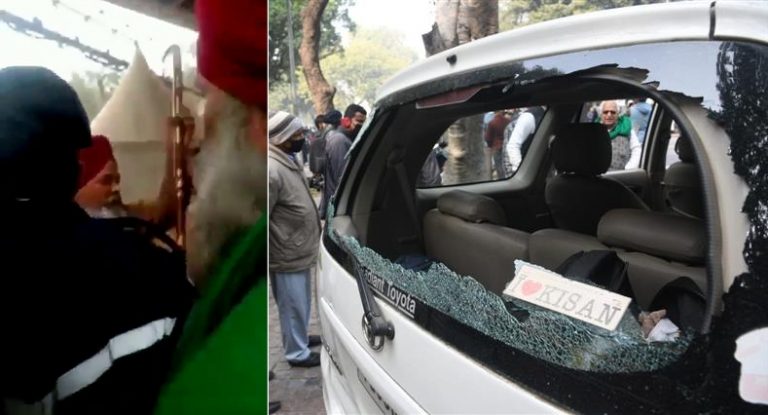
After staging protests along the Haryana-Delhi border causing massive inconvenience to the public, the farmers from Punjab are now resorting to vandalism and forceful disconnection of power supply to Reliance Jio towers to express their opposition to three farm laws passed by the Modi government.

The farmers, who had just a few days back staged protests outside the petrol pumps and retail outlets of Reliance have now resorted to vandalism of private properties belonging to Reliance Jio as a mark of protests against the three farm laws.

The protestors of various farmers’ union have shut the power supply to several Jio towers in Nawanshahr, Ferozepur, Mansa, Barnala, Fazilka, Patiala and Moga districts in the last three days. In a video shared by Asianet news network, one can see how protestors have gone rogue in Punjab and disrupting power supply in the state. A protestor can be seen cutting power supply to Jio mobile towers disrupting the telecom company’s services in several parts of the state.

In Ferozepur, the power supply to the cellular transmission towers was cut by farmers separately under the banner of BKU (Ugrahan) and BKU (Dakaunda).

We are disconnecting power supply as a form of protest, says farmers’ union

Defending the vandalism, BKU leader said that they disconnected power supply to five Jio mobile towers in Ferozepur to lodge our protest. “Our fight is against the corporate houses,” he added. BKU (Ugrahan)’s Gora Singh Bhainibagha confirmed that they cut the power connection to four mobile towers in Mansa on Wednesday and on Thursday, staged a dharna outside Jio offices.

Reportedly, the violent protestors in Nawanshahr, under the banner of Kirti Kisan Union (KKU) disconnected power supply to 11 Jio mobile towers. KKU leader Master Bhupinder Singh Wariach claimed that these black laws have been made to benefit the corporates, hence we are lodging our protest as the government is not ready to listen to us at all.

Sukhdev Singh Kokrikalan, general secretary of BKU (Ugrahan ) said they have been protesting against the corporates sector ever since the Centre came up with the three farm ordinances.

“First we sat outside petrol pumps of Reliance and ESSAR. Then we protested outside the Reliance malls and stores. We lifted our dharna from the dealer-based petrol pumps of these firms but we are still protesting at the company-owned pumps. Next, our call was to boycott Jio cellular service as part of which farmers ported out their numbers and have now disconnected the power supply to mobile towers,” said Kokrikalan.

Pubjab CM Captain Amarinder Singh cautions protestors, asks not disrupt power supply networks and vandalise Jio towers

Following the vandalism by the protestors in Punjab, Punjab Chief Minister Captain Amarinder Singh has asked farmers not to disrupt state’s telecom services and inconvenience citizen.

According to Times of India journalist Rohan Dua, the Punjab government, realising the dangerous situation, appealed the protestors to follow not to disrupt connect or manhandle employee and technicians of telecom companies.

Interestingly, while Punjab farmers are vandalising Jio towers today after Captain Amarinder Singh fanned the protests, it was Captain himself who had blamed Akali Dal for stalling progress.

2016 tweet by Captain Amarinder Singh

That’s Captain Amarinder Singh, pleading with Punjab farmers, presumably with folded hands, to do themselves a favor. Explaining how the farmers could have tripled their incomes if only they had a chance to deal with Reliance. But alas, the Akalis rained on their parade.

Thousands of protestors from Punjab have camped at the Haryana-Punjab border for around a month as the stalemate between the government and the protesters continue. The protests which began as a grievance against the farm reforms has now turned political with Khalistani groups, far-left, Islamist groups hijacking the protests to further their political agenda.

The time when Balasaheb Thackeray regretted sending ‘idiot’ Pritish Nandy to Rajya Sabha

Filmmaker and former Shiv Sena MP have been the subject of social media backlash after his recent comment on West Bengal was deemed as provocative and inciteful by netizens.

While dismissing allegations against him, Nandy has now claimed that his jibe of West Bengal fighting back with ‘Rabindra Sangeet and bricks’ was ‘sarcastic’ in nature and did not give any call for violence. He further ‘clarified’ that he was not a Shiv Sena MP even though he won his election to the Rajya Sabha on a Shiv Sena ticket.

Pritish Nandy claimed that he was a joint candidate of the Sena-BJP alliance and that his candidature was supported and endorsed by BJP stalwart Pramod Mahajan. “Now I want to respond to the Shiv Sena MP barb. Yes, I won an election on a Sena ticket but as a Sena-BJP joint candidate. BJP’s then super boss Pramod Mahajan ran my campaign and ensured my victory,” the filmmaker tweeted.

Screengrab of the tweet by Pritish Nandy

Balasaheb Thackeray on Pritish Nandy

However, Editor of The Print, Shekhar Gupta in an article in the Indian Express on November 24, 2012, made interesting revelations about how former Shiv Sena supremo Balasaheb Thackeray felt about Pritish Nandy. The article titled, “National Interest: Through his wine glass, darkly” recounts Gupta’s interaction with the saffron heavyweight, days after his demise.

Screengrab of the article by Shekhar Gupta (Photo Credits: Indian Express)

Shekhar Gupta recounted how during one such dinner with Balasaheb Thackeray, he saw his grandson Aditya Thackeray wearing a T-shirt, bearing the picture of a bald-headed WWF wrestler. The Shiv Sena leader mistook the wrestler for Pritish Nandy, who was elected to the Rajya Sabha on his party ticket in July 1998.

Yeh kya, idiot Pritish Nandy ka shirt pahan ke ghoom raha hai (Why are you wearing the shirt of that idiot Pritish Nandy)?” Thackeray rebuked his grandson. His statement, however, took Shekhar Gupta by surprise. He inquired, “He is your party MP. How can you speak of him so disparagingly?”

Screengrab of the article by Shekhar Gupta (Photo Credits: Indian Express)

In his unique, no-holds-barred style, Balasaheb Thackeray replied, “Theek hai. Idiot toh main hoon,not Pritish (This is true. Actually, I am the idiot, not Pritish).” The Shiv Sena supremo emphasised, “He took Rajya Sabha from me and I figured only much later, too late, that he is Christian.” Remembering the conversation, Shekhar Gupta wrote, “Yet, it seems, at least once, he claims to have been foxed and that too by a poet journalist.”

Claims of Pritish Nandy on Pramod Mahajan, Balasaheb Thackeray

In an article titled, “The irrelevance of the BJP” published in The Times of India on May 3, 2010, Pritish Nandy claimed that while the Shiv Sena votes alone were not enough to secure his election to the Rajya Sabha, Balasaheb Thackeray had made ‘impassioned plea’ for him. The appeal of the then Shiv Sena supremo helped him get votes from the BJP as well.

Screengrab of the article by Pritish Nandy in Times of India

“Clearly, the BJP was behind my victory even though Pramod Mahajan never quite liked me. But he listened to Balasaheb,” he noted. Today, Pritish Nandy suggests that it was the BJP which proved to be game-changer for by emphasising that Pramod Mahajan had campaigned for him.

However, he had claimed in 2010 that the BJP stalwart did not like him and would not have ‘ensured’ his victory, had it not been from Balasaheb Thackeray. Given the saffron leader’s comments about Pritish Nandy, it is safe to conclude that Balasaheb Thackeray and Pramod Mahajan were misled into believing that the ‘idiotic’ filmmaker would uphold the party’s beliefs, post his election to the Rajya Sabha.