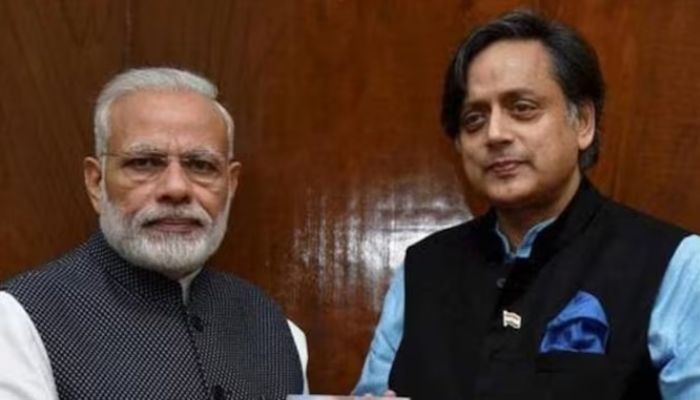
During the Raisina Dialogue 2025 in New Delhi on 18th March, Congress leader Shashi Tharoor said that he seems to be wiping egg off his face conceding that despite himself calling for the condemnation of Russia’s war with Ukraine and objecting to the Indian government’s continuation of business with Russia, three years later India is in a unique position to be friendly with both countries and be welcomed by both leaders.
“I am still wiping the egg off my face because I was one person in the parliamentary debate who actually criticized the Indian position at the time back in February 2022,” Tharoor said.
Explaining his reasoning for condemning the war, Tharoor continued “On the well-worn grounds that Espen (Norway’s Foreign Minister) will understand because he and I talked about all this in my UN days, that there was a violation of the UN Charter, sovereignty of a member state, namely Ukraine, and we had always stood for the that there had been a violation of the principle of the inviolability of borders of a sovereign state, inadmissibility of the use of force to settle international disputes and all of those principles had been violated by one party, and we should have condemned it.”
"3 years back, I criticised Govt's approach. But, today I'm wiping the EGG on my face. ~ India has a Prime Minister who can hug both the president of Ukraine & Russia, two weeks apart & be accepted in both places."?
— The Analyzer (News Updates?️) (@Indian_Analyzer) March 19, 2025
“Well, 3 years later, it does look like I am the one with egg on my face because clearly the policy has meant that India has actually a Prime Minister who can hug both the president of Ukraine and the president of Moscow two weeks apart and be accepted in both places and therefore India is in a position where it can make a difference to a lasting peace if it was so required in ways that very few countries would be able to,” Tharoor added.
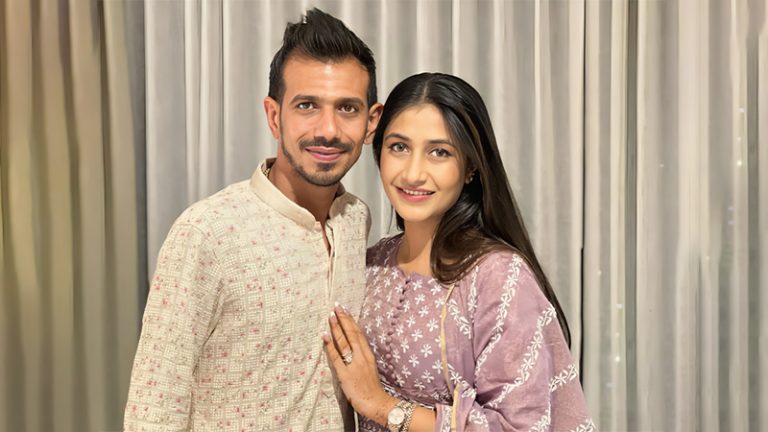
Bombay High Court on Wednesday ordered a family court to decide on the divorce petition filed by cricketer Yuzvendra Chahal and his estranged wife Dhanashree Verma by tomorrow, granting them a waiver of a mandatory six-month cooling off period. The court order also mentioned that Chahal has agreed to pay an alimony of ₹4.75 crore to Dhanashree.
The high court overturned the decision of the family court to refuse the waiver of the cooling-off period of six months stipulated under Section 13B of the Hindu Marriage Act for a divorce decree. The High Court agreed to grant the waiver considering Chahal’s participation in the upcoming Indian Premier League (IPL). The leg-spin bowler is a member of the Kings XI Punjab team.
The court stated, “As petitioner 1 (Chahal) is participant of IPL, learned counsel informs that he may not be available from 21st March, the learned judge family court is requested to decide petition by tomorrow,” as reported by Bar and Bench.’ The court also noted that Chahal and Verma have been living apart for over two and half years, and both parties have agreed on the alimony during the mediation process.
Chahal and Verma got married in December 2020, but they are living separately since June 2022. In February this year they filed a plea seeking divorce on the basis of mutual consent. They also sought waiver of the six-month cooling-off period.
However, the family court rejected the request on the grounds that the terms of the mutual consent were only partially fulfilled. The court said that while Chahal was required to pay ₹4.75 crore to Dhanashree as per the consent terms, only ₹2.37 crore has been paid. The court considered it as partial compliance of the consent terms and rejected the waiver.
This information from the high court order makes it clear Chahal is not required to ₹60 crore as alimony to Dhanashree, as was being claimed on social media. Dhanashree’s family had already denied that she has demanded ₹60 crore.
However, the High Court has now granted the waiver of the mandatory 6-month cooling-off period for divorce and ordered the family court to decide the case on Thursday. The court stated that the partial payment of alimony was in compliance with the mutual consent terms as Chahal is required to pay the balance amount only after the decree of divorce.
The Bombay High Court said, “Thus it is clear that there is no impediment in the facts and circumstances of the case in granting the applications… Accordingly, impugned order dated 20th February is quashed and set aside and the writ is allowed.”
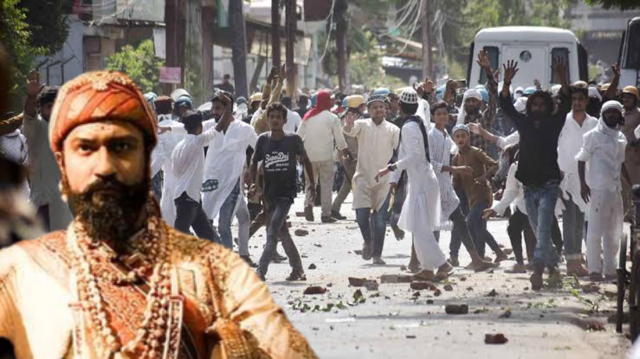
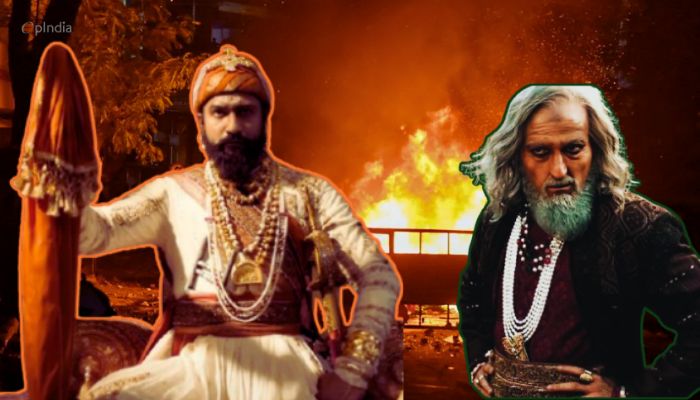
The recent violence in Nagpur was yet another grim reminder of how the Indian Left operates as a protective shield for Islamist mobs, ensuring that every act of aggression is justified, rationalized, or outright ignored. As usual, instead of holding Islamists accountable for their intolerance and violent tendencies, left-wing ideologues scrambled to spin the narrative—this time absurdly blaming actor Vicky Kaushal and the film Chhaava for “provoking” Muslims.
The Left’s routine whitewashing of Islamist violence
Whenever a Muslim mob indulges in violence, an influential section of India’s so-called “liberal” ecosystem instantly rallies behind them. Their objective? To shift the blame onto Hindus, the BJP, the RSS, or any other convenient scapegoat—while shielding Islamists from accountability. This playbook was followed to the letter in the Nagpur violence case.
The riots erupted because Islamists took offence at demands to remove Aurangzeb’s tomb in Sambhaji Nagar—a demand that, by any rational measure, should have sparked a debate, not a riot. Aurangzeb was a documented religious bigot, a genocidal ruler responsible for the destruction of countless Hindu temples, forced conversions, and mass killings. And yet, instead of asking why Muslims continue to revere such a polarizing historical figure, the Left-wing discourse immediately pivoted to blaming Chhaava and Vicky Kaushal for “hurting sentiments.”
This intellectual dishonesty is not new. It is the same mechanism that kicked in after every major Islamist riot—from the anti-CAA protests to the Udaipur beheading of Kanhaiya Lal. Each time, instead of acknowledging the radicalization within a section of the Muslim community, the Left concocts excuses to exonerate the perpetrators and demonize those who merely speak inconvenient truths.
Whether it is Ram Guha or Apoorvanand, The Wire’s Siddharth Varadarajan or Rohini Singh, popularly referred to as 2 BHK on social media for her alleged proximity with a political party, or politicians of the Left persuasion, all of them have sought to blame truth-telling in the form of movies made on historical events for the Islamist penchant for violence, passing the buck on the victim for committing the unpardonable sin of amplifying the truth and shielding the perpetrators who are champing at the bit of taking to violent means to suppress dissent.
The ever-shifting goalpost: From Aurangzeb’s tomb to Chhaava
A telling aspect of this narrative manipulation is how swiftly Leftist commentators and Islamist apologists changed their justifications. Initially, they claimed that Hindus demanding the demolition of Aurangzeb’s tomb “provoked” Muslims into retaliation, the narrative took a sudden turn to blame Chhaava for igniting sentiments of Hindus by depicting historical truths about Mughal oppression. Whatever narrative floated their boat, liberals went along with it, latched onto Aurangzeb’s tomb controversy as well as Chhaava, alleging that Hindus had “pushed Muslims against the wall.”
This pattern is predictable. When Islamist mobs pelt stones at Hindus, the Left asks, “What provoked them?” When Hindus respond, the Left screams, “Fascism! Majoritarianism!” It is always Hindus who must self-censor, always Hindus who must bend over backwards to avoid offending Islamists.
The Left’s intellectual gaslighting and the “victimhood” industry
The Left’s gaslighting follows a well-rehearsed formula. First, they deny that Islamist violence is a recurring problem. Next, they claim that Muslims are perpetual victims, pushed into a corner by “Hindu majoritarianism.” Finally, they manufacture an excuse for why violence was inevitable—whether it’s a film like Chhaava, an election campaign, or even a mere demand to remove a tyrant’s tomb.
This strategy is designed to provide Islamists with an unchallenged space to operate, ensuring that they remain forever shielded from criticism. It also feeds into a dangerous victimhood complex, where even the most violent and intolerant elements within the Muslim community believe that they are justified in their actions because they have been “wronged” in some way.
The real question: Why are Islamists always itching to riot?
The more pressing question, which no Leftist intellectual dares to ask, is: Why do Islamists so often resort to violence at the slightest “provocation”? Why does a mere film or a historical discussion become an excuse for mayhem? Why does the “secular” Left never challenge this hair-trigger outrage?
The answer is uncomfortable: Islamists have been conditioned to believe that their religious sentiments are above scrutiny and that any challenge to their historical narratives is akin to blasphemy and must be met with force. So whether it’s Allaudin Khilji, Aurangzeb or any other Mongol marauder, the Islamists are trained to hail them as religious warriors and their criticism as sacrilege deserving of a violent response. This conditioning is actively enabled by India’s Left-wing elites, who have consistently provided intellectual and moral cover for their actions.
In the case of the Nagpur violence, no sincere attempt was made to question why 600-1,000 Muslims would riot over Aurangzeb’s tomb. No Leftist questioned why a historical mass murderer is still a revered figure and his grave being allowed to turn into a shrine where the faithful can congregate and draw inspiration for another Nagpur-like riot or Chhatrapati Sambhaji Maharaj like torture. Instead, they followed their script—attacking Hindus, blaming the BJP, and portraying Muslims as helpless victims.
The consequence: Encouraging an endless cycle of violence
This deliberate mollycoddling of Islamists has dangerous consequences. By consistently shifting blame away from rioters and towards their victims, the Left ensures that Islamist violence remains unchecked. Every riot, every street veto, and every act of intolerance reinforces the idea that force, not reason, dictates public discourse in India.
Ultimately, the Nagpur violence was not about Chhaava or Vicky Kaushal—it was about an ecosystem that refuses to hold Islamists accountable. As long as this mollycoddling continues, the cycle of violence will only escalate, with the Left continuing to gaslight Hindus into believing that they are always at fault for daring to speak the truth.
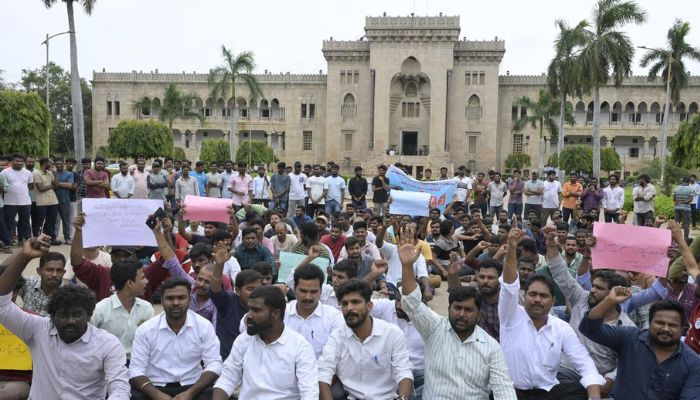
Osmania University has prohibited agitations, dharnas and demonstrations within its departments, colleges, centres, and administrative buildings. The University authorities said they have viewed the matter seriously and decided to prohibit trespassing, staging dharnas and agitations, raising slogans etc in the premises of the Departments/Colleges/ Centres/Administrative Building of the varsity.
Osmania University VC, with the help of the government, is trying to suppress the voices of questioning. The university administration is trying to take away the right to question. pic.twitter.com/RgmKLL7mhl
The University has also prohibited preventing administrative authorities and staff from discharging their official duties and using “unparliamentary and filthy language” against University staff and authorities.
This reportedly comes after some students at Osmania University protested recently after a razor blade was allegedly found in a curry served for dinner at the New Godavari hostel mess.
The protesting students allegedly blocked the varsity’s main gate and raised slogans against the administration while holding the curry vessel. The students demand Vice-Chancellor Professor M Kumar to address their grievance. The students alleged that a few days ago when worms were found in the cabbage curry served at the mess.
As per an internal document of the University, they said it was observed there are several incidents of students/student groups have been entering the Departments /Colleges, Centres/Administrative Building, Osmania and staging demonstrations and
Dharnas resulting in disruption of the administrative work and giving a wrong perception of the University to the Society. Such incidents, they said are causing adverse effects on the smooth functioning of the University, leading to delays in administrative and academic progress. On certain occasions, these incidents also raised security issues and concerns. The University further said that if any person is found involved in the above “activities, serious action will be initiated” against such person as per law. The varsity also said that stakeholders (i.e., Students on rolls) with a genuine grievance in the University system, if any, may first approach the concerned Official at the institution level, and thereafter may represent to the Registrar and the authorities, with prior permission.
Meanwhile, students are protesting against the varsity’s directives and are demanding the withdrawal of the said circular.
Under the leadership of the #BRSV student organization, a protest was held demanding the withdrawal of the circular issued in Osmania University, which was introduced unlawfully and against democratic principles….#OU#Protest#Telanganapic.twitter.com/MpvRBLFNu6
The protesting students also demanded release of their arrested peers.
Tension brewed at Osmania University (OU) in Hyderabad, with students protesting and demanding the withdrawal of circulars banning protests and rallies. The students also seeked the release of their arrested peers. #toi#timesofindia#osmaniauniversity#oupic.twitter.com/9VWBt51uHO
Union Minister and BJP leader Kishan Reddy criticised Telangana Chief Minister Revanth Reddy after Osmania University banned protests and processions at the campus and said it is an “undemocratic decision”.
He also acknowledged the role of the Varsity during the struggle for the freedom movement. “Osmania University has a long history. It played a significant role during the freedom struggle as well… When the first Telangana revolution began in 1969, nearly 369 students of Osmania University were martyred in police firing… When TRS formed the government, KCR put a ban on student agitation in the university,” Reddy said.
“And now, Revanth Reddy has issued an order banning processions, sloganeering, gathering, and protests in the university… No university puts a ban on such things… It is an undemocratic decision…,” Kishan Reddy added.
ఉస్మానియా యూనివర్సిటీ అధికారులు విడుదల చేసిన అప్రజాస్వామిక సర్క్యులర్ ను వెనక్కి తీసుకోవాలని ఎబివిపి బంద్ కీ పిలుపూనిస్తే అక్రమ అరెస్టులను చేయడాన్ని ఎబివిపి తీవ్రంగా ఖండిస్తుంది . pic.twitter.com/SwkqjWResQ
In a statement, the Akhil Bhartiya Vidyarthi Parishad (ABVP) also condemned the restrictions on protests at Osmania University. “ABVP strongly condemns the illegal arrests and calls for a bandh to demand the withdrawal of the undemocratic circular issued by Osmania University authorities.
Two significant incidents that occurred in Gujarat recently attracted the attention of nearly the whole country. The events were shocking and heartbreaking. Legal action is underway in both cases. However, why do individuals believe the two instances are different?
One instance had antisocial elements openly brandishing swords and intimidating bystanders in Vastral of Ahmedabad and the other involved Rakshit Chaurasia who killed a woman and wounded seven other people by his speeding car in Vadodara. Ironically his name is Rakshit (protector), but ended up destroying lives.
These two tragedies were not the only ones that occurred in Gujarat. Such situations have transpired on multiple occasions in the past, and each time, action was carried out. People eventually forget about them. They, however, cannot overlook the action that follows the same pattern consistently. P olice have responded differently in each case. Let’s discuss the two in more detail.
Anti-social elements create terror in Ahmedabad, houses vandalised
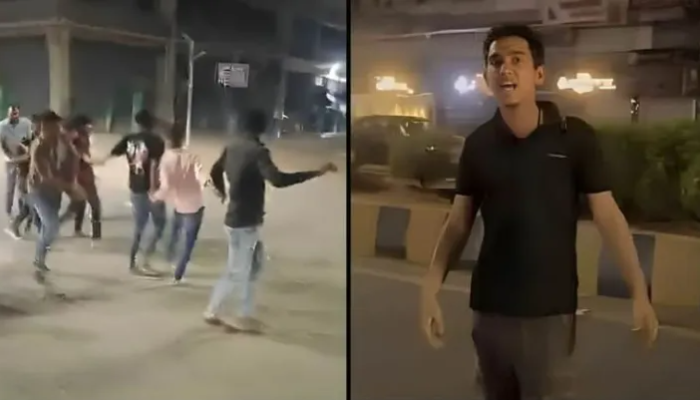
The date was 13th-14th March when some anti-social individuals wreaked havoc at night in Vastral and their videos went viral on the media and online. They waved swords in public and attacked passersby. They also damaged vehicles. Part two of the video was released a few hours after the first one in which the police publicly thrashed the accused and paraded them on the streets. Afterwards, more clips of these videos surfaced.
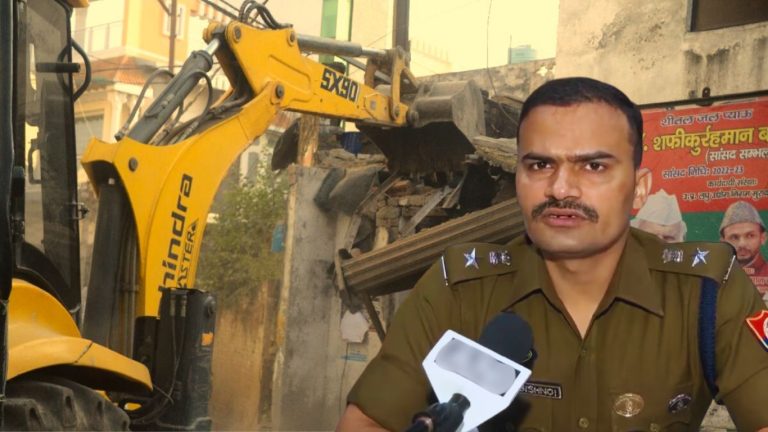
Some displayed the action taken against the culprits while others showed the protests by the family members of the latter. Another footage featured the demolition of their houses under the protection of the police administration. Several people were also seen destroying the kutcha houses located in the area with hammers. Many perpetrators were caught during the night while the remaining were nabbed next morning. The authorities should continue their action as it is necessary to be strict with those who harass common people, to prevent similar instances in the future.
After the incident, the state police chief also ordered swift action and asked to prepare a list of all such individuals in Gujarat within 100 hours following which further measures ensued. The 14 accused in the case were sent on 4-day remand. According to the latest reports, 13 of them have been sent to judicial custody. The cops file a First Information Report (FIR) after the arrest and the accused are brought before the court once the investigation is completed, in these matters. Notably, the main accused is still absconding and the hunt is on to catch him. A charge sheet will be submitted in court once the inquiry is over.
Accused arrested in Vadodara case
Let’s now analyze the case in Vadodara which happened on 13th March. It occurred at the same time as the aforementioned issue in Vastral. Gujarat received national attention as a result of both instances. The incident in Vadodara took place in the Karelibaug area close to the Amrapali Complex. Rakshit Chaurasia, a law student of MS University, drove the car at full speed in a drunken state and crushed 8 people including a woman (Hemali Patel) died on the spot.
He then came out of the four-wheeler and shouted “another round, another round” as if nothing had happened. The video also gained notoriety online as netizens expressed their outrage. He was apprehended by the locals and turned over to the authorities. The police then conducted a rapid test on Rakshith and Prince Chauhan (his friend who was in the car) which revealed that the pair had taken drugs and alcohol. However, the medical test report is yet to be released.
The accused brought the drugs to “enjoy” Holi, according to the police statement. They are currently in protected police remand. The probe is ongoing and further action will be decided after the medical report is received. The date of hearing is also not fixed. The accused is a Varanasi native who is at present a student in Vadodara. It is obvious that he hails from a wealthy household because he stated that his father is a “businessman.”
Discussion on social media about both incidents, questions on police action too
The two instances listed above have generated a lot of debate on social media. Users responded to the police move and remarked that although Gujarat Police inquired both crimes, which happened simultaneously in the state, no real action has been taken against Rakshit while the homes of the accused in Ahmedabad have been razed. The police’s lack of a firm stance against the young man has infuriated people. He reportedly belongs to an affluent family while the offenders from the other case have unprivileged roots.
It is vital for the police to keep an eye on those who cause nuisance in public. However, the lack of action by the police against the perpetrators in Vadodara case is incomprehensible to the people. The same was previously observed in the Tathya Patel case. He ran over nine individuals and killed them instantly on 20th July 2023, when he drove his Jaguar car at a high speed (more than 142.5 kmph) on the Iskcon Bridge. Tathya Patel’s father was charged with acting outrageously even after the incident. No particular measures were taken during that incident and users are blaming the police of failing to take a firm stance this time around as well.
Debate regarding the stance of the judiciary
On the other hand, there is also debate among users concerning the court’s stance. People frequently talk about the court’s lenient attitude in cases such as Tathya Patel and now Vadodara incident. The reason is that these people have powerful connections because of their wealthy parents while middle-class individuals are publically humiliated and have their illegal homes eliminated. The fact that Prajnesh Harshadbhai Patel alias Gota, Tathya Patel’s father, was also granted bail and that his company/business has not been thoroughly investigated is another topic of controversy.
However, Tathya Patel cannot be released from prison after nine people were killed. He is incarcerated at Sabarmati Central Jail at the moment. He has submitted multiple bail applications, including both regular and temporary bail. However, his plea was continuously denied by the Gujarat High Court and the Ahmedabad Sessions Court. The judge recently denied his bail request in December 2024. The matter is still pending, though.
Judiciary’s position in Pune Porsche case
The Pune Porsche case triggered the most discussion about the court’s position. Anish Awadhiya and Ashwini Koshta, two young IT experts were killed on 19th May 2024, when a 17-year-old inebriated minor drove a Porsche and crushed them. The accused was granted bail with “severe” terms by the Juvenile Justice Board just hours after the incident. The conditions included completing a 300-word essay, serving 15 days of traffic duty with the Yerawada police, seeking treatment for addiction and going to counseling. The nation was so enraged by the board’s judgment that on 22nd May the JJB was forced to revoke the bail and place the accused in an observation house until 5th June.
He was released from the observation home by the Bombay High Court on 25th June and granted his custody to his aunt. Furthermore, the Pune Police petitioned JJB to have the youngster tried as an adult and it remains pending. The teenager, of course, came from privileged background as well. These young men who were seen intoxicated in these startling occurrences are members of prominent families. Their expensive vehicles are now a topic of conversation too. Charges of tampering with evidence, pressuring the driver to take the blame and altering the blood sample have been brought against the accused’s father, mother and grandfather in the Pune case.
On 27th May, Dr Ajay Taware and Dr Shrihari Halnor of Sassoon Hospital were arrested as they had altered the blood sample of the accused which prevented his drunken state from being exposed. He is still out on bail and no punishment has been imposed om him by the court. Moreover, the Bombay High Court pronounced that he should be treated as an underage under the Juvenile Justice Act. Netizens raised objections that he murdered two people, IT specialists, at that. The culprit has completed the 15-day safe driving course and submitted an essay in the court.
Why are the people angry
The aforementioned conversations addresses the infamous and contentious cases. Netizens are furious at the dearth of action taken against the children of such affluent parents. Why are they not reprimanded publicly? Why is their ancestral properties or businesses not being investigated? Why are they not subjected to the same standard of inquiry? Why they aren’t in Tihar jail? Why does the police lack the ability to take decisive action while the court readily grants bail to such accused in exchange for written essays or statements? These questions have incensed people on social media.
Whether it is the Vadodara incident, the Ahmedabad Iskcon bridge case or the Pune Porsche instance, the lack of effective measures like the one enforced in Vastral has been bothering people amid debates on social media. There are calls for the police to treat all of the accused with the same toughness as they did in Ahmedabad. Similar measures should have been executed in the Vadodar case and other such incidents akin to Vastral where a strong example was set. Thus, the mania for speeding cars could have been curbed among such wealthy individuals, and a precedent for society could have been established.
The Sambhal administration is set to take stringent action against encroachment on government land in the Chandausi municipal area in the Sambhal district of Uttar Pradesh. Around 34 illegal structures including a mosque built on the municipal land in Chanduasi city will be demolished. The action came after a complaint was filed by a municipality clerk highlighting the encroachment of about six and a half bighas of land out of the twenty-nine bighas belonging to the municipal board.
The administration will take action against the mosque and illegal houses built by illegally occupying 6.5 bighas of municipal land in Waris Nagar of Chandosi in Sambhal district of Uttar Pradesh. The DM has given instructions to investigate the documents of 34 structures including the mosque. If illegal occupation is found in this investigation, demolition action will be taken.
The DM reached the spot to take stock of the situation and ordered that whoever sold or occupied government land, action would be taken as per the rules. This decision has created a stir in the area. The administration has become strict regarding the mosque and 34 houses built on government land in Chandausi Waris Nagar. Municipal Corporation Chandausi had complained to the tehsil administration that the Mustafa Mosque built in Waris Nagar of Laxmanganj area and the houses built around it are built on government land.
As per reports, on 8th March a team of the revenue department headed by the Tehsildar measured the encroached land. The team found that 33 houses and a mosque were built on encroached land. Besides, two plots were also illegally occupied. On Monday (17th March), District Magistrate Sambhal, Rajendra Pensiya and SP Krishna Kumar Bishnoi inspected the illegal buildings. The people living in the houses constructed on the municipal land failed to produce any documents proving that the land belonged to them. The DM and the SP directed the officials to demolish the illegal construction. They also ordered the filing of FIRs against the encroachers.
“The land belongs to the municipal board. An illegal registry has been created without ownership of the land. 34 illegal structures including 33 houses and a mosque have been constructed,” said DM Pensiyia.
Sambhal MP’s house likely to be demolished
A house belonging to Sambhal MP Zia Ur Rehman is also likely to be demolished after it was found to have been constructed without getting the map approved. A case has been going on in the court regarding an unapproved construction in the house. Sambhal SDM Dr Vandana Mishra said that the MP was allowed to either show that there was no new construction in the house or to show that the house did not belong to him but to someone else. However, the MP failed to produce any documents to prove either.
#WATCH | Sambhal, Uttar Pradesh | Sambhal SDM Vandana Mishra said, "Today was the date in that case (carrying out construction work without getting the building map approved from civic authorities) but the SP MP's (Zia Ur Rehman) side did not present any evidence, nor any fact… pic.twitter.com/TODkMiOArv
A two-member investigation committee has been set up to examine the unapproved construction in the house. The committee will submit its report in the next 3 days to the SDM. The next date of hearing in the matter is 22nd March. Action regarding demolition will be taken based on the report of the committee.
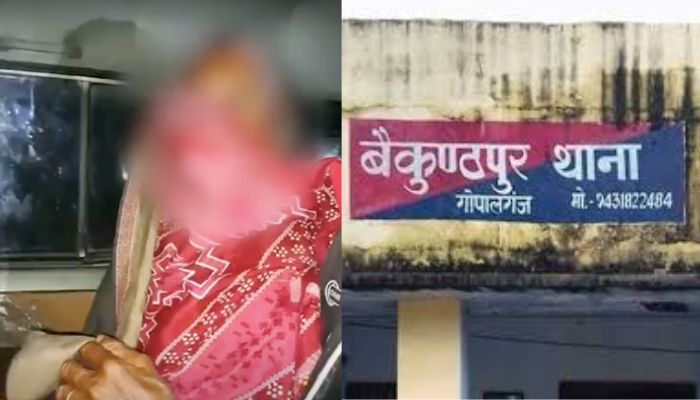
In Bihar’s Gopalganj district, an 80-year-old Dalit Hindu woman was allegedly raped on 14th March 2025 when she had gone to a wheat field to cut grass. According to the complaint lodged by the victim’s son, at around 4:30 pm, the victim was attacked and gagged by a Muslim man who then allegedly raped her. Reports say that the accused also attempted to gouge out her eyes.
After the alleged crime, the 24-year-old main accused who is reported to be known by the alias Chhote Alam fled the spot after assuming that the unconscious victim had died.
A village girl spotted the victim in an unconscious state and then informed the 80-year-old woman’s family. Subsequently, the victim was brought to her home by her family and a doctor was called. The victim is reported to have regained consciousness on 15th March, after 19 hours.
The complaint filed by the victim’s family states that the accused persons had threatened the victim not to inform anyone about their heinous crime or they would kill her.
In his complaint, the victim’s son mentions that after she revealed her ordeal before them, they went to one of the accused Syed Ali’s house to confront him. However, accused Syed Ali, Babudin, Shahabuddin, Saddam, Hashmat and Jummadin drove them away and hurled casteist slurs.
During #Holi, a #Dalit#Hindu woman was gangraped in #Bihar. @TOIIndiaNews promptly mentioned "During Holi" to give an impression that the crowd celebrating Holi i.e. Hindus had done this heinous crime. They do not disclose the name of the criminals, which you should have guessed… pic.twitter.com/WgLtF9rLhP
“S*&la ch@m%&r siyaar, hamare darwaze par aa kar shikayat karne aa gya. Bhago nahi toh yahin ch@m&%r siyaar m@d&*c^%d jaan se maar denge,” the complaint cites the accused persons as saying.
The police have registered a case against the accused persons including the main accused, four of his family members and two others present at the crime scene, under relevant BNS sections and the SC/ST Act.
The Baikunthpur, Police Station SHO earlier said that one of the persons who was present with the accused has been arrested while efforts are on to arrest the main accused and others.
According to an Aajtak report, Sadar SDPO Abhay Kumar Ranjan has said that the victim was sent for medical examination and the medical reports refute the allegations of rape as mentioned by the victim’s family in the complaint, however, the physical assault was confirmed. The officer also reportedly stated that the main accused had been arrested.
Times of India omits names of the Muslim accused, insinuates old woman raped by Holi celebrating men
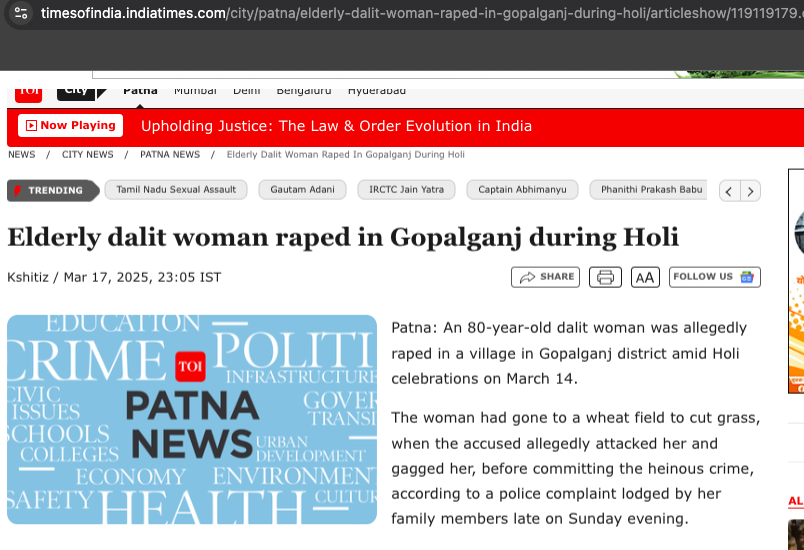
The Times of India newspaper published a report on this incident, however, not without omitting the names of the Muslim accused and insinuating that the incident happened amidst Holi celebrations as if the Holi-celebrating Hindu men raped the victim. “An 80-year-old dalit woman was allegedly raped in a village in Gopalganj district amid Holi on March 14,” TOI report headlined “Elderly Dalit woman raped in Gopalganj during Holi”.
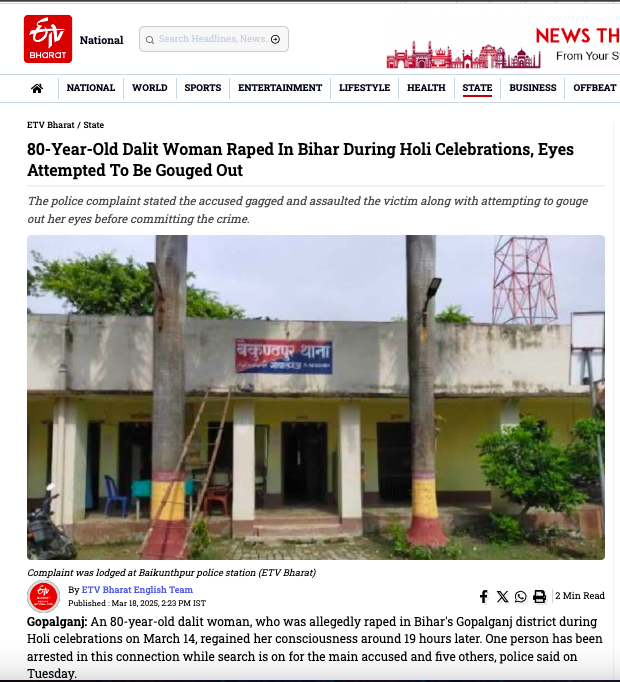
Meanwhile, ETV Bharat also insinuated that the Dalit woman was raped during Holi celebrations and did not mention the names of the Muslim accused.
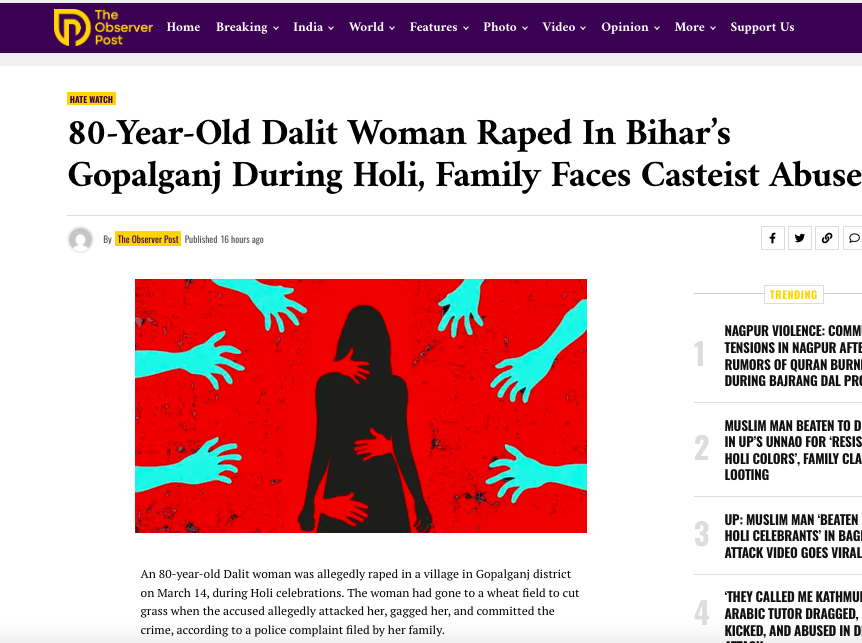
Similarly, The Observer Post, an Islamist ‘media’ outlet notorious for peddling fake news and false narratives, also insinuated that the alleged incident happened during Holi celebrations. Despite mentioning details from the complaint, both the Islamist propaganda outlet and TOI omitted the names of the Muslim accused and laid emphasis on Holi and casteist slurs hurled at the victim by the accused. Thus, keeping the readers the impression that the casteist slurs spoken against the Dalit woman and the alleged crime were committed by Holi-celebrating ‘upper caste’ Hindu men.
While The Observer Post withholding names of the Muslim accused and using the “during Holi celebrations” framing is not surprising since defending Islamists is their core agenda, a mainstream media outlet like the Times of India publishing such misleading headlines is alarming.
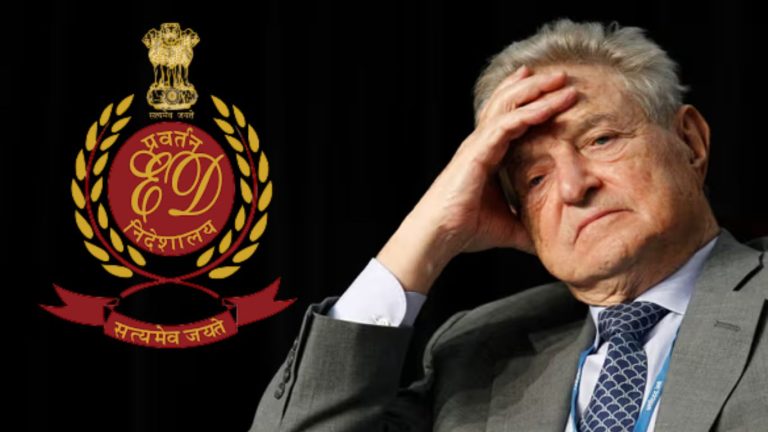
On Tuesday (18th March), the Enforcement Directorate (ED) raided 8 locations in Bengaluru linked with beneficiary entities of the Open Society Foundation (OSF), owned by far-left billionaire George Soros. The raids were reportedly conducted as part of the ED investigations into the violations of the Foreign Exchange Management Act (FEMA) regulations by three Bengaluru-based companies.
The entities whose premises were searched by the ED included some international human rights bodies and a company named Aspada Investments Pvt Ltd. Aspada Investments Pvt Ltd was reportedly set up by the OSF in Mauritius to channelise funds in India. It was set up in Bengaluru on February 4, 2013, to manage OSF’s investment in India.
OSF’s investment arm provided ₹300 crore to more than 12 Indian companies
As per reports, the Soros Economic Development Fund (SEDF), a social impact investment arm of the OSF, transferred around ₹25 core between 2020-21 and 2023-24 to three Indian companies in violation of the FEMA guidelines. The companies are named- Rootbridge Services Pvt Ltd (RSPL), Rootbridge Academy Pvt Ltd (RAPL) and ASAR Social Impact Advisors Pvt Ltd (ASAR). The SEDF reportedly provided funds to the tune of ₹300 crore to more than 12 companies in India.
The OSF was put under the Prior Reference Category (PRC) by the Ministry of Home Affairs (MHA) in 2016 which mandated the OSF to seek prior permission from the ministry before giving any donations to FCRA-registered entities in India. However, the OSF had been trying to bypass the regulations and restrictions by bringing in funds through FDI and consultancy fees and using the money to fund certain NGOs in India, in contravention of Indian laws.
SEDF transferred funds to Indian companies for ‘services’ that were never rendered
According to the Times of India, the SEDF transferred funds to the RSPL through compulsorily convertible preference shares. The RAPL set up in 2019, was given ₹2.7 crore by the SEDF as commission agent services. However, no services were provided by the company which suggested that the RAPL acted as an agent for the SEDF to bypass the FCRA regulations for funding NGOs in India. Similarly, the ASAR which was set up in 2016, received an amount of ₹2.9 crore from the SEDF in the name of ‘service fees’ which was suspected by the investigation agency to be a donation in disguise. The ED is examining the end use of other FDI funds brought in by Soros EDF and OSF.
Soros’ Open Society Foundation is accused of engineering regime change operations around the world though civil society groups and activists. The OSF describes itself as the world’s largest private funding agency of groups supporting human rights, justice and accountable government. In 2020, it had an annual budget of US$1 billion. The SEDF is an active social impact investor in India and its stated goals include ‘helping smallholder farmers and small businesses boost their incomes, making healthcare, schooling and financial services more available and affordable to a broader range of people’. The OSF has reportedly invested $90 million in start-up and early funding projects managed by Aspada Investments since 2008.
The ED raids on the OSF-funded entities in India come at a time when Soros’s foundation is facing the heat in the United States after the Trump government came to power. Soros had aligned with far-left liberals and had opposed Donald Trump ahead of the US Presidential election. He had also announced his dislike for the Modi government in India, and had stated that his organisation has set aside $1 billion to change ‘nationalist’ governments around the world.
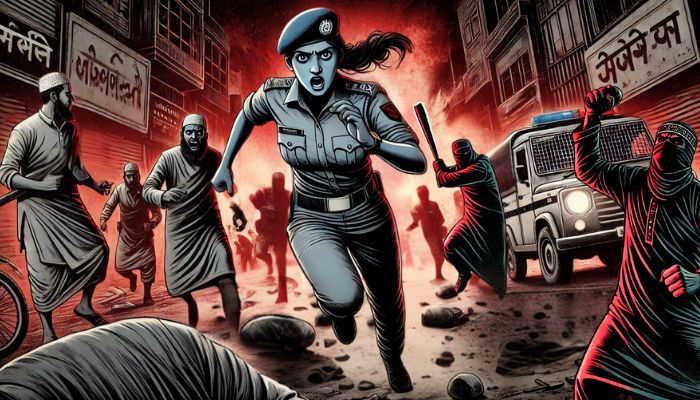
On 17th March, a Muslim mob molested a woman police officer in the Bhhaladarpura area of Nagpur, Maharashtra, and attempted to disrobe her during the violence by the mob over Hindus demanding the removal of Aurangzeb’s tomb. An FIR has been filed against the rioters at Ganeshpeth police station. The violence broke out in Nagpur over rumours that copies of the Quran were burnt during protests by Hindus. Thousands of mobsters were seen chanting Islamic slogans, vandalising vehicles, pelting stones at houses, and destroying shops belonging to Hindus in different parts of the city.
According to media reports, a mob of around 500 individuals was chanting slogans and pelting stones. Senior police officials reached the scene with a heavy police force, including riot control personnel and female officers, to bring the situation under control.
As the police attempted to disperse the mob, the Islamists turned aggressive and started pelting stones at the police personnel. They abused the police and physically assaulted some officers. Amid the ongoing violence, a group within the mob got hold of a woman police officer and molested her. They attempted to disrobe her. Fortunately, the female police officer managed to escape in time. As she escaped, the rioters turned to police vehicles parked in the area and vandalised them.
Round-the-clock police patrols
Police have marked 11 areas as highly sensitive and 19 as sensitive following the riots. Additional police forces have been deployed in the area for round-the-clock patrols. The sensitive areas include Mahal and Mominpura. Reports suggest that armed police units have been patrolling these areas continuously to ensure law and order.
Nagpur Violence
On the evening of 17th March, Nagpur underwent violent unrest that left more than 30 people wounded over rumours of the burning of a copy of the Quran during a protest by Hindu organisations demanding the removal of Aurangzeb’s tomb in Chhatrapati Sambhajinagar.
Demonstrators covered an effigy of the Mughal despot with a sheet and then put it on fire during the agitation. Rumours, however, quickly surfaced that a copy of Quran had also been burned during the outrage. The fake claims then spread like wildfire especially through social media, triggering members of the Muslim community. The atmosphere became tense as thousands of Muslims gathered to protest and shouted Islamic slogans after which they soon wreaked havoc on the streets of Nagpur.
According to reports, rioters set fire to cars, threw stones and damaged public property. Three cars and around 30 vehicles were set ablaze, 33 police personnel were hurt, and nearly 60 to 65 rioters were arrested. The area around the Kotwali police station was soon affected by the violence that started in Chitnis Park and Mahal and later spread to other parts. The decoration materials intended for the Ram Navami Shobha Yatra were also not spared. According to witnesses, the rioters had their faces concealed and were carrying swords, weapons and bottles.
Islamists and their cheerleaders masquerading as ‘secularists’ have mastered the art of guilt-tripping Hindus for simply narrating their historical persecution at the hands of Islamic invaders. On 17th March 2025, Muslim mobs unleashed violence against Hindus and the local police over demands to remove the grave of 17th-century Mughal tyrant Aurangzeb. In his lifetime, Aurangzeb ordered the demolition of countless Hindu temples including the ones in Kashi, Mathura, forced Hindus to pay discriminatory Jizya tax and forcefully converted numerous Hindus to Islam, however, the converted descendants of Aurangzeb’s Hindu victims got so offended over a movie retelling his brutalities or an attempt erase symbols associated with him that they resort to violence.
Over the years, a chilling pattern has been observed whenever Hindus attempt to narrate their stories of persecution by Islamic jihadis through films like the recent blockbuster Chhaava based on the life and valour of Chhatrapati Sambhaji Maharaj who was tormented for days before being murdered for not converting to Islam or The Kashmir Files which retold the genocide of Kashmiri Hindus in the early 1990s, a wave of ‘protests’ and violence from Islamists and pro-Islamist narrative pushed by their apologists dominates social media. The violent jihadis take to the streets to ‘put Hindus in their place’ and their propaganda wing which extension includes left-liberals burns the midnight oil to paint the victims as villains.
While Aurangzeb’s ‘Moohboli aulaads’ [read self-declared descendants] come up with some or the other immediate excuse to justify their mob violence and arson, this is not just a reaction to a suspiciously convenient rumour, rather, it is a calculated strategy to silence Hindus, psychologically bludgeon them into submission. They essentially want to deter Hindus from even attempting to reclaim the stories of their Hindu ancestors who resisted Islamic fanaticism or retell the stories of their sufferings at the hands of Muslim invaders, a persecution that echoes into the present and continues to this day, although in varied forms.
The fabricated claims of the burning of paper containing Quranic verses mirror tactics seen in Muslim-majority Bangladesh where false claims of Quran burning and deliberately placing Quran copies in Hindu temples are used to unleash and justify anti-Hindu pogroms.
Even in the Nagpur violence case, Maharashtra Chief Minister Devendra Fadnavis said that the riot was pre-planned, a trolley full of stones and weapons were recovered by the police and even houses and establishments were selectively targeted by the rioting mob comprising 200-300 men. In another related incident, the Muslim mob attacked the police in the Bhaldalpura area injuring 33 police officials including one who was attacked with an axe. He further stated that the film Chhaava presented the true history, which stirred emotions and fuelled anger against Aurangzeb, his Islamic fanaticism and brutalities on Hindus, especially Chhatrapati Sambhaji Maharaj.
While Muslim rioters used the excuse of the alleged burning of a sheet containing religious text and blamed the Hindus for offending their religious sensibilities by demanding the removal of Aurangzeb’s grave, their cheerleaders on social media are blaming actor Vicky Kaushal who played the role of Chhatrapati Sambhaji Maharaj in the film Chhaava.
Basically, the Islamists want to convince Hindus that what happened with Chhatrapati Sambhaji Maharaj centuries back is to be blamed on him only and not Aurangzeb or his jihadist zeal to convert the Hindu king to Islam, and now it is not the Muslim mobs but an actor who portrayed the character of the Hindu king onscreen and the film that depicted the sacrifice of Chhatrapati Sambhaji Maharaj and the cruelty of Aurangzeb are to be blamed for inciting them enough to justifiably run riots.
Islamo-leftist propagandists doing what they do best—blame Hindus, film Chaava and actor Vicky Kaushal for the violence unleashed by Islamists
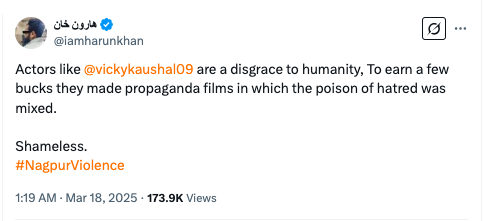
In this vein, one Harun Khan wrote on X, “Actors like @vickykaushal09 are a disgrace to humanity, To earn a few bucks they made propaganda films in which the poison of hatred was mixed. Shameless.”
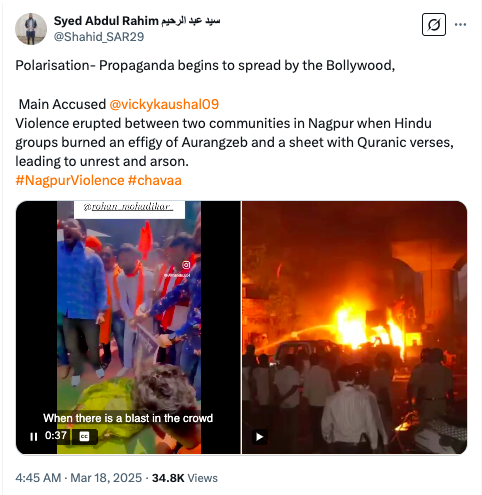
Similarly, one Syed Abdul Rahim wrote, “Polarisation- Propaganda begins to spread by the Bollywood, Main Accused @vickykaushal09 Violence erupted between two communities in Nagpur when Hindu groups burned an effigy of Aurangzeb and a sheet with Quranic verses, leading to unrest and arson.”
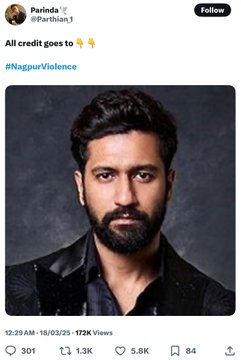
One X user blamed Chaava actor Vicky Kaushal for the Islamist violence in Nagpur.
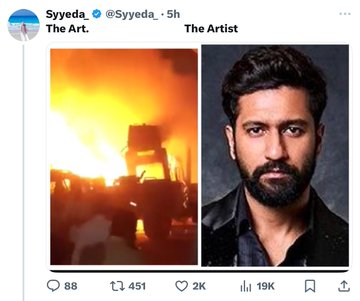
Another one called Vicky Kaushal the artist behind the art of Nagpur violence.
Asif Mujtaba, the co-conspirator of Sharjeel Imam, one of the Islamists who orchestrated the onslaught against Hindus during the Delhi anti-Hindu riots in 2020, wrote, “Violence erupted between two communities in #Nagpur when the hindutva groups burned the effigy of #Aurangzeb & a sheet with Quranic verses. It led to violence & arson.”
Violence erupted between two communities in #Nagpur when the hindutva groups burned the effigy of #Aurangzeb & a sheet with Quranic verses. It led to violence & arson.pic.twitter.com/Y2p191G9mj
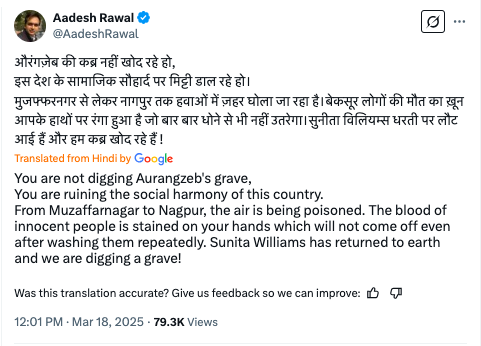
Meanwhile, ‘journalist’ and BJP-detractor Aadesh Rawal also conveniently blamed the Hindus and the BJP for ruining communal harmony and raised no questions over violent Jihadis. “You are not digging Aurangzeb’s grave, You are ruining the social harmony of this country. From Muzaffarnagar to Nagpur, the air is being poisoned. The blood of innocent people is stained on your hands which will not come off even after washing them repeatedly,” Rawal posted.
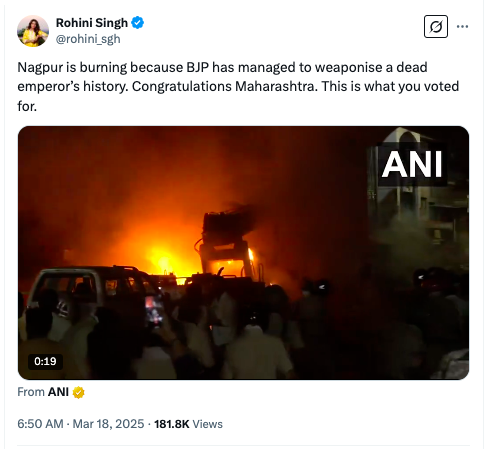
Similarly, ‘journalist’ Rohini Singh, better known as “2BHK” also stayed true to the Islamo-leftist narrative of downplaying Islamist violence and blaming Hindus, the BJP, the people who voted for BJP and everything under the sun except the violent mob. “Nagpur is burning because BJP has managed to weaponise a dead emperor’s history. Congratulations Maharashtra. This is what you voted for,” Singh posted.
Meanwhile, leftist propaganda outlet TheWire’s Arfa Khanum Sherwani also decided to blame the BJP for the Muslim mob violence in Nagpur instead of the Muslim rioters. Arfa asserted that somehow the BJP is making Hindus fight against the grave of a Muslim ruler who died centuries ago and that such a party cannot give a good future. She, however, did not elaborate as to why the present-day Muslims whose ancestors were essentially Hindus consider Islamic tyrant Aurangzeb as their religious hero why is it that Muslims find their historical-religious icons in the likes of Aurangzeb and Tipu Sultan whose Hindu hate knew no bounds.
“The party which is presenting rulers who left the world hundreds of years ago as your enemies, What future will the party that is making you fight not against living people, but against graves, give you? Write it down, BJP which keeps you entangled in the past is destroying your tomorrow,” Arfa posted.
जो पार्टी सैकड़ों साल पहले दुनिया छोड़ चुके शासकों को आपका दुश्मन बनाकर पेश कर रही है, जो पार्टी आपको ज़िंदा इंसानों नहीं बल्कि अब क़ब्रों से लड़ा रही है, वो आपको क्या भविष्य देगी? लिखकर रख लीजिए, गुज़रे हुए कल में उलझाकर रखने वाली BJP आपका आने वाला कल तबाह कर रही है।
While the traducers of BJP-Modi have consistently been blaming Hindus and the BJP for Muslim mob violence against Hindus and the police be it in Sambhal or Nagpur, the mainstream media has also jumped on the bandwagon to subtly push the blame on the Hindu side. In this vein, the Times of India published a report on Nagpur violence and at the very onset it set a tone that somehow anti-Aurangzeb protestors are to be blamed for unleashing violence on the police and Hindu localities.
Accept your persecution, let us extol oppressors of Hindus: The Islamist intransigence
From Chhaava to Kashmir Files, the Islamo-leftist narrative has been about turning Hindus oblivious to their historical persecution, guilt-tripping them for even talking about attacks on their religious identity be it in the era of Mughals, the British colonial era or the contemporary times where Muslims are minority but a privileged one in many respects especially when it comes to their fragile religious sentiments. It is for this reason that any attempt by the Hindus to retell the grim stories of their persecution at the hands of Islamists through cinema is met with vehement resistance and violence from the Muslim mobs.
Remember how the Islamists and their sympathisers in the media and politics demanded a ban on The Kashmir Files and the self-proclaimed peaceful Maulanas issued threats that “Kalma-chanting Muslims” would kill Hindus? Yet nobody from the ‘Bhaichara’ and ‘Ganga-Jamuni Tehzeeb’ gang condemned such open Islamist threats. From petitions to get the film banned, calls for boycott to targeted smear campaigns and of course, violence the Islamists joined by Muslim appeasing politicians and media allies, tried their level best to prevent the cinematic retelling of the Islamist onslaught against Kashmiri Hindus in the early 1990s wherein Hindus were brutalised, killed, raped, and forced to flee their homes, reach the masses, especially Hindus.
While the the murderous slogans of Raliv, Galiv, and Chaliv still send chills down the spine of Kashmiri Pandits, the Islamists and their cheerleaders played every trick at hand not only when the anti-Hindu pogrom transpired but even when the film The Kashmir Files released in 2022. In March 2022, several Muslim men assaulted three Hindu youths who raised patriotic slogans coming out of the theatre after watching the Vivek Agnihotri directorial.
The Kashmir Files only scratched the surface of the unimaginable horrors—rapes, killings, exodus—unleashed upon Kashmiri Hindus by Islamic terrorists in Jammu and Kashmir during the early 1990s and yet, even this restrained portrayal was enough to offend the Islamists.
Be it during the time of The Kashmir Files or the current unrest over Chhaava, the Islamists re-victimize Hindus so they keep quiet and get conditioned to not only accept their persecution but also, never talk about it, to facilitate the Islamists to continue the persecution and play victim at the same time—demonising Hindus further. Even during the release of the film The Kerala Story which depicted a cautionary tale of how Hindu girls in Kerala were trapped in a relationship through love jihad, brainwashed, and enlisted to serve the terror outfit ISIS in Syria-Iraq, the Islamists had declared the film ‘Islamophobic’. Many petitions were filed in court to get the film banned, simply because it highlighted a real, prevalent and sometimes organised, as seen in the case of the Beawar grooming gang, the trend of Islamists targeting Hindu women for sexual abuse and religious conversion. The film’s makers received threats from Islamists for daring to make a movie highlighting the menace of love jihad. Boycott calls were made by the so-called ‘secular’ brigade against the film which despite this became a blockbuster.
The victims become the aggressors and the aggressors the victims. Hindus are painted as monsters for telling the stories of their pain, and then, are blamed for the re-victimisation as well, as evidenced in the Nagpur Islamist violence and how the Islamo-leftist cabal is blaming it on Hindus and the BJP. The ‘secular’ politicians make ingratiating statements to pander to the Islamists and whitewashing by the Islamo-leftist cabal has only emboldened the Islamists to get randomly offended over anything that they perceive as a threat to their religion or the supposed religious supremacy.
If one peers into the psyche of Islamists, there is a sinister pattern. They glorify historical figures who mirror their own religious fanaticism, elevating Hindu-hating despots like Aurangzeb and Tipu Sultan to heroic status, while hardly even talking about Dara Shikoh, who was beheaded by his brother Aurangzeb for being tolerance towards Hinduism. They draw inspiration from historical figures who violently spread Islam across India and introduced discriminatory policies against Hindus and other non-Muslim communities as they apparently dream of replicating the same if and when the ‘nizam’ changes.
The success of The Kashmir Files and The Kerala Story rattled the Islamo-leftist ecosystem since these films ditched the conventional Bollywood approach of presenting a ‘secularised’ version of real-life incidents. Now, the success of Chhaava has left the Islamists and their sympathisers fuming as this film has managed to achieve its intended purpose. No, its purpose was not to incite Hindus against Muslims, rather, its purpose was to educate the Indian people about Chhatrapati Sambhaji Maharaj’s courage, sacrifice and devotion towards Hindu Dharma, within the bounds of cinematic storytelling. Had the Indian education from schools to colleges delved deeply into the lives of Chhatrapati Sambhaji Maharaj, Chhatrapati Shivaji Maharaj and other great Hindu warriors, both Hindus and Muslims would have grasped their authentic history contrary to the secularised and biased version they were taught. The film Chhaava came across as a shocker to many who even admitted to having known hardly anything about Chhatrapati Sambhaji Maharaj and the torture he endured to protect his Dharma.
In a Hindu-majority India, Hindus should not be villainised for celebrating the true heroes of Bharat. Despite ruling India’s vast expanse, Aurangzeb’s heart remained brimmed with hatred and venom for a Kafir Hindu majority. Those who extol his name or spark riots in his defence reveal a dangerous truth that although Aurangzeb lies in his grave, his abhorrence for Hindus thrives on, pulsing through the veins of converts descended from the very victims he subjugated.
It is due to this unending disdain for the Hindus, their religion, culture, festivals and mere existence that Islamists find some or the other excuse to target the former, especially when the Hindus dare to reclaim their religious sites, history and pride or simply narrate the stories of their persecution through creative and peaceful means like cinema. The prevalent pattern suggests that there is a psychological experiment at play to make Hindus accept their persecution and also feel guilty about having complained about being persecuted by Islamists in the past or today.