Home Blog Page 5111

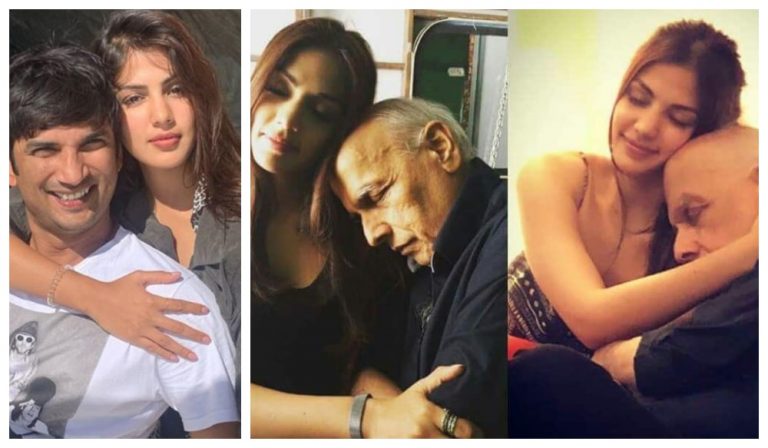
‘My existence is worthless if I can’t help you,’: Leaked WhatsApp conversation between Rhea and Mahesh Bhat on June 8. Read details

The mystery surrounding the death of the 34-year-old actor Sushant Singh Rajput is getting murkier with every passing day. Besides the questions pertaining to the circumstances that led to his death, eyebrows are now being raised about the contradictory statements made by director Mahesh Bhatt and actress Rhea Chakraborty.

Following the death of Sushant Singh Rajput on June 14, Suhrita Das wrote a Facebook post praising Rhea for supporting the deceased actor during his ‘clinical depression’. Das, who works as an associate of Mahesh Bhatt, wrote, “Can’t forget the evening in Sushant’s terrace when it felt like everything was normal in the world while deep within he was slipping away. Sir (referring to Mahesh Bhatt) saw that.”

Suhrita Das further added, “That’s why he shared the very words his Master UG told him warning him about Parveen Babi. Walk away or this will take you down under along with.” On the fateful day of Sushant’s death, the close associate of Mahesh Bhatt admitted that he told Rhea Chakraborty to leave the 34-year-old actor.
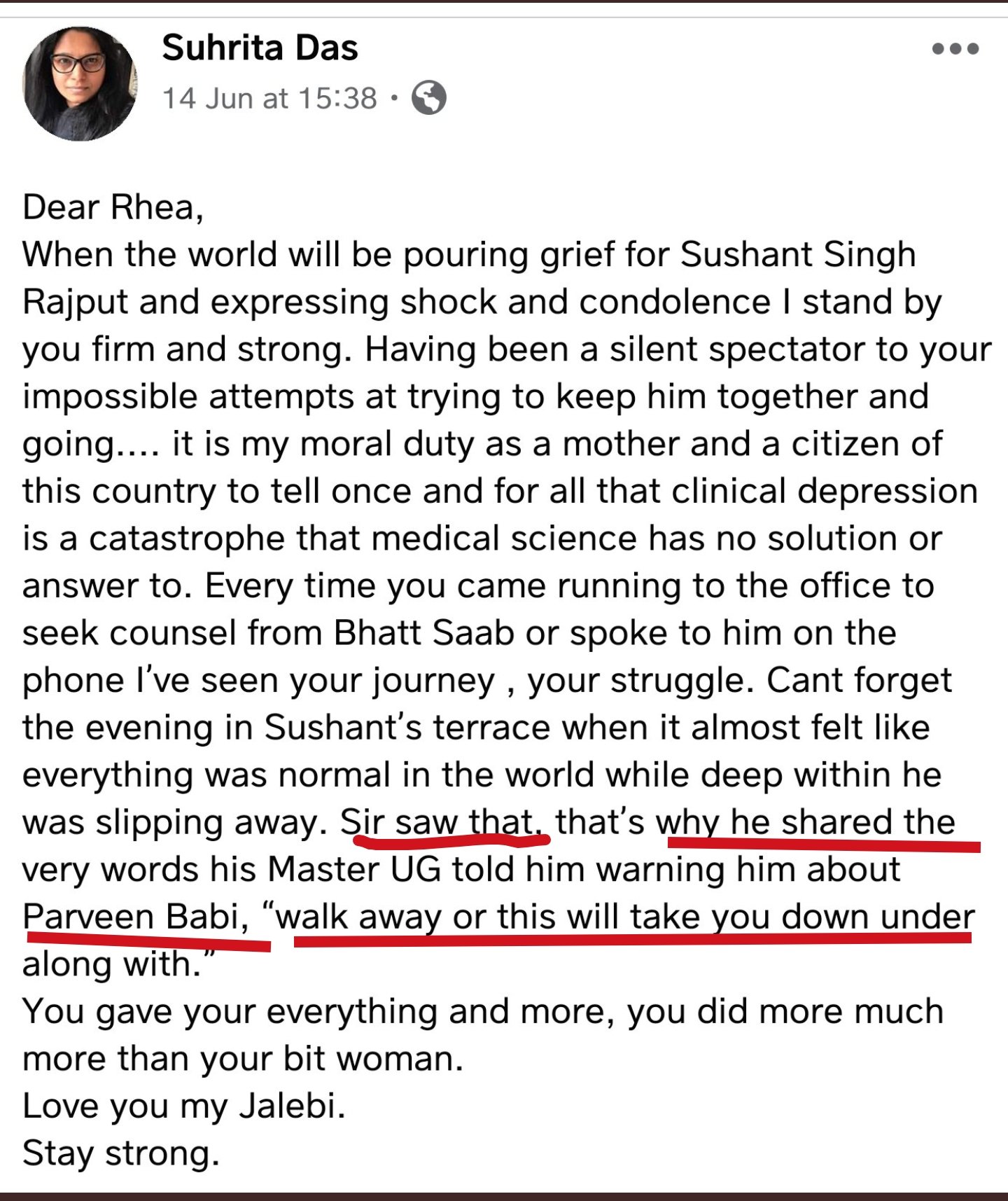
Screenshot of the post by Suhrita Das (Image Courtesy: Twitter/@Sharanyashettyy)

Mahesh Bhatt denies asking Rhea to abandon Sushant Singh Rajput

However, in his statement to the police on July 27, Mahesh Bhatt stated that he had met Sushant Singh Rajput only twice, once in 2018 and again in 2020. He also dismissed allegations that he consulted Rhea to leave the actor. “I have never said anything to Rhea about leaving Sushant or anything like that. Rumours about this are baseless,” he was quoted as saying.
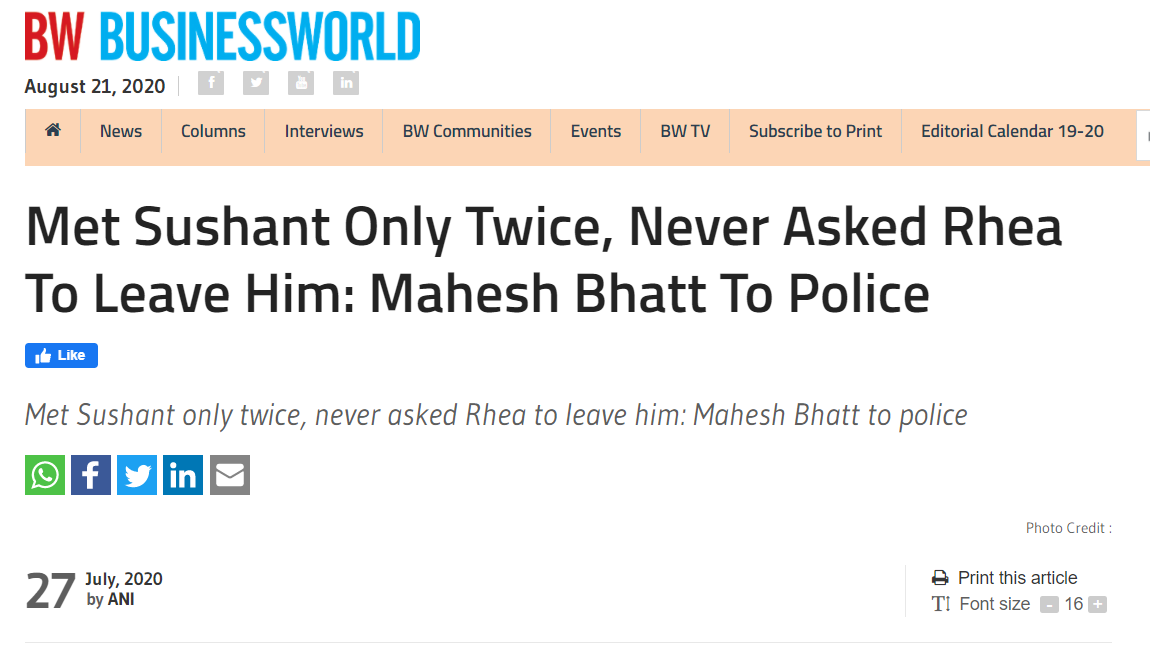
Mahesh Bhatt denies telling Rhea to leave Sushant (Photo Credits: Business world)

Whatsapp chat reveals Rhea left Sushant after consulting Mahesh Bhatt

While Mahesh Bhatt has denied telling Rhea about deserting Sushant, an exclusive report by India Today suggests otherwise. The said report contains allegedly ‘leaked’ WhatsApp correspondence between Bhatt and Rhea wherein the latter thanked the former for ‘unclipping her wings.’

“Aisha (name of movie character) moves on..sir..with a heavy heart and sense of relief. Our last call was a wake-up call. You are my angel. You were then and you are now,” Rhea Chakraborty messaged Mahesh Bhatt on Whatsapp on June 8, says the report. The director replied, “Don’t look back. Make it possible what is inevitable.” Bhatt appreciated the actress for being ‘brave’. Later in the conversation, Rhea wrote, “You’ve again unclipped my wings, twice in one life is almost God-like.”

The alleged chat shows Rhea ‘thanking’ bhat again and again, calling him an ‘angel’. She also thanks her destiny for making her meet Mahesh Bhat. In reply, Bhat is saying that Rhea is his ‘child’ and if he cannot be of any use to Rhea, his life will be worthless. He congratulates Rhea for ‘doing what she did’. Rhea then says she has unconditional love for the veteran filmmaker.

The alleged Whatsapp correspondence revealed by India Today, which took place after Rhea left Sushant’s house, seems to suggest that Rhea had ‘left’ Sushant after Mahesh Bhat’s advice.

Rhea claims Sushant asked him to ‘leave’

Recently, Satish Maneshinde, the lawyer who is representing Rhea Chakraborty, had stated that his client had left the house of Sushant at his behest. “Sushant had been calling his family, tell them he was moving out of Mumbai and requesting them to come meet him. After several days of Sushant calling and crying over the phone, his sister Meetu agreed to come live with him on June 8, 2020. Sushant then requested Rhea to move in with her parents for the time being,” he was quoted as saying.
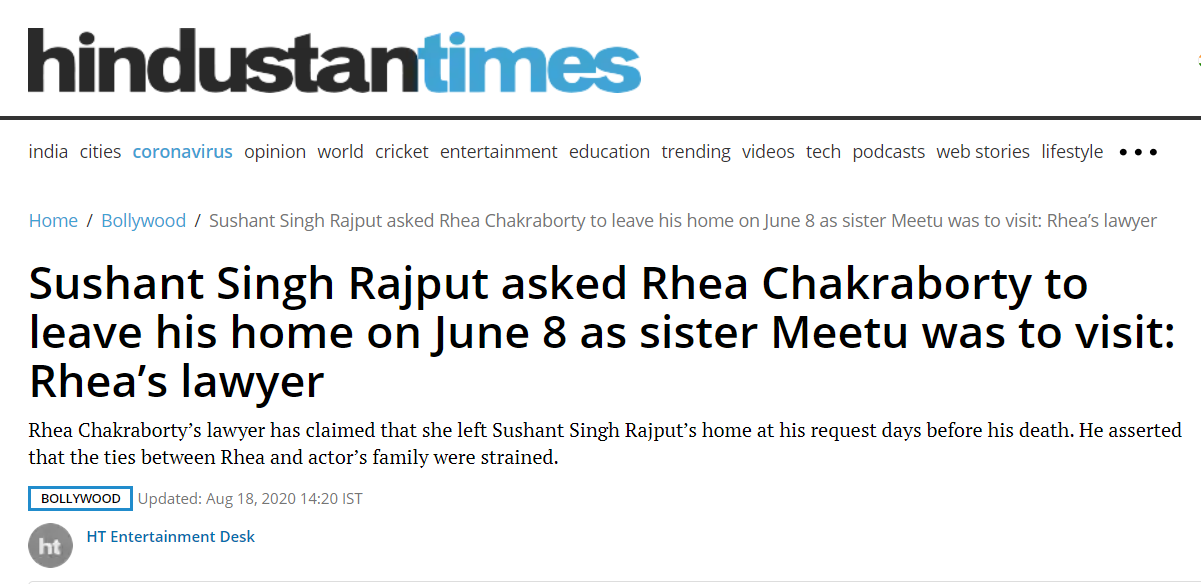
Lawyer of Rhea Chakraborty makes starling claim (Image Courtesy: Hindustan Times)

While the close associate of Mahesh Bhatt had earlier claimed that he encouraged Rhea to leave Sushant, the director had denied the claim as ‘rumour.’ While the whatsapp conversation between Rhea and Bhatt suggests that she left the deceased actor on the behest of Bhatt, her lawyer has now claimed that Sushant had instead asked her to leave temporarily. Amidst the contradictory statements, the case of Sushant Singh Rajput remains shrouded in obscurity.
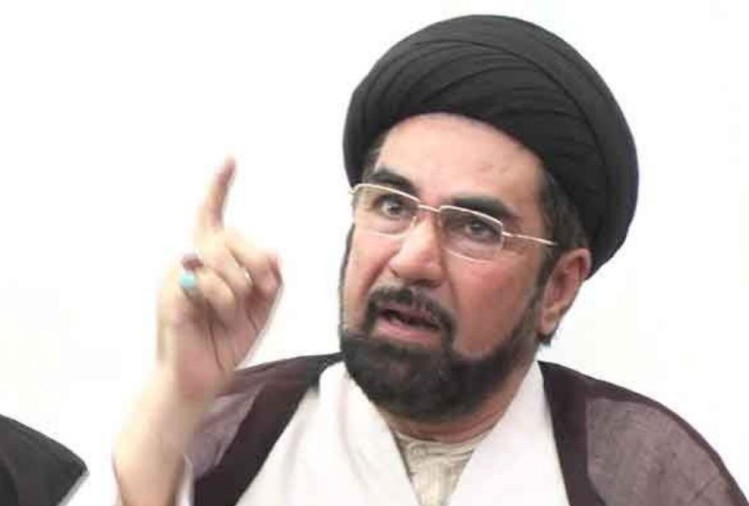
‘Will hold Muharram events despite coronavirus, arrest if you can’: Shia cleric Kalbe Jawad dares Lucknow authorities

On Thursday, prominent Shia cleric Maulana Kalbe Jawad Naqvi warned the Lucknow authorities against imposing a blanket ban on all Muharram rituals. The Shia cleric also said that he will be holding majlis (sermons) at the Imambara despite coronavirus protocols and dared the authorities to arrest them based on “unconstitutional order”.

According to Times of India report, Maulana Kalbe Jawad, attacking the Lucknow police authorities for putting a blanket ban on religious events due to coronavirus pandemic said that the guidelines issued for Muharram are unconstitutional and illegal.

Maulana Jawad, the cleric who is ‘mutawwali’ of Imambara Ghufranmaab, also said that he will hold religious events despite the restrictions and police are free to arrest him.

Coronavirus orders are against guidelines issued by WHO, says Maulana

As per the Times of India report, the cleric also submitted a written statement with the police commissioner claiming that the order to restrict religious events was not just misleading which has created turmoil in the community, but is also against the guidelines issued by WHO, central and state governments on coronavirus.

“This new guideline should be repealed immediately since COVID-19 protocols are already in place. And I will be taking the sermon from Friday at Imambara Ghufranmaab as has been for decades. The number of people will be limited to 50 along with thermal scanning, sanitisations, social distancing and masks,” Maulana Jawad said.

The controversial cleric added that he would request his community to not protest his arrest but adhere to coronavirus protocols strictly. Jawad also said that permission to hold majlis inside Imambaras by following strict protocols have been issued in Maharashtra, Andhra Pradesh, Karnataka and in Kashmir.

Meanwhile, several clerics including Jawad and All India Shia Personal Law Board general secretary Maulana Yasoob Abbas also claimed that the police is threatening taziya makers to neither make nor sell them. Taziyas are kept at homes by Muslims during Muharram as a replica of Imam Husain’s mausoleum.

“A number of taziya makers have complained to me that they are not being allowed to sell taziyas, which is absolutely against people’s rights and the law. These people have told me that they are being threatened by the police and problems are being created in their sale and purchase,” Jawad wrote in his memorandum to the police commissioner.

Maulana Jawad not new to controversy

Last year, Maulana Kalbe had stoked a huge controversy after he had provoked Muslims and the Dalits to take up arms. Shia cleric Maulana Kalbe Jawad has announced to set up a camp in Lucknow to teach them about the ‘right to self-defence’ and how to apply for a firearm licence.

Controversial lawyer Mahmood Pracha along with Maulana Syed Kalbe Jawad Naqvi had announced that they would conduct camps to assist people from the Muslim and Dalit communities to procure firearms.

Begusarai: Main accused behind Hindu minor girl’s abduction Izmul arrested, girl confirms of being kept in confinement and administered sleeping pills

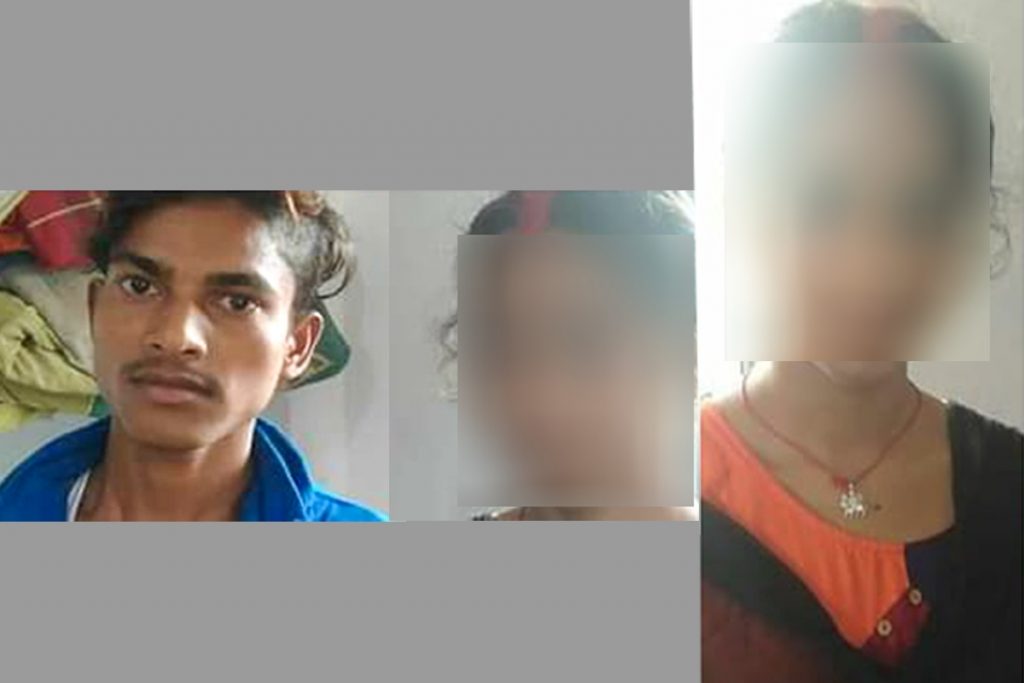
A day after the Hindu minor girl from Begusarai, who was abducted on gunpoint on July 26, was rescued, the main accused, Izmul Khan alias Nazmul alias Aryan, has also been arrested. Swarajya’s journalist Swati Goel Sharma took to Twitter to share the video.

Nazmul has uploaded picture of the minor girl of Begusarai wearing Sindoor

The journalist has also shared some posts made from the Facebook account of Izmul Khan, who used ‘Captain America’ as his Facebook name. According to locals, who had been tracking his account, Izmul Khan had after the kidnapping, posted a picture of the minor girl wearing sindoor (vermillion) in her hair and a pendant of Ma Durga around her neck. This was said to be the first update on his account since the day of the kidnapping.

Izmul’s deleted Facebook post

According to reports, when the villagers had first gone to Dinesh Kumar Pandit to show him the post, featuring his missing daughter, he had expressed relief to at least see his daughter alive.

Nazmul’s Facebook posts show he had been active on social media

Swarajya reports that when it’s correspondent again checked Izmul’s Facebook profile on August 20, that particular post had been deleted. It, however, showed another post updated about a week ago, that read (as translated), “You have the right to fight with me, but you have no right to leave me”. The report said that there were three comments below this particular post. One Dharambir had written (as translated), “Come back home. Because of you, your brother and sister are in jail. The matter will be settled once the girl is back safe.” One Asif Aqbal had written (as translated), “Your family is very stressed because of you and have even gone to jail. Come back and surrender.”

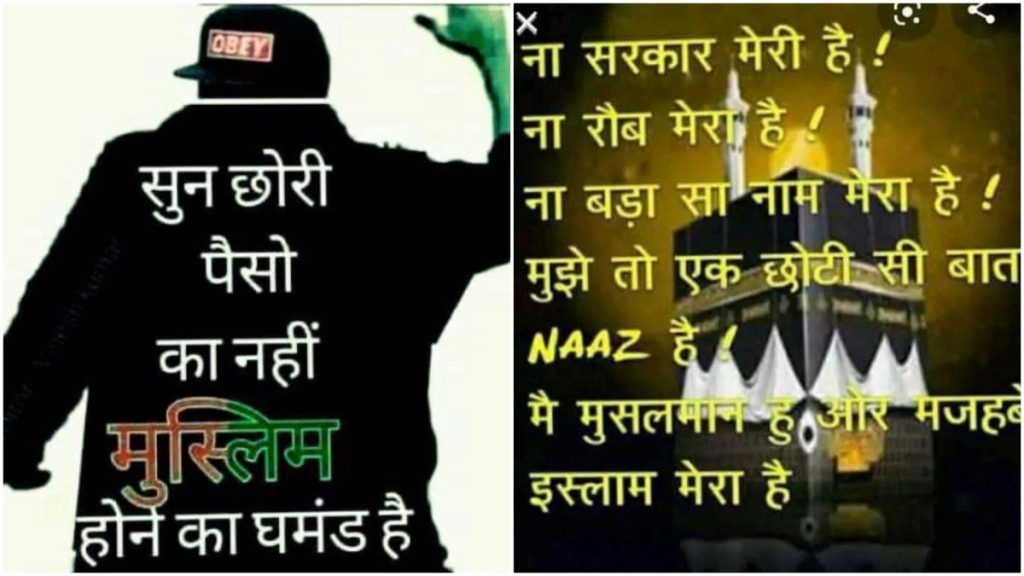
As his Facebook page was scrolled down further, Izmul’s timeline showed two posts from April. The first translated as: “Listen girl, I am not arrogant about money but about being a Muslim”. The second post as translated: “Neither the government is mine nor I have influence. I don’t even have a big name. I am proud of only one thing — that I am a Musalman and my religion is Islam”. 

“My first reaction to the post was that of relief. I was relieved to see my daughter alive,” Dinesh commented on August 20, two days after the girl was rescued by the Bihar police. We reported how on August 19, at around 7:30 am Dinesh Kumar Pandit had received a call from the Bachhwara police station in Beguasarai, informing that the girl has been found in Patna. Izmul, as per Dinesh, is about 20 years of age while his daughter is a minor.

Dinesh expresses angst against Begusarai police

Dinesh, however, said that the Facebook post also filled him with anger towards the police, who had all this while asserted that they were not getting any lead in the case. OpIndia, which has been following the case closely, reported how the DSP had insisted that this was a matter of “love affair” and had asked Dinesh to get some proof.

“Here was my daughter’s kidnapper updating his Facebook status and the police had been claiming all this while that they were trying but getting no leads. Obviously they were doing nothing,” angry Dinesh lambasted.

Dinesh said that when he met his daughter at the police station on August 19, he had asked her about the picture uploaded by Izmul. The girl confided that she was pressurized to get it clicked that way. Dinesh said that he presumes that the boy did so to convey to us that his aim was not religious conversion. And moreover, he wanted to sabotage the girl’s reputation and jeopardise her future so that “we give in”, claimed Dinesh.

Dinesh who returned with his daughter later on Wednesday evening, after completing all judicial formalities, said that his daughter has been constantly crying and hugging her mother, and telling him that she had tried to call him and even escape, but never got the opportunity.

Dinesh, the father of the Hindu minor girl from Begusarai, confirmed that his daughter admitted to being kidnapped and kept in confinement. She also said that she was regularly given sleeping pills.

Meanwhile, the girl’s medical reports are awaited to confirm whether she was sexually assaulted, only after which would the police invoke the POCSO Act against the accused.

The kidnapping of the Begusarai minor Hindu girl

On July 26, a Hindu minor girl was allegedly abducted on gunpoint from Bhikan Chak village, falling under Bachhwara police station limits, in Begusarai, Bihar, while she was returning from the market with her father. Dinesh, the minor girl’s father had alleged that seven people, including main accused Nazmul and a female, approached them in a Bolero car while they were crossing the Panchayat Bhavan in Behrampur in Mansurchak Block in Begusarai district and took away his daughter on gunpoint.

Pakistan Minister boasts of having such a precise bomb that it will target India all the way to Assam, but without harming the Muslims

0

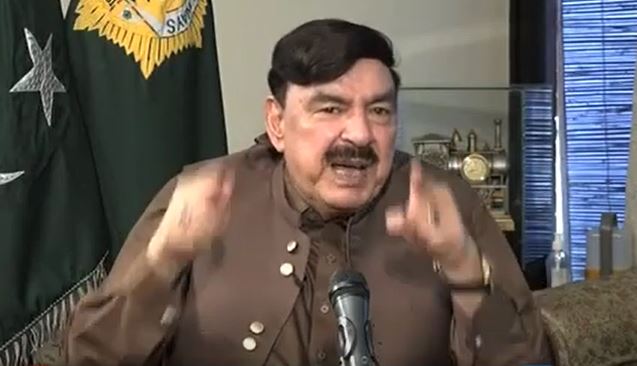
Sheikh Rasheed Ahmad, the ‘creative’ Railway Minister of Pakistan, who had once blamed breakfast made of eggs as the reason for the train disaster in Lahore, has once again boasted about his country having “very small, calculated and perfect bombs to target India all the way up to Assam, but in a way that Muslims are not harmed.”

In an interview to a television channel, Sheikh Rasheed admitted that the Indian Army is far superior to the Pakistan Army in conventional warfare. Therefore, Pakistan is working on these miniaturised nuclear weapons. He said that their bombs are so perfect and precise that they can hit places as far as Assam, but they will not harm Muslims as those small bombs will avoid Muslim dominated places.

Muslims in India prey for Pakistan’s prosperity, Pakistan Minister exults attack orchestrated by Islamists

The Pakistani minister exults the recent attacks in India’s Jamia Milia, Shaheen Bagh, Lucknow, Uttar Pradesh and Bengaluru orchestrated by Islamists. He said that the Muslims had achieved tremendous results out of these riots. The minister said that Muslims do not forget their ‘insult’ and sooner or later they seek revenge. He mentioned how three Muslims youths came out in the open and set police stations on fire in Bengaluru. He furthers that soon thousands of Muslims hit the streets and rioted across the city, all this to revenge the insult of Prophet Muhammad.

The minister also added that the Muslims in India are always praying for the prosperity of Pakistan.

During the course of the interview, the Pakistan Minister reiterated that if India at all attacks Pakistan, then this would be the last and an extremely lethal and bloody war, where Pakistan would not fight it the conventional way.

This is, however, not the first time, Pakistan’s railway minister has, in a headless rant, ‘threatened’ India with a nuke war. Almost losing his mental balance after India decided to repeal Article 370 from Jammu and Kashmir, he had given away his country’s ‘highly-classified’ secret by disclosing that Pakistan has 125-150 gram ‘smart bombs’, which may hit and destroy a targeted area in India. Expressing his war-mongering fantasy, despite having no strength to fight one, Rasheed Ahmad ‘threatened’ India of war by stating that his country is all prepared to fight against India.

Rasheed Ahmad, who seems to be still struggling to gather his thoughts after an electric shock, has once again gone into the same trance.

“Uttarakhand will give befitting answer to those who killed Dilbar Negi”: Kapil Mishra hits out as Kejriwal says AAP will contest state elections

0

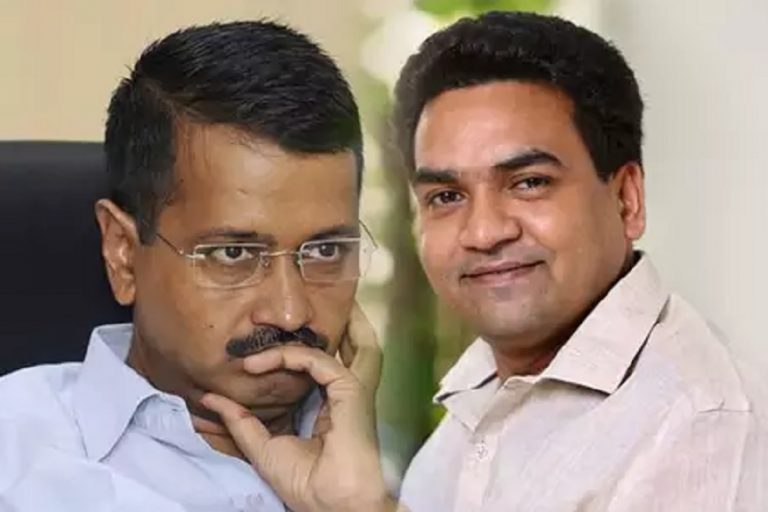
Hours after Arvind Kejriwal announced that his Aam Aadmi Party will debut in Uttarakhand’s Assembly elections, BJP leader Kapil Mishra took to Twitter to tear into the Delhi CM. He said that Uttarakhand will give a befitting reply to the murderers of Dilbar Singh Negi, who was mutilated and burnt alive in the Delhi anti-Hindu riots.

The BJP leader Tweeted in Hindi: “दिलबर नेगी के हत्यारों को उत्तराखंड की जनता जमानत जब्त करवा कर भगाएगी” roughly translated as “The people of Uttarakhand would make sure that the election security deposits, of the killers of Dilbar Negi, are forfeited and they are thrown out of the state”.

For the uninitiated, Dilbar Singh Negi, who was brutally attacked by the Islamists, during the anti-Hindu riots that were orchestrated in the national capital in February 2020, was a native of Uttarakhand. The violent mob had chopped off Negi’s limbs and had burnt him alive inside the sweet shop.

Kapil Mishra responds to Kejriwal’s announcement that Aam Aadmi Party would debut in Uttarakhand Assembly elections

BJP leader, Kapil Mishra, was responding to Arvind Kejriwal’s comment that AAP’s decision to contest polls in the hilly state was taken after a survey. Kejriwal speaking to the media said that many Uttarakhand natives living in Delhi came up to him and requested him to contest the Uttarakhand Assembly elections. If one is to believe the Delhi CM, the Uttarakhand natives were so impressed with his party’s performance in the last 5 years in Delhi that they wanted him to do the same for Uttarakhand.

AAP party’s link to the anti-Hindu Delhi riots

It is pertinent to note here that, Aam Aadmi party’s ex-leader Tahir Hussain has already confessed to orchestrating the riots that broke out in northeast Delhi in February this year. Delhi Police had named him as one of the main conspirators of the riots along with several others including some NGOs and political groups like Pinjara Tod and PFI.

Tahir Hussain, an AAP leader with close ties with the top leadership of the party, was found coordinating, orchestrating the attacks against Hindus. He is also accused of involvement in the murder of IB official Ankit Sharma.

OpIndia’s detailed report on the chronology of the event that led up to the riots is now available on Kindle. It has a comprehensive account of the loss of life and property in riots and how Hindus were targeted.

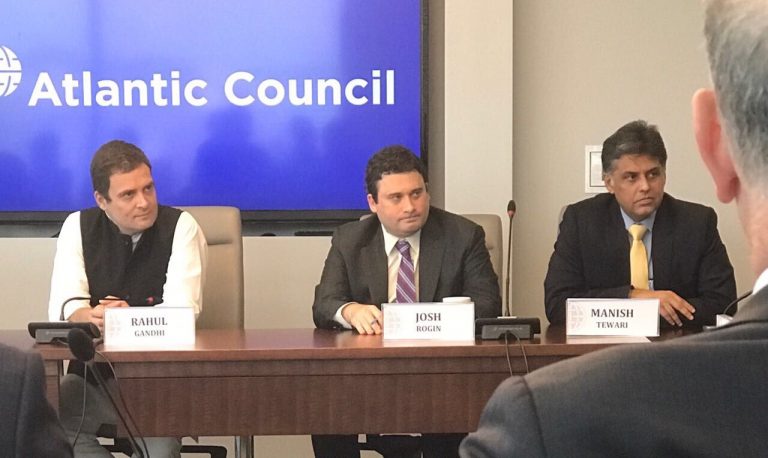
Manish Tewari opens a pandora’s box, writes to Facebook asking to contact his US-based lobbyist on alleged Facebook-BJP links

Days after the Wall Street Journal published an article claiming that BJP has links with social media giant Facebook, BJP’s IT cell head Amit Malviya has made some shocking revelations about Congress leaders hiring lobbyists in the USA to spread propaganda. Malviya posted a letter written by Congress MP Manish Tewari to Facebook, where he had asked the company to contact his lobbyist in the USA for any further information.

Manish Tewari wrote the letter to Facebook on 18th August, referring to the WSJ article published on 14th August. Saying that the article accuses of one Facebook executive of being biased towards the BJP led NDA government, Manish Tewari sought a response from the company on the matter. Tewari also noted that the allegation of Facebook bending its Global Hate Speech Policies at the behest of the Indian executive is a direct assault on the sovereignty and territorial integrity of India.

Apart from seeking response from Facebook on the WSJ article, Manish Tewari also informed the company that if they want to add any additional thought, and if they require any immediate assistance or clarification in the matter, they can contact his senior policy advisor Dr. Bharath Gopalaswamy of Washington DC.

Now, this revelation that Bharath Gopalaswamy is Manish Terwari’s ‘senior policy advisor’ has opened a pandora’s box, according to Amit Malviya.

This is because, Bharath Gopalaswamy was the Director in an organisation that works with Facebook to manage content related to politics and elections. He was the director of the Atlantic Council from 2013 to 2019. In 2018, Facebook had entered into a partnership with the Washington DC based Atlantic Council to use their services to prevent ‘abuse of their service’ during elections and other sensitive occasions.

A statement issued by Facebook had said that the Digital Forensic Research Lab of the Atlantic Council works closely with Facebook to provide real-time insights and updates on emerging threats and disinformation campaigns from around the world. “This will help increase the number of “eyes and ears” we have working to spot potential abuse on our service — enabling us to more effectively identify gaps in our systems, preempt obstacles, and ensure that Facebook plays a positive role during elections all around the world,” Facebook had said.

They had also informed that they will Atlantic services during elections and other highly sensitive moments, which will allow them to focus on a particular geographic area. The agreement between Atlantic Council and Facebook makes it clear that the former decides who is spreading misinformation and who is not, and based on their input, Facebook takes action.

Although Atlantic Council is known as a bipartisan and centrist organisation, it actually specialises in working with political and ideological propaganda. It has been accused to be a tool of American imperialist forces, with the ability to manipulate and influence political outcomes in countries around the world to suit American interests.

According to Amit Malviya, when a large number of pages were deleted by Facebook last year, the following of deleted pro-right wing pages were much more than the following of deleted pro-Congress pages. He informs that this process was led by the Atlantic Council.

“In light of these revelations, it is puzzling that the INC, at the first instance, has clandestinely chosen to use the services of Bharat Gopalaswamy to lobby for INC with Facebook. It is clear that by using the services of Think Tanks/its members, who use the charade of academic neutrality, INC has compromised its position. It is clear such alliances and services are used to gain access to FB’s management to influence the political process in India,” Amit Malviya said.

He said that such an explicit relation of Congress leaders with overseas influencer raises ethical and conflict of interest issues. Amit Malviya also expressed surprise that the Congress was using the services of a lobbyist to influence a private company like Facebook. “Lobbyists are the paid persuaders whose job is to influence the decision of Govts, but what amazes us is the use of such persuaders to influence the decisions of private corporations like Facebook,” he said.

Another important point raised by Amit Malviya is the issue of a sitting MP of Parliament using the services of a foreign lobbyist.

It may be noted that Manish Tewari himself was also associated with Atlantic Council, he had joined the organisation in 2017 as a senior fellow. Later that year, he had hosted Rahul Gandhi at an event in the organisation in Washington DC in September 2017.

This shows that, while Congress alleges Facebook of being partial towards BJP based on a report which was based on unknown sources, the party’s senior leadership has been associated with an influential organisation that has the power to control the political narrative on Facebook. In the words of Amit Malviya, “To operate behind close doors through quiet negotiations by using array of tactics to shape public opinion, the Indian National Congress, led by Sonia Gandhi and her son, has touched a new low in the politics.”

It may be noted while Manish Tewari says in his letter dated 18th that Facebook has not responded to the WAJ article, actually the company had already refuted the claims made in the article a day before. On 17th August, a Facebook spokesperson had said, “We prohibit hate speech & content that incites violence & we enforce these policies globally without regard to anyone’s political position/party affiliation. We’re making progress on enforcement & conduct regular audits of our process to ensure fairness & accuracy.”

The challenges to ‘Secularism’ and the need to implement NRC to preserve it

0

Prime Minister Narendra Modi should not participate in the Bhumi Pujan ceremony of the Ram Mandir construction at Ayodhya. And the State-owned national broadcaster Door Darshan must not telecast the live proceedings of the ceremony. Both the acts would be violative of the spirit of Secularism that is the guiding principle of the government, enshrined in the Constitution.

These were the vituperative outpourings of the raving and ranting Muslim Opposition and the leftists who were not, in any case, agreeable to the very idea of the construction of the Ram Mandir in the first place.

This is a classic example of how the anti-Hindu Opposition manipulates every issue by introducing a communal twist to it. Be it the enactment of a law, or its implementation, every move by the National Democratic Alliance (NDA) government is applied to the touchstone of the Secularism doctrine. Even earlier, some opposition parties had employed the same tactic to sabotage the Citizenship Amendment Act (CAA).

It derided the Act as a BJP ploy to brand Muslims as infiltrators or illegal immigrants and throw them out of the country as part of their purported communal agenda. Under the ruse of peaceful protest meetings and rallies, they orchestrated violent clashes between Hindus and Muslims, which claimed several lives and caused large-scale destruction of public and private property. Vast amounts of money smuggled from across the border were used to fund extensive chaos and anarchy.

Government Maligned

After instigating communal clashes in Delhi, the political Opposition went to town deriding the Union government for its alleged failure to maintain law, order and overall peace. The biggest loser in the bargain was communal amity. Though the insidious act of the Opposition to create a sectarian divide between the Hindus and the Muslims has been successfully thwarted for the present, there is no denying the fact that the threat to communal harmony persists.

Enemy Factor

Fighting communalism is no more an issue restricted to the different communities on the one hand and the government on the other. There are some external agencies involved. These agencies are interested in seeing the creation of more and more theocratic states like Pakistan and Bangladesh in place of a strong and secular India. Our nation’s enemies are hoping to achieve their end-goal by instigating one community against another and creating a religious divide between the communities.

The following window provides a sneak preview into the magnitude of the problem:

  • The intelligence agencies had already got leads into the sources of funds pumped into the country to sabotage the implementation of the CAA. The National Investigating Agency (NIA), which is probing the international gold smuggling racket in Kerala, has revealed that the sale proceeds of the smuggled gold were meant to be utilised for financing terrorist operations and anti-national activities such as anti-CAA protests.
  • The secret financial dealings of the Congress party with the Chinese government, which have been recently exposed, are currently under probe. Money is seldom received for no good reason and thus, suspicion of what was done in exchange for this money has been raised by several people.
  • If the available intelligence reports are anything to go by, several places of worship of the Muslims and Christians and the educational institutions run by them have become dens of radicalisation and conversion activities.

Acts of War

The real threat is to the communal harmony and not to Secularism, which the anti-Hindu governments of the past that spoke of ‘Saffron Terrorism’ used as a fig leaf to cover their shame. The days of the soft options like spreading awareness among the public regarding the evils of communalism and the perils faced by Secularism are over. Now is the time for the enemies of the State to be weeded out. Being a State policy, threats posed to Secularism should be treated as acts of war against the State. 

The enemies of the nation are working overtime in the mainstream and social media for the subversion of the State. Gross abuse of the right to free expression is rampant. The degeneration of the mainstream and social media, which are public forums for the exchange of ideas, thoughts and useful information into a platform for the nefarious activities of the anti-nationals needs to be arrested forthwith. 

Urgent Steps Needed

Unfortunately, the most serious challenge to Secularism springs from the ignorance of the silent majority of the Hindus about the impending probability of their becoming a minority community in their own country. They seem to be indifferent to the irrefutable truth that Secularism is safe in this land only so long as the Hindus remain the majority community. 

The day the Hindus become a religious minority in India, their eventual decimation would become a matter of time as it happened in Pakistan and Bangladesh. One does not even have to look too further away for the repercussions of a state where Hindus cease to be a majority. Even a cursory look at the history of Kashmir would show the consequences.

To make matters worse, the TFR (Total Fertility Rate) of Hindus is nowhere near compared to the Muslim community. Which only means that the Hindu community, in numbers, is growing at a much slower pace. Furthermore, both these Abrahamic faiths practise conversion without any check by the local governing bodies or the state governments. The NDA government should, therefore, implement the CAA, National Register of Citizens (NRC) and also impose a strict ban on conversions.

(The author of this article is Dr Sunil Gupta. He is a Chartered Accountant, author and blogger. He has served as an Independent Director on the Boards of India’s most influential public sector banks)

Democratizing Temple administration: Throwing the baby out with the bathwater

In the ongoing discussion about state entrenchment in Hindu Temples, we come face to face with the question of what the alternative system would be, were the State to make a long-overdue exit, and whether it would be duly “democratic”. 

The issue can only be addressed with a baseline understanding the different types of temples and forms of Temple ownership, that vary across jātivarnakula, and sāmpradaya. That being said, the resources and wealth of the largest shrines in India are so vast that they require considerable manpower and expertise in order to efficiently administer – making them a doubly important topic of parlance.  

What distinguishes the Hinduism from other religions is that it is not a monolith. There is no single central concentration of power, and certainly no single, central religious organization or head. Countless sects, denominations, and schools of thought with numerous overlapping faiths; each with their own set of age-old highly specific rituals, festivals, deities, and traditions. These unique traditions, whether folk or Vedic or a blend of the two, are often confined to distinct deities, geographic locations, or even lineages.  

Historically, the administration of Temples has been handed down through the generations to the successors of that particular sampradāya, whether that be a particular family, a caste, or a whole village.  

Following the unconstitutional takeover of Temple administration by various state governments, which was essentially a perpetuation of the vestiges of colonial law (in both cases, only Hindu places of worship were targeted and never those belonging to other faiths), the situation with respect to the state of endowments, wealth, Temple properties, heritage preservation, antique idols, etc., has only gotten worse. While the reason for government incursion is cited as corruption and misappropriation of funds, the state has done absolutely nothing by way of increasing transparency and protection of assets as far as Temples are concerned.

Every rupee of Temple wealth and every square inch of Temple land unquestionably belong to the Deity and the Deity alone. There must, consequently, be no compromise by way of demanding utmost transparency when it comes to the management of Temples. Since the state has not delivered on this aspect, but in fact has allowed the exponential increase of corruption to unimaginable levels, especially in wealthy Temples across South India, the exit of the government is of paramount importance.

Naturally, upon the exit of the government, the administration and affairs should ideally directly be handed over to its rightful heirs, or the hereditary trustees of the Temple. While a few valuable players may be taken aboard for additional help, the financial and decision-making power must remain firmly with said hereditary trustees, as this is the only way to maintain Temple traditions in toto. After all, unique sampradāya and sthala purana (the history of that particular Temple, how it came to be established, and the lore surrounding it etc.) are what make a Temple one-of-a-kind.  

Temples are sacred to each and every Hindu and are the custodians of the Hindu faith. Temple traditions, some of which can be traced back millennia, have been preserved passionately and unwaveringly by those that subscribe to it. Any attack upon Temples and their traditions can be considered a direct attack upon Hindu Dharma.

Colossal levels of financial and ideological corruption have already crept in due to the state trampling Hindu rights. While we can strive toward a healthy level of equality and fairness, it is possible that subjecting Temples to constant scrutiny and social vigilance would be counter-productive. 

While a Hindu of any caste, creed, or race can take darshan and perform puja in any Temple of their choosing, irrespective of their sampradāya, ishta devata, kula devata or any other factor, an extrapolation of this right does not draw a logical corollary with being granted a stake in the administration of such an external sampradāya to which they are essentially an outsider. This is largely due to the elaborate nature of the rituals and rules that constitute or characterize the traditions themselves, and the resolute manner in which they are passed on to future generations – the specifics of which an outsider may not have intimate knowledge of. Deviations from the system would effectively dismantle the tradition itself, which, more often than not, is difficult to establish yet can be broken in an instant. 

For instance, would it be fair for a Vaishnava brahmin that say, newly began worshipping at his local Maisamma or Mesai (a south Indian folk goddess) Temple, to stake a claim in the administration of said Temple, solely by virtue of his living in its vicinity? Would they respect the weight of its history as much as one that has a deep familial connection, not only with the Deity but also with the institution itself? Not only is such a person not qualified to uphold and respect the tradition, but they are also clueless in most aspects of what that particular Temple and its rituals entail. Even if they spent years learning, they still most likely would not profess the same level of loyalty. An outsider inherently has little to no vested interest, and hence no obligation whatsoever to uphold the tradition without distortion.  

The same can be applied vice versa, yet no one is denying that either party can enter each other’s Temples or profess their faith for the latter, wholeheartedly. It is possible to draw a line between a devotee and invested party without it being discriminatory. The Constitution enshrines the rights of devotees or any individual for that matter, to be protected from discrimination based on caste. We’ve come a long way in terms of eradicating social evils related to caste, and thankfully, our country is, for the most part, not resistant to the right kind of social reform. 

At face value, democratizing Temple administration seems like a noble venture. But the negative connotations associated with birth-based varna should not be the driving force behind rallying to permanently alter a Temple’s character – that would be akin to throwing the baby out with the bathwater. Straying too far from well-established traditions, even if well-intentioned, can have disastrous consequences by way of corruption of the Temple’s essence that make it exclusive in the first place. 

At the core of what keeps Hinduism alive, and a key factor that led to its survival through two barbaric invasions is its seemingly archaic practice of passing on knowledge and rituals unchanged through the generations. Despite this, we’ve lost a substantial amount of knowledge. Losing sight of this would mean losing the diversity that is so precious to the Hindu fold.  

Agra: Lady doctor brutally murdered for rejecting senior’s marriage proposal, arrested accused confesses to the crime

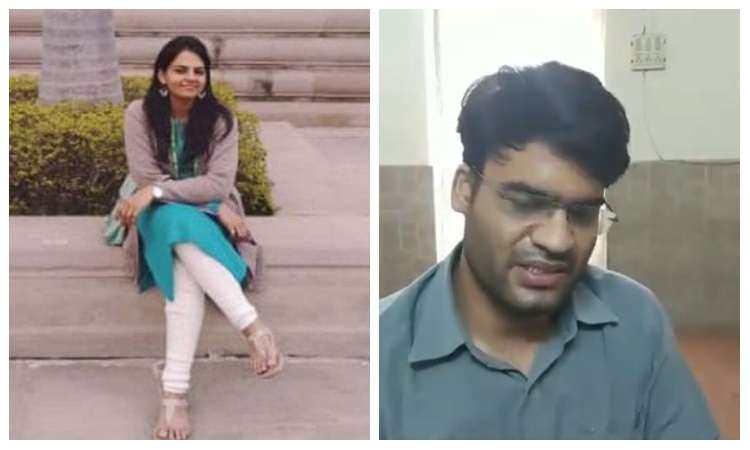
Vivek Tiwari, a doctor working in Agra’s SN Medical College was arrested yesterday by the police for charges of murder. The doctor is arrested for the murder of a junior doctor, named Yogita Gautam. As per reports, the doctor has confessed to killing Dr Yogita Gautam over a failed love affair.

A video of the confession by Dr Vivevk Tiwari is going viral on social media. Dr Vivek Tiwari is posted as a medical officer in Jalaun, Uttar Pradesh. In the video, he is heard confessing that he had driven down to Agra to meet Dr Yogita on Tuesday.

He says that around 6:30 pm in the evening, he picked up Yogita. Tiwari has stated in teh video that he and Dr Yogita were in a relationship for the past 7 years. Dr Yogita works in the Gynaecology department of the SN Hospital.

As per the doctor’s confession, when Dr Yogita sat in his car, a heated argument took place between the two after which Dr Vivek, in a fit of rage, strangulated her.

Vivek then says that after stragulating Dr Yogita, he had taken the knife he keeps in his car and had hit her head several times with it. He then says that after ensuring that she is dead, he had taken the body to a secluded place and had hidden it in the woods.

Doctor Yogita Gautam’s body was recovered from the field in Bamrauli Katra area in Agra

The Agra police had recovered Dr Yogita’s body on Wednesday, from the field in Bamrauli Katra area under Dauki police station of Agra. The body reportedly had injury marks on the face and head. She was wearing a t-shirt and trousers and no identity documents were recovered from the body. He mobile phone was missing too. The body was later identified as that of Dr Yogita. She was missing from Tuesday evening.

Family alleged that Dr Vivek Tiwari had threatened them of dire consequences

The police had begun the search operation based on a complaint by Yogita’s family members. Dr Yogita was reported missing from her rented accommodation in Noori Darwaza area under MM Gate police station of Agra on Tuesday evening. Her phone was also unreachable after which the family had reported the matter to the police. They had named Dr Vivek Tiwari as the prime suspect.

The lady doctor’s father, Ambesh Kumar had alleged that Tiwari had been pressurising his daughter to marry him for the last few years.

The family also alleged that Tiwari had also called and threatened them to convince Yogita to get married to him. He had warned them of dire consequences if they failed to convince their daughter.

Meanwhile, SSP Agra Babloo Kumar has confirmed injury marks on the body’s head and neck, adding that the post-mortem report has also revealed that Dr Yogita had struggled to save herself before dying.

Yogita was on duty treating COVID patients

Dr Yogita’s name was recently in the news when a COVID-19 patient had successfully delivered a healthy child in Agra’s SN Hospital in April. She was a part of the team that had operated on the 28-year-old mother and ensured the healthy delivery of the infant in the COVID care facility. Yogita had assisted Dr Sangeeta Sahu of the SN Hospital in the LSCS procedure. It was the third such case in the hospital.

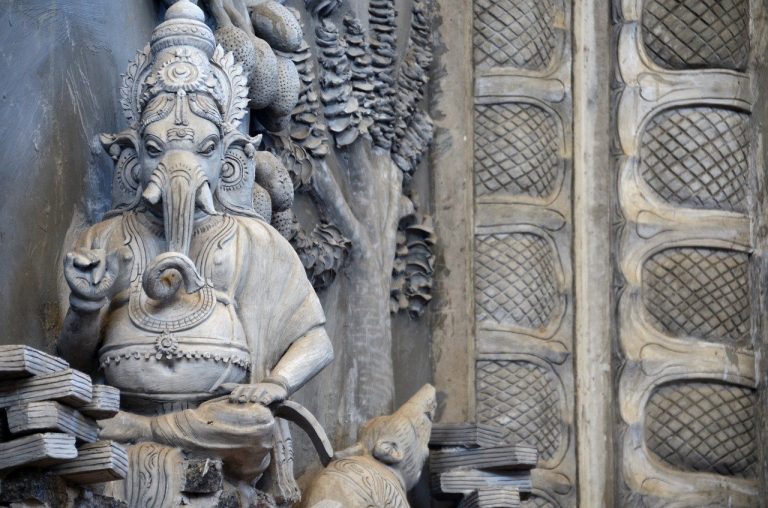
From Java, Philippines, Bali, Cambodia, Borneo to Burma: Understanding Ganesha from an iconographical perspective

With Ganesha festival around the corner, but with humble celebrations owing to the coronavirus spread, it seems this year will be a muted one for most religious festivals with most people being forced to stay indoors. So instead of focusing on the celebrations, my article takes a look at Ganesha – Vighnesvara from a different perspective, with a brief look at his iconography and the stories associated with him.

Ganesha, also popularly referred to as Vighnesvara, is the god who presides over obstacles, by both placing them in the way and also removing them. His capability of doing both is explained through a story in the Lingapurana. The story states that the various rakshasas and asuras through their virtuous acts and sacrifices received many boons from Shiva. Armed with these boons they then turned to attack the devatas and defeated them.

After facing many such defeats the gods headed by their king Indra requested Shiva to create someone who would provide obstacles in the way of the asuras and rakshahas in their virtuous acts, hence making them unfit for any boons. Shiva agreed, and from one of his amsas (his energy or power) came to life a being known as Vighnesvara, who was asked by Shiva to create obstacles for the asuras, rakshasas, and other evil beings in their acts of virtues and sacrifices.

He also asked Vighnesvara to help the devas and other pious beings in their good deeds by removing all obstacles. In ShivapuranaMatsyapurana, and Skandapurana the birth of Ganesha is however attributed only to Parvati where while bathing she combined the oils and ointments with the impurities that came from her body and created the figure of a man, which she brought to life by sprinkling the waters of the Ganga.

Interestingly, if we study the various Puranas and Agamas, we will see various versions of Ganesha’s origin, where we see him as the son of Parvati alone, of Shiva alone, of both Shiva and Parvati, and even with an independent origin (Swaymbhu- Surya Vinayaka, a popular narrative in Nepal).

It is stated that while composing Mahabharata, Vyasa had Ganesha as his amanuensis or scribe, who wrote with his own tusk as Vyasa dictated the verses non-stop. In Brahmavaivarta-purana Ganesha was Krishna himself in human form. In modern times Ganesha is the deity who is invoked by all those that are performing pujas, sacrifices, while invoking other gods, during difficult compositions in writing, and in other times in the daily affairs of men. Ganesha- Vighnesvara’s other names include Ganapati, Ekadanata, Heramba, Lambodara, Surpakarna, Gajanana, and Guhagraja

According to historian Y. Krishan, 1981-82, “Ganesha has now come to be called as the lord of all heavenly hosts, wisest of the wise, lord of treasures of treasuries, most adorable of all, the supreme of all beings, and the king of all kings. In Ganesha-purana various verses from the Purusha-sukta of the Rig Veda have been used for invoking Ganesha, and the 9th-13th century eulogy of Ganeshagita has been almost wholly taken from Bhagavadgita, where Ganesha, like Krishna, is a supreme being endowed with karuna (highest level of compassion). Since Ganesha was later identified with Vedic gods, he was also endowed with their attributes in visual imaging (murtis and paintings). With the ankusa, vajra, and lotus he is made at par with Indra; the crescent moon, tiger skin garment, and snake associates him with Rudra/Shiva; with his pasa (noose) he equals Varuna, and the axe makes him equal to Brhmanaspati.”

The first terracotta images of Ganesha found by archaeologists are from Pal (Maharashtra), Chandraketugarh (West Bengal), Verrapuram (Tamil Nadu), and Ter (Maharashtra), all of which belong to the 1st c. CE. The earliest Ganesha murtis in stone are from Mathura, and they belong to the Kushana era (2nd–3rd c. CE).

From various available books, research papers, and images it can be derived that the earliest murtis of Ganesha, of both the standing and sitting varieties, were with two arms holding a parasu and a mulaka (radish). The potbelly and one tooth are also among the earliest characteristics seen that continue even today. TAG Rao in his book on temple iconography presents a general form of Ganapati collected from various text sources that show him as four-armed; however, the Brhatsamhita in a couplet describes him with two arms carrying a kuthara (parasu) and a mulaka, potbellied, and with one tooth:

Pramathadhipo gajamukhah pralambajatharah kutharadhari syat| Ekarisano bibhranmulakakandan…….

Interestingly, the pot of sweets that is now synonymous with Ganapati finds no mention in Brhatsamhita, which has the earliest mention of the deity; however, the pot of sweets appears early in iconography from 1st c. CE (seen in the Pal terracotta Ganeshas). Later texts like Suprabhedagama, Vishnudharmattora, Rupamandana, etc. show Ganapati with four arms (which can go up 6, 8, 10, or even 16 arms) carrying the attributes: own tooth (svadanta), modaka (sweets), ankusa (elephant goad), pasa (noose), naga, vajra, japmala, lotus, wood apple (bael), etc. It is in these later texts that we find a mouse being described as his vahana, and there are mentions of his consorts Vighnesvari, Buddhi, Sri, Bharati (Sarda), Riddhi, and Siddhi.

These later books also give traits that are commonly seen now in Ganesha murtis, such as, three eyes, the poses abhanga and samabhanga, tiger skin as garment, and a snake as his sacred thread. These texts have also described many other iconographic forms of the god, such as Bala Ganapati, Bija Ganapati, Sakti Ganesha, Taruna Ganapati, Maha Ganesha, Nrtya Ganesha, Haridra Ganesha, Heramba Ganesha, etc. India once had six subdivisions under the Ganapatya sect, and these were devotees that worshipped the 6 different forms of Ganapati: Maha, Haridra, Svarna, Santana, Navanita, and Unmatta-Ucchista.

Ganesha as a giver of success and fortune is equally venerated by the Hindus, Jains, and Buddhists. In fact, Ganesha is seen in many parts of SE Asia, and many medieval era images have been found from Java, Philippines, Bali, Cambodia, Borneo, Burma, Thailand, Sri Lanka, China, and Japan. These images show the ancient to medieval cultural and religious connections that India once had with these countries, the ties that still remain, despite the innumerable attempts that have been made to erase them.