Indians are generally highly intelligent. Yet when it comes to secularism, most intellectuals, media and politicians get the concept wrong, so wrong that it looks as if Indians were purposely fed wrong information.
Contrary to the general perception in India, ‘secular’ is not the opposite of communal. Communal as such is not objectionable. It means ‘pertaining to a community’. In Germany, elections to local bodies are called “communal elections” (Kommunalwahlen).
‘Secular’ means worldly and is opposed to religious. ‘Religious’ in this context referred to Christianity, to an organized, dogmatic religion that claims that it is the sole keeper of the Truth, which all must believe blindly.
What is this revealed truth? In short: the human being is born in sin, which dates back to Adam and Eve. But fortunately, some 2000 years ago, God had mercy on humanity and sent his only son Jesus Christ to earth to redeem us by dying for our sins on the cross, then rising from the dead and going back to his father up in heaven. However to be able to get the benefit of Jesus’ sacrifice, one must be baptized and become a member of the Church, otherwise, one will be singled out for eternal hell on Judgment Day.
Understandably, such claims did not appeal to those who used their intelligence, but for many centuries they had to keep quiet or risk their lives. The reason was that for long the Church was intertwined with the state, and harsh laws made sure that people did not question the ‘revealed truth’. Heresy was punished with torture and death. Even in faraway Goa, after Francis Xavier called the Inquisition to this colony, unspeakable brutality was committed against Indians. In many Muslim countries till today, leaving Islam is punishable by death, as both these religions insist on one belief, the one which is in their holy book.
Significantly, those centuries, when Church and State were intertwined, when the clergy prospered and the faithful sheep suffered are called the dark ages. And the time when the Church was forced to loosen its grip, is called the era of enlightenment, which started only some 350 years ago. Incidentally, India had a hand in it. When Indian knowledge reached Europe, it fostered greatly scientific progress, and this played a crucial role in curbing the influence of the Church.
Now the idea that reason, and not blind belief in one ‘revealed truth’, should guide society, took root in Europe and this lead to the demand for separation between State and Church. Such separation is called secularism.
Today, most western democracies are secular, though many still grant Christianity preferential treatment. For example in Germany, the Constitution guarantees that the Christian doctrine is taught in government schools. Nevertheless, the present situation is a huge improvement over the dark ages.
In India, however, the situation was different. Here, the dominant faith of the Indian people never demanded blind belief in an unreasonable doctrine. Their faith was based on insights of the Rishis and on reason, intuition and direct experience and involved a long tradition over many thousands of years. It expressed itself in a multitude of ways. Plurality is the hallmark. It allows the one Brahman, the cause for the universe, be worshipped in the forms of many deities who are ultimately all one with Brahman. Their faith was about trust, devotion and reverence for the One Source of all life. It was about doing the right thing at the right time according to one’s conscience. It was about the Golden Rule: not to do to others what one does not want to be done to oneself. It was about having noble thoughts, about how to live life in an ideal way. It was about Satya and Dharma.
However, this open atmosphere changed when Islam and Christianity entered India. Indians, who good-naturedly considered the whole world as a family, were despised, ridiculed and even killed in big numbers only because they were ‘Hindus’ (which is basically a geographical term). Indians did not realise that dogmatic religions were very different from their own, ancient Dharma and that pluralism was not allowed. For the first time, they were confronted with merciless killing in the name of God/ Allah.
During Muslim rule, Hindus had to lie low for fear of their lives, and during British rule, they were ridiculed and cut off from their precious Sanskrit tradition with the help of ‘education’ policies. Naturally, this took a toll on their self-esteem. Till today, this low self-esteem is evident, especially in the English educated class. Nevertheless, it is a great achievement and testimony of the fighting spirit of Indians that Hindu Dharma survived for so many centuries under foreign occupation, whereas the west succumbed completely to Christianity and over 50 countries to Islam in a short span of time.
Coming back to secularism. Though Hindu Dharma survived and never dictated terms to its followers nor to the state, ‘secular’ was added to the Constitution of India in 1976. Maybe, because after Independence Muslim and Christian representatives had pushed for special civil laws and other benefits and got them, which is against secularism.
However, even after adding ‘secular’, the government seemed eager to benefit specifically the dogmatic religions, which secularism is meant to counter.
Why would ‘secular’ be added to the Constitution and then not acted upon? It’s a mystery. But over time, most Indians came to understand by ‘secular’ the complete opposite of what it means. They believe that secularism means fostering Christianity and Islam, both of which have no respect for Hindus and whose divisive dogmas condemn all Hindus to eternal hell.
Media and politicians helped to muddy the water. They called parties that represent a religious group, ‘secular’, instead of ‘religious’. When the state gave in to demands by Christianity and Islam, it was called ‘secular’. WHY did the government do this?
It is an absurdity. Can you imagine the Jews honouring the Germans with preferential treatment instead of seeking compensation for the millions of Jews killed? Yet Islam and Christianity that have gravely harmed Indians over centuries got preferential treatment by the Indian state, and India’s own beneficial, plural dharma that has no other home except India, is pushed into a corner. And to top it all, this is called ‘secular’!
Obviously Indians have not learnt from the European experience during the dark ages. Hindus have not yet realized that the dogmatic religions really want to put the mind of all humans into a strait jacket. They say it openly: “We alone have the full truth. All must accept it.”
It is surely wise for the state to ignore demands by the dogmatic religions which insist on blind belief in unverifiable, unreasonable and divisive dogmas, and which foster only their own members.
Yet this advice does not apply to Dharma.
It would be a disaster if the state would also ignore Dharma and become a-dharmic. Dharma is the backbone of a harmonious society. It needs to flourish, needs to be taught to children. And of course politicians, too, need to follow dharma, need to follow their innate knowledge about what is the right thing to do. When this happens, India has a great chance to become again the famed golden bird and the Guru of the world.
As torrential rains in Mumbai continues to pummel the financial capital of the country, inundating various parts of the city, Kanta Murti, a 50-year-old pavement dweller took it upon herself to avert the dangers emanating from the rising levels of water in the Matunga suburb of the city.
Realising that the water levels in Matunga were crossing dangerous mark, Murti forced open a manhole on Tulsi Pipe Road in Matunga West to let out the flowing waters to recede. However, while all her savings and tent were washed away in the rolling rains, she stood there for 7 hours to warn the motorists and vehicles about the open manhole. The video of Murti’s bravery had gone viral on the Internet.
Kala, along with her fellow footpath dwellers spent an anxious night on August 3 as the water continued to touch alarming levels. By next morning, the road and the footpath were deluged in more than 3 ft of water. A few motorbikes that were parked on the road had begun to float away. Worried that BMC would not turn up to drain the water, Kanta herself opened the manhole and stood there guarding it to warn the oncoming motorists.
Speaking to the media, Kanta said, “I wrenched open the manhole drain water & stood there to warn vehicles. BMC officials came later and chided me for it.”
I sell flowers to make a living and support my 3 children’s education. My 5 other kids are married and I am the only earning member in the family. My husband is handicapped after being paralysed from a railway accident: Kanta Murti #Mumbaihttps://t.co/zeB8UZoATGpic.twitter.com/Pe6oq1QNNA
Kanta lives on footpath and sells flowers to support education of her three daughters. Her five other kids are married and she is the sole bread-winner of her family. Kanta’s husband is differently-abled after being paralysed in a tragic railway accident.
Almost six decades ago, on October 20, 1962, China had attacked India. Provoked by a territorial dispute and tensions over Tibet, the war was short and India lost to China. India’s belief that it can never be attacked by China did not let the Indian army prepare, and the result was the standoff between 10,000-20,000 Indian troops and 80,000 Chinese troops. The 1962 Sino-India war continued for about a month and ended on November 21, 1962, and China emerging victorious.
This is a historical truth that the then Congress government led by former PM Jawaharlal Nehru and his defence minister VK Krishna Menon had fallen short of expectations in their dealings during the 1962 war with China, leading to the debacle. It is said that Army warned then Defence Minister Krishna Menon in 1961 about the need to prepare for a Chinese invasion. However, the warning fell into deaf ears and the follies made by the then Congress government left a deep-seated scar on the history of India, as explained in a 2012 article by India Today journalist Gaurav Sawant.
Jawaharlal Nehru warned of a possible attack by China, almost two and a half years before the 1962 Sino-India war
Shockingly, the then government, led by Jawaharlal Nehru, was warned of a possible attack by China, almost two and a half years before the first wave of Chinese troops overran the border in 1962, but Nehru and the then defence minister Krishna Menon, did not feel the need to take professional military advice, and the result was that India suffered its worst-ever defeat during the Indo-China conflict in 1962.
Author and journalist Gaurav C. Sawant in his report in Mail Today in 2012 wrote how, the Army commander had tried to warn of possible Chinese attacks in the coming years, which the then Congress government led by former PM Jawaharlal Nehru had ignored, costing India dearly.
SSP Thorat predicted China’s attack to which Nehru turned a deaf ear
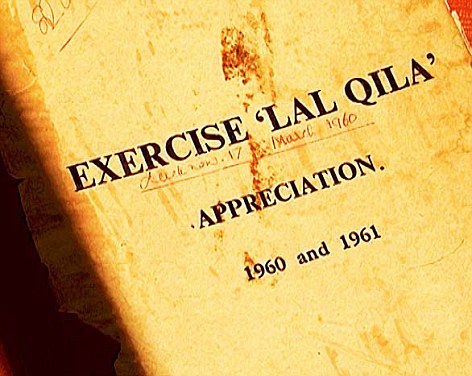
As per the article by Gaurav Sawant, on March 17, 1960, Lt Gen SPP Thorat, commanding the Eastern Command, had conducted a military exercise that accurately predicted the timing and nature of a possible Chinese attack.
The report had warned about possible Chinese attacks in the coming years, image via Daily Mail UK
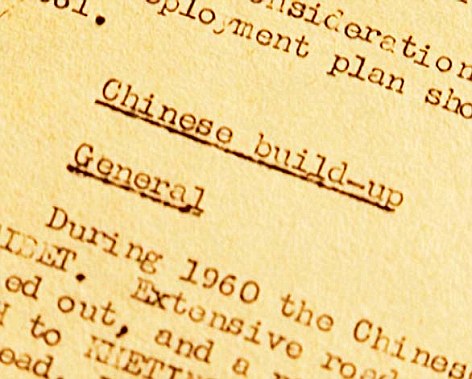
SPP Thorat wrote an assessment after a year-long study of the Chinese build-up across the McMahon Line. In his report, Thorat had said that the Sino-Indian ties, that had remained friendly in the past, had undergone a considerable change.
“This is primarily due to the claim made by China upon large territories which are clearly ours. She (China) has also refused to recognise the McMahon Line as the international boundary and has made deliberate incursions into our territory in Ladakh, Uttar Pradesh and NEFA (NorthEast Frontier Agency, now Arunachal Pradesh)… We are required to resist to the full and evict any further incursions by China. This requires us to be fully prepared to undertake immediate military action…” his assessment said.
Gen Thorat’s ‘Exercise Lal Qila’, conducted in Lucknow on March 17, 1960, was perhaps the most detailed military drill carried out, writes Sawant. Thorat knew that the Chinese would attack. He made detailed studies of Intelligence Bureau (IB) reports, the terrain, the time taken by Chinese troops to cover distances and their preparations to accurately predict a Chinese attack.
The then Army commander Gen Thorat’s secret report a predicting Chinese attack, image via Dailymail UK
He wrote in his assessment report: “The task was to defend our territory and that of Sikkim against aggression from Pakistan and China and be prepared to give military assistance to Nepal and maintain law and order in the Naga Hills and Tuensang Agency (NHTA).”
The former director-general of infantry, then a young captain, Lt-Gen Guru Bakshi, said: “In 1959, we as young officers were addressed by Gen. Thimayya. The impression we got was that the government, especially then defence minister VK Krishna Menon, was not interested in professional military advice. Gen. Thimayya had red flagged the Chinese build-up. The civilian leadership was not listening.”
Lt-Gen Shantanu Chowdhary, the former vice-chief of army staff, said: “Sadly, there was a lack of coordination between the top military and political leadership. Had effective preparations been done, when Lt-Gen Thorat warned, the situation would have been very different.”
Reportedly, Gen Thorat had also batted for the utilisation of the air force in an offensive role during the 1962 Sino-India conflict, but the Nehru government had not paid heed to the suggestion.
Recently, Air Chief Marshal NAK Browne also said that had air power been used then, the results of the war would have been different.
Author and military historian Kunal Varma said: “Then defence minister was not convinced that China would attack India. (Then PM) Nehru went with his view and the rest is history. Had Lt-Gen Thorat’s report been taken in the right spirit, India would have been better prepared.”
Air Marshal Denzil Keelor’s video
In fact, in June this year, a video had resurfaced on the internet amidst the ongoing debate over the historical blunders committed by the Congress party, especially during the Nehruvian era, revealing how India under the leadership of the country’s first Prime Minister Jawaharlal Nehru lost strategic areas due to the follies committed by him.
In the video, Air Marshal Denzil Keelor (Retd.) was heard speaking about the 1962 India-China war, stating that India lost the war to China because of Jawaharlal Nehru’s failure. He said that Nehru has then relied on diplomacy and ignored the armed forces, because of which India lost.
Had Jawaharlal Nehru paid attention to the detailed studies in 1960, India’s defeat at the hands of the Chinese could have been avoided. Keelor had stated that at the time of the war, Indian Army’s soldiers did not even have proper woollen clothing to face the weather and the difficult terrain of the Himalayas.
Jawaharlal Nehru viewed the army with suspicion. He did not, ever, pay attention to his army’s submissions and did little to strengthen or bolster the army. There have also been reports that Nehru and his defence minister VK Krishna Menon had then insidiously conspired to discredit General Thimayya (Chief of Army Staff from 1957 to 1961, who ahead of the 1962 Indo-China War), setting in motion a chain of events that contributed to India’s defeat in the Himalayas.
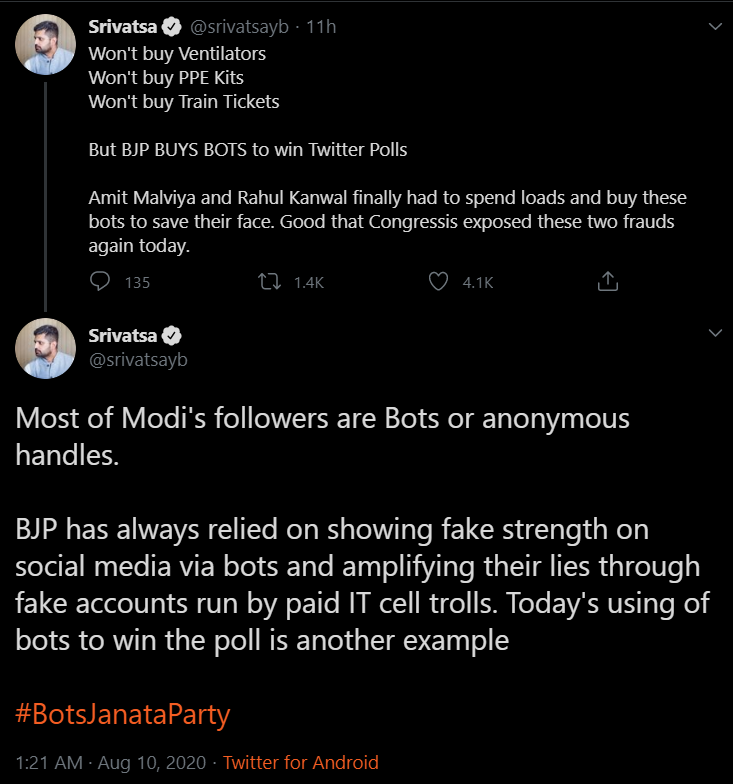
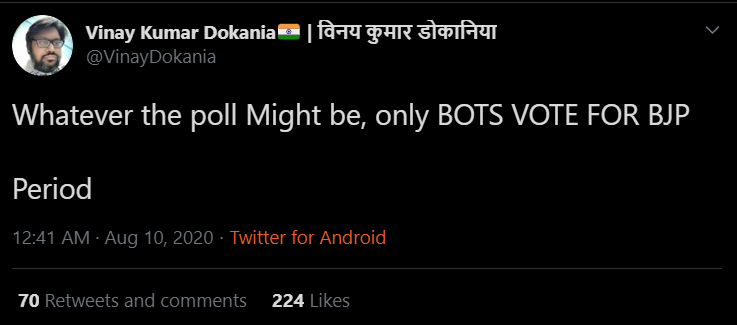
The Congress party and its IT Cell has embarked on a novel initiative on Twitter. After losing a poll conducted by India Today on the social media platform, they have resorted to making allegations that the BJP employed bots to tilt the poll in its favour. The poll asked people on social media who their preferred candidate for the office of Prime Minister was.
Poll by India Today
Along expected lines, Narendra Modi won the poll comprehensively. However, Congress supporters and IT Cell accounts on the platform accused the BJP of winning the poll using bots. It is, of course, a bewildering allegation given that the poll results are consistent with every opinion poll that has been conducted over the past six years and the results of the 2019 General Elections proved abundantly which politician was the more preferred candidate for Prime Minister.
The Congress party, however, decided the best course of action was to claim that the BJP had won the Twitter Poll using bots and somehow, the IT Cell managed to link it to EVM machines. The Congress party’s shenanigans involving EVMs are well known but using the results of a Twitter poll to rake up its conspiracy theories of EVM manipulation is indeed a bit of a stretch.
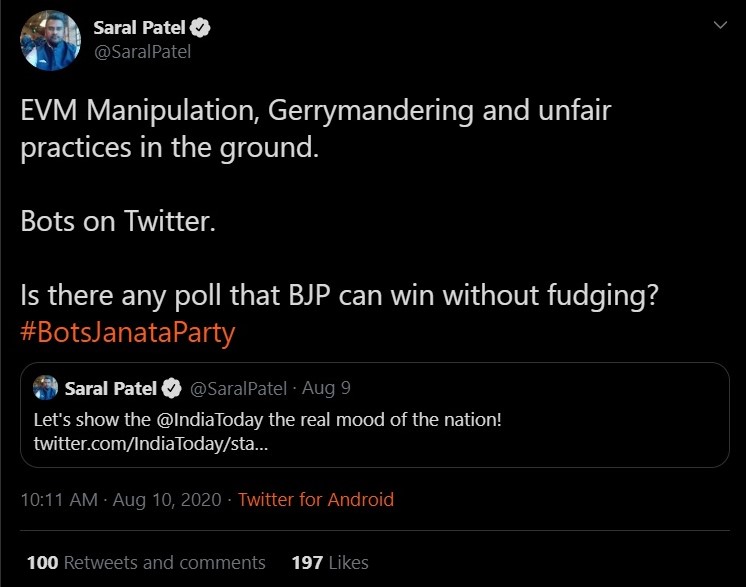
Saral Patel is the National Convener of Congress Social Media Department
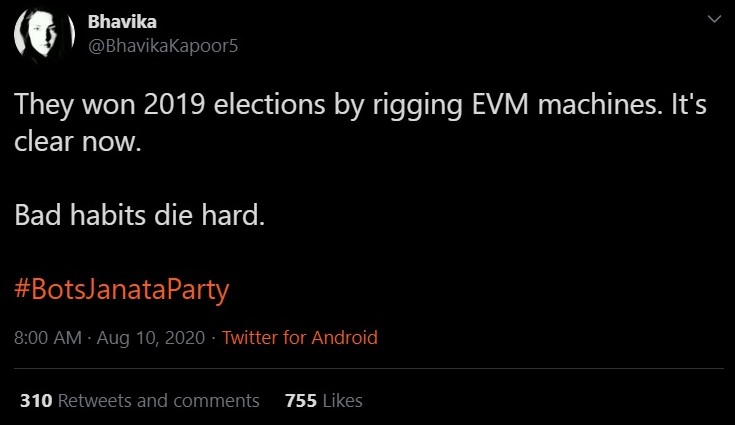
Consistent with the narrative planted by Saral Patel, Congress supporters claimed that the results of the Twitter poll is clear evidence that the BJP won the elections through EVM manipulation.
Congress supporters are not taking Twitter poll defeats sportingly
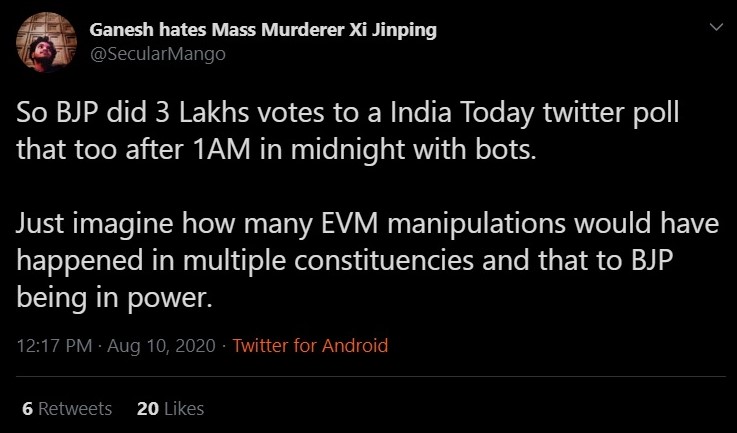
Others are asking people to ‘imagine’ the extent of EVM manipulations in the country given that the Twitter poll was allegedly manipulated by the BJP with bots. It is ridiculous, of course, but the mere fact that we are even discussing this issue shows that the Congress party has long since distanced itself from the last remaining bits of its sanity.
Source: Twitter
While one would expect someone from the Congress party to step in and put an end to the madness, it is clearly not happening. They are receiving great praises for suffering an apocalyptic meltdown over a defeat in a Twitter poll. One cannot be sure whether Rahul Gandhi was this dejected after leading Congress to debacle in two consecutive Lok Sabha Elections.
Source: Twitter
One cannot be sure whether the Congress party actually believes these lies or if they know these are not truths but are lying anyway. It’s hard to say which one is worse precisely.
Source: Twitter
There is a much easier explanation for this that does not require anyone to put their faith in delusions. The India Today poll was circulated widely on social media as is evident from the number of retweets it received on Twitter. It is quite possible that Rahul Gandhi was leading at some point during the polling but that was before supporters of the Prime Minister took notice of the poll.
After Modi supporters saw that Rahul Gandhi was leading, they voted in the poll and circulated it among their own friends. Accounts with huge follower counts surely quote-tweeted the poll and asked their followers to vote as well. All of this can happen very quickly and within a couple of hours, the whole scenario can easily change.
Furthermore, it is only to be expected that the politician who enjoys a far greater popularity across the country will also enjoy greater popularity on social media. Online poll victories for the more popular politician is not surprising. Nonetheless, there is an interesting story to be told here. The Congress party, which is accusing the BJP of using bots, is known to have used bots in the past to counter the social media dominance of the BJP.
In October 2017, the party’s bid to relaunch Rahul Gandhi was aided by a horde of Russian, Kazhak and Indonesian bots. With help from these bot accounts, the Congress party witnessed a massive surge in its social media activity. If one were not aware of what was actually happening, he or she must have thought that the Congress party was gaining in popularity.
The mainstream media, again, true to its nature, hyped up Rahul Gandhi and claimed that the Congress party was ‘finally getting its act together’. Thus, the party which crafted a narrative of its resurgence using bot accounts is accusing the BJP of employing bots and somehow linking it to EVM manipulation. Intriguing, certainly.
Not merely bots, ‘fake girls’ could also be seen on social media aiding attempts to relaunch Rahul Gandhi. There was enough evidence to indicate that the Congress party was using pictures of random girls on the internet in order to increase the fan following of the scion of the Nehru-Gandhi dynasty.
Thus, for the Congress party to accuse the BJP of using bots to win Twitter polls appears a bit ridiculous given its own conduct in the past. Furthermore, its attempt to cast aspersions on the legitimacy of the 2019 General Election results on the basis of the results of an online reveals the intellectual bankruptcy that has gripped the party.
Contrary to the allegations made by the Congress party, it is, of course, infinitely more likely that the Congress party is not winning the online polls because it is not employing as many bots as they used to. Under any circumstance, it is preposterous to claim that the BJP is using bots on Twitter to show Narendra Modi is more popular than Rahul Gandhi.
The far likelier scenario is that without national level elections anytime soon and campaigning for the Assembly Elections disrupted by the Coronavirus crisis, the Congress party is not investing in bots as much as they did prior to the Lok Sabha elections. And in the absence of bots, their online popularity has taken a heavy drubbing.
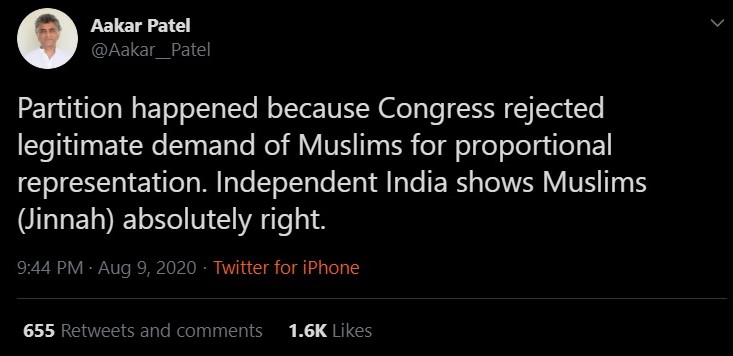
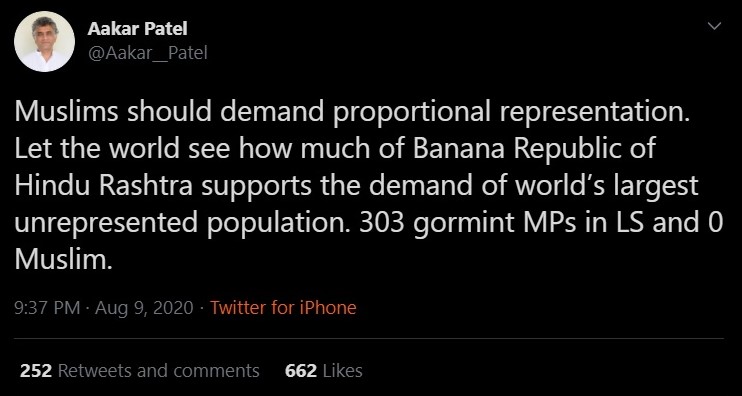
Former head of Amnesty India, which claims to be a humanitarian organisation, Aakar Patel, has decided it is time for him channel the spirit of Mohammed Ali Jinnah and make an elaborate defence for the creation of Pakistan. During an elaborate meltdown on micro-blogging site Twitter, Aakar Patel said it was time for Muslims in India to demand proportional representation in the Parliament and elected bodies.
Aakar Patel whitewashed the real reasons behind the creation of Pakistan and claimed that partition occurred because the Congress at the time refused to accede to the ‘legitimate’ Muslims demand for proportional representation. He claimed that Independent India has proved Jinnah correct. Thus, the ‘humanitarian activist’ blames Hindus for the Muslim demand to establish a separate Islamic state.
Source: Twitter
Aakar Patel also said that Indian Muslims should demand proportional representation. A ‘proportional representation’ would mean that a certain number of seats in elected bodies would be reserved for Muslims. Some individuals also take it to mean that a certain number of positions within the bureaucracy and the Army should be reserved for Muslims.
Source: Twitter
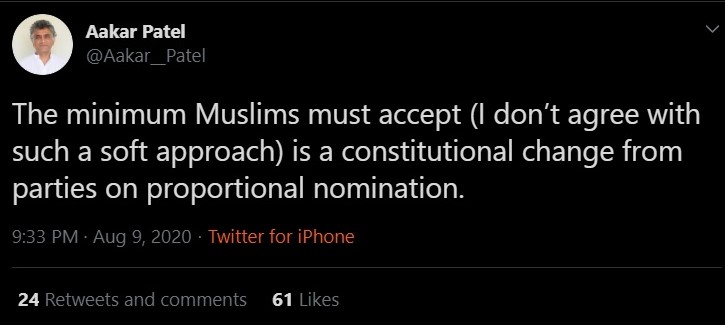
The activist also said that he does not agree with a ‘soft approach’ and insisted that a constitutional change from political parties on proportional representation is the minimum that Indian Muslims should accept.
Source: Twitter
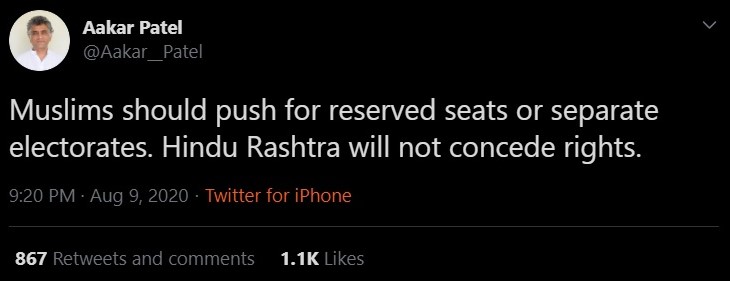
While inciting Indian Muslims to demand reserved seats or separate electorates, Aakar Patel insisted that the “Hindu Rashtra will not concede rights”, implying that it is a legitimate demand.
Source: Twitter
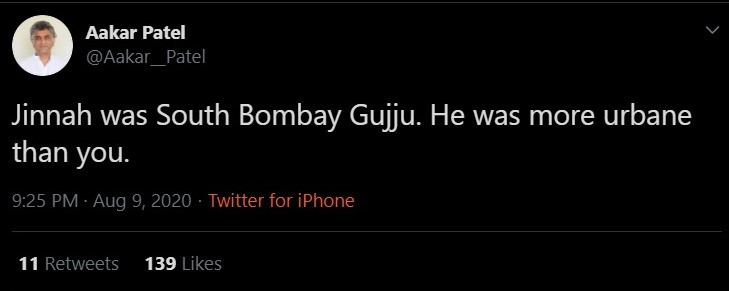
The activist also made an ardent defence of Jinnah, the Jihadist who called for a ‘Direct Action Day’ that directly led to the massacre of Hindus. He said that Jinnag was a ‘South Bombay Gujju’ and more ‘urbane’ than the average Indian, as if that excused his Jihadist inclinations.
Source: Twitter
Quite conveniently, for a person who belongs to the coterie of individuals that accuses Narendra Modi of working against India’s constitutional valuers, Aakar Patel appears only ever willing to the opinions of the Constituent Assembly on the matter. The issue of separate electorates was discussed by the Constituent Assembly of India, charged with drafting the Constitution, and it was summarily rejected for its communal hues.
Shri R.K.Sidhva said during a debate on the matter, “My Friend, Mr. Muhammad Ismail, while arguing yesterday stated that without separate electorates the Muslims will not get justice and they will not get that representation which they desire. If my Friend, Mr. Muhammad Ismail even at this stage believes in the two-nation theory-communalism-then certainly he will have no place. But there are many persons like Mr. Lari, who told his co-religionists that “even at this stage you are talking of the two-nation theory and separate electorate: please forget all this.””
He also elaborated on why the system of proportional representation will never work in India. He stated, “In a small group this system can be exercised. Besides, those who are acquainted with the system know that proportional representation is cumbersome process and it has to be understood by an intelligent person. Mr. Lari wants to introduce this system in an electorate ranging from 50,000 to a lakh of voters. In Belgium and Switzerland there are hardly a few lakhs of population leave aside the small number of voters in their constituencies. In our country there are 40 crores of people and we have constituencies with voters numbering from 50,000 to a lakh. A system of proportional representation cannot work here. From the material supplied by the Constituent Assembly Office I find that in one country they experimented with this system and they had to revert to the majority ballot box system. In a general election this system can never work.”
Even Jawaharlal Nehru was against separate electorates as he believed it would create enmity between the majority and minority communities. Nehru remarked, “As soon as you get something that can be called political democracy, then this kind of reservation, instead of helping the party to be safeguarded and aided, is likely actually to turn against it. But where there is a third party, or where there is a n autocratic monarch, or some other ruler, it is possible that these safeguards may be good. Perhaps the monarch may play one off against the other or the foreign ruler. But where you are up against a full-blooded democracy, if you seek to give safeguards to minority, and a relatively small minority, you isolate it. May be you protect it to a slight extent, but at what cost? At the cost of isolating it and keeping it away from the main current in which the majority is going.”
“It is a bad thing for any small group or minority to make it appear to the world and to the majority that “we wish to keep apart from you, that we do not trust you, that we look to ourselves and that therefore we want safeguards and other things”,” he added. The strongest words, however, came from from Sardar Vallabhbhai Patel who said, in no uncertain terms, that separate electorates have no place in India.
Sardar Vallabhbhai Patel, who was then the Chairman of the Advisory Committee on Minorities, said, “Those who claim that in this country there are two nations and that there is nothing common between the two, and “that we must have our homeland where we can breather freely”, let them do so. I do not blame them. But those who still have that idea that they have worked for it, that they have got it and therefore they should follow the same path here, to them I respectfully appeal to go and enjoy the fruits of that freedom and to leave us in peace. There is no place here for those who claim separate representation.”
Sardar Vallabhbhai Patel did not stop there. He continued, “For a community to think that its interests are different from that of the country in which it lives, is a great mistake. Assuming that we agreed today to the reservation of seats, I would consider myself to be the greatest enemy of the Muslim community, because of the consequences of that step in a secular and democratic State. Assume that you have separate electorates on a communal basis. Will you ever find a place in any of the Ministers in the Provinces or in the Centre? You have a separate interest. Here is a Ministry or a Government based on joint responsibility, where people who do not trust us, or who do not trust the majority cannot obviously come into the Government itself. Accordingly, you will have no share in the Government. You will exclude yourselves and remain perpetually in a minority.”
It is important to remember that the stalwart of the independence era was speaking at a time when the country had just recently undergone a partition. Quite clearly, he was not willing to tolerate irrational demands from the Muslim community at such a time. It was also clear that the demand for separate electorates was made by only the Muslim community and others such as Jains, Buddhists and Sikhs did not really feel the need for it.
Thus spoke the venerable Patel, “I remember that the gentleman who moved the motion here last time, in August 1947, when asking for separate electorates, I believe, said that the Muslims today were a very strong, well-knit and well-organised minority. Very good. A minority that could force the partition of the country is not a minority at all. Why do you think that you are a minority? If you are a strong, well-knit and well-organised minority, why do you want to claim safeguards, why do you want to claim privileges? It was all right when there was a third party: but that is all over. That dream is a mad dream and it should be forgotten altogether. Never think about that, do not imagine that anybody will come here to hold the scales and manipulate them continuously. All that is gone. So the future of a minority, any minority, is to trust the majority.”
Therefore, the question regarding the issue of separate electorates is one that has already been settled. It was settled during the Constituent Assembly debates itself. Hence, for activists such as Aakar Patel to rake up the issue now is a pathetic attempt to incite Indian Muslims on the promise of mythical carrots that do not exist.
There is absolutely zero chance that separate electorates will be accepted in India without a great deal of bloodshed and communal strife. There was also great consent among the politicians of the independence era that separate electorates fanned the sentiments of separatism which contributed to the formation of Pakistan. That ‘human rights activists’ of 2020 are demanding something that has the potential to unleash an era of unbridled calamity only speaks volumes about where their loyalties lie.
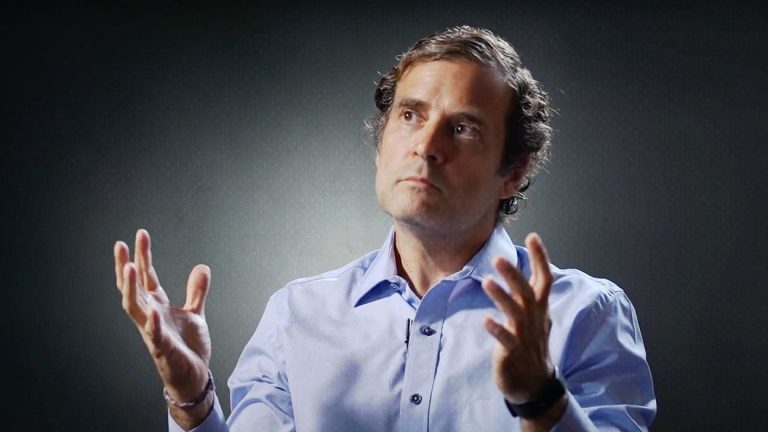
The Congress party has often been involved in influencing the media to ensure that the image of the ‘Grand old party’ and the family members that are involved in running it. From Jawaharlal Nehru to the current crop of Rahul Gandhi and Priyanka Gandhi, under the watchful eye of mother Sonia Gandhi and her cohorts, the Congress party has often had a complicated relationship with the truth and by extension, any media house or journalist that dares to write about the truth. One the prime examples of this complicated relationship is when a 2005 interview of Rahul Gandhi was killed by Tarun Tejpal of Tehalka because it embarrassed the Congress party.
In an interview to Zee TV, Vijay Simha had detailed how his interview of Rahul Gandhi in 2005, for the Tehalka magazine was killed after Tarun Tejpal was possibly pressured by the Congress party and its senior politicians.
In the interview, Simha says that in the beginning, the newsroom of Tehalka was the place to be since Tarun Tejpal’s voice had a strength to it. However, after 2006, things started to go downhill and he started doubting the intentions of Tejpal after his story was killed. He said in 2005, he had met Rahul Gandhi and since he was a new politician, he had said a lot about himself, Congress, his personality and politics. When Rahul spoke in the interview, many politicians in the Congress party felt that their “job was in danger”.
Thereafter, the senior politicians started pressurising saying that “why did you talk to such a person?”. Further, shockingly, he says that the politicians told him that he used to be a “nashedi” and used to do “nasha’. Essentially saying that Rahul Gandhi and his views should be trusted since he was a drug addict.
Due to this, he says that Tarun Tejpal came under a lot of pressure. In the beginning, he was standing with his team saying that the interview is accurate and that his team has done no wrong. After that, he got some calls (and he didn’t reveal who was calling him) that he suddenly took a u-turn and the interview was pulled down.
Simha says that this context of how the interview was pulled down is important since later he was accused of fabricating the interview. Simha revealed that many people started claiming that he had done a false sting operation and fabricated the interview and hence, it was taken down. However, that was not the case.
He further makes a far more shocking revelation. Vijay Simha says that this was not the only story that was killed at Tehalka. He was in the know of several other stories being killed, however, he did not really have the power, despite being one of the senior editors, to say something or do anything about it.
Simha, branded this form of journalism as a blatant form of murder. “Ye to katal hai”, he said.
What was the 2005 interview of Rahul Gandhi that was killed by Tarun Tejpal after being pressurised by Congress
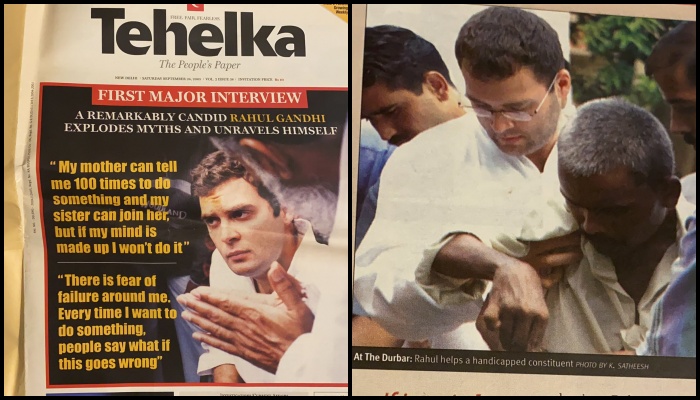
The 2005 interview of Rahul Gandhi was not much different from any of his current interviews where he sounds rather confused. Rahul Gandhi, as is his charming personality, contradicts himself in a matter of sentences and not much was different back then. However, in his state of perpetual confusion, Rahul Gandhi did reveal a lot about the inner workings of Congress and most importantly, how not only his party but even he was severely challenged when it came to effective governance and commitment to the people of India.
Snapshot of the Tehalka interview by journalist Sheela Bhatt, who had ironically posted it to hail Rahul Gandhi for his comments
In the interview, Rahul Gandhi made several revelations that could have hurt the Congress party and his own image as a coherent politician, an image Congress was desperately trying to create for Rahul.
‘I can’t do much as an MP’ to ‘Nobody does more than me’: Rahul Gandhi’s cognitive dissonance
In the beginning of the interview, which is still available online here, Rahul Gandhi is first asked about the abysmal condition of the roads in Amethi. To that, Rahul Gandhi says that he is only a Member of Parliament, and other than spending his MPLAD funds, an MP cannot really do much.
He says, “If you want to know what’s going on here, you need to understand that there are lots of issues. I am a Member of Parliament, and an MP can’t do much. I get₹2 crore (under the MP Local Area Development Scheme). That allows me to lay 8 kilometres of road. That’s it. But we have been able to get 500 kilometres of road laid in Amethi. To me that’s an achievement. What can I do beyond that? Nothing. You’ve seen the place. Nothing works here except the Sanjay Gandhi Hospital. However, I can’t blame the state government and say everything is their fault. My men do that but I can’t”.
In this segment, Rahul Gandhi seems to suggest that all MPs are more or less helpless other than utilising their MPLAD funds for the development of their constituency and that anything he has been able to do beyond that is because he had good connections. However, that is not how the system works and MPs have the power to make proposals to the government for the development of their constituency which is then put into motion. The development of a constituency can even happen by talking to Industry leaders and other corporates to ensure that industry is opened in the area, thereby leading the its development.
However, here, Rahul Gandhi seems to be oblivious to how governance can actually be done.
Further, Rahul displays his utter cognitive dissonance when after saying that he can’t do much as an MP to develop the state, just a few questions down the line, he says that no other MP in the country has done as much as him.
He says, “My idea of politics is not to do things in a week. If somebody wants to come to me and says that I have failed, well fine… I am not failing. I am succeeding. If there’s anything being done anywhere in Uttar Pradesh, it is in Amethi. In fact, no other MP in the country is doing as much as I am”.
Rahul Gandhi cannot seem to decide in this interview if he is a helpless MP who cannot do much due to the system, or is an MP is doing more than anyone else in the country. Either way, none of those assertions seem to make sense since one is factually incorrect and the other is betrayed by the fact that 15 years later, Amethi had hardly seen any development whatsoever and Rahul Gandhi lost that seat in 2019 as a result of it.
Confused statements on RJD, SP, Bihar and Uttar Pradesh – the now allies of Congress
During the interview, Rahul Gandhi gave us a glimpse into not just his beautiful mind but also how the Congress party functions as an ally of anybody who can catapult them and their family members to power.
Here is a chronology of his comments on the same, one, which would make his confusion apparent.
First he says that he does not blame the UP government for no developmental work being done in the state. In the beginning of the interview, when asked about Amethi, he says, “Nothing works here except the Sanjay Gandhi Hospital. However, I can’t blame the state government and say everything is their fault. My men do that but I can’t”.
Immediately in the next answer, Rahul says that there is a total collapse of the administration system in UP and Bihar. However, just before that, he had said that he does not blame the state government for it. One has to ask Rahul then – who should have been blamed?
After trying to say that there is no governance in UP and Bihar and also trying to shield RJD and SP at the same time, Rahul Gandhi says that he does not support the Mulayam Singh Yadav government. When asked about the support, he says, “That cannot go on. I don’t support that (the UP government) at all. I am not going to bat out this one. I’ll do something about it”.
In the very next question, he says that the decision to support Mulayam Singh Yadav comes from other senior Congress leaders and that one day, they may simply wake and up and stop supporting the government. This is a “complex” issue and hence, he refused to comment further on it.
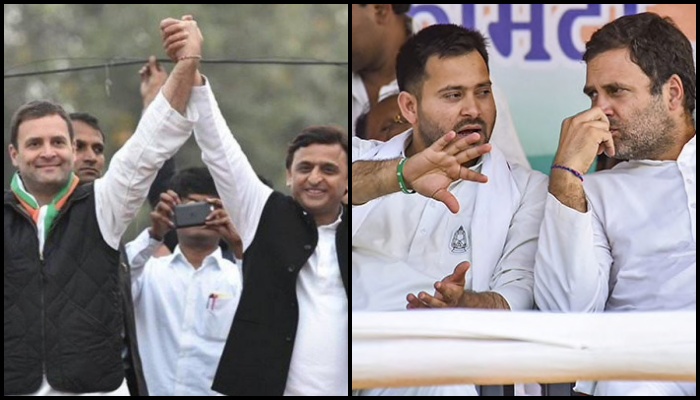
It is pertinent to note that Congress is now in alliance with SP and RJD and Rahul Gandhi is rather supportive of the “youth leaders” of both parties – Akhilesh Yadav and Tejashwi Yadav. Essentially, after saying that he does not support them in 2005 to now allying with them in 2019-2020, Rahul Gandhi has come a long way.
Rahul Gandhi with Akhilesh Yadav and Tejasvi Yadav
In 2005, Rahul Gandhi had promised to bring change in a month
In his 2005 interview, Rahul Gandhi had promised that the interviewer will see a change in the constituency in a month’s time.
He tells the interviewer, “Look at Amethi. Do you know that we have been able to educate 40,000 people? If you come to Amethi after a month, you will find every Congress worker teaching children in his or her house. Each one will teach one or two children. That is the way I work. That is meaningful work. You will be foolish; I will be foolish to say that I am going to do things in a week. I am not going to do things in a week. That is not the way I am. That is not the idea”.
However, the shocking and abysmal state of Amethi was rather evidence after 15 years of Congress ruling the constituency. As a result of that, Rahul Gandhi was booted by the people, the very people of the very constituency that Congress considered a fiefdom for long.
An analysis of 10 years of Rahul Gandhi vs 4 years of Smriti Irani can be read here.
Information Technology a mere hype, said Rahul Gandhi in 2005: Captain ‘missing the obvious’
In his 2005 interview, Rahul Gandhi had said, “There is excessive hype about IT in India. It affects only a few people, and I can’t see why so much is made of it. There is no doubt that IT is a growing area, but I am looking at empowering the multitude. I think education is the way to go. We simply can’t progress until we give people in places like this [Amethi] a chance. I agree that good work is being done in Karnataka and Tamil Nadu, but that is not the case elsewhere”.
This is a rather shocking statement to be made in the year 2005, which can actually be considered one of the most landmark years for information technology in general.
It was in 2005 that YouTube was founded, Apply had announced its plans to switch to Intel processors, Reddit was launched, the first YouTube video was uploaded, Google hired DARPA veteran Vint Cerf to carry on his quest for a global open Internet, Google Maps was launched, Microsoft Windows XP Professional was released, Google introduced personalised homepage, Opera Mini browser was launched, Google Analytics was launched, UTorrent was launched. It was way before in 2003 that Airtel had launched its broadband services and by 2005, .in websites were also launched.
With so much happening, for Rahul Gandhi to say that Information Technology boom was only a fad only goes to show how short sighted the politician really is.
In fact, Rahul Gandhi’s shortsightedness is evident by one simple fact: narendramodi.in domain was registered in the year 2005.
My first lesson in arrogance in my professional life came from a bathroom in the UK
As usual, Rahul Gandhi is the master of spouting gibberish and when asked simple questions.
Here is what Rahul Gandhi said in his interview – A little anecdote from UK:
Let me tell you about arrogance. My first lesson in arrogance in my professional life came from a bathroom in the UK. I was doing consultancy for a firm in England. They were into distribution, you know, getting things around. I had one look and I thought these guys know nothing. I can fix things in a day or two. I did what I was asked to. My boss was pleased. He gave me another responsibility. Something else in the same organisation that needed fixing. It was a mess. I had already done my first job well. So I was confident. I had the answer. I thought, man, bar codes are the solution. We can fix things by having different bar codes for different products. The boss looked at me quietly. He told me I was good at my job, and asked me to have a look at the office bathroom. The bathroom was full of graffiti. This guy is like that, that guy is like this etc. Suddenly it hit me. All the bar codes in the world wouldn’t have helped. The problem was something else. That, my friend, is arrogance. It is one bathroom lesson I haven’t forgotten. That is the arrogance you have to deal with. When I take life this way, I stop thinking that the other guy is a joker. I realise I am the joker.
This is it. That is his entire anecdote. It does not make sense. Did he mean that he got arrogant after his first solution worked and his colleagues left mean comments in the bathroom stall for him? Or did he mistake bar code for bathroom code? If he thought bar code was his brainwave, he needs to understand that bar codes were in use since decades before he ‘came up with the solution’. Perhaps next time he could visit the bathroom at AICC headquarters where his mother Sonia Gandhi had locked up Sitaram Kesri to stop him from becoming party president to get some more wisdom and enlighten/entertain us.
The only thing that perhaps made sense in that nonsensical anecdote was the last sentence – “I realise I am the joker”. Well, yes indeed.
Does he ‘want to learn’ or ‘his personality is made, he is what he is’?
During the course of the interview, Rahul Gandhi gave an eloquent answer about how he is willing to learn till the day he dies. He said, “I believe that you know more than me in the job that you do. The guy who fixes the air-conditioner at my place knows more than me about air-conditioning. The person who sweeps outside my house knows more about sweeping than I do. My job in politics is to transmit the knowledge that people have from one person to another. This outlook is central to my life. I hope that I will have the ability to learn till the day I die”.
However, he contradicts himself soon enough.
Further in the interview, he says, “My personality is made. I am done. There is nothing more to be made of me. I am what I am. My strength comes from me, not from what happens outside of me. I am not going to change inside. I am prepared for things going the other way. I understand I can’t always have things my way”.
One has to ask Rahul Gandhi how do these two statements go together? Does he want to learn? Or is just done ‘done’? We will perhaps never know but judging by his politics, it is probably the later.
‘Every time I want to do something, there is this fear that it may go wrong’
Finally, Rahul answers the most important question – Why did Congress want this interview deleted. His Midas touch, of course.
‘I don’t like to ask questions in the parliament’
When asked why Rahul Gandhi does not ask questions in the parliament, he says:
“I don’t ask questions in Parliament because I like to think things through. Just look around at the questions that are asked in Parliament, and you’ll know why I don’t ask questions. I mean look at them. Is that the kind of stuff you want me to ask?”
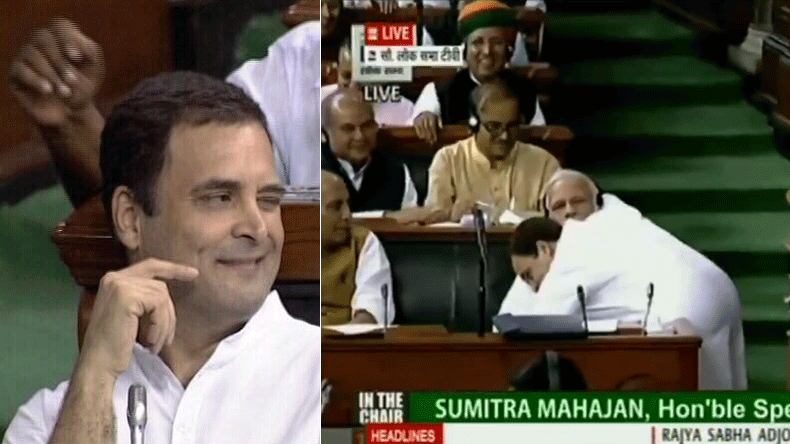
15 year since, we know exactly the kind of theatrics that Rahul Gandhi prefers to do in the parliament instead of asking questions that would benefit the people of the nation and/or his own constituency.
Remember this?
Rahul Gandhi hugging and winking in parliament
On the basis of this one interview, perhaps an entire thesis can be written, with elaborate examples, on what is exactly wrong with Rahul Gandhi and the Congress party. However, the most important aspect is why this article was forced to be taken down:
In this interview, Rahul Gandhi sounds confused, disconnected and just inept at being a politicians. Further, he also reveals that the Congress party and its scions are least interested in the welfare of its people and are terribly unaware of what the future holds. Nobody is surprised that Congress, that has always managed the media in order to manage the image of Rahul Gandhi, got this interview pulled down.
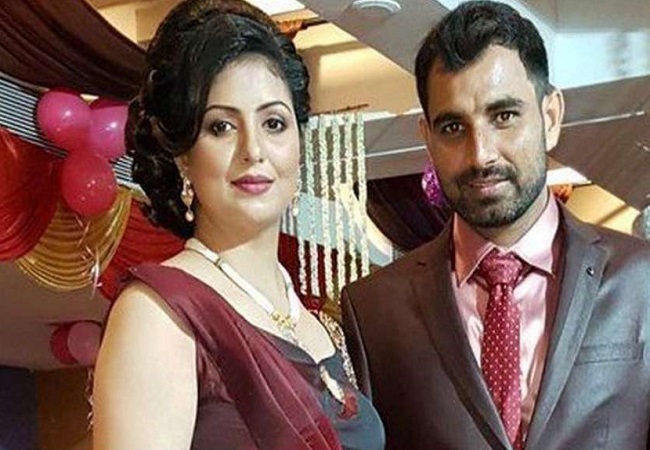
Cricketer Mohammad Shami’s estranged wife Hasin Jahan has filed a complaint with the cyber cell in Kolkata’s police headquarters at Lal Bazar, after she allegedly started receiving death and rape threats from radical Islamists for sharing congratulatory messages on Ram temple Bhoomi Pujan in Ayodhya on her social media account.
Hasin Jahan complaints with Kolkata police
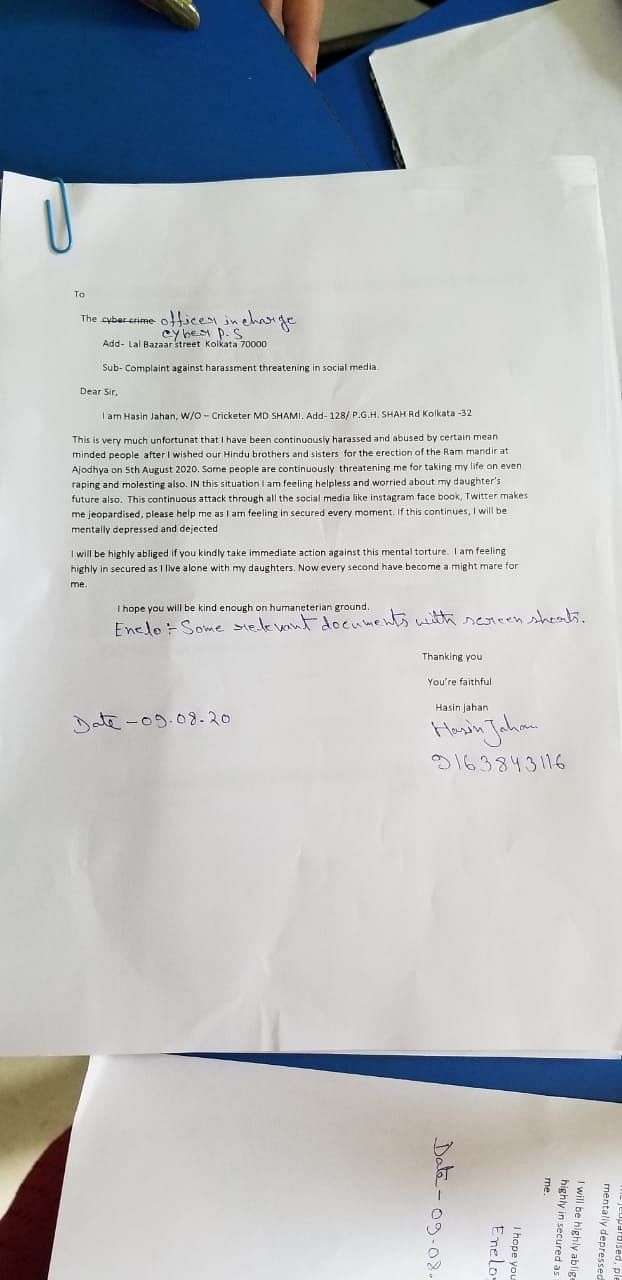
Jahan wrote in her complaint: “This is very much unfortunate that I have been continuously harassed and abused by certain mean-minded people after I wished our Hindu brothers and sisters for the … Ram Mandir at Ayodhya on 5th August 2020. Some people are continuously threatening me for taking my life … even raping and molesting also. In this situation, I am feeling helpless and worried about my daughter’s future also. The continuous attack through all the social media like Instagram, Facebook, Twitter makes me jeopardised. Please help me as I am feeling insecure every moment. It this continues, I will be mentally depressed.”
“I will be highly obliged if you kindly take immediate action against this mental torture. I am feeling highly insecure as I live alone with my daughter. Now every second have become a nightmare for me,” Jahan said adding she hopes the authorities will be kind to her ‘on humanitarian grounds’.
Copy of Hasin Jahan’s complaint given to cyber cell of Kolkata Police
Hasin Jahan gave her best wishes to the Hindu community on the Bhoomi Pujan of Ram Mandir in Ayodhya
Jahan had taken to her Instagram handle to put out a post congratulating Hindus on the Ram Mandir Bhoomi Pujan. She wished that Indians, irrespective of their caste and religion, would live together in harmony and contribute to make India a superpower of the world. This irked the Islamic fundamentalists, who in turn started threatening the cricketer’s wife with rape, molestation and even death.
A post shared by hasin jahan (@hasinjahanofficial) on
Hasin Jahan’s husband and former Indian cricketer Mohammad Shami threatened by Islamists
It is pertinent to note here, that Hasin Jahan’s husband and former Indian cricketer Mohammad Shami has also been on target of these radical Islamists, who called him a “bad Muslim” for celebrating his daughter’s birthday. In 2017, we reported how the cricketer was attacked online for indulging in ‘unislamic’ act after he shared a collage of pictures on Facebook, where he and his family were seen celebrating the birthday of his daughter. The comments left on the cricketer’s Facebook page had suggested that the radicals were especially irked by Hasin Jahan not wearing a hijab during the celebrations.
Earlier too, religious fanatics had criticised and abused him for sharing a picture of himself with his wife, where his wife was not wearing any hijab or ‘modest dress’, which was argued to be against Islam.
On the historic day of Ram Mandir Bhoomi pujan, Islamists suffer a meltdown
On the day of the Ram Mandir Bhoomi Pujan on August 5, many radical elements and Islamists had taken to social media to trend hashtags like #ReturnBabriLandToMuslims, #5AugustBlackDay and #BabriZindaHai.
In a historic meltdown, these Islamists not only rejected the idea of constructing a Ram Mandir at the sacred site but also discredited the Supreme Court judgement on the Ram Janmabhoomi case to claim that site at which Ram Mandir is being built will always be a mosque for them, ignoring the reality that they failed to prove it in the court.
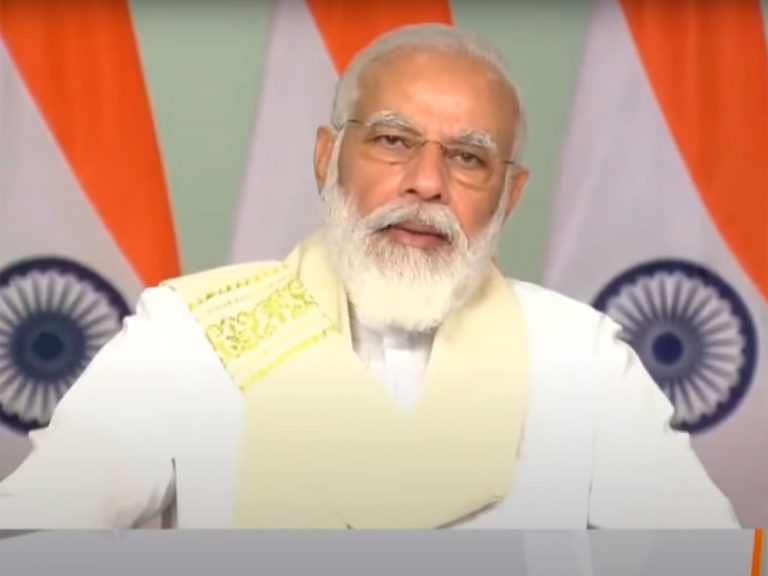
PM Modi on 10th August inaugurated the much-awaited Submarine Optical Fibre Cable (OFC) between Chennai and Port Blair via video conferencing. The foundation of the project was laid down in December 2018 by PM Modi to ensure high-speed internet connectivity for the residents of Andaman and Nicobar Islands.
While remembering the Islands’ importance in Independence movement and it’s relations to Neta Ji Subhash Chandra Bose, PM Modi talked about how this Submarine OFC and other projects will help in boosting the economy in the Islands.
In his speech, PM Modi said that he was pleased to launch the project in 2018, and now he is happy that he got the chance to inaugurate it as well. This OFC will connect Chennai, Port Blair, Little Andaman and Swaraj Island. He added that it is an early 15 August gift for the people of Andaman and Nicobar as this project will open new doors to opportunities.
Project completed ahead of time
The project has been completed before its scheduled time. A total of 2,300 KM cable was laid down to connect the important parts of the Andaman and Nicobar Islands in the first phase of the project, at the cost of Rs 1224 crores. The other areas of the Island will soon get connected to the fibre optics network. There were numerous challenges like monsoon season, high tides and deep-sea that made the project challenging. PM Modi said that these reasons did not allow the previous governments to find ways to connect the Island with high-speed internet facility like the rest of the country.
He thanked the dedicated team that worked tirelessly on the project and completed it in before the scheduled time despite the coronavirus pandemic. He said that it was the responsibility of the nation to provide such service to the people of Andaman and Nicobar. In the last few years, India has been working extensively in strengthening the border areas and ports. This project is a symbol of Modi government’s promise of ease of living, he added.
Inauguration of the submarine Optical Fibre Cable in Andaman and Nicobar Islands ensures:
High-speed broadband connectivity.
Fast and reliable mobile and landline telecom services.
Big boost to the local economy.
Delivery of e-governance, telemedicine and tele-education.
Better internet connectivity will improve tourism on the Islands
“India is a global leader in providing cheap and fast internet services. Now the people of Andaman and Nicobar Islands will be able to enjoy these services, PM Modo also added that better connectivity is essential for tourist destinations. Tourists often leave early keeping lack of fast connectivity in mind. Now, as they will get fast internet services while enjoying their holidays, they will stay for a longer duration that will help in improving the tourism on the Islands.
Improved road, air and sea connectivity
PM Modi said that the government is working to solve road, air and sea connectivity issues as well. A 10,000 crore worth transhipment project that is underway on the Islands will allow large ships to stop on the Islands. It will help in improving the economy of the Island and provide more opportunities for the people there. The government is working on improving road connectivity on the Islands and widening the NH4 as well. PM said that the four ships that are being built at Cochi shipyard to improve Water Connectivity between the Islands and the rest of the country will be delivered soon.
आइलैंड के बीच और बाकी देश से Water Connectivity की सुविधा को बढ़ाने के लिए कोची शिपयार्ड में जो 4 जहाज़ बनाए जा रहे हैं, उनकी डिलिवरी भी आने वाले कुछ महीनों में हो जाएगी: PM @narendramodi
The airport at Port Blair will soon be able to handle 1200 passengers at a time. The aviation ministry will start sea-place services to connect Islands in the cluster that will reduce commute time between two locations. In the next few months, smaller airports will start operations across Islands that will improve the connectivity with the rest of the nation. The work on the deep draft inner harbour on the East Coast will be completed soon. Pm Modi said that the government is working on promoting ease of business and maritime logistics in the sea.
The Blue Economy
PM Modi said that these modern infrastructure projects are essential for the Blue Economy as well that covers fisheries, aquaculture and sea-weed farming. Several countries are exploring possibilities in sea-weed farming. He informed that the pilot project in this area that was started in Andaman and Nicobar Islands showed a positive response and the government would soon implement it across Islands. Once they prove to be a success, it will be implemented in the rest of the country.
आज जितना भी आधुनिक इंफ्रास्ट्रक्चर अंडमान निकोबार में तैयार हो रहा है, वो ब्लू इकॉनॉमी भी गति देगा।
ब्लू इकॉनॉमी का एक अहम हिस्सा है Fisheries, Aquaculture और Sea Weed farming: PM @narendramodi
PM Modi said that though new opportunities are opening, it is essential that everyone on the Islands should take all the precautions to keep themselves safe during the pandemic. He added that it is essential to wear masks and practice social distancing to avoid infection.
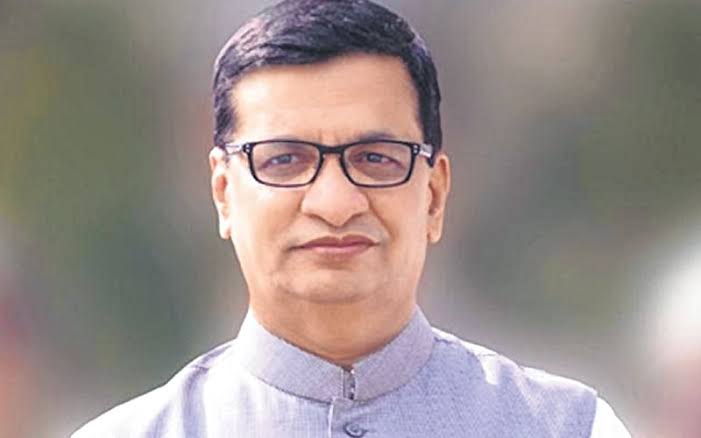
At a review meeting of the coronavirus crisis in Solapur, Maharashtra Congress President Balasaheb Thorat asked his party workers to be tough with the government officers by taking 4-5 bullies with them. He suggested the district party workers to take the help of toughies in order to get their work done.
“The Government authorities should fear us. We should have some grip over the administration. Take 4-5 guys along with you to instil this fear,” Thorat said while addressing the local Congress cadres in Solapur.
Before Thorat, Congress MLA Yashomati Thakur, who was also present in the meeting, echoed similar sentiments, asking Congress workers to be overly aggressive while dealing with the authorities.
“If your work is not getting done, create a ruckus. Nobody understands the language of request. You have got the right to snatch it. Every leader has to take care of his taluka. There should be no complain from your side. We will support you,” Thakur said.
The meeting was attended by the Minister for Women and Child Development, Adv. Yashomati Thakur, Minister Dattatraya Bharane, Collector Milind Shambharkar, Commissioner of Police Ankush Shinde, Municipal Commissioner P. Shivshankar, District Superintendent of Police Manoj Patil, Zilla Parishad Chief Executive Officer Prakash Vaichal.
Thorat also added that the state is going through a raging pandemic and the infection is rapidly spreading because of the foreign nationals. He asserted that though the spread of coronavirus in Mumbai is on the mend, it is on the rise in other regions of the state.
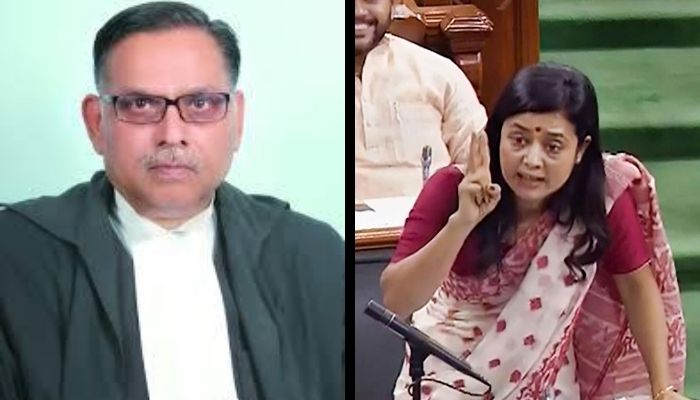
On Monday, the Supreme Court of India rapped up Trinamool Congress MP Mahua Moitra for filing the same petition after it was dismissed earlier in May. The politician had moved the apex court challenging a circular issued by the Union government which states that the State Relief funds and CM funds will not fall within the purview of Corporate Social Responsibility (CSR) activities under Section 135 of the ‘Companies Act.’
Supreme Court is hearing a fresh plea by MP Mahua Moitra, challenging a circular issued by the Centre which stated that CM Funds and State Relief Funds won’t come within the purview of CSR activities under S. 135 of Companies Act. @MahuaMoitra
While hearing the plea, Justice Ashok Bhushan rebuked her and said, “How can you file this petition again? The same Petitioner’s plea was dismissed on May 5, 2020.” When advocate Rohit Rathi appearing for Mahua Moitra conceded that the plea was rejected, Justice Bhushan reiterated, “How can the same Petitioner file another Petition on the same issue?”
Justice Bhushan: In view of the fact that the matter was dismissed on May 5, we are not inclined to hear this plea. Dismissed.
Although advocate Rathi argued that the notification for the petition came subsequently in light of the subsequent development in the matter, yet the Supreme court rejected the plea on the ground that it was earlier dismissed by the said court. The apex court further observed that the issues such as the ones raised, should be debated and discussed in Parliament, not contested in court.