Home Blog Page 5306

Harish Salve takes on Harsh Mandar, Prashant Bhushan and the cottage industry that attempts to defame the Judiciary and the Modi govt: Here are the details

Senior advocate Harish Salve appeared on a webinar on Saturday to discuss the attacks that are made to undermine the authority of the judiciary. In this context, he discussed numerous issues and spoke on the kind of criticism that is permissible and that which is not. The webinar was hosted by the CAN Foundation.

Harish Salve subtly chided ‘activist’ Harsh Mander who was spotted during the recent spate of violence in the country inciting Muslims against the Indian State. He did not take any names but the implication was obvious. He said, “There are several people who criticize the Supreme Court, the stature of judges and say that they won’t yield justice and then they come to Court the next day. Should the Supreme Court support them? It is better to ignore these people and not give them importance but there is a need to establish a conduct and calls for introspection.”

“An article by an Indian said the Indian judiciary is hopeless, only the international judiciary can do something. This is crossing the boundaries and over stepping the liberty of expression and free speech. Criticism on grounds of its judgment or for not taking proper action is admissible but to say that the Court is doing or not doing a particular thing to please the government is immoral. People have gotten used to using the court for their agenda and rather than criticising the judgement, they criticise the institution,” added the senior advocate.

During the interview, Harish Salve said that he had recommended the government to form a tribunal for private defamation. He lamented the fact that defamation cases in India take a long long time to complete and gave the example of the United Kingdom where such cases are fast-tracked. In this context, the senior advocate referred to an incident involving ‘PIL activist’ Prashant Bhushan.

Harish Salve said that Prashant Bhushan had made “derogatory comments” against Justice Kapadia which had led to the Justice expressing “anguish” in court nu the Attorney General had not done anything. As an amicus, Harish Salve had moved a contempt case in the matter. However, Justice Kapadia has passed away since then but the case is still pending.

Thye senior advocate also said that while ‘trollers’ can be ignored, people with an influence over public opinion such as activists and those holding government positions who have the capability to mobilise public opinion must be dealt with carefully. In this context, he referred to a recent judgement in Andhra Pradesh where a certain verdict had gone against the ruling party. He opined that calling the judges casteist was not correct.

“You can criticize a Judgment saying the Judge has taken a conservative line, you can say court is not robust, you can say that they don’t want to take deference with the executive but you can’t say that the judges or a particular is scared to take on the government and personally attack the stature of the judge. That is absolutely wrong and immoral,” said Harish Salve.

The senior advocate reserved scathing remarks for media trials. In recent years, we have seen numerous instances where the media takes upon itself the mantle of judge, jury and executioner. Harish Salve said, “Why do we say that in the currency of the trial, there should not be any media trial? It is not because the judges will get influenced, but, because by doing such media trials you undermine the real trial. If we do nothing about this growing menace, it will become a major problem.”

He continued, “Many people come to court with a certain agenda of shaming the government. If the judge doesn’t rule in their favour, they criticise the judge for being dishonest. The judge has taken an oath of honesty and acting without fear, but due to the media pressure he’s under the constant fear of public opinion.” Harish Salve also said that if ‘social media diatribe’ goes unchecked, “20 years down the line we may not have courts left to practice in”.

Harish Salve also slammed NDTV news anchor Sreenivasan Jain for the media trial he engaged in after Lt. Col. Purohit received bail. He said, “Srinivasan Jain called me to ask, how come Col. Purohit got bail? I said Srinivasan, you are so prepared, instead of ASG arguing you should have.” He also said that media should be more accountable for how and what they publish on their platforms.

Another instance he mentioned involved PTI, the news agency. He recounted an incident where it was claimed in a tabloid that, “Salve said in the Court – Yes my client has evaded tax, so what?” Along expected lines, it caused quite an uproar. Hurt by the blatant piece of misinformation, he decided to investigate how it came about. He then discovered that it was by a member from PTI.

When PTI was asked of the matter, they replied that it was the work of a youngster who was running in and out of court. The youngster was told by someone that Salve had indeed said the words and he ran with it.

On the matter of PILs, Salve said that it had become a tool to use against political adversaries. He said that PILs have become a tool to control the government and its functioning. He also emphasised that when the government abdicated its responsibility to govern, the Court transgressed its boundaries and started governing. In this regard that there were times when the Judiciary controlled the government.

India must take a firm stand while holding dialogue over LAC: History of conflict, China’s devious motives and the fear behind the curtain

In the year 1913, the United Kingdom (UK), China and Tibet met at Shimla to sign an agreement on the alignment of the international boundary as per the map produced by the Foreign Department of British India. Though China initialled on the proposal, later they backed off citing ambiguities and technical reasons. Henry McMahon, the Foreign Secretary, who had drawn up the proposal, then decided to bypass the Chinese and settle British India’s Himalayan border bilaterally by negotiating directly with Tibet. China, however, rejected Tibet’s claim of independent rule and maintained that the said treaty had no sanctity without China’s endorsement.

In the following decades, the world saw two major world wars followed by the establishment of two new countries in the subcontinent – India and Pakistan, as also establishment of the People’s Republic of China (PRC) after the Chinese Civil War in 1949. The new Indian Government looked at maintaining very cordial relations with China. One year later, PRC took full control of Tibet and built roads and border outposts in Aksai Chin. The Ardagh–Johnson Line as per British India Government, was considered as a formal proposed traditional boundary of the State of Jammu & Kashmir with Xinjiang and Tibet. Aksai Chin was, therefore, claimed by India to belong to Kashmir.

But China refused to accept it saying it was a historic part of Xinjiang. Aksai Chin offered an important road link which connected the Chinese regions of Tibet and Xinjiang. India did protest, but it fell on deaf ears. Therefore, China’s construction of this road became one of the triggers of the 1962 conflict.

Later, Prime Minister Jawahar Lal Nehru announced in Parliament that India regarded the McMahon line as its official border. However, it had no effect on China and they continued to insist that they had no claims over Indian territory, but in their official map, they continued to show 1,20,000 sq km of Indian territory as theirs.  India claimed that the Himalayas were the ancient boundaries of the Indian subcontinent and thus the McMahon line was to run through highest ridges of Himalayas. However, on the map, the McMahon line at places appeared to run South of the highest points which set the roots of differences in perception. 

The beginning of the dispute between India and China

In 1954, while Prime Minister Nehru reiterated the Indian position, claiming that historically, Aksai Chin had been part of the Indian Ladakh Region and that the border was non-negotiable. While the Chinese continued to build a road into Aksai Chin, the final jolt in the relationship came in 1959 when Prime Minister Nehru accommodated Dalai Lama after he fled Lhasa. The uprising in Tibet had been crushed and China usurped Tibet completely. Accommodating Dalai Lama by India, badly irked Mao Zedong and thereafter, a slew of border incidents started taking place which also resulted in few deaths and injuries.

In 1960, officials from India and China met to resolve the border issues; but there was no convergence of thought and standing point of view. Prime Minister Nehru then adopted a forward policy and Indian troops started to patrol and construct border outposts. Somehow, the Indian side believed that breaking out of a full-scale war wasn’t a realistic possibility. The Indian leadership perhaps failed to read Chinese internal raging anger towards India’s forward policy and perceived Indian subversion of the region of Tibet.

Claims and counterclaims

In the fall of 1962, China launched two major offensives, one in Chip Chap valley in Aksai Chin and the other in Namka Chu. Aksai Chin was easily accessible to the Chinese and was difficult for Indians on the other side of Karakoram to reach. Besides these two major attacks, minor skirmishes took place on borders of Sikkim too. The war lasted for a month and China managed to capture much beyond Tawang up to Brahmaputra plains in the Eastern Sector and in the Western Sector they completely swept across Aksai Chin, captured Chip Chap valley, Galwan Valley and Pangong Tso lake. PLA had captured areas quite deep into Indian territory on both Eastern and Western Sectors.

Thus, if China wanted, they could have easily retained captured territory up to Tawang which has a strong religious sentiment attached with Tibet and over which they always staked their claim. But peculiarly, they did not do so despite the much-publicised dispute related to their claim over Arunachal Pradesh being part of Southern Tibet. They took a unilateral decision to withdraw completely up to its claimed ‘Line of Actual Control’, but on the other side, they decided to retain over 2000 sq km of the alpine desert in Ladakh.

Though it was totally uninhabited with no resources, it connected Lhasa in Tibet and Kashgar in Xinjiang. China later ceded over 750 sq km to Pakistan and in return, Pakistan recognised Chinese sovereignty on almost 800 sq km of land in Northern Kashmir and Ladakh. The 1962 war with India thus ended with a strategic gain for China. 

Acceptance of the McMahon Line

Later on, in 1972, Chinese Premier Zhou claimed that the Chinese military had withdrawn North of the McMahon Line in good faith. Thus, in all fairness, it was an admission on his part that the McMahon Line was a reality between India and China. The Line of Actual Control (LAC) is thus the effective border between India and China covering a distance of over 3488 sq km along with Ladakh, Kashmir, Himachal Pradesh and Arunachal Pradesh. Barring a couple of pockets, China has accepted the border with Sikkim as the International Border.

Notwithstanding the 1962 war and Nathu La conflict of 1967, difference in perception concerning the exact alignment of the McMahon line continues to linger on. This has many times resulted in friction along the border. However, things have drastically calmed down since then and the last bullet between the two countries was fired in 1975 in Yangtse on a patrol party of Assam Rifles. India and China signed several agreements and accords between 1993 and 2013 to prevent any flare-up along the LAC.

China’s approach

Today, China’s foreign policy favours ‘multi-polarity’ and thus seeks to resist domination by any power, especially the US, of not only the world in general but more specifically of the Asian region. China, therefore, extends cooperation with its neighbours through a mix of military capability, economic power and diplomatic nuances. As far as India is concerned, China has already taken away what it wanted during the 1962 war. For the rest of Ladakh, Sikkim and Arunachal, China knows that it is not only impossible to retake these geographical segments but also what do they gain by attempting to do this? This helps them neither tactically nor strategically. Any war with India aimed at capturing territory will only push them back economically by decades in their quest to compete with the US.

Though officially, China will never acknowledge the LAC as an international boundary of permanent settlement between the two countries, in reality, on the ground,  the LAC is a boundary to which China has already reconciled except for few pockets where perception differs either due to lack of clarity in deciphering the actual geographical features on the ground through which the alignment of the LAC should be running or where it gives them any tactical advantage locally.

Since the LAC is not an established international boundary, the dispute in the form of friction on the ground, therefore, must continue to not only manage a favourable perception of own countrymen towards CPC but also send a clear message to all neighbouring countries of India as to signal New Delhi’s incapability in asserting control over its border. China also undertakes these regular incursions for building facts on the ground to claim the borders as ‘disputed’ in the eyes of the world.

That is why, for several decades, without fail, every year few face-offs take place building a record of continued dispute. Chinese are known to be working on very long-term objectives and plans. Thus, such a record of disputes built up over several decades, will not only make their claims look stronger, but also give them an upper hand during any negotiations if ever held with the help of international arbitrators. Intrusions, therefore, keep taking place as a never-ending effort to either reach the tactically advantageous geographical segment on the ground along the LAC or to stretch the Indian Army logistically. 

The devious motives of China

The Doklam face-off was a very different thing that happened to what is happening in Pangong Tso and Galwan Valley today. It had a definite devious motive to get close to India’s so-called ‘Chicken Neck’ bordering with Bhutan. It was projected as settling border issue with Bhutan and supposedly on the face of it had nothing to do with India. It lasted for over two months, but when India finally decided to draw the redline, China blinked. 

Is the current ongoing face-off in Ladakh on similar lines of Doklam? The answer is a straight No. Then what is the objective this time? China was very critical of India post abrogation of Article 370 and 35A calling it unacceptable and challenging it at the UNSC. Both China and Pakistan got rattled with the fear that India has started to look at merging Pakistan Occupied Kashmir (POK) with Kashmir and thus reunite the erstwhile state.

This would have meant the end of the China Pakistan Economic Corridor (CPEC). In the garb of calling it a matter of differing perception, China has been trying to slowly encroach upon the territory in Eastern Ladakh by which Beijing intends to slowly choke the possibility of India expanding towards Gilgit Baltistan. 

In the current face-off, the aggressiveness in China’s behaviour has been outwardly visible since April 20. Seeing the pattern of current intrusion, one can also conveniently assume that China is perhaps looking at pushing the Indian Army West of the Indus and Shyok rivers, essentially giving China partial control over of strategically important Shyok and Chang Chenmo rivers. Or is the game bigger than what it seems to be on the face of it?

The geo-political shift

Since over the last two decades, the world has started to experience China’s growing aggression, interference, control, subversion or plunder and ambition for global hegemony, but in the temptation of achieving some economic gain through cooperation, many have ignored it. Way back in 1998, India’s then Defence Minister, Late George Fernandes, had the foresight of declaring China as being India’s Number One Enemy in times ahead.

Notwithstanding, like other Nations, India too moved ahead building diplomatic and economic ties with China. With the passage of time, China not only became India’s largest trading partner, but also both the countries started to cooperate on a range of international issues like trade, climate change, unfair regulations of WTO towards developing nations and reform of global financial order. 

As China grew economically and militarily, so also grew China’s hegemonic nature which gradually started to lead to not only territorial conflicts, but also a conflict of interests with the West. Over time, China started to appear as a bully on the international arena. However, today, China seems cornered.

The Chinese attempt at imposing a strict national security law over Hong Kong has not only been opposed by the common people of Hong Kong but has also resulted in an unprecedented display of solidarity by Australia, Canada, Japan and the UK with people of Hong Kong. This new legislation would have expanded China’s ability to monitor and oversee Hong Kong’s security operations and target people seeking to undermine China’s authority.

Tensions between China and the West have been heightening over a range of issues including but not limited to WHO investigating the true origin of coronavirus pandemic, new legislation issued in Hong Kong being condemned by the world, China imposing steep trade tariffs on Australia and calling Australia a “US dog”, as also a close confrontation between Chinese Navy and the US Navy in the South China Sea.

Further, increasing arms sales by the US to Taiwan as also repeatedly highlighting Taiwan’s distinct national identity has upset China. Recently, on the 19th of May China was miffed to notice the presence of two Indian MPs at Taiwanese President’s Swearing-in ceremony. China immediately conveyed a message to India to refrain from supporting Taiwan. This clear signal by India in recognizing Taiwan’s sovereignty could have also played a factor in the sudden increase in military activism along the LAC.

Cornered China

One of the biggest losers of India’s stated policy of achieving self-reliance is the Chinese manufacturers and technology services companies. As India is one of the biggest markets, any anti-China policy or sentiments would increase the threat to the Chinese economy. Since going to war suited neither China or India, it has been observed that China has always resorted to adopting aggressive postures on the borders under the garb of LAC disputes, the latest being the ongoing face-off at Pangong Tso and Galwan Valley.

This is a smart but cheap tactic by China to stir the emotions of the Indian masses making the Indian Government look weak and unable to defend the territorial integrity and, in the bargain, coerce India into agreeing to their demands through interaction at the diplomatic level. Adopting the current standoff in Ladakh, objecting to infrastructure development by the BRO, supporting the anti-India communist government in Nepal headed by Prime Minister Oli, supporting Pakistani covert actions in Kashmir and fanning anti-India flames in the Middle East appears to be a multi-directional approach to pressure India to accommodate to certain critical interests of China at stake in the present.

India’s close relations with the US as also with other Western Nations and the Indian Health Minister now being tasked with a major role at the World Health Organization (WHO), has in all probability created a panic in the Chinese hierarchy. Beijing is apprehensive that India to please the US could use this platform to implicate China of being responsible for spreading Covid-19 virus. It is possible that the current face off could also be related to diverting the internal pressures being faced by Xi Jinping due to mishandling of Covid-19 spread and worsening of the economic situation.

There are also unconfirmed reports of an internal struggle going on between Military Theatre Commanders in China. The desire of WTC and STC Commanders to become a member of CMC in 2021, could also be driving the current ongoing situation against India and Taiwan respectively. Both may be trying to establish their relevance and trying to project themselves as a more competent and dynamic potential candidate for CMC.

Fear behind the curtain

It has been observed that over the last decade, there has been a gradual shift of PLA training activities and building up of a cluster of military infrastructures towards the Western side apart from building major road access and townships on the pretext of encouraging tourism and promoting Buddhism.

In reality, it is a big façade perpetrated by Beijing over the remote province. Their major concern is centered around protecting POK and especially the area of Gilgit Baltistan from where the CPEC enters Pakistan. Someday, India capturing this area will not only choke the CPEC but will also provide India with a land route access to mineral-rich Central Asia.  

At present, Gilgit Baltistan has started to see growing internal strife much to the worry of both Pakistan and China. The Indian Government beginning to talk openly about reclaiming POK has only added to their anxiety levels. This could be why suddenly out of blue China suggested a need for Tri-lateral negotiation involving Pakistan to resolve the current ongoing standoff?

Besides being mineral-rich it is also a well-established fact now that Central Asia is slowly turning into a crucial hub not only in China’s BRI project but majorly in China’s national security-related to Kazakhstan, Tajikistan and Kyrgyzstan sharing a 3300 km long boundary with restive Xinjiang Province in the West.  

The people of these three countries have always felt cheated, deprived and persecuted at the hands of the Chinese historically. The recent rise in mass anti-China protests due to growing distrust towards Chinese intentions, therefore, has become a matter of major concern for China. Any major flare-up in times to come will attract the attention of world powers adding to the ongoing discomfort of China related to Hong Kong and Taiwan at present. India’s direct access through land route will only further worsen their problems.

India’s approach

There is no straight jacket solution to current predicament in Ladakh. A multi-pronged approach needs to be adopted, having first drawn a redline in clear terms. India must make it clear in a subtle way that India is not going to blink first at any cost. In the current COVID-19 scenario, China is fully conscious that the entire international community seems to be against them.

China, therefore, cannot afford to take the risk of even a skirmish as no one can guarantee that it would remain confined to just the India-China border. A war now between two regional powers would get the entire world involved in one way or another and would give the West and President Trump, in particular, a legitimate reason to engage China militarily. So, therefore, it is advantage India now. The Indian military, therefore, must continue firm on ground moving reserves to cover the vulnerable pockets and call China’s bluff.

Besides enhancing round-the-clock surveillance, India must also actively get down to perception management by conveying good intentions to resolve the issue through international media. The building of infrastructure must also continue as before. As quoted in Hindustan Times e-paper India’s Defence Minister Shri Rajnath Singh has already made it clear that while talking with China at both Military and Diplomatic levels the Government will not allow India’s dignity to be hurt under any circumstances.

At the diplomatic level, using the Chinese philosophy of Wolf-Warrior Diplomacy, India must convey that when it comes to push versus shove, India may be compelled to revisit the Panchsheel agreement under which India had conceded recognition of Tibet as part of China. Therefore, it would be in the best interest of both the nations to settle the traditional boundary disputes, trade deficit, China’s unnecessary call for tri-lateral negotiations involving Pakistan concerning India’s stand on ongoing contentious issues like Hong Kong, Taiwan, WHO at mutual one to one level without drawing undue international attention.

Summary

It will not be out of place to assume at this stage that perhaps a new cold war has begun. Has China committed the error of overtly and directly competing with the Western Powers, both economically and militarily rather prematurely? A massive anti-China wave seems to be building up around the globe. A few days ago, President Xi Jinping ordered PLA to scale up the battle preparedness to protect the country’s sovereignty. However, he did not define any specific threat.

A study of the western region of China reveals that China is deeply concerned about the porous western borders and rising Uyghur insurgents. With ongoing unrest against China especially in three Central Asian countries bordering with China as also in Gilgit Baltistan, PLA, therefore, needs to consolidate their presence in the western region to ensure that at no stage any situation in Xinjiang gets out of control.  China also needs to exercise economic influence over both Pakistan and Central Asia. Thus, any strengthening of the position of India’s military in Ladakh region as also a demonstration of Government’s resolve to merge POK back in Kashmir comes as a vulnerability for China in this region.   

To sum up, therefore, it will be apt to quote Mr Ram Madhav’s views when he said, “As the new cold war clouds gather over the horizon, countries like India have to weigh their options carefully. NAM-type ‘neither here, nor there ‘neutrality is no longer feasible because the new cold war is going to play out in India’s immediate neighbourhood. Instead, India could become the fulcrum for countries in the Indo-Pacific region,” unquote. Therefore, under the prevailing geopolitical situation today, India, must adopt a firm stand drawing a red line at all levels while progressing with any dialogue over LAC with China. 

This article has been authored by Lt Gen Abhay Krishna, PVSM, UYSM, AVSM, SM, VSM, (Retd). Former Army Commander South Western Command, Eastern Command and Central Command

‘If we open borders, people from other states will come for free treatment,’: Delhi CM Arvind Kejriwal to keep borders sealed for one more week

As the country entered the Unlock-1 phase, Delhi chief minister Arvind Kejriwal on Monday took a controversial stance when he announced that the national capital’s borders will remain sealed for the next one week on the account of a possible influx of residents from neighbouring states for free treatment that would overwhelm the health care services in Delhi.

Kejriwal claimed that if the borders are opened, people from neighbouring states will flock to Delhi as the treatment for coronavirus in the national capital is free and the beds meant for the ailing Delhi residents will be occupied with 2 days.

The Aam Aadmi Party chief also added that he is seeking the opinion of people from Delhi on whether the capital should open borders or not. “I need your suggestion on this matter. Give your responses by 5 pm Friday,” he said while sharing a WhatsApp number (+91 8800007722) for people to weigh in their suggestions.

Kejriwal has asked Delhi residents to advise whether the government should open up the borders but restrict treatment only to the local residents or since Delhi is the national capital, its medical facilities be open for all the citizens of the country.

It must be noted here that other than state government run hospitals, there are many central government run hospitals in Delhi like AIIMS, Safdarjung Hospital, Ram Manohar Lohiya. The treatment at these hospitals are either free of cost or cost very negligible.

Arvind Kejriwal had claimed ‘outsiders’ come to Delhi for free treatment

This is not the first time that Delhi CM Arvind Kejriwal has made controversial remarks for the ‘outsiders’ who gravitate to the national capital for medical treatment. Last year, the AAP chief had stoked a controversy when he proclaimed that people from outside come to Delhi for ‘free treatment’ but Delhi has ‘its own capacity’. “How can Delhi serve people of the entire country?” he said while addressing a gathering in the national capital in September 2019.

Speaking on long queues about purchasing medicines prescribed by doctors, Kejriwal said that the reason is a lot of people are coming from outside of Delhi for treatment. “We carried out a survey. About 80% of patients in Delhi hospitals are outsiders. There are enough hospitals in Delhi which can cater to residents of Delhi. A Delhi resident can get treatment within 30 minutes of entering a hospital. But the queues are because of people living outside of Delhi who come here for treatment. A person from Bihar can take a ticket for Rs 500 and come to Delhi and get free treatment worth Rs 5 lakh and go back. We are happy because they are our country people only and they should get treatment. But Delhi has its own capacity. How can Delhi give treatment to patients of the entire country? The situation in the rest of the country should improve,” he said.

NGO, Islamic scholars initiate campaign to end Saudi Arabia’s control over mosques at Mecca and Medina

In an unprecedented move, an NGO named Al Haramain Watch, established in 2018, has initiated a campaign to establish international control on the mosques in Mecca and Medina, reported Middle East Monitor. The organisation, also known by the name of International Commission to Monitor Saudi Administration of the Two Holy Mosques, has garnered support from 100 Islamic scholars and ‘human rights activists’ in its campaign to nullify the hegemony of the Saudi Kingdom over the Holiest shrines in Islam.

Through its campaign, the NGO wants to raise awareness among Islamic nations and Muslim communities in Europe and US about the Saudi regime’s policies on pilgrimage to the twin cities. The organisation is of the belief that the Saudi Government has failed to provide unequivocal access to all Muslims wanting to visit the Holy shrines. The Saudi monarchy has restricted Muslims from Qatar and Iran (revoked in 2017) to make the Hajj pilgrimage.

Demand for International Control

In view of the travel restrictions to Saudi Arabia, Al Haramain Watch called out the kingdom for its violation of international law and its founder’s vision. The NGO in its petition has accused the Saudi Government of ‘permanent politicisation’ and absence of strategic development in managing the mosques.

It called upon Islamic countries as well as the media to form an ‘interim framework’ for the management of the Holy sites. The organisation suggested setting up a high-level committee wherein members aka Islamic countries are elected for 4 years. Their work will be reviewed and supervised by other member states. Supposedly, a petitioner, Azmi Abdul Hamid, is in possession of a historical document allegedly written by Saudi Arabia founder Abdulaziz Bin Saud, wherein he stated that all Muslims, had the right to run the administration of the two mosques.

The organisation was established with the objective of preventing the politicisation of Islamic pilgrimages, ensuring proper management of the mosques at Mecca and Medina, and establishment of sovereign funds consisting of the income generated from Hajj and Umrah pilgrimages. Similar demands were earlier made in the past by a Turkish politician in the year 2014. Another Turkish think-tank had also demanded an ‘Islamic Vatican.’

‘Looting’ for justice: See how US ‘protestors’ are busy looting stores amidst violent ‘resistance’ after the George Floyd killing

Violent protests and rampage had gripped several cities in the United States of America after the death of a black person George Floyd due to police brutality sparked outrage in Minneapolis, Minnesota.

However, the ‘protests’ have now evolved into large-scale looting, mayhem and rampant crimes.

Videos of rioters looting the showrooms of luxury brands like Louis Vuitton and others have been doing rounds on social media. In the viral social media videos, it was seen that looters and vandals, under the garb of protests, have been attacking stores in several cities and looting the items, fleeing to their cars with the expensive goods.

More videos of rampant loot and crimes are now doing rounds on social media. It is disturbing that the protests, which started over demands to get justice for an unfortunate victim of police brutality, have now morphed into rampant anarchy, and robbery.

In Rochester, New York, protestors were seen looting a store and fleeing with stacks of Nike shoes.

The videos shows that people are not just looting from the store, but also from each other. Seemingly well-to-do persons are seen parking their cars and rushing to loot the stores.

In NYC, a Lululemon store was vandalised by the so-called protestors where they just broke the glass, and proceeded to loot the store.

Another store of the luxury watch brant Rolex was also looted in Manhattan, NYC.

Amazon Truck looted

Even cargo trucks containing online order packages were not spared. In a video, looters were seen rampaging an Amazon delivery truck in Santa Monica, California.

Looters ‘looting’ each other

In another video shared by Norbert Elkes, looters were seen brutally attacking other looters to grab the goods.

Pooping, looting, burning for ‘justice’

Utter lawlessness and rampant violence have been spreading in several US states. While US President Trump has called for strict control of riots and violence, the condition seems to be worsening day by day.

In Salt Lake City, Utah, a white woman was seen squatting on top of an overturned police vehicle and defecating while onlookers cheered around her. While the video went instantly viral, the hashtag #Poopingforjustice started trending.

‘Protestors’ have also set several private and government vehicles, properties and even a police precinct on fire in the USA. On May 29, the 3rd police precinct in Minneapolis and several shops were set on fire by rioters.

George Floyd Killing: Communists in America burn down homeless man’s only possessions. Watch video

Even as the rioting and violence continues across America following the killing of African-American man George Floyd, the communists and far-left rioters associated with ANTIFA set fire to a homeless man’s possession.

The video was shared by Twitter user Greg Reese, Texas based producer of InfoWars.com.

As can be seen in the video, rioters bring out the mattress and put it on a pyre as the man who owned the mattress and those things helplessly and unsuccessfully tried to save his possessions from turning into ash. “I live here,” he could be heard shouting as everything he owned burned.

In another such video, the rioters can be seen beating up an old woman and her husband as they tried to protect their business from being destroyed.

The video was shared by cinematographer Luke Rudkowski on Twitter. As per him, the incident happened at Rochester, New York and the police is trying to identify the rioters.

Another such video shows a woman in New York pleading to rioters to spare her business as they punch her in the face. When her husband tried to save her, they even beat him up.

Trump designates ANTIFA as terrorist organisation

ANTIFA has been around for decades but got its presence in the US in the 1980s. It shot to prominence after Donald Trump was elected as US President in 2016. It got into news last year when the violent communist group, celebrated by Democrats and mainstream media, attacked a gay journalist. The Antifa is not a fringe element in the Left. They are blue-eyed boys in the liberal fraternity. The FBI under the Obama administration had classified Antifa’s actions as ‘domestic terror activities’. 

Joe Biden, Vice President during Obama’s Presidency under which the FBI designated Antifa as carrying out terrorist activities, began his Presidential campaign for 2020 by calling the Far-Left group a “courageous group of Americans”. On Sunday, US President Donald Trump announced that ANTIFA will be designated as a terrorist organisation.

Antifa members typically dress in black and often wear a mask at their protests, and follow far-left ideologies such as anti-capitalism and take to violence during their protests. They take up causes such as LGBTQ and indigenous rights. 

US protests: President Trump was escorted to the bunker while rioters raged near the White House on Friday, say reports

On Friday night, US President Donald Trump was reportedly escorted to a special bunker after riots, post the George Floyd case, had spread to outside of the White House in Washington, DC. Protestors had gathered outside the Presidential Estate on Friday night and clashes took place between the rioters and the President’s Secret Service. Reportedly, the security forces had to take Trump to the secret bunker that had earlier been used for the safety of the President of the country during terrorist attacks.

The demonstrators hurled abuses at the US President and also resorted to pelting bottles and bricks. According to New York Times, the protesters had set off fireworks and set a car ablaze. Even though officials conceded that there was no danger, yet the family members of the US President were intimidated by the violent protests. While the protest was peaceful during the day, it took a violent turn by the night. The rioters surged forward against the lines of the riot police to seize control of the Lafayette Square near White House.

While the protests surged outside, the US President was briefly taken to the bunker beneath the White House, media reports have claimed.

On Saturday, Donald Trump had praised the Secret Service for their professionalism and for allowing the protesters to scream and rant while effectively. He appreciated them for stopping rogue protesters. The US President has been under fierce criticism from the Opposition and the media for his supposed inflammatory tweets and absence of a televised address to the nation in times of crisis.

Warning the violent protesters, he said, “If they had (breached the fence), they would have been greeted with the most vicious dogs, and most ominous weapons, I have ever seen.” Hailing the resistance put up by the Secret Service against the frenzied mob as ‘good practice’, Donald Trump lambasted the DC Mayor Muriel Bowser for his inability to send the police to contain the situation and safeguard the White House.

The Death of George Floyd

A series of violent protests had sparked off in the country, following the extra-judicial murder of a 46-year-old African American man, George Floyd by a white police officer, Derek Chauvin in Minneapolis, Minnesota on Monday. Despite the victim complaining about not being able to breathe, coupled with verbal protest from onlookers, Chauvin knelt on the former’s neck for 7 long minutes until his body became unresponsive.

Surveillance footage showed that the victim did not resist arrest while he was handcuffed, contrary to the claims of the police. A shopkeeper had called the cops on Floyd for allegedly trying to pass a ‘potential counterfeit bill’. On being taken to the Hennepin County Medical Center, he was pronounced dead.

Violence in the United States

On May 26, hundreds of protestors hit the streets to protest against the killing of George Floyd. The demonstration continued outside the nearby police precinct. Soon, the protest took a violent turn. On Wednesday night, Police cars were vandalised and pelted with rocks. To pacify the situation, the cops resorted to firing tear gas and rubber bullets at the frenzied mob. The mob also breached the security and reached for the police precinct in the neighbourhood where Floyd died. The building was set of fire by the unruly mob, amidst slogans demanding justice for the victim.

On Saturday, rioters had also desecrated the 142-year old St. Patrick’s Cathedral in Manhattan in New York, fin the aftermath of the George Floyd Case. The walls were defaced with words such as ‘F*ck’, ‘BLM (Black Lives Matter)’, NJNP (No Justice No Peace) that were written in black letters. 

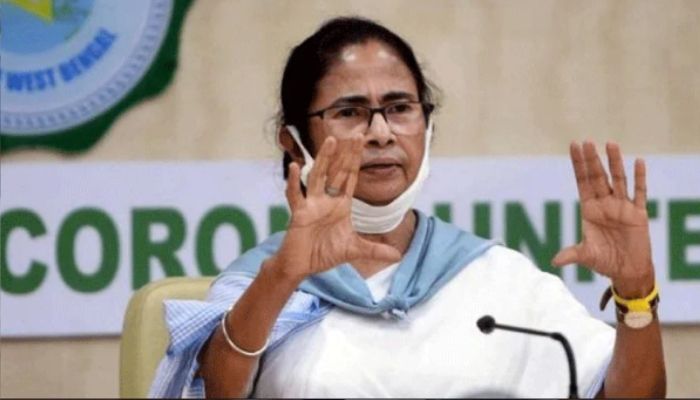
It is not in my hands anymore, you can sleep with coronavirus now, make it your pillow: Mamata Banerjee

West Bengal CM Mamata Banerjee has been struggling with the devastation caused by cyclone Amphan and the rapidly increasing coronavirus cases in the state.

As per a report in The Hindu, Mamata Banerjee, on Saturday, had announced a number of relaxations in the lockdown to be allowed in the state from June 1.

The CM said, “Public sector and private offices will open from June 8, Schools will remain closed for the month of June. Religious places of worship will open from June 1. Tea and jute industry can function with 100% staff from June 1. Buses will operate but only no standing passengers will be allowed.”

Blames Railways for increase in coronavirus cases

Banerjee said, “If thousands can travel in crammed trains, I feel that temples and mosques can also open. I was the Railway Minister. I know there are 20 to 25 coaches to a train. Thousands are travelling in a crammed condition for 48 hours. Those who are not infected are getting infected.”

Blaming the railways for the increased coronavirus cases in her state, Banerjee asked whether the railways has turned Shramik Special trains into ‘Corona Express’.

While she admitted that about 5 lakh migrant workers have returned to the state, 75,000 have come via Shramik Special trains. She added that migrant workers from coronavirus hotspots like Mumbai and Delhi are also coming.

However, the CM forgot to mention that the Shramik Special trains ferry migrant workers to a state only with the state government’s approval.

I am helpless, there is nothing I can do

Expressing her utter helplessness to stop coronavirus cases in the state, the Bengal CM stated, “It is not in my hands any more. Now I have nothing to do. You can sleep with corona by your side. Make it your pillow. I am sorry.”

West Bengal has recorded 5130 cases of coronavirus as of date. 309 people have died in the state so far. 18 out of 22 districts have recorded coronavirus cases. Kolkata has the highest number of cases, followed by North 24 Parganas. Both regions were also badly affected by cyclone Amphan.

Cyclone Apmphan: “Sorbonaash Hoye Gachhe”, said Mamata Banerjee

As the cyclone Amphan ravaged coastal districts in Odisha and Bengal on May 20, the Bengal CM was also seen struggling in her response. Addressing a press conference, a visibly shaken Banerjee had stated, “Sorbonaash Hoye Gachhe”, (everything is ruined).

Mamata Banerjee said the impact of Amphan was worse than the coronavirus pandemic and claimed the cyclone could have caused damage worth Rs 1 lakh crore.

Following the ravaging cyclone, the alleged delays and administrative failure in relief and rescue work had caused chaos and protests in many parts of the state. When electricity, drinking water, phone network and many other essential services remained unavailable in Kolkata even days after the cyclone, questions were raised over the efficacy of the state government.

Facing a barrage of questions, Mamata Banerjee had said, “I and the people in my team have not slept for three days. Either let us work, or gun me down or cut my head off”.

Madhya Pradesh: 4-year-old raped in Chhatarpur, dead body discovered from a well

In a shocking incident, dead body of a 4-year-old girl child was recovered from a well in Chhatarpur in Madhya Pradesh on Friday. She was raped between the intervening night of May 28 and May 29, reported news agency ANI. The post mortem report of the child had confirmed signs of sexual assault. A case has been registered for rape and homicide.

According to the Superintendent of the Police (SP) Kumar Saurabh, the investigation in the case is underway. On allegations of police negligence, Kumar assured that disciplinary action would be taken against police officers if their conduct is found inappropriate during the investigation. “If it is found true, those involved will be suspended”, he reiterated.

Minor girl raped in Bhopal

On April 18, a minor girl was forcefully dragged into a car and was raped by two men, namely Shafiq Khan (24) and Abid Khan (22), in Bhopal, Madhya Pradesh. According to the reports, the 17-year-old girl and her friend were on her way to JP hospital in Bhopal, when she was abducted by two men near the hospital at 07:30 PM on April 18. One of the accused brutally raped her by taking her to the BHEL township and left her near the city’s Mayur Park.

Ladakh standoff: Congress supporters want to dismantle Statue of Unity amid call to boycott Chinese products

In the backdrop of Ladakh standoff and military aggression by China at the Line of Actual Control (LAC) in Ladakh, many celebrities including education reformer Sonam Wangchuk, the inspiration behind Aamir Khan starrer 3 Idiots, had called to boycott Chinese products. Soon, Congress-friendly journalists and Congress supporters took to Twitter to spread misinformation and to demand that the Statue of Unity, world’s tallest statue in honour of Sardar Vallabhbhai Patel, be dismantled.

The Wire columnist asked whether the Statue of Unity will be dismantled for the economic boycott of China. Many wanted to dismantle and demolish the statue while claiming that the statue was ‘Made in China’. Journalist Rajdeep Sardesai, too, spread the lie that the statue was made in China.
Rajdeep Sardesai’s now deleted tweet claiming Statue of Unity was made in China

Is Statue of Unity made in China

The ‘Statue of Unity’, the tallest statue in the world built as a tribute to one of India’s greatest leaders – Sardar Vallabhbhai Patel – was actually constructed by the engineering major Larsen & Toubro (L&T) in India and not in China.

According to the reports, the ‘Statue of Unity’ is a three-layered statue. The first and the inner-most layer has two 127-metre-high towers made of reinforced cement concrete. The second layer has been constructed using a steel mesh. Both of these layers were made in India.

The third, which is the outermost layer, has been done using a bronze cladding, which carries intricate details of Patel’s clothes, posture and facial expressions. It is this layer of the statue which was built in China.

Most importantly, when the construction of the statue began, the builders found out that none of the 15 major bronze foundries in India was capable of building these claddings. The construction giant L&T then initiated a global tender to identify a partner to build the cladding.

Finally, the China-based Jiangxi Toqine Metal Crafts Corporation, which is the world’s largest foundry, was given the work of production of around 7,000 bronze plates and panels of various sizes.

This bronze cladding work, reportedly, forms only 9 per cent of the total value of the project. “The entire statue itself is being built in India at the site and only the bronze cladding in the form of bronze plates is being sourced from China, which constitutes a negligible amount of less than 9 per cent of the total value of the project,” the company had stated in 2015.

Secondly, according to an Indian Express report, of the total 4,076 labours working at the site of the statue in two shifts, only 200 workers were from China. The labours who worked in batches for two-three months each since September 2017, were part of a team consisting a thousand workers, who were employed for cladding work. Hence, it forms only 5 per cent of the total workforce involved in erecting the Statue of Unity.

A statue which has been built with over 95 per cent of India’s workforce and also 90 per cent of the statue’s work was done by companies belonging to India.

But Congress supporters’ dislike for Sardar Patel does not let them see beyond this.

Ladakh standoff

About 5000 Chinese army personnel, under the garb of a military exercise, diverted their movement towards the Indian side of the LAC (Line of Actual Control). The current stand-off began on May 5-6 and has been continuing all along the LAC up to Sikkim. Sources told ANI that the behaviour of Chinese troops had been reminiscent of the stone pelters in Kashmir who are funded by Pakistan. The Chinese troops came armed with sticks, clubs with barbed wires and stones in an area near the Pangong Tso lake during a face-off with Indian troops there, the source revealed.