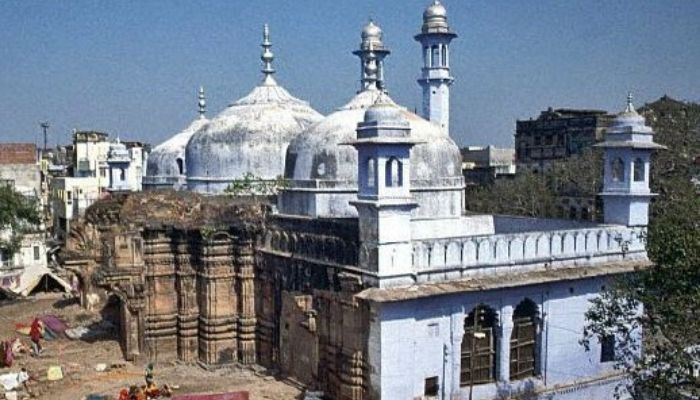
A Hindu organisation, Vishwa Bhadra Pujari Purohit Mahasangh, has reportedly moved the Supreme Court of India challenging Section 4 of the Places of Worship (Special Provisions) Act, 1991 that calls for maintaining status quo of all places of worship, except the Ram Mandir at Ayodhya. They claim that the said law is a hindrance in the path of legally reclaiming disputed religious structures, such as Kashi and Mathura.
Section 4(1) of the Act states, “It is hereby declared that the religious character of a place of worship existing on the 15th day of August 1947 shall continue to be the same as it existed on that day.” As such, no mosque can be converted into a temple and vice-versa. The Public Interest Litigation (PIL) filed by the Hindu body has sought for declaring the contentious section of the Act as ultra vires and unconstitutional. The move may open the legal route to reclaim disputed religious sites other than the Ram Mandir.
“The impugned Act has barred the right and remedy against encroachment made on the religious property of Hindus exercising might of power by followers of another faith,” the petition said. The Hindu organisation argued that the said provisions of the Act prevented aggrieved parties from resolving their grievances through civil suits or invoking High Court’s jurisdiction under Article 226 of the Indian Constitution.
Prevents Judicial Remedy
The petition stated that the contentious Act prevented the restoration of the religious character of the Hindu religious structures that have been encroached upon by ‘followers of other Faith’, prior to August 15, 1947. The Hindu body argued that the Parliament had acted in an unconstitutional manner by making an ‘impugned provision’ and as such had ceased the resolution of disputes through court proceedings.
The petition argued that the Parliament had ‘transgressed’ its power of making laws by barring judicial remedy, a basic tenant of the Constitution. The Hindu body further stated that under Article 32 (Remedies for enforcement of rights) and Article 226 (Empowers the High Courts to issue directions), the Parliament cannot take the power of aggrieved citizens to approach appellate Courts and Courts of the first instance.
Cannot make laws with retrospective effect
Seeking restoration of all proceedings abated due to Section 4 of the Places of Worship Act, the Hindu body stated that devotees have their Right to Religion guaranteed under Article 25 of the Constitution. It reiterated that the Parliament cannot stop devotees from getting the custody of their religious sites through the Court of law. The Parliament cannot restrain Hindu devotees to get back their religious places of worship through the judicial process and cannot make any law which takes away or abridges the vested religious right of devotees and cannot make any law with retrospective effect,” it said.
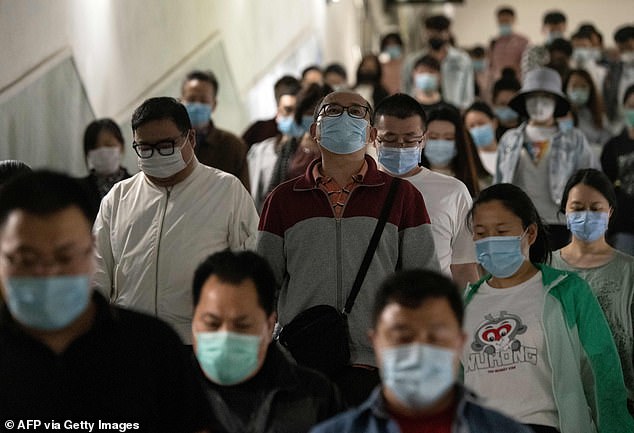
Fresh cases of coronavirus have been reported from Chinese capital Beijing this week resulting in authorities shutting six major wholesale food markets and locking down few residential blocks on Friday.
According to the reports, the fresh cases have now raised fears of a resurgence of the pandemic in the Communist country after China had claimed that it had brought domestic coronavirus infections under control.
The six new cases were reported in Beijing on Friday and another one was reported on Thursday. The new cases in Beijing comes after no new cases for nearly two months.
According to the city officials, two new cases were reported on Friday are colleagues from a meat research centre in Beijing’s Fengtai District. Both the cases had not come contacted any confirmed or suspected coronavirus carriers. They are now receiving treatment at a local hospital.
Beijing put on high alert; markets, schools closed
The local government has also locked down the residential areas where the three other patients were found. The local Xinfadi meat wholesale market and Jingshen seafood market have also been closed on Friday for disinfection and environmental sample collection after both the patients had visited the market.
Beijing’s Education Commission said on Friday it had cancelled first, second and third-graders’ planned return to school on Monday — affecting some 5,20,000 students
Meanwhile, Beijing has been put on high alert and emergency response has been readied to prevent a new spike after fresh cases were detected in the city within two days.
China’s dubious data on coronavirus cases
China, which is the epicentre of the Wuhan coronavirus from where the pandemic spread to the rest of the world, had earlier claimed that the country only saw 84,000 infections and just over 4,600 deaths from coronavirus.
However, the figures published by the Chinese government has been rejected by the rest of the world resulting in widespread scepticism over the authenticity of claims made by the Chinese establishment. Even in China, discontent among people had risen after the Communist Party of China released numbers indicating that the contagion has been brought under control.
Additionally, a database leak from a Chinese military-run university had exposed dubious claims made by China regarding the number of the affected person due to the coronavirus as the leaked data had suggested that at least 640,000 people have affected contrary to the claims of only 84,000 coronavirus infections in the country.
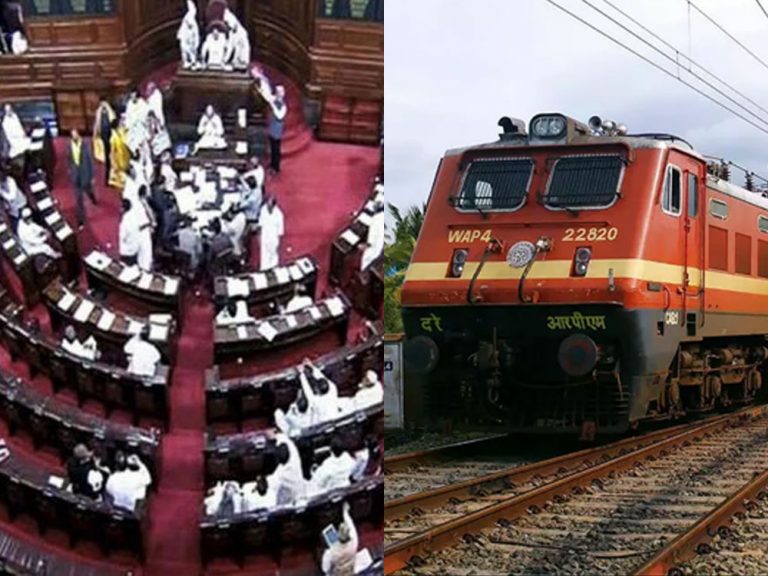
The Rajya Sabha secretariat noted in a report that a former CPI(M) Rajya Sabha member from West Bengal booked 63 train tickets in January 2019 but used only seven of them. The issue was raised in the report when the said parliamentarian sought reimbursement of all 63 tickets. The government has to pay Rs.1,69,005 for these tickets in total while the cost of tickets on which he travelled was only Rs.22,085. That makes an extra payment of Rs.1,46,920 that could have been easily avoided if the former Rajya Sabha member cancelled the tickets on time.
Travel benefits for former Parliamentarians
Former Parliamentarians get travel allowance from the government and can travel for free in the first AC coach if travelling alone. If they are with a companion, they can ask for reimbursement for an AC Tier-II ticket.
Not an isolated case
The Rajya Sabha secretariat noted in the report that this is not an isolated case. They have found several instances when former and current Members of Parliament book multiple tickets but do not use all of them. However, they do seek reimbursement for all the tickets. In another similar case, a sitting member of Rajya Sabha used on 15 per cent of the tickets booked during January 2019 but sought reimbursement for all.
Railway sent bill worth Rs.7.8 Crore
For the calendar year 2019, Railway has sent bills totalling to Rs.7.8 Crore for ticket expenses of former and sitting lawmakers. It covers one-third of the total bill amount raised for the tickets bought by former and sitting lawmakers, their companions, and their spouses. Lok Sabha will pay the remaining two-third bill.
Inquiry initiated on Vice President’s orders
When Vice President M Venkaiah Naidu came to know about the issue, he asked Rajya Sabha secretariat to initiate and inquiry. The Rajya Sabha secretariat has issued an advisory in which they asked the sitting and former members to cancel unused tickets. If they fail to cancel the tickets on time, the amount will be recovered from the lawmakers.
The coronavirus pandemic has shown no signs of a slowdown in Maharashtra as the total coronavirus cases in the state has now crossed the 1 lakh mark on Friday as the total tally stood at 1,01,141 after 3,493 fresh cases were reported.
According to the reports, with a total of over 1 lakh cases and 3,717 deaths, Maharashtra contributes one-third of the total cases in India. The capital city of the state – Mumbai alone accounts 52,667 cases and 2,044 deaths. The coronavirus cases in Dharavi, Asia’s largest slum located in Mumbai, crossed 2,000-mark.
Out of these total cases 47,793 patients have recovered till date, however, active cases are at 49,616.
The Maharashtra Police have also reported 129 new coronavirus cases taking the total number of positive cases to 3,388. So far, 36 policemen have died due to the deadly virus disease, while 1,945 Maharashtra policemen have recovered from the pandemic.
The total Coronavirus cases in the country has also crossed the 3 lakh mark. According to latest health ministry data, 3,08,993 persons have tested positive for Coronavirus so far. Among them, 1,54,330 people have recovered and 8,884 succumbed to the infection.
Maharashtra Minister tests positive
Meanwhile, Maharashtra Social Justice Minister Dhananjay Munde has tested positive for coronavirus. However, his condition is stable as he is asymptomatic.
He is the third minister in Maharashtra to contract the virus. Jitendra Awhad of the NCP and senior Congress leader Ashok Chavan had earlier tested positive earlier and both recovered from the infection.
Earlier this week, Munde had attended a state cabinet meeting and had also taken part in the NCP’s foundation day event two days ago in Mumbai.
Public Health Minister Rajesh Tope has added that social distancing was observed on both the occasions and if anyone develops symptoms, the person will be tested as per the Indian Council of Medical Research’s guidelines.
The Minister also added that Munde’s private staff including the cook, drivers and personal assistant contracted coronavirus before him.
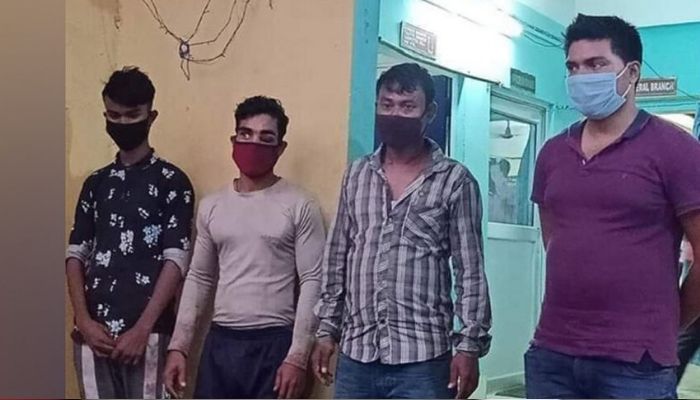
The Assam Police had reportedly arrested 5 individuals in connection to the gruesome murder of a man named Rituparna Pegu on Saturday. The incident took place in the Noonmati area of Guwahati, Assam. The victim, who was a resident of the Commerce College area, was killed during an argument over a chair. The arrested have been identified as Dulal Ali, Ibrahim Ali, Manowara Khatun, Hussain Ali and Arman Ali.
According to the Assistant Commissioner of Police, Debaraj Upadhyay, the victim was killed following an argument over a seat. Rituparna Pegu was at a shop named Armaan Home Furnishing which belonged to one Armaan Ali. The murderer, Hussain Ali, was an employee at the store. A heated argument ensued between the victim and Hussain, over a chair. Reportedly, Pegu slapped the accused who then called his family members and thrashed the victim. Hussain then stabbed Pegu with a knife from behind. The victim immediately collapsed on the roadside and died. He was rushed to the hospital but it was in vain.
Gruesome murder in Guwahati: In a shocking incident, once again one aboriginal Bhumiputra a tribal boy Rituparna Pegu was stabbed to death in broad daylight in Noomati area of Guwahati city on Friday by Arman Ali & Ali Hussain. @narendramodipic.twitter.com/QdF7IFTlge
The disturbing incident took place in broad daylight and was caught on a CCTV camera in front of the shop. The store owner, Arman, in his defence, said that he tried to pacify both sides but Hussain had already stabbed the victim with the knife. The video of the incident had gone viral on social media. In the said clip, the victim could be seen lying unconscious on the road, soaked in blood. Police officers then carried Pegu on all fours into the ambulance.
Rituparna pegu being taken to the hospital (Photo Credits: The Sentinel)
Police Action in the Rituparna Pegu murder case
On the basis of the CCTV footage, the Noonmati police had arrested Hussain along with four others, namely, Dulal Ali, Ibrahim Ali, Manowara Khatun, and Arman for the murder of Rituparna Pegu. The cops also informed that a charge sheet would be filed very soon. A case was registered under Indian Penal Code Sections (IPC) Sections 147 (rioting), 148 (rioting, armed with a deadly weapon), 149 (unlawful assembly guilty of offence committed in prosecution of common object), and 302(murder).
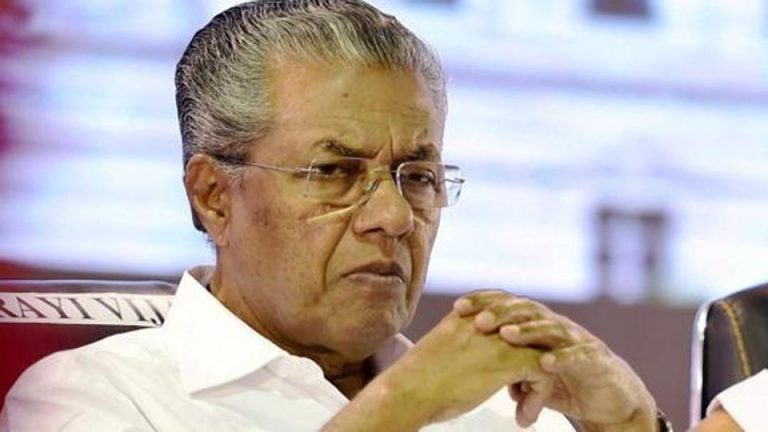
The Kerala Chief Minister Pinarayi Vijayan stoked a controversy on Friday after he, along with the CPI(M) leaders in Kerala, gave a hero’s farewell to a murder-convict party leader, PK Kunjananthan, who died on Thursday.
According to reports, Kerala CM and CPI(M) leaders gave a glowing farewell after the death of 72-year-old PK Kunjananthan, leader from Kannur district. PK Kunjananthan, who was an influential leader and also an aide of Chief Minister Pinarayi Vijayan was in 2014 convicted in a political murder case and sentenced to life imprisonment.
PK Kunjananthan, a member of CPI(M) area committee at Kannur, died of an intestinal infection at Medical College Hospital, Thiruvananthapuram, on Thursday night.
Chief Minister Pinarayi Vijayan condoled Kunjananthan’s death and hailed the deceased leader as “a comrade who had selflessly loved the party and exhibited concern towards society. As a social worker, he had won the acceptance and love of all sections of people in Panur”.
In a Facebook post, Chief Minister Pinarayi Vijayan claimed that PK Kunjananthan was a committed social worker who spent his entire life for the society. He also added that people in Panur liked Kunjananthan irrespective of the political differences.
However, the incumbent Chief Minister hailing and praising a murder accused was not received well as various social media users and also citizens criticised him for supporting a murder convict.
Not just Pinarayi Vijayan, several Communist party leaders including CPI(M) central committee members visited the hospital and shouted slogans hailing the deceased as a “martyr who will never die”.
At Panur, several CPI(M) leaders and workers paid tribute to the deceased leader and observed a hartal to pay respects for Kunjananthan.
PK Kunjanathan convicted for murder, granted parole several times
PK Kunjanathan was on bail on health grounds at the time of death. Kunjananthan, along with 11 others, was held guilty in the murder of CPI(M) rebel leader TP Chandrasekharan in 2012 in Kozhikode district. Kunjananthan who was a close associate of Pinarayi Vijayan has been serving a life sentence for conspiracy charges in the murder of TP Chandrasekharan.
In 2012, that TP Chandrasekharan, a former CPI(M) member who had quit the party over ideological differences was brutally murdered by Communist party workers. The investigation had revealed that TP Chandrasekharan was stabbed 51 times by the accused.
Later, during the investigation, the police found out that it was PK Kunjananthan who was the mastermind behind the murder of TP Chandrasekharan. The CPI(M) leader was later convicted by the court in July 2014. However, his jail term was surrounded by controversies.
Soon after the CPI(M) led the LDF back to power in 2016, Kunjananthan was granted parole frequently, which was even flagged by the Kerala High Court. On March 14 this year, he was given the parole once again Kunjananthan bail for three months for treatment. Since his conviction for six years, Kunjanathan had enjoyed more than 400 days of parole.
During his parole days, Kunjanathan had attended party events and conferences and eventually got elected to the CPI(M) area committee even after he was convicted in a murder case.
Someone has rightly said that the best way to kill a tree is by destroying its roots. Sanatan Dharma has a history of more than 5000 years. The organic form of this ancient and beautiful religion is still alive and flourishing because of the traditions that the devotees follow. From Jallikattu in Tamil Nadu to temple elephant Lakshmi, there have been countless attacks against traditions and customs of Hinduism.
The history of attacks against Hindu traditions
The court cases revolving around Jallikattu almost snatched the centuries-old tradition of Bull racing from Tamil Nadu. Similar attacks have been happening against temples in India that have elephants in their premises. PETA, which claims to raise voice for animal rights, has been trying to remove elephants from the temples since the organisation first came to India. In some cases, they succeeded using their strong international connections and ocean of money donated to them by many Indian and International organizations.
The story of temple elephant Lakshmi
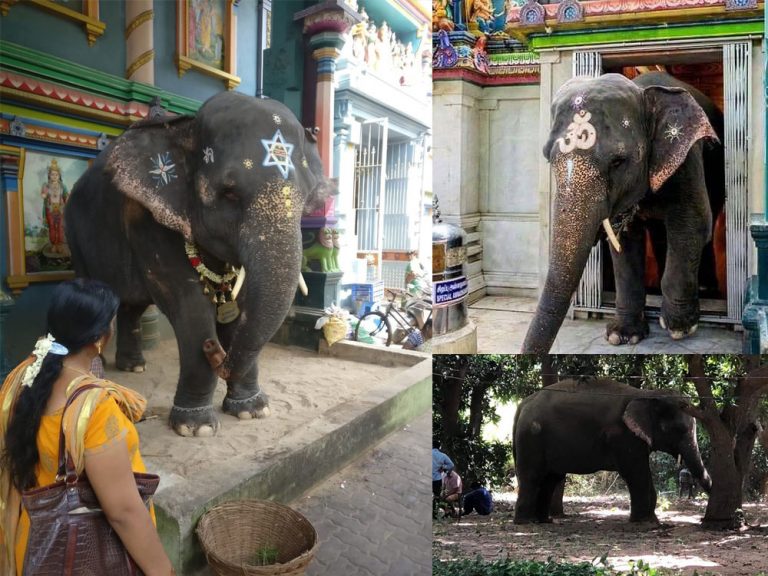
This is the story of Lakshmi, the humble elephant of Manakula Vinayagar Temple in Puducherry. Following the orders issued by the Directorate of Forests and Wildlife, she was forcibly shifted to Krishi Vigyan Kendra at Kurumamber. Animal Welfare Board and PETA raised the complaint alleging the deteriorating health condition of Lakshmi to Maneka Gandhi. She further requested Kiran Bedi and Directorate of Forests and Wildlife to remove the elephant from the temple and shift her to a ‘safer’ location.
Complaint raised by Animal Welfare Board of India
The complaint and coverage in MSM put all the blame on temple administration, stating that the temple has repeatedly abused and violated the Prevention of Cruelty to Animals and the Wildlife Protection Act, 1972. Also, there are some rules set by the Government of Tamil Nadu under Tamil Nadu Captive Elephants (Management and Maintenance) Rules, 2011 that every owner of an elephant has to follow. The complaint alleged the temple did not follow that many rules and regulations under the said act in case of Lakshmi that had an adverse effect on her health.
Temple’s side goes unheard
However, when OpIndia reached out to the devotees and activists from the temple side, the case looked a lot different. We approached Mr Subrat Goswami from Gurugram, who is trying to bring Lakshmi back to the temple. He said that temple adopted Lakshmi after she was abandoned by her herd in 1997. She was living in the temple premises ever since. After they received a complaint from the Directorate of Forests and Wildlife to furnish all the details of Lakshmi’s wellbeing, the temple administration provided all documents except the blood test report that was still pending.
Orders issued by Directorate of Forests and Wildlife
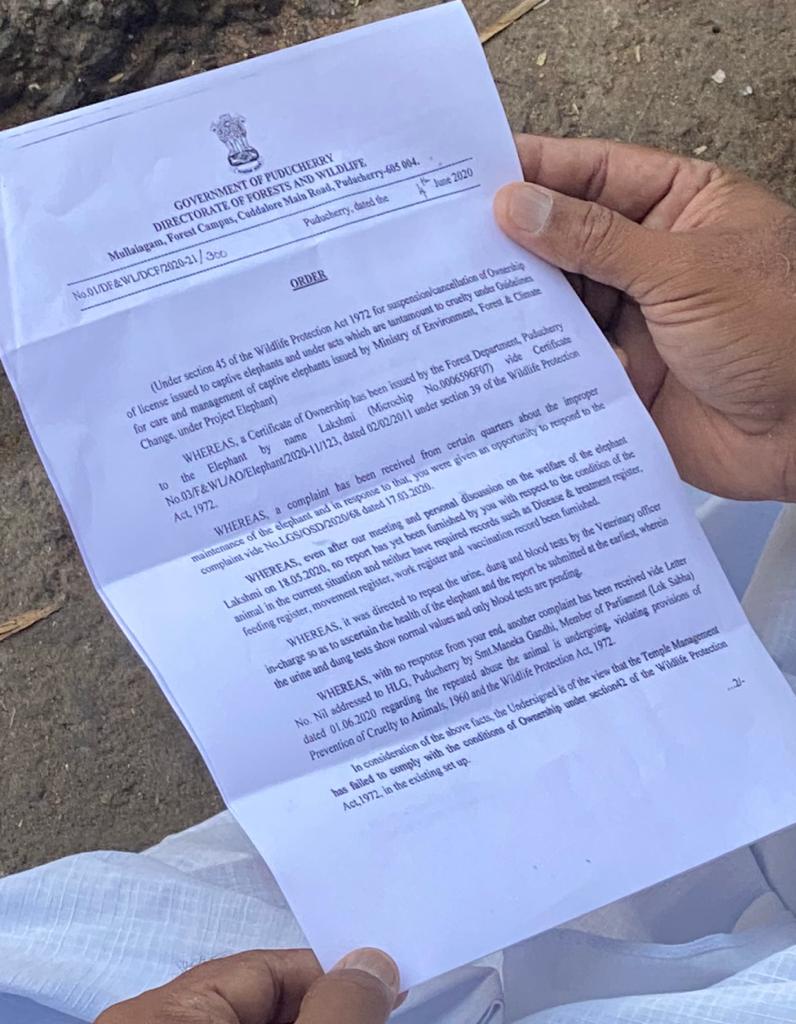
The pressure from PETA continued while waiting for the blood reports and the Forest department passed the orders to remove Lakshmi from the temple premises on 4th June 2020. In the orders, the department alleged that temple had not furnished any documents or details about Lakshmi’s health. They also alleged that the temple failed to provide records such as disease and treatment register, movement and work register, and vaccination to the department. When the devotees came to know about the orders, BJP workers and Hindu Munnani activists organized protests at the Vedapureeswarar temple. Forest officials came back empty-handed that day, but they executed the orders on 8th June with the police’s help.
A similar case of Kanchi temple elephants
This is not the first time PETA and anti-Hindu forces have tried to remove elephants from temples in India. A similar case took place in 2016 when forest officials removed three elephants from Kanchi Mutt. The administration decided to use deadly force against the innocent animals when they refused to go with the forest officials without a fight, resulting in severe injuries. As per the reports, Sandhya, one of the elephants, was profusely bleeding, and there were deep injuries on all three elephants after being loaded in the trucks. After a lengthy legal battle, the mutt got the elephants back, but the whole fiasco left a scar on the temple administration as animal rights activists hounded them for years.
The nexus against Hinduism
During the conversation with Satya, from Indu Makkal Katchi and Murlidharan S, freelance animal rights activists, some unsettling details came to light. They alleged that there is a nexus of so-called animal rights groups, missionaries and high-profile individuals operating in India that is trying to destroy the very fabric of Hinduism. They not only file false claims against Hindu temple administrations that keep animals but also take them away using several loopholes in the legal system. They then allegedly starve these “rescued” elephants and use their photos and videos to misguide people from around the world about Indian temples. These organizations receive millions of dollars in donations to “save the elephants” from “cruel Hindu temples.”
The devotees and Hindu animal rights activists have come forward to help the temples in maintaining the good health of the animals. The bond between the devotees and elephants like Lakshmi is unbreakable and it is visible on social media via posts on the hashtag #GiveOurLakshmiBack.
On Friday, online portal Scroll published an article claiming that the Indian Railways is charging more for the Shramik Special trains, and not providing any subsidy as claimed by the government. In the report titled “Far from subsidising Shramik trains, Modi government is actually charging extra for them”, Scroll claimed the amount charged by the Railways for the Shramik Special trains is more than the regular fare on the same routes.
Screenshot of the Scroll article
They also claimed that the govt’s assertation that 85% subsidy is provided on the trains can’t be proved as this figure has not been audited, and it is unclear for which base fare this subsidy has been calculated. The Scroll further claimed that a large number of Shramik trains also reached their destinations late.
But the claims made by the Scroll article are completely misleading, and they don’t reflect the fact on the ground.
Charging of Shramik Special Trains:
The ‘Shramik Specials’ are run with second class coaches with provision of separate berth for all the passengers. The services provided in ‘Shramik Specials’ are free food and water, additional rake maintenances required in wake of mandatory specialized disinfecting of the trains, special deployment of security staff, medical arrangements on need basis etc. Due to special run, there is unidirectional demand and the trains are running empty in the return direction i.e., in ‘lock & key’ condition. No separate charges like catering etc. have been taken from passengers.
The states were required to register the ‘Shramiks’ and other stranded persons and buy the tickets from railways to specified destinations and distribute the tickets to the passengers. Accordingly, the state governments were submitting fare to Railways. Nominal fare for the Shramik trains was finalized with a view to prevent unlimited and unrealistic demand generation and help genuine stranded migrants. Involvement of state governments through SOP (Standard operating procedure) was necessary to identify genuine beneficiaries and their transportation to stations from the shelters, maintain law and order and prevent stampede like situation etc. at stations, screening of passengers besides following the State wise Health protocols related to COVID-19 as the special trains are running on the request of the state government.
Indian railway on an average gives 43% subsidy on the fare. In the case of Shramik Special trains, they are being run on demand of states. As per the existing provisions, the ‘Train on Demand’ are run on FTR (Full Tariff Rate) basis due to additional operational inputs going into running of such trains. Though ‘Shramik Special’ are also ‘Trains on Demand’ with added customized inputs, as a conscious decision the Full Tariff Rate fare is not being charged as the ‘Shramik Special’ are for facilitation of ‘distressed’ persons stranded in different places after having started from their places of work before the lockdown. The fare/ passenger for normal Sleeper class trains is very less as compared to fare / passenger of FTR trains. On adding the subsidy factor, catering charges and other charges like detention charge, rake sanitizing charge etc., the percentage proportion of fare for Shramik Special trains running on sleeper class mail express fare and FTR train fare, further diminishes.
The Scroll article mentioned that Indian Railways charged Rs 13 Lakhs as fare for carrying 1200 Passengers from Thiruvanatapuram (Kerala) to Ambikapur (Chattisgarh) which comes out to be Rs 1,083 per passenger. However as per information received from sources in the concerned zonal Railways i.e Southern Railway, a Shramik special train no 06184 was run from Thiruvanatapuram to Ambikapur (2687 km) on 24.05.2020 with total of 1265 passengers. The total fare collected for this train was Rs 11.51 Lakhs, which comes to be Rs 910 per passenger, and this is the normal fare. The facts pertaining to total fare, per person fare and number of passengers as mentioned in the said news article are factually not correct and misplaced.
In the other examples mentioned in the article, the complete details like train number, originating date etc is not mentioned and hence the veracity of the facts can’t be verified.
‘Shramik Specials’ operations—Diversion of trains
The Scroll article also questioned the diversion took by many Shramik Special trains, which does not match with regular trains, and claimed that such diversions have no logic. But that is also not true, because they are not regular trains as the ‘Shramik Specials’ were arranged as “trains on demand” based on the demands placed by state governments in order to facilitate rapid transportation of migrant workers and other stranded persons. There are several challenges relating to these operations, which are not there with regular trains operations. Some of such challenges are:
Non-feasibility of pre-specified timetable as the trains are based on dynamic demand and departure time as per the convenience of the sending State Governments
Crew and rakes to be arranged on a case to case basis (regular trains have pre-defined links).
Platform berthing and maintenance schedules to be arranged for each train after demand is received from states.
Arranging rakes for transportation with a short notice of few hours.
No restriction placed on the states in respect of originating points and destination points as also the number of trains to be operated.
Specified pre-boarding health screening protocol to be followed.
Arrangement of food and water for passengers despite the closure of all catering facilities due to lockdown.
No overcrowding to be allowed in stations and platforms in view of social distancing norms and health protocols.
Despite the challenges, Indian Railways has fully met the demand placed by State Governments. So far, Indian Railways has operated 4393 specials and has transported 59.64 lakh migrant workers.
The ‘Shramik Specials’ operations began on 1st May 2020. National Executive Committee in its order dated 1st May 2020, allowed the movement of stranded persons by trains. Accordingly, Ministry of Railways had drawn up comprehensive guidelines on 2nd May 2020 for the States / UTs and Zonal Railways, clearly delineating the responsibilities of each agency to facilitate easy coordination and smooth operations.
In order to enable state governments to transport the migrants faster, the SOP was amended from 19th May 2020, removing the need for consent of the receiving state. Indian Railways also allowed multiple pick up and set down points in sending and receiving States to accommodate the request of the States
Congestion during 20th to 24th May, 2020
A lot of media attention had gone to delays suffered by the trains during the period 20th May to 24th May, which found a mention in the Scroll article also. Although Railways has already clarified that trains were diverted due to the congestion on few selected routes as too many trains were running on the same routes, Scroll claims that the logic is untenable because there is far less congestion now than pre lockdown.
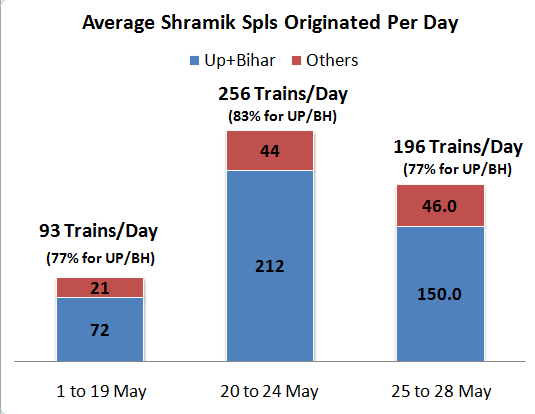
But the fact is that, this was a peak period of Shramik trains, and during this period the average number of trains went up from 93 (72 trains bound for UP & Bihar) per day (May 1-19, 2020) to 256 trains (212 trains bound for UP and Bihar) per day (May 20-24, 2020). Most of these trains originated from Gujarat, Maharashtra and Punjab.
Most of these trains were notified within a 10-hour window (14 hours to 24 hours) and had late starts creating bunching and congestion in the section. Further, most of these trains to UP and Bihar headed to few terminals like Gorakhpur, Jaunpur, Varanasi, Lucknow, Katihar, Purnea and Danapur. Also, State Governments faced a major challenge in arranging buses, police and health workers as well as sanitation/quarantine facility at these terminals to observe health protocols. On average, each train took about 2 hours to clear from the platform to make room for the subsequent train creating a cascading shadow of waiting trains over the routes leading to these terminals.
Moreover, the goods trains were never suspended during the lockdown, so the claim that congestion should be less is not correct, Railways indeed faced huge congestion in few select routes during that period.
Concentration of trains from Gujarat and Maharashtra towards UP and Bihar
As may be seen from the graph below, nearly 83% of the trains were bound for UP and Bihar:-
Congestion of Shramik Special trains
As a result of the concentration of the trains on one route, due to above reasons, some trains were stalled on the tracks for hours between Khandwa- Jabalpur- Manikpur- Prayagraj- Deendayal Upadhyay sections and Jhansi- Kanpur- Lucknow sections. Further trains could be moved only after ensuring decongestion of the route. To save the passengers from getting stuck in stationary trains in scorching heat, trains were diverted to alternative non-congested routes rather than wait for the congestion to ease which would have taken at least 12-18 hours. Accordingly, some trains were diverted to facilitate faster transit and create staggered arrival at congested destinations.
To ease the congestion on the Nandgaon-Khandwa section, trains which were detained South of Bhusaval and were headed towards Bihar and eastern UP were planned for diversion via Nagpur to SECR. The train from Vasai Road to Gorakhpur was among those diverted trains. This was done with a view to ease the gridlock and to facilitate further movement of trains. It may be noted that on 22nd May 2020, during the peak period both the Itarsi- Jhansi- Kampur- Allahabad route and the Itarsi- Jabalpur – Allahabad route were congested. Therefore, a quick decision was taken to divert towards Bihar and eastern UP were planned for diversion via Nagpur and Jharsaguda. The said train from Vasai Road to Gorakhpur mentioned in the Scroll article reached its destination in two and a half days, despite the planned diversion.
Route wise diversion of trains:
Route
Trains Diverted
Via Palwal-Ghaziabad-Moradabad
23
Via Rewari-Ghaziabad-Moradabad
04
ViaNagpur-Jharsuguda-Tata-Gomoh- Dhanbad
37
Via Katni-Singrauli
07
Total
71
Destination States of diverted trains: Bihar-51, Uttar Pradesh-16, Jharkhand-2, Assam-1, Manipur-1
It is important to note that the diverted trains constitute only 1.6% of the total Shramik Specials Operated.
Catering arrangement for diverted trains
Despite the diversion being sudden and eateries/catering contractors closed due to lockdown, there were very few instances of delay in arranging food and water reported on these trains, according to Railway ministry sources. Quick action was taken in coordination with local authorities and food and water supplies were maintained in these 71 trains also.
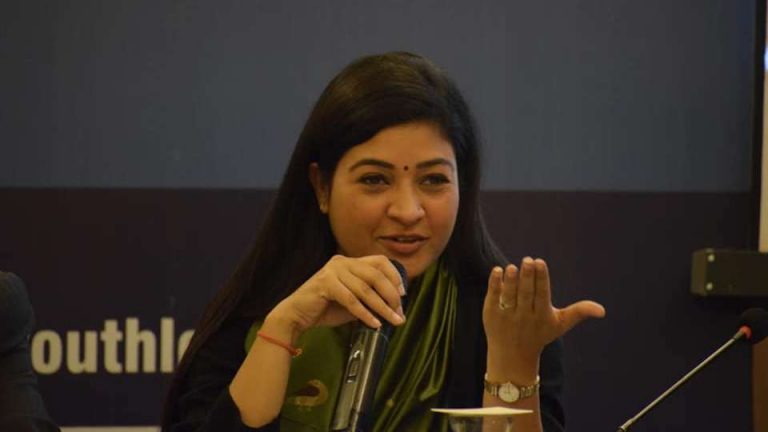
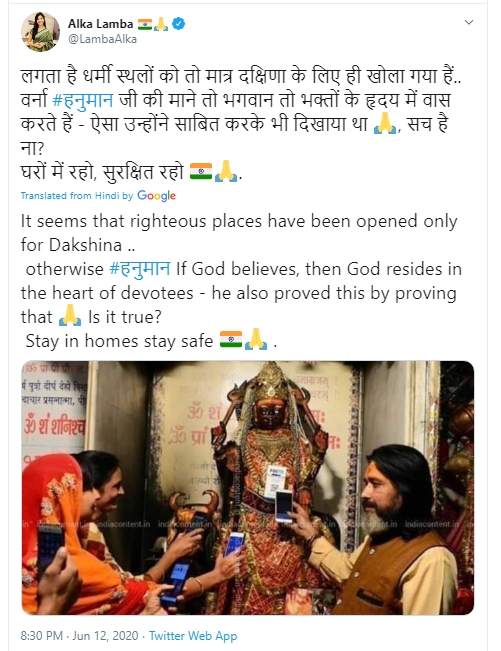
Former Aam Aadmi Party member who had recently returned to Congress, Alka Lamba today shared an image on her official Twitter account to allege that temples were opened after the lockdown for receiving donations from the devotees.
Ms Lamba shared a picture of a Hindu temple where the devotees are seen using their mobiles to donate money digitally to the temple.
“It seems that religious places have been opened only for receiving Dakshina (donations). If Lord Hanuman is to be believed, God resides in one’s heart which he had proved it. Stay in homes stay safe,” the English translation of Alka Lamba’s tweet read.
Truth about Alka Lamba’s shared photo
Casting aspersions on the Hindu temples, Ms Lamba, through the image shared by her on her official Twitter account alleged that the temples have opened for the sole purpose of seeking donations. However, the image attached by Ms Lamba in her tweet was not a recent picture but a four-year-old picture from 2016. Moreover, it is a stock image available for purchase online. Ms Lamba used this 4-year-old picture to besmirch the Hindu temples as rapacious centres that have opened following the lockdown to fill up their coffers. The image used by the Congress leader itself has the familiar copyright protection watermark indicating that the image has been taken from a stock image site.
As can be seen from the above image, the picture was from 2016 where people were seen using PayTM to send donations at Shani temple in Shashtri Nagar in Jodhpur. However, Ms Lamba did not care to verify the origins of the image and went ahead to defame the Hindu temples by claiming that as India entered into ‘Unlock-1’ phase when certain restrictions were being lifted by the authorities, temples were busy collecting donations.
Following multiple rounds of lockdown that ended on May 31, the central government ordered a calibrated re-opening of the country starting June 1 with specific set of guidelines about dos and don’t for the people. By June 8, the country had already completed all three phases including the re-opening of offices, malls, restaurants and religious spots based on the assessment by local law enforcement officials.
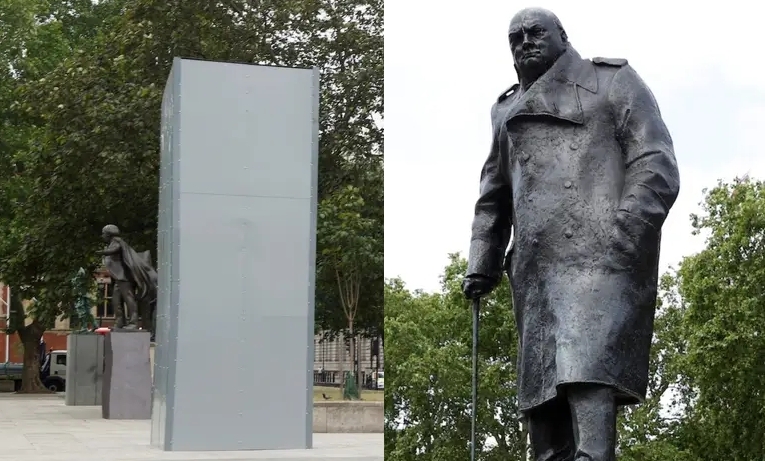
Several statues of prominent personalities in London are being covered in boards and steel bars after the demand for removal of them grows from anti-racism protesters. After the Black Lives Matters protesters demolished statues of Christopher Columbus in USA during the ongoing protests after the killing of African American George Floyd by a white police officer, the BLM protesters in UK are trying the demolish statues of persons they allege of being racist and fascists.
The bronze statue of Mahatma Gandhi which is erected in the London square is being covered and boarded amid the Black Lives Matter protests which erupted after the death of George Floyd in police custody.
As per reports of The News, the anti-racism protestors have demanded the British government to remove statues of Mahatma Gandhi from two prominent places in London and Leicester. The anti-racism protests following the killing of George Floyd in the USA in are gaining pace worldwide and have been successful in dismantling statues of many popular figures, most of them revered by millions.
The protestors smeared ‘racist’ on Gandhi’s pedestal
The demand for the removal of statues of Mahatma Gandhi has emerged amid the removal of controversial monuments and statues which are claimed to be a ‘racist’ in actual life. Gandhi is being seen as a ‘racist’ who allegedly had a hatred for the black people.
Reportedly, in the last week during protests in the UK, the BLM protesters vandalized Mahatma Gandhi’s statue standing in Parliament Square, London. The protestors smeared with ‘racist’ on the pedestal and threw white paint on the burnished bronze.
The Word ‘racist’ on the pedestal of Gandhi’s statue triggered reactions from netizens on social media. A petition in favour of the city’s statue was filed by the Labor party MP Claudia Webbe from East Leicester. She said, “Gandhi has shown us that organized peaceful resistance can be a force for change.”
Apart From Gandhi, Mandela and Churchill’s statue are under threat
Apart from Mahatma Gandhi, Winston Churchill’s statue and Nelson Mandela’s statue are also under threat of being targeted by the anti-racism protests. As a result, those statues are also being boxed to protect them from vandals. Similarly, the Centopath, the war memorial in London, also has been covered for protection.
Taking to twitter, UK Prime Minister Boris Johnson wrote, “The statue of Winston Churchill in Parliament Square is a permanent reminder of his achievement in saving this country- and the whole of Europe- from a fascist and racist tyranny.”
The statue of Winston Churchill in Parliament Square is a permanent reminder of his achievement in saving this country – and the whole of Europe – from a fascist and racist tyranny. 1/8
— Boris Johnson #StayAlert (@BorisJohnson) June 12, 2020
He further added, “It is absurd and shameful that this national monument should today be at risk of attack by violent protestors. Yes, he sometimes expressed opinions that were and are unacceptable to us today, but he was a hero and deserves his memorial.”
He further added that we all understand the legitimate feelings of outrage at what happened in Minnesota and the legitimate desire to protest against discrimination.
To anyone planning to join #BlackLivesMatter protests over the coming days: for you and your families safety, please stay at home and find a safe way to make your voice heard.
To the extreme far-right groups hijacking this crucial cause: Londoners have no time for your hatred. pic.twitter.com/JXs3iwNpUc
London Mayor Sadiq Khan also urged the people to London to maintain distance from participating in protests. He issued statements targeting the Far-right group accusing them of fuming violence. He posted on twitter. He stated, “I’m extremely concerned that further protests in Central London not only risk spreading Covid-19, but also could lead to disorder, Vandalism, and violence. Extreme far-right groups who advocate hatred and division are planning counter-protests which means the risks of the disorder are high.”