Home Blog Page 5381

Yogendra Yadav’s 7-point action plan to revive economy post coronavirus pandemic has more twists and turns than an Abbas-Mustan movie

Multi-talented Yogendra Yadav’s 7-point action plan to revive the economy after the Chinese coronavirus pandemic is nothing short of a Bollywood potboiler. When the plan was unveiled on Friday evening, most people, including some of the people who had endorsed the action plan which even 14-year-olds could’ve written, were appalled. Hours after it started getting public backlash, Ramachandra Guha distanced himself from the so-called ‘action plan’ claiming he never agreed to it to begin with.

“All resources (cash, real estate, property, bonds, etc) with the citizens or within the nation must be treated as national resources available during the crisis,” the document stated, which drew a lot of flak, with people calling it authoritarian.

The ‘Historian’ Ramachandra Guha, wearing his ‘economist’ hat had signed the document. However, following the outrage, Guha chickened out initially to say that he did not approve the final contents of the document, creating more confusion over the real intention behind such intellectual dishonesty.

Ramchandra Guha took to Twitter to announce that the clause that was presented to him during the discussion and the clause that was finally printed were vastly different, referring to clause 7.1.

Guha further said that this version did not have the approval of many signatories and has a “taken the attention away from the many sensible suggestions made in the Statement”.

Following his rejection of the original content, social media users began to mock the intellectual dishonesty of the ‘historian’, leading Guha to delete his series of tweets all together.

Ashutosh Varshney does ‘social distancing’ with Yogendra Yadav’s idea of nationalising private properties

Another intellectual Professor Ashutosh Varshney, echoing similar sentiments as Ramachandra Guha, took to Twitter to make a flip-flop over his earlier endorsement to the draconian idea nationalising private property.

As celebrated leftist trolls, journalists raised apprehensions about his endorsement to nationalising private properties in the country, Varshney brought in his academic rhetoric to clarify that the original idea presented to him was different to the one which was released in the public and indirectly rejected making any endorsement to the idea of snatching resources from the public.

Prof Varshney distancing himself.

Varshney responding to tweet by Journalist Shekhar Gupta said that “the writers of the statement are returning to the original draft.”

Another flip flop by Varshney and Ramchandra Guha

After facing severe wrath from the public for coming up with so-called ‘action plan’, Yogendra Yadav came up with a new ‘reformulated’ version of the original document.

Taking to Twitter, Yogendra Yadav said that “Pt 7.1 has attracted undue attention & interpreted to mean a call for nationalisation/expropriation of private property. This was far from our intention.”

He added that now, the clause has been reformulated to state, “The government must explore emergency ways of raising resources going beyond the usual set of taxes and levies to cope with the problem of funding large relief packages”

Guha, who had earlier, distanced himself from the clause in the plan, said that the new point in the statement is now appropriate and that the controversy over this should be put at rest. Interestingly, Guha who had deleted his earlier tweet, jumped back into the scene to indirectly push the same idea, but with a different tone and tenor.

“The new pt 7.1 in the Mission Jai Hind Statement is extremely appropriate and all controversy should now be set at rest. I trust that fellow citizens shall focus on the many important recommendations in our plan and will urge Central and State Governments to implement it,” he said.

Guha approves of new and improved version

Intellectual Varshney, who had earlier rejected of endorsing the plan, returned back with much vigour to make a u-turn and claim that raising revenue to address mass suffering is the basic issue and the idea was not to expropriate. He too endorsed the new clause, which more or less endorsed the original idea of snatching away the hard-earned wealth of common masses, but now with a different approach.

Varshney also approves

The controversial ‘seven-point action plan’ was endorsed by ‘intellectuals’ like Abhijit Sen, Yogendra Yadav, Ramchandra Guha, Deepak Nayyar, Harsh Mander, Ashutosh Varshney, Bezwada Wilson and Amit Basole among others.

With Prof Varshney and Ram Guha on the same page as Yadav, we look forward to other signees to wake up and let us know about the latest twist.

21st Century belongs to Atmanirbhar Bharat: The new reforms will gear us to enter phase two of the rise of Indian economy after 1991 liberalization

An optimist would say every cloud has a silver lining. On May 12 at 8 PM, when Prime Minister Shri Narendra Modi addressed the nation, he had a similar approach and message for the citizens. The world is enduring the biggest catastrophe in a hundred years. COVID 19 is a new reality, a harsh truth that is slowly becoming a part of our everyday lives.

Successive lockdowns since March have wreaked havoc on the economic activity and the GDP of the country. The United Nations slashed India’s economic growth projection for the current year to 1.2 per cent, which still is second highest among major world economies.

The Prime Minister’s office and his Cabinet Ministers have been engaged in constant brainstorming with stakeholders and experts to lay a foundation for the new economic trajectory and came out with an ambitious plan of self-reliance: The Atmanirbhar Bharat Abhiyaan.

The messaging projected a need for localism and promotion of Make in India, launched in the year 2014 right after the BJP government took control. It’s an indicator for China, by first putting roadblocks to Chinese investments in the form of new FDI policy route and now this push for indigenous production to invite other prospective companies eager to shift base out China, which deceived the world by concealing the severity of the Virus back in December and also arrested the whistle-blower late Dr Li Wenliang who first intimated about the novel Corona Virus on a Chinese Social media platform.

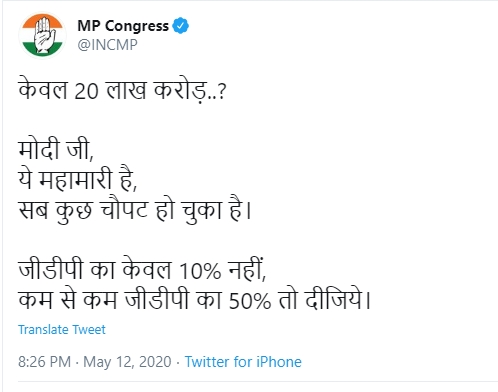
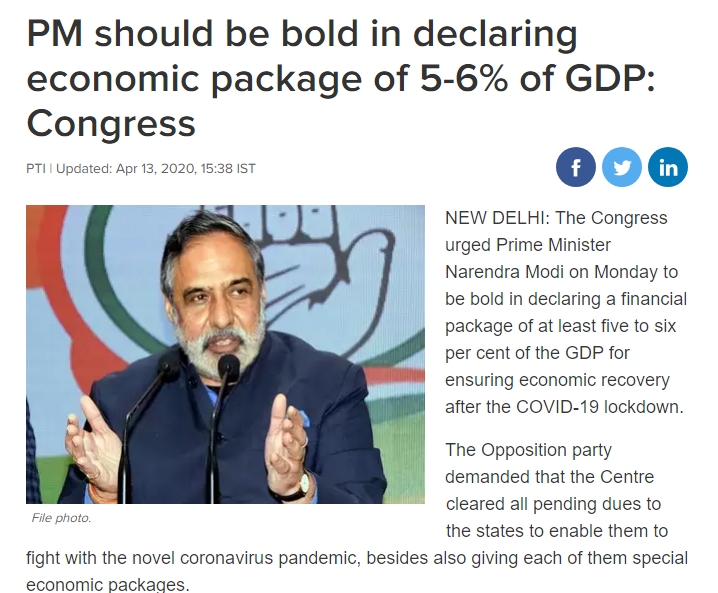
For this self-reliance, the PM announced a historic stimulus package of INR 20 Lakh Crores amounting to almost 10 per cent of the GDP. The figure sounds like music to ears, especially for experts who demanded stimulus support of at least 5 to 6 per cent of the GDP. Though a few questions remain unanswered as to the source of this number and fiscal deficit balancing.

Majority of the economies worldwide are feeling the heat of the Corona Pandemic and have announced various support packages for their citizens. Japan’s COVID support amounts to 21.1 per cent of the GDP, The US gave support of 13 per cent, Germany gave 10.7 per cent, France 9.3 per cent, Italy 5.7 per cent, the UK gave 5 per cent and China, which was the home to Wuhan Virus gave only 3.8 per cent support.

The Finance Minister took the baton in her hand and on May 13, began series of her press conferences, laying the groundwork for the ambitious plan relying on five main pillars, i.e. Economy, Infrastructure, Tech-driven System, Demography and Demand. Apart from the new announcements, there is a slew of measures that the government took during the lockdown period to build the foundation for this Atmanirbhar Bharat.

There are about 63 million Micro, Small and Medium Enterprises ( MSME’s), which supposedly are the backbone of Indian economy contributing to 29 per cent of the GDP and will be major players in the Atmanirbhar Abhiyaan. They were a prime focus of the Finance Minister’s announcement, which dedicated six major steps for the same. The big one being, INR 3 lakh crores collateral-free government-backed automatic loans for businesses/SMEs, liquidity infusion of INR 50 thousand crores via funds of the fund, size definition liberalization and Global tender disallowance for govt projects of up to Rs 200 Crores, which in turn pushes Make in India. These efforts apart from addressing the investment and functionality issue would foster jobs and add to the pillar of infrastructure and demand.

Some major announcements were also made for the Employee Provident Funds, TDS and TCS cuts, Discoms, realty sector etc. Though widely extolled, they also met with criticism of not addressing the real problem of the downtrodden and the majorly affected migrant workers and small farmers.

Without giving much room for criticism, The Finance Minister reached Press Information Bureau within 24 hours with a support package for street vendors, migrants, small farmers and the middle class.

The second booster was no less powerful with revolutionary ideas in the form of technology-driven ‘One Nation One Ration Card’, addressing silos, leakages and food avail crisis. Affordable rental PPP mode housing was a sixer and so was the idea to support 50 lakh street vendors by credit facilities with an infusion of liquidity worth INR 50 thousand crores. Ground reports post these announcements showed a fall in the number of migrants walking back home.

The labour code modification is a step in the right direction to formalise the workforce, avert the job crisis and boost confidence. Special attention has been given to the right to health and women safety in these measures. Indian policy- making has been bereft of understanding women issues and adequate attention was missing. This pertinent announcement of making arrangements for night shifts with safety will address this missing piece of the puzzle.  

Liquidity support to farmers and rural economy post-COVID, like 63 lakh loans worth INR 86,600 crores approved show that the government is willing to strengthen every sector of the country to move towards self- resilience. Some claimed this idea to be old wine in a new bottle and fears of protectionism were raised. The right approach would be a mixed concoction of both pushing local production and enabling foreign investments to make the products in India. Demand will depend on the quality and viability as consumers have experience of world- class imported products and will not settle for anything less.

Some of these measures received an overwhelming response from industry experts, stakeholders and key players. They welcomed these decisions and are hopeful for a U-turn shift for the economic activity and regard them as a cornerstone for the self-reliance aim. Apart from pushing local production, it would enthuse the entrepreneurial zeal of local producers and service providers. In a time when pessimism is at a peak, such cushion support is the holy grail for reviving spirits and achieving aims. After 1991 liberalization reforms, if implemented well, these big bang reforms will gear us to enter phase two of the rise of the Indian economy.

The key lies with implementation, message percolation, system reformation and checks and balances. The ball is in the court of state players and administrative actors to take the baton from the hands of the cabinet and run successfully with the support of 1.3 billion citizens to the end goal of ‘The Atmanirbhar Bharat’.

Author: Sanya Dhillon, Public Policy and Political Communications professional

Bengal BJP President Dilip Ghosh stopped from visiting cyclone-hit areas, police claims he did not have permission

West Bengal BJP President and MP Dilip Ghosh on Saturday took to Twitter to say that he was not allowed to visit the cyclone-hit areas of the South 24 Parganas districts. Ghosh was on his way to Canning and Basanti, two of the villages worst afflicted by the menace of cyclone Amphan, to distribute relief materials for the victims. His car was stopped by the police at the Dhalai bridge near Garia area of the district.

“I don’t know why they have stopped me from carrying out the relief work in the region. The police doesn’t seem to stop the TMC leaders who are freely moving around and distributing relief materials to the cyclone-hit people of the villages,” Ghosh said.

Ghosh also threatened to organise a sit-in vigil if he was not allowed to carry out the relief work in the cyclone affected areas of West Bengal. “If the state government wants to pursue relief politics, they should get ready for a befitting reply from our workers,” he said.

Minor clashes broke out between the police and BJP workers accompanying Ghosh for the relief work. Police personnel were reportedly pushed by the saffron-clad BJP workers to pave the way for the Bengal President’s vehicle to move forward.

The police, on the other hand, stated that the West Bengal BJP President was stopped from carrying out relief activities in the cyclone-hit regions because he was not having the requisite permissions required to as per lockdown and disaster management rules.

Kolkata Mayor and State Minister Firhad Hakim accused the state BJP of doing politics over the distribution of relief materials.

The stonewalling of political opponents from carrying out the relief activities at the times of adversity demonstrates that the Mamata Banerjee-led TMC government in Bengal does not want its political rivals to win any kind of support from the people whom it had miserably failed in providing protection and security from the ravages of the cyclone.

Mamata Banerjee lied about PM Modi’s advance assistance to West Bengal

Yesterday, the West Bengal chief minister West Bengal unabashedly lied about PM Modi’s announcement of advance assistance package of Rs 1000 crore for the state to tide over the damages caused by cyclone Amphan. After surveying the cyclone-affected regions of West Bengal, PM Modi, in a video message, clearly and distinctly announced that he will be extending advance assistance of Rs 1000 crore to West Bengal. Mamata Banerjee was a short distance away from PM Modi when he declared the financial aid to the state.

However, subsequently, while talking to the press, Mamata Banerjee, in a bid to understate the centre’s help to the state, claimed that there was no clarity on the financial aid provided by PM Modi and she was not sure whether its an advance assistance or relief package.

Mayawati blames Congress for migrant crisis, says the videos shared by the party is less empathy and more drama

Bahujan Samaj Party supremo and former Uttar Pradesh chief minister Mayawati today took to Twitter to call out Congress for its stand on the migrant crisis amid coronavirus outbreak.

Today, the migrant crisis which has arose in India amid coronavirus outbreak worsening the condition of crores of migrants is only because of Congress. Had they ensured enough employment opportunities in villages and cities for people, then they would not have to leave their states for better work opportunities. Similarly, the way Congress leaders are putting out videos trying to show empathy for the migrants in crisis looks more like a drama, she tweeted. Congress should’ve rather told us how many people it actually helped amid the lockdown. Mayawati further said that if the BJP ruled central and state government implements policies such that employment opportunities can be created in these states to make them self reliant, then such a situation may not arise in future again. Mayawati further appealed to BSP workers to help out those migrants in distress as it is only humane to do such.

Congress ‘bus’ controversy

Congress General Secretary Priyanka Gandhi had claimed that last week, the Congress had arranged for 1,000 buses for migrants but due to lack of permission from UP government, they are stuck at the border. Following that, the UP government accepted the offer and asked for details of the buses along with driver details. However, when the list was sent by Congress, many of those ‘buses’ were actually ambulances, auto rickshaws, private cars and even buses which were blacklisted over various irregularities with authorities.

Later the bus drivers who were arranged for by the Congress in Rajasthan chanted anti-Congress slogans over stale food served to them. The political slugfest turned ugly after UP government and Congress indulged in FIR war. UP Police booked Priyanka Gandhi’s adie Sandeep Singh and Congress UP chief Ajay Lallu for forgery and cheating. After that, Rajasthan Police filed a retaliatory FIR against UP Additional Chief Secretary (Home). Later on Tuesday, Lallu was arrested by Agra Police for sitting on a dharna amid coronavirus lockdown. However, Priyanka Gandhi then later recalled the buses claiming UP government was playing politics.

Congress’ Rae Bareli MLA Aditi Singh called out her party’s bluff and praised Yogi Adityanath for handling the migrant crisis in state amid coronavirus crisis. She was later suspended from Congress.

Yogendra Yadav and other intellectuals suggest taking over private property in war against Coronavirus, amend it after backlash saying they didn’t mean it

On May 22, leftist politician Yogendra Yadav had posted a statement issued by several ‘economists, intellectuals and activists’, calling for a 7-point plan of action of action to combat the situation arising out of Coronavirus outbreak. While some of the demands are already being taken care of by the government, and some are general leftist demands, one particular point in their proposal had attracted widespread criticism.

The point number 7.1 in the so-called ‘Mission Jai Hind’ had called for the government to take over all properties of private citizens and treat them as national resources. The point said, “All the resources (cash, real estate, property, bonds, etc) with the citizens or within the nation must be treated as national resources available during this crisis.”

The so-called intellectuals clearly said that govt should take over all cash, real estate, property, bonds belonging to private citizens and treat them as national resources to be used in the war against coronavirus. This is obviously a very dangerous proposal, and as expected received only few takers. Even people in the left-liberal eco-system didn’t agree to this.

After receiving wide-scale criticism, the group has now revised the point number 7.1 in their proposal. Now the point says, “The government must explore emergency ways of raising resources going beyond the usual set of taxes and levies to cope with the problem of funding large relief packages”.

This is a significant climb down for the leftists, who are usually not known to respect the views of others. But even while they changed their proposal, they didn’t leave this opportunity to peddle another lie. While posting the amended proposal, Yogendra Yadav said that the point 7.1 had attracted undue attention. He claimed that it was “interpreted to mean a call for nationalisation/expropriation of private property”, and it was ‘far from their intention’.

If it was far from their intention, then the ‘intellectuals’ write very bad English, because that is what their original proposal meant. If something is to be treated as ‘national resources available during this crisis’, it means those resources will have to be taken over by the government, either permanently or temporarily. It can’t mean anything else, and it does not convey any other message that Yogendra Yadav and his friends may be suggesting.

Even though only one suggestion attracted attention of people, it does not mean that other suggestions are very good. Even though they have modified the point number 7.1, they have retained the point number 2.2, which called for use of private infrastructure for free quarantine, and private hospitals, ICU beds and ventilators. Thereby, they are still proposing that govt should take over private hospitals and institutions for free Coronavirus treatment and quarantine.

It may be noted that coronavirus testing and treatment is already free in all government hospitals and facilities, and even in private hospitals the treatment is available for free for the poor under Ayushman Bharat scheme.

Some of their other proposals are also already being implemented. Their first proposal says bring migrants back withing 10 days without charges. The Railway ministry is already dozens of Shramik Special trains to bring migrants home, and already lakhs of migrants have already availed the services of these trains. They need not pay for travelling in the Shramik trains, as the cost is borne by the central govt and state govts. Their demand to complete this exercise is certainly not practical, as the number of people stranded in other states is huge, and it is not possible to transport such larger number of people in just 10 days. Prior to the lockdown, the number of people who work outside their states were not known. And after the special trains started, lakhs of people registered. Therefore, trains are being arranged as per the demand.

Moreover, the transport of migrants is being staggered on the request of several receiving states, as the incoming migrants need to kept in quarantine. As most migrants are returning from Coronavirus hotspots like Maharashtra, Gujarat, Rajasthan etc, they need to be kept in quarantine before they can be tested.

Their suggestion for moratorium on interest on loan payment has also been already announced. Initially RBI announced a three-month moratorium, which have been extended by another three months until 31 August.

Shiv Sena puts Hindutva on a back-burner, says Ram Mandir in Ayodhya can wait

Ever since Shiv Sena formed an unholy nexus with political rivals- NCP And Congress to form a government in Maharashtra, it has evidently shunned its core ideological moorings of Hindutva and embraced appeasement politics of its newfound allies.

Keeping in line with this, the Shiv Sena party, which was once at the forefront of getting a magnificent Ram Temple to be built at the site of Ayodhya, has now put the issue on the back-burner and claimed that the construction of Ram Temple in Ayodhya can wait.

Refusing to comment on the Shiv Ling and several pillars that were excavated in Ayodhya, Shiv Sena spokesperson Sanjay Raut stated that all issues such as “India, Pakistan, Ram Mandir” can be put on hold now.

Speaking to the Times Now, the firebrand Shiv Sena leader, who was recently relegated from the post of Saamana editor, Raut said that the country is reeling under the unprecedented crisis of coronavirus outbreak and issues such as India-Pakistan and Ram Temple can wait until the pandemic recedes.

However, political analysts viewed these statements from Shiv Sena as further abnegation of its commitment to the cause of Hindutva.

Shiv Sena accused of betraying Hindutva

Ever since Shiv Sena broke its alliance with the BJP, the latter has accused it of trading its much-revered Hindutva ideology for the position of chief ministership. Shiv Sena severed ties with its erstwhile partner after being embroiled in a dispute over the rotational chief ministerial post.

While Sena claimed that the BJP had promised to have a rotational chief minister-2.5 years each before the elections, the BJP, on the other hand, claimed that no such pact was deliberated with Shiv Sena.

With the aim of installing a Shiv Sainik as the chief minister of the state, the Uddhav Thackeray-led party snapped its ties with the BJP and formed an alliance with the ideological rivals-NCP and Congress, sacrificing its support for Hindutva on the altar of chief ministerial position.

The first signs of Shiv Sena dropping the Hindutva issue came to fore when a Common Minimum Programme(CMP) was hashed out between the allies of the Maha Vikas Aghadi government. It appeared that in their thirst for power, Shiv Sena had have given up on the Hindutva cause. In fact, there were speculations that the Congress and NCP wanted an assurance from Shiv Sena that their Hindutva agenda is going to take a back-seat once the government is formed.

After forming government with NCP and Congress, Shiv Sena has drastically toned down its demand for a Bharat Ratna for the Hindutva ideologue and Freedom Fighter Veer Savarkar, indicating that Shiv Sena no longer champions the cause of Hindutva with the same vigorous intensity it once did. Reservations up to 5 per cent for Muslims in Maharashtra was another such incident which demonstrated that Shiv Sena has abandoned the Hindutva cause.

Army Chief General Naravane visits Ladakh amid raising tensions with China along LAC

Amid rising tensions between the Indian and Chinese troops along the Line of Actual Control (LAC), the Chief of Army Staff General Manoj Mukund Naravane visited the headquarters of the 14 Corps based in Leh in the Union Territory of Ladakh on Friday.

According to the reports, the Army chief General MM Naravane visited Ladakh for a security review of the sensitive sector as tensions between India and China along the disputed Line of Actual Control has grown since last week.

The Army chief was briefed by top military field Commanders in Leh, including Northern Army Commander Lieutenant General YK Joshi and 14 Corps Chief Lieutenant General Harinder Singh.

China eyeing strategic infrastructure in North and Eastern sector

The security review by the Army Chief in the sensitive region comes a day after there were reports that China had deployed excessive troops and set up temporary tents across the Galwan river in Ladakh after a face-off near Pangong Tso on May 5-6.

It is also believed that Chinese troops have also taken up positions along the Pangong Tso Lake and are also carrying out aggressive patrols with motorboats to intimidate Indian forces in the region. Reportedly, the Chinese troops have damaged some temporary structures put up in the finger area near Pangong Tso Lake. 

Reportedly, the Chinese may be targetting Darbuk-Shyok-Daula Beg Oldi (DBO) Road that was constructed last year, which is a lifeline for Sub Sector North (SSN). However, Indian forces have successfully deterred the Chinese with aggressive mobilisation. 

Apparently, China is unhappy over the construction of a road and bridge at the Galwan area that has recently been undertaken by India for patrolling and to help the local population.

Troops clashed in Eastern sector

The Galwan stand-off comes at the backdrop of a recent incident where troops of both India and China were involved in two face-offs in a span of a week in the Eastern Ladakh and near Naku La Pass in the Sikkim sector along the contentious border between the two countries.

In the first incident, the Chinese army personnel had clashed with Indian forces along the northern bank of the Pangong Lake in eastern Ladakh on May 5. The face-off ended the next morning following dialogue between the two sides. A number of soldiers on both sides had sustained minor injuries 

Just days before, in another incident, nearly 150 Indian and Chinese military personnel had engaged in a face-off near Naku La Pass in the Sikkim sector of the Sino-India border in which at least 10 soldiers sustained injuries.

Earlier, China’s foreign ministry has accused Indian troops of trespassing across LAC and stated that China had to take “necessary countermeasures” after the Indian army allegedly obstructed normal patrols by Chinese troops.

However, India has rejected Chinese allegation that the Indian troops crossed LAC in Ladakh and Sikkim sectors and initiated tensions. Meanwhile, India had also accused the Chinese army of hindering patrols on the Indian side.

Intellectual dishonesty sorted with a little help from Shekhar Gupta: Professor Varshney endorses clause 7.1 by ‘intellectuals’, leaves door open for uturn after Shekhar Gupta intervenes

Prominent left-leaning intellectuals who evidently endorsed the controversial “7-point action plan” as claimed by the Former AAP member and current Swaraj Party leader Yogendra Yadav, have now tied themselves in a knot as the glaring loopholes and flaws are discovered in the action plan that was supposed to provide an assistance to the government to fight the ramifications of the coronavirus pandemic in the country. 

The contentious clause 7.1 which stated that all private property, which included bonds, gold, property etc ‘must be treated as a national resource’ to fight the pandemic. After one of the intellectuals, Ram Guha, distanced himself from the action plan, another liberal lodestar Professor Ashutosh Varshney, whom liberals quotes routinely to lend legitimacy to their harebrained suggestions, almost flip-flopped after endorsing the draconian expropriation of the private property mentioned in the clause.

At first, Prof Varshney endorses giving up private property to government

When one of the celebrated leftist trolls raised apprehensions about the use of “revenue” in the clause 7.1 that would provide unbridled powers to government, Varshney initially defended the tendentious clause by claiming “I understand the right to property, but what, according to you, are the rights of the migrant poor?”

Subsequently, the President of the Editors Guild of India, Shekhar Gupta, chimed in, expressing his shock over Professor Varshney’s stance and questioned him if he had read the clause carefully before endorsing it.

“Intriguing, @ProfVarshney….don’t think even Bernie Sanders & Jeremy Corbyn would go that far…Hand on your heart: did you read the statement carefully before endorsing it?” Gupta tweeted.

However, Gupta’s intervention served as a trigger for Professor Varshney to hedge his bets and remain non-committal after having endorsed the expropriation of private property by the government. Echoing Guha, Varshney, too, claimed that the clause which he signed was profoundly different than what it is now in the action plan proposed by Yogendra Yadav. 

Prof Varshey washing his hands off the ‘letter’

“You know @ShekharGupta my economic philosophy. I don’t support Sanders and Corbin. The statement presented to me had no expropriation. It was only about higher revenue-raising in a time of crisis. Unclear what happened since I signed. It is 2am in Boston.Will check when I get up,” Varshney tweeted.

Ram Guha distanced himself from “7-point action plan”

Self-proclaimed intellectual Ram Guha was one of the earliest proponents of the juvenile action plan, also withdrew his endorsement after being mocked by the netizens for his support to the controversial clause of 7.1 that allowed the government to take hold of the private properties to raise revenue in its bid to lift the country out of coronavirus induced economic inertia.

Ramchandra Guha took to Twitter to announce that the clause that was presented to him during the discussion and the clause that was finally printed were vastly different, referring to clause 7.1.

The published version of the clause was ‘radically different’ according to Ramchandra Guha. The published version of Clause 7.1 says, “All the resources (cash, real estate, property, bonds, etc) with the citizens or within the nation must be treated as national resources available during this crisis.” Guha claimed that he had not endorsed this version.

DMK Rajya Sabha MP RS Bharathi arrested under SC/ST Act for his controversial remark on appointment of Dalit judges, gets bail

Rajya Sabha MP and DMK’s organizing secretary RS Bharathi was arrested by the Chennai police from his residence in Alandur on Saturday morning. The DMK leader was arrested for his controversial remark on the appointment of Dalit high court judges. A complaint was filed against him by President of Adhi Tamilar Makkal Katchi on May 12. Following the complaint, the Teynampet police filed an FIR against the Rajya Sabha MP under section 3 of the Scheduled caste and Schedule tribe (Prevention of Atrocities) Act along with relevant sections of the IPC.

Soon after the arrest by the Central Crime Branch (CCB) of the Greater Chennai Police, RS Bharathi was released as he managed to obtain bail. He was released after Egmore Metropolitan Magistrate Court granted him interim bail till June 1. The case is scheduled to come up for further hearing on Wednesday. The case was initially registered by the Teynampet police but later it was transferred to the CCB.

The DMK leader in a party event had said that the appointment of Dalit judges in Madras High Court is the result of the alms given to them by the Dravidian movement.

“Arrested for exposing AIADMK corruption”, DMK Leader says.

RS Bharathi has alleged that he is being arrested for exposing the corruption in the ruling AIADMK government. He said, “A video clip of my speech at the party event was circulated by a specific group on social media. I spoke about it the next day to you (media). Today, after 100 days, the action is being taken against me. The reason for the sudden arrest is because yesterday evening I lodged a complaint regarding the corruption by Deputy Chief Minister O Panneerselvam with the Vigilance Commission. There is another complaint that is being prepared against the procurement of bleaching powder for coronavirus disinfection work in Coimbatore for around Rs 200 crore. Somehow they got a whiff of it and they have arrested me now. Even if I’m arrested, the complaint against Minister SP Velumani will be given.”

He alleged that police arrested hin despite being told that he’s of older age and under quarantine. He added, “I feel sorry for the policemen because they are being used to satisfy someone else. In the next few months, the same officers will come for our security and salute us. We have seen this many times and we are used to this.”

“Dalit Judges are appointed in High court are the result of the alms given by the Dravidian movement,” says RS Bharathi

In a party’s event on 15 February 2020, RS Bharathi had asserted that Dalits were appointed as High court judges because of the charity done by the Dravidian movement. He claimed that no Harijan has become a judge in High court in Madhya Pradesh. He added, “after Karunanidhi became CM of Tamilnadu, the first Dalit judge, A Vardarajan was appointed. Seven or eight others from the Adi Dravidar community went on to become judges after that. It is the alms given by the Dravidian movement.”

RS Bharathi later expressed regret for hurting sentiments of a marginalized community. He took to twitter and wrote, “I express regret for hurting the sentiments of the oppressed persons. My intention was not to hurt them, but to just highlight the good things Kalaignar (Karunanidhi) has done for them.”

Rajdeep’s obsession with ‘Gujarat model’ reflects the biggest fear of ‘liberals’ – Modi winning Delhi the same way he won Gujarat multiple times

It is said that real obsession needs an unconscious motivation behind it. Obsession, like every intense emotion, is all-consuming. It is an emotion where the world, the rest of the world, simply melts away almost become a haze. When one looks at the world, all but the object of obsession is visible. Obsession, it is said, has the foundational bases of either pure love or unadulterated hate and when it comes to Rajdeep Sardesai, one doesn’t really need to analyse too much to understand what the foundational emotion could possibly be for his mindless, passionate obsession with Modi and the Gujarat model.

Through the years, almost with surgical precision, Rajdeep Sardesai has obsessed over the ‘Gujarat model’ and now Prime Minister Narendra Modi. For any normal person, this sort of passionate obsession would stem from unbridled love. But for Rajdeep, it probably stems from chilling fear born out of passionate hate. While the world burns, Rajdeep, almost an evil avatar of Arjun in another, hateful universe, keeps his eye on the Modi shaped bullseye that he needs to hit with his poison laced arrow.

In January 2020, Rajdeep Sardesai wrote an article that spoke about the Gujarat model entering Delhi via JNU. Of course, he misses the larger point that if the VC of JNU can be called ‘Modi’s man’ then most other people who work in JNU can be called the cadre of the Maoist party.

Article by Rajdeep Sardesai in HT

Before 2020, the Gujarat Model had come to Delhi in 2018, per Rajdeep Sardesai. Same headline. Same logic. Different incident.

Rajdeep Sardesai’s article in 2018

The obsession did not stop there. Recently, even during the Coronavirus pandemic, Rajdeep Sardesai was obsessing over the Gujarat Model. He forgot to talk about the Tablighi Jamaat that spread the pandemic far and wide just as India was beginning to get a handle on the pandemic, or even Maharashtra, where the “best CM” Uddhav Thackeray let his state spiral out of control. Rajdeep was bothered about Gujarat. Not because he believes in the pursuit of truth, but because he is obsessed with his pursuit of PM Modi.

Rajdeep Sardesai’s article during the Coronavirus pandemic

He writes, in the very first paragraph, “The much-hyped Gujarat model is in a mess as the coronavirus pandemic progresses. Consider the following: One, not only does the state have among the highest number of coronavirus disease (Covid-19) cases in the country, but more worryingly, it has a mortality rate of 5.9%, which is nearly twice the national average of 3.09%”.

Rajdeep, of course, forgets that by mid-April, Maharashtra had a death rate hovering around the 7% mark while he harps on the 5.9% mortality rate in Gujarat. And while this is not a competition and journalists should be more focussed on how to fight the pandemic, Rajdeep was seen obsessing over the ‘Gujarat model’ to bring PM Modi down.

The obsession of Rajdeep Sardesai with Modi and Gujarat Model has been rampant and far-reaching. Several tweets and articles over the years have been wasted trying to discredit the Gujarat Model and by extension, PM Modi.

An obvious conclusion drawn by anyone who is not exactly in the know would be that Rajdeep Sardesai is speaking “truth to power”. However, for the ones who know Rajdeep, the realisation that the “truth” and “Rajdeep” stopped living in the same zip code a long time ago. For the uninitiated, Rajdeep perhaps fights against the corridors of power. However, for those who have followed Rajdeep, the famed interview of Sonia Gandhi proves that Rajdeep would dance with twinkle-toed shoes in the corridors of power if the corridors have name-plates that Rajdeep adores.

Perhaps in a Freudian slip, Rajdeep, in his 2018 article quoted above, exposes the real reason why he is so madly, deeply and passionately obsessed with the Gujarat Model – The fear that the Modi-Shah duo can repeat the run at the power they had in Gujarat, for over 2 decades, at the Central level. What if Modi were to repeat their political performance in Delhi, as they did in Gujarat.

In his 2018, in a Hindustan Times article written by him, Rajdeep Sardesai gives us a window into his charred, extremely terrified soul.

Rajdeep Sardesai’s article in 2018

The underlying fear that has forced Rajdeep to be obsessed with the Gujarat model is not the critique of governance, speaking truth to power or even his vulture-like love for violence post-2002, but his deep-seated hatred for PM Modi and Amit Shah and the fear that the duo could rule at the centre for the foreseeable future, just like they governed Gujarat and never lost an election. This fear is not just limited to Rajdeep Sardesai, however. For all those ‘liberals’ who have been close to the Congress, the fear of Modi and Shah ruling the country for the foreseeable future is almost unbearable. They have tried everything in their power to arrest the possibility. And that their attempts have failed is what frustrates them.

The career journalists breastfed by politicians are usually obsessed with the side that provides them with most nourishment. Just as hungry children who crave undivided attention, nourishment, and most importantly, crave the hold that they have over the parent, journalists of the cash-for-vote and Radiia variety crave a Congress government at the centre. A Congress at the centre is mostly a constant source of nourishment for those journalists who wish to buy expensive flats and farmhouses without doing an honest day’s work. Their access journalism works only with friendly governments and friendlier NACs.

And thus, the thought of Modi-Shah duo reigning supreme for the foreseeable future inspires these journalists to display with abandonment issues with much aplomb, veiled behind the seeming critique of governance.

Rajdeep Sardesai who admits, rather openly, that his journalism is that of a vulture, fluff interviews with one who shall not be called Antonia Maino, and his unbridled hate for Modi, is obsessed with the Gujarat model because if the Gujarat model comes to Delhi, his source of nourishment disappears for the foreseeable future too. Perhaps, instead of lashing out at the bellowing, hungry child, we must observe a moment of silence for the mortal remains of his career that await burial.