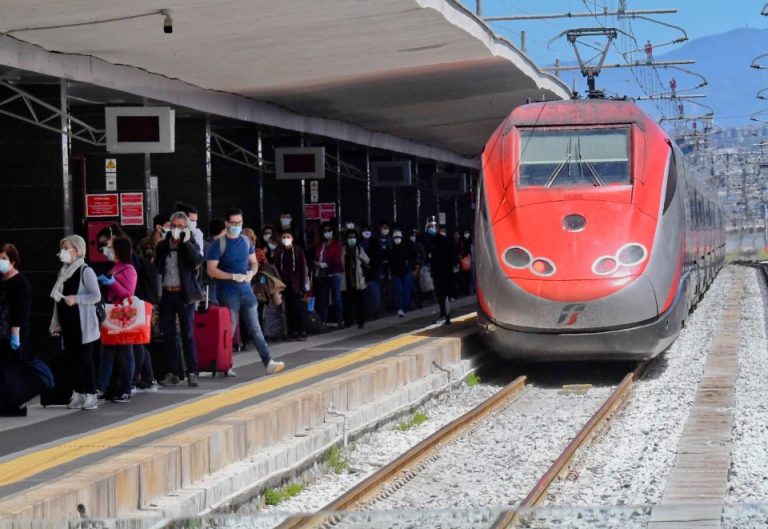
A pregnant nurse working with those suffering from psychiatric trauma after being hit by the deadly coronavirus pathogen in a hospital in Italy was brutally raped by an illegal migrant from Senegal as she waited for her bus at the Corso Arnaldo Lucci Metropark bus stop, just behind the city’s main rail station. She was attacked by the accused while she waited for the bus to return home after finishing her day’s shift of treating the coronavirus patients.
The illegal migrant from Senegal was arrested on Sunday for allegedly raping the 48-year-old nurse after she left work at a Naples hospital at around 3 pm.
Recounting the 45 minutes of horror the nurse said that she doesn’t know whether her physical pain or the mental pain was effecting her more. She said she would now try and struggle to move on and help other people who have experienced similar trauma in life.
The pregnant nurse recollects that she begged the man to let her go as she was pregnant
In what transpired, the pregnant nurse had reached the Metropark well before time and had an hour to wait because of the reduced transport services due to the coronavirus crisis. She says there was no one around as she waited for her bus.
She recollects that it was around 3 pm when she was waiting at the deserted Corso Arnaldo Lucci Metropark bus station, suddenly the accused jumped over the fence and started sprinting towards her. Initially, thinking him to be a robber the nurse tried to give him her purse but before the nurse could understand the accused grabbed her by the arm and pinned her to the ground, gagging her with his hand.
She said: “He would put his hands everywhere and would get angry every time I was defending myself.” The nurse recollects that she begged the man to let her go as she was pregnant and was struggling to breathe but he did not stop assaulting her.
“He kept repeating ‘let me do what I want or I’ll kill you. Stand still and don’t scream’. He was double my size and all his weight was on my back. He got angry because my jeans were too tight and he couldn’t take them off,” the nurse was quoted by La Repubblica, an Italian daily as saying.
The accused attempted to even kill the nurse
The nurse recollected telling the accused that if someone came he would be arrested, but he kept trying to rip her jeans off, she said, furthering that her back was completely wounded and her neck covered in bruises. At one point he even attempted to kill her by putting his arms around her neck to choke her.
The illegal migrant continued to assault her for almost 45 minutes until a bus arrived and the driver noticed what was going on and started screaming. By then, the Army arrived and surrounded the attacker until the police got there and took him into custody.
The police took the woman to the hospital and informed her husband. The nurse says she hasn’t yet gone back to work. She added that her husband feels guilty and helpless for not being able to protect her and the incident has devastated the entire family.
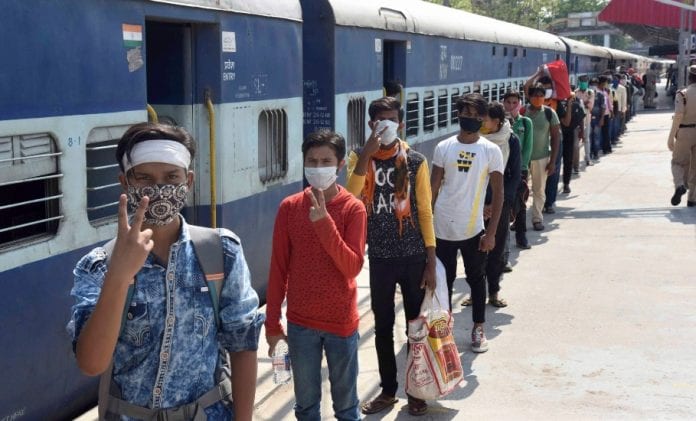
In a remarkable development, the Indian Railway operated 145 Shramik special trains from across India on Thursday. An official from the Ministry of Railways has revealed that in this mission to send the migrants back to their native places, the Indian Railways has helped close to 2.10 lakh migrant labourers to return back their homes on Thursday.
An official statement from the Ministry of Railways informed, “Yesterday, 145 Shramik trains were operated and nearly 2.10 lakh passengers were ferried home. As of 9 AM today, 999 Shramik Specials have been approved.”
The Ministry further added, “As on 14th May 2020, a total of 800 “Shramik Special” trains have been operationalized from various states across the country. More than 10 lakh passengers have reached their home state.”
Till now 800 trains have been terminated in various states like Andhra Pradesh, Bihar, Chattisgarh, Himachal Pradesh, Jammu & Kashmir, Jharkhand, Karnataka, Madhya Pradesh, Maharashtra, Manipur, Mizoram, Odisha, Rajasthan, Tamil Nadu, Telangana, Tripura, Uttar Pradesh, Uttarakhand, West Bengal.
The state and Union territories/district administrations have been operational in conducting certain activities to ensure strict observance of lockdown orders. The passengers are being screened properly before boarding the train and the passengers are also given free meals and water.
Indian railways operated the Shramik Special trains after MHA orders
The Indian Railways decided to operate ‘Shramik special trains’ for migrant labourers following the orders of Ministry of Home Affairs regarding the movement of migrant workers, pilgrims, tourists, students and other persons stranded at different places via special trains after the reports of migrants scuffling to go back to their natives emerged.
These special trains have reportedly ferried migrants to cities like Tiruchchirappalli, Titlagarh, Barauni, Khandwa, Jagannathpur, Khurda Road, Prayagraj, Chhapra, Balia, Gaya, Purnia, Varanasi, Darbhanga, Gorakhpur, Lucknow, Jaunpur, Hatia, Basti, Katihar, Danapur, Muzaffarpur, Saharsa, etc.
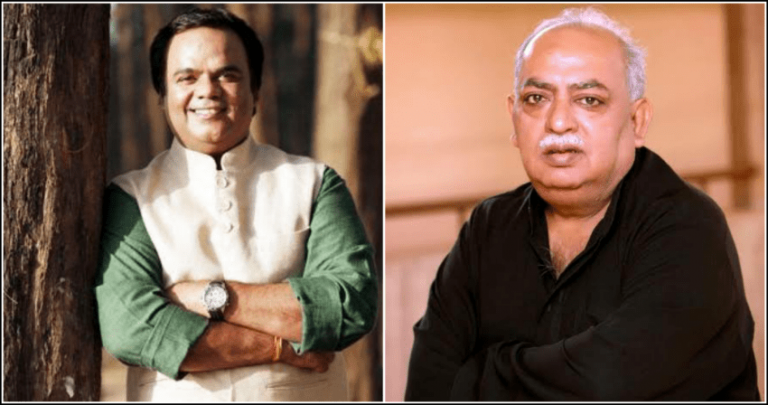
Urdu poet Munawwar Rana recently hogged the spotlight for his blatantly Hinduphobic remarks wherein he had relegated 100 crores Hindus in India to ‘animals’ who come in handy only during the elections.
The remark stirred a massive outrage on the social media where netizens not only condemned Rana’s appalling remarks but also criticised Rana’s work and raised aspersions on the originality of the poems composed by him.
Rana has received widespread acclaims and praise for a famous couplet “Mere Hisse Main Maa Aayi (I inherited my mother). However, it has been accused now that the lines that brought so much fame to Rana may have been stolen from Vidisha poet Alok Srivastava.
This has been a subject of discussion on social media. Senior journalist Ashok Shrivastav took to Twitter to share an old letter penned by poet Alok Srivastava addressed to Munawwar Rana in which he alleges the Urdu poet of stealing his couplet and brazenly garnering accolades for it.
“Munawar Rana has been accused of stealing the lines of his famous couplet “Mere Hisse Main Maa Aai”, which was originally composed by the Hindi poet Alok Srivastava in his famous poem “Mere Hisse Mein Amma Aai”, senior Doordarshan journalist Ashok Shrivastav tweeted while tagging Munawwar Rana on Twitter and seeking his response on the charges of intellectual property theft levelled against him.
मुन्नवर राणा पर आरोप हैं कि उनकी मशहूर नज़्म “मेरे हिस्से में माँ आई” दअरसल हिंदी कवि आलोक श्रीवास्तव की कविता “मेरे हिस्से अम्मा आई” को चुरा कर लिखी गई। ( आलोक जी का पुराना पत्र पढ़िए)@MunawwarRana, जी आरोप गंभीर है। जवाब दें अन्यथा कोई अवार्ड बचा हो तो लौटा दें।#MunnawarRanapic.twitter.com/hwB5lH8e6A
— Ashok Shrivastav (@AshokShrivasta6) May 15, 2020
The letter attached in the tweet is dated May 2003 in which poet Alok Srivastava alleged Munawwar Rana of brazenly copying lines from his poems and passing off as his in a function in Gwalior. He also added that despite being periodically reminded that he is using stolen poems to garner fame, Rana continued reproducing the adopted lines in many poetic symposiums.
It is pertinent to note that Alok Srivastava is amongst the most eminent poets in the country. Many illustrious celebrities such as Jagjit Singh, Amitabh Bachchan, Malini Awasthi and others have lended their voices to the songs and Ghazals written by Alok Srivastava.
In addition to this, Alok has also been a prolific writer and renowned for writing songs for many Bollywood movies. Alok has also participated in a legion of Kavi Sammelan and Mushairas(poetic symposiums) in dozens of countries and has won laurels abroad.
In a subsequent tweet, journalist Ashok Shrivastav claimed that the letter by Alok Srivastava, that has been doing the rounds on the Internet, has not been validated yet. He has sought help on social media to establish the veracity of the claims made in the letter by asking people to put him through either Munawwar Rana or Alok Srivastava.
Shortly thereafter, journalist Ashok Shrivastav posted yet another tweet claiming that the letter has been validated. The Doordarshan journalist claimed that all his life Munawwar Rana continued garnering applause and fame for the couplets he shamelessly copied from the poems authored by Alok Srivastava and till date has not responded to the letter written by the Vidisha poet.
— Ashok Shrivastav (@AshokShrivasta6) May 15, 2020
Alok Srivastava’s poem “Amma”
This is not the first that Munawwar Rana has been accused of plagiarism. There had been myriad occasions when Munawwar was alleged of stealing the poems composed by Alok Srivastava. However, it was not so hotly debated as it is being now. Perhaps, therefore Rana never deigned to issue a clarification on the allegations of copying poems levelled against him.
The lines of the poem ‘Amma’ written by Alok Shrivastava are as follows –
“बाबूजी गुजरे..आपस में सब चीजें तकसीम हुईं। मैं घर में सबसे छोटा था, मेरे हिस्से आई अम्मा।“
This poem of Alok was reportedly published in many magazines. On several occasions, Alok has asserted that Munawwar had stolen the lines of his poem.
The lines which Munawwar Rana has always proclaimed as his are as follows:
‘किसी को घर मिला हिस्से में या कोई दुकाँ आई। मैं घर में सब से छोटा था मेरे हिस्से में माँ आई।’
Munawwar Rana’s controversial Hinduphobic remarks
In a Hinduphobic tweet, Sahitya Akademi Award-winning poet Munawwar Rana referred to Hindus as ‘animals’ who only come in handy while voting and Muslims as the only ‘humans’.
Addressing BJP spokesperson Sambit Patra, Munawwar Rana was criticising the government of India’s measures to combat coronavirus. He said, “After seeing government’s failure on coronavirus, it has been proven that there are 35 crore humans and 100 crore animals,”. As per 2011 census, the Muslim population was estimated at about 17.22 crore which would have grown over the years. And while he did not explicitly mention that he meant Hindus and Muslims as ‘animals’ and ‘humans’ in his tweet, the veiled allusion to Hindus was condemned by many on social media.
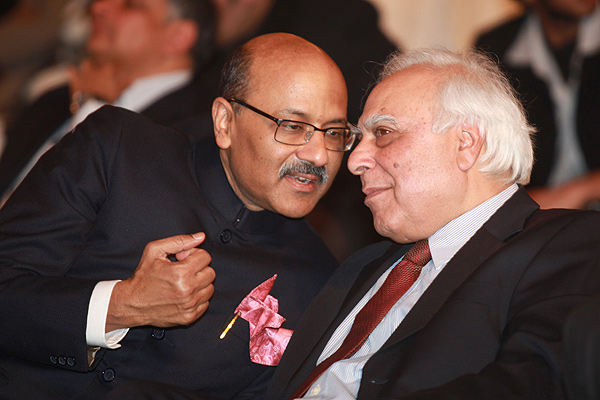
The mainstream media has been the biggest purveyor of fake news for quite some time now. It has been evident that the fake news was driven as much by malice as it was by sheer incompetence. Now, there finally appears to be an admission of sorts on the horizon here. An article on The Print, the media venture of Shekhar Gupta of the Editors Guild of India, argues that liberals ought to embrace fake news in their war on Prime Minister Modi. To further his argument, the article in The Print used a paper written by Christopher Paul and Miriam Matthews for RAND Corporation, an American think-tank.
The headline of The Print article
The Print argued, “Across the world, fire-hosing of falsehood is becoming a powerful propaganda tool. Those who want to defeat such propaganda may have to do their own fire-hosing of falsehood. As the Hindi saying goes, iron cuts iron. When public opinion is being manipulated with fake news and lies, the opposition cannot win the game with mere fact-checking. It may have to do its own rapid and continuous misinformation with little regard for the truth.”
The author did not stop there. He went on to call for curbs on freedom of expression of individuals and crackdown on political opponents. He suggested that the opposition parties “attack the opponent’s supply chain of lies. If opposition-ruled states are not cracking down on fake news and communal hate-mongers in their states, for example, they’re making a huge mistake.” The Print tries to pass it off as a noble cause but it is pretty clear what he means.
Since what constitutes ‘hate speech’ is completely left to the will of the interpreter, the government can persecute its political nemesis with impunity. For instance, during the Arnab Goswami versus Antonia Maino (Sonia Gandhi) saga, the Congress party has equated it to an attempt at stoking communal tensions. Thus, what The Print run by Shekhar Gupta essentially argues for is the persecution of supporters of Narendra Modi by states where opposition parties are in power such as in Rajasthan and Chhattisgarh.
To be clear, the mainstream media has been peddling fake news for quite some time now and all the time, the fake news is geared towards benefiting only one section of the political spectrum, which does not happen to be the BJP. The Print of Shekhar Gupta has been at the forefront of it often enough. Now the reason for it has become imminent. They are so convinced of their moral superiority that they believe it is permissible for them to deliberately spread fake news to achieve political objectives. This is the same author who was earlier accused of fabricating quotes to whitewash the genocide of Kashmiri Pandits. It appears that Shivam Vij, and by extension Shekhar Gupta, believe that spreading fake news is justified as long as it is dedicated to defeating Narendra Modi and Hindutva.
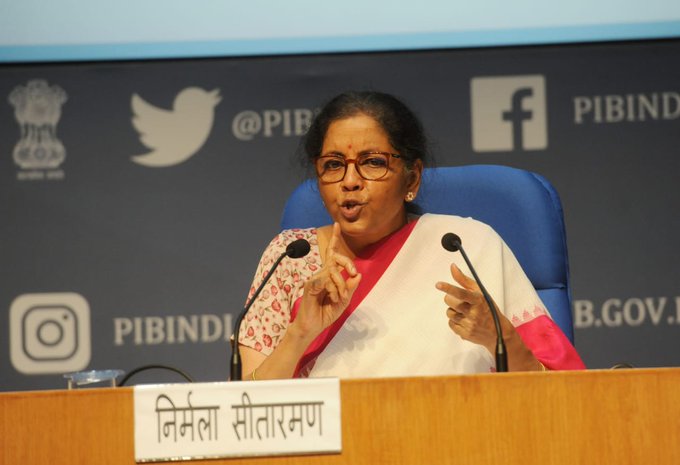
On Friday, Finance Minister Nirmala Sitharaman announced the third tranche of Modi government’s “Atmanirbhar Bharat Abhiyan” package worth Rs 20 lakh crores to restart the economy following the coronavirus lockdown.
In her first address, Finance Minister Nirmala Sitharaman had announced comprehensive relief measures on Wednesday to support various sectors including Micro, Small and Medium Enterprises, Discoms, NBFCs, Micro Insurance Institutions, etc.
In the first tranche, the Modi government had announced 16 included six measures for MSMEs, EPF, NBFCs and MFIs, discoms, contractors, real estate sector and had also put out some tax measures.
Later, on Thursday, Finance Minister Nirmala Sitharaman had declared the second tranche of the “Atmanirbhar Bharat Abhiyan” package that included relief measures to migrant workers, street vendors, housing, employment generation for tribals and small farmers.
Third tranche of announcements under “Atmanirbhar Bharat Abhiyan” economic package
Finance Minister Sitharaman on Friday said that the third tranche of the announcement will focus on Agriculture and Allied Activities – fisheries, animal husbandry, dairy, etc.
The Finance Minister announced eleven measures, out of which 8 will be aimed at building better capacities and allocation for ramping up storage and logistics. The remaining 3 are governance and administrative reforms, she added.
At the outset of the announcement, Finance Minister announced that during lockdown provisions were made to conclude rabi crop harvest and some states have gone ahead largely with procurement process while observing social distancing. Agricultural work was supported during the two months of lockdown, FM Sitharaman added.
“It goes to the credit of the Indian farmer who has always stood up to various challenges and has made India reach certain global benchmarks,” said Finance Minister.
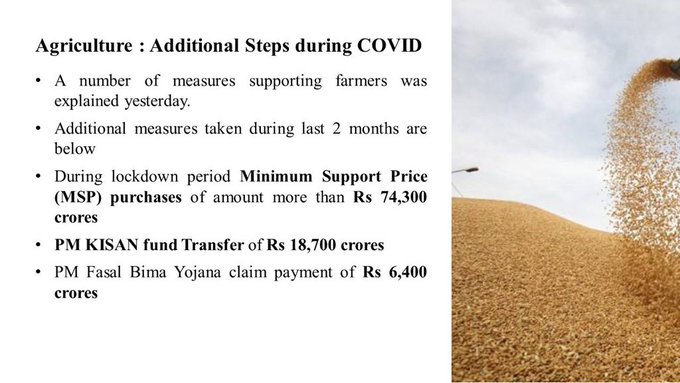
FM Sitharaman said that funds worth Rs 18,700 crores has been done transferred under PM KISAN in past 2 months and PM Fasal Bima Yojana claims worth Rs 6,400 crores released in past two months.
The Modi government also said that Rs 74,300 crore worth of produce was purchased under Minimum Support Price during lockdown
Image Source: PIB
Agri Infrastructure Fund
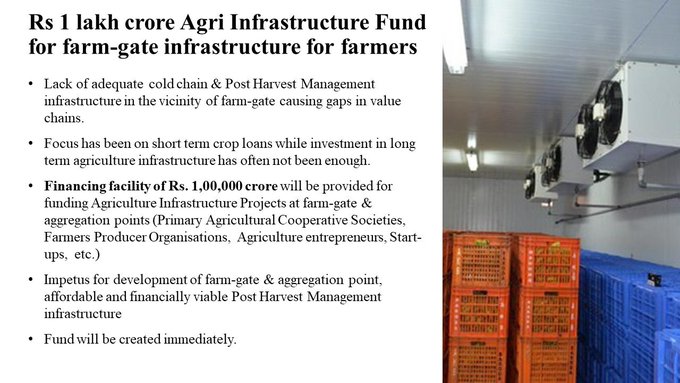
The Modi government announced that it will immediately create a Rs 1 lakh crore Agri-Infrastructure Fund for farm gate infrastructure for farmers.
Finance Minister said that Rs 1 lakh crore will be dedicated for aggregators, primary agriculture societies for strengthening the farmgate infrastructures, which includes cold chains, storage centres, yards, etc.
“Impetus for development affordable and financially viable Post Harvest Management infrastructure will be given,” announced FM Sitharaman.
Image Source: PIB
Support for Micro Food Enterprises (MFE)
Additional Rs 10,000 crore is dedicated by the Modi government for micro food enterprises (MFEs) in a cluster-based approach, announced FM.
She added that the government is aiming to implement PM’s vision of ‘Vocal for Local with Global outreach’, a scheme will be launched to help 2 lakh Micro Food Enterprises
“Branding, modernising and capacity ramp-up will be part. This will benefit 2 lakh MFEs. The focus will be on women, ST/SCs. Will look at regional clusters,” the FM added.
Through the scheme, existing SHGs, MFEs, farm producer organisations will be supported, the Finance Minister announced. She added that the formalisation will be done on a cluster-based approach, like for Bihar it can be on makhanas, for Kashmir saffron, etc.
Image Source: PIB
Pradhan Mantri Matsya Sampada Yojana
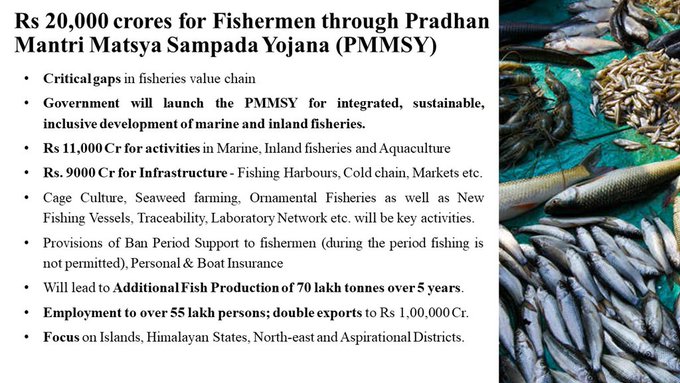
Government to launch Pradhan Mantri Matsya Sampada Yojana for integrated, sustainable, inclusive development of marine and inland fisheries to plug critical gaps in fisheries value chain.
The Finance Minister announced that under the scheme logistics capacities for activities related to marine and inland fisheries will be developed. The schemed intends to provide employment to 55 lakh in the sector, which is expected to contribute Rs 1 lakh crore to India’s exports.
“The mission will help in better standards, new fishing vessels, harbours, insurance for fishermen and boats and will lead to an additional 70 lakh tonnes over the next 5 years. It is to empower people to make a livelihood for themselves. Making sure India is helped to stand on its own,” said FM Sitharaman.
An amount of Rs 20,000 crores will be earmarked for fisheries. As part of this scheme, Rs 11,000 has been assigned for marine, inland fisheries and aquaculture and Rs 9,000 crore for infrastructures such as fishing harbour, cold chains and fish markets.
Focus will be on Islands, Himalayan states, North-east and Aspirational districts, added Finance Minister.
Image Source: PIB
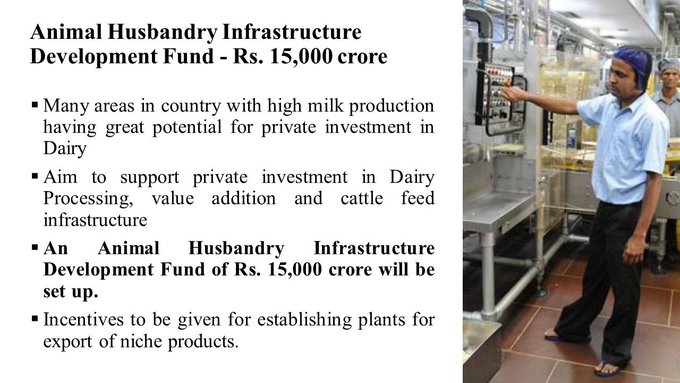
Support for Animal Husbandry sector
The Modi government announced an Animal Husbandry Infrastructure Development Fund worth Rs. 15,000 crore to support private investment in Dairy Processing, value addition and cattle feed infrastructure.
National Animal Disease Control Programme has been launched with a total outlay of Rs 13,343 crores for 100% vaccination of cattle, buffalo, sheep, goat and pig population in India.
The Finance Minister also said that incentives to be given for establishing plants for export of niche products.
Image Source: PIB
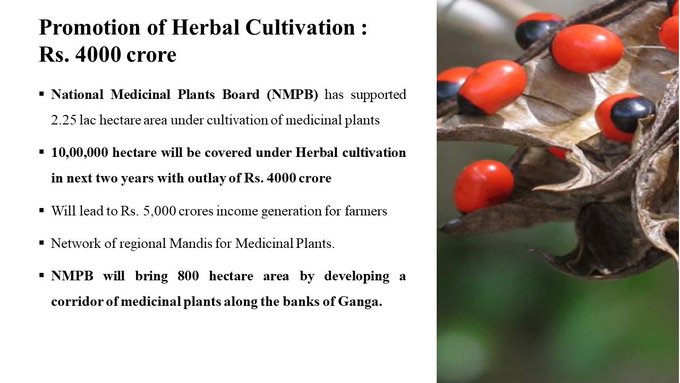
Promotion for Herbal cultivation
To promote Herbal Cultivation in India, the Modi government announced to commit Rs 4000 crore. The move aims to cover 10 lakh hectare under herbal cultivation in 2 years.
The support will generate income of Rs 5,000 crore for local farmers engaged in this cultivation, said Finance Minister.
FM Sitharaman also said National Medicinal Plant Board will undertake 800 hectares of areas in the corridors of river Ganga for growing of herbal and medical plants.
Image Source: PIB
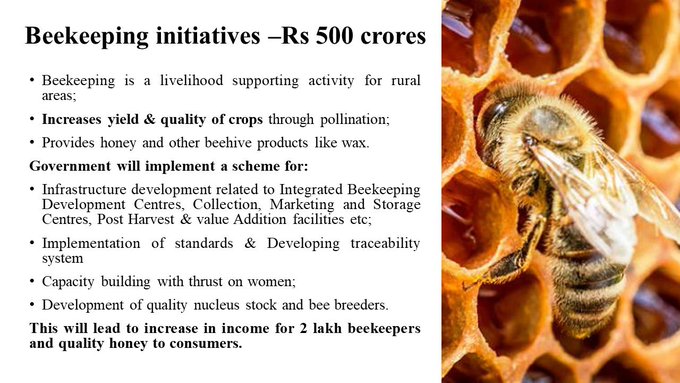
Beekeeping initiatives
The Modi Government announced that they will implement a scheme for infrastructure development related to Beekeeping. The scheme aims to increase income for 2 lakh beekeepers with special thrust on capacity building of women.
The Finance Minister said that scheme will include infrastructure, capacity building, marketing and export support.
Through the scheme. the development of quality nucleus stock and bee breeders will be undertaken.
Image Source: PIB
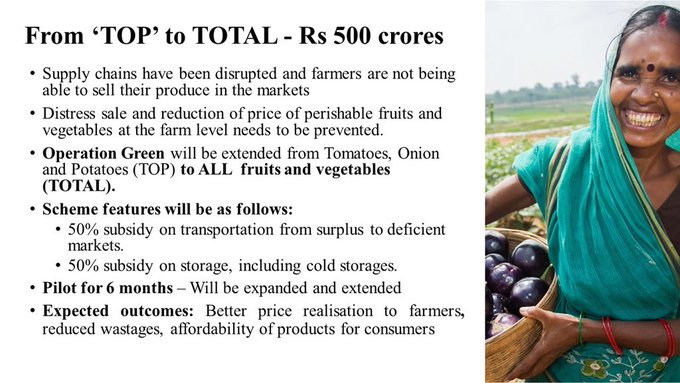
Extension of Operation GREEN
In a major announcement, Finance Minister said that government has extended Operation Greens from Tomatoes, Onion and Potatoes (TOP) to all fruits and vegetables.
The Finance Minister said that the pilot extended for the next six months and will be expanded further. She added that scheme will provide 50% subsidy for transportation and 50% subsidy for storage including cold storage included.
Image Source: PIB
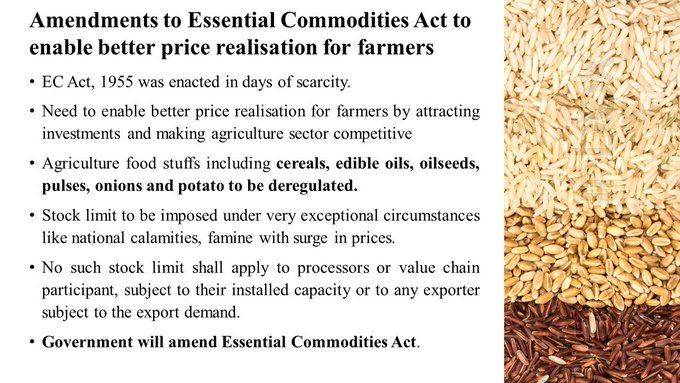
Amendment to Essential Commodities Act
The government also stated that it will amend the Essential Commodities Act to enable better price realisation for farmers. Addition to that, the agriculture food stuffs including cereals, edible oils, oilseeds, pulses, onions and potato will be deregulated, announced FM Sitharaman.
Stock limit to be imposed under exceptional circumstances like national calamities, famine with surge in prices, she added.
Image Source: PIB
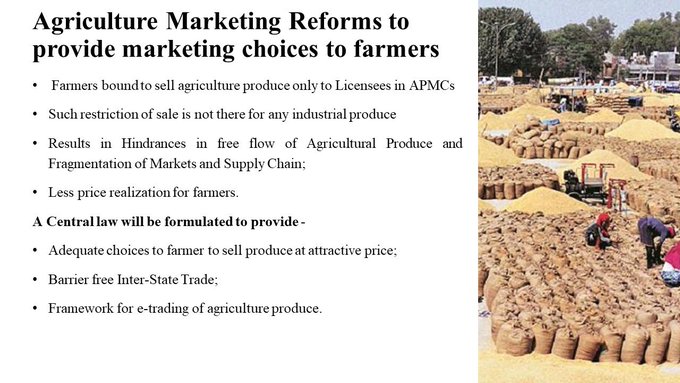
Reforms to Agriculture Marketing
The Finance Minister also said that the government will bring in a law to implement agriculture marketing reforms to provide marketing choices to farmers. The law will provide adequate choices to farmers to sell produce at an attractive price.
The government of India is working on a central law to provide farmers with inter-state trade free of barriers, a framework for e-trading of agriculture produce and adequate choices for them to sell produce at an attractive price. At present farmers are allowed to sell only to select licensees in selected agricultural markets in their own states, which limits choices for the farmers. The new law will remove the inter-state barriers in trade in farm produces.
Image Source: PIB
‘Atmanirbhar Bharat Abhiyan’ – A mission for self-reliance
In his fifth address to the nation over the Coronavirus pandemic, on Tuesday Prime Minister Narendra Modi announced an economic package under ‘Atmanirbhar Bharat Abhiyan’ amounting Rs 20 lakh crore to revamp the economy which is facing a serious crisis due to the Chinese epidemic. The economic package includes the recent announcements made by the government and the Reserve Bank of India on supporting key sectors of the country.
In his speech, PM Modi said the economic package would be around the 10 per cent of the GDP.
“I announce a special economic package today. This will play an important role in the ‘Atmanirbhar Bharat Abhiyan’. The announcements made by the government on coronavirus, decisions of RBI and today’s package totals to Rs 20 lakh crore. This is 10 per cent of India’s GDP,” PM Narendra Modi said.
The Prime Minister also said the package would help every section of society, including workers, farmers, the middle class, industrial units and the MSME sector.
The stimulus will play an important role in the ‘Atmanirbhar Bharat Abhiyan’ (Self-reliant India Campaign), PM Modi said.
“India’s self-reliance will be based on five pillars — economy, infrastructure, technology-driven system, vibrant demography and demand. When India speaks of self-reliance, it does not advocate for a self-centred system. In India’s self-reliance there is a concern for the whole world’s happiness, cooperation and peace,” PM Modi said in his address.
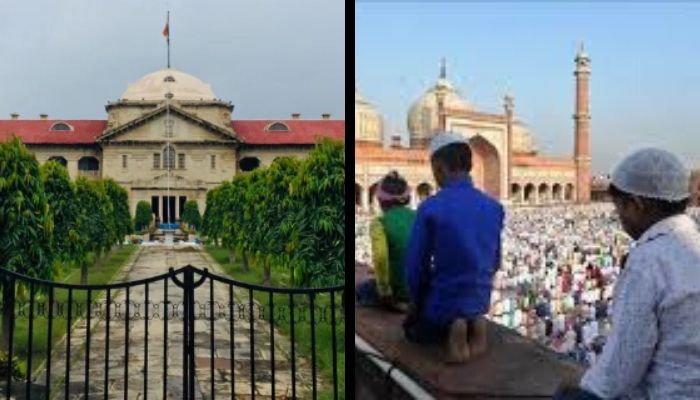
On Friday, the Allahabad High Court ruled that while reciting Azaan (call for Muslims to pray) by a Muezzin from a Masjid is integral to Islam, the use of amplifying devices such as loudspeakers are not, reportedBar and Bench. The Court held that usage of such devices for ‘Islamic call to prayer’ is not protected under Article 25 (Right to Freedom of Religion) of the Indian Constitution.
A Division Bench comprising of Justice Shashi Kant Gupta and Justice Ajit Kumar observed that the use of amplifying devices is subject to public order, health, morality, and other provisions of the Part III of the Indian Constitution.
The #AllahabadHighCourt on Friday allowed ‘azaan’ from mosques but said that the use of loudspeakers could not be permitted. The court said that ‘azaan’ was a part of Islam but using loudspeakers were not a part of the religion.
The Court’s order came after Public Interest Litigations (PILs) were filed by MP Afzal Ansari, Congress leader Salman Khurshid, and Advocate S Wasim A Qadri, following the order of the District administration to restrict the recital of Azaan, amidst the Coronavirus lockdown. They sought permission for the recital of Azaan over amplifying devices claiming it to be an integral part of Islam.
Allahabad HC order on Azaan
The Allahabad High Court ordered, “Therefore, until and unless there is a license/permission from the authorities concerned under the Noise Pollution Rules, under no circumstances, Azan can be recited through any sound-amplifying devices.” Doing so, without requisite permission, will be deemed as a violation of Noise Pollution Rules. As such, the Court had directed to take strict action against such people. The Court order, initially reserved on May 5, also asked the district administration to not cause hindrance in the recital of Azaan, even during the lockdown as it is an integral part of Islam.
The order said:
“Therefore, it is held that Azan may be an essential and integral part of Islam but the recitation of Azan through loud speakers or other sound-amplifying devices cannot be said to be an integral part of the religion, warranting protection of the fundamental right enshrined under Article 25 of the Constitution of India, which is even otherwise subject to public order, morality or health and to other provisions of part III of the Constitution of India.”
A Supreme Court judge and his family in Delhi have been quarantined after one of their in-house staff was tested positive for the coronavirus.
According to the reports, the cook at the residence of a Supreme Court justice was tested positive today after he was referred to a hospital following a complaint of body ache and mild fever. The cook was reportedly on leave since May 7.
However, there is no information yet regarding the identity of the affected Supreme Court judge, who has been quarantined.
“The cook had taken leave to attend some function at his daughter’s place. He had been absent from the judge’s residence since May 7. Today his son called up the judge’s residence and reported that his father has been admitted to hospital and that he has been found coronavirus positive,” Times of India reported quoting a source.
However, it is unclear whether the cook was asymptomatic while working at the judge’s residence prior to May 7 or whether he caught the infection while attending the function at his daughter’s place. The contact-tracing of the concerned infected employee is being carried out, they said.
Judge and his family to be quarantined for next 10 days
As a preventive measure, the judge and his family have been advised to stay quarantined for the next 10 days. Reportedly, the family members had no contact with the cook for the last seven days.
Speaking to Times of India, the quarantined Supreme Court judge said “I am fine. I and my family will self-quarantine ourselves for the next week or so and will scrupulously abide by the medical advice”.
The Delhi police personnel who were employed in the security detail of the judge and family will also be quarantined as they might have come in the contact with the cook at the judge’s residence.
In addition to that, there are at least two suspected cases of corona positive cases among Supreme Court employees. As per the TOI report, one has tested negative now, the other person’s grandmother has succumbed to co-morbidities after getting infected. Five members of the latter employee’s family have also tested positive.
Amidst the coronavirus lockdown, the Supreme Court has been conducting hearings via videoconferencing from respective judges’ residence. Only single-judge benches have started to hear the cases, while petitioners can continue to appear through videoconference, the lawyers will resume arguing from their chambers starting next week.
With the diplomatic relations between Beijing and Washington at an all-time low, largely attributed to the tussle over the provenance and accountability of the coronavirus outbreak, the United States has upped its ante against China as the Senate gave its unanimous consent to bill that would impose sanctions on Chinese officials over gross human rights violations against Uyghur Muslims.
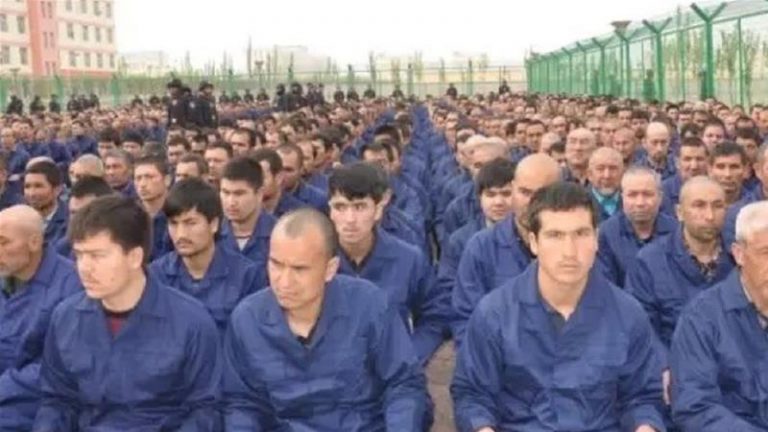
The bill, sponsored by Republic Senator Marco Rubio of Florida, would condemn China for corralling more than a million Uyghur Muslim residents of its northwestern province of Xinjiang in internment camps and subjecting them to harsh and inhuman conditions.
“Moments ago, we passed our Uyghur human rights bill in the Senate which holds the Communist of Party of #China accountable for grotesque actions,” Republican Sen. Marco Rubio of Florida tweeted.
Moments ago we passed our #Uyghur human rights bill in the Senate which holds the Communist of Party of #China accountable for grotesque actions.
It now heads to the House which I hope can pass it as soon as tomorrow so @POTUS can sign it into law. https://t.co/fgW3yC4DVl
The actions of the Communist government of China are “horrific and will be a blot on humanity should we refuse to act,” Senator Rubio said.
The bill was first passed by the Senate in September last year, but the House revised it to limit the export of devices that could be used to spy on or limit the communications or movement of members of the group and other Chinese citizens.
As per the current legislation, American President Trump will be required to report to Congress a list of senior Chinese officials involved in the serious human rights violations of Uyghur Muslims in China, along with the Department of State, which will have to report to Congress on human rights abuses in Xinjiang, including individuals forcibly held up in labour camps.
The passage of legislation by the US Senate comes amidst the growing clamour within America to hold China accountable for the novel coronavirus that continues its relentless march on the US soil, infecting 1.4 million people and killing more than 85,000 in the country.
China’s inhuman treatment of Uyghur Muslims
China has long been on the receiving end of criticism over its alleged treatment to Uyghur Muslims and sending them to mass detention centres. China has also been accused of oppressing and interfering Uyghur Muslims in their religious activities.
Chinese oppression of Uyghur Muslims has been known for a long time. Earlier the Chinese police had imposed a dress code for Uyghur women, under which the Muslim women are not allowed to wear long dresses. Last year photos had appeared on social media showing police cutting dresses of Uyghur women for being “too long”. It was also reported that Han Males are sleeping on the same bed as Uyghur Muslim women in China whose male family members, often husbands, are locked up in ‘reeducation camps’ in conformity with a diktat by the Chinese regime.
Despite such atrocities, China has not faced any repercussions for its ongoing totalitarian policies which are most heinously affecting the Uyghurs. They have been abandoned by the Muslim world as well. Imran Khan, who cannot stop engaging in delirious rhetoric against India regarding Kashmir, has refused to condemn China’s actions against Uyghurs.
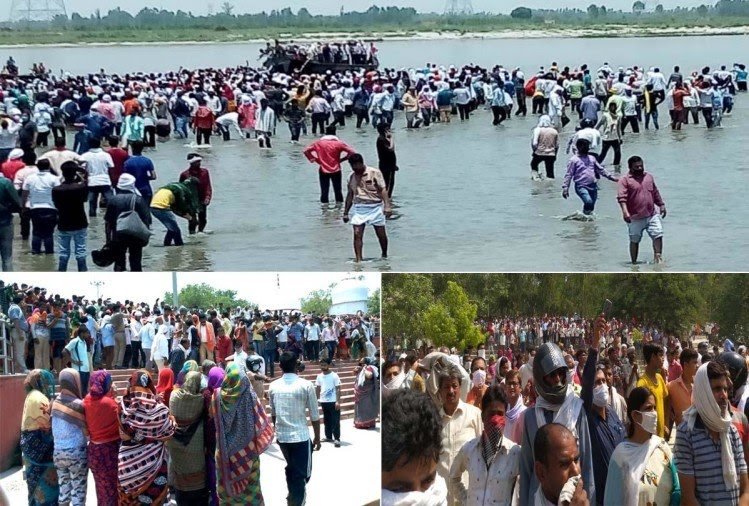
The Kanpur police have lodged FIRs against almost 4000 unidentified disciples of Baba Shobhan Sarkar, who had gathered despite lockdown norms and social distancing protocols, to pay tribute and attend the last rites of the seer.
The followers reportedly headed towards the Arogya Dham hospital at Sunauhra Ashram in Chaubeypur area, after receiving the news of his demise. Swami Shobhan Sarkar had passed away at his ashram in the Shivli area of Kanpur Dehat district on May 13 (Wednesday) morning.
Meanwhile in Kanpur. Baba Shobhan Sarkar passed away and 1000s of people gathered to pay their respects. Om Shanti ? pic.twitter.com/J637DD3ITv
Police tried to stop the crowd from proceeding towards the seer’s ashram in Chaubeypur area in Kanpur, Uttar Pradesh, but their efforts proved futile. Video clips of the violation went viral on social media platforms said the station-house-officer Vinay Tiwari, further informed that the Kanpur police were forced to lodge 4 FIRs against almost 4000 followers under the Epidemic Act. “No matter how powerful the persons are, strict action will be taken against them,” he added.
4 FIRs lodged against thousands of followers for flouting social distancing norm to visit last rites of Baba Shobhan Sarkar
Out the 4 FIRs, three have been filed in Chaubeypur police station. The first FIR was filed by station in-charge Vinay Tiwari, against 2000 people who were present at Sunoda Ghat. The second FIR was lodged against 1200 unidentified followers of the want by sub-inspector, Anjali Tiwari. Meanwhile, the third FIR has been written by Sub Inspector Devendra Kumar against 900 unidentified people gathered at Bela road crossing.
The fourth FIR against thousands of unidentified followers was registered by the Shivli Police on Wednesday, for violating coronavirus protocols and government directives regarding the social gathering, said, Superintendent of Police (Kanpur Dehat) Anurag Vats.
The flouters would face strict action as police are investigating who all were responsible for the event amid a complete ban on religious gatherings, said Deputy IG (Kanpur) Anant Deo Tiwari.
It is pertinent to note here that Kanpur has reported 311 cases of coronavirus so far, out of which 111 are active cases.
Baba Shobhan Sarkar had risen to fame during the UPA era
Baba Shobhan Sarkar alias Suryabhan Tiwari had risen to fame during the UPA era. In the year 2013, he created a flutter when he claimed, that he, in a dream, saw over 1,000 tonnes of gold lying buried under the ruins of the old fort of 19th-century king Ram Baksh Singh in Daundiya Khera village of Unnao. He had then said the ghost of Ram Baksh Singh is worried about Indian economy and wants the treasure to be used for the growth of the country.
This bizarre claim had got the then Congress government springing to action. The excavation had begun on October 18, 2013, and just 11 days after, the ASI had stopped it, concluding that there was no gold.
The Wuhan Coronavirus pandemic will change the world as we know it. During the course of the past few months, it has been made abundantly clear that the world to come will be vastly different than what has been before. Traditional ways of doing things will change radically and countries and business establishments around the world will be forced to make drastic changes in order to cope with the norms and restrictions that are expected to become a part and parcel of everyday life at least in the near future.
One area which is likely to suffer gravely are establishments such as theatres and multiplexes. The future of such business hangs in the balance. Under such circumstances, INOX appears to be suffering a meltdown.
IMPORTANT… #INOX reacts to film producers / Studios releasing films on #OTT platforms, bypassing theatrical release… OFFICIAL STATEMENT… pic.twitter.com/J5lqHrS4ud
In a scathing statement, INOX took great offence at Rising Sun Films for announcing the release of Amitabh Bachchan and Ayushmann Khurrana starrer Gulaba Sitabo directed by Shoojit Sircar on OTT platform Amazon Prime on June 12. It said, “INOX would like to express extreme displeasure and disappointment on an announcement made by a production house today, to release their movie directly on an OTT platform by skipping the theatrical window run. The decision of the production house to deviate from the globally prevalent content windowing practice is alarming and disconcerting.”
INOX stated further, “Such acts, though isolated, vitiate the atmosphere of mutual partnership and paint these content producers as fair weather friends rather than all-weather life-long partners. Needless to say, INOX will be constrained to examine its options, and reserves all rights, including taking retributive measures, in dealing with such fair-weather friends.” “INOX would like to reiterate that as the backbone of the cinematic value chain, this windowing pattern has done wonders in terms of revenues for the content creators and all other stakeholders, as it offers them the opportunity to extract the best from all available mediums, which include cinemas, OTT platforms as well as satellite,” it added.
The reaction, or overreaction from INOX, is understandable. There is great uncertainty over when theatres could even begin to operate safely without risking the spread of the virus. Under such circumstances, there is great opportunity for online streaming sites such as Netflix and Amazon Prime to cash in on the situation to provide a platform for the release of new movies. Netflix already does it and others might follow suit as well which might cripple the theatre industry. Under normal circumstances, it wouldn’t be a problem if online streaming sites ventured into the scene but in the age of the Coronavirus, when social distancing is the norm, it could gravely affected the theatre industry. And thus we have the INOX almost panicking.
It’s not merely the movie industry that is likely to witness a sea change in the post-Coronavirus world. Businesses, even the non-mainstream ones, are making changes to adapt themselves to the crisis. A strip club in Oregon, USA, the Lucky Devil Lounge was forced to make its way into the takeout-dining business. However, things weren’t going too well absent the strippers and the owner, in desperation, tweeted that the store would be sending out its dancers to deliver the food. It was meant to be a joke, until the tweet went viral.
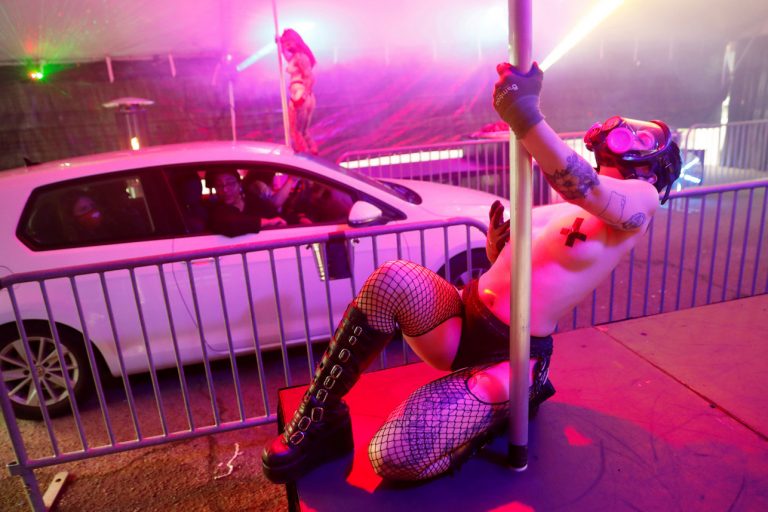
Describing the event as a light bulb going off inside his head, the Lucky Devil incorporated a drive-through pole-dance show for carry-out orders, and food deliveries by dancers accompanied by bouncers to enforce social distancing. An additional 30 dollars was charged for each option while the food prices were kept the same. And soon, the business was booming. The dancers performed in face masks and hand gloves in scantily dressed clothing. It’s only one as of now but more and more strip clubs could take that route.
An exotic dancer who goes by the name Karma Jane wears personal protective equipment while performing in a drive-through go-go dance tent (Image Credit: Terray Sylvester/Reuters)
In the age of the Coronavirus, Work From Home (WFH) is gaining momentum as well. Companies in sectors where it can afford to have its employees work from their homes were forced to direct their employees to continue their services during the lockdown from the confines of their homes. Going forward, it could very well become a permanent feature as companies would be able to cut their costs by having their employees WFH as it would mean that the companies could afford to not rent as many properties as they have to as of now.
Recently, it was reported that Twitter CEO Jack Dorsey had told his employees through an email that they could WFH forever which means that employees will be able to WFH even after the pandemic is over, whenever that may be. Thus, Twitter became the first tech company to make WFH permanent for its employees. And it will come as no surprise to anyone if more companies join the bandwagon. Numerous companies in India as well are currently mulling over the decision as we speak.
The airline industry is another sector which has suffered great losses due to the pandemic and it is only to be expected that certain changes will be witnessed in the manner in which passengers travel as well. It is being reported that as part of the new normal, airports may have an outlet dedicated to selling personal protective equipment (PPE) to travellers. The PPE shops could open in all major airports. They will sell face masks, gloves, disposable goggles, coverall or gowns and sanitisers to passengers as people may be required to have PPE in order to fly.
These are only some of the changes that are to be expected in the post Coronavirus world. Although it’s early to say just yet the extent to which the world will change but it can be safely predicted that the new normal will not be anything like the normal of yesteryear. The Wuhan Coronavirus, in that aspect, is truly a history altering event that will change the world as we know it. Apart from altering the global world order, the changes will also be visible in mundane affairs of public life and people will experience these changes acutely in their everyday lives.