The Supreme Court on Thursday declined bail to various persons accused in the Unlawful Activities (Prevention) Act (UAPA) case in connection with the 2020 Bengaluru Riots by refusing to interfere with the ongoing National Investigation Agency probe.
However, noting that there has been an inordinate delay in the commencement of trial in the matter due to a lack of special UAPA courts in Karnataka, a Bench of Justices BV Nagarathana and SC Sharma directed the Karnataka government to set up more such courts.
“The Registrar General of the High Court of Karnataka in consultation with the State government and after obtaining instruction from the Hon’ble Chief Justice of the Karnataka High Court set-up special courts for UAPA cases registered either by the State Government or the NIA”, the Court noted in its orders.
The Court has directed that the same shall be done within a period of three months.
The accused persons, approximately 150 in number, who belonged to the SDPI (Social Democratic Party of India) had moved the top court to seek bail.
Their counsel contended that the trial in the matter has been pending since long and the same is not expected to commence anytime soon.
He further submitted that there is a large pendency in NIA cases in Karnataka as there is a paucity of courts to try such cases.
The Court was told that the central government’s Home Ministry has already asked the State government to set up additional special courts for UAPA cases.
Further, the Additional Solicitor General of India (ASG) submitted that the Karnataka High Court has issued directions to the State government for setting up of additional courts in this regard. However, the Karnataka government has not complied with such directions.
After considering the submissions, the Court passed directions to the State government to set up additional courts in consultation with the State High Court to ensure expedited trial of such cases.
It further directed both the sides — the accused persons and the Central government’s NIA to cooperate, in this regard.
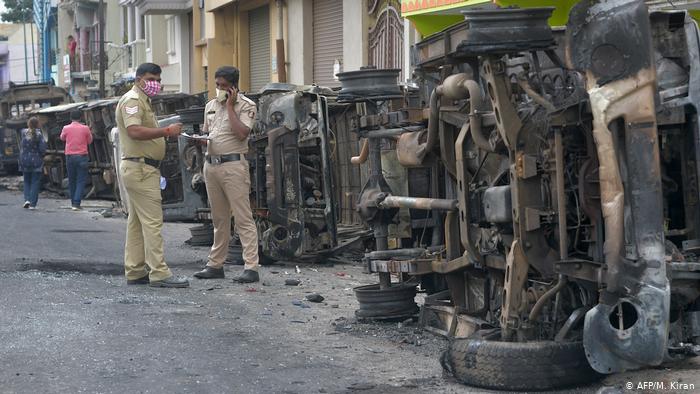
The case concerned around various arrests made by the NIA in 2020 after a violent attack and rioting took place at the DJ Halli and KG Halli police stations in Bengaluru.
As per the NIA, the accused rioters are members of SDPI and the Popular Front of India (PFI). Three people died and nearly 60 police officials were injured in the incident.
(This news report is published from a syndicated feed. Except for the headline, the content has not been written or edited by OpIndia staff)
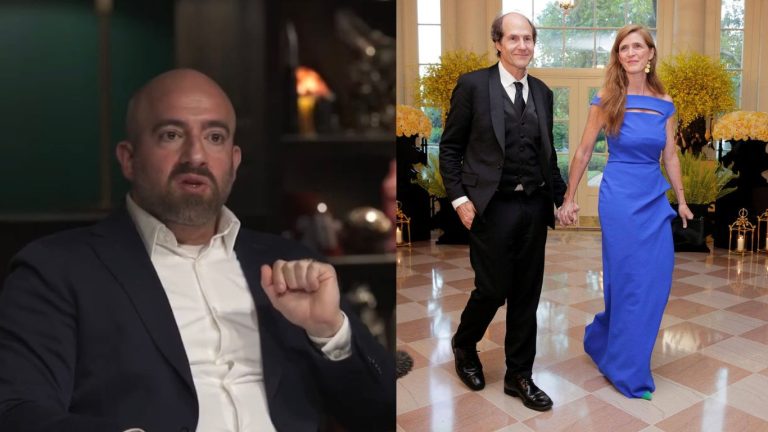
Former US diplomat Mike Benz who revealed how the USAID attempted to tarnish the image of PM Modi ahead of 2019 Lok Sabha elections, has further exposed how the USAID administrator Samantha Power and her husband Cass Robert Sunstein spearheaded policies and programmes that facilitated the entry of illegal immigrants in the US and encouraged censorship of the US citizens.
Speaking on the Shawn Ryan Show said that when Samantha Power was heading the USAID, her husband Cass Robert Sunstein was moved over to the Department of Homeland Security (DHS), which manages borders and immigration, as the Senior Advisor of Immigration Policy on Open Borders. Benz alleged that Power and Sunstein worked in tandem to help illegal immigrants enter the US. Benz said that while Samantha Power spent billions of dollars as the USAID head to help illegal immigrants enter the US, her husband at the DHS was creating and popularising policies to open the borders for illegal immigrants.
"Samantha Power is funding the machine so that they all get here. There's no catch and release and the whole the whole thing's open and we can't do anything to stop them…Samantha Powers net worth increased from an estimated 6.7 million to 16.5 million to around 30 million. How… pic.twitter.com/QxGAJVOZPK
”It’s a one two punch. Samantha Power is funding the machine so that they (illegal immigrants) get here. Her husband who is at the DHS creating and popularising and implementing policies that make sense sure there is no catch and release and the whole thing (border) is open and we can’t do anything to stop them,” he said.
Sunstein wanted the US government to develop strategies to counter alternative ideas online
Speaking about Sunstein, Benz said that he wrote a paper entitled ‘Conspiracy Theories’ justifying the US federal government’s interference in online media space to counter free alternative theories like the 9/11 conspiracy theory, gaining popularity on social media platforms like YouTube. Benz claimed that Sunstein’s paper “made the argument that US federal government needs to infiltrate the online space and infiltrate the cognitive intelligentsia of alternative movements…undemining the diplomatic posture and standing of the US and our military posture. If these theories gain steam, it would massively degrade the ability to wage war in Afghanistan, in Iraq and build an international coalition.”
Benz explained that Sunstein was promoting censorship as he wanted to develop strategies to counter the alternative theories gaining popularities on YouTube or other social media platforms that would influence people’s opinions about governments in their countries like in France, Germany and the UK and make them question them and even change them. ”The US government needs to develop capacities to infiltrate these movements and develop methods to either neutralise them or reroute their cognitive thought leadership in order to avoid the outcome that results in free and unfederal media alternative popularizing ideas that could undermine the workings of the State department and the US military, “
”This gets back to the role of the USAID in psychological operations and why the US needs to lie about what it does abroad and why it needs to lie about what it does to our own oversight organs and the people, the US citizens who vote for it,” he added.
Sunstein’s book considered as the Holy Bible for the censorship industry
Benz said that Sustein co-authored a book called ‘Nudge: Improving Decisions on Health, Wealth and Happiness’ which is considered as “the Holy Bible for the censorship industry”. He said that the book provides idea for countering ‘disinformation’ and ‘to get people to do things’. “ It is a book about how to get people to do things without top down coercion, the appearance of the autocratic coercive control… find a way to get them to do it without your fingerprints being on it,” Benz said.
Further expanding on this, Benz said that Sustein’s book suggests ways to take censorship to a whole different level where it not required to be implemented in the form of a formal government policy rather informal measures are used to stop people from saying things that the governor does not approve. “You want people to feel like their lives will be over if they challenge it but you don’t criminalise it (because) we have a first amendment,” he added.
USAID interfering with the Indian state, its links with the Congress
There were speculations about Congress leader Rahul Gandhi collaborating with the US for a regime change operation in India during his dubious visit to Uzbekistan in 2023 at a time when Samantha Power was also there.
In an investigative report OpIndia examined the connections between Sam Pitroda, Chairman of the Indian Overseas Congress, and various U.S. government entities and foundations through his NGO, the Global Knowledge Initiative (GKI). GKI, co-founded by Pitroda, received funding from organisations such as USAID, the U.S. State Department, and the Rockefeller Foundation. The article highlighted that two of GKI’s co-founders, Nina V. Fedoroff and Sara Farley, had notable connections to the US government and the Rockefeller Foundation, raising concerns about potential influences on Indian political figures, particularly Rahul Gandhi, due to these associations.
Sam Pitroda, a longtime associate of the Gandhi family and Chairman of the Indian Overseas Congress, has played a key role in organising Rahul Gandhi’s foreign engagements. Though he previously held U.S. citizenship, he renounced it at Indira Gandhi’s insistence and served as an advisor to former Indian PM Manmohan Singh.
In 2009, while advising Singh, Pitroda co-founded the Global Knowledge Initiative (GKI) in the U.S. alongside Nina V. Fedoroff and Sara Farley, both of whom have deep ties to the U.S. government and global foundations.
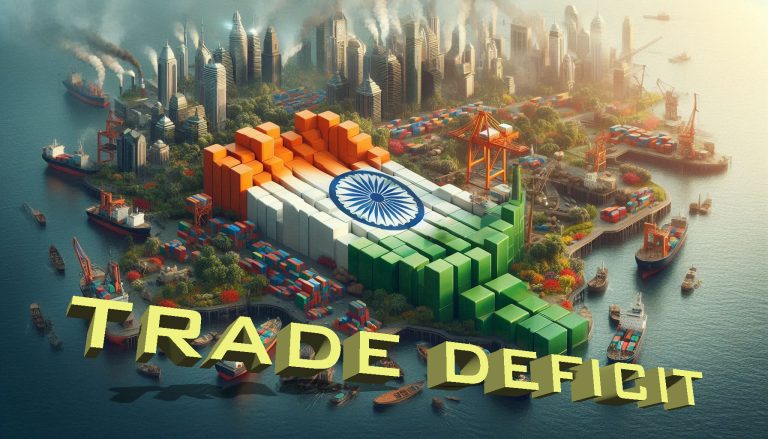
India’s merchandise trade deficit is expected to have narrowed to USD 20.88 billion in January 2025, down from USD 21.94 billion in December 2024, according to a report by Union Bank of India.
The report suggested that this improvement was primarily due to a decline in gold imports amid rising prices and the conclusion of the festival and wedding season.
It said “Merchandise trade deficit likely narrowed in Jan’25 to USD 20.88 bln vis-a-vis USD 21.94 bln a month ago. This was probably led by marginal moderation in the demand for gold amid surge in prices in the backdrop of uncertainty in the global markets”.
The narrowing of the trade deficit was likely influenced by a decline in gold imports, as higher global prices reduced demand. Gold prices have been rising due to uncertainty in global markets, making purchases costlier.
Additionally, with the festival and wedding season coming to an end, the need for gold has subsided, further contributing to the lower trade deficit.
However, the report noted that the oil trade deficit widened slightly due to an increase in global crude oil prices. Brent crude oil prices rose to USD 78.35 per barrel in January from USD 73.13 per barrel in December. As a result, India’s crude oil imports saw an overall increase.
The report noted that India imported 1.67 million barrels per day (bpd) of crude oil from Russia in January, marking a 13 per cent increase from December. Imports from other major crude oil suppliers also rose.
Saudi Arabia’s crude oil exports to India grew by 12 per cent compared to the previous month, while crude oil imports from the US saw a massive surge of 322 per cent, reaching 279,000 bpd in January from 66,000 bpd in December. Kuwait and Brazil also saw an uptick in oil exports to India.
In contrast, oil imports from Iraq declined by 8 per cent month-on-month. India’s total crude oil imports in January increased by 6 per cent, reaching 4.98 million bpd, up from 4.70 million bpd in December.
Despite higher crude oil imports, exports of petroleum products faced challenges. It said “Exports of petroleum products took a hit amid sluggish demand in developed economies after logistical disruptions along major supply routes, majorly in the Red Sea”.
The report outlined that while India’s trade deficit improved in January, the rising oil import bill remains a concern. The country’s dependence on crude oil imports and global market conditions will continue to influence its trade balance in the coming months.
(This news report is published from a syndicated feed. Except for the headline, the content has not been written or edited by OpIndia staff)
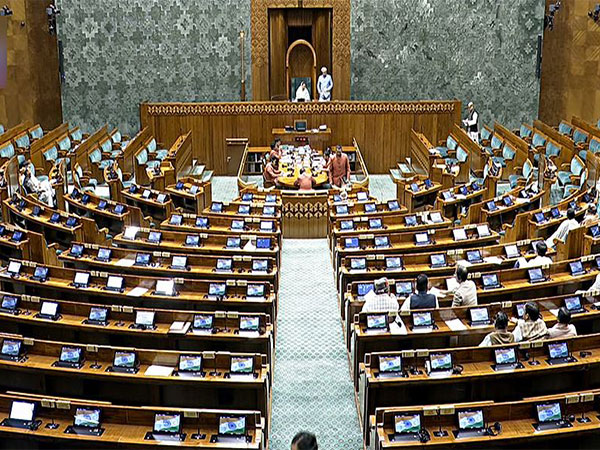
The Joint Parliamentary Committee (JPC) report on the Waqf (Amendment) Bill, 2024, was tabled in the Rajya Sabha on Thursday amid ruckus and continuous sloganeering from opposition members.
Bharatiya Janata Party (BJP) MP Medha Vishram Kulkarni presented the report. She also tabled a copy of the record of evidence given before the panel on the Waqf (Amendment) Bill, 2024.
The JPC report’s presentation was followed by uproar in the Upper House of the Parliament, leading to the adjournment of the session till 11.20 am. However, soon after the proceedings were resumed, the house again witnessed the disruption from the opposition MPs.
Earlier today, Jagadambika Pal, BJP MP and Chairman of the Joint Parliamentary Committee (JPC) on the Waqf (Amendment) Bill, said that the JPC will present its report in Parliament after six months of nationwide consultations.
Speaking to ANI, the JPC Chairman emphasized the committee toured the country to collect inputs before finalizing the report, which included the adoption of 25 amendments across 14 clauses.
“Today, the JPC will produce its report in the Parliament. To have a detailed discussion and deliberation, the JPC was formed six months ago. In the last six months, we have prepared a report after touring the whole nation. We have adopted 25 amendments in 14 clauses,” he said.
Meanwhile, Congress MP Gaurav Gogoi said that instead of focusing on the already available Waqf Act, an attempt is being made to bring a politically motivated amendment.
Speaking to ANI, Gogoi asserted that several members of parliament have expressed their dissent in the JPC report, highlighting the constitutional negligence caused by this bill.
“Currently, there is an act that manages Waqf properties, and instead of focusing on how the government can better implement this act, an attempt has been made to bring a politically motivated amendment,” he said.
Congress MP KC Venugopal also slammed the Centre and said that the way in which the JPC conducted, it “was wrong.”
The JPC on the Waqf (Amendment) Bill adopted the draft report and the amended revised bill on January 29. However, opposition leaders submitted their dissent notes on the report.
Trinamool Congress MPs Kalyan Banerjee and Md Nadimul Haque, who were members of the panel, had protested “the expunction of key portions of their dissent notes” submitted to the Joint Parliamentary Committee (JPC) on the Waqf (Amendment) Bill, 2024.
Banerjee and Haque alleged that the committee’s conclusions were biased and predetermined and claimed that the committee ignored stakeholder representations, witness depositions, and submissions made by opposition members.
The Waqf Act of 1995, enacted to regulate Waqf properties, has long been criticised for issues such as mismanagement, corruption, and encroachments.
The Waqf (Amendment) Bill, 2024 aims to address these challenges by introducing reforms such as digitisation, enhanced audits, improved transparency, and legal mechanisms to reclaim illegally occupied properties.
(This news report is published from a syndicated feed. Except for the headline, the content has not been written or edited by OpIndia staff)
On the 12th of February, Punjab Kesari published a report about an alleged Ayushman Bharat ‘scam’. The headline said that a massive Ayushman Bharat scam of Rs 562 crores had been detected with 2.7 lakh claims being found false.
As soon as the report was published, AAP trolls started defaming the Modi government claiming that the Ayushman Bharat scheme itself was a scam. The trolls questioned the integrity of the government claiming that the government itself was perpetrating a scam.
डंका बज रहा है दुग्गल साहब और मंडली का।
Fake claims in Ayushman Bharat: Rs 562.4cr fraud health insurance claims in India, 74cr of them from Punjab, Haryana, Himachal Pradesh | Chandigarh News – The Times of India https://t.co/0iuUWQTN8p
— Guramneet Singh Mangat l ਗੁਰਅਮਨੀਤ ਸ਼ਿੰਘ ਮਾਂਗਟ l (@guramneet) February 13, 2025
Another AAP troll questioned the media, asking why the Sheesh Mahal scam of former CM Arvind Kejriwal was being discussed instead of the Ayushman Bharat scam.
Ayushman Bharat has a probable 500 crore scam but why bother Papa ji. Let’s talk some irrelevant nonsense on prime time. https://t.co/m91egUpYMB
The insinuation was that a large portion of the budget allocated for Ayushman Bharat was a scam and that it was, somehow, the government that was responsible for this scam. The insinuation also was that the government allocated Rs 562 crores for a ‘scam’, essentially, that the crores of the government money had been spent fraudulently.
However, the truth is far from it.
What is the alleged Rs 562 crores Ayushman Bharat “scam”
The news of the Ayushman Bharat Scam comes from a question which was asked in the Rajya Sabha on the 12th of February by Amarendra Dhari Singh, an RJD leader.
A part of the question asked by AD Singh was – “Whether there are instances of fake billing in Ayushman Bharat Pradhan Mantri Jan Arogya Yojana (AB-PMJAY) by private sector hospitals thereby making the poor people agree to their greed”.
The government responded to the question, talking about 2.7 lakh claims being found to be fake.
The government said, “Out of 6.66 crore claims processed by NAFU, 2.7 lakh claims of private hospitals worth Rs. 562.4 crore were found to be non-admissible on account of abuse, misuse or incorrect entries. Further, any claims by empanelled hospitals found to be suspicious by NAFU are withheld until proper scrutiny by SAFU teams including field verification where necessary”.
The response by the government makes it clear that 2.7 lakh claims worth Rs 562.4 crores were found to be ‘non-admissable’ and that, these claims were ‘withheld’ for proper scrutiny.
This would mean that the private hospitals filed their claims with the government and the ones that were found suspicious (2.7 lakh claims) were withheld for investigation and the amount was NOT disbursed to the hospitals. Essentially, there was no “scam” since no money was disbursed in fulfilment of the fraudulent claims. The response means that the private hospitals were attempting to scam the government, however, the government did not pay them for the fraudulent claims they had raised.
What are the steps taken by the government to ensure efficient detection of fraud claims, ensure zero-tolerance
The National Health Authority (NHA) has put in several measures to ensure that there is efficient detection of fraud claims by private hospitals and once those fraud claims have been detected, there are measures in place to penalise the errant hospitals.
According to the response in Rajya Sabha (PDF), the government first and foremost blacklists suspends or de-panel the errant private hospitals.
Additionally, misuse/abuse claims are rejected, and penalties or legal actions are imposed on such hospitals. To enhance the detection of misuse or abuse, near real-time monitoring and AI-based systems are used to check hospital claims. Further, hospitals undergo random audits and surprise inspections to ensure the authenticity of claims. State Health Agencies (SHAs) also conduct regular desk medical audits as well as field audits.
As a result of the stringent measures, a total of 1,114 hospitals have been de-empanelled, and 549 hospitals have been suspended under AB-PMJAY.
The National Anti-Fraud Unit (NAFU) has employed 57 different technologies to detect fraud claims before the money is disbursed. These technologies include rule-based triggers and Machine Learning algorithms, fuzzy logic, image classification and de-duplication, etc. Other technologies and interventions such as enhanced access controls to the NHA IT system, near real-time dashboards to highlight suspicious cases, regular monitoring and cleansing of databases and other data analytic techniques are also deployed.
With the response of the government, it is clear that there was no “scam” in the Ayushman Bharat scheme. There were private hospitals that attempted to defraud the government by missing the system and raising false claims. The government, on its part, used advance technologies to identify the fraud claims and put the claims on hold pending investigation. 2.7 lakh claims amounting to Rs 562 crores were detected and thwarted – resulting in no loss to the public exchequer. Further, the government has so far de-empanelled 1114 hospitals and suspended 549 hospitals as punitive measures.
On Thursday, 13 February, Congress MP Manickam Tagore gave notice to move a motion for the adjournment of the Business of the House in the Lok Sabha to discuss the relaxation of “National Security Protocols” for the Khavda Renewable Energy Project in Gujarat along the India- Pakistan border.
In his notice, Tagore said, “The Khavda Renewable Energy Park Project, led by the Adani Group, is situated just one km from the sensitive India-Pakistan border in the Rann of Kutch, a region with a history of conflicts between the two nations.”
Tagore’s notice even claims that the Modi government neglected and went against military officers to steamroll this project. “The government went so far as to create exceptions for this project, and potentially others, near India’s borders with Pakistan, China, Nepal, Myanmar, and Bangladesh. This is a direct assault on the integrity of military advice and national security protocols. The Modi government’s cronyism, with its clear favouritism toward the Adani Group, is a threat to the sovereignty of our nation. The decision to award such a high-risk project to Adani raises severe concerns about conflicts of interest and transparency in governance,” he said.
The claims made by Congress are indeed concerning, not because what they are claiming, because Congress has been claiming that the BJP government does not take India’s military interests seriously for years. And the entire country knows that it is not a serious claim, at least when it comes from Congress, because generations of Indians have witnessed first hand how serious Congress was about India’s military and strategic interests.
What is problematic here, is that Congress seems to be taking orders from London.
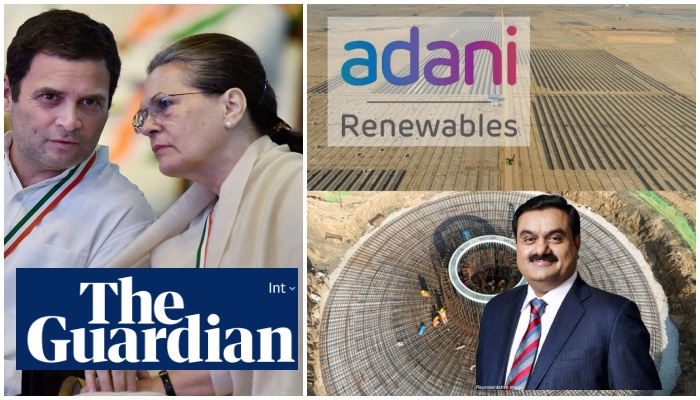
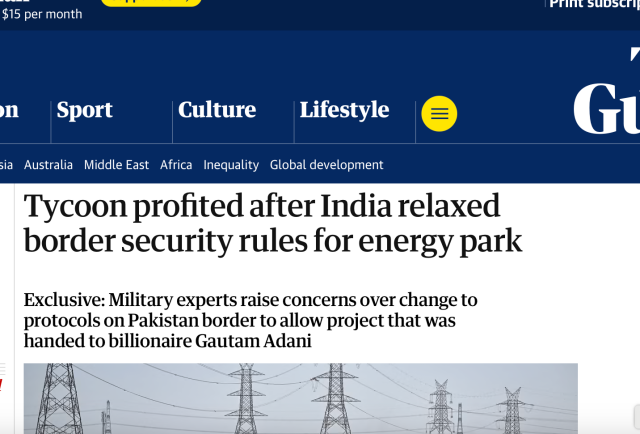
Congress party’s adjournment motion has been brought a day after British news portal The Guardian, known for its anti-India bias, published an ‘exclusive’ article full of speculations, unnamed sources and whisper-mongering about how the Khavda solar energy plant, planned to be the world’s largest renewable energy plant, is bad.
The reason that The Guardian has cited to claim the Khava energy plant is bad, is that it is ‘close to Pakistan border’. Another reason is that it is being built by Adani. They have no reason to claim Adani is bad, but they insinuate it anyway because we just have to trust them to tell us which political party and which company is good or bad because “trust me bro”. Substantiation is not needed when it is a British portal preaching sermons about good and evil to Indians.
Guardian article by Hannah Ellis Petersen and Ravi Nair
Guardian’s exclusive article titled “Tycoon profitedafter India relaxed border security rules for energy park”, authored by Hannah Ellis Petersen and Ravi Nair makes a lot of claims, and insinuations. It claims that the Adani Group was ‘charged’ by a US attorney, without mentioning that the attorney’s intentions were questionable owing to his political affiliations and the case itself was flimsy, raising a number of doubts as to why a US court would want a targeted smear campaign against a energy conglomerate in India.
The article is authored by Hannah Ellis Petersen and Ravi Nair. Petersen has been known to indulge in anti-India and anti-Hindu activism through her alleged ‘journalism’. OpIndia’s detailed article on her can be read here. Ravi Nair is associated with OCCRP, a George Soros and USAID-funded Leftist organisation that has targeted Adani in the past and has a clear political bias against the Modi government and for that matter, any major infrastructure development in India that ensures strategic energy security.
Guardian claims that they have come to know that security protocols were amended for the project. But they fail to substantiate what exactly is the problem if a country amends some earlier protocols to allow a major infrastructure project in a barren desert land that is sparsely populated and is not viable for farming or other activities? It is India’s own land after all. Why can’t India benefit from a solar project on its own land?
Further in the article, it is stated that the Gujarat government talked to the central government and the ministry of defence in particular to clear this project. That is indeed surprising because governments in Indian states are known to sit on proposed infrastructure projects for years, even decades, without clearing the deal and allocating land. How can a state government be efficient and serious about developing its state? Baffling indeed. No surprise that Congress is unhappy over it.
The main problem, cited by The Guardian and the so-called ‘military experts’, is that the Khavda energy plant, spread across a vast area, is at some places just a kilometre away from the Pakistan border. As per them it must be very wrong to develop infrastructure close to the border with a hostile nation.
Should we leave it barren and undeveloped because it is border area?
Well, leaving border areas unpopulated, undeveloped and desolate has cost India dearly in all these years. Border areas need good roads, good connectivity, and a nation hoping to grow fast to meet the aspirations of 1.4 billion people needs energy projects on an urgent basis. The Khavda energy plant, when completely developed, is designed to produce 30 Gigawatts of clean energy, enough to power a small country.
Khavda renewable energy plant, an emblem of global climate action, is progressing at an unprecedented speed to become the world’s largest energy generator on the planet. Delivering affordable green electrons, Khavda will not just power millions of homes but will also make India… pic.twitter.com/NMVWJdnsIf
The project will power millions of homes. Social initiatives by Adani Group are already helping villages in the area that earlier had very limited means of livelihood and progress. They are extending support to schools and working with local communities to foster economic progress, but as per Congress and Guardian, India must not allow it, because it is near Pakistan border.
The hybrid solar and wind energy park in Khavda is expected to start operations this year and it will also supply power to Google’s cloud services and operations in India. After completion and when running in full capacity, the plant is projected to generate 81 billion units of clean energy, and power 16 million households annually, more than the number of houses in Poland and Canada. The plant is also designed to generate 15,200 ‘green’ jobs.
In today’s world, sovereign energy production is as much a military strategy as buying tanks and guns. The Rann of Kutch is mostly barren, desert land. To claim that India should just leave it barren and not push for infrastructure projects is outrageous. The people who live in these areas deserve to be a part of the growth story, and every inch of India deserves connectivity and sustainable development, not just to make the country stronger but to keep us safe from the enemy nations in the neighbourhood.
Congress left India’s border regions undeveloped and backward for decades. The villages in border areas never got proper roads, schools or opportunities to earn a decent livelihood. Be it Rann of Kutch, Jammu and Kashmir, Jaisalmer, Ladakh or North East India, developing infrastructure and connectivity is not “bad”, it is a critical strategic necessity of the modern world.
When border areas have better roads, better mobility and technological connectivity, it helps the military in times of conflict. It also sends a strong message to the enemy nation, that these areas are not desolate and neglected so that they can trespass at will. Developed border villages are a message to the enemy that “we are watching your every move”.
Common sense dictates that a sophisticated energy plant that supplies power to millions of households and companies like Google will be protected from external threats and security challenges by a state-of-the-art security system, surveillance tech and personnel. For The Guardian and Congress to try and claim that the world’s largest green energy project will be a ‘security risk’ is not juvenile, it is misleading and clearly intended to spread fear among the masses.
Congress and its old habit of ‘foreign’ hungama in Parliament
Congress has an old habit of choosing the most mundane, useless, baseless topics to create disruptions in the parliament. Despite multiple failures and repeated rejections by the Indian voter, the party is yet to grasp that the parliament is to discuss issues that are of actual concern to the Indian public, not a stage to perform theatricals to please their foreign masters in Western nations.
At the start of the budget session, PM Modi had made a jibe at Congress and the Opposition in general, saying that for the first time after 2014, a Parliament session is about to begin without a ‘foreign spark’ to trigger disruption. He was hinting at precisely this habit of the Congress Party, to get some ‘foreign-origin’ trigger and try their best to manufacture outrage.
Session after session, the party leaves all relevant, important issues at bay and chooses topics that are custom-created out of thin air by some foreign publication or Western organisation and performs a political mujra to entertain their foreign Sahebs. Be it Pegasus, Rafale, Hindenburg, and now this fresh moronery, Congress seems to be doing a never-ending course study on how to waste Parliament’s time on baseless drivel.
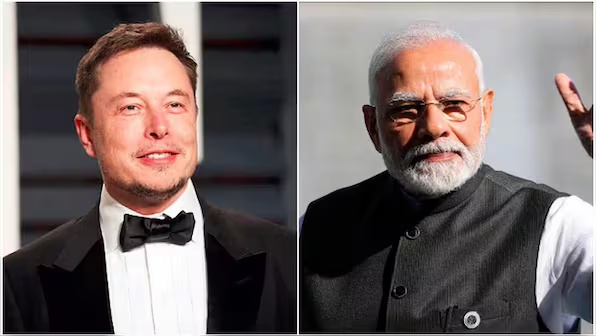
Prime Minister Narendra Modi will meet Elon Musk during his visit to the US and Starlink’s entry in the South Asian Market could be discussed during the meeting, Reuters reported, citing two people familiar with the plans.
Musk is likely to hold a meeting with PM Modi and the Indian government expects these could include Starlink’s plans to start satellite broadband services in India, Reuters reported citing two sources, who did not want to be named as the plans are private.
Starlink wants to start operations in India. The Indian government has backed Musk’s idea that spectrum should be assigned rather than auctioned. However, Starlink’s licence application is still being reviewed.
“Musk is agreeable to give assurances on India security concerns, which includes storing data locally,” one of the sources told Reuters.
Earlier in December, Musk announced Starlink satellite internet was inactive in India after authorities seized two of the company’s devices, one in an armed conflict zone and another in a drug smuggling bust, according to a Reuters report.
It was not clear whether Tesla’s entry into India would come up for discussion between PM Modi and Musk, Reuters reported, citing sources. However, increased sourcing of electric vehicle components from India is likely to be discussed during the meeting.
PM Modi is set to meet US President Donald Trump during his two-day visit to the US. PM Modi is travelling to the US after concluding his three-day visit to France. This will be the first visit of Prime Minister Modi to the United States since the inauguration of the second presidential term of President Donald Trump.
“Although this will be our first meeting following his historic electoral victory and inauguration in January, I have a very warm recollection of working together in his first term in building a Comprehensive Global Strategic Partnership between India and the US,” PM Modi had said in his departure statement.
“This visit will be an opportunity to build upon the successes of our collaboration in his first term and develop an agenda to further elevate and deepen our partnership, including in the areas of technology, trade, defence, energy, and supply chain resilience. We will work together for the mutual benefit of the people of our two countries and shape a better future for the world,” he added.
(This news report is published from a syndicated feed. Except for the headline, the content has not been written or edited by OpIndia staff)
US President Donald Trump has signed proclamations to close existing loopholes and exemptions to restore the 25 per cent tariff on steel and raise the tariff on aluminium to 25 per cent, White House Press Secretary Karoline Leavitt said on Wednesday (local time).
While addressing a press briefing on Wednesday (local time), Leavitt noted that Trump continues to take bold action to protect the steel and aluminium industries of the US.
“On trade, President Trump continues to take bold action to protect America’s critical steel and aluminium industries, much like he did during his first term. President signed proclamations to close existing loopholes and exemptions to restore a true 25 per cent tariff on steel and elevate the tariff on aluminium to 25 per cent as well. This administration believes these tariffs will protect our national security and put American workers first,” Karoline Leavitt said.
She announced that Tulsi Gabbard has been confirmed as Director of National Intelligence. She said that Gabbard’s swearing-in ceremony will take place at the White House.
Karoline Leavitt said, “On another important matter this morning, Senate Republicans continued to confirm President Trump’s exceptionally qualified nominees most recently Director of National Intelligence Tulsi Gabbard who will be joining us later at the White House for her swearing-in ceremony. It’s imperative that the remainder of the President’s cabinet nominees are confirmed as quickly as possible.”
The US Senate voted on Wednesday to confirm former Democratic Representative Tulsi Gabbard as Director of National Intelligence, CNN reported. The vote was 52-48 mostly along party lines, though Republican Senator Mitch McConnell of Kentucky joined Democrats in opposing the confirmation, as per CNN.
Gabbard, one of US President Donald Trump’s more controversial picks, faced concerns from several Republican senators over her lack of support for Ukraine; her shifting position on the Foreign Intelligence Surveillance Act’s Section 702, a key surveillance and security tool; her 2017 meeting with former Syrian President Bashar al-Assad; and her past support for Edward Snowden. However, key swing Republican senators, including Senators Susan Collins of Maine, Lisa Murkowski of Alaska and Todd Young of Indiana ultimately decided to back her confirmation.
Tulsi Gabbard is Trump’s 14th nominee to be confirmed since January 20. Her confirmation was a dramatic turnaround for a nomination that, from the start, has been among Trump’s most divisive. A former Democratic congresswoman from Hawaii, Gabbard drew scrutiny from Senate Intelligence Committee lawmakers over her views on surveillance and a series of controversial meetings she held in Lebanon and Syria in 2017, including with then-President Assad.
(This news report is published from a syndicated feed. Except for the headline, the content has not been written or edited by OpIndia staff)
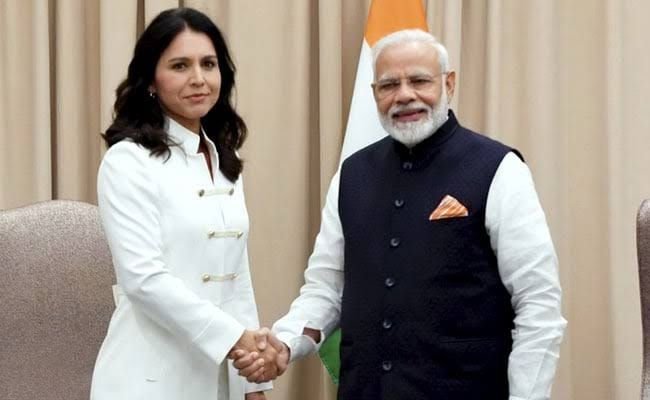
Prime Minister Narendra Modi held a meeting with US Director Of National Intelligence (DNI) Tulsi Gabbard in Washington, DC on Wednesday (local time). PM Modi and Gabbard discussed various aspects of India-US friendship.
PM Modi and Gabbard shook hands and warmly greeted each other. He congratulated Gabbard on her confirmation. The meeting comes just hours after Gabbard was sworn in as US Director of National Intelligence at the swearing-in ceremony in the White House.
“Met USA’s Director of National Intelligence, @TulsiGabbard in Washington DC. Congratulated her on her confirmation. Discussed various aspects of the India-USA friendship, of which she’s always been a strong votary,” PM Modi posted on X.
PM Modi arrived in the US for a two-day visit at the invitation of US President Donald Trump. India’s Ambassador to the US, Vinay Mohan Kwatra, and other officials welcomed him at the airport. This is PM Modi’s first visit to the United States after Donald Trump assumed office for the second term.
After landing in the US, PM Modi arrived at Blair House and greeted members of the Indian diaspora, who had gathered there to welcome him. People chanted “Bharat Mata Ki Jai” and Modi Modi” as they welcomed him at the Blair House. PM Modi thanked them for welcoming him.
“A warm reception in the winter chill. Despite the cold weather, the Indian diaspora in Washington DC has welcomed me with a very special welcome. My gratitude to them,” PM Modi posted on X.
Upon arrival in the US, PM Modi said that he looked forward to meeting with Trump and building upon the India-US Comprehensive Global Strategic Partnership.
In a post on X, PM Modi stated, “Landed in Washington DC a short while ago. Looking forward to meeting @POTUS Donald Trump and building upon the India-USA Comprehensive Global Strategic Partnership. Our nations will keep working closely for the benefit of our people and a better future for our planet.”
Ministry of External Affairs (MEA) spokesperson Randhir Jaiswal said that PM Modi, during his visit, will meet Trump, members of the US cabinet and industry leaders.
In a post on X, Jaiswal stated, “A new chapter in the India – US Comprehensive Global Strategic Partnership. PM @narendramodi arrives on an official working visit to Washington D.C., USA. During the visit, PM will meet @POTUS @realDonaldTrump, members of the US Cabinet & industry leaders.”
During his visit to the US, Blair House is more than just a luxurious guest house. It’s a symbol of American hospitality and diplomacy, a place where relationships are forged, and history is made. It is a luxurious, 70,000-square-foot extension of the White House.
Before departing for his visit, PM Modi stated that his visit to the US will be an opportunity to build on the successes of collaboration in his first term and develop an agenda to further elevate and deepen the partnership between the two nations.
In his departure statement, PM Modi said, “Although this will be our first meeting following his historic electoral victory and inauguration in January, I have a very warm recollection of working together in his first term in building a Comprehensive Global Strategic Partnership between India and the US.”
“This visit will be an opportunity to build upon the successes of our collaboration in his first term and develop an agenda to further elevate and deepen our partnership, including in the areas of technology, trade, defence, energy, and supply chain resilience. We will work together for the mutual benefit of the people of our two countries and shape a better future for the world,” he added.
Since November 2024, PM Modi and Trump have spoken on the phone twice. External Affairs Minister S Jaishankar attended the inauguration ceremony of President Donald Trump. During the visit, EAM Jaishankar also met US Secretary of State Marco Rubio and participated in the QUAD Foreign Ministers’ meeting in January 2025.
PM Modi arrived in the US after concluding his three-day visit to France. During his visit to France, PM Modi met with US Vice President JD Vance on Tuesday (local time).
Notably, India and the US launched a “strategic partnership” in 2005. The ties between the two nations were elevated to a Comprehensive Global Strategic Partnership during Trump’s visit to India in February 2020.
(This news report is published from a syndicated feed. Except for the headline, the content has not been written or edited by OpIndia staff)
The Shiv Sena (UBT) strongly criticised its ally, NCP (SP) leader Sharad Pawar on Wednesday for felicitating Maharashtra Deputy Chief Minister Eknath Shinde, highlighting rifts within the opposition Maha Vikas Aghadi (MVA).
Sena (UBT) spokesperson Sanjay Raut stated that honouring someone who played a key role in splitting the Shiv Sena and “weakening Maharashtra” was a serious insult to the sentiments of the Marathi people.
“Certain things should be avoided in politics. Sharad Pawar did not honor Shinde… he honored Amit Shah. That is how we see it. Bestowing such recognition upon someone we consider an adversary of Maharashtra is a blow to the state’s pride,” said party MP Sanjay Raut.
He added that while Pawar may have had a different perspective, this move has not been well received by the people of Maharashtra.
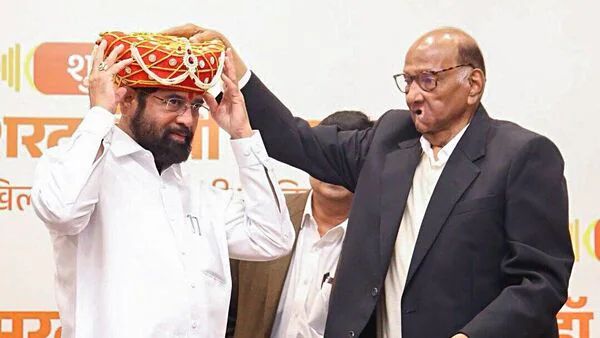
Shinde was conferred with the Mahadji Shinde Rashtra Gaurav Puraskar on Tuesday at an event in Delhi. The award was presented by Pawar in the presence of Union Minister Jyotiraditya Scindia during the 98th Akhil Bhartiya Marathi Sahitya Sammelan.
While Pawar’s party maintained that the event was focused on literature rather than politics, the BJP interpreted the felicitation as an acknowledgement by the NCP (SP) chief that Shinde was a superior chief minister to Uddhav Thackeray.