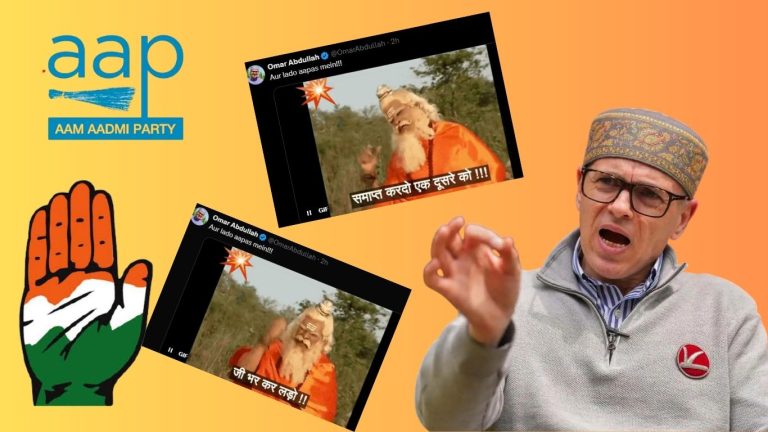
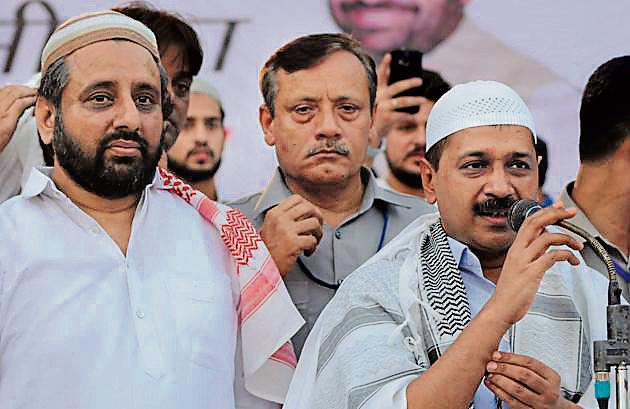
As the Aam Aadmi Party (AAP) and the Congress party are trailing in the early trends of the Delhi Assembly election results, Jammu and Kashmir CM Omar Abdullah took a veiled dig at the two parties for not putting up a united front in the elections.
Commenting on the election result trends on Saturday, Abdullah indirectly pointed out the internal tensions between the AAP and the Congress. He shared a sarcastic meme on X which said, “Fight till you want. Finish each other.”
AAP and Congress along with Abdullah’s party National Conference are part of the I.N.D.I. Alliance of the opposition parties. In the Delhi Assembly elections, the AAP is fighting for a third consecutive term while the BJP is seeking a return to power after almost three decades.
Congress says the I.N.D.I. Alliance was for Lok Sabha elections only
Speaking on the I.N.D.I. Alliance senior Congress leader Pawan Khera said that the political parties have a choice to fight in alliance or individually in state-level elections. “The alliance was forged for the Lok Sabha elections. The decision regarding fighting in alliance or individually is taken by the political parties according to the situation in a state, ” said Khera. The alliance was formed before the 2024 Lok Sabha elections by the leaders of 28 parties.
Early trends show the AAP struggling
The exit polls released by several polling agencies after the Delhi Assembly elections predicted a win for the BJP ending the three-term rule of the AAP. Some polling agencies predicted a close fight between the AAP and the BJP. However, almost all the exit polls were unanimous on Congress getting none or hardly 2-3 seats. The early election trends are matching the exit poll predictions as the AAP is struggling to hold its fort in even the 11 Muslim-dominated seats in Delhi.
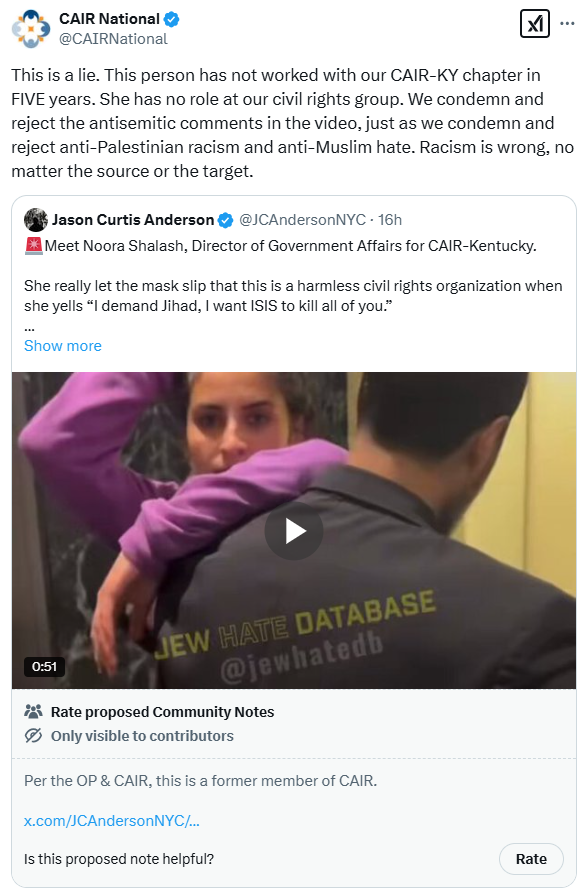
On 7th February (local time), a video went viral on social media allegedly showing Council on American–Islamic Relations (CAIR) Kentucky official Noora Shalash assaulting Jews inside a Mid-town Manhattan building. In the video, the woman, allegedly yelled, “I demand jihad, I want ISIS to kill all of you.”
The authenticity of the viral video was not independently verified by OpIndia. CAIR International has claimed that the woman in question has not worked with them for over five years. However, the organisation had shared a post in 2020 calling her a CAIR official.
? ALERT: JEW HATRED IN NYC ?
New York City ? “F*ck the Jew” ?
A woman chased, assaulted, and threatened Jews inside a Midtown Manhattan building! This is the reality of Jew hatred in 2025. pic.twitter.com/dRnT4SKCE5
According to a profile of Noora Shalash on the Israeli conservative news website VIN News, she serves as the Director of Government Affairs for the Council on American-Islamic Relations (CAIR) in Kentucky. Born in Amman, Jordan, Shalash was raised in Lexington, Kentucky. She has been actively involved in advocating civil rights for American Muslims through her organisation.
Earlier, she worked as a Senior Sales Leader at Coach and as a Sales Specialist at Victoria’s Secret. From 2016 to 2020, she served on CAIR Kentucky’s Board of Directors.
CAIR International, in a post, claimed that she had not worked with the organisation for over five years. CAIR wrote, “This is a lie. This person has not worked with our CAIR-KY chapter in FIVE years. She has no role at our civil rights group. We condemn and reject the antisemitic comments in the video, just as we condemn and reject anti-Palestinian racism and anti-Muslim hate. Racism is wrong, no matter the source or the target.”
Source: X
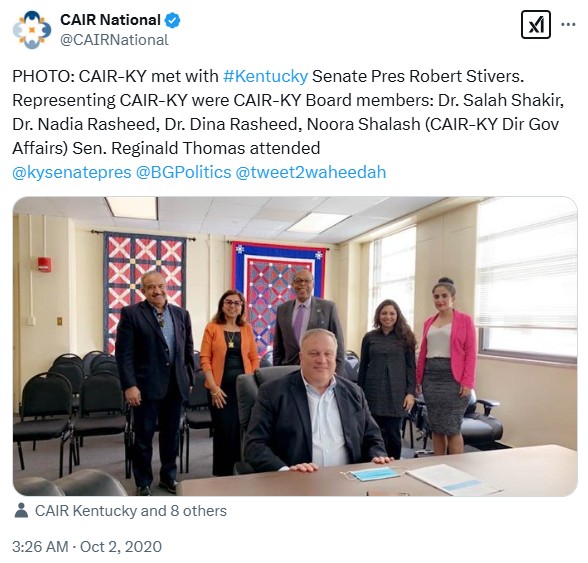
However, a post by CAIR from 2020, which is less than five years ago, mentioned her as ‘CAIR-KY Dir Gov Affairs’.
Source: X
OpIndia investigated the video and found that Noora Shalash had posted a photograph on Facebook wearing the same dress seen in the video. The photograph was published on 6th February with the caption, “New Jersey, so far, is the most disgusting place I’ve ever been to.”
Source: Facebook
CAIR and its problematic connections to terror outfits
CAIR identifies itself as a Muslim civil rights organisation in the United States that claims to protect ‘civil rights, enhance understanding of Islam, promote justice, and empower American Muslims’.The fact, however, is that CAIR is an Islamist group that has spoken against India and Hindus on several occasions. The organisation has been vehemently pushing Hinduphobia and anti-Hindu propaganda in India.
In 2022, CAIR released a report titled “Still Suspect: The Impact of Structural Islamophobia”, in which it said that there has been a rise in discrimination against Muslims living in the United States.
In its report, CAIR claimed that it had received 6,720 complaints nationwide last year involving a range of issues, including immigration, travel discrimination, law enforcement, government overreach, hate and bias incidents, custody rights, school incidents, and free speech incidents.
The CAIR claimed that government discrimination and bias continue to have a disproportionate effect on American Muslims and further demonstrate that Islamic communities continue to be viewed with suspicion. The report also listed the impacts of severe structural and interpersonal Islamophobia in the United States.
Ironically, CAIR, which always complains about alleged Islamophobia in the United States, has been aggressively promoting Hinduphobia and anti-Hindu propaganda in India. We are aware of how CAIR had extended support for the extremely Hinduphobic ‘Dismantling Global Hindutva‘ conference.
Not only this, but in December last year, CAIR had reportedly taken offence at the display of the names of the LeT terrorists and scenes from the deadly 26/11 terror attack that were displayed on a mobile billboard truck in New Jersey. While calling the movement of the vehicle ‘deliberate and well co-ordinated’, CAIR criticised the broadcast of 26/11 footage as ‘messages of hate.’ This was despite the fact that the mobile billboard truck did not display anything contentious but the truth.
In January 2022, CAIR launched Hinduphobic propaganda based on a report by alleged journalist Rana Ayyub. In a press release, CAIR demanded the movie theatres not to release Sooryavanshi, a Hindi movie. In the press release, CAIR alleged the movie spreads “disgusting and dangerous” anti-Muslim propaganda inspired by the ‘fascist Hindutva movement.’
The organisation has also called for the release of 49-year-old Pakistani terrorist Aafia Siddiqui, who is currently serving 86 years in prison for attacking US Army and FBI personnel in Afghanistan.
It is noteworthy that CAIR has links with the Palestinian Islamist fundamentalist terror organisation Hamas. Hamas has a long history of violating human rights. Hamas is designated as a terrorist organisation by several countries, including The European Union, the United States, Canada, Israel, Japan, Australia, the United Kingdom etc.
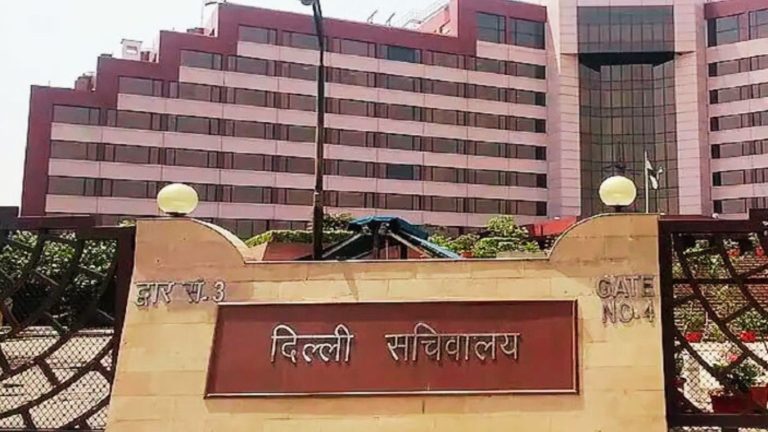
As the counting of votes in the Delhi Assembly elections is underway and the incumbent Aam Aadmi Party appears to be losing, the General Administration Department of the Government of Delhi has issued a notice to temporarily close the Delhi Secretariat to ensure the safety of the records.
The notice read, “To address security concerns and the safety of records, it is requested that no files/documents, Computer Hardware etc. may be taken outside the Delhi Secretariat complex without permission from GAD. It is, therefore, directed that necessary directions may be issued to the concerned Branch In-charges under the Departments/Offices situated in Delhi Secretariat to ensure the safety of records, files, documents, electronic files, etc. under their section/branches.”
General Administration Department, Government of Delhi issues a notice.
"To address security concerns and the safety of records, it is requested that no files/documents, Computer Hardware etc. may be taken outside Delhi Secretariat complex without permission from GAD. It is… pic.twitter.com/VZU4CU5xpt
An FIR was registered against Congress MP Rahul Gandhi in Odisha for allegedly making anti-India remarks. The FIR was registered at the Jharsuguda town police station on the complaint of some Hindu organisations and the BJP. An investigation is being carried out by the police in the case.
The FIR, filed by a person named Ram Hari Pujari, states that Gandhi’s remarks threatened the unity and integrity of the nation. It further states that he incited rebellion against the country by declaring war against the Indian state. Gandhi is also accused in the FIR of misusing his freedom of speech by making the statement. The statement was made by Rahul Gandhi on 15th January 2025 during the inauguration of the new Congress headquarters at Kotla Road, Delhi.
“Our ideology, like the RSS ideology, is thousands of years old and it has been fighting the RSS ideology for thousands of years. Do not think that we are fighting a fair fight. There is no fairness in this. If you believe we are fighting a political organisation, called the BJP or the RSS, you have not understood what is going on. The BJP and the RSS have captured every single institution of our country. We are now fighting, the BJP, the RSS and the Indian state itself, ” Gandhi said.
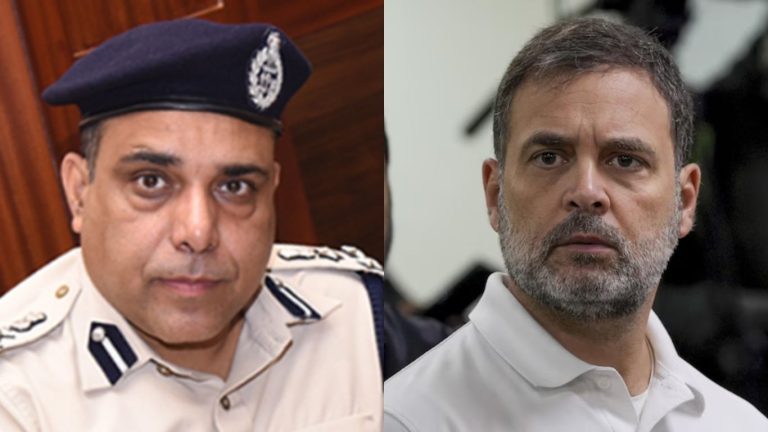
On receiving the complaint against Gandhi, IG range Sambalpur Himanshu Lal ordered the filing of the FIR. Speaking to OpIndia, IG Lal said, “Activists of some Hindu organisations including Bajrang Dal, the RSS and the BJP had complained about Rahul Gandh’s statement. On this complaint, the police found the allegations true in the prima facie investigation. I have ordered a FIR in this regard.”
“A case has been registered under relevant sections of the BNS in the matter, we are investigating it in detail. As per the rules, a notice will also be sent to Rahul Gandhi in this regard and further action will be taken. His side will also be taken, ” he added.
OpIndia spoke to P Jharunguda Smit Parmar in this matter, who confirmed that an FIR has been registered. He has said that a case has been registered against Rahul Gandhi under sections 152 and 197 (1) (D) of the BNS. OpIndia has a copy of the FIR. Section 152 criminalises attempts to excite, secession or armed rebellion or subversive activities, or encourages feelings of separatist activities or endangers the unity, sovereignty and integrity of India. Section 197(1)(D) deals with the acts of making or publishing false or misleading information that can endanger India’s sovereignty, unity, integrity or security.
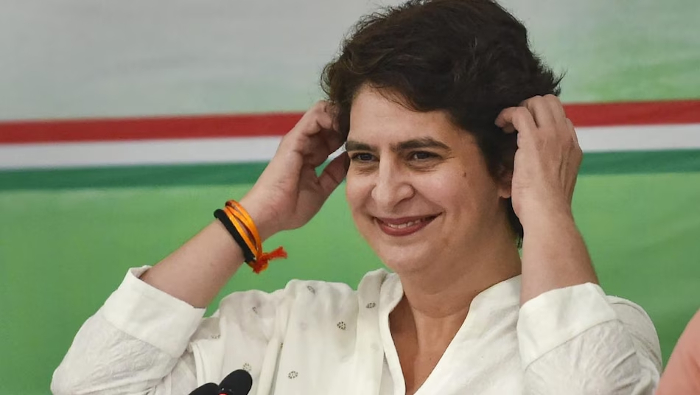
Congress MP Priyanka Gandhi Vadra who arrived at Kannur Airport on Saturday morning said that she has not checked the trends of the counting of votes in the Delhi Assembly elections.
Speaking to mediapersons here, the Wayanad MP responded to a query posed to her about the results projected in early trends posted by the Election Commission today. “I don’t know, I haven’t checked the results yet.”
The BJP crossed the majority mark in the Delhi assembly election results, as per trends posted by the poll body. According to the available trends, the party, which was in power in Delhi for 15 years, was seen trailing in all 70 constituencies in the national capital. In the 2013 assembly elections the Congress had won eight seats.
Polling for the 70-member Assembly was held on February 5, with a total voter turnout of 60.54 per cent.
Along with Delhi, the counting for by-elections in Uttar Pradesh’s Milkipur seat and Tamil Nadu’s Erode seat is also underway.
Meanwhile, as BJP is leading in the majority of seats in the Delhi assembly election, Jammu and Kashmir Chief Minister Omar Abdullah took a jibe at opposition INDIA bloc members Congress and Aam Aadmi Party (AAP).
Abdullah, a senior leader of the National Conference, which is also part of the INDIA bloc, took to X as early trending counting trends indicated a loss for both the ruling AAP and Congress in Delhi.
Sharing a popular meme, which purportedly said, “Jee bhar kar lado. Samaapt kardo ek dusre ko!” He also captioned the post, “Aur lado aapas mein!!! (Fight amongst yourselves some more).”
This came after the BJP took an early lead in 41 seats in the 70-member legislature in the national capital.
The sharp remark was intended after Congress and AAP’s decision to contest the Delhi elections separately, despite being allies under the INDIA bloc banner.
Notably, the Jammu and Kashmir CM had earlier questioned the very existence of the INDIA bloc.
All security arrangements have been put in place. Polling for the 70-member assembly was held on February 5, with a total voter turnout recorded at 60.54 per cent.
The AAP is aiming for a third consecutive term, while the BJP is making all efforts to return to power after more than two decades in the National Capital.
Most exit polls released on Wednesday gave the BJP an edge over the AAP. However, AAP leaders said that exit polls have historically underestimated the party’s performance. They expressed confidence in returning to power.
Key constituencies include New Delhi, where AAP leader and former Delhi Chief Minister Arvind Kejriwal is contesting against Congress leader Sandeep Dikshit and BJP’s Parvesh Verma.
(This news report is published from a syndicated feed. Except for the headline, the content has not been written or edited by OpIndia staff)
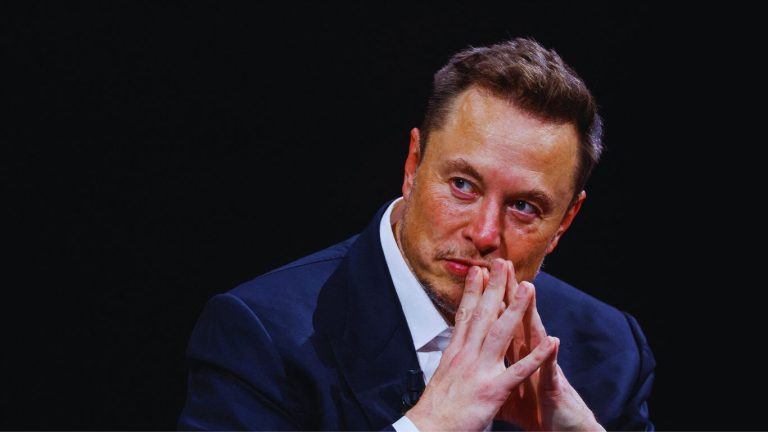
A staff member of the Department of Government Efficiency (DOGE), a newly formed department in the Trump administration headed by Elon Musk, resigned after his racial social media posts from the past surfaced online. However, he will likely be reinstated.
As per reports, the DOGE employee named Marko Elez (25) was fired after The Wall Street Journal reported some racist posts by a now-deleted X account linked to him. Elez had reportedly posted inflammatory remarks last year from a pseudonymous account.
“Just for the record, I was racist before it was cool,” he posted in July last year. In another post made in September, he said, “You could not pay me to marry outside of my ethnicity”. In the same month, Elez posted, “Normalise Indian hate”. The posts no longer exist. The information of Elez’s resignation was confirmed by White House spokesperson Karoline Leavitt.
Elon Musk held a Twitter poll after Elez’s resignation asking X users whether he should be reinstated. 78 per cent votes came in favour of reinstating him.
Bring back @DOGE staffer who made inappropriate statements via a now deleted pseudonym?
While disagreeing with Elez’s racist posts, US Vice-President J D Vance, who is married to someone of Indian origin, came out in his support and said that he should be given a second chance. Vance commented on the Twitter poll held by Musk and said, “Here’s my view: I obviously disagree with some of Elez’s posts, but I don’t think stupid social media activity should ruin a kid’s life. We shouldn’t reward journalists who try to destroy people. Ever. So I say bring him back. If he’s a bad dude or a terrible member of the team, fire him for that.”
Here’s my view:
I obviously disagree with some of Elez’s posts, but I don’t think stupid social media activity should ruin a kid’s life.
We shouldn’t reward journalists who try to destroy people. Ever.
Marko Elez, a computer science major from Rutgers University, worked for Musk at SpaceX, including on Starlink satellites and X. He also co-founded a startup named Unimetrics.io that connected high-school students with their mentors to help them with their college applications.
The results of the Delhi Assembly elections are coming out on Friday (8th February, 2025). In the trends so far, BJP seems to be returning to power in the National Capital after 27 years. The trends are showing that AAP is performing very badly after sweeping the last 2 elections. AAP is not getting votes even in those Muslim areas where it had maintained its supremacy continuously since 2013. Many big names of AAP are also trailing as per the trends.
Delhi’s famous Okhla seat, from where Amanatullah Khan is the sitting MLA, is also witnessing the same trend. He seems to be struggling to win even in his own bastion. BJP’s Manish Chaudhary has given him a tough fight and Chaudhary is ahead of Amanatullah by 1800+ votes in the counting till 9:30 AM. Muslim votes are likely to be divided between AAP and Congress on this seat.
At the same time, AAP may have to face a bad defeat in Delhi’s Mustafabad seat as well. Mohan Bisht of BJP is leading AAP’s Adeel Ahmed Khan by 5 thousand votes. This difference is likely to increase further. There is also talk of Congress dividing votes here. AIMIM candidate Tahir Hussain is also believed to have played a role in dividing Muslim votes.
BJP is also ahead in Muslim dominated seat Jangpura. Here BJP’s Tejinder Singh Marwah has left AAP’s Manish Sisodia behind. Manish Sisodia used to contest elections from Patparganj earlier. He changed his seat and switched to Jangpura this time.
BJP is also leading in Kasturba Nagar seat. Neeraj Baisoya of BJP is leading from Kasturba Nagar. He is ahead of Naresh Pehalwan of AAP by 2500 votes. Karnail Singh of BJP is leading from Shakur Basti seat, with corruption accused Satyendra Jain of AAP trailing by 3000 votes.
However, AAP is getting lead from Chandni Chowki seat which has Muslim votes. Here AAP’s Punardeep Singh Sahni is leading Mudit Agarwal of Congress. AAP has also got lead in Matia Mahal seat. Here AAP’s Ale Mohammad Iqbal is leading Asim Ahmed Khan by 4000 votes.
Meanwhile, Gopal Rai is leading from Babarpur seat. Here AAP is leading BJP by over 5000 votes. Kapil Mishra is leading from VIP seat Karawal. Here too there are a large number of Muslim votes. Kapil Mishra is ahead of AAP candidate by 6 thousand votes.
AAP has got a slight lead in Seelampur which has also predominantly Muslim votes. Here AAP’s Zubair Ahmed has got a lead of 700 votes over BJP’s Anil Sharma.
On Friday, February 7, Industrialist and Adani Group chairman Gautam Adani’s youngest son, Jeet Adani, married Diva Jaimin Shah in a private wedding ceremony attended by close family and friends.
Gautam Adani shared the news on social media platform X, posting pictures from the wedding.
“With the blessings of the Almighty, Jeet and Diva united in the sacred bond of marriage today. The wedding, held in Ahmedabad, was conducted with traditional rituals and Shubh Mangal Bhaav in the presence of close family and loved ones. It was a small and highly private ceremony, and although we wished to, we couldn’t invite all our well-wishers. I sincerely apologize for that,” Gautam Adani shared in a post in Hindi.
परमपिता परमेश्वर के आशीर्वाद से जीत और दिवा आज विवाह के पवित्र बंधन में बंध गए।
यह विवाह आज अहमदाबाद में प्रियजनों के बीच पारंपरिक रीति रिवाजों और शुभ मंगल भाव के साथ संपन्न हुआ।
यह एक छोटा और अत्यंत निजी समारोह था, इसलिए हम चाह कर भी सभी शुभचिंतकों को आमंत्रित नहीं कर सके,… pic.twitter.com/RKxpE5zUvs
Jeet Adani got engaged to Diva Shah, daughter of Gujarat-based diamond merchant Jaimin Shah, on March 12, 2023, in an intimate ceremony in Ahmedabad.
The wedding rituals commenced at 2 PM today, following traditional Jain and Gujarati customs, at ‘Shantigram,’ the Adani township in Ahmedabad. Ahead of the wedding, on February 6, the couple enjoyed a lively pre-wedding celebration, where they performed ‘bhangra.’ Gurdeep Mehndi, son of renowned singer Daler Mehndi, electrified the event with his high-energy performance, captivating the audience with his signature style.
During his Maha Kumbh Mela visit last month, Gautam Adani had promised a “simple and traditional” wedding for his son, Jeet Adani. True to his word, he kept the ceremony modest while also silencing speculation of a grand affair. Instead, the billionaire donated ₹10,000 crore to various social causes.
Guided by his philosophy—Seva Sadhana Hai, Seva Prarthana Hai, Seva Hi Parmatma Hai—Adani’s donation will primarily fund large-scale infrastructure projects in healthcare, education, and skill development. The focus will be on creating affordable world-class hospitals, medical colleges, K-12 schools, and global skill academies with assured employability.
Jeet Adani is the Director at Adani Airports, overseeing operations at six international airports and leading the development of a seventh in Navi Mumbai. He graduated from the University of Pennsylvania’s School of Engineering and Applied Sciences.
Two days before the wedding, Gautam Adani introduced Mangal Seva, an initiative supporting newly married women with disabilities. Initially, 500 such women will receive ₹10 lakh each annually. To mark the launch, Jeet Adani met 21 newly married divyang women and their husbands.
The Donald Trump administration has cracked down on the controversial United States Agency for International Development (USAID). It has sent senior officials on leave, fired contractors and, most importantly, imposed a sweeping freeze on foreign assistance. Elon Musk, tasked to head DOGE (Department of Government Efficiency), has dubbed USAID a ‘criminal organisation’. “Time for it to die,” he said in a tweet on Sunday (2nd February). As a result, the USAID website and its X account were taken down.
The USAID has long been regarded, at least unofficially, as a regime change operator of the USA. The United States Agency for International Development (USAID) was set up in the early 1960s to administer humanitarian aid programmes on behalf of the US government – however, behind the lofty punch words, lies a murky world of regime change operations, clandestine funding and undermining of sovereign nations.
One of the sovereign nations that USAID took special interest in, is India. While millions of dollars flowed directly into India, there are several projects and NGOs, funded by USAID, that work “internationally”, including in India, and work to undermine the interests of India at large and Hindus, specifically. For example, the Atlantic Council, funded by the US Deep State and specifically by USAID, attempted to use journalists and ‘fact-checkers’ and launched a massive campaign to censor private messages on Whatsapp and other platforms to dent the support for Prime Minister Narendra Modi. One of the major donors to the Atlantic Council and this specific initiative was George Soros as well – the billionaire who had floated a $1 Billion fund to counter nationalist leaders like PM Modi and Donald Trump.
The web of the deep state is a rather fascinating spider’s web with several layers and linkages. For example, there is credible evidence to suggest that the US Deep State including USAID has substantial influence within the Indian National Congress with Sam Pitroda, Rahul Gandhi’s prime mentor and Congress’ overseas chairman, being squarely in bed with them.
It therefore, suffices to say that over the years, USAID managed significant budgets to drive its initiatives, which included toppling governments, establishing favourable regimes, creating hostile environments for political leaders left-liberals dislike, and more. Interestingly, a large chunk of US taxpayers’ money was used for these activities. In the 2023 fiscal year alone, the agency oversaw over $40 billion in appropriations, making up more than a third of the funds allocated to the Department of State, Foreign Operations, and related programs.
With Donald Trump and Elon Musk’s DOGE biting USAID, several hitherto unknown interference layers are being unravelled. OpIndia’s detailed and ongoing investigation into USAID can be explored here.
One of the hitherto unexplored layers of foreign interference in India is that of the clandestine effort to convert the indigenous people of Bharat – the Hindus – specifically to Christianity. As this investigation will show, USAID contributes substantially towards the effort.
World Vision Inc. and USAID – the money trail
In 2020, OpIndia touched upon the activity of an NGO called “World Vision Inc.”. In June 2020, NDTV partnered with this NGO to supposedly establish a “hunger-free India”. In May 2020, NDTV had also solicited donations in partnership with World Vision. The program was supposed to help children suffering from hunger amidst the global COVID-19 pandemic.
#HungerFreeIndia | "About 6 lakh children under the age of 5 are at the risk of facing death as per the Lancet report": Madhav Bellamkonda, National Director, World Vision India
According to a list published by Forbes, World Vision was one of the top Christian NGO beneficiaries of USAID funds.
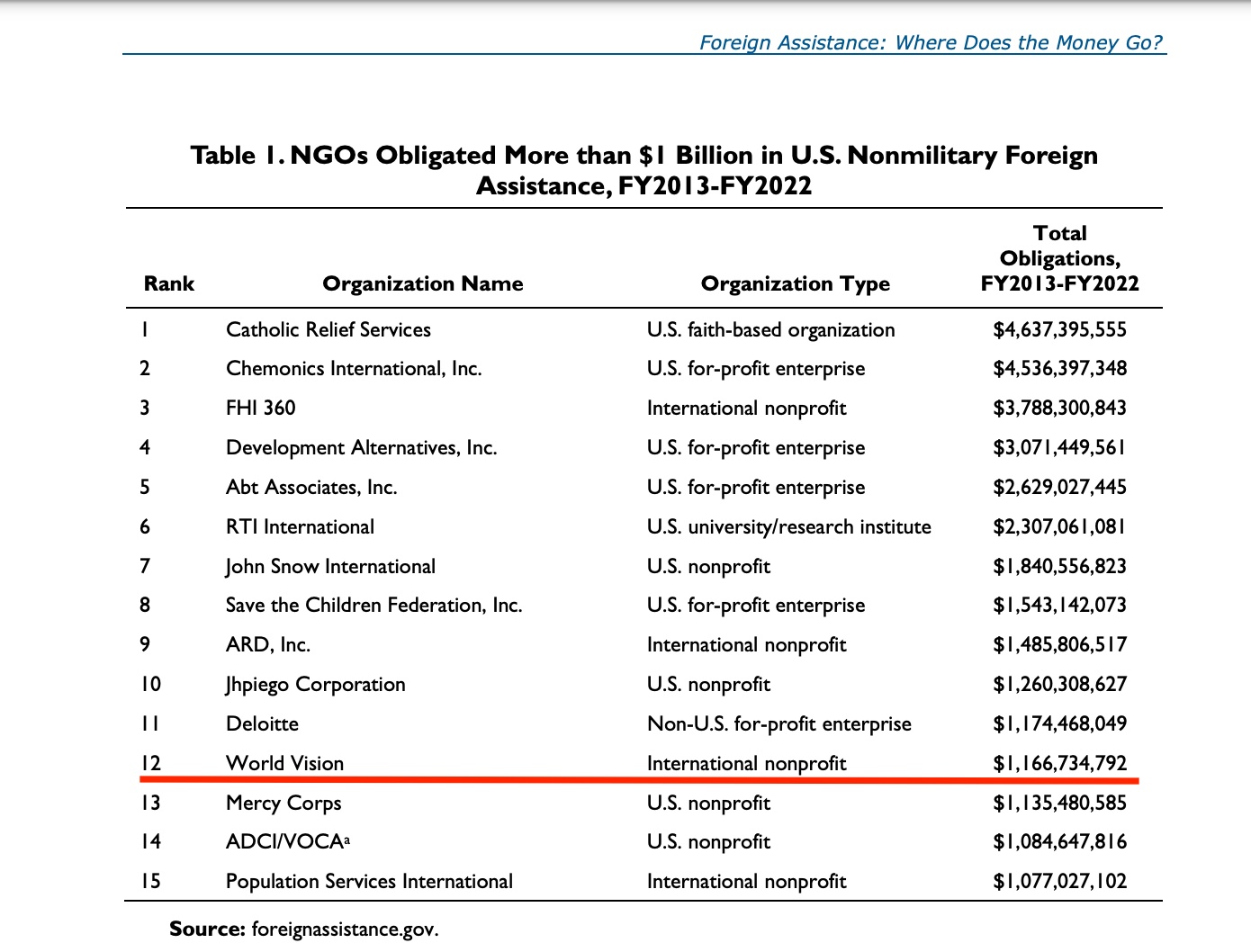
Between 2013 and 2022, World Vision received over $1.2 billion from USAID.
A Congressional Research Service report (CRS report) also testified to the quantum of funds that USAID gave to World Vision.
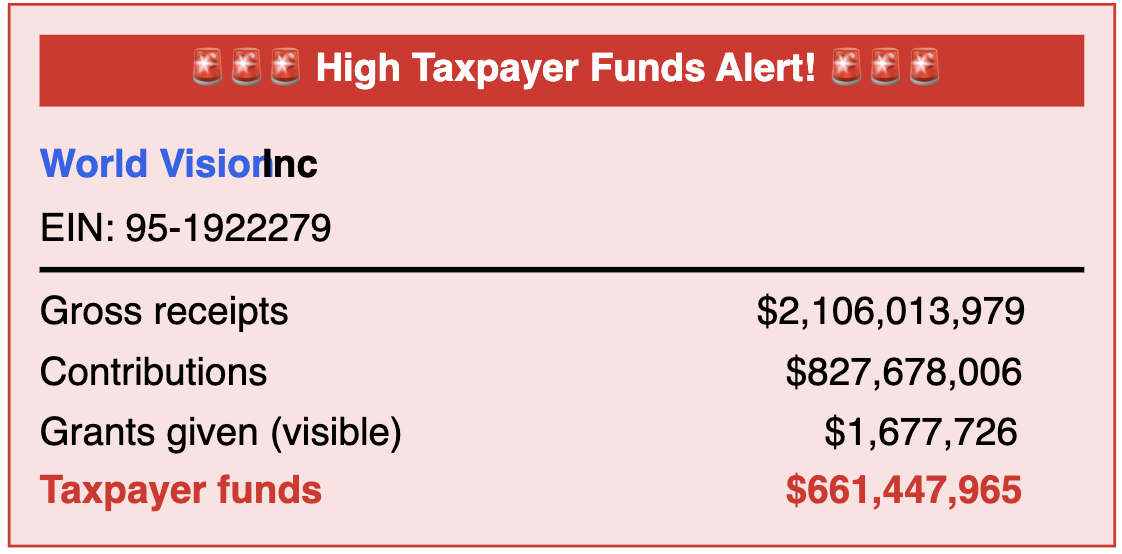
According to Data Republic, World Vision INC got over $2 Billion with a high contribution of US taxpayer money.
TIME Magazine reported how Christian organisations, like World Vision, were responding to the USAID freeze announced by the Donald Trump administration. The magazine writes, “Evangelical and other Christian charities have not been spared these cuts. Among the organizations that lost funding are such Christian behemoths as World Vision, International Justice Mission, Samaritan’s Purse, and Catholic Relief Services, which at $476 million, was the largest USAID recipient in 2024.Because of the vagueness of the language around which programs would still be funded, some groups pulled back their spending, just in case. “World Vision is responding to the executive order that pauses U.S. foreign assistance funding—except emergency food assistance—for the next 90 days, while programs are reviewed for alignment with the current administration’s foreign policy,” said the international relieforganization in a statement to TIME”.
Another publication, Christianity Today, quoted a USAID official who used to work with World Vision. The publication says, “Most of USAID’s budget goes to grants for specific development projects, including at Samaritan’s Purse, World Vision, World Relief, Catholic Relief Services, and many other faith-based groups. It supports local Christian health clinics in Malawi and groups providing orphan care”.
It further quoted the official. “It is exceptionally painful to watch all this,” said Kent Hill, a former top official at USAID who also worked at World Vision and in Christian higher education as the president of Eastern Nazarene College. If USAID has specific problems, shutting the whole agency down instead of addressing the problems is a “tremendous overreaction” and “inhumane,” he said.
World Vision internationally boasts of being present in nearly 100 countries with at least 34,000 people working for them. One of the countries where they are present – is India.
World Vision India presents itself as a Christian humanitarian organisation that focuses on the well-being of children, their nutrition, poverty upliftment etc – the usual tropes.
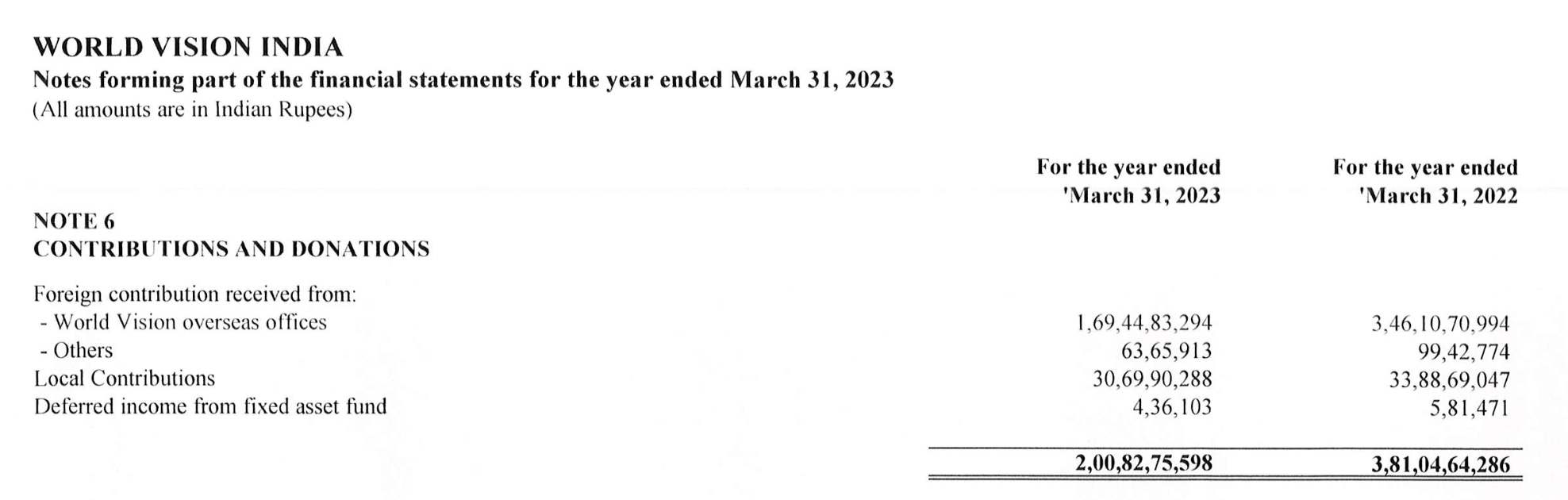
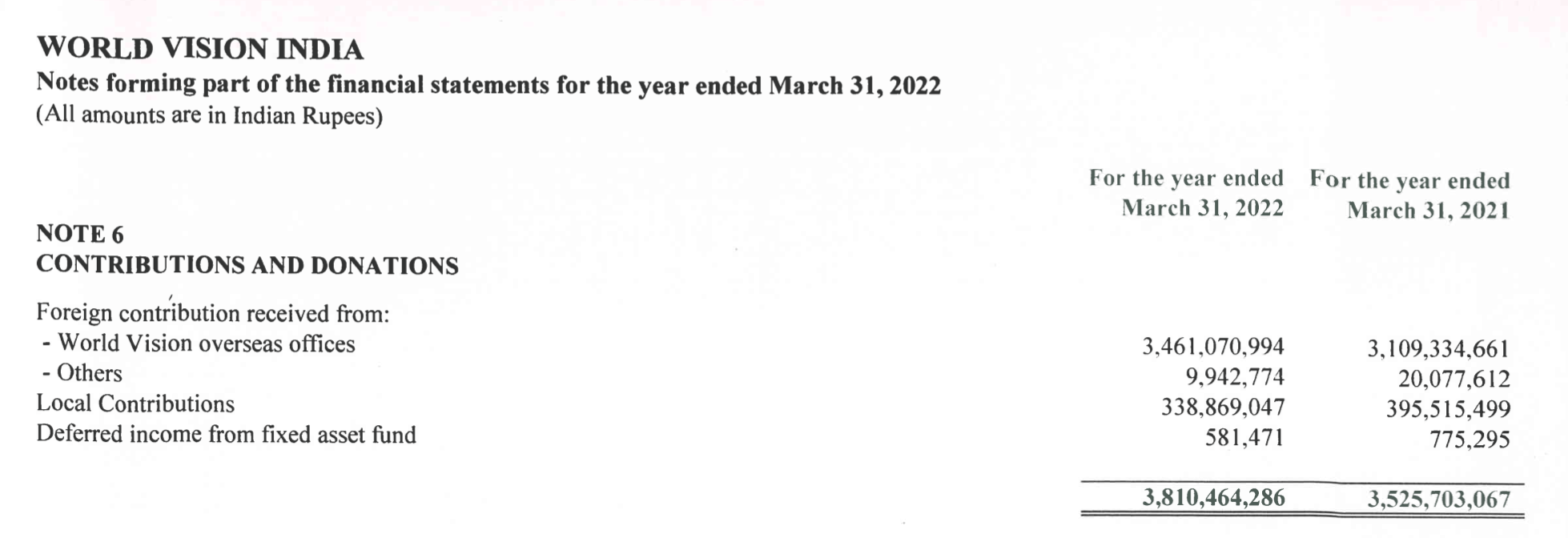
World Vision India gets a bulk of their revenue from World Vision International and certain “other” foreign contributors – unmentioned by name in their financial statements. Their 2023 financial statement shows that they received almost Rs 170 crores from World Vision Overseas offices – which is funded by USAID – to the tune of over a billion dollars in 10 years.
In the financial year ending March 2022, they received almost Rs 350 crores from World Vision Inc. and in the financial year ending 2021, they received upwards of Rs 310 crores.
Given that World Vision Inc. is one of the top recipients of USAID grants and has received over a billion dollars, it is safe to say that World Vision India is also funded by USAID.
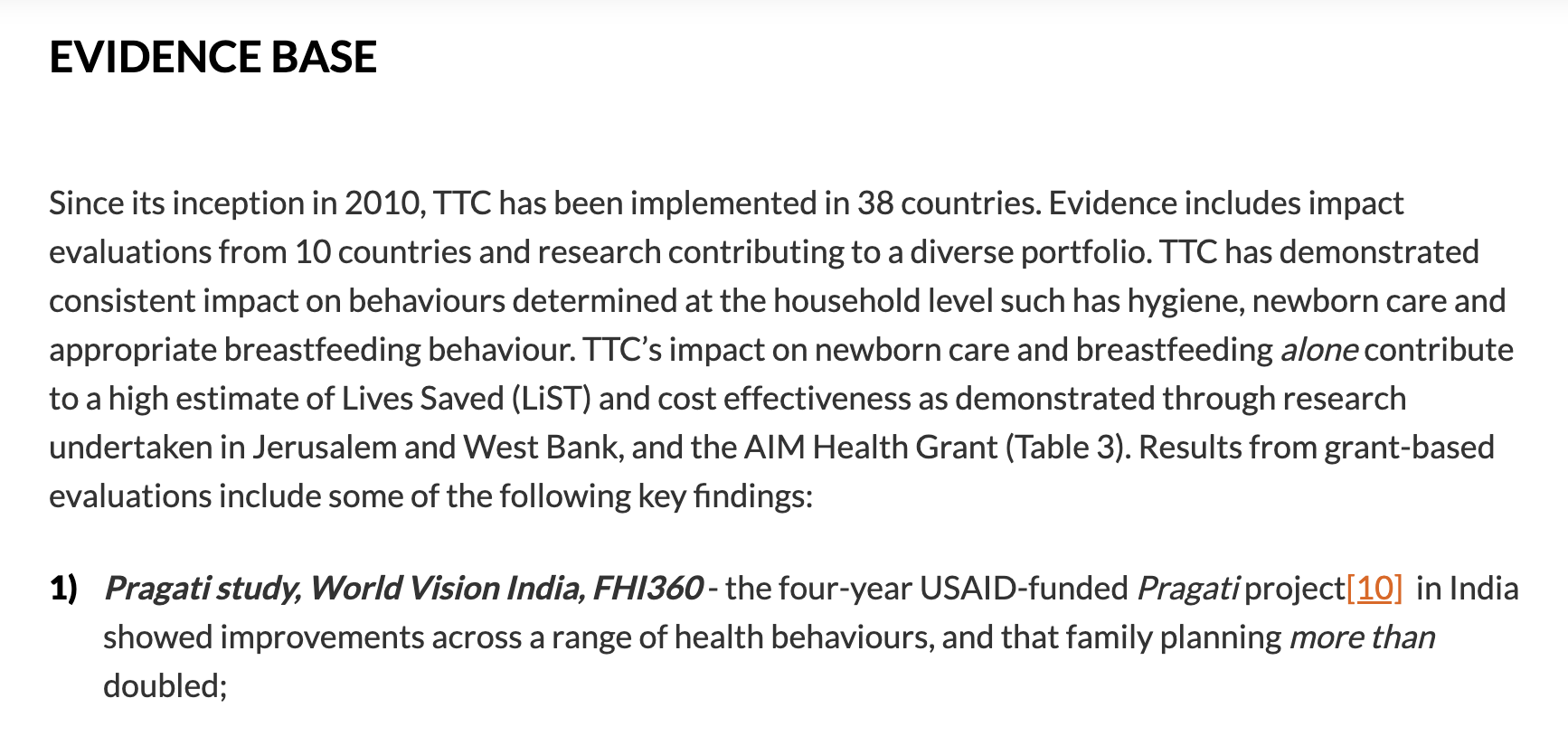
On the World Vision website (the page of the parent organisation directly funded by USAID), an interesting project called “Pragati”. On the website, it is listed that Pragati was a joint venture between World Vision and FHI 360.
The listing specifically says that it is a USAID-funded project. Interestingly, FHI360 is also an organisation which is funded by the USAID. FHI360 has received $3.78 billion from USAID between 2013 and 2022.
Is World Vision a ‘secular’ organisation working towards humanitarian causes – What they claim
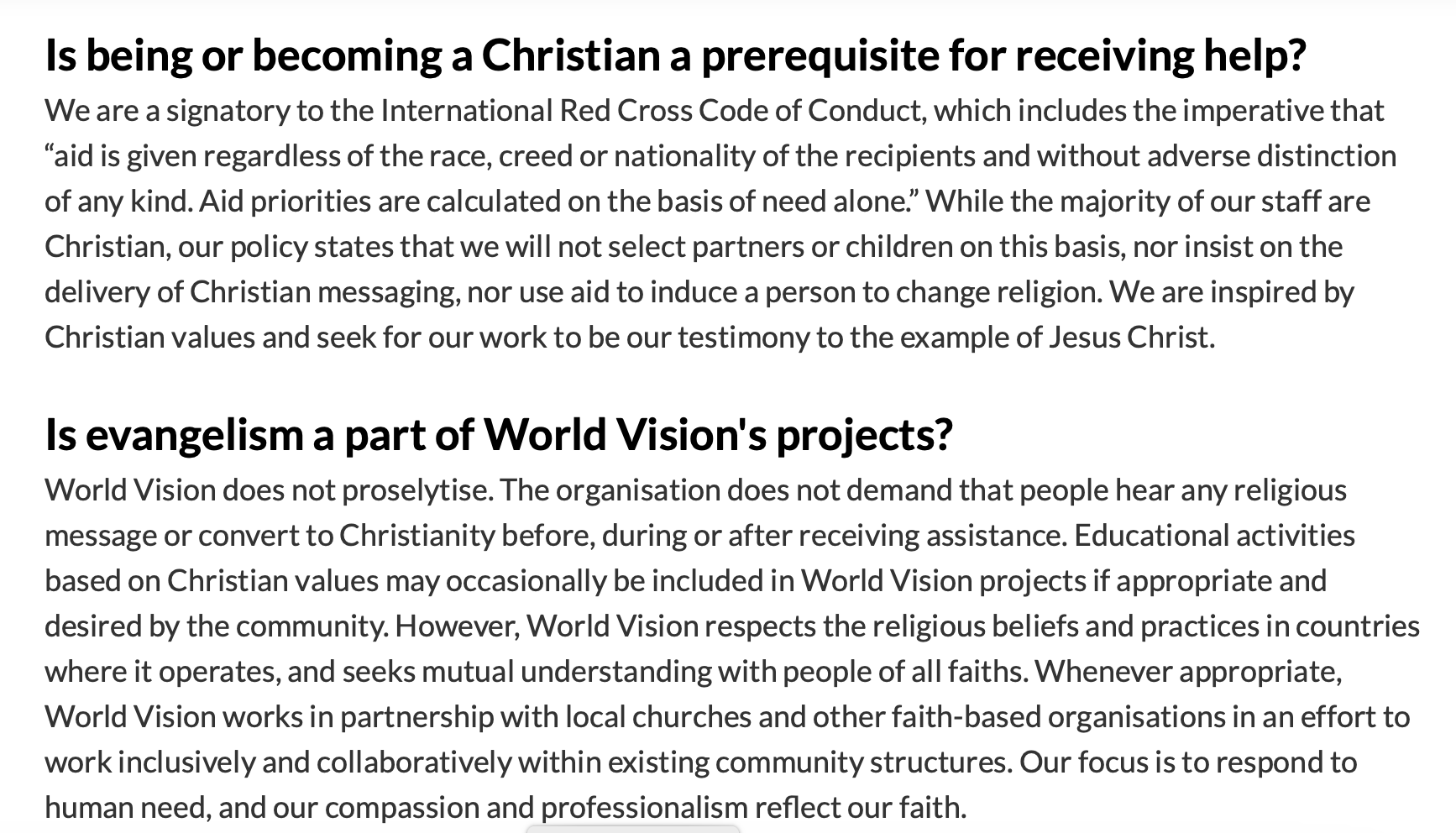
On the face of it, World Vision claims that it does not indulge in proselytisation (conversion) and does not let faith come in the way of who it partners with and/or the children it selects for its humanitarian work. In the FAQ section of the World Vision website (the parent organisation), the NGO claims that one does not have to be a Christian to receive aid from the NGO. Further, the NGO claims that it does not indulge in proselytisation activity.
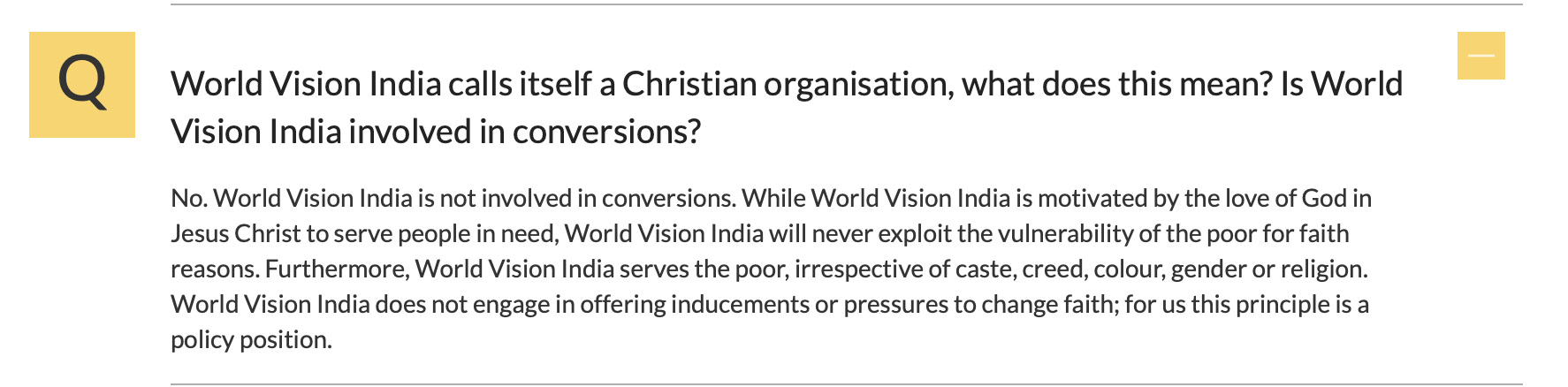
World Vision India also claims that while it is indeed a Christian organisation, it is only “motivated by the love of God in Jesus Christ” and does not exploit the vulnerabilities of the poor to convert them to Christianity.
Therefore, it is clear that World Vision attempts to claim that the NGO does not use the vulnerabilities of Hindus to convert them to Christianity.
While World Vision makes such tall claims, the truth is, possibly, far from it.
USAID funded World Vision – Predatory Proselytisation masked as humanitarian work
One of the primary ways in which Christian missionaries proselytise is to exploit the vulnerabilities of the poor and marginalised. The Hinduphobia Tracker, an NGO which tracks religiously motivated hate crimes against Hindus, defines ways in which Hindus are converted. Proselytisation by Inducement is defined as, “Predatory Proselytisation is not just limited to threat, harassment, force and violence, but it also has contours of stealth. In several cases, the Hindu victim is exploited to convert, with non-Hindus taking advantage of their poverty. In such cases, the Hindu victim who is suffering financially is offered monetary benefits, including lucrative offers for jobs, health treatment etc, to induce the victim into changing his/her religion. In such cases, the religious identity of the victim and the aim to disenfranchise him from his faith form the heart of the crime. Also, taking advantage of and exploiting an individual’s economic vulnerabilities is widely acknowledged as exploitation, forms of which are often penalised by law. Such cases therefore are considered religiously motivated hate crimes since the victim’s religious identity forms the very heart of the crime itself”.
There are several markers that World Vision indulges in proselytisation despite declarations to the contrary.
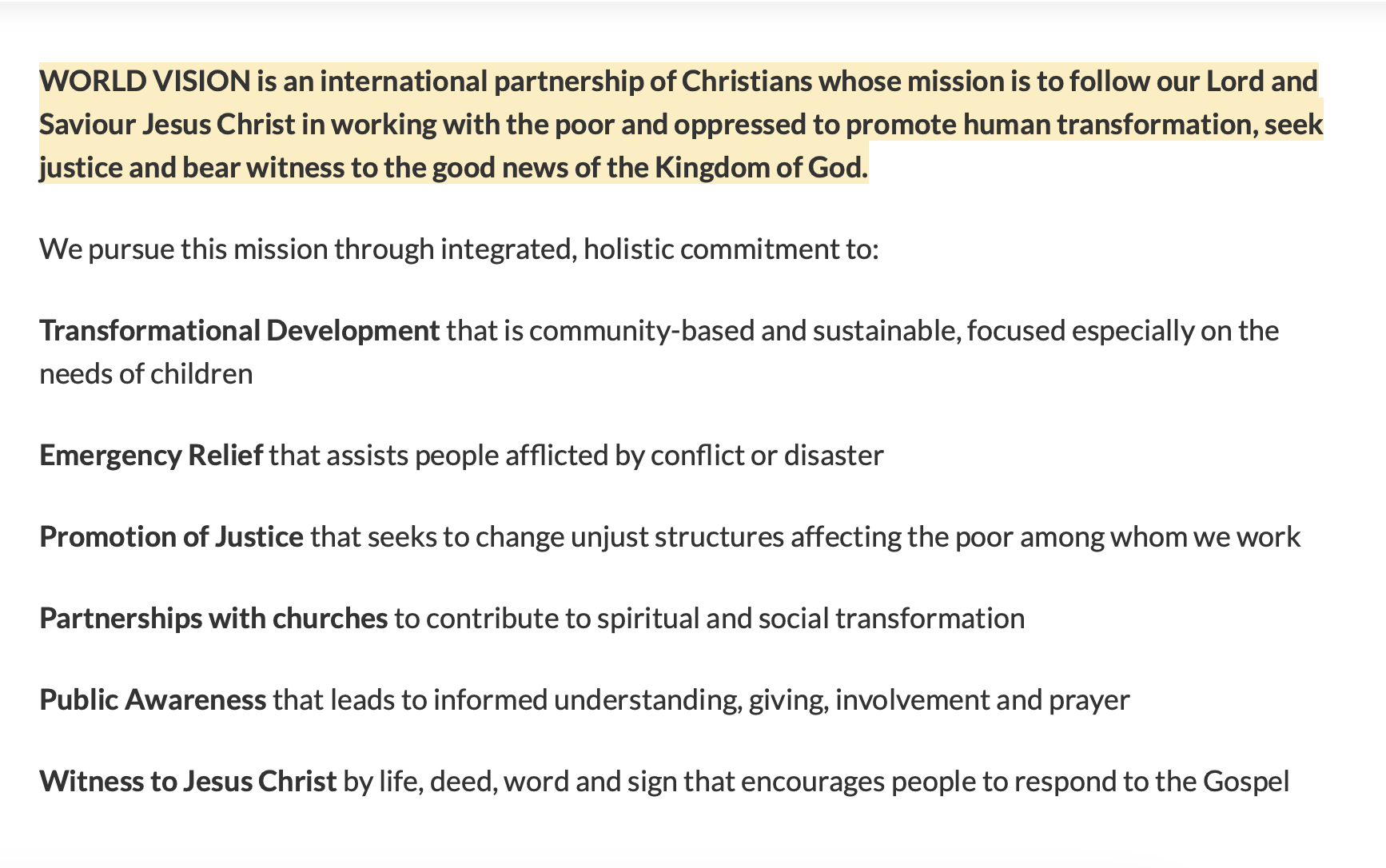
The mission statement on the World Vision website indicates the proselytising nature of the NGO.
Mission statement on wvi.org
World Vision states in its mission statement that it is an “international partnership of Christians whose mission is to follow Lord and Saviour Jesus Christ”. Further in the statement, it says that its work involves working with the “poor and oppressed” to “promote human transformation, seek justice and bear witness to the good news of the Kingdon of God”.
One of its mission statements is to “encourage people to respond to the Gospel”.
Despite WVI’s declarations that it does not indulge in proselytisation, the very fact that its mission statement explicitly states that it “encourages people to respond to the Gospel” makes it amply clear that evangelism forms a core part of WVI’s work with the “poor and oppressed”.
In 2009, HuffPost published an article that pointed towards the mission statement mentioned on the World Vision Singapore website. It stated that the mission statement on the WVI Singapore platform mentions that it does not indulge in proselytisation, however, it also adds, “At the same time, World Vision shares the Church’s commitment to disciple followers of Jesus Christ who bear witness to the Gospel by life, deed, word and sign, with the goal of encouraging people to respond to the Gospel. We do this through the life of service that we lead, the deeds of Christian love we perform, the words that we share about our faith and the signs of prayers answered as we visibly and concretely improve the lives of others.”
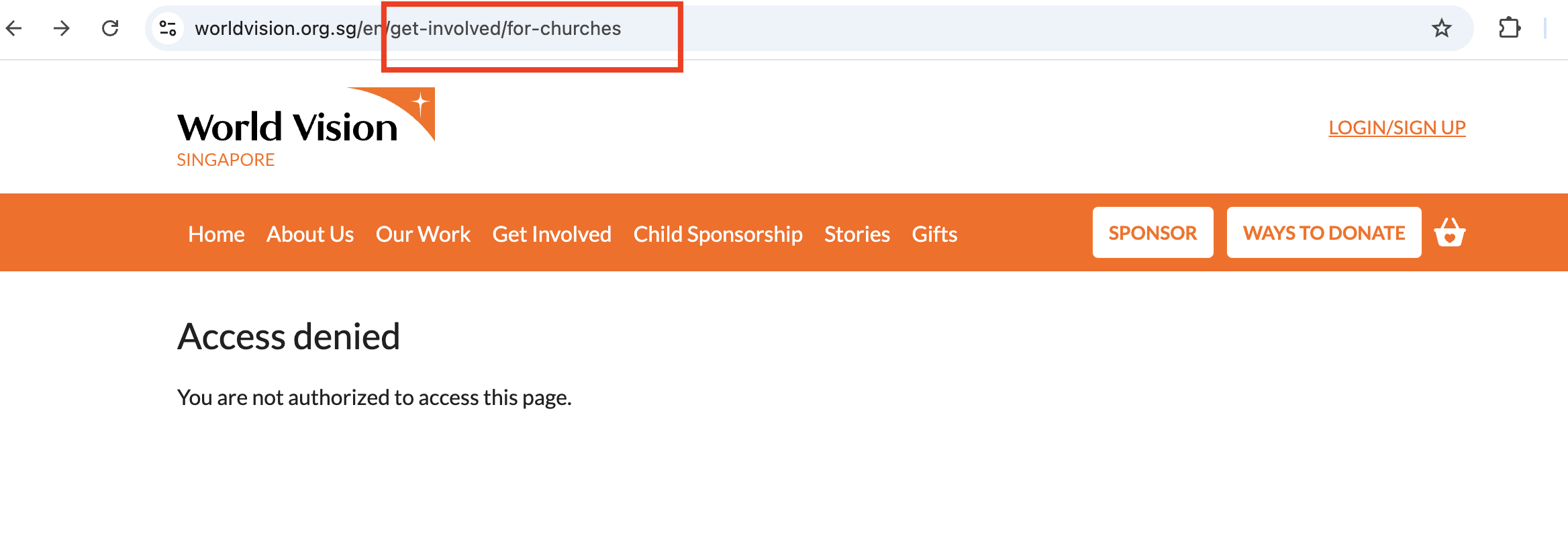
Interestingly, the Mission Statement page quoted by the HuffPost article has been blocked by WVI.
The URL, however, gives away that it was a page dedicated to “Churches”, and therefore, it can be assumed that it was a mission statement specifically for Churches.
This clandestine blocking of pages to cover its tracks is a usual practice by World Vision.
Beyond the country-specific websites, there seem to be 2 websites of World Vision – one is wvi.org and the other is worldvision.org. While wvi.org is accessible, access to worldvision.org has been specifically blocked for users in India.
If one looks at Worldvision.org, the website whose access has been blocked in India by the NGO, the faith-based activity of the organisation becomes far more apparent.
While worldvision.org has an entire section for partnership with Churches, wvi.org has no such section.
The ‘Church’ section on worldvision.org, at the very face of it, makes it clear that proselytisation is a core function of the NGO.
On the homepage of the “Church” partnership section of the website, the NGO clearly states that it “aspires to mobilise the Church outside its four walls and advance the Kingdon of God”. Advancing the Kingdon of God would only mean that the World Vision aims to proselytise and convert the vulnerable to Christianity beyond the four walls of the Church.
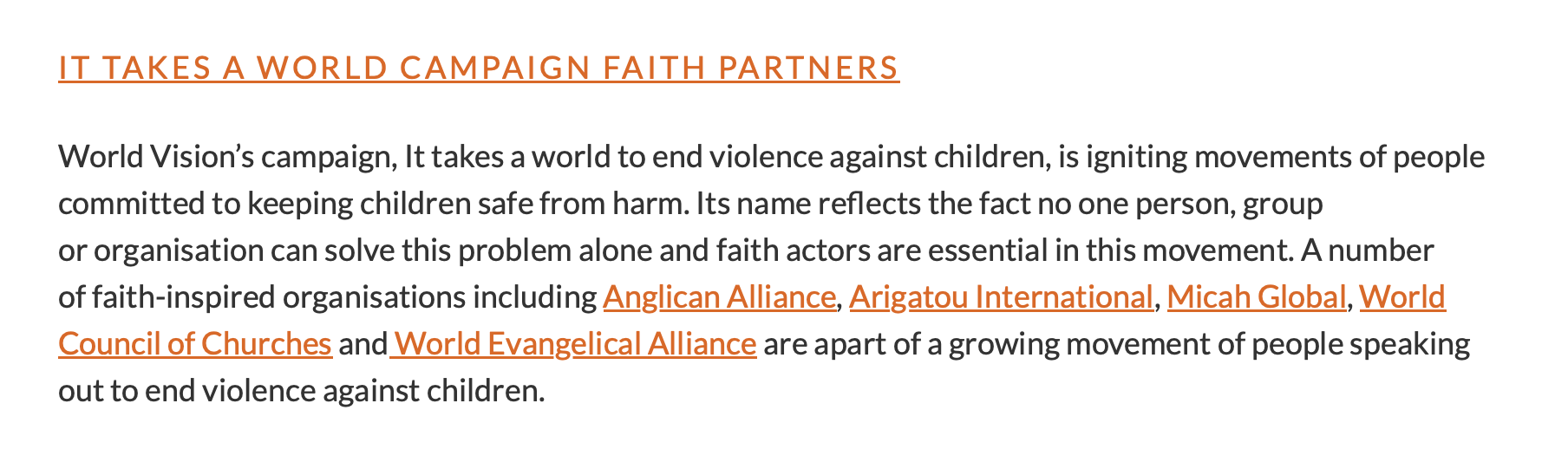
In wvi.org, on the other hand, there is a section on ‘faith-based partners’ in which, several evangelical organisations are listed as partners.
All of these faith-based organisations indulge in widespread proselytisation of indigenous people, by exploiting vulnerabilities – even in India.
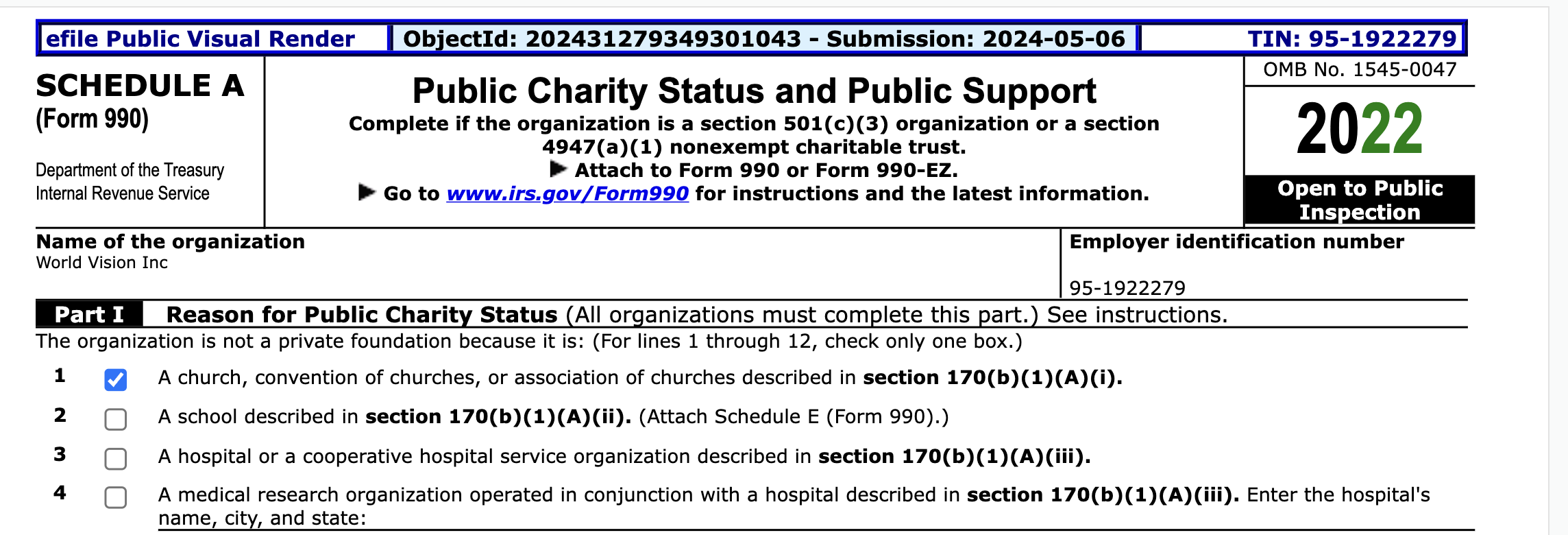
When one looks at the latest (Financial year ending 2023) IRS Form 990 filed by World Vision, it becomes evident that the NGO not only considers itself “Christian” in terms of the faith it espouses but is officially considered a “Church”.
That World Vision indulges in rampant proselytisation is evidenced also by a 2010 report by journalist S. K. Shashikumar.
In his report 15 years ago, Shashikumar documented the conversion work of World Vision in India.
According to him, World Vision New Zealand’s report (4 September 2002) reported on the funding of ADP in Dahod, Gujarat. Under the head, “spiritual development” the report stated:
“Held a vacation Bible school for 150 children from different villages. The children participated in games, Bible quizzes, drama and other activities. Organised a one-day spiritual retreat for 40 young people and a children’s Christmas party. Each of Dahod’s 45 villages chose five needy children to attend the party.” In Dumaria, Banka district, eastern Bihar, “the ADP supports local churches by running leadership-training courses for pastors and church leaders.”
Further, the report stated:
In the Gajapati ADP, situated in Gumma Block of Orissa’s Gajapati district, a World Vision report admits that “Canadian missionaries have worked in the area for just over 50 years and today 85-90 per cent of the community is Christian. However, local church leaders had little understanding of the importance of their role in community development. ADP staff build relationships with these leaders to improve church cooperation and participation in development initiatives.” Here World Vision organised two training camps for local church leaders in holistic development.
In Mayurbhanj, again in Orissa, World Vision regularly organises spiritual development programmes as part of its ADP package. The World Vision report says: “Opposition to Christian workers and organisations flares up occasionally in this area, generally from those with vested interests in tribal people remaining illiterate and powerless. World Vision supports local churches by organising leadership courses for pastors and church leaders.”
In India, World Vision is active in Bhil tribal areas and openly admits its evangelical intentions: “The Bhil people worship ancestral spirits but also celebrate all the Hindu festivals. Their superstitions about evil spirits make them suspicious of change, which hinders community development. ADP staff live among the Bhil people they work with, gaining the villagers’ trust and showing their Christian love for the people by their actions and commitment.”
World Vision Advocacy – an arm of US govt to meet foreign policy goals
Iain Buchanan, author of “Armies of God: Study in Militant Christianity”, claims that such missionary organisations are employed by the US government to pursue their foreign policy objectives.
In a 2018 interview with DNA, he said, “…there is no doubt at all that US strategy makes deliberate (and somewhat cynical) use of Christian agencies in pursuit of foreign policy — and that the distinction between the religious and the secular is deliberately blurred in the process. There are over 600 US-based evangelical groups, some as big as large corporations, and between them they constitute a vast and highly organised network of global influence, purposefully targeting non-Christians, and connecting and subverting every sector of life in the process.”
Buchanan also asserted that World Vision is effectively an extended arm of the US Department of State. He said, “Most of the major evangelical corporations (like World Vision, Campus Crusade, Youth with a Mission, and Samaritan’s Purse) operate in partnership with the US government in its pursuit of foreign policy goals. World Vision, which is effectively an arm of the State Department, is perhaps the most notable example of this. There is also the benefit of custom-built legislation, with the International Religious Freedom Act of 1998 providing necessary sanction to bring errant nations into line.”
What Iain Buchanan claimed in 2018 seems to be true, given what we now know of how USAID functions, the billions it gave to World Vision, the proselytisation work of World Vision even in countries like India and the regime change operations of USAID and the US dept of state.
Notably, World Vision regularly indulges in lobbying work as well. According to its latest IRS filing, the ‘Church’ spend upwards of $180,000 for lobbying during elections and is in touch with government officials, legislators etc.
In tune with these revelations, the role and function of “World Vision Advocacy” becomes crucial to analyse.
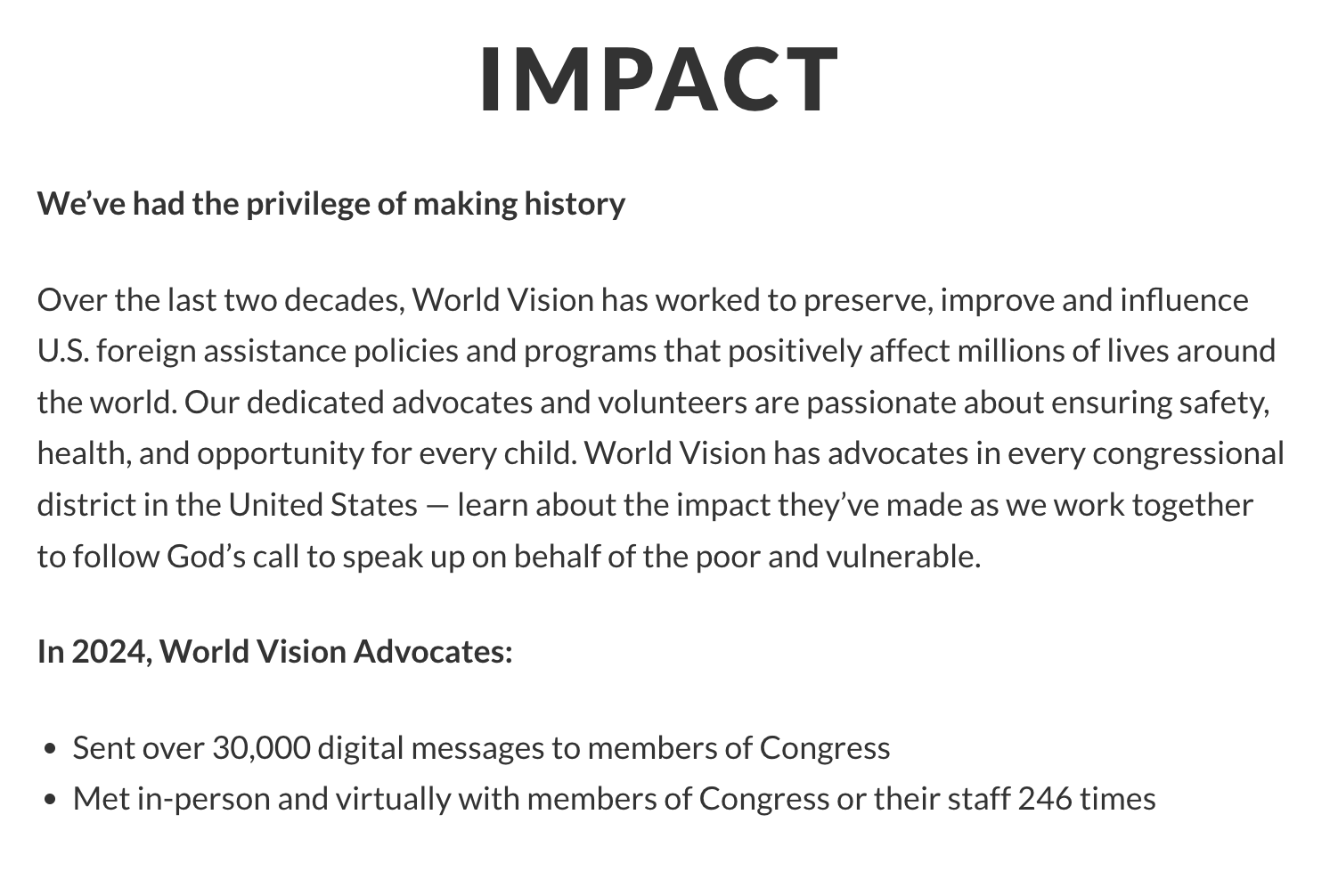
World Vision Advocacy itself claims that it aims to influence the US government’s foreign assistance policy.
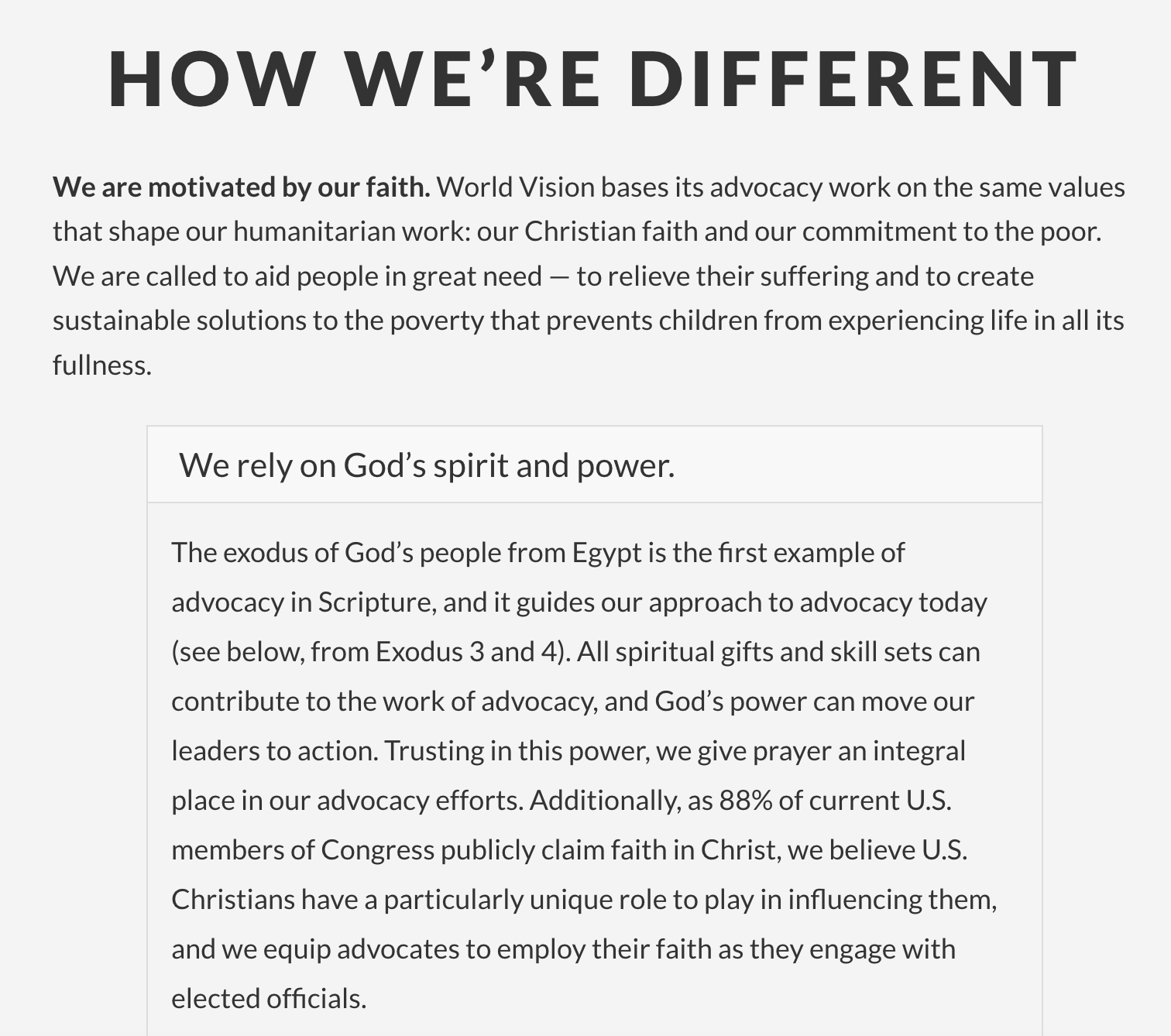
Further, they also claim that their advocacy is driven by the Christian faith.
If World Vision Advocacy claims to lobby with the US government to influence their policy on foreign funding and claims that it is exclusively driven by the Christian faith, it is safe to conclude that their advocacy revolves around Christianity not just in the US but even outside of the US. This, coupled with the fact that it gets billions from USAID which is specifically disbursed to Christian Churches and organisations and also, the fact that it is classified as a Church by the IRS, makes it amply clear that the NGO is not a humanitarian organisation but an extension of the US deep state tailored to meet its foreign policy goals.
World Evangelical Alliance – a World Vision trusted partner
On its website. World Vision proclaims that it partners with ‘faith-based’ organisations in their humanitarian causes.
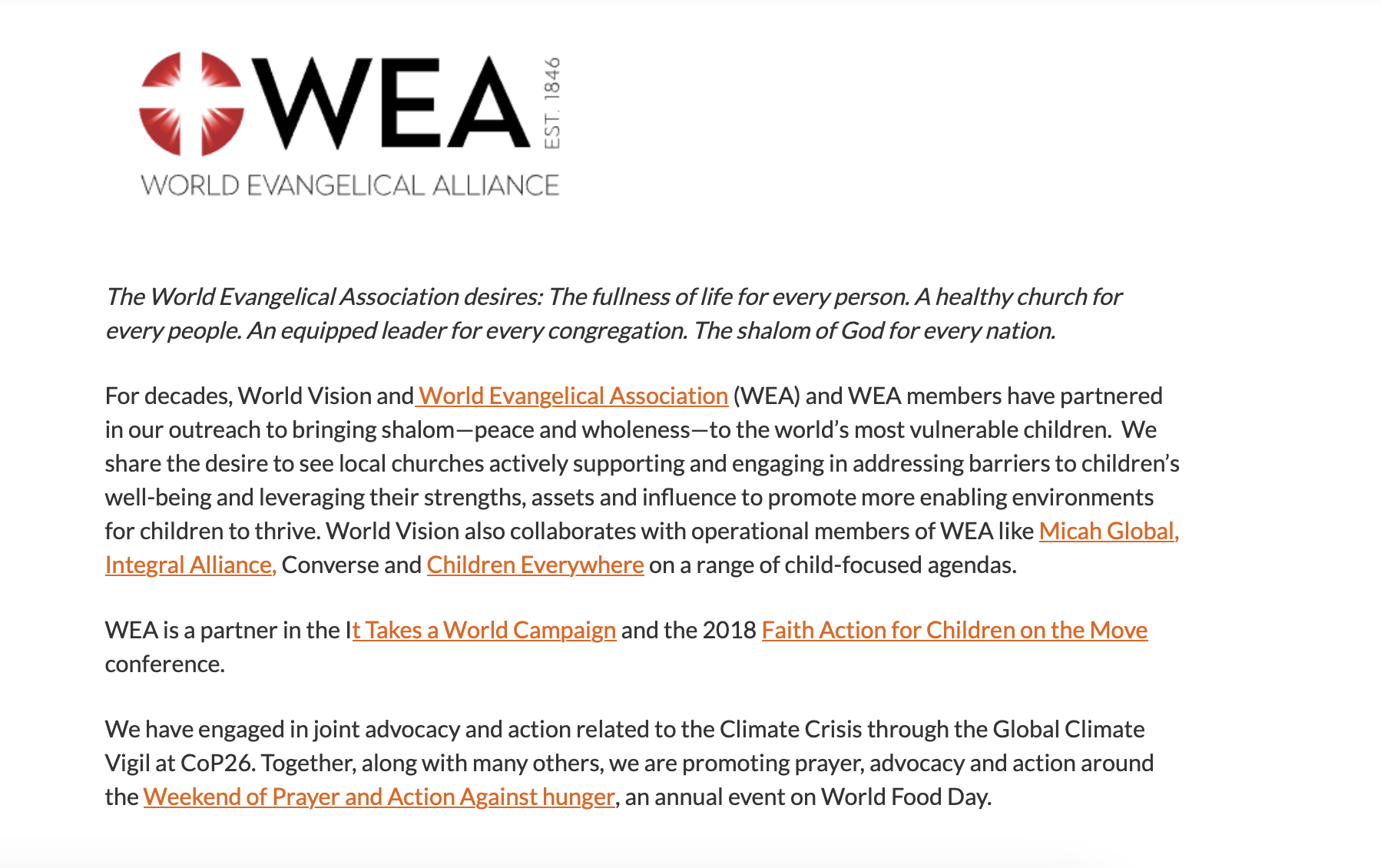
One of those partners is the “World Evangelical Alliance”.
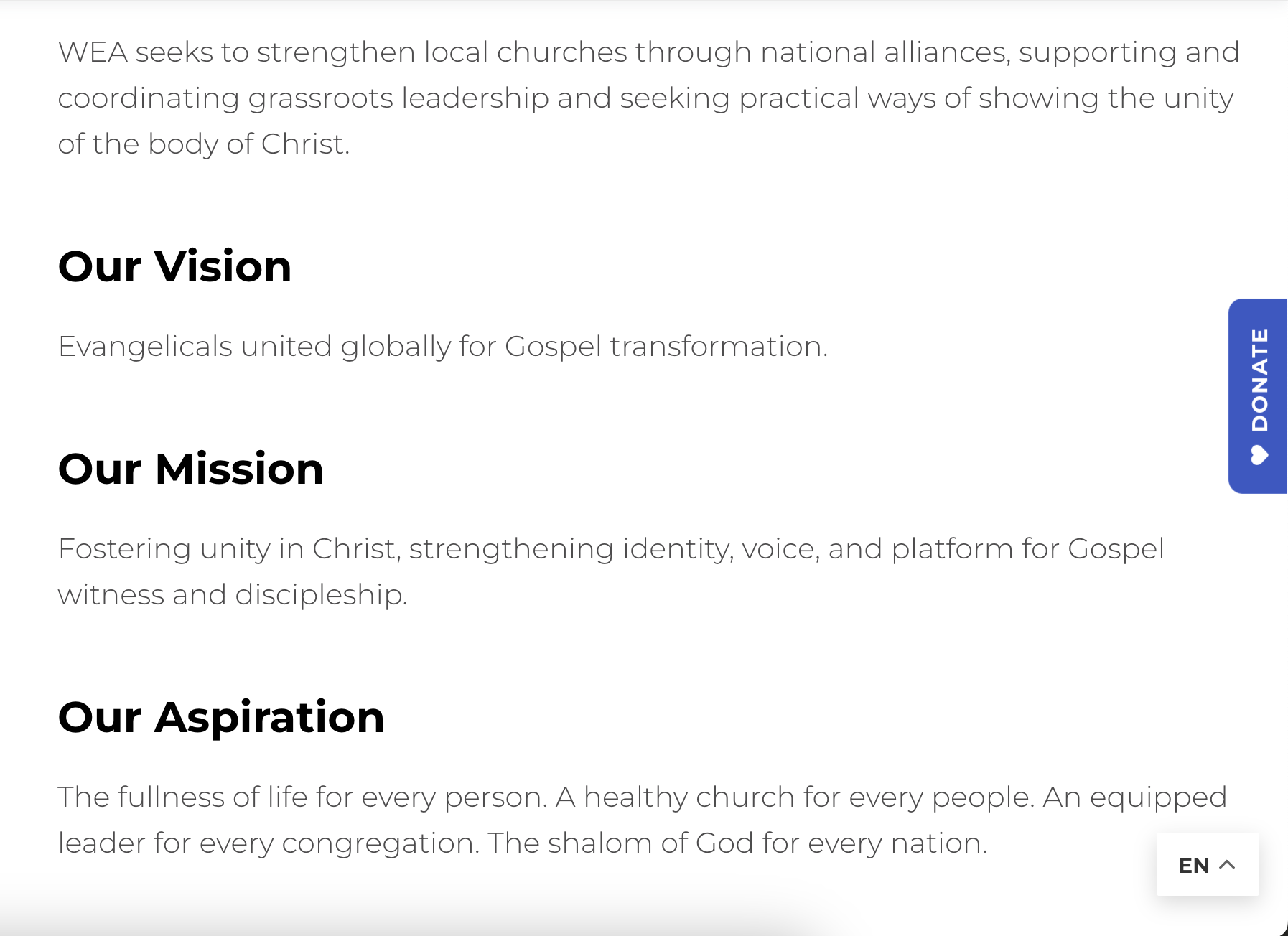
The “desire” statement of WEA itself makes it apparent that its goal is theological in nature and is to establish Christianity in every nation. The statement of WEA says, “A healthy Church for every people. The shalom of God for every nation”.
The WEA mission statement itself makes it clear that their aim is spreading the gospel to the world and establishing a Christian “kingdom”.
WEA is governed by an “International Council” that boasts of having representatives of each region. Its website says, “The International Council (IC) is the governance board of the World Evangelical Alliance (WEA). It consists of one representative for each region and a selection of members-at-large that complement the diversity of gender, age and skills. IC members are elected by the representatives of regional and national Evangelical Alliances at WEA General Assemblies, which generally take place at least once every six years”.
On the International Council of WEA, there is a member from India. The member from India on the board that governs WEA is Dr Snehal Pinto. For the uninitiated, Snehal Pinto is the Director of Ryan International Schools in India. Ryan International and the murky functioning of the Pintos have often come under scrutiny in India. There have been several documented instances of international evangelists who work on converting people to Christianity making appearances at Ryan International School.
In 2017, a gruesome murder of a 4-year-old student took place on the premises of Ryan International School of Gurugram. The CBI had apprehended a class 11 boy for the crime. Post the murder, a letter b a former student of the school was penned, detailing how there was no freedom of thought in the school and how it functioned on dictatorial tactics. One of the aspects of the letter detailed how the school forced children to follow Christianity.
“The complaint here is not so much that Ryan promotes (forces) Christianity on its students, it is HOW they go about doing it. For example, every school has boards outside classrooms where students are encouraged to showcase their creativity. They usually get together and decorate it, presenting interesting topics of discussion (e.g. global warming, politics, solar system etc.). Our school also had them, until one fine day all the boards were replaced with wooden boards with Bible verses on them. Yes, every one of them. While I would love to read Bible verses, any educationist would affirm that one does not create receptivity in the child to learn if you take something he/she likes and force them to read religious texts instead. And yes, that goes for any religion.
In another incident, Saraswati idol in the music room also magically disappeared one fine day. I would have thought it was a miracle had ‘sa re ga ma pa’ and Bhajansdidn’t follow suit. No one would talk about it, because no one was allowed to talk about it. Also, speaking of music, the one thing that spreads cheers in all age groups, forcing students to ‘joyfully’ sing hymns in 40 degrees of weather at morning assembly at the cost of some students actually fainting is not going to promote love for music in children. Actually, in defence of the school, it is not opposed to other forms of music. For example, our ‘pious’ school recently had Ranbir Kapoor and Katrina Kaif promoting Jagga Jasoos with Ryan Pinto in Ryan VK recently. Young children joined in the chorus ‘dil ullu ka pattha hai’ as part of the promotions for the movie.
I realize that religion is indeed a very sensitive topic, and am therefore compelled to add this. Please be assured that I have a great respect for all religions, I studied in another minority institution, where the nuns always encouraged and never forced us to be part of any/all prayers or celebrations. I have the highest regard for the selfless work we saw the sisters engage in the field of education. But blatant disregard to the religious sensitivities in explicit and implicit manners can create resentment in a child, ironically in a place that is especially meant to teach an appreciation of diversity and culture“.
Apart from forcing children to adhere to Christianity, the Pintos have also been accused of siphoning off money and misappropriation of funds.
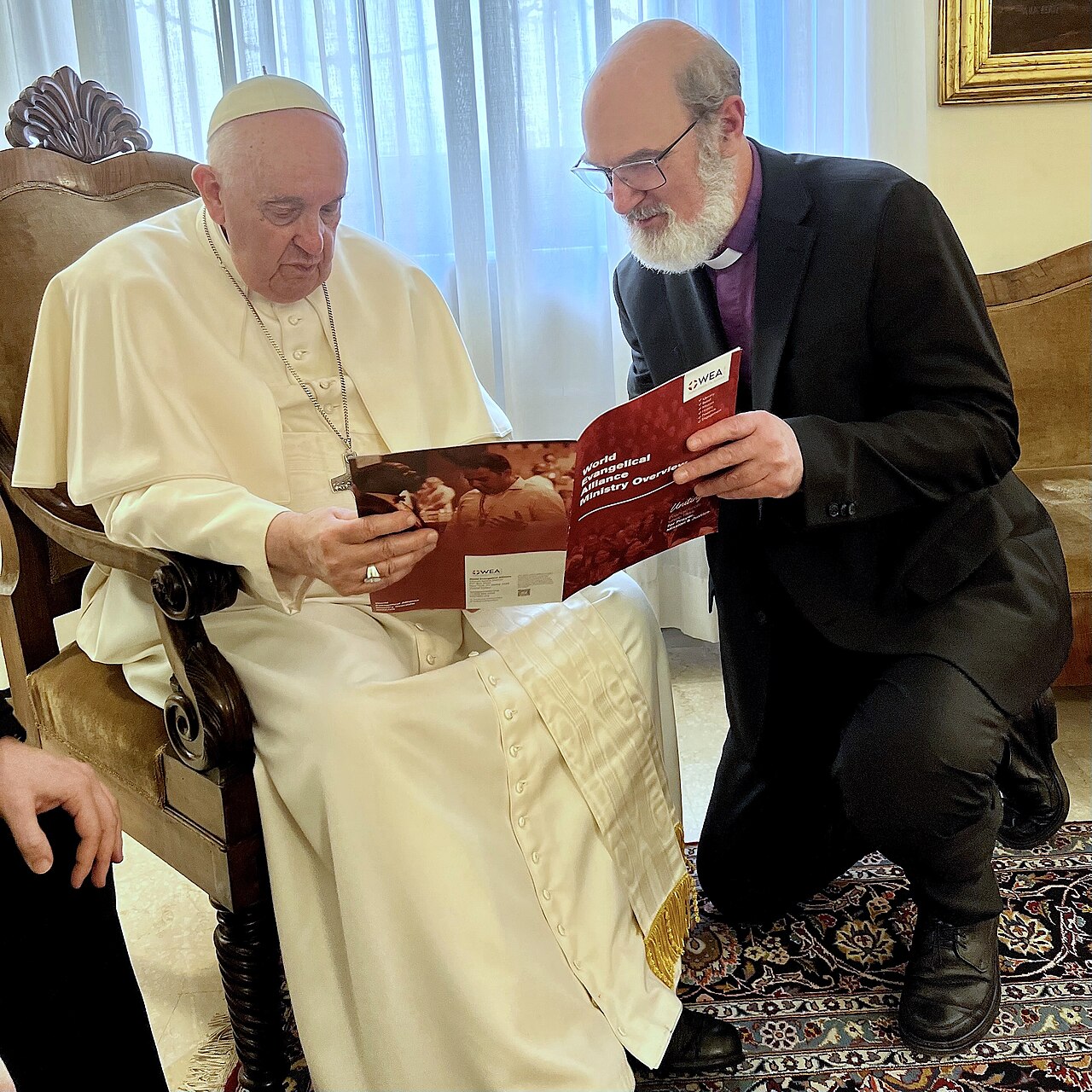
Coming back to the core values of WEA, Thomas Schirrmacher, who has been the CEO and Secretary General since 2021 has interesting beliefs about the function of WEA and its role in conversions.
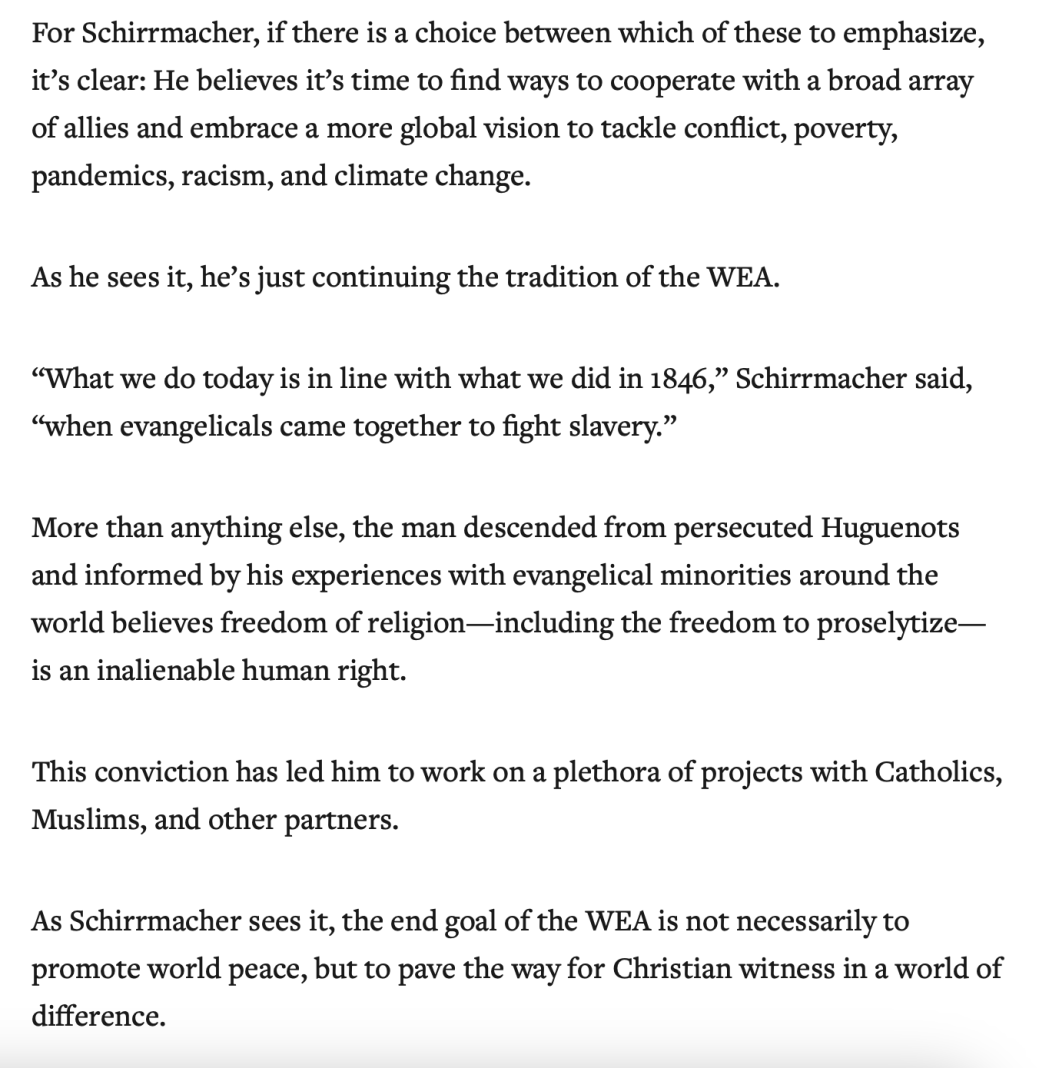
An article in Christianity Today details how Schirrmacher believes that the freedom of religion includes the freedom to convert people to Christianity.
Further, Schirrmacher says that the end goal of WEA is “not necessarily to promote world peace, but to peace the way for Christian witness in a world of difference”.
In 2021, keeping in tune with this mission, the WEA signed an agreement with one of the largest Muslim organisations in the world. The Muslim organisation accepted that the WEA would try to convert Muslims.
A report in Christianity Today reads, “The world’s largest Muslim organization accepts that Christians will try to convert its members. A new partnership with evangelicals seeks to ensure this does not lead to conflict. “Evangelicals very much aspire to proselytism, and so does Islam. So naturally there will be competition,” said NU secretary general Yahya Cholil Staquf. “But we need to have this competition conducted in a peaceful and harmonious environment.”
This agreement in itself is a testament that proselytisation is indeed one of the core functions of WEA and also of the World Vision, even though these organisations like to hide behind the veil of humanitarian work.
In 2008, WEA admitted that it proselytises and converts people to Christianity. “We are also working on guidelines in the area of evangelization and proselytization because we are under deep attack”, the then head of WEA had said.
WEA’s “Mission Commission” rather plainly states that their aim is Christian conversions. On its website, it states its aim as, “Our primary concern is to advance God’s mission as revealed in the Biblical narrative. Missions (plural) is our human response to God’s revelation, resulting in God’s kingdom being extended through faith in Christ”.
The WEA Mission Commission published a “Forecast 2023” magazine where they essentially admitted that their aim is to ensure conversion to Christianity.
In this, the WEA essentially says that they aim to increase the influence of Christianity and convert more people to the faith. If indigenous people from traditional faiths or majority religions convert to Christianity, they recommend that they should be allowed to follow their local culture and that should not be an impediment to conversion. This is, essentially, plainly saying that practices like “Yeshu Yeshu” in India where Hinduism is appropriated for forced conversion, is a practice that should be acceptable.
There is a lot more evidence that points to the obvious proselytising nature of WEA, however, for the purpose of this article, it suffices to say that for WEA – a partner of World Vision – conversion to Christianity and “bringing the Gospel” to the “vulnerable” is one of the prime objectives.
Behind the facade of a ‘humanitarian organisation’, World Vision-funded terror outfit Hamas
It is noteworthy to mention that World Vision also face grave allegations of bankrolling Hamas, a terror outfit that triggered the downfall of Gaza with its October 7 attacks against Israel, which resulted in the deaths of over 1,200 Israelis, besides over 200 others taken captive.
Curiously, in 2021, the Israeli Registrar of Non-Profits petitioned the Jerusalem District Court to dissolve a local branch of the international aid agency, World Vision, citing financial mismanagement and alleged terror funding. Following a multi-year investigation, the Registrar found that the non-profit failed to implement humanitarian projects as claimed and diverted funds, including to Hamas.
The case is linked to Mohammad El-Halabi, World Vision’s Gaza manager, accused of redirecting $50 million in aid to Hamas. While World Vision’s Australian officials denied the allegations and insisted on proper financial oversight, an independent audit contradicted these claims. The audit revealed unclear financial transactions, multiple bank accounts, and salary payments not aligned with the non-profit’s goals. Additionally, non-profit checks were found in Hamas operatives’ possession.
According to ME Forum’s Sam Westrop, World Vision also helped arrange funds for an Islamic terror organisation linked to Osama Bin Lande – and USAID was in the know of it.
USAID gave $125,000 to the Islamic Relief Agency, a designated terrorist organization in Sudan linked to Bin Laden. And, even worse: USAID officials *knew* it was designated. Another USAID-funded charity @WorldVision, helped to arrange it all. pic.twitter.com/zyDqflA0tq
The findings emphasize significant oversight failures, with the Registrar concluding that, at best, the organization was negligent in financial management.
World Council of Churches – A USAID funded World Vision trusted partner – links to Bread For The World which in turn funds Harsh Mander, separatists and Urban Naxals
Another trusted partner of World Vision is the World Council of Churches (WCC). In their own words, “The World Council of Churches is a fellowship of churches which confess the Lord Jesus Christ as God and Saviour according to the scriptures, and therefore seek to fulfil together their common calling to the glory of the one God, Father, Son and Holy Spirit. It is a community of churches on the way to visible unity in one faith and one eucharistic fellowship, expressed in worship and in common life in Christ. It seeks to advance towards this unity, as Jesus prayed for his followers, “so that the world may believe.” (John 17:21). The World Council of Churches (WCC) is the broadest and most inclusive among the many organized expressions of the modern ecumenical movement, a movement whose goal is Christian unity”.
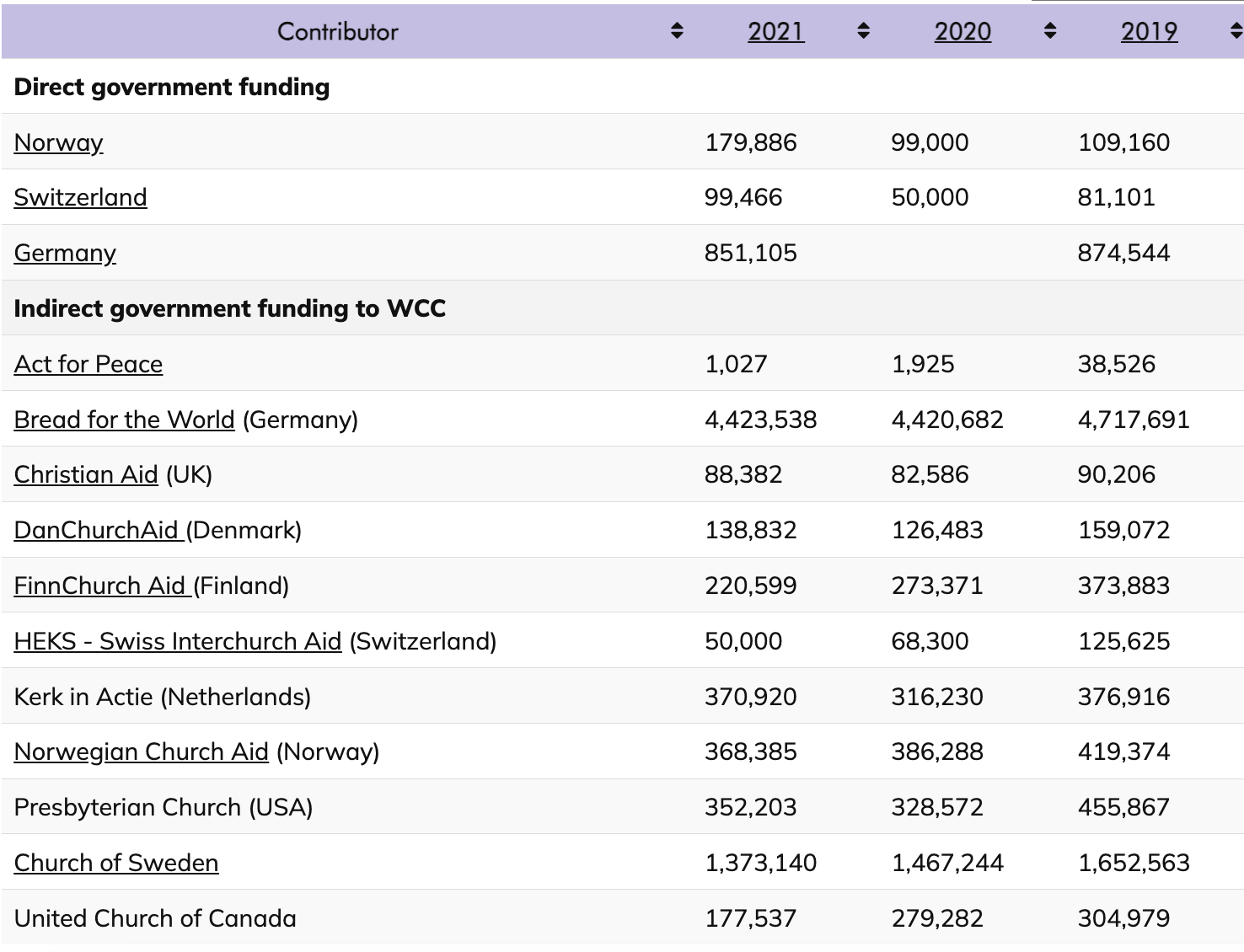
The World Council of Churches is funded by several governments across the world either directly or indirectly.
According to NGO Monitor, apart from several governments, directly and indirectly, paying WCC, one of the highest contributions to WCC is by an organisation called “Bread for the World” – a German-based NGO.
In 2018, a report calling Amarnath Yatra a “militarised pilgrimage” was published to undermine the faith of Hindus. OpIndia had covered the report extensively and delved into the organisations which published the report.
OpIndia had found that the organisations had links to Islamists, Urban Naxals and Christian organisations – one of them being Bread of the World.
The concerned report titled ‘Amarnath Yatra: A Militarized Pilgrimage’, on the basis of which all of the portals wrote the abysmal articles was published by the Jammu Kashmir Coalition of Civil Society (JKCCS) in collaboration with Bangalore-based Equitable Tourism Options (Equations). Its website describes the organization as “a federation of human rights organisations and individuals working in Indian-administered Jammu and Kashmir.”
JKCCS is affiliated with the Coordination of Democratic Rights Organizations (CDRO), an organization we have reported on extensively in the first part of this series, among other organizations. The CDRO has the People’s Union for Democratic Rights (PUDR), Civil Liberties Committee, Andhra Pradesh (APCLC) and Committee for Protection of Democratic Rights (CPDR) as its constituent organizations and has links with PUCL through its fraternal organization, PUDR and Committee for Release of Political Prisoners (CRPP). These organizations have a history of its members being arrested for various activities related to Naxalites as mentioned in our report.
The IPTK, which is a constituent organization of JKCSS, has Gautam Navlakha as one of its conveners. Gautam Navlakha is one of the activists who was raided by the Pune Police in connection with the violence at Bhima Koregaon and had links with an ISI-funded Kashmiri Separatist. Gautam Navlakha is associated with the PUDR as well.
Equations, which had co-published the insidious report on Amarnath Yatra, was found to have links to Breads of the World in our reportage back in 2018.
On its website, it states, “Equations envisions a just and equitable world, where all people have the freedom and right to determine their lives and future”. It further states, “Equations envisions tourism which is non-exploitative, where decision making is democratized and access to and benefits of tourism are equitably distributed.” The organization states that it works across the themes of ‘Child & Tourism’, ‘Ecosystems, Communities and Tourism’, ‘Governance, Law and Tourism’, ‘Tourism Education’ and other areas related to tourism.
On its website, Equations also mentions the records of the foreign contributions it has received. We discovered that two organizations regularly made contributions to them for ‘Research and Advocacy work on Tourism in India’ and related grant and travel expenses from 2016. Those organizations are ‘Bread for the World’ (henceforth referred to as Bread) and ‘Misereor’. In 2018 alone, Equations received over Rs. 26 lakhs in contributions from Bread and over Rs. 24 lakhs from Misereor. In 2017, Bread contributed more than Rs. 57 lakhs and Misereor over Rs. 83 lakhs to Equations. In 2016, Equations received as grant over Rs. 65 lakhs from Bread and more than Rs. 46 lakhs from Misereor. It can, hence, be seen that Equations received a significant amount of grants from foreign organizations.
Bread’s website describes itself as “a collective Christian voice” whose goal is to end world hunger at home and abroad. It is based in Washington but the donations have been made from Germany. The organization works regularly with a host of evangelical Churches and organizations. Evangelical Covenant Church, Evangelical Lutheran Church in America, National Association of Evangelicals, and National Latino Evangelical Coalition among them. Bread also has ‘strong partnerships’ with Oxfam, among other organizations, which was accused of covering up sexual misconduct by its members in Haiti. Bread also plays a leadership role in many coalitions of organizations including the Evangelical Immigration Table.
In India, Bread makes contributions to various NGOs and institutions. One such organization that receives donations from Bread for the World is the South Central India Network for Development Alternatives (SCINDeA), which focuses on development activities and works with Tribals, Dalits, fisherfolk, quarry workers, slum dwellers and other such groups. Yet another organization that receives funds from Bread is the Rongmei Naga Baptist Association (RNBA). One of the many objectives of RNBA is to set up and run a theological seminary.
Yet another NGO that receives contributions from Bread for the World is the Center for World Solidarity (CWS) whose mission is “To promote a rights-based, gendered and eco-sustainable approach that will advance people-centred governance, livelihoods and management of natural resources.” Its mother-ship is Action for World Solidarity, one of the objectives of which is “to defend political, social and cultural human rights”.
Conspicuously, another organization that receives a great deal of contribution from Bread is the Socio-Legal Information Center (SLIC), a division of which is the Human Rights Law Network (HRLN). The HRLN works in a variety of areas such as Child Rights, Labour Rights, Prisoners’ Rights, Criminal Justice, and Refugee Rights among a host of others. Notably, the HRLN claims it has been providing free legal aid to Rohingya detainees across the country. The network has filed PILs related to the implementation of the RTE Act. HRLN has also filed a PIL in the Supreme Court on behalf of Najeeb’s mother, the missing student from JNU, upon which the SC directed the Delhi government, the Police and authorities at JNU to be even more rigorous in their probe to find him. The HRLN was also part of a campaign to abolish sedition along with PUCL, PUDR, APDR, CPDR, and APCLC, which are coordinating organizations of CDRO, an umbrella organization we have reported on extensively.
This is, however, not all. Harsh Mander also has links to Bread of the World.
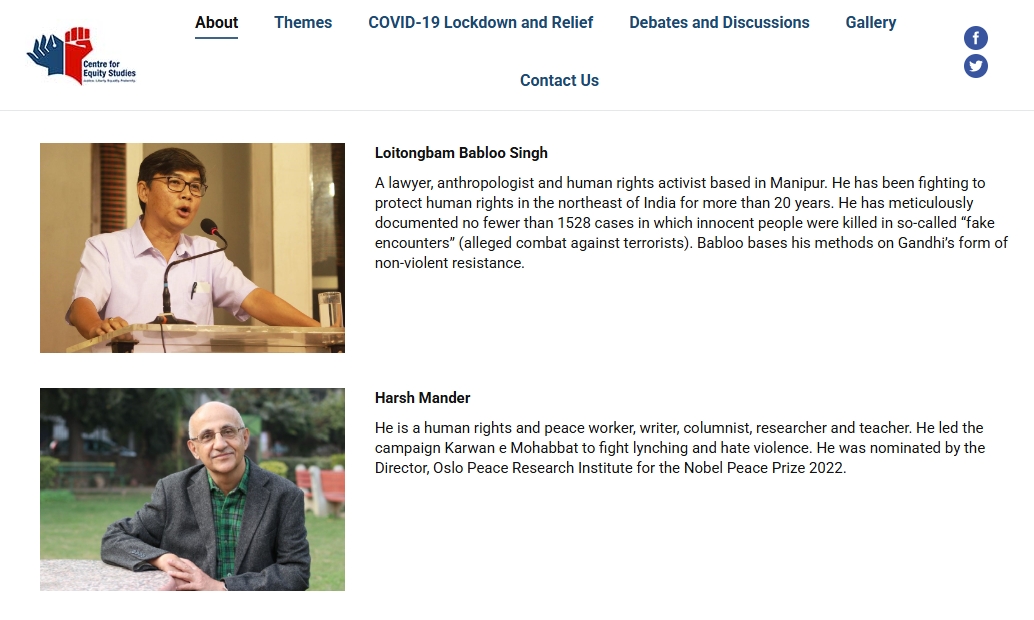
Harsh Mander had worked in the Indian Administrative Service (IAS) for almost two decades and quit the services ‘in protest’ against the ‘state-sponsored riots’ in Gujarat in 2002. Since he left the IAS, Harsh Mander has spent quite a colourful life in ‘civil society’ organizations. Among his many contributions, he has worked as the country director of ActionAid India. However, he is most famous for his service in Sonia Gandhi’s National Advisory Council (NAC) which drafted the anti-Hindu Communal Violence Bill. Most recently, he was also seen inciting violence ahead of the Delhi anti-Hindu violence.
Presently, Harsh Mander is the Director of the Centre for Equity Studies (CES). It has received funds from Christian Evangelical Organizations and he has openly batted for religious conversions in the past. Apart from Christian organizations, the CES has received funds to the tune of Rs. 30 crores between 2010 and March 31st, 2018. The donors include Action Aid, Oxfam and Bread for the World (Bread).
Harsh Mander is also a known Ishrat apologist, the female LeT operative who was killed in an encounter along with three others by Crime Branch Officials in Gujarat. He was also one of the individuals who had signed a mercy petition for the Mumbai Attack Terrorist Yakub Memon, was among the 203 persons who had signed the mercy petition for Pakistani terrorist Ajmal Kasab and had signed the mercy petition for Afzal Guru also. Apart from such antics, his judicial interventions have been many. Harsh Mander had also filed a petition in the Supreme Court seeking the recusal of then Chief Justice of India Ranjan Gogoi from hearing a case relating to the condition of detention camps and deportation of illegal immigrants from Assam.
Harsh Mander was also one of the forty ‘activists’ who had filed a review petition in the Court against the Ayodhya Verdict that paved the way for a Bhavya Ram Mandir at Ayodhya. He is also part of the coterie which filed a petition against the Citizenship Amendment Act. It is important to remember here that Harsh Mander did all of this while being associated with foreign-funded NGOs.
Harsh Mander with his organization ‘Karwaan-e-Mohabbat’ published a report on the violence at the Aligarh Muslim University that absolved the students of all sins and peddled numerous lies against the Uttar Pradesh Police. Later, of course, the entire report turned out to be a massive fraud. Harsh Mander had also promised to register himself as a Muslim if the CAB was passed but OpIndia has not been able to confirm yet if he has gone through with his promise after the CAB became CAA. He has also spread great lies about the NRC in the past and the foreign tribunals in Assam.
Earlier, Mander was part of a coterie that had penned a letter against the CAA. Harsh Mander and his NGO Karwan-e-Mohabbat have been very active in the protests in Shaheen Bagh, the anti-CAA protests masterminded by the notorious Radical Muslim Sharjeel Imam – which eventually led to the Delhi anti-Hindu riots. He had also incited a mob ahead of the violence.
Another NGO that appealed against the CAA and incited sentiments ahead of the Delhi anti-Hindu riots was ‘INSAF’. INSAF too was funded by Bread For The World. A full report on that can be read here.
Bread For The World also has close ties to USAID. Samantha Power, USAID administrator, praised Bread For The World only a few months ago. USAID has also funded Breads For The World.
World Council of Churches, World Evangelical Alliance and World Vision rallied against anti-conversion laws
In August 2024, The National Council of Churches in India (NCCI) issued a statement condemning the intent of the Uttar Pradesh Government to pass the Uttar Pradesh Prohibition of Unlawful Conversion of Religion (Amendment) Bill 2024. “This amendment significantly intensifies the provisions of the original Uttar Pradesh Prohibition of Unlawful Conversion of Religion Act, 2021,” the July 31 statement said.
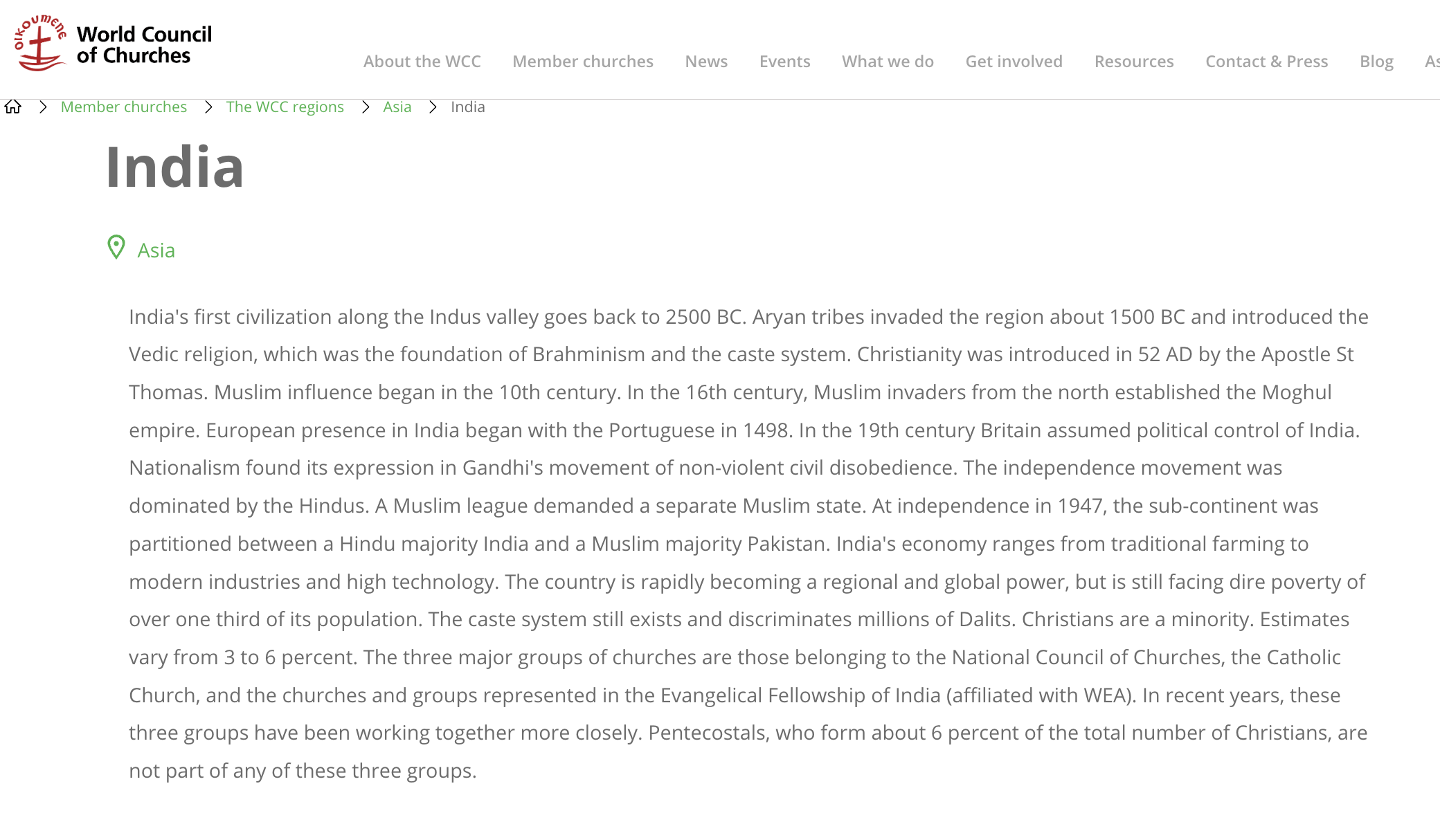
The Council was established in 1914 as the “National Missionary Council.” In 1923, the Council constituted itself as the “National Christian Council of India, Burma and Ceylon,” with the British ecumenist William Paton as its first general secretary. Paton started the NCCI in India and also helped establish the World Council of Churches under which the NCCI falls. It is pertinent to note that the World Council of Churches appears to be deeply anti-Hindu. Here is how its website describes India.
WCC endorses the ridiculous Aryan Invasion theory to describe India and also emphasises caste – a trope that is often peddled to convert vulnerable Hindus.
The World Evangelical Alliance (WEA) and the Evangelical Fellowship of India (EFI) submitted a joint written statement to the United Nations Human Rights Council’s 46th session, held from February 22 to March 23, 2021, under Agenda Item 4: Human rights situations that require the Council’s attention. In this statement, WEA and EFI vilified India and Hindus, denouncing the anti-conversion laws that were passed in several BJP-ruled states.
The crux of the representation to the United Nations was that anti-conversion laws infringe on the religious rights of the Christians to convert Hindus and the laws are often used to suppress Christians and falsely accuse them of predatory proselytisation. The reality, however, is far from what the WEA presented to the UN. In a little over two years, the Hinduphobia Tracker has recorded 403 incidents of Predatory Proselytisation with 4014 documented victims. Most of these cases are that of Christian missionaries using predatory means to convert Hindus.
In 2023, the World Evangelical Alliance also attempted to interfere in India’s internal affairs by holding a discussion at the UN about the ethnic violence in Manipur. They also misrepresented the violence in Manipur as an onslaught against Christian Kukis when the target community has widely been the Hindu Meities of Manipur.
The Meitie representative at the panel tried to put forth his views, but according to an NDTV report, was squarely shut down. The report reads:
Khuraijam Athouba, the spokesperson of the Core Committee (COCOMI), an umbrella body of Meitei civil society groups, got three minutes to speak towards the end of the panel discussion. He alleged the discussion was “one-sided” and propagated the views of only one community.
“This is a forum of the United Nations, so everyone has a right to know the facts and truth to address what is happening in Manipur… When we talk about the Hindu majority, we Meiteis in Manipur are not the majority… We represent around 8.5 lakh of the (state’s) population. And the Christians in Manipur are around 12 lakh. They comprise more than 53-54 per cent,” Mr Athouba said before he was interrupted by the moderator, who asked him to make haste.
“But we need to clarify the facts,” Mr Athouba responded.
“If you are narrating it in the wrong context, we need to check it out. Or shall we go with the wrong facts and continue this debate and discussion? What’s your intention then, we need to check it out. The religion card was never an issue in the Manipur violence because the Meiteis never targeted Christians. There is also a huge population of Meitei Christians… They (panellists) missed informing that Meitei churches have been completely vandalised and razed in Kuki-dominated areas in Churachandpur right on the first day (of the violence) before violence broke out in Imphal,” Mr Athouba said.
Mr al-Saliby of the World Evangelical Alliance, who moderated the discussion, then insisted that the session has to end and offered to speak to the COCOMI spokesperson after the event.
“But allow me to speak. Let the audience know. Why are we completely neglecting the issue of narcoterrorism? The UNODC has already reported that Churachandpur has become the hub of the new Golden Triangle… It is a completely one-sided discussion. It should be neutral,” Mr Athouba said, referring to a report by the United Nations Office on Drugs and Crime. The “Golden Triangle” refers to the tri-junction of the Myanmar, Laos and Thailand borders, which used to be the preferred route of drug traffickers.
Mr al-Saliby strongly denied it was a one-sided discussion. “We are not a one-sided discussion. There is a lot we can provide after the discussion,” he said.
“Then you should have the patience to listen to me,” Mr Athouba shot back.
Even before the BJP came to power at the centre in 2014, the WEA was targeting Hindus, misrepresenting facts and attacking the BJP. In 2012, it specifically raised concerns about the state of Karnataka, which was governed by the BJP. It also vilified Hindus as extremists.
Jayakumar Christian – CEO and Director of World Vision India – “Hindus need to be introduced to God”
An interview with Jayakumar Christian, the World Vision India head by Christianity Today reveals the sinister agenda of the organisation and the contempt the organisation itself has for Hindus.
Upon being asked how Hindus feel when they get introduced to Jesus Christ, in the interview, Jayakumar Christian says, “Average Hindus need to be introduced to the name of that God—Jesus. I’ve said many times that we do not need to break our heads in India convincing any Indian about the existence of God. The challenge is, “What is the name of this God who is involved with the poor?” That’s where Christian distinctiveness—and divisiveness—is felt. Our privilege in World Vision is being able to call attention to the name of God as Jesus through our lives, relationships, and actions, not in a divisive manner, but in a distinctive manner.”
Jayakumar Christian, who is the head of World Vision India, also appears to be deeply sympathetic towards Urban Naxals.
— Jayakumar Christian (@JChristian_Ind) July 5, 2023
Christian expressed sympathy for Stan Swamy, who was an Urban Naxal jailed for his anti-national activity.
According to the NIA, Stan Swamy was a key conspirator in the Bhima Koregaon Elgar Parishad case of 2017, which witnessed violence, stone-pelting, and arson at Shaniwar Wada in Pune. He was arrested on October 8 and produced before the Special Court in Mumbai the following day. Interestingly, he was never put under police custody and was instead remanded to judicial custody at Taloja Central jail. The NIA had informed that all legal formalities, including medical examination, were undertaken.
As per the Central investigative agency, Stan Swamy was a ‘hard-core CPI (Maoist) activist’ who had received funds from other Maoists for furthering the activities of the banned outfit. He was also the convenor of PPSC, an organisation that was alleged to be a front organisation of CPI(M). “Incriminating documents related to communications for furthering the activities of the banned terrorist organisation CPI (Maoist) were seized from his possession,” the NIA emphasised.
Soon after Stan Swamy was arrested for his involvement in the Bhima Koregaon violence case, the left-liberal lobby went into overdrive to fight for his bail. However, earlier this year, the special NIA court refused to grant bail to the Jesuit priest, maintaining that prima facie Stan had hatched a “serious conspiracy” with the members of a banned Maoist organisation to plunge the country into chaos and overthrow the government.
Rejecting the bail plea of Stan Swamy, the special judge DE Kothalikar cited the email correspondence between the activist and his co-accused, observing that Stan and others he communicated with were referred to as “comrades”, and that Swamy had received Rs 8 lakhs from one comrade, Mohan, allegedly for the furtherance of Maoist activities.
Action by Modi govt against USAID funded World Vision
In 2022, the Modi government suspended the FCRA license of World Vision India after it was found that it was a religious organisation, however, it was accepting FCRA under the garb of being a humanitarian organisation.
In January 2024, the Modi government suspended the FCRA license of World Vision, much to the outrage of the Left.
Excl: MHA cancels the FCRA registration of World Vision India, an NGO that focusses on children’s issues. The U.S.-based World Vision is one of the world’s largest Christian voluntary,operational in India for the past 70 yrs,can’t receive foreign donation https://t.co/45SgomZBVL
The narrative was rather simple – the Modi government has suspended the foreign donation license of an organisation that works for the poor, needy children, only because it claims to be a Christian organisation. That the organisation was predatory, had dubious links and was manipulating vulnerable Hindus did not particularly make it to the Left narrative.
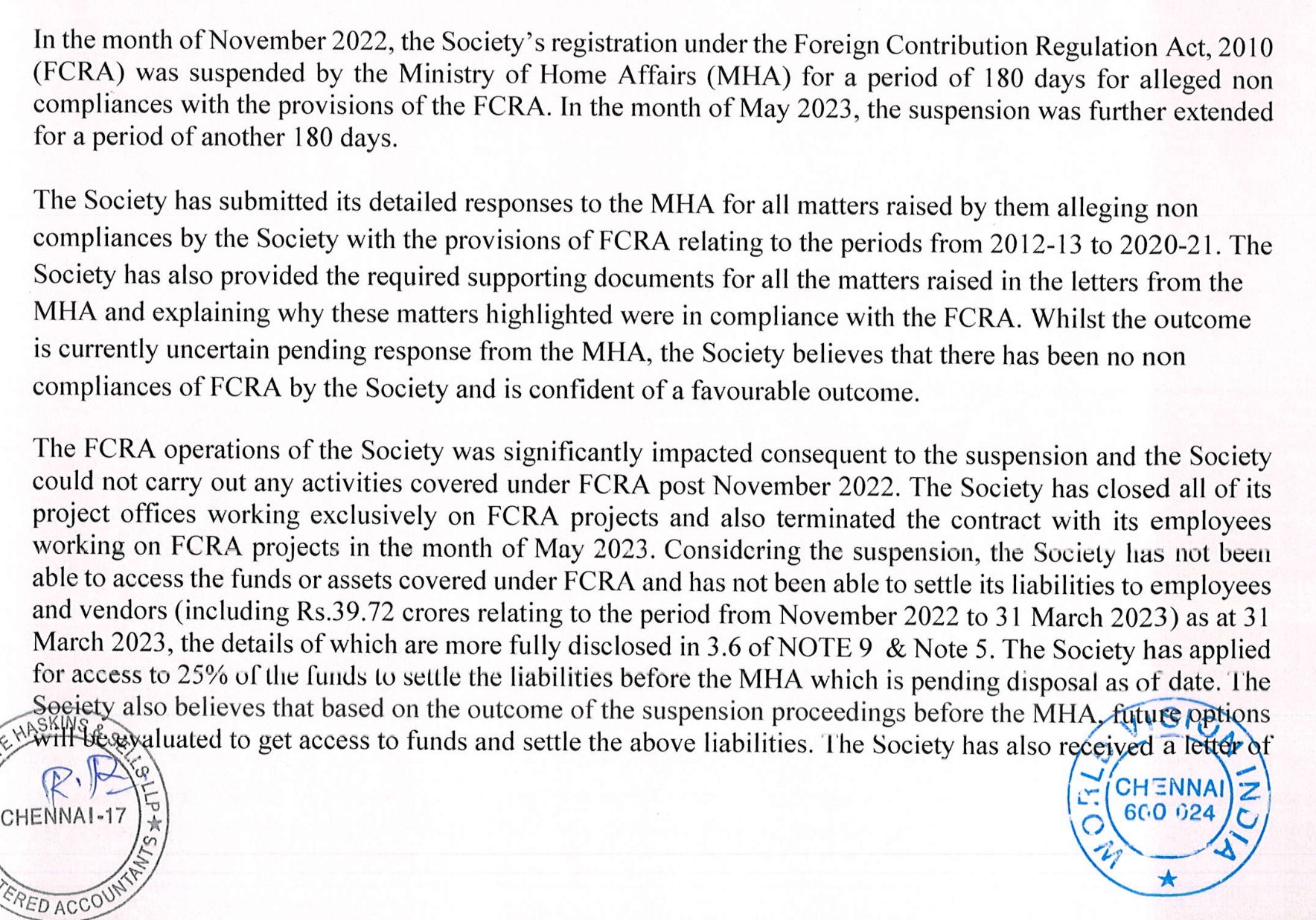
In the latest financial report by World Vision, an entire section is added explaining the cancellation of the FCRA license by the Modi govt.
According to World Vision, the following is the chronology of action against them.
1. Background of Tax Audit and Assessments
• In 2016-17, the Income Tax Department (IT Department) initiated a Special Audit under Section 142(2A) of the Income Tax Act, 1961 for the Assessment Year (AY) 2014-15 (Financial Year 2013-14).
• On July 31, 2017, the Society received a notice of demand under Section 156 of the Act for INR 101.92 crores due to the IT Department’s assessment of permissible expenses.
• The Society appealed on August 24, 2017, arguing legal and factual errors in the IT Department’s assessment.
• To avoid being classified as an “assessee in default,” the Society paid INR 10 crores as part of the tax demand.
2. Direct Bank Deduction & Additional Tax Demands
• In February 2018, the IT Department directly deducted 20% of the total tax demand from the Society’s bank accounts as part of its enforcement action.
3. Assessment Year 2017-18 (Financial Year 2016-17)
• On December 24, 2019, the Deputy Commissioner of Income Tax (Exemptions) issued an order under Section 143(3) estimating a tax payable of INR 31.39 crores.
• A notice of demand was issued under Section 156, requiring payment within 30 days or an appeal within 60 days.
• The Society filed an appeal on January 18, 2020, arguing legal and factual errors in the IT Department’s findings.
• To avoid being classified as an “assessee in default,” the Society paid INR 1.56 crores as part of this tax demand.
4. Assessment Year 2018-19 (Financial Year 2017-18)
• On September 14, 2021, the Additional/Joint/Deputy/Assistant Commissioner of Income Tax issued an order under Section 143(3) estimating a tax payable of INR 5 crores.
• A demand notice was issued under Section 156, requiring payment within 30 days or an appeal within 60 days.
• The Society paid INR 5 crores to avoid being considered an “assessee in default.”
• The Society also filed a writ petition in the Madras High Court, arguing legal errors in the IT Department’s order.
5. Assessment Year 2021-22 (Financial Year 2020-21)
• On December 30, 2022, the Assessment Unit of the Income Tax Department issued an order under Section 143(3)estimating a tax payable of INR 9.99 crores.
• A demand notice was issued under Section 156, requiring payment within 30 days or an appeal within 60 days.
• The Society filed a writ petition in the Madras High Court, arguing legal errors in the IT Department’s assessment.
• The Madras High Court granted an interim stay on the assessment order and tax demand.
According to sources, the FCRA license of World Vision was cancelled because of their illegal conversion activity in India. By cancelling the FCRA license, the Modi government ensures that 100s of crores that were being funnelled to India specifically for religious conversion of Hindus by an organisation that had converted Hindus in India since 1951, gets thwarted.
Conclusion
World Vision International, according to Congressional reports, gets billions from USAID. It received almost $2 billion from USAID in 10 years, making it one of the top recipients of USAID funds. World Vision India, in turn, received hundreds of crores every single year from the USAID-funded entity. While it pretends to be a humanitarian organisation, in reality, it is a Christian fundamentalist organisation that allies with other Christian fundamentalists, to convert unsuspecting Hindus, especially children and women. World Vision has been indulging in conversion activity in India for many years. It was first established in India in 1951. For over 70 years, World Vision received crores to convert Hindus and subvert Hinduism. It was only in 2024 that the Modi government revoked its FCRA license, denting its conversion activity in India.
With the USAID funding being frozen, such organisations may take a temporary hit, however, one has to wonder if funding to such fundamentalist Christian organisations would be restarted by the US government in some other form, if not the USAID.
Note: This is part 1 of the series that will be focussing on USAID and other US govt departments funding Christian conversion in India. On World Vision itself, OpIndia has collected over 400 magazines that the NGO has published since the 1950s. The material will be analysed in the coming weeks.
India has lodged a strong protest against Bangladesh for its negative portrayal of India in the country and for holding the Indian govt responsible for its internal problems. The Ministry of External Affairs summoned Md. Nural Islam, Bangladesh Acting High Commissioner to India, on 7 February to register the protest officially.
“The Bangladesh Acting High Commissioner to India, Mr. Md. Nural Islam, was summoned by MEA to the South Block today, February 7, 2025, at 5:00 pm,” MEA said in a statement.
MEA told the Acting High Commissioner that it is regrettable that regular statements made by Bangladesh authorities continue to portray India negatively, holding India responsible for internal governance issues. “These statements by Bangladesh are in fact responsible for the persistent negativity,” MEA added.
The statement issued by MEA said that the Bangladesh govt has been told that India desires a positive, constructive and mutually beneficial relationship with Bangladesh, which has been reiterated several times in recent high-level meetings.
India also said that comments made by ousted prime minister Sheikh Hasina has been made in her individual capacity and India has no role to play in that. “Conflating this with the Government of India’s position is not going to help add positivity to bilateral relations,” the statement said.
MEA further added, “While the Government of India will make efforts for a mutually beneficial relationship we expect that Bangladesh will reciprocate similarly without vitiating the atmosphere.”
The MEA action came after the Bangladesh govt summoned the Indian envoy yesterday to protest against a speech made by Sheikh Hasina. Bangladesh’s foreign ministry handed over a protest note to India’s acting high commissioner in Dhaka a day after Hasina made the speech on her Awami League party’s social media channels. In her speech, she accused interim government chief Muhammad Yunus of conspiring to kill her and her sister Sheikh Rehana.
Bangladesh govt requested that India prevent her from making further speeches.
Notably, since the fall of the Sheikh Hasina government, anti-India sentiments have skyrocketed in Bangladesh. The interim govt led by Muhammad Yunus has also shown its anti-India stand.