A shocking incident has come to the fore wherein a woman Tahsildar of Telanagana’s revenue department was burnt alive in her office allegedly by a man angry over the official not fixing errors in his land records.
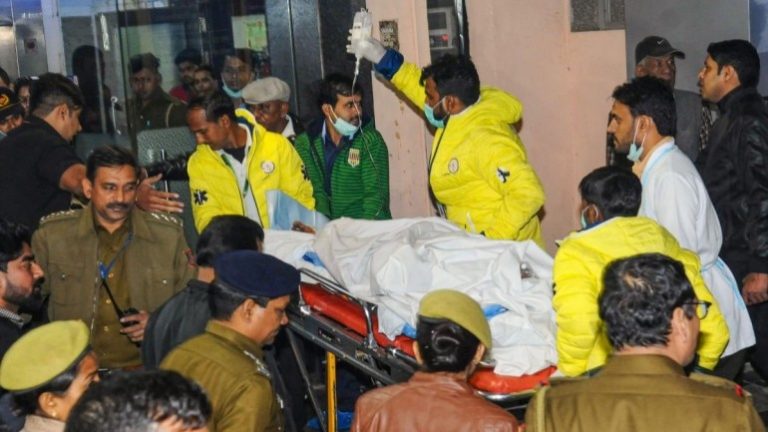
In the incident which occurred in Abdullapurmet Tahsil Office in Ranga Reddy district on the outskirts of Hyderabad on November 4, Tahsildar or Mandal Revenue Officer (MRO) Vijaya Reddy was in her chambers when a man walked in, poured petrol and set her ablaze. While the official died on the spot, the two employees who tried to save the MRO were injured. The condition of one of them is stated to be critical.
Police confirmed that the incident took place during the office lunch hours when there were not many visitors in the office.
The eye-witnesses to the incident claimed that the accused entered the woman officers office with passbooks related to his property this afternoon. Half an hour later, much to the horror of all passers-by, the Tahsildar rushed out of her office in flames. Although Vijaya Reddy’s office staff wrapped her in a blanket in an attempt to douse the flames, she died soon afterwards. Sources said that the accused, identified as Suresh Mudiraju, had smuggled a bottle of fuel into Vijaya Reddy’s office along with his land documents.
The assailant who also suffered burns in the incident later got himself admitted to a private hospital at Hayathnagar with reportedly 50-60 per cent burns and is said to be in a critical condition, confirmed Rachakonda Police Commissioner Mahesh Bhagwat adding: “Suresh Mudiraju did not act on impulse. He came to the victim’s office with a plan.”
According to sources, Suresh Mudiraju was furious about the authorities not fixing errors in his documents despite several visits to the revenue office and even getting an order from the court in this connection.
The incident has, however, sent shock waves among government officials, who began protesting, demanding security for themselves.
The Supreme court on Monday slammed the Chhattisgarh Congress government for its involvement in tapping the phones of a senior IPS officer, Mukesh Gupta and his family members.
Taking serious note of the issue the bench comprising Justices Arun Mishra and Indira Banerjee said: “What is the need to do like this? No privacy is left for anybody. What is happening in this country.”
Hearing the case of alleged phone tapping of Indian Police Service officer, the apex court reprimanded the Chhattisgarh government asking them as to whether the right to privacy of a person can be violated like this. “Who ordered this phone tapping?” the bench asked the state authorities, seeking a detailed affidavit clarifying who ordered the surveillance and the reasons behind it.
In October, the top court had asked the state police to refrain from arresting or “unduly harassing” the senior police official, Mukesh Gupta.
The apex court also objected to a separate first information report (FIR) that had been filed against a lawyer representing Gupta. It stayed the inquiry against Mahesh Jethmalani and said that no coercive measures should be taken against him until further orders.
The Congress government led by Bhupesh Baghel in Chhattisgarh had directed Gupta’s lawyer, Jethmalani not to politicise the matter by including the chief minister’s name in the parties involved. It ordered that Baghel’s name be removed from the memo of respondents in the plea.
On February 9, two IPS officers, including one Rajnesh Singh, who was the superintendent of police in Narayanpur at that time and Mukesh Gupta who was then special deputy general of police were suspended after the Economic Offences Wing registered a report against them for alleged criminal conspiracy.
They were also accused of illegally tapping phones during the Civil Supplies Corporation scam investigations in 2015.
Gupta and Singh were charged with providing false evidence and tampering with the proof, and forgery, among other sections of the Indian Penal Code (IPC). Gupta had, however, refuted all the allegations, and claimed the inquiry was done according to the law.
The court had through an interim order on September 2, 2019, stayed three FIRs against Gupta filed by the state. It had also sent a notice to the state government and the chief minister.
The JNU sedition case in 2016 brought out in the open the evil that has flourished undeterred in many high profile universities. The slogans that were raised that fateful night, which was exactly three years after terrorist Afzal Guru was hanged till death, revealed that Kashmiri Jihad had sympathizers in the highest institutions of this country.
Afzal Guru was one of the main conspirators behind the terrorist attack on the Indian Parliament in 2001. He was ultimately convicted for his role in the attacks and subsequently hanged in 2013. Six policemen and two Parliament Security Service personnel were martyred during the attack. The event at JNU in 2016 was organized to commemorate the ‘death anniversary’ of the Islamic terrorist.
The most troubling of them, among the many troubling slogans that were raised night, after “Bharat tere tukde honge inshallah inshallah” was “Afzal hum sharminda hain tere qatil zinda hain”. Even for the average Indian, it appeared to be a direct threat against the people who performed their pious duty towards the country by eliminating an Islamic terrorist.
Those who are aware of history, however, it would have been certain that the words were indeed a death threat to those involved in the whole series of events, starting straight at the top, that is, the judges who delivered the verdict. Indeed, that is the lesson history teaches us. The fate that befell Neelkanth Ganjoo, a High Court judge in Kashmir, is a stark reminder of the precise nature of that particular slogan.
Between 1966 to 1968, Judge Ganjoo presided over the trial of Jammu Kashmir Liberation Front (JKLF) co-founder Maqbool Bhat as a sessions court judge. In August 1968, he sentenced Maqbool Bhat to death for the murder of police constable Amar Chand in 1966. The Supreme Court upheld the verdict in 1982. Two years later, after JKLF terrorists in Britain murdered diplomat Ravindra Mhatre, the death sentence against Maqbool Bhat was carried out at Tihar Jail.
Five years later, in 1989, on November the 4th, Neelkanth Ganjoo was shot in broad daylight by JKLF terrorists. The judge who sentenced Maqbool Bhat to death during his time at the sessions court was among the first Kashmiri Pandits to be murdered by Islamic terrorists during the period of turmoil and grief. What happened to the Kashmiri Pandits requires no elaboration.
Thus, following the events of the night of 9th February 2016, when people claimed that the students were merely exercising their right to freedom of expression and political dissent, they were, intentionally or otherwise, ignoring the nature of the Jihad in Kashmir. One judge, who JKLF terrorists undoubtedly blamed for the justice that was meted out to Maqbool Bhat, has already been shot to death in the past. How many such murders do Jihadists have to commit before people stop trivializing slogans such as “Afzal hum sharminda hain tere qatil zinda hain”?
Afzal Guru, arguably, is the biggest face of the Kashmiri Jihad after Maqbool Bhat. To this day, Kashmir observes a shut down every year to mark the day Maqbool Bhat was hanged till death: February 11. Given the fate of the sessions court judge who sentenced him to death, the only reasonable way to interpret the slogan pertaining to Afzal Guru that was raised in JNU on the 9th of February, 2019, is to conclude that it was a direct threat to the judges who sentenced Afzal Guru to death.
People can continue to be ostriches but the fact of the matter is separatism in Kashmiri is merely a continuation of the thousand-year-old Islamic Jihad against the Hindu Civilization. India is considered a modern manifestation of it by Jihadists and thus, an attempt is made to claim the land of Jammu & Kashmir for Islam. When a Kashmiri separatist says, “Bharat tere tukde hinge inshallah inshallah,” it does not mean the kind of liberation that Tibetans demand from Chinese rule, it means Jihad. When a Kashmiri Separatist screams “Bharat ke barbadi tak Jung Chalegi”, it does not mean the tactics that the people of Hong Kong are embracing against the totalitarian Chinese state. It means Jihad.
Jihad is not political dissent, it is a declaration of war. Slogans in favour of Jihad are always a direct threat and ought to be treated as such. Declaring Jihad against the Indian Union cannot ever be considered as freedom of expression. Any attempt to do so either betrays malice against the Hindu Civilization or painful ignorance that ought not to be taken seriously by any sensible person.
India has refused to join the Regional Comprehensive Economic Partnership (RCEP) agreement stating that its concerns have gone unheeded. India has asserted that the RCEP agreement does not reflect its original intent and it will not comprise on its core interests.
Sources: India decides not to join Regional Comprehensive Economic Partnership (RCEP) agreement. PM stands firm as key concerns not addressed; there will be no compromise on core interests. RCEP agreement does not reflect its original intent. Outcome not fair or balanced. pic.twitter.com/o058sJZnOn
According to the sources, Prime Minister Narendra Modi stood resolute on India’s demand on market access and tariff-related issues, adding key concerns were not addressed.
In his speech during the ongoing RCEP summit, Prime Minister Narendra Modi said the present form of the RCEP Agreement “does not fully reflect the basic spirit and the agreed guiding principles” or India’s concerns.
PM Modi further added, “When I measure the RCEP Agreement with respect to the interests of all Indians such as farmers, traders, professionals and industries, workers and consumers, I do not get a positive answer. It also does not address satisfactorily India’s outstanding issues and my own conscience permits me to join the RCEP.”
India refused to budge to the pressure applied by foreign powers to ink an agreement without addressing its trade issues. A source revealed that this time India placed paramount importance to its interests by stressing the need to address its concerns over trade deficits and need for countries to open markets to Indian services and investments.
According to news agency ANI, India’s core concerns include inadequate protection against import surge, insufficient differential with China, possible circumvention of rules of origin, keeping the base year as 2014 and no credible assurances on market access and non-tariff barriers.
India’s refusal to join the economic bloc comes after Commerce Minister Piyush Goyal strongly defending joining it. Countering the criticism from opposition parties including Congress, he had said that India had lost out in earlier FTAs with different countries during previous governments, and the RCEP will reverse that trend. He had asserted that the government will protect the interest of domestic industry and the people of India before entering into any free-trade agreement. But now as India’s demands were not met, India decided against joining the RCEP.
The planned free-trade agreement encompasses 10 member countries of the Association of Southeast Asian Nations (ASEAN) and six of the bloc’s dialogue partners – China, Japan, South Korea, India, Australia, and New Zealand.
If it comes into effect, the RCEP would have become the world’s largest free trade area, including half of the world population and account for nearly 40 per cent of the global commerce and 35 per cent of the GDP.
According to the sources, China is pushing for a swift inking of the agreement, as a part of its strategy to counter the United States on their ongoing bilateral trade-war. Now the rest 15 countries are likely to go ahead and sign the conclude the deal excluding India.
The communist government in Kerala after taking a U-turn in the past on the Sabarimala temple issue, has now once again reiterated that his government’s policy is to implement the Supreme Court’s order, which allows women of all age group to enter the temple, thereby desecrating the Sabarimala temple tradition.
After heaping atrocities on Sabarimala devotees, communists in Kerala had in a U-turn in June 2019 asked the centre for the law to protect Sabarimala traditions. However, now again going back to its previous deportment has said that it will support the SC September 2018 verdict allowing the woman of menstruating age to enter the Ayappa temple.
According to a New18 report, the Kerala Chief Minister Pinarayi Vijayan on Monday said that it will not possible to bring a law against the apex court judgement.
With almost two weeks to go for the longest yearly pilgrimage season at Sabarimala to commence, Vijayan said that the state cannot bring a law against the SC judgement and is based on “fundamental rights unlike Jallikattu”, adding that all measures will be taken to ensure safe and peaceful conditions for all devotees.
A few days ago, while addressing the media, the Kerala CM had clarified that his LDF government would put in all efforts to execute the order and facilitate “devotees visiting the temple” and also would not file review petition over the verdict and file its opinion if the apex court demands it while hearing the petition.
The CPM had in 2018 welcomed the controversial Supreme Court verdict. Massive protests and demonstrations had ensued following the Supreme Court September 2018 verdict which dismissed the age-old ban on the entry of women of menstrual age (10-50 years) in the Sabarimala temple, one of the most revered and sacred shrines in Kerala. Protestors had thronged the Sabarimala temple vowing to preserve the temple traditions of barring women’s entry.
The Left was under severe criticism from the opposition for mishandling the deteriorating situation and failing to maintain law and order in the state as violence broke out in many regions.
Kerala administration, led by CPI(M) had willingly aided the entry of two women in the Sabarimala temple, thereby desecrating its centuries-old customs. It had even attempted several times to help non-Hindus and activists in entering the temple, sometimes even escorting them. Kerala CM Pinarayi Vijayan and the Communist government were viewed by the people as complicit in violating the long-held traditions of the Sabarimala temple. Even the Kerala high court had slammed Pinarayi Vijayan-led communist government in Kerala for using brute force to evict temple devotees from Sabarimala shrine.
This year’s “Mandalam- Makaravilakku” season will begin on November 16.
After it was reported that India has decided against joining the RCEP in its present form, Indian Coordination Committee of Farmers’ Movements (ICCFM) has welcomed the move, and has called for India to formally withdraw from all RCEP negotiation and similar Free Trade Agreements. RCEP is a trade bloc with the ASEAN group and its FTA partners, and India was supposed to be one of the members of this group. But as India’s demands were not met during the negotiations, India decided not to join the economic block.
The full statement issued by ICCFM is given below:
“INDIA HAS TO WITHDRAW FORMALLY AND FULLY FROM RCEP NEGOTIATIONS & SIMILAR FREE TRADE AGREEMENTS”:
Indian Coordination Committee of Farmers’ Movements
New Delhi, November 4th 2019: Reacting to the developments in Thailand, with countries in RCEP negotiations deciding to go ahead for now without India, farmer leaders in India stated that this is a good development, and that India will not lose in any manner. They reiterated their demand that India stay out of the RCEP deal. “We will not accept any further negotiations by the government, and this is not just about RCEP but other Free Trade Agreements too, including the one being negotiated with USA”, said Yudhvir Singh of Indian Coordination Committee of Farmers’ Movements (ICCFM). Farmer leaders claimed it as a victory of farmers’ movements in India and other movements who kept up the pressure on the Indian government to prioritise citizens’ interests over investors’ and corporations’, through large scale protests and direct actions.
ICCFM had given a call of action on 24th October when widespread anti-RCEP protests were organised by all members of ICCFM in their respective states. From now on, ICCFM will maintain this momentum of opposition to RCEP and other FTAs in coming days till India finally withdraws formally from the negotiations.
“We will not accept this Regional Comprehensive Economic Partnership in any form, and India has to withdraw from RCEP negotiations completely. The government will face increased agitations and resistance from farmer movements otherwise”, warned Yudhvir Singh of Indian Coordination Committee of Farmers’ Movements (ICCFM).
“We are happy that RCEP is for now going ahead without India, but the threat of RCEP has not gone for ever. As per the news reports from Bangkok, it will be finalised at the 36th Round of ASEAN Summit scheduled for February 2020 in Vietnam. Almost every sector in agriculture (including plantation sector), dairy and manufacturing has opposed the RCEP. It is unclear why India should continue to pursue negotiations on this trade deal, for whose benefit. Analysis of the past FTAs is clearly showing that we only have increased trade deficits with FTA partners, after the FTA is signed and implemented. Further, there have been significant price crashes for our farmers. While the government seems to believe that India will also benefit from increased exports, past FTAs have clearly shown that such agreements have not out-performed overall export growth in any manner, and the utilisation rate for what is negotiated for exports is very low. Meanwhile, what the government really has to worry about is the import deluge that we will be subjected to. We should not forget that elsewhere in the world, national leaders are boldly prioritising their citizens’ and country’s interests and walking away from deals being negotiated or even deals made in the past. There is a free trade deal being negotiated between EU and USA which has kept agriculture out of the deal. We demand once again that India stay out the RCEP deal as well as other FTAs for our overall economy’s interests”, said Yudhvir Singh.
The worries of farmers’ movements pertain to direct impacts on milk producers as well as other producers like that of plantation products (oil palm, coconut, pepper, cardamom, rubber, coffee etc). There will be impacts on oilseed producers with cheaper palmolein products from south east asia and threats to wheat and cotton producers too. There are also concerns around farmers’ seed rights and seed freedoms if RCEP pushes India towards a UPOV regime, due the fact that other countries in the pact are already aligned with the UPOV regime of IPRs on seeds. While it is being said that the IPR provisions have been re-negotiated, the threat is not likely to vanish. Concerns around Investor-State-Dispute-Settlement provisions in RCEP, data localisation in the context of e-Commerce etc., persist too.
Kannaiyan Subramanian of South Indian Coordination Committee of Farmers’ Movements (SICCFM) said that the current context of Indian economy as well as the agrarian crisis in the country have to be kept in mind too, when negotiating such deals. “The country is witnessing rapid deceleration in growth of the economy, businesses are shutting down or slowing down, unemployment is on the rise, and farmers’ suicides are continuing unabated. We cannot afford to have any development that has direct or indirect impacts on the rural economy in particular. Farmers are already facing severe price crashes with the government not making good on its meagre price promises. In such a situation, if we reduce and also eliminate import duties on almost all product lines and subject our markets to cheaper produce from elsewhere, how are our farmers expected to survive?”.
“On the WTO front, we already are having a turbulent time. While on the face of it, there is a stalemate in WTO talks, in reality, there have been several adverse developments on this front. India’s food security programmes have come under question, on the grounds that we are breaching the accepted subsidy levels for our rice and wheat producers. Sugarcane subsidies have also come under question and we have been dragged to the dispute settlement body”, explained Rakesh Tikait, national spokesperson, Bharatiya Kisan Union (BKU). “RCEP has to be understood in this context of Indian farmers already receiving a battering in global trade agreements”.
Badagalapura Nagendra, President of Karnataka Rajya Raitha Sangha said, “It is high time that the government put out the various deals that it is negotiating in the public domain. The undemocratic and secretive processes are not acceptable to us. State governments should assert their authority in this context. We also do not buy the argument of the Union Commerce Minister that inefficiencies of our producers cannot be protected any more – what the Commerce Minister is not realising is that other producers are receiving far greater subsidies than Indian producers, and in fact, our farmers have been negatively subsidised. This was also captured in an OECD study last year very clearly. What is also important to realise that reliance on cheaper imports does not help the cause of growth in the country, and will only get us into a vicious spiral of increased unemployment and losses, with our production, and producers’ purchasing power getting affected”.
RCEP is a Free Trade Agreement being negotiated between 16 countries including 10 countries that belong to the ASEAN bloc, along with Japan, China, South Korea, Australia, New Zealand and India. If the agreement gets signed and takes effect, it would cover 47% of the world’s population, about 30% of the world’s GDP, 33% of the world’s exports, would involve 8 of the 10 busiest ports of the world, and 30% of the world’s maritime trade. The deal is not just about commerce, but also about investments, and is expected to account for 32.5% of global investment flows, if sealed. RCEP’s negotiations have been underway from 2013 and 28 rounds of talks have been held so far. With 11 of the 15 partners that India is negotiating RCEP with, the country already has a trade deficit. India has opted to stay out of the deal for now, as per a joint statement issued in Bangkok by the leaders of 16 negotiating partner countries.
Note: The press release issued by ICCFN has been published without any editing.
The scourge of air pollution seems to have hit the southern metropolis of Chennai as well as the city woke up to a hazy smog on Monday with PM 2.5 measure registering unhealthy levels. With the national capital being in the news for its worsening climate, the smog cover over Chennai set off alarms for the residents of the city fearing if their city would go the Delhi way.
If weather bloggers are to be believed, there may be a trickle-down effect on the Chennai’s pollution levels due to the acute pollution crisis suffered by the north India.
Weather blogger Pradeep John described that while the recurring problem of stubble burning by farmers in Haryana and Punjab has rarely affected states like Tamil Nadu, this time around it has coincided with the break in monsoon. John has predicted that most parts of Tamil Nadu will be covered with a hazy smog next week because of the pulled air from north India being down towards the southern India.
The dispersion models of SILAM vindicated John’s stands showing that smoke plumes were traveling east from Delhi into the Bay of Bengal, and from there drifting towards Chennai and other parts of Tamil Nadu.
It’s not just #Delhi, most of India is hit by #AirPollution crisis. Dispersion Models suggest that the plume is travelling across India (in east coast too). It’s a #NationalHealthCrisis!
According to the experts, in the absence of north-easterly to easterly winds in the Bay of Bengal, which are mainly responsible for bringing seasonal rains to Chennai and Tamil Nadu, the polluted north-westerly winds from the north west India are moving towards the south and blowing into Chennai and along the south-eatern coastal line.
The weak #nem2019 is likely to create a different type of issue for parts of #TamilNadu due to strong continental winds instead of Easterlies. Coming few days places like #Chennai could see increased #pollution levels as indicated by ECMWF outputs in this chart. #Comkpic.twitter.com/jIv8XW07WZ
— Chennai Weather (COMK – Chennai Rains Blog) (@ChennaiRains) November 3, 2019
As a result of the above phenomenon, Chennai and major parts of southern India might experience a delay in the seasonal rains and increased pollution levels.
However, the Indian Meteorological Department (IMD) appeared to disagree with the opinion of the weather bloggers. The IMD says that it is impossible for polluted air to travel from Delhi, which is about 30 degree latitude. The deputy director general of the IMD, S Balachandran asserted that the pollution in Delhi has absolutely no impact on Chennai.
The former head of IMD, Chennai, YEA Raj said, “During northeast monsoon, Chennai has easterly, northeasterly and southeasterly winds. So if there is something wrong in the ocean, that air could get pushed towards Chennai. Also, during southwest monsoon, if Bengaluru has polluted air, there are chances of it drifting to Chennai due to the westerlies. Otherwise, the surface level air parcel moving from Delhi to Chennai is not possible during northeast monsoon.”
The Delhi government led by Arvind Kejriwal faced the scrutiny of the Supreme Court today as the apex court questioned the Aam Aadmi Party government on its implementation of the odd-even scheme as a measure to curb the choking air pollution in the national capital.
Reportedly, the apex court pulled up the Delhi government by questioning the achievement of Arvind Kejriwal’s ‘odd-even scheme’ and asked the government to furnish figures regarding the impact of the road rationing.
“What is the logic behind the odd-even scheme? Banning diesel vehicles we can understand, but what is the point of the odd-even scheme?” asked Justice Arun Mishra.
“People have to travel. You are not stopping travel. What do you achieve by stopping cars?” said SC bench comprising of Justices Arun Mishra and Deepak Gupta, who are hearing a plea by the pollution control body Environment Pollution Control Authority on stubble burning in neighbouring states like Punjab and Haryana.
Justice Mishra asked Delhi government why it has put restrictions on private cars while exempting autos and taxis. He added that these autos and taxis will ply more and pollute equally when people are not using their private vehicles.
Reprimanding the Delhi government, Justice Gupta stated that it would make sense if the government’s debate was based on cars and buses. “It would make sense of you were saying cars vs buses. The solution is single-person-use vehicles against mass-use vehicles. You have only added some 100 buses to public transport. People don’t even want to use Metros. The Metro to the Airport runs empty most of the time,” added Justice Gupta.
The Supreme Court directed the Delhi Government to produce data or records to prove that the odd-even scheme has reduced pollution in Delhi by November 8, even as autos and taxis continue to ply the roads.
Earlier, the SC had warned the Centre as well as Delhi government regarding the air pollution in the national capital and said the city is choking, but both the governments are simply passing the buck. Taking a strong note of the situation, the apex court said, “Delhi chokes every year, but we haven’t been able to do anything.”
“Every year this is happening and continues for 10-15 days. This can’t be done in civilised countries. Right to life is most important. It’s not the way we can live,” the court said while directing both the Delhi government and the centre to take the requisite steps to curb the situation.
“This is too much. There is no safe place to live in this city, even in homes are not safe. We are losing precious years of our life due to this,” the court added.
India’s Prime Minister Mr Narendra Modi has declared his vision of making India a $5 trillion economy by 2024. The hallmark of visionary leaders is that they set audacious targets and then achieve them. However, the roadmap to achieve this goal is not devoid of its share of challenges. A deeper look into the current economic situation and required growth rates to achieve this milestone would reveal that this would be a “stretch goal” which is achievable but not without significant action on economic reforms.
As per the published data from the International Monetary Fund (IMF), India’s GDP in 2018 was $2.7 trillion. IMF forecast for India’s GDP in 2024 is $4.7 trillion. These estimates are in-line with Morgan Stanley which forecasts India’s GDP to touch $5 trillion by 2025.
The INR/USD exchange rate assumed by the IMF for future years in the above analysis is shown in the table below. The green cells contain data taken from IMF and white cells show the calculated values.
INR/USD currency exchange rates assumed in IMF estimates
From the IMF estimates above, it can be inferred that if –
India’s nominal GDP grows at about 11.8% per year
and inflation hovers at around 4% to 4.2% per year (hence real GDP growth = 7.6% to 7.8% per year)
and INR depreciates at no more than 2% per year (INR/USD exchange rate in 2024 is less than 79)
Then India’s nominal GDP would be approximately $4.7 trillion in 2024.
The size of the economy in 2024 could exceed $4.7 trillion, if the GDP growth rate picks up or if Rupee stays stronger than the above estimates. For example, if real GDP grows at 7.6% per year, but the currency exchange rate in 2024 stays at the levels of INR 75 per USD then nominal GDP would hit $4.9 trillion in US dollar terms.
Challenges
Unfortunately, the global economy is currently going through a slowdown as all major economies of the world are facing headwinds. As of 2019, USA is facing an economic slowdown. China’s GDP growth is at 27 years low and Industrial Output is at 17 years low. Germany is facing a recession (not a slowdown of growth, but actual CONTRACTION of the economy). France’s growth is declining across industries. In Britain, investments are down to 17 years low. Japan’s factory output has slumped. Australia’s GDP growth is at 20 years low. Singapore is facing a recession. South Korea exports are down for 8 consecutive months and the world economy is expected to grow at its slowest pace since the financial crisis of 2008.
With all major economies of the world going through turbulence, India’s economic growth is expected to face a temporary slowdown too. During such scenarios, exports may find it tough to rise and investments may dry down which would make the target even stiffer.
Opportunities
At the same time, the ongoing US-China trade war can be potentially leveraged as a huge one-time opportunity. Towards the year 1999, the global issue of Y2K migration had presented an opportunity that was seized with both hands by the Indian IT companies. That one-time window of opportunity helped nascent Indian IT companies to grow by leaps and bounds and become global behemoths. The current US-China trade war presents a similar opportunity that could potentially help India’s Manufacturing sector grow rapidly.
As per USISPF, hundreds of companies are currently looking to relocate their manufacturing base from China. Elon Musk had expressed his desire to start Tesla Manufacturing in India. If Government of India could swiftly come up with policy reforms for companies looking to start manufacturing in India, it could lead to the rapid expansion of India’s Manufacturing sector with large scale job creation, increased exports and rapid economic growth.
Structural reforms like IBC, GST and others have helped India jump World Bank’s Ease of Doing Business rankings from 142 (in 2014) to 63 (in 2019). That’s a quantum jump signifying a marked improvement in starting new businesses in the country. In another favourable policy change, the government has slashed corporate tax rates from 30% to 22% for existing companies and from 25% to 15% for new manufacturing companies. Including a surcharge and cess, the effective tax rate for existing companies would now come down from 35% to 25.17%. This makes India a highly attractive investment destination for companies looking to set up manufacturing.
In a continued slew of reforms, the government may also announce a dedicated relationship manager for any entity investing more than $500 million in India. Such an officer would help the investor with all government clearances at the centre and state levels.
The Road Ahead
The above steps show the government’s intent to fuel economic growth. However, while the above are necessary, they may not be sufficient by themselves. As the above analysis illustrates, an aggressive increase in exports is not only the key to boost economic growth but would also strengthen INR to propel the nominal GDP even higher.
For the last few years, India’s exports have stayed stagnant. Recently, a government panel has reported that an Exports growth rate of 10% is achievable. It requires India to reduce the cost of capital and introduce labour reforms that facilitate easier business expansion. Making labour laws more flexible would enable firms, particularly in labour-intensive sectors, to scale up rapidly. This would create more jobs in the MSME sector which is traditionally the backbone of the Indian economy for sustainable growth, employment generation, development of entrepreneurial skills and contribution to export earnings.
Another recommendation to increase exports is through a renewed focus on Free Trade Agreements (FTAs). In that direction, it might be worthwhile to consider that by early November 2019, India may sign up RCEP (Regional Comprehensive Economic Partnership) deal. RCEP is a Free Trade Agreement between ten ASEAN countries along with six additional members that include India, China, Australia, New Zealand, Japan and South Korea. In the currently proposed form, RCEP would be the world’s largest economic bloc, covering nearly half of the global economy.
RCEP requires member countries to provide duty-free access to their markets to each other. This makes RCEP a double-edged sword. While some trade organizations in India fear that this might help Chinese goods to flood Indian markets, the treaty also has its benefits for Indian exports. For agricultural products like rice, India has a competitive advantage and RCEP would open up ASEAN countries as a new 10 million tonne market for India. The treaty would also enable Indian industry to join global supply chains for high-end goods such as electronics and engineering.
Additionally, the government is also pursuing a limited trade deal with the USA to reinstate GSP (Generalized System of Preference) for India. GSP is the largest US trade preference programme and is designed to promote economic development by allowing duty-free entry for thousands of products from designated beneficiary countries.
If India signs up RCEP and the limited trade deal with the USA, then it might provide a significant opportunity to increase exports in the coming years. It would also compel Indian manufacturers to create globally competitive products for local consumption and exports, lest they lose out to cheaper imports from China, Vietnam and South Korea.
Summary
The key to hitting the $5 trillion mark is increasing exports, reducing the cost of capital and bringing flexible labour laws. While the government has taken some steps in the above direction, more action on economic reforms is still required.
Eventually, whether India’s nominal GDP reaches $5 trillion by 2024 or is stuck at below $4.7 trillion is dependent on how the various global factors play out and how the Government of India rolls out economic reforms to propel the economy.
One civilian was dead and as many as 22 people were left injured when terrorists threw a grenade in Maulana Azad road market in Srinagar.
#CCTV The moment when terrorists threw a grenade in a market on Maulana Azad road in Srinagar earlier today. 15 people were injured in the attack. #JammuAndKashmirpic.twitter.com/V0Hy0OTICi
As per DNA report, at least 22 people were injured and one person lost his life. As per initial reports, the terrorists came on a bike and threw a hand grenade on a busy market spot. The injured include at least 3 SSB personnel. One Rinku singh of Saharanpur has succumbed while two locals Aijaj and Fayaz Ahmed are critical.