Home Blog Page 602

Indian govt expresses concern on arrest of ISKCON monk Chinmoy Krishna Das, asks Bangladesh to ensure safety and rights of Hindu minorities

0

Responding to the arrest and denial of bail of Chinmoy Krishna Das the Ministry of External Affairs on Tuesday urged the Bangladeshi government to ensure the safety and security of Hindus. “We have noted with deep concern the arrest and denial of bail to Shri Chinmoy Krishna Das, who is also the spokesperson of the Bangladesh Sammilit Sanatan Jagran Jote”, the statement said.

“This incident follows the multiple attacks on Hindus and other minorities by extremist elements in Bangladesh. There are several documented cases of arson and looting of minorities’ homes and business establishments, as well as theft and vandalism and desecration of deities and temples”, the statement said.

“It is unfortunate that while the perpetrators of these incidents remain at large, charges should be pressed against a religious leader presenting legitimate demands through peaceful gatherings. We also note with concern the attacks on minorities protesting peacefully against the arrest of Das. We urge Bangladesh authorities to ensure the safety and security of Hindus and all minorities, including their right of freedom of peaceful assembly and expression,” the statement added.

Chinmoy Krishna Das who was arrested on Monday was on Tuesday produced before a Chittagong court that refused to entertain his bail plea and sent him to custody. The Dhaka Tribune reported that Chinmoy Krishna Das Brahmachari was presented before Judge Kazi Shariful Islam of the Chittagong Sixth Metropolitan Magistrate’s Court at 11 am on Tuesday. Chinmoy Krishna’s lawyers filed a bail petition, which was rejected by the court, ordering him to be sent to jail.

Chittagong Metropolitan Police (CMP) Additional Deputy Commissioner Kazi Md Tarek Aziz said Chinmoy was brought to Chittagong by road at night. He faces a sedition case at Kotwali police station, and he was arrested in connection with that case and brought to court.

A handle on X, Voice of Bangladeshi Hindus that has been documenting alleged attrocities against minority Hindus in Bangladesh, quoted Chinmoy Prabhu as saying from the court premises, “Whatever happens to me, you don’t stop the logical movement…. we call upon all the Hindu monks of India to stand against it. All Hindu monks of India should organize a protest rally against Islamist Jihadi Yunus.”

Earlier in the day, International Society for Krishna Consciousness (ISKCON) on Tuesday urged India to speak to the Bangladeshi government regarding the detention of Chinmoy Krishna Das, one of the prominent leaders of ISKCON Bangladesh. 


(This news report is published from a syndicated feed. Except for the headline, the content has not been written or edited by OpIndia staff)

‘Judiciary not here to play opposition’s role’: Ex-CJI DY Chandrachud takes a subtle dig at Rahul Gandhi, says judiciary’s responsibility to scrutinise laws

According to former CJI DY (Dhananjaya Yeshwant) Chandrachud, the judiciary exists to “scrutinise laws” and people should not presume that it can fulfil the role of opposition in the Parliament or state legislatures. His statement came in response to Leader of the Opposition of Lok Sabha Rahul Gandhi’s recent remarks that it has become the opposition’s job to work on behalf of the media, investigative agencies and judiciary. However, he refrained from directly addressing the comment or taking any names.

“Well, I don’t want to join issue with the Leader of the Opposition because that’s not the ambit of what we are here to speak. But what I want to say is this, people should not presume that the judiciary should be performing the role of the Opposition in Parliament or the State legislatures. Too often, there’s a misconception that the judiciary has to play the role of the Opposition in legislatures, which is not so. We are here to scrutinise laws,” he stated in an exclusive interview with ANI.

He further added, “We are entrusted with the duty to scrutinise executive action on whether it is consistent with the law, and whether it is consistent with the Constitution. There’s a different space in a democracy for the political opposition and what people try to do is to use the judiciary and to shoot from the shoulders of the judiciary and to try and convert the court into a space for the political opposition.” Rahul Gandhi alleged, “We are alone working on the behalf of media, investigative agencies and judiciary also. This is the reality of India.”

Chandrachud also stated that it is normal for people to mingle during formal gatherings in response to a query about the duration of his meetings with the Prime Minister and the Leader of the Opposition under intensive social media scrutiny. “Well, there are times when you interact with the Leader of the Opposition as well. For instance, many of our statutes require that a selection committee for appointment to a particular post must consist of the Prime Minister, the Chief Justice of India, and the Leader of the Opposition. Now, you know, you discuss what you have to discuss, and you arrive at your conclusions. And after you’re done with those conclusions, you are human beings, right? You’re going to spend 10 minutes after that having a cup of tea, talking about everything under the sun from cricket to movies to something,” he pointed out.

He also responded to the issue surrounding Prime Minister Narendra Modi’s visit to his home for a puja in September. He maintained that other judges have before visited the residences of prime ministers and that this particular incident was not exceptional. He mentioned, “Look at the work which we have done. I think something which is, you know, a social visit, a sociable visit and this is not unique. I’ve said this before, prime ministers visit people in the homes of judges on social occasions, sometimes on sad occasions as well.”

He added, “This is the element of elementary social courtesy which is followed within the system. And, you know, these social courtesies do not detract from the fact that despite these social curtsies which are observed at different levels of the government, in the work which we do, we are entirely independent of each other.” A row broke out when PM Modi went to the home of the then-Chief Justice of India to celebrate Ganpati Puja. The visit was criticized by the opposition, particularly Congress and the All India Trinamool Congress (AITC or TMC), which claimed that such meetings would lead to concerns about possible conflicts of interest.

On 10th November, DY Chandrachud retired as Chief Justice of India. He has since been replaced by Justice Sanjiv Khanna.

Who is Zia Ur Rahman Barq, the Samajwadi Party MP booked for instigating violence in Sambhal during the court-ordered survey of Jama Masjid

0

On 24th November, violence broke out in Sambhal, Uttar Pradesh, when a team of local authorities went to Jama Masjid to conduct the second round of a court-ordered survey. Thousands of Muslims gathered outside the mosque. When the police asked them to leave, they became irked and started pelting stones. The mob set several vehicles ablaze and opened fire at the police using locally made guns. More than 20 police personnel were injured, and at least four mobsters were killed in friendly fire. As per media reports, seven FIRs have been registered in the matter. In one of the FIRs, Sambhal MP and Samajwadi Party leader Zia ur Rahman Barq has been named as the prime accused.

Zia ur Rahman Barq was born on 13th July 1988 in Sambhal, Uttar Pradesh. He hails from a prominent political family. His grandfather, Shafiqur Rahman Barq, was a former Member of Parliament from Sambhal.

According to the affidavit he submitted during the Lok Sabha Elections 2024, he pursued higher education at Chaudhary Charan Singh University in Meerut and Aligarh Muslim University. He holds two degrees, a Bachelor of Laws and a Bachelor of Arts. During his time at AMU, he was actively involved in student politics and was associated with the Aligarh Muslim University Students’ Union (AMUSU) in 2005–06.

Political Career

Initially, Barq was associated with Asaduddin Owaisi-led All India Majlis-e-Ittehadul Muslimeen (AIMIM) until 2017. Later, he joined the Akhilesh Yadav-led Samajwadi Party (SP) and was elected as an MLA for the 18th UP Assembly. He represented the Kundarki constituency from 1st March 2022 to 4th June 2024. Subsequently, he contested the Lok Sabha Elections 2024 and was elected as MP from the Sambhal constituency.

Zia Ur Rahman Barq’s alleged role in Sambhal violence

According to the FIR filed against him, Barq visited the mosque days before the violence without permission and incited unrest. Barq, however, has denied the allegations. In a statement, he claimed that when the violence broke out, he was not in the state, let alone in Sambhal. He accused the UP Police of conspiring against him.

The FIR read, “On November 22, Ziaur Rahman Barq visited the Jama Masjid. After offering namaaz, he gathered a crowd without administrative permission and made provocative statements. For political gain, he incited the crowd to disturb communal harmony.”

Furthermore, the FIR mentioned Suhail Iqbal, son of MLA Iqbal Mahmood, as being present in the crowd on the day the violence broke out. The FIR read, “Suhail Iqbal incited the crowd by saying, ‘Ziaur Rahman Barq is with us, we are also with you. We will not let anything happen to you; fulfil your intentions.’ As a result, the crowd became more violent.”

Barq has been named “Accused No. 1” while Iqbal has been named “Accused No. 2” in the FIR. Seven hundred to eight hundred unidentified individuals have also been booked in the same FIR. According to the FIR, a mob comprising 700–800 armed individuals gathered to disrupt the court-ordered survey at Jama Masjid. The FIR further stated that the mob snatched official weapons from police personnel and targeted the police with intent to kill. It read, “One person from the crowd fired at Circle Officer Anuj Chaudhary to kill him. Anuj was shot in the leg and sustained injuries.”

Other controversies and cases in which Barq was involved

Barq’s name has been associated with several cases and controversies. According to the affidavit submitted by him during elections, there are six ongoing cases against him. In 2022, five FIRs were filed against him at Hajratnagar Police Station, Mainather Police Station, Kundarki Police Station, and Sambhal Police Station. Later, in 2023, an FIR was registered against him at Hayat Nagar Police Station. He was booked in all six cases for violating the Model Code of Conduct during campaigning.

In April 2024, he was booked for making incendiary statements about deceased gangster-turned-politicians Atiq Ahmad and Mukhtar Ansari. Other than Zia ur Rahman, five other unidentified persons were also named as accused in the case lodged at Kotwali Police Station. While meeting with residents in the Chaman Sarai locality in Sambhal, Zia ur Rahman sought votes in the name of the “Qurbani” [sacrifice] of gangster-turned-politicians Mohammad Shahabuddin, Mukhtar Ansari, and Atiq Ahmad. They were booked under IPC sections 171-C (undue influence during elections), 153-A (promoting hatred between various groups based on religion and race), and 188 (disobedience to order duly promulgated by a public servant).

Weeks before being booked in the Sambhal violence case, on 5th November, Barq threatened to ban Hindus from entering Dargahs. His statement came in response to restrictions allegedly placed on Muslims from participating in the Maha Kumbh Mela scheduled for January 2025. Barq suggested that Muslims could consider barring Hindus from Islamic places of worship, such as mosques and shrines, to counter limitations on Muslim entry to the Kumbh Mela. He claimed that this new trend of barring Muslims from the Kumbh violates the Constitution and that the silence of the Yogi Adityanath government implies support for such actions.

Not only Barq but his grandfather was also known for making controversial statements. In January 2022, during the UP Assembly Elections, a video of his grandfather Shafiq-ur-Rehman Barq went viral on social media, where he dismissed Azam Khan’s imprisonment as a trivial issue for the SP. He claimed that it would not have any impact on the party’s position in the elections. Later, he stated that the video was edited to make the statement sound objectionable when the SP took note of it and the controversy around it. Shafiq had earlier, in August 2021, a sedition case was filed against him for suggesting that the Taliban’s takeover of Afghanistan was equivalent to India’s struggle for independence.

Maharashtra: Maulana Sajjad Nomani, who had appealed to Muslims to vote for MVA, issues apology after Mahayuti storms to power

0

The issue of “vote jihad” surfaced as a major issue in the recently concluded Maharashtra assembly election which saw the BJP-led Mahayuti came to power with unprecedented numbers. The issue gained further prominence during the campaign after Khalil-ur-Rahman Sajjad Nomani popularly known as Maulana Sajjad Nomani video asking the members of the Muslim community to vote for the Maha Vikas Aghadi headed by the Congress party became viral on social media. Nomani who is the spokesperson of the All India Muslim Personal Law Board, even threatened to boycott any Muslim if they didn’t comply and vote for the saffron party.

Now, since his clarion call yielded no results and the Mahayuti swept the state, he has issued an official statement to defend himself and apologize for inciting communal sentiments during the election. The statement read, “My statement of boycotting Muslims who support the Bharatiya Janata Party (BJP), which is currently in discussion, was given in response to the inquiries of many people in a particular context. These people were prevented from exercising their fundamental right to vote in the Lok Sabha election. My reaction was for those preventing the common citizen of India from exercising the constitutional right to vote. Therefore, it would be inappropriate to look at my statement out of that specific context.”

He added, “My statement above is from September 2024, before the Maharashtra assembly polls. It was not against any community nor it was my intention. It wasn’t a fatwa of any kind either. However, I will take back my comments and offer an unconditional apology if my statement offended anyone. Whether they are Muslims or not, I have always stood up to those who have wronged the common people and fought for justice and the truth.”

Nomani had expressed that a BJP loss in Maharashtra could destabilise the central government. He had called for the severing of social and religious ties with Muslims who were affiliated with the saffron party. He claimed that such individuals have abandoned Islam and demanded that their “hookah-paani should be stopped” (complete boycott). The Muslim followers of the BJP should change their name to ‘Ghanshyam,’ he had declared mocking them and indicating their expulsion from the community.

He is also infamous for asking Muslims not to send their girls to schools and colleges as it is haram (forbidden) in Islam. Additionally, he warned that parents who send their daughters to school will be sent to Hell (Jahannam). Despite wearing a hijab, he stressed that Muslim females should never be left alone even if she is going to college. Notably, all-time feminist and small-time actress Swara Bhasker and her husband Fahad Ahmed, a candidate of Sharad Pawar’s Nationalist Congress Party (NCP) who lost his Anushakti Nagar assembly seat to Mahayuti’s Sana Malik also met Nomani after which she was slammed by netizens for her hypocrisy following which she brazenly defended herself only after the voting was over.

Sambhal violence: Stones found on rooftops in Muzaffarnagar, UP Police on high alert, issues warnings in multiple districts

On 24th November, violence erupted in Sambhal, Uttar Pradesh, when a team of officials went for a second round of a court-ordered survey at Jama Masjid. Thousands of Muslims gathered outside Jama Masjid and raised religious slogans. When the police asked them to leave, they started pelting stones and set multiple vehicles ablaze. Reportedly, rioters also opened fire at the police and injured several police personnel. The police had to resort to lathi-charge and tear gas to disperse the mobsters. At least four rioters were killed in the mayhem, most likely by illegal weapons carried by elements in the mob, the police said.

UP Police on high alert following Sambhal violence

Following the violence in Sambhal, UP Police has been on high alert. Warnings have been issued in several districts, including Muzaffarnagar, Amethi, and Kanpur, to ensure no one engages in violence. In Muzaffarnagar, police used drones for surveillance and found stones collected on rooftops.

On 25th November, Superintendent of Police (Muzaffarnagar) Satyanarayan Prajapati joined police personnel in a flag march. During drone monitoring of the area, the police found that stones were collected on the rooftops of many houses. The police swung into action and removed bricks, stones, and other construction materials from the roofs of at least seven houses. Reports suggest that the intelligence department team has also been alerted, after which it started surveillance in the area. SSP Abhishek Singh has ordered the district police to stay vigilant. Additional police force in plain clothes has been deployed in the area to maintain law and order.

Amethi police issued warning against collecting stones on rooftops

In Amethi, police conducted flag marches in several areas and urged residents not to pay heed to rumours. Furthermore, the police issued a strict warning against collecting bricks and stones on rooftops and said legal action would be taken against those who indulge in such activities. Amethi police swung into action mode following the violence that took place in Sambhal to avoid any such occurance in the aftermath in Amethi. Police also used drones for surveillance in several regions.

Police conducted anti-riot drills in Kanpur

Following the violence in Sambhal, Kanpur police and administration are on high alert. The police patrolled sensitive and hypersensitive areas and conducted anti-riot drills in the city. Furthermore, the police used drones to conduct surveillance in dense and mixed-population areas.

According to media reports, Kanpur police are also keeping an eye on social media. The police have warned that if anyone is found spreading rumours, strict legal action will be taken. Additional police force has been deployed in sensitive areas. Speaking to the media, DCP West Rajesh Kumar Singh said that instructions have been given to exercise precautionary vigilance in areas with mixed populations. The entire district has been put on high alert.

Stones and bricks found on rooftops in Firozabad

Following the violence in Sambhal, Firozabad police also conducted a flag march in markets under the leadership of CO Praveen Kumar Tiwari. During drone surveillance in the Ruknpura area, police found that there were piles of bricks and stones on the rooftops of many houses. Police swung into action and issued notices to the owners of the houses to remove them immediately. The police also issued a warning that if bricks and stones are found again, strict legal action will be taken against the house owner. Speaking to the media, CO Praveen Kumar said that any attempt to spread tension will not be tolerated.

Ghaziabad police on high alert following Sambhal violence

Following the violence in Sambhal, Ghaziabad police have been put on high alert. Police have been patrolling mixed-population and Muslim-majority areas, while also conducting surveillance using drones. Local residents are being urged not to pay heed to rumours, and officers have been engaging with communities to maintain peace. Additionally, police personnel, along with administrative officials, have increased vigilance around religious sites and sensitive areas. Foot patrols and drone monitoring are being carried out to ensure law and order.

Improvised weapons, illegal guns, and an Islamist mob ready to attack – Why Sambhal burnt on 24th November

n the aftermath of the Sambhal violence on 24th November, police have clarified that the deaths of three individuals occurred due to firing by rioters, not by the police. Post-mortem reports revealed that two victims were shot with country-made pistols, while the a 315-bore bullet was found inside the body of another victim, a type not used by Uttar Pradesh Police. Sambhal SP Krishna Kumar Bishnoi stated that the police initially fired tear gas and rubber bullets to disperse the mob but were fired upon by rioters.

The investigation has uncovered improvised weapons, and over 7,000 stones have been recovered. A Muslim woman and Shahi Jama Masjid’s head, Zafar Ali, were arrested for involvement in the riots. An FIR against 800 people, including SP leader Zia Ur Rehman Barq and Sohail Iqbal, has been filed. Fifteen police personnel were injured, and seven cases have been registered across two police stations.

Authorities suspended internet services for 24 hours which was extended further, closed schools, and sealed the district until 1st December to prevent further unrest. Families of the deceased have accused police of firing, but officials, including Moradabad Commissioner Anjney Kumar Singh, dismissed these claims, emphasising the victims’ involvement in the riots.

Court-ordered survey at Jama Masjid in Sambhal

On 19th November, a court-mandated survey was conducted at Jama Masjid in Sambhal, Uttar Pradesh. The court ordered the survey in response to a petition filed by Supreme Court Advocate Vishnu Shankar Jain, and seven co-plaintiffs, asserting that the mosque occupies the site of a temple dedicated to Bhagwan Kalki. The site in question is a protected monument under the Ancient Monuments Preservation Act of 1904. The survey was carried out under the supervision of Advocate Commission. A heavy police force was deployed in the area to ensure the survey proceeded peacefully.

During the survey, however, Muslims living in the area gathered outside the Jama Masjid and raised religious slogans. The District Magistrate of Sambhal confirmed that the survey was completed in around two hours and stated that a report would be submitted to the Civil Court, which will review it on the next date of hearing, 29th November 2024. OpIndia accessed the petition filed by the plaintiffs in the case.

OpIndia’s detailed report on petition filed at the court can be checked here.


UP: Muslims in Etah claim Hindu family’s ancestral land as Waqf property, a mob coming from Dargah attacks Hindu family, Farhan and Rafiq arrested

On the 24th of November, a Muslim mob invaded a Hindu family’s farm, claiming it to be Waqf property, in Uttar Pradesh’s Etah district. The attackers who threw stones and used sticks to attack Hindus are alleged to be associated with a dargah. Three members of the Upadhyay family were injured during the incident and are being treated. Out of the 15 named attackers, the police have arrested Farman and Rafiq, while the search for the remaining attackers is ongoing.

This is a case from the Jalesar police station area in Etah, wherein Sunil Kumar Upadhyay filed a complaint with the police on Saturday night. In the case, he stated that he owns 24 Bigha land near Vasant Talkies. A dargah is located close to the road from this land. People linked with the dargah were clashing over Sunil’s ancestral land. The Dargah committee claimed that the land belonged to the Waqf. After this, on the 6th of November, the local authorities measured the land and settled the issue.

During the measurement, representatives from the Waqf Board were present. To avoid any further dispute, Sunil and his family had the administration mark the boundaries of their land on Sunday. Suddenly, a Muslim mob arrived at the site at 4:30 p.m. carrying stones and sticks in their hands. When one of the mob attackers saw Sunil’s family, he shouted, “Kill these bastards today.”

Subsequently, the violent mob attacked the Upadhyay family with lathis and stones were pelted. Some of the attackers also demolished the boundary wall built by Sunil. The number of attackers arriving from the direction of the nearby Dargah is said to be around 150. Along with demolishing the boundary wall, the attackers also vandalised the vehicles, tables and chairs parked there. This incident created an atmosphere of chaos in the surrounding area and the shopkeepers in the vicinity closed their shops out of fear.

Three members of the Upadhyay family, Monu, Sanjay and Suresh were injured during the mob violence and are receiving medical treatment. Somehow, Sunil informed the police about the incident and soon after, the police reached the spot. Seeing the police vehicles arriving, the attackers fled from the spot. While leaving, they also threatened to kill Sunil and his family members. The victim has demanded strict action against the accused.

In his complaint, Sunil Upadhyay has named Rafiq, Arman, Bablu, Wasim, Farman, Nasir, Shakir, Danish, Nadeem, Nasir, Arshad, Shakeel, Irfan, Mahfooz, Yamin and Muzammil. All of them have been booked under sections 191 (2), 191 (3), 190, 109, 115 (2), 352, 351 (3), 125 and 324 (4) of the Indian Penal Code (IPC) along with section 7 of the Criminal Law Amendment Act, 1932.

OpIndia has obtained a copy of the complaint. The video of this violence is also going viral on social media. Police teams were formed and raids were conducted in search of the absconding accused. On Monday (25th November), the police arrested Farman and Rafiq. Meanwhile, a Police team has been deployed at the spot and raids are being conducted to arrest other accused.

Union Cabinet clears One Nation One Subscription scheme, scholarly research articles and journals to become acessible nationwide through a single platform

 The Union Cabinet, chaired by Prime Minister Narendra Modi, has approved One Nation One Subscription, a new Central Sector Scheme for providing country-wide access to scholarly research articles and journal publication.

Information and Broadcasting Minister, who briefed the media on the cabinet decisions, said the scheme will be administered through a simple, user friendly and fully digital process.

This will be a “One Nation One Subscription” facility for the government higher education institutions and R&D laboratories of the central government.

An official release said that a total of about Rs.6,000 crore has been allocated for One Nation One Subscription for three calendar years, 2025, 2026 and 2027 as a new Central Sector Scheme.

“One Nation One Subscription will build on and further enhance the scope and reach of the range of initiatives undertaken by the Government of India over the past decade in the domains of education, for maximizing access to quality higher education for the youth of India,” the releasse said .

“This will supplement the ANRF initiative to promote research and development and foster a culture of research and innovation throughout government universities, colleges, research institutions, and R&D laboratories,” it added.

The benefits of One Nation One Subscription scheme will be provided to all Higher Educational Institutions under the management of the Central or State Government and Research & Development Institutions of the Central Government, through a national subscription coordinated by a central agency, namely the Information and Library Network (INFLIBNET), an autonomous inter-university centre of the University Grants Commission (UGC).

This list covers more than 6,300 institutions, translating into nearly 1.8 crore students, faculty and researchers, who will be able to potentially avail benefits of One Nation One Subscription.

“This is in line with the goals of Viksitbharat@2047, National Education Policy (NEP) 2020 and Anusandhan National Research Foundation (ANRF). The initiative will expand access to scholarly journals to a vast diaspora of students, faculty, researchers and scientists of all disciplines, including those in tier 2 and tier 3 cities, thereby promoting core as well as interdisciplinary research in the country,” the release said.

ANRF will periodically review the usage of One Nation One Subscription and publications of Indian authors of these institutions.

The DHE and other Ministries having HEIs and R&D Institutions under their management shall be proactively conducting Information, Education and Communication (IEC) campaigns among students, faculty and researchers of these institutions about availability and method of access to One Nation One Subscription, resulting in improved usage of the facility across the country, the release said.

The state governments will also be requested to carry out campaigns at their level for gmaximizing usage of the unique facility by students, faculty and researchers of all government institutions, it added. 

Tensions grip Bangladesh after the arrest of prominent Hindu leader and ISKCON monk Chinmoy Krishna Das who led protests for minority rights

On Monday, November 25, Bangladesh Police arrested a Hindu leader and ISKCON monk, plunging the strife-torn country into a new crisis months following the ouster of PM Sheikh Hasina after the murderous takeover by Islamist rioters. Chinmoy Krishna Das Brahmachari, a Hindu priest and prominent leader of Bangladesh’s religious minority, was arrested in Dhaka. Das was among the foremost leaders advocating for the safeguarding of minority rights in the predominantly Muslim nation. 

The arrest comes in the wake of protests by the Hindu community in Rangpur, approximately 300 kilometres north of Dhaka, calling for stronger legal safeguards and the establishment of a dedicated ministry for minority affairs.

Radharamn Das, ISKCON’s spokesperson, expressed concern over the arrest, tweeting: “I just received the shocking news that Chinmoy Krishna Das Brahmachari, a Hindu monk and a prominent advocate for Bangladeshi minorities in these challenging times, has been detained by Dhaka police and taken to an undisclosed location. Kind attention,” while tagging External Affairs Minister S. Jaishankar and the Indian High Commission in Dhaka.

Das was detained earlier this week at Dhaka airport and a sedition case was filed against him earlier this month, reportedly for his uninhibited critique of violence targeting minorities, especially Hindus of Bangladesh. Over 19 individuals were charged with sedition for participating in a minority rights rally in Chittagong. 

Hindus form about 8% of Bangladesh’s 170 million people. Since former Prime Minister Sheikh Hasina’s ouster, the military-backed interim government led by Mohammed Yunus has faced growing criticism for its inability to address the rise in violence against minorities. In recent months, Hindu-owned businesses, commercial establishments, homes, and temples have been targeted across the length and breadth of the country as Islamist mobs have enjoyed free rein under a regime that seemed to have empowered religious zealots. 

As per reports, tensions have gripped several cities in Bangladesh following the arrest of Das.

BJP leader Suvendu Adhikari also condemned the Yunus administration, asserting that Brahmachari is at the forefront of a “fight for survival” for Hindu minorities in Bangladesh.

“Renowned firebrand Hindu leader Shri Chinmoy Krishna Das Prabhu has been abducted by the Detective Branch at Dhaka Airport in Bangladesh. He is leading the fight for the survival and dignity of the Hindu minorities of Bangladesh. The Bangladeshi Sanatani community fears that Md Yunus’s ‘radical’ regime may go to any extent, even eliminating ‘perceived threats’ to its authority. I urge @DrSJaishankar Ji to kindly take note of the matter and take urgent steps,” Adhikari posted on X.

SC quashes preferential land allotments for MPs, MLAs, judges, and journalists in Hyderabad, says it promotes inequality

0

The Supreme Court on Monday set aside the preferential allotment of lands to the housing societies of MPs, MLAs, civil servants, judges, defence personnel, journalists etc. within the Hyderabad Municipal Corporation limits, saying it promotes inequality.

A bench Chief Justice of India Sanjiv Khanna and Justice Dipankar Datta quashed the Andhra Pradesh Government Memoranda (GoM) of 2005 classifying MPs, MLAs, officers of the AIl India Service/state government, judges of the Constitutional courts, and journalists as separate classes for allotment of land at the basic rate.

It also set aside the subsequent GoMs issued in 2008 allotting the lands within the limits of the Greater Hyderabad Municipal Corporation to these classes.

The bench while quashing GoMs said they are bad in law and being violative of Article 14 of the Constitution of India.

“Such a policy to be suffering from the malaise of unreasonableness and arbitrariness, and promoting inequality leading to the violation of Article 14 of the Constitution,” the court said while dismissing the appeals filed by the state government and the cooperative societies and their members against a 2010 judgment of the Telangana High Court.

The bench said, “Land is a finite and highly valuable resource, particularly in densely populated urban areas, where access to land for housing and economic activities is increasingly scarce. When the government allocates land at discounted rates to the privileged few, it engenders a system of inequality, conferring upon them a material advantage that remains inaccessible to the common citizen.”

The top court pointed out that this preferential treatment conveys the message that certain individuals are entitled to more, not due to the necessities of their public office or the public good, but simply because of their status.

“Such practices foster resentment and disillusionment among ordinary citizens, who perceive these actions as corrupt or unjust, thereby eroding trust in democratic institutions. This policy undermines solidarity and fraternity, reinforcing societal hierarchies rather than actively working to dismantle them,” it said.

The allotments were made to cooperative societies composed of members of various groups, including Members of Parliament, Members of both houses of the state legislature, officers of All India Services, judges of the Supreme Court and High Court, state government employees, defence personnel, journalists and individuals from weaker sections of society.

The top court held that the object of the policy perpetuates “inequality” and it does not meet the equality and fairness standards prescribed by the Constitution.

“We think that Judges of the Supreme Court and the High Court, MPs, MLAs, officers of the AIS, journalists etc., cannot be treated as a separate category for allotment of land at a discounted basic value in preference to others. The object of the policy perpetuates inequality. The policy differentiates and bestows largesse to an advantaged section/group by resorting to discrimination and denial. It bars the more deserving, as well as those similarly situated, from access to the land at the same price. It promotes social-economic exclusion, to favour a small and privileged section/group. The policy does not meet the equality and fairness standards prescribed by the Constitution,” the verdict stated.

(This news report is published from a syndicated feed. Except for the headline, the content has not been written or edited by OpIndia staff)

UP govt gears up for Mahakumbh 2025 with 3-tier security and comprehensive pilgrim facilities

0

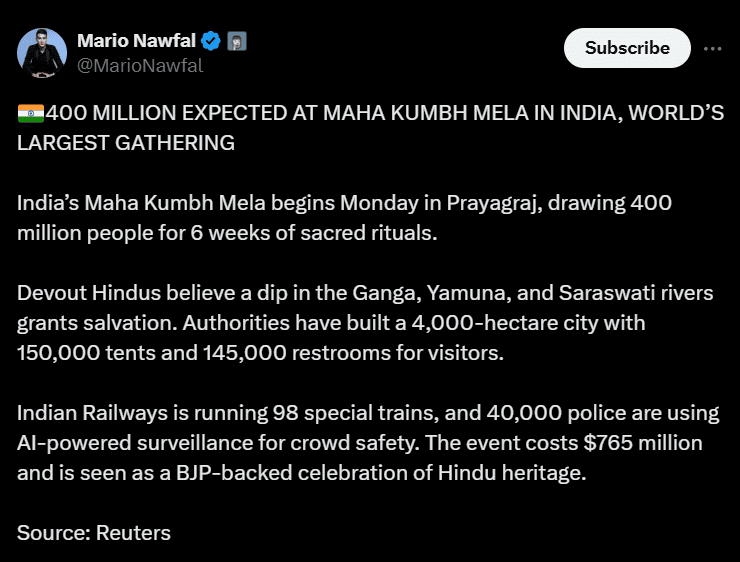
With an anticipated turnout of 45 crore devotees for Mahakumbh 2025, the Uttar Pradesh government, under the leadership of Chief Minister Yogi Adityanath, has devised a comprehensive plan to ensure smooth facilitation for pilgrims at the Sangam while also preparing to handle emergencies effectively.

A robust three-tier security system has been implemented, prioritising the safety of all pilgrims, with dedicated Water Police deployment. At Kila Ghat, designated for VIP movement, special forces have been stationed to ensure seamless arrangements, providing a hassle-free experience for both domestic and international devotees.

Advanced security measures have also been put in place from Saraswati Ghat to Sangam Ghat, including deep barricading and extensive safety nets, which are nearing completion.

Janardan Prasad Sahni, in charge of the Kila Police Water Unit, stated that ahead of the Mahakumbh, every boat is being thoroughly inspected. A tester boat has been arranged for this purpose, and it will be used to check each boat. Only after thorough inspection and approval will any boat be allowed into the water.

Extensive security arrangements are being made from Sangam Noz to Kila Ghat. Personnel from the PAC, SDRF, and NDRF will work together to ensure devotees’ safety. Sahni also mentioned that special measures have been introduced to ensure pilgrims face no difficulties while exiting after taking a dip. A special red strip will be placed on boats to alert pilgrims.

Chief Minister Yogi Adityanath has issued clear instructions to officials, emphasising that no devotee attending the Mahakumbh should face any inconvenience. In line with these directives, every ghat will be thoroughly inspected before being opened for pilgrims.

Security arrangements are also being enhanced at the Arail, Jhusi, Phaphamau, and Someshwar ghats. Adequate facilities are being prepared for bathers from Rasulabad to Kila Ghat and Kakhera Ghat.

The Water Police have made special arrangements for pilgrims’ safety by implementing a three-tier security system. The first team will manage crowds outside the ghats and divert pilgrims to alternate routes in case of excessive crowds. The second tier will be stationed on boats during the bathing process to ensure convenience and provide immediate assistance in emergencies. The third tier will facilitate pilgrims’ safe exit after their bath.

(This news report is published from a syndicated feed. Except for the headline, the content has not been written or edited by OpIndia staff)