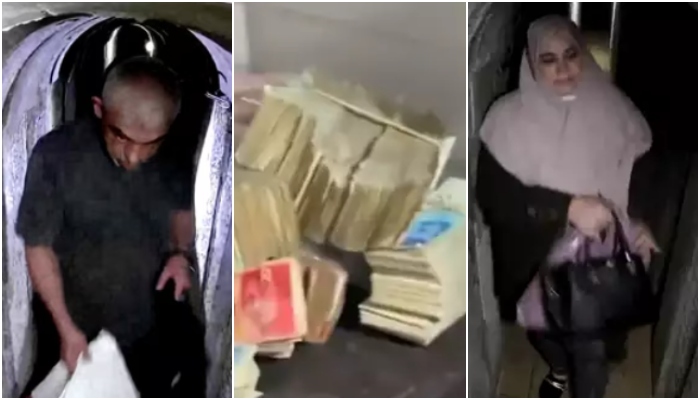
On Monday, 21st October, the Israeli military issued shocking video footage of terrorist organisation Hamas’s chief Yahya Sinwar’s secret bunker, revealing the lavish comforts Sinwar enjoyed while hiding during the ongoing Gaza war. Yahya Sinwar, the slain Hamas chief, the mastermind of the terrible October 7th terror attack on Israel, apparently planned to ride out the war in his bunker beneath the ruined city of Khan Younis. He had millions in cash in his bunker, and all the material comforts.
The Israeli Defense Forces (IDF) posted video footage of an adequately equipped bunker with contemporary showers, several bathrooms, a fully operational kitchen, and food rations marked with the United Nations Palestinian Refugee Agency (UNRWA) emblems.
The bunker also had several bottles of cologne, hygiene materials, and a private shower. Sinwar’s personal quarters housed a big safe containing millions of Israeli shekels (1 Shekel = 22.29 Indian Rupees), as well as lockers with weapons, ammunition, and explosives.
The IDF has released footage showing their entry into Sinwar’s bunker, where UNWRA bags and millions of shekels were found.
Sinwar and other Hamas leaders have been siphoning billions from the people of Gaza, allegedly with @UNWRA’s involvement.
Sinwar, 61, had sought refuge in the bunker with his guards and close companions as Israel attacked above ground following October 7 terror attack. The footage shows a bag of UNRWA-supplied food, corroborating Israel’s long-standing charges that Hamas siphons money from foreign agencies, exacerbating Gaza’s already grave humanitarian plight.
According to reports, Sinwar spent much of his time hidden underground, overseeing Hamas activities and evading capture. Abu Zamar, his wife, was seen carrying a Hermes Birkin bag worth Rs 28 lakh ($32,000) during their escape to the bunker.
Last week, on 17th October, Israel confirmed that Hamas chief Yahya Ibrahim Hassan Sinwar had been killed in a military operation in Gaza. While the Israeli Defence Forces had said that they were checking whether one of the three persons killed in the operation was Sinwar, Foreign Minister Israel Katz first gave the official confirmation of the same.
The minister confirmed the death of Hamas chief Yahya Sinwar in a personal message sent to dozens of foreign ministers around the world. The message said, “The arch-terrorist Yahya Sinwar, who is responsible for the massacre and atrocities of October 7, was eliminated today by IDF soldiers.” Later IDF also confirmed the death of the Hamas chief on X. They tweeted, “Eliminated: Yahya Sinwar”.
On 20th October, the IDF released another video in which Sinwar and his family could be seen entering the high-class tunnel under Gaza from 6th and 7th October 2023, hours before the terror attack on Israel.
IDF International Spokesperson Lieutenant Colonel Nadav Shoshani posted the video on X, showing footage from a camera mounted on the ceiling of the concrete-lined narrow tunnel. In the video, Sinwar could be seen entering the tunnel with his wife and children carrying bags. After that, Sinwar made several trips to the tunnel, carrying bags, bottles, and other items. Towards the end of the video, he could be carrying a TV with the help of a child.
The visuals shown in the video released by IDF are from 10::45 PM on 6th October to 1:32 AM on 7th October, a duration of around 3 hours.
?DECLASSIFIED FOOTAGE:
Sinwar hours before the October 7 massacre: taking down his TV into his tunnel, hiding underneath his civilians, and preparing to watch his terrorists murder, kindap and rape. pic.twitter.com/wTAF9xAPLU
Shoshani wrote posting the declassified footage, “Sinwar hours before the October 7 massacre: taking down his TV in his tunnel, hiding underneath his civilians, and preparing to watch his terrorists murder, kidnap and rape.”
As per the Israeli military, Yahya Sinwar lived in the tunnel for most of the year, directing the war against Israel from safety. IDF said that the footage was recovered several months ago during raids in Gaza, but has been released now after his death.
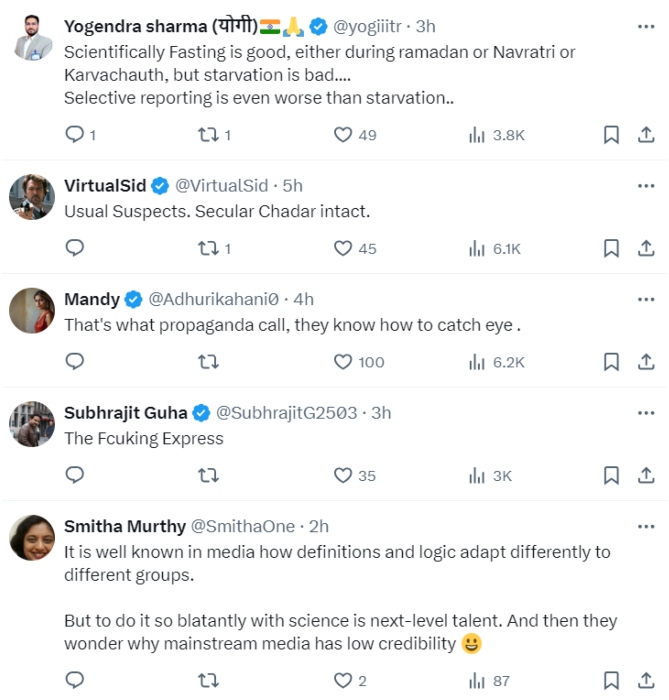
Indian women on Sunday, 20th October celebrated the festival of Karwa Chauth, holding rigorous fasts for their husbands, showcasing love, and worshipping the full moon. The women fast on this day and abstain from food and water praying for the long life, health, and well-being of their husbands. Karwa Chauth is a major festival in Northern India and is observed with much fanfare among women. However, the leftists-liberals continue to corner the Hindu celebrations in some or the other way. While they criticize Hindu celebrations like Ganeshotsav, Durga Puja, Diwali, etc for idol worship or for causing alleged pollution, the festival of Karwa Chauth is being targeted for the ritual of fasting.
A new article by the Indian Express on 20th October claimed that fasting on Karwa Chauth by women could have drastic impacts on their health leading to hormonal imbalances and other related problems. The report also added that women could experience stress, and feel malnutrition and this eventually could result in delayed or missed periods, known as amenorrhea, as well as irregular cycles. However, during Ramadan, the Indian Express published an article claiming that fasting could boost insulin sensitivity, better glycemic control, and reduce inflammation.
Several people called out the hypocrisy of the IE media and criticized it for targeting the Hindu festival. After this, the media house modified the article to remove the context of the Hindu festival of Karwa Chauth, still claiming that fastings could have a disastrous impact on women’s health.
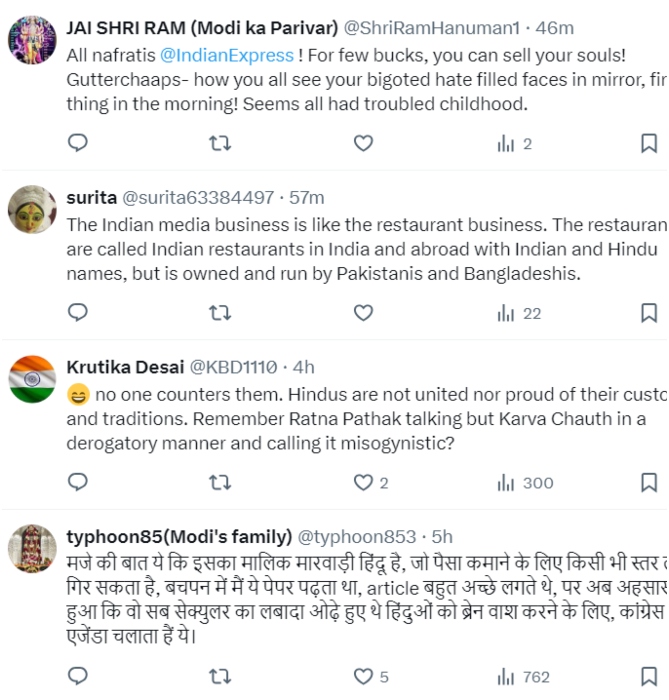
Netizens criticized the Indian Express for adopting selective reporting and stated that the IE media house was spreading propaganda against the Hindu festival. They called the report out after which the original article targeting the Hindu festival was modified to make it look casual.
To support the claims that read ‘fasting on Karwa Chauth could have a drastic impact on women’s health’, the Indian Express talked to Dr. Pooja C Thukral, Consultant Obstetrician and Gynaecologist at Cloudnine Group of Hospitals in Faridabad who affirmed that prolonged or regular fasting, can impact the hormonal health of women. “Fasting, particularly when extended, can lead to fluctuations in essential hormones that regulate critical bodily functions such as the menstrual cycle, metabolism, and stress responses,” she said.
According to Dr Thukral, insulin is one of the key hormones affected by fasting; as the body transitions from food-based to stored energy, insulin levels fall, impacting blood sugar management. However, if fasting lasts for an extended amount of time or becomes a regular habit, the body may respond by raising cortisol, the stress hormone.
The doctor further said that elevated cortisol levels ie elevated stress could interfere with reproductive hormones like estrogen and progesterone, causing hormonal imbalances. In some women, this may lead to menstrual irregularities, mood swings, and a general sense of fatigue. Moreover, fasting can lower leptin, the hormone that regulates appetite and energy reserves. When leptin levels drop, the body may perceive it as a signal to conserve energy rather than focus on reproduction, which can potentially impact menstrual cycles and fertility, she indicated.
Fasting becomes good for Indian Express when it is Ramadan
However, the same Indian Express opined otherwise when it came to talking about fasting during Ramadan. In March this year, the Indian Express published an article in which it said that time-restricted fasting could help individuals reduce body weight, fat, blood sugar levels, and cholesterol.
“Fastings during Ramadan can confer several potential health benefits, similar to those observed with intermittent fasting regimens. These include improved insulin sensitivity, better glycemic control, and reduced inflammation. Fasting triggers a cellular process called autophagy, where damaged or dysfunctional components are recycled, potentially reducing the risk of age-related diseases and promoting cellular renewal. The caloric restriction during Ramadan fasting can lead to weight loss, particularly in individuals who are overweight or obese, provided they maintain a balanced diet during non-fasting hours,” the report read.
Targeting Hindu festivals and blaming them for pollution, water shortage, patriarchy, global warming, and much more has been a popular theme in mainstream media for years. With growing awareness among readers, many portals have started to understand that peddling blatant propaganda to besmirch festivals of Hindus in a Hindu-majority country is not going to benefit them much. However, there are still some efforts underway. The subtle messaging from the leftist-dominated mainstream media has been that Hindu festivals are ‘backward’ and ‘bad’ while festivals of Christians and Muslims are about joy, brotherhood and happiness. The contradictory stand of the Indian Express on Karwa Chauth fasting and Ramadan fasting is just one example of the hypocrisy that passes as journalism in Indian mainstream media.
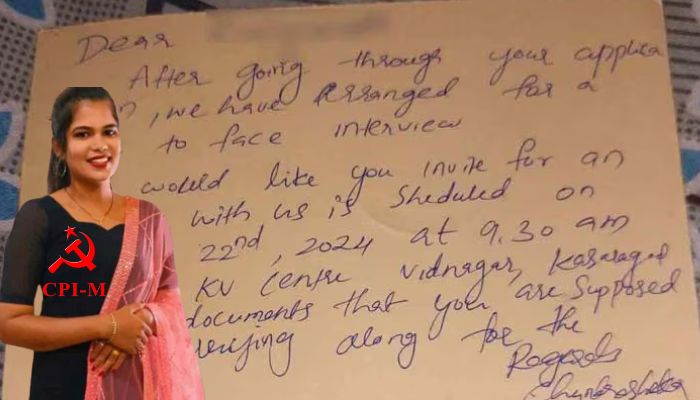
A Democratic Youth Federation of India (DYFI) leader named Sachitha Rai has duped more than a dozen job seekers to the tune of ₹2 crores in the Kasaragod district of Kerala. DYFI is the youth wing of the ruling Communist Party of India (Marxist).
A teacher at a government-aided lower primary school, the CPIM leader carried out an elaborate scam between January 2023 and February 2024 to earn the trust of jobseekers amid high unemployment in the State.
She would write postcards, impersonating as interviewer from government entities, to prospective jobseekers who were known to her. The postcard would be delivered on the day the alleged interview would be scheduled, ensuring that the candidates would miss the interview.
The mouds operandi
Sachitha Rai would then step-in and calm the panicked jobseekers. She would then solicit money to the tune of several lakh rupees while promising for a second interview. But those interviews would never materialise.
The government entities that were impersonated by the CPIM leader included Kendriya Vidyalayas, the State Bank of India (SBI) and the Central Plantation Crops Research Institute (CPCRI).
Sachitha Rai initially preyed upon 4 of her batchmates, who studied Diploma in Education (DEd) at the District Institute for Education and Training (DIET) between 2014 and 2016. She siphoned off ₹25.21 lakhs from them with the assurance of landing them a governemnt job.
Aaccording to one victim, Sachitha Rai approached 30 of her batchmates and juniors with the promise of offering them jobs. She was successful in entrapping 7 people. It was only her who intiated contact and lured desperate jobseekers.
Duping innocent people including her batchmates
The CPIM leader also duped a woman named Nishmitha Shetty to the tune of ₹15.06 lakhs between May-August 2023.
Forced by circumstances, Nishmitha filed a police complaint for cheating and a First Information Report (FIR) was lodged against Sachitha on 6th October this year. It was only then that the CPIM leader’s four batchmates learnt about the tragedy that had befallen them.
Sachitha Rai worked closely with a tout named Chandrasekhar Kuntar. The fake postcards of interview calls bore his signature and were posted from Kasaragod.
When one victim, who suffered medical complications during childbirth, demanded the return of her money on not landing a job, the CPIM leader claimed that her tout ‘disappeared with all the money’.
Husband of Sachitha Rai plays victim card
That victim has so far recovered ₹5.70 lakhs from Sachitha’s husband Jibin. The CPIM leader also defrauded her own party member named Malesh BS to the tune of ₹1 lakh but the amount is not significant as compared to the others she had defrauded.
Her husband claims that she is innocent and that Sachitha did not know it was illegal to collect money in exchange for jobs. I think the BJP is behind these complaints,” he says.
People who suffered from the scam of CPIM leader
A list of people (know so far) duped and the total amount siphoned of by the CPIM leader –
Ramisath K (name changed) – ₹5 lakhs
Akshaya N (name changed)- ₹5 lakhs
Amitha K (name changed) – ₹15.41 lakhs (recovered ₹5.75 lakhs)
Nishmitha Shetty – ₹15.06 lakhs
Nadiya Fathima (name changed) – ₹1.4 lakh
Mokshith Shetty – ₹1 lakh
Malesh B S – ₹1 lakh
Kumari Supritha (name changed) – ₹7.32 lakhs
Shruthi (name changed) – ₹2.5 lakhs
Rashmika (name changed) – ₹13.12 lakhs
According to the police, all victims paid Sachitha via bank transfers and UPI. They estimate that she has collected over ₹2 crores so far from desperate jobseekers.
A Station House Officer told Onmanorama News, “We haven’t summoned her for questioning yet as she is seeking anticipatory bail from the High Court after the Sessions Court rejected her petition. Once the High Court makes a decision, we will call her in.”
CPIM resorts to face saving
After facing the wrath of the public, the local leadership expelled her from the party. To further save facr, the CPIM Kumbla Area Committee also alleged that Sachitha has ties with the Karnataka BJP. DYFI also removed her from the youth wing.
Sachitha has now sought ‘anticipatory bail’, which was rejected by the Kasaragod Sessions Court on 16th October this year. The police are yet to question her and are waiting for the bail application to be resolved.
Unemployment in Kerala is on the rise and Sachitha sought to exploit in the the State, where her party is in power.
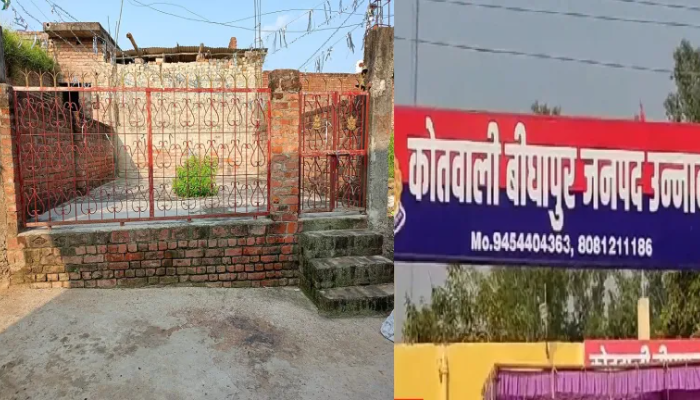
Islamists have tried to stop the renovation of the temple located in Ranipur village of Unnao district of Uttar Pradesh. Local extremists including Nihal, Anees Khan, Asghar Khan, Shoaib, Salim, Yunus, Achhe and Rais among others alleged that the renovation of the temple will cause hindrances in the time of namaz in the mosque, as it is located only 100 meters away. The area comes under the Nibai outpost of Bighapur police station.
Only 25 to 30 Hindu families reside in the predominantly Muslim village of Ranipur, which is home to around 125 Muslim households. The Hindu community has a Shiva temple that dates back more than 70 years. They perform their religious functions like mundan, chhedan and marriage on the platform of this temple. The platform has walls and pillars but lacks a roof because the Muslim radicals are opposed to it. They argue that a mosque exists at a distance of 100 metres and any construction work will disrupt the prayers there.
The conflict reached the Bighapur police station from the police post on 7th-8th October and the authorities immediately issued an official warning to 26 Muslims and 6 Hindus against any activities threatening law and order in the area to calm down the situation. However, the matter further escalated and on 20th October started making the rounds on social media. The local Dainik Jagran newspaper also published a report on this on 21st October, which also featured a comment from Rishikant Shukla, Circle Officer (CO) of the police station. He stated that authorisation has to be taken from the administration before building a religious place. The villagers (Hindus) have been asked to get permission and only then the construction work can be initiated. The report of this entire matter has been sent to the Sub-Divisional Magistrate (SDM).
Furthermore, the CO even gave a statement claiming that official action is underway. A local police officer, who is currently the Station House Officer (SHO) of the police station, should be aware of this matter since an official warning has been put out. However, when OpIndia called SHO Rajpal, he categorically denied the conflict, but, then began providing clarification after he was informed about the CO’s remark citing media reports about the issue.
The official, who has up to now maintained that there is no controversy was seen avoiding the subject. Rajpal claimed, “There is no dispute. This matter is of 7th-8th October. People from both sides have been officially warned.” He defended, “It was to prevent the matter from escalating,” when asked why the cops gave a warning in the absence of any contention. However, it was obvious that there was indeed an issue. He could be trying to ensure that the matter does not get raised in the media. Moreover, the Unnao police were even a few steps behind and its social media handle questioned, “Which police station is it,” when a netizen sought information about the case.
A young man named Aviral took to X (formerly Twitter) and wrote, “Shocking news from Uttar Pradesh. 90% of the population is Muslim and they won’t allow the temple to be built. Muslim mob stopped Hindus from building a temple in a Muslim-dominated village. Radical Muslims are behaving arbitrarily in the Ranipur village of Unnao. What is the truth of the matter?” He also tagged the official handles of Unnao Police and Uttar Pradesh Police to which the former replied, “Please, tell us the police station area.”
This response was a blatant admission of police inaction and ignorance of the problem. The cops are trying to deflect attention from the issue that Aviral brought out. The police administration did not treat this matter seriously, although it involved the oppression and violation of the religious rights of the Hindu community. It is obvious that the Islamic zealots have been in control of the hamlet for a long time, and the authorities have given up rather than attempting to control them. The renovation of the temple is being delayed by the issue of administrative permission.
When this authorization will be granted is still up in the air, but Unnao police are making a very noticeable effort to avoid acknowledging the matter as contentious. The authorities would have acted straight away if this had anything to do with the mosque, but in this instance, the infringement of the religious rights of Hindus has not been considered critical. It seems as if the police administration has surrendered before the Muslim extremists.
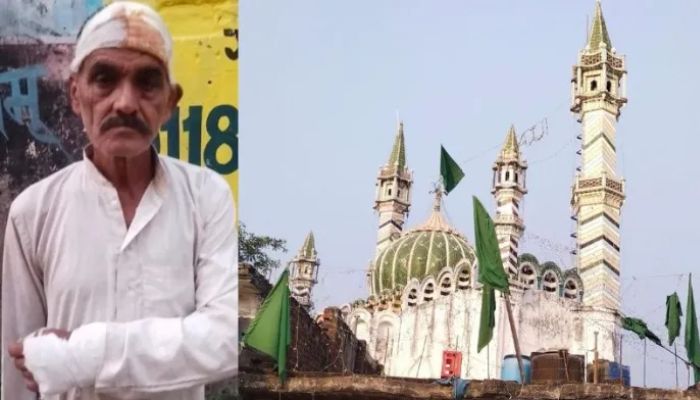
Violence has subsided, but communal tensions prevail in Uttar Pradesh’s Bahraich. Islamists brutally murdered a 22-year-old Hindu youth Ram Gopal Mishra and numerous Hindus were injured. Among the victims of the riots, there was a 70-year-old man Vinod Kumar Mishra. This retired teacher has told OpIndia and several mainstream media publications, including AajTak and ZeeNews, about provocative announcements made from the mosques to call upon Islamists to attack the Hindus during the Durga Visarjan procession on 13th October 2024.
The victim of the Islamist violence told OpIndia that the Islamists pelted stones at the Durga idol in Maharajganj, causing significant damage to the idol. After this, the Islamists assaulted the DJ. Vinod Kumar Mishra alleged that soon after, announcements were made from the mosques to attack and kill Hindus.
“There were announcements from two mosques, ‘Jo jahan mile, use wahin maar do, kaat do.’ 200-300 Muslims came with weapons and attacked Hindus. I thought they knew me, so they wouldn’t attack me, but they did. They cut the tyres of bikes and burnt the vehicles of Hindus,” Mishra said.
#Watch: "There were announcements from two mosques, 'Jo jahan mile, use wahin maar do, kaat do.' 200-300 Muslims came with weapons and attacked Hindus. I thought they knew me, so they wouldn't attack me, but they did. They cut the tyres of bikes and burnt the vehicles of Hindus."… pic.twitter.com/iaitlWvHDj
While the Islamist propagandists remained mum when the mainstream media reported Vinod Kumar Mishra’s claims, however, as soon as OpIndia published, Mishra’s statement, the Islamist ecosystem outrightly dismissed his statement as ‘disinformation’ and tagged the Bahraich Police on X to target OpIndia.
Mohammed Zubair, infamous for dog-whistling against former BJP spokesperson Nupur Sharma and unleashing Islamist bloodhounds against her, rubbished the testimony of an eyewitness of the Bahraich violence as ‘Disinformation’ after Bahraich Police’s response on OpIndia’s tweet bearing a witness’ account of events that unfolded on that fateful day leading to Ram Gopal Mishra’s killing.
Shockingly, Bahraich Police also rejected the statement made by Vinod, who is an eyewitness and a victim of the anti-Hindu violence as a ‘misleading fact’. The Police went on to issue a veiled threat to the media saying that incidents for which evidence is not available should not be broadcast without information. As an X user shared the newspaper cutting of a Jagran report regarding Mishra’s allegations, the Bahraich Police said that a notice is being issued to the publication.
The shocking normalisation of attacks and killings of Hindus
It is rather shocking that Bahraich Police is toeing the line of Islamists who have a record of justifying and normalising the attacks and killings of Hindus since they were offended. OpIndia has been reporting how the Islamo-leftist ecosystem is justifying Ram Gopal Mishra’s brutal killing and normalising violence against Hindus. While Islamist propaganda portal TheWire passed off Ram Gopal Mishra’s murder as an of ‘self-defence’ by Islamists, Newslaundryblamed Hindus for playing ‘provocative’ songs like “Tel laga lo Dabur ka naam mita do Babur ka” to rationalise the Hindu youth’s killing. While Islamist propagandists rationalising the Hindu youth’s murder is not surprising given that they have a history of blaming Hindus for communal violence started by Islamists to the extent that they argue that Hindus should not take their festive processions in ‘Muslim areas’ to avoid ‘provocation’, the Bahraich Police instead of investigating Vinod Kumar Mishra’s allegations, dismissing the same as ‘misleading’ is beyond comprehension and alarming.
The police should not ignore the fact that Vinod Kumar Mishra is an eyewitness and a victim of the riots, his statement warrants a thorough investigation and not outright dismissal as ‘misleading’ or ‘disinformation’. The Bahraich Police threatening media outlets for bringing forth the ordeal of the Hindu victims of the riot is not only an interference in the media’s job to present all the facts and versions of the victims but also raises questions over the police’s seriousness in the matter.
Notably, the Bahraich Police has been severely criticised for its conduct since the beginning. The Yogi government has not only announced a high-level probe into the incident but also removed several police officials. As per reports, the SHO of Hardi police station and in charge of the Mahsi area have been removed. In fact, the eyewitnesses of the incident said that if the police had shown promptness, Ram Gopal Mishra would have been alive.
While the police are taking measures to prevent the spread of fake news, rumours or any material that may threaten the law and order in anunrest-hit area, it does mean that they can suppress the accounts of eyewitnesses of the incident. The victims of the incident have a right to narrate their ordeal before the people through the media. The police should take cognizance of the claims made, investigate the same and act accordingly. If not the eyewitnesses and victims, whose statement should people hear and the police investigate Islamist ‘fact-checkers’, TheWire, and Newslaundry who have already blamed Hindus for the violence and Ram Gopal Mishra for his killing?
The conduct of Bahraich Police in the recent anti-Hindu violence raises the question of whether Bahraich district has been given to TMC-ruled West Bengal on lease. If not so, then why is the Bahraich Police acting like the Kolkata Police, which demonstrates more dexterity in serving notices to social media users for speaking about riots and violence there than in acting against the culprits?
On one hand, the Islamo-leftist ecosystem is coming up with ‘offensive’ songs and slogans and other trivial excuses to justify the attack on Hindus and blaming Ram Gopal Mishra for his brutal killing by Islamists, on the other, Bahraich Police itself is suppressing the Hindu victim’s version of the incident. In such a situation, how can Hindus, particularly the family of deceased Ram Gopal Mishra expect an unfair investigation into the incident and justice? If indeed, announcements were made from the mosques to attack and slaughter Hindus, as alleged by the Hindu victims, the people need to know this.
Stopping the media from reporting this will not uphold the ‘communal harmony’ but will only bolster the motivation of those murderous voices on the loudspeakers of the mosques. The stance taken by the Bahraich Police in this episode is typical of West Bengal, as is anti-Hindu violence; nonetheless, the Yogi government and the Uttar Pradesh Police would like to set a better precedence. Stifling Hindu victims’ voices, threatening the media, and toeing the line of Islamist propagandists will never restore communal harmony; instead, identifying and punishing Islamist rioters will.
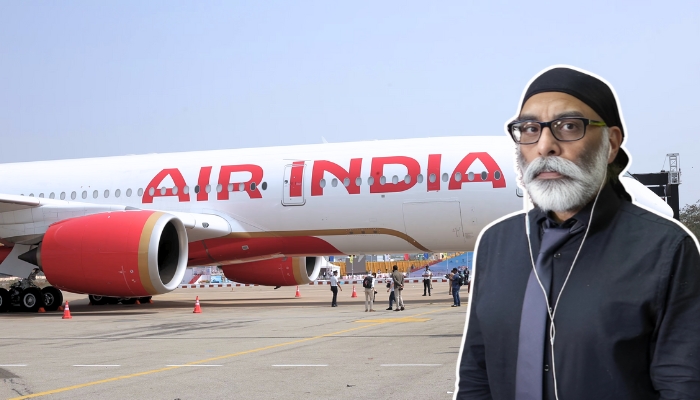
On Monday, 21st October, Khalistani terrorist Gurpatwant Singh Pannun issued yet another threat to airline passengers, warning them not to board Air India flights from 1st to 19th November. While warning the passengers, he asserted that an attack could take place on Air India flights during that period, which coincides with the “40th anniversary of the Sikh genocide.”
Pannun is a designated Khalistani terrorist and is wanted by the Government of India. He is the founder of the Khalistani terrorist organisation Sikhs For Justice (SFJ), which is based in the US. He holds dual citizenship in Canada and the US. This is not the first time that Pannun has issued such threats of attacks on Air India flights.
Notably, Pannun’s threats came at a time when several Indian airlines have been receiving dozens of hoax bomb threats. Furthermore, there is diplomatic tension between India and Canada following the latter’s accusations against the former of killing Khalistani terrorist Hardeep Singh Nijjar on Canadian soil. Not to forget, Canada has recently accused the High Commissioner of India to Canada and other diplomats of being involved in criminal activities on Canadian soil, further escalating the diplomatic tensions between the two countries.
In November 2023, Gurpatwant Singh Pannun released a video claiming that the name of the Indira Gandhi International Airport would be changed and the airport would remain closed on 19th November. He further threatened people against taking Air India flights on that day. He was charged with criminal conspiracy, promoting enmity between different groups on the grounds of religion, and several offences under UAPA by the National Investigation Agency (NIA).
“We are asking the Sikh people not to fly via Air India. From November 19, there will be a global blockade. Air India won’t be allowed to operate. Sikh people, don’t travel by Air India after November 19. You life can be in danger,” Pannun had said.
In December 2023, he threatened to attack the Parliament of India on or before 13th December. The threat came after claims made by the US authorities that they had foiled a plan by Indian agents to assassinate Pannun. On 13th December 2001, Pakistani terrorists had attacked the Parliament of India.
In another threatening statement, he had said that the Chief Minister of Punjab, Bhagwant Mann, and the Director General of State Police, Gaurav Yadav, would be assassinated on 26th January 2024. He also urged gangsters to unite and launch an attack on Mann.
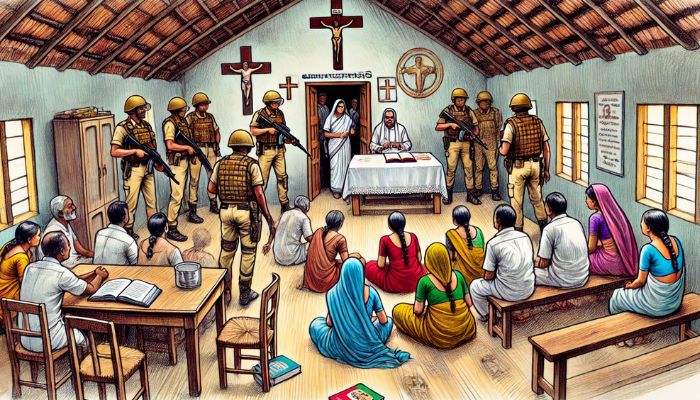
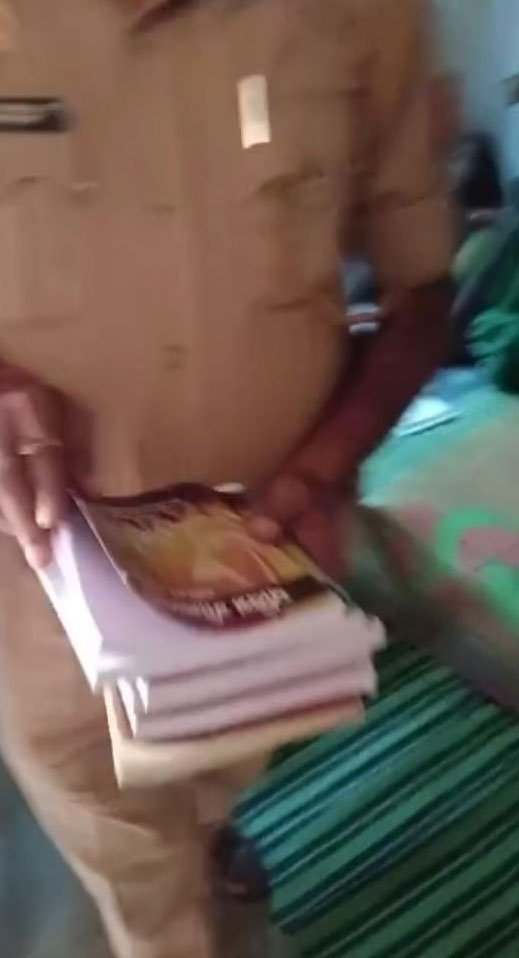
On Sunday, 20th October, Azamgarh Police raided a house in the Kandharapur area of Miria Redha village following a complaint filed by Bharatiya Janata Party District Vice President Harivansh Mishra and halted a mass conversion event. A team led by Kandharapur Station House Officer (SHO) Rudrbhan Pandey raided the location and seized objectionable materials, including religious books. The person behind the mass conversion event was identified as Rajaram Yadav. He was taken into custody by the police for further questioning.
Literature seized by the police during conversion event. Source: Harivansh Mishra/Facebook
In his complaint, Mishra alleged that several Hindus were being coerced into converting to Christianity. He further accused Yadav of forcing Hindus to tear down the images of Hindu deities and replace them with Christian symbols. Mishra informed the police that the village had become a hotspot for conversion activities and described the incident as a large-scale conversion attempt. He accused Yadav, the main suspect in the case, of using allurements and deceptive methods to persuade Hindus to abandon their faith. He said, “This is a serious attack on the Hindu faith, and I have filed a formal complaint demanding strict action.”
Superintendent of Police (SP) City, Shailendra Lal, confirmed in a statement that police recovered objectionable literature from the site. He added that the accused, Rajaram Yadav, was detained following the raid. He said, “A case has been registered, and legal proceedings are underway.” According to reports, Christian prayer meetings were being held in the area every Sunday and Thursday, targeting vulnerable villagers for conversion.
Notably, a similar incident occurred in the area a couple of weeks ago, when conversion attempts under the guise of healing sessions were uncovered in Kandharapur and Maharajganj. Three individuals were arrested by the police for persuading people to convert to Christianity by promising miraculous cures.
As mass conversion incidents have increased in the area, local authorities have intensified their efforts to crack down on such activities. Mishra and other Hindu leaders have demanded a thorough investigation into these incidents to prevent further occurrences.
The United States administration is investigating the unauthorized publication of sensitive information evaluating Israel’s plan to attack Iran. One of the known parties confirmed the legitimacy of the documents. Speaking on 20th October on CNN, US House Speaker Mike Johnson, who is a Republican from Louisiana, acknowledged the probe and expressed his grave concern over the leak.
He expressed, “There are some serious allegations being made there. The investigation’s underway, and I’ll get a briefing on that in a couple of hours.” Three US officials verified the same for the Associated Press. The Pentagon also admitted to being aware of the development.
The documents, which are dated 15th and 16th October, were uploaded on Telegram by a reported pro-Iranian account known as “Middle East Spectator,” and they started making the rounds online on 18th October. They bear labels designating them as top secret and intended only for viewing by the United States and its “Five Eyes” partners, which include Australia, Canada, New Zealand, and the United Kingdom.
First, it was claimed that the American Defense Department and then a member of the intelligence community in the United States only had disclosed them. It seemed that all of the data had been obtained by analyzing satellite images.
— ❗️??/??/?? EXCLUSIVE: One of our sources in the U.S. intelligence community has shared with us an extremely sensitive top secret U.S. intelligence document, dated October 15-16, detailing Israeli preparations for an extensive strike inside Iran: pic.twitter.com/pH53YiJ390
According to documents attributed to the National Security Agency and National Geospatial-Intelligence Agency, Israel continued to prepare military resources for a retaliatory strike to Iran’s lethal ballistic missile attack on 1st October. One of the documents attributed to the National Geospatial-Intelligence Agency involved Israel moving munitions around, while the other from the National Geospatial-Intelligence Agency described air-to-surface missile drills conducted by the Israeli air force, which are presumably part of the preparations for an impending attack on Iran.
The documents said, “The Israeli Air Force continued air-launched ballistic missile (ALBM) handling, covered UAV operations, and conducted a second large-force employment (LFE) exercise from 15th to 16th October 2024, according to imagery analysis.” They further stated that more than 40 IS02 (ROCKS) ALBMs and at least 16 Golden Horizon ALBMs have been handled by the Israeli Air Force since 8th October and added that Hatzerim Airfield was still handling ALBMs as of 16th October.
The documents showed that Tel Aviv was equipping aircraft with ROCKS and Golden Horizon air-launched ballistic missiles for an assault. Another assertion made in one of the documents is that Israel possesses nuclear weapons, something the nation has consistently refused to acknowledge in public. The document also highlighted that there are no signs that the US believes Israel intends to attack Iran with nuclear weapons.
One of the individuals shared that the probe seeks to examine how the documents were obtained, whether through hacking or by an intentional leak by a member of the US intelligence community. It also wants to determine whether any additional intelligence data was exposed. According to the official, investigators are conducting an inquiry to find out who viewed the documents before they were uploaded. Notably, any such leak would automatically set off a joint FBI, Pentagon, and US intelligence agency probe.
A National Geospatial-Intelligence Agency document that was leaked by Air National Guardsman Jack Teixeira, who entered a guilty plea in March for leaking highly classified military documents about Russia’s war on Ukraine, bore similarities to one of the two documents. Several of its contents were defined as transferable within the Five Eyes while some were marked to be shared between the United States and the United Kingdom only.
Tehran, the capital of Iran, is listed as the location of the Telegram channel that was involved in the leak. It has previously released material in favour of Tehran’s self-described “Axis of Resistance,” which consists of militant organizations in the Middle East that are armed by the Islamic Republic, as well as memes with Ayatollah Ali Khamenei, Iran’s supreme leader. Iran is listed as the location of the X account linked to the channel, according to its profile. The documents contained a reported visual intelligence report that the National Geospatial-Intelligence Agency (NGA) of the Department of Defense disseminated earlier this week among members of the American intelligence community.
The group, however, claimed that they do not know the identity of the person who leaked the document, nor do they have any ties with them. They also denied knowing anything about the authenticity of the documents. They added that their group was made up of independent journalists who had no connection to Iran. “As far as we are aware, the documents first appeared in a private Telegram group with just over 7000 members, where the leaker was likely present. Somehow, the documents found their way out of the group; it was at this moment that the Middle East Spectator took notice of the documents through an anonymous DM. Such DMs were sent to various other people and news outlets,” alleged Middle East Spectator.
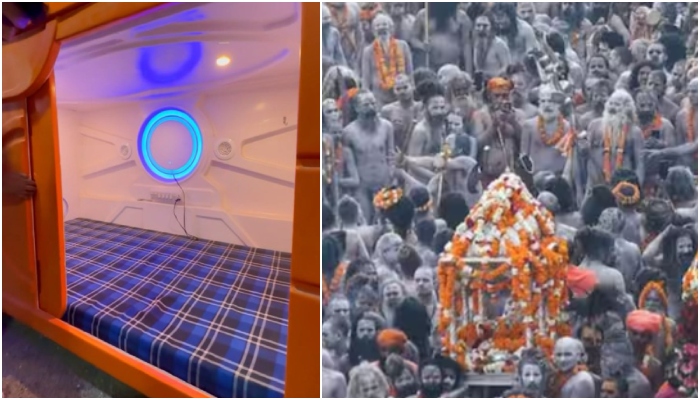
On Monday, 21st October, the state government of Uttar Pradesh announced that it would launch comfortable sleeping pods to enhance the experience of the devotees during the Prayagraj Kumbh Mela 2025. The state said it was taking considerable steps to provide a pleasant and comfortable experience for pilgrims visiting the Prayagraj Maha Kumbh 2025. In addition to the massive tent city being set up for visitors, the administration further intends to offer cutting-edge sleeping pods for the first time.
The state Tourism Department has already created a thorough road map for this program. If all goes as planned, devotees will soon have access to these revolutionary sleeping pods, providing a modern and comfortable living option during large religious gatherings.
State-of-the-art sleeping pods to enhance devotees' comfort at the 2025 Maha Kumbh.
Following the popularity of the sleeping pod facilities at Prayagraj Junction Railway Station, devotees and tourists visiting the Kumbh area will shortly be able to enjoy the same amenities during religious gatherings.
Aparajita Singh, Prayagraj’s Regional Tourism Officer, announced on Sunday, 20th October, that a traditional tent city is being established in the Parade Ground, while two luxury tent cities are being developed under a public-private partnership (PPP) model in Arail and Jhunsi. Tourists and devotees have responded enthusiastically to the facility, with 1,600 of Arail’s 2,000 tents already reserved.
The second tent city in Jhunsi would consist of 400 sleeping pods. As per the reports, the tender procedure is presently underway, and development will be completed once all safety requirements have been met.
It is crucial to note that the idea of sleeping pods in Prayagraj was introduced in July 2024. BJP leader Rita Bahuguna Joshi lauding the BJP government said that in India only two sleeping pod establishments were developed and both were in Mumbai, and that now the third one was being built in Prayagraj, Uttar Pradesh. The Mahakumbh is slated to commence on January 14th, 2025, with Makar Sankranti, and end on February 26th, 2025, with Maha Shivratri.
VIDEO | "I am very pleased that as part of the preparations for the Kumbh Mela, sleeping pods have been inaugurated today (on Friday)… The happiest part is that there are only two such sleeping pods in India, both in Mumbai, and this is the third one being built in our country,… pic.twitter.com/MOE74rHMaA
The sleeping pod is a compact capsule-sized room outfitted with high-tech features. The facility includes phone charging, Wi-Fi access, locker rooms, and luxurious toilets, among other amenities.
According to the reports, visitors would be able to hire sleeping pods to make their stay comfortable during the largest religious gatherings. There is a plan to deploy sleeping pods at airport lobbies and railway stations as well.
The tent city, set up by the state ahead of the Mahakumbha 2025, is spread over 4000 hectares between Sangam, Arail, and Phaphamau and is divided into 25 sectors. The facility is set to offer a range of accommodations, from humble to luxurious, for the 45-day fair which is scheduled to attract around 40 crore visitors this time.
Earlier on 6th October, the government said that it had set a deadline of December 15th this year to provide all the facilities to the devotees participating in the Mahakumbh Mela 2025 in Prayagraj. CM Yogi Adityanath also said that the government was using AI tools to ensure safety, focusing on ‘zero plastic usage’, and expanding the area of the Maha Kumbh.
Explaining the arrangements and preparations for Maha Kumbh 2025, he further said that the government is ensuring that no devotee has to walk for more than 1 km during the festival except for the 6 peak days, which include the festival of Makar Sankranti, Mouni Amawasya, Mahashivratri, Posh Purnima and Maghi Purnima. CM Yogi emphasized that to facilitate the transport for devotees, the government will provide more than 700 shuttle electric buses.
Recalling the Kumbh Mela of 2019, UP CM said that the preparations for Mahakumbh 2025 are going on at a war footing and there are no obstacles in the preparations. He further informed that the state government is working with the different central government departments to speed up the preparations.
With the Maha Kumbh Mela all set to take place from January 14th to February 26th, 2025, tight security arrangements are being made. The main bathing festival, known as the “Shahi Snan” (royal baths), will take place on January 14th (Makar Sankranti), January 29th (Mauni Amavasya), and February 3rd (Basant Panchami).
UP government has announced to provide subsidies for the transformation of dhabas, restaurants, and hotels on the major routes to offer improved facilities to tourists and devotees attending the festival.
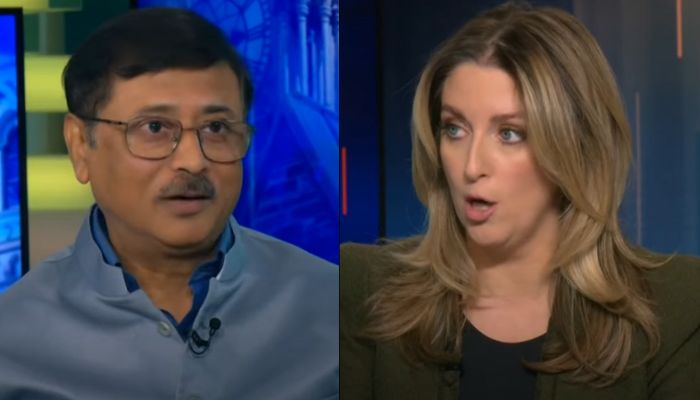
On Sunday (20th October), CTV News published an interview of former Indian High Commissioner to Canada, Sanjay Kumar Verma, who was recently recalled by the Indian government over security concerns.
The Royal Canadian Mounted Police (RCMP) had accused the Indian career diplomat of facilitating the murder of Khalistani terrorist Hardeep Singh Nijjar on Canadian soil, without providing any hard evidence. The Liberal Trudeau government had additionally declared him as a ‘person of interest.’
Before leaving the country, Sanjay Kumar Verma sat down with CTV News correspondent Vassiliki “Vassy” Kapelos and exposed the logical fallacies in the claims of the Canadian government. He lashed out at the Trudeau government for jeopardising bilateral ties with India in exchange for appeasing Khalistanis.
1. No evidence shared by Canada
During the course of the 26-minute-long interview, the CTV journalist remained fixated on the sweeping claims made by the Trudeau government and the RCMP despite no evidence to back it up.
Sanjay Kumar Verma insisted that Canada show evidence before accusing a sovereign, democratic nation like India of carrying out extra-territorial killings.
At the very onset, he stated, “We needed to see some evidence on the basis of which we can converse with our Canadian counterparts. Unfortunately, not a shred of evidence has been shared with us. Any evidence which is shared has to be legally acceptable. We are a country of rule of law, and so is Canada.”
The former Indian High Commissioner to Canada emphasised, “So, therefore, anything which is acceptable in the Canadian court of law would largely also be acceptable in the Indian court of law, and therefore that evidence would work. Unfortunately, we have not got anything from any Canadian official which can lead us to a better spot.”
2. Trudeau resorted to political grandstanding
Sanjay Kumar Verma was quick to point out how Canada flouted established protocols to score political brownies and harmed ties with India in the process.
“Canada didn’t follow the practice which should have been there. Evidence should have been shared first. But someone decided to stand in the parliament and talk about a thing for which he himself has said there was no hard evidence. So let’s be very clear what we are talking about. And the day on which he did that, since then he has made sure that the bilateral relation with India only goes downwards, spiralling down,” he highlighted.
The career diplomat further added that the Trudeau government has nothing but evidence in the form of hearsay, obtained from anti-India and pro-Khalistani elements residing in Canada. Despite this, other politicians in the country was willing to accept political speeches in the Parliament as ‘biblical evidence.’
3. On political bias of RCMP
During the interview, the CTV News correspondent Vassy tried to portray the RCMP as an independent authority. Sanjay Kumar Verma instantly called her bluff out.
“How politically independent they are, we can discuss it till the cows come home. They are. That’s your view.I will give you my view. So till two days before, they said there is no evidence to share. And in PFI, in the Foreign Reference Committee meeting, and all of a sudden, there was all the evidence in the world available with them,” he stated.
“So let’s not go there. And the political motivation, I have been talking about it for a long time. No official, no institution can remain completely aloof of what’s happening politically,” he further added.
4. A deliberate ‘meeting’ stunt at the 11th hour
On being quizzed about RCMP officials willing to meet their Indian counterparts but the Indian government not entertaining them, Sanjay Kumar Verma clarified how such a request came at the 11th hour without any clear agenda for the meeting.
“They wanted to leave for India on the 8th of October. They gave their completed application form only on the 8th of October. So, visa needs to be affixed.For any delegation, government delegation, to travel to another country, you need an agenda to go by. There was no agenda at all,” he stated.
“I think it was pre-planned. They knew that the visa cannot be issued in half an hour to an hour, and therefore they did it.I think it was absolutely politically motivated,” he highlighted his concerns.
The ex-High Commissioner pointed out, “There is a time which is taken to issue a visa. Between India and Canada, there is no visa-free agreement. So, therefore, in general, I can tell you, in general, for a government official from India to come to Canada, it would take at least a week to get the visa…So, the visa is one. Second is, what did they want to talk about? That was not shared at all.”
5. On being declared a ‘person of interest’ in Canada
During the interview with CTV News, Sanjay Kumar Verma also talked about the decision of the Canadian government to declare him as a ‘person of interest.’
He outrightly rubbished the allegations levelled at him as politically motivated, devoid of any evidence. The recalled diplomat asked why the Trudeau government did not go ahead and file a chargesheet if they had the evidence.
While discussing the request of the Canadian authorities to the Indian government to waive his diplomatic immunity, Verma inquired, “On what basis? If you are a defendant, for example, which I’m not, then you will be shared with the evidence. On the basis of which anything can take place. And that happens even if you have been caught for a petty crime.”
“If I am going for an interrogation, I need to know what I am (being) interrogated for. I need to know what is the evidence that you have. So that I go prepared. Let me see what concrete evidence Mélanie Joly is talking about. As far as I’m concerned, she’s talking politically.As far as I’m concerned, she has got nothing in her hand,” he added.
6. On allegations against Indian diplomats
The RCMP and the Canadian government had accused Sanjay Kumar Verma and 5 other Indian diplomats of gathering information and providing it to the assassins of Khalistani terrorist Hardeep Singh Nijjar.
He clarified, “First of all, I as High Commissioner of India had never done anything of that kind. That is one. Second, my colleagues, do we want to know what pro-Kalistani elements in Canada are doing? Yes, we do. That’s my national interest. That’s my core concern with Canada which is trying to tear up Indian territory.””
“So if the Canadian politicians are so novice that they want me not to know what my enemies are doing here, I am sorry. Then they do not know what the international relation is all about. There is nothing covert. It’s all overt. So we read the newspapers, we read their statements. Since we understand Punjabi, so we read their social media posts and try to infer from there,” he emphasised.
7. India’s position on extra judicial killings
Verma was quick to condemn the killing of Nijjar and added that India believes in the rule of law. He however pointed out how some G7 countries, with a proven track record of extra-territorial assassinations, were lecturing India without evidence.
The career diplomat stated, “It (extra judicial killings) should not happen anywhere in the world. I know the countries which have done it. And some of them are G7 countries, by the way. So let us not talk about it. There should not be double standards.”
“So as far as we are concerned, the largest democracy in the world, we are committed not to do extrajudicial killings on any territory, leave foreign countries,” he added.
8. Canada has become a hotbed of Khalistanis
The former Indian High Commissioner raised alarms about how people who come to Canada on student visa get involved in terrorist activities.
Some of them came here as innocent international students, and they turned into criminals in this country. I don’t know what happened. How did they get influenced?” he asked bluntly.
“There are so many things. Khalistani extremists are being encouraged all the time…I also know that some of these Khalistani extremists and terrorists are deep assets of CISIS,” Sanjay Kumar Verma emphasised.
The ex-Indian High Commissioner to Canada stated that India is home to the largest Sikh population and that the ones instigating seperatism of Punjab are based in Canada.
“These Khalistani terrorists and extremists, who are based out of Canada, are not Indians. They are Canadian citizens, and no government should encourage their citizens to attack sovereignty and territorial integrity of other countries,” he concluded.
9. Inaction by Trudeau govt on evidence provided by India
Sanjay Kumar Verma stated that the Indian government sent 26 dossiers to Canada, providing evidence about Khalistani terrorists operating from Canadian soil and yet no action was taken against them.
He said, “We have sent 26 dossiers to Canada. What has happened?”, he inquired. In another segment of the interview, the career diplomat pointed out, “The most important case at hand from our point of view are the 26 extradition requests, and so many other arrest requests.”
He pointed out, “We only want the Canadian regime of the day, the government of the day, to understand my core concerns, and try to act on that sincerely, rather than being bedfellows with those who are trying to challenge Indian sovereignty and territorial integrity.
10. No bullying developing country
Lastly, Sanjay Kumar Verma made it clear to the CTV News journalist Vassy, who was seemingly working on Trudeau’s agenda, that India would no longer be bullied.
“Gone are the days when the so-called developed countries or Western bloc would ask a developing country, you must do this, and they will run after them and do it,” he made it crystal clear.
“We are a rule-of-law country, as Canada prides itself to be a rule-of-law country,” the ex-Indian High Commissioner to Canada underlined.