

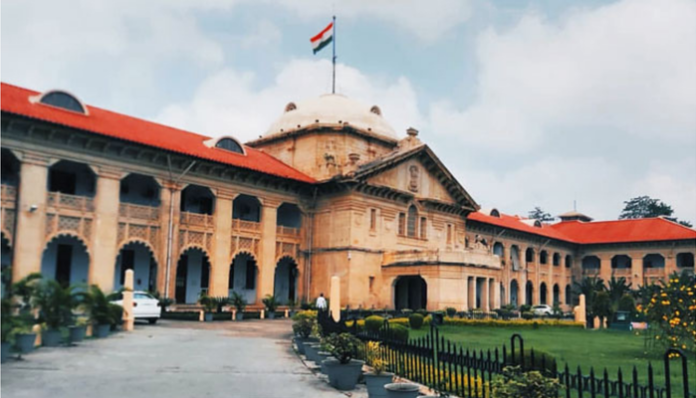
The Allahabad High Court recently held that individuals availing the benefits meant for the Scheduled Castes (SCs) after converting to Christianity amounts to “fraud on the Constitution”. A bench of Justice Praveen Kumar Giri directed the District Magistrates of all the districts in Uttar Pradesh to act in accordance with the law, identify and prevent such occurrences within a deadline of four months.
Applicant accused of mocking Hinduism and Hindu deities
The High Court passed the direction while dismissing a plea filed by one Jitendra Sahani, seeking the quashing of an FIR filed under Section 153-A, 295-A IPC, accusing him of mocking Hindu deities and promoting enmity. Sahani is also accused of furnishing a fake affidavit claiming that he is a Hindu, while he converted to Christianity and became a priest. The applicant denied the allegations against him and claimed that he merely sought permission to preach the “words of Jesus Christ” on his own land, which was denied by the District Magistrate Maharajganj and an FIR was lodged against him.
Applicant, who converted to Christianity, filed a fake affidavit claiming that he was a Hindu
Opposing the applicant’s plea, Additional Government Advocate drew the Court’s attention to the statements of witnesses who testified that Sahani, who originally belonged to the Kewat community, had converted to Christianity and was functioning as a ‘Padri’ (Priest). The witnesses said that he had been luring poor people to convert to Christianity by promising them jobs and financial benefits. The AGA cited the statement of a witness named Lakshman Vishwakarma, who said that Sahani used filthy, abusive and absurd language about Hindu deities. “You people have been following the Hindu religion for centuries…It has thousands of gods and goddesses; someone has eight hands, someone has four, someone has a trunk on their face…someone rides a mouse, someone rides a peacock…someone drinks bhang, someone smokes ganja,” Vishwakarma said in his statement, describing Sahani’s remarks against Hinduism.
An individual ceases to belong to his original caste after converting to Christianity: HC
The High Court noted that while Sahani described himself as a Hindu in the affidavit filed by him, the police investigation revealed that he was a Christian. The High Court referred to the Constitutional provisions and several Supreme Court rulings to assess the legal status of converts to non-Hindu faiths. Justice Giri referred to a ruling (C. Selvarani v. Special Secretary-cum-District Collector 2024) wherein the Supreme Court said that religious conversion for the sole purpose of availing benefits is seen as a fraud on the Constitution and is contrary to the ethos of reservation policies. The top court added that an individual ceases to belong to their original caste upon conversion to Christianity.
Justice Giri also referred to an Andhra Pradesh High Court ruling ( Akkala Rami Reddy v. State of A.P, 2025), wherein the the High Court held that an individual, who converted to Christianity and actively professes and practices the religion, cannot continue to be a member of the Scheduled Caste community and is consequently barred from invoking the provisions of the Scheduled Caste, Scheduled Tribe (Prevention of Atrocities) Act.
The High Court directed the District Magistrate, Maharajganj, to enquire into the religion of the applicant within three days and take strict action against him if he is found guilty to discourage the practice of filing fake affidavits before the Court. “Apart from the above, the Cabinet Secretary, Government of India, and the Chief Secretary, Government of U.P., are directed to look into the matter of the Scheduled Castes, the Scheduled Tribes and other Backward Classes, as well as the provisions of law and act in accordance with law…” the High Court said. “All the District Magistrates of the State of U.P. are directed to act in accordance with the law within four months and communicate to the Chief Secretary, State of U.P. and other Principal/Additional Chief Secretary, so that such fraud on the Constitution may not occur…” the High Court added.
