

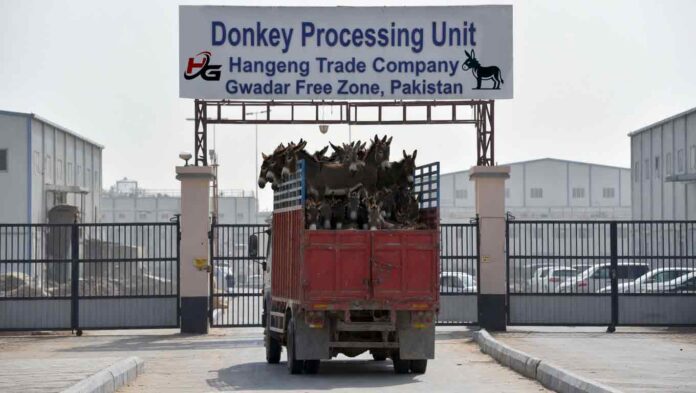
A Chinese firm that established Pakistan’s first large-scale donkey slaughterhouse and processing facility in the Gwadar North Free Zone has announced the immediate closure of its operations and the termination of all employees, citing persistent bureaucratic hurdles, blocked exports despite full regulatory compliance, and mounting financial losses.
Hangeng Trade Company, a private limited entity under the China-Pakistan Economic Corridor (CPEC) framework, had built the modern export-oriented plant in the Gwadar Free Zone. The facility was designed to process up to 300,000 donkeys annually, producing donkey meat and hides primarily for export to China, where demand exists for use in traditional medicine such as ejiao. As per reports, the company had invested over $7 million (around 50 million yuan) for the state-of-the-art slaughterhouse infrastructure.
In an official statement issued on May 1, 2026, International Labour Day, and signed by company representative Andy Liao, Hangeng Group declared it could “no longer sustain normal operations” in Pakistan and linked facilities in China. The statement, addressed to partners, media, employees, and authorities including the Government of Pakistan and the Ministry of Planning, said that the plant had met all inspection and quarantine standards of China Customs and complied with international HACCP food safety requirements. Despite this, “exports have remained blocked” due to the absence of necessary approvals from Pakistani authorities.
📢 Official Statement
— HanGeng official (@HangengPakistan) May 1, 2026
Dear partners, media, and friends,
It is with deep regret that we announce that on May 1st, 2026—International Labor Day—we are forced to inform all our employees in Pakistan and China that, due to ongoing non-market factors and operational barriers, the…
The company detailed the reasons for its exit as “ongoing non-market factors and operational barriers,” “execution-level uncertainties,” and “systemic barriers” that went beyond technical compliance. It said that over the past three months, it continued to bear “substantial financial losses,” including employee wages, contractual penalties, electricity bills, and container demurrage charges, while awaiting higher-level intervention.
“The challenges we face are no longer purely technical or compliance-related, but stem from execution-level uncertainties and systemic barriers, which have ultimately made it impossible for the business to continue operating,” the statement read.
Hangeng expressed gratitude to supportive Pakistani officials, particularly from the Ministry of Planning, for demonstrating the “spirit of China-Pakistan friendship.” However, it issued an advisory to other Chinese potential investors ahead of Pakistan’s upcoming B2B investment forum with China during the Prime Minister’s visit later this month. The company cautioned others, “Before making investment decisions, it is essential to carefully assess the potential policy execution gaps and institutional uncertainties that may arise during project implementation.”
The statement added, “the Chinese government and Chinese investors have consistently supported Pakistan’s economic development and social progress. However, the situation we are currently facing also highlights the real challenges that can occur during the investment process.”
The company extended their deepest apologies to all the employees. Ot said, “Under the current circumstances, we are no longer able to provide stable employment.” The company ended the statement with “We are truly sorry. We have done everything we could.”
The shutdown comes despite earlier optimism around the project. Pakistani authorities had approved donkey meat and hide exports to China in 2023 under strict protocols to protect the domestic market, with the Gwadar facility positioned as a flagship CPEC initiative to generate foreign exchange, create jobs, and utilise the port for regular shipments, which was initially planned at around 50 containers per month.
